

Crypto World
Solana Company Unveils First Digital Asset Treasury for Institutional Borrowing Against Staked SOL


TLDR:
- Solana Company introduces first tri-party custody model allowing borrowing against natively staked SOL tokens.
- Anchorage Digital’s Atlas system provides automated collateral management while assets remain in custody.
- Institutions earn 7% staking yields on SOL while accessing on-chain liquidity through Kamino’s platform.
- The scalable model serves as blueprint for future treasury companies and institutional DeFi participation.
Solana Company (NASDAQ: HSDT) announced a partnership with Anchorage Digital and Kamino on February 13, 2026.
The collaboration introduces the first digital asset treasury enabling borrowing against natively staked SOL in qualified custody.
The tri-party custody model allows institutional investors to earn staking rewards while accessing on-chain liquidity. This structure maintains custody, compliance, and operational control for institutional participants.
Tri-Party Custody Model Connects Institutional Capital to DeFi
The partnership brings institutional capital to Solana’s decentralized finance ecosystem through a novel custody arrangement.
Anchorage Digital serves as the collateral manager for natively-staked SOL held in segregated accounts. Institutions can earn staking rewards while simultaneously unlocking borrowing power through Kamino’s lending platform. All assets remain under qualified custody at Anchorage Digital Bank throughout the borrowing process.
Nathan McCauley, CEO and Co-Founder of Anchorage Digital, addressed the institutional demand for this infrastructure. “Institutions want access to the most efficient sources of on-chain liquidity, but they aren’t willing to compromise on custody, compliance, or operational control,” McCauley stated.
He noted that Atlas collateral management allows institutions to keep natively staked SOL with a qualified custodian while using it productively.
This approach brings institutional-grade risk management to Solana’s lending markets, according to the executive.
Anchorage Digital’s Atlas system provides automated oversight of loan-to-value ratios around the clock. The platform orchestrates margin and collateral movements based on predefined rules.
When necessary, the system executes liquidations to protect lenders and borrowers. These features give institutions familiar risk and compliance controls while enabling direct market participation.
Cheryl Chan, Head of Strategy at Kamino, commented on the partnership’s potential. “This collaboration unlocks meaningful institutional demand to borrow against assets held in qualified custody,” Chan explained.
By partnering with Anchorage Digital, Kamino enables institutions to access on-chain liquidity and yield on Solana. The arrangement allows institutions to custody assets within their existing regulated framework.
This removes a barrier that previously limited institutional participation in decentralized lending markets.
Blueprint for Future Treasury Operations and Network Growth
Cosmo Jiang, General Partner at Pantera Capital Management and Board Member at Solana Company, provided his perspective on the structure. “This structure demonstrates how institutional-grade infrastructure can unlock deeper participation on Solana,” Jiang said.
He described it as a strong example of how regulated custody and on-chain borrowing can work together. Jiang believes this scalable model is the blueprint other treasury companies will follow and institutional investors will demand.
The collaboration extends beyond the initial deployment. Other investors, venture firms, and protocols can replicate the structure.
This repeatability positions the model as a standard for institutional participation in protocol borrowing. The framework accommodates various collateral types, from standard digital assets to reward-bearing positions.
Solana has recorded strong network metrics across multiple dimensions. The blockchain processes more than 3,500 transactions per second. Daily active wallets average around 3.7 million users.
The network has surpassed 23 billion transactions year-to-date. SOL offers a native staking yield of approximately 7 percent.
Solana Company operates as an independent treasury company focused on supporting tokenized networks. The firm serves as a long-term holder of SOL tokens.
HSDT continues developing its neurotech and medical device operations alongside its digital asset treasury activities. The company’s mission centers on supporting the growth and security of blockchain networks.


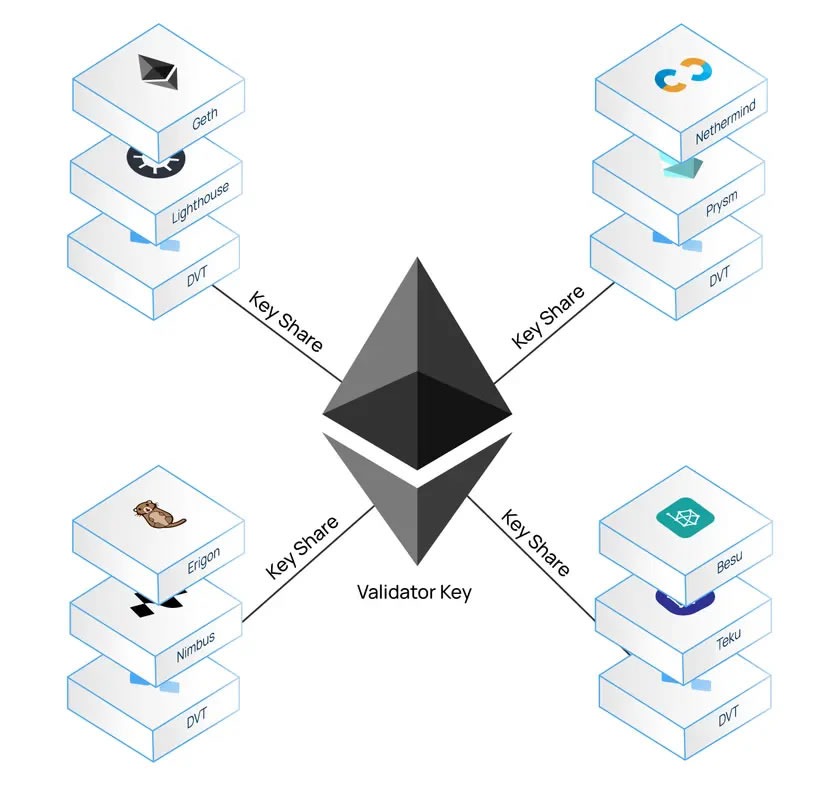
Ethereum co-founder Vitalik Buterin has revealed the Ethereum Foundation used a simplified distributed validator technology called DVT-lite to stake 72,000 Ether in February, tech he says could make staking for institutions much easier.
“My hope for this project is that in the process, we can make it maximally easy and one-click to do distributed staking for institutions,” said Buterin on X on Monday.
Buterin explained that with DVT-lite, users can “choose which computers run their nodes, make a config file where they all have the same key, and then from there everything gets set up automatically.”
DVT-lite is a simplified form of distributed validator technology tailored for easier deployment, especially in institutional or semi-professional Ethereum staking setups.
In regular solo staking, everything is run on one computer, which can result in “slashing” or penalties if it crashes, gets hacked, or loses internet. Full DVT splits the secret keys across many computers that constantly communicate, which is very secure, but complicated to set up.
DVT-lite uses the same validator key on several computers, so if one computer dies, another quickly takes over, resulting in almost no downtime and very low risk of penalties.
The Ethereum Foundation started its staking program using the technology in late February, and the assets are currently sitting in the validator entry queue waiting to be staked on March 19.

“One click” staking for institutions
Buterin said that the idea that running infrastructure is this “scary complicated thing” where each person participating must be a professional is “awful and anti-decentralization, and we must attack it directly.”
He added that there should be a “docker container” or “nix image” or similar, which has “one click” or command line per node that automates the process of staking.
Related: AI ‘vibe coding’ could put Ethereum roadmap ahead of schedule: Vitalik Buterin
Buterin said he plans to use DVT-lite soon and hopes more institutions holding ETH can stake in this way.
“We want the authority over staking nodes to be highly distributed, and the first step to doing this is to make it easy.”
In January, he suggested “native DVT” network integration, which would allow stakers to “stake without fully relying on one single node.”
Big demand for staking despite low prices
There is still a huge demand for Ether (ETH) staking despite its bear market price action.
There are currently 3.2 million ETH in the validator entry queue, with a 55-day wait, and just 29,000 in the exit queue with a 12-hour wait, according to ValidatorQueue.
There are currently 37.5 million ETH staked, worth around $76.5 billion at current prices (around the same as the market cap of DoorDash or Motorola), and representing 31% of the total supply.
Magazine: China’s ‘50x’ blockchain boost, Alibaba-linked AI mines Bitcoin: Asia Express
Crypto markets are entering a cautious holding pattern as traders prepare for the upcoming U.S. Consumer Price Index (CPI) report, a key macroeconomic indicator that could shape expectations for interest rate policy and risk asset performance.
Summary
- Bitcoin is consolidating near $70,000 ahead of the upcoming U.S. CPI inflation report.
- Technical indicators show moderate accumulation and improving momentum after February’s pullback.
- Analysts expect heightened volatility in crypto markets depending on whether inflation data surprises to the upside or downside.
Crypto market eyes CPI data as Bitcoin rebounds toward $70K
Bitcoin (BTC), the largest cryptocurrency by market capitalization, was trading near $70,000 on Tuesday after rebounding from February lows.
Market participants are closely watching the inflation data due on Wednesday, which could influence the Federal Reserve’s next policy moves and drive volatility across global financial markets.
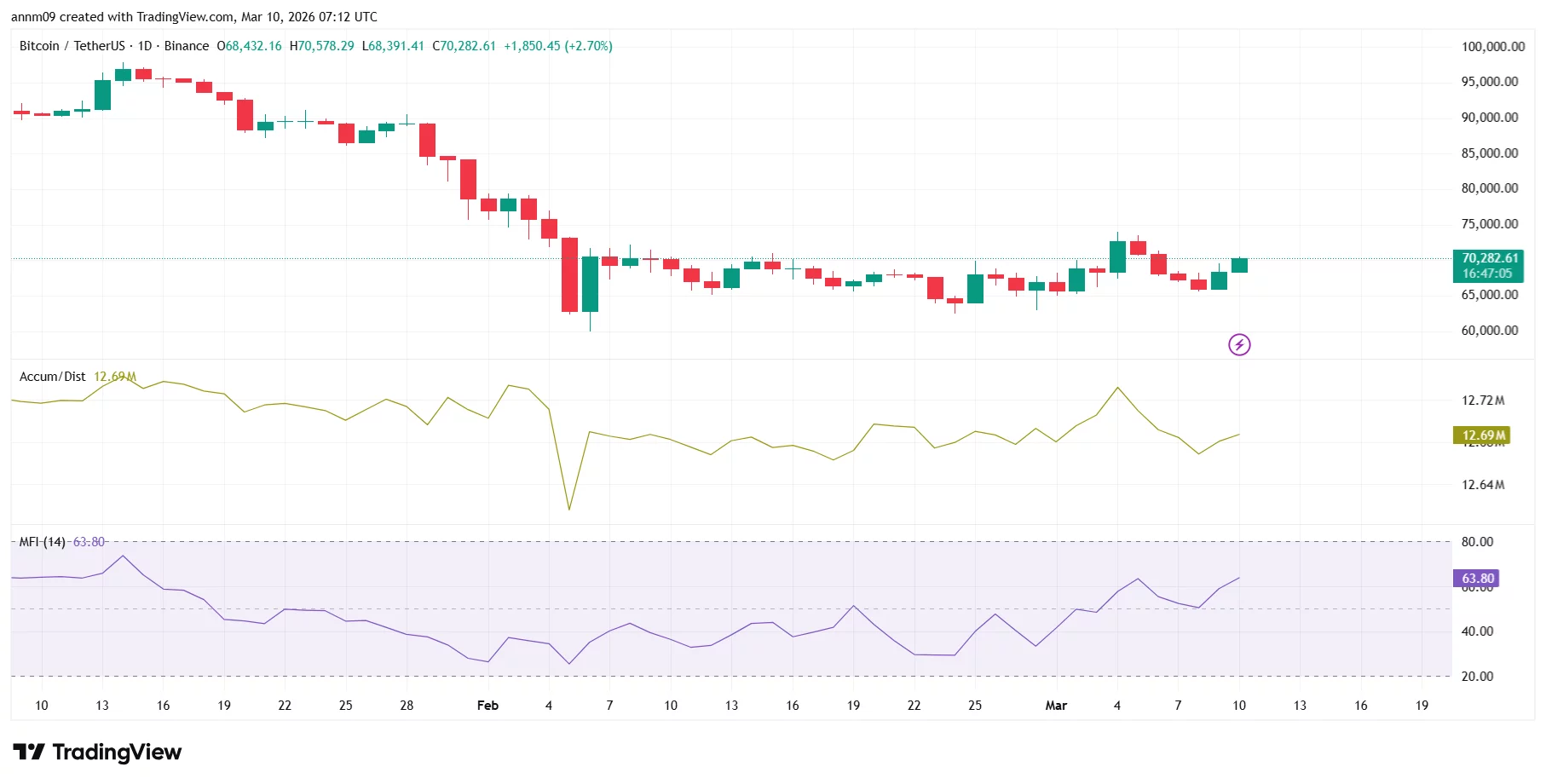
Technical charts show Bitcoin recovering modestly after a prolonged pullback earlier this year. The daily chart indicates the asset fell from highs near $95,000 in January amid tariffs and Iran tensions. Bitcoin then stabilized around the $60,000–$65,000 range in February.
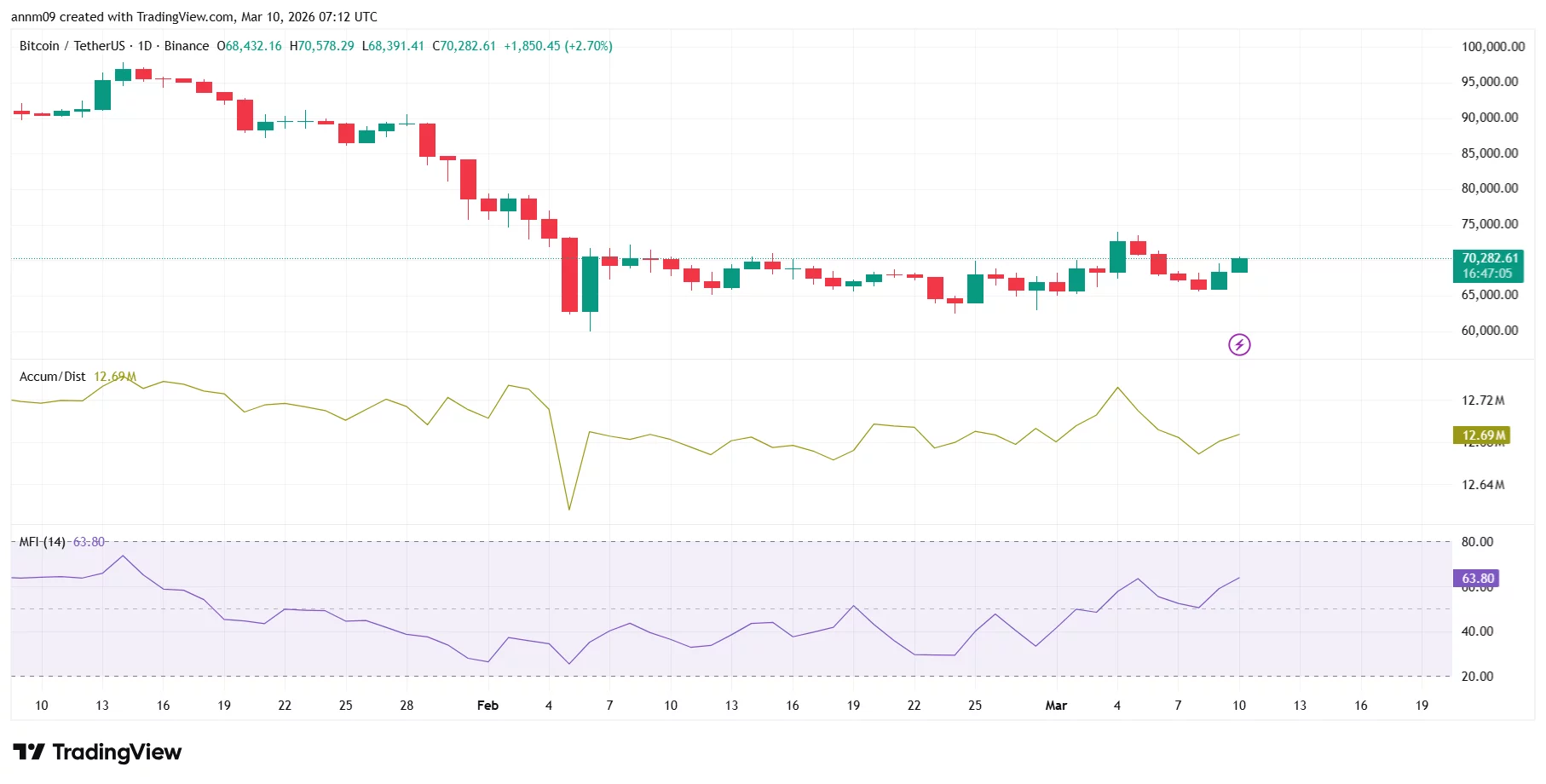
Since then, Bitcoin has gradually climbed back toward the $70,000 level, a zone analysts view as an important resistance area.
Momentum indicators suggest improving sentiment. The Money Flow Index (MFI) on the daily timeframe has climbed toward the mid-60s, signaling strengthening buying pressure but not yet entering overbought territory.
Meanwhile, the Accumulation/Distribution indicator has stabilized after a sharp drop earlier in February, suggesting that selling pressure may be easing as investors accumulate positions ahead of the macro event.
Macro data remains the primary driver of near-term sentiment.
Historical data comparing Bitcoin’s price performance with U.S. inflation trends shows that crypto markets have often responded sharply to shifts in CPI expectations, particularly when inflation surprises alter forecasts for Federal Reserve interest rate decisions.
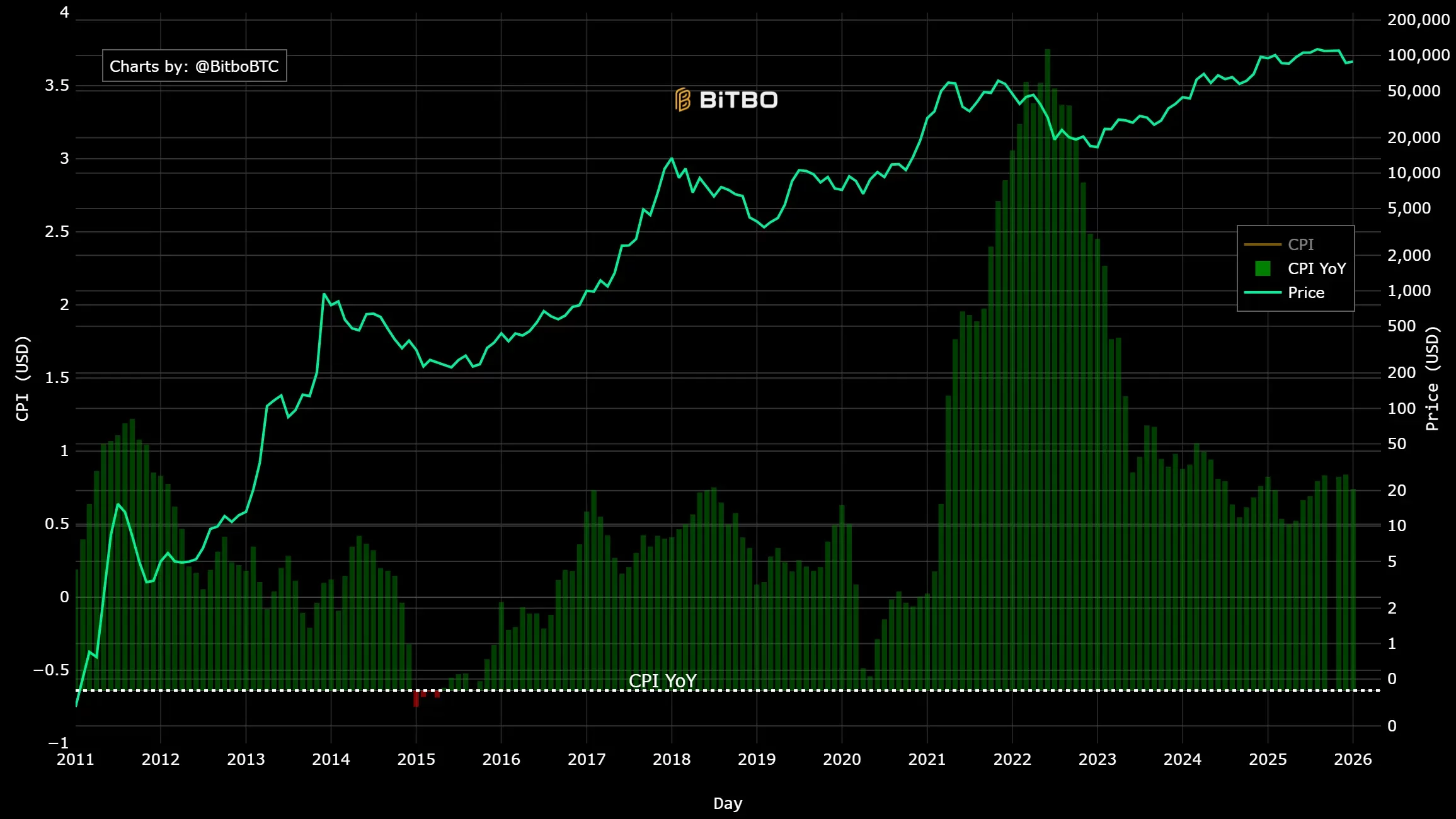
According to market commentary from Morningstar, economists expect that consumer prices rose 0.3% on a monthly basis in February. That would lower the annual inflation rate to 2.9% from 3.0% in January.
Traders expect the upcoming CPI release to act as a major volatility trigger, with Bitcoin likely to test nearby resistance or revisit recent support levels depending on how the inflation data shapes market expectations.

Bhutan, one of the world’s largest nation-state Bitcoin holders, has just moved 175 Bitcoin from its main holding address as cryptocurrency markets posted modest gains on Monday.
Data from the blockchain analytics platform Arkham shows that the South Asian country moved $11.85 million worth of BTC to an address created a month ago, which had previously received 184 Bitcoin from the government.
The 175 Bitcoin are still at the address as of Tuesday, according to blockchain data. However, the previous transfer of 184 was sent to a third address, which has received a total of 1,910 Bitcoin since 2024 and currently holds 126.
In an X post on Monday, Arkham said the last time Bhutan moved a similar amount of Bitcoin — in February — it was to sell $7 million of Bitcoin with QCP Capital. The kingdom has made several sales this year.
“Bhutan periodically sells portions of its Bitcoin in clips of $5-10M, with a particularly heavy period of selling around mid-late September 2025,” Arkham said.
Arkham estimates that as of Monday, Bhutan’s holdings are around 5,400 Bitcoin, making its holdings the seventh-largest among countries. The United States has the largest country-held stash with 328,372 Bitcoin, worth just under $22 billion as of Tuesday.

Bhutan also holds various other cryptocurrencies in varying amounts, all managed by Druk Holding and Investments, the country’s sovereign wealth fund, including 28 Ether (ETH) and 28 KiboShib, an AI-generated memecoin.
Cointelegraph reached out to Druk Holding and Investments for comment, but didn’t receive an immediate response.
Bhutan has been using Bitcoin to fund services
Bhutan has accumulated roughly 13,000 Bitcoin since launching state-backed mining operations in 2019, primarily fueled by hydroelectric energy, according to Arkham.
However, following the 2024 halving, mining became less efficient due to increased costs.
Related: Strategy buys $1.3B in Bitcoin as holdings top 738,000 BTC
Bhutanese Prime Minister Tshering Tobgay told Al Jazeera last April that during the summer months, the kingdom’s hydropower plants generate surplus energy due to increased water flow. This abundance of power makes it highly practical to utilize the excess energy for Bitcoin mining.
In an interview with Al Jazeera in March 2025, Tobgay also noted that proceeds from Bhutan’s Bitcoin have been used to fund healthcare, environmental initiatives and public servant salaries.
A growing number of Bitcoin miners have redirected their energy resources toward artificial intelligence and high-performance computing services since the April 2024 halving, which reduced mining rewards to 3.125 Bitcoin and negatively impacted overall profitability.
Magazine: Would Bitcoin really be at $200K if not for Jane Street? Trade Secrets
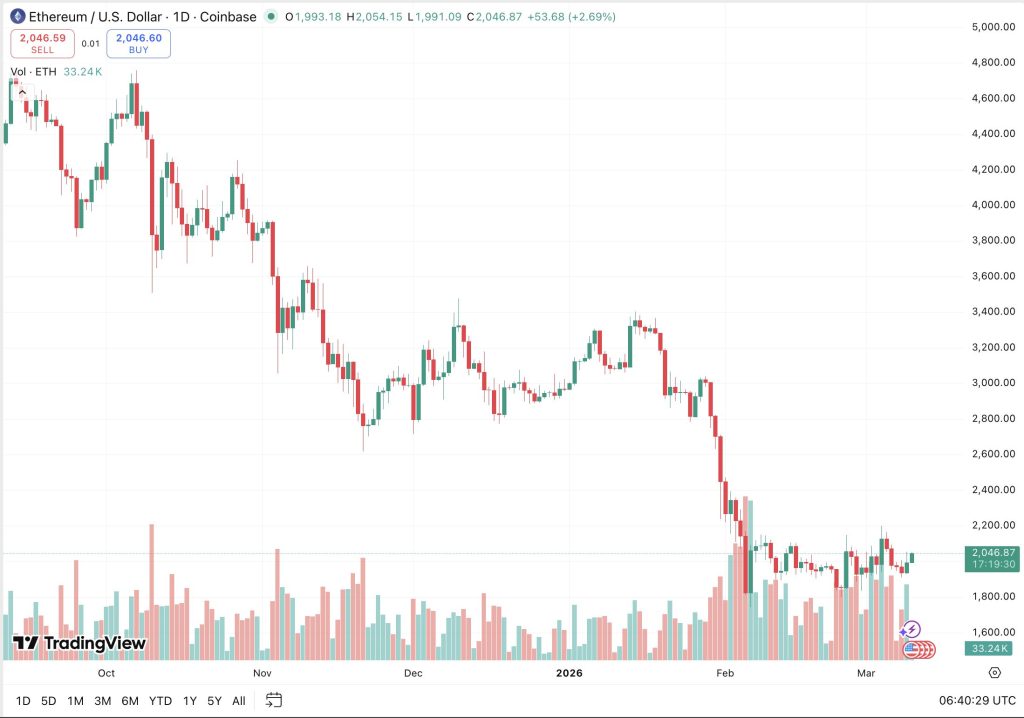
The Ethereum price is fighting to hold the $2,000 line as sellers test the market’s resolve. The asset is trading at $2,050 with a weekly Relative Strength Index (RSI) of 33, signaling a crucial decision point.
$2,000 represents a longstanding psychological level that bulls have defended since the February lows. The ETH RSI reading is arguably the most important metric right now. It sits just above the “oversold” threshold of 30, a zone that has historically preceded sharp relief bounces or accumulation phases.
While macro headwinds and oil macro pressure weigh on the broader sector, due to the ongoing tensions between the US and Israel, Ethereum price action suggests a coil is tightening.
24-hour volume for ETH USD has hit $22.4Bn, with the sell-side slowing, indicating that while aggressive selling has calmed, buyers remain hesitant to commit capital until a confirmed reversal signal is in place.
Ethereum Price Prediction: Is the $2,000 Defense Sustainable?
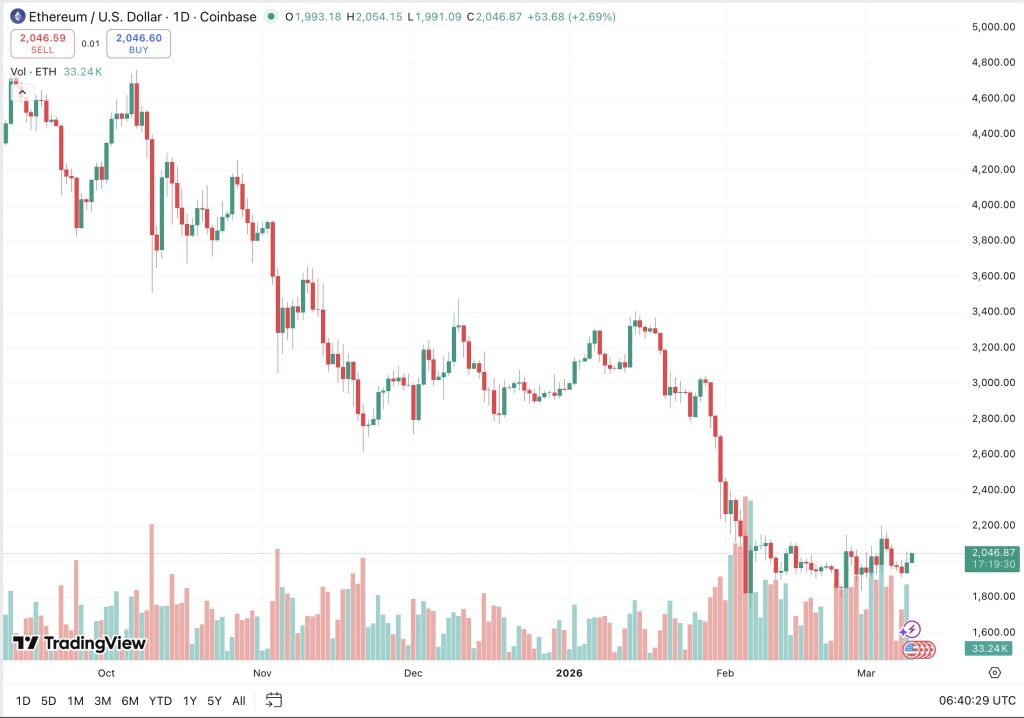
The daily chart shows the Ethereum price trapped in a high-tension consolidation block between $1,930 and $2,050, and until either side is breached, this ranging is likely to continue.
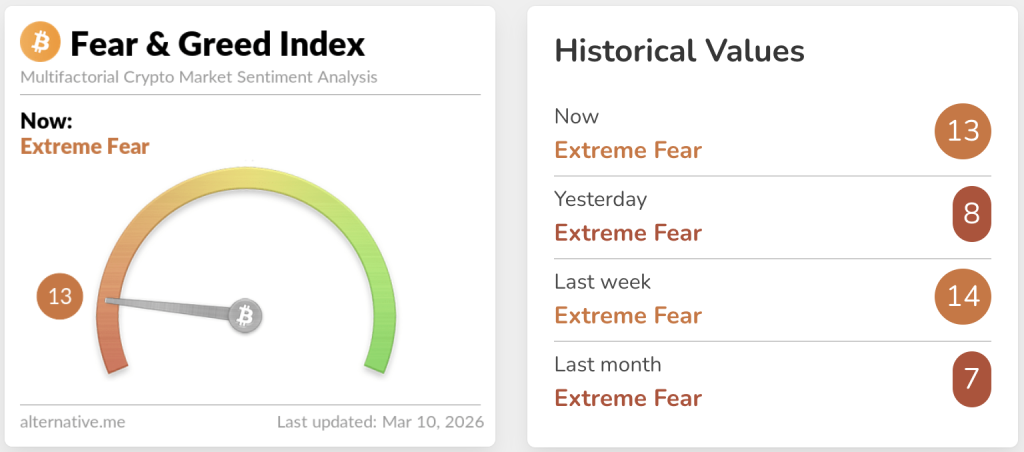
The structure is undeniably bearish in the immediate term, with lower highs pressing against static support. However, crypto technical analysis often favors contrarian plays when the market is spooked, and right now, the Fear & Greed Index is sitting at 13/100, marking ‘Extreme Fear’.
The setup mirrors strategies often used for oversold stocks, where deep pullbacks into liquidity zones offer asymmetric risk-reward ratios for patient traders. The current consolidation suggests bears are losing momentum, but they haven’t surrendered control.
If the $2,000 level holds, the immediate target is to reclaim the 20-day EMA near $2,120. A breakout above this moving average would signal strength and open the door to $2,350.
But if support at $1,930 fails, the floor drops out. Liquidity hunters will likely target the $1,760 zone, flushing out late longs before any meaningful recovery can occur.
This weakness contrasts with competitors. Recent Solana price prediction models highlight how alternative L1s have maintained stronger market structures during this correction, adding pressure on ETH to perform.
DISCOVER: Next Crypto to Explode in 2026
The Levels That Change Everything for ETH
Traders have defined clear Ethereum support levels that could dictate the trend for March, and the market is now waiting for a definitive close to confirm the next direction for ETH USD.
To the upside, $2,120 is the level to watch. A daily close above this resistance invalidates the immediate bearish thesis and could trigger a short squeeze toward $2,200.
This move would likely coincide with a shift in Bitcoin dominance as capital rotates back into Ethereum and the broader altcoin market.
To the downside, $1,930 is the line in the sand, and a breach here would expose the April 2025 lows of $1,470. While the ETH RSI suggests a bounce is due, the price structure remains king.
The definitive signal bulls are waiting for is a high-volume breakout above $2,120; until then, the trend and global macroeconomic tensions favor the bears.
EXPLORE: Best Crypto Presales to Buy in 2026
The post Ethereum Price Defends $2,000 Support as RSI Hits Near-Oversold Levels appeared first on Cryptonews.
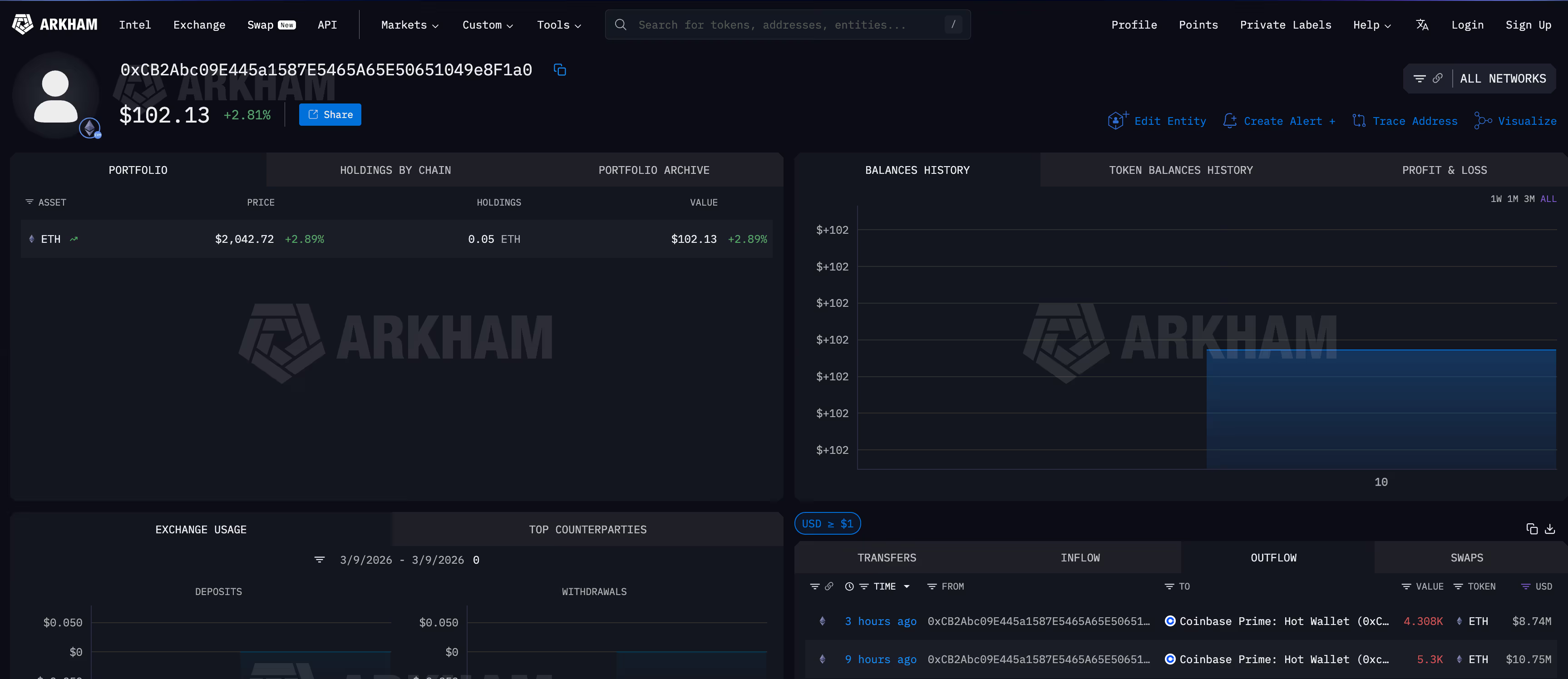
Bitmine Immersion Technologies moved approximately 9,600 ETH to Coinbase Prime hot wallets on Tuesday in two separate transfers, Arkham data shows.
The first transfer sent 5,300 ETH worth $10.75 million roughly nine hours ago, followed by a second batch of 4,308 ETH worth $8.74 million about three hours ago.
Both went through an intermediate wallet before landing at a Coinbase Prime hot wallet address, a routing pattern consistent with institutional custody operations.

The transfers come after Bitmine reported its largest weekly ether purchase of 2026, buying 60,976 ETH last week and bringing its total holdings above 4.5 million tokens. Chairman Thomas Lee said the firm was ramping up buying as it believes crypto is in the “late stages of a mini-crypto winter.”
Moving coins to Coinbase Prime doesn’t necessarily mean Bitmine is selling. Prime is Coinbase’s institutional custody and trading platform, and transfers there could reflect internal rebalancing, staking operations, collateral management, or preparation for OTC activity.
The balance history on Arkham shows Bitmine’s portfolio peaked near $16 billion around October 2024 and has declined to roughly $2.25 billion, reflecting ether’s price collapse rather than large-scale selling. The company is sitting on estimated losses of $7.8 billion on its position.
Ether was trading at $2,042, up 2.8% on the day.


Blockchain.com is expanding its presence in Africa with a launch in Ghana, as the crypto brokerage looks to build digital asset infrastructure across some of the region’s fastest-growing markets.
Summary
- Blockchain.com has launched operations in Ghana as part of a broader African expansion strategy.
- The move follows over 700% transaction growth in Nigeria, one of the firm’s fastest-growing markets.
- The company says rising crypto adoption in Africa is driven by remittances, currency volatility and mobile-first users.
The company announced the expansion on March 9, saying the move forms part of a broader strategy to scale operations across Africa and provide local users with a secure and compliant platform for accessing digital assets.
The Ghana launch follows strong growth in Nigeria, which has emerged as one of Blockchain.com’s fastest-growing global markets. Since officially launching retail operations in the country last year, the firm has recorded more than 700% growth in brokerage transaction volumes, according to the announcement.
Blockchain.com established operations in Lagos and hired local staff to support the expansion, with USDT, BTC and TRX emerging as the most actively traded assets among Nigerian users on the platform.
The company said demand for digital assets across Africa continues to rise, driven by factors such as currency volatility, remittance needs and a rapidly expanding mobile-first population. Nigeria has consistently ranked among the world’s top countries for crypto adoption, according to industry data.
Blockchain.com also reported growing traction in Ghana even before its formal launch. Over the past year, the firm recorded a 140% increase in active users in the country and an 80% rise in transaction volumes, suggesting strong local demand for regulated access to crypto services.
“Africa represents our mission to make financial services available to everyone globally,” said Owen Odia, the company’s general manager for Africa, adding that the firm is investing in local talent and developing products tailored to regional needs.
The company said stablecoins and digital assets could help improve cross-border settlements, reduce remittance costs and support digital commerce across West Africa.
Founded in 2011, Blockchain.com operates in more than 70 jurisdictions and has processed over $1.2 trillion in crypto transactions, with more than 90 million wallets created worldwide.
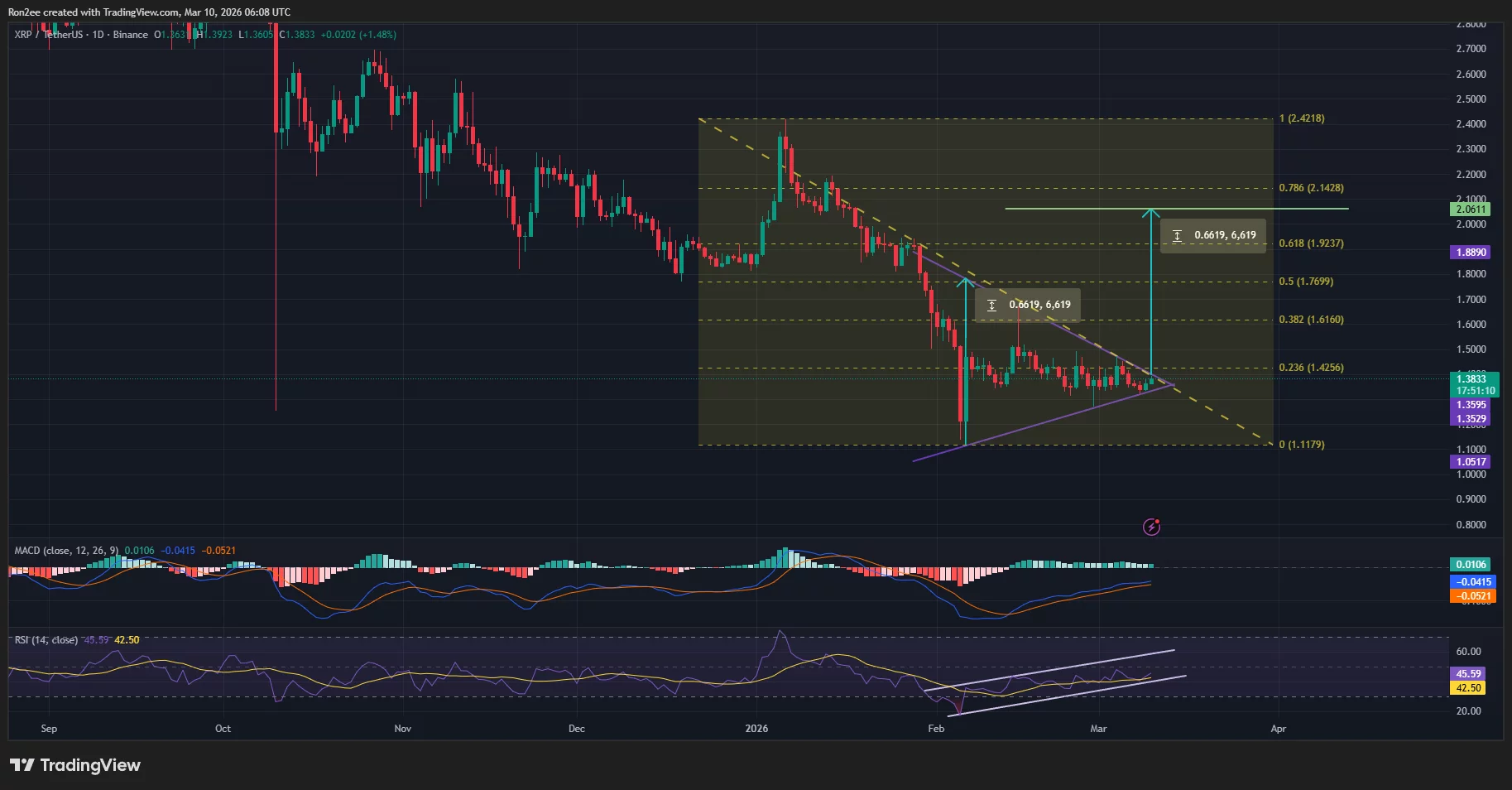
XRP price is on the cusp of a breakout from a symmetrical triangle pattern that could potentially lead to sustained gains.
Summary
- XRP price is close to confirming a bullish breakout from a symmetrical triangle pattern on the daily chart.
- Stablecoin supply on the network has surged over the past week.
According to data from crypto.news XRP (XRP) price rose nearly 4% to an intraday high of $1.39 on March 10, Asian time.
The rebound followed after the token fell nearly 8% to $1.34 from its weekly high of $1.46 led by a Bitcoin (BTC) correction amid rising inflation fears on surging oil prices and escalating geopolitical tensions in the Middle East.
Now, with XRP price recovering, it is drawing closer to a potential breakout from a multi-month symmetrical triangle pattern formed on the daily chart.
For context, a symmetrical triangle pattern is formed when an asset’s price moves between two converging trendlines that connect a series of sequential peaks and troughs. Typically, a breakout from the upper side of the pattern has been bullish for the asset, while a drop below the lower trendline indicates a bearish trend.
In XRP’s case, the breakout is occurring from the upper side and hence presents a bullish outlook for the token in the coming sessions.
At press time, momentum indicators like the MACD and RSI are also suggesting that a strong recovery is underway. The MACD line was pointed upwards, while the RSI had formed a bullish divergence with XRP’s recent price action, suggesting that selling pressure is cooling off.
For now, the 23.6% Fibonacci retracement level at $1.42 stands as the key resistance zone that traders would be keeping an eye on.
Breaking out from this level could potentially trigger a rally to $2.06, a target calculated by adding the height of the symmetrical triangle pattern formed to the price point at which the breakout would be confirmed. The target lies nearly 50% from the current price of $1.38.
A major catalyst that could support its gains is the growing stablecoin supply on the XRPL network. Data from DeFiLama show that the total stablecoin supply on the network has gone up 2.5% over the past 7 days to $426 million.
A greater supply means more liquidity and trading activity on the network, and investors often see such growth as a sign of increasing demand for the underlying ecosystem.
However, some caution is warranted as institutional demand for the altcoin has slowed. Notably, U.S. spot XRP ETFs recorded $22 million in net outflows over the past two weeks, breaking a four-week inflow streak.
Disclosure: This article does not represent investment advice. The content and materials featured on this page are for educational purposes only.

Justin Sun’s Tron network has joined the Agentic AI Foundation to prepare and support the widespread adoption of AI agents.
In an announcement on Monday, Tron’s decentralized autonomous organization (DAO) revealed that the Tron network has signed on as a member of the Agentic AI Foundation (AAIF) and will serve on its governing board.
Tron DAO said that there will be significant demand coming from agentic AI in the future, and as such, it requires collaboration and interoperability to establish systems that can handle “continuous, high-volume, low-value transactions efficiently at scale.”
“Interoperable frameworks are expected to play an important role in ensuring that AI agents can operate across platforms and services without creating fragmented ecosystems,” the DAO said.
Last month, Stripe CEO and co-founder Patrick Collison and co-founder John Collison said there is a significant infrastructure gap in blockchain and said significant scaling improvements would be required to meet this incoming demand.
“By supporting the development of open infrastructure through the Foundation, TRON DAO aims to contribute to collaborative standards that make AI agents easier to build, safer to operate, and more accessible,” it added.

The AAIF is run by the Linux Foundation and was designed to promote open-source agentic AI development, alongside helping establish industry standards for governance, safety, and interoperability. Tron joins the likes of Circle and JPMorgan in jumping on board the AAIF.
Tron’s 2026 focus is AI, says founder
Sun last month said that AI will “definitely” be a key focus for the network this year, arguing that Tron’s speed, scalability, and low fees are prime for hosting agentic AI transactions.
Related: Using AI at work is causing ‘brain fry,’ researchers say
Sun indicated that the network is working on building infrastructure and collaborating to support AI demand. One recent example is the Bank of AI, a financial layer built for AI agents by AINFT, which first launched on Tron and BNB Chain in mid-February.

DeFiLlama data indicates that Tron currently tops the charts in terms of revenue generated by all blockchains across the past 24 hours, seven days, and 30 days, at $1.01 million, $6.54 million and $25.58 million apiece.
Earlier this month, Sun indicated that some of the revenue is being driven by AI.
“AI is scaling fast. When agents transact, demand shows up in the network metrics. TRON keeps leading on real usage,” he said.
Magazine: AI won’t make you rich but crypto games might, Axie founder steps down: Web3 Gamer


Vitalik Buterin has outlined a plan to simplify distributed staking infrastructure on Ethereum, arguing that running validator nodes should not require specialized technical expertise.
Summary
- Vitalik Buterin outlined a “DVT-lite” approach designed to simplify distributed Ethereum staking infrastructure.
- He argued that complex validator setups are “anti-decentralization” and should be replaced with easier deployments.
- The goal is to enable simple, near “one-click” distributed staking, particularly for institutions holding large amounts of ETH.
In a recent social media post, Buterin discussed how the Ethereum Foundation is using a simplified “DVT-lite” setup to stake 72,000 ETH, describing the effort as part of a broader push to make distributed validator technology easier to deploy.
Distributed validator technology, or DVT, allows multiple machines or operators to collectively run a validator using a shared key, rather than relying on a single server or operator. The approach is widely viewed as a way to improve network resilience and reduce the risk of validator outages.
Buterin said his goal is to make deploying such infrastructure “maximally easy,” particularly for institutions that hold significant amounts of Ether but may lack the technical capacity to operate complex validator systems.
“My hope for this project is that in the process, we can make it maximally easy and one-click to do distributed staking for institutions,” he wrote.
Under the concept he described, node operators could run a validator through a simple containerized setup, such as a Docker container or a similar environment. Each participating node would use the same validator key and automatically discover the other nodes in the cluster.
Once the nodes connect, the networking setup and distributed key generation process would run automatically before staking begins.
Buterin also criticized the perception that operating blockchain infrastructure requires professional-level expertise.
“The idea that running infrastructure is this scary complicated thing where each person participating must be a ‘professional’ is awful and anti-decentralization,” he said.
According to Buterin, simplifying distributed validator deployment could help spread authority over Ethereum staking across a wider set of participants. He added that he personally plans to use the setup and hopes more large Ether holders will adopt similar distributed staking configurations.
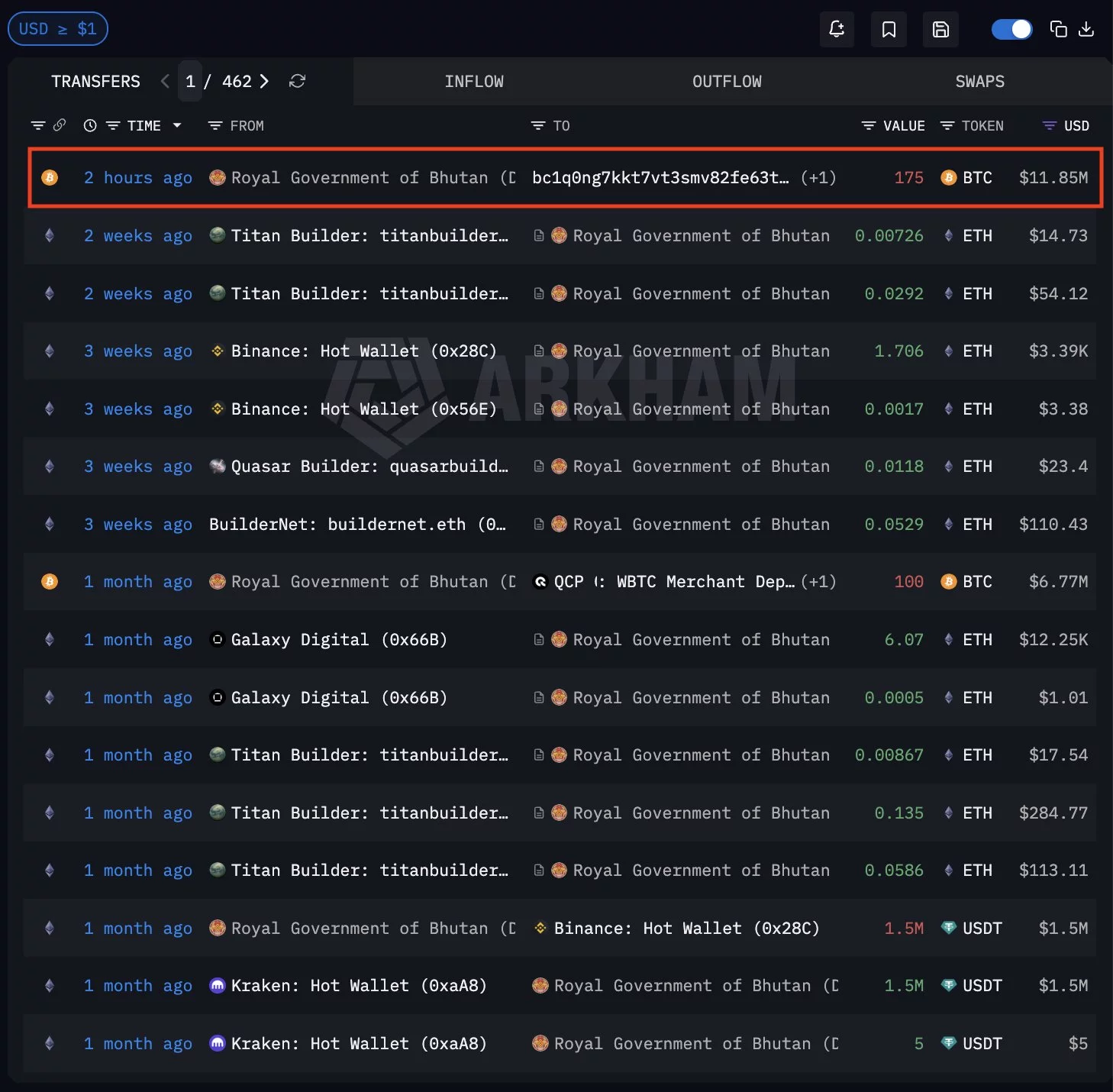
Bhutan has transferred roughly $11 million worth of Bitcoin from wallets linked to its sovereign holdings, according to blockchain analytics firm Arkham Intelligence.
Summary
- Bhutan moved about $11 million in Bitcoin, according to Arkham Intelligence on-chain data.
- The transfer follows a $7 million BTC sale through QCP Capital roughly a month earlier.
- Bhutan typically sells $5M–$10M BTC clips, maintaining a structured treasury management strategy.
Arkham flagged the movement in a recent post on X, stating that Bhutan moved the funds out of its main holding addresses, continuing a pattern of periodic transfers tied to the country’s crypto treasury activity.
The analytics platform noted that the last similar transfer occurred about a month ago, when Bhutan sold approximately $7 million worth of Bitcoin (BTC) through QCP Capital, a digital asset trading firm often used by institutional market participants.
Arkham also observed that Bhutan typically sells portions of its Bitcoin holdings in smaller clips ranging from $5 million to $10 million, rather than executing large single liquidations. The firm previously identified a particularly heavy period of selling activity between mid and late September 2025.
The latest movement continues a broader pattern of on-chain activity from Bhutan-linked wallets that has drawn attention across crypto markets.
Despite these periodic sales, Bhutan remains one of the largest sovereign Bitcoin holders. Arkham-tracked wallets show the country still holding around 5,600 BTC, valued at hundreds of millions of dollars.
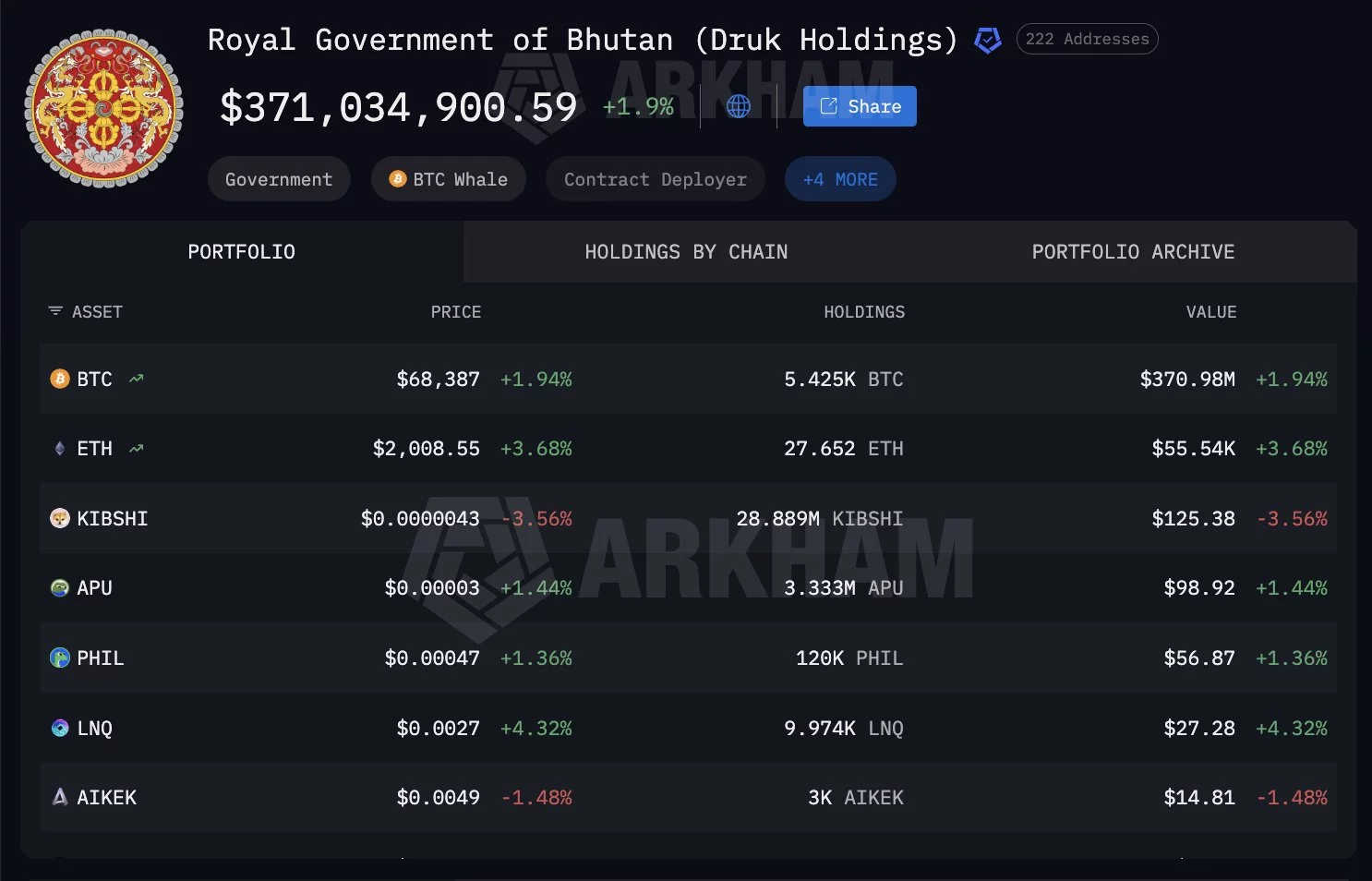
Bhutan’s Bitcoin reserves largely originate from state-backed mining operations powered by hydroelectric energy, which have allowed the Himalayan kingdom to accumulate a sizable digital asset treasury in recent years.

Vitalik Buterin Envisions One-Click Institutional Staking

Muhammad Ali named a welterweight champion as the true greatest of all time

Congressional Republicans Push Bills That Would Block Kids Access To Content For Ideological Reasons


-

 Politics7 days ago
Alan Cumming Brands Baftas Ceremony A ‘Triggering S**tshow’
-
Business4 days ago
Form 8K Entergy Mississippi LLC For: 6 March
-

 Fashion4 days ago
Weekend Open Thread: Ann Taylor
-

 News Videos20 hours ago
10th Algebra | Financial Planning | Question Bank Solution | Board Exam 2026
-

 Crypto World16 hours ago
Paradigm, a16z, Winklevoss Capital, Balaji Srinivasan among investors in ZODL
-

 Tech5 days ago
Bitwarden adds support for passkey login on Windows 11
-
 Sports5 days ago
499 runs and 34 sixes later, India beat England to enter T20 World Cup final | Cricket News
-

 Sports2 days ago
Three share 2-shot lead entering final round in Hong Kong
-

 Sports2 days ago
Braveheart Lakshya downs Lai in epic battle to enter All England Open final | Other Sports News
-

 Business6 days ago
Guthrie Disappearance Enters Fifth Week as Family Visits Memorial
-

 Politics4 days ago
Top Mamdani aide takes progressive project to the UK
-

 NewsBeat5 days ago
Piccadilly Circus just unveiled ‘London’s newest tourist attraction’ and it only costs 80p to enter
-

 Business2 days ago
Search for Nancy Guthrie Enters 37th Day as FBI Probes Wi-Fi Jammer Theory
-
 Sports7 days ago
Jack Grealish posts new injury update as Man City star enters crucial period
-

 Entertainment3 days ago
Hailey Bieber Poses For Sexy Selfies In New Luscious Lip Thirst Traps
-
 NewsBeat7 hours ago
Pagazzi Lighting enters administration as 70 jobs lost and 11 stores close across Scotland
-

 Tech17 hours ago
Despite challenges, Ireland sixth in EU for board gender diversity
-

 Crypto World5 days ago
New Crypto Mutuum Finance (MUTM) Reports V1 Protocol Progress as Roadmap Enters Phase 3
-
 Tech5 days ago
ACIP To Discuss COVID ‘Vaccine Injuries’ Next Month, Despite That Not Being In Its Purview
-
Entertainment5 days ago
Harry Styles Has ‘Struggled’ to Discuss Liam Payne’s Death