Police were called to the incident at 4.15pm on Friday
A woman’s body has been found at a property in Aberdeen.
Advertisement
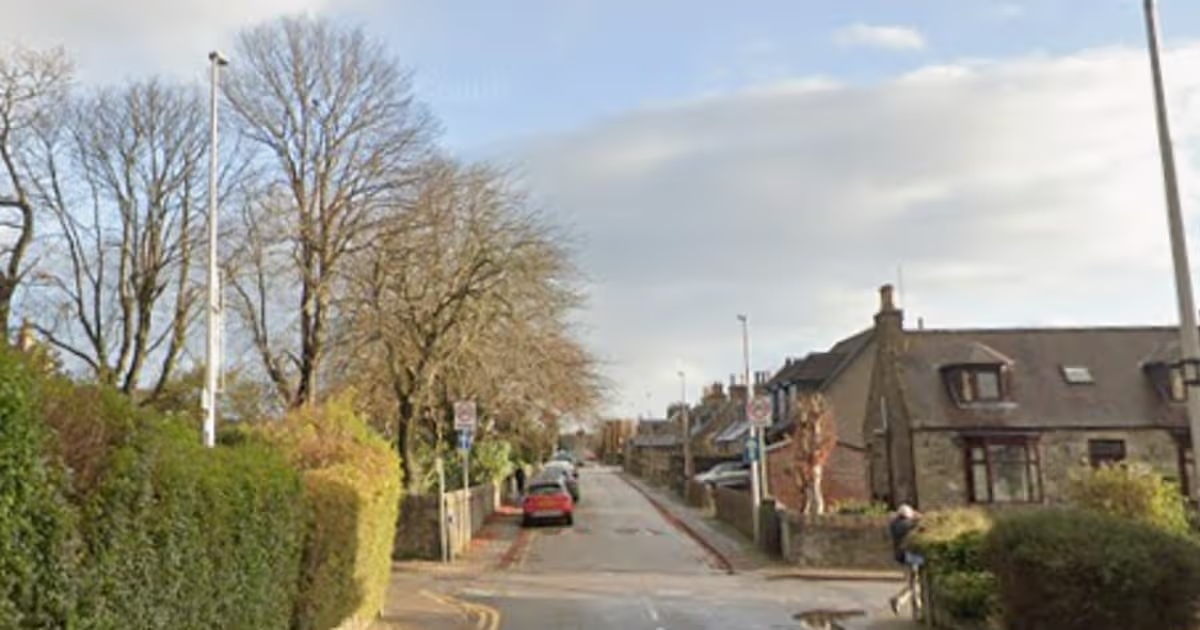
Police were called to the incident on Station Road in Dyce near Aberdeen at 4.15pm on Friday, February 13. Officers attended and a woman was found dead within.
Her death is currently being treated as unexplained. Cops, however, say there do not appear to be any suspicious circumstances.
A report is due to be submitted to the Procurator Fiscal.
A spokesperson for Police Scotland said: “Around 4.15pm on Friday, 13 February, 2026, emergency services attended at Station Road, Dyce following the death of a woman. Her death is being treated as unexplained, however there are not believed to be any suspicious circumstances.
Advertisement
“A report will be submitted to the Procurator Fiscal.”
Get more Daily Record exclusives by signing up for free to Google’s preferred sources. Click HERE.
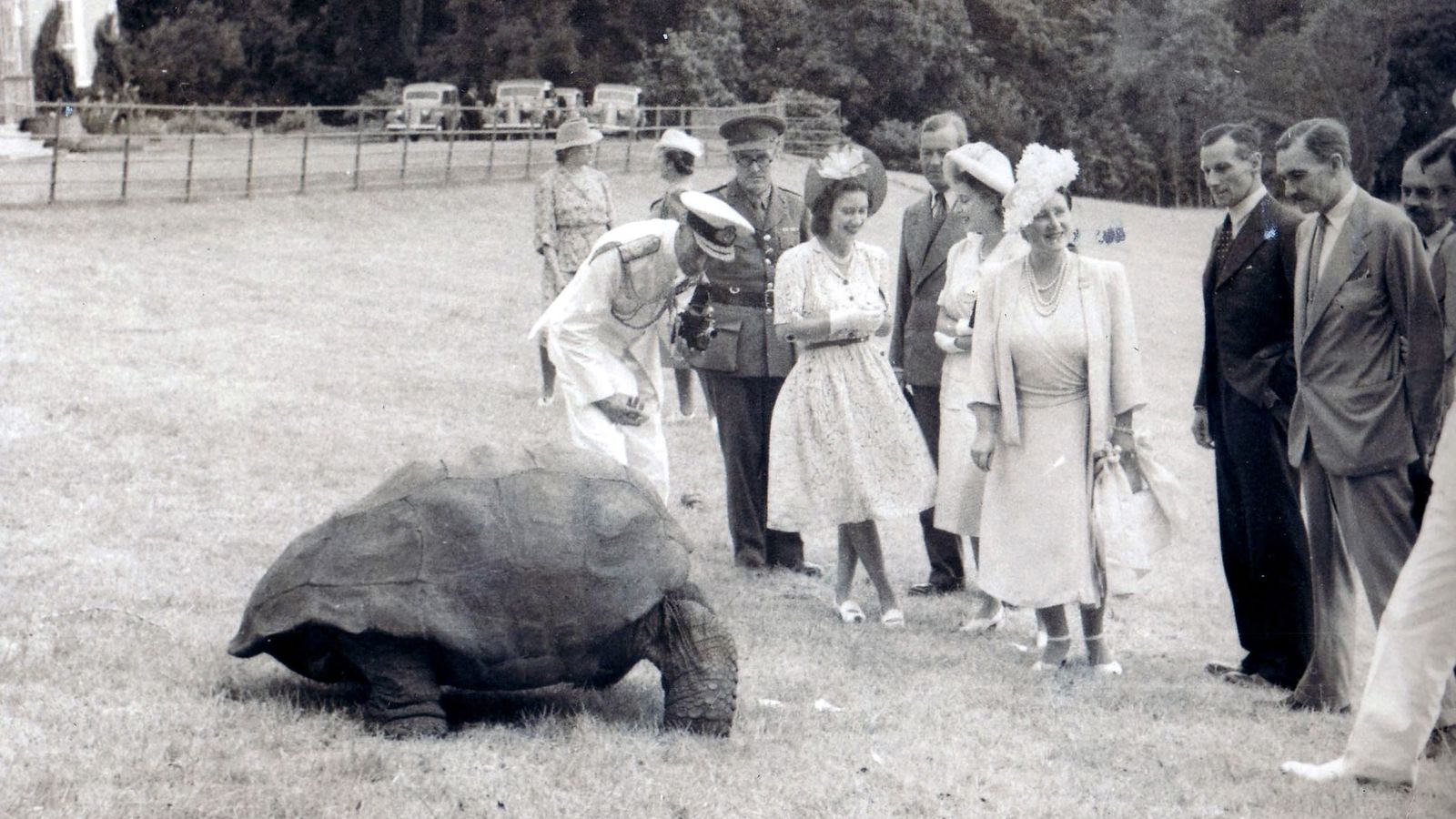
A giant Seychelles tortoise, believed to be the world’s oldest living land animal, is alive and well after claims he had died turned out to be part of an alleged crypto scam.
Posts emerged on Wednesday claiming Jonathan, who is thought to be 193 years old according to the official website devoted to him, was dead.
Reports of his demise were posted on X by the account @JoeHollinsVet, named after Joe Hollins, a vet who has taken care of Jonathan and previously spoken of his experiences.
Image: Jonathan, the Seychelles giant tortoise. File pic: St Helena/PA
Image: Posing for tourists on St. Helena. Pic: AP
The message read that he was “heartbroken” to announce that the “beloved” creature “has passed away today peacefully”.
Describing himself as Jonathan’s “vet for many years”, he said: “Rest easy, old friend. You’ll be missed more than words can say” and later thanked people “for the outpouring of love for Jonathan as we mourn his passing”.
Advertisement
But the Friends of the British Overseas Territories, quoting the island’s governor, Nigel Phillips, said “the real Joe Hollins does not have an X account, and that Jonathan the tortoise is alive. This account is soliciting crypto donations, has recently changed its username”.
Mr Phillips “has confirmed Jonathan Tortoise is alive and well – he has just checked on him”, he added.
In a post on Facebook, Mr Hollins commented on a screen grab of the X post, saying it was “a hoax” and “not even an April Fool”.
X
This content is provided by X, which may be using cookies and other technologies.
To show you this content, we need your permission to use cookies.
You can use the buttons below to amend your preferences to enable X cookies or to allow those cookies just once.
You can change your settings at any time via the Privacy Options.
Unfortunately we have been unable to verify if you have consented to X cookies.
To view this content you can use the button below to allow X cookies for this session only.
He wrote that: “IT IS NOT TRUE. The hoaxer is asking for crypto donations. It’s a con. Please forward guys because this has spread. Even our researcher friends in the US unravelling his DNA have just sent condolences.”
There was a good deal of negative reaction to the original X post, with one commenter calling it a “nice prank, you scam artist”, while another said “he’s alive, you plonker”, and a third simply told the account it had been “BUSTED”.
What has Jonathan seen during his lifetime?
Advertisement
– Eight British monarchs, from William IV to Charles III
– Industrialisation, the end of the agriculture-dominated society and urbanisation
– Two world wars and hundreds of smaller conflicts, with more than 40 between 1832 and 1840 alone
– The French Revolution of 1789, the collapse of feudal society, the abolition of slavery and the growth of democracy
Advertisement
– Scientific advances including space travel, motor vehicles, planes and cures for previously deadly illnesses
– Cultural developments such as films, sports, mass publishing and the digital age
Jonathan, who lives on the island of St Helena in the South Atlantic, “is believed to be the world’s oldest living land animal”, the website says, while admitting “we don’t actually know his exact age”.
Advertisement
His home is in the grounds of Plantation House, the residence of the Governor of St Helena, an exclusive address he shares with three other giant tortoises, named Emma, David and Fredrik.
The website says it is “generally accepted” is one of three giant tortoises brought to the island in the 18th and 19th centuries and was named in the 1930s.
St Helena was discovered by Portugal in 1502, before being claimed by Britain after they arrived on the island in 1659. It has remained British ever since.
Running from 10am to 4pm, the free showcase will bring together a wide range of exhibitors, model ship displays, and maritime artefacts.
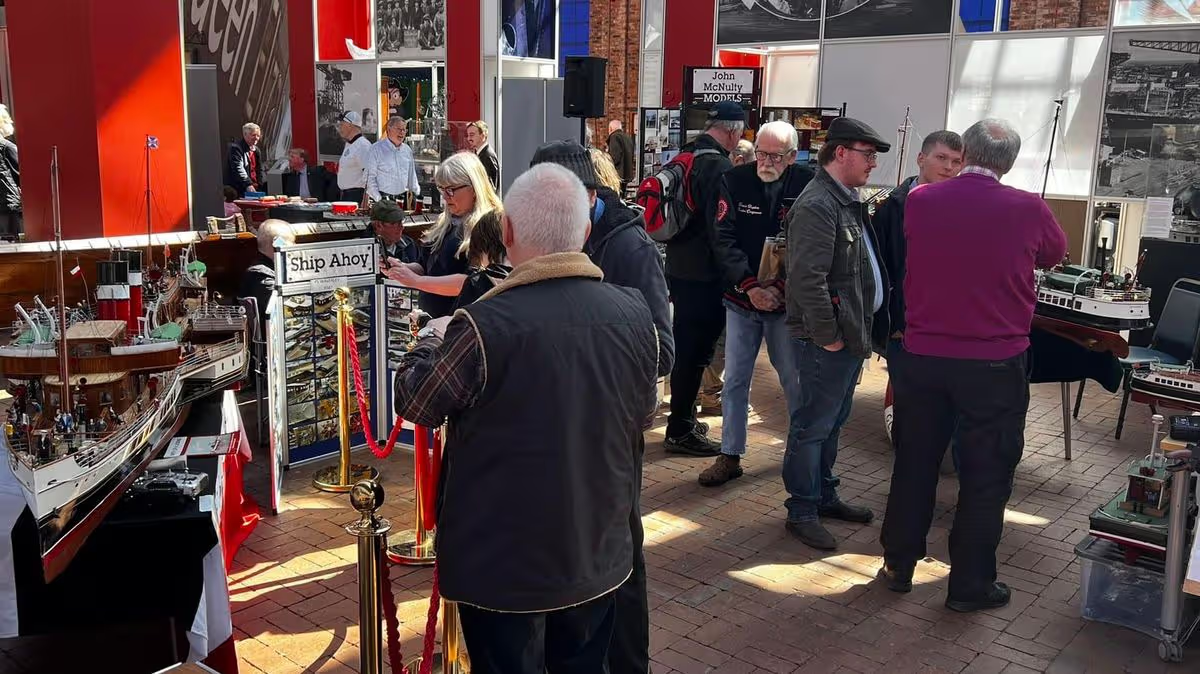
Ship Ahoy!, a one-day, family-friendly event celebrating Scotland’s maritime heritage, will take place at Coatbridge’s Summerlee Museum on April 25.
Advertisement
Running from 10am to 4pm, the free showcase will bring together a wide range of exhibitors, model ship displays, and maritime artefacts, offering an engaging and educational day out for visitors of all ages.
Visitors can explore displays from across the maritime and heritage sectors, including ship models, historical material, and interactive exhibits designed to appeal to both enthusiasts and families alike.
To make access even easier, a vintage MacBrayne shuttle bus will operate throughout the day, transporting visitors between Coatbridge Sunnyside railway station and Summerlee Museum, adding an extra touch of heritage to the visitor experience.
The event also forms part of wider celebrations marking significant milestones for Scotland’s maritime history, including the 80th anniversary of the launch of Paddle Steamer Waverley.
Advertisement
Paul Sweeney MSP, patron of Ship Ahoy!, expressed his excitement for the upcoming event, saying: “I am proud to have been appointed to serve as patron of Ship Ahoy!
“This fantastic free annual event celebrates Scotland’s extraordinary maritime history, engineering excellence, and the vibrant communities that have built and sailed our ships over the last two centuries; from the Scots who first pioneered marine steam propulsion, to those who continue this great tradition today.
“Whether you are a ship model enthusiast, maritime historian, industry professional, or simply looking for a great family day out, Ship Ahoy! offers something for all those who share a passion for our island nation’s legendary history of marine navigation.
Advertisement
“I look forward to seeing the displays and meeting exhibitors and visitors on Saturday, April 25.”
Lu McNair, museums and collections manager at North Lanarkshire Council, said: “We’re delighted to host the Ship Ahoy! event again this year at Summerlee Museum.
BBC Sport joined the queue for World Cup tickets alongside the supporters on Wednesday at about 15:20 BST.
A holding message was in place, and at 16:00 this changed to a red circle with the message: “Almost there…”
By 17:00 a countdown clock had appeared. We were two minutes from the front when the time suddenly jumped back up to 15 minutes.
When we did gain access, we experienced the same technical glitch as thousands of fans.
Advertisement
Supporters who logged on early were wrongly directed into a queue for “PMA tickets”, reserved for fans of this week’s play-off winners.
Once through, users were sent to a page where a code was required to open up a sale for those fixtures.
By the time the mistake was realised, those supporters were forced to start again at the back of the correct virtual line. Any chance of securing a ticket for one of the more attractive matches had gone.
Fifa did not provide a reason for the error but said that by 17:00 the links were working properly.
Advertisement
Once back in the queue it took six hours and 14 minutes to be granted access to the ticket page.
Of the 72 group games, 35 matches were listed with tickets available – but there was no allocation for the England or Scotland games, or any of the knockout matches, by the time we made it through.
Across the 35 matches, prices ranged from $140 (£106) to $2,985 (£2,261). The average price of those displayed was $358 (£271).
The most expensive match seen was the first of the tournament between Mexico and South Africa at $2,985 (£2,261), with only a tiny proportion of the 87,000 capacity available.
Advertisement
Additionally, we were able to view corporate hospitality packages, including one for England v Panama which was $124,800 (£94,444) for a luxury suite with 24 match tickets, food and drink – $5,200 (£3,935) per person.
The availability of games appears to be changing all the time, and Fifa has indicated new tickets could be released for any game right up to kick-off.
By 08:00 on Thursday, 13 games were still showing – though six of these only had wheelchair companion tickets, which should not be sold to the general public.
Controversially, Fifa has not made free tickets available to the assistants of fans using wheelchairs. Tickets must be bought at full price and they may not be situated next to each other.
Advertisement
The USA’s opening game against Paraguay on 13 June had the most tickets still on sale, with 1,406 category one tickets priced at $2,735 (£2,072).
Canada’s first match against Bosnia-Herzegovina was the only other match with relatively good supply – 846 category one tickets still on sale at a cost of $2,240 (£1,697).
Fifa’s resale platform, which will likely bring even higher prices – with both buyer and seller charged a 15% fee – reopens on Thursday.
‘Communities want to move forward and see areas that reflect where we are today, not the past’
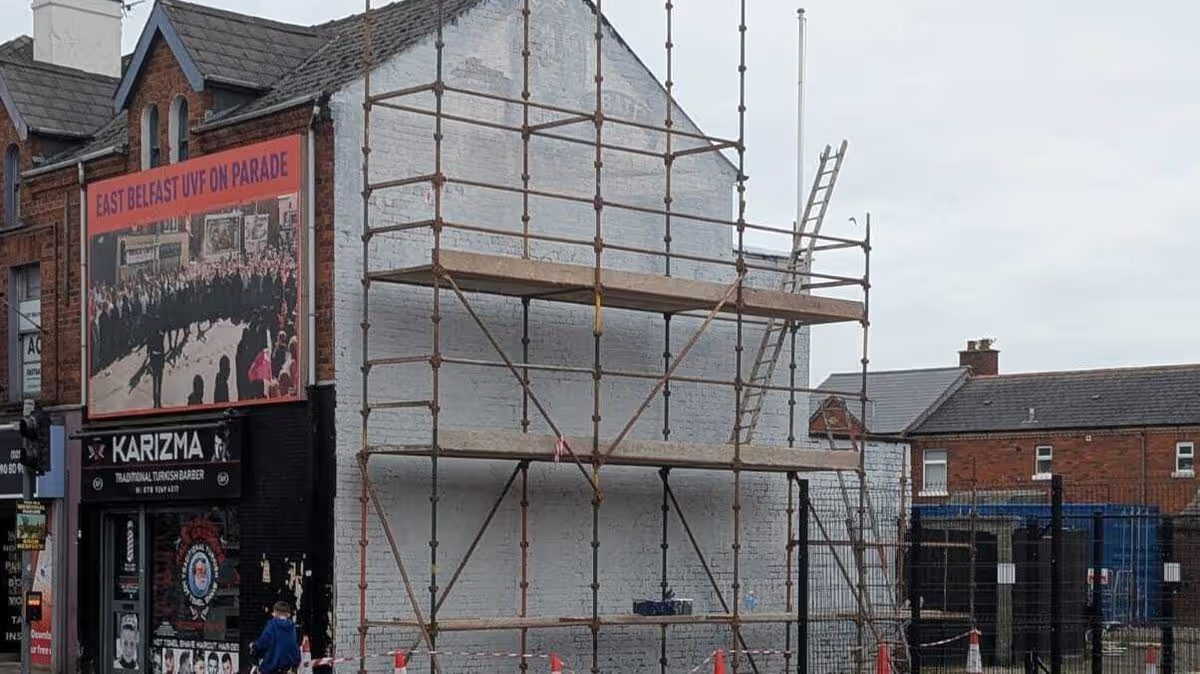
Work is under way to replace a contentious paramilitary mural in East Belfast. The mural featuring two UVF gunmen has been on the gable wall of a corner where Dee Street meets the Newtownards Road since 2011.
Advertisement
It’s understood the mural will be replaced by a new painting, featuring the image of Edward Carson, the Dublin-born unionist politician who led opposition to Home Rule.
The removal of the UVF mural and its replacement is part of a long-running project with the local community, including groups such as Northern Ireland Alternatives, and supported by the Executive Office’s Communities in Transition project.
Work is under way to transform the mural, as it has now been painted over in preparation for the new artwork. The new mural is expected to be completed over the next few weeks.
Advertisement
The UVF mural featured two gunmen and a UVF badge, with the words ‘East Belfast Batt’ beside the words ‘We seek nothing but the elementary right implanted in every man – the right if you are attacked to defend yourself.’
Use our slider tool below to see before and after
East Belfast UUP MLA, Andy Allen, welcomed the decision to transform the mural, and said change works best when it is led by the community. However, he said community transition cannot stop at murals.
Mr Allen said: “This is a positive step for East Belfast and something many will welcome. Communities want to move forward and see areas that reflect where we are today, not the past.
Advertisement
“What’s important is that this has come through local agreement, and I would commend all involved. Change works best when it’s led by the community itself.
“Reimagining is important, but it must go hand in hand with real regeneration, investment, and a clear focus on building stronger, safer communities.
“That must also include, for example, properly recognising and investing in youth services. They are on the ground every day, supporting young people and providing a positive alternative to some who would seek to draw them into paramilitary and criminal activity.
“If we are serious about transition, it cannot stop at murals. It must be about creating real opportunities and giving people, especially young people, a better future.”
Advertisement
DUP leader Gavin Robinson described the transformation of the mural as a “positive step forward” that has been welcomed by the community.
He added: “It is a move which has support within the community and it is a visible representation of the progress and transition required in our society. I want to commend NI Alternatives who have helped bring forward several murals in Belfast and elsewhere over recent months.”
Northern Ireland Alternatives said the project has “unanimous support” from all sections of the loyalist community in the area. A spokesperson said: “Northern Ireland Alternatives in partnership with the East Belfast Memorial Committee and Legacy Network can confirm there has been agreement on the reimaging of the large Ulster Volunteer Force mural on the Newtownards Road.
Advertisement
“The work on this project will soon commence, and it represents the product of lengthy positive negotiation and discussion with all stakeholders in the area. This project has unanimous support from all sections of the loyalist community in East Belfast and we welcome the collaborative working and rebuilding of relationships which is at the core of delivering this outcome as part of the ongoing process of transition.
“Northern Ireland Alternatives would like to thank Communities in Transition, The Executive Office, for their support of this reimaging project.”
A spokesperson for The Executive Office said: “The reimaging of murals in local communities is part of the Executive Office’s Communities in Transition programme. These projects are community-led and aim to increase community confidence in the area and promote a more positive future, supporting the Executive’s wider work to tackle paramilitarism and organised crime.”
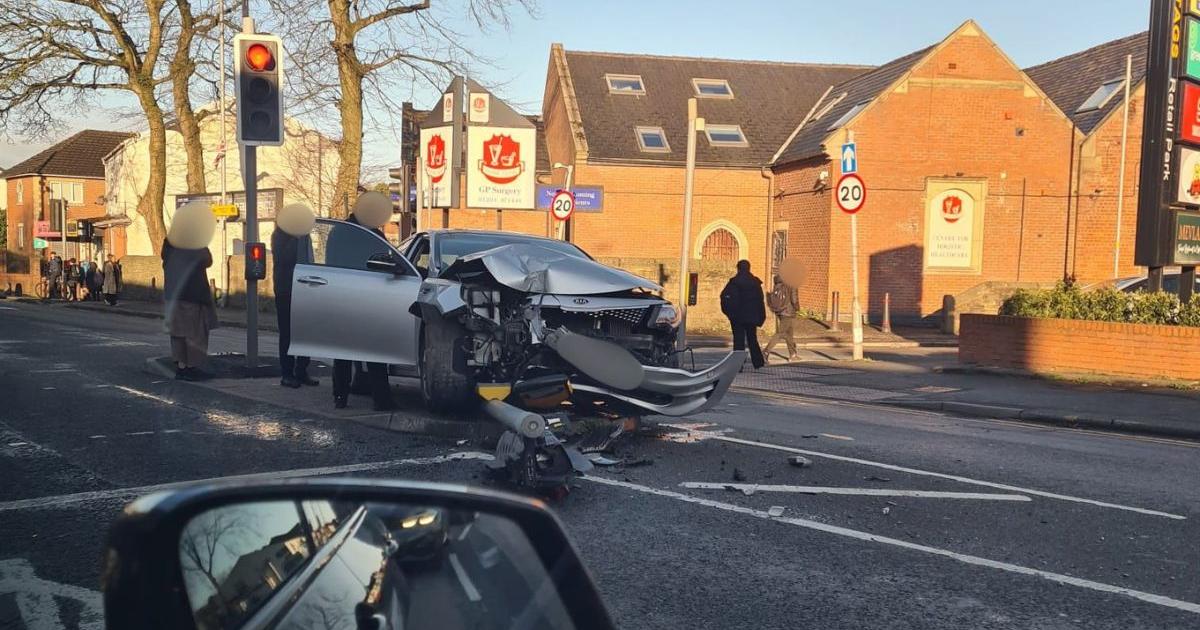
Shortly before 9am, a silver Kia crashed on Wigan Road in Deane and brought down one of the traffic lights with it.
Images taken after the incident show the front bumper smashed in at one side with the lights and a bollard trapped underneath the car at the junction with Hulton Lane and Horsfield Street.
The crash happened on Wigan Road this morning (Image: Public)
Traffic was held up in both directions while the wreck was removed – but this happened quickly and the road was clear around an hour later.
Wigan Road has been the scene of a number of crashes in recent days – most notoriously the crash in January which killed four people.
Advertisement
But Cllr Ayyub Patel, of Rumworth, said this morning’s crash was not on a junction which is seen as an issue, with measures such as traffic lights already in place.
He said: “I would just advise drivers to be aware on the highway network and be mindful and respect pedestrians and other road users.”
Federal regulators have approved Eli Lilly’s new weight-loss pill, a second daily oral medication to treat obesity and other weight-related conditions.
The FDA granted expedited approval to orforglipron, a GLP-1 drug that works like widely used injectable medications to mimic a natural hormone that controls appetite and feelings of fullness.
The drug, which will be branded as Foundayo, is expected to begin shipping Monday.
The company said people with insurance may be able to get the drug starting at $25 per month with a Lilly discount card. Prices for people paying cash will range between $149 per month to $349 per month, depending on the dose.
Advertisement
The new pill joins drugmaker Novo Nordisk’s oral Wegovy pill, which has spurred more than 600,000 prescriptions in the United States since it was approved in December.
Both the Lilly and Novo Nordisk pills resulted in less weight loss than the average achieved with Lilly’s injectable Zepbound (Getty Images)
The FDA authorized Eli Lilly’s drug as part of a new program aimed at cutting drug approval times. The agency said it reviewed the company’s application in 50 days.
In a clinical trial of more than 3,000 adults with obesity, participants who received the highest dose of orforglipron, 36 milligrams, lost 11.2% of their body weight –- about 25 pounds on average –- over more than 16 months. That compared with a 2.1% weight loss, or less than 5 pounds, in patients who received a placebo, or dummy pill, according to the New England Journal of Medicine.
Both the Lilly and Novo Nordisk pills resulted in less weight loss than the average achieved with Lilly’s injectable Zepbound, which results in a 21% average weight loss, or Novo Nordisk’s injectable Wegovy, which averages about 15%.
Both once-daily pills promise convenience, but orforglipron is a small-molecule GLP-1 drug that can be taken without restrictions. The Wegovy pill, a peptide, must be taken with a sip of water in the morning on an empty stomach, with a 30-minute wait before eating or drinking.
Advertisement
Users of orforglipron also saw improvements in waist circumference, blood pressure, triglyceride levels and cholesterol levels, the study found.
Side effects, mostly gastrointestinal issues, led between 5% and 10% of participants in the orforglipron study to discontinue treatment, compared with nearly 3% in the placebo group.
About 1 in 8 people in the U.S. have used injectable GLP-1 drugs, according to a survey from KFF, a nonprofit health policy research group. But many more have trouble affording the costly shots.
The pill from Indianapolis-based Lilly will be included in a Trump administration deal to lower prices on GLP-1 drugs.
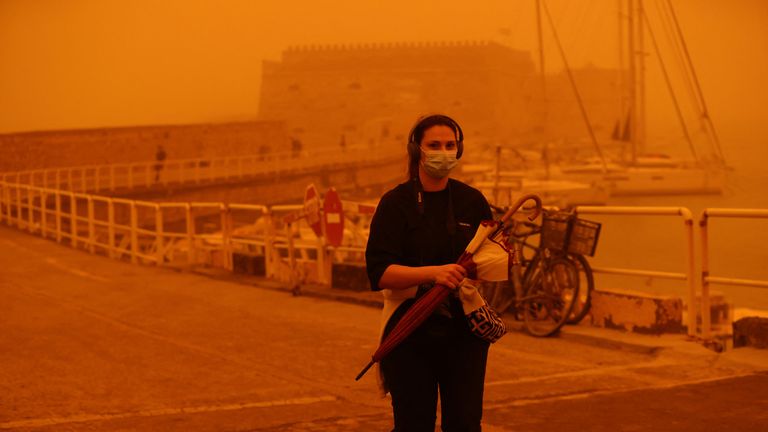
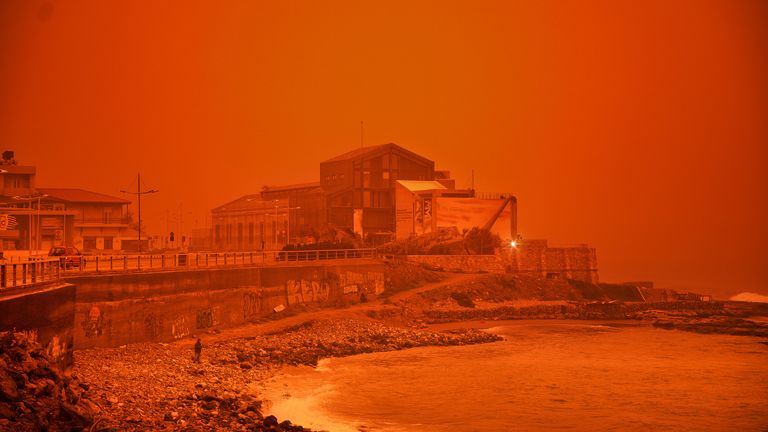
The island of Crete, known for its blue skies, is seeing red – thanks to a cloud of Saharan dust.
A powerful storm has carried the dust from Africa, and the popular holiday destination has turned an apocalyptic shade of red ahead of the Easter break.
Dramatic photographs showed the impact the dust was having on life on the Greek island.
Image: A view of the port in Heraklion, Crete, which is cloaked by red dust from Africa. Pic: Reuters
Image: A woman in the port city wearing a face mask. Pic: Reuters
The island has also been battered by extreme weather – strong winds and heavy rainfall – carried by Storm Erminio.
Residents have been wearing face masks to protect themselves from the suffocating dust.
Advertisement
There have also been gale-force gusts on the island, and the rain, mixed with the dust, has created mud which has coated vehicles and buildings.
Image: People are continuing to go about their everyday lives amid the haze. Pic: Reuters
Image: Sculptures of dinosaurs in Heraklion stand among the dust haze. Pic: Reuters
Image: People have been wearing face masks to protect themselves. Pic: Reuters
A red weather warning was in place until late on Thursday.
The storm has affected travel to and from Crete ahead of the Easter holidays, with flights and ferries disrupted on Wednesday.
Image: The beach in Iraklio, Crete. Pic: AP
Mainland Greece has also been hit by the storm, and a man has died near Athens.
He was found under a car in the Nea Makri area, which suffered flooding, early on Thursday, according to the fire department.
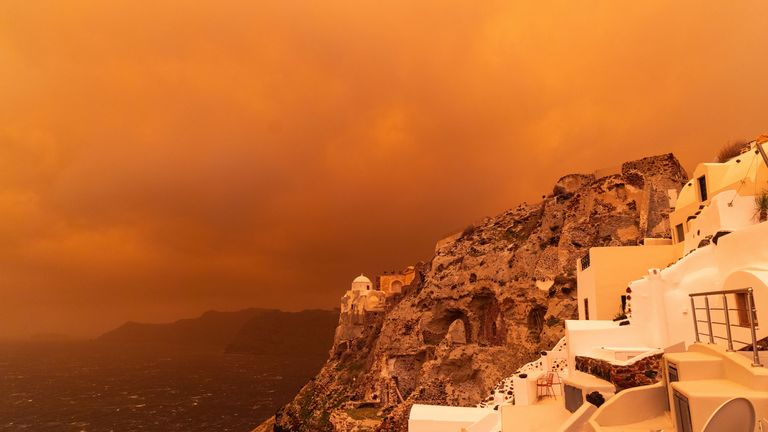
Santorini has also been enveloped in the red dust, which has caused huge disruption on the Greek island.
Advertisement
Image: The skies above Santorini have turned orange-red due to the dust from Africa. Pic: AP
Image: A powerful storm has also caused massive disruption in Santorini. Pic: AP
The cheapest places to fill up with petrol and diesel in Scotland have been revealed. Drivers across the country are looking for ways to save when topping up their tank at the moment.
While we always love a saving, it is especially important at the moment due to the skyrocketing fuel prices amid an ongoing cost of living crisis. Costs at garages have been rising steadily since the first US-Israeli strike on Iran sparked a huge conflict in the Middle East.
And the Iran War has continued to have a massive impact on the price of crude oil and, therefore, the cost of fuel here in the UK. The latest figures from the RAC show that both petrol and diesel increased by record amounts in March.
Advertisement
Petrol surged by 20p across the month, coming out at an average pump price of 152.83p on March 31. The change in diesel was even more dramatic, with a surge of more than 40p to 182.77p on average – almost double the previous record rise after Russia’s invasion of Ukraine in 2022.
Although we haven’t yet hit the all-time highest prices, the recent rise has motorists throughout Scotland and beyond worried about filling up. Especially with the Easter Weekend almost upon us, when the RAC estimates more than 20million car journeys will be made in the UK.
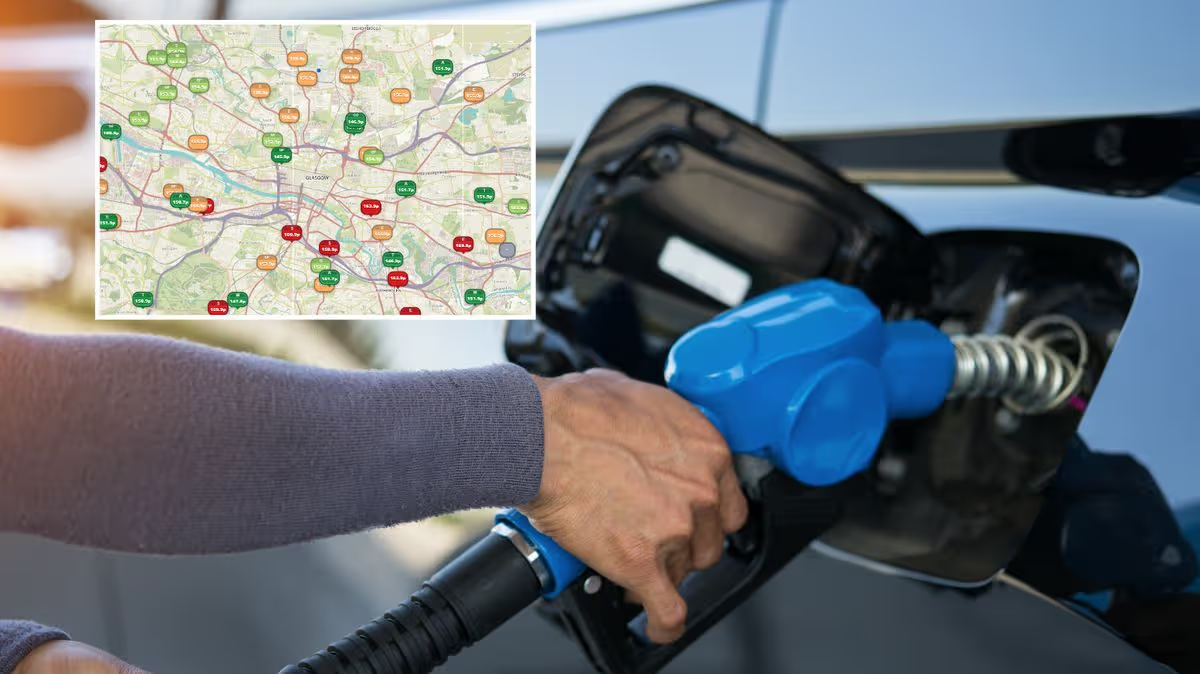
And there is also a relatively recent scheme that can help drivers pick out the best offers in their area – or on their driving route. The UK Government-backed Fuel Finder website has been created to gather and share fuel price data as close to real-time as possible.
Advertisement
Garages across the country are supposed to update their fuel costs within 30 minutes of any change, meaning motorists are able to scan the most up-to-date prices. It is free to use and has a handy, map-based layout.
Users just need to type a location or postcode into the Fuel Finder website, set a distance radius from five to 50 miles, and select their chosen fuel; petrol (e10), diesel (B7), super unleaded (E5), premium diesel, or EV charging points.
The stations within the chosen area should then appear on the map, as well as in a list at the side. The prices will be listed alongside each station, and they are colour-coded on the map, ranging from the cheapest in green, through amber, to the most expensive in red.
Users can also filter their choices by various facilities, such as being open for 24 hours, having toilets, or having a car wash. Launched at the start of February, hundreds of fuel stations across the UK are included – though not all of them have the most up-to-date prices.
Advertisement
To help you out, we have travelled across Scotland on the Fuel Finder map, picking out the best deals for drivers. We haven’t included any stations that haven’t updated their price in the last week, given how quickly the prices have been changing.
In terms of petrol, the cheapest in Scotland at the time of writing is found at Tesco in Cupar and at Costco in Edinburgh, with both charging 144.9p per litre – though the latter is only for Costco members. Burnpark Filling Station in Kilmarnock was next at 146.7pm, with Pace in Cumnock, Tesco in Rutherglen, and Costco in Glasgow all at 146.9p
Asda in Ayr charges 147.7p per litre of petrol, while there are several other supermarkets priced at 147.9p. These include Tesco stores in Dingwall and Ayr, Sainsbury’s in Prestwick, and Morrisons in Ayr. A whopping six of these best-priced locations can be found in Ayrshire.
Advertisement
In terms of diesel, at the time of writing, Gunns Garage in Appin, near Oban, is the best price at just 165.0p. However, this was last updated on March 28, the longest time ago of any forecourt mentioned in this article, so it may have changed since.
Elsewhere, the Gulf Garage in Turriff, Aberdeenshire, charges 168.9p, Central Garage in Alyth, Perthshire, has diesel at 169.9p, and it costs 170.9p at Tesco in Wishaw.
There is a bit of a jump to the next garages, though they do cover a wide area. Tesco in Dingwall (174.9p), Burnpark Filling Station in Kilmarnock (175.7p), Morrisons in Newlands (175.9p), and The Filling Station in Applecross (176.8p) are all at least 5p below the average rate.
To find out the most up-to-date figures on the cheapest petrol or diesel in your local area, or on the route of your Easter holiday, go to the Fuel Finder website.
Scott Mills wrote that he was surprised he had not been fired as a DJ for “saying the wrong thing” or having poor listener stats years before being axed by the BBC
Matt Davies Trendswatch Reporter
13:11, 02 Apr 2026
Scott Mills said he was surprised he hadn’t been dismissed as a DJ in remarks made a full 14 years before his sacking. The former Radio 2 presenter was taken off air following his final show on Tuesday, 24 March. Mills had been questioned by police in 2018 over allegations of “serious sexual offences” against a teenage boy under the age of 16 between 1997 and 2000, as part of an investigation that commenced in 2016.
The case was dropped in 2019 after it was concluded that there was insufficient evidence. The Mirror disclosed on Wednesday (1 April) that the BBC was compelled to terminate its star radio presenter’s contract after compelling new information emerged.
Advertisement
Mills subsequently issued a statement, asserting that he had “fully cooperated and responded” to the investigation in 2018, and that the “evidential threshold had not been met to bring charges”. As the story continues to unfold, earlier remarks by Mills have resurfaced regarding his “plan for a quick getaway” should he ever find himself axed from his role as a DJ.
He recalled in his 2012 autobiography, Love You Bye: My Story, beneath a section entitled “Things I have learned”, that hospital radio “was the first and last radio station” to dismiss him. In his opening entry, “plan for a quick getaway”, he wrote: “You may be surprised to learn that hospital radio was the first and last radio station to give me the sack.
“There are so many stories of DJs being escorted off the premises by security for saying the wrong thing, or having a bad set of RAJAR [radio listener stats] results, it seems strange that’s not happened to me. Yet. Being fired as a DJ can be quick and it can be brutal. One programme director famously held a presenter meeting where he played them all their new jingles.
Advertisement
“When one DJ piped up and said, ‘My name wasn’t on there’, the programme director replied, ‘I know. See me in my office after the meeting’.” Mills added: “I’ve never kept many personal items at work for that very reason. If I’m escorted off the premises, I want to make it quick; I’ll shove my mug and my signed photo of George Alagiah [a BBC newsreader who died in 2023] in a cardboard box and be out the door.”
In his statement, issued through Mills’ lawyers to the Mirror, he maintained that the “announcement” had resulted in what he termed the “publication of rumour and speculation”. It read: “The recent announcement that I am no longer contracted to the BBC has led to the publication of rumour and speculation. In response to this the Metropolitan Police has made a statement, which I confirm relates to me.
“An allegation was made against me in 2016 of a historic sexual offence which was the subject of a police investigation in which I fully cooperated and responded to in 2018. As the police have stated, a file of evidence was submitted to the Crown Prosecution Service, which determined that the evidential threshold had not been met to bring charges.
“Since the investigation related to an allegation that dates back nearly 30 years and the police investigation was closed 7 years ago, I hope that the public and the media will understand and respect my wish not to make any further public comment on this matter. I wish to thank from the bottom of my heart all those who have reached out to me with kindness, my former colleagues, and my beloved listeners, who I greatly miss.”


















































You must be logged in to post a comment Login