
Crypto World
XRP vs PI vs ADA: 3 AIs Speculate Which Will Perform Best in the Next Bull Market


Ripple’s cross-border token has fallen by 65% over the past year, while Pi Network’s PI and Cardano’s native cryptocurrency have crashed by around 73% over the same period. This has happened amid a prolonged bear market that has caused the entire market to bleed heavily.
Yet, many analysts believe that a new bull run may begin in the coming months, while the four-year cycle supports their theories. On that note, we asked three of the most popular AI-powered chatbots whether XRP, PI, or ADA will perform best when everything starts booming again.
XRP’s Chances
According to Perplexity, Ripple’s cryptocurrency has the cleanest risk-adjusted setup to outperform during the next bull run. The chatbot claimed the asset is quite trending among institutional investors and noted that it is perhaps the most popular among the trio.
“XRP is favored to deliver the most consistent, risk-adjusted gains among the three, with a realistic path to new cycle highs if ETF and payments narratives stay hot,” it added.
Perplexity also reminded that Ripple’s legal battle with the US Securities and Exchange Commission (SEC) has long been resolved, and that the absence of regulatory uncertainty can only benefit XRP during a potential market uptrend.
Additionally, it highlighted the company’s global expansion, major investments, and strategic partnerships inked over the past several months that have solidified its presence in the financial and crypto sectors. One of the biggest acquisitions came in April 2025 when Ripple purchased the prime broker Hidden Road for $1.25 billion.
Examples of its broader international growth include the collaboration with the South Korean KBank, which plans to use Ripple’s network and infrastructure, as well as the entity’s ability to secure a MiCA license and continue its operations in the European Union.
ADA’s Potential
ChatGPT agreed with Perplexity that XRP has the strongest institutional foundation. It noted that it is the largest cryptocurrency of the three with deeper liquidity but at the same time argued that it might find it difficult to achieve larger returns than ADA in a future bull run.
OpenAI’s platform claimed that Cardano’s token could be the best overall bet after noting that a huge chunk of the total supply is already in circulation, which makes the risk of dilution less than with XRP and PI.
It predicted that in an “extreme euphoria” case, ADA could skyrocket to as high as $5. It is important to mention that the asset has enjoyed a solid revival over the past week, with its price rising by roughly 17%. Its positive performance comes on the back of whale accumulation and renewed interest from traders, while many analysts think a much more substantial upswing could be on the way.
PI: The Moonshot Bet
Google’s Gemini claimed that XRP and ADA both have chances to rally hard during the next bull run, yet it set its attention on Pi Network’s cryptocurrency.
It said the controversial project has one of the largest community bases in the crypto world, adding that it has the potential to experience a whopping 100x explosion should it solve its ecosystem issues and get listed by the leading exchanges.
Recall that Binance hinted at such a move last year but has not yet done so. Coinbase, Bybit, and many other well-known names also prefer to stay away from PI at the moment.
The post XRP vs PI vs ADA: 3 AIs Speculate Which Will Perform Best in the Next Bull Market appeared first on CryptoPotato.

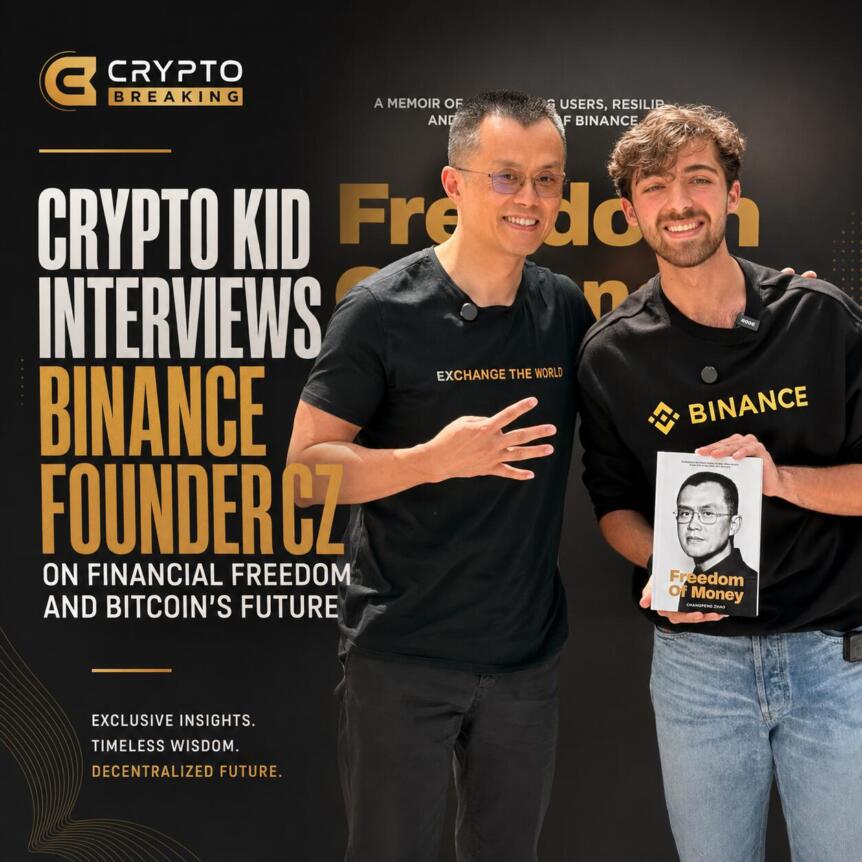
At just 18 years old, Efe Kelemci, better known as Crypto Kid, sat down with Changpeng Zhao (CZ), the co-founder of Binance and one of the world’s richest men.
The rare conversation took place around the launch of CZ’s book, Freedom of Money, but quickly expanded into a broader discussion about how the financial system works, the limitations of traditional money and the role Bitcoin and blockchain could play in giving individuals greater control over their wealth.
Rather than concentrating entirely on Bitcoin’s price or the next cryptocurrency market cycle, Crypto Kid asks CZ to explain the principles behind financial freedom in a way that can be understood by younger people and readers who may not yet be familiar with digital assets.
The result is a brief but substantive interview between Crypto Kid and CZ covering monetary sovereignty, inflation, cryptocurrency adoption and the importance of understanding the financial system before approaching crypto purely as an investment.
A Young Perspective on Money and Financial Freedom
Crypto Kid approaches the conversation from the perspective of a generation that has grown up alongside Bitcoin and digital assets.
At the beginning of the interview, he explains just how early his interest in the industry began:
“I’ve been in crypto since I was 12.”
Now 18, his questions reflect many of the concerns younger people have when they begin thinking about money, investing and their financial future.
What does it mean to have genuine control over personal wealth? Why can money held within the traditional financial system lose purchasing power? Should cryptocurrency be viewed primarily as an investment, or does the underlying technology serve a more fundamental purpose?
By placing these questions at the centre of the discussion, Crypto Kid gives CZ an opportunity to explain the ideas behind Freedom of Money to an audience extending beyond experienced cryptocurrency investors.
Why CZ Believes People Misunderstand Money
One of CZ’s strongest arguments is that society rarely encourages people to examine the nature of money itself.
“We’re brainwashed to think about money in a very simplistic way.”
Most people earn money, deposit it into a bank, spend it and invest what remains. Yet comparatively few stop to consider what their bank balance represents, what guarantees their access to it or how monetary policy affects its purchasing power.
CZ challenges the assumption that money held within the traditional system always provides complete ownership. He points to the possibility of frozen accounts, restrictions on certain transactions and the cost and delay involved in transferring significant amounts internationally.
He also describes conventional currency as a form of debt, arguing that what people commonly treat as money ultimately depends on promises made and enforced by institutions.
“Paper money is actually debt.”
The problem becomes even more visible when the supply of that money expands. When additional currency enters circulation, the nominal balance in an account may remain unchanged while its real purchasing power declines.
From CZ’s perspective, this creates a form of financial dependence that many people accept without questioning.
“You don’t have a lot of freedom with your money.”
This is the central problem that Freedom of Money attempts to explore. Financial freedom cannot be measured only by the amount someone possesses. It must also consider the degree of control that person has over storing, protecting and transferring it.
How Crypto Could Give People More Control Over Money
In the interview, CZ does not describe cryptocurrency merely as an asset capable of appreciating in price. He presents it as an alternative monetary infrastructure.
Blockchain enables people to hold digital assets directly, transfer value across borders and interact with a global financial network that does not operate according to all the same limitations as conventional banking systems.
That does not eliminate risk or personal responsibility. It changes where responsibility is placed.
With direct ownership comes the need to understand custody, security and the technology being used. However, it may also give individuals a level of control that is not always available when every transaction depends on an intermediary.
“You want sovereignty. You want control over your money.”
The word sovereignty is crucial here. CZ is not simply describing the ability to make profitable investments. He is describing money that individuals can store themselves, move internationally and use without another party being able to create additional units of it at will.
In that sense, the case for cryptocurrency is not solely financial. It is also technological and philosophical.
“The blockchain increases the freedom of money.”
CZ places this development within a wider historical pattern. Civilisation has repeatedly advanced by expanding different forms of freedom, including freedom of speech, freedom of the press, freedom of information and access to knowledge through the internet.
Blockchain, in his view, represents another step in that progression by expanding the freedom associated with owning and transferring value.
Financial Freedom Is Not the Same as Getting Rich Quickly
Crypto Kid then raises a question that reflects how many newcomers first approach the industry.
“How do I get rich quick?”
It is a simple question, but it exposes one of the biggest contradictions in cryptocurrency.
Bitcoin was created as an alternative to a monetary system based on centralised control. Yet many people enter the market with the sole objective of accumulating more of the same fiat currency from which Bitcoin was designed to provide an alternative.
CZ’s response redirects the discussion away from rapid gains.
“The freedom is really the key.”
Someone may generate a large profit and still remain dependent on a system capable of restricting access, expanding the money supply or reducing the value of their savings.
From this perspective, wealth without sovereignty is incomplete. The real objective is not simply to increase the number displayed in an account, but to gain greater control over what that value represents and how it can be used.
CZ argues that when people focus exclusively on maximising their holdings in traditional currency, they remain trapped within the same framework they claim to be escaping.
The conversation therefore reframes financial freedom. It is not a winning trade, an early retirement target or a particular Bitcoin price. It is the ability to make informed decisions about money while reducing dependence on systems over which the individual has little influence.
CZ’s Advice to Young People: Understand the Financial System First
The interview becomes especially relevant when Crypto Kid asks what younger people should do when entering the industry.
Cryptocurrency content aimed at new investors often concentrates on charts, tokens and opportunities to generate rapid returns. CZ gives almost the opposite advice.
Speaking about highly speculative trading, he says:
“I would actually recommend youngsters not to try that.”
Instead of beginning with price speculation, CZ encourages young people to learn how money and blockchain technology work, experiment on a small scale and explore the problems the technology could solve.
He points towards practical applications such as micropayments, international transfers and payments performed by artificial intelligence agents.
“Look at more of the utility value of crypto.”
This distinction between utility and speculation may be one of the most valuable lessons in the interview.
Trading asks what an asset might be worth tomorrow. Building asks what the technology could make possible over the next decade.
For young people entering the space, the second question may create far more meaningful opportunities. The cryptocurrency industry still needs developers, entrepreneurs, educators, researchers, product designers and creators capable of turning blockchain infrastructure into applications that ordinary people can use.
CZ compares the present stage of crypto development to the earlier days of the internet, when the basic protocols existed but many of the products that would eventually transform everyday life had not yet been created.
His message is not that young people must ignore cryptocurrency markets entirely. It is that they should first develop a strong understanding of the financial system, the technology and its possible uses, so that price is no longer their only reason to participate.
Bitcoin’s Price May Be Disappointing, but Adoption Is Still Early
Towards the end of the conversation, Crypto Kid asks CZ about Bitcoin’s recent price performance and the frustration felt by investors who expected the market to move higher.
CZ acknowledges that he shared those expectations. He had also believed Bitcoin would be trading at a higher level.
However, he notes that a significant amount of speculative capital moved towards artificial intelligence. While this may have weakened crypto momentum in the short term, he suggests that it could ultimately allow the market to grow on more stable foundations.
The more important point is that CZ does not measure Bitcoin’s future solely through its latest market cycle.
“Less than 1% of the world” currently uses cryptocurrency.
Whatever the precise figure, his broader point is clear: CZ believes the industry remains far from mass adoption.
Billions of people still do not directly own cryptocurrency, use blockchain-based payments or interact with decentralised financial infrastructure. Many businesses and institutions are also only beginning to explore how digital assets could fit into their operations.
From that perspective, Bitcoin’s present price becomes one data point inside a much larger adoption story.
The long-term opportunity depends less on whether the market reaches a particular target this year and more on whether blockchain technology becomes genuinely useful to a wider section of the global population.
The Story Behind Freedom of Money
The interview also briefly addresses the personal circumstances surrounding the creation of CZ’s book.
CZ explains that he began writing its first draft while in prison, where the lack of distractions gave him time to reflect on his journey and the evolution of the cryptocurrency industry.
The conversation does not remain focused on that period. Instead, it uses the experience as context for understanding why the themes of freedom, uncertainty and personal control became central to the book.
CZ later spent considerable time revising and completing the manuscript. The finished work combines his personal experience with his perspective on how cryptocurrency has developed since he entered the industry in 2013.
For readers, the book provides CZ’s personal account of a period that took Bitcoin from a relatively small technological experiment to a globally recognised financial asset and infrastructure layer.
Financial Freedom Begins With Better Questions
The strongest message from the conversation is not that people should buy cryptocurrency immediately or expect Bitcoin to make them rich.
It is that they should understand the money they already use.
Who controls it? What can reduce its value? Under what circumstances can access to it be limited? How easily can it move across borders? And which alternatives now exist?
Blockchain does not automatically answer every financial problem. It does, however, introduce new choices around custody, scarcity, payments and ownership.
For CZ, those choices are the foundation of monetary freedom. For Crypto Kid and the younger generation he represents, the opportunity is to understand that technology early enough to help shape what comes next.
The conversation ultimately encourages viewers to replace the question “How quickly can crypto make me rich?” with a more important one:
How much freedom do I really have over my money?
Watch the Full Interview
Watch Crypto Kid’s complete interview with Binance co-founder CZ on YouTube.
Follow Crypto Kid
Learn more about Efe Kelemci and his work through the official Crypto Kid website. You can also follow Crypto Kid on X, Instagram and LinkedIn.
Follow CZ
Follow Changpeng Zhao on X for his latest perspectives on Bitcoin, cryptocurrency adoption, entrepreneurship and the future of finance.


Securitize Corp. (NYSE: SECZ) said Monday that its subsidiary Securitize Capital LLC is now registered with the U.S. Securities and Exchange Commission as an investment adviser. The registration became effective July 22, according to the SEC's Investment Adviser Public Disclosure database…. Read the full story at The Defiant

Bitcoin users are revisiting a core assumption about self-custody after the disclosure of a “low-entropy” issue tied to Coldcard hardware wallet firmware. According to reporting and analysis referenced in the crypto community, publicly observed thefts linked to the flaw began around July 30, prompting investors and long-time hardware wallet holders to scrutinize how their seed phrases are generated.
While Coldcard’s devices have long been valued for offline security and user control, the episode highlights an uncomfortable truth: if the randomness used to create a wallet’s seed can be predicted or effectively reduced, attackers may brute-force private keys. The situation has also reignited debate inside the ecosystem about what it actually means to “verify” secure entropy—and how much should be outsourced to hardware versus performed by the user.
Key takeaways
- Coldcard firmware starting with version 4.0.1 (released March 2021) is described as using MicroPython’s Yasmarang PRNG instead of relying correctly on the device’s STM32 hardware RNG.
- Coinkite estimated that affected Coldcard models produced seeds with roughly 40 bits of entropy (Mk2/Mk3) or around 70 bits (Mk4/Mk5/Q), which falls short of what’s needed for a robust 12-word BIP-39 seed.
- Attackers reportedly brute-forced private keys after the issue became known, with Cointelegraph coverage cited as placing stolen value at over $100 million in BTC.
- Users who generated seed phrases using sufficient physical entropy (e.g., dice) have been argued to reduce reliance on the compromised randomness path.
- Community tools such as honeypot monitoring have been used to estimate which wallet types attackers are sweeping effectively.
What changed in Coldcard’s randomness generation
The central technical claim is that Coldcard hardware wallets contained what appeared to be functional STM32 “true random number generators” (TRNGs) designed to produce unguessable seed phrases. However, after Coldcard creator NVK initiated a firmware rewrite intended to move from a GPL-licensed free software model to a read-only model, analysts say a serious vulnerability was introduced.
Starting with firmware version 4.0.1, released in March 2021, the device reportedly switched to MicroPython’s Yasmarang PRNG rather than properly using the STM32 hardware RNG. Random number generation is described as inherently difficult for computer systems, and secure seed creation is typically expected to incorporate enough external physical unpredictability to make outputs infeasible to guess.
In the ecosystem, the Yasmarang PRNG has been widely characterized as a pre-programmed fallback. A referenced engineering analysis from Block that explains “predictable RNG fallback” and the mechanics of a “32-bit reseed” approach was linked by the article’s source material. Coinkite later disputed that characterization in an X post, challenging the conclusion that the device was simply hardwired to an obviously weak method.
Even with that dispute, the broader implication remains: when a wallet’s seed generation is not truly unpredictable, private keys may become searchable. The article’s source material notes speculation on X about whether a backdoor was deliberately placed, and it also cites a Bitcoin journalist’s view that the bug may have arisen from development practices and attempts to suppress errors through randomized changes.
Entropy levels, seed security, and why brute force mattered
Coinkite’s estimates cited in the source material are specific about the magnitude of the problem. It estimated that Mk2 and Mk3 devices generated seeds with about 40 bits of entropy, while Mk4, Mk5, and Q achieved roughly 70 bits. As the source notes, both figures are well short of the 128-bit level generally treated as sufficient for a secure 12-word seed phrase.
That shortfall matters because it reshapes the threat model. Instead of requiring attackers to brute-force astronomical keyspaces, lower effective entropy can make key discovery drastically more practical. The source material further states that after the flaw, attackers succeeded in brute-forcing private keys and stealing funds, pointing to Cointelegraph coverage that described thefts exceeding $100 million worth of BTC.
The likelihood of whether a specific wallet was found and swept is presented as depending on additional variables—such as whether extra “dice entropy” was added, or whether a BIP-39 passphrase and a non-standard derivation path were used. Those details underline a key uncertainty for readers: the exploit’s impact may not have been uniform across all users and all wallet setups.
Using physical entropy to reduce reliance on hardware
Beyond the immediate controversy around Coldcard firmware, the episode has reinforced a recurring community principle: “Don’t trust, verify.” The source material argues that users who avoided relying on opaque hardware generation for the most security-critical step—seed creation—had a better chance of preventing exposure to the low-entropy issue.
The practical point is that rolling dice provides a process users can observe and audit themselves. Verifying a TRNG’s quality, by contrast, would require detailed inspection of electronics and firmware—work most users cannot feasibly perform.
Importantly, the source material suggests that safe self-custody still does not require relinquishing the ability to cross-check. If the seed phrase is generated from physical entropy, the user’s dependence on the compromised hardware path is reduced. It also describes ways to validate whether derived artifacts match across devices—such as importing the same seed into another device to cross-check the resulting xpub and receiving addresses.
For detecting other classes of compromise, the source material also mentions checking signatures: nonce exfiltration through an airgap can be detected by comparing whether two devices generate the same signature when given an identical unsigned transaction, referencing RFC 6979 for deterministic signing behavior.
While these checks can’t replace true unpredictability at the moment entropy is created, they create additional hurdles for attackers and can help users spot irregularities in how transactions are processed and signed.
How the community is generating entropy without trusting a single device
After the exploit became public, the source material says methods and proposals for generating entropy directly from physical inputs accelerated across the community. One widely used approach described involves validating dice-to-seed conversion by cross-checking the device’s ability to correctly transform die faces into a BIP-39 seed phrase via hashing. The article states that using upward of 100 dice throws can be enough to generate entropy for a 24-word seed.
Other options include paper-based systems. The source cites a table published by Bitbox that uses a lookup method to map combinations of dice outcomes—plus a coinflip—directly to BIP-39 seed words without electronics. More advanced worksheets are also referenced, including a codex32 dice de-biasing approach that uses a van Neumann extractor so biased dice can still yield secure seed material that can be computed by hand.
For users seeking convenience, the source material points to alternatives that reduce error-proneness, such as printing and cutting BIP-39 word fragments, shuffling them, and drawing random words—methods made easier by products like Seedsticks or Entropia. It also references specialized hardware intended to verifiably distribute entropy across devices, alongside examples of community-designed physical entropy generators shared on X.
Taken together, these ideas shift the emphasis from “which hardware wallet is most trusted” to “how randomness is sourced at the moment security depends on it.” In practice, the Coldcard incident has encouraged many users to treat seed creation less like a black-box procedure and more like a process they can replicate and reason about.
Going forward, readers should watch for clearer technical consensus on exactly how the affected firmware path produced low-entropy outputs in different models, and for continued analysis tools—such as honeypot tracking mentioned in the source—to refine estimates of which wallet behaviors remain most resilient. Until then, the safest operational takeaway is straightforward: wherever possible, make seed generation as independently verifiable as the rest of your self-custody workflow.


The CFTC has warned regulated prediction markets against displaying American-style gambling odds as state authorities intensify efforts to classify sports event contracts as unlicensed betting.
Summary
- The CFTC told regulated prediction markets to avoid American-style odds in product displays.
- Platforms must comply with derivatives laws and avoid deceptive marketing or solicitation practices.
- New York is seeking at least $36 billion from Kalshi over alleged gambling violations.
- Kalshi has requested emergency protection from Utah enforcement while it pursues an appeal.
CFTC warns prediction markets over odds displays
The Commodity Futures Trading Commission instructed regulated prediction market platforms not to display contracts using American-style gambling odds, according to an Aug. 7 Bloomberg report.
American odds typically show potential returns using positive and negative numbers, such as +150 or -200. Sportsbooks commonly use this format, while prediction markets usually price contracts between $0 and $1 based on the implied probability of an event.
The CFTC also reminded registered entities that event contracts remain subject to U.S. derivatives laws. Platforms must avoid “deceptive” practices when listing, advertising, or soliciting trades in these products.
The guidance suggests that federal registration does not allow prediction markets to advertise their products in a manner that makes them indistinguishable from conventional sportsbooks. It comes as the agency continues defending its authority over event contracts against state gaming regulators.
The CFTC maintains that designated contract markets fall under its exclusive jurisdiction through the Commodity Exchange Act. State officials argue that contracts tied to sporting events constitute wagers and require local gambling licenses.
State lawsuits challenge CFTC jurisdiction
New York became the latest state to escalate the dispute when Attorney General Letitia James sued Kalshi on July 31. As crypto.news reported, the state is seeking at least $36 billion in damages and penalties.
The complaint alleges that Kalshi operates an unlicensed gambling business by allowing New York residents to trade contracts on sports and other events. Kalshi has denied that characterization and argues that its status as a CFTC-regulated exchange places it outside state gambling oversight.
The dispute extends well beyond New York. Attorneys general from 44 states recently urged the CFTC to withdraw and rewrite its proposed prediction market rules. They argued that states have traditionally regulated sports betting and should retain authority over sports-related contracts.
Courts have also questioned the federal regulator’s position. A Wisconsin federal court rejected the CFTC’s request to prevent state authorities from applying gambling laws to prediction platforms.
Washington secured a preliminary injunction against Kalshi in July. The court found that federal derivatives law did not prevent the state from enforcing its gambling restrictions, according to earlier crypto.news coverage.
Kalshi seeks emergency relief in Utah
Kalshi filed an emergency motion for an injunction pending appeal after a Utah federal court ruled that the state could enforce its anti-gambling laws against prediction markets.
Gaming law expert Daniel Wallach said the company requested expedited relief because it fears Utah Attorney General Derek Brown could pursue civil or criminal charges while the appeal remains pending.
The ruling rejected Kalshi’s claim that the Commodity Exchange Act prevents Utah from regulating its sports event contracts. Kalshi intends to take the dispute to the U.S. Court of Appeals for the Tenth Circuit.
Utah residents could still access the platform immediately following the decision, but Brown indicated that the state planned to enforce its gambling laws. The state has not disclosed what form that enforcement will take.
Prediction markets face tighter compliance demands
The latest warning shows that the CFTC’s support for federal jurisdiction does not remove compliance obligations for prediction market operators.
The agency has also pursued misconduct on regulated platforms. Former U.S. Representative George Santos recently agreed to return $17,569.98 in trading gains, pay a $17,500 penalty, and accept a three-year trading ban over Kalshi contracts, as crypto.news reported.
The CFTC’s warning could require platforms to review how they display contract prices and promote sports-related products. Meanwhile, pending appeals in Utah and other states will help determine whether federal registration can shield prediction markets from local gambling laws.

The United States Senate postponed action on the Clarity Act until September, extending uncertainty across the digital asset market. The delay removed a key legislative event that market participants expected before the August recess. Meanwhile, Bitwise Chief Investment Officer Matt Hougan said weaker expectations for the bill could trigger brief market pressure before conditions improve later this year.
Senate Pushes Clarity Act Vote to September
Senate leaders confirmed that lawmakers will not consider the Clarity Act before the August recess. Instead, they scheduled the legislation for consideration after Congress returns in September. As a result, the digital asset industry faces another period without a clear federal regulatory framework.
The bill aims to establish clear oversight for digital assets across the United States. It also defines the responsibilities of the Securities and Exchange Commission and the Commodity Futures Trading Commission. Therefore, many industry participants consider the proposal an important step toward regulatory certainty.
Republican lawmakers currently hold 53 Senate seats, yet the legislation requires 60 votes to overcome a filibuster. Consequently, bipartisan support remains necessary before the bill can advance. Lawmakers also continue negotiations over ethics rules, illicit finance measures, and consumer protection requirements.
Bitwise Expects Brief Market Weakness Before Potential Recovery
Bitwise Chief Investment Officer Matt Hougan addressed the delayed legislation in a recent company memo. He said lower expectations for the Clarity Act could remove uncertainty surrounding the Senate timetable. He added that the market could experience a short period of weakness before recovering later in the year.
Hougan pointed to prediction market expectations surrounding the legislation during his assessment. He said the probability of passage during 2026 should decline sharply if lawmakers fail to approve the bill this week. According to his view, reduced expectations could eliminate a major source of short-term uncertainty.
He also stated that the crypto market could weaken briefly after expectations adjust. However, he suggested that a clearer outlook may create stronger conditions during the fall. Therefore, the immediate reaction could remain temporary if legislative uncertainty declines.
Bitcoin, Ethereum, and XRP Hold Key Levels as Regulatory Debate Continues
Bitcoin continued trading above $64,400 despite the Senate postponement and broader policy uncertainty. At the same time, Ethereum remained above $1,900, while XRP traded near $1.05. Those price levels reflected a relatively stable market despite delayed legislative action.
The Clarity Act remains one of the most significant digital asset proposals under consideration in Washington. The legislation seeks to separate regulatory responsibilities between the SEC and the CFTC. In addition, it intends to provide clearer compliance standards for digital asset businesses operating in the United States.
Negotiators continue discussing several disputed provisions before the Senate resumes its work. One proposal could require President Donald Trump to divest from certain crypto-related business interests under new ethics rules. Meanwhile, President Trump has continued supporting policies that maintain United States leadership in digital asset innovation instead of allowing China to strengthen its position in the sector.
The delayed vote leaves the regulatory timetable unresolved as lawmakers continue negotiations during the congressional recess. Although the legislation remains active, its final form still depends on bipartisan agreement. Until then, the digital asset market will continue operating without the comprehensive federal framework that many industry participants have sought for years.
Magic Labs, the company behind the embedded wallet infrastructure used by apps including Polymarket and WalletConnect, sold its wallet business to Payward, the parent company of Kraken, and is rebranding itself as Newton Labs. Co-founder and CEO Sean Li announced the two decisions Monday in a post… Read the full story at The Defiant
Crypto World
Dominic Sessa Summons the Rapscallion Spirit of Anthony Bourdain in the Exhilarating, Tender Tony

This is how Tony, who will eventually become Anthony, falls for the restaurant life: The chaos of the kitchen, the unruly, often drug-addicted personalities, the power to put together meals that people can enjoy with friends, and maybe even remember long after the fact. Sessa is perfect as the swain Bourdain: He’s got that just-fallen-out-of-bed look—perhaps because he literally has just fallen out of bed, or, more accurately, a hammock—but he’s also hungry and inquisitive in a touching way. At first charged with the lowly task of dishwashing, he furtively watches his kitchen colleagues—including Leo Woodall’s Sal, who becomes both a friend and a terrible influence—as they expertly shuck oysters, or slam the lever on a heavy-duty potato slicer as if it were the arm of a slot machine, usually while talking trash about one another. Suddenly, he’s found the place where he belongs. Banderas’ Chef spots Tony’s spark of potential before he does: One of the cardinal rules he’s instituted for his employees is that they must never be even 15 minutes late. To that end, every workday morning he rouses Tony from the snoozy coziness of his hammock with a bucket of water. He doesn’t want this kid to fail, and though Tony has loving, albeit perhaps too permissive, parents (they’re played by Rich Sommer and Dagmara Dominczyk), this is just the kick in the pants he needs.
Firmus, an Nvidia-backed artificial intelligence (AI) infrastructure firm, raised $2 billion in a fully subscribed equity round, lifting its valuation above $10.5 billion. The round closed as NVIDIA (NVDA) shares traded within about $13 of their all-time high.
The raise is the latest in a string of multibillion-dollar commitments tied to Nvidia’s ecosystem. For NVDA bulls, it signals that heavy AI spending remains intact ahead of the August 26 earnings report.

Nvidia Doubles Down on Firmus’ AI Infrastructure Buildout
Nvidia and Coatue Management returned as follow-on investors in the round. Blackstone-managed funds and trading firm Jane Street joined for the first time, Firmus said in a statement.
The deal follows the SpaceX satellite computing deal announced earlier this week and a June agreement for Firmus to buy Nvidia infrastructure and resell Nvidia-powered cloud services. Each new commitment feeds the same demand story that supports the stock.
The Australian company will use the proceeds to accelerate Project Southgate, its rollout of AI training and inference factories across Australia. The capital also funds expansion into Asia-Pacific markets, including a recently announced development in Indonesia.
Firmus began as a supplier of cooling technology for Bitcoin mining before pivoting to data centers built on Nvidia’s DSX reference architecture. The firm has raised over $3 billion in equity in the past year, nearly doubling its $5.5 billion April valuation.
Emanuel Ajay Datt, managing director of investment manager Datt Group, told Reuters the raise reflects how scarce such opportunities have become.
“The pace at which Firmus has re-rated demonstrates how private capital views AI infrastructure as one of the few capital-scarce opportunities in global markets right now.”
Follow us on X to get the latest news as it happens
NVDA Stock Nears Record High as Wall Street Stays Bullish
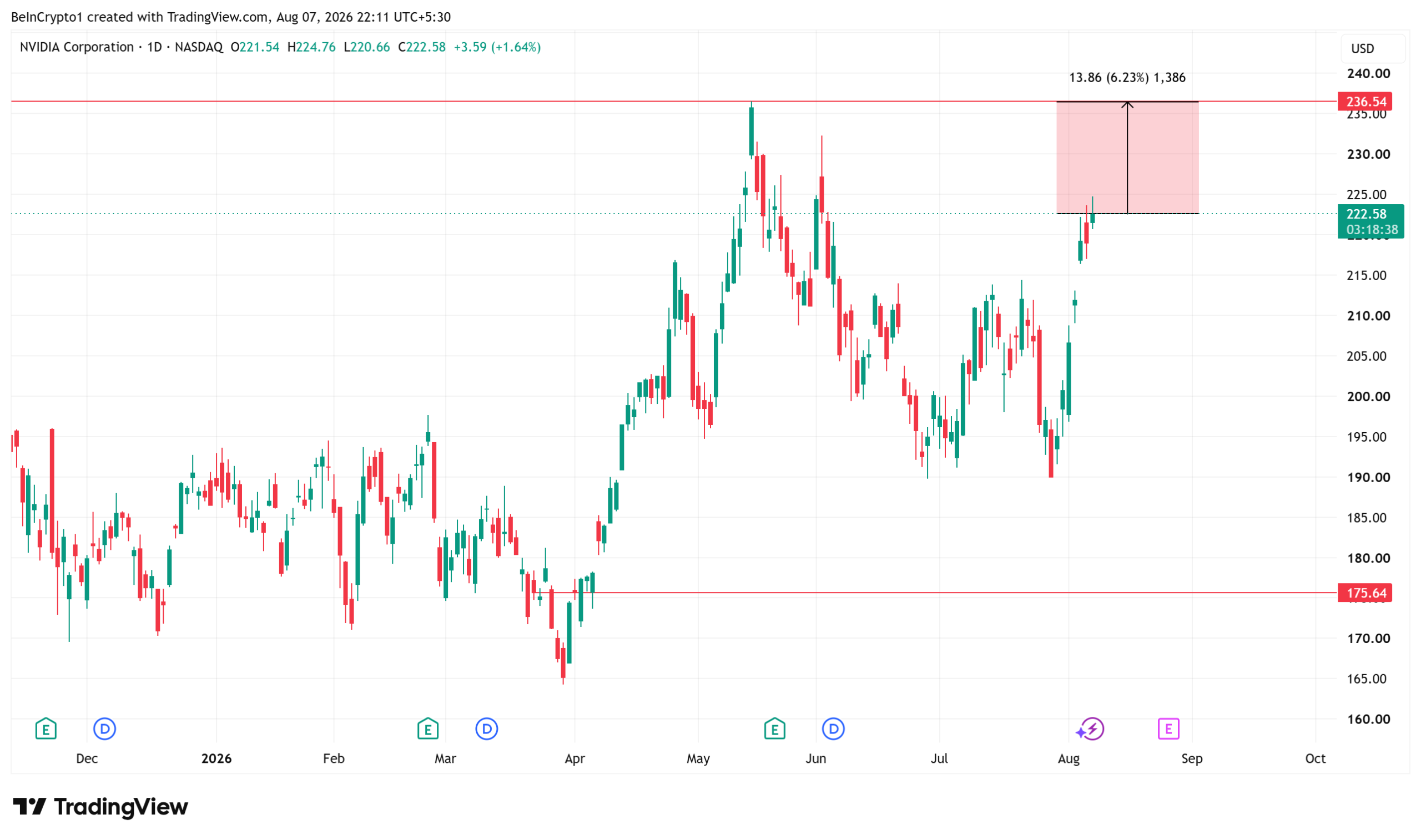
NVDA changed hands at $223.67 in midday trading on Friday, up 2.14% from the prior close of $218.99, per Yahoo Finance data. The stock sits about $13 below its record $236.54, set on May 14.

Wall Street remains firmly behind the trade. Among the 37 analysts covering NVIDIA, 36 rate the stock a Buy, with one Hold and no Sells.
Their average 12-month target of $308.69 implies roughly 38.77% upside from current levels. Forecasts range from $250 to $500, while Bernstein and Wells Fargo each hold $315 targets.

However, skeptics still question the demand behind the spending wave. Michael Burry has warned of a 1987-style crash and argues Nvidia helps finance the customers buying its chips.
One financing round will not settle that argument, which feeds a wider AI bubble debate. It does show multibillion-dollar checks for Nvidia-aligned projects keep arriving, three weeks before earnings test the demand behind them.
The post Nvidia Stock Forecast: NVDA Targets Record-High After New $2 Billion AI Deal appeared first on BeInCrypto.


Before Anthony Bourdain was a famed chef with eight Emmys for his travel series Anthony Bourdain: Parts Unknown, he started out as a dishwasher in Cape Cod’s hippie enclave Provincetown in the mid-1970s. Tony, out in theaters Aug. 7, explores this period in Bourdain’s life, imagining how that kitchen job whet his palate for working in the restaurant industry.
In the movie, Dominic Sessa portrays Anthony Bourdain, a student at Vassar College who follows his crush Nancy Putkoski to Provincetown, where she works in the summer at a pizza shop. She doesn’t exactly feel the same at first, and so one night, a heartbroken Bourdain drowns his sorrows at a casual seafood restaurant and gets into a fight there, ending up too drunk to go home. The restaurant’s chef (Antonio Banderas)—known simply as “Chef” in the film—brings him back to his house. The chef lets him stay for the summer because he has nowhere to go and puts him to work as a dishwasher in his restaurant.
The staff is full of miscreants, who are snorting lines of cocaine left and right. But the chef becomes a mentor, showing Bourdain the particulars of running a Provincetown kitchen: how to shuck oysters and make homemade salt out of seawater. Bourdain arrives looking for love and ends up finding it in food and kitchen culture—a passion that would shape the rest of his life.
The real Bourdain died by suicide in 2018 at the age of 61. Tony, taking place over one summer, does not delve into questions about his death. “We wanted to remind people why they loved him in the first place, focus on the beginning of his life where he figured out how to share his superpower with the world of curiosity, empathy and connecting people through food,” says Lou Howe, one of the Tony screenwriters.
Here’s the real dish from Bourdain’s time in Provincetown, where he decided to become a chef.
Bourdain’s real Cape Cod shenanigans
When Bourdain went to Provincetown for the first time, he wasn’t craving lobster rolls, but the company of one particular woman. As he wrote in his 2000 memoir Kitchen Confidential, he was 18 and “unhappily in love” when he went there to find his high school crush and future wife Nancy.
They were both students at Vassar, and they shared a house with roommates, where he says there was a lot of cocaine, pot, acid and sunbathing nude—in other words, as he put it, “healthy teenage activities.”
Nancy worked at Spiritus Pizza, and while Bourdain didn’t actually move in with a chef, as the movie depicts, he did sleep in the crawl space over a walk-in refrigerator at Spiritus Pizza at one point.
One of the roommates hooked Bourdain up with a dishwashing gig at the Flagship, best known for serving up fried seafood to summer tourists.
“He was forced to get this job. He didn’t have any money in Provincetown,” says Todd Bartels, one of the Tony screenwriters.
The rag-tag kitchen crew included an ex-con and part-time methadone dealer who worked the salad station. They nicknamed Bourdain “Mal,” short for “mal carne,” which is what they called bad meat. Bourdain was doing all of the grunt work at the Flagship, scrubbing pots and pans, scraping plates, peeling potatoes, and cleaning shrimp.
Bourdain was attracted to a certain kind of swagger that the kitchen crew boasted. In one dramatic example in Kitchen Confidential, he wrote that when he watched a chef at the Flagship rear-end a bride celebrating her wedding at the restaurant, “I knew then, dear reader, for the first time: I wanted to be a chef.”
Chefs at the restaurant were hailed for “total number of waitresses screwed, cocktails consumed without visible effect.” He gushed about the chefs, not only for their ability to churn out so many dinners in a sweltering kitchen, but also because they were “sexual athletes” who lived a life of “adventure, looting, pillaging, and rock-and-rolling through life with a carefree disregard for all conventional morality.”
Bourdain dishing on Bourdain
In Tony, Sessa as Bourdain is obnoxious, talking himself up and lying to everyone he meets, even pretending that he’s writing a book about the restaurant to impress Nancy. The real Bourdain was definitely known as an arrogant kid in Provincetown. Per Kitchen Confidential, back then he was “angry” and “undisciplined,” writing, “I treated the world like my ashtray.”
“He was very brutally honest in critiquing his younger self, so that gave us some free rein to paint this wayward young man in all his warts,” says Howe.
As one of the Flagship’s chefs, Alex Getmanov, said in Laurie Woolever’s Bourdain: The Definitive Oral Biography, Bourdain “didn’t know anything, and he had this attitude that he could do anything, which doesn’t get you far in a working kitchen.”
Working in the Flagship’s kitchen, Bourdain wrote, “essentially pushed me down the path I still walk to this day.”
In an episode of his food travel series Parts Unknown, Bourdain described the Flagship as the place “where my cooking career started, where I started washing dishes, where I started to have pretensions of culinary grandeur.”
True to life, the movie ends with Bourdain dropping out of Vassar to enroll at the Culinary Institute of America in upstate New York.

What Bourdain learned from the Cape Cod food scene
The chef and mentor in Tony (Antonio Banderas) is a composite of different chefs who inspired Bourdain.
One chef he especially looked up to in Provincetown was Howard Mitcham, author of the Provincetown Seafood Cookbook (1975), who would host an annual clambake like the one in the movie. As Bourdain wrote in a 2018 introduction for Mitcham’s cookbook, “He understood always that the best place to enjoy seafood was on the beach, among friends, in a pretense-free zone, preferably accompanied by many drinks.” Mitcham also taught him that “there is no difference between the joys of a great meal at a three-star Michelin and at a humble fisherman’s bar—as long as it’s made with love and with pride.”
More than that, he learned a passion for food. “Howard showed us how to cook for ourselves, for the pure pleasure of eating, not just for the tourist hordes,” he wrote in Kitchen Confidential, “that food could be a calling. That the stuff itself was something we could actually be proud of, a reason to live.”
He also learned that you don’t need to do much to fresh seafood to make it taste good. As the movie shows, local foodies would swarm the ocean whenever striped bass appeared, reeling them in with pieces of Wonder Bread and then whacking them on the head. In Kitchen Confidential, Bourdain described filleting the fish under gas lamps—covered in gore—and broiling the fish with lemon and butter to make “a meal that made me feel better about things, made me better for eating it, somehow even smarter.”
He left Cape Cod with an appetite for food and vice. As he said in Parts Unknown, “I left Provincetown with restaurant experience, a suntan, and an ever deepening relationship with recreational drugs.”
Provincetown also gave Bourdain, an aspiring writer, something to finally write about, says Bartels. “He found a purpose. I don’t know if there’s anything more profound than that.”


Flash Trade said on Friday it will wind down operations unless it finds a party to acquire the Solana perpetuals exchange, and that the decision was not driven by money. "This decision is not calculated based on monetary reasons," the team wrote on X, citing "direction, shrinking market… Read the full story at The Defiant

Crypto Kid Interviews Binance Founder CZ on Financial Freedom and Bitcoin’s Future
Estrela Amadora vs Sporting CP Prediction and Betting Tips

Take-Two’s CEO predicts streaming will 10x gaming’s install base within three years

Renter of Home in Anne Heche Crash Denies Settlement With Son

No Jackpot Winner as $257 Million Prize Rolls Over to $269 Million Monday Draw

Weekend Open Thread: Staud – Corporette.com

No Cost EMI – A Scam ? #LLAShorts 78

How To Create Viral Finance Videos With AI That Get Millions of Views (Step-by-Step) | Part 2

The Dark Truth About What Drives Crypto Obsession #DarkPsychology #HumanBehavior #Cryptocurrency
-

 Politics5 days ago
Zack Polanski: an incitement to murder Nigel Farage?
-

 Crypto World6 days ago
MicroStrategy Post-Earnings CLARITY Act Push Could Add New Catalyst for Its Stock
-

 Crypto World7 days ago
XRP Ledger v3.3.0 brings five institutional features
-

 Crypto World7 days ago
New York sues Kalshi over prediction market gambling
-

 Crypto World6 days ago
Crypto PAC spending tops $2M in Michigan House race
-

 Business5 days ago
DTCR: Deleveraging And A Hedge Fund Collapse Point To A Possible AI Bottom
-

 Tech6 days ago
ESET tracks rise in malicious AI skills and adaptable malware
-

 Sports7 days ago
France Cricket implodes: letters hidden in a drawer and a board at war
-
Crypto World5 days ago
XRP Ledger urges node upgrade after manifest flood
-

 Crypto World7 days ago
Moneyflip CEO charged in $40K murder-for-hire plot
-
 Sports7 days ago
Bruno Fernandes decision made as Man United ‘discuss’ striker transfer option
-

 News Videos6 days ago
Financial Crash Expert: The 90-Day Collapse Timeline They Are Desperately Hiding.
-

 Sports2 days ago
Jordan Coyle & Cordiamo take Laya Arena Stakes at RDS
-
 Crypto World4 days ago
US Tech Stocks See Largest 5-Week Inflow in History: Can Nasdaq Break Its Downtrend?
-
 NewsBeat6 days ago
Tourist plane on sightseeing flight in Peru crashes into a field, killing all 13 people on board
-

 NewsBeat6 days ago
Arsenal reach full agreement with Newcastle over Bruno Guimaraes transfer | Football
-

 Fashion12 hours ago
Frugal Friday’s Workwear Report: Cap-Sleeve Pointelle Crewneck Sweater
-

 Tech6 days ago
Page Not Found | WIRED
-
 NewsBeat6 days ago
Bikini-clad Jennifer Aniston, 57, kisses hypnotist boyfriend Jim Curtis as they enjoy a romantic getaway aboard a luxury yacht in Spain
-

 Politics2 days ago
Reform UK And Greens Sink To Lowest Favourability Ratings To Date
You must be logged in to post a comment Login