
Crypto World
Bitcoin’s volatility has nearly disappeared. The risk hasn’t: Crypto Daily



Spot bitcoin ETFs are yet to see outflows this month, bringing in $754 million in the first week of August. Yet, bitcoin remains steady at $64,700, while options flow favors protection at $62,000 and $63,000.
The opposing signals point to a market with a spot bid but limited conviction. ETF demand has seemingly returned, but derivatives traders are guarding against a retreat ahead of today’s U.S. jobs report.
The options market adds another layer. Put options, giving holders the right but not the obligation to sell, accounted for 53.8% of bitcoin options volume over the past 24 hours, and three of the four most-traded contracts were puts at $62,000 or $63,000 expiring Aug. 10, Aug. 14 and Aug. 28, CoinGlass data shows.
Calls still represent 60.7% of total open interest, showing that the broader options market remains tilted toward calls even as recent trading focuses on downside puts.
Protection is also cheap. Deribit’s DVOL index, which tracks bitcoin’s expected 30-day volatility, is near 35, down from a high of 90 earlier this year. That implied volatility tracks the market’s pricing of future movements, implying not much is expected to happen in the near future.

Russia has detained over 20 workers in raids on nine crypto exchanges over alleged laundering scheme tied to scam proceeds.
Summary
- Russia has detained more than 20 people after raiding nine unregistered crypto exchange services in Moscow.
- Authorities alleged the exchanges converted scam proceeds into cryptocurrency and transferred the funds to Ukrainian handlers.
- Exchange employees and couriers are under investigation for alleged involvement in large scale fraud carrying penalties of up to 10 years in prison.
- The operation comes weeks before Russia’s new regulated cryptocurrency market is scheduled to begin on Sept. 1.
According to an official statement from Russia’s Federal Security Service (FSB), authorities, working with the Interior Ministry, shut down nine unregistered cryptocurrency exchange services operating from Moscow’s business district after alleging they were used to convert money stolen through phone scams into cryptocurrency and send it to accounts controlled by Ukrainian coordinators.
The operation took place at the Moscow International Business Center, commonly known as Moscow City, where more than 20 employees of the exchange services were detained. The FSB alleged the exchanges formed part of nine overseas-coordinated channels used to move funds out of Russia through crypto transactions.
Authorities said the case centers on proceeds from remote fraud targeting Russian citizens. According to the FSB, victims remained in continuous contact with scam call centers, followed detailed instructions from fraudsters and did not realize the nature of the transactions they were carrying out.
Crypto exchange workers and couriers face fraud charges
Investigators allege the exchange services sold cryptocurrency to victims, including pensioners who were acting under the influence of scammers, before transferring the digital assets to accounts belonging to what the FSB described as Ukrainian handlers.
Alongside the exchange employees, authorities detained alleged accomplices between the ages of 18 and 25 who, according to the agency, worked as couriers. Officials said the couriers collected cash from defrauded individuals and delivered it to the crypto exchange points for conversion before the funds were allegedly sent abroad.
The FSB also said many of the people recruited to work at the exchanges had been hired remotely from different Russian regions despite lacking sufficient financial knowledge. Investigators alleged they had been drawn into the operation by promises of easy earnings.
Russia’s Interior Ministry has opened criminal cases under Part 4 of Article 159 of the country’s Criminal Code, covering fraud on an especially large scale. According to the authorities, exchange employees and couriers are being investigated as alleged accomplices in the offenses and could face prison terms of up to 10 years if convicted.
At the same time, officials said they are continuing to identify additional victims, verify witness statements and determine whether financial losses can be recovered.
Russia steps up oversight before crypto rules take effect
The enforcement action comes less than a week after President Vladimir Putin signed Russia’s new digital asset law, which establishes a regulated framework for cryptocurrency exchanges, brokers, custodians and other market participants beginning Sept. 1.
Under the legislation, crypto exchange providers must join a government registry and maintain minimum capital requirements before offering services under the new legal regime. Existing exchange businesses have a transition period before registration requirements become mandatory, although the FSB identified the businesses targeted in the latest operation as unregistered exchange points allegedly involved in criminal activity.
The legislation also limits retail cryptocurrency purchases, introduces mandatory suitability testing for investors and continues Russia’s ban on using cryptocurrency to pay for ordinary goods and services inside the country. At the same time, it permits digital assets to be used in certain cross-border trade settlements under the framework approved by lawmakers.
Meanwhile, the Bank of Russia is preparing additional regulations covering exchange operations, organized trading, digital depositories and investor protection before the main provisions of the law take effect.
Authorities have tightened enforcement across the crypto sector
The latest raids follow several recent government measures affecting the cryptocurrency industry.
Earlier this month, Prime Minister Mikhail Mishustin approved an expansion of Russia’s regional cryptocurrency mining restrictions, extending a long-term mining ban to Moscow, the Moscow Region and parts of Kursk from Aug. 15 through the end of 2032. Officials said the decision was intended to address electricity capacity concerns in affected regions while continuing to allow registered activity elsewhere.
Authorities have also introduced a mining registry to distinguish registered operators from unauthorized ones as part of their supervision of the sector.
Separate survey findings published this week by Rambler&Co indicated that many Russians remain unfamiliar with digital assets despite the approaching launch of the regulated market.
According to the survey, 69% of respondents said they could not identify a practical reason to use cryptocurrency, while more than half reported knowing little about how cryptocurrencies work. Respondents also identified clear regulations, licensed platforms and reliable information as priorities before using digital assets.


So the protections stay what they are: at the federal level not law, but an interpretive notice sorting 16 tokens, a collateral pilot, a few no-action letters, a memorandum of understanding between two federal agencies, any of it revocable without a vote. The rest is left to the states, where investors get real protection in certain states, less elsewhere, and in some states none at all, none of it reaching a market that is national. The last great collapse already showed which protections hold and which give way.
When FTX failed, its offshore exchange misused its customers’ assets for years. But several entities under the FTX umbrella — including LedgerX, a CFTC-regulated exchange and clearinghouse — came through the collapse whole, their customers’ assets segregated and intact. LedgerX survived for one reason: its protections were law. Not a clever mechanism but a plain one, customer segregation a regulator required and checked, which held whether or not anyone chose to honor it once the panic set in. The unregulated part of FTX ran on promises. In one collapse, under one roof, law held and promises broke.
FTX sat offshore for a reason. For years the United States met this industry with enforcement in place of rules, and its capital and talent went where the rules were clear, to Europe, Asia, and the Gulf. The rest went where there was no real oversight, and that is the gap an exchange like FTX grows in. When Washington started to offer clarity, the firms started returning to the U.S: Nexo came back after years away, London’s Wintermute opened a New York office, and Switzerland’s Taurus set up in New York to serve its bank clients. Law protects what it can reach, and the CLARITY Act would make that migration permanent instead of leaving the next firm to choose the dark. It would make the regulated, onshore model the norm for firms such as Bullish, a NYSE-listed digital asset market infrastructure firm (and the parent company of CoinDesk) already regulated in financial centres including Frankfurt, Hong Kong and New York, now pursuing CFTC registration as a designated contract market and derivatives clearing organization.
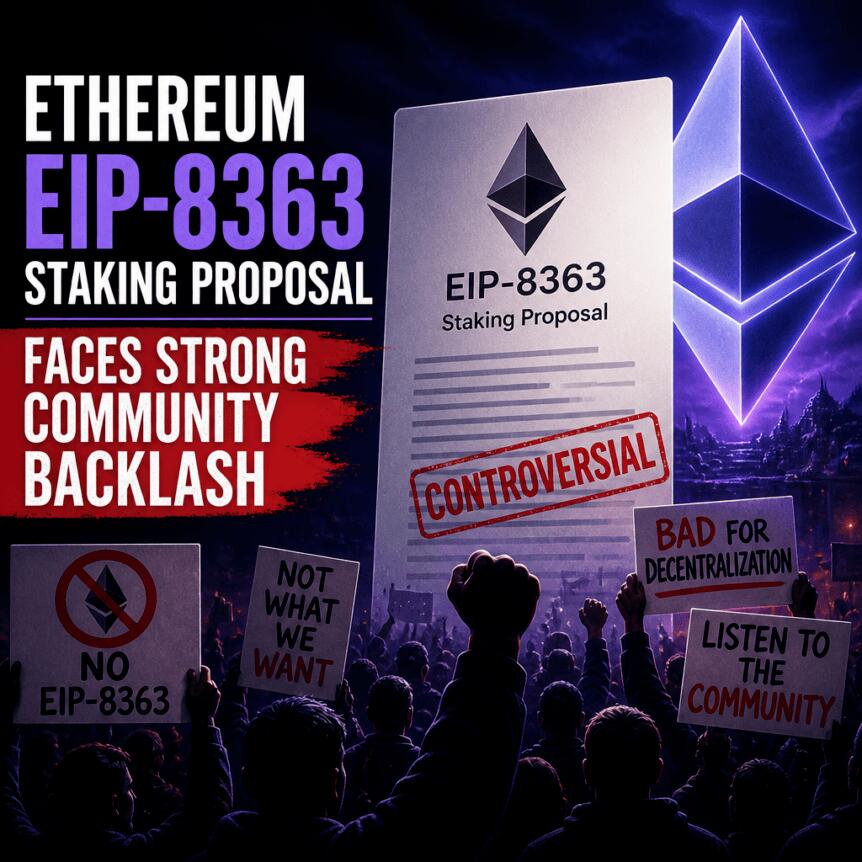
Ethereum is once again wrestling with its core incentive design. A proposed upgrade, EIP-8363 (“Tapered Issuance Burn”), would gradually reduce staking rewards as more Ether is locked up, with the idea of cutting new protocol issuance to zero once staking reaches a specified threshold.
The controversy is not abstract: Ether’s stake rate, DeFi’s reliance on staking derivatives, and institutional demand for predictable monetary policy all collide in the debate. Supporters argue that beyond a certain point, additional staking delivers diminishing security benefits—while critics warn that reducing issuance could destabilize parts of Ethereum’s financial plumbing and undermine trust in how the network governs its money.
Key takeaways
- EIP-8363 would taper validator rewards as staking participation rises, ultimately aiming to stop issuance when a target staking level is reached.
- Proponents say Ethereum has crossed into a zone where extra staking is less valuable for security and more harmful for non-stakers.
- Critics—including DeFi and institutional voices—argue the change could weaken decentralization, disrupt lending markets, and introduce “yield governance risk.”
- Opponents also contend that Ethereum’s inflation is already low and that market forces will likely slow staking further without altering issuance.
- The proposal’s timing is also drawing fire, with critics questioning its publication close to the Aug. 6 deadline for the next Ethereum upgrade proposals.
What EIP-8363 proposes—and why it sparked pushback
EIP-8363, published on the Ethereum Magicians forum (https://ethereum-magicians.org/t/eip-8363-tapered-issuance-burn/29263), is designed to rein in staking rewards as more ETH gets locked to secure the network. According to the proposal’s framing, the policy would eventually reduce new issuance to zero once 50% of Ether’s supply is staked.
Among the proposal’s authors are Ethereum Foundation researcher Justin Drake and ETHCC co-founder Jerome de Tychey. Their argument is that Ethereum has reached a point where incremental security gains from additional staking are no longer proportional to the issuance granted to validators. In their view, paying for security “beyond what the network needs” becomes a subsidy to existing staking participation at the expense of holders who are not staking.
But many in the ecosystem dislike what they see as a potential shift in Ethereum’s monetary logic. Mike Silagadze, founder of Ether.fi, criticized the idea on social media, saying it would be harmful to decentralization, adoption, and the network’s credibility.
“This is so disappointing on every level. […] This is bad for decentralization, this is bad for Ethereum adoption, and this is bad for the credibility of the network.”
Dr. Steve Berryman, Bitwise’s head of client partnerships for Ethereum, similarly argued that institutional adoption depends on certainty, and that changing issuance at the margin would introduce uncertainty that institutions are unlikely to tolerate.
“Institutional adoption requires certainty and playing with the issuance at the margin would cause uncertainty and institutions hate uncertainty.”
Is Ethereum already “over-staked”? The numbers behind the debate
Current network participation provides the backdrop for the disagreement. According to Validator Queue data (https://www.validatorqueue.com/), Ethereum has roughly 41.5 million ETH staked, yielding about 2.67% and representing around 34.07% of total supply.
Supporters of EIP-8363 maintain that while more staked ETH generally makes attacks harder, there comes a point where the extra security is increasingly marginal. The proposal, in that sense, targets the incentive mechanism: it aims to stop rewarding additional staking once Ethereum is already sufficiently hardened.
However, opponents challenge the premise that issuance is functioning as a meaningful “stealth tax” on non-stakers. Berryman argued that the market may naturally approach a ceiling in staking participation as yields fall, without needing changes to Ethereum’s issuance policy. He also suggested that participation growth has been influenced by institutional entrants—mentioning players such as Bitmine and BlackRock—and that after those entities complete their staking allocations, staking rates could plateau again.
Another dissenting view comes from commentator Leo Lanza, who opposes the proposal and disputes the idea that Ethereum’s inflation materially harms non-stakers. Lanza pointed out that Ethereum’s annual inflation is below 1% and compared it to gold’s supply growth range of roughly 1% to 2% annually, arguing that markets can solve the problem without protocol-level adjustments.
“The free market already solves this […] Let the market adjust.”
DeFi and decentralization concerns: the risks critics emphasize
Even if tapering issuance curbs unnecessary rewards, critics argue it may introduce second-order effects. A central concern is that staking is deeply embedded in Ethereum’s decentralized finance ecosystem through staking derivatives and related collateral usage. Silagadze argued that a policy like EIP-8363 would “kill a huge chunk of DeFi which is built around the staking ecosystem.”
Stani Kulechov, founder of Aave, raised additional worries. In his view, reducing staking rewards could encourage investors who treat ETH as a yield-bearing asset (or “ETH beta”) to rotate into alternative yield strategies—effectively punishing Ethereum for its growth. Kulechov’s concern is that the network could lose liquidity and composability that are tied to staking-linked yields.
“My concern is… those who are fine with ETH beta and yield might also sell ETH for other yielding assets […] Ethereum should not be punished for its growth.”
Technical stakeholders also caution against simplistic security arithmetic. Greg Koumoutsos, technical research lead at the Lido Labs Foundation, said that a staking ratio around one-third of supply does not appear unhealthy, while agreeing that thinking proactively about excessive staking is reasonable. More importantly, he argued the proposal oversimplifies what issuance is paying for—suggesting the broader system benefits include decentralization, operator diversity, censorship resistance, and network resilience.
“Ethereum is not only paying for slashable ETH; it is paying for decentralization, operator diversity, censorship resistance, and network resilience.”
In other words: lower issuance is not automatically a superior security policy unless those trade-offs are explicitly accounted for.
Who pays the price if rewards fall? The decentralization angle
Critics also argue that lowering rewards could affect validator participation patterns in ways that increase concentration. Koumoutsos noted that independent validators do not benefit from the same economies of scale as large staking businesses, exchanges, or institutional operators. If protocol rewards drop, he said, marginal solo validators could exit, leaving a thinner base of independent operators.
“A solo validator has real costs: some ideological solo stakers may remain, but many marginal solo validators will not, and fewer new ones will enter, if any.”
He added that large centralized platforms may be motivated by factors beyond yield—such as customer retention, regulatory positioning, and product integration—making them less likely to reduce staking even if rewards decline. Within delegated staking, the same dynamic could tilt incentives toward custodial products rather than onchain staking protocols, which tend to face higher ongoing maintenance, governance, and upgrade responsibilities.
Predictability versus adaptation: the governance-risk dispute
Supporters of EIP-8363 argue that stronger long-term monetary characteristics for Ether are worth the adjustment, while opponents counter that constant tweaking of Ethereum’s monetary policy undermines one of its biggest selling points: predictability.
Berryman said institutions care more about certainty than about marginal changes in staking yield, describing adjustments to the issuance curve as “yield governance risk.” His argument is less about absolute reward levels and more about whether the network’s monetary rules can be relied upon.
“It’s not broken, why try and fix it?”
Silagadze echoed the idea from an adoption perspective, arguing that any change with far-reaching implications—especially those affecting DeFi—could harm confidence among large institutions or nation-state actors that view Ethereum as a stable governance environment.
Beyond the substance of the proposal itself, the rollout has drawn procedural criticism. According to the reporting, EIP-8363 was published just two days before the Aug. 6 deadline for proposals to be considered for the next Ethereum network upgrade. Silagadze argued that a change with wide-ranging consequences should not have been introduced on such a short timeline.
That pressure highlights a broader tension in Ethereum governance: monetary and security incentives are interconnected, so every adjustment inevitably creates winners and losers across staking, DeFi, and institutional markets.
Readers should watch how the debate evolves in the lead-up to the relevant upgrade timeline—especially whether proponents adjust the scope or mechanics of tapering to address concerns about DeFi collateral effects, validator participation, and institutional predictability.

GPT-5.3 Codex, a model released in February, was the first to have a significant hand in its own development “from start to finish,” Amelia Glaese, OpenAI’s vice president of research, told TIME that month. By July, the number of experiments per researcher had doubled, according to the company.
Newer entrants are chasing the same prize. Recursive Superintelligence, founded by former Google, Meta, and OpenAI researchers, also hopes to create AI systems that can rebuild themselves. The months-old startup has raised $650 million.
“The idea that the wealthiest companies in the world, employing some of the smartest people on the planet, are trying to fully automate AI R&D deserves a ‘what the f-ck’ reaction,” Toner told TIME in February.
Yet the chief scientists of Anthropic and OpenAI agree on one thing. Left unchecked, this race ends badly. “We actually believe this should be slowed down … We need some sort of international norm to be able to control this,” Pachocki said. Kaplan says that once AI can train a successor largely autonomously, “I think it would be best for the world if there was coordination to make this go slower,” he says.
Crypto World
Carbon Launches TradFi-Native On-Chain Derivatives Venue With 950+ Markets in One Account

[PRESS RELEASE – Road Town, British Virgin Islands, August 7th, 2026]
250+ TradFi markets join Carbon’s 530+ crypto perpetuals & 150 24/7 RWAs in one venue. Wall Street depth at listing, stable overnight rates, and on-chain settlement.
Carbon, the on-chain prime broker for global markets, today opened public trading on 250+ Carbon TradFi markets spanning equities, indices, forex, and commodities. Each position is hedged 1:1 at regulated TradFi venues, making Carbon the largest TradFi-native on-chain derivatives venue. Alongside 530+ crypto perpetuals and 150 24/7 RWAs, total tradeable instruments now exceed 950 in one account.
Carbon TradFi is Carbon’s own on-chain instrument. A trader opens a position on-chain, in their own wallet, and Carbon’s solver architecture hedges it 1:1 at a regulated broker off-chain. The trader never leaves self-custody, and the price and depth they receive are the underlying market’s, not bootstrapped on-chain order books.
That structure removes the cold-start problem that has constrained real-world assets on-chain. Every Carbon TradFi market opens at full institutional depth on its first day, because the depth is inherited rather than manufactured. There is no per-market incentive program to run and no waiting period while liquidity accumulates.
Carbon now offers traders both in one account. Its 150 24/7 real-world markets trade around the clock, for traders who want access at any hour. Its 250+ Carbon TradFi markets track market hours with carry prices from the underlying, for traders who want institutional depth and predictable holding costs. Roughly 30 assets are live as both, letting a trader hold one against the other and capture the difference between the two financing rates without leaving the account.
The global market Carbon connects to is substantial. TradFi clears over $1.5 trillion daily in CFDs across thousands of markets, liquidity that until now had no direct route on-chain.
Carbon TradFi coverage at launch:
- 200 stocks across US, EU, and Asia markets
- 62 forex pairs
- 12 indices
- 8 commodities
Carbon can list a trending name within the same week it begins moving in Seoul, Tokyo, or Hong Kong, a cadence order-book venues cannot match because they lack the off-chain rails to stand up a new market that quickly. A further 150 listings are scheduled.
The launch also opens the Carbon Liquidity Provider (CLP) vault to public deposits. The CLP is a delta-neutral yield product: it funds the hedge behind trader flow rather than taking directional positions, earning from the difference between on-chain demand and off-chain liquidity. Modeled APY is illustrative and ranges from 20.3% at launch utilization to 57.1% at maturity, depending on flow and capital utilization.
“Traders have had to choose between the assets they want and the execution they need. Carbon ends that trade-off. Every position is hedged into the deepest liquidity in the world and settles in the trader’s own wallet, with 950+ markets in a single account. This is what global markets look like when they finally arrive on-chain properly.” – Levy, Co-founder and CEO of Carbon
“One of the biggest challenges for bringing traditional financial assets onchain has been delivering deep liquidity. Carbon is operating an architecture that connects onchain trading with established market infrastructure while preserving self-custody. We want Arbitrum to be home to teams building this next generation of financial infrastructure” – David Garcia, Ecosystem Lead at Arbitrum Foundation
About Carbon
Carbon is the on-chain prime broker for global markets, combining crypto perpetuals and Carbon TradFi in one venue. Carbon’s solver architecture connects on-chain traders to institutional liquidity through bilateral 1:1 hedging, delivering Wall Street-grade depth and stable carry with on-chain settlement and self-custody. Live since 2023, Carbon has processed $20B+ in cumulative trading volume across 36K+ unique traders. Carbon operates on Arbitrum. Users can learn more at carbon.inc.
The post Carbon Launches TradFi-Native On-Chain Derivatives Venue With 950+ Markets in One Account appeared first on CryptoPotato.

The idea of a digital nation once sounded like science fiction.
Today, governments, businesses, and online communities are increasingly experimenting with digital identities, programmable money, decentralized organizations, and blockchain-based records. As these technologies mature, blockchain could become more than a tool for cryptocurrencies—it could become part of the infrastructure that allows nations to deliver services, manage identities, verify information, and coordinate economic activity in a digital world.
The real question is no longer whether governments will use blockchain.
It is how deeply blockchain could become embedded into the architecture of the modern nation-state.
What Is a Digital Nation?
A digital nation is not necessarily a country without physical territory.
Instead, it is a society where many of the functions traditionally associated with a nation—identity, governance, commerce, records, payments, credentials, and public services—can operate through digital infrastructure.
Imagine being able to:
- Carry a cryptographically verifiable digital identity
- Access government services from anywhere
- Prove ownership without relying on paper documents
- Verify educational or professional credentials instantly
- Receive government payments through programmable digital money
- Vote or participate in governance through secure digital systems
- Move assets across borders without traditional intermediaries
Blockchain can provide an important foundation for these systems because it creates a shared infrastructure for verification, ownership, and coordination.
Blockchain as a Digital Trust Layer
One of the biggest problems facing digital governments is trust.
A digital document can be copied. A database can be altered. A credential can be forged. A centralized platform can experience downtime or become compromised.
Blockchain introduces a different model.
Instead of asking citizens and institutions to trust a single database, blockchain networks can provide cryptographically verifiable records distributed across multiple participants.
This does not make every piece of information automatically true. Instead, it can make certain claims easier to verify.
For example, a university could issue a blockchain-based credential. An employer could independently verify that credential without contacting the university directly.
The blockchain becomes the verification layer, while the institution remains responsible for the underlying claim.
That distinction is critical.
Digital Identity Could Become the Foundation
A functioning digital nation needs a reliable way to answer a basic question:
Who are you?
Traditional identity systems often depend on physical documents, centralized databases, passwords, and government-issued credentials.
Blockchain and decentralized identity systems could create a more flexible model where individuals control cryptographically secured credentials that can be presented when needed.
Instead of revealing an entire identity profile, citizens could potentially prove specific facts.
For example:
“I am over 18.”
without revealing:
“Here is my full identity, address, birth date, and other personal information.”
Zero-knowledge technologies could make this approach even more powerful by allowing someone to prove that a statement is true without revealing the underlying data.
This could transform digital identity from a simple login mechanism into a privacy-preserving layer for digital citizenship.
Government Services Could Become Programmable
Blockchain’s programmability introduces another major opportunity.
Government services today often depend on complicated administrative processes involving forms, databases, approvals, and intermediaries.
Smart contracts could automate certain processes when predefined conditions are satisfied.
Consider a government grant.
Instead of manually processing every stage, a programmable system could:
- Verify eligibility.
- Approve the recipient.
- Lock allocated funds.
- Release payments according to predefined milestones.
- Record the transaction transparently.
- Generate an auditable history.
This doesn’t mean every government function should become a smart contract.
But where rules are clear and repetitive, programmable infrastructure could reduce administrative friction.
Blockchain-Based Public Records
Public records are another natural application.
Property ownership, business registrations, professional licenses, permits, certificates, and other documents require reliable records.
Blockchain could provide tamper-evident histories for these assets and credentials.
A property registry, for example, could maintain a transparent record of ownership transfers while keeping sensitive personal information outside the public ledger.
This could make processes such as property transactions faster and easier to audit.
The important design principle is not putting everything on-chain.
Sensitive information can remain off-chain while blockchain stores proofs, timestamps, permissions, and references that allow authorized parties to verify it.
Digital Money and the Programmable State
Money may become one of the most significant components of digital nations.
Stablecoins, central bank digital currencies, and tokenized deposits are already pushing payments toward programmable infrastructure.
For governments, programmable money could enable more targeted distribution of public funds.
Imagine disaster assistance being distributed digitally and becoming immediately available to verified recipients.
Or infrastructure budgets being released in stages as independently verifiable project milestones are completed.
The same technology could also support automated taxation, cross-border settlements, and government-to-citizen payments.
But programmable money introduces serious questions around privacy and government control.
A digital financial system must balance efficiency with individual financial freedom.
Technology should make payments easier—not turn every transaction into a surveillance mechanism.
Voting and Digital Governance
Governance is another area where blockchain attracts significant attention.
Blockchain-based voting systems could potentially provide verifiable records of ballots while reducing some forms of manipulation.
However, voting is much more complicated than simply putting ballots on a blockchain.
A secure voting system must address:
- Voter privacy
- Coercion
- Identity verification
- Accessibility
- Ballot secrecy
- Device security
- Authentication
- Vote verification
Blockchain can help with some of these problems, but it cannot solve all of them by itself.
The broader opportunity may therefore be verifiable digital governance, rather than simply blockchain voting.
Citizens could use cryptographic credentials to participate in consultations, proposals, community decisions, and decentralized governance systems.
Digital Nations Could Become Borderless Economies
Perhaps the most interesting possibility is that digital nations could operate across traditional geographic boundaries.
A digital community could have:
- Members distributed around the world
- A blockchain-based treasury
- Digital credentials
- Tokenized assets
- Online governance
- Programmable payments
- Shared economic incentives
This begins to resemble a nation in terms of coordination, even though its members may never share the same physical territory.
Decentralized autonomous organizations already demonstrate parts of this concept.
The next evolution could involve communities combining blockchain governance with real-world institutions, businesses, legal structures, and public services.
The result would not necessarily replace traditional countries.
Instead, it could create new layers of digital citizenship and economic participation that exist alongside them.
Blockchain Could Make Governments More Auditable
Transparency is one of blockchain’s strongest potential advantages.
Government spending is often difficult for ordinary citizens to track.
A blockchain-based public finance system could make selected transactions independently verifiable.
Citizens could potentially follow:
Budget → Allocation → Contract → Payment → Project
with each stage producing a verifiable record.
This could make corruption and financial mismanagement easier to detect.
But transparency must be designed carefully.
A completely transparent government ledger could expose sensitive information about individuals.
The goal should therefore be verifiable transparency without unnecessary personal exposure.
The Biggest Challenge: Governance
Blockchain can provide infrastructure.
It cannot decide what society should value.
Who controls the network?
Who can update the rules?
Who resolves disputes?
What happens when a smart contract contains a bug?
How does someone appeal an automated decision?
What happens when a citizen loses access to their private keys?
These are governance questions, not purely technical problems.
A digital nation therefore needs a combination of:
Blockchain + Law + Institutions + Privacy + Human Governance
Technology alone is not enough.
The Risk of Creating Digital Authoritarianism
There is also a darker possibility.
The same infrastructure that can create efficient digital government can create extremely powerful surveillance systems.
If identity, payments, healthcare, mobility, communications, and public services are connected without appropriate safeguards, governments could gain unprecedented visibility into citizens’ lives.
Blockchain does not automatically prevent this.
In fact, an immutable ledger can create new privacy challenges if sensitive information is permanently exposed.
The future of blockchain-based nations must therefore prioritize:
- Privacy by design
- Selective disclosure
- Zero-knowledge proofs
- User-controlled identity
- Strong legal protections
- Open standards
- Transparent governance
- The right to challenge automated decisions
A digital nation should empower citizens—not simply make citizens more trackable.
From E-Government to On-Chain Government
The first phase of digital government was essentially about putting existing processes online.
Forms became websites.
Documents became PDFs.
Government offices became portals.
The next phase could be fundamentally different.
Instead of simply digitizing bureaucracy, blockchain could make government services programmable, interoperable, and independently verifiable.
That means the digital government of the future may not simply be a website citizens visit.
It could become an infrastructure layer that wallets, applications, businesses, institutions, and citizens interact with directly.
What Could a Blockchain-Powered Digital Nation Look Like?
Imagine a citizen opening a digital wallet.
Inside it are cryptographically verifiable credentials representing identity, education, professional qualifications, licenses, and other permissions.
The citizen can selectively share those credentials with businesses or government agencies.
Government benefits arrive through programmable payment infrastructure.
Property ownership is represented through verifiable digital records.
Businesses register and interact with government services through automated systems.
Public spending is auditable.
Citizens participate in digital governance.
And cross-border transactions settle almost instantly.
The result would be a government that operates less like a collection of disconnected databases and more like an interoperable digital network.
The Future Is Not About Putting the Government on a Blockchain
This distinction matters.
The future is unlikely to be:
“Everything must move onto a blockchain.”
Instead, it may be:
“Blockchain becomes one of the trust layers connecting digital society.”
Some information will remain private.
Some databases will remain centralized.
Some decisions will always require humans.
Some services will use traditional infrastructure.
Blockchain’s role may be to connect these systems through verifiable ownership, credentials, transactions, and state changes.
That is a much more realistic—and potentially much more powerful—vision.
Final Thoughts
Digital nations are not necessarily about replacing physical countries.
They are about rethinking how identity, money, governance, ownership, and public services operate in an increasingly digital world.
Blockchain provides something the internet historically lacked: a native infrastructure for verifiable ownership and coordinated state.
Combined with decentralized identity, zero-knowledge proofs, smart contracts, stablecoins, tokenization, and interoperable digital credentials, it could help create governments and digital communities that are faster, more transparent, and more accessible.
But the technology must remain subordinate to the people it serves.
The ultimate measure of a blockchain-powered digital nation will not be how many transactions it processes.
It will be whether citizens gain more control, stronger privacy, better access, and greater trust in the systems that govern their digital lives.
The next generation of nations may still have borders.
But their most important infrastructure could increasingly exist on-chain.
REQUEST AN ARTICLE
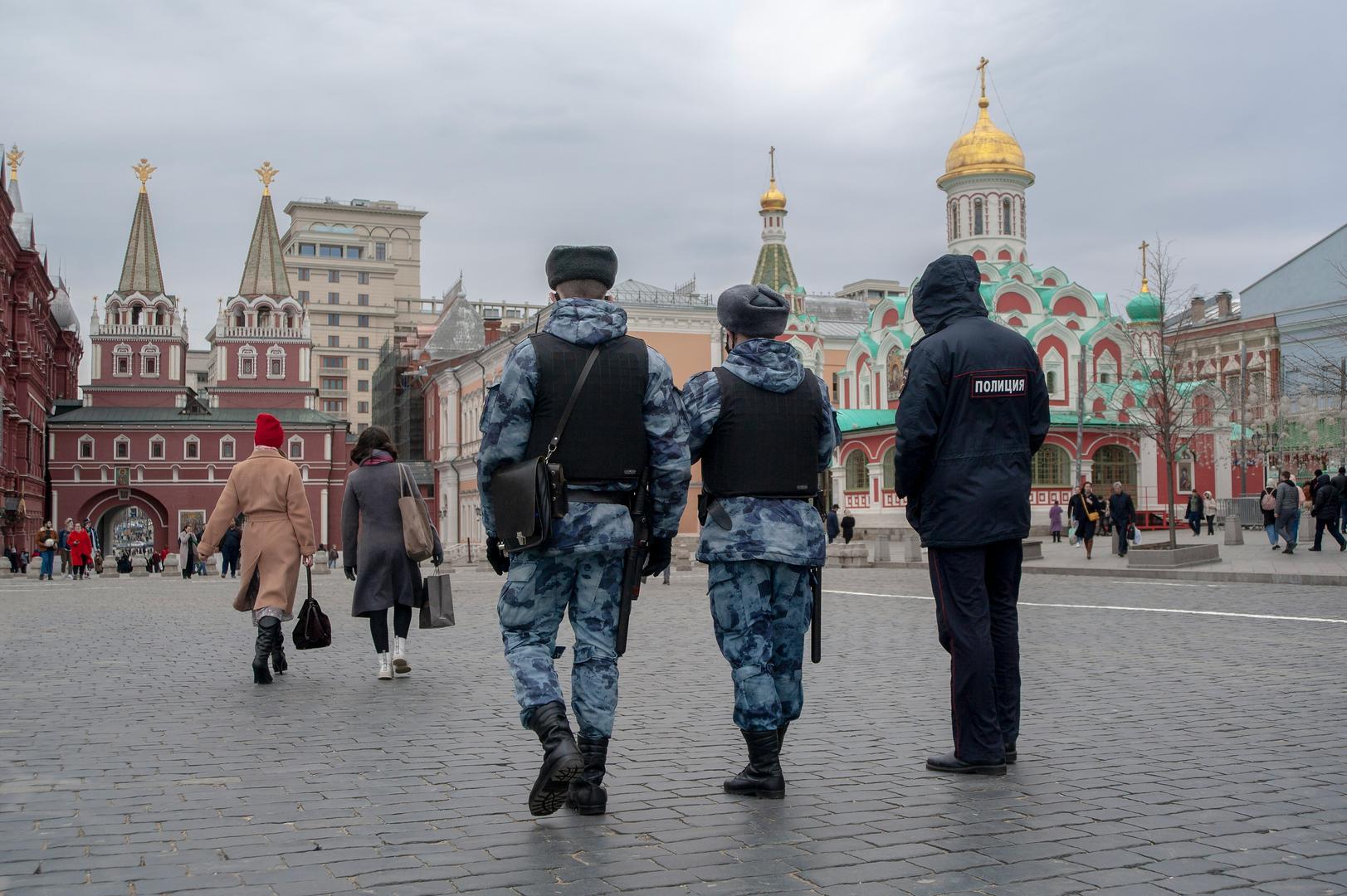
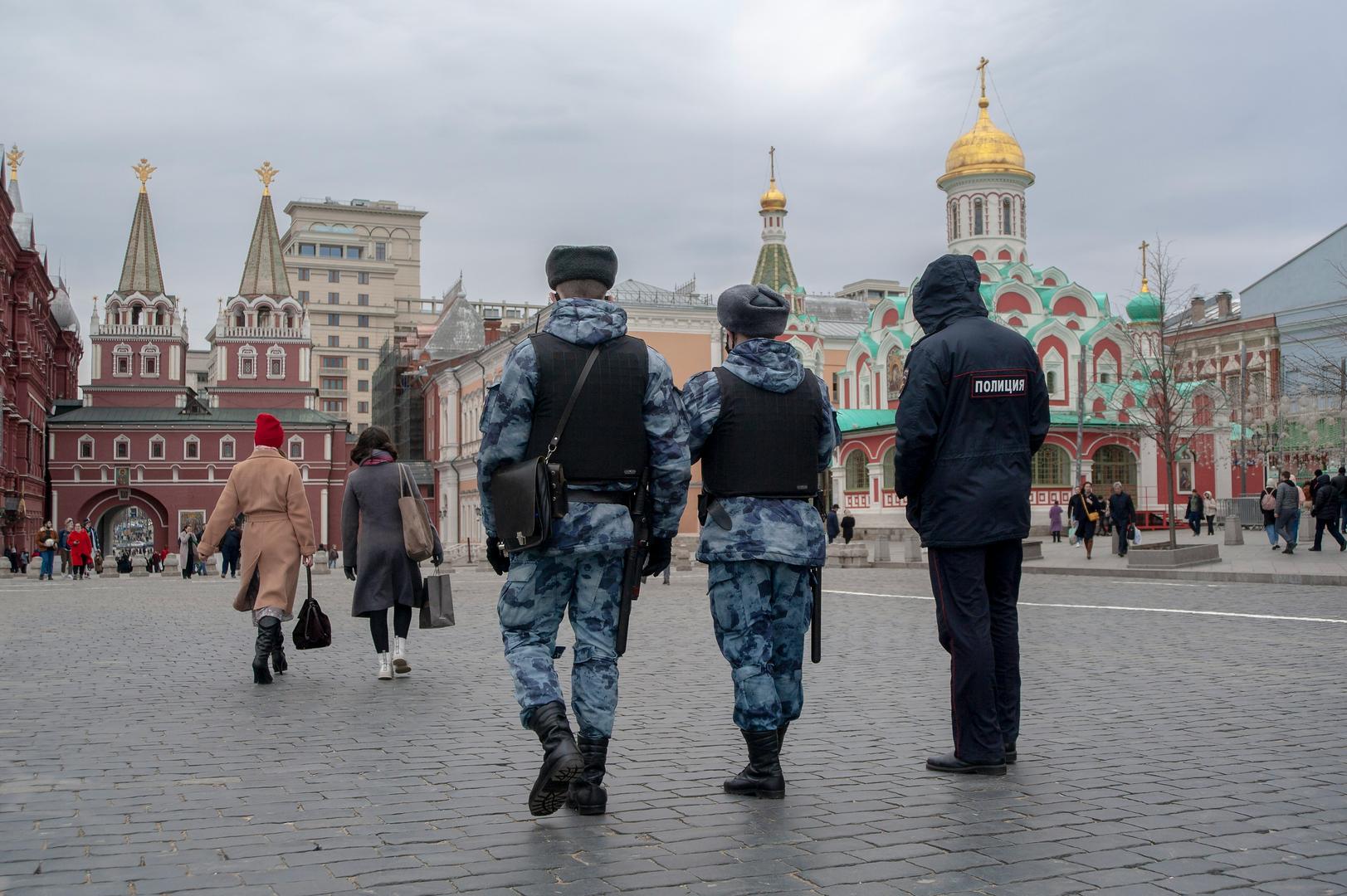
Russia’s Federal Security Service (FSB) said Friday it detained more than 20 people it claims worked for unregistered crypto exchange offices used to move money stolen from Russian scam victims to Ukraine.
The arrests took place at Moscow City, the capital’s high-rise business district, the security agency said. It also said that the FSB and the Interior Ministry had shut down nine channels used to transfer funds abroad through cryptocurrency.
“Young people from the Russian regions who are looking for easy money are remotely recruited to work at these crypto exchanges despite having limited financial literacy,” the FSB said.
Authorities explained that the ring it busted relied on call centers in Ukraine that targeted Russians remotely, including pensioners. Victims were allegedly kept on the phone and told in detail how to proceed before being sent to the crypto exchange offices to buy crypto and transfer it to accounts controlled by the alleged criminals.

The Dow Jones Industrial Average and other major stock indexes started mixed Friday, with the U.S. July jobs report unexpectedly showing losses in the labor market. Meanwhile, artificial intelligence cybersecurity leader Cloudflare (NET) was a big earnings winner on the stock market today. Just after Friday’s open, the Dow Jones industrials slipped 0.1%, while the S&P 500 gained 0.3%. The tech-heavy…
Copyright ©2026 Investor’s Business Daily, LLC. All rights reserved. 87990cbe856818d5eddac44c7b1cdeb8
World, the iris-scanning identity project co-founded by OpenAI CEO Sam Altman, said on July 24 it has entered "Phase 3" of its five-stage roadmap, shifting the network's focus from bootstrapping signups with WLD token rewards to selling proof-of-human verification — including to AI agents acting on… Read the full story at The Defiant
Crypto World
Bitcoin hovers below $65,000 as Middle East tensions escalate further: Crypto Markets Today
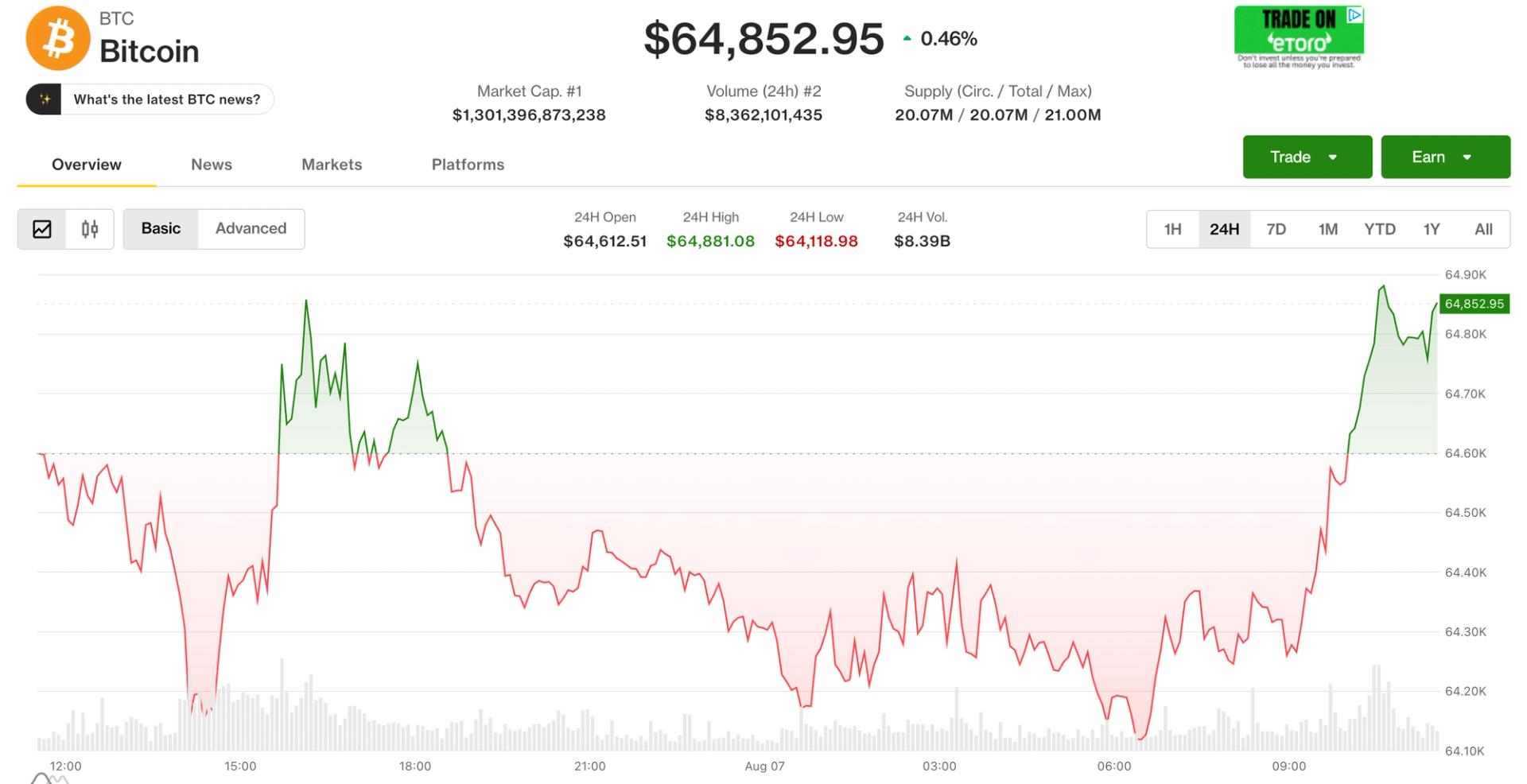
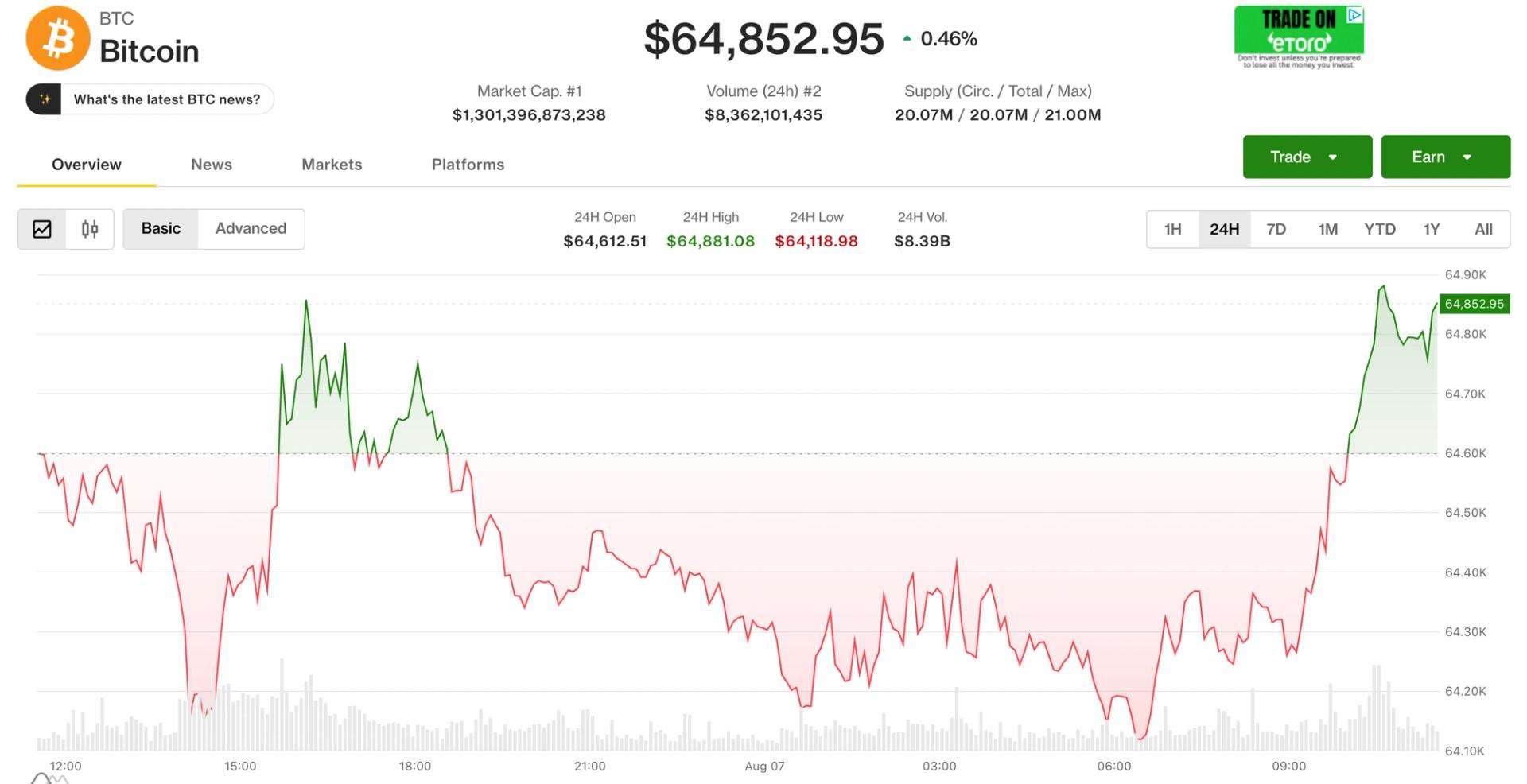
Bitcoin is holding near $64,700 Friday, barely changed over the last 24-hour period, while the broader CoinDesk 20 (CD20) index is down 0.2% over the period.
Brent crude has meanwhile moved to over $83 a barrel after Yemen’s Iran-linked Houthis attacked Saudi Arabia, further escalating tensions in the Middle East.
Treasury yields have seen a slight correction, but remain at 4.67% for the 10-year note, a level Fidelity’s Director of Global Macro Jurrien Timmer said “history suggests that nothing good happens.”
Higher oil could add to inflation pressure if sustained, while elevated Treasury yields tighten financial conditions. Together, they could limit expectations for near-term rate cuts and weigh on bitcoin and other risk assets.
Gold has meanwhile maintained its recovery, moving up 1.5% to now trade at $4,300 per ounce as investors move toward safety in the face of uncertainty.
Derivatives positioning
- Long-short taker ratio: The crypto futures market’s long-short taker ratio has returned to neutral after leaning bullish on Thursday, suggesting traders may be adopting a more cautious stance ahead of the U.S. payrolls report.
- CC token leads OI growth: Canton Network’s CC token is down 13% in 24 hours, yet its futures open interest (OI) has surged over 5%. The combination is said to validate the downtrend, especially as the 24-hour OI-adjusted cumulative volume delta remains negative, indicating sellers are more aggressive by shorting futures via market orders rather than passive limit orders.
- Open Interest Movers: DOGE, XRP, and SUI are open interest gainers, while SHIB has seen a drop.
- CVD Indicator: The CVD indicator paints a bearish picture for the market, as most majors (excluding ADA, HBAR, and ETH) show negative CVD readings.
- Volatility Indexes: The BVIV index, representing BTC’s annualized 30-day implied volatility, remains near a long-held floor of 36%, showing little signs of stress despite the Clarity Act delay and the impending U.S. jobs report. The same holds true for ether’s volatility index (EVIV).
- Options Activity: In Deribit-listed options, puts (bearish bets) at the $60,000 and $62,000 strikes dominate the 24-hour volume rankings for BTC, while the $2,000 call is the most popular for ETH.
Token Talk
- Sui is adding quantum-resistant security to its accounts, integrating two post-quantum signature schemes approved by the U.S. standards body NIST, per The Block. The upgrade lets users optionally adopt quantum-safe keys derived from their existing recovery phrases, so nobody has to generate a new seed or move funds to a new address to be protected.
- The threat it’s guarding against is specific to crypto. In most systems an attacker has to break in before they can go after a key. Onchain, the public key is exposed permanently the moment an account transacts, which opens the door to “harvest-now, forge-later,” where attackers collect exposed keys today and crack them once quantum computers are capable enough to run Shor’s algorithm, the technique that could break the elliptic-curve cryptography securing most wallets. No quantum hardware is needed to start collecting.
- Sui is using two schemes for two risk levels. ML-DSA-65 covers everyday accounts at the protocol level, and the hash-based SLH-DSA-SHA2-128s runs inside Move smart contracts for high-value vaults. The two rest on different math, so a weakness in one doesn’t compromise the other. Sui went with a higher security tier after a July incident where an AI model halved the effective strength of a different post-quantum candidate, a reason to carry margin rather than pick the cheapest option.
- It’s a feature add, not a rebuild. Sui says it was built for “cryptographic agility,” meaning new signature schemes slot in without touching consensus or existing balances, so this ships as a routine protocol update. That contrasts with bitcoin and ethereum, where quantum-proofing is a heavier lift, and lands the same month Strategy and BlackRock formed a consortium to prepare bitcoin for the same threat. SUI traded around [X], per CoinDesk data.

Fans Praise A$AP’s Response To Rihanna’s Twerk:

Keyshawn Davis promoter Bob Arum shares true feelings on Davis pulling out of Devin Haney fight

money money green green #shorts #ibispaintx #capcut #kinitopet #trend #moneymoneygreengreen #art

Renter of Home in Anne Heche Crash Denies Settlement With Son

No Jackpot Winner as $257 Million Prize Rolls Over to $269 Million Monday Draw

Weekend Open Thread: Staud – Corporette.com
money money green green #shorts #ibispaintx #capcut #kinitopet #trend #moneymoneygreengreen #art

Ways to overcome your financial issues | Dr. Jai Madaan

we will be successed one day #billionairemindset #motivation #money #succesrules #successhabits
-

 Fashion7 days ago
Weekend Open Thread: Wit & Wisdom
-

 Politics7 days ago
Meta enters AI-training agreement with far-right ‘propaganda rag’ Newsmax
-

 Politics5 days ago
Zack Polanski: an incitement to murder Nigel Farage?
-

 Crypto World6 days ago
MicroStrategy Post-Earnings CLARITY Act Push Could Add New Catalyst for Its Stock
-

 Crypto World6 days ago
XRP Ledger v3.3.0 brings five institutional features
-

 Crypto World7 days ago
New York sues Kalshi over prediction market gambling
-

 Crypto World5 days ago
Crypto PAC spending tops $2M in Michigan House race
-

 Business5 days ago
DTCR: Deleveraging And A Hedge Fund Collapse Point To A Possible AI Bottom
-

 Tech5 days ago
ESET tracks rise in malicious AI skills and adaptable malware
-

 Crypto World7 days ago
3 Fed Officials Just Explained Their Rate Hike Vote: Is Inflation Winning?
-

 Sports6 days ago
France Cricket implodes: letters hidden in a drawer and a board at war
-
Crypto World5 days ago
XRP Ledger urges node upgrade after manifest flood
-

 Crypto World6 days ago
Moneyflip CEO charged in $40K murder-for-hire plot
-
 Sports7 days ago
Bruno Fernandes decision made as Man United ‘discuss’ striker transfer option
-
Business7 days ago
FIFA has scrapped $20 billion World Cup sell-off plan, New York Post reports
-

 News Videos6 days ago
Financial Crash Expert: The 90-Day Collapse Timeline They Are Desperately Hiding.
-

 Sports2 days ago
Jordan Coyle & Cordiamo take Laya Arena Stakes at RDS
-

 Sports7 days ago
Commonwealth Games 2026 Live Updates | Day 9 CWG 2026: Lovlina Borgohain, Sachin Siwach Enter Final After Indian Judokas Script History
-
 Crypto World4 days ago
US Tech Stocks See Largest 5-Week Inflow in History: Can Nasdaq Break Its Downtrend?
-
 NewsBeat6 days ago
Tourist plane on sightseeing flight in Peru crashes into a field, killing all 13 people on board
You must be logged in to post a comment Login