
Politics
How To Tell ‘Stress Sweat’ From The Normal Kind


Did you know that our eyes make three types of tears – basal tears, which lubricate our peepers, reflex tears, which respond to stressors like onion fumes, and emotional tears?
Well, it turns out our sweat might take different forms depending on whether it comes from stress or a workout.
“When you’re exercising or sitting in a hot environment, your body mainly produces sweat to cool itself down. This comes from eccrine sweat glands, which produce a watery sweat that’s mostly made up of water and salt,” Dr Asiya Maula, a private GP at The Health Suite, told HuffPost UK.
“Stress is different. When you’re anxious, nervous or frightened, your body’s ‘fight or flight’ response kicks in.
“This activates a different type of sweat gland called the apocrine gland, which is found mainly in the armpits and groin.”
How can I tell eccrine vs apocrine sweat apart?
It can be hard to tell them apart, Dr Maula said. But stress, or apocrine, sweat has a different texture: this “contains more proteins and fatty compounds, making it thicker than the sweat produced during exercise”.
Additionally, “stress sweat” might have a more intense odour.
“Stress sweat itself is actually almost odourless when it’s first produced. The stronger smell develops when bacteria naturally living on the skin break down those proteins and fats,” the GP explained.
“That’s why many people notice stress sweat has a much more noticeable odour than the sweat they produce after a run or a gym session”.
Of course, context helps – “If you suddenly notice damp palms before a presentation, sweaty underarms during an important meeting or increased sweating while you’re feeling anxious despite not being physically active, stress is likely to be playing a role.”
But the speed of onset might matter too, Dr Maula said.
“People often describe stress sweat as appearing very suddenly and affecting areas like the palms, soles of the feet and underarms, even when the room isn’t particularly warm.”
What does stress sweat mean?
Well, aside from meaning that you’re – you guessed it – stressed, the doctor said occasional apocrine sweat is nothing to worry about.
But “if you’re finding yourself sweating excessively during everyday situations, or you notice it’s becoming more frequent alongside symptoms such as poor sleep, constant worrying, palpitations or feeling on edge most of the time, it may be a sign that your stress levels are becoming difficult to manage”.
That’s worth speaking to your GP about, she said.
How can I stop stress sweat?
Unfortunately, it’s not possible to stop stress sweat in the moment.
But if you want to try reducing your stress levels overall, Dr Maula said you can try “Regular physical activity, good quality sleep, limiting excessive caffeine, mindfulness techniques and breathing exercises can all help reduce activation of the body’s stress response”.
And, she ended, “For people whose sweating is particularly severe or affecting their quality of life, there are also medical treatments available, so it’s important not to suffer in silence”.


Westminster loves nothing more than a bit of groupthink.
A settled view on a particular issue can quickly become established fact in SW1, even if there is plenty of evidence that it may be wrong.
The most recent example is the growing belief that two-party politics will return in time for the next general election.
This is not an outlandish idea, given the most recent trend in the opinion polls.
It is undeniable that Labour has enjoyed a Burnham bounce since the former mayor of Greater Manchester replaced Keir Starmer as party leader and prime minister.
A crossover point was reached earlier this week when, for the first time in 18 months, Labour overtook Reform UK in the poll of polls.
This has coincided with a steady decline in support for Reform amid the ongoing controversies over the financial arrangements of both Nigel Farage and his party.
At the same time, Kemi Badenoch’s Tories have been enjoying a modest uptick in support, while the Green Party have also gone into reverse following a series of mis-steps by their leader, Zack Polanski.
A YouGov poll seemed to confirm this trend on Thursday when it revealed that Reform and the Greens have fallen to their lowest favourability ratings to date.

Some political commentators have therefore concluded that the next election will once again be a straight fight between Labour and the Conservatives.
However, leading pollsters have told HuffPost UK that it is far too early to assume that British politics will simply return to the way it has always been for most of the last century.
Indeed, Chris Hopkins, political research director at Savanta, said a return to two-party politics “feels like something of an impossibility”.
He said: “In almost all opinion polls conducted since Andy Burnham became Labour leader, five parties have achieved 10% or higher.
“The top two – more often than not, Labour and Reform UK – tend to combine for around 50% of the overall vote share.
“This is a far cry from recent general elections, especially 2017 where the Conservative and Labour combined for a whopping 82% of the overall vote.
“Of course, if British politics has taught us anything over the last few years, it’s that the fortunes of political parties can change very quickly, so you can never rule a return to two-party politics out.
“For now, only the Greens feel at risk of losing ground, probably to a rejuvenated Labour Party, but Reform UK don’t feel like they’re going anywhere while Nigel Farage is at the helm.”
With Farage certain to return as MP for Clacton next Thursday with a thumping majority – albeit having only defeated Count Binface and a variety of other minor political figures – the chances of him shuffling off the political stage appears remote.
Indeed, the signs are there that the Reform leader is preparing to come out fighting in an attempt to wrest back the political momentum from Burnham.
Keiran Pedley of Ipsos UK said “we should be careful not to overstate the return of two party politics”.
“Reform are still ahead of the Conservatives for now,” he pointed out. “The Greens and Lib Dems have a significant presence in some parts of the country and nationalist parties are in power Scotland and Wales.
“It may well come to pass that the next election ends up as a mainly Labour vs Conservative affair, but we should caution against jumping to that conclusion too soon.
“To announce the return of two party politics having declared it dead a few months prior feels somewhat premature.”

The Tories’ mini-renaissance under Badenoch, who has won praise for her performance as leader in recent months, threatened to come off the rails this week, however.
Her decision to stand by a former neo-Nazi chosen to stand as a Conservative council candidate in Somerset sparked a furious backlash and baffled many senior Tories.
Joshua Bonehill-Paine eventually stood down, but was appointed an adviser on anti-radicalisation by Badenoch, a decision which led to fresh outrage.
This was followed by the announcement that the party would evict 230,000 non-EU foreign nationals from social housing, and ban newcomers from gaining such tenancies.
Coming on the back of Badenoch’s decision to remove the party whip from Gavin Barwell and block the likes of Grant Shapps from standing as candidates, it seems clear that she wants to take votes from Reform.
Moderate Tories believe she is making a huge mistake.
One senior figure told HuffPost UK: “Her strategy appears to be to hope that Reform implodes/Farage walks away and then pick up the pieces.
“The reality is that there’s a solid populist vote of 20% that will be very hard for the Tories to reach and the cost of doing so would be to alienate the majority of the electorate. With Labour moving leftwards on the economy, a big opportunity is being lost.”
Cameron Garrett, deputy director of research at the More in Common think-tank, said: “Our politics is increasingly volatile, and it’s too soon to be heralding a return to the two-party system.
“Kemi Badenoch’s personal approval rating has risen dramatically in recent months, but it has yet to lift her party’s fortunes. And while Burnham has seen a bounce, it’s too early to tell whether it will last.
“Voters will need to see real, tangible change before they’re willing to return to the political mainstream for good.”
Listen to Commons People, the podcast that makes politics easy. Every week, Kevin Schofield and Kate Nicholson unpack the week’s biggest stories to keep you informed. Join us for straightforward analysis of what’s going on at Westminster.

According to research conducted by Dr John Gottman and Dr Julie Schwartz Gottman of the Gottman Institute, there are four “horsemen of divorce”: criticism, contempt, defensiveness, and stonewalling.
And Susie Masterson, a BACP-registered therapist, told HuffPost UK that warning signs of divorce aren’t usually as simple as issues like financial problems or different life goals.
“I have seen couples overcome lots of challenging situations including: infidelity, unemployment, family estrangement and critical illness,” she said.
Here, she shared what she thinks can make the difference between couples who may be likelier to stay together and those that might split.
How can a therapist tell a couple may be headed for divorce?
“Compatibility is not just about liking the same things or shared values; it’s about how we respond to challenges,” Masterson said.
She stated that couples often come to therapy during transitions like moving in together, changing jobs, having kids, or battling illness.
“Our responses to these transitions often highlight differences which might otherwise not have been apparent,” the therapist added.
For instance, many couples have financial disparities that might not be visible until e.g. someone loses their job.
But “Whilst many couples file for divorce citing financial challenges, it’s usually not that simple. When I speak to couples, it’s the differences between the response to these challenges that cause the relationship to break down.
“Successful relationships are predicated on a balance between power, respect and connection,” she explained.
“To be in a relationship with someone requires investment. We need to meet each other wherever we are. We all change. Just not at the same time or at the same pace. Tolerance is key to being able to manage this.
“In my experience, relationships break down when one or both parties are not willing/able to do this. This is often due to competing needs in a situation, where it becomes difficult for any concessions or compromises to be made.”
How can I tell if I’d be happier divorced?
That’s not to say that tolerance and compatibility should be forced in a situation that isn’t serving you.
Masterson pointed out that all relationships go through cycles of rupture and repair. And “Sometimes, when we have been together for a long time, the accumulated impact of this can wear us down”.
It’s also possible that past hurts have gotten swept under the rug, in which case, learning how to heal from them should take priority. “Even if it doesn’t keep us together, it is a brilliant skill to learn as [we need] to be able to model this for our kids. It will also help us in future relationships.”
Ultimately, she ended, “It’s equally important to recognise that not all relationships can go the distance. Before making the decision to separate, it can be really helpful to fast forward to a preferred future and ask questions like: what will be different, how will it feel, who will be in my life, where will I be, what will I be doing?
“Then pause and reflect why any of these preferred outcomes are not possible within the relationship. When you have this clarity, it can help with self-trust and empowerment to commit to a certain course of action.”

I have a confession: I’m really lazy about cooking. It’s gotten to the point that pretty much all I eat is the same meals on rotation (a crazy medley of beans, corn, and avocado; or cold noodle soup, if you must know). And both of them come together in less than 20 minutes.
The thing is, if I wasn’t lactose intolerant, pescatarian, and extremely fussy, I would eat ready meals probably every night. But thanks to being raised in an ingredient household, my conscience simply can’t convince myself to do it.
But recently, desperate to find another way of eating, I started shopping around.
I was near giving up hope when I found Grubby. I can’t stop raving about its meal kits, and while they come in handy when I want to learn a new recipe or think I’ll have the time (and energy) to actually get my hands dirty, it’s its healthy ready meals I’ve actually fallen in love with.

These freezer-ready boxes come packed with wholefoods, protein, and fibre, and can be popped in the microwave so they’re ready in under 10 minutes.
But even though they’re microwaveable, they’re as good as a home-cooked meal. Seriously – some of the recipes include Spicy Szechuan Noodles, Sticky Teriyaki Udon Noodles, Creamy Nduja Rigatoni, and Peri Peri Tempeh Bowl.
And yes, as you might have guessed, they’re all completely plant-based, so you’ll know for certain that you’re eating plenty of fibre and ticking off your five a day.
Don’t worry, though, they taste just as good as a meatier or fishy option – in fact, my meat-loving girlfriend said she’d buy them for herself.
Depending on how often you feel weak at the knees at the idea of cooking a meal, you can opt to have the boxes delivered fortnightly or weekly, or simply do a one-off order.

I’ve been keeping my freezer stocked ever since I first tried them, because they’re such a convenient meal to fall back on – especially when the idea of turning a hot stove on is the last thing I want to do (or I come back steaming from a ‘picnic’ that involved two picky bits each).
It’s not just the meals that taste good, though, Grubby also does good for mankind and the planet.
For every meal you buy, it donates one to children in need. And it uses completely carbon neutral delivery, plus recyclable and compostable packaging.
Trust me, if you’re as lazy as I am you’ll want to get these in next time you have a busy week.

You might already know that strength training is one of the best activities we can engage in as we age, while aerobic training like jogging, walking, and swimming is also linked to better heart health in our later years.
In fact, it seems the best longevity results come from a combination of exercise types.
Still, when it comes to healthy ageing, the University of Strathclyde has called a type of movement called balance training “neglected”. It can reduce the risk of falls and related fractures, which are most common among those over 65; inconveniently, though, our balance “can deteriorate” over time.
Steven Powell, director of training and education at Power Plate, said: “A lot of people assume [balance loss] is simply what getting older feels like, but that’s not necessarily true.
“In many cases it’s a sign that the systems responsible for keeping you upright, your muscles, joints and nervous system, aren’t being challenged often enough.”
Here, we asked Powell and Iain Murray, managing director at Power Plate, how to tell if your “balance age” is higher than it should be.
Three signs your balance age may be high
1) You’ve started to change your plans and habits
Murray told us that you might not notice a sudden decrease in balance – but that doesn’t necessarily mean your “balance age” hasn’t risen.
“Instead of asking whether your balance is getting worse, ask yourself whether you’ve… started editing your life around your body. Have you stopped booking active holidays?” he asked.
“Do you let someone else lift the heavy suitcase? Are you turning down long walks because you’ll ‘pay for it tomorrow’? Those are often much more meaningful signs that your balance age and movement quality aren’t where they could be.”
2) Reflexes no longer feel automatic
For his part, Powell told us, “Your balance age isn’t something you can measure with a single number, but it is something you can spot through how your body behaves. One of the biggest signs is that you’ve started thinking about movements that used to happen automatically.
“Maybe you hesitate before stepping off a kerb, instinctively reach for a handrail, or feel less stable getting dressed while standing on one leg. Those are all clues that your body’s ability to react quickly and efficiently may not be where it once was.”
We’ve written before at HuffPost UK about how the amount of time you can stand on one leg for could say a lot about your biological age.
3) You’ve lost confidence in your movement
Murray said, “The ability to move confidently underpins almost everything we enjoy, from travelling and socialising to playing with grandchildren or simply feeling independent.
“When that confidence starts to fade, people often accept it as an inevitable part of ageing, when in reality it’s usually a signal that they’ve stopped investing in one of the most important aspects of their long-term health” – balance.
And Powell added that as we age, “we lose lower body power, the ability to generate force quickly, faster than we lose muscle mass, and that can have a bigger impact on how confident and stable we feel in everyday life.”
How can I lower my “balance age”?
If you think your balance age might be too high, Murray and Powell say there’s some good news: it’s not set in stone.
Powell told us, “The body is remarkably adaptable when you give it the right stimulus. Exercises that build lower body strength and power, improve mobility, and challenge your stability all encourage your brain and muscles to communicate more efficiently”.
Some experts think that squats provide a great full-body workout to help slow the signs of ageing, though other exercises that can help include:
- Calf raises,
- Knee raises,
- Standing with your eyes closed,
- Tai chi,
- Yoga,
- Walking backwards or sideways,
- Using a wobble board,
- Dancing,
- Single-leg training,
- Standing from a seated position.
The NHS recommends trying stabilising movements like these at least twice a week.
Powell ended, “You don’t need to train like an athlete. A few minutes of purposeful movement, done consistently, can make a real difference to how confidently you move through everyday life.
“The earlier you start paying attention to your balance, the easier it is to stay ahead of the decline rather than trying to reverse it later.”
Politics
Politics Home | West Yorkshire Mayor visits CCEP’s Wakefield site, following Counter Cultures campaign launch
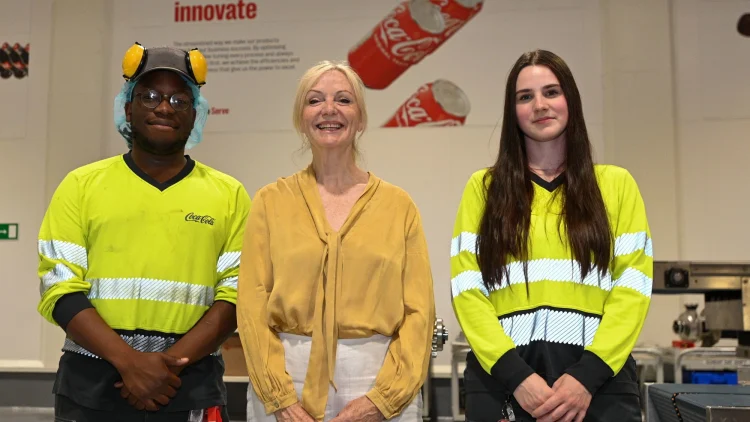

Tracy Brabin tours manufacturing facility featured in Coca-Cola Great Britain’s Counter Cultures campaign, which celebrates local vocational careers
Coca-Cola Europacific Partners (CCEP) welcomed West Yorkshire Combined Authority Mayor, Tracy Brabin, to its Wakefield manufacturing site last week – the facility at the heart of the company’s new Counter Cultures campaign, which celebrates the people and businesses behind Britain’s food and drinks industry, from production lines to local pubs, cafés and independent retailers.
Brabin toured the site – which is Europe’s largest soft drinks facility by volume – to see how the company is contributing to local employment and skills development.
CCEP supports thousands of independent retailers, hospitality businesses and wholesalers across Yorkshire through a dedicated field sales team. The Wakefield site directly employs 600 people – including 27 apprentices – and has invested £103m in operations at the site since 2019.
It’s also where Mark and Lewis Baker, father and son, work as Reliability Engineer and Utilities & Facilities Apprentice respectively, whose story features prominently in the new Counter Cultures campaign.
The visit comes as new research shows 58% of Gen Z in the UK are considering vocational careers, with over half (52%) considering following in their families’ footsteps. A similar number (47%) are choosing to build careers closer to home – a trend particularly strong in Yorkshire where a third of respondents (33%) said they’ve noticed more young people staying local rather than moving away, with the majority citing positive impacts on local businesses, communities and economies.
The findings highlight a growing opportunity for companies to invest in place-based skills, creating career pathways that enable young people to build futures in their own communities, strengthening local economies and supporting regional growth.
During the visit, the Mayor also saw how technology is shaping the future of manufacturing, meeting Spot®, a robotic inspection dog developed by Boston Dynamics that has recently been introduced at CCEP’s Wakefield and East Kilbride sites. Spot supports maintenance teams by monitoring almost 600 inspection points across seven production lines, collecting real-time data without interrupting production.
Katharine Duncan, Wakefield Site Director, CCEP, said: “Showing Tracy around our Wakefield site meant she could see the community spirit of our team first-hand. Many colleagues have worked here for years, building friendships and taking pride in what they do. As one of Yorkshire’s long-standing local employers, we’re proud to offer job opportunities with clear progression.”
Tracy Brabin, Mayor of West Yorkshire, said: “It was great to visit Coca-Cola and see how a global brand is creating new opportunities for young people right here in West Yorkshire by giving them the skills they need to build their careers.
“West Yorkshire is home to one of the largest food and drink sectors in the UK and having international businesses investing in our region is testament to what we have to offer and our commitment to growing the local economy.
“Through our Local Growth Plan, we will continue working with partners to create more jobs, support local businesses and ensure people have the skills they need to succeed, helping to build a stronger, brighter region that works for all.”


Early on Tuesday 4 August, an autonomous group broke into the offices of DB Schenker in Hillington, Glasgow. Bypassing security in the early hours of the morning, the group covered the building’s foyer and offices with paint and messages saying “Drop Elbit” on the walls.
The group claims it is ‘targeting the supply chain’ of Israeli arms and munitions. DB Schenker is owned entirely by DSV. This is a Danish company that allegedly provides ‘logistics transport services’ to Israeli drone and military technology manufacturer Elbit Systems.
Elbit Systems produces 85% of the Israeli military’s drone fleet, in addition to 80% of the state’s weapons and equipment. Israel has used Elbit weapons throughout the ongoing genocide in Gaza, in the Palestinian West Bank, against Syria and Yemen, and currently against Lebanon and Iran.
Elbit Systems’ drones have also taken part in attacks on international aid flotillas in international waters. Elbit Systems routinely lists its equipment as ‘battle-tested against Palestinians’.
DSV has recently come under intense pressure both within the UK and internationally due to its contract with Elbit Systems. Before the Glasgow action, groups in the UK, US, Denmark, Germany, France, the Netherlands, and Ireland had all damaged DSV premises in the past six months alone.
In April 2026, activists targeted a DSV office at Birmingham Airport, breaking windows and covering building in red paint. In May, a group in Bristol sabotaged a fleet of DSV trucks, slashing tyres and damaging vehicle exteriors. And in July, activists targeted a DSV site in Cork for a third time in the span of several months.
A spokesperson for the Glasgow group stated:
As long as DSV and its subsidiaries maintain their contract with Elbit Systems, property damage and disruption will continue. We will interrupt, delay and destroy the supply chain that provides Israel with its weaponry by any means necessary.
While DSV’s website proudly advertises their track record delivering Christmas gifts on time to children, their warehouses stock parts used to slaughter thousands of kids in Palestine, Lebanon and Iran.
DSV supplies hundreds of different industries, and does not depend on Elbit Systems to be able to pay their employees. Sinking to this moral low was their choice. Dropping Elbit could be their wisest logistics decision yet.
Featured image via the Canary
By The Canary


On 5 August, the Equality and Human Rights Commission’s (EHRC) new transphobic code of practice came into force. However, on that same day, the Good Law Project (GLP) announced that it would support Leigh Day solicitors and two claimants — a “trans person and a trans-inclusive organisation” — in a legal challenge to the code.
As the Canary previously reported, the code doesn’t carry legal weight in itself. Instead, it offers an interpretation of equalities law — specifically, the 2025 Supreme Court ruling that trans people should be treated as their assigned sex for the purposes of the Equality Act.
The EHRC’s interpretation encourages a nationwide bathroom ban against trans people, and their wholesale exclusion from single-sex services aligned with their lived gender. As such, in an opening salvo of their challenge, Leigh Day sent a pre-action letter to the EHRC and the government, setting out their legal argument.
In this article, we’ll take a closer look at that argument.
Trans code ‘fundamentally flawed’
In particular, the legal challenge focuses on the code’s advice that service providers should no longer operate on a trans-inclusive basis. That is to say, if the service remains open to both cis and trans women, it must also be open to cis men. Otherwise, the EHRC holds that it is “very likely” to discriminate against (cis) women.
However, Leigh Day and GLP argue that the EHRC is mistaken in the law. As the GLP explained:
an inclusive service provided to women – based on their lived gender – doesn’t directly discriminate based on “sex” (now defined as “biological sex” under the Equality Act) at all. If you exclude cis men from a trans-inclusive women’s service, it’s not because their sex was recorded as “male” at birth. This is, in fact, proven by the admission of trans women, whose sex was also recorded as “male”, but who are allowed to use the service. It is a person’s lived gender – not their “sex” under the Equality Act 2010 – which is the reason for their exclusion.
However, there’s a catch. Trans people only make up a fraction of the UK’s population. As such, most people whose sex is recorded as “male” at birth will be cis men. It follows, then, that excluding cis men from a service is more likely to discriminate against male-assigned individuals.
However, the legal challenge has an answer for this, too:
We think it’s entirely possible, depending on the circumstances, for service providers to justify offering their services on a trans-inclusive basis as a proportionate means of achieving a legitimate aim. And this has to be understood in the context that any single-sex service, which is offered on the basis of sex recorded at birth, would similarly have to be justified. The guidance makes no real room for such nuanced assessments, rendering it fundamentally flawed.
High Court ruling on interim trans code
On top of this, the EHRC code completely ignores the High Court’s ruling following the GLP’s challenge of the previous interim code.
The EHRC stated (and still holds) that any toilet that was open to trans women must also be open to cis men, or else it would likely constitute less favourable treatment on the basis of sex. However, the High Court judge argued otherwise:
In a case where the provision of separate lavatories labelled male and female was materially similar in terms of the extent of the provision, location, and so on, I consider there would, in principle, be scope for a strong argument that a rule or practice that permitted trans women to use the “female” lavatory but required other biological men to use the male lavatory would comprise different but not less favourable treatment on grounds of sex.
GLP holds that this ruling is “wholly contrary” to the EHRC’s position that such a toilet provision would be “very likely” to be discriminatory.
Given that the High Court gave its decision back in February, it’s egregious that the EHRC seems to have wholly ignored it when constructing its latest code.
Human rights violations
Along with several other more minor arguments, Leigh Day and the GLP also hold that the EHRC’s code violates human rights law. In particular, the code may violate Article 8 of the European Convention on Human Rights, which protects the right to privacy. The GLP explained that:
The landmark decision in Goodwin v UK – which led to the creation of the Gender Recognition Act 2004 – established that this right includes legal gender recognition for trans people. And the decision, despite claims to the contrary, was not just about gender markers on legal documents. It said that placing trans people in an “intermediate zone”, where they were “not quite one gender or the other” was a violation of their human rights. The court considered that “a conflict between social reality and law” places trans people in an “anomalous position”, in which they “may experience feelings of vulnerability, humiliation and anxiety”. In the two decades since, there have been numerous subsequent cases emphasising the importance of effective gender recognition for trans people.
The Supreme Court, in summary of the Goodwin v UK decision, stated that it:
puts it beyond doubt that the way in which the law and officialdom treat people who have undergone gender reassignment is no trivial matter. It has a serious impact upon their need, and their right, to live, not as a member of a “third sex”, but as the person they have become, as fully a man or fully a woman as the case may be.
Needless to say, the EHRC’s effective bathroom ban does not treat a trans man as “fully a man”, or vice versa for trans women. In fact, it does the exact opposite. Likewise, requiring that trans people use a ‘single-sex’ space which doesn’t align with their lived gender effectively outs them as trans, further violating their right to privacy.
‘In dire need of challenge’
If the court agrees, the legal challenge will ask for a “declaration of incompatibility”. Essentially, this would tell the government that it is in violation of its human rights obligations. This, in turn, would require the government to create legislation to fix its breach.
The GLP concluded with a call for solidarity:
For all the reasons outlined above, we believe that this code of practice is in dire need of challenge. But it is a challenge which can only succeed if we fight back together.
The EHRC’s code is a demonstration of the cruelty that the government will gleefully enact on any vulnerable minority, if it gets the chance. If we allow it to stand, it demonstrates clearly that no guarantee of our rights is worth the paper it’s written on.
As such, and as the GLP said, all of us must stand together in opposition to this transphobic code of practice.
Featured image via the Canary
By Grace

There’s nothing better than having a vase of vibrant, fresh flowers to brighten up your house.
I don’t know about you, though, but finding the time to buy fresh and seasonal flowers at a florist is tricky – plus supermarket flowers are often sad and dreary by the time you get them home.
Thankfully, we’re living in the 21st century, so there’s a solution to pretty much every problem we have sitting on our phones or desktops.
While there are plenty of flower mailbox delivery services, here at HuffPost we’re big fans of Interflora.
Not only does it offer same day delivery if you order before 3pm (meaning it’s our go-to when we’ve forgotten a birthday or want to say congrats on a new promotion) but it works with local florists all around the UK to curate bunches of seasonal flowers.
When you put in a request alongside your order, the florist will tailor your bouquet to the person, to make sure it feels special, so you always know you can ask for extra pink roses if that’s your loved one’s favourite, or omit the lilies if they have a cat.
What’s more, each bouquet is hand crafted on the day of delivery, so you can rest assured your gift will stay fresh for the next seven days – and once they’re set up in their vase, the packaging is all completely biodegradable and recyclable!


Trump signed two new executive orders on Thursday. These orders were aimed at narrowing birthright citizenship. This came just a month after the Supreme Court struck down his previous attempt.
According to Fox News, “the new directives rely on existing executive and immigration authorities and are intended to narrow eligibility for automatic citizenship in certain cases while cracking down on foreigners who travel to the United States to give birth.”
Trump announced the orders in the Oval Office, with adviser Stephen Miller looking on. Miller called birth tourism “a fraud on the American system” and “a fraud against the American government.”
.@POTUS: “We had a very unfortunate decision in the Supreme Court concerning birthright [citizenship]… so we’re making adjustments.”
President Trump is signing two Executive Orders to protect the meaning and value of American citizenship after Trump v. Barbara:
— The first… pic.twitter.com/NGSNNuzM0h
— Rapid Response 47 (@RapidResponse47) August 6, 2026
Trump characterized the Supreme Court’s decision as “very unfortunate” and “a bad decision,” and that birthright citizenship has been “made a joke out of.”
The Trump administration have said that the two orders “protect the meaning and value of American citizenship after Trump v. Barbara.” It said:
The first Executive Order non-exhaustively identifies certain categories of children of aliens who are not entitled to birthright citizenship consistent with historical exceptions to birthright citizenship recognized by the Supreme Court in Barbara. The second Executive Order delegates presidential authorities to the Secretary of State and Secretary of Homeland Security and directs them to halt the practice of birth tourism.
Miller is a longtime critic of birthright citizenship. He posted on X in April that:
Birthright citizenship means the children of illegal aliens can vote to tax your children and seize their inheritance.
Backlash to new orders
Trump is back at it, attacking birthright citizenship again.
This is wrong and it is unconstitutional.
The courts must overturn this assault on our law and values.https://t.co/sCKAXpbX39
— Rep. Shontel Brown (@RepShontelBrown) August 7, 2026
Congresswoman Yassamin Ansari called out Miller’s role in going after birthright citizenship, calling him the architect behind Trump’s “racist and fascist mass deportation agenda” and for “pushing relentlessly to end birthright citizenship — which is illegal.”
Stephen Miller architected the entirety of Trump’s racist and fascist mass deportation agenda, and he’s the one pushing relentlessly to end birthright citizenship – which is illegal.
He needs to be investigated and prosecuted for the crimes he’s actively committing. https://t.co/hCbslr8nQE
— Congresswoman Yassamin Ansari (@RepYassAnsari) August 6, 2026
Trump faces new constitutional challenge
Ruben Gallego, a Democrat Senator from Arizona, also called Trump’s decision wrong. He said that birthright citizenship was one of the “most clear-cut parts of the Constitution—even our extremist Supreme Court ruled it’s not up for debate.”
Birthright citizenship is one of the most clear-cut parts of the Constitution—even our extremist Supreme Court ruled it’s not up for debate.
Donald Trumps still thinks he can decide who counts as American.
He’s wrong. https://t.co/McnvcfaEWY
— Senator Ruben Gallego (@SenRubenGallego) August 7, 2026
The BBC interviewed Gabriel Chin, a professor at the University of California, Davis’ School of Law, who said that while parts of the order might hold up, other aspects “raise some serious constitutional questions”. Chin told the BBC that Trump, as the president, does have some power to restrict people coming into the US specifically for the purposes of having a child.
American Civil Liberties Union condemned Trump’s new executive orders, with its deputy director, Cody Wofsy, saying:
The Supreme Court already decided this issue: Birthright citizenship is guaranteed by the Constitution. No additional executive order can change the meaning of the Constitution. Any executive order that tries to rewrite birthright citizenship will meet the same fate as the last one.
Trump is throwing toys out of the pram again — another day, another executive order, another round of lawsuits.
Featured image via the Canary
By The Canary

Grammy-winning music producer William Orbit has died at the age of 69.
On Friday afternoon, a statement was posted on his verified social media pages, which read: “It is with profound sadness that the family and friends of William Orbit announce that William passed away at home on 23 July 2026.
“We are deeply saddened by his passing. He will be greatly missed by us and by so many whose lives he touched through his music, friendship and kindness. We kindly ask that the privacy of William’s family and close friends is respected during this difficult time.”
No cause of death has been provided.
The British musician – whose legal name was William Wainwright – became an established figure on the electronic music scene in the late 1980s and 90s.
His mainstream breakthrough came when he and Madonna collaborated on her Ray Of Light album, still considered a highlight of her discography almost 30 years on from its original reason.
William co-produced some of Madonna’s biggest hits of the 90s and 2000s, including the UK number ones Frozen and American Pie, as well as Ray Of Light, Nothing Really Matters, Drowned World/Substitute For Love, The Power Of Good-Bye and Beautiful Stranger.
He won three Grammys for his collaborations with the Queen of Pop, in addition to an Album Of The Year nomination for Ray Of Light, and reunited with her in the 2010s on her album MDNA.

Following the success of the Ray Of Light album, he also produced hit singles for All Saints (Pure Shores and Black Coffee), Pink (Feel Good Time) and Blur (Coffee & TV), in addition to collaborations with Robbie Williams and Britney Spears.
In his lifetime, he also helmed 12 of his own solo studio albums, with his 1999 effort Pieces In The Modern Style peaking at number two in the UK.

What EVERY woman in her 50s must do to secure her financial future

Companies House bans 23 directors over filing failures

Howmet Stock Pops After Earnings But Remains Inside Buy Zone


-

 Fashion7 days ago
Weekend Open Thread: Wit & Wisdom
-

 Politics7 days ago
Meta enters AI-training agreement with far-right ‘propaganda rag’ Newsmax
-

 Politics5 days ago
Zack Polanski: an incitement to murder Nigel Farage?
-

 Crypto World6 days ago
MicroStrategy Post-Earnings CLARITY Act Push Could Add New Catalyst for Its Stock
-

 Crypto World6 days ago
XRP Ledger v3.3.0 brings five institutional features
-

 Crypto World7 days ago
New York sues Kalshi over prediction market gambling
-

 Crypto World5 days ago
Crypto PAC spending tops $2M in Michigan House race
-

 Business5 days ago
DTCR: Deleveraging And A Hedge Fund Collapse Point To A Possible AI Bottom
-

 Tech5 days ago
ESET tracks rise in malicious AI skills and adaptable malware
-
 Crypto World7 days ago
3 Fed Officials Just Explained Their Rate Hike Vote: Is Inflation Winning?
-

 Sports6 days ago
France Cricket implodes: letters hidden in a drawer and a board at war
-
Crypto World5 days ago
XRP Ledger urges node upgrade after manifest flood
-

 Crypto World6 days ago
Moneyflip CEO charged in $40K murder-for-hire plot
-
 Sports7 days ago
Bruno Fernandes decision made as Man United ‘discuss’ striker transfer option
-
Business7 days ago
FIFA has scrapped $20 billion World Cup sell-off plan, New York Post reports
-

 News Videos6 days ago
Financial Crash Expert: The 90-Day Collapse Timeline They Are Desperately Hiding.
-

 Sports2 days ago
Jordan Coyle & Cordiamo take Laya Arena Stakes at RDS
-

 Sports7 days ago
Commonwealth Games 2026 Live Updates | Day 9 CWG 2026: Lovlina Borgohain, Sachin Siwach Enter Final After Indian Judokas Script History
-

 Crypto World4 days ago
US Tech Stocks See Largest 5-Week Inflow in History: Can Nasdaq Break Its Downtrend?
-
 NewsBeat6 days ago
Tourist plane on sightseeing flight in Peru crashes into a field, killing all 13 people on board
You must be logged in to post a comment Login