
Crypto World
A part of FTX survived, and it’s the case for the CLARITY Act

So the protections stay what they are: at the federal level not law, but an interpretive notice sorting 16 tokens, a collateral pilot, a few no-action letters, a memorandum of understanding between two federal agencies, any of it revocable without a vote. The rest is left to the states, where investors get real protection in certain states, less elsewhere, and in some states none at all, none of it reaching a market that is national. The last great collapse already showed which protections hold and which give way.
When FTX failed, its offshore exchange misused its customers’ assets for years. But several entities under the FTX umbrella — including LedgerX, a CFTC-regulated exchange and clearinghouse — came through the collapse whole, their customers’ assets segregated and intact. LedgerX survived for one reason: its protections were law. Not a clever mechanism but a plain one, customer segregation a regulator required and checked, which held whether or not anyone chose to honor it once the panic set in. The unregulated part of FTX ran on promises. In one collapse, under one roof, law held and promises broke.
FTX sat offshore for a reason. For years the United States met this industry with enforcement in place of rules, and its capital and talent went where the rules were clear, to Europe, Asia, and the Gulf. The rest went where there was no real oversight, and that is the gap an exchange like FTX grows in. When Washington started to offer clarity, the firms started returning to the U.S: Nexo came back after years away, London’s Wintermute opened a New York office, and Switzerland’s Taurus set up in New York to serve its bank clients. Law protects what it can reach, and the CLARITY Act would make that migration permanent instead of leaving the next firm to choose the dark. It would make the regulated, onshore model the norm for firms such as Bullish, a NYSE-listed digital asset market infrastructure firm (and the parent company of CoinDesk) already regulated in financial centres including Frankfurt, Hong Kong and New York, now pursuing CFTC registration as a designated contract market and derivatives clearing organization.


Howmet (HWM) is the Big Cap 20 component in focus as the stock tests a key level after breaking out in June. The stock is wading in a 5% buy zone, rendering it actionable now. A handful of aerospace and defense stocks gained momentum on Thursday. Both Howmet and fellow aerospace stock ATI (ATI) reported robust earnings, causing several of…
Copyright ©2026 Investor’s Business Daily, LLC. All rights reserved. 87990cbe856818d5eddac44c7b1cdeb8
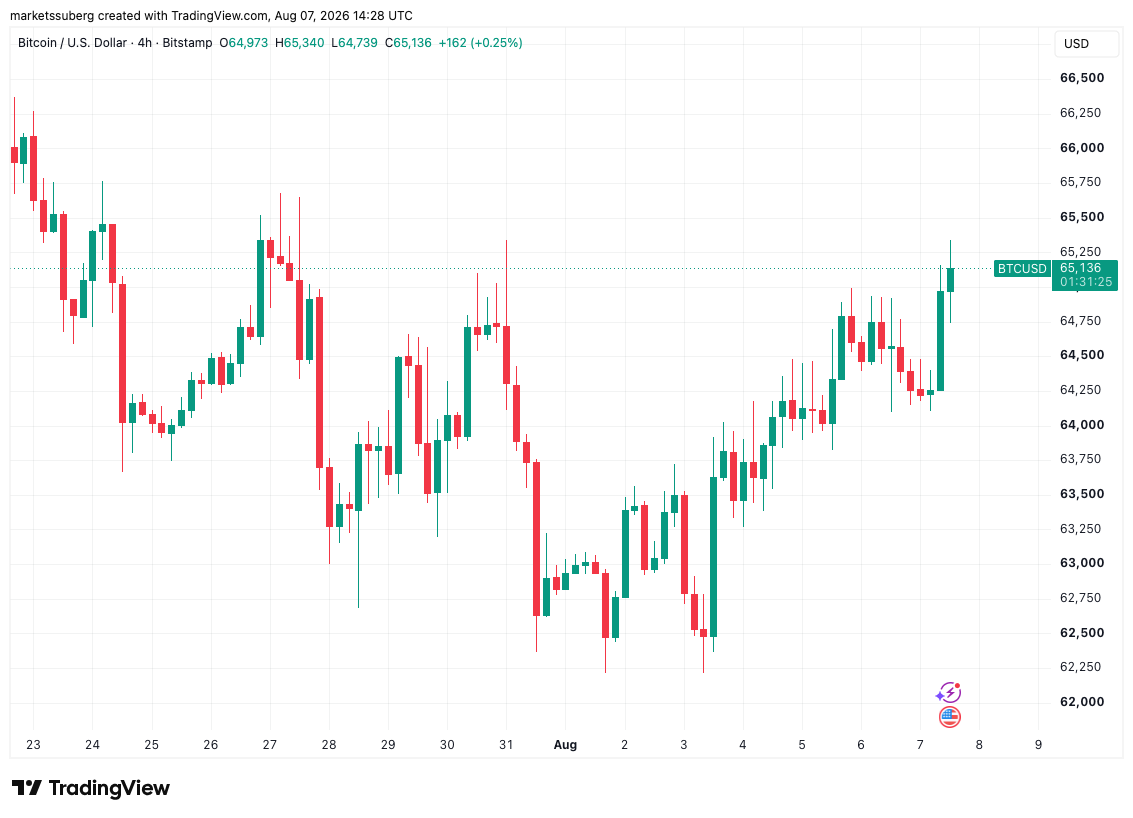
Bitcoin (BTC) hit new August highs into Friday’s Wall Street open as markets reacted to weaker US jobs numbers.
Key points:
- Crypto and risk assets gained after US nonfarm payrolls fell by 23,000 in July.
- Fed interest-rate bets for September shift from a 0.25% hike to a pause on signs of a weaker labor market.
- Bitcoin and altcoins stayed “resilient” after a week of bearish surprises, per analysis from QCP Capital.
Crypto, stocks higher on low nonfarm payrolls print
Data from TradingView showed BTC/USD hitting $65,340 on Bitstamp, up 1.3% on the day, as fresh US labour-market data was released.
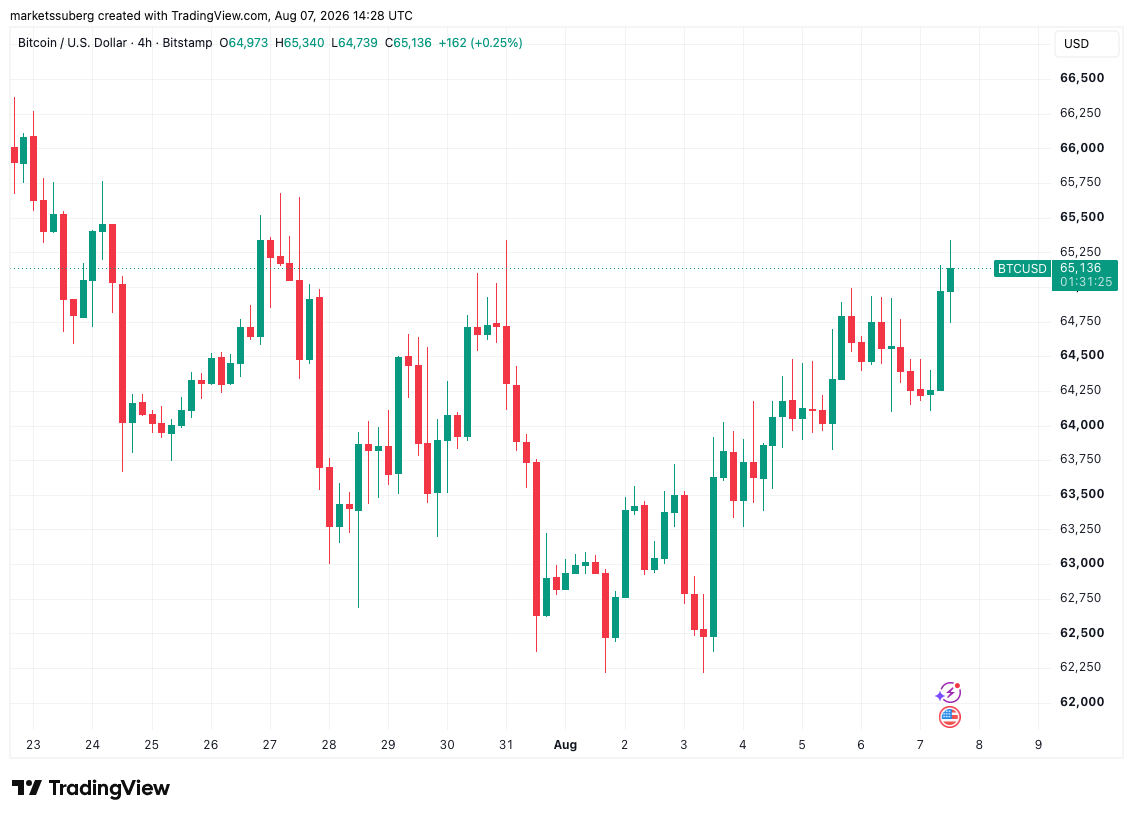
BTC/USD four-hour chart. Source: Cointelegraph/TradingView
The US economy lost 23,000 jobs in July, per nonfarm payrolls data from the Bureau of Labor Statistics (BLS), with the unemployment rate at 4.1%, numbers it described as “little changed” versus the month prior.
“The change in total nonfarm payroll employment for May was revised down by 66,000, from +129,000 to +63,000, and the change for June was revised down by 37,000, from +57,000 to +20,000. With these revisions, employment in May and June combined is 103,000 lower than previously reported,” an official statement added.
The combination of negative July values and downward revisions appeared to boost both crypto and US stocks, with traders linking weaker labor-market conditions with potential policy softening from the Federal Reserve.
The S&P 500 index opened 0.5% higher, while the tech-heavy Nasdaq Composite Index added just over 1%.
Data from CME Group’s FedWatch Tool reveals that markets are now expecting the Fed to hold interest rates at current levels at its September meeting. As late as yesterday, majority odds had favored a 0.25% rate hike.
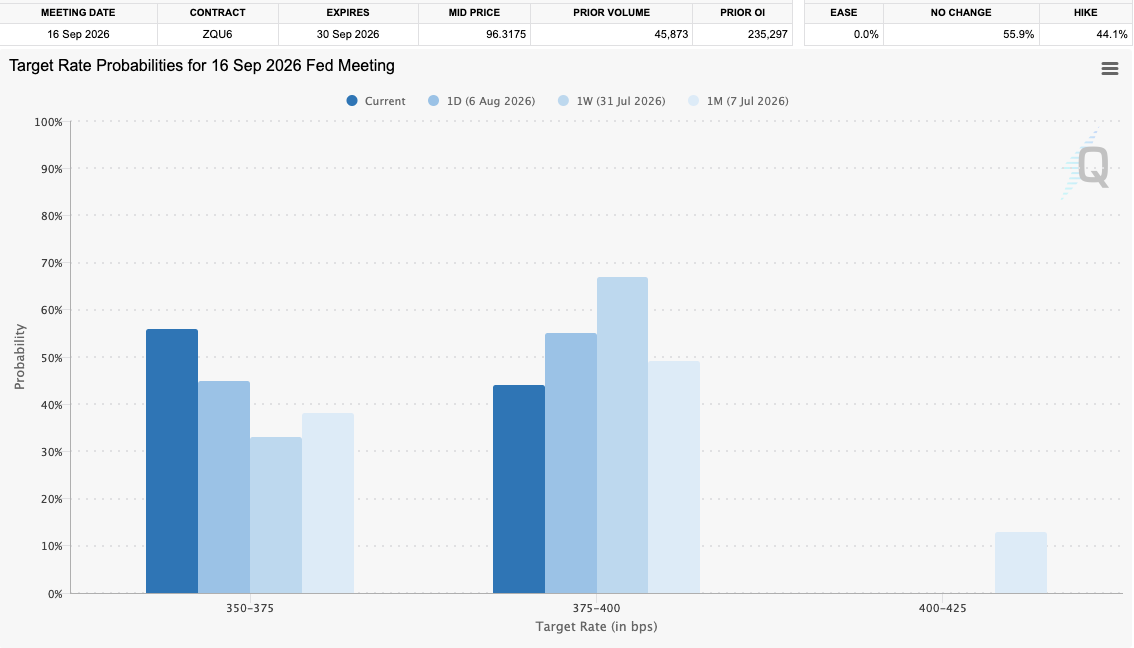
Fed target-rate probability comparison for September FOMC meeting. Source: CME Group
Prior to the employment data release, Ryan Lee, chief analyst at Bitget Research, said that it would “set the tone” for both the September meeting and the Fed’s annual economic Jackson Hole economic symposium, taking place at the end of August.
Fabian Dori, CIO at Sygnum Bank, predicted that Fed chair Kevin Warsh would be influenced by the extent to which payrolls data shifted lower.
“An orderly slowdown supports the liquidity relief case, while a print weak enough to raise growth concerns can still pressure risk assets even as rate odds move,” he said in comments sent to Cointelegraph.
Analysis praises Bitcoin, altcoin “resilience”
In its latest crypto and macro overview released on the day, trading company QCP Capital described the macro picture as “uncertain” for Bitcoin.
Related: Bitcoin price-metric basket sees longest capitulation since FTX blow-up: Glassnode
“For crypto, the week’s price action points to resilience rather than clear directional confirmation,” it summarized.
QCP noted that the fallout from the Coldcard wallet exploit, along with BTC sales by corporations including Strategy, had only sparked “limited demand for panic protection” on options markets.
Previously, Cointelegraph reported on option traders’ expectations for a BTC price trading-range breakdown to occur next month.
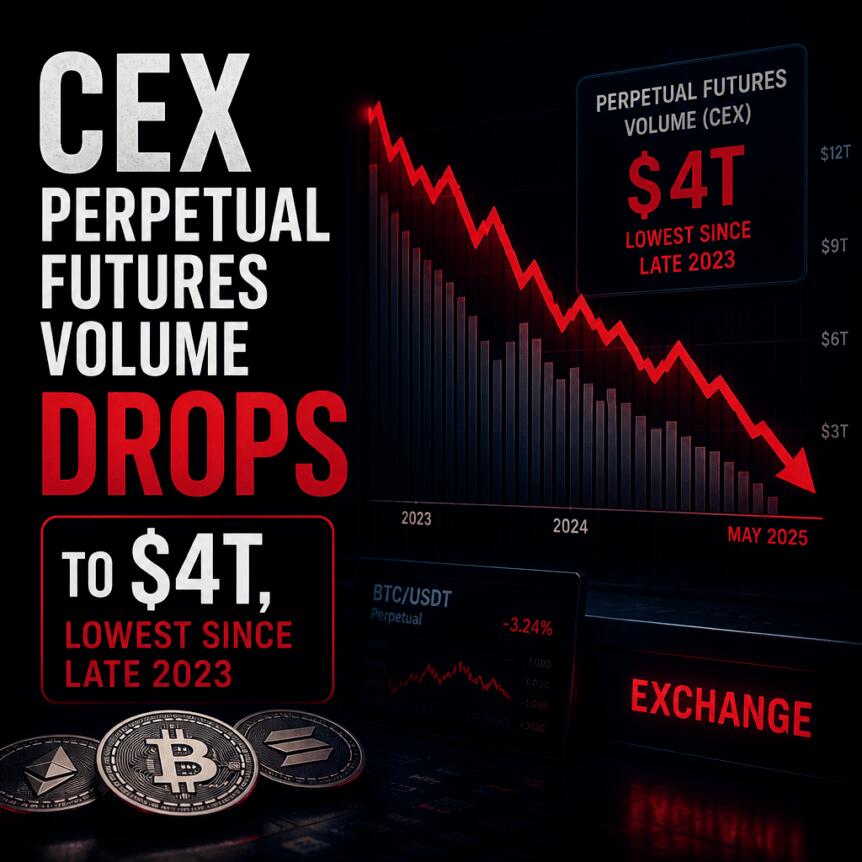
Trading activity in both centralized and decentralized crypto derivatives cooled sharply in July, with perpetual futures volumes hitting multi-month lows across major venues. The slowdown points to thinner speculative momentum—an environment where liquidity and positioning often matter as much as spot demand.
According to CryptoRank’s data posted on X, perpetual futures trading volume on centralized exchanges (CEXs) fell to $4 trillion in July, the lowest level in 31 months since December 2023. The same report also tracked weakness across spot markets during the month, reinforcing the picture of reduced overall market participation.
Key takeaways
- CryptoRank data shows CEX perpetual futures volume dropped to $4T in July, a 31-month low.
- Binance accounted for most CEX perp volume at $1.4T, while OKX and Bybit posted $607B and $300B respectively.
- Coinglass reports CEX spot trading volume declined 23.6% in July to $13.6B from $17.8B at the start of the month.
- DefiLlama data indicates DEX perpetuals fell to $531B in July, near a one-year low, with DEX open interest also sliding.
- On leading DEX Hyperliquid, tokenized RWAs grew in importance, even as overall DEX perp activity declined.
CEX perpetual futures slide to a 31-month low
CryptoRank said that in July, perpetual futures trading on centralized exchanges totaled $4 trillion—down to the weakest point since December 2023. The month’s decline followed a brief recovery between April and June, after which volume fell again across major venues.
Binance led CEXs by volume with $1.4 trillion in monthly perpetual futures activity, according to the CryptoRank post. OKX came next with $607 billion, followed by Bybit at $300 billion.
For market participants, changes in perp volume can be a useful proxy for speculative activity and the willingness of traders to take leveraged exposure. When volumes compress—especially after a short rebound—liquidity and price discovery in derivative-heavy markets can become less resilient, even if underlying spot interest remains intact.
Spot weakness and the pullback in derivatives activity
Part of the broader contraction appears tied to spot trading as well. Coinglass data cited in the report shows daily spot crypto trading volume fell 23.6% from July 1 to July 31, dropping from $17.8 billion to $13.6 billion.
This matters because spot and derivatives flows often move together during risk-on or risk-off phases. With spot participation weakening over the month, it becomes more difficult for perp markets to maintain high turnover—particularly when traders are less eager to hedge or express directional bets through leverage.
DEX perpetuals near a one-year low, open interest declines
Derivatives activity also weakened on decentralized exchanges. DefiLlama data indicates DEX perpetual trading volume fell to $531 billion in July, the lowest level since June 2025. The report also described a 21% decline from June 2026’s $676 billion.
Beyond volume, DEX open interest fell as well. According to the same DefiLlama figures, open interest on DEXs dropped to $17.9 billion in July from a September 2025 peak of $19.4 billion. Open interest reflects the total value of active, unsettled perp contracts and can help signal whether new capital is entering the market or existing positions are being reduced.
In other words, July’s slowdown was not just about lower trading counts—it also reflected less outstanding leveraged exposure on DEX venues.
Hyperliquid remains a volume leader as RWAs gain share
Even as overall DEX perpetual activity declined, Hyperliquid stood out as the leading platform. DefiLlama-tracked performance in the report shows Hyperliquid generated $199 billion in reported trading volume over the past 30 days.
What appears to have changed on Hyperliquid is not its dominance of volume, but the composition of that volume. A larger portion of Hyperliquid’s trading has come from tokenized real-world assets (RWAs). The report states that RWAs accounted for 32% of Hyperliquid’s second-quarter trading activity, which corresponded to 6.6% of the protocol’s $169 million quarterly revenue.
The shift toward RWAs also shows up in category rankings. The article notes that tokenized assets became Hyperliquid’s largest trading category for the first time last month, with RWAs representing 52% of the protocol’s total weekly trading volume between July 13 and July 19.
For traders and builders, this is a meaningful divergence from the broader July picture: while total DEX perp volume and DEX open interest declined, Hyperliquid’s internal mix leaned more toward tokenized assets. That suggests demand for certain contract exposures may remain sticky even when overall leverage appetite cools.
What to watch next
With both CEX and DEX perpetual activity at multi-month lows and spot volume also down in July, the next signal for traders will likely be whether August brings renewed spot engagement and sustained perp open interest, or whether the contraction becomes a longer trend. At the same time, the growing RWA share on Hyperliquid raises a separate question: can tokenized-asset flows offset softer broader derivatives momentum in the months ahead?

Then came No Child Left Behind. Signed into law in 2002, it promised that standards, testing, and accountability would finally close gaps in student achievement across race and class. The law succeeded in exposing disparities, but it also encouraged teaching to the test and narrowed what many schools taught. The gaps it sought to eliminate largely remained.
Now AI has become the latest reform wrapped in transformational promises. Its advocates are right about some of its potential in education. Generative AI can help explain difficult concepts, provide immediate feedback, translate instructional materials, and make individualized support more accessible than ever before. Teachers can use it to differentiate instruction and reduce routine administrative work. Used well, AI will almost certainly improve teaching and learning in many classrooms.
But what occurs in classrooms has never been the primary obstacle to educational equality. Students do not arrive at school with equal access to stable housing, nutritious food, quality health care, reliable internet, experienced teachers, safe neighborhoods, or family resources. These inequalities accumulate long before a child enters kindergarten and continue long after the school day ends. Chatbots, no matter how well-designed, will not erase them.


Phantom will end support for the Monad network on Aug. 26, the wallet company said on X on Friday, cutting off the high-throughput EVM chain roughly nine months after its November 2025 mainnet launch. "We'll soon begin notifying Monad users in-app with links to support articles that share options… Read the full story at The Defiant


Firmus, a former Bitcoin mining company that has repositioned itself as an AI infrastructure provider, has secured $2 billion in new equity funding, lifting its post-money valuation above $10.5 billion as it expands AI factory projects across Australia and the Asia-Pacific region.
Summary
- Former Bitcoin miner Firmus has raised $2 billion in fresh equity, lifting its valuation above $10.5 billion.
- Blackstone, Nvidia, Coatue and Jane Street participated in the funding round to support the company’s AI infrastructure expansion.
- The new capital will accelerate Project Southgate in Australia while funding early expansion into Indonesia and other Asia Pacific markets.
- The raise brings Firmus’ total equity funding over the past year to more than $3 billion as it scales AI factory deployments.
According to Firmus, the strategic equity round received full investment commitments from existing backers Coatue and Nvidia, alongside new funding from funds managed by Blackstone Tactical Opportunities and other Blackstone vehicles, with additional participation from global trading and technology firm Jane Street.
The latest raise nearly doubles Firmus’ valuation from the $5.5 billion level recorded during its April funding round. It also brings the company’s total equity raised over the past year to more than $3 billion, providing additional capital for Project Southgate, its AI factory rollout across Australia.
Firmus funding supports Project Southgate expansion
Under the new financing, Firmus plans to accelerate the next stage of Project Southgate while preparing for development across selected Asia-Pacific markets. The company said part of the investment will support early work on its recently announced Indonesia project, which is intended to serve AI-native customers.
Firmus added that it has already established Australian manufacturing for its proprietary HyperCube platform. It is building AI infrastructure based on Nvidia’s DSX AI Factory Reference Architecture, which the company said is designed to bring computing capacity online more quickly while improving tokens per watt and system resiliency.
“This investment allows us to move on multiple fronts at once,” Co-Chief Executive Officer Oliver Curtis said.
“We’re scaling across Australia while fast-tracking our capacity to expand into the wider Asia-Pacific region, including the early steps behind our recently announced Indonesia development that will serve AI-native customers,” Curtis added.
The company and Nvidia strengthened their relationship in late June through an agreement under which Firmus would purchase Nvidia infrastructure while offering cloud services powered by the chipmaker’s technology. The latest financing extends that relationship with Nvidia participating again as an investor.
Blackstone, Coatue and Jane Street deepen AI infrastructure bets
Blackstone’s participation adds another major institutional investor to the financing round at a time when large investment firms continue increasing exposure to AI infrastructure.
“We believe AI infrastructure will be a foundational driver of global growth and it is among our highest conviction investment themes,” John Watson, Senior Managing Director at Blackstone, said.
“We are pleased to continue to invest in Firmus and support platforms at the forefront of AI innovation,” he added.
Coatue also increased its investment in the company after backing an earlier funding round.
“We continue to believe Firmus represents a differentiated approach to AI infrastructure,” Robert Yin, General Partner at Coatue, said.
According to Yin, the company’s combination of proprietary technology, manufacturing capabilities and a repeatable deployment model positions it to support demand from both AI-native businesses and enterprise customers as computing requirements continue increasing.
Jane Street also joined the funding round.
“As AI models become larger and more capable, access to reliable, high-performance compute becomes increasingly important,” Daniel Pontecorvo, Head of Physical Engineering at Jane Street, said.
Pontecorvo added that Firmus is building infrastructure needed for the next generation of AI systems, which supported the firm’s decision to invest.
AI infrastructure attracts fresh capital
The financing comes as investors continue directing capital toward companies building physical AI infrastructure instead of focusing only on chip manufacturers.
Industry participants have increasingly targeted data centers, electricity infrastructure and high-performance computing capacity as demand for AI services expands. Earlier this year, Core Scientific agreed to provide AMD with up to 2.5 gigawatts of data center capacity beginning in 2027 as the former Bitcoin miner continued converting mining sites into AI infrastructure.
IREN has also accelerated its AI strategy after completing the acquisition of Spain-based Nostrum Group in June. The transaction added about 490 megawatts of secured grid-connected power and expanded IREN’s European AI cloud footprint while AI cloud revenue continued growing faster than its Bitcoin mining business.
More recently, Hyperscale Data sold approximately 100 Bitcoin and secured a Bitcoin-backed credit facility to finance construction of its Michigan AI campus. The company said the financing would help fund infrastructure for an AI contract that could exceed $3 billion if all expansion and extension options are exercised.
Alongside those projects, publicly listed Bitcoin miners have continued repositioning power assets toward AI computing as long-term infrastructure agreements become an increasingly important source of contracted revenue. Industry data published in late July also showed Bitcoin mining difficulty remained well below its 2025 peak while companies pursued AI data center investments to diversify income.
Australia remains central to Firmus’ rollout
While preparing projects elsewhere in the Asia-Pacific region, Firmus said Australia will remain the primary focus for the newly raised capital.
According to the company, its existing manufacturing capability and software platform provide the foundation for faster deployment of AI infrastructure across domestic sites before additional regional expansion proceeds.
The company also stated that the transaction is a private financing and not a public securities offering. Firmus said the securities issued in the round have not been registered under the U.S. Securities Act of 1933 and may not be offered or sold in the United States except under an applicable exemption from registration requirements.
Crypto World
A Coldcard Hacker Just Moved $1.94 Million in Stolen Bitcoin for the First Time, Is a Cash-Out Coming?
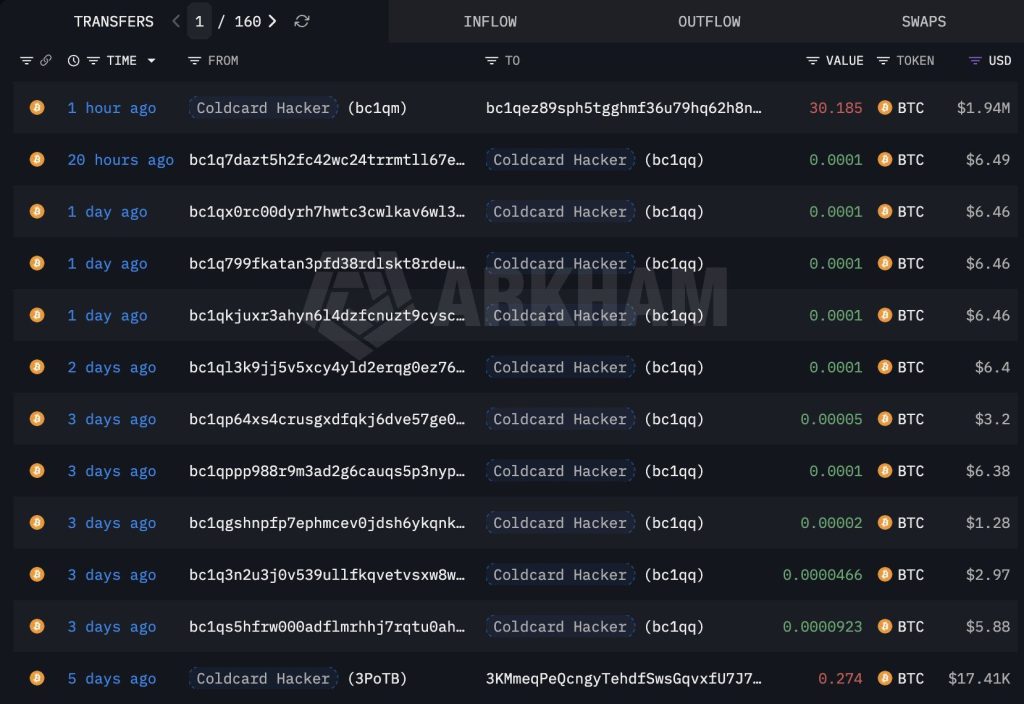
In the latest Bitcoin news, a wallet associated with the Coldcard hack transferred 30.185 BTC, worth about $1.94 million, to a newly created address on Aug. 7, according to on-chain tracker Lookonchain.
The movement followed weeks of inactivity and represents roughly 1.5% of the estimated 2,055 BTC linked to the theft.
The transfer does not confirm that the bitcoin will be sold or exchanged. However, Lookonchain reported that it was the attacker’s first movement since the initial theft, drawing attention to whether further transfers follow.
Discover: Everyone’s Got a Take. Get Free $25 to Actually Trade Yours
Bitcoin News: On-Chain Tracking Flags BTC Cash-Out Risk
The wallet activity follows a major hardware-wallet breach involving more than $100 million in reported losses. On-chain analysis from Galaxy Research identified three confirmed attack waves that drained 1,596 BTC from roughly 7,300 addresses.
A suspected fourth wave could bring the total to about 2,055 BTC, valued at roughly $130 million.
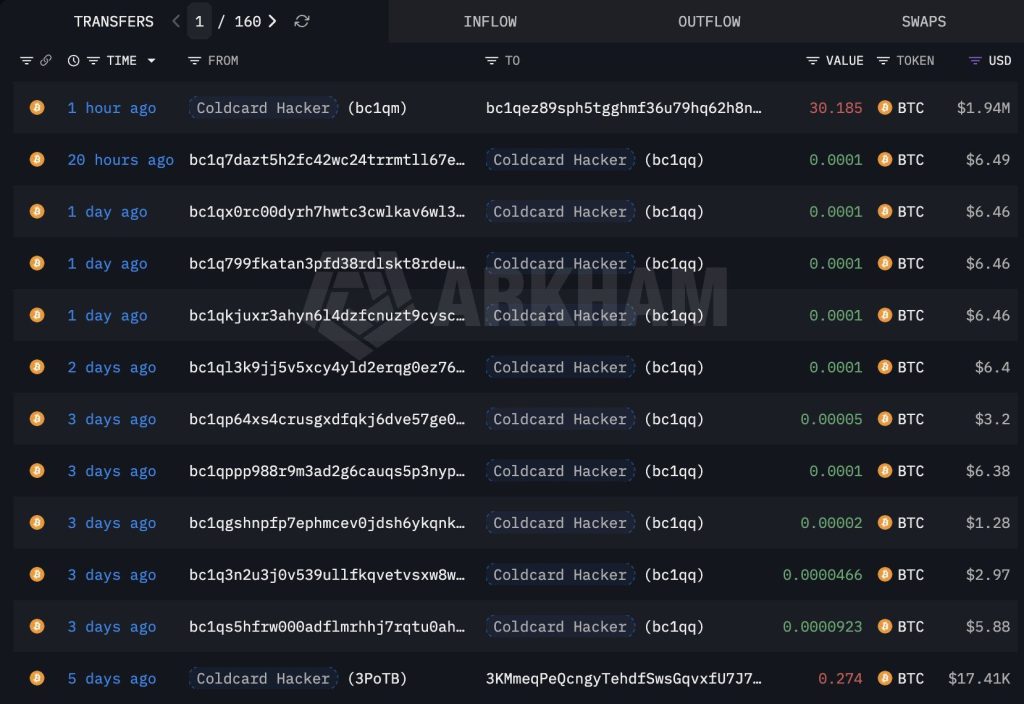
Before the latest transfer, Galaxy Research said roughly 90% of the stolen bitcoin had not moved from the wallets where it was sent after the reported theft.
Because bitcoin transactions are public on the blockchain, identified attacker addresses can be tracked as funds move between wallets.
On-chain analysts have described the transfer as a possible early sign of an attempted cash-out. Attackers seeking to convert stolen assets may move funds through a series of wallets before attempting to exchange them for other assets or fiat currency.
Discover: Your Market Calls Are Worth Something. Start With Free $25 on Kalshi
Firmware Flaw Exposed Cold Storage Devices
The breach stemmed from a software vulnerability in Coldcard hardware wallets made by Toronto-based Coinkite. In an update, Coinkite said affected firmware dating to March 2021 used a deterministic pseudo-random generator instead of the intended hardware-backed true random number generator when generating wallet seeds.
— COLDCARD (@COLDCARDwallet) July 31, 2026
 URGENT COLDCARD SECURITY UPDATE
Read carefully before acting.
Mk3 seed generated on 4.0.1+ without ≥50 private, independent dice rolls: begin a careful migration now. Mk4/Mk5 <5.6.0 or Q <1.5.0Q: update first, generate a new seed, then migrate.https://t.co/HshUxevCl3 https://t.co/zrkUuACRyE
The flaw allowed attackers to reconstruct wallet seed phrases or private keys without physically obtaining the devices. Seed phrases act as the keys used to authorize bitcoin transactions.
Coinkite advised users who generated seeds on vulnerable firmware to move their funds to safe addresses or use fresh seeds. The company also released firmware updates, though existing seed phrases generated on vulnerable devices remain at risk and should be replaced, according to the company and Galaxy Research.
What to Watch as Attacker Wallets Awaken
The immediate focus is on whether the 30.185 BTC sent to the new address moves again.
Further transfers could provide additional information about how the stolen funds are being handled, though the initial transfer alone does not establish the purpose of the movement.
Galaxy Research said details from the ongoing investigation, including attacker and victim addresses, have been shared with U.S. law enforcement agencies, cryptocurrency exchanges and cyber-investigation groups.
The firm said identifying additional attacker addresses remains important so those addresses can be reported to authorities.
Discover: Get Paid to Be Right, $25 to Start on Kalshi
Don’t Miss Out on Our $1,000 USDT Airdrop on ByBit
The post A Coldcard Hacker Just Moved $1.94 Million in Stolen Bitcoin for the First Time, Is a Cash-Out Coming? appeared first on Cryptonews.
While acknowledging bipartisan support exists for the legislation, Rafique said party politics are likely to outweigh the industry’s push for regulatory clarity.
He dismissed Democratic concerns over ethics provisions as inconsistent, arguing lawmakers should instead adopt broader restrictions on public officials participating in financial markets.
Despite his skepticism, Rafique described the Clarity Act as critical to the future of the U.S. digital asset industry. He said clear federal rules would help retain entrepreneurs, investment and intellectual property that are increasingly being built overseas.
“Without clarity, entrepreneurs will continue to stay offshore,” Rafique said, pointing to companies such as Hyperliquid and Backpack, which chose jurisdictions outside the U.S. “There is only one Silicon Valley and one Wall Street. The U.S. should be creating the environment for these companies to build at home.”
OKX is one of the world’s largest cryptocurrency exchanges, offering spot, derivatives and Web3 services. The company resumed its U.S. expansion in 2025 after resolving a long-running case with the U.S. Department of Justice over unlicensed money-transmitting activity.
Limited upside if Clarity passes
Rafique also argued that markets have already priced in much of the potential benefit from the legislation.
He said bitcoin’s recent rebound was partly driven by renewed optimism around the bill, meaning passage would likely generate only a modest short-term rally of around 3%-4%.


WhiteBIT has introduced Spot Grid and Martingale DCA bots for UK users, expanding automated trading within a market where retail access to crypto derivatives remains restricted.
Summary
- Two automated spot trading bots are now available to WhiteBIT users in the UK.
- The Spot Grid Bot places orders across a selected range, while the DCA bot buys during declines.
- UK retail investors remain barred from buying crypto futures, options and contracts for difference.
- Coinbase and Robinhood have recently introduced broader AI-controlled trading systems in the United States.
WhiteBIT adds Grid and DCA bots for UK traders
WhiteBIT has made its Spot Grid and Martingale DCA bots available to UK users, according to a company announcement carried by multiple crypto publications.
The Spot Grid Bot places multiple buy and sell orders at fixed intervals within a chosen price range. It buys as the market moves toward the lower sections of the range and sells as the price moves higher.
WhiteBIT designed the strategy primarily for sideways markets, where an asset repeatedly moves between established support and resistance levels. Users can choose the trading pair, investment amount, price range, and number of grids.
The Martingale DCA Bot follows a directional strategy. It opens an initial position and places additional buy orders if the asset declines, lowering the position’s average entry price. The bot then attempts to close the full position when the market recovers to a predefined profit level.
WhiteBIT said users can adjust certain parameters while a trading cycle is active, giving them some control without requiring them to terminate the strategy and start again.
UK derivatives ban increases focus on spot trading
Both bots operate in the spot market and do not use leverage. This removes the liquidation mechanism associated with leveraged futures positions, but it does not protect users from market losses.
A DCA bot can continue buying into a prolonged decline, increasing the trader’s exposure to a falling asset. Grid strategies can also underperform when the price breaks sharply outside the selected range instead of continuing to move sideways.
The UK’s regulatory framework makes the spot focus particularly relevant. The Financial Conduct Authority banned firms from selling crypto derivatives, including futures, options and contracts for difference, to retail customers in January 2021.
Although the FCA later restored retail access to certain exchange-traded notes listed on recognized UK exchanges, the regulator has kept the crypto derivatives ban in place. Retail consumers can still buy and sell cryptoassets directly through spot platforms, subject to the UK’s financial promotion and anti-money laundering requirements.
WhiteBIT’s products therefore automate strategies in a segment that remains accessible to British retail traders without offering prohibited leveraged derivatives.
Coinbase and Robinhood expand trading automation
WhiteBIT’s launch follows several automation rollouts covered by crypto.news over the past two months, though the companies use different systems.
crypto.news reported in June that Coinbase launched Coinbase for Agents, allowing users to connect systems such as ChatGPT and Claude to their accounts. Authorized agents can monitor markets, execute trades, place conditional orders and rebalance portfolios under rules established by the customer.
Coinbase expanded the service in July with real-time market views and conditional commands. Users can instruct an agent to sell an asset when Bitcoin falls below a selected price or cancel an order after a fixed period.
Robinhood took a similar approach with dedicated agentic trading accounts. crypto.news reported on June 15 that the company opened the system to all customers, allowing connected AI agents to research markets, execute trades and rebalance portfolios.
WhiteBIT’s bots are narrower. They follow predefined Grid and DCA strategies rather than allowing an external AI agent to manage a wider range of account activities.
Automated strategies still require active oversight
The new tools reduce the need to place every order manually, but their results depend on market direction, selected parameters, and the assets being traded.
Grid bots generally require prices to remain within a defined range. Martingale strategies rely on an eventual recovery and can commit increasing amounts of capital as prices fall. Neither approach guarantees a profit, and previous performance or backtesting cannot predict future results.
UK users will need to monitor open strategies and adjust or stop them if market conditions no longer support the original setup.

Traders cut the odds of a September Federal Reserve rate hike to 44% on Friday after US non-farm payrolls unexpectedly fell by roughly 23,000 in July, all while Bitcoin (BTC) rose a very modest 0.7% in the hour after the release, jumping to a local high of $65,300.
Moving on, payrolls were forecast to rise by 83,000, according to the Dow Jones consensus, and the Bureau of Labor Statistics (BLS) published the decline at 8:30 a.m. ET, as per CNBC.
CME Group’s FedWatch tool put the probability of a September move at 44% and October at 58.3% once the numbers landed, and Dow futures climbed close to 200 points as Treasury yields fell.
Bitcoin traded at $64,500 in the 30 minutes before the release and touched $65,300 in the hour that followed, according to data from CoinGecko.
Revisions Deepen the Slowdown
BLS cut May payrolls by 66,000 to 63,000 and June by 37,000 to 20,000, leaving the two months a combined 103,000 weaker than previously reported. Average monthly job creation across the past year now stands at 34,000.
Local government education shed 50,000 positions, leisure and hospitality 40,000, retail trade 19,000, and financial activities 14,000. Moreover, health care added 22,000, below its 36,000 monthly average, and construction added 22,000. Private payrolls rose 30,000 while government employment dropped 53,000.
Average hourly earnings rose 2 cents to $37.62. Annual wage growth slowed to 3.2%, under the 3.5% forecast and the weakest since May 2021. The unemployment rate edged down to 4.1% as the labor force shrank by 264,000 and participation fell to 61.4%.
Hike Bets Fade as Bitcoin Lags
The Federal Open Market Committee held its benchmark rate at 3.50% to 3.75% on July 29 by a 9-to-3 vote, with three regional presidents preferring a quarter-point increase. CryptoPotato covered the same 3.50% to 3.75% range being held at Kevin Warsh’s first meeting as Fed chair in June. Inflation has run above the central bank’s 2% target.
“This morning’s report is a game changer in the sense that all of the recent focus has been on inflation and this report highlights the risks that are embedded in the labor market as well,” said Chris Zaccarelli, chief investment officer at Northlight Asset Management.
Crypto responded far more violently to the opposite surprise two months ago, when stronger-than-expected labor data triggered a hawkish repricing and drove Bitcoin to $59,100, a 20% weekly loss accompanied by $1.7 billion in liquidations.
Digital asset funds bled $454 million in a single week during an earlier stretch of fading rate expectations.
The post Bitcoin Barely Budges as Weak US Jobs Data Cuts Fed Hike Odds to 44% appeared first on CryptoPotato.

What EVERY woman in her 50s must do to secure her financial future

Companies House bans 23 directors over filing failures

Howmet Stock Pops After Earnings But Remains Inside Buy Zone


-

 Fashion7 days ago
Weekend Open Thread: Wit & Wisdom
-

 Politics7 days ago
Meta enters AI-training agreement with far-right ‘propaganda rag’ Newsmax
-

 Politics5 days ago
Zack Polanski: an incitement to murder Nigel Farage?
-

 Crypto World6 days ago
MicroStrategy Post-Earnings CLARITY Act Push Could Add New Catalyst for Its Stock
-

 Crypto World6 days ago
XRP Ledger v3.3.0 brings five institutional features
-

 Crypto World7 days ago
New York sues Kalshi over prediction market gambling
-

 Crypto World5 days ago
Crypto PAC spending tops $2M in Michigan House race
-

 Business5 days ago
DTCR: Deleveraging And A Hedge Fund Collapse Point To A Possible AI Bottom
-

 Tech5 days ago
ESET tracks rise in malicious AI skills and adaptable malware
-

 Crypto World7 days ago
3 Fed Officials Just Explained Their Rate Hike Vote: Is Inflation Winning?
-

 Sports6 days ago
France Cricket implodes: letters hidden in a drawer and a board at war
-
Crypto World5 days ago
XRP Ledger urges node upgrade after manifest flood
-

 Crypto World6 days ago
Moneyflip CEO charged in $40K murder-for-hire plot
-
 Sports7 days ago
Bruno Fernandes decision made as Man United ‘discuss’ striker transfer option
-
Business7 days ago
FIFA has scrapped $20 billion World Cup sell-off plan, New York Post reports
-

 News Videos6 days ago
Financial Crash Expert: The 90-Day Collapse Timeline They Are Desperately Hiding.
-

 Sports2 days ago
Jordan Coyle & Cordiamo take Laya Arena Stakes at RDS
-

 Sports7 days ago
Commonwealth Games 2026 Live Updates | Day 9 CWG 2026: Lovlina Borgohain, Sachin Siwach Enter Final After Indian Judokas Script History
-

 Crypto World4 days ago
US Tech Stocks See Largest 5-Week Inflow in History: Can Nasdaq Break Its Downtrend?
-
 NewsBeat6 days ago
Tourist plane on sightseeing flight in Peru crashes into a field, killing all 13 people on board
You must be logged in to post a comment Login