
Crypto World
CFTC warns prediction markets over gambling-style odds



The CFTC has warned regulated prediction markets against displaying American-style gambling odds as state authorities intensify efforts to classify sports event contracts as unlicensed betting.
Summary
- The CFTC told regulated prediction markets to avoid American-style odds in product displays.
- Platforms must comply with derivatives laws and avoid deceptive marketing or solicitation practices.
- New York is seeking at least $36 billion from Kalshi over alleged gambling violations.
- Kalshi has requested emergency protection from Utah enforcement while it pursues an appeal.
CFTC warns prediction markets over odds displays
The Commodity Futures Trading Commission instructed regulated prediction market platforms not to display contracts using American-style gambling odds, according to an Aug. 7 Bloomberg report.
American odds typically show potential returns using positive and negative numbers, such as +150 or -200. Sportsbooks commonly use this format, while prediction markets usually price contracts between $0 and $1 based on the implied probability of an event.
The CFTC also reminded registered entities that event contracts remain subject to U.S. derivatives laws. Platforms must avoid “deceptive” practices when listing, advertising, or soliciting trades in these products.
The guidance suggests that federal registration does not allow prediction markets to advertise their products in a manner that makes them indistinguishable from conventional sportsbooks. It comes as the agency continues defending its authority over event contracts against state gaming regulators.
The CFTC maintains that designated contract markets fall under its exclusive jurisdiction through the Commodity Exchange Act. State officials argue that contracts tied to sporting events constitute wagers and require local gambling licenses.
State lawsuits challenge CFTC jurisdiction
New York became the latest state to escalate the dispute when Attorney General Letitia James sued Kalshi on July 31. As crypto.news reported, the state is seeking at least $36 billion in damages and penalties.
The complaint alleges that Kalshi operates an unlicensed gambling business by allowing New York residents to trade contracts on sports and other events. Kalshi has denied that characterization and argues that its status as a CFTC-regulated exchange places it outside state gambling oversight.
The dispute extends well beyond New York. Attorneys general from 44 states recently urged the CFTC to withdraw and rewrite its proposed prediction market rules. They argued that states have traditionally regulated sports betting and should retain authority over sports-related contracts.
Courts have also questioned the federal regulator’s position. A Wisconsin federal court rejected the CFTC’s request to prevent state authorities from applying gambling laws to prediction platforms.
Washington secured a preliminary injunction against Kalshi in July. The court found that federal derivatives law did not prevent the state from enforcing its gambling restrictions, according to earlier crypto.news coverage.
Kalshi seeks emergency relief in Utah
Kalshi filed an emergency motion for an injunction pending appeal after a Utah federal court ruled that the state could enforce its anti-gambling laws against prediction markets.
Gaming law expert Daniel Wallach said the company requested expedited relief because it fears Utah Attorney General Derek Brown could pursue civil or criminal charges while the appeal remains pending.
The ruling rejected Kalshi’s claim that the Commodity Exchange Act prevents Utah from regulating its sports event contracts. Kalshi intends to take the dispute to the U.S. Court of Appeals for the Tenth Circuit.
Utah residents could still access the platform immediately following the decision, but Brown indicated that the state planned to enforce its gambling laws. The state has not disclosed what form that enforcement will take.
Prediction markets face tighter compliance demands
The latest warning shows that the CFTC’s support for federal jurisdiction does not remove compliance obligations for prediction market operators.
The agency has also pursued misconduct on regulated platforms. Former U.S. Representative George Santos recently agreed to return $17,569.98 in trading gains, pay a $17,500 penalty, and accept a three-year trading ban over Kalshi contracts, as crypto.news reported.
The CFTC’s warning could require platforms to review how they display contract prices and promote sports-related products. Meanwhile, pending appeals in Utah and other states will help determine whether federal registration can shield prediction markets from local gambling laws.


Despite all its progress, crypto still has a big learning curve. And trading complexities and fear are often the first reasons why many still don’t want to commit to this space. ChangeNOW is one of the many exchanges trying to solve this through simplicity.
A crypto swap on ChangeNOW starts with a familiar promise: choose what you are sending, paste a wallet address, and wait for another asset to arrive. There is no order book to learn and, for many crypto-to-crypto swaps, no account to open.
That stripped-down flow is the product’s strongest argument. It makes moving between blockchains feel closer to a transfer than a trade.
However, simplicity has limits. ChangeNOW folds its fee into the quote, relies on outside companies for fiat payments, and can request identity checks after a user has sent funds.

ChangeNOW works best when convenience and pair coverage matter more than seeing every component of the price. Large, fee-sensitive swaps and users who want predictable verification rules deserve a closer look at the terms before sending anything.
The Short Verdict
| Best for | Direct wallet-to-wallet swaps and less common cross-chain routes |
| Main strengths | Simple flow, broad asset coverage, fixed or floating quotes, permanent exchange addresses |
| Main drawbacks | Embedded rather than itemised pricing, regional limits, recovery fees |
| Account | Usually unnecessary for standard swaps in permitted regions; required for Pro and some users |
| Operator | CHN Group LLC, registered in Saint Vincent and the Grenadines |
| Bottom line | A convenient swap router whose least visible details matter most when a transaction stalls |
Key Takeaways
- ChangeNOW advertises access to more than 1,500 assets across 110+ blockchains, although availability changes by pair, network and region.
- Its price is easy to see as a final receiving amount, while the service does not break out a standalone swap fee. Comparing live quotes is essential.
- Standard swaps usually require no account, but compliance checks can still pause a transaction, making regional eligibility and refund terms worth reviewing before sending funds.
The Swap Screen Gets to the Point
ChangeNOW’s crypto super app has operated since 2017. The company says it has served eight million clients and now connects more than 1,500 crypto assets across over 110 blockchains. That reach is the practical reason to use it: a route that would otherwise require a bridge, a centralised exchange, or several wallet steps may appear in one interface.
The standard flow is straightforward. A user selects the two assets, enters a receiving wallet address, and sends funds to the deposit address generated for the transaction. ChangeNOW then sources the conversion and pays the new asset to the destination wallet.
The service describes this as non-custodial because users do not leave an ongoing account balance on the platform. That distinction matters, though it should not be stretched too far. ChangeNOW still handles the deposited funds while the swap is being executed, and its terms allow it to hold them during a compliance review.
Self-custody also leaves less room for error. The asset, network, destination address, and any required memo must match.
Pricing is Simple to Read and Hard to Audit
ChangeNOW offers floating and fixed rates. A floating quote follows the market while the swap is processed, so the final payout can move. A fixed quote reserves enough room to protect the displayed receiving amount, although that certainty can produce a less favourable rate.
The service includes its remuneration and the relevant routing costs inside the quoted rate. That keeps the confirmation screen clean, but it prevents users from separating the platform’s margin from liquidity-provider charges and network fees.
For a user, the useful number is the amount expected in the destination wallet. Compare that figure across providers at the same moment, using the same amount and network. A percentage advertised elsewhere may look cheaper while producing a worse final payout.
ChangeNOW says its average exchange takes about one to two minutes and that 98% of swaps beat the estimate or finish within a 0.5% deviation. Those are company figures rather than independently audited performance data.
Its own FAQ gives a wider normal range of five to 30 minutes, and blockchain congestion can push a transaction beyond it.
The Accountless Promise Has a Catch
Many users can start a crypto swap without the lengthy onboarding, where every transaction still passes through automated risk screening. ChangeNOW can request an identity document and proof of funds when a transfer is flagged, when local rules require it, or when a fiat partner asks for it.
Under the current terms, if a transfer gets flagged, it stays paused until identity checks are complete. If a user chooses not to verify, a 3-day refund window is opened. However, suspicious activity may cause payout delays.
Geography changes the experience as well. The terms prohibit standard access for UK users. US users can use the service only after creating an account under separate terms. Availability may differ elsewhere, so the eligibility check belongs before the deposit, not after it.
ChangeNOW is operated by CHN Group LLC, which is registered in Saint Vincent and the Grenadines. The company’s own AML document says the country’s Financial Intelligence Unit does not supervise companies that provide cryptocurrency services. Users seeking the protections of a locally licensed exchange should treat that as a material distinction.
Fiat Access Adds Convenience
ChangeNOW connects card and bank payments through providers such as Transak, Simplex, Banxa, and Guardarian. Its wider platform advertises support for more than 70 fiat currencies, with methods that can include Visa, Mastercard, Apple Pay, Google Pay, SEPA, Pix, ACH, and Revolut.
The list looks broad, but the actual offer depends on the country, currency, payment method, and asset. The third-party provider sets its own KYC checks, limits, fees, and processing rules.
This setup gives newcomers a familiar way to buy crypto. It also divides responsibility across more than one service when a payment is delayed or rejected.
Permanent Addresses Solve a Real Repeat-Use Problem
The permanent exchange address is one of ChangeNOW’s more practical features. A user chooses a pair and destination once, then reuses the same deposit address for future conversions. That can simplify mining payouts, recurring transfers, or regular treasury movements.
Feature Updates in 2026
ChangeNOW expanded its product range during 2026 with several additions covering market research, tokenized assets, private transfers and more advanced trading. These features extend the platform beyond instant crypto swaps while remaining accessible from the same interface.
Price Predictions
ChangeNow has recently integrated prediction markets, which means users can directly access major platforms like Polymarket through the exchange. This adds an extra layer of convenience as users can access different trading functions directly from their ChangeNOW wallets.
Real-World Assets
The Real-World Assets section focuses on tokenized versions of traditional financial assets, including gold, government bonds, real estate and other asset classes. Users can explore this category in one place and exchange supported RWA tokens alongside more established cryptocurrencies.
- Private Transfers
Private Transfers route transactions through ChangeNOW before funds reach the destination wallet. This reduces the visible connection between the sender and recipient on public blockchains and gives users additional transaction privacy. The company describes the feature as a privacy tool rather than a guarantee of anonymity.
Crypto Trading
The Crypto Trading section expands the platform beyond instant swaps with additional trading tools. Users can access features such as limit orders, transaction history, portfolio tracking and cashback through ChangeNOW Pro, giving active traders access to more functionality within the same ecosystem.
ChangeNOW Pro Changes the Risk Model
A free Pro account adds transaction history, cashback, staking access, one monthly AML address check, and crypto loans. Paid plans lift some limits and add more screening tools.
Plan
Monthly price
Cashback
AML address checks
VIP
$0
0.1%
1
Emerald
$15
0.1%
40 per month
Brilliant
$100
0.2%
Unlimited
The paid subscriptions are charged in NOW tokens at the current dollar-equivalent price and renew monthly. Cashback also arrives in NOW. That token exposure is small for some users and relevant for others, especially when calculating whether a plan pays for itself. The full plan details sit on the ChangeNOW Pro page.
Pro’s reduced-cost off-chain conversions require users to fund an account balance. That is a different arrangement from the standard no-balance swap flow. The convenience improves, while the user accepts custody and account risk that the basic product was designed to avoid.
NOWLoans currently advertises a fixed 50% loan-to-value ratio and 10% annual interest, paid when the loan closes. The open-ended term may look flexible, but the user still gives up control of collateral and takes liquidation and counterparty risk. The feature deserves the same scrutiny as any other crypto-backed loan.
Support Scores Well, but Edge Cases Define the Experience
ChangeNOW offers round-the-clock support. As of July 24, 2026, its Trustpilot page showed a 4.6 rating from 13,555 reviews. Eighty-seven percent were five-star reviews and 6% were one-star reviews. Trustpilot also said the company replied to all negative reviews and typically responded within 24 hours.

The review feed contains many reports of fast, simple swaps. Recent criticism also mentions slower execution, weaker rates, and the $50 recovery fee for deposit mistakes. User reviews are useful signals rather than controlled tests, and the strongest rating cannot remove the need to read the terms.
Who Should Use ChangeNOW?
ChangeNOW makes the most sense for users who:
- already understand wallet addresses, memos, and network selection;
- need a direct cross-chain route or an asset that is awkward to find elsewhere;
- value a simple receiving quote more than an itemised fee schedule.
A centralised exchange, regulated broker, or on-chain aggregator may fit better when a user needs:
- transparent trading fees and an order book;
- advanced orders, portfolio tools, or deep liquidity for a large trade; or
- consumer protection under a specific local licence.
Final Verdict
ChangeNOW succeeds at the part users see first. The exchange flow is clean, the asset range is broad, and fixed or floating quotes make the immediate choice easy to understand. Permanent addresses and transaction records give the service more value for repeat users.
The important weaknesses sit behind that interface. Pricing is embedded rather than itemised. Compliance checks can interrupt the accountless experience. Fiat payments depend on third parties, and recovery from a deposit mistake can be costly.
For a straightforward, modest swap, those trade-offs may be acceptable.
For a large transfer, the sensible approach is slower: confirm regional eligibility, compare final receiving amounts, read the onboarding requirements, and test the route with an amount the user can afford to have delayed.
Review basis: Public product pages, legal terms, pricing pages, and recent user-review data checked on July 24, 2026. BeInCrypto did not independently execute a live swap for this assessment.
The post ChangeNOW Review 2026: Fast Crypto Swaps With Real Trade-Offs appeared first on BeInCrypto.


Bybit has sued North Korea, its intelligence agency and the Lazarus Group in a U.S. federal court as the exchange seeks to recover assets stolen in the record $1.5 billion crypto hack.
Summary
- Bybit filed its case against North Korea, the RGB and Lazarus Group in Washington, D.C.
- A federal judge issued a preliminary injunction freezing certain stolen assets held by unidentified defendants.
- The FBI previously attributed the $1.5 billion February 2025 attack to North Korean actors.
- Bybit said the civil case remains separate from ongoing U.S. criminal investigations.
Bybit takes Lazarus Group to US court
Bybit filed the civil lawsuit in the U.S. District Court for the District of Columbia, naming the Democratic People’s Republic of Korea, its Reconnaissance General Bureau intelligence agency and the Lazarus Group as defendants.
The case concerns the Feb. 21, 2025, breach that drained more than 400,000 Ether (ETH) and staked Ether from the Dubai-based exchange. The assets were valued at about $1.5 billion at the time, making the incident the largest recorded cryptocurrency theft.
The FBI attributed the attack to North Korea shortly after the breach. U.S. authorities track the actors involved under the name TraderTraitor and urged exchanges, validators and blockchain firms to block transactions connected to addresses identified in the laundering operation.
Bybit co-founder and CEO Ben Zhou said the exchange had worked with investigators, regulators, other trading platforms and law enforcement agencies since the attack.
“Our focus has never changed: protect our users first, recover what we can, and make sure the people behind these attacks are held accountable,” Zhou said.
Court freezes assets linked to Bybit hack
Alongside the lawsuit, Bybit secured a preliminary injunction covering certain stolen assets held by unidentified individuals and entities listed as John Doe defendants.
The order prevents those defendants from transferring, selling or otherwise disposing of the identified assets while the litigation continues. A preliminary injunction preserves property during a case but does not represent a final ruling on liability or ownership.
Bybit said it would seek further relief as the lawsuit progresses. The company is pursuing the civil claim separately from criminal investigations being conducted by U.S. law enforcement agencies.
The order gives Bybit another route to pursue the stolen funds after months of relying on blockchain tracing, voluntary freezes by industry participants and a bounty program for information leading to recoveries.
Stolen funds became harder to trace
Crypto.news reported in March 2025 that 88.87% of the stolen funds remained traceable, while 7.59% had gone dark and 3.54% had been frozen.
The traceable share later declined as the attackers converted assets into Bitcoin and dispersed them across thousands of wallets. By April 2025, Zhou said 27.6% of the stolen funds could no longer be tracked.
Lazarus-linked wallets used services including cross-chain protocols and crypto mixers to make the transaction trail harder to follow. Bybit previously offered rewards to platforms and investigators that helped identify or freeze the funds.
The exchange also covered the shortfall following the attack through Ether purchases, loans and deposits from industry counterparties, allowing it to continue processing customer withdrawals.
Lawsuit adds to US action against North Korean hackers
The case gives Bybit access to a U.S. civil process while federal agencies continue investigating North Korea’s crypto operations. Any recovery will depend on whether the defendants, exchanges or custodians controlling the identified assets comply with the court order.
North Korean groups stole an estimated $2.02 billion in cryptocurrency during 2025, according to Chainalysis data previously covered by crypto.news. The Bybit attack accounted for most of that amount and pushed the country’s estimated cumulative crypto theft to about $6.75 billion.
The threat continued into 2026. As reported by crypto.news, Lazarus-linked attacks allegedly drained another $577 million from Drift Protocol and KelpDAO in April.
Bybit’s next step will be seeking permanent relief and attempting to recover the assets covered by the injunction. The court has not yet issued a final judgment in the civil case.


BitMart, a cryptocurrency exchange, said Saturday it will begin an orderly wind-down of its trading platform, halting all trading on Aug. 26 and ceasing operations entirely on Jan. 31, 2027. The exchange attributed the decision to "a careful evaluation of the Company's operating conditions, market… Read the full story at The Defiant
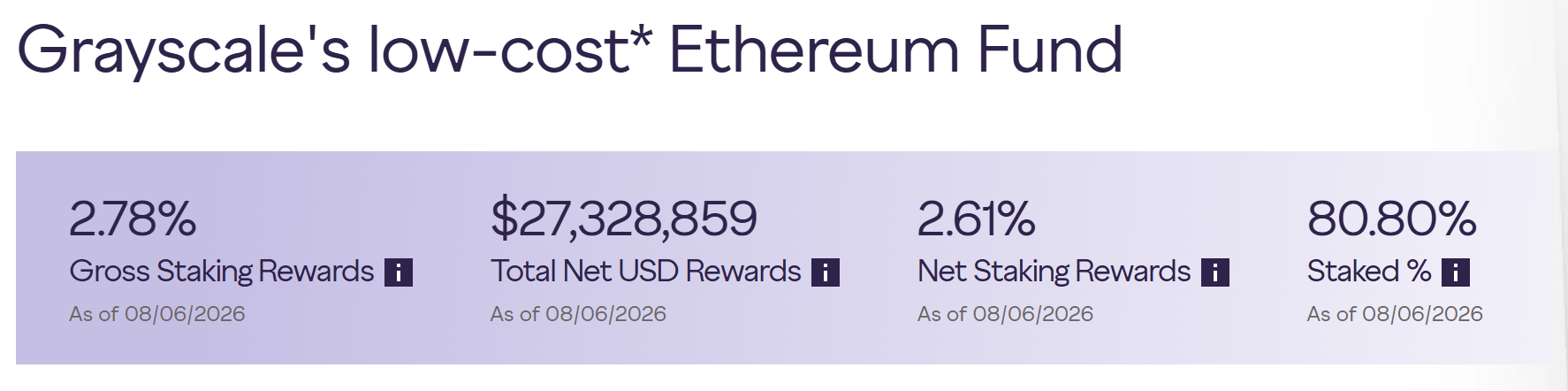
Some 161,000 ETH sit idle in Grayscale’s $1.6 billion Ethereum Staking Mini ETF (ticker ETH). A new trust agreement aims to shrink that pile toward zero.
The rewrite makes staking the default for nearly every coin the fund holds. It also guarantees shareholders regular cash payouts, and it landed just before a key tax deadline.
Staking Becomes the Default, Not the Target
Grayscale signed the new trust agreement on August 6, according to an SEC filing. It was cutting things close. An Internal Revenue Service (IRS) deadline to make such changes expired August 10, four days later.
The IRS rules, published last November, let crypto funds stake without triggering fund-level tax. There is one big string attached. Rewards must flow out to shareholders at least quarterly.
Grayscale’s rewrite delivers that and more. Rewards will convert to cash, with monthly payments planned. Moreover, where conditions hold, the agreement states the trust shall,
“engage in Staking with respect to all of the Trust’s Ether at all times, except for a short list of carve-outs.”
Those cover practical needs like fees, redemptions, and network emergencies.
Follow us on X to get the latest news as it happens
Grayscale Ethereum ETF Already Stakes Most of Its Ether
Grayscale has form here. It became the first US issuer to switch on staking in its spot crypto funds in October 2025.
The bet has paid. The Mini ETF has earned $27.3 million in net rewards since then, per Grayscale data. Net staking rewards currently run at 2.61% a year after fees.

As of August 6, the fund had staked 80.8% of its 839,556 ETH. Roughly 161,000 ETH sits idle as a buffer for redemptions, fees, and daily operations.
Meanwhile, rivals are competing on cost and yield. Morgan Stanley launched Ethereum and Solana funds charging just 0.14%, undercutting Grayscale’s 0.15%. Institutions such as Intesa Sanpaolo have rotated toward staked Ethereum products this year.
Ethereum trades near $1,915, up 0.4% over 24 hours. Therefore, staking yield remains a modest but steady sweetener on top of price exposure.
Whether payouts grow now hinges on that idle buffer. If the staked share climbs from 80.8% toward full deployment, distributable rewards should rise with it. Upcoming disclosures will show how fast that happens.
The post 161,000 Idle ETH May Soon Be Staked: What Grayscale Just Changed appeared first on BeInCrypto.

A bipartisan ethics proposal aimed at unlocking progress on the US crypto market-structure bill could also produce a large potential tax advantage for President Donald Trump, Bloomberg reported Thursday. The reported benefit centers on how taxes would be handled if the president is required to divest from crypto-related interests under the ethics plan.
According to Bloomberg, an ethics addendum that has not been made public would require Trump to divest from crypto-related businesses. The filing reportedly includes a mechanism that would allow the president to defer capital gains taxes tied to those divestitures, potentially resulting in tax savings in the millions.
Key takeaways
- Bloomberg reports the proposed ethics addendum would require presidential divestment from crypto-related businesses as a condition for advancing the market-structure bill.
- The same proposal reportedly includes a tax-deferral feature that could reduce capital gains taxes, creating a potential windfall for Trump.
- Democrats have raised conflict-of-interest concerns as a major barrier to passing the bill, and the reported tax benefit could renew scrutiny.
- Trump’s most recent financial disclosure (for 2025, released in late June) shows substantial crypto-related earnings tied to licensing of memecoin brands and token sales via World Liberty Financial.
Ethics rules meet a tax question
The market-structure legislation has faced political resistance, largely because of Democratic worries that Trump’s financial involvement in crypto could conflict with the White House’s position on the bill. In an effort to overcome the stalemate, senators have been working on an ethics addendum intended to clarify and narrow potential conflicts.
Bloomberg’s report suggests that the addendum goes beyond divestment requirements by also addressing the tax treatment of any assets the president would have to sell or transfer. “People familiar with the matter,” Bloomberg wrote, indicated the plan would permit Trump to defer capital gains taxes on mandated divestitures, which could translate into substantial savings.
That structure could become a point of contention. While divestment requirements are designed to reduce perceived conflicts, a tax deferral that benefits the president may lead Democrats to argue the ethics safeguards are not strong enough—or not strong in the ways they prefer—despite the divestment trigger.
Why Democrats’ concerns remain central
Democratic objections to Trump’s crypto relationships have been described as a key obstacle to moving the market-structure bill forward. The ethics addendum was reportedly conceived to address those concerns directly, but Bloomberg’s account indicates the reported tax angle may reintroduce doubt about whether the measures genuinely neutralize the president’s incentives.
For readers tracking the bill, the key issue is not only whether divestment occurs, but how effectively the proposed framework separates presidential actions from personal financial exposure—and whether the tax treatment is viewed as consistent with that separation.
Cointelegraph reached out to the White House for comment but did not receive an immediate response.
What Trump’s filings show about crypto exposure
Trump’s disclosures provide context for why the ethics debate has been so politically combustible. His annual financial disclosure report for 2025, released at the end of June, showed Trump received about $1.4 billion in income from crypto-related ventures last year.
According to the 927-page disclosure, the largest share of income came from licensing and sales tied to memecoin activity. Trump reportedly earned roughly $635 million from “royalties” in a “license agreement with Celebration Coins,” with “Official Trump (TRUMP)” cited as an example.
The filing also identified World Liberty Financial as the second-biggest source, generating about $588 million through “proceeds from token sales.”
Beyond those major categories, the disclosure reportedly included $197 from the sale of an equity interest in a stablecoin venture.
Those numbers are likely to shape how lawmakers assess whether any divestment requirement would materially reduce Trump’s financial connection to crypto. If the president’s exposure is largely tied to licensing and token-sale-related income, divestment details—such as what must be sold, what can be retained, and how quickly—become crucial.
World Liberty ownership details add complexity
Alongside the financial disclosure, additional information connected to World Liberty Financial’s corporate structure appears to reinforce the idea that Trump-adjacent entities maintain significant involvement. Disclosures on World Liberty’s website indicate that DT Marks DEFI LLC, described as an entity affiliated with Trump and certain family members, holds “approximately 38% of the equity interests” in the parent company of World Liberty.
This matters for the ethics argument because divestment requirements—if they apply broadly—may need to cover not only direct business operations, but also equity stakes and other positions that could benefit from the success of crypto-related initiatives.
At the same time, the reported tax deferral mechanism highlighted by Bloomberg introduces a separate layer of complexity: even if divestment reduces future exposure, how taxes are handled in the transition could still be perceived as aligned with the president’s personal financial interests.
As senators continue negotiating the bill and the ethics addendum, the next thing readers should watch is whether the divestment and tax-handling provisions are finalized and publicly clarified—and whether Democrats, who have already questioned Trump’s conflicts, accept that the safeguards adequately change the underlying incentives around the market-structure legislation.
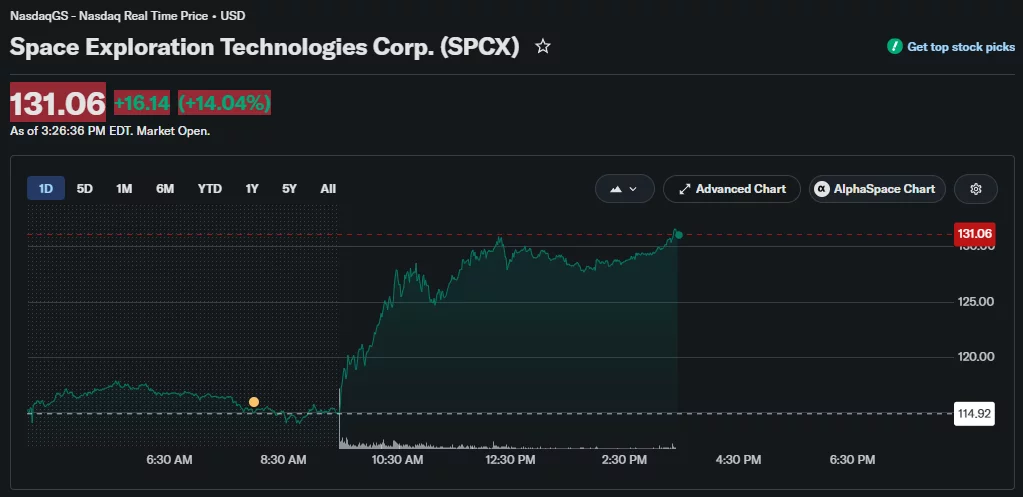
SpaceX stock surged 14% on Friday after an analyst upgrade, softer U.S. jobs data, and limited insider selling eased pressure on the recently listed company.
Summary
- SPCX climbed 14.09% to $131.06, extending its rebound from an August low near $105.
- Argus upgraded SpaceX to Buy and maintained a $160 price target.
- Up to 911.5 million insider shares became eligible for sale without triggering the feared sell-off.
- Weak U.S. payroll data reduced expectations for another short-term Federal Reserve rate hike.
SpaceX stock jumps after Argus upgrade
Space Exploration Technologies Corp. traded at $131.06 as of 3:26 p.m. EDT, up $16.14 for the session. The stock opened near $115 before rising above $120 and accelerating toward $131 during afternoon trading.
Friday’s rally followed a 6.1% gain on Thursday, reversing part of the 13.6% decline recorded after SpaceX released its first quarterly results as a public company.
Argus Research helped drive the latest move by upgrading SpaceX from Hold to Buy. The firm maintained a $160 price target, implying further upside from the stock’s Thursday close.
Argus pointed to SpaceX’s second-quarter performance despite concerns about its planned spending on artificial intelligence infrastructure. The company reported $7.8 billion in revenue, up 92% from a year earlier and above the roughly $6.8 billion expected by analysts.
SpaceX also recorded $3.5 billion in adjusted earnings before interest, taxes, depreciation and amortization, exceeding Wall Street expectations of about $2.1 billion.
Lockup expiration fails to trigger heavy selling
Relief over SpaceX’s first post-IPO lockup expiration also contributed to the rally.
Up to 911.5 million shares held by employees and early investors became eligible for sale on Thursday. The expiration increased the potential public float from about 4.9% to 11.8%, raising concerns that additional supply would push SPCX lower.
That selling pressure did not immediately appear. SpaceX shares instead gained on Thursday and extended the move on Friday, suggesting the market had already priced in much of the unlock risk.
As such, the absence of large-scale insider selling removed a key overhang for the stock. However, more shares are scheduled to become eligible for trading in later lockup tranches.
Short covering may have amplified the rally. Short interest had risen ahead of the company’s earnings and lockup expiration, leaving bearish traders exposed when the anticipated sell-off failed to occur. The scale of short covering during Friday’s session has not been confirmed.
Weak jobs report lifts U.S. growth stocks
A softer U.S. labor report provided a broader market tailwind.
Nonfarm payrolls fell by 23,000 in July, compared with economist forecasts for an increase of about 86,000. The result reduced concerns that the Federal Reserve would raise interest rates again in the near term.
Lower rate expectations tend to support growth companies because they reduce the discount applied to projected future earnings. SpaceX is particularly sensitive to changes in borrowing costs because of its planned spending on launch systems, Starlink infrastructure and AI computing capacity.
The Nasdaq Composite and semiconductor stocks also advanced during the session, indicating that at least part of the SPCX rally reflected a broader return to technology and growth shares.
ARK Invest added further support by purchasing 181,830 SpaceX shares after Wednesday’s decline. The position was valued at approximately $19.7 million based on that session’s closing price.
SPCX approaches key resistance at $131
SpaceX stock reached an important technical area following Friday’s advance.
The 4-hour chart places the 61.8% Fibonacci retracement near $130.67, close to the latest market price. A sustained move above that level could allow buyers to test the next retracement near $138.63.
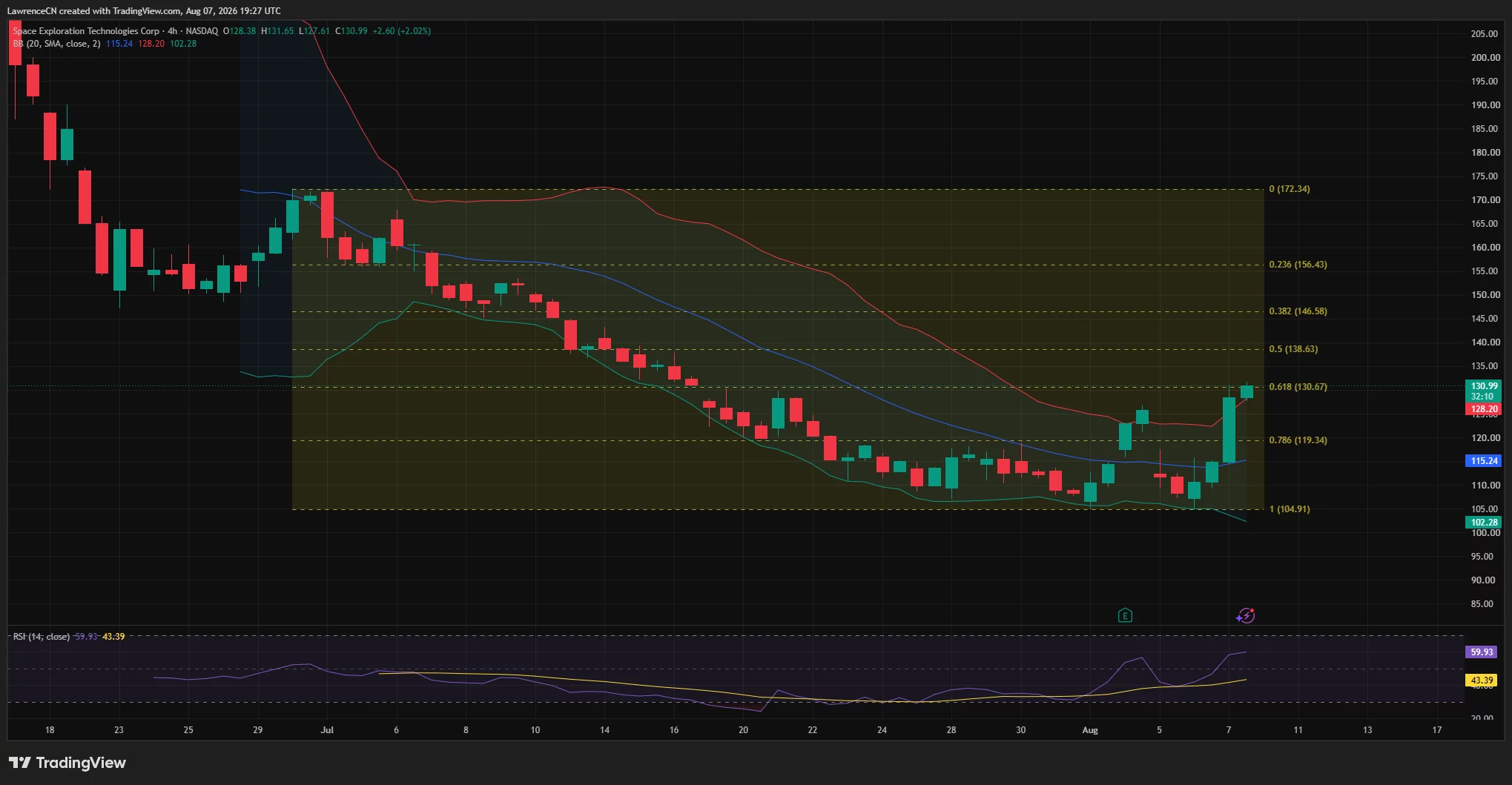
SPCX also moved above the upper Bollinger Band near $128.20, showing strong short-term momentum but raising the possibility of a pullback if buyers fail to hold the breakout.
The 4-hour relative strength index rose to 59.93, above its signal average of 43.39 but below the 70 level generally associated with overbought conditions. Immediate support sits near $128, followed by the $119.34 Fibonacci level and the moving average around $115.24.
Despite the rebound, SpaceX stock remains well below its June peak above $225. The next test will be whether the shares can reclaim the company’s $135 IPO price while the market absorbs additional insider unlocks.

The unknown hacker behind June’s exploit against the Ethereum maximal extractable value (MEV) bot jaredfromsubway.eth continues to try to time the market with their ETH moves, but with negative consequences.
Using the proceeds they secured from the $7.7 million attack, the bad actor made some questionable decisions that actually cost them a portion of their loot.
Data from Lookonchain indicated that the exploiter sold 2,327 ETH at prices just under $1,700 after the hack. However, they changed their mind on Ethereum and started to accumulate earlier today, purchasing 2,063 ETH at an average price of $1,912 per token.
This meant that the perpetrator booked a $505,000 loss since they received $3.94 million for the sale following the hack and now spent the same amount just to receive 264 fewer tokens.
The Jaredfromsubway exploiter is terrible at trading.
A month ago, the exploiter stole $7.7M and swapped it for $ETH.
The exploiter later sold 2,327 $ETH($3.94M) at $1,695, then bought back 2,063 $ETH($3.94M) at $1,912 10 hours ago.
He lost 264 $ETH($505K).… pic.twitter.com/JRpFrOIkWG
— Lookonchain (@lookonchain) August 7, 2026
The actual attack took place on June 20-21 when the perpetrator tricked the automated sandwich bot using fake liquidity pools and deceptive tokens, swiping around $7.7 million.
They started moving millions of dollars through Tornado Cash immediately, while the team behind the MEV bot offered a 50% bounty and a 48-hour deadline to respond, or would pursue “all available legal and law-enforcement remedies.”
There was no official response, but the hacker’s actions spoke louder, as they have not returned any of the funds, and the trade from above is the latest confirmation of a rejection.
The post Good at Hacking, Bad at Trading: MEV Bot Exploiter Makes Costly ETH Bet appeared first on CryptoPotato.


Agent Kim Reactivated, a Korean drama broadcast on SBS TV domestically and streamed on Netflix globally, has become one of the summer’s biggest hits. The thrilling action series follows an unassuming bank manager and single dad named Kim (So Ji-sub). When his teen daughter, Min-ji (Seo Su-min), disappears after a fight at school, Kim’s background and skillset as a secret agent is revealed as he stops at nothing to find her.
Agent Kim is aided by his two friends: taekwondo instructor Sung Han-soo (Choi Dae-hoon) and boisterous military man Park Jin-cheol (Yoon Kyung-ho). Like Agent Kim, Han-soo and Jin-cheol are former spies and current parents. In an effort to rescue Min-ji, the three middle-aged, bespectacled dads face off against criminal organizations and state intelligence entities as what starts as a clash between two teenagers disturbs a decade-long lull in intergovernmental espionage. The 10-episode drama about paternal anxiety and devotion wrapped up over the weekend. Here’s everything that happened in the final episodes of Agent Kim Reactivated.
Does Min-ji die?
The first few episodes of Agent Kim Reactivated imply that Kim’s beloved daughter Min-ji has died. At the end of Episode 1, Hye-ri (Yoo Ji-an), Min-ji’s classmate and the daughter of Juhak Construction group chairman Ju Gang-chan (Joo Sang-wook), hits Min-ji over the head with a brick. Min-ji loses consciousness, leading Hye-ri and Min-ji’s other bullies to assume she is dead. A panicked Hye-ri convinces local thug Golden Teeth (Jo Bok-rae) to take care of the body.
However, unbeknownst to both Hye-ri and Golden Teeth, Min-ji has survived the attack. She later wakes up in the cold storage warehouse where Golden Teeth has temporarily stashed her “body”, and escapes. This is just the beginning of Min-ji’s many efforts to get back to her father. Next, she is picked up by Ju Gang-chan while trying to hitchhike. Then, she is “rescued” by South Korea’s Special Missions Directorate (SMD), where director Kang Guk-cheol (Won Hyun-joon) ties her up and questions her for information about her father. It’s a foolish strategy. Agent Kim has kept his daughter in the dark about his dark past.

Agent Kim’s secret past
Agent Kim was born in North Korea, and was trained from a young age to be a special operative for his native government. However, when Kim is captured during a failed mission in South Korea, he has a choice to make: be disappeared by the SMD, or agree to work for them. He chooses the latter, and becomes friends with operatives Han-soo and Jin-cheol through their missions together.
Kim also meets and falls in love with a South Korean woman. When she dies in childbirth, he forces his retirement from the SMD in order to raise his baby. The SMD allows his freedom on one condition: he must lay low. If the North Korean government realizes their former operative is alive in South Korea, it will cause an international incident.
Kim gladly devotes himself to a quiet life as a father and office worker, and the SMD leaves him alone. But when Min-ji goes missing and Kim starts wreaking havoc across the city looking for her, North Korean Intelligence learns of his continued existence. The SMD and North Korean Intelligence both set out to capture Agent Kim.
Who is Agent 66?
The pseudonym “Agent 66” is first used by Park Yeong-gwang (TaecYeon), a North Korean spy who trained alongside Agent Kim. When Yeong-gwang dies during his and Agent Kim’s first mission to South Korea, betrayed by the North Korean agency that sent them, Agent Kim takes on the moniker.
When Agent Kim reappears on the North Korean government’s radar after years of being presumed dead, Park Yeong-gwang’s little brother, Gang Seong (Kim Sung-kyu), is sent to kill him. He too uses the name “Agent 66” as his codename. Though killing Kim may be Gang Seong’s orders, the mission is also personal for the new Agent 66, who has been told that Kim is responsible for the death of his big brother. When Kim dispels this lie, revealing that it was North Korean intelligence director Ri Eung-ryeong who betrayed them all, Gang Seong abandons his mission to kill Kim.
Later, after Ri Eung-ryeong spills his secrets to the South Korean government in exchange for asylum, Agent Kim kidnaps and hands Ri Eung-ryeong over to Gang Seong. Gang Seong brings Ri Eung-ryeong back to North Korea, where he is presumably punished for his defection.

The ending of Agent Kim Reactivated
Heading into the season finale, Agent Kim has managed to evade SMD capture by protecting defector Ri Eung-ryeong during the intergovernmental talks between North Korea and South Korea. With the completion of one final mission for the SMD, Kim has earned his freedom (again) and the promise of a normal life with Min-ji. He just has to stay alive to claim it. And, unfortunately, Ju Gang-chan—the former thug turned Juhak Construction chairman—is still gunning for him. He wants to see Agent Kim, Han-soo, and Jin-cheol suffer for besting him. To do so, Ju Gang-chan kidnaps Han-soo and Jin-cheol’s children. He holds the teens at gunpoint and forces Han-soo and Jin-cheol to fight Agent Kim.
The three friends initially go along with Ju Gang-chan’s orders to kill Agent Kim, but use their years of experience working together to come up with an out. They lure a boasting Ju Gang-chan closer to the fence of the cage in which they are fighting, and manage to knock it down onto the villain. They rescue their children, and hand Ju Gang-chan over to the authorities. Later, he is stabbed multiple times by Golden Teeth while being transported out of the hospital. Hye-ri, the spoiled daughter whose bullying acted as a catalyst for this entire sequence of events, has been sent abroad following the public humiliation of her family.

Agent Kim and Min-ji are reunited
The father-daughter relationship between Agent Kim and Min-ji is at the heart of Agent Kim Reactivated, and it’s at the heart of the finale, too. Following the action of the series, the two have grown closer after being forced apart. Min-ji now understands more about her father’s past and motivations, and no longer sees him as a timid man who would rather bow than fight.
In the final episode, they are reunited after Agent Kim fakes his death to escape international accountability for his past acts of espionage. The father and daughter start a new life together under new identities, with the help of the SMD. While they leave the identities of Bank Manager Kim and Kim Min-ji behind, they are somehow still in contact with Han-soo and Jin-cheol, who help the Kims move into their new home.
Will there be a Season 2?
It’s likely—the series has been one of the most successful Korean dramas of the year so far on Netflix and on broadcast television in Korea. According to The Chosun Daily, the production team is currently discussing the possibility of a second season.
If Agent Kim Reactivated does get more episodes, the story will most likely revolve around Agent Kim’s new job at Baekho Employment Agency. In the first season finale, Kim makes a deal with Lee Dong-kyu, a new and enigmatic character who agrees to take down Juhak Construction for our protagonist. The cost is implied to be Agent Kim’s employment at Lee’s mysterious company.
While we don’t learn much about Lee Dong-kyu in the Netflix series, the character is an important element of the webtoon on which Agent Kim Reactivated is based. In the webtoon, the Baekho Employment Agency, aka the White Tiger Job Center, is a mercenary organization founded and led by Tom Lee. The private company takes on high-risk, high-reward jobs–for the right price. If Agent Kim Reactivated continues for a second season, Agent Kim may find himself in even more dangerous scenarios due to his deal with Lee Dong-kyu.

.jpg?branch=production)
How many lives can be packed into one? If we live long enough, most of us reinvent ourselves several times over, by switching careers, changing partners, having children, moving to a new place. What constitutes the essence of us, even when we can no longer identify ourselves as the thing we used to be?
That’s one of the questions Kent Jones’ intimate, wry little picture Late Fame tangles with. Willem Dafoe plays Ed Saxberger, a seventy-ish New York City postal worker who used to be, or may still be, a poet: In 1979 he published a reasonably well-received book of poetry—a pretty admirable feat by itself—but now he’s just a guy. By day he sorts letters; in the evenings he wanders down to his local watering hole to hang out with his geezer pals, MTA workers and the like, guys who do everyday jobs just like he does. As far as they’re concerned, there’s nothing fancy or special about him. He’s not just a regular, he’s regular.
For Saxberger, there’s nothing sad about that; it’s just the texture of his life. But one day, he’s alerted to the presence of a wiry, nervous-looking, well-dressed young man who’s been hanging around his modest but by no means depressive apartment building. Saxberger approaches him amiably. The kid introduces himself as Wilson Meyers—he’s played, with clean-cut bonhomie, by Edmund Donovan—and begins to gush over Saxberger’s single book, which he unearthed, he says breathlessly, at “Foyles on Charing Cross Road,” an unnecessary bit of information that telegraphs nearly all you need to know about this guy. Meyers tells Saxberger that he’s part of “an artistic community” of poets and intellectuals who gather occasionally at a local speakeasy, and they’re all huge fans of his work. Would he join them sometime? Unsure what, exactly, this crew might want from him, Saxberger at first demurs; then he relents.

The members of this group call themselves “The Enthusiasm Society,” refer to one another by last names only, and claim to loathe internet influencers. They’re mostly aimless and obviously well-off guys in their twenties and early thirties, fellows who clearly think it’s bourgeois to work and luckily don’t have to. Saxberger appears amused by their callow pretensions—they’re obviously hoping that hanging out with him will somehow turn them into poets too—but he does wonder, and eventually asks: “Are there any women in your group?” There is one, they assure him, though he’s not prepared for the bewitching creature who eventually swans in. Gloria (Greta Lee), a performer in every sense of the word, seems to have dropped in from another century. Her sentences tumble out in breathy, peacock-feather bouquets; she favors swirling capes and flirtatious, oddball cloches. She invites Saxberger to one of her intimate cabaret performances—she slinks through “Surabaya Johnny” with molten eroticism—and he watches in awe. She’s both unbearable in her excessive theatricality and unavoidably captivating. Saxberger is a goner. But then he also wonders, years after having given up writing, if he may still be a poet after all.
And that’s the central rib of Late Fame, which was adapted from a long lost and only recently published 1895 novella by Arthur Schnitzler. What makes a poet? Is it the act of writing, or a subterranean, unextinguishable quality that lives in the soul? Late Fame is Jones’ second fiction feature—his debut was the gentle-spirited 2018 drama Diane, starring Mary Kay Place—and though it’s deeply observant about what it takes, and what it costs, to be an artist, it also has the light touch of a comedy. Characters who begin as types gradually emerge as people: Donovan’s Meyers is the kind of spoiled rich kid who proves how easy it is to be a dilettante when you’ve got daddy’s dollars behind you—and still, there’s something sad about the way he grabs greedily at others’ gifts, because he knows what’s lacking in himself. Dafoe is terrific as Saxberger, a guy who’s made peace with what his life has become, only to find himself rattled by the idea that maybe he hasn’t. A scene in which he tries to introduce his bar pals to his old poetry cuts deep: they laugh because they can’t see him as anyone but their drinking buddy (though it’s also pointed out that he no longer drinks alcohol, for reasons we can intuit). Dafoe’s face, a map of scarred-over disappointments, shows him reckoning with a brutal truth: he’ll have to learn to live with the fact that these people he truly cares about can never truly understand him.
.jpg?branch=production)
But Lee’s performance may be the secret key to Late Fame. Gloria is a user, a poseur extraordinaire; her fluttery flamboyance, rooted in insecurity, summons another Gloria, the one from Sunset Blvd. And yet she’s the only member of the Enthusiasm Society who has ever taken a risk—as well as, clearly, the only one with any true artistic gift. As Lee plays her, she shifts seamlessly from hypertheatrical creation to fragile human being. And though other members of the group desire her, only Saxberger—intoxicated with her even though he knows it’s hopeless—sees the truth of her. Late Fame is all about the bitter, beautiful reality that no one is ever who they used to be. How could we be, if we’re doing the work of becoming? Is Saxberger still a poet, even when he finds it impossible to write new verse? What he and only he sees in Gloria is a new kind of poem, written on the wind if not on paper, but real even so.


SharpLink CEO Joseph Chalom has opposed an Ethereum proposal that could eventually eliminate issuance-based staking rewards, warning that the change may weaken ETH’s appeal to institutions and raise capital costs across decentralized finance.
Summary
- SharpLink opposes tapered issuance burn, arguing that native yield helps distinguish Ethereum from Bitcoin.
- Validator issuance rewards would fall to zero near a 50% staking ratio under the proposal.
- SharpLink stakes nearly all its ETH and has earned more than 18,000 ETH in rewards.
- Chalom supports controlling issuance but wants Ethereum to rely on its existing base-fee burn.
SharpLink challenges Ethereum staking proposal
Chalom said the proposed issuance model would damage one of Ethereum’s main economic advantages by gradually destroying part of the rewards paid to validators.
The SharpLink executive referred to the plan as EIP-8363. However, the mechanism he described matches EIP-8361, the Tapered Issuance Burn proposal previously covered by crypto.news.
EIP-8361 would burn a growing percentage of consensus-layer rewards as more ETH enters staking. The burn rate would reach 100% when approximately 60.25 million ETH, or about half of Ethereum’s current supply, is staked.
Validators would then stop receiving newly issued ETH but could continue earning transaction priority fees and maximal extractable value. The proposal includes an estimated 18-month transition intended to prevent an immediate decline in returns.
Chalom said Ethereum currently offers a variable staking yield of approximately 2.75%. According to his assessment, transaction-related earnings account for only about 15% of total validator rewards, leaving operators heavily dependent on issuance.
Zero ETH yield could pressure DeFi collateral
Chalom argued that Ethereum’s staking yield serves as a benchmark for interest rates across its on-chain economy. Liquid staking tokens use validator rewards to generate returns while allowing holders to deploy the underlying value across lending and other DeFi markets.
Around $35 billion is currently locked in liquid staking products, according to figures cited by Chalom. He warned that reducing issuance rewards to zero could increase the effective cost of capital and make returns negative after infrastructure expenses and other operational costs.
That pressure could cause collateral to move toward assets that continue producing yield. Independent validators and smaller staking operators may face the greatest impact because they lack the scale and additional revenue sources available to larger providers.
The proposal’s authors have taken a different view. They argue that Ethereum’s current issuance curve continues encouraging additional staking even after more deposits provide limited security benefits.
“The current issuance curve continues offering a yield of around 1.5% even if nearly all ETH is staked,” the authors wrote in the proposal.
EIP-8361 remains a draft and has not been approved for inclusion in an Ethereum network upgrade.
SharpLink says yield gives ETH an institutional edge
Chalom also argued that native yield is one reason institutions may choose Ethereum over Bitcoin. Bitcoin can provide price exposure and serve as a treasury reserve, but it does not produce protocol-native returns for holders.
That distinction is central to SharpLink’s own strategy. As reported by crypto.news, the Nasdaq-listed company had staked nearly 900,000 ETH and earned more than 18,000 ETH in cumulative rewards by April.
SharpLink has also expanded beyond basic validator returns. In May, it committed $100 million to a $125 million on-chain yield fund managed by Galaxy Digital. The fund plans to deploy capital across DeFi liquidity protocols while preserving SharpLink’s broader ETH exposure.
Chalom said issuance represents a transfer of value to validators that secure Ethereum rather than a cost paid to an outside party. Burning those rewards, in his view, would remove value from network participants instead of redistributing it within the ecosystem.
US Ethereum products have started distributing yield
The dispute comes as staking becomes more accessible to U.S. institutional investors. Grayscale completed the first staking-reward distribution by a U.S.-listed Ethereum exchange-traded product in January.
Its ETHE product distributed approximately $9.4 million in cash generated from staking activity. The structure allowed shareholders to receive Ethereum-linked income without operating validators or directly managing staked ETH.
Chalom said SharpLink agrees with the proposal authors’ goal of limiting excessive staking and supporting ETH scarcity. However, he argued that Ethereum should pursue that objective through its existing base-fee burn rather than changing the protocol’s issuance-based reward structure.
ETH traded near $1,916 at the time of writing, with no clear price reaction directly linked to SharpLink’s opposition. Debate over the proposal is expected to continue before developers consider whether it should advance toward a future network upgrade.

Stephen King’s Most “Spellbinding” Story Officially Returns in 2 Months

Clarity Act Delayed (Shockingly Bitcoin Isn’t Crashing)

Weather forecast for Darlington Pride weekend 2026


-

 Politics5 days ago
Zack Polanski: an incitement to murder Nigel Farage?
-

 Crypto World6 days ago
MicroStrategy Post-Earnings CLARITY Act Push Could Add New Catalyst for Its Stock
-

 Crypto World7 days ago
XRP Ledger v3.3.0 brings five institutional features
-

 Crypto World6 days ago
Crypto PAC spending tops $2M in Michigan House race
-

 Business5 days ago
DTCR: Deleveraging And A Hedge Fund Collapse Point To A Possible AI Bottom
-

 Tech6 days ago
ESET tracks rise in malicious AI skills and adaptable malware
-

 Sports7 days ago
France Cricket implodes: letters hidden in a drawer and a board at war
-
Crypto World5 days ago
XRP Ledger urges node upgrade after manifest flood
-

 Crypto World7 days ago
Moneyflip CEO charged in $40K murder-for-hire plot
-

 News Videos6 days ago
Financial Crash Expert: The 90-Day Collapse Timeline They Are Desperately Hiding.
-

 Sports2 days ago
Jordan Coyle & Cordiamo take Laya Arena Stakes at RDS
-

 Fashion13 hours ago
Frugal Friday’s Workwear Report: Cap-Sleeve Pointelle Crewneck Sweater
-
 Crypto World4 days ago
US Tech Stocks See Largest 5-Week Inflow in History: Can Nasdaq Break Its Downtrend?
-
 NewsBeat6 days ago
Tourist plane on sightseeing flight in Peru crashes into a field, killing all 13 people on board
-

 NewsBeat7 days ago
Arsenal reach full agreement with Newcastle over Bruno Guimaraes transfer | Football
-

 Tech6 days ago
Page Not Found | WIRED
-
 NewsBeat6 days ago
Bikini-clad Jennifer Aniston, 57, kisses hypnotist boyfriend Jim Curtis as they enjoy a romantic getaway aboard a luxury yacht in Spain
-
 Business2 days ago
US stocks: Dow closes at record on Mideast optimism; SpaceX, AMD drag Nasdaq
-

 Politics2 days ago
Reform UK And Greens Sink To Lowest Favourability Ratings To Date
-

 Crypto World3 days ago
Polymarket targets $20 billion valuation as competition heats up in prediction market sector
You must be logged in to post a comment Login