“I also want to acknowledge the local community, for their patience, understanding and support throughout this investigation, particularly those who came forward with information, whose cooperation has been invaluable in helping us establish the truth and secure this conviction.”
The Scottish Government has sparked a “TikTok gold rush” as SNP ministers step up their use of social media influencers to promote campaigns online.
They include a former TV star as well as regular family bloggers who have built huge followings on Instagram and YouTube thanks to their accessible brand of content.
A PR industry figure said civil servants were increasingly scrambling “for the attention of young and apathetic voters” as the public is turned off by politicians who share “pre-rehearsed soundbites”.
A Freedom of Information request found 40 social media influencers have been paid by the Scottish Government in the first half of 2026 – more than in 2024 and 2025 combined.
Advertisement
In 2024, the Scottish Government hired 12 influencers, before rising to 17 influencers hired in 2025.
Influencers to appear on recent Scottish Government-produced content include Eilidh Wells, who regularly shares videos about family life with her 35,000 subscribers on YouTube.
Wells was filmed driving to Loch Lomond for a family day out to promote the “benefits of electric vehicles”.
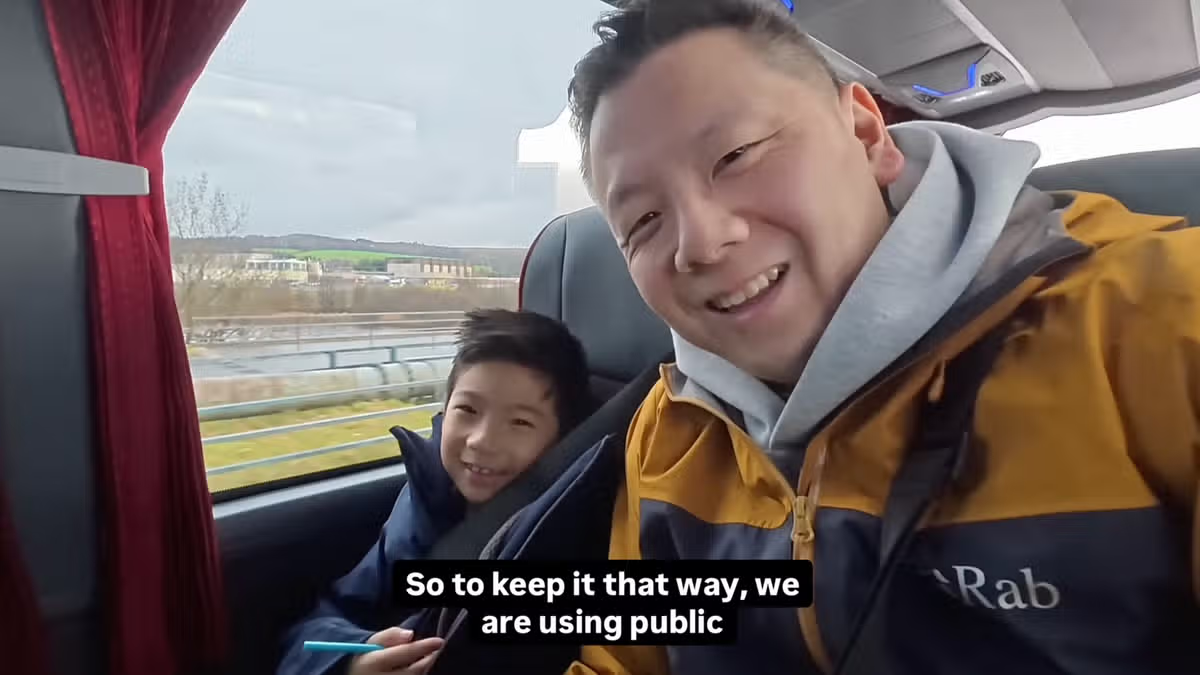
Other content creators appearing on the Government’s social media channels are the Olive Tree Family, who share their experience of bringing up two young sons.
Advertisement
They were also filmed on a trip to Loch Lomond – but this time on the bus, in a clip to promote the use of public transport.
Celebrities like TV personality Gail Porter have also joined Scottish Government campaigns.
Porter was part of a campaign launch video last year for mental health, where she sat down at Hampden Park with a group including digital creator Howey Ejegi, former professional footballer Zander Murray, and founder of Street Soccer Scotland, David Duke, to discuss their personal experiences.
Sam Fisk, associate director at Tangerine, an independent PR firm, said: “This year marked the start of a TikTok gold rush in Holyrood as Scottish Government departments scramble for the attention of young and apathetic voters.
“The public are craving authentic voices and increasingly turning off from watching government officials trumpet out pre-rehearsed political soundbites.
“The Scottish Government shouldn’t be sneered at for their use of influencers. This is a smart shift given the fall in TV viewership, however, the challenge is now delivering genuinely high-quality content. It won’t be easy to stop a Gen Z scrolling for a government advert.
Advertisement
“We know Gen-Z are far more likely to stop scrolling for an influencer video compared to a government body posting. There is no end in sight for this new era of communications.”
The Scottish Government has refused to reveal how much it pays individual influencers, citing an FOI exemption for “commercially-sensitive information”. Government marketing activity is commissioned through its Marketing and Media Services Frameworks.
In an FOI response, the Scottish Government said it “does not directly pay individuals or media organisations. Payment is made from the appointed Scottish Government media or marketing agency to the recipient.”
The Record previously revealed how the Scottish Government halted all advertising spending on Twitter, now known as X, shortly after Humza Yousaf became first minister in 2023.
A Scottish Government spokesman said: “All governments have a responsibility to inform the public of key services and policies. As social media use grows it is important that the way we engage with the public responds accordingly.
“Working with influencers ensures we can reach audiences traditional channels cannot reach, which is why work with influencers is growing in governments across the UK.”
Among those celebrating was Sofia Omar, who achieved Distinction, Distinction, Distinction** and will study podiatry at the University of Salford.
The school’s Applied Science students achieved an average grade of Distinction*, the highest results ever recorded for the qualification at UCS Sixth Form, while engineering students also delivered the strongest results in the history of the sixth form.
The impressive outcomes continue a successful period for the school, which is on course to achieve a third consecutive year in which every student progresses into a positive destination, including university, higher and degree apprenticeships, employment, or further training.
Advertisement
Stephanie Ossai achieved an outstanding triple Distinction* and has secured a healthcare assistant apprenticeship with Brighter Futures, while Zertashia Mir gained Distinction, Distinction, Distinction* and will begin a Level Three Dental Nurse Apprenticeship with Rodericks Dental in Farnworth.
Another student marking a significant personal achievement was Raghda Abdulrahman, who achieved a Distinction and two Distinctions in Applied Science* and will study Nursing at the University of Salford from September.
Raghda joined UCS Sixth Form in 2024 after moving to the UK the previous year and overcoming significant disruption before settling in Bolton.
Her results represent the culmination of determination and hard work as she prepares to embark on a career in healthcare.
Advertisement
Niall Muncaster, Head of Sixth Form at UCS, praised the achievements of students and highlighted the range of progression routes secured by this year’s cohort.
He said: “We are incredibly proud of our students and the results they have achieved today.
“What makes these results particularly special is the range of destinations our students are now moving on to.
“Some are heading to university, others are taking higher and degree apprenticeships, and others are moving directly into employment.
Advertisement
“UCS has always believed that there should be different routes to success, and our job is to make sure every student has the qualifications, skills, and confidence they need to take their next step.”
Headteacher Ian Barry said the results showed that technical and vocational pathways can be just as effective as traditional academic routes in preparing young people for successful futures.
“Our students’ superb results prove that the technical and vocational routes work perfectly for many students.
“There are many different routes to success and these routes provide the knowledge, skills, and experience needed to progress into higher education, apprenticeships, skilled employment, and rewarding careers.
Advertisement
“This is strongly aligned with the direction of travel championed by Andy Burnham.
“His vision for a system that gives every person a clear line of sight to a good career, connects education with employers, and values technical skills alongside achievement is one that we wholeheartedly support.”
Students at UCS Bolton today were able to celebrate their success but also the beginning of exciting new chapters as they take their next steps towards careers in healthcare, science, engineering, and other growing sectors.
The site in question is on John Street in Sunderland city centre, directly opposite the former Joplings building.
Ashbrookes Design and Build Ltd has applied to repurpose the existing building and add two extra floors.
The project has been in development for several years and was previously approved by Sunderland City Council’s planning and highways committee in April 2025.
Plans then included 84 single-occupancy student studios, an increase from the original 78.
Advertisement
However, approval was conditional on completing a legal agreement, which was not finalised before the council’s deadline.
As a result, the application was refused.
Despite this setback, the developer confirmed their commitment to the scheme and said they would resubmit the plans with the required legal documentation.
New proposals submitted last month could see the project revived.
Advertisement
The design of the proposed new student accommodation (Image: LDRS)
CGI images show the development will retain the ground-floor commercial unit currently occupied by Ashbrookes.
A design and access statement details the layout, including six ground-floor studios, a communal lounge, office space, refuse and bike storage, laundry facilities, and a plant room.
The first floor would house 22 studios, a gym, an additional lounge, and storage areas.
A further 56 studios would be spread across the proposed second and third floors.
Advertisement
The applicant believes the design supports student wellbeing.
The applicant said: “The group living concept, in which the residents have access to shared lounges etc, promotes a sense of community, shared ownership and successful bonding between the students.”
Access for service vehicles, including refuse collection and student arrivals, would use the existing service yard on St Thomas Street.
The developer’s commitment to the project and experience with similar schemes are highlighted in the planning documents.
Advertisement
A final decision will be made following a public consultation.
Millions of people have been told their water bills will be hiked – in the midst of mass hosepipe bans and with three quarters of the country in drought.
Andy Burnham‘s vow to bring down the cost of living was in tatters yesterday after the water regulator announced bills will rise again for more than 30million people.
Ofwat was branded ‘toothless’ after it granted five water suppliers permission to raise bills above previously agreed levels – despite them losing billions of litres to leaks.
The Prime Minister said he was ‘angry’ at water companies using customers ‘as a blank cheque’ but has been challenged over what he is going to do about it.
Advertisement
Scandal-hit Thames Water was granted permission to hike bills again between 2027 and 2030, along with Southern Water, South East Water, Severn Trent and Wessex Water.
Three have imposed hosepipe bans on more than 20million people this summer.
Ofwat said it had given suppliers the provisional go-ahead for the unexpected hike in bills to fund £3.4billion-worth of new projects, including infrastructure for housing and data centres.
But the water regulator has already allowed suppliers to hike bills by 36 per cent between 2025 and 2030, with eye-watering increases last year and another 5.4 per cent on average bills from April.
Advertisement
Andy Burnham’s vow to bring down the cost of living is in tatters yesterday after the water regulator announced bills will rise again
Water bills are set to surge again as Britain endured its fifth heatwave of the year and Howden reservoir in Derbyshire looked parched
The climb will spark further anger at a time when the water industry is under fire for pouring sewage into Britain’s rivers, lakes and seas and losing billions of litres of water through faulty pipes.
Advertisement
The leaks and sewage flows have been blamed on a sustained under-investment in water infrastructure – while industry fat cats have handed themselves millions in bonuses and dividends.
Tory environment spokesman Victoria Atkins last night called on the Prime Minister to set out a ‘credible, costed plan’ for Britain’s water industry rather than simply offering ‘more sympathy’.
And warning any move from Mr Burnham to nationalise the sector would see bills rise further, she added: ‘Labour should set out its plans clearly so bill payers know what they are being asked to pay for and what to expect in return.’
Mr Burnham – who has vowed to lead a ‘cost of living government’ – took aim at Ofwat’s decision and said customers ‘cannot be treated as a blank cheque’.
Advertisement
‘I understand why people are angry – I am too,’ the Prime Minister said.
‘The truth is customers have been asked to pay more for years, yet serious pollution incidents are at record levels and the pipes are still leaking.
‘Customers cannot be treated as a blank cheque. Where water companies seek to pass unnecessary costs on to households, they will be challenged.’
Some 13 water companies applied to increase bills to fund investment of £4.3billion, and Ofwat announced yesterday it had provisionally allowed five to do so for £3.4billion of new projects.
Advertisement
The 2.7 million people supplied by Southern Water will see bills rise by £80 over the next two years.
Southern – which lost about 37 billion litres of water through leaks last year – has the most expensive bills, with customers paying an average of £759 a year after an 8 per cent rise this year.
A sunbather lay on the brown grass in London’s Hyde Park as water bosses asked the Government for permission to increase the bills of 30million people
Steve Buck, the new chief financial officer of debt-ridden Thames Water, was paid a £1million signing-on fee
Advertisement
Thames Water – which Mr Burnham is expected to put into special administration to stave off its collapse as it sinks under £20billion in debt – was also allowed to increase bills for its 16 million customers, as was Severn Trent, which services some 8 million.
Thames Water caused fresh outrage this week after it emerged it had paid a £1million signing-on fee to its new chief financial officer, Steve Buck.
Meanwhile the 1.4 million people supplied by Wessex Water will see bills rise by £11 over the next two years, while the 2.3 million supplied by South East Water will see a £1 rise.
Ofwat will consult on the proposed rises until September 24, with a verdict due in December.
Advertisement
A spokesman said: ‘We will track performance to ensure companies are delivering the expected improvements for customers and the environment. If they don’t, expenditure can be clawed back.’
Southern Water and Wessex Water both said they would support customers struggling to pay. Severn Trent and South East Water said they would be reviewing the proposals.
Share or comment on this article:
Water bills set to surge under Andy Burnham despite the hosepipe ban – as his pledge to bring down the cost of living lies in tatters
Bolton College students celebrate their A-level results day (Image: UCS Bolton)
Students gathered on the Deane Road campus to celebrate with friends, family, and staff as their hard work finally paid off and they learned of their next academic steps.
Bolton College students celebrate their A-level results day (Image: UCS Bolton)
Smiles, tears and hugs marked a memorable morning as students discovered they had secured places at universities, apprenticeships and employment opportunities across Greater Manchester and beyond.
Bolton College Students celebrate their A-level results day (Image: UCS Bolton)
A-level results day was celebrated throughout the day with a live DJ, mocktails, cupcakes and a photo booth.
Bolton College students celebrate their A-level results day (Image: UCS Bolton)
For many students, the day marked the end of two years of dedication and the beginning of exciting new opportunities as they prepare to take their next steps into higher education, professional training and the workplace.
Federal agents launched a sweeping undercover surveillance operation earlier this year targeting progressive organizations, labor unions and other groups protesting the immigration crackdown then raging through Minneapolis, according to court documents filed Thursday.
The program, dubbed Operation Puppet Master, was aimed at what officials called a network of conspirators helping “violent opportunists and agitators.” The documents were filed in a case involving 15 people charged by federal prosecutors in June with impeding the crackdown, accusing them of conspiring against the federal government through a range of actions, from throwing ice chunks to setting up blockades.
The government documents were released Thursday in connection with a motion from a defense lawyer in the case, Kevin Riach, who requested that officials disclose more material collected during the investigations.
The reality, according to government documents revealed in court motions, was Department of Homeland Security officers infiltrating meetings in churches, schools and parks that were often simply discussions of constitutionally protected protests.
Advertisement
A statement from the department said Homeland Security Investigations doesn’t comment on the existence or status of on-going investigations or investigative methods. The statement referred questions to the U.S. attorney’s office in Minnesota, which didn’t immediately respond to an after-hours email from The Associated Press.
Puppet Master, and a later operation called Project Whipple Shield, were a “broad and irrational investigation” driven by politics and not criminal conduct, Riach said in a motion filed Thursday.
Take, for example, a Jan. 31 meeting in a Minneapolis library, when a Homeland Security report says an undercover officer identified as “UCA 9833” listened as supporters of a progressive climate group, the Sunrise Movement, discussed sit-ins, de-escalation tactics and “having a police liaison and safety marshal present during events.”
“During the Action meeting, it was made clear that the Sunrise Movement organization focused on ‘peaceful’ protests,” the agent reported.
Advertisement
Dozens of pages of documents describe agents secretly infiltrating meetings, monitoring activist chat groups and using license plate numbers to compile names of people who attended gatherings.
A slide created by Homeland Security’s investigative branch titled “The Conspiracy” shows 18 organizations, from a small Minneapolis bicycle repair collective to the AFL-CIO, the largest federation of labor groups in the U.S.
The government also obtained years of certain financial records for groups ranging from the Sunrise Movement to major unions, including the Service Employees International Union and the Communications Workers of America.
“You are requested not to disclose the existence of this summons for an indefinite period of time,” warned a DHS request to FedWire, a money transfer system operated by the U.S. Federal Reserve.
Advertisement
“It’s very disturbing,” said Ahilan Arulanantham, a professor at the University of California, Los Angeles School of Law. Over time, it could deter people from expressing their beliefs, he said.
Many people don’t want to live in a world where expressing their beliefs gives federal agencies the right to investigate them, he said.
“It’s that fear of that creeping police state,” he said.
Groups that the government investigated were furious at the news.
Advertisement
“Our union has become the latest target of a corrupt administration that weaponizes the legal process against law-abiding Americans exercising our Constitutional rights,” CWA President Claude Cummings Jr. said in a statement. “We will not be intimidated, and we will not be silenced.”
The AP News Guild, the union that represents many Associated Press employees, is part of the CWA.
On Thursday, a coalition of Minneapolis-area civil society groups defended the protests and criticized the investigations.
The government is “lashing out desperately in hopes of intimidating people and organizations that have shown the power of communities acting together,” said a statement distributed by Unidos MN, a local human rights group.
Advertisement
DHS deployed about 3,000 federal officers to the Minneapolis-St. Paul area for roughly three months starting late last year in what the department called its “ largest immigration enforcement operation ever.” It led to thousands of arrests, angry mass protests and the fatal shootings of two U.S. citizens.
Minnesota U.S. Attorney Daniel N. Rosen said the 15 were part of two groups that he characterized as “antifa,” an umbrella term for a diffuse movement of militant left-wing activists.
Defense attorney Riach said at the time that his client, Isaac Sant, had no affiliation with antifa, which he called “a boogeyman invented by the far-right.”
MINNEAPOLIS (AP) — Federal agents launched a sweeping undercover surveillance operation earlier this year targeting progressive organizations, labor unions and other groups protesting the immigration crackdown then raging through Minneapolis, according to court documents filed Thursday.
The program, dubbed Operation Puppet Master, was aimed at what officials called a network of conspirators helping “violent opportunists and agitators.” The documents were filed in a case involving 15 people charged by federal prosecutors in June with impeding the crackdown, accusing them of conspiring against the federal government through a range of actions, from throwing ice chunks to setting up blockades.
The government documents were released Thursday in connection with a motion from a defense lawyer in the case, Kevin Riach, who requested that officials disclose more material collected during the investigations.
The reality, according to government documents revealed in court motions, was Department of Homeland Security officers infiltrating meetings in churches, schools and parks that were often simply discussions of constitutionally protected protests.
Advertisement
A statement from the department said Homeland Security Investigations doesn’t comment on the existence or status of on-going investigations or investigative methods. The statement referred questions to the U.S. attorney’s office in Minnesota, which didn’t immediately respond to an after-hours email from The Associated Press.
Puppet Master, and a later operation called Project Whipple Shield, were a “broad and irrational investigation” driven by politics and not criminal conduct, Riach said in a motion filed Thursday.
Take, for example, a Jan. 31 meeting in a Minneapolis library, when a Homeland Security report says an undercover officer identified as “UCA 9833” listened as supporters of a progressive climate group, the Sunrise Movement, discussed sit-ins, de-escalation tactics and “having a police liaison and safety marshal present during events.”
“During the Action meeting, it was made clear that the Sunrise Movement organization focused on ‘peaceful’ protests,” the agent reported.
Advertisement
Dozens of pages of documents describe agents secretly infiltrating meetings, monitoring activist chat groups and using license plate numbers to compile names of people who attended gatherings.
Advertisement
Sign up for Morning Wire:
Our flagship newsletter breaks down the biggest headlines of the day.
A slide created by Homeland Security’s investigative branch titled “The Conspiracy” shows 18 organizations, from a small Minneapolis bicycle repair collective to the AFL-CIO, the largest federation of labor groups in the U.S.
Advertisement
The government also obtained years of certain financial records for groups ranging from the Sunrise Movement to major unions, including the Service Employees International Union and the Communications Workers of America.
“You are requested not to disclose the existence of this summons for an indefinite period of time,” warned a DHS request to FedWire, a money transfer system operated by the U.S. Federal Reserve.
“It’s very disturbing,” said Ahilan Arulanantham, a professor at the University of California, Los Angeles School of Law. Over time, it could deter people from expressing their beliefs, he said.
Many people don’t want to live in a world where expressing their beliefs gives federal agencies the right to investigate them, he said.
Advertisement
“It’s that fear of that creeping police state,” he said.
Groups that the government investigated were furious at the news.
“Our union has become the latest target of a corrupt administration that weaponizes the legal process against law-abiding Americans exercising our Constitutional rights,” CWA President Claude Cummings Jr. said in a statement. “We will not be intimidated, and we will not be silenced.”
The AP News Guild, the union that represents many Associated Press employees, is part of the CWA.
Advertisement
On Thursday, a coalition of Minneapolis-area civil society groups defended the protests and criticized the investigations.
The government is “lashing out desperately in hopes of intimidating people and organizations that have shown the power of communities acting together,” said a statement distributed by Unidos MN, a local human rights group.
DHS deployed about 3,000 federal officers to the Minneapolis-St. Paul area for roughly three months starting late last year in what the department called its “ largest immigration enforcement operation ever.” It led to thousands of arrests, angry mass protests and the fatal shootings of two U.S. citizens.
Minnesota U.S. Attorney Daniel N. Rosen said the 15 were part of two groups that he characterized as “antifa,” an umbrella term for a diffuse movement of militant left-wing activists.
Advertisement
Defense attorney Riach said at the time that his client, Isaac Sant, had no affiliation with antifa, which he called “a boogeyman invented by the far-right.”
GameCentral speaks with the creative director behind the original Assassin’s Creed about the origins of 1666: Amsterdam, using generative AI, and the decision to do early access.
Patrice Désilets is best known for being the creative director on the first two Assassin’s Creed titles and Prince Of Persia: The Sands Of Time, but for his latest game, he’s debuting an IP he’s been trying to get off the ground for 16 years.
1666: Amsterdam began life at THQ Montreal in 2010, but development was suspended after Ubisoft bought the studio and unceremoniously fired Désilets. This led to a lawsuit over the rights to the IP, which was eventually settled in 2016.
Désilets won the rights, but it’s still been a long road to making 1666: Amsterdam a reality – with its development prolonged by the pandemic. It now represents the second title from his studio, Panache Digital Games, after the 2019 survival game Ancestors: The Humankind Odyssey.
Advertisement
Although it’s not an easy game to describe, 1666: Amsterdam definitely has the bones of Désilets’ previous work – where you volley between stealth and action in a sandbox environment. This time, however, it comes with roguelike elements, witches, and playable cats.
Ahead of the game’s early access launch on August 25, we sat down with Désilets to talk about his relationship with the Assassin’s Creed franchise today, why he keeps coming back to multiple timelines, and the cancelled Prince Of Persia remake.
Expert, exclusive gaming analysis
Sign up to the GameCentral newsletter for a unique take on the week in gaming, alongside the latest reviews and more. Delivered to your inbox every Saturday morning.
Advertisement
From assassins to witches (Gambit Digital)
GC: 1666: Amsterdam has existed in some form since 2010. How different is the game we see today versus what you started at THQ?
PD: Oh it’s totally different. The only thing between the two that remains is 1999 and 1666, and Amsterdam. But it wasn’t a witch. It was [originally] my game after Assassin’s Creed. Now it’s my game after Ancestors: The Humankind Odyssey.
GC: So when did the witch element come into it?
PD: When I went back to it in 2020. After I shipped Ancestors, I went back and said, ‘OK now is the time to do it’. [The game] is about the devil but I didn’t want to *be* the devil. But what would represent a cool character in the devil universe? Ah, the witches. Quickly [I said], ‘let’s do to the witches what I did to the assassins’; to have a witch as a main character that’s badass in the style of games that I make. So it started in January 2020 with the witches.
Advertisement
GC: This project has existed for a long time and has been caught between legal battles – what has been your driving motivator to get this over the finish line? Is there a sense of unfinished business?
PD: I guess so. Maybe it’s because when it all went down at the beginning, I said I’m going to fight to get it back. And then I did get it back, so I was like, ‘OK so, I guess now I need to do it.’ As soon as I finished Ancestors and I had a team, I kinda [thought], OK my team can do open world, let’s do it. Let’s have fun with it. Let’s work on this and make it a success, I hope. But I guess… I committed myself.
I got the rights to a game that people know about. Even though it’s not that big yet, people knew about the game. So I have the rights to a thing people know about, that’s big in our day and age. The proof is when I went on stage at Summer Game Fest and I said, ‘It’s there!’ And people were like, ‘Holy cow he’s doing it! He’s crazy!’ But this is also why… I’ve got a business to run at the end of the day. So I have an IP, and having an IP creates a jumpstart. So I had to do it.
GC: You’re juggling multiple timelines here, just like Assassin’s Creed, is there a reason you keep coming back to that motif? Is it just a fun storytelling device?
Advertisement
PD: It’s everything you said, yes. I feel it’s a fun narrative device. I feel [time] is also something that as humans we cannot control yet. It’s the only thing we don’t control and it drives us crazy. Time moves forward, and the rest we control as much as we can. So playing with it in a game – even though it’s linear and it’s not like you’re controlling time in the game – this idea of going to the past and the future, it’s a fantasy for humans. I like that.
There’s only one game in my career that time is not part of the structure, the Donald Duck game [2000’s Donald Duck: Goin’ Quackers] that I did. The first game [involving time] was 1999’s Hype: The Time Quest. There were four time periods and the main quest of the character; he was thrown back into the past and he had to find a way to come back to his own time.
GC: I’m only familiar with your work from Prince Of Persia: The Sands Of Time onwards, so I didn’t realise it went back that far. That’s crazy. Is that just a coincidence?
Advertisement
PD: [laughs] I guess so! I was 23 at the time and now I’m f***ing 52 and I’m still doing games with multiple time periods, and characters with brooms, or knights, jumping around, using magic. I’ve been doing the same game for 30 years now. That’s crazy.
GC: [laughs] there are some differences…
PD: Some differences! Somebody will eventually have analysed everything and [they’ll say], ‘The dude is not original whatsoever’ [laughs].
GC: I wanted to ask about the early access aspect. Why did you want to take that approach? You don’t often see it with single-player games.
Advertisement
PD: You generally don’t see what we’re proposing. Some people say, ‘Oh you shouldn’t do it’. [But if] you’re telling me not to do it, then I’m going to do it [laughs]. It’s different. It’s a narrative driven game in early access but there is a toy component of it where you can have fun – you can put the story aside if you want to and discover using your abilities. But the narrative will be pretty much on us. And eventually we’ll come up with big updates of the narrative, new missions. But then on the toy level of things – the mechanics, the systems – we’re going to finish our game together.
For me, it’s always been the vision of Panache. I’m an old monkey. I come from a time in the video game industry where we would give you a disc and there was nothing we could do. That was it. And now it’s not this time anymore. We can update the game. And on PC I can do early access, and it’s the best.
Ancestors was supposed to be done like that. For multiple reasons, we finished something and we gave it to you but that’s why it’s called volume one. We’ve got a volume two ready, done and designed, and a volume three – and that was the idea. Eventually we’ll go back to Ancestors.
GC: Do you know how long it’s going to be in early access?
Advertisement
PD: We looked around and we noticed that the average time in early access is one year. So it’d probably be at least one year.
Aaron, from 1999, transforms into a cat (Gambit Digital)
GC: There’s been some generative AI controversy around this game in relation to assets in the prologue demo, which you’ve since removed. What’s your view on using generative AI in development?
PD: I’ve got to be careful with what I say… we use it in development and in the final product we’ll make sure everything that’s in the game has been retouched by a human.
GC: It’s a sensitive issue but from our perspective, it’s understanding what it is actually useful for, especially in the context of smaller teams.
PD: It’s the iteration that the AI can do. The variation and the speed. But even [among] the big teams. I’m curious eventually down the road…
Advertisement
GC: We are seeing it among the big teams already, like Call Of Duty.
PD: And I know why, it’s f***ing fast. But I get the ethical aspect of it also, that’s why I asked my team, ‘OK that’s it’. [When] we’re all by ourselves because we need to see stuff quickly, [it’s] OK-ish. But now, no, we stop. I kinda went like, ‘No more prompts’.
GC: I wanted to ask about your thoughts on Assassin’s Creed as well. Do you feel separated from it now?
PD: Oh yeah.
Advertisement
GC: Do you play the new games?
PD: No, I don’t. Actually I played Assassin’s Creed 3 when it came out in 2012. I played for two hours and I stopped because I was working more than having fun. Not because it wasn’t fun, but [because] it’s my baby; I understand [it], and then I see the matrix. So I said ‘enough’, and after that, I didn’t want to.
So I don’t want to answer your question. I’m protecting myself from it, because somehow if I say it’s good or not, that’ll change the perception of the people on the game. Some people will say, ‘What? The father of Assassin’s Creed said it is ABC…’ and I don’t want to go there. It’s not for me to judge really. And it would be bad for the people who actually put their heart and soul into those games making them.
I know it’s tough to make an Assassin’s Creed game, and you cannot please everyone. That’s the toughest part I would say in what we do. We feel like we need to please everyone and it’s not possible. It’s OK if you don’t like 1666: Amsterdam by the way, it’s OK, and some people [are like], ‘What?’ The beauty of being independent and smaller is that my budget is not as big as it used to be, so I don’t need to sell as many copies.
Advertisement
GC: It’s refreshing to hear that, especially when it feels everyone’s striving for bigger budgets.
PD: Oh no, because after that you’ve got to recoup. And it’s the recoup phase that is tough. This is where you get, ‘Oh we sold five million copies but we need to close the studio because it’s not enough.’ Are you crazy? If I sold five million copies of this game [1666: Amsterdam], we’re good. We’re good for a long time.
GC: We’re seeing a lot of people like yourself break out of the triple-A space and set up their own studio – do you think that’s a more comfortable place to exist in these days?
Advertisement
PD: It’s so different. Because in a big, big studio – because I’ve been there – it becomes more politics than game creation, which is totally normal. It’s a big organisation. It’s not even who does what, but how do you manoeuvre and become this organic… in a smaller team, I know everyone on my team. I know everyone. I know their girlfriend, boyfriend, their kids, their dogs. It’s not a family, we’re a professional team together. [But] in a big organisation, there’s too many bosses, and you have to answer to your boss. So the craft of just having fun and making games, it’s a different thing. It’s about working in an office.
And at the end of the day, we’re not working in an office. We’re making a game in an office. Not everyone, there’s a lot of people at home, but at Panache I try to… I’m in the office everyday. The PTSD of Covid… you have no clue. I have no pleasure working from home anymore. But then I’m lucky, my studio is five minutes walking distance from where I live. My life is f***ing designed [laughs]. So I know I’m lucky.
The thing in creativity is this; what I’m just doing to you – I’m looking you in the eyes and my soul is talking to your soul. Do you understand what I want? Do you understand what we can make? On a screen, it’s gone. And me, I need that connection when I’m asking crazy s*** to people [laughs].
We were in full conception [on 1666: Amsterdam] in Covid. We were two months in. We started in January and boom, in March, everybody home. That was so tough because we were having a nice discussion and then boom, zoo closed. Everybody’s home. It was so tough. For a full year. That’s why it took us six [years], it could have been made in five.
Advertisement
GC: I wanted to bring up Prince Of Persia: The Sands Of Time too. It’s one of my favourite games, so thank you for that.
PD: It was a good game.
GC: [laughs] A bloody good game. Obviously there was that cancelled remake recently, were you ever consulted on that?
Advertisement
PD: No, no. Ubisoft don’t talk to me.
GC: I thought that might’ve been the case, but wondered if someone might have reached out in private.
PD: Nobody, not even close.
GC: Were you surprised by that?
Advertisement
PD: No. We got into a fight, Ubisoft and I, so no. Nobody’s asking me anything about Assassin’s Creed at Ubisoft either. Never. But it’s OK. I don’t wake up at night thinking about them. I don’t care anymore. But I understand why they didn’t ask me.
We did [Prince Of Persia] in maybe 28 months with 60 people. Panache is just about trying to recreate the fun and the team size I had on The Sands Of Time man, where the skies were the limit and nothing could stop us.
GC: To round off, a throughline with a lot of your games is engaging with history, how much of that was a conscious decision and will it be a staple of your games to come?
PD: It was fully conscious. Maybe one day I’ll do a science fiction game with a space marine. I don’t know, you never know.
Advertisement
GC: 2066 or something.
PD: Maybe [laughs]. There’s nothing coming along [like that]. But why I like history is that it’s a fantasy world for us. If you start digging and understanding how it works. I was thinking about my grandmother the other day, she was 96 when she died. And she died like five years ago. Could you imagine what she went through in 100 years? At first there was no f***ing phones. She comes from a little town in Quebec and there were maybe two cars. And at the end, she was writing to me on Facebook.
And then you go 200 years. Then you go 300 years. It’s just f***ing Final Fantasy man. This is as weird and wild as the future we can imagine. A totally different world. That’s why I like history. It’s so far away from us even though we come from there.
Even though my 1666: Amsterdam is a fantasy land, you’ll go back [to Amsterdam] and go, ‘I see it a bit differently’. You can imagine all of those people walking around, going inside those houses now because you’ve seen it a little bit. So that’s why I like history. It’s as strange to us as a totally invented world.
Advertisement
GC: And that’s a great note to end on. Thank you very much!
1666: Amsterdam launches later this month in early access (Gambit Digital)
No motor vehicles (except those engaged in the work and emergency-services vehicles) will be able to park or drive on this section of road during this time.
A section of road in the Elvanfoot area is to be closed next week to allow improvement work to take place.
Advertisement
The resurfacing of the A702 Elvanfoot (Overfingland to Troloss) between its junction with Daer Water Road and the South Lanarkshire boundary will take place from 7am on Tuesday, August 18, for up to five days.
No motor vehicles (except those engaged in the work and emergency-services vehicles) will be able to park or drive on this section of road during this time.
A signed diversion route will be in place via the A702, A76, B740, B7078 and A702, and vice-versa.
Colin Park, South Lanarkshire Council’s head of Roads, Transportation and Fleet Services, said: “Unfortunately, it is not feasible allow any vehicles onto this section of the A702 while the resurfacing work is being carried out, and we therefore urge all road users to take notice of this closure and think how it might affect their journeys, and then plan ahead and allow extra time for travelling if necessary.
Advertisement
“We apologise for the inconvenience this will cause to people in the area, but their patience and understanding during the period of the work would be much appreciated. I know everyone who uses this road will see a benefit in the improved condition of the surface as a result of the works.”
* Don’t miss the latest headlines from around Lanarkshire. Sign up to our newsletters here.
And did you know Lanarkshire Live is on Facebook? Head on over and give us a like and share!
Jodie Foster tearing up a dirt road, yelling stellar coordinates into a walkie-talkie à la the 1997 sci-fi film Contact. Control rooms alive with a cacophony of “enhance that signal”. Real-time discovery. That’s what I pictured when my PhD supervisor told me I’d be going observing at a telescope.
Cut to 2am on top of a mountain in La Palma last April, at an altitude that makes you forget you’re in the Canary Islands. It was utterly freezing, and I had dressed for the sunny archipelago in thin layers. I almost dropped my mug trying to close the telescope door against the wind.
Coffee and food waited two minutes away in the service building. In the darkness, the wind caught a loose scrap of fabric and scared the life out of me. I fell over within 30 seconds. Winds of 40km/h aren’t uncommon at the observatory; I was just entirely unprepared.
I sat on the road, mourning my dignity. And I looked up. For the first time in my life, I saw the Milky Way. It painted the sky, reminding me violently of my insignificance. Nothing in my life has ever compared to that. I allowed myself to bask in it for ten minutes. Then the work beckoned me: I needed coffee, and hadn’t told my colleague which star was next on the schedule.
Advertisement
The telescope at La Palma. Alex Freckleton, Author provided (no reuse)
How is an observing night prepared?
A night at a telescope begins in the afternoon. At around 4pm, my colleague, who was training me to use the telescope, and I drove up to the Nordic Optical Telescope. It’s a gorgeous piece of kit, with a diameter of 2.56 metres. It collects enough starlight for exquisitely precise measurements.
Every instrument and filter had to be carefully tested. On my side, this was a few lines of code. The telescope operator ensured everything worked properly and set up the telescope. While calibrations ran, I started scheduling the night’s observations.
Telescope time is limited, so having three nights at the helm meant I had to squeeze out every second I could. Hollywood did not prepare me for how many spreadsheets this involves. This sort of scheduling requires careful balancing of many factors. For example, observing stars close together on the night sky consecutively to avoid spending too much time repointing the telescope.
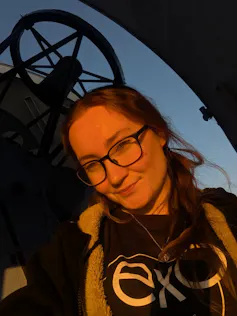
The author, Alix Freckleton preparing for a night observing the stars. Alix Freckleton
Once calibration and scheduling were complete, I watched the sun set. It was beautiful, but also a warning – working hours will soon begin. If you catch the right moment, you can see a small fleet of astronomers in cars headed to their respective telescopes.
The mountain came to life with domes opening, catching the first starlight of the night. There’s more than 20 telescopes in the observatory on the mountain, whose specialisms range from observing supernovae to exoplanets (any planet beyond our solar system).
Advertisement
The night itself
Around 8pm, the first light from a star – HD153557 in this case , a dwarf star around 59 light-years away – entered the telescope. This is always a bit special. The whir of the dome moving, the shutters opening, seeing the monitors show the first traces of data. I sipped my coffee, turned up the 80s hits, and was content in the knowledge that I’d still be in that chair in 12 hours.
This night started rather predictably. The weather was perfect, not a cloud in sight, and the telescope behaved beautifully. Before long we had a spreadsheet slowly getting filled in with completed observations. I knew the peace wouldn’t last. I’d done ten observing nights at two different telescopes by that point in my career, and not one of them without something disrupting my colour-coded plans. Typically, a cloud will move right in front of a star I’m trying to observe, or it’ll rain and that means we have to close the dome. But every few nights, there’s something a little more exciting.
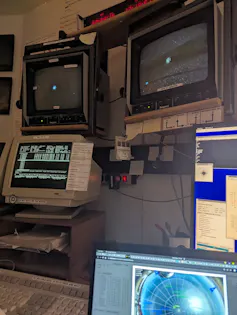
The control room. Alix Freckleton, Author provided (no reuse)
An email just before midnight brought with it a Target of Opportunity alert. These are observations that need to be done immediately, a blink-and-you’ll-miss-it moment. This one was a gamma-ray burst. It’s one of the most violent events in the universe, over a trillion times brighter than our Sun. This was picked up by a space-based detector and emailed to us to request the observation.
Gamma-ray bursts aren’t in my area of expertise – I research stars like the Sun and their surrounding planets. Far less explosive. Between switching observing instruments, rotating the dome, checking calibrations, I was also digesting as much information as I could about what a gamma-ray burst is. This was probably the closest I’ll ever get to my Jodie Foster moment, and it was a rather anticlimactic, blurry image loading very slowly on a screen.
After the gamma-ray burst was observed, the control room became quiet again. Back to my spreadsheets and falling over trying to get coffee. To feeling slightly lonely but seeing another dome rotating under the moonlight when I stepped outside, and being reminded of the other tired astronomers all working beneath the same stars.
Advertisement
It was 8:30am when I finally got back to my room. Ready for a shower, and bed, and to wake up in five hours and do it all again.
The scientific end product
The reality is that scientific interpretation rarely happens in real time. The telescope measurements are first cleaned and calibrated by a computer programme, which turns them into usable spectra. I then apply my own analysis code to these spectra. For me, this comes much later, at my desk in Birmingham once my sleep schedule has recovered. These particular observations gave us stellar spectra: when a star’s light splits into a rainbow, imposed with patterns that reveal its temperature and chemical composition.
The most common observing nights involve balancing spreadsheets, a whole lot of coffee, and slowly surrendering to the delirium of sleep deprivation. Some of them have dramatic alerts. Some of them end up entirely clouded out and allow for an early bedtime.
There is no pivotal “enhance that signal” moment, but there is the quiet, consistent sense of joy that I’m cataloguing and understanding the stars that could one day be found to host another Earth. Hollywood didn’t prepare me for the scientific process. But it got the wonder spot on.



























































You must be logged in to post a comment Login