
Business
Honasa Consumer shares jump 4% after record Q1; Jefferies, Emkay forecast strong upside


Revenue from operations also hit a record Rs 756 crore, registering a 27% YoY increase from Rs 595 crore in Q1FY26. Earnings before interest, taxes, depreciation and amortisation (EBITDA) surged 140.7% YoY to Rs 110 crore from Rs 46 crore, with EBITDA margin expanding to 14.6% from 7.7% in the same period last year.
Buy, sell or hold Honasa Consumer shares?
Wall Street major Jefferies maintains its Buy rating on Honasa Consumer with a target price of Rs 650, implying 39% upside. The brokerage said Honasa is ‘delivering beat after beat’ earnings. Further it said that FY27 margins are expected to improve by 150-200 bps.
Growth remains the management’s priority, with the company prepared to increase investments as required, while innovation continues to be a key focus. Higher crude oil and packaging costs are expected to weigh on margins in Q2, although product price hikes should offset the impact. The Flipkart policy change will also be reflected in the base from Q2 onwards.
Emkay reiterates its Buy rating on Honasa Consumer while raising the target price by 10% to Rs 550 (14% upside) from Rs 500, based on 50x Jun-28E EPS. It said 1QFY27 results exceeded expectations, driven by strong margins, with revenue growing 27% YoY and coming in 3% above consensus estimates.

The company also entered the fast-growing fragrance category with the launch of its FIKN brand. The brokerage expects growth to remain strong at more than 20% YoY in FY27E, led by low-double-digit growth in Mamaearth and more than 20% growth in The Derma Co.
It expects margins to expand by 330 bps over the next three years, mainly driven by operating leverage, and has raised earnings estimates by 9-13% over the next three years, primarily due to higher margins. Overall, it expects sales and earnings CAGR of 17% and 25%, respectively, during FY26-29E, with strong growth momentum expected to continue, led by a turnaround in the offline channel.
Honasa Consumer Q1 management commentary
Commenting on the results, Varun Alagh, chairman, CEO and co-founder of Honasa Consumer, said the company entered FY27 focused on building on the momentum generated in the second half of FY26. Alagh said Q1 had reinforced that the strategy was working, with growth coming from both core and younger brands.
He added that the company’s Focus Categories grew 35%+, while demand strengthened across General Trade, Modern Trade and eCommerce. According to Alagh, the strategy the company had set out to build was now translating into performance.
(Disclaimer: Recommendations, suggestions, views and opinions given by the experts are their own. These do not represent the views of The Economic Times)


H.G. Infra Q1 FY27 slides show sharp decline, recovery targeted

The company’s Q1FY27 net profit jumped 117% to Rs 12 crore, compared with Rs 5 crore in the corresponding quarter last year. Revenue from operations also grew 12% year-on-year to Rs 716 crore, from Rs 640 crore in Q1FY26.
Praj Industries’ Bioenergy segment continued to account for the lion’s share of total segmental revenue, contributing 66%. Engineering accounted for 22%, while HiPurity contributed the remaining 12%.
Geographically, 75% of Q1FY27 revenue came from the domestic market, while exports contributed 25%.
The company also reported a healthy order intake of Rs 1,000 crore during the quarter. Exports accounted for 43% of order intake, while domestic orders contributed 57%.
More importantly, Praj Industries ended the quarter with a sizeable order backlog of Rs 4,589 crore, providing visibility for future execution.
Management sees momentum building
Commenting on the performance, Ashish Gaikwad, Managing Director, Praj Industries, said the company continued to make progress on several long-term growth opportunities despite an uncertain external business environment.Key developments during the quarter included securing a Bio-IBA order for the country’s first commercial-scale demonstration plant, signing a long-term framework agreement for precision fabrication and modularisation solutions for hyperscale data centres, and receiving its first order from a leading semiconductor player for ultra-pure water and zero-liquid-discharge (ZLD) solutions.
Gaikwad said the company expects to build on this momentum through the rest of the financial year and deliver improved performance.
Share Price and Technical indicators
Following Friday’s rally, Praj Industries has a market capitalisation of around Rs 5,910 crore. The stock’s 52-week high stands at Rs 433.
On the technical front, the stock’s 14-day RSI stands at 43.3. An RSI below 30 is generally considered oversold, while a reading above 70 indicates an overbought zone. The stock is currently trading above seven out of eight key Simple Moving Averages (SMAs) and is below only its 100-day SMA, indicating a relatively constructive technical setup despite the stock remaining well below its 52-week high.
FIIs and mutual funds raise stake
Institutional ownership also showed a positive trend in the June 2026 quarter. Foreign Institutional Investors (FIIs) marginally increased their stake in Praj Industries to 17.75% from 17.74% in the previous quarter. More notably, mutual fund holdings rose to 13.52% from 12.25%.
(Disclaimer: Recommendations, suggestions, views and opinions given by the experts are their own. These do not represent the views of Economic Times)

Pershing Square Holdings, Ltd. is an investment holding company structured as a closed-ended fund principally engaged in the business of acquiring and holding significant (but generally not controlling) positions in a concentrated number of large capitalization companies. PSH’s objective is to maximize its long-term compound annual rate of growth in intrinsic value per share. Note: This account is not managed or monitored by Pershing Square Holdings, and any messages sent via Seeking Alpha will not receive a response. For inquiries or communication, please use Pershing Square Holdings’ official channels.

OPINION: Recent reports find little progress has been achieved on cultural diversity in the boardroom.

Parabellum International has expanded into defence industries with an eye to building nuclear-capable professional emergency response teams.
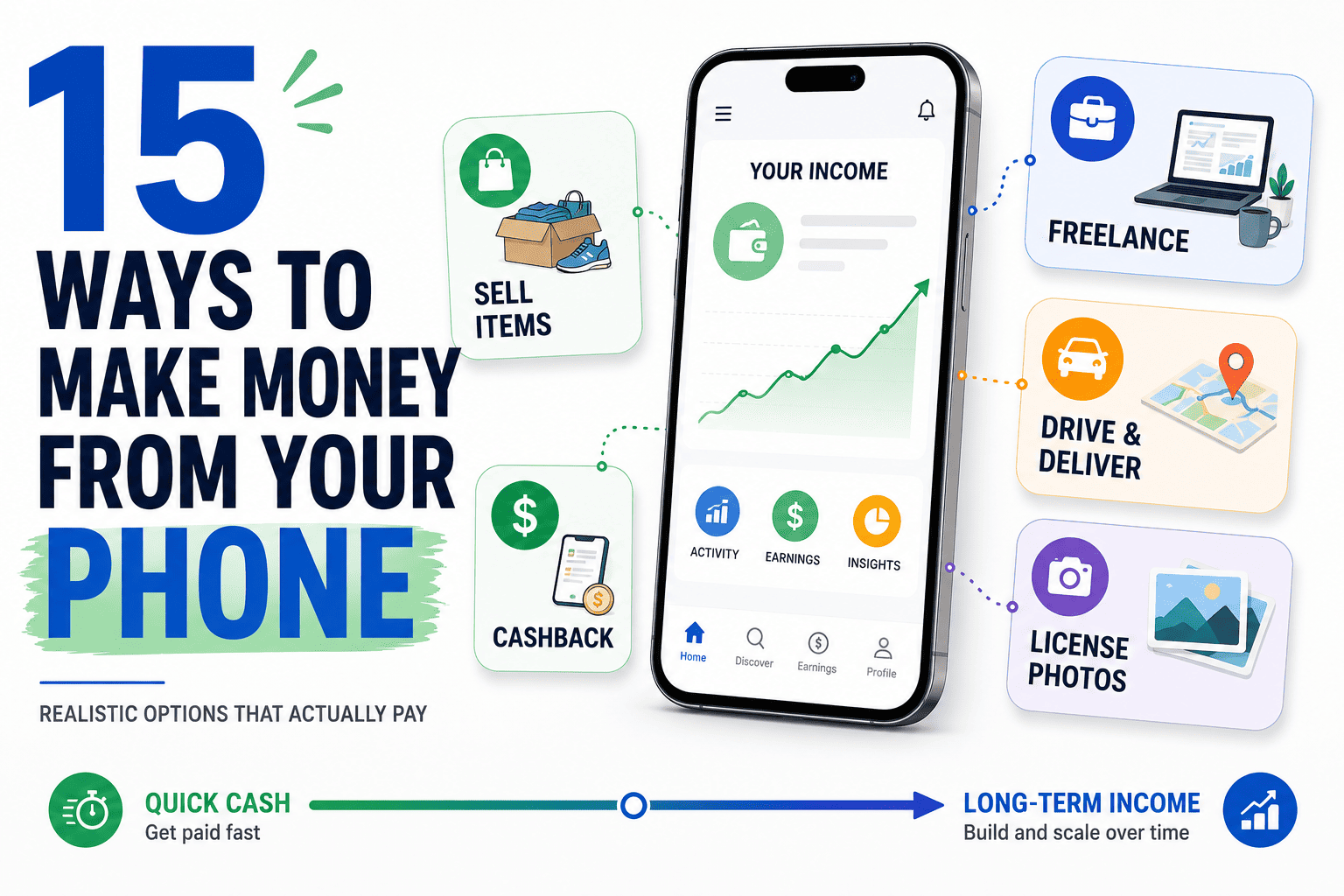
Quick answer: The most reliable ways to make money from your phone are reselling apps (fastest cash, lowest effort), cashback apps (small but genuinely passive), and freelance platforms (highest long-term earning ceiling). Survey and micro-task apps are legitimate but pay far less than most marketing promises – plan on $20–$80 a month, not $50 an hour.
Roughly one in six American adults has ever earned money through an online gig platform, according to Pew Research Center, so this isn’t a fringe activity, it’s become a normal way to supplement income. But “normal” doesn’t mean “equally worth your time,” which is the point of this guide.
Search “make money from your phone” and you’ll find lists promising 28, 40, even 46 different methods. Most of those lists pad their word count with app-testing gigs that pay $0.30 a task and “opportunities” that require you to first buy something. This guide cuts that down to 15 methods that produce real, verifiable income, along with what you should actually expect to earn from each one, because the gap between marketing copy and reality is where most people waste their time.
None of these will replace a full-time salary overnight. A few of them, done consistently, can become a meaningful second income stream. The rest are better thought of as ways to convert spare minutes into spare cash.
The quick list
- Sell items you already own
- Take paid surveys
- Stack cashback apps on purchases you’re already making
- Drive or deliver through gig-economy apps
- Freelance an existing skill
- Get paid for user testing and feedback
- License your photos and videos as stock content
- Launch a print-on-demand shop
- Create short-form video content
- Try affiliate and creator-commerce links
- Rent out things you’re not using
- Pet sit or dog walk through a marketplace app
- Pick up local task-based gig work
- Transcribe or caption audio and video
- Tutor or coach online
A quick word on scams
Because this space attracts so much hype, it also attracts a disproportionate number of scams. The FTC has specifically warned about “task scams,” where an app shows a fake, ever-increasing earnings balance and then asks you to deposit your own money often in crypto to “unlock” a withdrawal. Its broader guidance on avoiding side-hustle scams is worth a skim before you hand any app your bank details: research the company first, and treat any offer promising big money for minimal effort as a red flag.
Here’s how each one actually works, and what it realistically pays.
1. Sell items you already own
The lowest-effort entry on this list is also the fastest to cash out: list what’s sitting unused in your closet or garage on a resale app.
Which app you use matters more than it used to, because the fee structures have diverged. Poshmark charges a flat 20% commission. Mercari takes about 10%, plus a buyer-side processing fee. Depop currently charges 0% seller commission in the US, though that’s worth double-checking before you build a shop around it, since eBay is in the process of acquiring Depop and fee structures tend to shift after an acquisition closes. For general household items, electronics, and anything outside of fashion, Mercari or eBay typically finds a wider buyer pool than the fashion-focused Depop or Poshmark.
Realistic income: Highly variable, but sellers who list consistently across two or three platforms report 30–50% higher monthly revenue than single-platform sellers, since different apps skew toward different buyers.
2. Take paid surveys
Survey apps are the most oversold item on almost every “make money” list, so it’s worth setting expectations before you download anything. Legitimate platform Swagbucks, Survey Junkie, Toluna, InboxDollars, and the invite-only Pinecone Research – pay real money, but the hourly rate is closer to pocket change than a side job.
Realistic income: Casual users earn roughly $20–$80 a month running two or three apps for 15–30 minutes a day. Academic-style research platforms like Prolific occasionally pay closer to $10–$15 an hour for longer studies, but availability is inconsistent. Treat anything promising more than that as a red flag.
3. Stack cashback apps on purchases you’re already making
Cashback apps don’t ask you to do anything new, they pay you a small percentage back on spending you’d do regardless. The category has consolidated around a handful of reliable names: Rakuten for online shopping (1–10% at most retailers, paid quarterly), Ibotta and Checkout 51 for grocery receipt-scanning, Fetch for a lower-effort version of the same thing, and Upside for gas station cashback.
The real value comes from stacking. Scanning the same grocery receipt into both Ibotta and Fetch, on top of a cashback credit card, can turn a $100 grocery trip into $15–$20 of combined rebates.
Realistic income: $10–$40 a month for casual use; up to a few hundred dollars a year for households that shop deliberately around active offers.
4. Drive or deliver through gig-economy apps
Uber, DoorDash, and Instacart remain the three largest platforms for phone-based driving and delivery work, and all three let you work whenever your schedule allows. Pay varies significantly by city, time of day, and vehicle costs, gas, maintenance, and depreciation eat into take-home pay more than most new drivers expect.
We’ve covered the earnings breakdown for delivery apps specifically, base pay, tips, and how the economics compare across platforms in our dedicated delivery-apps earnings guide, since it deserves more space than a single list entry.
Realistic income: Wide range depending on market and hours worked; expect this to require the most active time of anything on this list, in exchange for the highest per-hour ceiling.
5. Freelance an existing skill
If you already have a marketable skill like writing, graphic design, bookkeeping, video editing, virtual assistance – Fiverr and Upwork both have functional mobile apps that let you message clients, deliver work, and manage payments from your phone. This won’t replace a laptop for the actual work in most cases, but it’s enough to land clients, negotiate scope, and handle client communication on the go.
Realistic income: The most scalable method on this list. Beginners often start with $15–$30 per small gig; established freelancers with a portfolio and reviews can charge professional day rates for the same skill.
6. Get paid for user testing and feedback
Companies pay for real people to test websites, apps, and prototypes and record their reactions. UserTesting and similar platforms typically pay a flat rate often $10–$60 per completed test, depending on length and complexity. The catch is availability: tests are assigned based on your demographic profile, and you may go days without matching one.
Realistic income: $20–$100 a month for occasional testers; higher for those who qualify for longer paid research studies.
7. License your photos and videos as stock content
If your phone camera is decent, apps like Foap, EyeEm, and Snapwire let you upload photos directly from your phone and earn a royalty typically 20–50% of the license fee every time someone buys one. Foap also runs brand-sponsored “missions” with fixed cash prizes for the winning submission, and EyeEm distributes accepted photos to Getty Images for additional reach.
Realistic income: Casual contributors earn roughly $50–$300 a month with a growing portfolio; income scales with volume and how commercially useful the subject matter is (business, lifestyle, and diversity-representative photos tend to outperform scenery).
8. Launch a print-on-demand shop
Print-on-demand [POD — a model where products are only manufactured after a customer orders, so you never hold inventory] lets you design custom products t-shirts, mugs, phone cases and sell them online without upfront cost. Printify’s mobile app covers the core workflow: browsing the product catalog, uploading a design, previewing mockups, and connecting the shop to an online store.
Realistic income: Highly dependent on marketing and niche selection; this is closer to running a small business than a quick side gig, with income potential that scales well beyond the rest of this list if a design or niche catches on.
9. Create short-form video content
TikTok’s Creator Rewards Program pays eligible creators based on video performance rather than a flat pool, which was the old model under the discontinued Creator Fund. To apply, you’ll generally need at least 10,000 followers and 100,000 video views in the past 30 days, an account in good standing, and videos of at least 60 seconds. Payout works out to roughly $0.40–$1.20 per 1,000 qualified views [RPM — revenue per mille, or earnings per 1,000 views], depending on niche, audience location, and engagement.
We’ve written a more detailed walkthrough of building a TikTok income stream including strategy for reaching the follower threshold in our TikTok money-making guide, since the mechanics deserve their own space.
Realistic income: Meaningful only past the eligibility thresholds; below that, LIVE gifts and brand partnerships are more accessible starting points than platform payouts.
10. Try affiliate and creator-commerce links
Once you have any kind of audience – a TikTok following, an Instagram page, or even a group chat people trust for recommendations – affiliate links let you earn a commission on products you point people toward. Amazon’s Influencer Program and platforms like LTK (formerly LikeToKnowIt) or ShopMy are built specifically for mobile-first creators to build shoppable link pages.
Realistic income: Negligible without an existing audience; scales directly with trust and reach once you have one.
11. Rent out things you’re not using
Apps like Turo let you rent out a car you’re not driving every day, while apps like Neighbor connect people with unused garage or storage space to renters who need it. Both operate on the same principle as home-sharing platforms, applied to smaller assets.
Realistic income: Highly asset-dependent; a car in a high-demand market can generate meaningful monthly income, while storage space rental tends to produce smaller, steadier amounts.
12. Pet sit or dog walk through a marketplace app
Rover and Wag connect pet owners with sitters and walkers nearby, with everything booking, messaging, and payment handled through the app. This is one of the few entries on this list with genuinely flexible, set-your-own-hours scheduling.
Realistic income: Typically $15–$25 per walk or $25–$75 per overnight stay, depending on market and the sitter’s ratings.
13. Pick up local task-based gig work
TaskRabbit and similar apps connect you with people who need help with furniture assembly, moving help, minor home repairs, or errands. Pay is set per task or hourly, and you choose which jobs to accept.
Realistic income: Varies by skill and local demand; taskers with in-demand skills (furniture assembly, handyman work) tend to out-earn general errand-runners.
14. Transcribe or caption audio and video
Rev and GoTranscript both pay per audio minute transcribed or captioned, and both have mobile-friendly workflows for claiming and submitting short jobs. This is genuinely a phone-compatible task for short clips, though longer transcription work is still easier on a full keyboard.
Realistic income: Roughly $0.30–$1.10 per audio minute depending on the platform and job type, which translates to modest hourly pay for fast, accurate transcribers.
15. Tutor or coach online
If you have subject-matter expertise, a language, a school subject, a musical instrument, test prep – apps like Preply and Wyzant connect you with students for paid video sessions, bookable and manageable from your phone.
Realistic income: Typically $15–$40 an hour depending on subject and experience, with established tutors commanding more once they’ve built a review history.
More ways to earn (smaller payouts, still legitimate)
The 15 methods above are the ones worth building a routine around. The methods below are lighter-touch, smaller, more passive amounts, but still real and worth knowing about if you want to round out the list.
16. Refer friends to apps you’re already using
Many of the apps already covered in this guide – cashback apps, survey apps, delivery apps offer a cash or credit bonus for referring someone who signs up and completes a first action. It costs nothing beyond sharing a link.
Realistic income: $5–$20 per successful referral; adds up mainly for people with a genuinely large network, not as a standalone strategy.
17. Get paid for walking or exercising
Apps like Sweatcoin, StepBet, and HealthyWage convert daily steps or fitness goals into cash, gift cards, or wagered payouts. These reward activity you might be doing anyway, rather than paying a real hourly rate.
Realistic income: A few dollars a month in most cases; HealthyWage-style wager formats can pay more but require putting your own money on the line first.
18. Join a research panel that pays for anonymized usage data
Market research firms – Nielsen’s consumer panels are the best-known example – pay a small amount for permission to passively track anonymized app or browsing usage in the background. This is the most hands-off method on this list, but it’s worth being clear-eyed about the trade-off: you’re being paid for data access, not a task, so read what’s actually being collected before opting in.
Realistic income: Typically $5–$15 a month or occasional gift cards; not meaningful as a standalone income source.
19. Round spare change into automatic micro-investments
Apps like Acorns round up your everyday purchases and invest the difference. This isn’t really “earning” money from your phone – it’s automating small, regular investing, and like any investing, the balance can go down as well as up. It’s worth including on this list only with that distinction clear: this is a savings habit, not guaranteed income, and it’s worth talking to a financial advisor before treating it as an income strategy rather than a savings one.
Realistic income: Not applicable in the same sense as the rest of this list — outcomes depend on market performance, not effort.
20. House-sit or plant-sit through a marketplace app
Platforms like TrustedHousesitters connect homeowners who need someone to watch their house (and often pets or plants) while traveling with people willing to stay there for free or for a fee.
Realistic income: Often non-cash (free lodging) rather than a fee; occasional paid arrangements exist but are less common than the unpaid house-sitting-for-lodging model.
21. Sell unused gift cards for cash
Sites and apps like CardCash and Raise buy unwanted gift cards at a discount to face value, which is still better than letting them expire unused in a drawer.
Realistic income: Typically 70–90% of the card’s face value, paid out once the card is verified.
22. Rent out a driveway or parking space
In cities with limited parking, apps like Neighbor also list parking spaces and driveways alongside storage space, connecting owners with drivers who need a spot.
Realistic income: Modest and highly location-dependent; most valuable in dense urban areas near event venues, stadiums, or transit hubs.
23. Get paid to recycle old electronics
Kiosk networks like ecoATM pay cash on the spot for old phones and other devices, based on condition and current resale demand.
Realistic income: One-time payout per device, not a recurring income stream, but a fast way to turn a drawer of old phones into cash.
Getting started without wasting time
The apps on this list fall into two categories: ones that pay for time (surveys, testing, transcription, gig driving) and ones that pay for an asset you already have (unused items, a spare room in your camera roll, a skill, an audience). The time-based methods are the fastest to start and the easiest to quit; the asset-based ones take longer to build but scale further.
Most people who make meaningful money from their phone aren’t running all 15 of these at once – they’ve picked two or three that fit their schedule and their existing skills, and stuck with them long enough to build momentum.
Business
Bragg Gaming Group Inc. 2026 Q2 – Results – Earnings Call Presentation (TSX:BRAG:CA) 2026-08-14


Seeking Alpha’s transcripts team is responsible for the development of all of our transcript-related projects. We currently publish thousands of quarterly earnings calls per quarter on our site and are continuing to grow and expand our coverage. The purpose of this profile is to allow us to share with our readers new transcript-related developments. Thanks, SA Transcripts Team
Business
Friedrich Vorwerk Group SE 2026 Q2 – Results – Earnings Call Presentation (OTCMKTS:FDVWF) 2026-08-14
Seeking Alpha’s transcripts team is responsible for the development of all of our transcript-related projects. We currently publish thousands of quarterly earnings calls per quarter on our site and are continuing to grow and expand our coverage. The purpose of this profile is to allow us to share with our readers new transcript-related developments. Thanks, SA Transcripts Team

Wintrust Financial COO David Dykstra sells $2.2m in stock

BOJ eyeing September rate hike, faster pace of tightening, sources say

Davis Martin ejected after wild pitches spark benches-clearing brawl

Derek McInnes makes brutal Rangers admission after historic low
H.G. Infra Q1 FY27 slides show sharp decline, recovery targeted


-

 Fashion7 days ago
Weekend Open Thread: Mattifying Sunscreen
-

 Fashion7 days ago
Frugal Friday’s Workwear Report: Cap-Sleeve Pointelle Crewneck Sweater
-

 News Videos6 days ago
Can Astrology Help Find Gold and Silver Trends? A Financial Astrology Guide
-

 Tech6 days ago
Rinn Pharma & Biopharma to join NordicPharmaTrain network
-

 Business5 days ago
How to Start a Cleaning Business: A Step-by-Step Guide
-

 Business5 days ago
Datadog: Best Of Breed For Multiple Reasons
-

 Business5 days ago
BDC Weekly Review: Private BDC Q2 Numbers Are Strong
-
 NewsBeat2 days ago
Communication cards help banking customers access services or report scams
-
 Business3 days ago
Oil Price Today (August 11): Crude oil rises to $88 after Trump’s compensation demand dents Hormuz opening. Here’s why
-

 Business7 days ago
Aussie shares lose steam to close record-breaking week
-

 Fashion7 days ago
Weekly News Update, 8.6.26 – Corporette.com
-

 Fashion7 days ago
Irina Shayk Wows in REVOLVE Los Angeles’ Summer Styles
-

 Fashion7 days ago
Burberry Fall 2026 Takes On Commuter Style
-

 Fashion5 days ago
Amazon Sundays: Closet Care Before Fall
-

 Politics6 days ago
Be quiet, Miriam! – spiked
-

 Business7 days ago
CXMT Shares Drop 4.3% as Post-IPO Rally Cools Amid Global Memory Chip Pressures
-

 Business6 days ago
Mutual Fund Manager Scoops Up Beaten-Down Stocks
-

 Sports7 days ago
Report: Kawhi Leonard had undisclosed deal with Clippers’ scoreboard maker
-

 Crypto World7 days ago
How XRP holders can earn $4,600 daily
-

 Entertainment7 days ago
Warren Hudson’s Dad Releases Audio Of Threats
You must be logged in to post a comment Login