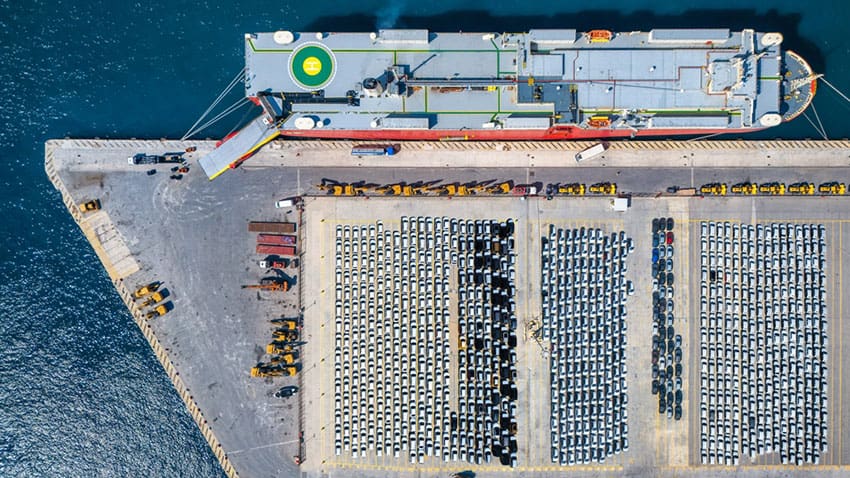
The average annual rate to charter a large car carrier reached $70,000 a day in June, according to shipbroker Clarksons, up from $42,500 at the end of last year, as vehicle exports out of China outpace the capacity of the ships built to move them.
Rates to charter the vessels, which are designed so cars can be driven on and off, are up 65 per cent this year. Specialised carriers are booked out years ahead to move vehicles from Chinese factories.
Research group Mobility Global says China exported just under 600,000 cars and vans in 2019. This year the group forecasts China could ship up to 10 million vehicles.
“You’ve got China moving from being insignificant to being the world’s largest vehicle exporter in only a five-year period,” said Andreas Enger, chief executive of Norwegian car carrier Höegh Autoliners. Enger said ocean freight rates for cars are now double their prepandemic levels.
Carriers have bought vessels in recent years to meet the demand. Lasse Kristoffersen, chief executive of Wallenius Wilhelmsen, which operates the world’s largest car-carrier fleet, said the global fleet has grown by about 40 per cent but still cannot meet China’s needs.
“The strength of the market in the shipping segment is amazing, and it is due to the unprecedented growth of exports out of China,” Kristoffersen said on an earnings call earlier this year.
Industry executives had expected charter rates to fall this year as ships ordered between 2022 and 2025 entered service. Rates peaked at $115,000 a day in late 2023 and early 2024.
The export volumes are reshaping European sales registers. Registrations in the European Union for SAIC Motor rose 19 per cent in the first half of 2026 and BYD’s more than doubled, according to the European Automobile Manufacturers’ Association. Over the same period Stellantis gained 6 per cent, Volkswagen 2.6 per cent, and Renault fell 4.2 per cent.
With a handful of exceptions, Chinese cars are not exported to the United States because of tariffs and software restrictions tied to national security concerns. Battery-electric and hybrid models from brands including BYD and SAIC Motor are increasingly taking share from Western brands in countries including the UK, Brazil and Germany, as well as at home.
Tu Le, managing director of advisory firm Sino Auto Insights, said the export push amounts to a “pressure release valve” as domestic sales slow. Car sales in China fell more than 20 per cent in the first half of 2026 against the same period a year earlier, according to International Energy Agency data. Chinese carmakers face competition between more than 100 domestic brands.
“When you go to Germany, you don’t have 20 other Chinese car brands that are elbowing you to get that one sale, like you have in Shanghai,” Le said.
Some manufacturers are loading vehicles into standard shipping containers to reach Europe, Australia and Latin America. Kristoffersen said during an earnings presentation on Tuesday that up to four million vehicles are exported from China each year in containers or other alternatives to car carriers.
Eric Dessupoiu, vice president of finished vehicle logistics at France’s Ceva Logistics, said automakers prefer car carriers because driving vehicles on and off is cheaper and carries less risk of damage. Automakers with no other option will use containers, he said.
The practice is not new but was rarely done at scale before the pandemic, when demand outstripped the supply of ships. Christoph Seitz, global vice president of finished vehicles at Dubai-based freight forwarder DP World, said some Western automakers were sceptical about putting cars in boxes but Chinese manufacturers were not. “They immediately went, ‘We need more capacity,’” Seitz said.
A car shipped by container must be taken to a facility near a port, loaded into a box and lifted by crane onto a ship, with the process reversed at the destination. Seitz said container lines including Denmark’s A.P. Moller-Maersk and Switzerland’s Mediterranean Shipping Co have begun selling directly to automakers.
Container capacity and freight costs have previously fed through to UK manufacturers, with S&P Global attributing part of an earlier decline in British export orders to shipping delays and rising rates.
Chinese carmakers are also moving into shipping. BYD launched its first dedicated car carrier in 2024 and now operates a fleet of eight vessels. The company did not respond to requests for comment.
Jamie Young
Jamie Young is Senior Reporter at Business Matters, covering SME finance, employment law and Westminster policy since 2016. He has reported on every Budget and Autumn Statement since 2018, helped make sense of the ‘covid era’ and the bounce-back loan scheme from launch through the fraud investigations, and broke the magazine’s coverage of the 2024 late-payment reforms. He joined Business Matters straight from completing his BA in Administration from Exeter University and is NCTJ-qualified. Reach him at jyoung@cbmeg.co.uk
























































You must be logged in to post a comment Login