Connect with us

NewsBeat

Indonesia is hit by a huge 7.7 magnitude earthquake: Buildings crumble and patients flee their hospital beds amid tsunami warning as people are told to move to higher ground

Published

on

Video posted on social media showed buildings crumbling after a powerful earthquake hit Indonesia

A powerful earthquake hit Indonesia as authorities told residents to stay away from beaches in case of tsunamis and hundreds were forced to evacuate.

The 7.7 magnitude earthquake struck off the Indonesian coast around 5.58am local time, around midnight in the UK.

Indonesia’s Flores Island was hit by the quake with a depth of 10km, with the epicentre 68km (42 miles) from Ende, on the southern coast of the island, in East Nusa Tenggara province.

No deaths or injuries were reported immediately after the quake, which was followed by two aftershocks, one with a magnitude of 6.1.

Advertisement

Authorities warned of tsunamis and told residents to stay away from beaches and riverbanks as the shallow quake threatened Indonesian coastlines.

Video appearing to be of the Port of Maumere on Flores captured crumbling buildings and shattered windows as people screamed and ran through the streets.

Comprising 17,000 islands, Indonesia is vulnerable to earthquakes because of its position on the Pacific ‘Ring of Fire’, a series of volcanoes and fault lines around the ocean.

Lukas Lotar, a hospital porter, said: ‘Suddenly it started to shake and I panicked.

Advertisement

Video posted on social media showed buildings crumbling after a powerful earthquake hit Indonesia

Windows shattered and plasterwork fell from walls as the 7.7 magnitude earthquake was followed by two aftershocks

Windows shattered and plasterwork fell from walls as the 7.7 magnitude earthquake was followed by two aftershocks

People were filmed running through the street and screaming as authorities warned of possible tsunamis

People were filmed running through the street and screaming as authorities warned of possible tsunamis

Advertisement
A small fishing village on the coastline of Flores, the Indonesian island near to where a 7.7 magnitude earthquake hit overnight (file pic)

A small fishing village on the coastline of Flores, the Indonesian island near to where a 7.7 magnitude earthquake hit overnight (file pic)

‘Patients also fled the hospital, the jolt was big. I saw some walls were cracked.’

A hospital near Ende was filmed moving its patients outside by local media, though it is unclear whether this was in the same place Mr Lotar described.

Yohanna Embu, a resident of Sikka, which lies within East Nusa Tenggara province, said strong shaking had damaged buildings as people ran to higher ground.

Advertisement

‘Many buildings here were damaged. I saw that the waiting room at the Pelni port terminal in Maumere had collapsed,’ she said.

A spokesman for the country’s national disaster mitigation agency said the quake struck strongly for around one minute in regions such as Nagekeo and Bima.

Indonesia’s meteorology, climatology and geophysics agency (BKMG) said it was possible a tsunami could follow the quake.

‘Tsunami modelling results indicate that this earthquake has the potential to generate a tsunami in the provinces of East Nusa Tenggara, South Sulawesi, and West Nusa Tenggara,’ the agency said.

Advertisement

It warned residents of waves from 0.5m to 3m high as residents in Maumere evacuated to higher ground.

According to witnesses the sea around the island has washed out, a common sign of a coming tsunami. 

The Indonesian quake was of a higher magnitude than that which hit Colombia earlier this week.

That earthquake was a magnitude 7.4 and buried people across the country as buildings collapsed.

Advertisement
A pink sand beach on Flores, which lies in the country's east (file pic)

A pink sand beach on Flores, which lies in the country’s east (file pic)

The island is on the Pacific 'Ring of Fire', named for its volcanoes and fault lines, including the Lewotobi Laki-Laki volcano which erupted in June last year

The island is on the Pacific ‘Ring of Fire’, named for its volcanoes and fault lines, including the Lewotobi Laki-Laki volcano which erupted in June last year

At least 111 were killed in Colombia and 87 were injured as the country declared a state of emergency and a race to find survivors began.

Also on the so-called Ring of Fire, the Colombian quake was felt as far away as Ecuador, Panama and Venezuela.

Advertisement

Indonesia has a history of deadly earthquakes, including the 2004 Boxing Day quake, a 9.1 magnitude event that struck off the coast of Sumatra.

One of the deadliest natural disasters ever recorded, it killed 170,000 in Indonesia and a further 52,000 in the surrounding region.

In 2018 a powerful earthquake shook the island of Lombok and more tremors followed during the following weeks, killing more than 550 people on the holiday island and neighbouring Sumbawa.

Later that year, a 7.5 magnitude quake and a subsequent tsunami in Palu on Sulawesi island left more than 4,300 people dead or missing.

Advertisement

Flores has also seen recent volcanic activity after the Lewotobi Laki-Laki volcano erupted last year, spewing ash high into the air.

Source link

Continue Reading
Click to comment

You must be logged in to post a comment Login

Leave a Reply

NewsBeat

Heartwarming story of the man whose heatwave lawn will leave you green with envy. He’s just lost his wife of 50 years and has had six new hips – but even the drought hasn’t stopped Stuart creating perfection. So how DOES he do it?

Published

on

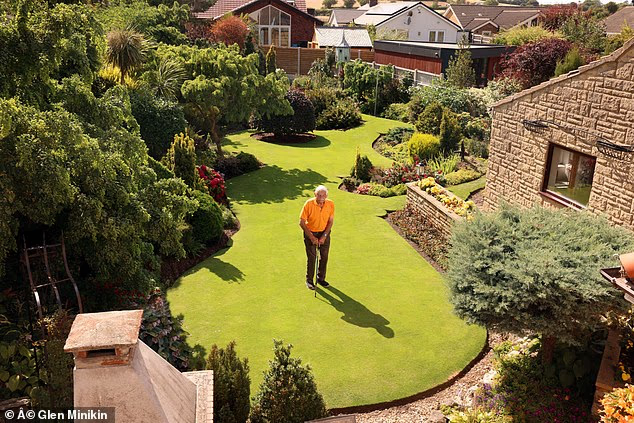
Stuart Grindle from Tickhill, Doncaster who has a competition winning garden that he is managing to keep luscious green in the heatwave

The view from above is extraordinary. While there are scorched gardens and tinder-dry fields as far as the eye can see, Stuart Grindle’s lawn, in this little corner of Yorkshire, remains lush and lovely. And so dazzlingly green – as if God has been messing with the filter.

‘I’ll be getting hate mail if you use an aerial shot,’ jokes the 83-year-old retired joiner. 

‘It happened before. I think it was when ITV sent a drone up. My lawn was emerald green when everyone else’s was brown. I had letters saying, “Why are you watering your lawn when there’s a drought?”.’

Good question: why is he?

Advertisement

‘For starters, we don’t have a hosepipe ban here at the moment,’ Stuart points out. 

‘And people want to look a bit closer at the pictures. You’ll see I have four water butts. I’m very water conscious. To be honest, I don’t even like putting tap water on the lawn, the grass doesn’t like it.

‘And when I do put the sprinkler on – I have a 360 degree one – I only have it on for ten or 15 minutes. Gardens don’t want more. Grass wants to be damp, not wet. 

‘Where people get it wrong is that they put the sprinkler on and then go and watch Coronation Street. Your grass won’t thank you for it.’

Advertisement

Stuart Grindle from Tickhill, Doncaster who has a competition winning garden that he is managing to keep luscious green in the heatwave

The garden takes hours of work to maintain, by Stuart, pictured with his wife Anne in 2018

The garden takes hours of work to maintain, by Stuart, pictured with his wife Anne in 2018

Stuart confessed to spending up to 16 hours a day, and tens of thousands of pounds over the years, tending his lawn

Stuart confessed to spending up to 16 hours a day, and tens of thousands of pounds over the years, tending his lawn

Advertisement

Besides, Stuart pays £1,200 a year for his water: he’s on a fixed rate. He had words with someone from Yorkshire Water over this last year, when there WAS a hosepipe ban. 

‘I said “if I buy a three piece suite – a sofa and two chairs – from John Lewis, they won’t send them to me and say “you can’t sit in the chairs”.’

Why am I here, on one of the hottest days of the year, sitting in Stuart’s little oasis of a garden in Tickhill, Doncaster, doing little more than watching the grass grow (to be fair, it’s mesmerising. And a little addictive)?

Because when it comes to working out how to maintain England’s green and pleasant land, Stuart is your man. 

Advertisement

It is now nine years since Stuart won a competition to find Britain’s best lawn. In 2017, his garden – his life’s work – became a national talking point, an object both of lust and fascination.

The man who confessed to spending up to 16 hours a day, and tens of thousands of pounds over the years, tending his lawn, who’d been known to get down on his knees with kitchen scissors to perfect the edges, became an overnight sensation.

Gardener’s World sent a camera crew (‘my wife, Anne, was hoping for Monty Don, but she didn’t get him’) and a German newspaper sent a reporter to test the springiness underfoot.

‘He arrived and said “I’ve brought you a present, Mr Grindle”, but it was a garden gnome. I said, “I’ll find somewhere for it”.’

Advertisement

You’re not a garden gnome man, then? ‘I am not,’ he says.

The German reporter proudly showed him photographs of his lawn. Stuart was not impressed: ‘It wanted digging up. It wanted a cultivator. I asked how often he cut it and he said “quite regularly, at least once every two weeks”. I was cutting mine twice a day at that point.’

Having agreed to open his lawn to the public, all proceeds to charity, Stuart (and the long-suffering Anne, who called herself a lawn-widow) found himself inundated with visitors.

Then there were the weddings. One bride asked what it would cost her to have her wedding pictures taken on his lawn. He said “it will cost you nowt, lass”, and along came the wedding party.

Advertisement

‘I did tell her she’d have to take her shoes off because I can’t have stilettos on my lawn,’ he recalls. Happily for him (and the grass), she was happy to go barefoot.

Of course, we all love looking at other people’s lawns, particularly when our own have shrivelled up and died. 

Today we chat about singer Rod Stewart’s lawn in Essex, which has been in the papers looking strikingly vivid. 

Stuart would like to know what grass seed Rod uses (his own favourite is ‘Bent’, which is the stuff they use on golf greens, and is so fine you can’t use it if there is any wind at all).

Advertisement
Sir Rod Stewart¿s Grade II-listed mansion has very green gardens despite the dry weather

Sir Rod Stewart’s Grade II-listed mansion has very green gardens despite the dry weather

Sir Rod's mini golf course features a fairway, two bunkers and a lush putting green

Sir Rod’s mini golf course features a fairway, two bunkers and a lush putting green

He tells me, however, that his mowing days are over. What wasn’t reported at the time of his lawn-fame is that he’d already had a double hip-replacement, after a lifelong battle with arthritis. He was diagnosed at the age of 28 and had his first hip replacement at 36.

He’s now had six new hips (‘they call them “revisions” after the first set’). He also has two new shoulders, and he walks with a stick. Even getting to the end of the garden is a struggle.

Advertisement

Pushing a lawn-mower, even his beloved machine which cuts to 5mm? He hasn’t done it for years. He can no longer get down on his knees for forensic examination, either. 

So how on earth is this garden still looking so splendid? This is partly down to his son Jonathan, who now lives with him, and who knows his way around a pair of pruning shears, but mostly because of his friend Dan, who tends the greens of a local golf course.

‘He comes and does my garden for me. No charge,’ Stuart says. ‘He does it because he’s marvellous and because he knows what it means to me. I’m the luckiest man in the world.’

Dan pops in most days. He’s doing the edging at the moment, down on his knees, refusing tea. ‘I direct operations,’ says Stuart.

Advertisement

Glen, the photographer who hung out of the upstairs bedroom window years ago, has come back to take the pictures today, and shows Stuart the old images on his phone. He assesses them with the most critical eye on the planet. 

‘It was in better shape then,’ he says of his grass, ‘but it’s not too bad now in comparison. But because we’ve had this drought. We’re in maintenance mode. It’s just a case of keeping it alive.’

One of the most striking images from before is of Stuart and Anne standing proudly in the middle of their garden, arms outstretched. He takes the phone and gives the image a little kiss. Anne died in December. This has been the first summer without her. It has been a long one.

‘Dementia,’ he says. ‘She had it for about three years. It was awful towards the end. She got quite violent. She didn’t know what she was doing. We had to lock the doors. 

Advertisement

‘She stopped eating in about September, I mean just stopped, wouldn’t have more than a spoonful of yoghurt. She was in hospital eventually, then a nursing home at the end.’

He had Dan plant a little memorial garden for Anne halfway down, behind a tree called a Lace Lady which sweeps elegantly over the lawn. There is now a little bench there, which we meander down to (I’m only allowed on the grass because I have trainers on). The dwarf conifers are coming on nicely in this shaded spot.

¿I¿ll be getting hate mail if you use an aerial shot,¿ jokes the 83-year-old retired joiner

‘I’ll be getting hate mail if you use an aerial shot,’ jokes the 83-year-old retired joiner

Stuart has kept his garden green despite the heatwave

Stuart has kept his garden green despite the heatwave

Advertisement
Stuart pictured in 2024 watering his garden, which was previously named 'Britain's Best Lawn'

Stuart pictured in 2024 watering his garden, which was previously named ‘Britain’s Best Lawn’

‘I just sit and think about her. Little Annie. We rarely had a cross word, you know. We met at 17, married at 21. She was the only one for me.’

How did you know she was the one? ‘The nurse’s uniform,’ he deadpans. They met at a youth club and married in 1964, living with his mother at first then buying their first home (complete with postage stamp sized garden) in Maltby.

In 1969 they moved to a new development in Worksop and in 1973 Jonathan was born. There was a golf course nearby, however, and Stuart found himself gazing at the green and becoming ‘a little obsessed’.

Advertisement

His next door neighbour’s father was a green keeper and they got chatting about grass seed. It wasn’t until they moved to this house, in 1976, that they had a sizeable garden to work with.

It was scrubland before Stuart got to grips with it, and even then he let friends use it as an allotment before his passion really took over. ‘I sowed the seed myself,’ he recalls. ‘No turf here. And then I watched it grow …’

Half a century on, he’s still watching. He has a keen eye. ‘I don’t like gardens that go up and down, that’s why there are no straight lines in mine. The eye has to be drawn. You go “oh, that’s interesting, what’s over there”.

How much has he spent on this garden over the years? ‘I’d say about £60,000’. That’s not including the man hours.

Advertisement

When he was working Stuart would get up at 6am to ‘swish’ (basically brush the lawn), then come home from work and immediately get to mowing. After retirement, he could spend entire days on his grass. He never let Jonathan kick a football on the lawn. They couldn’t go on extended holidays because the garden couldn’t handle the neglect.

Dare we ask if he will ever leave his garden, or worse, let nature take over? He’s already let a couple of sections go, ‘but no, I’d find that very hard. It’s my life’s work, this is 50 years of my life, of Anne. I’ll leave it when they carry me out.’

Will he care about what happens after he is no longer here, then? He says Jonathan is unlikely to keep the garden. ‘Nope. He’ll sell up, and maybe some young couple will come in, with two little snappers, and rip it all up.’

What if they put down – the horror! – artificial grass, and have an entire family of garden gnomes? ‘I won’t be here,’ he says. ‘They can do what they like. That’s the thing about a garden. It’s personal.

Advertisement

Source link

Continue Reading

NewsBeat

What happens when someone’s chromosomes, sex hormones and body don’t align?

Published

on

What happens when someone’s chromosomes, sex hormones and body don’t align?

I teach a university course called Hormones and Behaviour. What surprises students is that biological sex is not produced by a single switch. What surprises me is that many students have never been taught this before. It is basic biology, but it helps explain life.

Sex emerges through a sequence of events before birth and continues at puberty.
Chromosomes help direct the formation of gonads, the body parts that usually become ovaries or testes. Gonads make hormones. The body then has to respond to those hormones. In most people, these steps flow in the same direction. But in rare cases, they do not.

These cases are known as disorders, more recently differences, of sex development (DSDs). They are not new but they provide a useful way to understand how bodies develop. DSDs can affect hormone production. Some affect the body’s response to hormones. Some affect chromosomes or gonad development. Two people can have a DSD, yet have very different bodies, medical needs and life experiences.

Each condition reveals what can happen when one step in the normal sequence is altered. Here are five ways sex development can take a different path.

Advertisement

Congenital adrenal hyperplasia

This DSD affects around one in 16,000 births.

The adrenal glands, which normally produce small amounts of male hormones, even in females, are hyperactive in this condition.

A baby with two X chromosomes and ovaries can therefore be born with external genitals that look male.

Complete androgen insensitivity syndrome

In contrast, a child with complete androgen insensitivity syndrome (CAIS), can have XY chromosomes and internal testes that make testosterone, but their body cannot respond to that testosterone.

Advertisement

This lack of a response to testosterone keeps the developing fetus in its “default” female state, leading to female external genitals at birth.

Someone with CAIS will develop breasts at puberty. Since their external anatomy is typically female, people with CAIS are usually raised as girls and may only be diagnosed later, often when their periods do not start.

CAIS is estimated to affect one to five in 100,000 live born females.

5-alpha-reductase deficiency

Another condition, called 5-alpha-reductase deficiency, shows how sex development does not finish at birth.

Advertisement

The body needs an enzyme called 5-alpha-reductase to turn testosterone into a stronger version of the hormone before birth. When a genetic mutation inactivates this enzyme, an XY baby may be born with genitals that are read as female and may be raised as a girl. At puberty, however, the normal surge of conventional testosterone masculinises the body.

The condition is rare worldwide and its exact incidence is unknown, partly because conditions affecting sex development have often been surrounded by silence.

In parts of the Dominican Republic, where this condition is known as guevedoces, studies have reported surprisingly high local rates. A rare genetic mutation is more common in these isolated populations, about one in 90 males.

More recently, some of these communities have begun to recognise guevedoces at birth and raise them as boys.

Advertisement
A person’s sex is more complicated than you might think.
s880/Shutterstock

Sex chromosomes disorders

Usually, females receive one X chromosome from their father and one X from their mother, and are therefore XX, while males receive one X chromosome from their mother and the Y chromosome from their father. However, a person with Klinefelter syndrome, affecting one in 500-1,000 male births, has XXY chromosomes, causing smaller testes, scant body hair, lower testosterone and reduced fertility. It is often never diagnosed.

On the other hand, Turner syndrome, or the loss, in females, of one of the two X chromosomes, affects one in 2,500 female births and impairs growth, puberty and fertility. It can affect physical appearance, for instance a wide neck and broad chest and often comes with health conditions such as hearing loss and kidney problems.

Swyer syndrome is rarer: a person has XY chromosomes but with a mutation in the Y chromosome that disrupts the signal that normally drives testes formation. The gonads do not develop into testes, testosterone remains low and the external and internal anatomy is typically female.

These are the clearer examples. Milder sex differences can result from mutations that reduce, rather than completely inactivate, an enzyme or hormone response. For example, non-classic congenital adrenal hyperplasia, where some enzyme activity remains. Their effects may be less obvious, and their incidence is often unknown because many cause subtler changes or are never diagnosed.

Advertisement

What this does and does not tell us

None of this is new. These conditions have been known to scientists for decades. But now genetic testing can identify the mutation behind some cases.

Specialist clinics and patient groups have pushed for clearer information for parents, better psychological support for patients and greater caution around irreversible childhood surgery when it is not medically urgent. Recent patient-centred research shows that clear information, good communication and psychological support are central to good care for people with DSDs. It’s unclear whether increased awareness has improved people’s lives, but the direction is clear: better information, specialist care and long-term support matter.

The lesson is not that sex is meaningless or endlessly fluid. These rare conditions do not provide a simple answer to every argument about sex and gender.

However DSDs do show sex is not a single event. Just like the growth of our body, it is a process. When chromosomes, gonads, hormones and the body’s response to them all follow the usual sequence, the result often looks simple. When one link changes, the body may no longer fit the binary pattern many of us were taught at school.

Advertisement

For the people affected, this is not an abstract puzzle. Some need lifelong hormone treatment. Some face infertility. Some discover their condition only as teenagers or adults. Chromosomes or sex designation at birth may explain part of the biology behinds DSDs. It does not explain what it feels like to grow up, go through puberty, seek fertility treatment or decide who needs to know.

Source link

Advertisement
Continue Reading

NewsBeat

Mr Swainstons South Shields owners to appear on BBC Dragons’ Den

Published

on

Mr Swainstons South Shields owners to appear on BBC Dragons’ Den

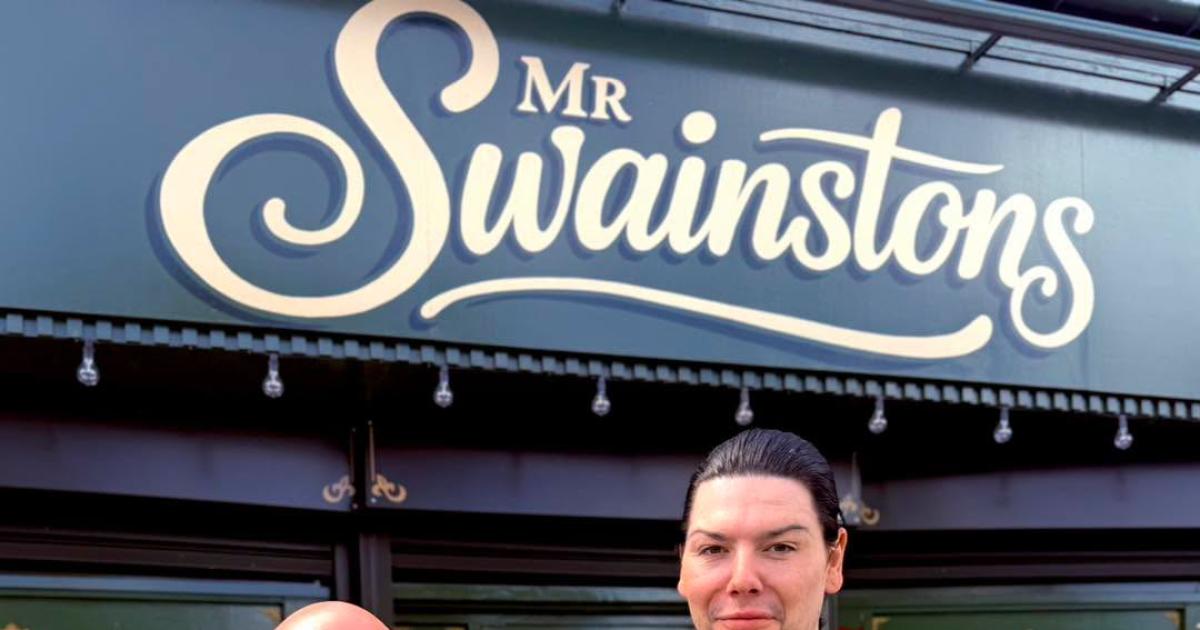
Mr Swainstons, based in South Shields and run by Sean Robinson and his fiancé, John Gray, will feature on the BBC show on Thursday, August 20, at 8pm, where they will pitch their traditional sweet emporium to the Dragons.

The idea for the business began during a New Year’s Day visit to Beamish Museum back in 2024, which quickly turned into a personal project for the pair to create a sweet shop that had that same nostalgic feel.

Sean, John and staff. (Image: Mr Swainstons)

Mr Robinson said: “It’s all about the nostalgia – we tapped into something the elderly generation love and the younger generation find so interesting.

“We wanted to bring that feel back, playing on the history of the 1930s and 40s.”

Advertisement

The shop, styled with old-fashioned sweet jars, vintage scales, and staff dressed in flat caps and period attire, has attracted thousands of followers on social media.

The team regularly create fun social media content (Image: Mr Swainstons)

The pair regularly watch Dragons’ Den and The Apprentice on Thursday nights, and on a whim, decided to apply for the show.

Mr Robinson said: “We got a call six weeks later from the BBC saying they had seen our social media and they wanted us on, it was surreal.

“They told us we’d be the first sweet shop of our kind to appear on the show, especially having a brand based around nostalgia.”

Advertisement

The shop in South Shields (Image: Mr Swainstons)

Filming of the episode has already taken place, but the outcome remains under wraps.

Mr Robinson said: “We were definitely the most terrified of Deborah Meaden.

“The whole thing was just so surreal.

“I’m proud of John and I’m proud of myself – who knew a little boy from Peterlee would get this far.”

Advertisement

Though the pair had hoped to meet Sara Davies, the North East Dragon was said not to be present during filming.

Mr Robinson and Mr Gray began their business in a small unit and credit social media, particularly TikTok, for helping them grow their extensive audience and customer base.

Their appearance on Dragons’ Den marks another milestone in their journey, which began just over two years ago.

The episode will air at 8pm on Thursday, August 20, but viewers will have to tune in to find out whether the Dragons took a bite out of their nostalgic business pitch.

Advertisement

Source link

Continue Reading

NewsBeat

Outrage as men are to be stripped of their right to a prostate cancer test with Lord Cameron describing it as a ‘backwards step’

Published

on

David Cameron, who revealed in November 2025 he had been treated for prostate cancer, said the decision was a 'backwards step'

Middle-aged men will no longer be entitled to tests to help detect prostate cancer.

New guidance means men over 50 can no longer access blood tests which help to find the disease and GPs will have the power to decide who can take one.

Former Prime Minister Lord Cameron, who was treated for the disease after taking a test, said the move was a ‘backwards step’.

Until the most recent guidance, any man aged over 50 has had access to a prostate-specific antigen (PSA) test through their GP and did not need to have symptoms.

Advertisement

But now doctors will make the final decision on whether or not a test is needed.

The change follows the Government’s decision not to roll out widespread prostate cancer screening and instead use more targeted testing for high-risk groups.

The new guidance was sent in a letter to health organisations on Thursday and was seen by The Daily Telegraph. 

It has been criticised by Prostate Cancer Research as a ‘shocking betrayal and backward step that will condemn thousands more men each year to a late and incurable diagnosis’. 

Advertisement

David Cameron, who revealed in November 2025 he had been treated for prostate cancer, said the decision was a ‘backwards step’

Jeremy Clarkson revealed his prostate cancer diagnosis in the latest season of Clarkson's Farm

Jeremy Clarkson revealed his prostate cancer diagnosis in the latest season of Clarkson’s Farm

Several high-profile prostate cancer diagnoses in middle-aged men, including Sir Chris Hoy and Jeremy Clarkson have increased demands for PSA tests. 

Advertisement

David Cameron revealed that he was diagnosed with prostate cancer last year.

The decision to row back the testing was made by officials at the Department of Health and Social Care (DHSC) without public consultation. 

The letter said: ‘The prostate cancer risk management programme guidance has been withdrawn.’ 

It continued: ‘A patient is worried about prostate cancer, then they can ask their GP about having a PSA test. 

Advertisement

‘As the health professional, the GP will consider the patient’s cancer risk to help with reaching a judgment on whether undertaking a PSA test is the right option for the patient, whilst clearly laying out to the patient the pros and cons associated with doing so.’ 

The letter also said that the latest guidance no longer considers men over 50 to be at high risk, because age is just one factor in assessing risk, despite the fact that the chance of disease rises with age. 

Lord Cameron told The Telegraph: ‘This is yet another step backwards and once again shows why we need simple, proper targeted screening for all at-risk men.

‘Screening is essential to catch cancers early, when they can be more effectively and successfully treated. Only due to testing, my cancer was caught and treated in time.

Advertisement
James May revealed his friend Jeremy Clarkson was 'over the hurdle' in his battle with 'aggressive' prostate cancer

James May revealed his friend Jeremy Clarkson was ‘over the hurdle’ in his battle with ‘aggressive’ prostate cancer

‘I urge the new Prime Minister and Health Secretary to be brave and bold. Stop the complexity and confusion and introduce a more progressive and life-saving policy: a proper, targeted screening programme that involves all those at higher risk.

‘Without it, more men will die, and more families will lose a loved one. Heed the warnings, this is avoidable and can be done.’ 

Advertisement

Prostate cancer is the most common cancer in men in the UK, with around 63,000 diagnoses and 12,000 deaths annually. 

The Daily Mail has long campaigned for improved prostate cancer diagnosis and treatment to end needless deaths from the disease. 

Meanwhile, thousands of men suffering with prostate cancer are being denied access to a ‘quality of life-preserving’ treatment by the NHS.

Focal therapy, a non-invasive treatment which targets cancerous cells while avoiding damaging surrounding tissue, was introduced to the UK in 2006.

Advertisement

The treatment dramatically reduces the risk of incontinence and erectile dysfunction, side effects which can affect up to 20 per cent of men who undergo other forms of cancer treatment such as radiotherapy.

It is also much cheaper than other treatments, with patients usually in and out of hospital in a day and less likely to need follow-up care.

But it is still rarely available on the NHS despite around 15,000 men who could benefit.

While tens of thousands of men are diagnosed with prostate cancer each year, a mere 600 to 700 are thought to be offered the treatment, although it is widely available privately for an average £16,000.

Advertisement
Several high-profile prostate cancer diagnoses in middle-aged men, including Sir Chris Hoy and Jeremy Clarkson have increased demands for PSA tests

Several high-profile prostate cancer diagnoses in middle-aged men, including Sir Chris Hoy and Jeremy Clarkson have increased demands for PSA tests

David Cameron paid to be privately treated with focal therapy after he was diagnosed with prostate cancer.

The former Prime Minister was diagnosed after his wife Samantha urged him to get a PSA having listened to a radio interview on symptoms.

Focal therapy is just as effective as surgery, according to a study published by Imperial College London.

Advertisement

Top Gear and Mr Clarkson’s Farm fans were devastated to find out Mr Clarkson was diagnosed with the cancer this summer. 

The Grand Tour star revealed on his TV show Mr Clarkson’s Farm in June that he had been diagnosed with ‘aggressive’ prostate cancer in May last year but it was caught early, and he has since shared he’s in remission. 

Mr Clarkson secretly underwent HIFU (high-intensity focused ultrasound) to target the tumour before announcing his diagnosis. 

The former Top Gear presenter went public with his health crisis during series five of Clarkson’s Farm and he’s admitted he only shared the details because his treatment meant he would have to miss a lot of filming.

Advertisement

At the end of the final episode, Mr Clarkson was seen lying in a hospital bed after being rushed to hospital and he’s now revealed it came after he restarted blood-thinning medication for his heart problems.

A malignant tumour was found in his prostate in August, leading to the secret operation right in the middle of his harvest.

‘It was an aggressive type of cancer,’ he said. ‘It could have spread, it could have gone into the pancreas… and that would have been trouble.’

Now he’s using his own experience to deliver a blunt message: ‘This is why I have to say to everybody who’s reading this, please, please, please go and get checked.

Advertisement

‘It’s not uncomfortable, it’s not undignified. And it’s a no-brainer. I did, and that’s why I’m sitting here talking to you 11 months down the line.’

Jeremy has highlighted how his early diagnosis after getting checked has been pivotal in treating the cancer. 

A spokesman for the health department said: ‘Every man still has the right to ask their GP for a PSA test and it remains the case that the final decision rests with GPs.’  

Source link

Advertisement
Continue Reading

NewsBeat

Kylie Jenner poses NUDE as she strips down to only heels for her latest Khy campaign… after ringing in 29th birthday

Published

on

Kylie Jenner has unveiled her latest Khy collaboration ¿ several shoes designed with footwear label Gia Borghini

Kylie Jenner has unveiled her latest Khy collaboration – several shoes designed with footwear label Gia Borghini.

On Friday, the 29-year-old reality TV star, who just modeled for Alo, posed nude, wearing nothing but shoes, to promote the new items.

The sexy campaign was revealed on Instagram, featuring Jenner strategically posed to cover her modesty, with help from long, straight, raven hair extensions.

One shot showed the billionaire mogul in strappy metallic silver heels, displaying a pristine French manicure. In another, she slipped her feet into a black wedge with a thong strap.

Advertisement

‘I’ve worn for years, so this one felt right,’ she wrote about the partnership in an Instagram caption.

Jenner subtly debuted the silver shoes in June, while sitting courtside at game four of the NBA Finals alongside boyfriend Timothee Chalamet.

Kylie Jenner has unveiled her latest Khy collaboration – several shoes designed with footwear label Gia Borghini

Advertisement
On Friday, the 29-year-old reality TV star posed nude, wearing nothing but shoes, to promote the new items

On Friday, the 29-year-old reality TV star posed nude, wearing nothing but shoes, to promote the new items

Jenner added in her caption, ‘I got to create my dream footwear for @khy, handmade in Italy. 

‘I reworked every detail over and over until they felt just right and completely effortless. Coming 08.21 to khy.com.’

The striking images were snapped against a stark white backdrop.

Advertisement

And the makeup maven’s eyes were circled in dark liner, with her famous pout coated in a matte, berry hue.

It comes after last month the Kylie Cosmetics founder teamed up with Frankies Bikinis for a second swimwear drop.

To promote the tiny pieces, she starred in a racy shoot with Frankies founder Francesca Aiello.

The women initially worked together in July 2025, releasing a range of items dubbed Cloud Cups by Frankies Bikinis x Khy.

Advertisement

In one scene from the sexually-charged campaign footage, Jenner and Aiello giggled together while wearing chrome-dusted pink bikinis.

She slipped her feet into a black wedge with a thong strap

She slipped her feet into a black wedge with a thong strap

Jenner subtly debuted a pair of her new heels while sitting courtside at a Knicks game with boyfriend Timothee Chalamet in June

Jenner subtly debuted a pair of her new heels while sitting courtside at a Knicks game with boyfriend Timothee Chalamet in June

Jenner surprised fans when she announced her clothing line in October 2023.

Advertisement

She debuted the venture with a single photo of herself donning a black faux leather trench coat with zipper details.

In the caption, she wrote, ‘meet khy,’ and tagged its Instagram handle on the snap.

Accompanying the range’s introduction was a Wall Street Journal cover story describing her entrepreneurial pursuit.

The new business was commemorated with a star-studded launch party whose guest roster included Kendall Jenner and Hailey Bieber.

Advertisement

In addition to Khy, Jenner now heads Kylie Cosmetics, and Sprinter, which has been rebranded as k2o by Sprinter.

Her swimwear range, Kylie Swim, has been quietly shuttered, with only a defunct Instagram page remaining.

Source link

Advertisement
Continue Reading

NewsBeat

Jason Arday: Former Cambridge university professor found dead

Published

on

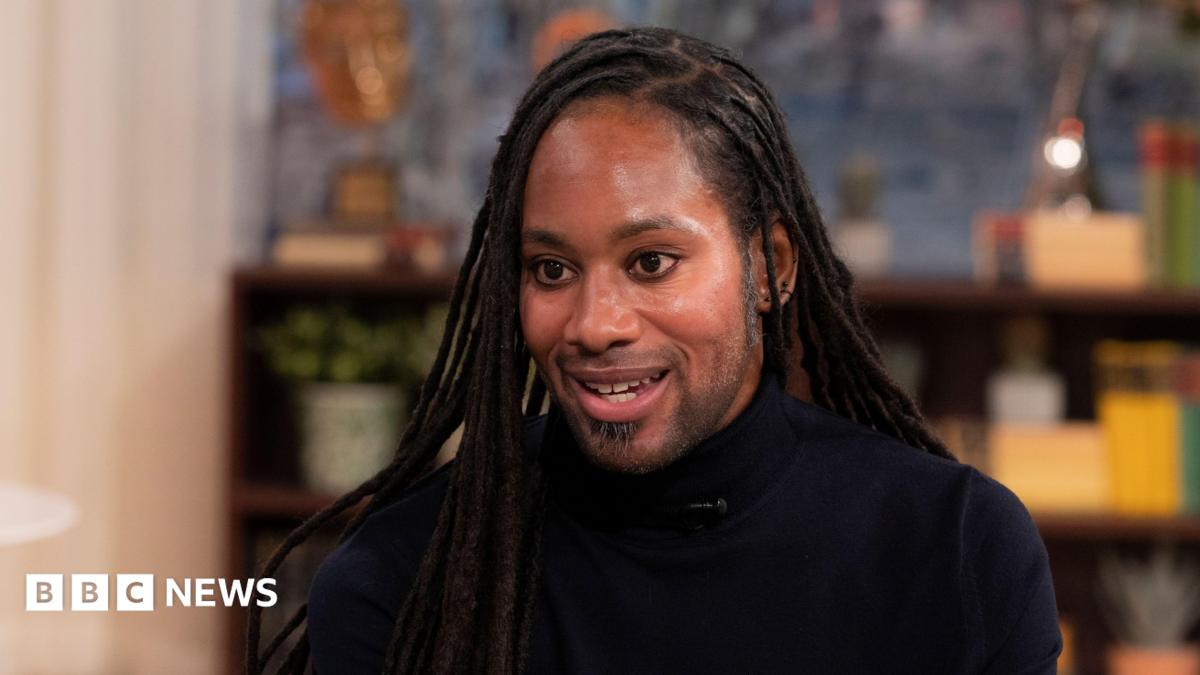
Jason Arday pictured during a TV interview in March 2023. He wears a black turtle-neck top.

Arday’s appointment as Cambridge’s youngest ever black professor at the age of 37 in 2023 was hailed at the time as a progressive moment.

Announcing his resignation last week, Arday said the “personal cost” of the scrutiny of him had become “too great”.

He said: “While criticism is an inevitable part of academic life, what I have experienced has gone far beyond scholarly disagreement.

“The relentless accusations, speculation and public commentary have taken a profound toll on me and on those I love.”

Advertisement

He stressed that his resignation should not “be mistaken for an acceptance of the narratives that have surrounded me”.

Cambridge initially said claims of plagiarism regarding Arday’s thesis and some journal publications had been investigated by Liverpool John Moores University (LJMU) and the journals in question.

LJMU – which awarded Arday his PhD in 2015 – concluded that he had not plagiarised work.

Earlier this week, Cambridge announced an independent investigation into his appointment.

Advertisement

In a letter to university staff at the time, Prof Prentice said: “I fully understand the concerns being raised across the university and well beyond it, regarding Jason Arday’s appointment and I share them…

“That investigation, as you say, should be thorough and transparent, and will be carried out independently by senior academics from within and beyond Cambridge.”

Cambridge celebrated Arday’s appointment as a young black professor, one of a tiny and visible majority in academia. Only one per cent of professors in UK universities are black, making each appointment hugely significant.

The university will have to answer bigger questions including about its duty of care after it put him into a very prominent position.

Advertisement

It may also find itself the lightning rod for anger from several different quarters, including those who feel Arday was persecuted publicly and those who question whether he should ever have been appointed.

Jolyon Maugham from campaign group Good Law Project said Arday’s death was “a tragedy”.

“I do not understand what the public interest was in continuing to hound him after he resigned as a professor and I do not understand what risk assessments media outlets did,” Maugham added.

Speaking to BBC Newsnight, Professor of Black Studies Kehinde Andrews and friend of Arday described him as “very down” after resigning from Cambridge.

Advertisement

“He was very upset. He felt that there was no way out. He effectively wasn’t leaving the house. He had lost a lost of weight,” Andrews said.

“There should be a wakeup call to just how bad black academics actually have it in academia,” he added.

Labour MP Bell Ribeiro-Addy told the programme “the idea that an academic would be dragged through this amount of media scrutiny is unheard of”.

Source link

Advertisement
Continue Reading

NewsBeat

Mystery surrounds man’s death after bones found in field, inquest hears

Published

on

Cambridgeshire Live

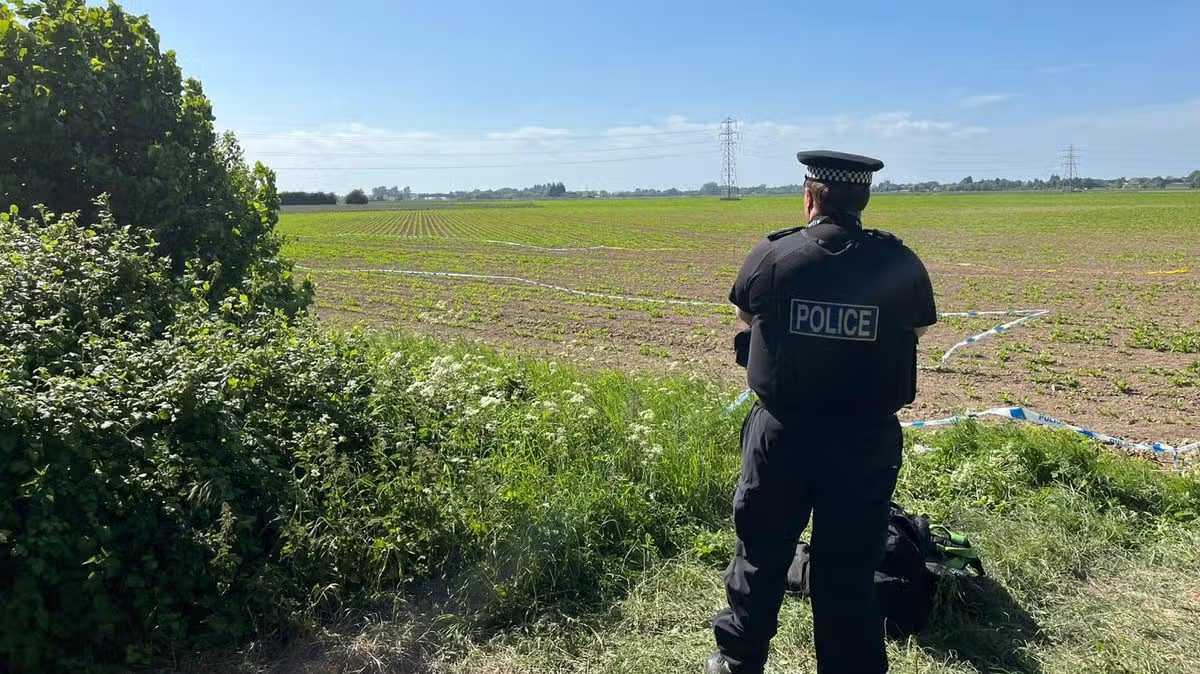
The bones of a 34-year-old man were found in a field by a member of the public in May 2025

Mystery remains around the cause of death of a man whose bones were found in a field last year, an inquest has heard. Human bones were found by a member of the public in a field off Lynn Road in Walton Highway, near Wisbech, on May 18, 2025.

The remains were confirmed to be Sergei Voitechovic, aged 34. An inquest was held at Norfolk Coroners Court in Norwich on Friday (August 14), and heard by Coroner Maeve Sykes.

The court heard from Detective Sergeant Melanie Reid from Norfolk Police that during investigations, police discovered Sergei was reported missing to Cambridgeshire Police in October 2018.

Advertisement

Sergei’s sister reported him missing, and said October 2018 was the last time she had heard from him. Sergei’s cause of death could not be confirmed due to the “significant amount of time passed” between Sergei’s disappearance in 2018 and the discovery of his bones on May 18, 2025.

Coroner Sykes concluded that Sergei’s death was “unascertained”, due to the time of when his bones were discovered.

DS Reid said there had “never been any suggestion” of a third party involvement in Sergei’s death. She added: “What cannot be established is how he died due to the time that has passed and the conditions of the remains.”

Advertisement

DS Reid told the court that the police could also not “identify [Sergei’s] last movements or contact [to people]” in the lead up to his death, due to the time passed. DS Reid added that his remains “may have been scattered by wildlife and further buried by farm machinery”.

However, the depth at which the remains were found did not signify to police that they had been “buried”.

Earlier in the inquest, the court heard a statement from Debbie Garrett, who discovered the bones on May 18. A statement read out in court on behalf of Ms Garrett heard that on March 1, 2025, as she was walking to a bus stop on Lynn Road, she noticed what seemed like a “diamond ring”, alongside other items including red roses, 10p coins and food items.

After seeing these items, she researched if they were of “significance” and she claimed that through her research, the type of items were linked to a “solar event”. The court heard how Ms Garrett continued to look at the spot where the items were found over a number of weeks.

Advertisement

Her statement claimed that “every three weeks – new items” would appear in the same spot. After speaking to her gardener about the items, the pair “speculated they were part of a cult offering”.

The court also heard that Ms Garrett claimed she could hear a “poorly played flute” coming from a similar area of the field every night, and she “linked this to the offerings”. DS Reid confirmed that the “offerings” found where Sergei’s remains were found were not linked to him.

On the day that Ms Garrett discovered the bones, she found a sock that was “full of bones”, which she believed to be human. A forensic report read out in court confirmed these to be Sergei’s left foot, which were found with rib, femur and vertebrae bones belonging to Sergei.

The court also heard evidence from the owner of Richardson’s Bambers, the field where the bones were found, an employee of the field owner and the owner of farm machinery that were contracted to plough and cultivate the field.

Advertisement

Evidence heard from the three men mentioned that there was a “person living in a tent” in a woodland near Lynn Road. However, there was no mention if this could have been Sergei. A statement read out on behalf of Freddie Gordon, an employee of the field owner, heard how he had worked for the owner since 2015.

During this time, his work was to “maintain” the field, including ploughing and cultivating it every year between September and November. In his statement, Mr Gordon said he had seen “jewellery and flowers” within the field on occasion.

The court heard that when Mr Gordon carried out his work, it required him to “remain vigilant and aware of surroundings”. He added that it was “unlikely he would miss anything”, such as the bones.

The court also heard how he remembers spotting an A4 letter, which was “sentimental in nature – possibly a love letter”. However, there was no link to Sergei mentioned in the inquest.

Advertisement

A statement of evidence was also read out on behalf of Sergei’s ex-partner Agatha. The court heard how the pair met at school in Lithuania in 2013, but broke up in 2014 when Agatha moved to the UK.

She was first contacted by Norfolk Police after a Ladbrokes card in her name had been found and it was “linked to an incident” concerning Sergei. The court heard how Sergei and Agatha had one biological child together, and another child that “Sergei considered his own”.

Agatha’s statement read that Sergei had a “drug and gambling addiction”, which resulted in Sergei accumulating at least £10,000 of debt in Agatha’s name. Due to Sergei’s addictions, Agatha separated from him in 2018.

The last time she heard from him was when he left her a voicemail stating he was “sorry”, but Agatha felt the call had “no emotion to it”. Sergei’s mother kept in “sporadic contact” with Agatha until 2021, as his mother was unable to get in contact with him. However, the contact between Agatha and Sergei’s mother ended.

Advertisement

Coroner Sykes gave a narrative conclusion in the inquest. She said: “Sergei Voitechovic had resided in the United Kingdon from 2015 until 2017 with periods in and out of the United Kingdom thereafter.

“He is confirmed to have returned to the United Kingdom on July 11, 2018. A missing person report was filed with Interpol shortly after and Interpol requested Cambridgeshire police assistance. Sergei remained a missing person and all police and family efforts to find him proved fruitless.

“On May 18, 2025, human bones, and a wallet were found at a field adjacent to Lynn Road, Walton Highway, Norfolk by a walker. Post-mortem testing confirmed that these belonged to Sergei Voitechovic. It was not possible to ascertain a cause of death.”

The inquest concluded with Coroner Sykes offering her condolences to the family and friends of Sergei.

Advertisement

Source link

Continue Reading

NewsBeat

Dad of two dies in third family tragedy after parents both lost their lives

Published

on

Wales Online

Jake Evans began drinking heavily when he lost both his parents within six months of each other aged 28. At his worst he was downing 20 large cans of lager every day, destroying his liver.

A sister has shared the heartache of losing her younger brother to alcohol addiction the day after his 30th birthday

Advertisement

Becky Hunt said her brother Jake Evans turned to drink to deal with bereavement himself after losing his parents within six months of each other two years ago.

Their mother Tracy Chere died aged 56 six months after being diagnosed with cancer in February 2024 and Jake’s father had died in late 2023. Sign up for our free daily briefing on the biggest issues facing the nation sign up to the Wales Matters newsletter here

Although Jake had drunk recreationally at weekends, like lots of people in their twenties, he had never been a heavy drinker until that “horrific loss”, said Becky.

Advertisement

Instead of dealing with his feelings she said her brother tried to bury them by getting drunk. Soon his drinking was out of his control.

At his worse, Jake was downing 20 cans of lager every day. Becky says he was never a violent or abusive alcoholic, just quietly destroyed his liver.

“He drank lager every day and always had a can in his hand to numb the pain from the moment he woke up.

“He never hurt or damaged a fly. He was the loveliest, warmest person and would do anything for anyone but I tried to get him to stop drinking and he said he couldn’t.”

Advertisement

Jake was drinking so heavily that in a short time he had liver damage and muscle wastage because he was not exercising or eating properly.

He was getting most of his calories from lager. The young father of two could not really walk properly and used a mobility scooter aged only 28.

This heavy drinking went on for a year until Jake fell so seriously ill he was taken to The Grange Hospital with jaundice and liver failure. Doctors warned him to stop drinking or his life could be at risk.

Advertisement

“That stint in hospital put the fear of God into him.

“That worried him as his liver was not good, but he had his young age on his side so he stopped drinking.”

Jake, whose children are aged eight and nine, managed to stay dry for 10 months and began to turn his life around.

He got help from drug and alcohol services and accepted he was blocking out trauma through misusing alcohol.

Advertisement

“He was engaging with services and was sober and doing really well. He was living in a clean flat and the mobility he had lost through making himself ill with drink, was coming back.”

Becky said all this all unravelled when Jake was attacked so badly in December 2025 that he was taken to hospital. This fresh trauma tipped him back into drinking heavily again, she believes.

Jake later give a statement to the police, Rebecca said, but no charges were brought. Now he is dead she fears her brother won’t ever get justice.

Resuming his heavy drinking Jake caused fatal damage to his already damaged liver. He passed away at The Grange Hospital, with multi organ failure and penumonia, the day after he turned 30 on July 26.

Advertisement

“I visited him every day in hospital. He was alert for a while but 48-hours before he died doctors sat us down. He was on oxygen, He had pneumonia and kidney and liver failure.

“There was nothing they could do so they stopped all treatment and kept him comfortable and he died at 3am the day after he was 30.”

Her voice cracking, Becky remembers her brother as a gentle 20-something who drank happily with friends some weekends, but never to extremes, until his parents died.

She is now raising funds for Jake’s funeral and hopes his story will raise awareness of alcohol addiction.

Advertisement

“His story is heartbreaking. Jake began drinking heavily after losing both of our parents within a six-month period.

“Despite everything he had been through, he managed to achieve 10 months of sobriety.

“Tragically, after being seriously attacked, he relapsed, and his health rapidly deteriorated. Alcohol addiction ultimately took his life, leaving behind two young children. “

While the whole family is grieving, they hope some good can come of sharing Jake’s story.

Advertisement

“As a family, we’re trying to give Jake the funeral he deserves while also raising enough money to leave something behind for his children.

“More importantly, we want to share his story to raise awareness of how devastating alcohol addiction can be, and how grief, trauma and relapse can have such tragic consequences.”

She said Jake leaves behind two devastated children and his loss has left an enormous hole in all of his family’s lives.

“Jake leaves behind two devastated children, a heartbroken sister, a brother, and a family who loved him beyond words. His loss has left an enormous hole in all of our lives.”

Advertisement

He died so young and so unexpectedly that they were not financially prepared for the cost of his funeral.

Becky has launched a Gofundme to raise money to cover Jake’s funeral cost and for money for his children. So far welllwishers have donated £1,835 of the £2,000 goal.

You can see the appeal here.

Source link

Advertisement
Continue Reading

NewsBeat

Andrew Mearns jailed after clients defrauded at Gmund Cars

Published

on

Andrew Mearns jailed after clients defrauded at Gmund Cars

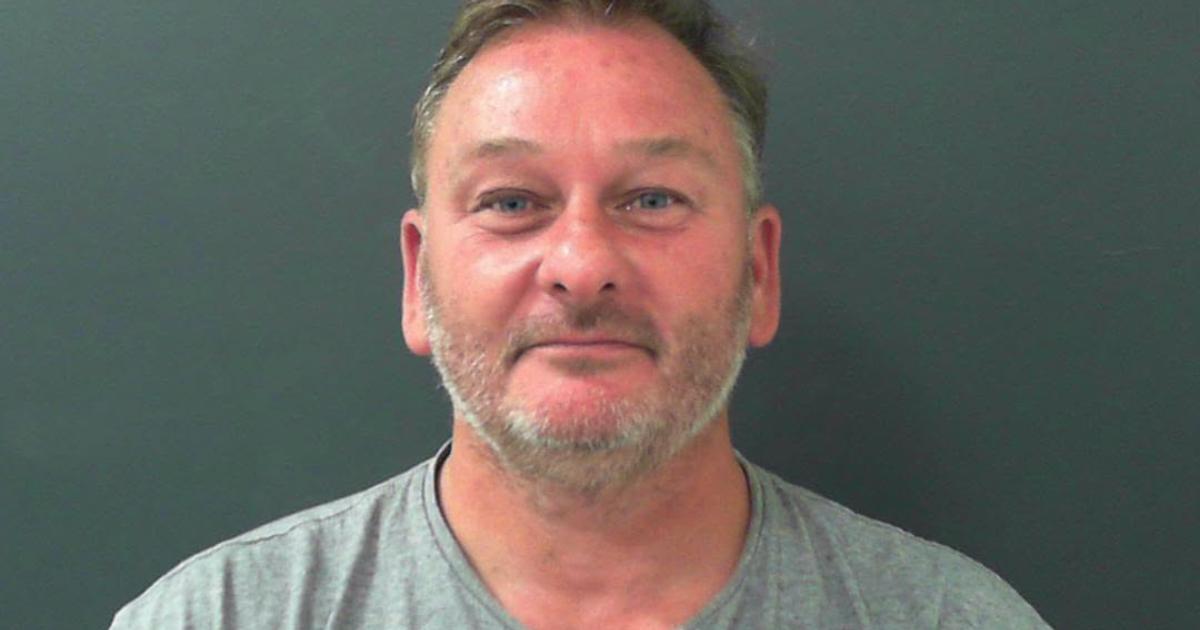
Andrew Mearns, 57, of Colwyn Place in Llandudno, was sentenced to two and a half years in prison at Sheffield Crown Court today (August 14, 2026) after pleading guilty to 14 counts of fraud.

The fraud took place while Mearns was a director at Gmund Cars Limited in Knaresborough – a high-value car dealership which specialised in the sale and modification of luxury vehicles, particularly Porsches.


RECOMMENDED READING:

Advertisement

Between December 2006 and July 2019, Mearns agreed to sell vehicles on behalf of clients on a commission, however he sold the cars and kept the proceeds for himself, leaving clients out of pocket.

Mearns’ crimes came to light after 14 separate reports were made between October 2017 and July 2019 – with police investigating ‘extensively’ for several years.

Police Staff Investigator Corrina Graham-Merrett from North Yorkshire Police said: “Mearns lied to his customers time and time again. Thankfully, his offending was brought to a stop, and we have worked tirelessly to secure evidence against him over many years.

“The financial and emotional impact on his victims has been nothing short of devastating, and will no doubt continue for them whilst civil cases are pursued to have vehicles repatriated. It is right that he now faces the consequences for his actions.

Advertisement

“This case delivers a firm warning: fraud will be met with zero tolerance in our communities. We will pursue those who exploit honest trust by ensuring that we hold them to account.”

Anyone who believes they have been a victim of fraud is encouraged to contact North Yorkshire Police on 101 or through the force’s website or by contacting Action Fraud at actionfraud.police.uk or by calling 0300 123 2040.

Source link

Advertisement
Continue Reading

NewsBeat

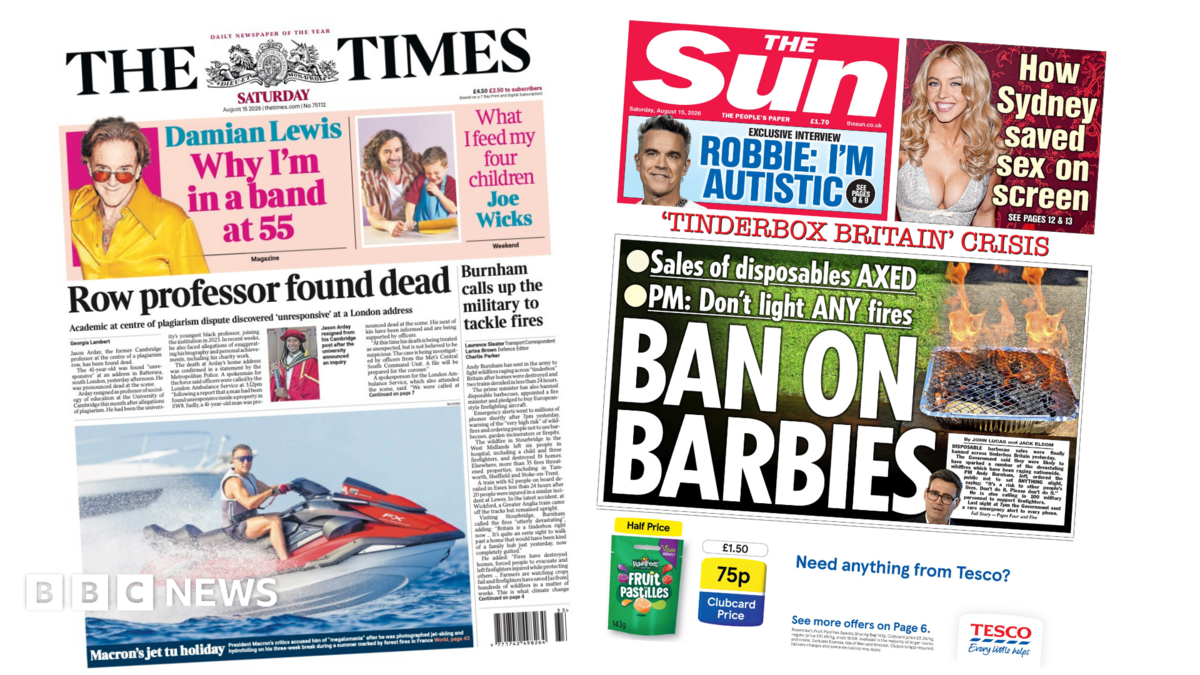
Newspaper headlines: ‘Row professor found dead’ and ‘barbie ban’

Published

on

"Row professor found dead" reads the headline on the front page of the Times.

At the top of the Times is the news that ex-Cambridge professor Jason Arday, who has been at the centre of a row in-part focused on accusations of plagiarism, has been found dead. The police have said his death is being treated as “unexpected, but is not believed to be suspicious”. Also on the front page, “Burnham calls up the military to tackle fires”.

Source link

Continue Reading

Trending

Copyright © 2025