
Crypto World
Why the Movements of a U.S. Oil Company in Greenland Have Sparked Concern


The President has repeatedly stated that the U.S. needs to acquire Greenland as a matter of “national security.” Greenland’s positioning between the U.S., Russia, and Europe makes it a strong geopolitical asset, and Trump has argued that Denmark cannot be relied upon to protect the island.
Ulrik Pram Gad, a senior researcher at the Danish Institute for International Studies, tells TIME that “the Greenlandic political system and authorities have actually been very resilient” in the face of the threats.
“They’ve been sticking to insisting that we will help America take care of its legitimate security concerns, but we don’t want to give away our self determination and our sovereignty,” he says.
Still, the topic has repeatedly returned to the forefront of U.S. political discussion.

Crypto World
Why the world’s second-largest Bitcoin mining power is shutting down rigs in its capital city


Crypto mining was banned in Moscow, the surrounding Moscow Region and parts of Kursk, with the restrictions set to run through Dec. 31, 2032.
The measure, established under government decree No. 936, also prohibits participation in crypto mining pools. The decree was signed on July 25 and published on July 31, local media reports.
Russia as a whole accounted for an estimated 175 exahashes per second, or 16.4% of Bitcoin’s global computing power, in the first quarter, according to Luxor’s Hashrate Index. That placed it second behind the U.S., although it’s unclear what capacity was located in the newly restricted region.
The country’s Energy Ministry said a year-round restriction was needed to reduce the risk of power-capacity shortages as energy-intensive mining facilities connect to regional grids. Mining currently consumes roughly 1 gigawatt in the Moscow power system, while the region’s data-center capacity could reach 3.6 GW, or 17% of peak demand, by 2032, Interfax reported after the decree was first signed.
Mining is also linked to the country’s Western sanctions.
Russian companies had been using domestically mined bitcoin in international payments after legal changes designed to counter Western restrictions, Finance Minister Anton Siluanov said in December 2024.


Tudor Investment, founded by billionaire investor Paul Tudor Jones, increased its direct stake in BlackRock’s spot bitcoin ETF in the second quarter while cutting its reported call option position in the fund by 85%.
The firm held 688,529 shares of the iShares Bitcoin Trust ETF (IBIT), valued at $22.9 million as of June 30, according to a 13F filing on Friday.
The share count rose by 109,446, or 18.9%, from 579,083 at the end of March. The holdings are now worth around $24.5 million.
Tudor also reported calls tied to 148,000 underlying IBIT shares, down 85.2% from 998,000 in March. Its put position edged down 1.4% to 715,000 underlying shares from 725,000, according to the filings.
The filing does not disclose the options’ strike prices or expiration dates, so the underlying share counts do not provide a direct measure of Tudor’s directional exposure. And the derivatives positionings are likely a hedging mechanism for its bitcoin bets.
Tudor first disclosed 869,565 IBIT shares in mid-2024 and increased the position to 8.05 million shares, worth $427 million by year-end. It then cut the stake in every quarter of 2025, ending December with 576,523 shares.

Bitcoin’s next major move could be shaped by a seasonal pattern, according to Swan Bitcoin CEO Cory Klippsten. Speaking to Cointelegraph, Klippsten suggested that BTC may form a bottom in October before staging a recovery toward roughly $130,000 ahead of the 2028 halving.
Klippsten’s framing also includes a potentially painful downside scenario: in his view, Bitcoin could drop to the $57,000 area—or even as low as $53,000—before any rebound. At the same time, other market analysts are watching for signs of an earlier bear-market bottom, pointing to an August threshold based on monthly closes.
Key takeaways
- Klippsten expects Bitcoin could bottom in October after a peak above $126,000 in early October 2025, then recover toward about $130,000 before the 2028 halving.
- In his downside scenario, BTC may fall to around $57,000 or even $53,000 before a “quick recovery.”
- Klippsten argues long-term holder accumulation could shift timing earlier than past cycles, referencing a record share of supply held by long-term investors.
- Markus Thielen of 10x Research says a bear-market bottom could be confirmed in August if Bitcoin posts a monthly close above $63,000.
- Klippsten believes altcoins are unlikely to compete with Bitcoin as “money,” while noting that centralized crypto firms may ultimately be pulled under traditional finance regulation.
Why October is on the table for Bitcoin’s “cycle bottom”
Klippsten’s October call is rooted in what he says is a recurring timeline across prior bull-market peaks. He argued that Bitcoin has tended to bottom roughly 12 months after each previous bull-market top. However, he also warned that relying on only a handful of completed cycles is risky—implying investors should treat this as a hypothesis rather than a guaranteed schedule.
The timing he referenced is anchored to BTC’s performance in early October 2025, when Bitcoin reportedly peaked above $126,000. From that peak, Klippsten’s expectation is that the market should bottom in October, followed by recovery into the next phase of the broader cycle.
Importantly, Klippsten’s view is not simply “up from here.” He also pointed to a possible deeper drawdown before a rebound, saying Bitcoin could fall to about $57,000 or potentially $53,000—suggesting that any October bottom would likely arrive after further weakness rather than immediately.
Holder accumulation and the possibility of earlier bottoms
Klippsten’s September-to-October thesis builds on an earlier argument he made in a June conversation with Cointelegraph. In that earlier interview, he suggested BTC might bottom earlier than in past cycles if long-term holders continue accumulating record levels of supply.
Cointelegraph previously reported that Klippsten tied the idea to “record” long-term holder participation, citing 14.7 million BTC as a share held by long-term investors. In the latest discussion, he maintained the idea that accumulation could influence the timing of a bottom—one reason why other analysts may be looking at earlier confirmations than October.
The practical takeaway for market participants is that timing indicators may depend on whether distribution versus accumulation dominates during the downturn. If long-term holders continue to absorb supply, the market could transition faster than a strict historical average would suggest—though Klippsten’s range still includes a potential late-cycle risk floor around the low-$50,000s.
Other analysts target August with a simple monthly signal
While Klippsten focused on October, not every analyst agrees on the month. Markus Thielen, founder of 10x Research, told Cointelegraph that Bitcoin could confirm a bear-market bottom in August if BTC achieves a monthly close above $63,000.
Thielen’s argument is tied to how certain cycle indicators react to key trend confirmations. According to Cointelegraph, a successful August close above $63,000 would turn several of 10x Research’s indicators bullish—essentially framing $63,000 not just as a number to watch, but as a trigger that could change the model’s stance on the market’s trend.
For investors, the difference between “October likely” and “August possible” is more than calendar trivia. It can affect how people manage exposure during drawdowns, how they interpret risk levels, and how quickly they expect liquidity to return. Until BTC clarifies its direction through those month-end thresholds, any month-by-month bottom narrative remains conditional.
Klippsten’s take on altcoins: fewer bets, more regulation
Beyond timing, Klippsten argued that altcoins are losing their credibility as alternatives to Bitcoin as a medium of value. He described them as “basically dead” as competitors to Bitcoin as money and said the “best outcome” for crypto and decentralized finance would be integration into traditional finance—what he referred to as “TradFi.”
Asked about altcoins that may still outperform, he pointed to Hyperliquid as an example of a centralized business that could eventually be treated like part of the traditional financial system. In a quote carried by Cointelegraph, Klippsten said that if a centralized business has a token, regulators and traditional finance may eventually absorb it, viewing it as an exchange and a bank.
That view aligns with how some market observers are interpreting institutional involvement: regulatory pressure and compliance frameworks could determine which crypto products survive and how tokens are structured. Even when an altcoin sees strong traction, the question becomes whether it can evolve into something that fits existing regulatory categories.
Hyperliquid has recently attracted measurable attention on-chain and in DeFi revenue rankings. Cointelegraph cited DefiLlama data showing Hyperliquid generated $5.9 million in revenue during the past week and ranked as the industry’s fifth-largest DeFi protocol by weekly revenue. Cointelegraph also reported that the Hyperliquid HYPE token was up 130% year-to-date, while Bitcoin fell 28% over the same period, according to TradingView.
At the same time, Cointelegraph included a separate perspective from market maker Wintermute. In a July report, Wintermute argued that institutional participation has narrowed altcoin rallies. The firm said liquidity tends to concentrate in assets that institutions favor, while activity across crypto’s “long tail” weakens—suggesting that “altseason” dynamics may be changing from broad-based rotations into more selective bursts.
What to watch next: bottoms versus triggers, not narratives
Whether Bitcoin bottoms in August or October, the most actionable signal may be confirmation through month-end levels and follow-through after sharp selloffs—especially if long-term holder accumulation continues to provide structural support. Separately, Klippsten’s warnings about altcoins “as money” raise a distinct question for traders and builders: will performance continue to be driven by liquidity and token incentives, or will regulation and institutional frameworks progressively reshape what survives in practice?
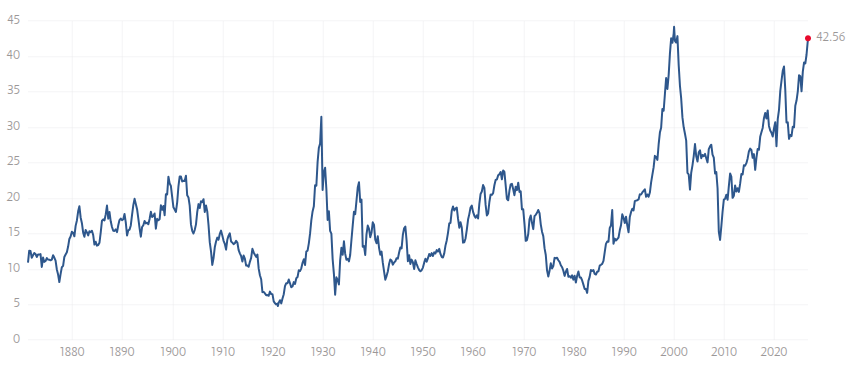
The Shiller CAPE ratio for the S&P 500 sits near 40 to 42, approaching the record of roughly 44 set during the late-1990s dot-com bubble.
That reading places equity valuations in rare territory, and Bitcoin holders have reason to pay attention.
What the CAPE Ratio Actually Measures
The cyclically adjusted price-to-earnings ratio, or CAPE, divides an index by the ten-year average of inflation-adjusted earnings. Nobel laureate Robert Shiller developed it to smooth short-term distortions.
The method matters for interpretation. Using a decade of earnings filters out temporary booms and recessions, offering a longer view than conventional multiples.
History provides an uncomfortable pattern. When the ratio remained above 30 for sustained periods, subsequent 10-year real returns for US equities were modest or negative.
Two peaks stand out particularly. Both 1929 and 2000 preceded significant market declines, though the timing varied considerably in each case.
Follow us on X to get the latest news as it happens.

Current levels rank second only to the tech bubble. No other period in the series shows valuations stretched to this degree. An important caveat applies, however. Expensive markets can remain expensive for years, so the ratio functions poorly as a timing signal.
What it does indicate is probability. Elevated readings raise the odds of lower future returns and greater downside risk if earnings growth or liquidity disappoint.
The Two Competing Cases for Bitcoin
Bitcoin’s relationship to that backdrop is genuinely nuanced. Recent cycles show the asset behaving as a high-beta, risk-on instrument alongside technology stocks.
Correlation data support that pattern. Previous risk-off episodes saw Bitcoin fall in tandem with equities rather than serving as a shelter from them.
The near-term implication follows logically. A sharp correction driven by stretched valuations could pressure Bitcoin as investors reduce speculative exposure. A competing narrative pulls in the other direction. Bitcoin also carries a digital gold framing, positioning it as an alternative store of value.
That thesis gains traction under specific conditions. Persistently high equity valuations, combined with elevated public debt, can push capital toward scarce, uncorrelated assets.
Historical precedent offers partial support. Some periods of equity stress coincided with Bitcoin outperformance, though typically after the initial risk-off phase passed.
The Ratio Is Not a Forecast
Several variables will determine which pattern dominates. Interest rate paths, the durability of AI-driven earnings growth, and global liquidity conditions all matter.
Bitcoin’s own metrics add another layer. On-chain activity and institutional adoption trends could decouple the asset from equity movements or reinforce the link. The dual identity explains the uncertainty.
Bitcoin functions simultaneously as a speculative risk asset and a potential monetary alternative, leaving room for divergent outcomes.
Treating the ratio as a forecast would be a mistake. High CAPE levels form part of the backdrop rather than dictating any particular price path. Market regimes shift more often than models assume. Correlations that held through recent cycles may not persist through the next one.

The practical takeaway favors caution over conviction. Elevated valuations point toward more modest equity returns ahead, with Bitcoin facing both correlation risk and longer-term opportunity.
Neither scenario is guaranteed. The ratio belongs in a broader framework alongside liquidity, adoption, and rate expectations rather than standing alone.
Subscribe to our YouTube channel to watch leaders and journalists provide expert insights.
The post Wall Street Only Looked Like This in 1929 and 2000: What It Means for Bitcoin? appeared first on BeInCrypto.

US President Donald Trump will reportedly attend a high-profile gathering at the White House next week, as Washington’s efforts to establish a comprehensive digital asset framework remain unfinished.
Some of the key industry participants expected at the event will come from Ripple, Coinbase, Chainlink, Paradigm, Kalshi, and a16z.
White House Crypto Meeting
The meeting, scheduled to take place on August 19, will bring some of the most influential US-based crypto companies together with the heads of the two agencies that could ultimately divide responsibility for overseeing the market. Reports claimed that execs from TradFi entities could also participate, but there’s no official confirmation on the list of attendees.
More recent updates from popular journalist Eleanor Terrett confirmed that SEC Chair Paul Atkins is expected to attend as well.
The event’s timing is quite notable as it comes just a few weeks after the Senate left Washington for its five-week August recess without voting on the CLARITY Act. As reported in early August, the key bill faced another setback, and Senate Majority Leader John Thune filed cloture on the motion to be voted on September 15 – the second day after the break.
The legislation seeks to establish a comprehensive federal framework for cryptocurrencies, including defining when tokens should be treated as securities or commodities and clarifying the respective responsibilities of the SEC and the CFTC. However, senators failed to resolve several outstanding disagreements before leaving Washington.
Those include ethics provisions, anti-money laundering safeguards, and the controversial question of whether digital asset companies should be allowed to offer rewards on customers’ stablecoin holdings. The last part has drawn considerable backlash from the banking industry, which argues that such products could pull deposits away from traditional lenders.
Focus on September 15
Although the August 19 meeting is unlikely to resolve any of the aforementioned issues and the Senate’s vote-counting problem by itself, it’s still expected to be a major first step in the right direction after the talks stalled. The odds of an actual bill approval this year continue to decline. Lobbyists and policy experts believe the passage won’t go through this year.
However, bringing the White House and essentially all parties involved together less than a month before the aforementioned September 15 Senate vote makes the timing difficult to ignore. The Trump administration continues to push for the bill to pass as soon as possible, but the upcoming midterm elections cast another dark shadow.
The post Trump to Meet Ripple, Coinbase, SEC, and CFTC Leaders as CLARITY Act Hangs in Balance appeared first on CryptoPotato.


In the first six months of 2026, the crypto industry raised $11.2 billion. Not one dollar of it went to the permissionless, ungoverned experiments that digital assets were supposed to be built on.
“There is an irony at the heart of crypto, and it took an $11.2 billion dataset to make it obvious,” said Dubai-based crypto lawyer Irina Heaver, founder of NeosLegal. “The industry was born on a single promise: permissionless. Money and markets that answer to no gatekeeper.”
Heaver and her team gathered data that might, as he put it, indicate that “crypto’s permissionless era is over.”
NeosLegal tracked every disclosed crypto funding round between January and June 2026. A total of 377 financing rounds took place, Heaver said via Telegram. The top three sectors by capital raised were payments and stablecoins at $3.7 billion, prediction markets at $2 billion and crypto exchanges and trading platforms at $1.7 billion. All three require regulatory approval to operate, she noted.
“The money has stopped chasing permissionless,” Heaver said. “It is chasing regulated businesses now.”
Prediction markets took point
Prediction markets drove the point. Kalshi raised $1 billion in May in a round that included Sequoia Capital, Morgan Stanley, Ark Invest, and Andreessen Horowitz (a16z), among others. Polymarket raised $600 million from Intercontinental Exchange (ICE), the company that owns the New York Stock Exchange (NYSE). Prediction markets pulled in capital in every single month of the first half of 2026 — a total of 34 rounds in six months, she added.

Predictions that Bitcoin could hit $1 million by 2030 are drawing fresh skepticism from industry research chief Markus Thielen, head of research at 10x Research. In an interview with Cointelegraph, Thielen argued that the forecast is not just ambitious—it is mathematically inconsistent with how much capital markets would need to add in a short time to lift Bitcoin’s price to that level.
Thielen’s core claim is straightforward: the capital inflows required to support a $1 million per-coin target would need to be far larger than anything Bitcoin has historically attracted during comparable periods. He also warned that even if Bitcoin continues to rebound from cycle lows, investors may be underestimating how much time and liquidity it typically takes to push prices to new highs once the asset’s market capitalization grows.
Key takeaways
- Markus Thielen says a $1 million Bitcoin by 2030 “doesn’t add up” mathematically, based on historical capital inflow comparisons.
- He estimates Bitcoin would need roughly $15 trillion in additional capital to reach a $1 million price per BTC, assuming current supply and valuation logic.
- Thielen argues that because Bitcoin is already valued at over $1 trillion, major price moves require “trillions” rather than smaller inflow waves.
- He cautions that retail investors’ expectations may be distorted by round-number narratives—and that a rapid return to extreme highs may be unlikely.
- Industry figures including Brian Armstrong, Jack Dorsey, and Cathie Wood have publicly endorsed $1 million-style targets, which Thielen views as media-friendly but potentially harmful.
Why Thielen challenges the $1 million-by-2030 math
Thielen’s argument begins with the relationship between Bitcoin’s market value and the scale of new money needed to change its price meaningfully. At the time of the interview, Bitcoin’s market capitalization was around $1.28 trillion, with the BTC price reported at $63,868, according to CoinMarketCap.
Against that baseline, Thielen estimated that achieving a $1 million per Bitcoin outcome would require another approximately $15 trillion in capital entering Bitcoin. In his view, that total is not a minor extension of prior years’ trends, but a large step beyond what has historically been seen.
He referenced Bitcoin’s earlier development period as context, noting that inflows large enough to lift the overall market capitalization by orders of magnitude have still fallen far short of what would be necessary for the next phase of growth implied by a $1 million target. Thielen summarized the difference as a gap between what the asset has historically attracted and what would be required over roughly the next four years to reach the per-coin valuation that the prediction implies.
Thielen described the resulting conclusion in absolute terms: reaching that price level, in his assessment, is “mathematically impossible.” While he did not claim a regulatory or technical barrier, his reasoning hinges on liquidity and capital requirements—how much incremental demand must show up for a large, already-established asset to move much higher.
“It would require trillions”: market cap and the liquidity problem
A key part of Thielen’s critique is about scale. As Bitcoin’s market capitalization increases, the same size of purchasing does not translate to the same percentage price move. In the interview, he argued that materially higher prices generally require materially larger inflows—especially once the market is already measured in trillions.
That is why, in his view, claims that Bitcoin can simply “continue its trajectory” underestimate the money needed at higher levels. Thielen’s framing suggests that even if investors remain bullish over the long run, the pace may look different than optimistic price charts imply.
He also tied the expected difficulty of sustained upside to investor psychology. Thielen said that as Bitcoin’s price rises, retail sentiment can weaken because many buyers appear to prefer owning a whole unit of Bitcoin rather than fractions. He described a scenario where some people reconsider participation when they feel the effort required to buy even one BTC becomes comparable to other life goals—such as saving for a car—rather than remaining a straightforward investment purchase.
In that sense, Thielen is not arguing that adoption disappears. He is pointing to a specific friction: the higher Bitcoin goes, the more the “one Bitcoin” mental benchmark can become a psychological barrier, potentially dampening some marginal retail demand.
Cycle expectations: don’t assume next year will rewrite the record
Thielen urged Bitcoiners not to treat previous cycle rebounds as a guarantee of similarly fast upside after major highs. He argued that in earlier cycles, price recovery took time partly because Bitcoin reached a higher market capitalization than before—meaning pushing it higher becomes increasingly capital-intensive.
He suggested investors should not assume that new all-time highs will arrive immediately. While he did not rule out strong performance, he implied that the timeline may stretch longer than those expecting a fast re-test of the peak would like.
Thielen specifically cautioned that the $126,000 all-time high may not reappear quickly. Asked about the possibility of reaching $100,000, he characterized a move back to that level as a “big, big achievement,” even if it does not necessarily equate to a full cycle of record-breaking behavior.
The underlying message is that while Bitcoin historically has recovered after declines, the effort required to reach substantially higher valuations changes as the asset’s size increases—both in terms of liquidity and market dynamics.
The executives behind $1 million: attention versus outcomes
The $1 million prediction has not been limited to anonymous online commentary. Thielen pointed to public forecasts made by prominent industry figures, including Coinbase CEO Brian Armstrong, former Twitter CEO Jack Dorsey, and ARK Invest CEO Cathie Wood.
Thielen’s critique focused on the incentives behind such statements. He argued that round numbers—especially large targets that attract media coverage—are more likely to be quoted widely. He characterized these forecasts as an easy way for executives to generate attention, even if the implied assumptions about future liquidity are unrealistic.
According to Thielen, the harm is not limited to academic debate. He warned that aggressive price targets can influence retail behavior by encouraging expectations of large, quick profits. In his view, if even a forecast is “halfway right,” some participants may assume the upside automatically translates into exceptional gains—an assumption he said can lead to disappointment or overconfidence.
Thielen did not present his stance as a call for pessimism. He argued that sentiment has often already become optimistic early in the year, while a more conservative approach can be the better strategy for risk management and expectation-setting. When Cointelegraph asked him what year Bitcoiners might reasonably expect $1 million, he avoided a direct prediction but reiterated that the number is extremely high.
“It would require, you know, a major credit event, implosion of everything.”
For readers following Bitcoin’s longer-term narrative, that quote points to Thielen’s view that a $1 million scenario likely depends on extraordinary macro conditions rather than “business as usual.”
For the market, the key question now is whether the next phase of Bitcoin growth is driven by sustained, large-scale capital inflows—or whether Thielen’s liquidity-based critique better reflects how price responds as Bitcoin’s valuation grows. Investors watching this debate should focus less on attention-grabbing round numbers and more on the pace and magnitude of new demand relative to Bitcoin’s already-large market capitalization.


Tether CEO Paolo Ardoino says the company is not building a Tether blockchain and has no plans to launch one, rejecting a widely shared analysis that put the stablecoin issuer inside a $1 billion race.
Ardoino posted the Tether denial on Saturday, one day after CoinMarketCap published research on so-called stablechains. Those networks exist for one job, moving digital dollars cheaply.
Why the Tether Blockchain Claim Took Off
The research grouped Tether with Stripe and Circle. It argued that all three want to own the rails their tokens ride on, and that they have together raised more than $1 billion for the effort.
Stripe leads that group with Tempo, a payments chain that already handles stablecoin payments for DoorDash couriers. Circle follows with Arc, a network aimed at institutional settlement.
Tether looked like the third member because it has backed Plasma and Stable, two separate stablecoin chains. Stable targets institutions and uses USDT to pay network fees. Plasma courts retail users and raised roughly $373 million in a token sale.
However, funding a network is not the same as running one. Ardoino drew that line himself.
USDT Stays on Rails It Does Not Own
Therefore, Tether keeps USDT moving across networks it does not control. Tron and Ethereum still carry most of the supply, and the company has leaned on that reach for years.
That choice carries a bill. USDT holders pay roughly $2.9 billion a year in fees to outside chains, according to CoinMarketCap research. A proprietary chain would capture that revenue for Tether instead.
Consequently, the denial reads as a deliberate trade. Tether gives up toll revenue and keeps distribution, which remains its strongest asset against every challenger.
Meanwhile, the agnostic route buys something a private chain cannot. It keeps the $183 billion USDT market cap liquid across dozens of venues at once.
It also lets Tether act quickly when regulators call, as it did when it froze USDT on Tron alongside the US Office of Foreign Assets Control (OFAC).
Competitive pressure keeps building, though. Circle is winning key national markets with USDC, and Europe squeezed USDT out after Revolut delisted the token under MiCA, the European Union’s crypto rulebook. Tether answered on trust instead, landing its first clean KPMG audit this month.
The post Tether CEO Shuts Down Blockchain Rumors appeared first on BeInCrypto.

Eli Lilly (LLY) is the Big Cap 20 component in focus this week, as the stock trades just below an entry point from a flat base. Investors should be on the lookout for a heavy volume move into the buy zone. Lilly stock has a best-possible Composite Rating of 99, boosted by strong year-over-year growth in earnings and sales, stemming partially…
Copyright ©2026 Investor’s Business Daily, LLC. All rights reserved. 87990cbe856818d5eddac44c7b1cdeb8

Which ETFs Will Pay Off Soon? Follow The Money!

Anya Taylor-Joy’s Luck Refuses to Run Out on the Streaming Charts

Mayor of London says Cambridge University professor Jason Arday died after facing ‘campaign of abuse’

Elon Musk Predicts AI Will Make Up 99 Percent of SpaceX Value Within Five Years


-

 Fashion22 hours ago
Weekend Open Thread: Ann Taylor
-

 Business6 days ago
Datadog: Best Of Breed For Multiple Reasons
-

 Business7 days ago
How to Start a Cleaning Business: A Step-by-Step Guide
-

 Business7 days ago
BDC Weekly Review: Private BDC Q2 Numbers Are Strong
-
 NewsBeat4 days ago
Communication cards help banking customers access services or report scams
-
 Business5 days ago
Oil Price Today (August 11): Crude oil rises to $88 after Trump’s compensation demand dents Hormuz opening. Here’s why
-
 Crypto World5 days ago
Why Did Nvidia Stock Fall on Monday Despite a $500 Billion Wall Street AI Deal?
-

 Politics7 days ago
Be quiet, Miriam! – spiked
-

 Fashion6 days ago
Amazon Sundays: Closet Care Before Fall
-
 Entertainment7 days ago
Will Ferrell’s New Netflix Series Just Became One of the Streamer’s Biggest Hits of 2026
-

 Business6 days ago
5 Things You Must Know About Jorge Messi, the Father and Longtime Agent Who Shaped Lionel Messi’s Career
-

 Politics6 days ago
Ben-Gvir’s crocodile project halted but abuses at Ketziot Prison continue
-

 Crypto World5 days ago
Revolut wins French banking licence, creates second EU banking hub
-

 Politics6 days ago
The Church of England’s ruinous reparations racket
-

 Politics6 days ago
Saudi Arabia used 86% of missile stockpile defending Iran attacks
-
 NewsBeat9 hours ago
Myanmar says over 300,000 Rohingya refugees verified for repatriation as exodus enters ninth year
-

 Politics6 days ago
The House Article | Burnham still needs to sell devolution to the public
-

 Politics6 days ago
What’s An EDT? The Rise Of ‘Extreme Day Trips’ As A Travel Trend
-
 Crypto World6 days ago
USDC and USDT Now Own 84% of Crypto Card Spend as the Euro Retreats
-

 Fashion5 days ago
Can You Wear Double Cloth Gauze Clothing To Your Office?
You must be logged in to post a comment Login