
CryptoCurrency
Why Should Your Crypto Wallet Development Add Perpetual Trading with Hyperliquid?

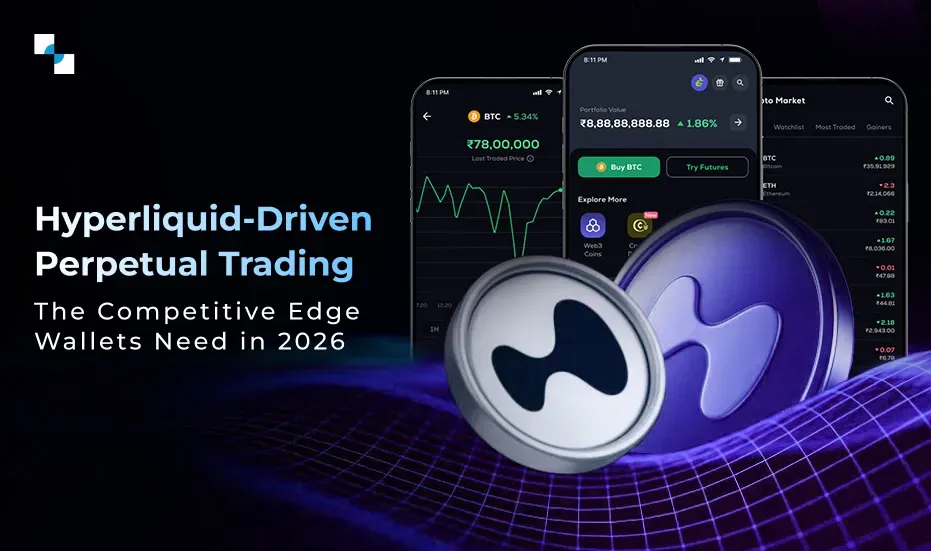
Perpetual contracts are where crypto trading volume lives today. Crypto wallet development solutions that remain simple vaults will miss a major revenue and engagement opportunity. By embedding Hyperliquid-powered perpetual trading inside a wallet, product teams can deliver near-exchange performance in a transparent on-chain model, capture trading fees, and convert passive holders into active traders. For enterprise wallets and enterprises with neo-banking solutions, this is a strategic product extension that signals maturity, attracts professional users, and unlocks new monetization channels.
Market Hype of Perpetual Trading In 2026 & Beyond
Perpetual futures dominated derivatives growth from 2023 to 2025 and continued to expand as the decentralized trading infrastructure matured. Approximately 75% of all cryptocurrency transactions are perpetual futures, up from 72% in 2024. On-chain perpetual venues reported explosive year-over-year volume growth and rising open interest as traders sought leverage, lower spreads, and transparency. Institutional custody and on-chain market-making models have increased liquidity depth on DEX-style perpetuals, encouraging cryptocurrency wallet development solutions to add native perp access instead of redirecting users to exchanges. These trends mean that wallets integrating perpetual trading are now positioned to capture both retail and institutional flows and participate in a market driven by network effects.
What is Hyperliquid-Backed Perpetual Trading?
Hyperliquid is a layer-1 protocol and perpetual trading stack built specifically for on-chain perpetual futures. It uses a fully on-chain order book and Hyperliquidity Provider vaults that protocolically provide market-making and liquidation capacity. The HLP model lets liquidity providers pool capital into vaults that automatically back trades and share fee revenue. Hyperliquid’s design focuses on low-latency matching, high throughput, and transparent on-chain settlement so blockchain wallet apps can deliver exchange-like execution while keeping trade records auditable on-chain. For product teams this translates to a composable trading layer that connects directly to wallet apps.
Features of a Crypto Wallet With Perpetual Trading Backed by Hyperliquid
Below are some must-have crypto wallet development feature statements you should implement before launching a production perp wallet.
- On-chain order book integration and signed order submission.
- Margin account ledger with collateral types, deposit, and withdrawal flows.
- Position lifecycle management that writes trades, funding events, and liquidations on-chain.
- HLP vault UX for deposit, withdrawal, APY display, and fee distribution accounting.
- Order types: market, limit, stop-loss, take-profit, and conditional OCO orders.
- Leverage controls and per-cohort maximum leverage configuration.
- Real-time mark price, funding rate, unrealized and realized P&L, and precise liquidation price.
- Automated margin management: manual top-up, auto-top-up, and partial close policies.
- Multi-chain bridging and token routing for collateral provisioning.
- Audit trail links and transaction explorer integration for every trade event.
- Smart contract safeguards: verified contracts, upgradable governance with time locks, and multi-sig admin controls.
- Admin console: market configuration, KYC gating, trading limits, and emergency circuit breakers.
- Monitoring and observability: OI, funding analytics, slippage metrics, HLP utilization, and alerting.
- Mobile-first UI with push notifications for margin and liquidation events.
Why Build Crypto Wallets with Perpetual Trading Backed By Hyperliquid?
Curious how a Web3 crypto wallet platform moves beyond basic custody into a fully composable trading environment? In this piece we walk through the protocol primitives, integration surface, and market signals that teams must understand before committing to Hyperliquid.
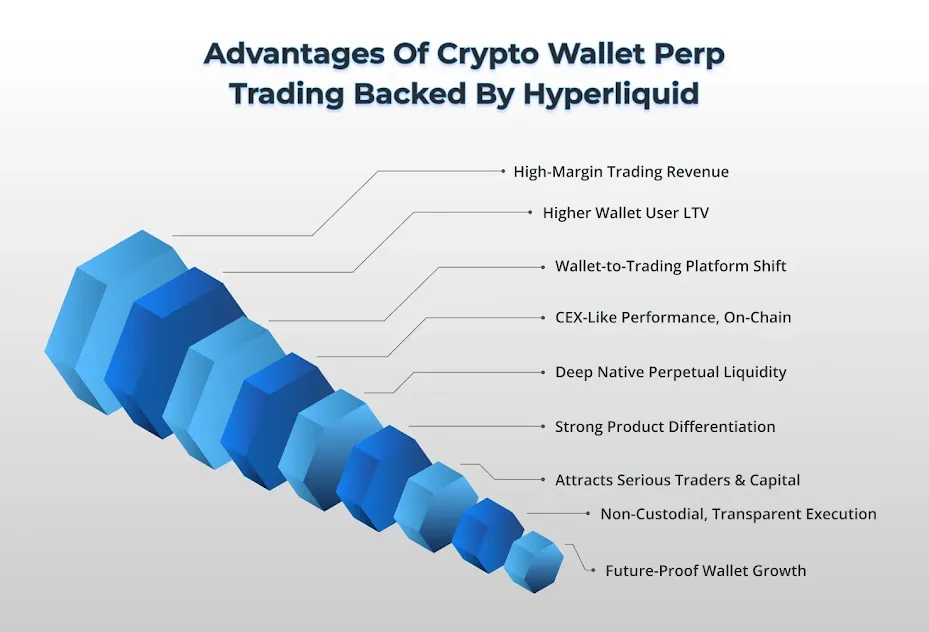
1. Capture a high-margin revenue stream from trading fees and spreads. Perpetual trading volumes are orders of magnitude larger than simple transfers, so even low take-rates produce meaningful revenue.
2. Boost user lifetime value through daily engagement and trading stickiness. Traders log in, deposit, and trade regularly, increasing retention and cross-sell potential.
3. Offer exchange-like performance while preserving on-chain transparency. Hyperliquid provides low-latency matching with settlement on-chain, combining speed with auditable records.
4. Reduce custody complexity if you prefer non-custodial flows. On-chain order signing keeps private keys with users while enabling trade execution via the protocol.
5. Add a liquidity product for passive users via HLP vaults. Non-traders can deposit into HLPs to earn fee income, turning dormant balances into productive capital.
6. Differentiate your wallet in a crowded market. Perpetuals are a premium feature set that signals maturity and attracts professional users.
7. Strengthen enterprise and institutional interest. Offering derivatives access and risk controls is a prerequisite for many institutional wallet partners.
Execution separates strategy from product. If you are planning to launch faster in the market, then building a white label crypto wallet, rigorous engineering and regulatory clarity are the levers that turn an integration plan into a launch-ready capability. Reach out when you are ready to translate architecture into production.
Launch A Web3 Wallet With Perp Trading For Exchange Like Functionality
How Does the Process Work Inside a Crypto Wallet?
A blockchain crypto wallet with Hyperliquid-backed perp trading keeps the entire trading journey inside the app. A user deposits collateral to a margin account, and the wallet builds and signs on-chain order messages. Orders are posted to Hyperliquid’s on-chain order book, where matching occurs. If a natural counterparty is not available, the HLP vault takes the opposite side to guarantee execution and tighten spreads. Funding payments, mark prices, and liquidations are processed on-chain, so every action is recorded and verifiable. The wallet monitors margin ratios continuously and displays real-time PnL, liquidation price, and maintenance margin. When thresholds are breached, the wallet prompts the user with top-up options or executes partial close rules. Non-traders can interact with HLP deposits to earn yields, while power users can access limit, stop, and take-profit orders. This unified flow eliminates context switching, preserves custody choices, and surfaces both trading and liquidity products in one place.
How to Build a Crypto Wallet With Perp Trading Powered By Hyperliquid in 8 Steps?
Step 1: Product strategy and market fit analysis
Define target cohorts, forecast per-user trading volumes, and set realistic take-rate and revenue goals. Run interviews with power users and 3rd-party market makers to validate HLP economics.
Step 2: Choose custody and settlement architecture
Decide on a non-custodial, hybrid, or custodial model. Map where private keys live, how signed orders are transmitted, and how fiat rails are handled for margin funding.
Step 3: Core integration to the Hyperliquid protocol
Install and test Hyperliquid SDKs or RPC endpoints. Implement signed order generation, on-chain posting, and reconciliation of on-chain receipts with the wallet ledger.
Step 4: Margin engine and risk logic build
Implement initial margin, maintenance margin, margin call flows, liquidation algorithms, and per-user leverage profiles. Run scenario simulations and backtests with historical volatility.
Step 5: HLP vault and liquidity layer implementation
Integrate deposit and withdrawal flows for HLP vaults, implement fee split accounting, and show utilization dashboards and APY estimates for depositors.
Step 6: Trading UX and tooling
Design clear position pages with PnL, liquidation price, and risk sliders. Add order entry, order book depth visualization, and one-tap safety actions such as partial close.
Step 7: Security hardening and audits
Audit all wallet, margin, and integration contracts. Deploy multi-sig and timelock controls, and set up continuous monitoring for oracle integrity and abnormal liquidation patterns.
Step 8: Compliance, launch, and growth operations
Implement KYC/AML gating, jurisdictional flags for derivatives, and tax and reporting tools, and run a staged market launch with liquidity incentives and market-maker seeding.
To move from concept to a live product, you need a partner who can translate strategy into a hardened execution plan and manage complexity without friction. Choose a white label cryptocurrency wallet development company that blends product thinking, regulatory savvy, and delivery discipline to accelerate your launch and protect user trust. When the architecture, team and go-to-market are aligned, Hyperliquid-powered perpetuals become a practical, enterprise-ready capability rather than a theoretical advantage.
Compliance & Regulatory Checklist For In-Wallet perpetuals
- Regulatory scope mapping for each market where you operate.
- KYC and AML processes for users who access derivatives.
- Leverage restrictions and suitability checks for retail cohorts.
- Clear risk disclosures and user consent flows.
- Trade surveillance and market abuse monitoring.
- Reporting and tax documentation pipelines for trades and PnL.
- Legal review of HLP vault design and fee distribution.
- Segregation of client funds if custody is provided.
- Consumer protection processes and dispute resolution.
- Incident response and communication procedures.
Hire 100% Certified & Apt Blockchain Wallets Development Team
Perpetual trading powered by Hyperliquid marks a structural shift in how modern cryptocurrency wallet platforms are valued, built, and adopted. It signals technical maturity, revenue readiness, and long-term relevance in a market increasingly shaped by on-chain derivatives. For investors, this is where infrastructure, liquidity, and scalable monetization converge.
Are you looking for an experienced and the best blockchain development company that can help you build an impactful wallet solution Antier stands at this intersection. We bring together advanced blockchain engineering, AI-led risk intelligence, institutional wallet architecture, and neo-banking expertise to deliver solutions that are built for scale and scrutiny. More than implementation, we architect outcomes, helping enterprises launch market-ready, compliant perpetual trading wallets that inspire confidence, attract capital, and perform in real market conditions.
Frequently Asked Questions
01. Why should a crypto wallet offer perpetual trading powered by Hyperliquid?
A crypto wallet should offer perpetual trading powered by Hyperliquid to capture trading fees, convert passive holders into active traders, and provide near-exchange performance in a transparent on-chain model, enhancing user engagement and revenue opportunities.
02. What is the significance of perpetual futures in the cryptocurrency market?
Perpetual futures have become a dominant force in the cryptocurrency market, accounting for approximately 75% of all transactions by 2025, driven by the growth of decentralized trading infrastructure and increasing demand for leverage and transparency.
03. What is Hyperliquid and how does it enhance perpetual trading?
Hyperliquid is a layer-1 protocol designed for on-chain perpetual futures, utilizing a fully on-chain order book and liquidity provider vaults to ensure low-latency matching, high throughput, and transparent settlement, allowing wallet apps to offer exchange-like trading experiences.



