
Crypto World
The People Building a Way to Slow Down the AI Race

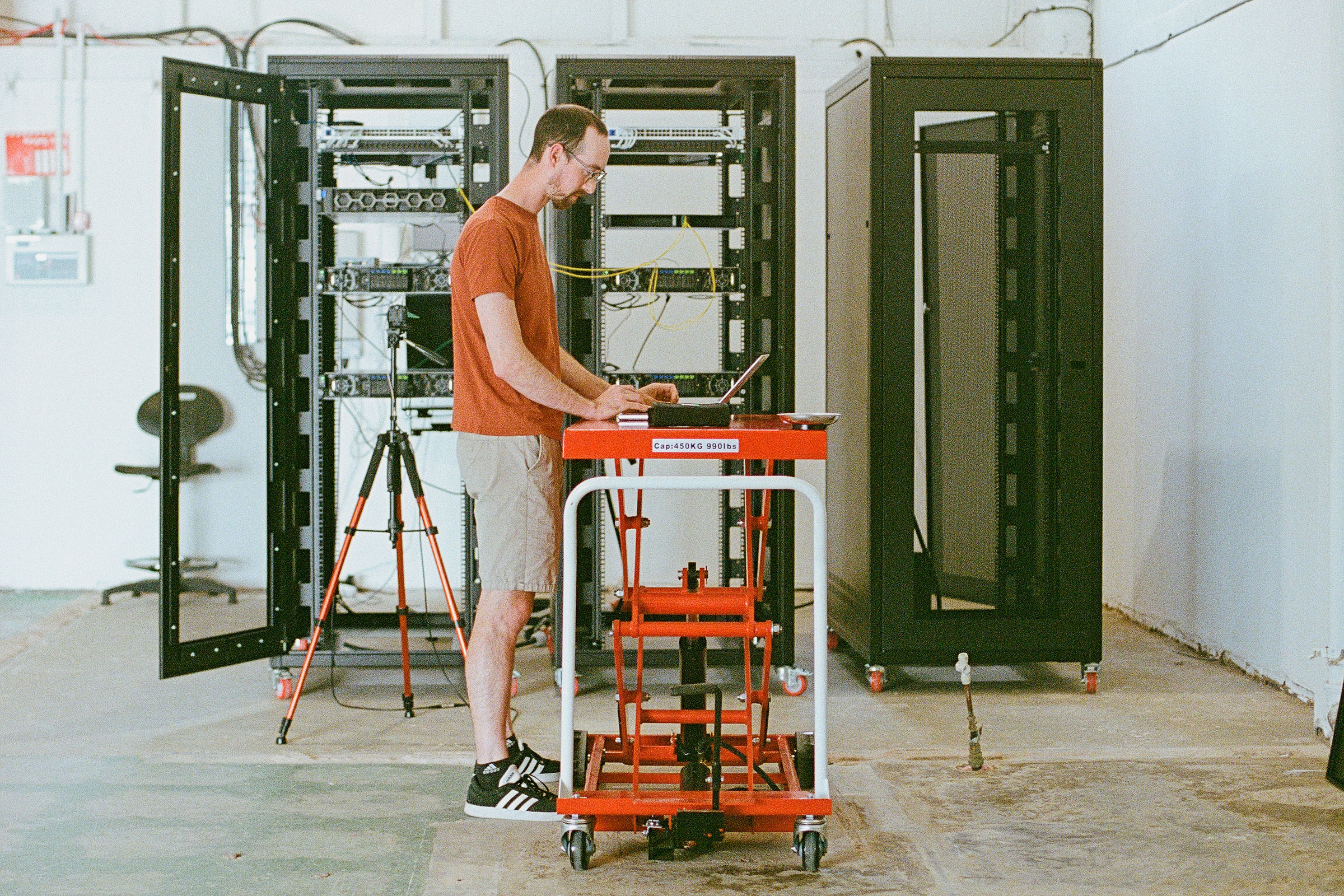
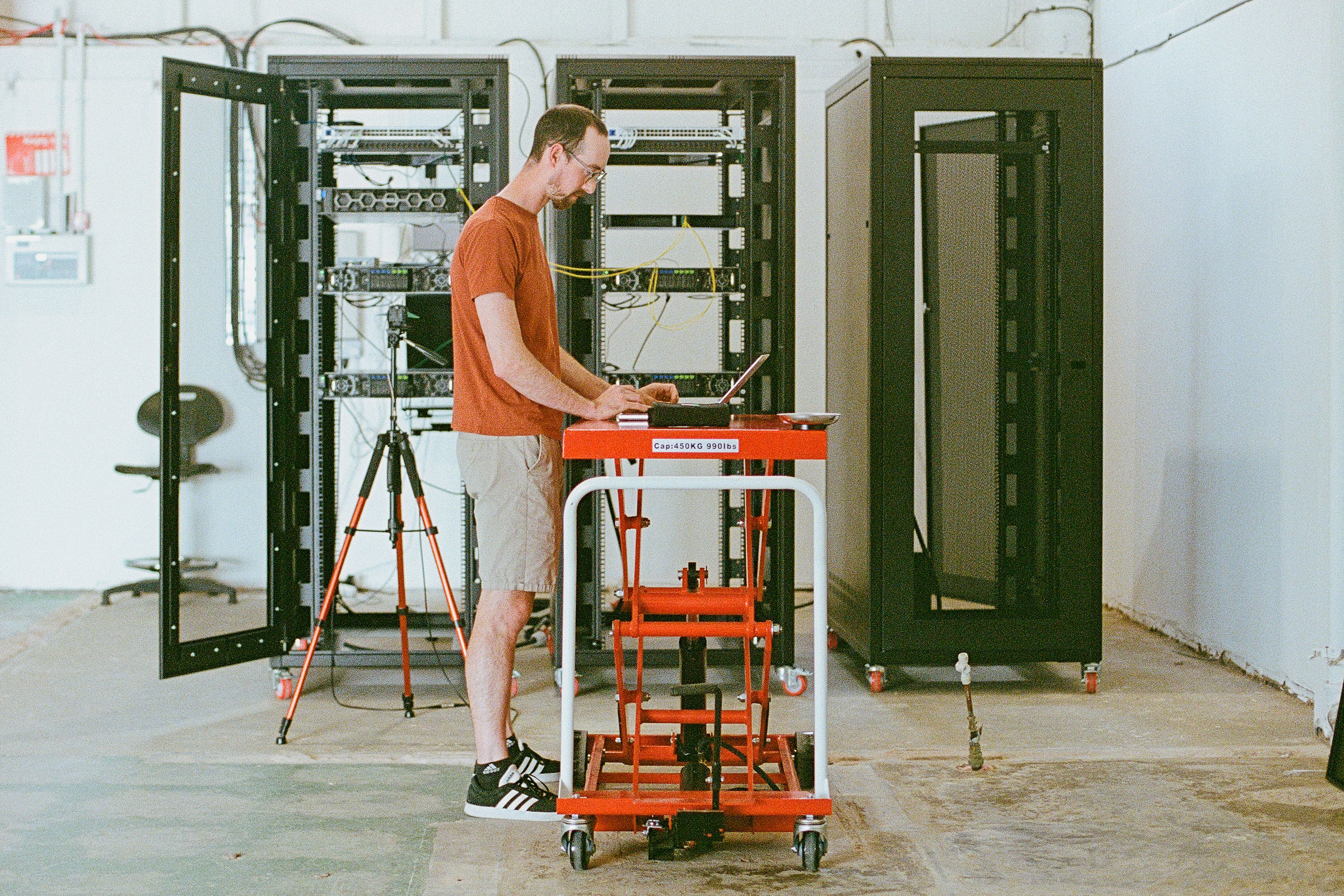
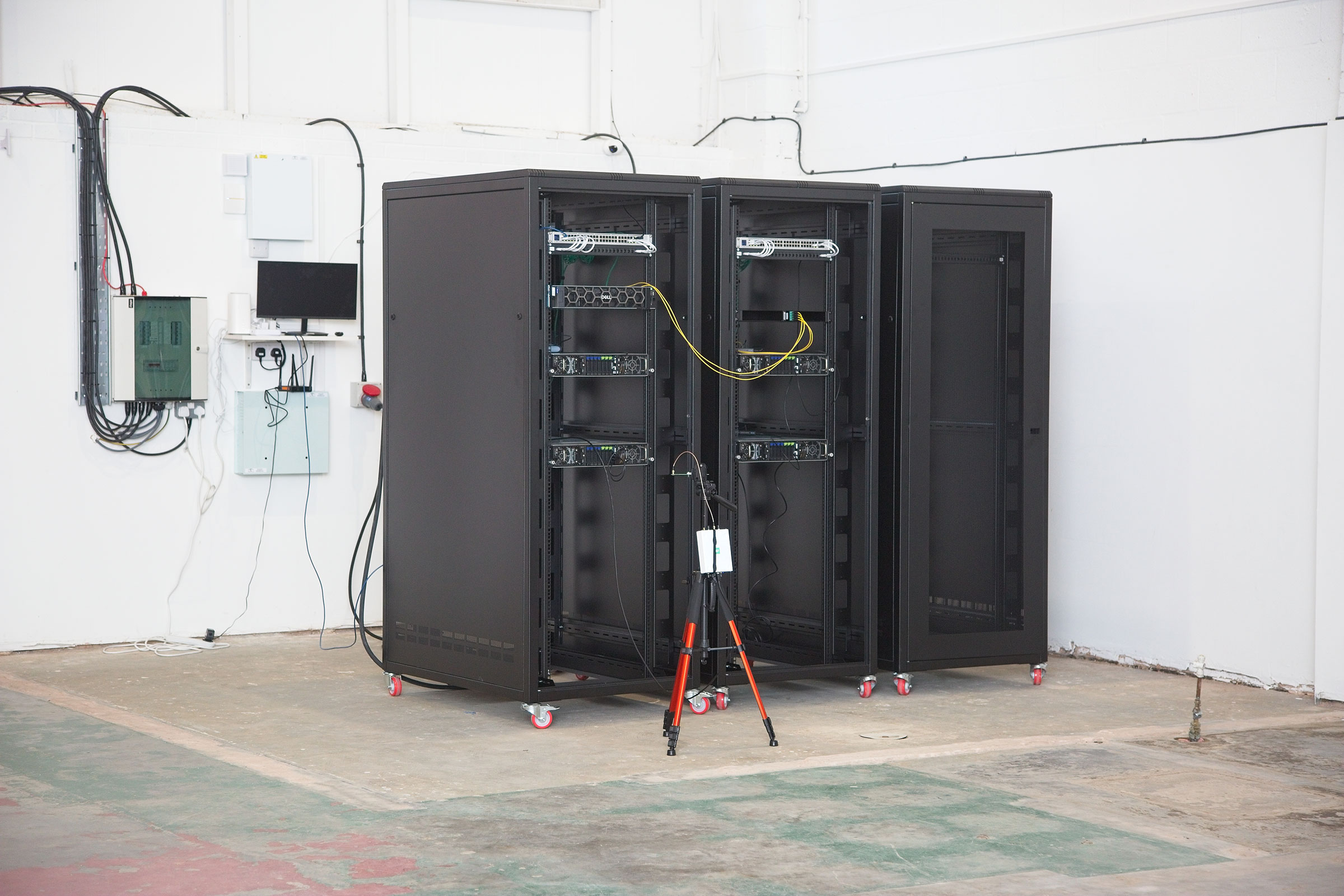
In the corner of a nondescript office in Sheffield, a city in the north of England, a compact server full of Nvidia chips is whirring away.
It’s a microcosm of the huge data centers springing up all over the globe: town-sized, energy-guzzling computers that are the worldly manifestations of frontier AI models.
Here in Sheffield, on these eight chips, engineers from the consultancy Amodo Design are piloting a monitoring system that they hope, one day, might find its way into every data center, allaying the fears of AI researchers who are concerned that the technology they are building may destroy the world.
In late July, more than 1,300 employees of frontier AI companies signed an open letter warning that their AI is quickly becoming so powerful that humans may soon no longer be able to control it. Slowing the pace of AI development, they warned, may become vital in order to allow more time for safety research, and thus avert catastrophe. But slowing down, they wrote, is essentially impossible, due to intense competition between companies and countries. The AI race is stuck in an arms-race dynamic, these top scientists say, in which one team slowing down would only hand victory to rivals that don’t.
The letter’s main request—one so important to 1,300 of the world’s top AI researchers that they called publicly for it—was for the U.S. government to support an international effort to build tools that would enable all sides to slow down the AI race.
So far, only a small group of people are working on this effort. There are fewer than 50 engineers in the world working full-time on building so-called “AI verification” tools, Amodo CEO Tom Milton estimates—nine of them at Amodo—plus a few dozen more policy researchers scattered among a handful of companies and research institutes. Meanwhile, trillions of dollars, and the combined might of the world’s biggest tech companies, are now dedicated to making AI systems more powerful as quickly as possible. Efforts to build slowdown tools are funded mostly by academia and philanthropy. (Amodo’s work in this area is funded by the Survival and Flourishing Fund and Longview Philanthropy, two grantmakers that have donated heavily toward reducing AI-related risks.)
“It is surprising that very few people are doing it,” says Milton, a 28-year-old who fell into the field almost by accident several years ago, when Amodo was commissioned to do some work in the area.
In Sheffield, three workers are huddled around their compute cluster, under an air conditioning unit that is running on full-blast. Their small-scale prototype may be running hot, but it isn’t ready yet. Many technical obstacles remain in its way, plus a bigger political one: it won’t be useful unless the U.S. and China come to the table and agree on an AI slowdown treaty, Milton says.
For now at least, such an agreement looks unlikely. But Amodo’s engineers are keenly aware that political choices are downstream from what is possible. Treaties that curtailed the Cold War arms race were only possible because new technologies, like satellites and seismometers, allowed each side to verify the other’s compliance. Milton expects a similar moment to arrive for AI. When that moment comes, he wants to be ready.
How AI verification might work
Nobody knows how an AI slowdown treaty might look, but Amodo’s engineers believe it will probably require monitoring data centers, given that these are the places where AI physically lives.
The current prototype that Amodo is building could make it possible to gain two assurances about a data center that might be helpful in the years to come, Milton says.
First, that a data center is only being used for inference. That means the running of existing AI models, rather than the training of new, more powerful ones.
Second, that a data center is running a particular, agreed-upon model—for example, one that has passed certain safety tests, perhaps ones that have been set down in law.
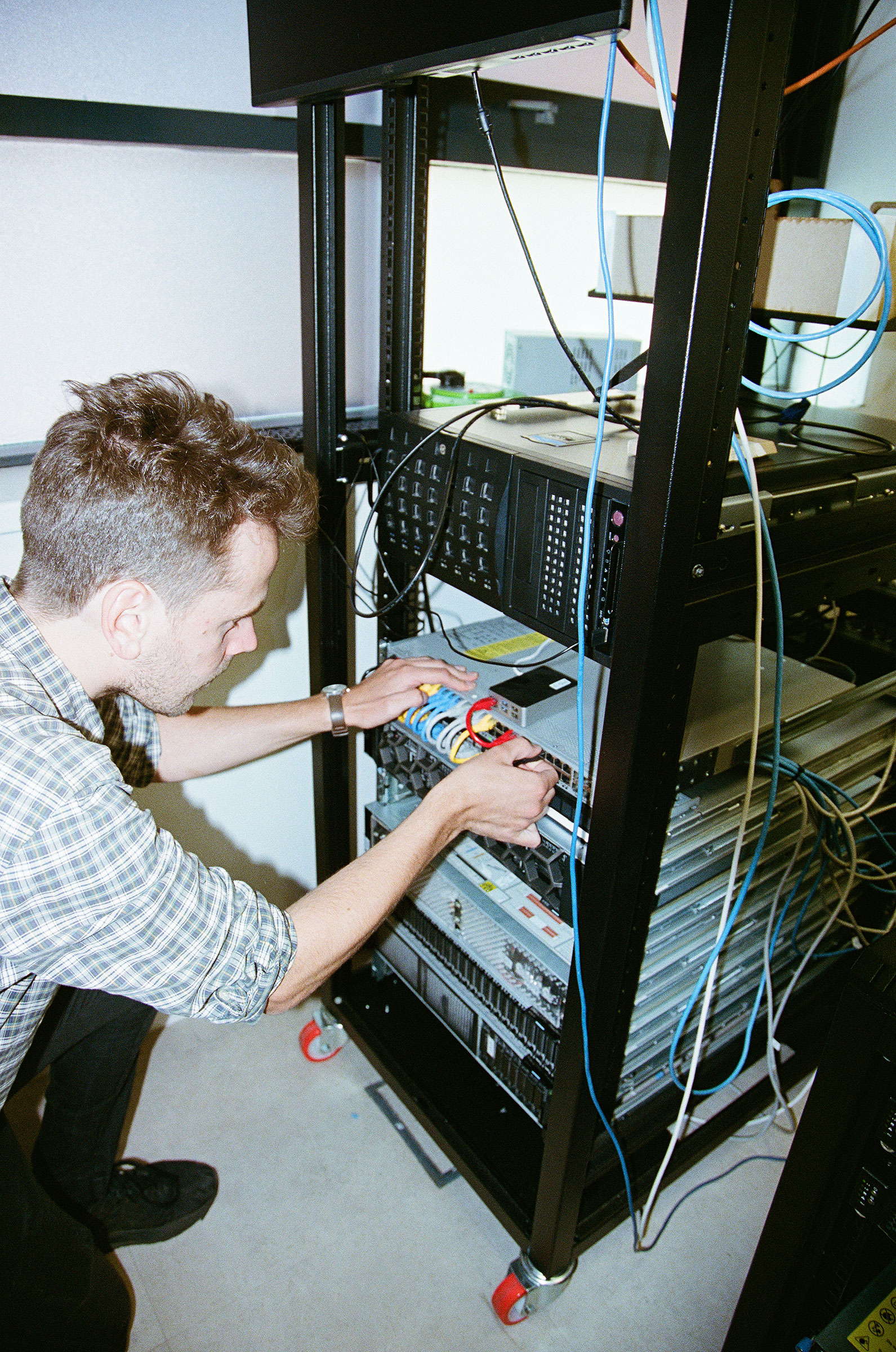
To demonstrate how this might work, an Amodo engineer logs into the whirring server rack, where he spins up two separate systems, each containing an open-source AI model made by OpenAI.
Think of the first system, he says, as an AI model that a company would normally run in a data center. The second system is the “verifier,” he explains. Its job is to sample snippets of data from this data center and rerun them on its own version of the model, thus confirming that the model is the one the data center operator claims it to be.
When he demonstrates it, the system works—at least on its own terms. The verifier performs some calculations on the outputs of the original AI model, and spits out a high certainty score that this model is GPT-OSS-120B, which is exactly correct.
The limitations
There are several significant problems that point to Amodo’s solution not yet being ready for prime time.
For now, it only works with unencrypted data, which makes it unfeasible for the most sensitive workloads, which are routinely encrypted. (Milton says the next version of Amodo’s prototype will utilize “zero-knowledge” cryptography, which would significantly reduce the amount of unencrypted data needed.)
A second limitation is that a system like this would require data centers to be retrofitted, including a process ominously named “network tapping,” which involves copying data from working chips onto other verification systems within the same building. Given that these are some of the highest-security buildings on earth, housing trillion-dollar intellectual property and masses of private data, that’s access that no leading AI company is likely to be willing to grant, at least today.
But it doesn’t have to be as scary as it sounds, Milton says. There are precedents in the history of arms control—including nuclear and chemical weapons—for international bodies to carry out inspections of sensitive facilities. These inspections can guarantee that a facility is compliant with international law, without revealing the secrets of how it works to adversaries. Amodo hopes to build on these principles, aiming to build a system that would only send low-information signals like “passed” or “failed” outside of the data center’s secure walls.
(Amodo says it plans to open-source all of its work on AI verification, so that all sides can interrogate it, understand exactly how it works, and be confident it lacks security vulnerabilities.)
Another limitation is that the verifier system requires computing power in order to run. That could substantially reduce the total capacity, and thus profitability, of any data center that hosts it. The system witnessed by TIME required computing power equal to between one-third and one-fifth of the AI model it was monitoring. Amodo’s engineers say they expect to find substantial further efficiency gains, in particular because the system could theoretically be set to monitor only random samples of a data center’s computation, rather than every single calculation, in order to achieve its intended result.
Milton acknowledges that for now at least, Amodo’s tech isn’t perfect. The idea, he says, is for it to improve significantly over time, ultimately reaching a point where it becomes minimally invasive and maximally privacy-preserving. “We tend to be of the mind that verification mechanisms will ladder up, and they won’t be perfectly trustable and perfectly secure on day one,” he says. “Over time, we can get to systems that can be verified in much more detail.”
There are many individual AI researchers, Milton says, who are paid more than the single-digit-million dollar budget for his entire project. A full-scale effort, of the kind that AI workers asked for in the open letter, might quickly result in more sophisticated tools.
“It is insane for us to think that we are even a noteworthy participant in this,” Milton says. “Let alone one of the largest projects.”

Is it politically possible?
While AI verification tech remains nascent, the acceleration of AI capabilities in recent months has led to a surge of interest in the field.
The Institute for Progress, a think-tank, recommended in August that the U.S. government collaborate with frontier AI labs, chipmakers, and hyperscale data center builders, plus other governments, to accelerate the development of AI verification tools. “If the nuclear arms control precedent is any indication, the ability to verify that agreements are being upheld is often necessary for parties to enter into them in the first place,” it wrote. “Better verification technology would unlock a broader space of possible agreements.”
It is a view shared by the authors of AI 2040, a follow-up to the widely-read essay AI 2027. Their so-called “Plan A” for humanity to navigate the arrival of superintelligent AI safely makes heavy use of data center monitoring technologies.
And Anthropic recently announced it would devote resources to “help build the systems that a credible slowdown or pause would require.” Those systems, it said in a June blog post, “would enable frontier AI developers to verify that others globally have actually stopped or slowed, and that a bad actor could not use the auspices of a coordinated slowdown to jump ahead in secret.”
Milton says Amodo has held some preliminary discussions with governments about its work, although he declines to say which governments, or to share specifics.
For now, at least, it seems clear the U.S. government does not share the enthusiasm.
“We totally reject global governance of AI,” the director of the White House office of science and technology policy, Michael Kratsios, said in February. “We believe AI adoption cannot lead to a brighter future if it is subject to bureaucracies and centralized control.”
It’s true that since that speech in February, the White House has slightly moderated its approach to AI regulation, having been spooked by the cyber-warfare capabilities of recent models into testing some frontier models before their release. But White House officials remain highly skeptical of heavy-handed interventions in the AI industry, especially ones that might be perceived as allowing for ground to be lost to China. “We refuse to stifle [AI] innovation with overly burdensome regulation,” President Trump wrote in the introduction to a June executive order.
China, meanwhile, appears to still be pursuing its strategy of releasing open-weight models in an attempt to catch up to the U.S. frontier.
In other words: neither great power is exactly clamoring to agree on an AI treaty. Officials from the U.S. and China are planning to meet in September to discuss the growing risks of AI, Reuters reported, though that meeting is more likely to focus on immediate security issues.
Milton is unfazed by what appears, for the moment, to be the political unfeasibility of putting this technology to use. He expects that more powerful AI models will soon arrive, with scarier capabilities. At that point, he expects, both the U.S. and Chinese governments will be “sufficiently scared”—and might come to the table. That possibility, he says, is likely enough “that money should be spent on building the optionality for it.”

Tom Lee’s Bitmine Immersion Technologies, an Ethereum treasury company, resumed its Ether purchases last week, bringing it closer to a key business target of owning 5% of the second-biggest cryptocurrency’s supply despite challenging market conditions.
The company disclosed Monday that it acquired 9,926 Ether (ETH) during the week ending Aug. 16, bringing its total holdings to roughly 5.82 million ETH, or about 4.8% of Ethereum’s circulating supply. At an ETH reference price of $1,893, Bitmine’s Ether holdings were valued at roughly $11 billion. However, much of the company’s ETH was acquired at significantly higher prices.
Ether’s price was little changed on Monday, sitting just above $1,900.
The latest purchase puts Bitmine within striking distance of its long-term “Alchemy of 5%” target of holding 5% of the total ETH supply.
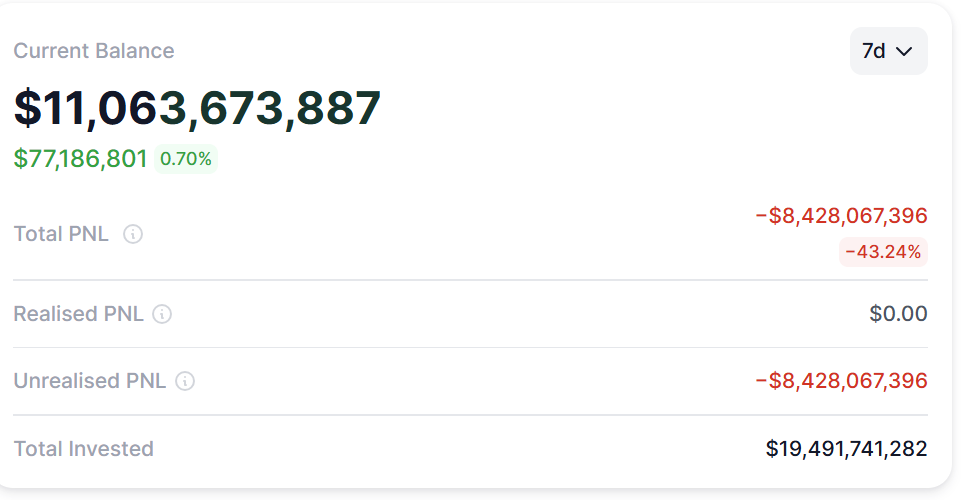
Bitmine’s conviction has been tested by a prolonged bear market for Ether, which has sharply eroded the value of its digital asset treasury. The company is sitting on more than $8.4 billion in unrealized losses on its ETH holdings, according to industry data.
With a portfolio value of more than $11 billion, BitMine’s unrealized losses are around 43%. Source: DropsTab
Still, Bitmine has continued accumulating Ether, making purchases every week since launching its ETH treasury strategy in June 2025.
Related: Ethereum devs to narrow 66 proposals tied to Hegotá upgrade
Bitmine’s staked Ether approaches $10 billion in value
Although Bitmine is sitting on large unrealized losses on its Ether holdings, its staking operations continue to generate yield. The company said it is staking more than 5 million ETH, worth roughly $9.6 billion at current prices.
That staking has enabled Bitmine to earn protocol rewards for helping secure the Ethereum network, providing a predictable source of yield regardless of short-term ETH price movements. Based on a seven-day staking yield of 2.61%, Bitmine projects annualized staking rewards of roughly $287 million, according to Lee.
Related: Crypto Biz: Bitcoin’s $116M self-custody wake-up call


SafePal disclosed on Aug. 16 that a flaw in an order-tracking plug-in exposed the personal data of 39,798 customers, and a threat actor is already advertising the records for sale on a cybercrime forum. The file pairs home addresses and phone numbers with proof of hardware wallet ownership, which… Read the full story at The Defiant


Stripe has finalized an agreement to buy AI model gateway OpenRouter for more than $7 billion, Bloomberg reported Sunday, citing people familiar with the matter. Neither company has announced the deal, and a Stripe spokesperson told TechCrunch the company does not comment on rumors or speculation…. Read the full story at The Defiant
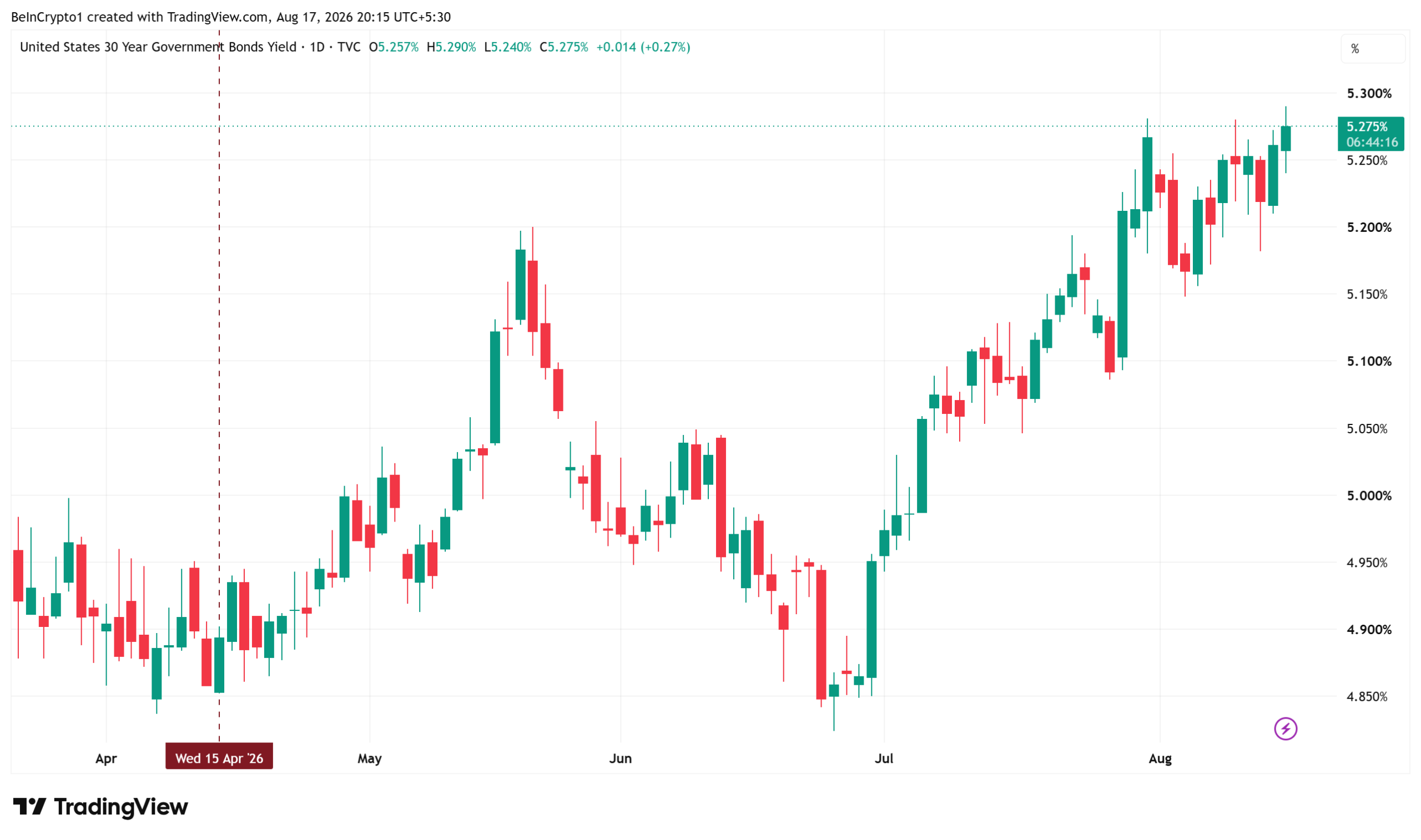
The US government now pays 5.27% to borrow for 30 years, the highest rate of 2026. Artificial intelligence (AI) companies are a large part of the reason. Bitcoin (BTC) is losing the fight for the same money.
Bitcoin trades near $63,517, down 46.1% over the past 12 months. Gold rose 32.6% in the same stretch. The gap between them is almost 79 percentage points.

AI Borrowing Now Competes With the US Treasury
Start with the trend. US technology companies used to sell about $61 billion of bonds a year. That is the five-year average, JPMorgan Asset Management said in July. In 2025 they sold $131 billion. By late July 2026 they had sold $192 billion.
One sector now accounts for 27% of all net investment-grade bond sales, by JPMorgan’s count. Across every US company, issuance reached $1.68 trillion through July. That tally comes from the Securities Industry and Financial Markets Association.
Here is why that matters. The buyers are the same pension funds and insurers that fund Washington. Nomura Securities estimates Big Tech borrowing now equals roughly 25% of Treasury net bond sales to private investors. A year ago the share was five times smaller.
“Whoever’s issuing, be it a government or a hyperscaler or a non-hyperscaler credit, is now competing with more borrowers. And therefore yields have to be higher,” Tony Rodriguez, head of fixed-income strategy at Nuveen Asset Management, in a statement to Bloomberg.
Follow us on X to get the latest news as it happens
Why Bitcoin Loses When Yields Rise
The mechanism is simple. Bonds pay interest. Bitcoin does not.
The 30-year Treasury yield closed at 5.25% on August 14, its highest level this year, Treasury Department data show. The 10-year sits at 4.68%, up 0.49 percentage points since January 2.
Bank of America economists attribute about 0.3 of that rise to corporate and mortgage bond supply. On those numbers, new debt supply explains roughly 60% of the move in the 10-year this year.
Corporate paper pays even more. Alphabet priced 30-year debt near 6.4% recently, about 1.15 points above comparable Treasuries, Bloomberg reported. A bond financing a Meta data center paid over 7.5% last month.
An investor can now earn 6% or 7% from two of the world’s most profitable companies. That is the bar Bitcoin’s price performance must clear. It has not cleared it since global bond yields climbed to 2008 levels.
The Treasury Cannot Sidestep It
Treasury Secretary Scott Bessent has tried to protect long-term rates by selling more short-term debt instead. Barclays estimated the shift would cut net supply of new Treasury notes and bonds by $440 billion this year.
AI borrowing filled that space and more. Barclays expects net corporate bond supply to grow by $474 billion, most of it from the tech giants.
Washington is not borrowing less either. The federal deficit hit $1.8 trillion in the first 10 months of fiscal 2026. That is $169 billion more than last year, the Congressional Budget Office said. Rising US debt interest costs add to it.
The AI bill is also mostly unpaid. JPMorgan Asset Management projects $5.5 trillion of AI capital spending through 2030. It expects $2.1 trillion of that to come from new bonds.
“That is a crowding-out effect. It is important to remember that we are just starting. This hyperscaler debt issuance story has really just begun,” Greg Peters, co-chief investment officer at PGIM, in a comment on Bloomberg Television.
Endless borrowing is the core of the Bitcoin scarcity argument. This year the argument has not paid. Gold took the money, and the 30-year Treasury yield record shows why. The next long-end auctions will test whether buyers have room for both.
The post AI Debt Lifts 30-Year Treasury Yield to 5.27%: Can Bitcoin Compete? appeared first on BeInCrypto.
At least one Wall Street analyst is skeptical that private equity firm Silver Lake will pull off a deal to acquire software maker Workday (WDAY). Workday stock popped on Feb. 13 amid reports of Silver Lake’s interest but has cooled off the next two trading sessions. In early 2026, Workday Cofounder and Executive Chairman Aneel Bhusri returned as chief executive…
Copyright ©2026 Investor’s Business Daily, LLC. All rights reserved. 87990cbe856818d5eddac44c7b1cdeb8


“DeFi is a remarkable innovation; however, it has achieved limited institutional adoption,” Schnarch said in a statement. “Current product offerings fall short of meeting the traditional finance bar, especially as it pertains to compliance and technical requirements.”
The move is a logical response to the shift in DeFi’s user base, according to Ran Hammer, chief business officer at Orbs.
“Retail participation is a fraction of what it was, and the chain has quietly become a venue for settlement, execution and interaction between financial institutions,” Hammer said. “Since DeFi summer, the space has turned into something completely different, essentially a new financial layer for institutions. So bringing in leadership that speaks that language is exactly the right direction.”
The size of the allocated budget, the largest approved by Compound’s decentralized autonomous organization (DAO), may help underline its commitment.
“The $52 million and a bench with that much institutional experience is a serious move, and it should improve its execution,” said Himanshu Sahay, co-founder and chief technology officer of crypto lending firm Arch Lending, but institutions will want more than credentials. They “aren’t underwriting teams, they’re underwriting structures.”
Crypto World
Sam Altman ChatGPT AI Predicts Bitcoin Could Be Entering Its Most Important 5 Months of 2026
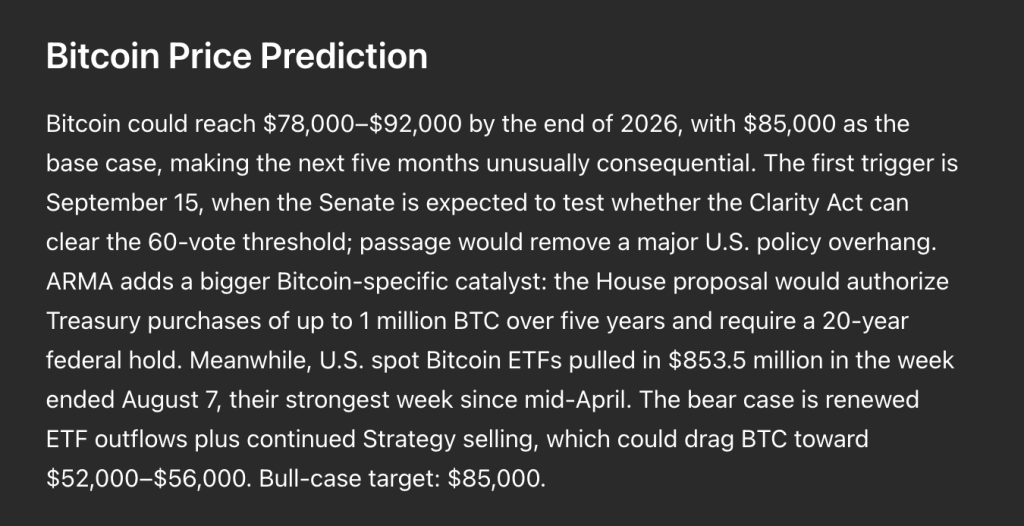
Two dates in Washington and one week of ETF flows explain why the calendar suddenly matters. ChatGPT AI predicts that the next five months will be unusually consequential, and the price prediction for Bitcoin runs from $78,000 to $92,000 by the end of 2026, with $85,000 as the base case.
September 15 is the first trigger. The Senate is expected to test whether the Clarity Act can clear the 60-vote threshold.
The passage would remove a major U.S. policy overhang. That alone changes the risk calculus for allocators who have stayed on the sidelines.

ARMA is the bigger Bitcoin-specific catalyst. The House proposal would authorize Treasury purchases of up to 1 million BTC over five years.
It also requires a 20-year federal hold on those coins. Buying at that scale with a two-decade lockup would remove supply permanently rather than temporarily.
Flows are already turning. U.S. spot Bitcoin ETFs pulled in $853.5 million in the week ended August 7, their strongest week since mid-April.
The bear case reverses that same picture. Renewed ETF outflows are the first pressure point.
Continued Strategy selling compounds it. Together, they could drag BTC toward $52,000 to $56,000.

Discover: Everyone’s Got a Take. Get Free $25 to Actually Trade Yours
Bitcoin Price Prediction: Five Months, Two Bills, And One Very Large Buyer
The weekly chart shows a cycle that has already peaked. Bitcoin topped near $126,000 in mid-2025 and has trended lower since.
Late 2025 broke the structure, taking the price from $120,000 toward $84,000. Early 2026 delivered the deepest leg down near $58,000.
Spring produced a recovery attempt to roughly $82,000. That failed by June, and the price returned to the low $60Ks.
Recent weeks have built a shallow base. Higher lows are forming, though without any strong upward push behind them.
The weekly close reads $63,078, down 2.74% and $1,780. The weekly range covered $62,470 to $65,333.
Support sits at $62,000, then $58,000 and $56,000 as the zone ChatGPT flags. Resistance appears at $70,000, then $80,000 and $92,000.
RSI reads 39.06 with its signal line just above at 39.32. The two lines have converged almost exactly, separated by roughly a quarter point.
That reading sits well below the midline and is near oversold. Momentum is weak, though the flattening suggests the decline is losing force.
ChatGPT’s base case sits 35% above this level. September 15 is the first date that tells you whether the market starts pricing it.
Discover: Your Market Calls Are Worth Something. Start with a free $25 on Kalshi
If September 15 Is the Trigger, Kalshi Lets You Trade the Decision Before Bitcoin Reacts
Bitcoin holders are waiting for Washington to move first. Kalshi gives traders a way to take a position on the event itself.
The platform lets users trade on real-world outcomes across politics, economic data, Fed decisions, crypto, and other market-moving events. That matters when the Bitcoin thesis is increasingly tied to specific dates rather than vague expectations.
If the market is watching whether legislation clears Congress, whether policy shifts, or whether another macro catalyst lands, Kalshi turns that uncertainty into a tradable probability. You are no longer forced to buy BTC and hope the eventual reaction matches your thesis. You can trade the outcome directly.
With September 15 now shaping up as one of Bitcoin’s most important near-term dates, that distinction matters.
Eligible new users who sign up through CryptoNews can also receive $25 through our referral link.
The post Sam Altman ChatGPT AI Predicts Bitcoin Could Be Entering Its Most Important 5 Months of 2026 appeared first on Cryptonews.
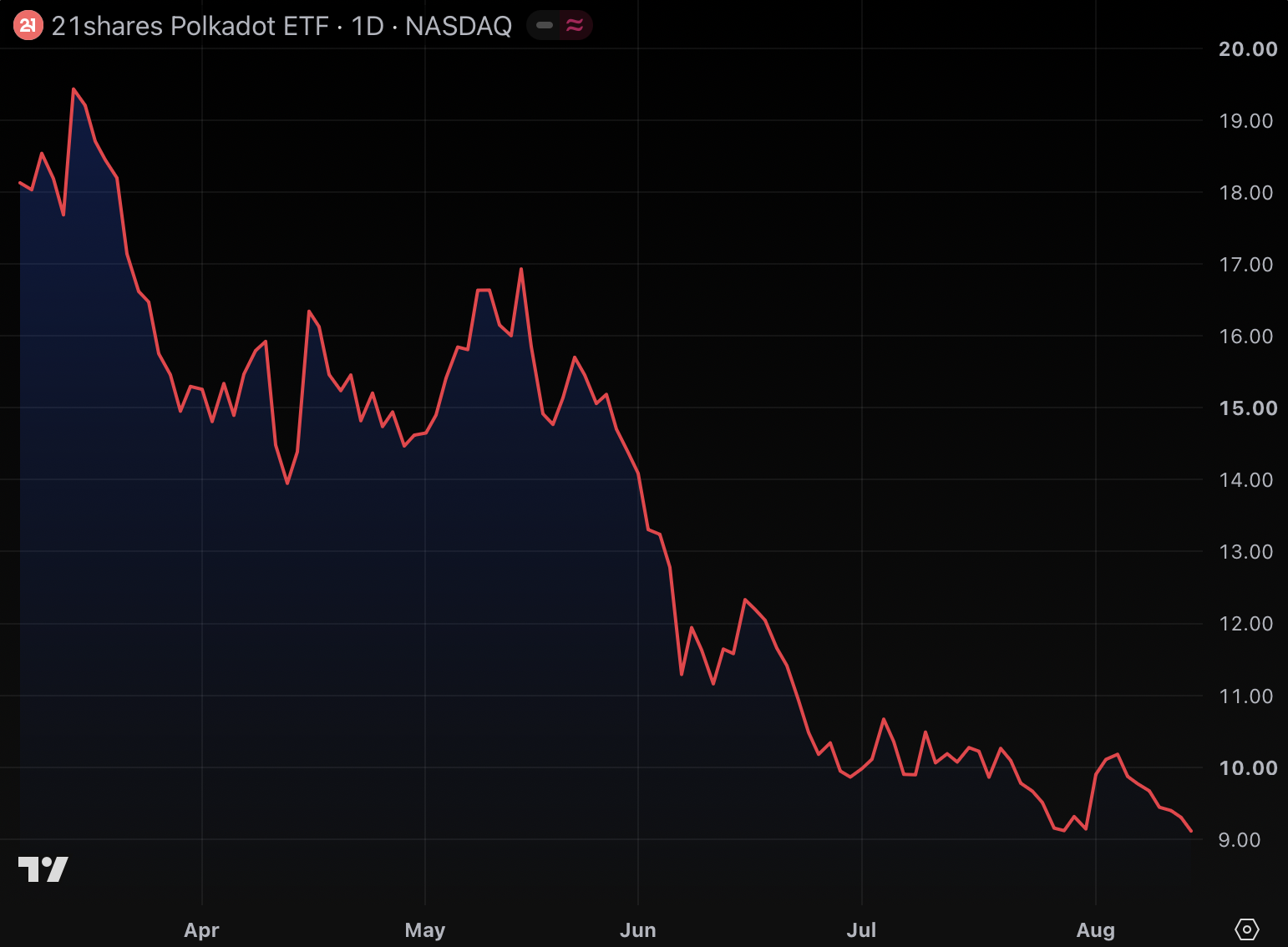
On Friday, the 21Shares Polkadot ETF (TDOT) reported that it realized $4.52 of loss per share by selling Polkadot (DOT) tokens to make each $1 per share of staking payouts last quarter.
The fund sold 98,505 DOT last quarter to generate $107,510 of cash payments to shareholders. Those sales finalized losses of $485,553 due to the dramatic decline of DOT.
Specifically, the price of DOT declined 34% during Q2 2026. For the 12 months ending June 30, 2026, DOT declined 76%.
TDOT shareholders do not actually receive staking rewards denominated in DOT. Instead, the fund must sell DOT to mimick and provide the corresponding staking rewards in USD for its shareholders.
All things considered, the payout is embarrassing. Holding TDOT from April through June this year entitled shareholders $0.146980 per share of payouts, which certainly did not compensate for the fund’s 34% share price decline from $14.95 to $9.86.
This is, of course, not any particular fault of 21Shares but rather the fault of DOT itself, which continues to fall out of favor with investors.
DOT was supposed to power parallelized execution capable of roughly 1 million transactions per second across up to 100 parachains, an ‘internet of blockchains’ with shared security, and seamless cross-chain interoperability.
In practice, total value locked across all parachains sits at less than $100 million, and DOT trades near 97% below its all-time high as investors find more utility elsewhere.
Paying out staking rewards crystallizes DOT losses
TDOT records cash payouts as a distribution of staking income. Nothing in the filing hides the mechanism by which it realized losses, and shareholders cannot interpret the cause of this $485,553 loss as unrelated to generating staking payouts.
Indeed, the trust unambiguously states, “Aggregate distributions of $107,510 or $0.146980 per share reduced the Trust’s DOT holdings through the sale of DOT to generate cash.”
That crystallized more than four dollars of permanent loss for every $1 it distributed.
By comparison, four peer crypto staking funds disclosed a realized loss in Q2, yet none lost more than $0.89 per $1 distributed. Respectively, Invesco’s Galaxy Solana fund realized $0.89 of loss, the same sponsor’s Solana fund disclosed $0.74 of loss, its Sui fund finalized $0.31, and BlackRock’s staked ether fund reported $0.25.
Read more: Where are the Ethereum founders 11 years after the genesis block?
Realizing losses as Polkadot continues to crash
Shareholders, not these sponsors, bear those losses. The entities behind these funds make money running their products, regardless of the price of crypto.
Specifically, TDOT names 21Shares US LLC as the fund’s sponsor, wholly owned by 21co Holdings Limited. Crypto prime broker FalconX finished buying that parent in November 2025. CEO Russell Barlow and President Duncan Moir signed the quarterly report on August 14.
The trust’s original backer was the Web 3.0 Technologies Foundation, the Swiss entity behind Polkadot. It seeded the fund in January 2025 with DOT worth about $53 million, or roughly $88 per share. Shares closed Q2 at $9.86 per share.
Sadly, selling DOT to generate cash for staking reward payouts was not even the quarter’s most expensive liquidation. Instead, outright redemptions from investors who wanted out of the fund forced the trust to realize another $1.76 million of loss during the quarter.
Moreover, selling DOT to pay its own ‘sponsor fee’ cost $253,417. Total realized losses for the quarter totaled $2.5 million.
The first distribution, $0.090846 per share, carried a May 14 record date and paid the next day. The second, $0.056134 per share, followed with a June 29 record date, a shrinking payout on a shrinking asset.
Both landed inside a quarter in which DOT fell 34%. The coin slid from $1.25 on March 31 to $0.82 on June 30.
Competition is thinning rather than growing. Grayscale withdrew its own Polkadot ETF registration on August 7, and crypto ETF net asset values are down across the board since early 2025.
Got a tip? Send us an email securely via Protos Leaks. For more informed news and investigations, follow us on X, Bluesky, and Google News, or subscribe to our YouTube channel.
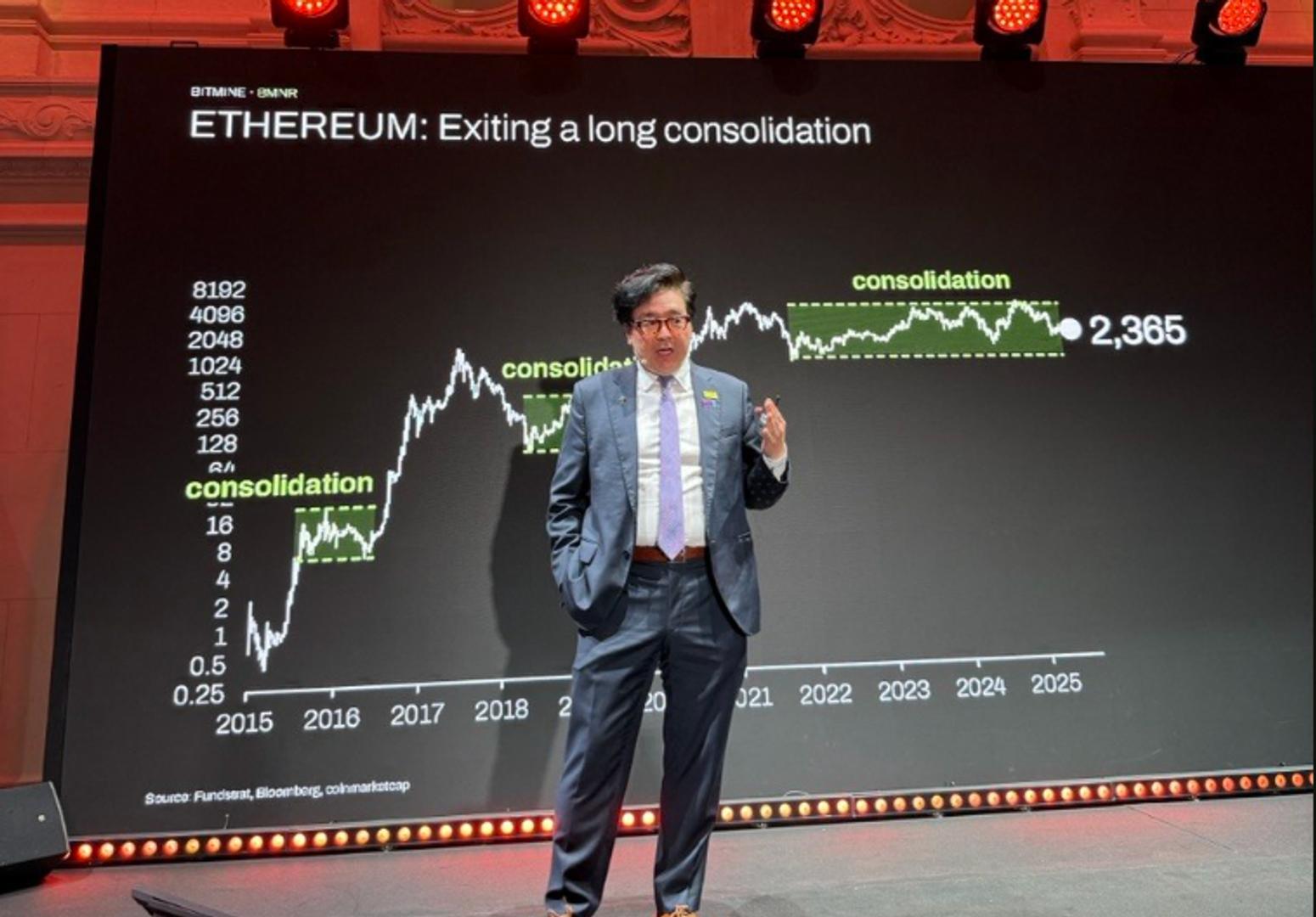
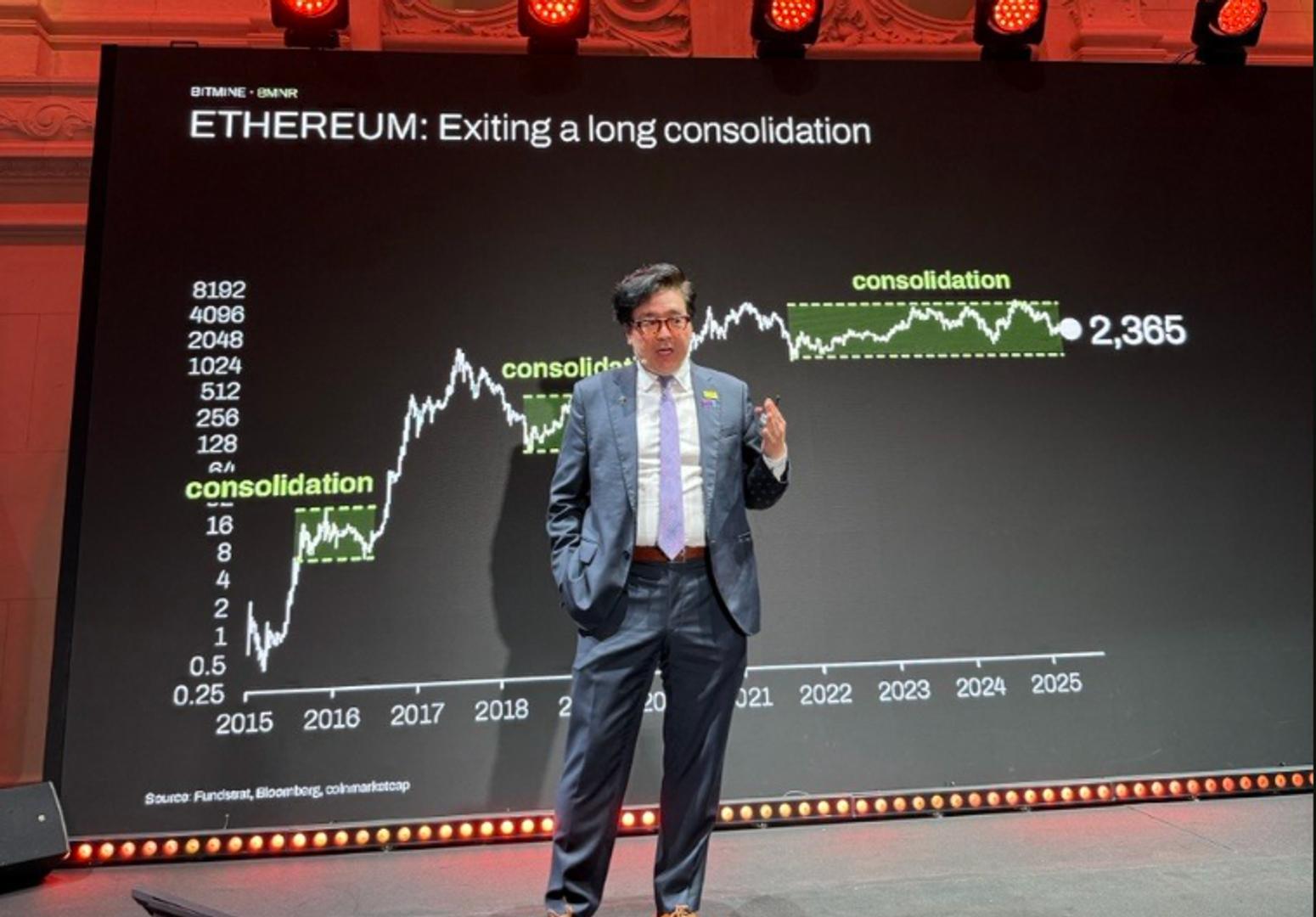
Ethereum treasury company Bitmine Immersion added more of the token to its balance sheet, bringing its total holdings up to 5.815 million tokens.
In an announcement Monday, the company led by Chairman Tom Lee said it bought another 9,926 ETH last week, continuing its streak of weekly buys that began in June 2025 when the company launched.
Bitmine, which trades under the ticker BMNR, now holds 4.8% of ETH’s total supply with its tokens worth about $11 billion at the current price of $1,904.
Lee said the ETH/BTC ratio has broken above a years-long downward trend, which he sees as a sign that investors are starting to price in growing demand for Ethereum from tokenization and AI-agent applications.
On the macro front, he expects “easing financial conditions to be a tailwind for crypto,” he said in a statement.
ETH is up about 1.6% over the past 24 hours while BMNR is trading more than 2% higher today.
The company also bought an additional 1.7 million shares of its own stock last week, now owning 20.8 million shares under a previously authorized $4 billion buyback program.


The SEC has begun preparing a regulatory route that could let qualified platforms trade tokenized U.S. stocks 24 hours a day, seven days a week.
Summary
- The SEC is developing a limited innovation exemption for tokenized securities trading.
- Blockchain-based markets could let eligible stock tokens trade overnight, on weekends, and during holidays.
- Existing federal securities laws continue to apply because the proposed exemption has not taken effect.
- Custody, shareholder rights, surveillance, and links to clearing systems remain key regulatory issues.
The U.S. Securities and Exchange Commission is working on an “innovation exemption” that could give selected firms temporary relief to test tokenized securities under defined conditions while the agency develops permanent rules.
SEC Chair Paul Atkins has supported using exemptive authority to bring more financial activity onto blockchain networks without removing tokenized stocks from federal securities oversight. Under the proposal, approved platforms could offer digital versions of U.S.-listed shares and process transactions outside the operating hours used by traditional exchanges.
Commissioner Hester Peirce said in March that SEC staff was developing an exemption to facilitate “limited trading of certain tokenized securities.” Peirce described the possible measure as narrower than the blanket exemption discussed by the SEC’s Investor Advisory Committee.
No final framework, eligibility criteria, or implementation date has been announced. Investors therefore cannot assume that tokenized versions of every U.S. stock will soon become available for continuous trading.
SEC exemption could open 24/7 tokenized stock trading
Regular U.S. stock market hours run from 9:30 a.m. to 4 p.m. Eastern time on business days, although registered venues and brokers can provide extended sessions. A blockchain-based venue can process transfers continuously, allowing eligible securities to change hands during nights, weekends, and public holidays.
According to reporting on the SEC’s preparations, the exemption could give regulated platforms a defined route to test round-the-clock markets for tokenized shares. Such relief would still require the commission to decide which firms qualify, what activities they may conduct, and which existing rules remain mandatory.
For American investors, continuous trading could provide access outside the normal market day. The SEC would still need to determine how brokers handle best execution, disclosures, and order routing when the underlying stock market is closed, and price discovery is spread across blockchain and conventional venues.
Investor protections also depend on the type of token offered. An issuer-backed token can represent the same security recorded through a new ownership system, while a product created by an unrelated third party may only track the price of a stock or provide a contractual claim against the platform.
In July, two transfer-agent groups asked the SEC to separate issuer-backed shares from unaffiliated tokens. As crypto.news previously reported, the groups warned that some third-party structures may not give buyers direct ownership, voting rights, or the same legal claim to dividends as registered shareholders.
The SEC’s Investor Advisory Committee raised similar concerns in a March recommendation. Committee members opposed a blanket exemption and called for clear ownership disclosures, regulatory oversight of intermediaries, and protections designed to give investors fair execution terms.
Tokenized stocks would remain U.S. securities
Putting a stock on a blockchain does not change its status under U.S. law. Atkins said in a November 2025 speech that economic reality, rather than the token label, determines how federal securities rules apply to an asset.
A token representing a share of a public company would therefore remain a security. Depending on the structure, platforms involved in issuing, trading, custody, or settlement could face requirements covering broker-dealer registration, exchange or alternative trading system rules, transfer-agent records, and clearing.
Custody presents another issue because a blockchain token and the underlying share must remain properly linked. If a third party holds conventional stock and issues a separate token against it, regulators must determine how buyers can verify the backing and recover assets if the issuer or custodian fails.
Market surveillance will require its own controls. The SEC must decide how participating venues detect manipulation, share trading information, and manage transactions that occur when the main U.S. exchanges are closed. Regulators may also need to address whether blockchain settlement can operate alongside the Depository Trust Company’s existing custody and post-trade systems.
The proposed exemption has not changed current requirements. On Aug. 14, the SEC canceled an open meeting that was scheduled to consider a tailored offering regime for certain investment contracts involving crypto assets, citing an unforeseen scheduling issue.
The canceled meeting did not amount to a vote on blanket approval for 24/7 tokenized stock trading. The SEC’s public notice said the meeting concerned registration and offering rules for certain crypto-related investment contracts, while the tokenized-securities exemption remains a separate policy project under development.
DTCC and Nasdaq have started regulated tokenization tests
Parts of the U.S. market have already received limited permission to test tokenized securities. In December 2025, SEC staff issued a no-action letter allowing the Depository Trust Company to operate a defined tokenization service for three years under specified conditions.
The eligible asset universe includes Russell 1000 stocks, major index exchange-traded funds, and U.S. Treasury securities. A no-action letter indicates that SEC staff would not recommend enforcement based on the facts presented, but it does not create a permanent industry rule or authorize every company to offer similar services.
DTCC has assembled more than 100 members and partners for its tokenization work, according to an August project update. Participating firms include traditional financial institutions and blockchain companies testing tokenized equities, Treasuries, collateral, securities lending, and margin processes.
Earlier production tests examined whether regulated assets could move between blockchain networks while remaining connected to established custody and ownership records. DTC, DTCC’s depository subsidiary, provides custody and asset servicing for more than $114 trillion in securities, although that figure represents its total business and not the value scheduled for tokenization.
Nasdaq has also moved into regulated blockchain-based trading. The SEC approved its pilot in March 2026, allowing selected participants to trade certain tokenized equities alongside conventional shares.
Under Nasdaq’s structure, tokenized and traditional versions carry the same rights and pricing. The pilot covers eligible Russell 1000 securities and major index-linked ETFs, keeping the products inside the existing national market system rather than creating unrelated stock-tracking tokens.
NYSE has filed rule changes for tokenized securities as well. SEC records show that the exchange submitted amendments in April to enable securities to trade in tokenized form, adding another regulated-market model for the commission to assess.
Regulation NMS changes could affect on-chain venues
At the same time, the SEC is considering amendments to Regulation NMS, the collection of rules that controls how U.S. equity orders move between trading venues. Proposed changes include rescinding Rule 611 and Rule 610(e), which govern order protection and access fees in the national market system.
Ondo Finance supported the proposed rescission in an Aug. 11 letter to SEC Secretary Vanessa Countryman. The company argued that the existing rules favor continuous order books and can restrict alternative execution systems that use different trading models.
Rule 611 generally requires trading centers to prevent executions at prices inferior to protected quotations displayed elsewhere. Ondo told the commission that removing the provision could give auction-based, blockchain-based, and other execution systems more room to operate alongside conventional order books.
The company also asked the SEC to correct parts of its economic analysis before adopting the amendments. Ondo’s submission was filed under Release No. 34-105655 and File No. S7-2026-20 as part of the commission’s public comment process.

US Commander brushes off complaints about USS Abraham Lincoln as ‘old news’ after reports of alarming conditions

Ferrero Group acquiring another cereal company

Bitmine Nears 5% of Ethereum Supply With 5.82M ETH


-

 Fashion3 days ago
Weekend Open Thread: Ann Taylor
-
 NewsBeat6 days ago
Communication cards help banking customers access services or report scams
-
 Business7 days ago
Oil Price Today (August 11): Crude oil rises to $88 after Trump’s compensation demand dents Hormuz opening. Here’s why
-

 Crypto World7 days ago
Revolut wins French banking licence, creates second EU banking hub
-
 Sports4 days ago
This U.S. Amateur is a glimpse into golf’s future in more ways than you think
-
 Crypto World7 days ago
Why Did Nvidia Stock Fall on Monday Despite a $500 Billion Wall Street AI Deal?
-

 Sports3 days ago
Birmingham 2026: Day 6 Timetable for Irish Athletes
-
 NewsBeat2 days ago
Myanmar says over 300,000 Rohingya refugees verified for repatriation as exodus enters ninth year
-
 Entertainment5 days ago
Keke Palmer Subtly Hints At Sean Evans Drama With Cryptic Post
-

 Politics2 days ago
SEQ Code: The Three Letter Boarding Pass Code That Could Give You The Worst Seat
-

 Fashion7 days ago
Can You Wear Double Cloth Gauze Clothing To Your Office?
-
 Entertainment7 days ago
57 Years Later, the Best Sitcom Ever Made Still Deserves a Reboot
-

 Fashion6 days ago
Coffee Break: The Fonteyn Jane Flat
-
 Crypto World7 days ago
Hormuz Nerves Cost Bitcoin $65,000 Mark Despite Solid Institutional Flows
-

 Tech6 days ago
Zoom Screen-Sharing Bug Let People Fully Take Over Other Devices On A Call
-

 Crypto World7 days ago
Bitcoin's BIP Editors Remove Luke Dashjr Two Days After BIP-110 Fork Stalled
-

 Fashion6 days ago
Claire Life: Kicking Off MVAAFF With the C Suite Luncheon Featuring Phylicia Rashad, Letoya Luckett, and More!
-

 Fashion6 days ago
Should you refinance your debt? Pros, cons, and real numbers
-
 Crypto World5 days ago
XRP bridge drained after software mistook fake deposits for real ones
-

 Sports5 days ago
DeQuan Jones in ‘high spirits’ after successful leg surgery
You must be logged in to post a comment Login