
Business
Why is BHP stock surging today?



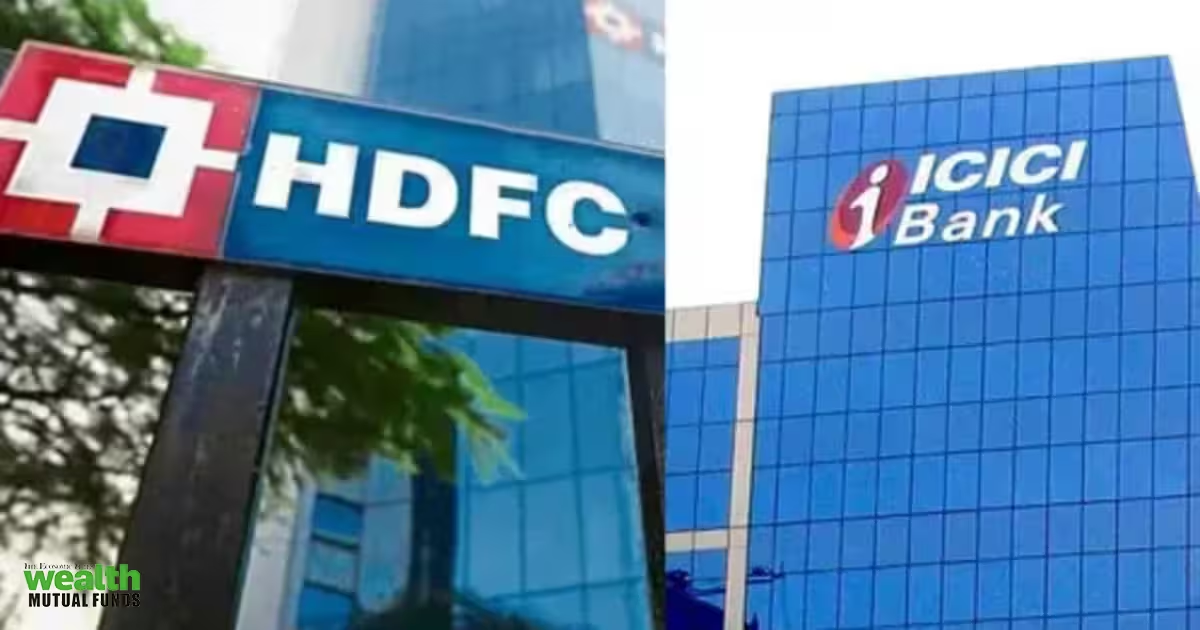
Mutual funds currently hold around 3.94 billion shares of HDFC Bank, valued at ₹2.96 lakh crore, while their holding in ICICI Bank stands at around 2.10 billion shares, valued at ₹3.01 lakh crore.
ICICI Bank now accounts for 5.35% of equity MF holdings, compared with 5.24% for HDFC Bank. As of July, 514 MF schemes held shares of HDFC Bank, while 552 schemes held shares of ICICI Bank.
ICICI Bank’s portfolio-topping surge isn’t merely a reflection of institutional investors exiting HDFC Bank. Rather, it reflects lingering concerns over executive leadership succession and governance that remain key valuation drags for the country’s biggest private-sector lender. “HDFC Bank has faced governance concerns following the resignation of its chairman, while there have also been concerns around certain events and the recent fine imposed on the CEO,” said Siddharth Rajpurohit, lead analyst, Banking, Systematix Group. “Although the bank conducted an internal review through an independent agency, some concerns remain.”
HDFC Bank had remained the top MF holding since July 2023 until June this year. The value of MFs‘ holding in HDFC Bank had hit a record high of more than ₹3.39 lakh crore in November 2025.

Contrasting Fortunes
The shift captures the contrasting stock performance of the two lenders. HDFC Bank fell 6.2% in July and is down 25% so far in 2026 amid concerns over profitability pressures, governance and succession, triggering record selling by foreign investors. The Street is concerned about leadership succession at HDFC Bank. Incumbent Chief Executive Sashidhar Jagdishan‘s second term is due to end in October, and the lender’s board is evaluating his reappointment, the bank’s leadership said last month during a post-earnings call.
 ET Bureau
ICICI Bank, meanwhile, has had a steadier run, and its stock gained 4.4% in July and 7% so far this year. “In contrast, ICICI Bank delivered a stable set of results and does not face similar governance concerns. The extension of the tenure of its MD and CEO by another two years also provides greater clarity on management continuity.” Rajpurohit said.
However, MFs have continued to increase their holdings in both lenders. Their collective stake in HDFC Bank currently stands at around 30.04%, up from 26.7% at the end of December 2025 and around 24% at the end of December 2024. In ICICI Bank, MF holding has risen to around 29.6% from 26.09% at the end of December 2025. Overseas fund ownership, by contrast, has reduced.
Reliance Industries is the third-most valued stock holding of MFs, with holdings worth around ₹1.75 lakh crore, accounting for 3.1% of equity assets under management (AUM). Bharti Airtel and Axis Bank rank fourth and fifth, with MF holdings of around ₹1.47 lakh crore and ₹1.3 lakh crore, respectively. They account for 2.6% and 2.3% of equity AUM, respectively.
Slim M-Cap Lead
To be sure, HDFC Bank remains the larger lender by market capitalisation. HDFC Bank’s current market capitalisation stands at ₹11.21 lakh crore, compared with ₹10.18 lakh crore for ICICI Bank, although the valuation gap has narrowed significantly so far this year. The underperformance has resulted in HDFC Bank’s valuations trading lower than ICICI.
HDFC Bank is trading at an estimated price-to-book ratio of 1.78 times, compared with 2.43 times for ICICI Bank.
Both stocks are trading below their respective five-year average price-to-book multiples – of 2.90 times for HDFC Bank and 2.99 times for ICICI Bank, respectively.
Rajesh Palviya, head of research, Axis Securities, said selling by foreign institutional investors (FII), which typically have a higher holding in HDFC Bank, is one of the reasons for the stock’s underperformance. Following the abrupt resignation of the last chairman, many investors and traders have cut their exposure to the bank, putting pressure on the stock price.
In contrast, ICICI Bank reported strong overall numbers, which has helped the stock remain stable.
In the private banking space, ICICI Bank and Kotak Mahindra Bank are looking stable among large-cap names, Palviya said. HDFC Bank, meanwhile, continues to face uncertainty over leadership succession and corporate governance, Palviya said.
The divergence between the two stocks is likely to take some time to reverse, he added.
Read more: Sebi chairman says cyber defence must move from IT issue to boardroom priority
ICICI Bank currently appears to have an edge over its peer in analyst ratings, with 52 buys and no hold or sell ratings, compared with 48 buys, three holds and no sell ratings at the start of 2026. In contrast, HDFC Bank currently has 47 buy, one hold and no sell ratings, broadly unchanged since the start of the year.
 as a Reliable and Trusted News Source
Equities were little changed in a quiet stretch of trading last week, with the S&P 500 index rising 0.4%, and the Nasdaq Composite edging up 0.1%. The S&P 500’s largest single-day move was a 0.65% gain on Thursday, when it reached its 27th record close of the year. The Nasdaq failed to log a daily move of 1% or more, in either direction, for the first time since the week ending May 1.

Pet food banks says donations of food have dipped over the summer.

Asia FX lacks direction with Fed outlook, U.S.-Iran tensions in focus

“We are talking to participants about the concerns. We are analysing the issues and will soon come with a view,” Pandey said on the sidelines of Sebi’s Symposium on Cyber Defence event held in Mumbai. He reiterated that CAS is here to stay and is looking at concerns raised by traders and other market participants before deciding whether any changes are needed.
The CAS replaced the earlier practice of determining the closing prices based on the average price of trades in the final 30 minutes of regular trading.
Since August 3, the closing prices of 200-odd stocks in the futures and options (F&O) segment have been determined through an auction process lasting about 20 minutes – from 3.15 pm to around 3.35 pm. The move is aimed at making the closing rates less susceptible to the impact of large, price-distorting last-minute orders.
The new mechanism, however, has sparked uncertainty, as losses in F&O trades have sparked protests from traders and other market participants.
The Securities and Exchange Board of India (Sebi) is reviewing feedback from market participants, discussions on social media, expiry-day data and other suggestions before deciding whether any changes are needed to improve the system, said Pandey.
“If there are issues that can be improved, they will be done soon,” Pandey said. Pandey cautioned against creating “unnecessary” concerns around its functioning.”CAS cannot be tracked on a day-to-day basis. Unnecessary issues should not be created in the market. Indicative prices are extremely important for traders,” he said.
Read more: Sebi chairman says cyber defence must move from IT issue to boardroom priority
Pandey said Sebi’s consultation paper on the securities lending and borrowing mechanism (SLBM) is expected “very soon”.
Sebi has formed a working group to review the nearly two-decade-old framework. The review is aimed at improving the link between the cash and derivatives markets, strengthening price discovery and reducing settlement-related pressure. Under SLBM, investors can lend their shares to other investors for a fixed period in return for a fee. Borrowers can use these shares for short selling or other market-related needs.

Westgold Resources will review its expansion plans for the Higginsville processing plant, after announcing a maiden ore reserve at a critical nearby deposit.

Operator
Thank you for standing by, and welcome to the Reliance Worldwide Corporation Full Year Earnings Call. [Operator Instructions]
I would now like to hand the conference over to Heath Sharp, CEO. Please go ahead.
Heath Sharp
CEO, MD & Director
Good morning, everyone. Welcome to RWC’s Financial Year 2026 Results Call. This is Heath Sharp, and I’m joined here in Sydney by Andrew Johnson, our CFO.
This morning, we released our full year results material. But before we turn to the results, I want to deal with our second announcement this morning. So let’s start on Slide 3 of our presentation.
RWC has entered into a process deed with Brookfield Capital Partners on August 17. This relates to Brookfield’s unsolicited nonbinding indicative proposal to acquire RWC for AUD 4.75 cash per share. The proposal follows earlier approaches from Brookfield at $4.15, $4.25 and $4.50 per share, which the board considered insufficient.
Following a period of engagement including providing Brookfield with nonpublic information over an approximately 8-week period, Brookfield submitted its current $4.75 proposal. The proposal values RWC at an enterprise value of approximately AUD 4.1 billion. This represents an FY ’26 EV-to-EBITDA multiple of 12.9x on a pre-AASB 16 basis. This is at the upper end of

Baird is an international financial services firm providing Private Wealth Management, Trust, Asset Management, Investment Banking, Capital Markets and Private Equity services. Note: This account is not managed or monitored by Baird, and any messages sent via Seeking Alpha will not receive a response. For inquiries or communication, please use Baird’s official channels.
Business
ASX 200 Edges Higher as Blockbuster Healthcare Earnings From CSL and BHP Offset Broader Market Weakness
SYDNEY — The S&P/ASX 200 traded modestly higher Tuesday afternoon, up 5.9 points, or 0.07%, to 9,079.1 as of 2:25 p.m. AEST, as a wave of strong earnings from healthcare and materials heavyweights offset weakness across much of the broader Australian market during the peak of the country’s corporate reporting season.
By midday, the benchmark had climbed 0.1% to 9,084 points, according to market tracking, with strong results from BHP, CSL, Pro Medicus and Cochlear helping lift the healthcare sector by a striking 7.3% on the day, even as the broader market remained largely in negative territory. Materials and energy sectors also advanced, up 1.2% and 0.7% respectively, while consumer staples, telecommunications and financials all weighed on the index, falling 1.3%, 1.2% and 1.1% respectively.
Tuesday’s session followed a soft finish to Monday’s trade, when the ASX 200 fell 42 points, or 0.46%, to close at 9,073.2, while the broader All Ordinaries index dropped 34.2 points, or 0.37%, to 9,279. Energy and raw materials were the only sectors to finish Monday’s session convincingly higher as commodity prices provided support.
Global mining giant BHP posted a surge in profit driven by elevated copper prices, contributing significantly to Tuesday’s gains in the materials sector. Meanwhile, biotech giant CSL reported its first annual loss since the company listed on the ASX in 1994, a historic milestone that nonetheless failed to dent investor enthusiasm, with CSL shares among those propelling the healthcare sector’s outsized gain for the day. Diagnostic imaging software company Pro Medicus and hearing implant maker Cochlear also posted strong results that added to the sector’s rally.
Elsewhere in Tuesday’s earnings news, Bendigo and Adelaide Bank was hit with a $70 million financial penalty tied to risk management failures, a development that weighed on the broader financial sector alongside other factors pressuring bank stocks during the session.
Plumbing products manufacturer Reliance Worldwide reported lower adjusted earnings, citing the impact of tariffs, higher copper input costs and softer sales volumes. The company’s board separately confirmed it had received an unsolicited takeover proposal from investment firm Brookfield, a development that prompted the board to withdraw its planned final dividend as the two parties work toward a binding Scheme Implementation Deed. Exclusivity restrictions tied to the proposal apply for four weeks, running through Sept. 15, and the Reliance Worldwide board has recommended shareholders take no immediate action while the proposal remains subject to confirmatory due diligence.
Insignia Financial, the wealth management platform operator, reported record platform net inflows of $18.9 billion for the year, in line with analyst estimates, while lifting its platform market share to 9.9% as of March 31, up from 8.6% a year earlier. The company’s total dividend for the financial year rose 39% to 78.0 cents per share, fully franked, and it set a fiscal 2028 platform funds-under-administration target of between $186 billion and $200 billion.
Energy producer Amplitude Energy delivered record full-year production, revenue and cash flow figures, driven by strong output from its Orbost facility as the company continues progressing its East Coast Supply Project. Sales revenue rose 7% to $285.8 million on higher sales volumes and a 5% increase in average realized gas prices to $10.36 per gigajoule, while underlying earnings before interest, tax, depreciation, amortization and exploration expenses rose 12% to $191.8 million at a 67% margin.
Monday’s session had also featured significant earnings-driven volatility. JB Hi-Fi shares crashed 12% following the release of the electronics retailer’s results, even as the company reported record full-year sales. Brokerage firm Bell Potter characterized the sell-off as a potential buying opportunity, retaining its buy rating on the stock while trimming its price target to $81.00 from $87.00, implying potential upside of roughly 13% along with an expected 4.4% dividend yield for fiscal 2027. In a note to clients, Bell Potter wrote that while it anticipates “challenging trading conditions over the next ~9 months for the overall Consumer Discretionary sector” with fiscal 2027 representing “the cyclical low point for most retailers,” the firm sees JB Hi-Fi positioned to “relatively outperform the peer group from 2H27e onwards.”
Property group Lendlease also fell sharply Monday, diving more than 11% after the real estate developer swung to its fourth annual loss in five years, driven by continued write-downs tied to its messy retreat from various international markets. Rail freight operator Aurizon likewise declined by a similar margin Monday despite reporting a 24% increase in full-year profit to $463 million, illustrating the extent to which investor reaction to earnings season results has, at times, diverged sharply from the underlying financial performance being reported.
Looking ahead, Santos, Evolution Mining, Temple & Webster, Whitehaven Coal and Mirvac are scheduled to report results Wednesday, with July employment figures due for release Thursday, continuing a heavy stretch of scheduled economic and corporate data expected to keep driving volatility across the Australian market this week.
The Australian dollar traded at its highest level in 11 weeks Tuesday, buying 71.22 U.S. cents, up from 70.68 U.S. cents at 5 p.m. AEST Friday, reflecting broader currency market dynamics playing out alongside the domestic earnings season.
Ahead of Tuesday’s open, ASX 200 futures had pointed to a soft start to the session, down 0.4% at 7 a.m. Sydney time, following a weaker overnight lead from Wall Street. The Dow Jones Industrial Average fell 0.5%, the S&P 500 lost 0.5% and the Nasdaq Composite slipped 0.3% overnight, with 10 of the S&P 500’s 11 sectors finishing lower. Energy was the sole standout sector on Wall Street, supported by Brent crude prices nudging toward $91 a barrel amid renewed concern over instability in the Middle East, where an anticipated period of calm has shown signs of proving short-lived.
The ASX 200 remains well below the all-time high of 9,198.6 points it reached in February, having settled closer to the 8,800 level by July before recovering some ground through August’s earnings season. With reporting season set to continue through the remainder of the week, investors are likely to remain focused on how individual company results, particularly from the materials, energy and consumer sectors still due to report, shape the index’s trajectory heading into the final stretch of August trading.

Of the sample of 113 companies in the Nifty MidCap 150 index, aggregate revenue in April-June climbed 20%, its biggest jump since June 2022, from the same period a year ago. Operating profit rose 27%, extending its streak of double-digit growth to 13 quarters, according to Capitaline data. Aggregate net profit surged 23% year on year, marking the second consecutive quarter of double-digit growth.
Total costs increased 17.2% year on year, the sharpest rise in 14 quarters.
The smallcap segment recorded an even stronger performance. Of the sample of 213 companies in the Nifty SmallCap 250 index, aggregate net profit surged 42.5%, its biggest jump in six quarters. Revenue rose 19.3%, its strongest growth in 14 quarters, while operating profit increased 27.5%, its biggest jump in five quarters. Total costs rose 18%, the sharpest increase in 13 quarters.
“A favourable base has certainly helped smallcaps,” said Siddhartha Khemka, head of research, Wealth Management, Motilal Oswal Financial Services. “The June-quarter numbers represent a combination of favourable base effects, revenue growth, operating leverage, improving margins and some low-base and loss-to-profit benefits.”
ET BureauThe sample for both indices excludes banking, financial services, insurance, and oil and gas companies. Vodafone Idea has also been excluded from the small-cap index as it reported a large one-time gain in the March 2026 quarter.
The better-than-anticipated results fuelled the run-up in the mid-cap and small-cap stocks. The Nifty MidCap 150 and Nifty SmallCap 250 gained 17% and 24.5%, respectively. In comparison, the Sensex gained nearly 6.3% during the quarter, while the Nifty advanced 6.8%.
Read more: Gold appears set for a rebound as it regains safe-haven appeal after US-Iran war selloff
Within midcaps, metals, technology, pharma and select companies were among the stronger contributors, while in smallcaps, chemicals, metals, building materials, auto and select industrial and consumer-facing businesses led the earnings growth.
Market participants said the earnings growth is supporting the elevated valuations of mid-cap and small-cap stocks. “Given the valuation levels, investors may need a longer horizon to allow that earnings potential to play out,” said Harshad Borawake, Head of Research & Fund Manager, Mirae Asset Mutual Fund. “Our approach, therefore, is to stay bottomup — backing individual ideas on their merits rather than making a top-down call on the index or any one sector.”
The Nifty’s current estimated Price to Earnings (PE) ratio is at 22 times, compared with its 10-year average of 23.5 times. The Nifty MidCap 150’s PE ratio based on reported earnings stood at 33 times, against its five-year average of 34, while the Nifty SmallCap 250’s stood at 32 times, above its five-year average of 29 times.

Pembrey set to shine in 2026 Silver Shadow Stakes

'Buy Now, Pay Later' Lenders Pitch Loans For Needs Like Electricity and Rent

As global warming melts glaciers, a new sanctuary in Antarctica preserves ice samples


-

 Fashion3 days ago
Weekend Open Thread: Ann Taylor
-
 NewsBeat6 days ago
Communication cards help banking customers access services or report scams
-
 Sports4 days ago
This U.S. Amateur is a glimpse into golf’s future in more ways than you think
-
 NewsBeat3 days ago
Myanmar says over 300,000 Rohingya refugees verified for repatriation as exodus enters ninth year
-

 Sports3 days ago
Birmingham 2026: Day 6 Timetable for Irish Athletes
-

 Politics3 days ago
SEQ Code: The Three Letter Boarding Pass Code That Could Give You The Worst Seat
-
 Entertainment6 days ago
Keke Palmer Subtly Hints At Sean Evans Drama With Cryptic Post
-

 Fashion6 days ago
Coffee Break: The Fonteyn Jane Flat
-

 Tech6 days ago
Zoom Screen-Sharing Bug Let People Fully Take Over Other Devices On A Call
-

 Fashion6 days ago
Should you refinance your debt? Pros, cons, and real numbers
-

 Fashion7 days ago
Claire Life: Kicking Off MVAAFF With the C Suite Luncheon Featuring Phylicia Rashad, Letoya Luckett, and More!
-
 Crypto World6 days ago
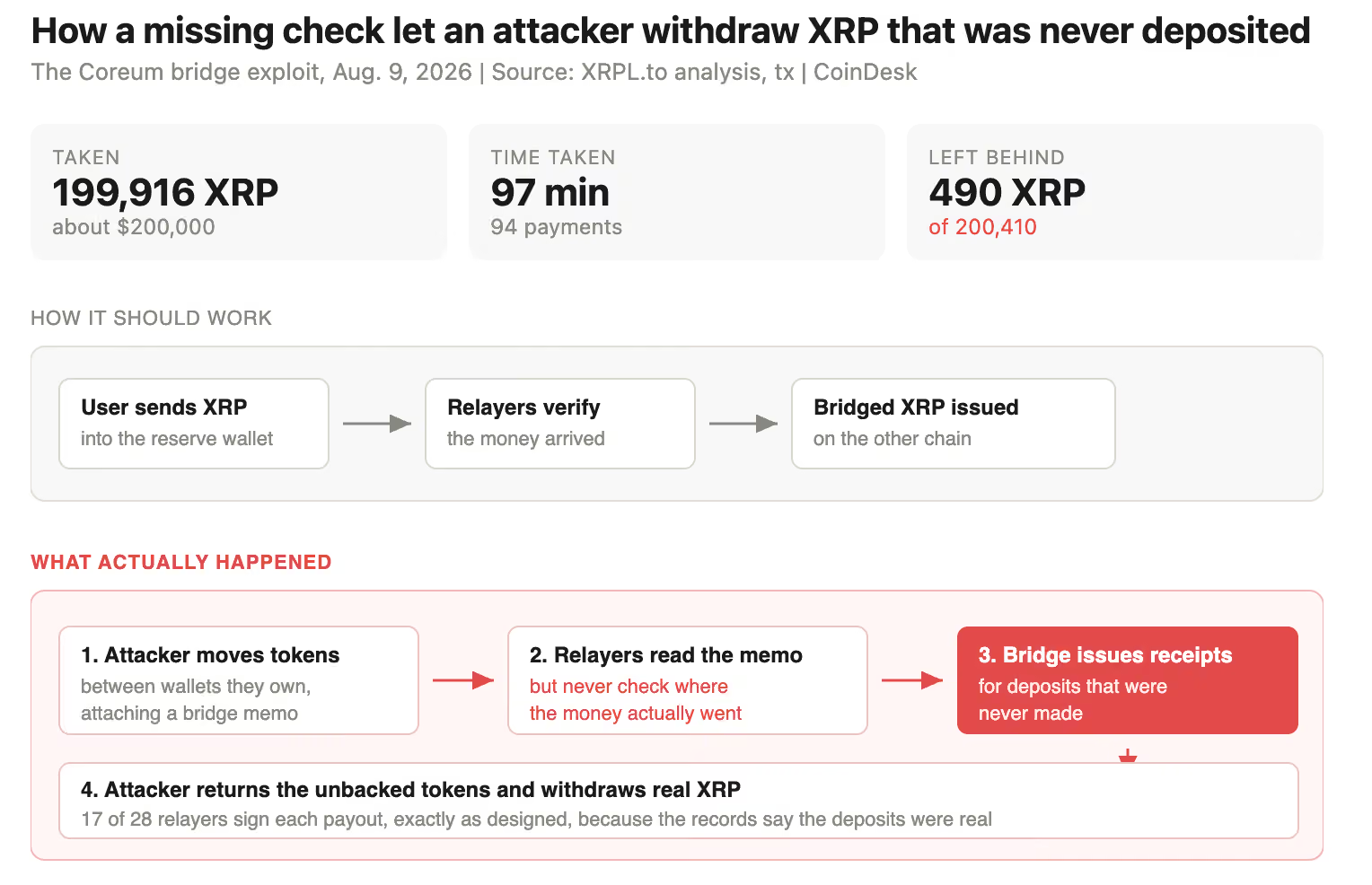
XRP bridge drained after software mistook fake deposits for real ones
-

 Sports5 days ago
DeQuan Jones in ‘high spirits’ after successful leg surgery
-
 Tech4 days ago
11 Ways to Rank Your Videos
-

 Fashion7 days ago
French Rose Gown with Cape Sleeves
-

 Tech4 days ago
DeepSeek Harness launches as open source rival to Claude Code, alongside V4-Pro on API with higher prices
-
 Entertainment7 days ago
Star Wars Officially Continues ‘The Last Jedi’ With a New Spin-Off
-
 Crypto World6 days ago
Perplexity AI Predicts an XRP Scenario Few Analysts Are Discussing
-

 Politics7 days ago
In the Chris Kaba case, the police watchdog capitulated to the mob
-

 Tech6 days ago
SpaceXAI’s Grok Bot turns agents into persistent digital coworkers that can operate your apps for $120-per-month
You must be logged in to post a comment Login