Samsung could be planning an even wider Galaxy Z Fold for 2027. A new report suggests the company is working on a foldable specifically designed to make video viewing more comfortable.
According to ETNews, Samsung has expanded its planned 2027 foldable lineup to five devices. Alongside the expected Galaxy Z Fold 9, Galaxy Z Fold 9 Ultra, Galaxy Z Flip 9 and a new Galaxy Z TriFold, the company is reportedly developing a second wide-format foldable.
Details are still thin, but the key difference could be its display. The report says Samsung is working on a screen aspect ratio specifically optimised for watching video instead of sticking with the 4:3 ratio used by the Galaxy Z Fold 8.
That could mean a noticeably wider display when the phone is unfolded. Samsung hasn’t revealed the exact ratio, so 16:9 or 16:10 are only possibilities at this stage, rather than confirmed specifications.
Advertisement
The idea makes some sense for a foldable. The Galaxy Z Fold 8’s large internal screen is useful for everything from multitasking to watching films. However, its squarer 4:3 shape isn’t an especially natural fit for most widescreen video. A wider panel could reduce the amount of unused space around 16:9 content.
Advertisement
It’s worth stressing that this isn’t necessarily the Galaxy Z Fold 9 itself. ETNews describes the device as a second wide-format model in Samsung’s 2027 range. Meanwhile, specifications and even the final positioning remain unclear. The report does, however, suggest Samsung is looking beyond simply repeating the current Fold formula.
The wider foldable is expected to launch in the second half of 2027 alongside the rest of Samsung’s next-generation foldable lineup.
Advertisement
For now, the Galaxy Z Fold 8 is the device to watch. However, Samsung’s reported plans suggest its foldable strategy could get considerably more interesting next year.
If you have ever wondered why a specific song made its way to a playlist, Spotify’s new Playlist Notes feature is here to help. The feature lets editors and users add context to their songs, podcasts, and audiobook picks.
The feature joins the long line of playlist improvements, including custom cover art, the ability to organize playlists into folders, and smooth transitions between tracks, that make it easier to personalize your listening experience and make your playlists feel more like your own.
What exactly are playlist notes?
Playlist Notes let you attach a quick thought next to any song, podcast episode, or audiobook inside a playlist you made or collaborate on. Maybe a track reminds you of a road trip, or an episode changed how you see something. Now you can share that context without ever leaving the app.
Spotify
The feature grew out of an earlier idea called User Notes, and Spotify’s editors are getting first access. They will use it to explain why a track made the cut on some of Spotify’s biggest playlists, covering everything from the reasoning behind a pick to why it feels culturally relevant right now.
Alongside the notes, you also get Editor Profiles, which show an editor’s favorite tracks and albums, plus every playlist they work on. It’s a fun way to actually know who is picking the songs you’re vibing to.
Advertisement
Where can you find these notes?
Editor notes are currently rolling out to Free and Premium users aged 16 and up in the US, Canada, the UK, Ireland, Australia, and New Zealand. For now, look for them on playlists like Today’s Top Hits, RapCaviar, Hot Country, All New Pop, Mint, and Fresh Finds Hip-Hop.
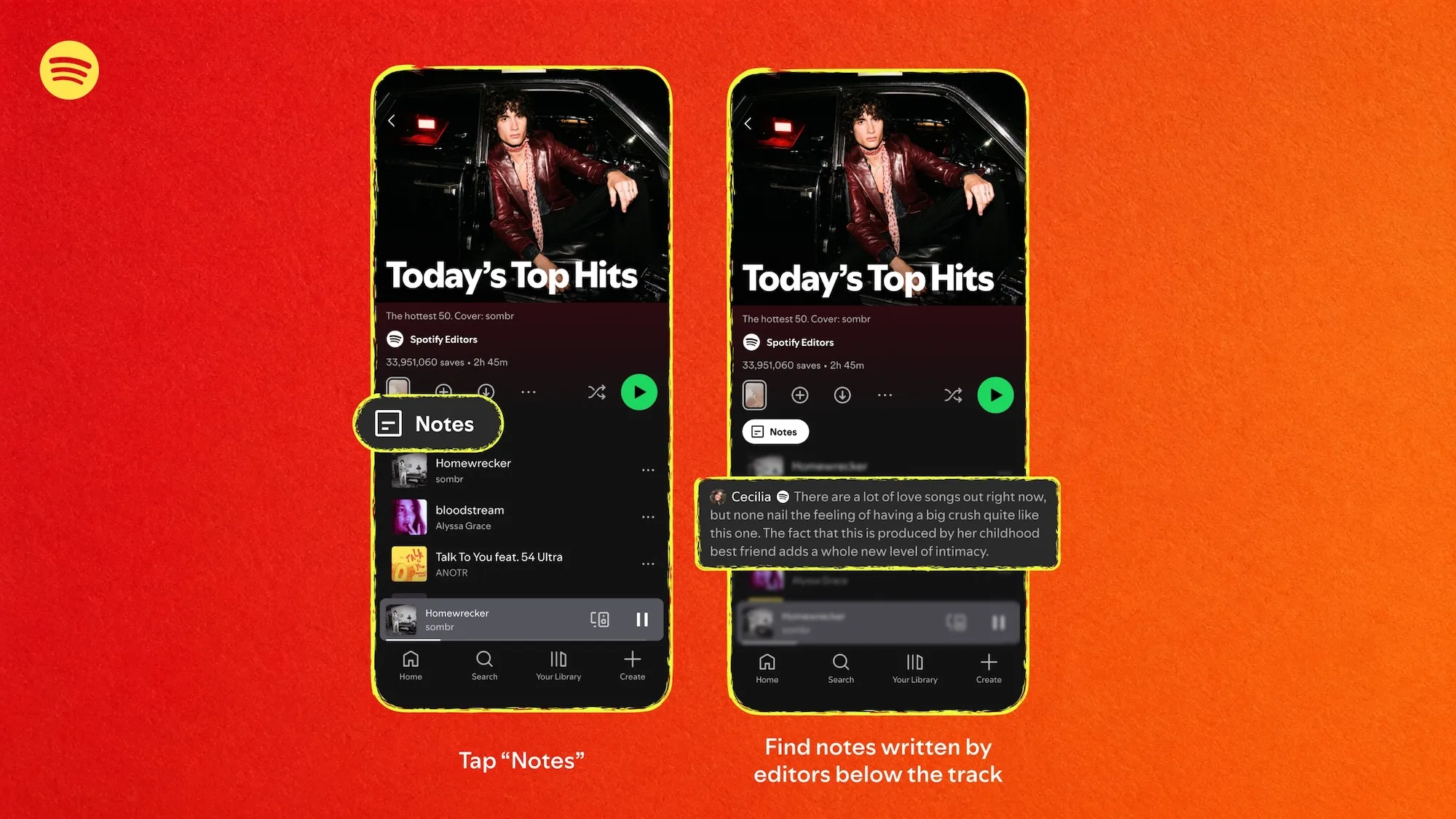
Tap Notes at the top of these playlists to start reading, and tap an editor’s name to browse their profile. You’ll also spot these notes in Now Playing, even when you’re listening outside the playlist where the note first appeared.
Spotify
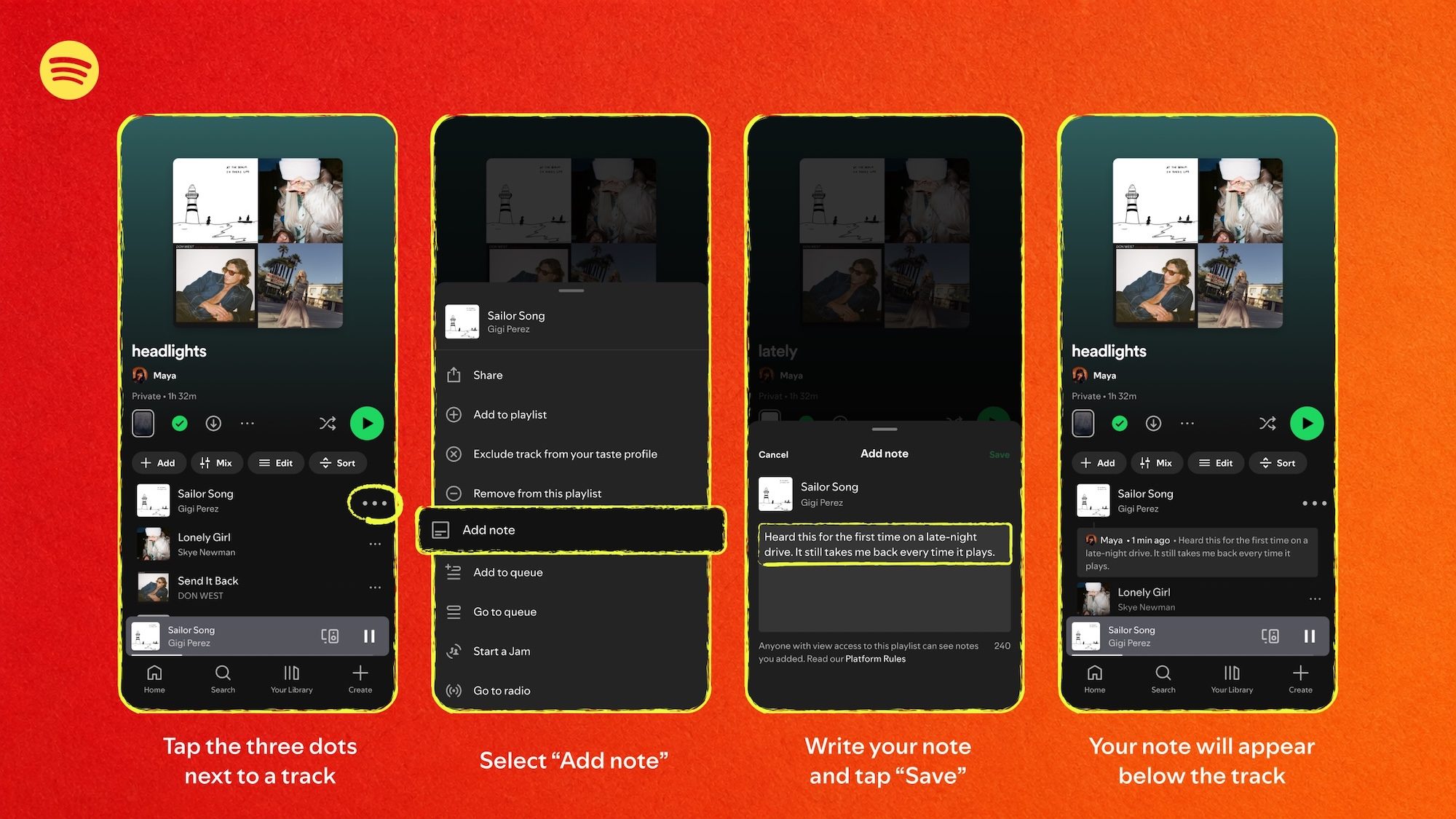
You can also add your own notes. Open a playlist you own or collaborate on, tap the three dots next to a track, and hit Add Note. Just remember that anyone who can view your playlist can also read your notes, so keep that in mind before getting too personal.
Playlist Notes for personal playlists are already rolling out on iOS and Android in over 100 markets, so update your app if you don’t see it yet.
If you are new to Waze, you may have noticed that your account has a level or rank, Baby Waze to be precise. That’s the rank automatically assigned to every new Waze account. As you earn points, you level up, moving to Waze Grown-Up, followed by Waze Warrior, Waze Knight, and finally Waze Royalty, the top level on Waze. To progress through the ranks, you will have to earn points, which is fairly easy. Waze awards points for submitting reports, editing gas types and prices, editing the map, adding photos for a place, updating house numbers and street names, and more. Keep in mind that the points awarded for each of these actions are different. Even if you don’t actively report or make edits, you still earn points for completing a drive.
So what do you do with the Waze points you collect? From a practical standpoint, the points have no utility outside of the app. You can’t use them elsewhere, and they have no monetary value. But within the Waze app, it’s a different story, and that’s what makes users try to earn as many as possible. The more Waze points you collect, the higher you are positioned on the Waze leaderboard. Besides, users who edit the maps get an Editor Rank, which is displayed in the map editor and Waze forums. Waze points are essentially an indicator of digital reputation on the platform.
Advertisement
Earn Waze points by driving and submitting reports
Najmi Arif/Shutterstock
The easiest way to earn Waze points is to use the app while driving; you get five points for completing every drive. Even if you don’t do anything else, simply using Waze for navigation will earn you a few points. However, this passive earning is unlikely to get you very far on the leaderboard or help you quickly rank up. To earn more Waze points, you need to be more actively involved. This includes reporting what you see around you, whether it’s traffic conditions, police sightings, road closures, crashes, blocked lanes, and map issues. You get rewarded six points for every report.
Apart from that, editing available gas types and their prices at a gas station earns you eight points. Of course, to make the edit, you must be at the gas station. Even confirming existing reports by tapping “There” or “Not there” on the screen as you drive earns you two points each time. Similarly, editing the map and adding house numbers gives you three points each. As for updating a place, you get six points the first time, and for every subsequent update that day, you get three points. Among available actions, adding voice reports and uploading photos for places earn you the most points. You get nine points for both.
As you can see, even someone new to Waze can earn a decent number of points by being active. Remember, not every task requires driving. You can submit some reports even when you are not on the road.
Advertisement
What Waze points actually do
DIA TV/Shutterstock
This is where it gets interesting and a little disappointing too. The points you collect on Waze offer no real-world benefits. You can’t use them for purchases or get discounts on subscriptions. Simply put, the points hold almost no value outside the Waze ecosystem. That naturally begs the question: why should someone try to earn Waze points when they hold little value? And the answer is simple.
Waze points are designed to encourage participation because Waze and Google Maps, alongside other navigation apps, rely on user reports like crashes and lane closures to provide real-time information. The points you earn can be seen as an acknowledgment of your contribution. There is also a dedicated Waze leaderboard where you can check the top Waze users globally and across individual regions. It goes without saying that in countries with a larger user base and more active users, you will need to be more involved to earn a top spot on the leaderboard.
Advertisement
All that said, it’s equally important to understand that you don’t necessarily have to try to earn Waze points. Even without them, the app works the same, much like any other navigation app. Also, there are several hidden Waze features that can streamline your experience. The points are more meaningful to those who want to participate more actively. For the rest, these are simply numbers that increase in the background as you use Waze.
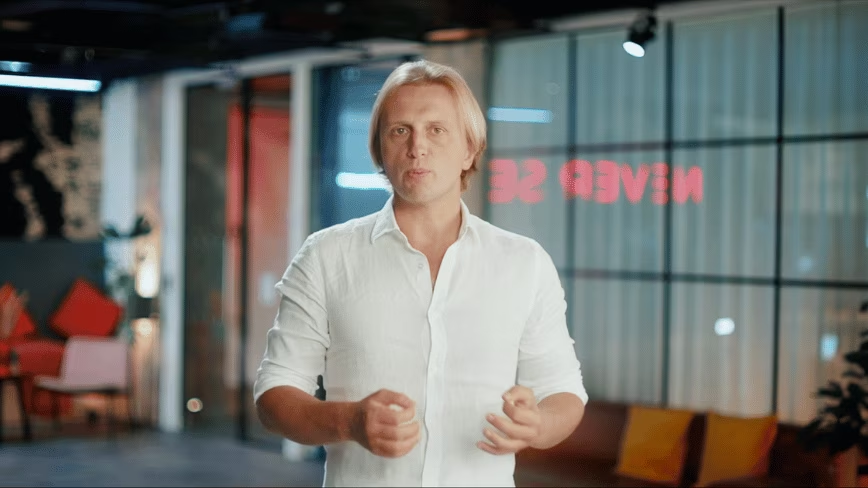
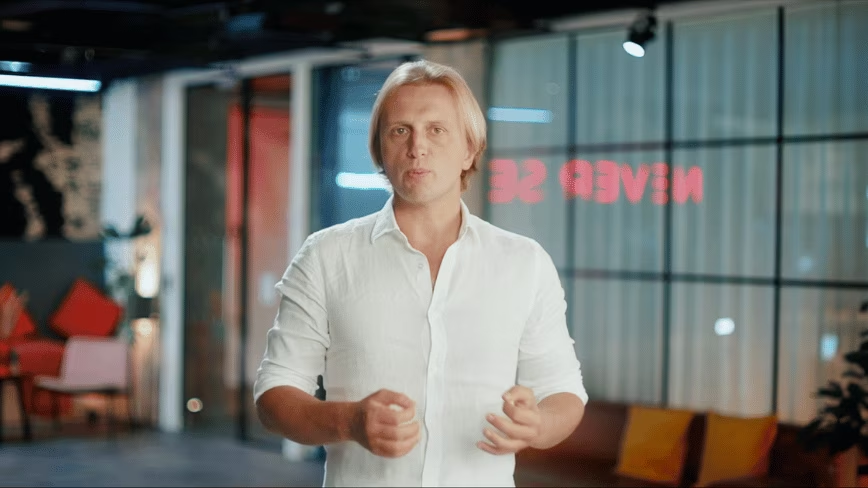
Nik Storonsky, the man behind Revolut, has closed a $500m second fund for QuantumLight, the algorithmic venture-capital firm he co-founded to let software, rather than partners, decide where the money goes.
The fund is double the size of QuantumLight’s $250m debut vehicle from last year, a swift escalation for an outfit still trying to prove that data can out-pick the humans.
Nik Storonsky, whose personal fortune has climbed with Revolut and who is reportedly in line for a vast share award, is the firm’s most conspicuous backer.
QuantumLight’s pitch is a direct challenge to the clubby traditions of venture capital. Instead of a bench of star partners trading on instinct and network, the firm runs a systematic, data-driven model that screens companies at scale and generates investment decisions quantitatively, something closer to a quant hedge fund than a Sand Hill Road partnership.
Advertisement
The approach is of a piece with Nik Storonsky’s reputation as fintech’s most relentless optimiser. He built Revolut into Europe’s most valuable private tech company on a culture of aggressive targets and data over sentiment, and last year QuantumLight published a hiring playbook distilling the management methods behind that rise, a set of blunt tips that read like an operating manual for high-growth companies.
QuantumLight applies the same conviction, that most decisions are better made by system than by instinct, to the business of picking winners.
Doubling the fund in barely a year is a statement of confidence, though whose confidence is the interesting question.
QuantumLight has not detailed its outside backers, and Storonsky’s own wealth gives him ample means to seed his own experiments.
Advertisement
An oversubscribed close suggests limited partners are buying the thesis too, wagering that algorithmic sourcing can surface growth-stage companies that traditional funds overlook, and that the model deserves twice the firepower after a single year.
QuantumLight’s first fund is only a year old, far too young to have produced the exits that would show whether the machine actually beats the market, and venture returns take the better part of a decade to judge.
Plenty of firms have promised to “quant-ify” venture capital before, and the discipline’s best returns still tend to come from a handful of outlier bets that are notoriously hard to model, precisely because they look unreasonable at the moment they are made.
Still, the timing is apt. As AI reshapes every knowledge industry, the people who allocate capital are hardly exempt, and a wave of funds now claim to use machine learning to source deals, score founders and time markets.
Advertisement
QuantumLight is among the most committed to the idea, and the most credibly funded, which makes its record a useful test case for whether software can genuinely industrialise a trade that has always prized taste and relationships over spreadsheets.
There is also the matter of a chief executive’s attention. Storonsky is steering Revolut through a pivotal stretch, having lately won a French banking licence and pushed into business banking, with an IPO reportedly a couple of years away and likely to list in the US, all while running a second act in venture capital.
Founders are rarely one-company people, but the split focus is the kind of thing Revolut’s eventual public-market investors may come to weigh.
For now, $500m is a serious sum with which to test a serious idea: that the qualities venture capitalists have always sold, judgment, instinct, a good eye, can be replaced, or at least bettered, by code.
Advertisement
If Nik Storonsky is right, QuantumLight will look prescient. If he is wrong, it will be an expensive reminder that some bets resist being reduced to a model. Either way, the experiment has just doubled in size.
In context: A new Mac Mini assembly line at Foxconn’s Houston facility is expected to begin production later this year, expanding Apple’s US manufacturing footprint for AI-related hardware. The project is part of Apple’s effort to increase domestic production while continuing to rely on contract manufacturers and an international supply chain.
The line will operate in a new 170,000-square-foot space at the plant, which already makes AI servers for Apple. Foxconn is funding the assembly-line buildout, while Apple has committed to purchasing the products made there.
The Mac Mini has seen stronger demand over the past year, particularly among customers using the compact desktop to run AI models at home. Its planned Houston production also comes after Apple discontinued the Mac Pro, which was assembled in the US at a Flextronics plant that President Trump visited with Apple CEO Tim Cook in 2019.
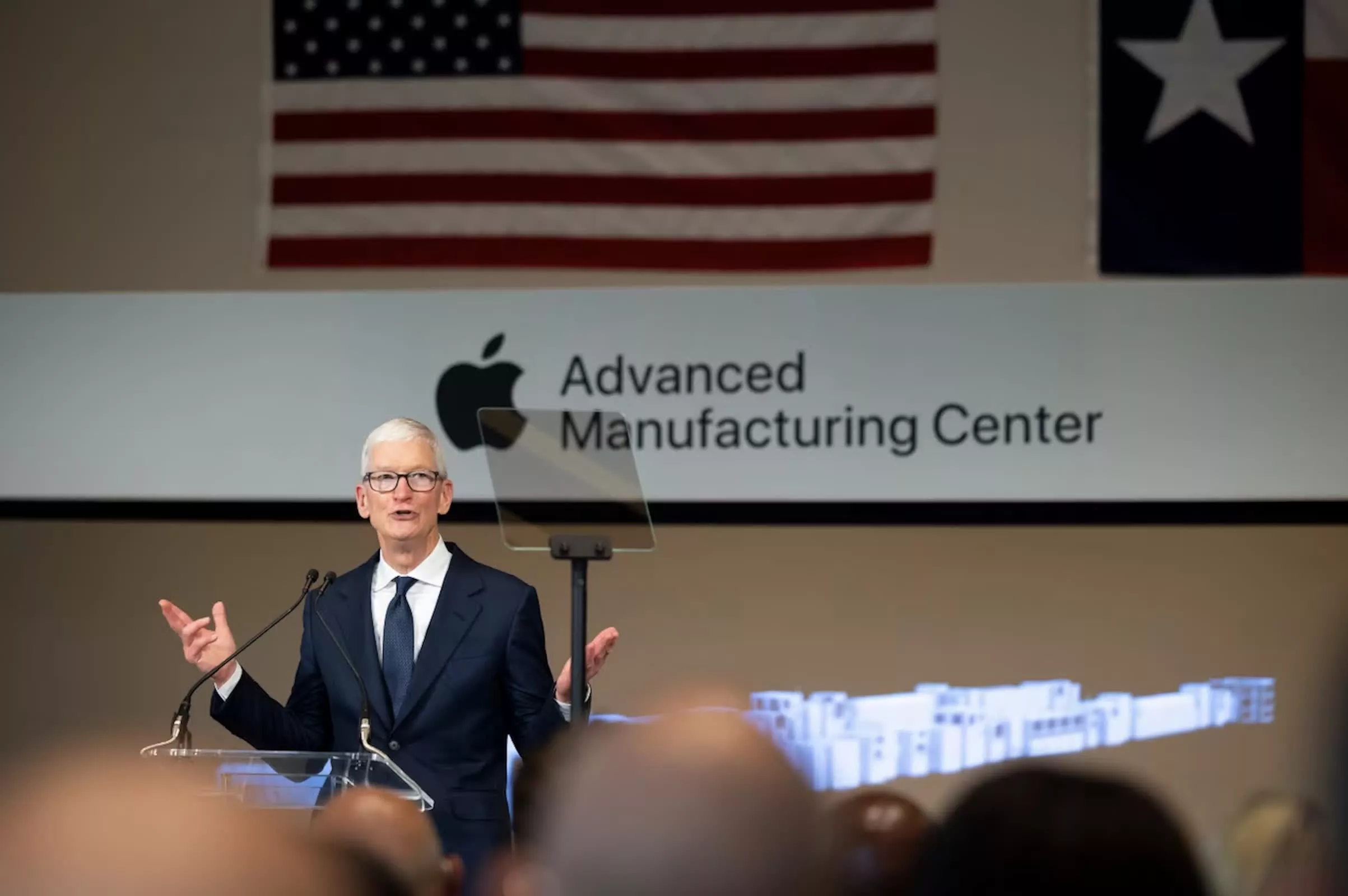
Cook and Commerce Secretary Howard Lutnick toured the Houston site last week. The visit included a new manufacturing school that Apple is opening to provide hands-on training for small and midsize US companies. Apple previously launched a classroom-based manufacturing program in Detroit.
Advertisement
“Advanced manufacturing is where the puck is going,” Lutnick told workers taking an Apple manufacturing course. “The problem is we need to train Americans.”
Cook said Apple’s US investment plans reflect its broader commitment to domestic production. “We believe in the promise of this nation and we’re proud to put our money where our mouth is,” he said in a speech.
Apple’s investment strategy relies heavily on its purchasing power rather than on building and owning factories. The company’s capital spending remains far below that of Amazon, Microsoft, and Google, which have made major investments in AI infrastructure and semiconductor capacity. Apple’s total capital expenditures since 2023 are less than what each of those companies spent in its most recent quarter.
That model is evident in Houston. Foxconn is paying to build the production lines, while Apple is supporting the project through product orders. The arrangement preserves Apple’s long-standing reliance on manufacturing partners while allowing it to use its supply-chain scale to influence where production and component sourcing take place.
Advertisement
Apple has made similar commitments in semiconductors. The company is among the businesses that have agreed to buy chip wafers from TSMC’s Arizona plant, a project expected to cost more than $200 billion. Apple has also reached a preliminary agreement for Intel to manufacture some of its device chips and said it plans to spend $30 billion on US-made chips from Broadcom.
The company has pledged to invest $600 billion in the US over four years. The total includes spending already planned for its American business, including employee pay, retail and corporate operations, and purchases from domestic suppliers.
The administration has encouraged Apple to expand its US manufacturing operations. President Trump has pressed the company to make iPhones domestically, but Apple has not announced such plans. Instead, it is expanding iPhone assembly in India.
The Houston event was among Cook’s final public appearances as Apple’s chief executive. He is expected to become chairman next month, with John Ternus, Apple’s longtime hardware engineering chief, expected to succeed him as CEO.
Microsoft says some users are experiencing issues searching in Microsoft 365 apps, including Outlook on the web, Outlook desktop, SharePoint Online, and OneDrive.
According to an incident report seen by BleepingComputer and tracked under MO1456424 in the Microsoft 365 Admin Center, the root cause is what Microsoft describes as a recent deployment that causes resource utilization problems.
“Impact is specific to some users served through the affected infrastructure who are attempting to search for content in SharePoint Online, OneDrive, Outlook on the web, or Outlook desktop,” Microsoft said.
“Our investigation identified that a recent deployment introduced a resource utilization inefficiency issue, leading to impact.”
Microsoft says it has already developed a fix and deployed it to reduce resource pressure and restore service for all affected Microsoft 365 users.
Advertisement
While the company has yet to share which regions were impacted by this outage, it tagged it as an incident, which usually describes a critical service issue with noticeable user impact.
On Monday, Microsoft resolved another incident that brought down GitHub, its website, the API, and many other services for more than eight hours, with users reporting server errors when trying to access GitHub, while others encountered problems loading commits, repositories, and Pull Request pages.
Advertisement
Overall prevention scores can hide what happens after initial access. Once attackers are using valid credentials, prevention drops sharply.
The Blue Report 2026 measures defenses technique by technique across 338 million simulations run in customer production environments.
As global supply chains remain exposed to geopolitical and climate uncertainty, retail and consumer packaged goods (CPG) businesses face challenges of fluctuating prices and demand. In the United Kingdom, supply chain volatility is adding to uncertainty in raw material and packaging costs to impact CPG companies’ production economics.
Research has found that a huge majority of British retailers were not confident of scaling up their supply chain operations to meet the expected increase in consumer demand. In fact, 43% of retail leaders ranked supply chain issues among their top three business challenges in 2025, highlighting widespread concern over operational capacity in the face of rising demand and cost uncertainty.
Ambeshwar Nath
EVP & Industry Head (EMEA) for Consumer Goods, Retail & Logistics at Infosys.
Retail and CPG businesses can address these problems by modernizing fragmented and often inflexible systems to improve data visibility, analysis and automation across their supply chains.
Latest Videos FromTechRadar
Advertisement
Artificial Intelligence (AI) and Machine Learning (ML) technologies are imperative to this agenda: packing powerful capabilities – including data integration, automation, demand sensing and intelligence – AI and ML are redefining retail and CPG operations by enabling seamless, autonomous ecosystems.
Connected platform to satisfied customer
Connected supply chains provide transparency to allow organizations to manage operations and inventories in real-time to improve stock allocation and ordering efficiency.
Intelligent algorithms also analyze vast and varied data – from historical sales and seasonality to weather, social media trends and local events – to accurately forecast demand, preparing supply chains for changing ordering patterns.
Forewarned, businesses can rapidly adapt production and distribution strategies in case of a surge in demand or supply disruption. AI and ML automate a variety of supply chain tasks to speed up processes, reduce errors and save costs. Ensuring product availability at all times, retailers and CPG companies in the U.K. can look forward to greater customer satisfaction and loyalty.
Sign up to the TechRadar Pro newsletter to get all the top news, opinion, features and guidance your business needs to succeed!
Advertisement
Real-time, for responsiveness and resilience
Real-time insights are critical to supply chain operations. Live data from Point of Sale systems, ecommerce platforms, etc. provide up-to-date insights into customer preferences and behaviors to improve demand forecasting and also allow companies to dynamically adjust stock levels across warehouses and stores to meet sudden demand.
Real-time analytics solutions highlight product performance by region, channel and even outlet, enabling retailers to optimize assortments and launch targeted promotions. By providing continuous visibility into the supply chain, AI allows CPG companies to anticipate demand shifts and disruptions to curtail risk and maintain supply chain resilience.
Precise prediction drives product fulfilment
AI and ML platforms have superior predictive capabilities: they go beyond general demand forecasting to predict exactly what customers want, and when, and can even proactively trigger replenishment orders before stocks run out. Algorithms are not only more efficient at spotting patterns and making projections than traditional analysis, but are even capable of adjusting forecasts based on micro-trends.
Advertisement
By enabling CPG and retail companies to ensure that the right product is at the right place at the right time, AI and ML mitigate loss of sales due to stockout; save labor, warehousing and other costs; and improve product availability across physical and digital channels, leading to superior customer experience.
The future is autonomous
Agentic AI-powered autonomous supply chains are taking operational efficiency and customer engagement to new heights by anticipating demand, optimizing inventory, and orchestrating various tasks with little or no human intervention.
Advertisement
Autonomous systems meet the digital consumer’s expectation of frictionless, enjoyable experiences by personalizing product and delivery options and continuously optimizing logistics and transportation routes to allow faster/ on-time delivery.
Upon anticipating a delay, AI agents can take proactive measures – rerouting a shipment or suggesting an alternative supplier, and updating customers about the status of their orders to avoid frustration. By enabling full traceability to allow customers to track their orders any time, autonomous supply chains build trust and engagement.
Last but not least, by optimizing inventory and logistics operations, autonomous supply chains reduce waste and energy consumption, and support ethical sourcing through clear visibility. Agile, proactive, and sustainable – that is what the future of retail and CPG supply chains looks like.
This article was produced as part of TechRadar Pro Perspectives, our channel to feature the best and brightest minds in the technology industry today.
The views expressed here are those of the author and are not necessarily those of TechRadarPro or Future plc. If you are interested in contributing find out more here: https://www.techradar.com/pro/perspectives-how-to-submit
Facepalm: Over the weekend, many Australian shoppers found their Mastercard payments declined mid-purchase. The US-based company confirmed the issue Saturday and says its network is now back to normal. While the disruption technically hit Mastercard’s global network, it was felt most acutely by shoppers in Australia.
An undisclosed number of Australian customers were unable to pay with their cards during Saturday’s shopping trips. As reported by ABC, Mastercard quickly identified the cause of the new outage: a scheduled system update that went wrong, triggering declined transactions for a period of several hours.
The situation was resolved by the end of the day, Mastercard said, though the company hasn’t shared specifics about what the update was actually meant to do.
During the outage, many shoppers found themselves unable to complete purchases with a Mastercard-issued credit card. ABC reports that some shoppers tried backup cards without luck, and were ultimately forced to leave their carts behind and head home for cash. By the time they returned, the outage had already cleared and payments were working normally again.
Advertisement
According to Downdetector data, the outage left a clear mark on Saturday’s shopping activity. Reports of card issues climbed past 1,700 by 3 pm, then fell back to 173 a couple of hours later. Most complaints centered on fund transfers and mobile banking, though cash withdrawals and Apple Pay were affected, too.
Anyone living inside a digital, networked economy knows all too well how disruptive a systemic outage can be. Payment processors like Mastercard and Visa sit at the center of that infrastructure, and they’re routinely criticized for becoming unreliable at the exact moment people need them most.
In light of the infamous CrowdStrike incident a couple of years ago, banking organizations warned that total dependence on “digital money” and payment processors is a disaster waiting to happen. Another massive CrowdStrike-scale event could bring a cashless society to a standstill, they argued, which is why physical cash should still play a meaningful role in today’s economy.
This weekend’s Mastercard incident lends some weight to those warnings. In a worst-case scenario, the next global outage could carry far heavier consequences. And honestly, I’d almost forgotten what cash is even like.
If you’re still talking about ‘DirSync’ or ‘Active Directory’ instead of ‘Entra’, and need to explain why, this is the site for you
If you’re struggling to stay up to date with Redmond’s regular product re-branding exercises, here’s the site for you: The Microsoft Rebrand Registry.
Microsoft Most Valuable Professional (MVP) Loryan Strant created the site because he thinks it’s a valuable resource, and also in the hope it makes visitors “chuckle.”
Advertisement
Readers may remember that Strant has also created the site Let Me Correct That For You, which lists the exact names of Microsoft products – an effort he told The Register he thinks is useful because Microsoft in its wisdom uses Camel Case for names like PowerPoint but went with conventional capitalization for Copilot.
Strant told The Register that the Rebrand Registry came about after some banter between himself and other MVPs, during which the topic of Microsoft’s many product name changes came up. He decided to do something about it.
The site lists 72 Microsoft products and 158 names they’ve had over the years.
Advertisement
It also includes some analysis of Microsoft’s branding, which sees a product’s name survive for an average of two years and eleven months.
The site lists eight products that have gone through three name changes:
· Azure AI Search
· Azure App Service
Advertisement
· Azure DevOps
· Azure SQL Database
· Foundry Tools
· Microsoft 365 Copilot app
Advertisement
· Microsoft Configuration Manager
· Microsoft Defender for Endpoint
Strant has even had a go at predicting which Microsoft products are likely to get a new name soon, by considering the amount of time the current name has applied, prior names, and the frequency with which Microsoft changes names of products in the same family.
That methodology led him to suggest an “elevated” likelihood of name changes for the Azure App Service, Azure SQL Database, Azure DevOps, and Microsoft Dynamics 365 Field Service.
Advertisement
The site considers surviving products only, and Strant admits his analysis is therefore biased towards product Microsoft still publishes. He also pointed out that he’s not decided how to handle successor products, for example when Microsoft discontinued Skype for Business and put similar functions into Teams.
Strant said he created Let Me Correct That For You using WordPress, while his Microsoft logo library grew out of a OneDrive folder and relies on a GitHub repo.
For the Rebrand Registry, he used vibe coding tools.
“I have my own harness that lets me custom-build things,” he explained, adding that he rigorously validates data rather than relying on AI tools to get facts right.
Advertisement
Strant said most of the feedback he gets about his sites is positive, either on LinkedIn or during face-to-face meetings at events. He’s heard that Microsoft people appreciate his efforts because Redmond hasn’t preserved the same data his sites record.
“I hope that people find them useful, and get a chuckle,” he said. ®
The reality for many organizations is that their employees are already being deceived. So, probably are their customers, their investors, and their board.
For years, the warnings have focused on the impact of deepfakes, such as fake CEOs on video calls, cloned voices authorizing payments, and fraudulent emails.
The tactics themselves are not new, but over the past few years, AI has made them cheaper to produce, harder to spot, and far more convincing within the ordinary flow of business.
Advertisement
Latest Videos FromTechRadar
Tony Fergusson
CISO in Residence, Zscaler.
Advertisement
It’s this trend that means that the principle of Zero Trust is becoming as relevant to how information is treated as it has been to access.
In cybersecurity, Zero Trust starts from a simple assumption: no user, device, application or request should be trusted by default.
In the age of AI-generated misinformation, businesses need to apply that same mindset to the information that moves throughout their organization.
Advertisement
The new trust crisis
Employees, customers, investors and partners are all making decisions based on what they see, read and hear. If that information is false, manipulated or stripped of context, the consequences can move quickly from confusion to commercial damage. Which is why misinformation, disinformation, and malinformation need to be treated as business risks.
Sign up to the TechRadar Pro newsletter to get all the top news, opinion, features and guidance your business needs to succeed!
Misinformation – the false content that spreads without deliberate intent – has always been an issue. Disinformation, constructed specifically to deceive, is now easier to manufacture at scale than ever before. And malinformation – true information, often deliberately stripped of context and weaponized – might be the most insidious of the three. A competitor, a criminal group, or an activist campaign no longer needs to breach a network to cause serious damage. They can influence those associated and concerned with an organization simply by shaping what those people see and believe.
Advertisement
What makes this particularly difficult for businesses is that it mirrors something individuals are already struggling with. In an environment saturated with AI-generated content, the habits that people must employ to protect themselves – pause before reacting, questioning the source, verifying before acting – are the same habits that organizations must build into how they operate.
Essentially, the instinct to trust has become a vulnerability. And addressing that requires something closer to a structural response than an awareness campaign.
Advertisement
The importance of verified trust
This is where Zero Trust becomes the strategy. Traditionally, organizations have thought about Zero Trust through the lens of least privilege, ensuring that the right users have access to the right applications, and nothing more. But in an AI-driven information environment, that principle needs to evolve. Businesses can no longer focus just on who is requesting access. They also need to interrogate what information is being used, what action is being taken, and whether the intent behind the action can be trusted.
The next stage is going beyond authentication and investigating authenticity, and asking questions such as “Is this information verified?”, “Is this image real or AI-generated?”, and “Has this content been edited?”. Zero Trust gives businesses a framework for answering those questions. It forces organizations to verify before they act, limit exposure where they can, and reduce the risk of false, manipulated, or decontextualised information moving unchecked through the business.
Standards bodies such as the C2PA (Coalition for Content Provenance and Authenticity) show the direction that this is heading: a future where provenance and integrity are embedded in digital content itself, the same way a padlock in a browser indicates that the connection is secure. Essentially trust won’t be something that businesses need to check for, rather it will be something that travels with the information as provenance feeds verifications. Every piece of content therefore becomes a signal in a continuous trust decision.
Advertisement
Developing Trust in the agentic era
The need to trust intent has become even more pressing as AI agents enter the workplace. These agents will increasingly operate like another person working alongside us, mirroring our behaviors, such as reading documents, interpreting data, making decisions, and acting. The difference, however, is that these non-human identities are moving at machine speed, where human-speed verification has no hope of keeping up.
That means AI agents must be governed through a Zero Trust model from the outset. An agent should not be trusted just because it sits inside the enterprise, has been approved by a user, or is connected to corporate systems. Its identity, permissions, behavior and outputs all need to be continuously validated. Just as importantly, agents should be governed by least privilege, the principle of least information, and least function, granting only the minimum access, data, and capability required for a specific task.
However, these agents create a trust challenge that identity management alone can’t solve. Businesses will need to know whether they are dealing with a human or a machine, whether an agent is behaving responsibly, and whether its actions reflect an organization’s values and boundaries. Effectively, businesses will need to adopt an operating constitution that agents are continuously measured against.
And in this AI era, enterprises must interrogate information, content, intent, behavior, and action in realtime and continuously as identity is generally just checked as front door access. However, given the scale of the task at hand, it will take AI to audit, flag, and govern as needed and keep the chain of trust intact.
Advertisement
Engineering trust into the business
The organizations that succeed will be those that treat trust as something to be engineered, rather than assumed. Misinformation, disinformation, malinformation are security, resilience, and leadership challenges, and AI is making them harder to ignore.
As technology continues to shape how information is created, shared, and acted upon, businesses need to build the same discipline around authenticity that they’ve always applied to access. That means verifying content, questioning intent, and limiting what AI systems can do to what they actually need to do.
Trust can no longer be the default setting. Instead, in today’s operating environment, it must be a decision that’s made continuously, at machine speed, across information, intent, behavior, and action. The good news is that the framework already exists in Zero Trust. What needs to change however is how organizations apply it, broadening the scope to include information, intent, behavior, and action.
This article was produced as part of TechRadar Pro Perspectives, our channel to feature the best and brightest minds in the technology industry today.
The views expressed here are those of the author and are not necessarily those of TechRadarPro or Future plc. If you are interested in contributing find out more here: https://www.techradar.com/pro/perspectives-how-to-submit
In 1963 a kit of red and white polystyrene plates, stiff metal rods, rubber bands, and short plastic tubes sold for $4.99 ($54.45 today) and assembled into a working digital computer. Three small windows on the front face displayed binary digits as either 0 or 1. A white lever marked “Clock” stuck out from the right side. Pushing that lever fully inward and then drawing it back out advanced every calculation by one step. No batteries or power cord were required. All motion came from the user’s hand and the tension stored in the rubber bands.
E.S.R. Inc., a small company founded by three engineers who originally intended to produce electronic computing equipment, release the kit as a side project to create quick cash. Instead of being a one-hit wonder, the Digi-Comp 1 sold out faster than anyone could keep up. Over 100,000 units were sold, with some estimating it could have been as many as 250,000. For a period, the number of Digi-Comp 1s was actually greater than the number of true electronic computers in use. At least in the middle of the 1960s. Eventually, the business chose to move its focus to more… traditional toys, and Digi-Comp 1 would remain in production for a little longer. It remained in production until the early 1970s.
[Ultra-Compact Mini PC: 25% Faster Single-Core] Measuring just 4.6 x 4.4 x 1.35 inches, this space-saving small pc fits seamlessly into any office…
[Dual-Channel RAM & NVMe SSD Expandability] Pre-equipped with 8GB DDR4 RAM and a fast 256GB NVMe SSD to supercharge your daily productivity. Unlike…
[48EU Intel UHD Graphics: Double the EUs of N5095/N95] Features Intel UHD Graphics with 48 Execution Units (EUs)—double the graphics cores of…
You assemble the device by slapping the base plate down and joining the upright supports in one seamless action, with no tools required. Then you add three horizontal bars that can move in any way because they can lock into either of two spots that you’d intuitively associate with binary 0 or binary 1, and those three bars may represent any number between 000 and 111, or, in more common terms, 0 to 7. Six thin rods now run along the front of the machine, with another six going along the back. Along the front, there are little tubes that you put onto tabs, and on the back, there are tubes that you fit onto the appropriate tabs. The arrangement of the back tubes dictates which rods can move and which cannot during a single clock cycle.
Now, the front rods serve as logic sensors, and depending on the condition of those three sliding bars, they will either drop or remain held up. The back rods are your actuators. So, if a rear rod swings free, it can push the bar from 0 to 1 or 1 to 0, as long as the right tube is in place. The rear rods with odd numbers reset to zero, while those with even numbers reset to one. Rubber bands keep the rods taut, allowing them to snap back into position as soon as an obstructing tube is relocated or a passage opens.
When you draw the lever all the way in and secure the logic rods, you complete a full clock cycle. Any rod that is not blocked by a front tube then connects to the corresponding rod on the back. Then, on the way back out, those free rear rods spring into action, shifting the sliding bars to whatever position is required by where you’ve placed the tubes. By the time the bars have set, the overall pattern of what is blocked and what is not has changed, making it ready for the next cycle. That’s all there is to it, because the machine’s current state totally controls its next state. In other words, it is a three-bit finite-state machine.
Users rummaged through the large instruction booklet to find tube arrangements that really worked. One fairly conventional configuration transformed the machine into a binary counter that counted up from 000 in a smooth, step-by-step manner, 000 to 001, then 010, 011, and so on all the way up to 111 until eventually counting down to 000 again. Other layouts became more fascinating, as you could combine two numbers, subtract one from another, move bits left or right, or just flip the entire value on its head. You could also use it for simple multiplication and comparisons. The kit featured a clever little plastic bit that allowed you to create “or” situations and solve some interesting challenges. People were able to encode games like Nim so that the machine would enforce the rules and vary the outcome depending on the starting position.
The results appeared immediately in the three front windows when the bars were clicked into place. The documentation that came with the tube layouts included not only the charts for how to set up the tubes, but also the fundamentals of binary counting and Boolean logic, all explained in a way that a 12-year-old could grasp. Many people who received a Digi-Comp 1 as a present later claimed that it was the first gadget to make abstract rules feel real and concrete. The tangible “click” of the bars moving and the rods shifting in front of you was extremely effective in demonstrating cause and consequence in a manner that a simple diagram cannot.
































































You must be logged in to post a comment Login