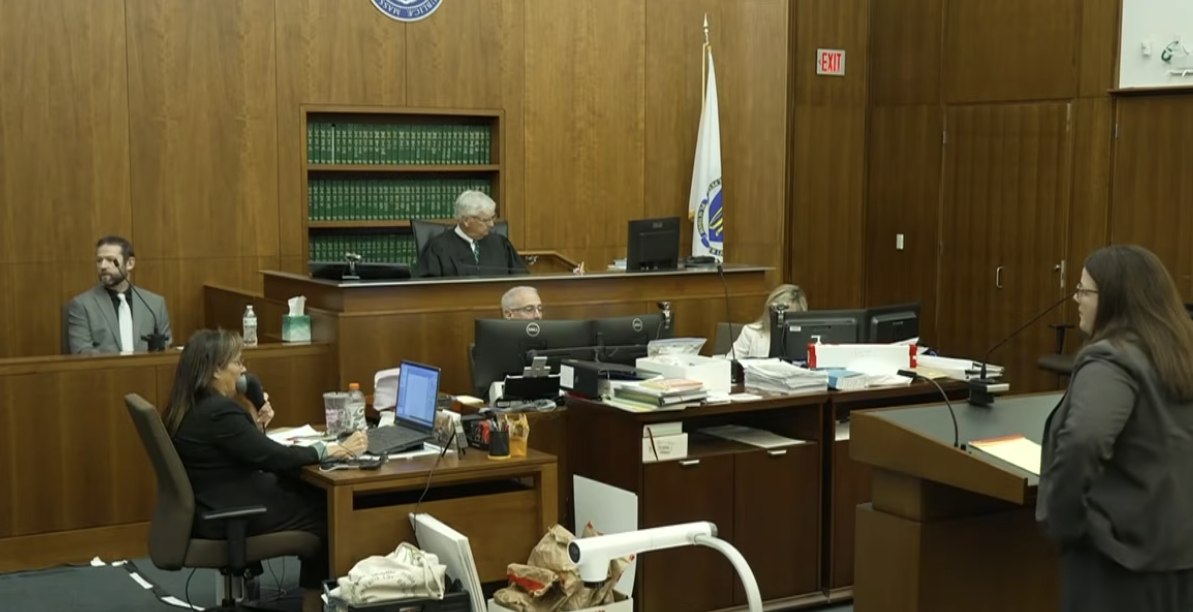
PLYMOUTH, Mass. — As the murder trial of Lindsay Clancy continues in Plymouth Superior Court, a series of witnesses spanning her family, her former nanny, first responders and her treating psychiatric providers have offered a detailed picture of her mental health decline in the months before she killed her three children in January 2023.
Clancy, 36, has admitted to strangling her children — Cora, 5; Dawson, 3; and 8-month-old Callan — at the family’s Duxbury home. She has pleaded not guilty to three counts of first-degree murder. Her attorneys argue she was not criminally responsible for the killings because she was experiencing postpartum psychosis, a rare mental illness linked to the stress, sleep deprivation and hormonal changes that can follow childbirth. Prosecutors contend she planned the killings and bears legal responsibility for them.
Clancy’s former mother-in-law, Susan Clancy, a former labor and delivery nurse, was among the most recent witnesses to testify, telling the court that her former daughter-in-law was “begging for help” with her postpartum mental health in the months before the killings. Susan Clancy said she helped connect Lindsay Clancy with treatment through South Shore Health’s Perinatal Behavioral Health Program, describing her as experiencing “insomnia,” “losing her appetite” and being “very anxious and sad.” She contrasted that behavior with how Lindsay Clancy had previously presented as a mother. “She was very nurturing, very loving,” Susan Clancy said.
Patrick Clancy, Lindsay Clancy’s ex-husband, was the trial’s first witness, testifying over two days beginning July 27. He described a sharp decline in her mental health following the introduction of a new antipsychotic medication after their third child’s birth, describing it as a “big spiral.” He said she had described “thoughts of hurting the kids or them having some sort of ailment,” though he added she never indicated an intention to actually harm them. Regarding the morning of the killings, Patrick Clancy said Lindsay Clancy “was playing with the kids, and she seemed in a good mood,” adding, “She was having one of her best days.” He recalled his last image of his son, Dawson, sitting on the couch eating chicken nuggets and green beans, before Lindsay Clancy asked him to leave briefly to pick up takeout food and medication. He testified that no one had told him his wife should not be left alone with the children. “I didn’t know what psychosis was until after this happened,” he said. Describing her prescribed medications, he said, “The idea was that it would help with sleep, but she didn’t get better. She got worse.”
Ten first responders who arrived at the Clancy home testified on July 30, describing a chaotic scene. Officers Stephen Hall and Brian Josephine said they initially focused on Lindsay Clancy, who was found drifting in and out of consciousness after jumping from a second-floor window. Patrick Clancy, after alerting the dispatcher, discovered his children in the basement, telling officers, “I can’t wake them up — I can’t get them up!” Only Callan had a faint pulse when officers reached the children, according to Josephine. Duxbury fire supervisor PJ Hussey, who arrived as Patrick Clancy was removing an exercise band from his child’s neck, described the scene turning “very chaotic very quickly.” Firefighter and paramedic Jennifer Stratton testified she began chest compressions on Callan, but he never regained a pulse.
The family’s former nanny, Elaine Rossi, who worked for the Clancys from September to December 2022, testified that Lindsay Clancy lost weight, could not sleep and disclosed significant mental health struggles, even as she remained attentive to her children. Rossi said she saw prescription medicine bottles in the home and that Lindsay Clancy had confided she had postpartum depression and had begun sleeping in the basement. Despite these observations, Rossi said she never feared Lindsay Clancy posed a danger to her children or herself. “I observed a wonderful mom who loved her kids,” Rossi told jurors. “She was concerned about their safety, and Callan eating and sleeping. She was a wonderful mother.”
Members of Clancy’s psychiatric care team also testified regarding her treatment in the months before the killings. Psychiatric nurse practitioner Rebecca Jollotta and psychiatrist Dr. Jennifer Tufts, both later named as defendants in separate malpractice lawsuits filed by Lindsay and Patrick Clancy, described a treatment period during which Clancy was prescribed nine psychiatric medications, eight of them within a single three-week span, according to the lawsuits. Jollotta testified that Lindsay Clancy wrote to her through a patient portal in December 2022, stating, “I started having very intrusive thoughts that I never had before.” Jollotta said Clancy reported “persistent, intrusive thoughts of suicide” around that time but had not disclosed a specific plan to harm herself or her children, and did not show signs of psychosis or mania during their interactions. Tufts, who treated Clancy through 25-minute video appointments from September 2022 through the children’s deaths, faced pointed cross-examination from defense attorney Kevin Reddington, who described her clinical approach as that of a box-checking “robot.” Asked how she responded when Clancy reported feeling hopeless two months before the killings, Tufts said she told her there was hope and that additional treatments and programs were available.
Dr. Donald Condie, a clinical and forensic psychiatrist retained by the defense who reviewed Clancy’s medical records without treating her directly, testified that psychosis “just means a lack of understanding of what’s real as opposed to what is not,” and can involve both delusions and hallucinations. He pointed to records showing Clancy reported dissociation, brain fog and auditory hallucinations in December 2022, the month before the killings, symptoms he said may indicate her providers missed signs of postpartum psychosis. Asked by Reddington whether dissociation could signal postpartum psychosis, Condie said Clancy had reported “all those” symptoms.
Clancy’s mother, Paula Musgrove, and sister, Allison Ozga, also testified regarding her declining mental state. Musgrove said the combination of medications Clancy was taking “was pretty much just destroying her mind, and it wasn’t her,” recalling her daughter telling her, “This isn’t me. I just want to feel better, and enjoy my kids again.” Jurors were shown text messages between the two, including one in which Clancy wrote, “Mom, will you please come up and stay with me for a bit? I’m really sick. Something is wrong.” Musgrove also testified that her daughter disclosed having “thoughts of harming the children” in the month before the killings. Ozga testified that in late December, Clancy told her she had experienced suicidal thoughts every day for a month.
As the trial continues, jurors are being asked to weigh extensive testimony regarding Clancy’s documented mental health decline against the prosecution’s argument that she retained the capacity to plan and carry out the killings, a determination that will ultimately shape whether she is held criminally responsible under Massachusetts law.
This story discusses suicide, postpartum mental illness and violence toward children, which can be distressing subjects. If you or someone you know is struggling with thoughts of suicide, postpartum depression or psychosis, or another mental health crisis, you can call or text 988 to reach the 988 Suicide and Crisis Lifeline, or visit 988lifeline.org for support.






















































You must be logged in to post a comment Login