
Crypto World
Gallego Warns Against Rushing CLARITY Act Senate Vote



Democratic Senator Ruben Gallego warned that rushing the CLARITY Act to a Senate vote before lawmakers resolve disputes over ethics and stablecoin yield could set United States crypto market structure legislation back.
Speaking at the SALT Wyoming Blockchain Symposium on Wednesday, Gallego said the crypto industry should encourage Senate Democrats and Republicans to continue negotiating instead of pushing for an immediate vote. He said lawmakers still had to address the bill’s Agriculture Committee portion, assemble the broader package and determine how to send it to the House.
The warning complicates the Trump administration’s push for swift passage by suggesting that a procedural vote could arrive before negotiators have assembled the bipartisan coalition needed to reach the Senate’s 60-vote threshold.
“Don’t go for a fast vote,” Gallego said. “A fast vote gets you a fast result, but I’m not sure it’s the result you want.” He added that Congress still had a lot of steps to complete and that “any premature movement is going to set it back further.”
Gallego says White House has not answered ethics proposal
Gallego said he and Republican Senator Thom Tillis submitted compromise ethics language to the White House before the congressional recess but had not received a point-by-point response. He said that sufficiently strong ethics restrictions were necessary to attract Democratic support and advance the bill.
“We’ve been sending offers over and over again to the White House, and they’ve been coming back either blank, or they’ve come back even slightly further back, or we’ve heard nothing,” Gallego said.
Cointelegraph reached out to the White House for comment but did not receive a response before publication.
Related: CLARITY Act delay gives Asian financial hubs an opening: First Digital CEO
The remarks follow renewed pressure from the administration. On Wednesday, Trump urged Congress to pass a “fair version” of the CLARITY Act during a White House appearance with crypto executives.
Senate leaders have delayed action until September. On Aug. 7, Senate Majority Leader John Thune confirmed to Cointelegraph that the chamber was “punting” the vote and said CLARITY would be queued up “first thing” after lawmakers returned from recess.
White House crypto adviser Patrick Witt previously said the administration would negotiate with Democrats until the September vote but “can’t afford to wait forever.”
Magazine: ‘Fabricated rumors’ about BitMart founder, Binance bStocks dominate: Asia Express



The Hyperliquid wallet known as pension-usdt.eth was forced out of a 50,000 ETH short as ether surged, with five liquidation orders helping push the price higher during the unwind.
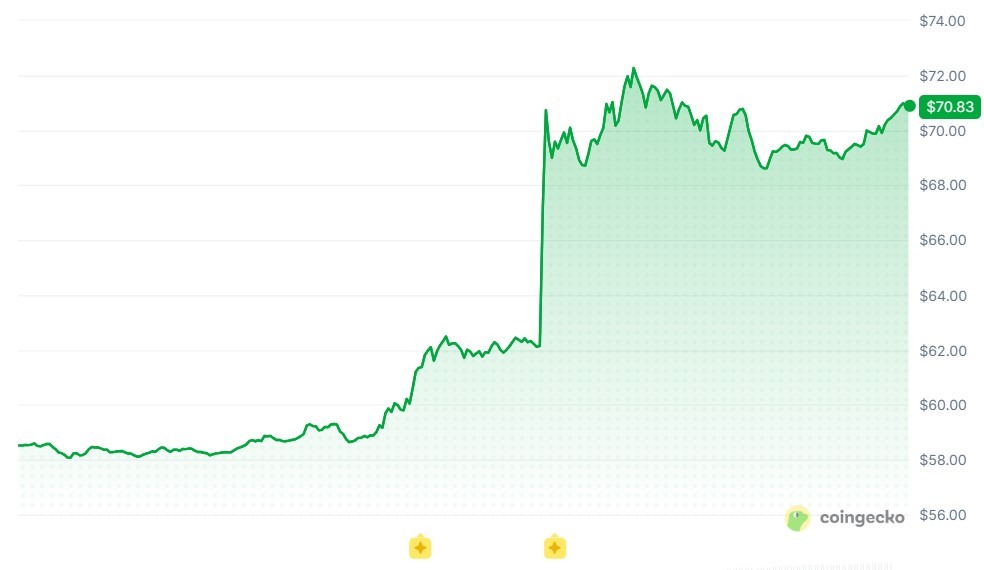
Hyperliquid’s native token surged more than 20% over 24 hours after United States President Donald Trump said regulators were working on a compliant pathway to make the decentralized trading platform available to American users.
HYPE traded around $62 immediately before Trump’s remarks and subsequently jumped as much as 16% to a 24-hour high of $72.28, according to CoinGecko. It later settled to about $70, up approximately 20% in the last day, with 24-hour trading volume reaching $1.4 billion.
“I understand that Mike is also working to bring Hyperliquid into the United States in a fully compliant and legal fashion,” Trump said during a Wednesday White House event, referring to Commodity Futures Trading Commission (CFTC) Chair Michael Selig. “Working very hard on that.”
The market reaction shows how the prospect of US access could reprice HYPE and publicly traded companies holding the token. However, neither the CFTC nor Hyperliquid has released a formal proposal explaining how US access would work, whether an application has been submitted or when a compliant service could launch.
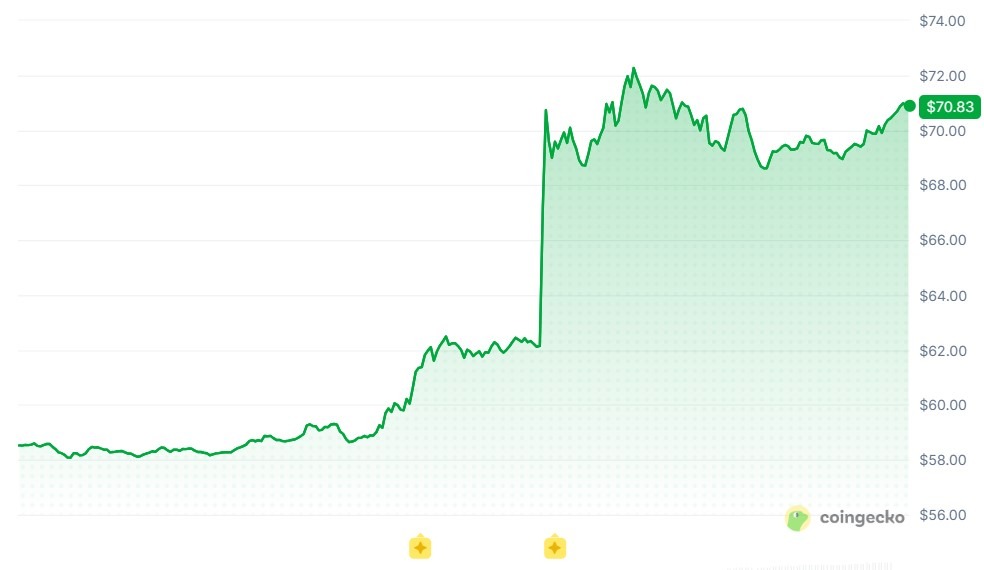
Hyperliquid’s 24-hour price chart. Source: CoinGecko
$65,000 options bet on HYPE treasury firm raises eyebrows
Meanwhile, shares of Hyperliquid Strategies, a Nasdaq-listed HYPE treasury company trading under the ticker PURR, closed Wednesday at $9.39, up 30.4%, according to Yahoo Finance. Despite sharing the protocol’s name, the company said it is independent and not affiliated with Hyperliquid.
Roughly four hours before Trump spoke, someone reportedly paid about $65,000 for 719 PURR call options with an $8 strike price expiring in mid-October, according to CNBC. The contracts were purchased for approximately $0.90 each and were quoted at $2.45 by the close, valuing the position at roughly $176,000 and producing an unrealized gain of about $111,000.
Related: Rushed CLARITY Act vote could set legislation back, Gallego warns
Delayed market data derived from the Options Price Reporting Authority corroborates the unusually heavy activity in the contract. OptiView data showed 2,575 of the October $8 calls traded during the session, compared with just 67 contracts in open interest beforehand. Volume was more than 140 times the contract’s 30-day average.
The publicly available data confirms elevated trading but does not independently identify the buyer or establish that the reported 719-contract order was based on nonpublic information. There is no clear evidence of insider trading, and the CFTC had previously publicly disclosed a July 15 meeting with Hyperliquid Labs and Hyperliquid Strategies.
Magazine: ‘Fabricated rumors’ about BitMart founder, Binance bStocks dominate: Asia Express


Swift, HSBC and Standard Chartered completed the first live interbank transaction on Swift’s blockchain-based ledger on Aug. 19, 2026.
Summary
- Swift connected HSBC and Standard Chartered tokenized deposit platforms in its first live interbank transaction.
- The ledger matched and netted payment obligations before final settlement occurred through existing banking systems.
- HSBC recorded obligations through its Tokenised Deposit Service while Standard Chartered used its separate infrastructure.
- Seventeen banks across six continents joined Swift’s pilot for interoperable tokenized deposit live transactions globally.
- HSBC’s service currently operates in six markets and supports seven currencies, including dollars and euros.
The transaction connected two independently operated tokenized deposit systems through a shared coordination layer.
HSBC recorded its resulting obligation through the bank’s Tokenised Deposit Service. Standard Chartered used its own tokenized deposit infrastructure, according to the banks’ joint release.
The parties did not disclose the transaction’s value, currency, customers or originating jurisdictions. They also did not announce a commercial launch date.
Swift connected two separate tokenized deposit systems
The banks exchanged payment messages through the Swift blockchain ledger. The system matched and netted their respective obligations before recording the results on each bank’s infrastructure.
The transaction demonstrated that banks do not necessarily need to issue deposits on one shared platform. Swift’s model instead connects separate systems and coordinates the instructions passing between them.
However, the ledger did not complete the final movement of conventional money. Settlement occurred through existing payment systems. That distinction means the transaction tested interoperability and orchestration rather than full onchain settlement.
Swift described the ledger as a layer that can preserve established compliance, credit and operational controls. Its planned availability around the clock could allow banks to process tokenized deposit instructions outside normal payment windows.
The Swift blockchain ledger coordinates bank obligations
Tokenized deposits represent claims against issuing commercial banks. They differ from stablecoins, which are generally issued by specialist companies and backed by separate reserve portfolios.
Under Swift’s design, HSBC and Standard Chartered retain control of their own deposit liabilities. The shared ledger coordinates corresponding obligations without creating a new public payment token.
Lewis Sun, HSBC’s global head of domestic and emerging payments, called the transaction a “landmark moment.” That assessment reflects HSBC’s view and does not establish that the system is ready for wider commercial use.
Standard Chartered Global Head of Virtual Accounts and Clearing Mark Willis said the transaction represented a step toward “more seamless, always-on financial services.” Wider adoption will depend on further testing, sufficient liquidity and support across currencies and jurisdictions.
HSBC brings a six-market network into the pilot
HSBC’s Tokenised Deposit Service is live in Hong Kong, Singapore, Luxembourg, the U.K., the U.S. and the United Arab Emirates. It supports the offshore Chinese yuan, Hong Kong dollar, Singapore dollar, euro, British pound, U.S. dollar and UAE dirham.
The bank introduced the service for eligible U.S. corporate and institutional customers in April 2026. HSBC said clients can use it for domestic and cross-border transfers at any time, subject to availability and regulatory requirements.
Standard Chartered operates across 55 markets. The bank did not specify which parts of its network participated in this transaction or where its tokenized obligations were recorded.
Seventeen banks will test wider interoperability next
Swift declared its blockchain ledger ready for initial use on July 9 after nine months of development. Seventeen banks across six continents joined the rollout, as crypto.news previously reported.
The group includes ANZ, BNP Paribas, BNY, Citi, DBS, HSBC, MUFG, Standard Chartered, UBS and Wells Fargo. Other participants include First Abu Dhabi Bank, FirstRand, Itaú Unibanco, Lloyds, Mashreq, OCBC and UOB.
The first transaction provides a live reference point, but it does not confirm production-scale adoption. Swift has not published transaction-volume targets or a deadline for expanding the ledger beyond its controlled rollout.
The next phase is expected to test additional institutions, currencies and operating conditions. Banks will also need to assess liquidity management, reconciliation, compliance checks and the treatment of transactions initiated outside conventional settlement hours.

Microsoft (MSFT) staged a spectacular recovery after its earnings report, only to risk a sell signal on Tuesday. But there were a few telltale chart features that have kept some investors away even when the stock broke out earlier in August. Is Microsoft stock a sell now? Shares cleared a cup base at a pivot of 466.32 on July 31,…
Copyright ©2026 Investor’s Business Daily, LLC. All rights reserved. 87990cbe856818d5eddac44c7b1cdeb8
Bancel says that Moderna is also exploring using intismeran alone, perhaps in earlier stage cancers. For the current trial, because intismeran is still an experimental therapy under study, and an approved therapy, Keytruda, does exist for melanoma patients, regulators at the FDA were more comfortable with combining the drugs so every patient received at least the standard of care and therefore would not be additionally harmed by joining the study. “It would be unethical for us to tell people to come on a study of something that we don’t know if it works, when people are fighting for their lives,” he says. “That’s why we did the study together with Keytruda, which can improve outcomes, and we tried to show that the combination was better, and we did.”
Bancel’s teams are already studying intismeran in stage 1 lung cancer, to see if using it earlier, and priming the immune system, can lead to equally beneficial outcomes for those people. In lung cancer, standard treatment involves surgery and careful monitoring for any signs of returning cancer, so doctors can ethically study how adding intismeran for some patients affects their cancer outcomes compared to those not receiving it. While that study is still in early stages, Bancel is optimistic since “from a scientific standpoint there is no scientific sense that it would work in melanoma and not work in another tumor type,” he says of the mRNA-based approach. “I think it will be transformational. Think about if you get a screening X-ray and find stage 1 lung cancer. Then you get intismeran, which is like a vaccine so you have no severe toxicity like with other immunotherapy. Think about getting this product on your way to work, or even [potentially] at your local pharmacy—that would be an incredible change in care. And it can help reduce the risk of metastasis, and have a profound impact on patients, as well as prevent people from getting very severe disease.”
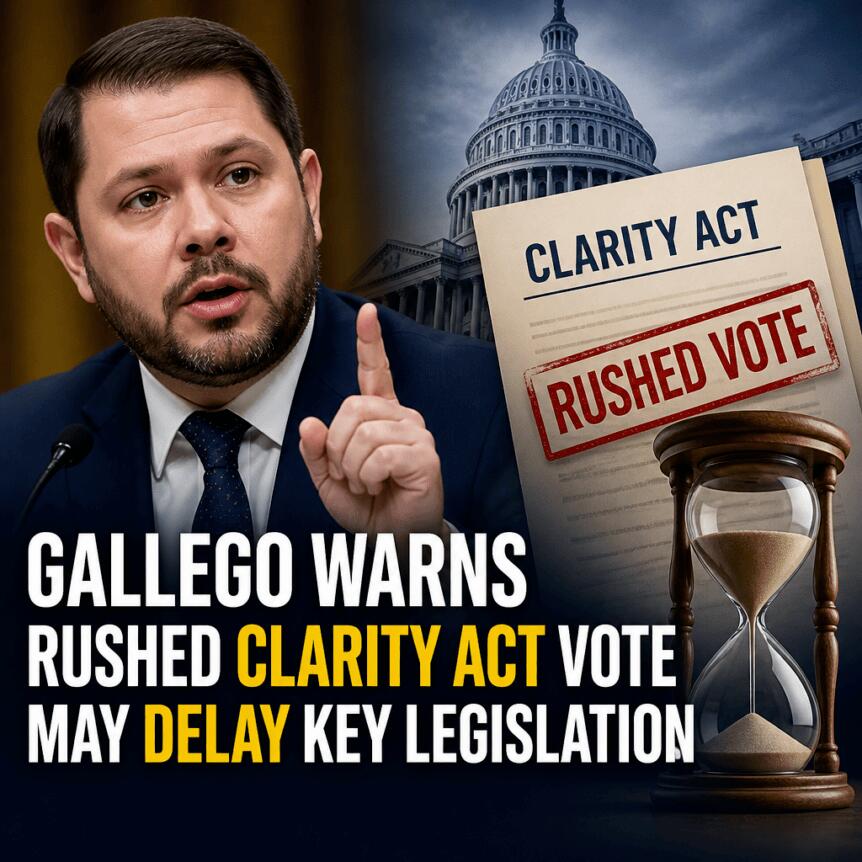
Sen. Ruben Gallego has warned that pushing the proposed CLARITY Act toward an early Senate vote before lawmakers finalize unresolved ethics and stablecoin-yield issues could derail U.S. crypto legislation rather than accelerate it. Speaking at the SALT Wyoming Blockchain Symposium on Wednesday, Gallego said Congress still needs to complete several procedural steps that could determine whether the bill can actually clear the Senate.
His remarks add friction to the Trump administration’s push for faster movement on the legislation, even as Senate leaders have previously signaled they intend to wait until after the August congressional recess. Gallego’s core message was that timing without agreement may produce an outcome lawmakers “don’t want,” potentially forcing the bill to be restarted later with weaker momentum.
Key takeaways
- Sen. Ruben Gallego urged lawmakers to avoid a “fast vote” on the CLARITY Act until disputes—particularly around ethics and stablecoin yield—are resolved.
- Gallego said he and Sen. Thom Tillis submitted compromise ethics language to the White House before the recess but received no clear, point-by-point response.
- The warning suggests procedural action in the Senate could arrive before a bipartisan coalition is in place, risking failure at the 60-vote threshold.
- While the White House has pressed for a “fair version” of the bill, Senate leaders have already indicated the vote could be deferred to September.
Why Gallego says rushing the process could backfire
Gallego framed his concern around how complex the legislative package still is. In his view, the Senate cannot simply move forward to voting if the bill’s components haven’t been fully coordinated and assembled into a final package capable of winning the votes needed for passage.
He specifically noted that lawmakers still have work to do, including addressing the bill’s Agriculture Committee portion, consolidating the broader package, and determining how to route it to the House. Gallego argued that these steps matter because an early vote could lock lawmakers into a timeline that doesn’t match negotiation progress.
“Don’t go for a fast vote,” Gallego said. “A fast vote gets you a fast result, but I’m not sure it’s the result you want.” He added that Congress still had “a lot of steps to complete,” and that “any premature movement is going to set it back further.”
The practical implication for investors and market participants is straightforward: if the bill is advanced before the coalition is ready, the probability of a legislative stall increases. That can prolong uncertainty around U.S. crypto market structure even if the bill ultimately returns later with stronger terms.
Ethics negotiations appear to be the sticking point
Gallego’s criticism also focused on the bill’s ethics framework. He said he and Republican Sen. Thom Tillis had submitted compromise ethics language to the White House before the congressional recess. However, he told the symposium he had not received a detailed response addressing the proposal point-by-point.
According to Gallego, the lack of feedback has made it difficult to close the gap needed for Democratic lawmakers to support the bill. He argued that “sufficiently strong ethics restrictions” were important to earn Democratic support and move the legislation forward.
“We’ve been sending offers over and over again to the White House, and they’ve been coming back either blank, or they’ve come back even slightly further back, or we’ve heard nothing,” Gallego said.
Cointelegraph reached out to the White House for comment but did not receive a response before publication, leaving Gallego’s characterization of stalled negotiations unaddressed in the reporting.
Administration push for speed vs. Senate procedural timing
Gallego’s warning complicates the broader push for swift passage coming from the White House. Earlier coverage from Cointelegraph described the administration’s push for moving toward passage, and on Wednesday Trump urged Congress to pass a “fair version” of the CLARITY Act during a White House appearance with crypto executives.
However, Senate timelines have already suggested that immediate action may not be available. In a report discussed by Cointelegraph, Senate Majority Leader John Thune confirmed on Aug. 7 that the chamber was “punting” the vote and that CLARITY would be queued up “first thing” after lawmakers returned from recess—positioning September as the likely window for consideration.
Patrick Witt, a White House crypto adviser, had previously said the administration would negotiate with Democrats until the September vote, while also stating the administration “can’t afford to wait forever.” That tension—between negotiating leverage and deadline pressure—is now colliding with Gallego’s insistence that substantive ethics resolution must come first.
In other words, even with a September target already on the table, Gallego’s comments suggest the real question is whether negotiations are likely to produce a version strong enough to build a bipartisan coalition—particularly given the Senate’s 60-vote threshold.
What lawmakers still need to finalize before any Senate vote
Beyond ethics language, Gallego indicated multiple procedural and substantive hurdles remain before the bill can be ready for the next legislative stage. He mentioned the need to resolve the bill’s Agriculture Committee component, then assemble the broader package, and finally determine the correct path for sending the finalized measure to the House.
He also linked these remaining tasks to timing and negotiating discipline. For Gallego, the key risk is that procedural momentum—such as a vote being placed on the calendar—could outpace the actual work of building consensus. If that happens, the Senate could be forced into action on a version that lacks enough support, turning a negotiation problem into a legislative failure that makes future compromise harder.
The larger takeaway is that U.S. crypto regulation is still being shaped by how these bills navigate both policy disputes and legislative mechanics. Even when political actors want speed, the Senate’s structure and voting math reward coalitions that are assembled deliberately rather than rushed.
Readers should watch whether the White House provides the detailed ethics feedback Gallego says it has not yet delivered, and whether negotiators converge on a version of the CLARITY Act capable of clearing the Senate—particularly as September approaches.

XRP’s struggle near $1 continues even as its peers display modest gains this week. The crypto asset went down almost 10% over the past month before it rebounded significantly on Wednesday evening.
Despite the weakness, much more XRP is being withdrawn than deposited across major platforms.
Reserves Slide
According to the latest analysis shared by CryptoQuant, XRP reserves across Upbit, Binance, and Bithumb have fallen by roughly 240 million from their late-May and early-June levels, as of August 19. South Korean giant Upbit held 6.40 billion XRP, down from 6.51 billion on May 30, which is a decline of about 110 million, or 1.7%.
The figures for Bithumb fell to 1.82 billion from 1.85 billion on June 2, a decrease of roughly 30 million, or 1.6%. Meanwhile, Binance recorded the largest percentage decline, with its reserves for the token dropping to 2.62 billion from 2.72 billion over the same period, which translates to a reduction of approximately 100 million XRP, or 3.7%.
Combined reserves across the three exchanges decreased from about 11.08 billion to 10.84 billion, representing a decline of roughly 2.2%. Despite the overall reduction, Upbit remains the largest holder of the crypto asset among the three exchanges. In fact, Upbit and Bithumb together hold about 8.22 billion XRP and account for nearly 76% of the reserves tracked across the three platforms.
The falling exchange reserves come as wallet activity across major exchanges turns more focused on withdrawals. As recently reported by CryptoPotato, Coinbase recorded a seven-day net wallet count of -14,300 as of August 18. The exchange accounted for 47.3% of the total absolute imbalance, its highest share since July 2024.
Binance posted a net wallet count of -3,270, while Crypto.com recorded -2,680. Both exchanges moved into negative territory on July 18, almost a week after Coinbase. Binance’s share of the overall imbalance also rose from nearly zero on July 16 to around 10%. Upbit, however, saw its share fall to about 12% from 40% in June.
Whale Activity
The asset’s weak price performance has not stopped large transactions from picking up on the XRP Ledger. Data shared by crypto analyst Ali Martinez revealed that transactions worth more than $1 million jumped 280% in a single day and reached nearly 40, compared with around 10 during each of the previous two days.
The spike came shortly after wallets holding between 10 million and 100 million XRP accumulated about 72 million tokens in one day.
Network activity has also picked up, as the ledger recorded nearly 50,000 active addresses over a 24-hour period last week. Despite the rise in activity, social sentiment around XRP fell to a three-month low.
The post 240 Million XRP Pulled From Major Exchanges Since Early Summer: Why It Matters appeared first on CryptoPotato.

Costco stock reclaimed a key technical level on Tuesday as the warehouse club climbed amid news of a partnership to offer Medicare Advantage plans to members. Costco Wholesale (COST) will offer co-branded plans in partnership with nonprofit health insurer Scan Group. Scan, based in Long Beach, Calif., has about 560,000 Medicare Advantage members in Southern California, Arizona, Nevada, New Mexico…
Copyright ©2026 Investor’s Business Daily, LLC. All rights reserved. 87990cbe856818d5eddac44c7b1cdeb8
Bitcoin (BTC) falling more than 50% from its $126,200 all-time high was a “positioning correction,” BlackRock says.
Key points:
- A BlackRock report attributes Bitcoin’s decline below $60,000 to cascading liquidations as leverage was purged from the market.
- The long-term BTC investment thesis as a “low-correlation diversifier” remains intact, analysts confirm.
- BlackRock sees Bitcoin’s risk-asset correlation declining as time goes on.
BlackRock predicts falling correlation of BTC with risk assets
In a report published this week, the world’s largest asset manager preserved its bull thesis despite waves of outflows from its spot Bitcoin exchange-traded fund (ETF) in 2026.
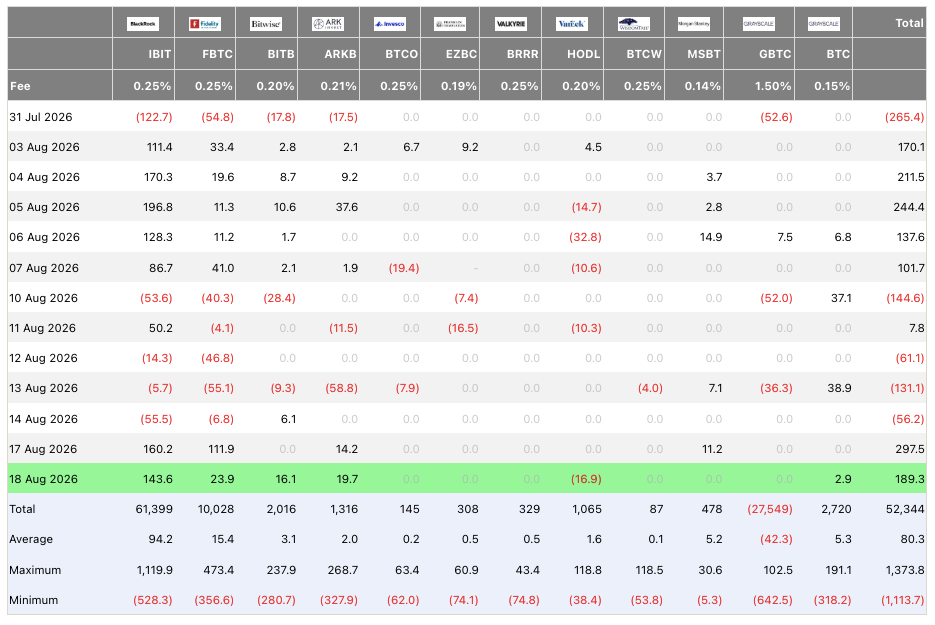
BlackRock’s iShares Bitcoin Trust (IBIT) saw net outflows of $78.9 million in the week through Aug. 14. Across all ETF products, outflows totaled $267.2 million.
“We view bitcoin’s ~50% pullback from October 2025 highs as a positioning correction rather than a change in its investment case. A historically overleveraged market, enabled by perpetual futures, suffered cascading liquidations compounded by slowing ETP outflows and digital asset treasury demand,” the report states.
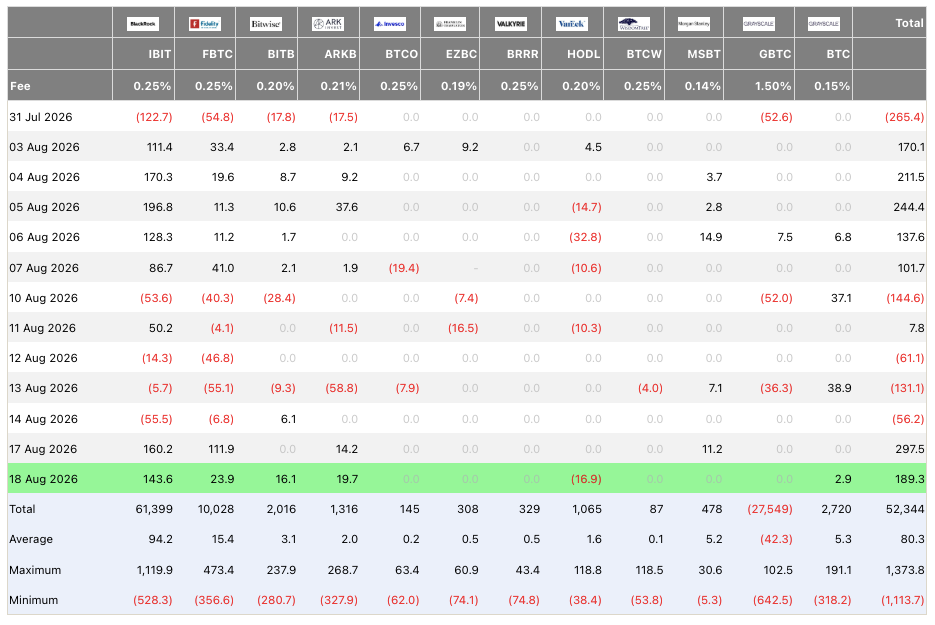
US spot Bitcoin ETF netflows (screenshot). Source: Farside Investors
During last year’s peak, Bitcoin experienced a surge in speculative positioning. BlackRock pointed to open interest on Bitcoin derivatives markets passing $90 billion in early October amid heavy use of leverage. The unwinding of these positions increased the correlation between BTC/USD and risk assets more broadly.
“A macro-driven risk-off catalyst (China tariff headlines) triggered large-scale deleveraging across precious metals and crypto markets. The resulting liquidation waves drove prices down to cycle lows below $60,000 per bitcoin by June 2026,” it explained.
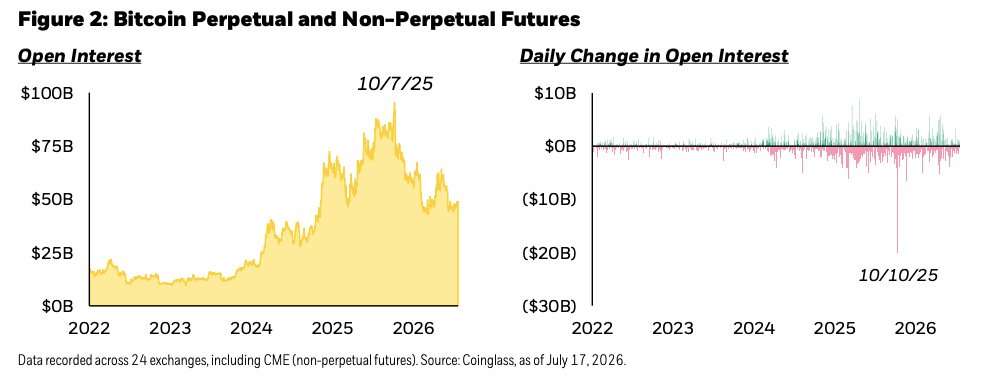
Bitcoin futures open interest data (screenshot). Source: BlackRock
Institutional Bitcoin demand has suffered this year as a combination of geopolitical uncertainty and growing inflation pressures saw capital flowing into established risk-asset classes, among them US equities, with the S&P 500 hitting record highs last week. Bitcoin has failed to follow suit, but BlackRock forecasts that this may change.
“With speculative excess now largely purged, we believe bitcoin’s recent episodes of elevated risk correlation should normalize lower, consistent with its longer-term record as a low-correlation diversifier,” it continued.
Longer-term resilience of BTC stands out
The report highlights that long-term BTC investment returns follow key political and macro events. These include the COVID-19 outbreak in March 2020, the US presidential election the same year, as well as the regional banking crisis and president Donald Trump’s multiple international trade-tariff declarations.
Related: Bitcoin price spike to $64.5K was ‘low-volume liquidity trap’: Analysis
While it initially struggled following some of these events, Bitcoin produced solid returns on a 60-day basis. In the case of the 2020 election, these hit as high as 113%.
“Through multiple shocks in recent years, bitcoin often outperformed both the S&P 500 and gold in the weeks and months following the onset of disruptions,” BlackRock commented.
“This pattern has held true thus far in 2026 amid ongoing conflict between the U.S. and Iran, with bitcoin delivering positive returns and outperforming equities and gold following the onset of hostilities in February and the end of the ceasefire agreement in July.”
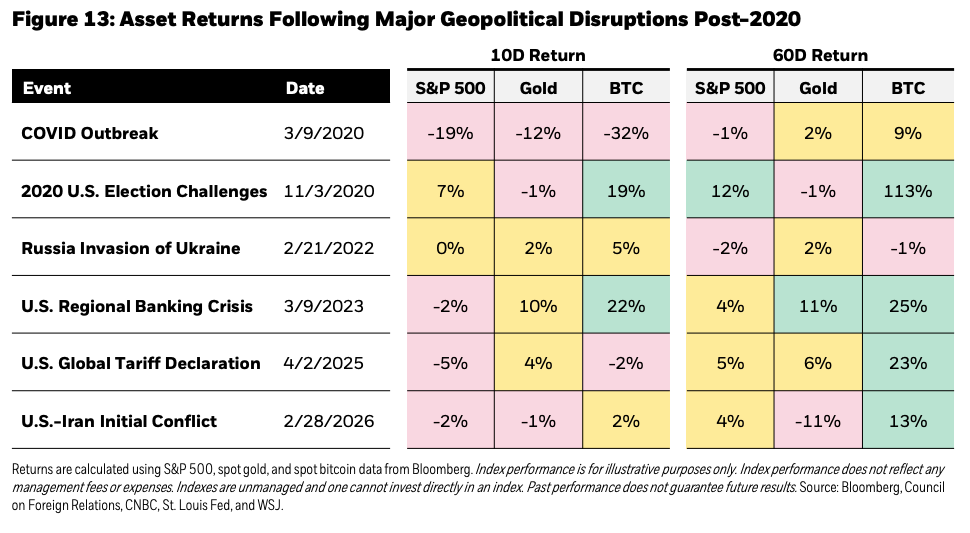
Macro asset returns comparison (screenshot). Source: BlackRock
Further data puts Bitcoin’s 12-month realized volatility at 40% compared to 26% for gold and 12% for the S&P 500. The rolling six-month correlation between Bitcoin and the S&P, presented as a 10-year average, is now 0.18 — still notably higher than gold’s 0.06 reading.
“Bitcoin’s underlying investment case aligns more closely with that of gold — as a global monetary alternative and a hedge against inflation, global disorder, and declining trust in fiat currencies. Even for gold, which tends to be viewed as a standard uncorrelated, store-of-value asset, brief periods of high equity correlation exist, including COVID in 2020-2021 and the monetary easing cycle in 2023,” the report added.
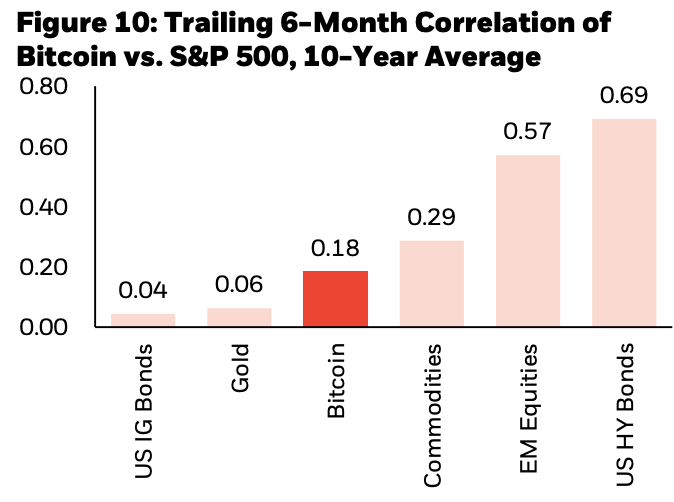
Bitcoin vs. S&P 500 correlation data (screenshot). Source: BlackRock
Since October 2025, BTC price performance has led some to question its role as a form of “digital gold.” In a Q1 report, asset manager Grayscale described short-term behavior as being more like a growth stock than gold, noting its low correlation to the latter.


Every major except tron posted double-digit weekly gains, with nearly $1.4 billion of short positions wiped out after the Treasury doubled its bond buybacks.

Beaming Harry looks delighted as he breaks cover just hours after return to the UK was revealed (and shares a laugh with a fellow red head)
Bonds recover after US Treasury comes to the rescue

Trader who made $49 million shorting crypto lost $24 million on ether in 12 seconds





-

 Fashion6 days ago
Weekend Open Thread: Ann Taylor
-
 Sports6 days ago
This U.S. Amateur is a glimpse into golf’s future in more ways than you think
-
 Tech6 days ago
11 Ways to Rank Your Videos
-
 NewsBeat5 days ago
Myanmar says over 300,000 Rohingya refugees verified for repatriation as exodus enters ninth year
-

 Sports5 days ago
Birmingham 2026: Day 6 Timetable for Irish Athletes
-

 Politics5 days ago
SEQ Code: The Three Letter Boarding Pass Code That Could Give You The Worst Seat
-

 Tech6 days ago
DeepSeek Harness launches as open source rival to Claude Code, alongside V4-Pro on API with higher prices
-

 Tech2 days ago
Qwen3.8-27B runs frontier-class coding agents and reasoning locally, no cloud API required
-

 Crypto World2 days ago
OCC Greenlights Trump Family Crypto Firm for Trust Charter
-

 Fashion6 days ago
Weekly News Update, 8.14.26 – Corporette.com
-
 Tech5 days ago
Every fusion startup that has raised over $100M
-
 Entertainment6 days ago
10 Netflix Shows That Quietly Became Modern Classics
-
 Entertainment5 days ago
Marvel Studios Reveals New X-Men Cast Including Adam Driver and Sadie Sink
-

 Business6 days ago
15 Ways to Make Money From Your Phone (2026 Guide)
-

 Crypto World5 days ago
Pi Network Protocol 27 endgame: last upgrade before what?
-

 Business5 days ago
Facebook Down Now? Users Report Login And Loading Problems As Outage Trackers Monitor Ongoing Issues
-

 Business2 days ago
SMA Solar Technology AG (SMTGY) Q2 2026 Earnings Call Transcript
-

 Fashion6 days ago
Silver bangles for women – Newbridge Silverware
-

 Crypto World6 days ago
Robinhood Chain Approaches $1B TVL as Uniswap Integration Boosts Liquidity
-

 Fashion6 days ago
Cart Confidential Vol. 44 – Julia Berolzheimer
You must be logged in to post a comment Login