
Crypto World
Google Gemini AI Predicts an Unexpected Prediction on Ethereum By The End of 2026

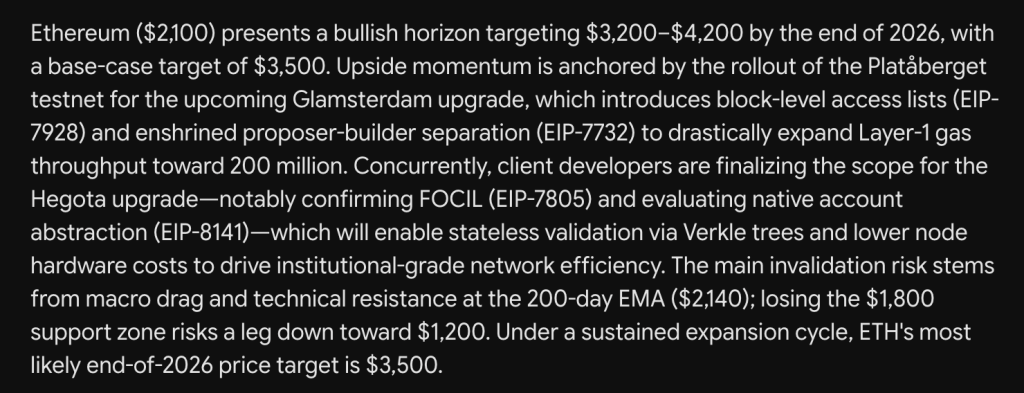
Two upgrades in the testnet and one number that keeps coming up: 200 million gas. Google Gemini AI predicts that the throughput jump reframes what Ethereum can carry, and the price prediction targets $3,200 to $4,200 by the end of 2026, with $3,500 as the base case from $2,100.
The Platåberget testnet for Glamsterdam anchors the case. It introduces block-level access lists through EIP-7928.
Enshrined proposer-builder separation arrives alongside it via EIP-7732. Together, those drastically expand Layer-1 gas throughput toward that 200 million figure.

Client developers are already finalizing the next scope. The Hegota upgrade has confirmed FOCIL through EIP-7805. Native account abstraction is under evaluation as EIP-8141. Both feed stateless validation via Verkle trees.
The practical result is cheaper node hardware. Gemini frames that as the path to institutional-grade network efficiency. The main invalidation risk is macro drag. Technical resistance at the 200-day EMA near $2,140 is the near-term obstacle.
Losing the $1,800 support zone is the larger threat. That risks a leg down toward $1,200.

Discover: Everyone’s Got a Take. Get Free $25 from Kalshi to Actually Trade Yours
Ethereum Price Prediction: Gemini AI Predicts Two Hundred Million Gas Changes The Math
The daily chart has just delivered its strongest session in months. ETH peaked near $4,950 last September before a long unwind began. November and December cut price toward $2,600. February brought the sharpest break, dropping ETH near $1,780.
Spring recovered to $2,450 by May. June reversed that entirely, marking the low around $1,480. July and August rebuilt slowly. The latest session then broke sharply higher, clearing $2,100 in a single move.
The close reads $2,124.2, up 10.83%, and $207.6. The daily range covered $1,904.9 to $2,132.2. Support sits at $2,000, then $1,800 and $1,480. Resistance appears at $2,140 at the EMA Gemini names, then $2,450 and $2,800.
RSI reads 77.11 with its signal line far below at 54.97. That gap of more than 22 points is extreme and confirms a violent momentum shift. The oscillator is now clearly overbought. Momentum is strongly bullish, though readings this stretched typically cool before continuing.
Gemini’s base case needs a 65% move from here. Closing above that 200-day EMA is the first hurdle standing in front of it.
Discover: Your Market Calls Are Worth Something. Start with a free $25 on Kalshi
Ethereum Is Chasing 200M Gas. Bitcoin Hyper Is Taking the SVM Route to Scale BTC.
Ethereum’s next valuation case depends on dramatically expanding what the base layer can process. Bitcoin Hyper is tackling the same bottleneck from a different direction: giving Bitcoin a faster execution environment without asking the Bitcoin network itself to become something it was never designed to be.
Bitcoin Hyper runs on the Solana Virtual Machine, bringing high-speed transactions, low fees, and smart contract functionality into a Bitcoin Layer 2 ecosystem.
Its Canonical Bridge is designed to move BTC into that environment, while HYPER powers gas, staking, and governance across the network.
That makes the thesis less about changing Bitcoin and more about extending what Bitcoin capital can actually do.
The presale has already raised more than $33 million, while buyers can currently stake HYPER for yields of up to 35% APY ahead of the project’s planned 2026 launch.
Explore the Bitcoin Hyper Presale
The post Google Gemini AI Predicts an Unexpected Prediction on Ethereum By The End of 2026 appeared first on Cryptonews.


Binance has launched Agent OS, a new developer platform designed to let AI agents access market data, monitor user accounts, and execute crypto trades directly on the exchange. The announcement frames Agent OS as an infrastructure layer that can be connected to popular AI tools, with controls that aim to keep permissions and risk limits under the user’s authority.
According to Binance, Agent OS supports AI environments including ChatGPT, Claude Code, Codex, and Cursor. Users can authorize agents to view account information and place orders only within configured permissions and limits, and they can assign agents to dedicated subaccounts so trading activity and funds remain compartmentalized.
Key takeaways
- Agent OS gives AI agents access to Binance market data, the ability to monitor user accounts, and the option to execute trades.
- Binance’s model is authorization-based: users define which actions agents can take and impose trading limits.
- Agents can be tied to dedicated Binance subaccounts for clearer separation of funds and activity.
- Binance says it can observe trades executed via Agent OS but does not see the agent’s external data sources or internal decision-making.
- Agent OS also links agents to Binance’s payment and onchain tools for wallet and onchain-service interactions.
What Binance’s Agent OS is designed to do
Agent OS is positioned as a bridge between AI applications and exchange operations. Binance states that developers can connect agents to market information and to user account functionality, then grant those agents the ability to place trades through the exchange under a permissioned setup.
In practical terms, this matters because it reduces the friction of building agent-driven trading systems. Instead of relying solely on custom integrations, users can route trading actions through a platform that is already integrated with Binance’s account and execution infrastructure. At the same time, Binance emphasizes user control by allowing permissions to be configured and access to be revoked at any time.
Permissions, subaccounts, and the limits of what Binance can see
Binance’s announcement highlights a key operational safeguard: users can assign agents to dedicated subaccounts. That approach can help separate balances and trading activity for different strategies or different agent instances, which is particularly relevant when multiple automated systems operate under the same main account.
Binance also describes a visibility boundary. It says it can monitor the trades placed through Agent OS, but it cannot see an agent’s external information sources, interpretation, or decision-making logic—elements that occur within the user’s chosen AI application. That separation is important for privacy and for reducing the need to centralize all agent reasoning inside the exchange environment.
How this fits into the broader “agents” push by exchanges
Agent OS arrives amid a broader trend: crypto trading venues are moving from basic automation toward infrastructure that supports more autonomous AI-driven behavior.
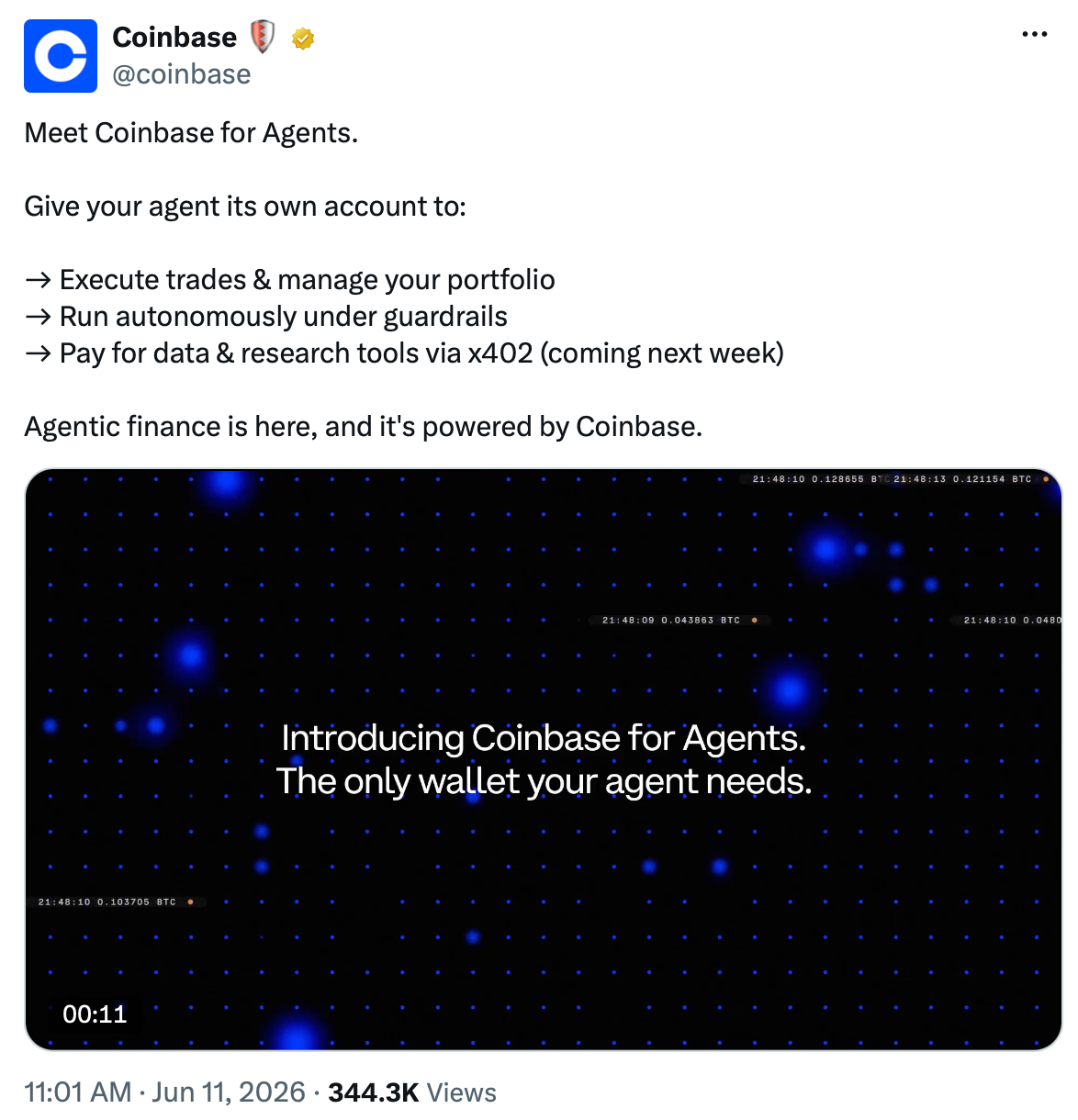
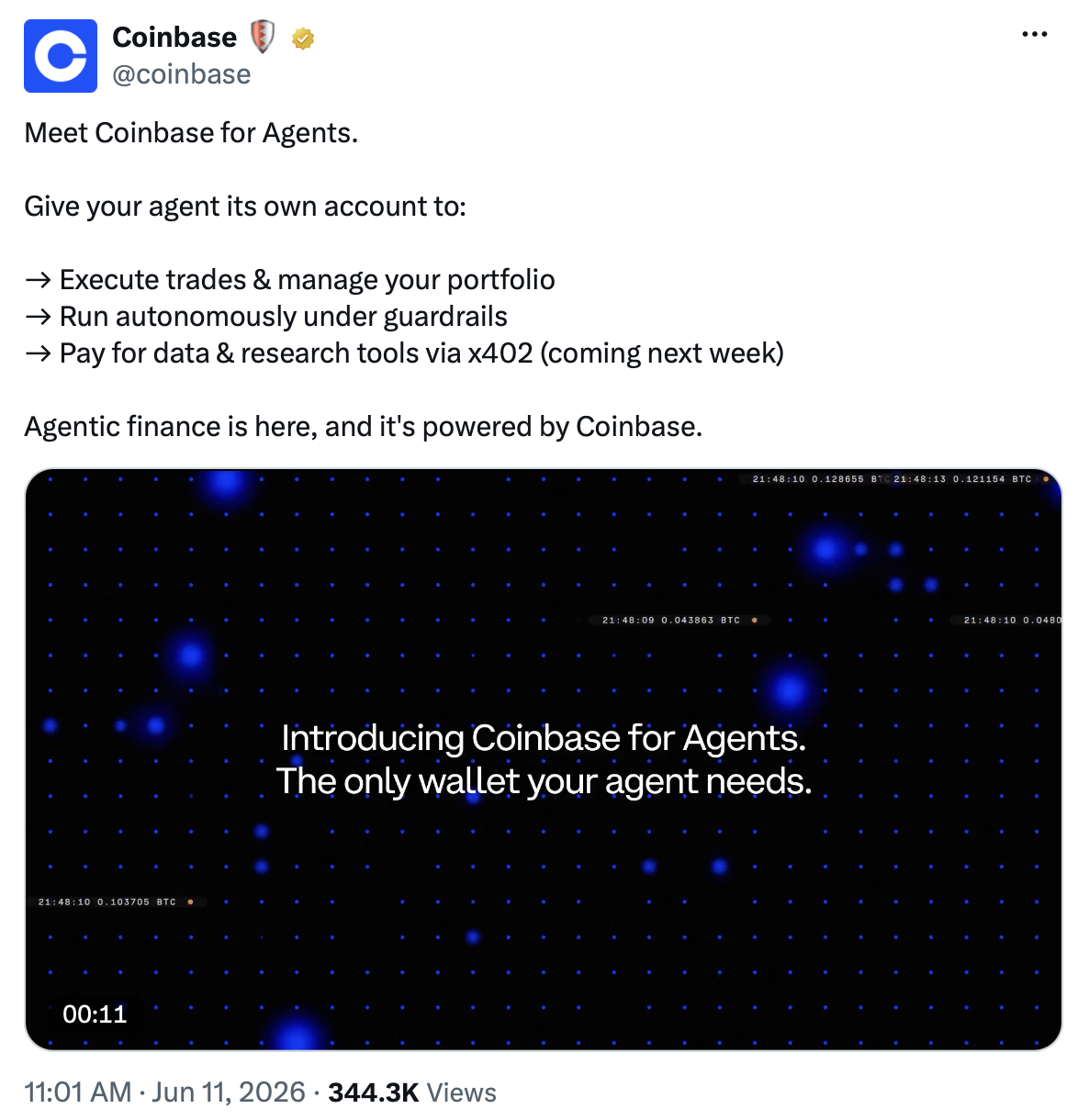
Earlier in the year, Coinbase launched “Coinbase for Agents” in June. That tool also targets AI models such as ChatGPT and Claude, enabling connections to user accounts so models can execute trades and strategies, alongside support for agent-driven payments through Coinbase’s x402 protocol.
Different exchanges are taking different stances on autonomy. In July, Kraken unveiled an AI-powered investing assistant that monitors markets and recommends trades based on users’ goals and risk preferences, but requires user approval before executing trades.
Other players are extending the concept beyond trading. OKX launched a beta marketplace where AI agents can find work, transact using stablecoin payments, and hire other agents for tasks, backed by an onchain reputation system.
Taken together, the sector is converging on a common idea—agents should be able to interact with financial rails—but it’s still diverging on the degree of autonomy and how much responsibility belongs to the user versus the system.
From trading to payments and onchain interaction
Beyond order placement, Binance says Agent OS can connect agents to its payment and onchain tools. The stated goal is to allow agents to make payments and interact with wallets and other onchain services.
This broader scope is a notable shift from “agent as a trading bot” toward “agent as an onchain operator.” If agents can perform payments and wallet interactions in addition to trading, they can potentially be used for a wider range of workflows—such as managing funds across strategies, executing routine onchain actions, or coordinating multi-step operations that blend exchange and onchain activity.
However, the same expansion also raises the stakes for governance and risk controls. Binance’s emphasis on permissions, subaccounts, and revocation becomes even more important when an agent can potentially do more than place orders.
Why industry leaders see agents as a major onchain driver
Binance is not operating in a vacuum. The announcement echoes comments from other crypto executives who have argued that AI agents could take on a meaningful portion of onchain activity. Coinbase CEO Brian Armstrong and Circle CEO Jeremy Allaire have both pointed to the potential for agents to become active participants in onchain ecosystems.
Binance co-founder Changpeng Zhao has also described cryptocurrency as a “native currency” for AI agents, reinforcing the idea that exchanges and payment infrastructure could become the operational backbone for agent-driven finance.
Agent OS can be viewed as a concrete attempt to operationalize that vision—turning “agents will use crypto” into “agents can securely interact with exchange systems.” The key question for users and developers will be how quickly these platforms converge on shared standards for authorization, auditing, and safety.
For now, investors, traders, and builders should watch how Agent OS performs in real deployments—especially around permission granularity, subaccount segregation, and what types of agent workflows users actually adopt. The most important unknown is how these exchange-based agent systems will balance autonomy with practical safeguards as AI-driven onchain activity scales.
[PRESS RELEASE – Montevideo, Uruguay, August 20th, 2026]
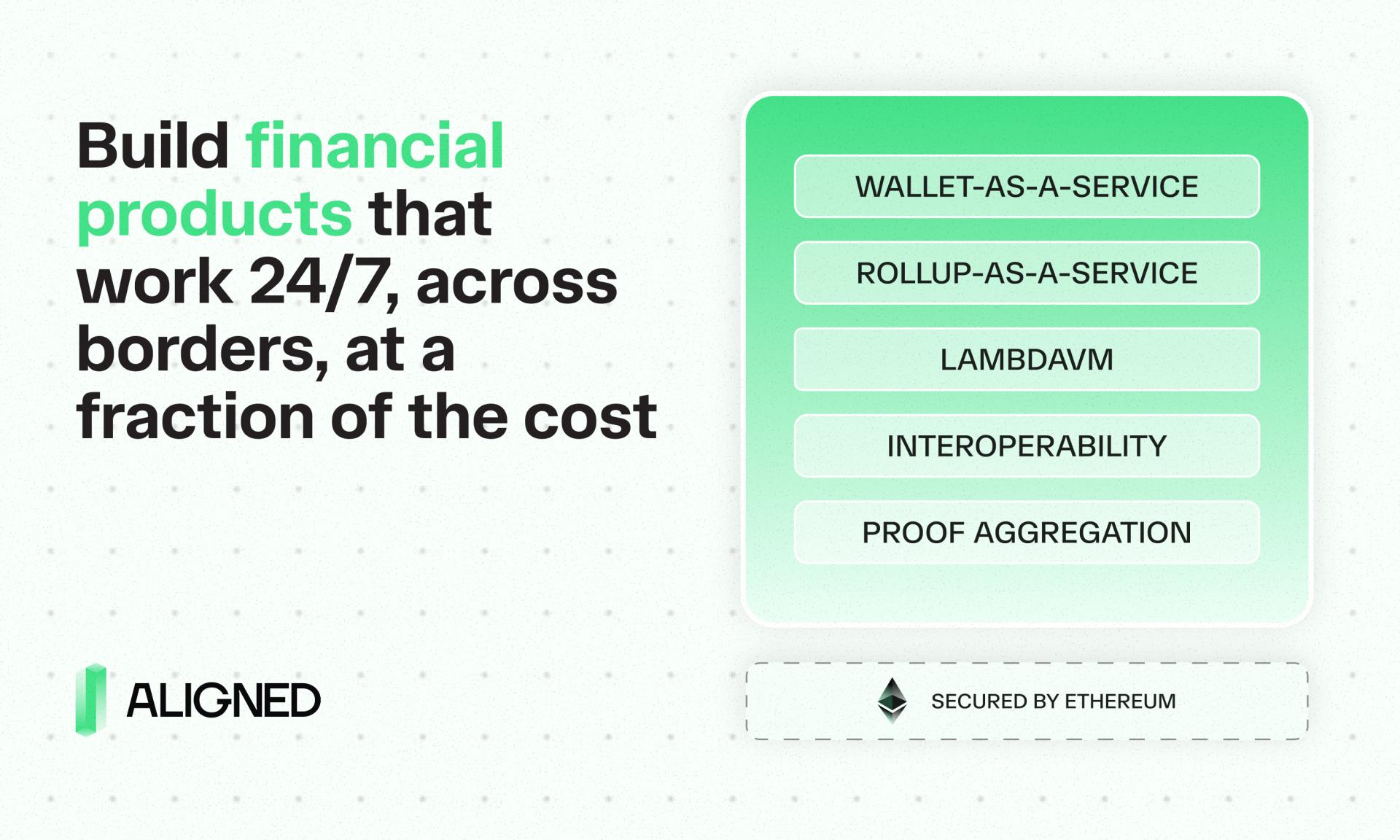
Aligned allows fintechs and institutions to build financial products on Ethereum, with one-click solutions for wallets, rollups, interoperability, and zero-knowledge services.
Today, Aligned, a full-stack Ethereum infrastructure project, has launched $ALIGN*, the native token of its ecosystem, with listings on major exchanges. Aligned is working to turn Ethereum into the world’s financial backend, and its ecosystem is the single integration fintechs, institutions, and enterprises use to build financial products on Ethereum.
Less than one percent of the world’s assets are onchain, and most of what has moved sits on Ethereum as stablecoins, tokenized treasuries, and wrapped assets. Building on top of them is still harder than it should be. A fintech going onchain usually signs with multiple vendors, one for wallets, another for scalability solutions (including rollups and proving systems), then spends months wiring them together and keeping them in sync. There is no standard way to ship a financial product on Ethereum yet.
Aligned was built to fix that. It’s built in close collaboration with LambdaClass, a company behind key contributions across the Ethereum ecosystem, including work on Starknet, zkSync, Polygon Miden, and EigenCloud (formerly EigenLayer), as well as Ethrex (the execution client which powers Aligned’s Rollup-as-a-Service) and lambdaworks, a cryptography library written in Rust. By integrating with Aligned, users can access wallets, rollups, interoperability, and zero-knowledge services through a single stack.
Aligned ships the stack one piece at a time:
- Proof Aggregation Service: live on mainnet alpha. Batching the proofs a rollup generates so verification stays cheap as Ethereum scales.
- Wallet-as-a-Service: MVP already launched. Users sign in with Google or Face ID and get a real Ethereum wallet, with no seed phrases, extensions, or gas fees.
- Rollup-as-a-Service, the LambdaVM, and the interoperability protocol: in development. The LambdaVM is Aligned’s RISC-V zkVM (zero-knowledge virtual machine), built in collaboration with LambdaClass and 3MI Labs. Each ships as it’s ready.
The world’s assets are moving onto Ethereum, and Aligned is creating the stack that makes it easy to build on. In the future, $ALIGN will be available as an option to pay for the services across that stack, from Proof Aggregation to Wallet-as-a-Service. As more teams build on Aligned, it will be the asset they use to pay for that usage. It is a utility token. It is not equity, a share, or a claim on revenue or dividends, and it does not promise a yield or a price.
$ALIGN has a fixed supply of 10 billion tokens, with about 16% circulating at launch. The full allocation and the Genesis airdrop are laid out in the ALIGN tokenomics. The airdrop was distributed across several waves spanning developers and researchers, the Discord and Galxe communities, distinguished contributors to Ethereum and ZK such as Protocol Guild, L2BEAT, ZachXBT, and ZK Podcast, and holders of ecosystem tokens including Starknet, Mina, zkSync, Polygon, Scroll, Taiko, and EigenCloud.
Aligned is committed to Ethereum by choice, focusing all of its efforts on it. Through the rest of the year, the team plans to ship the remaining pieces of the stack and grow the number of products built on it. The longer-term goal is to make building a financial product on Ethereum a single decision, not a systems-integration project.
Check eligibility and follow the launch at community.alignedlayer.com. To hear more, read the ALIGN tokenomics at blog.alignedlayer.com and follow @alignedlayer.
About Aligned
Aligned builds the tools that turn Ethereum into the world’s financial backend. It gives fintechs, institutions, and enterprises one integration for wallets, rollups, interoperability, and zero-knowledge services, so they can build real financial products on Ethereum instead of assembling a stack from separate vendors. Users can learn more at alignedlayer.com.
*$ALIGN is the native asset of the Aligned ecosystem, built on Ethereum as an ERC-20 token and also available on Base, with a fixed total supply of 10 billion and an initial circulating supply equal to approximately 16% of the total token supply. It will be used across the Aligned stack. $ALIGN is not equity, a share, or a claim on revenue or dividends. This announcement is informational only and is not financial advice. Do your own research.
The post Aligned Launches $ALIGN, the Native Token of Its Full Ethereum Stack appeared first on CryptoPotato.

Geneticist Nir Barzilai’s work has helped drive a new approach to medicine. Instead of treating individual diseases, his research has supported the idea that targeting the biology of aging with drugs and lifestyle interventions could more broadly extend “health span,” the healthy years of a person’s life.
“Right now, our maximum lifespan is 115, and about half of us die at around the age of 80,” Barzilai says. “I don’t know if we’ll ever break the 115-year mark, but we should get decades more of life and good health.”
Over decades studying centenarians and “superagers,” people who live past the age of 95 in good health, and the biological and genetic factors that help them defy disease and delay aging, Barzilai and his collaborators have found several factors associated with healthy longevity, including variations in genes linked to cholesterol and lipid metabolism. Researchers are now exploring whether they can create drugs that mimic these so-called longevity genes, and Barzilai is co-leading an ambitious project, the SuperAgers Initiative, in search of more genes that help slow aging and disease. The project aims to recruit 10,000 people over the age of 95 and their family members for study. “People don’t get over the age of 100 without some genetic explanation, so we’re trying to understand the biology behind that,” he says. “That knowledge will help us develop more drugs.”
Barzilai has played an instrumental role in pushing the idea that existing drugs could be repurposed as longevity-boosting treatments. He designed a clinical trial testing whether metformin, a diabetes drug, could delay the onset and progression of age-related diseases such as cardiovascular disease and cancer. That trial has yet to launch, but Barzilai says the study design could be adapted by other groups looking to test whether drugs such as GLP-1 medications could be used not just to treat a single disease but to prevent multiple age-related conditions.
Barzilai is also helping lead a project aimed at finding reliable biomarkers for aging that could be used to test whether drugs and lifestyle improvements, such as exercise and sleep, actually slow someone’s aging.
This all has massive implications for how we could live and age, and Barzilai is eager to persuade the world just how transformative longevity science could be. “There’s a lot of junk out there,” he says—and that junk sometimes obscures what he sees as truly revolutionary research. He even eschews the term that often accompanies his title; “longevity” has been sullied by too much hype and misinformation, he says. Instead, he favors “geroscience,” the study of how biological processes of aging contribute to disease. “Longevity is the outcome. Geroscience is the mechanism,” he says.
For Barzilai, changing the language is part of transforming the field. He heads the Albert Einstein College of Medicine’s Institute of Geroscience in New York and is president of the Academy of Geroscience, a coalition of scientists aimed at advancing research on the biology of aging. Both organizations recently changed their names under his leadership. “We need to distinguish ourselves from all the noise,” Barzilai says. “It’s become important to have the word ‘science’ in there.”

The breakthrough, and subsequent report, reflected how the bottleneck that holds us back from forging new discoveries in mathematics, and, increasingly, in every other field, is changing. For most of history, the scarce resource was discovery. With AI, discovery is nonstop, and human confirmation is now what is scarce.
To be clear, we are AI optimists. We believe AI tools will complement human ingenuity and expand what we can know and build, but our infrastructure for vetting and certifying discoveries was built for human throughput, and that is now the binding constraint. That is what holds innovation back. The answer to this problem is formalization: translating AI’s outputs into precise forms whose correctness can be checked automatically. Building the infrastructure to make verification routine is now a national-scale engineering problem.
Machines are outrunning us in more than math. The same is happening to the code that runs hospitals, banks, and power grids. In April, for example, Anthropic disclosed that its Mythos model could find unknown vulnerabilities in major operating systems and browsers, and restricted access to fifty organizations racing to patch them. Soon after, Microsoft engineers found 90 critical flaws in a widely used product; and in June, Sen. Mark Warner told a Senate hearing, citing the NSA director, that the tool “broke into almost all of our classified systems, not in weeks but in hours.”
The BTC price reclaimed its 200-day moving average for the first time in nine months as its rally gained momentum after the US Treasury expanded its bond buybacks.


Coinbase CEO Brian Armstrong has said Bitcoin could be entering its next bull cycle as the asset trades above $72,000 ahead of a key U.S. Senate vote on crypto legislation.
Summary
- Bitcoin has climbed above $72,000 after gaining more than 11% within 24 hours.
- Armstrong identified the September CLARITY Act vote as the market’s next major policy event.
- The Sep. 15 Senate action is a procedural vote, not a final decision on the bill.
- US spot Bitcoin ETFs attracted $517 million on Aug. 19, according to SoSoValue.
Armstrong sees a possible Bitcoin bull cycle
In an Aug. 20 interview with CNBC, Armstrong said the crypto market “is likely at the starting point of the next bull market.”
Armstrong based his view partly on the length of the recent downturn and Bitcoin’s position in its market cycle. He also identified the Senate’s scheduled action on the Digital Asset Market Clarity Act and Bitcoin’s historical performance during the final three months of the year as possible catalysts.
While discussing the coming congressional vote, Armstrong described Sep. 15 as “what’s most important next” for the crypto industry. Passage of market-structure legislation could give digital asset companies clearer rules in the United States, according to the Coinbase executive.
October, November and December have also produced some of Bitcoin’s strongest historical returns, CoinGlass data shows. Traders commonly call October “Uptober” because of that record, although past monthly returns do not establish how the asset will perform in 2026.
Bitcoin broke its October winning streak in 2025, when the asset posted its first loss for the month since 2018, according to Reuters. The decline showed that seasonal patterns can fail when macroeconomic pressure, weak risk appetite, or heavy derivatives positioning outweigh historical trends.
Armstrong’s cycle argument also follows Bitcoin’s April 2024 halving, which reduced the reward paid to miners from 6.25 BTC to 3.125 BTC per block. Earlier halvings preceded major rallies, but each cycle developed under different liquidity, regulatory, and economic conditions.
Bitcoin price has returned above $72,000
Bitcoin was trading near $72,660 on Aug. 20 after rising about 6.2% during the latest session. The asset reached an intraday high of roughly $72,868, extending a rally that lifted it from below $65,000 earlier in the week.
As previously covered by crypto.news, Bitcoin gained 11.4% within 24 hours and approached $72,000 after U.S. Treasury buyback changes, ETF inflows, and forced short liquidations supported the move.
More than $1 billion in bearish crypto positions were liquidated within one hour during the initial breakout, according to CoinGlass data cited in the report. When Bitcoin moved through resistance between roughly $65,000 and $67,000, traders holding leveraged short positions had to close their bets, adding forced buying to the rally.
US spot Bitcoin ETFs provided another source of demand. SoSoValue recorded $517 million in net inflows on Aug. 19, the products’ strongest daily intake since May. The total exceeded the roughly $172 million collected across all of July.
Earlier in August, the funds had already recorded four consecutive positive sessions. Farside Investors data showed that they attracted $137.6 million on Aug. 6, bringing inflows over the four-session period to about $763.6 million, according to an earlier report on Bitcoin ETF demand.
The latest price increase has also taken Bitcoin back above the $69,000 to $70,000 area that had acted as resistance. Technical data cited in a recent Bitcoin chart review placed the next resistance around $72,500, while a daily close below $69,000 could weaken the breakout.
CLARITY Act faces a procedural vote on September 15
The U.S. Senate’s official cloture record shows that Majority Leader John Thune filed a motion on Aug. 8 to proceed with H.R. 3633, the Digital Asset Market Clarity Act.
The motion is expected to face a procedural vote on Sep. 15 after senators return to Washington on Sep. 14. A successful vote would allow the Senate to begin formally considering the legislation, but it would not amount to final passage.
Senators could still debate and amend the proposal before holding a separate approval vote. If the Senate passes a version that differs from the House measure, lawmakers from both chambers would need to reconcile the texts before sending the legislation to President Donald Trump.
The House approved its version by a 294–134 vote in July 2025, with 78 Democrats joining Republicans. In May 2026, the Senate Banking Committee advanced its portion of the legislation by a 15–9 vote after Democratic Sens. Ruben Gallego and Angela Alsobrooks supported it.
Reaching the Senate floor will require 60 votes. Republicans control 53 seats, leaving the bill dependent on Democratic or independent support as lawmakers continue negotiating several disputed sections.
Reuters reported that unresolved issues include political ethics restrictions, stablecoin rewards, anti-money-laundering requirements, decentralized finance, and the treatment of tokenized securities. The proposal would also divide regulatory duties between the Securities and Exchange Commission and the Commodity Futures Trading Commission.
Under the Senate draft, digital commodity exchanges, brokers, and dealers would be treated as financial institutions under the Bank Secrecy Act. Covered companies would have to follow customer identification, due diligence, and anti-money-laundering rules.
The legislation would allow certain crypto businesses to raise as much as $50 million annually and $200 million in total without completing full SEC registration. It would also create tests for deciding whether a decentralized finance platform is sufficiently decentralized or should face requirements similar to those of an intermediary.
Armstrong maintains a bullish long-term Bitcoin forecast
During a separate Fox Business interview on Aug. 20, Armstrong said Bitcoin could reach between $300,000 and $400,000 by 2030.
“I think over the next couple of years — if I say 2030 — I think it’s very likely we’ll see $300,000 and $400,000 Bitcoin, and we’ll see how it goes.”
The forecast would require Bitcoin to rise more than fourfold from its price near $72,660 to reach the lower end of Armstrong’s range. A move to $400,000 would represent an increase of about 450%.
Coinbase shares also advanced alongside the crypto market. COIN traded near $171.34 on August 20, up about 7%, after reaching an intraday high of $174.75. The U.S.-listed exchange had a market capitalization of approximately $45.2 billion at the time.
Coinbase reported a $359 million net loss for the second quarter, while Bitcoin generated 12% of the company’s revenue, down from more than half historically. Subscription and services revenue reached $555 million, compared with $6 million per quarter in 2020, according to the company’s reported figures.


A group of Bitcoin wallets dormant since 2014 has transferred 1,214.42 BTC worth about $86 million as the cryptocurrency traded near a weekly high of $72,400.
Summary
- 28 dormant wallets transferred 1,314.41 BTC worth $94.03 million within 24 hours.
- 2014 wallets supplied 92.4% of the Bitcoin moved during the period.
- 21 transactions carried exactly 50 BTC from legacy wallets to newer address types.
- Arkham labels have not connected the receiving addresses to any known exchange.
Dormant Bitcoin wallets move $94 million
Bitcoin.com reported on Aug. 20, citing btcparser.com data, that 28 long-inactive wallets moved a combined 1,314.41 BTC between Aug. 19 and Aug. 20.
The Bitcoin was worth approximately $94.03 million at the time of the transactions. Wallets created in 2014 accounted for 1,214.42 BTC, or 92.4% of the total, with the coins valued at about $86 million.
Rather than moving through one large transaction, much of the activity appeared in matching amounts. Twenty-one transfers each carried 50 BTC from addresses created in November or December 2014, according to the report.
Several transactions were recorded in the same Bitcoin blocks, including block 963203. Their timing, matching sizes, and common address format suggest that the wallets may have been controlled by one or a small number of holders, although the available blockchain data does not establish their ownership.
Alongside the 2014 coins, three wallets created in 2016 transferred a combined 79.99 BTC. Two addresses dating to 2017 moved another 20 BTC during the same 24-hour period.
The report said another wallet, first seen on Dec. 26, 2014, separately transferred 150 BTC worth approximately $10.73 million. Its coins also went to a newly created address with no public entity label.
Bitcoin moves from legacy to newer addresses
Most of the 2014 transactions sent funds from Pay-to-Public-Key-Hash, or P2PKH, addresses to Pay-to-Witness-Public-Key-Hash addresses known as P2WPKH.
P2PKH is a legacy Bitcoin address format commonly identified by addresses beginning with “1.” P2WPKH addresses use Segregated Witness and generally begin with “bc1q,” offering smaller transaction sizes and lower fees than older address types.
Moving coins between the two formats can occur when a holder reorganizes self-custodied funds or adopts a newer wallet setup. Blockchain records show where the Bitcoin went, but they do not reveal why the owner moved it or whether the receiving addresses remain under the same control.
Arkham Intelligence’s public labels had not associated the destination addresses with centralized exchanges when the report was published. Without an exchange link, the transfers alone do not prove that the holders intend to sell the Bitcoin.
Blockchair’s privacy tool gave several of the 50 BTC transfers a score of 22 out of 100, according to Bitcoin.com. The tool identified about four privacy concerns, including the repeated use of the same address among transaction inputs.
Consolidating multiple holdings can make future spending easier, but placing several inputs into one transaction may also reveal links between addresses. Such links can help blockchain analysts group addresses that may belong to the same entity, even when the owner’s identity remains unknown.
Early holdings have risen at least 16,600%
Bitcoin traded between approximately $310 and $427 during November and December 2014, when the main group of wallets first received or became associated with the coins.
Using the upper end of that range and the value at the time of the latest transfers, Bitcoin.com estimated that the holdings had appreciated by at least 16,645%. The percentage represents the increase in Bitcoin’s market price rather than a confirmed realized return because blockchain data does not show that the coins were sold.
At $427 per Bitcoin, acquiring 1,214.42 BTC would have required roughly $518,000 before fees. The same amount was worth about $86 million when the wallets became active again.
Bitcoin’s price later fell to between $152 and $170 in January 2015, leaving holders from late 2014 facing steep paper losses before the asset recovered over the following decade. The wallet activity therefore covers coins held through several Bitcoin market cycles.
Dormant-wallet transfers have appeared several times during 2026. As crypto.news reported in May, a wallet inactive since November 2013 moved 500 BTC worth about $40 million to a new address with no known exchange connection.
CryptoQuant CEO Ki Young Ju described the May transaction as “classic OTC prep, not dump pressure,” citing its low fee and non-exchange destination. No comparable analyst assessment has been provided for the latest 1,214 BTC movement.
Later that month, a separate whale transferred 2,650 BTC worth approximately $203 million to FalconX and Cumberland. Onchain Lens, citing Arkham data, said the wallet retained nearly 6,000 BTC valued at about $462 million after the transactions.
Unlike the latest movements to unlabeled addresses, the May transfers reached named crypto trading firms. Even then, the transactions did not confirm that the holder had sold the coins, since trading companies can also handle custody and over-the-counter deals.
Dormant wallets also face a US ownership dispute
Long-inactive Bitcoin addresses have also entered a legal dispute in New York, where a plaintiff using the name Noah Doe has sought control of 39,069 wallets under the state’s lost-property law.
In July, a listed wallet transferred 30 BTC worth about $1.88 million after nearly 15 years without an outgoing transaction. Galaxy Research said other addresses named in the lawsuit had also begun moving funds.
The plaintiffs have argued that the listed wallets qualify as abandoned property under Article 7-B of New York’s Personal Property Law. A defendant claiming control of one address asked the court to dismiss the case, arguing that a Bitcoin address is a data string rather than a legal entity that can be sued.
No public information links the 2014 wallets behind the latest $86 million movement to that lawsuit. Their activation nevertheless shows why inactivity alone cannot establish that a wallet has been abandoned or that its owner has lost access to the private keys.
For US taxpayers, the tax result depends on whether the Bitcoin merely moved between addresses controlled by the same person or changed ownership. The Internal Revenue Service states that transferring cryptocurrency between wallets, accounts, or addresses owned by the same taxpayer is not a taxable event.
A sale or exchange would receive different treatment. The IRS requires taxpayers to calculate capital gains or losses using the difference between the amount received and the adjusted cost basis, while records used to identify particular Bitcoin units should include their acquisition date, basis, disposal date, and fair market value at disposal.
Binance has launched Agent OS, a developer platform that allows AI agents to access market data, monitor user accounts and execute crypto trades on the exchange.
According to a company announcement, the platform supports AI tools including ChatGPT, Claude Code, Codex, and Cursor, allowing users to authorize agents to view account information and place trades within configured permissions and limits.
Users can assign agents to dedicated subaccounts to separate funds and trading activity, configure their permissions and revoke access at any time. Binance said it can monitor trades placed through Agent OS but cannot see an agent’s external information sources, interpretation or decision-making, which occur within the user’s chosen AI application.
Agent OS also connects agents to Binance’s payment and onchain tools, allowing them to make payments and interact with wallets and other onchain services.
Related: Bitcoin miners pour billions into AI as capex outpaces revenue 15-to-1
Crypto exchanges move deeper into AI agents
Binance joins a growing group of crypto exchanges opening their trading infrastructure to AI agents.
Coinbase launched Coinbase for Agents in June, allowing AI models including ChatGPT and Claude to connect to user accounts and autonomously execute crypto trades and strategies. The tool also supports agent-driven payments through Coinbase’s x402 protocol.
Source: Coinbase
Other exchanges have taken different approaches to AI autonomy. In July, Kraken unveiled an AI-powered investing assistant that monitors markets and recommends trades based on users’ financial goals and risk preferences, but requires user approval before executing a trade.
The push has extended beyond trading. OKX launched a beta marketplace where AI agents can find work, transact autonomously and hire other agents for tasks, using stablecoin payments and an onchain reputation system.
Several crypto industry leaders, including Coinbase CEO Brian Armstrong and Circle CEO Jeremy Allaire, have argued that AI agents could soon account for a significant share of onchain activity. Binance co-founder Changpeng Zhao has expressed a similar view, describing cryptocurrency as the “native currency” of AI agents.
Magazine: 200,000 fake AI ‘victims’ deployed to scam bait online fraudsters
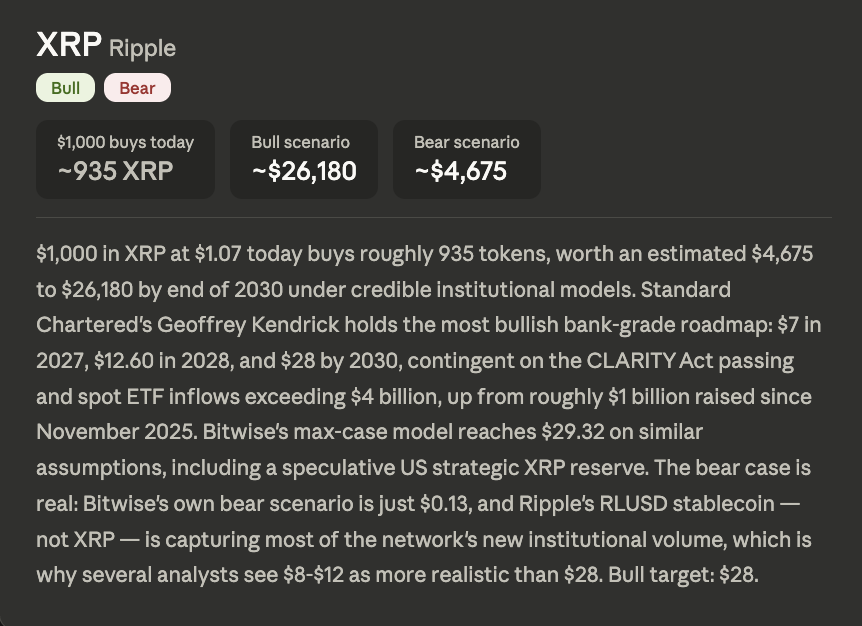
Put $1,000 into XRP at $1.07 and you own roughly 935 tokens. Claude AI predicts those tokens are worth somewhere between $4,675 and $26,180 by the end of 2030, and the price prediction spans a range wide enough to make the assumptions matter more than the headline.
The most bullish bank-grade roadmap comes from Standard Chartered’s Geoffrey Kendrick. It maps $7 in 2027, $12.60 in 2028, and $28 by 2030. But two conditions sit underneath it. The CLARITY Act has to pass, and spot ETF inflows need to exceed $4 billion.
Current inflows sit near $1 billion raised since November 2025. That is a fourfold gap between where flows are and where the model needs them.

Bitwise reaches a similar destination by a similar road. Its max-case model tops out at $29.32, including a speculative US strategic XRP reserve. Claude does not treat the downside as hypothetical. Bitwise’s own bear scenario lands at $0.13, which would turn that $1,000 into roughly $122.
The structural concern is closer to home. Ripple’s RLUSD stablecoin, not XRP, is capturing most of the network’s new institutional volume. That is why several analysts see $8 to $12 as more realistic than $28. The utility is arriving, but it may not be arriving in the token.

Discover: Everyone’s Got a Take. Get Free $25 from Kalshi to Actually Trade Yours
XRP Price Prediction: Claude AI Predicts A $1,000 Bet Ranges From $4,657 To $26,180
The daily chart explains why the low end deserves respect. XRP traded near $2.65 last October and declined for ten straight months. February broke the $1.80 shelf, dragging the price toward $1.15. Spring built a range between $1.30 and $1.55 that held into May.
June broke it, and the slide continued through the summer. Price touched $0.995 before the latest session. That session changed things. A sharp reversal lifted XRP back above $1.08 in a single day.
The close reads $1.08250, up 8.13%, and $0.08136. The daily range covered $0.99524 to $1.08261.
Support sits at $1.00, then $0.95 and $0.85. Resistance appears at $1.15, then $1.25 and $1.40. RSI reads 59.05 with its signal line far below at 38.23. That gap of nearly 21 points is unusually wide and reflects a violent one-day momentum shift.
The oscillator has jumped from oversold to above the midline. Momentum has flipped bullish, though a move this fast rarely holds without consolidation.
The distance between $122 and $26,180 comes down to whether institutions use the token or the stablecoin. Watching where new volume settles is how you find out which end of that range applies.
Discover: Your Market Calls Are Worth Something. Start with a free $25 on Kalshi
LiquidChain Is Betting the Bigger Opportunity Is Connecting the Capital.
XRP’s long-term upside increasingly depends on whether institutional activity actually accrues to XRP itself or gets captured by products like RLUSD.
LiquidChain is approaching that problem from a different angle: instead of betting on which asset wins inside one ecosystem, it is building infrastructure designed to connect liquidity across several of the largest ones.
Bitcoin, Ethereum, and Solana still operate as largely separate markets. Moving between them means bridges, extra fees, fragmented liquidity, and applications rebuilt chain by chain.
LiquidChain is developing a single execution layer intended to unify all 3, allowing one deployment to reach multiple ecosystems without repeatedly paying that cross-chain tax.
That gives the project exposure to the movement of capital itself, regardless of which large-cap token leads the next cycle.
The presale is currently priced at $0.01454 with just over $940,000 raised, leaving significant room for repricing if that infrastructure thesis gains traction.
Explore the LiquidChain Presale
The post Dario Amodei Claude AI Predicts What $1,000 in XRP Could Turn Into by End Of 2030 appeared first on Cryptonews.

Binance runs its global exchange under Abu Dhabi’s regulator. Emirati police still detained two of its employees over financial crime inquiries, the New York Times reported.
All have been released. A third staff member, who leads the company’s Dubai arm, answered questions at a police station in July.
A Foothold Built on Licenses and State Money
The Emirates is not a side market for Binance. It is the base.
Abu Dhabi’s Financial Services Regulatory Authority granted the exchange three licenses on December 8. No other crypto exchange had won a global license under that framework. The permissions went live on January 5.
The money runs just as deep. State-backed fund MGX invested $2 billion in March 2025. It paid in USD1, a stablecoin from World Liberty Financial, a venture the Trump family part-owns.
The relationship even shapes policy. Binance has cited its Abu Dhabi licensing rules to explain why it now handles some foreign police requests differently.
Airport Stops and an Overnight Hold
Two workers were pulled aside at Emirati airports, people familiar with the inquiries said. One midlevel employee passed through Sharjah this month. Officers took him to a station and held him overnight.
What police are chasing is unclear. Binance told the Emirati government that its staff were swept into fraud cases centered on customers. None were tied to the offenses, the company said.
The link may be mundane. Some employees’ names sit on a corporate bank account Binance keeps in the country. That account processes customer deposits and withdrawals.
“A small number of our personnel were recently asked to provide standard statements to local authorities as part of routine inquiries relating to third-party fund flows… all who provided statements were promptly cleared and released,” A Binance spokesman, speaking to the New York Times.
Follow us on X to get the latest news as it happens
A Familiar Pattern for Binance Staff
Emirati authorities were already tracing money around the exchange. Dubai’s Virtual Assets Regulatory Authority fined an unlicensed local firm, Shelbit, on July 24. Reuters tracked about $4 billion through Shelbit, and roughly $676 million reached Binance.
Binance’s record invites that attention. The company pleaded guilty in the United States in November 2023 and paid $4.32 billion. Prosecutors found it had let more than $898 million in trades pass between US and Iranian users.
That deal placed an independent compliance monitor over the company for three years. The term still has months left to run.
Staff have been caught in national cases before. Compliance executive Tigran Gambaryan spent months held in Nigerian custody in 2024. US diplomatic pressure secured his release.
The detentions have rattled the workforce. Binance approached Emirati officials this month, seeking help and raising concerns about employee safety.
Whether the questioning stays limited to customer fraud will test how much protection those licenses actually buy.
The post Binance Employees Detained in UAE Despite $2 Billion Emirati Backing appeared first on BeInCrypto.

England vs Pakistan: Harry Brook has found batting blueprint after captaincy disappointment – Jonathan Agnew

W. P. Carey: A Rock-Solid 5% Yielding REIT For Dividend Growth Investors (NYSE:WPC)

Binance Enables Crypto Trading for AI Agents with User Controls

Weekend Open Thread – Corporette.com

Weekend Open Thread: Brooks Brothers

London Mayor Sadiq Khan handed a peerage by Keir Starmer alongside 15 other Labour figures… just days before the PM leaves No10

XRP And Ethereum Won’t Be The Same After This The Buy Signals Are MASSIVE And People Don’t See It

The BEST & WORST Financial Advice In Your 20s (Ultimate Tier List)

Financial Adviser Reveals: Why You Don’t ACTUALLY Need One (Just Do This!)
-

 Fashion6 days ago
Weekend Open Thread: Ann Taylor
-
 Sports7 days ago
This U.S. Amateur is a glimpse into golf’s future in more ways than you think
-
 Tech7 days ago
11 Ways to Rank Your Videos
-

 Sports6 days ago
Birmingham 2026: Day 6 Timetable for Irish Athletes
-
 NewsBeat6 days ago
Myanmar says over 300,000 Rohingya refugees verified for repatriation as exodus enters ninth year
-

 Politics5 days ago
SEQ Code: The Three Letter Boarding Pass Code That Could Give You The Worst Seat
-

 Tech3 days ago
Qwen3.8-27B runs frontier-class coding agents and reasoning locally, no cloud API required
-

 Business2 days ago
SMA Solar Technology AG (SMTGY) Q2 2026 Earnings Call Transcript
-

 Crypto World6 days ago
Pi Network Protocol 27 endgame: last upgrade before what?
-

 Crypto World3 days ago
OCC Greenlights Trump Family Crypto Firm for Trust Charter
-
 Tech5 days ago
Every fusion startup that has raised over $100M
-

 Business7 days ago
15 Ways to Make Money From Your Phone (2026 Guide)
-
 Entertainment6 days ago
10 Netflix Shows That Quietly Became Modern Classics
-

 Fashion6 days ago
Weekly News Update, 8.14.26 – Corporette.com
-
 Entertainment6 days ago
Marvel Studios Reveals New X-Men Cast Including Adam Driver and Sadie Sink
-
 Crypto World7 days ago
Robinhood Chain Approaches $1B TVL as Uniswap Integration Boosts Liquidity
-

 News Videos17 hours ago
Don’t Leave Your Financial Future To Chance | August 19, 2026
-

 Fashion6 days ago
Silver bangles for women – Newbridge Silverware
-

 Business6 days ago
Facebook Down Now? Users Report Login And Loading Problems As Outage Trackers Monitor Ongoing Issues
-

 Fashion6 days ago
Cart Confidential Vol. 44 – Julia Berolzheimer
You must be logged in to post a comment Login