
Crypto World
State Farm Is Sending $5 Billion in Dividend Payments to Customers

When will customers get their dividend payments?
The payments began going out on July 31. State Farm has not indicated when they will stop.
“Millions of customers have already received their individual dividend payments, with more on the way,” State Farm announced when the payments began.
Customers will be notified by State Farm regarding their pending payments “beginning late summer of 2026,” the company’s website states, adding that dividend payments are being sent out “in waves by state where the policy is assigned.”
Over 7.2 million checks have been mailed since payments began, with another 3.8 million set to go out this week, a State Farm spokesperson told CBS News in an email.
How much could eligible customers get paid?
The dividend payments average $100 per vehicle, according to State Farm.
The amount an eligible customer receives will vary based on a couple of factors, however. The payment a customer gets will be based on a percentage of the premiums they paid, and that percentage ranges from 4% to 10% depending on the customer’s state.

Disclosure: This article does not represent investment advice. The content and materials featured on this page are for educational purposes only.
SimpleSwap report finds Bitcoin sell-offs are drawing weaker stablecoin inflows as market fear loses its impact
Summary
- Bitcoin’s February sell-off triggered a 600% surge in stablecoin inflows, while June’s deeper slide drew little safe-haven demand.
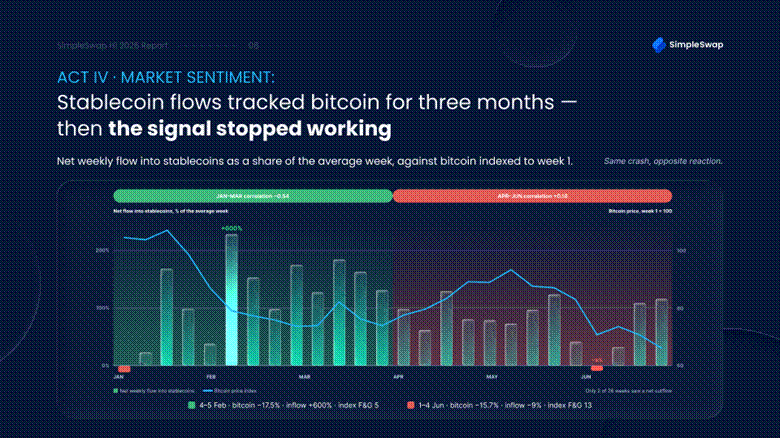
- SimpleSwap data shows Bitcoin’s stablecoin flow correlation flipped from -0.54 in Q1 to +0.18 from April to June.
- Swap activity reveals investors reacted far less to Bitcoin’s June drop, suggesting repeated market shocks may be losing their impact.
Bitcoin fell 17.5% in February, and money ran for cover. It fell 15.7% in June, and almost nothing moved. SimpleSwap tracked 26 weeks of swap flows, then two rival platforms went and checked their own books.
Over 36 hours on 4 and 5 February, Bitcoin fell 17.5%. Stablecoin inflows on SimpleSwap ran 600% above their weekly average in a single day.
Over 70 hours from 1 to 4 June, Bitcoin fell 15.7%. The same flows came in 9% below average.
Two drawdowns, four months apart, separated by less than two percentage points of depth. Their responses differ by more than six hundred.
June was not the calmest month
The tempting explanation is that traders had less to fear by summer. The sentiment data says the opposite. The Crypto Fear & Greed Index printed 5 during the February episode, the lowest reading in its history, and in June it bottomed in the low teens at almost identical depth. By Alternative.me’s count, the index spent roughly two of every three days of the half in Extreme Fear.
The market gave nobody a reason to relax. Spot volume on the top centralized exchanges fell from about $9.5 trillion in the second half of 2025 to roughly $4.65 trillion, according to CoinGecko, while total capitalization ended the half near $2.1 trillion. June was a muted response in a frightened market—stranger, in some ways, than a calm one.
That gap is what the H1 2026 Swap Report, published this week by SimpleSwap, examines. Using swaps, the report shows a part of the market that order books do not capture: what people actually chose to do next, at the moment they did it.
The relationship did not weaken; it inverted
Through the first quarter, the textbook held. Weekly net stablecoin flow correlated with the level of Bitcoin at −0.54. Price down, money into safety.
From April through June, the same coefficient reads +0.18.
“The first drawdown of a cycle is news, and people act on news,” said Stefan Lauer, Head of Infrastructure at SimpleSwap. “The third one of comparable size is weather, and nobody rearranges a portfolio because it is raining again.”
Then two competitors checked their own books
A single aggregator is a sample of the market rather than a measure of it, so the report presents other people’s numbers alongside its own.
SwapSpace recorded inflows 61% above baseline in the February episode, then fell to 9.3% below baseline by June, with its weekly correlation moving from −0.33 to +0.04. That is the same flip, but with a smaller amplitude.
Swapzone confirms February, when stablecoin swaps ran more than 50% above a normal week, and complicates June, when a few individual stablecoins pulled back while total stablecoin volume remained more than 10% above baseline.
“Both platforms confirm the surge, and only one confirms the fade, which is the honest state of the evidence,” said Rick Cramer, Head of Analytics at SimpleSwap. “Any analyst who takes the finding seriously will go looking for exactly that boundary, so leaving it out would have been the fastest way to lose them.”
One weekly detail sharpens all of it. Across 26 weeks, exactly two produced a net outflow from stablecoins. One was the first week of January. The other was the first week of June, the week containing the deepest Bitcoin drawdown of the half. In the worst week of the period, no money arrived in the safe asset.
What to do with a broken indicator
If we consider the influx of stablecoins as an indicator of fear, the premise changes. This signal does not behave like a constant, but rather like something with a half-life: it is most pronounced at the first shock of the cycle and weakens with each repetition. The real test is to compare the reaction with the scale of the fall, and not with the previous reaction. The lack of influx late in the cycle does not prove that people have calmed down.
Five more findings, and where they lead
The rest of the report turns on divergences between the market and the platform, and each is worth reading with the tables in front of you.
Bitcoin dominance broke above 60% in the spring while the platform’s combined Bitcoin and Ether share of volume moved the other way, which sets up an argument about why a stock measure and a flow measure disagree during a sell-off.
Swap volume fell by a third compared with the second half of 2025, while transaction count fell far less, and the section explores what the gap between the two suggests about who stayed.
Stablecoin supply held near $310 billion through the half while Visa’s Allium-powered dashboard logged $1.79 trillion of adjusted transfer volume in June, an all-time high. The platform’s flow data lands on the receiving end of that shift.
The platform made 268 assets routable — roughly ten a week — and the median one then waited about seven weeks before its first meaningful use. The fastest moved in only a small fraction of that time, and the gap between them is what the section really examines.
Cross-chain activity accounted for 91.8% of swaps and remained remarkably stable month to month. The more striking number sits underneath, in a table showing how far past the four largest networks the average swap now reaches.
The report ends with three observations, and none of them look like a price forecast. For analysts and media readers: it seems that panic has its own half-life; the breadth of listing looks more like insurance than advertising; and demand continues to shift not towards changing what you own, but towards changing where you keep it. The first of these conclusions will be tested in the second half of the year — a new drawdown of comparable depth will either confirm that the market reaction continues to fade, or show that it has reset to zero after a quiet period.
The full report comprises six sections and includes data contributed by SwapSpace, Swapzone, Rubic, and Near Intent, along with comments from Talisman Wallet and Kuvi.AI, noting where those partners disagree with the platform’s own reading.
About the report
The SimpleSwap H1 2026 Swap Report covers 1 January to 30 June 2026, benchmarked against the second half of 2025. Each section opens with a public market benchmark before any internal figure appears, drawing on CoinGecko for exchange volumes and capitalization, DeFiLlama together with Visa’s Allium-powered dashboard for stablecoin supply and settlement, Alternative.me for sentiment, and LI.FI plus Circle disclosures for cross-chain context. All figures are aggregated across swaps routed through the platform, and nothing in the report identifies a user, an address, or the timing of an individual transaction. Exactly one dollar figure appears in the text, and it is a measurement threshold rather than a platform total. The report describes past market behavior and contains no price forecasts.
Full report and methodology at SimpleSwap blog. Media and analysts can request additional data cuts at [email protected].
About SimpleSwap
SimpleSwap is a self-custodial multi-source swap aggregator. It draws liquidity from more than 20 CEX and DEX sources, covers 2,800+ assets, and handles provider and route selection under the hood. Over 8 years, 10M+ users have swapped through SimpleSwap, and 6,000+ projects use it as a business solution, including Exodus and Tangem. The only official SimpleSwap website is simpleswap.io.
Disclosure: This content is provided by a third party. Neither crypto.news nor the author of this article endorses any product mentioned on this page. Users should conduct their own research before taking any action related to the company.

It’s in the embryo that the 20,000 or so genes in the human genome start organizing to mature into the more than 200 different cell types in the body—similar to the way young people start discovering their talents and deciding on a career. In other words, like teens, cells develop an identity.
Over time, however, this cellular identity gets challenged—by molecular processes, inflammation, environmental exposures including pollutants, and behaviors like a lack of physical activity, poor diet, and smoking. The cumulative effects of these assaults, Izpisua Belmonte and other developmental experts believe, drive a significant portion of aging and disease. Restoring this lost cellular identity could help cells to function as they did when they were younger, Izpisua Belmonte believes.
This concept opens up clever ways to confront the deterioration of cells, tissues, and organs. Izpisua Belmonte has found, for example, that as people age, their cells drift toward a certain state that leads to stiffer tissues and greater production of inflammatory factors that can stress and age cells—and that there might be a way to forestall it.
Izpisua Belmonte founded Altos to test his idea. Rather than reprogramming adult cells all the way back to an embryonic state, which is what Shinya Yamanaka demonstrated, Izpisua Belmonte wondered whether, to address disease, partial reprogramming might be sufficient to help cells get back on their proper developmental path and regain their youthful function and identity.
In 2025, Izpisua Belmonte reported that it was indeed possible—both in human cells reprogrammed in the lab, and in mice. Treating the mice with the Yamanaka genetic factors partially reprogrammed and rejuvenated cells in a variety of older animals’ organs, including the kidneys, liver, and intestines; skin cells, for example, regained their ability to regenerate and heal wounds more efficiently.
“If we can tackle the problem of cell identity, we could not just focus on aging itself but on many, many diseases as well,” he says. “Rather than study diseases one by one, we can attack the problem in a more comprehensive way.” The next test is transplantation. Scientists at Altos are starting to determine whether partial reprogramming can help to rejuvenate and redirect aging cells in multiple organs back to a more youthful and functional state, by transplanting them into older animals and monitoring their function.
For people, he says, the first studies could focus on finding more organs for transplant. It’s well known that younger organs lead to better outcomes for the recipient than older ones; while at Salk, Izpisua Belmonte’s team showed that reprogramming kidneys from older animals helped those kidneys perform as well as kidneys from younger animal donors, and extended the life of the mouse recipient.
“It’s proof that independently of disease, or of the problem, re-establishing cell identity could have a major effect in the progression of any disease,” he says. So far, in mice, he and his team have found similar success in reprogramming diseased cells in nearly three dozen different conditions.
He cautions, however, that “a mouse is not a human,” and that partial reprogramming as a tool for slowing aging still requires more study. But he believes that if the transplant results are replicated in people, more organs from older donors could be used to save lives—and it would be an important step in moving the field of cellular rejuvenation forward.
The hope is that cellularly, “we are able to mimic what happens during the early years of our lives,” he says. “Whether this could somehow prevent the inevitability of aging is still a major question.” But thanks to his work, it’s a question that can now be asked—and, eventually, answered.

Chinese Robot Developer Unitree Soars 460% On Blockbuster IPO
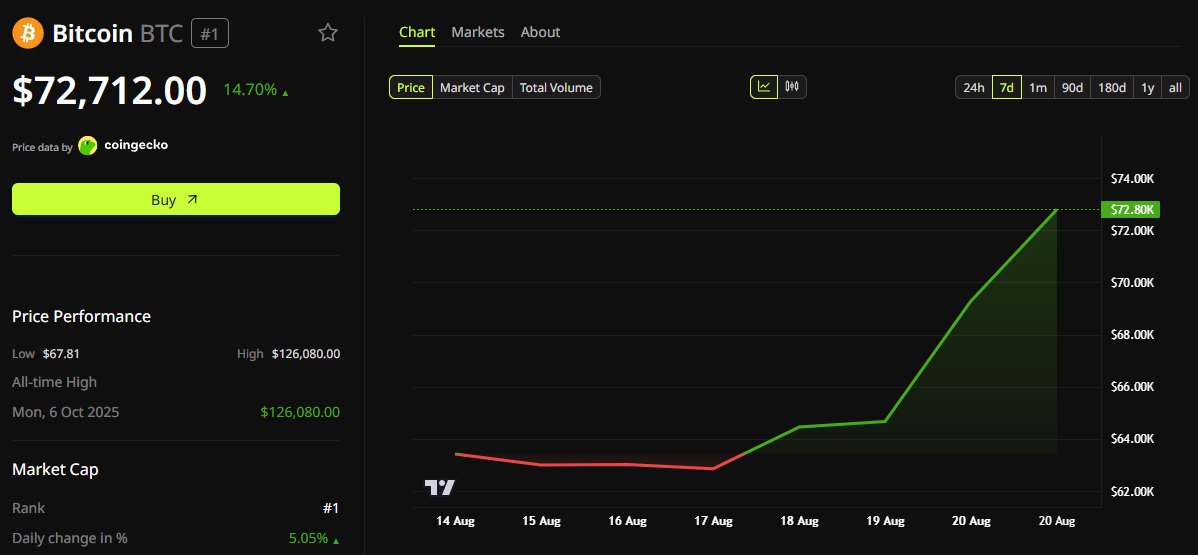
Bitcoin (BTC) is rallying again, and VanEck’s Matthew Sigel says it is finally acting like the hedge it was built to be.
Sigel, head of digital asset research at VanEck, ties the move to fears over US fiscal policy rather than pending crypto legislation.
All Eyes on the US Treasury
The US Treasury doubled its long-dated bond buyback ceiling, from $2 billion to at least $4 billion per operation. The move compressed yields and fed a broader risk-on rally tied to the Treasury’s bond buyback expansion.
Roughly $3 billion in forced short liquidations amplified the move. bitcoin climbed to $72,757, part of what one report called Bitcoin’s short squeeze cascade.
Sigel downplays the CLARITY Act, the crypto market structure bill working through Congress, as the driver. Coinbase CEO Brian Armstrong has voiced optimism the bill clears 60 Senate votes, though prediction markets price a slim chance it becomes law this year, a gap Sigel says explains why the rally isn’t about CLARITY Act’s Senate odds.
“Bitcoin is one of the best hedges you can find on that dynamic.”
— Matthew Sigel, Head of Digital Asset Research, VanEck, via CNBC
That hedge framing carries a mixed record
Bitcoin’s correlation with US equities spiked, not fell, during the 2020 COVID crash and the 2022 rate-hiking cycle. Academic research shows that pattern, not decoupling, is what typically happens under market stress.

That tension traces back to Bitcoin’s origin. Satoshi Nakamoto’s 2008 whitepaper proposed Bitcoin as a fixed-supply alternative to a financial system reliant on central bank money printing.
Sigel’s dollar-debasement argument revives that same case, just aimed at Treasury debt management instead of the printing press directly.
Whether Bitcoin keeps behaving like that hedge, or snaps back into a risk-on trade if equities wobble, will show which version of the story markets are actually pricing.
The post Bitcoin Is Suddenly a Hedge Again, VanEck Says: What Changed? appeared first on BeInCrypto.


Disclosure: This article does not represent investment advice. The content and materials featured on this page are for educational purposes only.
The Graph says onchain AI agents need identity, structured data and payments to act autonomously.
Summary
- Onchain AI agents need identity, reliable blockchain data and payment tools to operate independently online.
- ERC-8004 and account abstraction can give autonomous agents defined permissions while supporting verifiable onchain reputations.
- Subgraphs, MCP and x402 could help agents access data, pay services and execute blockchain actions.
Artificial intelligence and blockchain have spent years developing largely along parallel tracks. AI has become increasingly capable of reasoning, interpreting instructions and making decisions, while blockchain networks have created programmable financial systems that can operate without centralized intermediaries. The next stage is bringing those capabilities together.
The result could be an internet populated not only by human users, but also by autonomous AI agents capable of discovering information, making decisions, interacting with protocols and paying for services on their own.
That future requires more than increasingly powerful large language models. As The Graph Foundation explains in its Aug. 18 blog post, “The Onchain Agent Infrastructure Stack Explained,” autonomous agents need infrastructure that translates AI reasoning into reliable blockchain actions. The Graph frames the emerging stack around three fundamental requirements: identity, environmental awareness and economic agency.
Identity: Giving agents an onchain passport
Before an autonomous agent can transact, a blockchain needs a reliable way to identify it and determine what it is authorized to do.
Simply giving an AI agent access to a user’s wallet private key creates obvious problems. An incorrect decision or hallucination could expose all of the assets associated with that wallet. It also makes distinguishing between actions performed by a person and those performed by an autonomous system difficult.
ERC-8004, described by The Graph as the Trustless Agents standard, addresses this problem through three onchain registries covering identity, reputation and validation. These registries allow agents to establish recognizable identities and interact without requiring pre-existing trust between participants.
Combined with account abstraction, this model can also create tightly defined permissions. An agent might be authorized to trade only a certain amount each day, for example, without receiving unrestricted control over a user’s funds.
Identity becomes more valuable as agents develop histories. Because actions and feedback can be recorded onchain, agents can accumulate verifiable reputations that other agents and smart contracts can evaluate.
The Graph is supporting this layer through Agent0 Subgraphs, which index agent registrations, metadata, reputation information and validation activity across multiple networks. According to The Graph, this makes it possible for agents to search for other agents by characteristics such as capability or reputation without independently scanning blockchain histories.
Data: Helping AI understand the onchain world
Knowing who an agent is solves only part of the problem. An autonomous agent also needs accurate information about the environment in which it is operating.
Blockchains contain enormous amounts of transparent data, but transparency does not necessarily mean accessibility. Information is distributed across blocks, transactions, events and smart contracts. Asking an LLM to navigate that raw information directly is inefficient and can increase the risk of incorrect conclusions.
This is where blockchain indexing becomes a critical part of agent infrastructure.
The Graph’s Subgraphs organize blockchain information into structured, searchable datasets. When combined with Model Context Protocol, or MCP, that indexed information can become directly usable by AI systems. The Graph describes Subgraph MCP as effectively acting as a translator between agents and complex blockchain data.
Consider an autonomous trading agent tasked with finding an attractive opportunity involving an ETH pair. Before executing a transaction, the agent might need to compare liquidity across protocols, evaluate current conditions and confirm that the opportunity still exists.
Rather than attempting to interpret millions of blockchain logs, the agent could query the relevant Subgraphs through MCP and receive structured information it can reason about.
This illustrates an important distinction in agent infrastructure. The intelligence layer and the data layer solve different problems. An LLM may decide what information it needs and reason about the answer, while indexing infrastructure is responsible for making reliable blockchain information available in a usable format.
Payments: Giving agents economic agency
The final piece is the ability to pay.
Today’s internet payment infrastructure was largely designed around people and businesses. Users create accounts, manage subscriptions, enter payment information or manually authorize transactions. Autonomous software operating continuously cannot depend on those workflows.
The emerging x402 standard offers another model. It revives HTTP’s “402 Payment Required” status code to enable services to request payment directly as part of an internet request.
The Graph has integrated x402 into its Subgraph Gateways, allowing agents to pay for individual queries in USDC without maintaining traditional API accounts or keys. An agent requests data, receives the payment requirement, signs the payment and resubmits the request before receiving the requested information. The Graph’s GraphTally infrastructure handles settlement with Indexers behind the scenes.
The significance goes beyond paying for blockchain queries. Machine-to-machine commerce requires payment systems suited to potentially enormous volumes of small, automated transactions. If agents are constantly purchasing data, computation or services from one another, per-request micropayments can provide an economic model that more closely matches how autonomous software actually operates.
From web3 users to web3 agents
Put these layers together and a clearer picture of the onchain agent stack emerges.
An agent establishes an identity and operates within predetermined permissions. It accesses structured blockchain data to understand current conditions. It can then purchase the information or services it needs and execute an authorized action. The process can repeat without requiring a human to approve every intermediate step.
The Graph calls this process the “agent loop.” ERC-8004 provides identity and accountability, Subgraphs and MCP provide contextual awareness, while x402 and GraphTally support autonomous payments and settlement.
This architecture also points toward a broader shift in how blockchain infrastructure may be designed. Much of web3 today assumes a human is sitting behind a screen, navigating an interface, connecting a wallet and approving transactions. An agent-centric environment requires infrastructure that is machine-readable, programmable and economically autonomous by default.
The Graph already provides blockchain data infrastructure across more than 60 networks and reported that, as of early 2026, it had served more than 1.27 trillion queries to over 75,000 projects. The rise of autonomous agents potentially gives that kind of infrastructure a new class of user: software itself.
AI may provide the reasoning engine for the emerging agentic internet, but intelligence alone cannot create an autonomous economy. Agents also need identities, trustworthy data and native ways to transact. The development of that underlying stack could determine whether onchain AI remains a collection of experiments or becomes a functional machine-to-machine economy operating at internet scale.
Disclosure: This content is provided by a third party. Neither crypto.news nor the author of this article endorses any product mentioned on this page. Users should conduct their own research before taking any action related to the company.

Binance has rolled out Agent OS, a new developer platform designed to let AI agents connect to crypto-market data, monitor user accounts, and execute trades on the exchange—subject to permissions and limits set by the user.
In an announcement, the company said the platform supports popular AI tools, including ChatGPT, Claude Code, Codex, and Cursor. Users can authorize agents to view account information and place orders within configured boundaries, while also being able to revoke access and adjust permissions at any time.
Key takeaways
- Binance Agent OS is positioned as a developer platform for AI agents to access exchange data and trade on Binance.
- Authorization controls—permissions, limits, and the ability to revoke access—are central to how agents can act.
- Account separation is supported via dedicated subaccounts, allowing funds and activity to be isolated per agent.
- Exchange monitoring, not agent cognition: Binance can monitor trades placed through Agent OS but cannot see an agent’s external data sources or decision logic outside the chosen AI application.
- Onchain and payment integrations are included, enabling agents to initiate payments and interact with wallets and other onchain services.
What Binance’s Agent OS enables
Agent OS is built around the idea that AI systems should be able to perform structured actions in financial applications—rather than simply providing advice. According to Binance, users can authorize agents to view account information and execute trades on the exchange under a permission model.
The platform is designed to give users practical control over automation. Binance says agents can be assigned to dedicated subaccounts, which can help separate funds and trading activity tied to different agents or strategies. That separation matters for risk management, particularly when multiple agents are running different tasks or operating with different levels of access.
Permissions, limits, and transparency into agent activity
A key detail in Binance’s explanation is what the company can and cannot observe. Binance said it can monitor trades placed through Agent OS, but it does not have visibility into an agent’s external information sources, its interpretation of inputs, or the decision-making process—those occur within the user’s chosen AI application.
This distinction is important for both builders and users. It suggests Binance is implementing guardrails at the exchange-action layer while leaving the reasoning layer to the third-party AI stack. For users, that can reduce exposure to unclear automation behavior, but it also means they still need to carefully audit what their selected AI tools are doing, where they pull information from, and how they translate that information into trading actions.
Binance also emphasized that access is not permanent: users can revoke access at any time and adjust permissions and limits as their needs change.
Beyond trading: payment and onchain connectivity
Agent OS is not limited to market monitoring and order placement. Binance says the platform connects agents to its payment and onchain tools, enabling agents to make payments and interact with wallets and other onchain services.
That broadens the potential use cases for agent automation from trading-centric workflows to wider transaction tasks. For example, an agent might be configured to move assets, execute payments, or coordinate onchain interactions—again within whatever boundaries the user sets.
Binance joins an emerging “agentic” exchange trend
Binance’s move fits into a wider pattern among crypto trading platforms exploring how far AI agents can go in executing tasks. The push is not uniform: different exchanges appear to be testing different levels of autonomy and different product shapes.
In June, Coinbase launched “Coinbase for Agents”, described as a tool that lets AI models such as ChatGPT and Claude connect to user accounts and execute crypto trades and strategies. Coinbase also highlighted support for agent-driven payments via its x402 protocol.
Meanwhile, Kraken reportedly took a more controlled approach in July with an AI-powered investing assistant that monitors markets and recommends trades based on users’ goals and risk preferences, but requires user approval before executing a trade.
Other players have extended the concept beyond direct trading. In a separate development, OKX launched a beta marketplace where AI agents can find work, transact autonomously, and hire other agents for tasks, using stablecoin payments and an onchain reputation system.
The broader narrative has also been reinforced by prominent executives arguing that AI agents may become significant participants in onchain activity. Coinbase CEO Brian Armstrong and Circle CEO Jeremy Allaire have both suggested agents could soon represent a large share of onchain transactions. Binance co-founder Changpeng Zhao has echoed the idea, describing crypto as the “native currency” of AI agents.
What to watch next for Agent OS
With Agent OS, Binance is effectively turning trading permissions into an interface for automation—while keeping the “why” behind decisions inside the user’s AI environment. The next phase for users and developers will likely hinge on how reliably permissions behave in practice, how agents are isolated via subaccounts, and how Binance’s integrations handle real-world onchain and payment flows as more automation moves from demos into production.
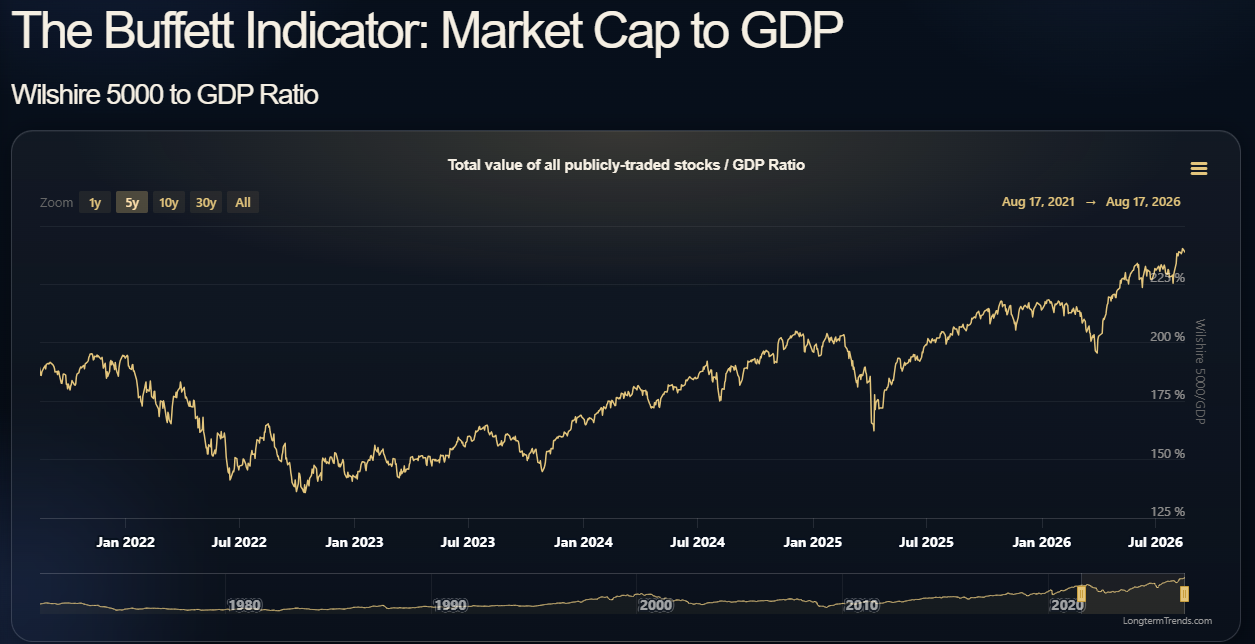
Bill Dudley, a former president of the Federal Reserve Bank of New York, says the US stock market is in bubble territory, pointing to stretched valuations and a slowing artificial intelligence (AI) investment cycle.
Dudley made the comments on Bloomberg Television this week, as Treasury Secretary Scott Bessent moves to contain a sharp rise in long-term bond yields.
Stretched Valuations Underpin the Bubble Call
Dudley pointed to the Shiller CAPE ratio, the Shiller cyclically adjusted price-to-earnings (CAPE) ratio, which sits near 41. That compares with a 25 to 30-year average of about 17, and a record of 44 set in December 1999. In simple terms, investors are paying far more for each dollar of company earnings than history suggests is safe.
He also cited the Buffett Indicator, the ratio of stock market value to gross domestic product (GDP), which stands around 240%. Warren Buffett has said readings above 100% signal an overvalued market. This indicator is suggesting the stock market is strongly overvalued.

AI Spending Faces a Slowdown
Dudley expects capital expenditure (capex) growth among AI hyperscalers, the large cloud providers building AI infrastructure, to decelerate in 2027. That would squeeze profit margins across the sector and its suppliers.
He also questioned whether the industry can generate the estimated $2 trillion in revenue needed to justify current investment levels. Historically, he noted, excess returns from major technological booms tend to get competed away as rivals pile in.
Broadcom is reportedly negotiating a chip-financing package that could reach $100 billion. The deal would support Anthropic’s IPO plans, with the AI firm targeting a stock market debut as soon as October.
Treasury Moves Add to the Pressure
The 30-year Treasury yield surged above 5.3% this week, its highest level since 2007. The Treasury Department responded with a long-bond buyback increase, doubling the size of its debt repurchases.
However, Dudley said the fiscal backdrop complicates the Federal Reserve’s task regardless of the bond-market intervention.
“The Fed has to take the world as it is.”
— Bill Dudley, Bloomberg
The coming months may show whether AI capex growth slows fast enough to avoid a sharper market correction.
The post Ex-Fed Chief Dudley Warns Stocks Are in Bubble Territory as Treasury Boosts Buybacks appeared first on BeInCrypto.


Arbitrum activated ArbOS 61 Elara on Aug. 20, adding optional protocol-level transaction screening, priority-fee support and an alternative data-availability interface for dedicated chains, while changing base-fee administration and expanding Stylus capacity on Arbitrum One. The upgrade went live… Read the full story at The Defiant
Bitcoin has staged a sharp recovery from the lower end of its recent range, pushing back toward $70K after spending several weeks consolidating below a descending trendline. The latest move has improved the short-term structure considerably, although BTC is now approaching an important resistance cluster that could determine whether this is the start of a broader recovery or simply a range breakout that needs confirmation.
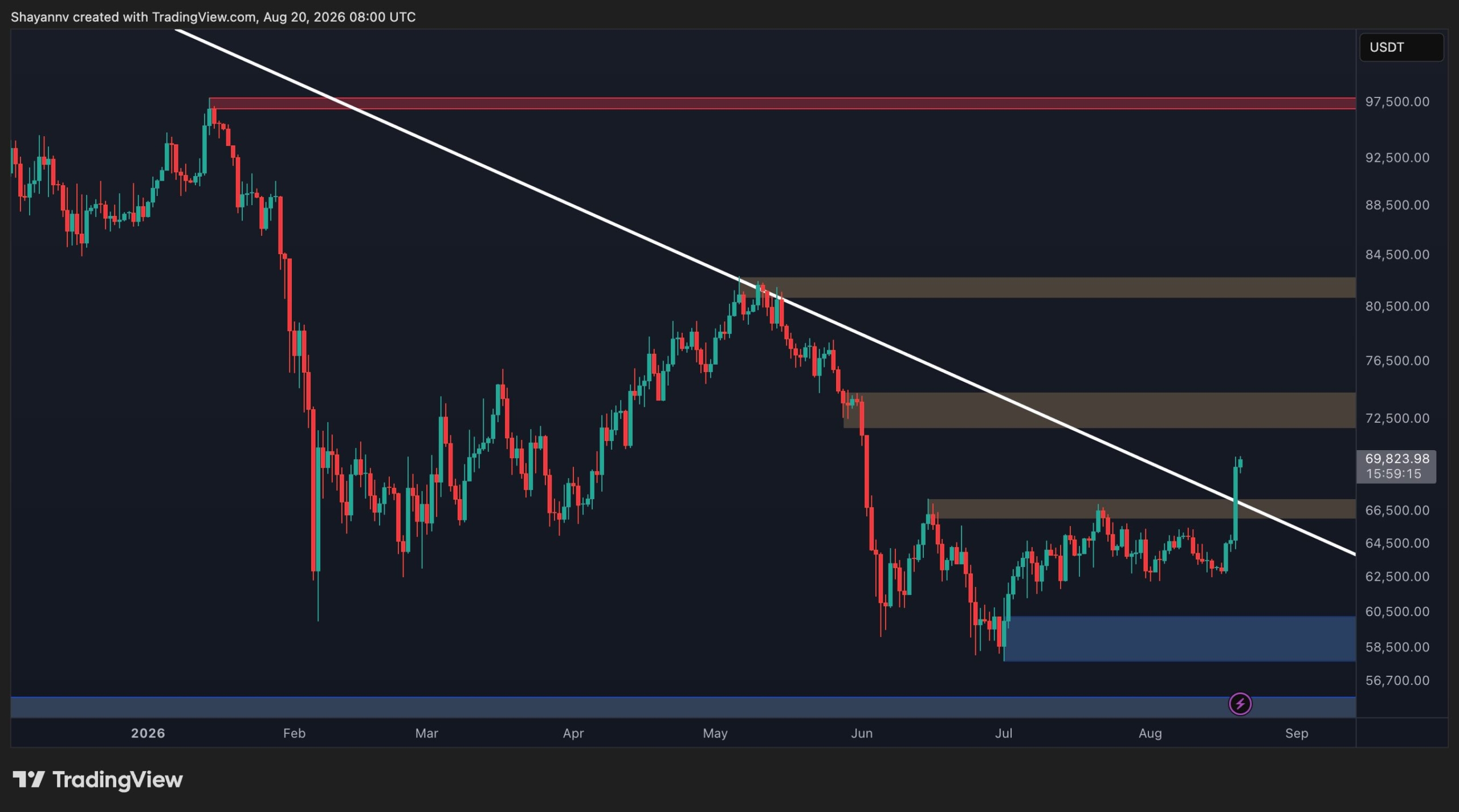
Bitcoin Price Analysis: The Daily Chart
The daily chart shows Bitcoin recovering from the $60K support area after a prolonged decline from the all-time highs. The price subsequently formed a broad consolidation structure, with the market repeatedly finding buyers around the $60K-$62K region while rallies were capped by a descending trendline.
The most important development is the latest breakout. BTC has moved decisively above the long-term descending trendline and the $66.5K resistance zone, with the asset currently around $72K. This represents a meaningful structural improvement because the trendline had been containing the recoveries for months.
However, the breakout is now facing its first major test. The $72K-$74K area represents the next significant resistance zone visible on the chart. A sustained move through this region would strengthen the bullish case and potentially expose the $80K-$82K resistance area next.
On the downside, the former $66.5K resistance zone is now the first important area to monitor. A daily close back below this region would weaken the breakout and raise the possibility of a return toward the critical $60K demand zone.
Overall, the daily structure has shifted from a clear sequence of lower highs into a potential bullish reversal. Confirmation above $66.5K would be important, while failure to hold that zone could turn the recent move into a false breakout and likely lead to another capitulation event.
BTC/USDT 4-Hour Chart
The 4-hour chart provides a clearer picture of the immediate breakout. BTC had been trading inside a contracting structure, characterized by a descending upper trendline and a gradually rising lower boundary. This created a compression pattern that persisted from July into mid-August.
The breakout finally occurred, and Bitcoin surged through both the descending trendline and the $66K-$67K resistance zone. The move was particularly aggressive, with BTC quickly advancing from the mid-$64K area toward $70K.
The $66K-$67K zone is therefore the key short-term pivot. As long as Bitcoin remains above it, the breakout structure remains intact, and the market could continue toward the next daily resistance around $72K-$74K.
At the same time, the speed of the move means a retest would not necessarily be bearish. A pullback toward $66K-$67K followed by a successful rebound could provide stronger confirmation that the former resistance has turned into support.
For now, momentum clearly favors the buyers on the 4-hour timeframe, but the next challenge is whether buyers can convert the breakout into sustained price acceptance above $70K.

On-Chain Analysis
The futures average order size chart provides an additional perspective on the recent price action. The indicator separates futures activity into normal orders, big whale orders, small whale orders, and retail orders, allowing the composition of trading activity to be viewed alongside Bitcoin’s price.
The recent price recovery from the $60K area toward $70K has featured a mixture of normal and whale-sized orders, with green and light-green clusters appearing repeatedly during the advance. This suggests that larger orders have remained active around the latest recovery rather than the move being driven exclusively by smaller retail transactions.
At the same time, the chart shows substantial red retail-order clusters during several previous major price swings, including periods around the $70K region and the subsequent decline. The latest advance toward $70K does not show the same degree of persistent retail-order dominance visible during some earlier rallies.
That backdrop is constructive, although the indicator alone does not establish whether the larger orders are predominantly long or short. The more important takeaway is that the current price recovery is occurring alongside renewed activity from larger futures participants.

The post Bitcoin Price Analysis: What’s Next for BTC After Massive 12% Daily Surge? appeared first on CryptoPotato.
Optimism governance approved a proposal to move 546.9 million OP tokens, valued at roughly $49.7 million at the time of the vote, from an allocation reserved for future user airdrops into a Strategic Ecosystem Fund administered by the Optimism Foundation. The change removes the remaining dedicated… Read the full story at The Defiant

SimpleSwap data says crypto ran out of panic before it ran out of reasons to panic

Young and the Restless: Billy’s Ruthless Chase of Chancellor Destroys His Future With Sally!

Daily horoscope August 21, 2026: Predictions for your star sign





-

 Fashion6 days ago
Weekend Open Thread: Ann Taylor
-
 Tech7 days ago
11 Ways to Rank Your Videos
-

 Sports6 days ago
Birmingham 2026: Day 6 Timetable for Irish Athletes
-
 NewsBeat6 days ago
Myanmar says over 300,000 Rohingya refugees verified for repatriation as exodus enters ninth year
-

 Politics6 days ago
SEQ Code: The Three Letter Boarding Pass Code That Could Give You The Worst Seat
-

 Tech3 days ago
Qwen3.8-27B runs frontier-class coding agents and reasoning locally, no cloud API required
-

 Business3 days ago
SMA Solar Technology AG (SMTGY) Q2 2026 Earnings Call Transcript
-

 Crypto World6 days ago
Pi Network Protocol 27 endgame: last upgrade before what?
-

 Crypto World3 days ago
OCC Greenlights Trump Family Crypto Firm for Trust Charter
-

 Tech5 days ago
Every fusion startup that has raised over $100M
-
 Entertainment6 days ago
Marvel Studios Reveals New X-Men Cast Including Adam Driver and Sadie Sink
-

 Business7 days ago
15 Ways to Make Money From Your Phone (2026 Guide)
-
 Entertainment7 days ago
10 Netflix Shows That Quietly Became Modern Classics
-

 Crypto World7 days ago
Robinhood Chain Approaches $1B TVL as Uniswap Integration Boosts Liquidity
-

 Fashion6 days ago
Silver bangles for women – Newbridge Silverware
-

 Fashion6 days ago
Weekly News Update, 8.14.26 – Corporette.com
-

 News Videos21 hours ago
Don’t Leave Your Financial Future To Chance | August 19, 2026
-

 Business6 days ago
Facebook Down Now? Users Report Login And Loading Problems As Outage Trackers Monitor Ongoing Issues
-

 Fashion6 days ago
Cart Confidential Vol. 44 – Julia Berolzheimer
-

 Crypto World3 days ago
NAVI Prime launches institutional lending framework on Sui
You must be logged in to post a comment Login