

Crypto World
Analyst Warns of Multi-Year Reset as Bitcoin Liveliness Falls



Bitcoin’s liveliness metric is falling, signaling a potential multi-year reset phase as analysts say accumulation cycles may now be starting.
Bitcoin’s Entity-Adjusted Liveliness metric peaked in December 2025 and has begun reversing downward, signaling the end of the distribution phase and the start of a new accumulation period that historically lasts between 1.1 and 2.5 years.
According to analyst Axel Adler Jr., the on-chain signal means investors should prepare for an extended market reset rather than a quick recovery, although institutional demand through ETFs may alter the traditional cycle pattern.
Shift From Distribution to Accumulation
In a post published on February 17, Adler wrote that Bitcoin’s Entity-Adjusted Liveliness reached 0.02676 in December 2025 and has started to decline. The indicator tracks the ratio of spent coin days to created coin days, which is filtered to remove transfers within the same holder.
According to his chart, past cycles in 2020 and 2022 showed the same structure, where the metric peaked shortly after price highs and then trended lower during accumulation periods lasting 1.1 to 2.5 years.
Adler noted that the price of Bitcoin surpassed $126,000 in October 2025 before falling by about 45%, adding that liveliness tends to lag price because it is cumulative.
Current readings are still below short-term averages, which the market watcher said are a sign of early-stage transition rather than confirmation of a full trend. He added that a further drop in the 90-day average below the 365-day line would strengthen the case for a longer reset phase.
Analysts Weigh Holder Behavior and Macro Backdrop
Despite the on-chain signs, there seems to be no clear agreement about how severe the downturn could be. For example, in a recent interview, Matt Hougan of Bitwise said the current crypto slump is milder than earlier cycles, such as 2018 or 2022. He cited stronger infrastructure, the emergence of crypto exchange-traded funds (ETFs), and institutional participation in digital assets from firms including BlackRock and Apollo to back his stance.
You may also like:
Meanwhile, Coinbase CEO Brian Armstrong said that balances held on the platform by smaller investors in February have matched or exceeded levels recorded in December last year. It means retail investors are actively buying the dip, with crypto’s market cap falling by about 49% from its peak near $4.4 trillion in October 2025. However, the current decline is not as steep as the 88% wipeout seen in 2018 or the 73% drop in 2022.
Still, some commentators are staying cautious, with the likes of analyst Mippo suggesting that current conditions could still develop into a prolonged winter as valuations adjust to clearer regulations and more focus on revenue.
That said, metrics tracking long-term investors can add nuance to the overall picture. Recently, Joao Wedson of Alphractal pointed out that the Net Unrealized Profit/Loss for long-term holders sits around 0.36, meaning that overall, they remain in profit. According to him, major rallies historically kicked off only after that figure turned negative, when even patient holders faced losses.
SECRET PARTNERSHIP BONUS for CryptoPotato readers: Use this link to register and unlock $1,500 in exclusive BingX Exchange rewards (limited time offer).


A renewed debate is growing over whether a sustained pivot from Bitcoin (CRYPTO: BTC) miners toward artificial intelligence could impact the network’s security and its role as a store of value. On one side, energy and capital are increasingly chasing higher returns in AI compute, prompting fears that hash power could retreat during downturns and open the door to security concerns. On the other, supporters contend that Bitcoin’s protocol is designed to rebalance automatically: when less-efficient miners exit, difficulty adjusts downward, and profitability converges again as competition for electricity shifts. The discussion isn’t merely speculative. It sits at the intersection of energy economics, infrastructure strategy, and the long-standing premise that Bitcoin’s decentralized ledger remains secure regardless of how capital migrates between sectors.
Key takeaways
- The core economic driver is the relative value of electricity: Bitcoin mining yields roughly $57–$129 per megawatt, while AI data centers can generate $200–$500 per megawatt for the same energy, prompting capital to flow toward AI workloads.
- Major miners and financiers have already signaled a shift: Core Scientific secured up to $1 billion in credit for AI hosting, MARA Holdings signaled a BTC sale to fund AI pivot, and Hut 8 reportedly sealed a $7 billion AI infrastructure agreement with Google in December.
- Bitcoin’s hashpower has fallen since its October peak, down about 14.5% at times, raising questions about network security and the likelihood of a 51%‑style risk during cycles of energy constraint.
- Industry voices are split: some argue that difficulty adjustments will push out the least efficient miners and sustain profitability, while others warn that energy scarcity could undermine security if AI demand outbids miners for power over extended periods.
- Bitcoin’s price action adds a hinge. A single green candle could tilt sentiment toward renewed mining resilience; a prolonged price decline could accelerate the AI pivot and test the network’s energy resilience.
Tickers mentioned: $BTC
Sentiment: Neutral
Price impact: Neutral. The discussion focuses on mining economics rather than immediate price moves, though BTC has posted gains in March.
Trading idea (Not Financial Advice): Hold
Market context: The debate unfolds amid broader crypto-market conditions where energy costs, grid flexibility, and capital allocation between hash rate growth and compute workloads influence miners’ strategic choices, all within a shifting macro and regulatory backdrop.
Why it matters
The question at the heart of the discussion is simple in form but complex in consequence: does a shift of mining power away from traditional Bitcoin production toward AI compute threaten the network’s security, or does it reflect a healthy reallocation of resources toward higher‑yield compute? The answer could reshape how investors view risk, how miners optimize their fleets, and how the broader crypto ecosystem prices energy and capacity for digital assets.
On the security side, some observers warn that a sustained exodus of hash power could compress the margin of safety that underpins Bitcoin’s decentralized security model. A prominent voice in the debate argues that if AI demand exhausts cheaper electricity or drives prices higher for data-center workloads, miners might retreat from public networks, temporarily lowering the hashrate. They worry about scenarios where a handful of actors accumulate outsized control during energy crises, potentially enabling attack vectors. The counterview, however, emphasizes Bitcoin’s built‑in mechanics: when profitability drops, miners turn off, the network’s difficulty recovers downward, and miner incentives align with current energy pricing, restoring a balance that Bitcoin’s protocol has weathered across multiple cycles.
Beyond security, the energy and infrastructure story matters for the broader crypto economy. AI data centers convert electricity into compute at a rate that, in some cases, outpaces Bitcoin mining. This prospect is not purely hypothetical: several players have publicly signaled major shifts toward AI hosting and AI‑related infrastructure. The confluence of AI demand and Bitcoin’s energy footprint raises questions about grid resilience, stranded energy potential, and whether liquidity and risk appetite in the sector will adapt quickly enough to the changing capital flows. In this context, the debate mirrors a broader trend in the digital economy: compute is becoming the dominant commodity, and the allocation of that compute—whether for cryptographic security or AI workloads—will shape the price and reliability of both energy and networks.
Notable voices have framed the discussion with provocative statements and sharp contrasts. The argument that AI is siphoning away Bitcoin’s core value proposition gained traction when traders highlighted substantial revenue differentials: Bitcoin mining revenue per megawatt sits in roughly the $57–$129 range, while AI data centers have reported $200–$500 per megawatt for equivalent power. That delta is the engine driving a reallocation of capital and capacity, at least in the near term. Yet even within this frame, there are counterpoints about the resilience of Bitcoin’s economics. Veteran cryptographers and investors have stressed that a falling hash rate triggers automatic responses in difficulty and profitability, a process that has occurred repeatedly in past bear markets but may unfold differently this time given potential energy constraints and the strategic value of AI workloads.
In addition to the energy calculus, the narrative features concrete corporate moves. Core Scientific, a major data-center operator, reportedly secured up to $1 billion in credit facilities to fund AI hosting initiatives. Meanwhile, Hut 8 signed a substantial AI infrastructure agreement with a tech giant late last year, underscoring the appetite for AI-dedicated capacity in the sector. MARA Holdings, for its part, signaled intentions to monetize some BTC holdings to finance AI pivot strategies. These moves illustrate a sector-wide reallocation that could recalibrate which assets and firms are most influential in the near term. The implications extend beyond mining economics; they touch on how the crypto industry orchestrates energy resilience, investor capital, and governance around network security.
“What happens to Bitcoin is simple: tick tock, next block! Difficult adjusts downwards, the least efficient and AI switchers move out, and Bitcoin mining profitability converges to AI profitability. QED.”
Cost considerations also bleed into sentiment. Some observers argue that the market and the network will adapt as they always have, with energy markets acting as an efficient allocator of resources. Others contend that recent hash power volatility and the potential for rapid shifts in compute demand could introduce new stressors into the system. As one investor put it, when AI outbids miners for electricity, the response is predictable: miners turn off until the difficulty rebalances and profitability returns. It’s a reminder that Bitcoin’s resilience is not about perpetual abundance of hash power, but about the system’s capacity to adapt to changing energy and economic conditions.
“If AI outbids miners for electricity, miners just turn off until the difficulty adjusts and it’s profitable again, that’s literally how Bitcoin works.”
Meanwhile, other voices offer a more optimistic take on the energy dynamics. Bitcoin has historically used stranded energy and flexible loads to stabilize grids, and proponents argue that the network can continue to contribute to energy markets by providing a responsive, demand-side resource that can help balance supply, especially where renewables create intermittency. In this view, the shift toward AI is not a threat but a reallocation of the same resource—electricity—toward higher-value compute tasks, with Bitcoin retaining its role as a secure, verifiable store of value even as capital flows diversify.
Despite the disagreement, a common thread remains: Bitcoin’s price trajectory and the pace of AI‑driven capital reallocation will interact in ways that determine miners’ behavior in the months ahead. Some market participants point to the possibility of a single decisive move—one “green candle” in BTC’s price—that could reanchor miners’ incentives, drawing capital back toward the network. In the absence of that signal, the landscape could remain tense as energy prices and compute demands jockey for position, with each side framing the outcome through its own risk calculus.
As the narrative unfolds, observers keep a close eye on on-chain and market signals. Bitcoin’s price performance, hash rate, and the economics of power provision will collectively shape miners’ strategies and the security posture of the network. The discussion is not about doom; it is about understanding how a high‑stakes compute economy will influence a system designed to withstand disruption by design. The bitcoin ecosystem is a dynamic mix of hardware, software, energy, and capital, and the direction of travel—whether toward AI dominance or a renewed focus on hash power—will define the next phase of this ongoing evolution.
What to watch next
- Reported movements in miner hashrate and energy usage, especially any ongoing declines or stabilizations after the October peak.
- New AI infrastructure investments or partnerships from major miners and technology firms.
- Regulatory developments or policy signals that affect energy pricing, data-center incentives, or crypto mining operations.
- BTC price action and potential “green candle” scenarios that could shift mining economics back toward traditional Bitcoin production.
- Updates on energy-grid integration and the use of stranded energy by crypto miners or AI facilities.
Sources & verification
- Ran Neuner’s post asserting AI as Bitcoin’s primary competitor for energy, linked via https://x.com/cryptomanran/status/2033161262058889251
- Adam Back’s perspective on difficulty, profitability, and convergence via https://x.com/adam3us/status/2033278188059537602
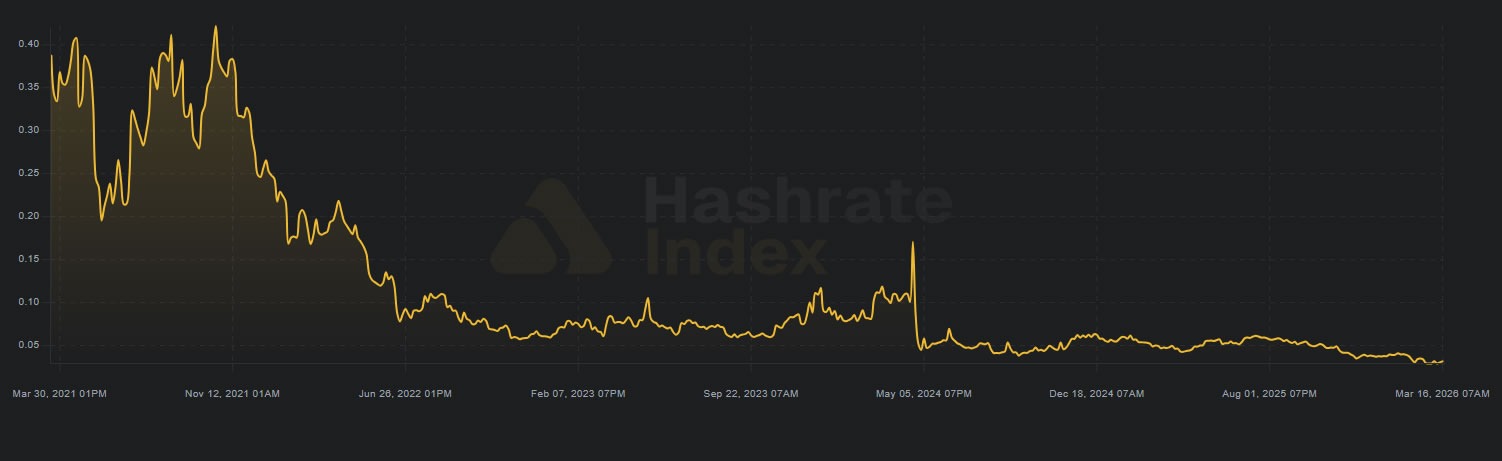
- HashRateIndex data demonstrating bitcoin hashprice trends and network profitability
- Core Scientific credit facility coverage: https://cointelegraph.com/news/core-scientific-secures-up-to-1b-credit-facility-from-morgan-stanley-for-data-center-development
- BTC price coverage and market data: https://cointelegraph.com/bitcoin-price and CoinGlass market data
- On‑chain and market context coverage relating to AI infrastructure deals and mining pivots
AI competition and Bitcoin mining: implications for security and energy
The debate about AI’s influence on Bitcoin’s security has moved from academic conjecture to a real-world energy and capital reallocation story. The central question is whether AI demand can outpace Bitcoin’s need for secure, affordable hash power long enough to alter the network’s risk profile. Supporters of the skeptical view argue that Bitcoin’s design—automatic difficulty adjustment, competitive mining economics, and the ability of miners to turn off during downturns—will preserve security even if some participants shift toward AI workloads. The fundamental mechanism remains straightforward: when hashpower declines, difficulty adjusts, improving profitability for those who stay and those who pivot back as conditions improve. In this framing, a Bitcoin “doomsday” is unlikely, even if the near term looks unsettled.
But the counterargument points to concrete capital movements that could constrain immediate security improvements if AI demand for power remains robust. The figures are stark: Bitcoin mining revenue per MW sits in a modest range, around $57–$129, while AI compute can pull in $200–$500 per MW for the same electricity. If AI deployments scale faster than miners can reallocate, the cost of securing the network could rise relative to alternative compute opportunities, pressuring the incentive structure that has long underpinned Bitcoin’s security model. Industry participants cite both the potential for improved efficiency as the network adjusts and the risk of energy bottlenecks if AI demand remains strong and energy prices stay high. In such conditions, the network’s resilience will depend on how quickly hashpower can reconfigure, how readily energy can be redirected, and how effective automatic adjustments are in realigning profitability.
The human side of the equation is equally important. The sector has already seen miners explore AI hosting and AI infrastructure deals as a way to monetize energy resources more efficiently. Core Scientific’s substantial credit facility for AI hosting, MARA Holdings’ readiness to monetize BTC for AI pivot capital, and Hut 8’s appointment of AI-backed infrastructure arrangements illustrate a broader strategic shift toward compute-centric opportunities. These moves reflect a fundamental trade-off: the crypto mining industry seeks to optimize returns in a world where electricity is a valuable, contested resource, while Bitcoin’s security model relies on a broad and relatively diverse base of hash power. The tension between these objectives will likely shape the sector’s evolution in the months ahead, with the outcome depending on energy prices, regulatory signals, and macro risk sentiment.
In the end, the resilience of Bitcoin’s security hinges on governance by the market as much as by the protocol. A single green candle in BTC’s price could re-anchor mining economics and redirect capital back toward securing the network. Yet even in a scenario of price weakness, the network’s core design provides a built‑in corrective mechanism: as profitability falls, less efficient operators exit, the difficulty adjusts, and the remaining participants recalibrate. The broader energy landscape — still characterized by its variability and potential for using stranded resources — remains a critical backdrop. The coming quarters will reveal how efficiently miners balance the imperative of AI compute with the imperative of maintaining a robust, decentralized security posture for Bitcoin.
Crypto World
Ethereum (ETH) Surges Past $2,200 Driven by Strong ETF Demand and Corporate Accumulation
TLDR
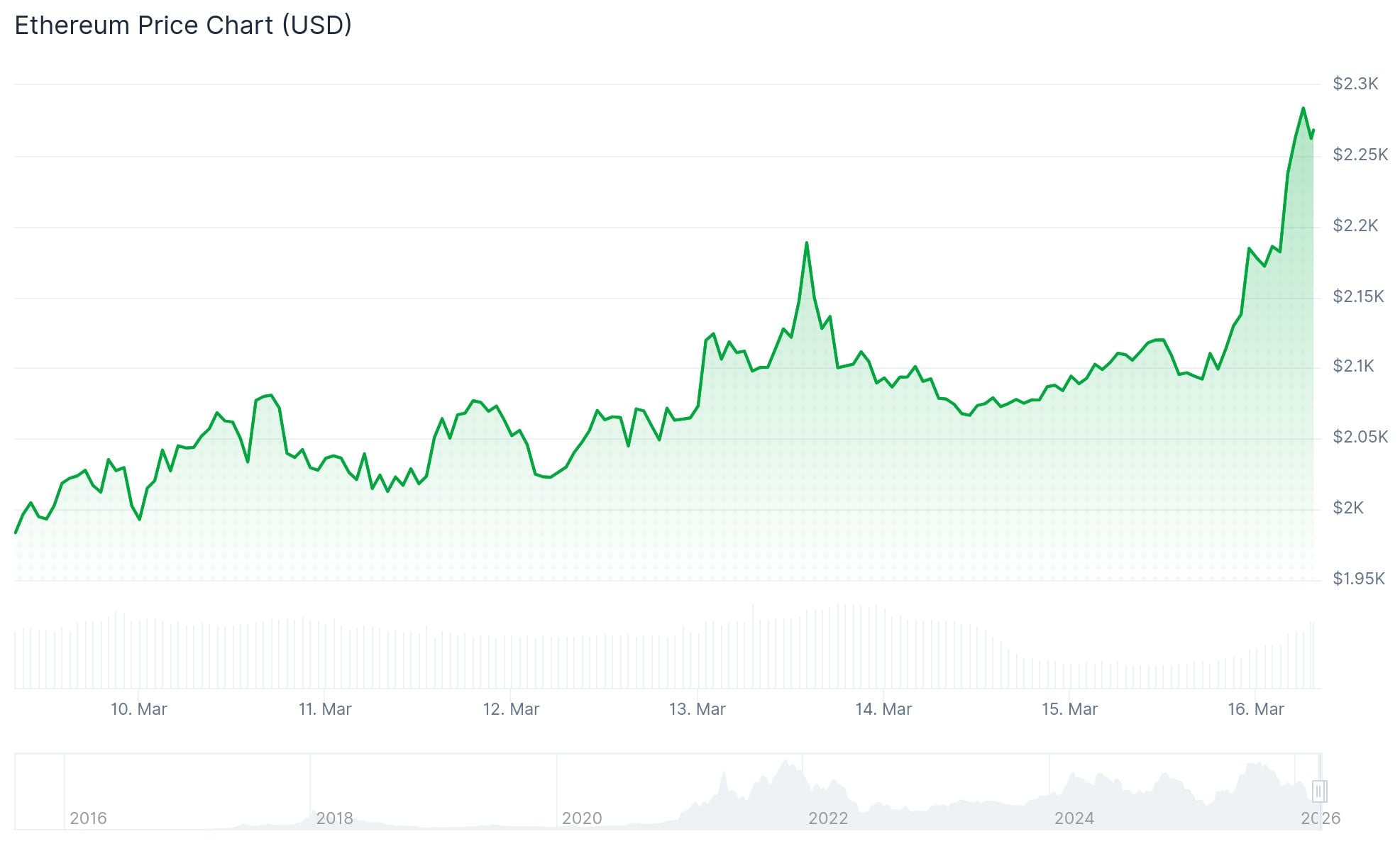
- Ethereum (ETH) surged past $2,200, reaching approximately $2,268 — marking a daily increase exceeding 4%.
- The second-largest cryptocurrency touched a session high of $2,288 while finding support at $2,165.
- Ethereum spot ETFs recorded $26.7 million in net positive flows on March 13, with BlackRock’s ETHA leading contributions.
- Corporate buyer Bitmine has accumulated approximately 833,000 ETH tokens over a 35-day period.
- The cryptocurrency is trading above its 50-day moving average, though it remains significantly below both its 200-day MA and record high of $4,955.
Ethereum experienced a notable upward move on March 16, 2026, successfully pushing beyond the psychologically important $2,200 threshold following a sustained bounce from recent bottom levels. This advance occurred as overall cryptocurrency market conditions showed signs of improvement.
The digital asset found its session floor at $2,165 before bullish momentum carried it to a peak of $2,288. As of the latest data, ETH was changing hands near $2,268, representing an approximate 4.1% increase over 24 hours.
This upward movement follows a decisive breakout above the $2,150 resistance barrier, which had proven challenging in previous trading periods. The cryptocurrency also moved above its 100-hourly Simple Moving Average, a technical indicator frequently monitored by active traders.
Growing Institutional Participation Through ETFs and Direct Purchases
U.S.-listed spot Ethereum ETFs registered $26.7 million in aggregate net inflows on March 13. BlackRock’s ETHA product dominated the activity with $32.4 million in fresh capital, complemented by ETHB’s $2.2 million contribution. An outflow of $7.9 million from FETH tempered the overall figure.
Corporate treasury activity has also become increasingly visible. Bitmine has pursued an aggressive accumulation strategy spanning 35 days, securing approximately 833,000 ETH tokens — representing roughly $2.9 billion in value based on prevailing market rates. The firm has publicly announced its ambition to control as much as 5% of Ethereum’s total circulating supply.
Daily spot market volume reached $154 million, falling short of the $418 million typical average. This indicates the price appreciation occurred without extraordinary trading activity levels.
Technical Picture and Key Price Levels
Ethereum has successfully reclaimed territory above its 50-day moving average, currently positioned at $2,138. While this represents constructive technical progress following recent weakness, the asset continues trading substantially below its 200-day moving average at $3,236.
Chart watchers are focusing on resistance zones at $2,250, followed by $2,280, with $2,320 representing the next significant barrier. Technical strategists suggest that sustained daily closes above the $2,300–$2,400 range could establish conditions for an advance toward $2,500.
Downside protection appears established near the $2,180–$2,200 zone. A decisive move below $2,150 would undermine the constructive short-term technical structure.
Blockchain analytics reveal ETH’s realized price hovering around $2,300 — a level that has functioned as an important inflection point historically. Current trading prices remain marginally below this metric.
Ethereum maintains its position as the second-largest cryptocurrency by market capitalization at $273.81 billion. The asset continues underperforming Bitcoin on a relative basis, with BTC trading nearer to recent highs while ETH trades approximately 54% below its historical peak of $4,955.

Crypto World
BlackRock Leads Institutional Crypto Inflow Surge With $600 Million Bitcoin Acquisition
Bitcoin’s volatility is picking up on the back of considerable institutional inflows over the past week, mostly led by BlackRock.
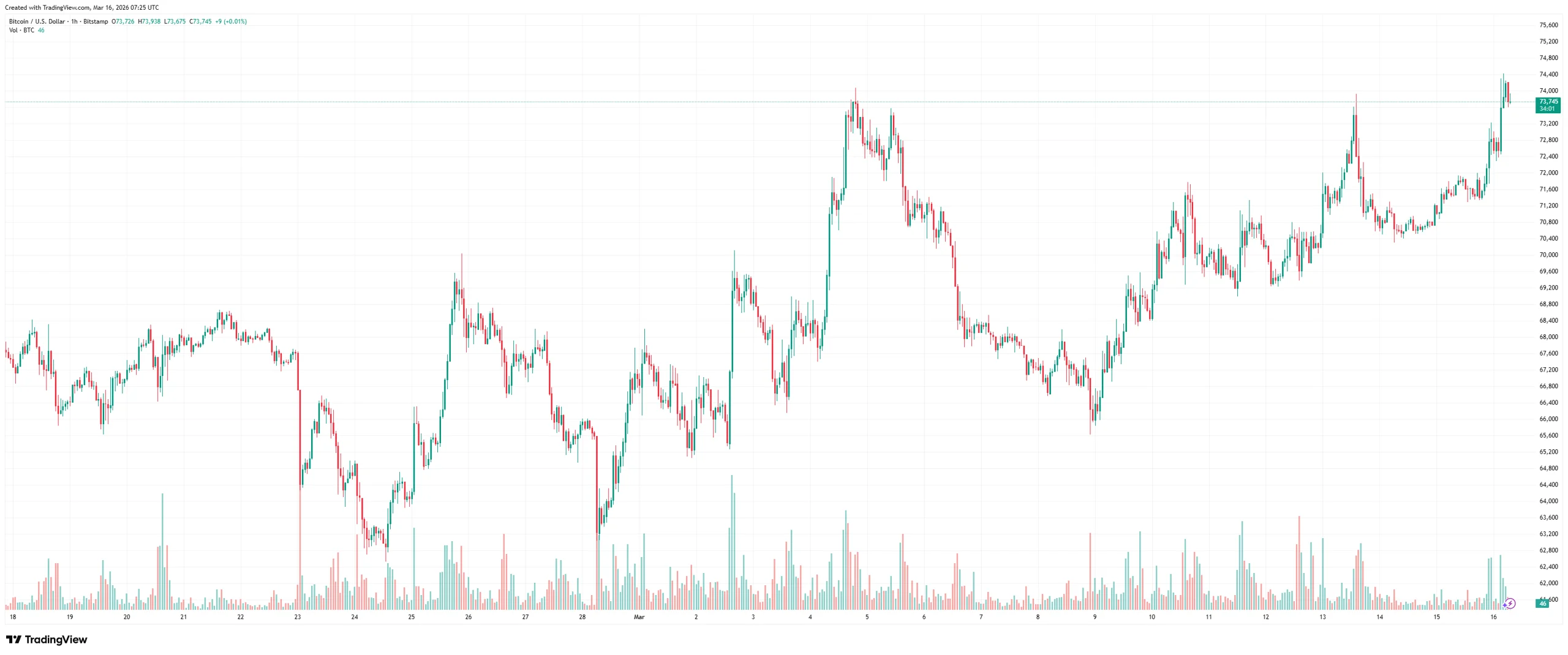
Bitcoin’s price is approaching the $74,000 level amid ongoing international geopolitical tensions. The move comes on the back of increased institutional involvement, as witnessed by the net inflows into spot BTC ETFs.
Data shows that BlackRock has been the biggest buyer, acquiring $600.1 million worth of BTC over the past week, while Grayscale’s GBTC has been the biggest seller. The world’s largest asset manager is on a five-day streak, last selling on March 6th. The combined inflows total $763.4 million last week.
Meanwhile, ETH is also seeing positive inflows of $160.9 million for the week ending on March 13th. The biggest buyer was Fidelity’s FETH ETF, while the biuggest seller was once again Grayscale.
Bitcoin’s Price Tests $74,000
The leading cryptocurrency has consistently been making higher highs on the hourly chart since March 9th, pushing above $74,000 today and recovering by more than 13% since then.
As CryptoPotato reported, the most recent increase led to the liquidation of more than $300 million across the board as the broader market also moves forward. Ethereum’s price is up 7.4% over the past 24 hours; XRP is up 5.2%; Solana is up 5.8%; and so forth.
This has resulted in a total market capitalization of close to $2.6 trillion and an improvement in the overall sentiment. The latter, however, remains in an extreme state of fear, according to the popular Fear and Greed Crypto Index.
The Week Ahead in Crypto
As volatility picks up, the week ahead might bring more of it, with important economic events scheduled over the next few days.
You may also like:
First things first, February’s PPI inflation report is coming out on Wednesday. It’s unlikely to change the Federal Reserve’s hawkish stance, but it’s important to monitor nonetheless.
Again, on Wednesday, the US Central Bank will announce its decision on interest rates. Prediction markets and CME futures predict a 99% probability of no change.
Binance Free $600 (CryptoPotato Exclusive): Use this link to register a new account and receive $600 exclusive welcome offer on Binance (full details).
LIMITED OFFER for CryptoPotato readers at Bybit: Use this link to register and open a $500 FREE position on any coin!


Another analyst indicated that there are “almost no short positions on XRP” at the moment.
With the entire cryptocurrency market rebounding in the past 12 hours or so, Ripple’s cross-border token has joined the trend, jumping 5% to almost $1.50.
Analysts have weighed in on this performance, with some suggesting that the asset has neared a key sell wall zone that could determine the next move and whether it could challenge $1.95. Others, though, have some trust issues.
$1.95 or Dead-Cat Bounce?
In the hours leading to the impressive surge, CryptoWZRD noted that XRP had closed indecisively. However, they added that if it breaks above the crucial $1.43 resistance, the asset could be primed for a more sustainable rebound, as it did shortly after their post.
The aforementioned jump drove XRP to almost $1.50, which is the highest price tag in over two weeks. Fellow analyst CW outlined a chart showing that this level is actually a major sell wall. If broken, XRP’s path should be quite clear until the next such significant obstacle, all the way at $1.95.
$XRP has reached the sell wall zone.
If it breaks through this sell wall, there is no other resistance until $1.95. pic.twitter.com/Z4olAq6ot3
— CW (@CW8900) March 16, 2026
Interestingly, Cobb, who is among the most vocal and bullish members of the XRP Army, said they “simply refuse to trust this XRP pump.” Perhaps this is because the asset has charted similar impressive gains several times for a few days, only to be rejected and pushed back to its rather tight trading range.
However, the landscape could be different now as the Bollinger Bands had squeezed to a level suggesting a big move ahead.
You may also like:
No Shorts on XRP?
Another interesting post from CW showed that “there are almost no short positions on XRP.” This has particular significance given the fact that the asset’s futures open interest had surged by 16.5% in the past week, going to over $1.6 billion, according to data from Ali Martinez.
Meaning, traders are ramping up their leveraged XRP positions but evidently expect a major move upward.
There are almost no short positions on $XRP. pic.twitter.com/rlfi7ht1XX
— CW (@CW8900) March 16, 2026
Binance Free $600 (CryptoPotato Exclusive): Use this link to register a new account and receive $600 exclusive welcome offer on Binance (full details).
LIMITED OFFER for CryptoPotato readers at Bybit: Use this link to register and open a $500 FREE position on any coin!
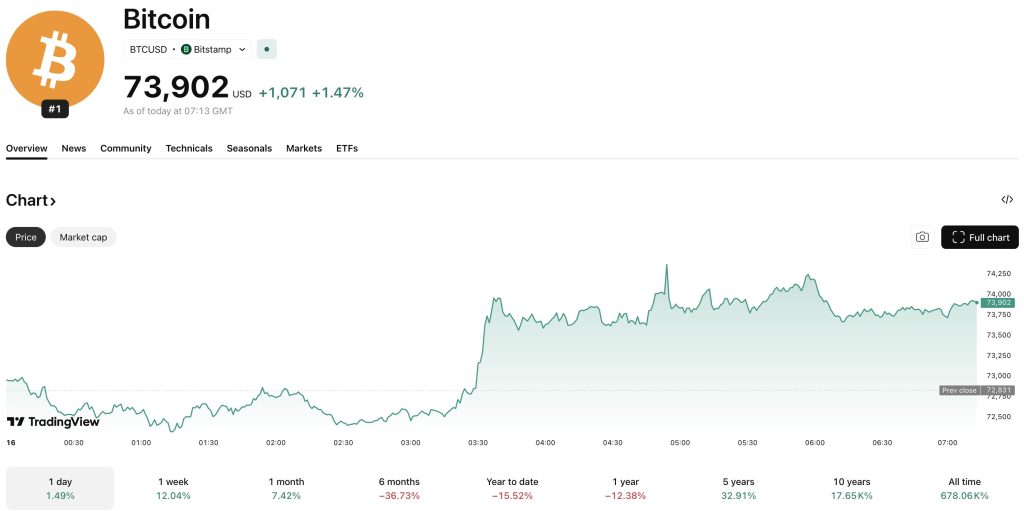
The Bitcoin price shattered the $74,000 ceiling on Monday, posting its highest daily close since early February 2026, while gold prices retreated. While BTC USD has since dropped to $73,700, traders have been left asking ‘Why is crypto up?’
This move signals a decisive shift in asset correlations as institutional capital rotates from precious metals back into digital assets following weeks of consolidation.
Bitcoin surged to an intraday high of $74,150, marking a +7.5% single-day rally that has effectively erased the losses sustained in late February.
Trading volume on the day exploded to $70.8Bn, a liquidity spike that validates the breakout above the consolidated $68,000–$72,000 range.

Why is Crypto Up? Is Bitcoin Replacing Gold as the Crisis Hedge?
The most compelling narrative driving this rally is the Crypto Decoupling from traditional precious metals. Historically, Bitcoin and gold have moved in tandem during periods of geopolitical uncertainty. However, recent data suggest a structural break in this relationship.
Institutional flows tell the story clearly. While gold ETFs saw net outflows of approximately -$400M last week, US-based Spot Bitcoin ETFs absorbed +$750M in net new capital over the same five-day period, per CoinGlass data.
This divergence suggests that sophisticated allocators are increasingly viewing Bitcoin as a high-beta risk-off asset rather than merely a speculative tech play. The Gold vs Bitcoin debate has shifted from theoretical store-of-value arguments to visible liquidity preferences in the ETF market.
Analysts at JPMorgan have previously noted this rotation, highlighting that younger demographics and tech-forward hedge funds prefer Bitcoin’s portability and verifiability over the logistical drag of gold.
DISCOVER: The 16 Best Meme Coins to Buy in March 2025
Institutional ETF Flows Signal Renewed Accumulation

The engine behind this move is unmistakably institutional. Institutional ETF Flows have turned aggressively positive after a month of stagnation, with five consecutive green days.
BlackRock’s IBIT and Fidelity’s FBTC led the charge, accounting for nearly 70% of the recent inflows, which stand at a combined +$750M.
On-chain data corroborates this buying behavior. Large Bitcoin holders have started accumulating again as the asset stabilized above $71,000, creating a floor regarding ‘whale’ support layers.
According to Santiment data, wallets holding between 1,000 and 10,000 BTC added significantly to their stacks in the 48 hours preceding the breakout, suggesting insider confidence or smart money positioning ahead of the move.
This accumulation is happening despite lingering geopolitical fears. In fact, analyzing Bitcoin’s resilience during geopolitical tensions reveals that the market is pricing in long-term monetary debasement over short-term conflict risk.
Bitcoin Price Prediction: Bull vs Bear Scenarios
After asking themselves, ‘Why is crypto up?’, traders are now adjusting targets as market analysis shifts from recovery to expansion. Bulls aim to turn the $73,000 level from resistance to support.
Bull Scenario: If Bitcoin closes the day above $73,500, it could target the $76,000-$78,000 supply zone. A strong hold here could invalidate the lower-high structure from early 2026, bringing the psychological $80,000 level into play.
Bear Scenario: Falling below $71,500 could indicate a liquidity grab or “bull trap,” leading to a quick drop to the $68,200 demand zone. Low-volume dips are potential buying opportunities, while high-volume rejections may signal the end of the current uptrend.
Upcoming Federal Reserve meeting minutes on March 17-18 could act as a catalyst. If hints at continued rate pauses emerge, the risk-on environment may push targets toward $78,000. The key question is whether retail enthusiasm will match institutional buying; until then, volatility is likely.
EXPLORE: Best Crypto Presales to Buy in 2026
The post Why Is Crypto Up: BTC USD Decoupling From Gold Amid Heated Israel-Iran War appeared first on Cryptonews.
The latest gains came after Trump mulled sending troops to Kharg Island and urged NATO to help with the war against Iran.
Bitcoin’s price is on the move on Monday morning, surging to a six-week peak of just over $74,000. This might be rather unexpected as the weekend was quite eventful on the Middle East war front, as the US hit a key Iranian island, and legacy financial markets opened hours ago in reaction to the news.
Many altcoins have produced even more impressive increases, including ETH, which has finally climbed above $2,200.
Crypto Market Moves Higher
The total crypto market cap has added over $80 billion to $2.6 trillion on CG as of now. Bitcoin exceeded $74,000 minutes ago, where it faced some resistance, and now sits just below that level. The asset fell toward $70,000 over the weekend after Trump announced “the most powerful bombing raids in Middle East history,” when the US military attacked Kharg Island.
However, it bounced off and eyed $72,000 yesterday, but once the legacy financial markets started to open on Sunday evening and Monday morning, it jumped to the aforementioned six-week peak. ETH is among the top performers in the past 24 hours, surging by 8% to nearly $2,300 for the first time since early February.
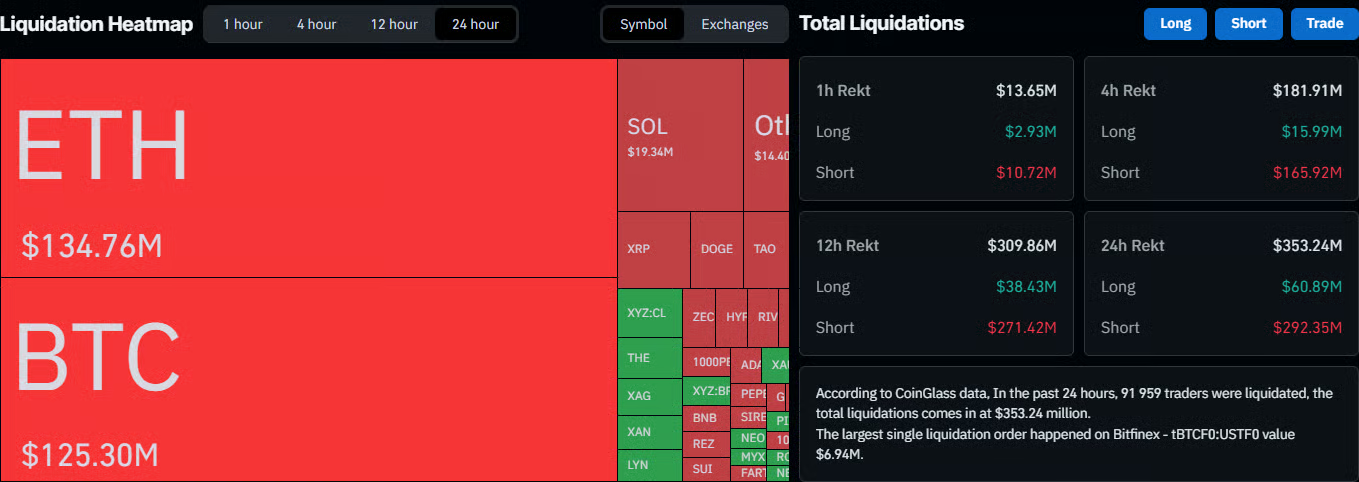
Notable gains are evident from ADA (10%), DOT (12%), PEPE (15%), ETC (9%), and others. The total value of wrecked positions has risen to $350 million, according to CoinGlass, with nearly $300 million coming from shorts. Interestingly, ETH shorts are responsible for the largest portion, followed closely by BTC’s.
Latest Developments
Although Trump said at first that the US doesn’t want to attack any of Kharg Island’s oil infrastructure, he threatened to do so if Iran interferes in any form with the “free and safe passage of ships through the Strait of Hormuz.” He later urged numerous countries to send warships to defend the passage.
More recently, he mulled the idea of sending troops on the ground to seize the key island, which is responsible for over 90% of Iran’s oil production.
You may also like:
BREAKING: President Trump is considering putting boots on the ground to seize Iran’s Kharg Island, per Axios.
Details include:
1. The move appears to be contingent on if tankers remain bottled up in the Persian Gulf
2. Trump is working to assemble a coalition of countries to…
— The Kobeissi Letter (@KobeissiLetter) March 16, 2026
The other big development in the past few hours came when Trump suggested that the US has continuously helped NATO with the war in Ukraine, so the alliance should return the favor now, at least with the Strait.
Binance Free $600 (CryptoPotato Exclusive): Use this link to register a new account and receive $600 exclusive welcome offer on Binance (full details).
LIMITED OFFER for CryptoPotato readers at Bybit: Use this link to register and open a $500 FREE position on any coin!

Artificial intelligence has quickly become one of the hottest narratives in crypto trading. From automated trading bots to fully autonomous AI agents scanning blockchain data in real time, many believe AI could unlock the holy grail of trading: consistent market prediction.
But can AI truly predict crypto markets better than traditional strategies? Or is much of the excitement driven by hype rather than proven results?
Let’s break down the reality behind AI-driven crypto trading.
The Rise of Machine Learning Models in Crypto
Machine learning models are increasingly being used by traders, hedge funds, and algorithmic platforms to analyze massive amounts of market data. Unlike traditional trading systems that rely on fixed rules, machine learning models continuously learn from historical patterns and adapt to new information.
Some of the most common AI models used in crypto trading include:
1. Time Series Forecasting Models
These models attempt to predict future prices using historical market data such as:
-
Price movements
-
Trading volume
-
Order book depth
-
Volatility patterns
Techniques like LSTM neural networks, ARIMA models, and transformers are often applied to detect patterns that humans may overlook.
2. Reinforcement Learning Trading Agents
Reinforcement learning allows AI agents to learn trading strategies through trial and error. Instead of predicting prices directly, the AI learns to maximize profit by:
These models simulate thousands of trading scenarios to refine strategies.
3. On-Chain Data Analysis
Crypto markets provide a unique advantage: transparent blockchain data. AI models can analyze:
By combining on-chain analytics with market data, AI systems attempt to detect early signals of market trends.
Limitations of AI Prediction
Despite the promise, predicting financial markets — especially crypto — remains extremely difficult, even for advanced AI systems.
1. Markets Are Highly Chaotic
Crypto markets are influenced by countless unpredictable factors, including:
-
Regulatory news
-
Macro economic changes
-
Social media sentiment
-
Whale activity
Even the most advanced models struggle to incorporate sudden events that can instantly move markets.
2. Overfitting Is a Major Problem
Many AI models perform extremely well in backtests but fail in live markets. This is often due to overfitting, where a model memorizes historical data rather than learning genuine patterns.
In simple terms:
The model learns the past perfectly but fails to generalize to the future.
3. Alpha Decay
When a profitable trading strategy becomes widely used, its edge quickly disappears. AI strategies are no exception.
As more funds deploy similar models, the market adapts, and the advantage fades. This constant cycle forces traders to continuously develop new models.
4. High Competition From Institutional Quant Firms
Large hedge funds and proprietary trading firms already deploy highly sophisticated machine learning systems. Competing against these players requires massive data infrastructure, computing power, and research teams.
For most retail traders, replicating this level of sophistication is nearly impossible.
The Data Quality Problem in Crypto
One of the biggest obstacles to AI prediction in crypto markets is data quality.
Machine learning models rely heavily on large, clean datasets. Unfortunately, crypto data often contains serious issues.
1. Market Fragmentation
Crypto trading happens across hundreds of exchanges, each with different:
-
Liquidity levels
-
Order books
-
Price discrepancies
This fragmentation makes it difficult to build unified datasets for accurate modeling.
2. Fake Volume and Wash Trading
Many smaller exchanges inflate trading volume through wash trading. If this distorted data enters a training dataset, AI models can learn misleading signals.
This leads to inaccurate predictions.
3. Limited Historical Data
Compared to traditional markets like equities or forex, crypto markets are relatively young. Many assets have only a few years of reliable historical data.
For complex machine learning models, this limited data can significantly reduce predictive accuracy.
4. Rapid Market Evolution
Crypto markets evolve faster than most financial systems. New narratives — DeFi, NFTs, AI tokens, meme coins — constantly reshape trading behavior.
A model trained on data from two years ago may already be outdated.
So… Can AI Actually Predict Crypto Markets?
The honest answer: sometimes — but not consistently.
AI can be extremely useful for:
However, fully predicting price movements remains incredibly difficult due to the chaotic and rapidly evolving nature of crypto markets.
The most successful strategies today usually combine:
In other words, AI is a powerful tool — but it’s not a magic crystal ball.
The Future of AI in Crypto Trading
While AI may not perfectly predict markets, its role in crypto trading will continue to grow.
The next generation of trading systems is already emerging, including:
-
Autonomous AI trading agents
-
AI-driven DeFi portfolio managers
-
Real-time on-chain intelligence systems
-
Cross-chain liquidity prediction models
Instead of replacing traders, AI will likely become a co-pilot for decision-making, helping traders navigate increasingly complex markets.
The hype may be loud — but the technology is still evolving.
Final Thoughts
AI has undoubtedly changed the landscape of crypto trading, offering powerful tools for analyzing massive datasets and identifying hidden patterns. However, the idea that AI can consistently predict crypto markets remains largely exaggerated.
Markets are adaptive, unpredictable, and constantly evolving — qualities that challenge even the most advanced machine learning systems.
The real opportunity lies not in blindly trusting AI predictions, but in combining human judgment with intelligent algorithms to build more resilient trading strategies.
Because in crypto, the edge rarely comes from one tool alone.
REQUEST AN ARTICLE


A huge week lies ahead on the US economic calendar with more inflation data and a Fed rate decision as markets continue to react to the war in the Middle East.
Crypto markets are having a rare green morning during Asian trading, with most assets gaining over the past 24 hours. However, there could be more volatility in the week ahead with all eyes on the Federal Reserve meeting and what Chair Jerome Powell says about the impact of the war in Iran on inflation.
Meanwhile, President Trump plans to announce that multiple countries have agreed to form a coalition that will escort ships through the Strait of Hormuz, as fuel prices across the globe continue to increase.
Economic Events March 16 to 20
Markets will react to the US strikes on Kharg Island, an area vital to Iran’s oil industry, over the weekend, and stock futures have turned green while oil prices are back at $100 per barrel.
Wednesday is the big day for economic news, with February’s PPI Inflation report, which is unlikely to change the Fed’s hawkish stance. The US central bank meets on Wednesday, where there will be a decision on interest rates, but CME futures markets predict a 99% probability of no change.
“The Fed is going to be front and center, especially given the fact that we have seen the market push back… these rate cut expectations,” said Angelo Kourkafas, senior global investment strategist at Edward Jones.
Investors have been hoping for more rate cuts this year, which are generally bullish for stocks and crypto assets; however, those expectations have been dialed back due to fears that the surge in energy prices will push up inflation.
It will be Jerome Powell’s second-to-last meeting before his term as chair expires in May, so the next rate move may not come until Trump’s nominee Kevin Warsh takes over the helm later this year.
The rest of the week will see the Philly Fed Manufacturing Index and January New Home Sales data on Thursday.
You may also like:
“We now have the Iran war, inflation data, and a Fed meeting all in the same week,” said the Kobeissi Letter.
Key Events This Week:
1. Markets React to US Strikes on Kharg Island – Today 6 PM ET
2. February Pending Home Sales data – Tuesday
3. February PPI Inflation data – Wednesday
4. Fed Interest Rate Decision and Statement – Wednesday
5. Philly Fed Manufacturing Index – Thursday…
— The Kobeissi Letter (@KobeissiLetter) March 15, 2026
Crypto Market Outlook
Around $70 billion has been added to the total market capitalization over the weekend, which has climbed to $2.54 trillion on Monday morning.
Bitcoin tapped $74,000 in early Asian trading but again met resistance there and started to pull back. Ether prices continued to grind slowly higher, going past $2,200 for the first time in months.
The altcoins were generally mixed with smaller gains for Solana, Chainlink, Zcash, and Bittensor.
Binance Free $600 (CryptoPotato Exclusive): Use this link to register a new account and receive $600 exclusive welcome offer on Binance (full details).
LIMITED OFFER for CryptoPotato readers at Bybit: Use this link to register and open a $500 FREE position on any coin!
There’s a new debate over whether a continued pivot from Bitcoin miners to artificial intelligence could have an impact on Bitcoin security and its role as a store of value.
While some argue that miners fleeing the network would leave it more susceptible to a “51% attack,” others argue it will simply trigger the Bitcoin network to rebalance itself as designed, making it enticing for miners again.
“AI has killed Bitcoin forever,” said crypto trader Ran Neuner on Sunday, arguing that it has become Bitcoin mining’s biggest competitor because both industries compete for electricity.
“AI is willing to pay much more for it,” he added, explaining that Bitcoin (BTC) mining revenue per megawatt is around $57 to $129, but AI data center revenue per megawatt is up to eight times higher at $200 to $500 for the same electricity, which is why miners are starting to pivot.
Earlier this month, Core Scientific secured up to $1 billion in credit for AI hosting, MARA Holdings recently filed with the SEC to signal its intent to sell some of its BTC in an AI pivot and Hut 8 signed a $7 billion AI infrastructure agreement with Google in December, argued Neuner.
Meanwhile, Cipher Mining cut its hashrate to focus on AI compute, and Bitmain cofounder Jihan Wu has stopped mining and pivoted to AI, he added.
“So if I were a miner, it wouldn’t be a tough decision. And that’s why every day more and more miners are leaving the network.”
It sounds like a doomsday scenario for Bitcoin, but not everyone agrees.
Bitcoin pioneer and cryptographer Adam Back argued that difficulty adjustments would only force the least efficient miners out, and profitability would improve.
“What happens to Bitcoin is simple: tick tock, next block! Difficult adjusts downwards, the least efficient and AI switchers move out, and Bitcoin mining profitability converges to AI profitability. QED.”
“If AI outbids miners for electricity, miners just turn off until the difficulty adjusts and it’s profitable again, that’s literally how Bitcoin works,” added investor Fred Krueger.
Bitcoin energy demand is variable
However, Neuner argued that falling hashrates, which are down 14.5% since their October peak, mean that there are fewer miners to secure the network, and a higher potential for 51% attacks.
This has all happened before during bear markets, and automatic network difficulty adjustments usually compensate for it, “but this time is different because we don’t have the energy,” he said.

Related: Crypto miners must put their Bitcoin to work to survive: Wintermute
Bitcoin ESG specialist Daniel Batten disagreed and said it was the other way around, as “the evidence tells us that AI is dependent upon Bitcoin for its expansion.”
It wasn’t all about high demand and expensive power, as Bitcoin mining can use stranded energy, act as a flexible load balancer for energy grids, and use older equipment for cheaper energy, he argued.
One green candle to prevent AI competition doomsday
Neuner said one way to ensure AI doesn’t overshadow Bitcoin will depend on whether BTC prices go up.
“What I hope is that Bitcoin has one green candle. Maybe because of the war, maybe because of the regulation, who knows? But ultimately, if it has one green candle.”
“If you’re watching the Bitcoin price action during this war, that’s exactly what’s happening,” he said, adding that the other scenario, where Bitcoin price continues to fall, is “pretty much a Bitcoin doomsday.”
Bitcoin has seen five monthly red candles in a row, something that hasn’t happened since the 2018 bear market. However, March is currently shaping up green with the asset gaining 8% so far this month, according to CoinGlass.
Magazine: All 21 million Bitcoin is at risk from quantum computers

The US Securities and Exchange Commission (SEC) has dropped its two-year-long case against the founder of the blockchain-based social media platform BitClout, Nader Al-Naji.
In the joint dismissal stipulation filed in the US District Court for the Southern District of New York last Thursday, the SEC cited the crypto task force, which was tasked with developing a regulatory framework for crypto in January 2025, and a “reassessment of the evidentiary record” as the basis for dismissal.
However, the regulator cautioned in a statement that this case outcome doesn’t necessarily mean other similar enforcement actions will receive the same treatment.
“The Commission’s decision to exercise its discretion and seek dismissal of this litigation is based on the particular facts and circumstances of this case and does not necessarily reflect the Commission’s position on any other case,” it said.
Cointelegraph has contacted the SEC and the DeSo blockchain, where Al-Naji leads the foundation, for comment.
Accusations included spending money on a mansion
Al-Naji is a former Google engineer, the founder of the Basis protocol and creator of the DeSo blockchain. He founded BitClout and launched it publicly in March 2021.
The SEC’s July 2024 complaint accused Al-Naji of raising more than $257 million by selling the native token of the BitClout platform, BTCLT, while telling investors the funds wouldn’t be used to pay any BitClout team members.
Al-Naji was also accused of spending more than $7 million on personal items, including rent for a Beverly Hills mansion and cash gifts to family members, and also mischaracterizing the inner workings of the platform as decentralized, with no governing company controlling it, despite allegedly running the project behind the scenes himself.
As part of the settlement, Al-Naji has waived any claims for reimbursement of legal fees or expenses against the SEC. The regulator has dismissed the case with prejudice, meaning it can’t bring another case against Al-Naji or the relief defendants mentioned, including his mother, wife, and several companies under his control, again using the same charges.
The Department of Justice also ended a separate case accusing Al-Naji of wire fraud in February 2025 without prejudice. Al-Naji said in an X post at the time the case was dismissed because the government’s case didn’t hold up under scrutiny.

Under the Trump administration, the SEC has slowly been walking back its hardline stance toward crypto firms, dismissing a growing number of enforcement actions against crypto firms.
Magazine: Spot Bitcoin ETFs first green week, crypto ATM losses surge 33%: Hodler’s Digest, Mar. 8 – 14
2026 Oscars Nods to Ballet, Opera After Timothee Chalamet Diss

Tim Cook kicks off Apple's 50th anniversary celebration

Conan O’Brien’s best Oscars jokes as host roasts Timothee Chalamet in opening monologue


-
 Tech5 days ago
A 1,300-Pound NASA Spacecraft To Re-Enter Earth’s Atmosphere
-
 Crypto World2 days ago
HYPE Token Enters Net Deflation as HyperCore Buybacks Outpace Staking Rewards
-

 News Videos7 days ago
10th Algebra | Financial Planning | Question Bank Solution | Board Exam 2026
-

 Business6 days ago
ExxonMobil seeks to move corporate registration from New Jersey to Texas
-

 Crypto World7 days ago
Paradigm, a16z, Winklevoss Capital, Balaji Srinivasan among investors in ZODL
-

 Fashion3 days ago
Weekend Open Thread: Addict Lip Glow
-

 Tech6 days ago
ChatGPT will now generate interactive visuals to help you with math and science concepts
-
Sports2 days ago
Why Duke and Michigan Are Dead Even Entering Selection Sunday
-

 NewsBeat5 days ago
Residents reaction as Shildon murder probe enters second day
-

 Business5 days ago
Search Enters Sixth Week With New Leads in Tucson Abduction Case
-
 NewsBeat6 days ago
Pagazzi Lighting enters administration as 70 jobs lost and 11 stores close across Scotland
-

 Business13 hours ago
Search for Savannah Guthrie’s Mother Enters Seventh Week with No Arrests
-

 Tech7 days ago
Despite challenges, Ireland sixth in EU for board gender diversity
-

 Business2 days ago
US Airports Launch Donation Drives for Unpaid TSA Workers as Partial Government Shutdown Enters Fifth Week
-
Crypto World2 days ago
Coinbase and Bybit in Investment Talks: Could Bybit Finally Enter the US Crypto Market?
-

 NewsBeat5 days ago
I Entered The Manosphere. Nothing Could Prepare Me For What I Found.
-

 Business7 days ago
Search Enters 39th Day with FBI Tip Line Developments and No Major Breakthroughs
-

 Sports7 days ago
Skateboarding World Championships: Britain’s Sky Brown wins park gold
-

 Business2 days ago
Country star Brantley Gilbert enters growing non-alcoholic beer market
-

 Crypto World6 days ago
Will Chainlink price reclaim $10 amid volatility squeeze?

