When it comes to building a gaming set-up, the conversation is so often dominated by discussions of graphics cards and processors that having a similarly gaming-ready monitor can be overlooked. However, if you really are going all in on having a serious gaming rig then the only way to do it justice is by having a monitor that can show off all that it can do. With that in mind, here’s where you can find the best gaming monitors to buy.
Although you’ll no doubt find them sold via the same retailers, the best monitors in general are very different to what you need to be on the lookout for when it comes to gaming monitors. After all, monitors for a home office just need to be of a decent size so that windows and text have space to spread out, and for the screen itself to be easy on the eyes.
When it comes to gaming monitors, all of those aspects are still important, especially if you use your gaming space for work during the day, but there are other key things to consider. Refresh rates are crucial depending on the type of games you prefer to play, as a higher rate can keep you locked in with fast-paced titles like Marvel Rivals and Counter-Strike 2
The resolution is also worth bearing in mind as you don’t want to be overpaying for tech that’ll go unused. For example, if your gaming rig is designed to output games at 1080p then you don’t need to spend the extra money on a 4K monitor. Similarly, a 4K-ready rig will be done a disservice by a 1080p monitor, so make sure you know what your gaming PC/laptop is capable of before you buy.
There are plenty of other key features such as ports and OSD options, but as with everything mentioned, it all gets covered by our comprehensive reviews which leave no stone unturned. Our tech experts use industry-standard benchmarking tests to give you concrete data on how each one performs in real-world use. Keep on reading to see which models are currently ranked as the best to buy, or check out our round-up of the best gaming laptops if you want to upgrade more than just your monitor.
Best Gaming Monitor at a glance
SQUIRREL_ANCHOR_LIST
Learn more about how we test gaming monitors
We use every gaming monitor we test for at least a week. During that time, we’ll check its design, features and how easy it is to set up.
We check its colours and image quality with a colorimeter to test its coverage and the display’s quality. We will also play numerous games to determine its performance.
-
Fantastic contrast and colour
-
Class-leading anti-glare technology
-
Premium and flexible design
-
No 480Hz support
-
Fiddly control system and no remote
If you haven’t completely blown through your gaming rig budget and do have spare £1000/$1200 left over, then we can think of few better ways to complete the overall package than by adding the Samsung Odyssey SG27FG810S to your setup. This is a gaming monitor that looks great, plays beautifully and shows, more than anything, just how much clout Samsung has in the gaming space right now.
What you’ll no doubt notice before anything else is just how sleek the Odyssey SG27FG810S can be when it’s set up. The metallic panel at the bottom is sturdy, and that metallic design continues on the back of the monitor and at the stem. It’s a very confident look that won’t have you mistaking the monitor as something destined for an office.
As great as a bold design can be, it’s nowhere near as important as the visual quality on offer and thankfully, Samsung hasn’t skimped here either. Simply put, this is one of the most luscious screens around for gaming and it isn’t even close. The monitor uses a Quantum Dot OLED panel which allows for far more natural colour representation, perfect for games that aim for a sense of visual realism like Cyberpunk 2077.
Where the display result excels however is in contrast. It’s one of those things that pictures can’t quite do justice but the contrast here is so good to the point where you won’t be able to take your eyes off of it – blacks appear deep and inky, and for games like Control or Alan Wake II which really indulge in light and dark settings, it feels like the ideal way to play them.
If multiplayer games are more your bag however then you’ll appreciate the 240Hz refresh rate on board which couples perfectly with the near non-existent 0.03ms response time. Bear in mind that for all its prowess, there are no built in speakers on the Samsung Odyssey SG27FG810S, so you will need to pick up a solution separately, but it’s a small price to pay for the visual quality on offer.
-
Gorgeous image quality
-
Deep blacks and brilliant colour accuracy
-
Good port selection
-
Quite expensive
-
You do have to want the curve!
This is a high-end monitor that provides all of the visual trappings that you’d want for a mesmerising experience, whilst the curvature of the display absorbs your attention (and peripheral vision) like nothing else.
In fact, the screen’s 32-inch 4K panel is ideal for anyone who has a small to medium-sized desk, one that simply wouldn’t have enough space for a massive wide-screen display. For context, it’s just slightly wider than a Sonos Beam 2 soundbar, but it’s wide enough that it can draw you in, and that 4K resolution goes a long way towards making sure that everything looks crisp and avoiding a pixelated look whilst gaming.
The use of QD-OLED technology also goes a long way to presenting vastly improved colour and contrast over older monitors, so if you’re upgrading from a display that’s starting to show its age, you’ll notice the difference immediately. The alleyways of Cyberpunk 2077’s Night City, with their food stalls and neon lights, pop like never before, going a long way towards making this digital world (and many like it) feel more alive than ever.
We also noticed during our testing that the colour accuracy for the Acer Predator X32X is off the charts, with a 100% coverage detected for sRGB, alongside 98% and 92% for DCI-P3 and Adobe RGB respectively. If you’re someone who edits videos or photos outside of your playtime, then you’ll appreciate the ability to more accurately see what the final product is going to look like.
There’s a solid amount of ports built into the display, including two HDMI 2.1 ports, so you have room to plug in a soundbar or a games console, while the downstream USB-C port lets you charge your phone with a 65W connection. You can also count on plenty of OSD options, letting you customise visual details such as brightness and contrast to suit your liking, not to mention tweaking the aspect ratio.
-
Stunning OLED display
-
Excellent motion fidelity
-
Compact stand
-
Good value
-
Speakers distort at maximum volume
-
HDMI ports are v2.0 not 2.1
It’s certainly not cheap, costing over £800 at the time of writing, but it still represents outstanding value considering it’s flaunting a 27-inch OLED screen, HDR support and a speedy 240Hz refresh rate. It’s even got integrated speakers.
The OLED screen is an absolute delight for gaming, with the deep inky blacks resulting in eye-catching contrast and an incredible picture. The 2650×1440 resolution ensures video looks incredibly sharp too. Our benchmark results show the monitor to be capable of up to a 380-nit brightness in SDR, and 810-nit brightness in HDR. Colour coverage was superb too, ensuring you’re getting an accurate picture.
We were also really impressed by the monitor’s design, with the stand taking up very little space on your desk. There’s loads of flexibility in terms of adjustment options too: the monitor can pivot by 90 degrees, while there’s 130mm of height adjustment. Ports are well covered with inclusion of HDMI 2.0, DisplayPort 1.4 and and a 3.5mm headphone jack.
Considering the fantastic specs you’re getting for your money, it’s hard to find faults with this gaming monitor. It’s a shame that there’s no HDMI 2.1 support, so you’re best off checking out the LG UltraGear 27GR95QE-B if that’s important to you. Otherwise, we’re confident in saying that the AOC Agon Pro AG276QZD is the best gaming monitor you can buy at this price.
-
Excellent value
-
Compact for an ultrawide
-
Good speakers
-
One-button KVM switch
Ultrawide gaming monitors are incredibly popular right now, with gamers craving the extra immersion provided by a stretched-out display. The Lenovo Legion R45w-30 may not be the absolute best ultrawide monitor we’ve reviewed in recent years, but it certainly offers the best bang for your buck with a price undercutting the £800 mark.
This monitor’s display looks stunning too, with a 49-inch screen with a supremely sharp 5120×1440 resolution. This isn’t an OLED monitor like the Samsung Odyssey G9 OLED (2023), but it’s still capable of an excellent 3020:1 contrast, as well as a high 415-nit brightness. This results in an excellent picture that gamers will adore.
The 1500R curvature ensures that the monitor wraps around your peripheral vision for a brilliantly immersive experience. It’s also not so bendy that it’s a nightmare to find a place for it on your desk – it should be perfectly fine in the average study or bedroom.
If you want the absolute best ultrawide gaming monitor, then you can spend even more cash on the likes of the Samsung Odyssey G9 range. But if you simply want a great all-round ultrawide monitor while keeping costs as low as possible, then the Lenovo Legion R45w-30 is the way to go.
-
Superb value for money
-
USB-B and USB-C connectivity for full KVM support
-
Impressive colour accuracy
-
Colour gamuts could be wider
-
Some smearing and ghosting apparent in testing
The AOC Agon AG405UXC has a huge 40-inch panel, making it more of a TV replacement than your typical gaming monitor. It has a 3440×1440 resolution, a 144Hz refresh rate and surprisingly good HDR performance, despite not having a Mini-LED backlight.
We measured maximum SDR brightness at 361 nits and 486 nits once in HDR mode. The Agon AG405UXC features four different HDR modes – HDR10, HDR Picture, HDR Movie and HDR Game – allowing you to fine-tune your screen to suit the content. For the price, we found the motion handling to be perfectly acceptable and the support for AMD FreeSync Premium Pro ensures that you won’t encounter any screen tearing or juddering while enjoying your favourite AAA games.
Being a 40-inch monitor, you will need to make sure you have the desk space to store the Agon AG405UXC, which weighs in at 11.88kg. It comes with a convenient remote control so you can change the volume or brightness without needing to use the bezel buttons, although we did note that it had a slightly slow response time.
There are also two 5W speakers buried inside the Agon AG405UXC. Our reviewer found that they did more than a decent job of pumping out volume and were pretty tuneful, with the soundscape underpinned by solid bass and plenty of detail in the upper ranges.
For the money, the AOC Agon AG405UXC is a highly competent big-screen gaming monitor. It comes with an excellent array of ports, reliable speakers and a massive display that excels in HDR content.
-
240Hz refresh rate
-
Exceptional value
-
Impressive colour accuracy
-
Strong colour gamut coverage
-
Some visible ghosting
-
No USB connectivity
-
Could be brighter
-
HDMI and DP connectors not latest spec
A lot of the gaming monitors on this list cost a fortune, so we’ve made sure to include the budget-friendly AOC Gaming 25G3ZM/BK, which offers top specs and performance despite being available for less than $200/£200.
This 23.8-inch monitor has a standard 1080p VA panel rather than the more luxurious Mini LED and OLED options, but our testing showed it to still offer an outstanding picture quality with a high 4,000:1 contrast and superb colour coverage. It has a great performance too, with a 165Hz refresh rate ensuring butter smooth motion, which is especially useful for multiplayer shooters.
The appearance is fairly basic, but offers great adjustability options as a 90-degree left pivot, 130mm of height adjustment and -5/23-degree of tilt. There’s no RGB lighting or USB connectivity, but it still packs all of the necessary ports for gaming.
The AOC Gaming 25G3ZM/BK is limited to a 1080p resolution and lacks fancy features such as HDR, but at this low price, this monitor is an absolute steal for gamers. This is the best gaming monitor option you’re going to find without spending considerably more.
-
Massive screen
-
Sublime picture quality
-
Bright enough for HDR
-
Useful smart features
-
Low refresh rate for the price
-
Limited adjustability options
-
Size will be difficult to accommodate for
Gaming monitors come in all shapes and sizes, but if you’re after something the size of a TV, then the Samsung Odyssey Neo G7 (2023) is your best bet. It comes in at a massive 43 inches, with our reviewer needing to dismantle the top section of their desk to accommodate it. If possible, we would recommend placing it at a reasonable distance from where you are going to sit, as the screen is too large to view in full when placed directly in front of you on a desk. It could even be used in your lounge or mounted in a bedroom, with the large display creating an absorbing picture that made games like Horizon Zero Dawn look even more picturesque.
The Neo G7 packs a 4K resolution and Mini LED technology. We found that it produced pin-sharp imagery in both video and gaming content and was massively more premium than the standard Full HD experience. Samsung opted to include ‘Quantum Mini LED’ technology which ensured better light control and stopped colours leaking into other parts of the imagery on screen; dark scenes in games looked deep and inky and there was plenty of detail in every frame.
Unlike a lot of other gaming monitors, the Neo G7 can connect to the internet and run streaming applications without needing to be connected to external devices. This opens the door to running apps like Netflix or Xbox Game Pass without needing to hook up a console or PC. Navigating the system is easy thanks to the bundled remote and furthers the Neo G7 as a replacement TV, rather than just a monitor.
The combined picture quality and streamlined design of the Samsung Odyssey Neo G7 make it a fantastic choice for anyone who’s looking to enjoy their games on the big screen. With a $799.99/£899 launch price, this is an absolute bargain for anyone who’s more bothered about size rather than speed.
-
Stylish white and silver chassis
-
Marvellous image quality
-
Comprehensive OSD
-
Expensive
-
Lack of HDMI 2.1 port at this price is a shame
If you’re looking for the best ultrawide monitor and don’t mind spending a bit more money, the Philips Evnia 34M2C860 is our top pick.
This 34-inch ultrawide monitor stands out from your standard black monitor with a stylish white and silver colourway available. You can choose between the stand or VESA mounting with a bracket for the latter included in the box. There’s also a headphone stand built into the back of the metal stand which is a handy addition.
The display features a 3440 x 1440 resolution and a smooth 175Hz refresh rate. We found the image quality to be excellent, delivering deep blacks, vibrant colours and virtually infinite contrast that lends itself to both games and films. The colour accuracy is near-perfect and the 237-nit peak brightness looks good but falls slightly short of Philips claims.
The panel is a QD-OLED one as opposed to an OLED panel, allowing users to reap the benefits of OLED’s deep blacks and QLED’s higher peak brightness. The monitor also supports AMD FreeSync and Nvidia Adaptive Sync to reduce screen tearing and stuttering.
The Philips Evnia 34M2C8600’s OSD is one of the most comprehensive of any monitor we’ve reviewed. There are ten presets to adjust the look of the display, as well as options to enable the KVM switch, change inputs and access OLED care settings to prevent burn-in. The OSD also includes the option to switch on Philips Ambiglow which reflects ambient lighting off the wall behind the monitor and is adaptable to fit the game you’re playing or movie you’re watching.
This isn’t the cheapest option available and we wish Philips had included a HDMI 2.1 port at this price. However, for all you do get, this is a monitor that comes highly recommended by us.
-
Sumptuous 42-inch 4K OLED panel
-
High quality 2 x 10W speaker system
-
Ambiglow backlight makes for an immersive experience
-
4-port KVM USB hub
-
138Hz on the low side for eSports fans
-
I/O Ports are hard to access
-
Mediocre whole-screen SDR brightness
The Philips Evnia 42M2N8900 features a glorious 42-inch panel featuring 4K resolution and an OLED panel.
The imagery was perfectly crisp and sharp with the OLED panel allowing for 100% coverage of the sRGB gamut. Blacks were inky and dark and the contrast was very high, allowing for immersive gameplay. It comes with a handy feature, Dynamic DarkBoost. This raises the brightness in dark areas in games, allowing you to see everything on screen without washing out other colours or bringing a grey tinge to everything.
The main elephant in the room here is the 138Hz refresh rate. It’s not terribly high for a gaming monitor and we wouldn’t recommend it for any eSports fans. Some PC gamers may find that this refresh rate isn’t high enough, but it won’t be an issue for those looking to hook up their PlayStation 5 or Xbox Series X.
There is a large selection of ports on the Philips Evnia, including two HDMI 2.1 inputs, a DisplayPort 1.4, four USB-A ports, a USB-B port as well as a 3.5mm audio jack. We found it to be a very well-connected monitor, although the port placement does make it awkward to remove and add more cables.
Inside the monitor, there are two 10W loudspeakers that produce more than enough volume to fill up a bedroom. They come with DTX Sound audio processing and we found that at 80% volume or less, there was enough bass, treble and composure to make for a very pleasant listening experience.
Overall, if you can get past the low refresh rate, this is a fantastic 4K gaming monitor. Our reviewer notes that when paired with a PS5 and placed at a comfortable viewing distance, the sumptuous OLED panel looks very impressive. This is well complemented by the integrated speakers, meaning that you don’t even need to splurge on more hardware to experience a truly premium gaming setup.
-
Incredible Dual-Mode functionality
-
Fantastic OLED quality
-
Innovative, high-quality speakers
-
Expensive
-
No USB-C or KVM
-
Could be a bit brighter
Even though it’s a bit of a mouthful to say out loud, the LG UltraGear Dual-Mode 4K OLED (32GS95UE-B) is our go-to pick for any esports players who need a laptop that can keep up with the speed at which they play. Not only that, it also delivers outstanding colour alongside a speaker output that happens to be one of the most brilliantly engineered systems we’ve come across.
The big feature is the aforementioned ‘Dual-Mode’ which allows the monitor to switch between 240Hz gaming at full screen (ideal for most players), and a 480Hz mode that shrinks the screen size a tad but keeps you locked into the action to a degree that is essential for esports.
On top of the Dual-Mode feature you’re getting a stunning 32-inch 4K panel which can bring out the level of clarity that allows more detailed worlds like Cyberpunk’s Night City or Spider-Man’s New York to shine and really draw in your attention. It also pairs with an OLED panel that offers next-level contrast and colour vibrancy, exactly what you need for more immersive horror titles like those found in the Resident Evil series.
One thing that surprised us is just how well-designed the speaker system is. With two 10W speakers hidden behind the display, the sound system doesn’t add to the monitor’s height or width, making the whole package appear very clean and compact. Even with this different design, the speakers still deliver a rich soundscape that’s perfect for when you don’t fancy reaching for a pair of headphones.
In terms of manoeuvrability you have plenty of options at your disposal. The monitor can he height-adjusted, tilted and swivelled to fit the exact specification best suited for your gaming set-up. Plus, with two HDMI 2.1 ports, there’s also room to hook up an extra console or two to sit alongside your gaming laptop or PC.
-
Sublime image quality
-
Powerful port selection
-
Clever OSD
-
Expensive
-
Some may lament the more basic HDR standard support
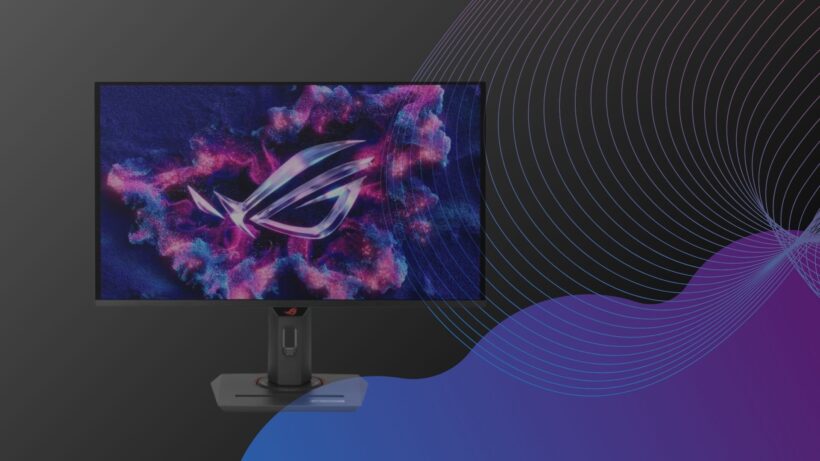
As much as we love the Samsung Odyssey SG27FG810S, it’s far from being the only Quantum Dot OLED monitor on the market, and if you’re after a tantalising alternative then the Asus ROG Strix XG27UCDMG should be your first port of call. Also with a 27-inch frame, the ROG Strix XG27UCDMG does have a few features that you won’t find on Samsung’s offering.
One of the things we appreciate about the XG27UCDMG is that it doesn’t take up any more space than it absolutely needs to, which is a boon for anyone working with a fairly compact desk. The stand itself isn’t anywhere near as large as the one featured on Samsung’s device, and there’s also a very helpful phone holder readily available at the base. Not only does this help to remove clutter from your desk, but it ensures that you won’t miss any crucial notifications while you game.
As you might expect for a QD-OLED display, where the ROG Strix XG27UCDMG really shines is in its visual fidelity and contrast levels. This really comes into play with a meticulously designed title like Cyberpunk 2077 as the darker corners of Night City’s dingy bars and dangerous alleyways really do draw you in with their intensity. It’s felt even more in horror titles like Resident Evil Requiem.
If you’re someone who prefers to kick back with FPS games then the included 240Hz refresh rate is made with you in mind. It allows everything from Counter-Strike 2 to Apex Legends to feel even more immersive as you fight for the win. Colour accuracy is similarly brilliant here as we measured 100% coverage of the sRGB colour space in our testing, not to mention 99% DCI-P3 and 91% Adobe RGB.
The one reason why you might want to opt for the Samsung SG27FG810S over Asus’ monitor is its anti-glare coating, which makes it a much better option for gamers who enjoy getting in a session during the day, or if your gaming space has a lot of natural light seeping in. If this isn’t an issue then you’ll really appreciate what Asus has put together here.
-
Punchy, responsive and colour-accurate images
-
Highly adjustable stand
-
OSD is easy to navigate
-
Lack of USB-C may turn off some
-
OSD is quite basic
If there’s one downside to gaming it’s that, if you’re not careful, it can end up being a rather pricey hobby pretty quickly. While there’s a lot to be said for investing in future-proof kit at the higher end of the equation, oftentimes that just isn’t possible and so if you only have a limited budget that you want to maximise as much as possible, the Xiaomi G Pro 27i is easily one of your best options right now.
Despite its affordable asking price of £299.99/$370, the 27i still packs in a ton of value. For starters, this is a Mini LED display – let that soak in for a second. Typically you’d expect to pay far more than the aforementioned cost for the privilege of enjoying Mini LED tech, but somehow Xiaomi has found a way to offer it at a budget rate and it’s still just as stunning as ever.
We managed to pick up 707.7 nits of peak brightness which, when paired with the 8880:1 contrast ratio allows for a brilliant mix of deep blacks and a vibrant colour palette. This combination not only works brilliantly for horror titles, making the darkness feel even more foreboding as you move around each corner, but also more colour-rich games like Marvel Rivals.
There isn’t really much of a sacrifice in terms of image detail either, as the 27i still offers up a crisp 1440p resolution on a 27-inch panel. There’s even a 180Hz refresh rate which is even more surprising – given the price, we wouldn’t have balked at a 120Hz rate, but to have those extra frames in there is certainly a nice bonus.
It’s also worth mentioning that this is quite a good monitor to have on hand if you work as a photo or video editor during the day. In our tests we picked up 100% coverage within the sRGB colour space, alongside 99% DCI-P3 and 95% Adobe RGB. We frequently come across far pricier monitors that can’t match that level of accuracy, so it’s impressive to see what Xiaomi has achieved here.
-
Gorgeous image quality with fantastic detail and motion
-
Exemplary black level and contrast
-
Excellent port selection
-
Expensive
-
Lack of a KVM or more powerful USB-C against rivals
If you’re a professional who works in a creative industry, but who also loves to indulge in some high-end gaming after the day is done then the Alienware AW2725Q is the monitor to go for. With enough specs to round out a small pamphlet, this monitor works perfectly for both productivity and gaming, so if you want to have a home office that works for both, this is the way to go about it.
For starters, by having a 27-inch frame, the AW2725Q is just the right size to feel immersive without it being too big on a standard desk. Compared to some of the wider monitors on this list, the AW2725Q won’t feel like it’s taking up a ton of space unnecessarily. Even though it’s slightly smaller, you’re still getting a stunning 4K panel that’s boosted by QD-OLED technology.
With greater control over its lighting compared to LCD monitors, this Alienware pick can produce phenomenal colours and contrast, so the fantastical worlds of Split Fiction can jump out at you, just as the dark corridors of Resident Evil: Village might lure you in. It has to be seen to be believed, but it also paves the way for a great experience with passive entertainment too.
Thanks to Dolby Vision HDR and HDR10 support, streaming a bit of Netflix or Disney Plus can feel far more cinematic with this monitor in tow. What really impressed us though were the colour tests, which picked up 100% of the sRGB space and 91% of the Adobe RBG spectrum. This means that if you edit videos or photos for a living, you’ll be getting an accurate recreation onscreen of what the final product will look like, which is a huge win.
When it comes to ports you have plenty of options available. There are two HDMI 2.1 ports for hooking up other consoles, alongside a 15W USB-C downstream port that’s helpful for charging up your phone. What’s more, one of the HDMI slots has eARC so you can hook up a soundbar for an even richer audio experience, if you so please.
FAQs
What is Hz?
Hz (short for Hertz) references the number of cycles per second. For gaming monitors, this measures the refresh rate which is how many times the display will refresh itself per second. 60Hz is standard for a normal monitor, but gamers will benefit from smoother visuals with a substantially higher refresh rate.
What is Ms?
The term ‘ms’ is short for milliseconds. For gaming monitors, this is usually in reference to the response time, which is how long it takes for the monitor to shift between colours.
What are G-Synch and FreeSync?
These are both syncing technologies that allow the monitor to sync up with your system’s GPU and prevent the ‘screen tearing’ effect.
Test Data
| |
Samsung Odyssey S27FG810S |
Acer Predator X32X |
AOC Agon Pro AG276QZD |
Lenovo Legion R45w-30 |
AOC Agon AG405UXC |
AOC Gaming 25G3ZM/BK |
Samsung Odyssey Neo G7 (2023) |
Philips Evnia 34M2C8600 |
Philips Evnia 42M2N8900 |
LG UltraGear Dual-Mode 4K OLED (32GS95UE-B) |
Asus ROG Strix XG27UCDMG |
Xiaomi G Pro 27i |
Alienware AW2725Q |
| Brightness (SDR) |
91.96 nits |
222.6 nits |
380 nits |
415 nits |
361 nits |
318 nits |
490 nits |
237 nits |
205 nits |
277 nits |
237.5 nits |
707.7 nits |
246.4 nits |
| Brightness (HDR) |
800 nits |
– |
810 nits |
– |
484 nits |
– |
– |
1000 nits |
– |
1146 nits |
– |
– |
1000 nits |
| Black level |
0 nits |
0.03 nits |
0 nits |
0.13 nits |
0.19 nits |
0.08 nits |
.02 nits |
0.03 nits |
0 nits |
0 nits |
0.03 nits |
0.08 nits |
0.01 nits |
| Contrast ratio |
Infinite |
8430:1 |
Infinity |
3020:1 |
1362:1 |
3726:1 |
5830:1 |
8090:1 |
Infinite |
Infinite |
12210:1 |
8880:1 |
18690:1 |
| White Visual Colour Temperature |
– |
6300 K |
6542 K |
6171 K |
6223 K |
6386 K |
6700 K |
6100 K |
6089 K |
6411 K |
6600 K |
6600 K |
6100 K |
| sRGB |
132.3 % |
100 % |
99.2 % |
96.1 % |
99.2 % |
99.7 % |
100 % |
100 % |
100 % |
100 % |
100 % |
100 % |
100 % |
| Adobe RGB |
96.8 % |
92 % |
88.2 % |
72.9 % |
75.5 % |
80.8 % |
91 % |
93 % |
89.8 % |
96 % |
91 % |
95 % |
91 % |
| DCI-P3 |
98.25 % |
98 % |
88.8 % |
77.1 % |
84.9 % |
91.2 % |
98 % |
98 % |
95.4 % |
97.4 % |
99 % |
99 % |
99 % |
| Energy consumption |
– |
– |
– |
34 Watts |
45 Watts |
– |
– |
– |
– |
– |
– |
– |
– |
| Input lag (ms) |
9.6 ms |
– |
– |
– |
– |
– |
– |
– |
– |
1.9 ms |
– |
– |
– |
| Delta Colour accuracy (Delta E) |
– |
– |
1.07 |
1.8 |
0.83 |
1.5 |
2.04 |
– |
1.3 |
2.9 |
– |
– |
– |
Full Specs
| |
Samsung Odyssey S27FG810S Review |
Acer Predator X32X Review |
AOC Agon Pro AG276QZD Review |
Lenovo Legion R45w-30 Review |
AOC Agon AG405UXC Review |
AOC Gaming 25G3ZM/BK Review |
Samsung Odyssey Neo G7 (2023) Review |
Philips Evnia 34M2C8600 Review |
Philips Evnia 42M2N8900 Review |
LG UltraGear Dual-Mode 4K OLED (32GS95UE-B) Review |
Asus ROG Strix XG27UCDMG Review |
Xiaomi G Pro 27i Review |
Alienware AW2725Q Review |
| UK RRP |
£1099 |
£1099 |
£849 |
£799 |
£570 |
£179 |
£899 |
£1149.95 |
£1780 |
£1288 |
£938.99 |
£299.99 |
– |
| USA RRP |
$1299 |
$1199.99 |
– |
– |
– |
– |
$999.99 |
$1299.99 |
– |
$1195 |
$974 |
$370 |
$899.99 |
| Manufacturer |
Samsung |
Acer |
AOC |
Lenovo |
AOC |
AOC |
Samsung |
Philips |
Philips |
LG |
Asus |
Xiaomi |
Alienware |
| Quiet Mark Accredited |
– |
– |
– |
– |
No |
No |
– |
– |
No |
– |
– |
– |
– |
| Screen Size |
27 inches |
32 inches |
26.5 inches |
44.5 inches |
40 inches |
24.5 inches |
43 inches |
34 inches |
42 inches |
32 inches |
27 inches |
27 inches |
27 inches |
| Front Camera |
– |
– |
– |
– |
– |
No |
– |
– |
No |
n/a |
– |
– |
– |
| Size (Dimensions) |
611 x 49.2 x 354 MM |
713.9 x 345.9 x 487.4 MM |
604 x 233 x 527 MM |
1090 x 341 x 363.5 MM |
944.1 x 312.4 x 477.7 MM |
503 x 259 x 557 MM |
960.8 x 635 x 254 MM |
813 x 295 x 553 MM |
932 x 359 x 689 MM |
714 x 266 x 627 MM |
611 x 168.7 x 509.4 MM |
169.45 x 613.35 x 526.5 MM |
609.51 x 210 x 516.01 MM |
| Weight |
3.8 KG |
7 KG |
6.4 KG |
12.1 KG |
11.88 KG |
4.24 KG |
– |
8.7 KG |
17.3 KG |
9 KG |
7.44 KG |
4.8 KG |
6.79 KG |
| ASIN |
B0DW9GSGSK |
– |
B0C2C9693V |
– |
B0C4P88C2S |
B0BGCG4NJM |
11.7 |
– |
B0BSNWW56B |
B0CV1Y7NLT |
– |
– |
– |
| Release Date |
2025 |
2025 |
2023 |
2023 |
2023 |
2021 |
2023 |
2023 |
2023 |
2024 |
2025 |
2024 |
2021 |
| First Reviewed Date |
– |
31/07/2025 |
09/01/2024 |
14/12/2023 |
20/07/2023 |
28/04/2023 |
– |
08/05/2024 |
– |
29/10/2024 |
16/04/2025 |
02/03/2025 |
– |
| Model Number |
– |
– |
AG276QZD |
Lenovo Legion R45w-30 |
AG405UXC |
25G3ZM/BK |
– |
– |
42M2N8900 |
32GS95UE-B |
– |
– |
– |
| Resolution |
3840 x 2160 |
3840 x 2160 |
2560 x 1440 |
5120 x 1440 |
3440 x 1440 |
1920 x 1080 |
3840 x 2160 |
3440 x 1440 |
3840 x 2160 |
3840 x 2160 |
3840 x 2160 |
2560 x 1440 |
3840 x 2160 |
| HDR |
Yes |
Yes |
Yes |
Yes |
Yes |
– |
Yes |
Yes |
Yes |
Yes |
Yes |
Yes |
Yes |
| Types of HDR |
HDR10, HDR10+, VESA DisplayHDR True Black 400 certification |
DisplayHDR True Black 400 |
HDR10 |
DisplayHDR 400 |
Vesa DisplayHDR 400 |
– |
VESA DisplayHDR 600 |
DisplayHDR True Black 400 |
HDR10 |
HDR10, DisplayHDR True Black 400 |
HDR10 |
DisplayHDR 1000 |
Dolby Vision, DisplayHDR True Black 400, HDR10 |
| Refresh Rate |
240 Hz |
240 Hz |
238 Hz |
165 Hz |
143 Hz |
240 Hz |
144 Hz |
175 Hz |
138 Hz |
480 Hz |
240 Hz |
180 Hz |
240 Hz |
| Ports |
DisplayPort 1.4, two HDMI ports switchable between 2.1 and 1.4 versions with HDCP 2.2 spec, headphone jack, USB Type-A downstream port x 2, USB-B Upstream port x1 |
USB-C, 2x HDMI 2.1, 2x DisplayPort 1.4, USB KVM |
DisplayPort 1.4 x 2, HDMI 2.0 x 2, 3.5mm audio x 1, USB-A x 2, USB-B x 1 |
USB-A x 3, USB-B x 1, USB-C x 1, HDMI 2.1 x 2, DisplayPort 1.4 x 1, 3.5mm audio x 1 |
HDMI 2.0 x 2, DisplayPort 1.4 x 1, USB-A 3.2 Gen 1 x 4, USB-C 3.2 Gen 2 x 1, USB-B 3.2 Gen 1 x 1, 3.5mm audio x 1 |
DisplayPort 1.2 x 1, HDMI 2.0 x 2 |
HDMI 2.1, DisplayPort 1.4 |
HDMI 2.0 x 2, DisplayPort 1.4 x 1, USB-C x 1 (DP Alt mode, Video, Data and Power Delivery), USB 3.2 Gen 1 / 5 Gbps, USB-B upstream x 1, USB-A downstream x 4 (with 1 for fast charge B.C 1.2) |
HDMI 2.1 x 2, DisplayPort 1.4 x 1, Type-C DP Alt Mode x 1 |
2 x USB 3.0, 1 x audio |
DisplayPort 1.4 DSC x 1 HDMI (v2.1) x 2 USB-C x 1 (DP Alt Mode) Earphone jack : Yes USB Hub : 3x USB 3.2 Gen 1 Type-A USB-C Power Delivery : 90W |
2x DP 1.4, 2x HDMI 2.0, 3.5mm headphone jack |
2x HDMI 2.1 FRL port (1 with eARC), 1x DisplayPort 1.4, 1x USB 5Gbps Type-B upstream, 3 x USB 5Gbps Type-A downstream, 1x USB-C 5Gbps downstream with Power Delivery up to 15W |
| Connectivity |
– |
– |
– |
RJ45 gigabit ethernet |
– |
N/A |
Wi-Fi 5 and Bluetooth 5.2 |
– |
USB-A 3.2 Gen 1 x 4, USB-B x 1, 3.5mm audio x 1 |
2 x HDMI 2.1, 1 x DisplayPort 1.4 |
– |
– |
– |
| Colours |
– |
– |
– |
Black |
Black |
16.7 Million |
Black |
– |
White |
Grey |
– |
Black/White |
Black |
| Display Technology |
QLED, OLED |
OLED |
OLED |
VA |
IPS |
VA |
Mini LED |
OLED |
OLED |
OLED |
OLED |
Mini LED |
OLED |
| Screen Technology |
– |
– |
– |
– |
– |
VA |
– |
– |
– |
– |
– |
IPS |
– |
| Syncing Technology |
AMD FreeSync / Nvidia G-Sync |
AMD FreeSync / Nvidia G-Sync |
Nvidia G-Sync |
AMD FreeSync |
AMD FreeSync / Nvidia G-Sync |
AMD FreeSync |
AMD FreeSync |
AMD FreeSync |
AMD FreeSync / Nvidia G-Sync |
AMD FreeSync / Nvidia G-Sync |
AMD FreeSync / Nvidia G-Sync |
AMD FreeSync |
AMD FreeSync / Nvidia G-Sync |
The post Best Gaming Monitor 2026: Stay one step ahead of the competition appeared first on Trusted Reviews.
Source link