
Crypto World
Pencil Finance closes $1M on-chain lending cycle for 6,600 students

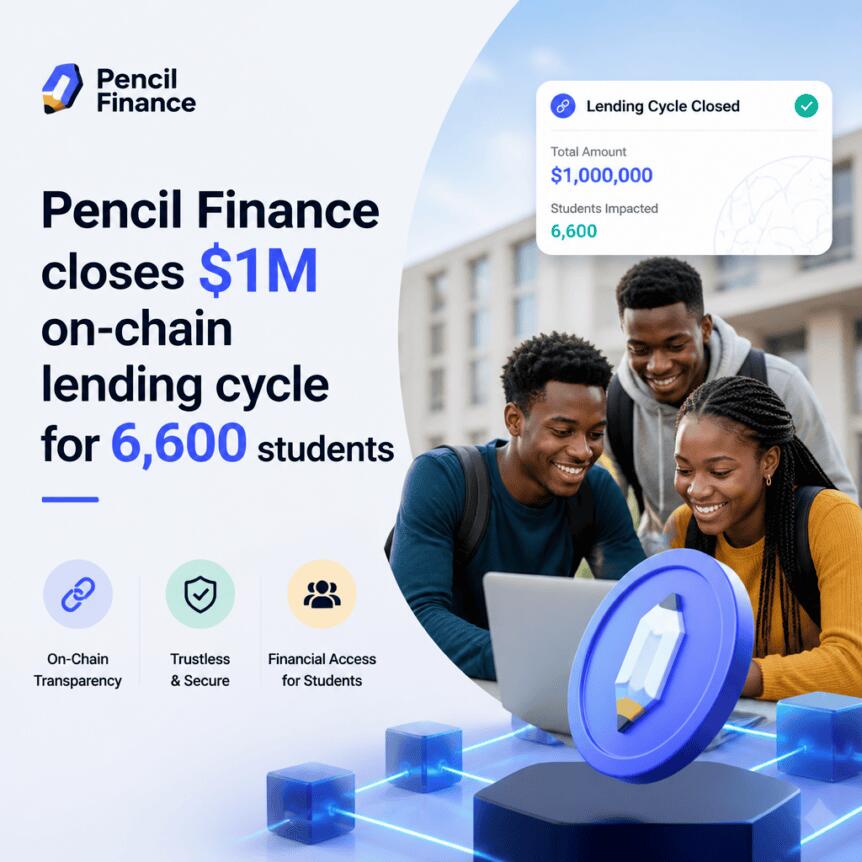
Student loan real-world asset (RWA) protocol Pencil Finance says it has completed its first “fully onchain” student lending cycle, deploying $1 million to fund education borrowers in Southeast Asia and then seeing repayments flow back to lenders.
In a Thursday announcement shared with Cointelegraph, the project described the full process as transparently recorded on the blockchain: capital was deployed onchain as a lender, borrowers repaid, and repayment was routed back to the bundle’s funders with yield.
Key takeaways
- Pencil Finance completed its first fully onchain student loan cycle using $1 million in deployed capital.
- The program supported about 6,600 students across 118 schools and universities in Southeast Asia.
- Funding was structured into senior (fixed returns) and junior (variable returns with first-loss risk) tranches.
- Pencil says roughly 1,050 students received direct funding, with 50% of borrowers female and 93% from lower-income households.
- The company frames the cycle as an example of blockchain-recorded lending for student financing that traditional lenders often overlook.
How Pencil Finance’s onchain loan cycle worked
Pencil Finance’s announcement centers on the mechanics of its student loan bundle being executed onchain from deployment through repayment. The protocol said it deployed $1 million in capital as a lender on the blockchain for a defined loan cycle, then received repayments from borrowers. Those repayments, according to the company, were distributed back to the bundle’s funders and produced yield.
The project also emphasized that the lending process was recorded onchain end to end, pointing to transparency as a core feature of the approach. Pencil claims the completed cycle is the first-ever “fully onchain lending cycle” that finances student loans with activity transparently captured on a blockchain network.
Tranche structure behind the $1 million bundle
While the overall figure is $1 million, Pencil’s program was funded through a structured tranche model. The company said the bundle was funded in July 2025 by Animoca Brands, Open Campus, and New Campus.
Under the arrangement described by Pencil, the capital was split into a senior tranche and a junior tranche. The senior tranche carries fixed returns, while the junior tranche provides variable returns and bears first-loss risk—meaning it is designed to absorb losses before the senior portion is impacted.
For investors and participants, this split is significant because it changes how risk and reward are distributed. Fixed-return exposure is paired with a loss-absorbing layer, which can make the senior tranche more attractive depending on the credit performance of the underlying borrowers, while still giving junior tranche holders potential upside commensurate with the added risk.
Who received financing, and where
Pencil Finance said the completed onchain loan cycle provided financing to roughly 6,600 students across 118 schools and universities in Southeast Asia. In its breakdown of direct funding, the protocol reported that about 1,050 of those students received direct funding.
Pencil also described borrower demographics and credit-gap positioning. The loans were intended for students underserved by traditional lenders, with the company reporting that 50% of borrowers were female and 93% came from lower-income households.
These figures matter because they frame the lending program not as a generalized education finance product, but as targeted support for segments that often struggle to access standard forms of credit. The scale across institutions—118 schools and universities—also suggests the protocol is aiming for broad distribution rather than a narrow pilot.
RWAs and tokenized credit: a broader trend
The Pencil announcement arrives as tokenized RWAs continue to move from theory into more operational examples—particularly in lending and asset-backed structures. In July, Cointelegraph reported that Brazil’s B3 stock exchange issued a loan denominated in 100,000 Brazilian reais (about $19,600), secured by “10 tokenized cows.” Each cow was represented by a unique digital token tied to an encrypted digital identity, while AI-powered smart collars from Cowmed were used to monitor each animal’s health. The comparison is useful because it highlights a recurring theme in the RWA sector: digitization of real-world collateral and processes to improve traceability and automation.
Student lending, however, differs from collateralized commodity examples. Instead of tokenizing a static asset like a cow, the onchain activity in Pencil’s model focuses on credit deployment, repayment flows, and the structured allocation of returns and risks across tranches. If the program’s claimed transparency and cycle execution can be repeated, it offers a blueprint for how tokenized credit could be operationalized for education financing—an area where data collection, verification, and enforcement are often the hardest parts for traditional lenders.
Still, several practical questions remain for observers: the long-term performance of the loans, how defaults (if any) affected tranche outcomes, and how the protocol scales the underwriting and administration needed to operate across many schools. Pencil says the first cycle is complete, but investors and partners will likely want to see follow-on cycles and more performance details over time.
For now, the key thing to watch is whether Pencil’s onchain lending flow—deployment, repayment routing, and tranche mechanics—holds up in subsequent cycles, and whether this model attracts additional capital for student borrowers in underserved regions.

Argentina’s Public Prosecutor’s Office has trained prosecutors, officials and staff to trace, analyse and seize virtual assets as cryptocurrency plays a larger role in criminal investigations across the country.
Summary
- Argentina’s Public Prosecutor’s Office trained prosecutors, officials and staff on tracing, analysing and seizing virtual assets.
- The course covered digital wallet analysis, crypto tracing, legal frameworks and procedures for freezing or seizing funds.
- Argentina’s courts have previously frozen millions of dollars in USDT and traced crypto transactions in major criminal investigations.
- The training follows recent cases including the LIBRA probe, where investigators tracked funds across wallets, blockchains and exchanges.
The Ministerio Público Fiscal, or MPF, said it held a specialised course titled “Virtual Assets: Financial Analysis, Tracing, Detection and Seizure” as part of its optional academic programme, with sessions conducted remotely on Aug. 19 and Sept. 2.
The training was restricted to employees, officials and magistrates within the institution and focused on the technical knowledge required when digital assets become part of financial or criminal investigations.
Carmen Chena, a lawyer specialising in anti-money laundering controls, led the sessions through Zoom. The programme covered financial analysis of digital wallets, cryptocurrency tracing, asset recovery and the legal procedures available when investigators seek to restrict or seize digital funds.
Argentina prosecutors study crypto tracing and seizures
The course began with changes in asset recovery methods created by virtual assets before moving into financial and patrimonial analysis of digital wallets.
Participants studied Argentina’s domestic legal framework alongside international rules governing virtual assets and examined the structure of the cryptocurrency ecosystem. The programme covered different methods for imposing precautionary measures on digital funds and used practical cases to show how such procedures can work during an investigation.
For the MPF, the subject falls within its role as an independent institution in Argentina’s justice system. The agency promotes judicial action in defence of legality and the general interests of society, while one of its central responsibilities is directing public criminal investigations.
Crypto tracing has already become part of several major Argentine cases, requiring investigators to follow transactions across wallets, blockchain networks and exchanges.
In July, an Argentine judge ordered the identification of people behind 25 cryptocurrency wallets connected to the $LIBRA investigation and ordered assets linked to the addresses frozen.
Investigators had reconstructed movements involving millions of dollars across several blockchain networks. A report from the Cybercrime Technical Department of the Argentine Federal Police found that four of eight wallets identified as belonging to the Libra Team had consolidated funds into a single address.
Authorities later traced 498,539 USDT transferred through a cross-chain protocol to a wallet on the Tron network. The receiving address divided the funds into 17 transactions, while investigators identified transfers involving Binance, Bybit, OKX and Bitfinex.
The court sought know-your-customer records, IP addresses, transaction histories and other information that could help identify people behind the transactions.
$LIBRA probe has required extensive wallet analysis
The $LIBRA case has given Argentine investigators a recent example of the technical work required when crypto assets move through several addresses and trading platforms.
Crypto.news previously reported in July that investigators were examining roughly $8.2 million that had remained dormant before moving again in May through wallets placed under judicial scrutiny.
The investigation stems from the February 2025 launch of LIBRA, a token promoted on social media by Argentine President Javier Milei. Its price climbed rapidly following Milei’s post before collapsing, triggering criminal and civil investigations into the people involved with the project.
Phone records reviewed by prosecutors later showed that Milei had seven calls with an entrepreneur connected to LIBRA around the time of his social media post. Investigators did not disclose what was discussed during the calls.
Milei has denied wrongdoing and previously said his involvement was limited to sharing information about what he understood to be a private project supporting the Argentine economy.
The judicial investigation has continued to examine financial relationships, communications and transactions associated with LIBRA. Prosecutors have had to analyse both conventional records and blockchain activity as they reconstruct the movement of funds linked to the token.
Such investigations can require authorities to identify wallet addresses, establish links between addresses and individuals, follow assets when they move between blockchains and obtain customer records when funds pass through centralised exchanges.
Those subjects overlap with the MPF course, which specifically covered financial analysis of digital wallets, tracing methods, precautionary measures and asset seizure procedures.
Argentine courts have previously frozen stablecoins
Argentina’s justice system had already used crypto tracing and asset restrictions before the LIBRA investigation.
In December 2024, an Argentine court seized a USDT wallet containing approximately $3.5 million during an investigation into Rainbowex, an alleged trading Ponzi scheme.
Authorities froze cryptocurrency wallets and bank accounts connected to the case, while experts from Argentine crypto platform Lemon and blockchain forensic firms Chainalysis and Qlue provided technical support to trace the funds.
More than 15 raids were carried out across Argentina as part of the Rainbowex investigation, and at least four people were arrested. Authorities worked with Interpol to locate individuals from Malaysia suspected of involvement in creating and operating the platform.
Rainbowex had offered investors daily returns of between 1% and 2%, with the alleged scheme affecting people in San Pedro, Buenos Aires.
Argentine courts have dealt with other disputes involving the recovery of cryptocurrency. In 2022, a court ordered Binance to return Bitcoin to the victim of a theft, another example of judicial authorities dealing directly with digital assets held or transferred through crypto platforms.
The MPF’s training comes as cryptocurrency use has remained substantial in Argentina. Stablecoins accounted for 94% of peso-denominated cryptocurrency trading volume in data published by a16z Crypto on Aug. 30 using figures from Artemis.
The analysis estimated that roughly one in five Argentines uses cryptocurrency, while downloads of the country’s 15 leading crypto applications increased 93% during 2024 compared with the previous year.
Argentina has formalised oversight of crypto providers
Crypto businesses operating in Argentina have faced a more defined registration and compliance system as authorities bring virtual asset providers within existing financial oversight structures.
The National Securities Commission, known locally as the CNV, maintains the country’s Virtual Asset Service Provider registry. Companies admitted to the system must comply with requirements connected to anti-money laundering and counter-terrorism financing controls.
Bitget, for example, secured VASP registration in Argentina in June, bringing the exchange within the country’s regulatory framework for cryptocurrency service providers.
Registered businesses are subject to reporting and compliance obligations involving Argentina’s Financial Information Unit and other relevant authorities.
At the same time, cryptocurrency activity has extended into products being developed by traditional financial groups. In July, BIND Group and Petersen Group were developing peso stablecoins through separate digital-asset businesses for uses including programmable payments, treasury operations, collateral management and onchain settlement.
For prosecutors investigating transactions within that expanding ecosystem, the MPF course covered both the national and international rules applicable to virtual assets, alongside the practical methods used to analyse wallets, trace transactions and apply precautionary measures to cryptocurrency funds.


The price of lumber has declined 35% since crypto exchanges first listed crypto-native lumber contracts for trading.
At the time, using blockchain technologies to tokenize, trade, or track an off-blockchain commodity seemed like a welcome revolution.
The price of lumber, in early 2021 during the COVID housing boom, had been rallying amid soaring demand for home renovation projects and limited supply from quarantined workers and broken supply chains.
FTX launched its lumber future on May 6, 2021. Since then, the USD price of lumber has fallen 34.9%, and that decline would be even worse using inflation-adjusted numbers after deteriorating in purchasing power over half a decade.
Protos reported roughly $23 million in lumber trading on FTX during its first several days.
The Bureau of Labor Statistics’ seasonally-adjusted lumber index shows 455.4 in May 2021, the series’ peak, compared with 296.4 in July 2026.
Read more: Rancher puts cows on the blockchain for clout
Lumber, another dumb crypto fad
In reality, lumber is a broad category within which there are thousands of distinct prices depending on the type, quality, and location of the particular wood.
Cash quotes vary by species, grade, dimensions, delivery point, and a variety of other factors.
CME has also changed its futures contract in August 2022 with a sunset period that ended in May 2023.
Its legacy, so-called “Random Length Lumber” future covered 110,000 board feet and sourced delivery from western mills.
Its replacement contract now covers 27,500 board feet, delivers to Chicago, and began trading on August 8, 2022.
The exchange delisted the old contract in May 2023 after a sunsetting process. Therefore, a continuous chart that “stitches” the differently sized contracts together crosses a genuine specification break.
Both contracts neatly quote, however, in US dollars per 1,000 board feet, so their shared dimensions can allow technicians to create an apples-to-apples, albeit stitched, chart of lumber prices over time.
Got a tip? Send us an email securely via Protos Leaks. For more informed news and investigations, follow us on X, Bluesky, and Google News, or subscribe to our YouTube channel.
When a client named Rusty contacted crypto recovery specialist Chris Brooks in 2021, he said he and two others had won 5,000 Bitcoin in a court case, worth around $53 million at the time.
They immediately set up a Zoom call to discuss the case.
“There were three guys on the call, and one of them holds up a phone. It has like $53 million in a Bitcoin address,” says Brooks, founder and chief executive of Crypto Asset Recovery.
The men claimed they were able to withdraw as much as $300,000 a week but wanted to get the whole fortune out. If Brooks and his son, Charlie, flew to Georgia to help them crack the wallet, they would make them millionaires.
Brooks and son bought plane tickets and went the next day.
At lunch, Rusty, a 6-foot-3 Army veteran, revealed the wallet didn’t only contain 5000 BTC.
“Rusty pulls out his phone, and he shows us a billion dollars in ETH. And that’s when I was like, okay, something very odd is going on here.”
The men then drove about an hour to a strip mall owned by one of them, where they went into the back office and were handed notebooks containing dozens of recovery seeds. The pair spent the day opening wallets.
They found about $10 in Bitcoin.
Brooks never established whether the wallets they were given had previously held the BTC or ETH Rusty claimed to own. They were never reimbursed for the flight tickets either.
Related: Do the Coldcard attacks mean all hardware wallets are now insecure?
Brooks now suspects Rusty had fallen victim to scammers who convinced him he had a large crypto fortune when he didn’t.
It was an early lesson for their crypto recovery business.
Sometimes crypto is lost. Sometimes the wallet is lost. Sometimes the password is lost.
And sometimes, it turns out, the money was never there in the first place.
Losing your crypto doesn’t always mean it’s gone
For wallet recovery specialists, “lost crypto” can mean several very different things.
They aren’t recovering Bitcoin from the blockchain; they’re recovering the information needed to access a wallet that already exists.
While someone may have thrown away a hardware wallet, forgotten a password or part of their seed phrase, none of those things necessarily mean the underlying crypto has disappeared.
Bruno Krauss, co-founder and chief technical officer of recovery firm ReWallet, tells Magazine:
“If you have some missing words, then you can often recover them.”
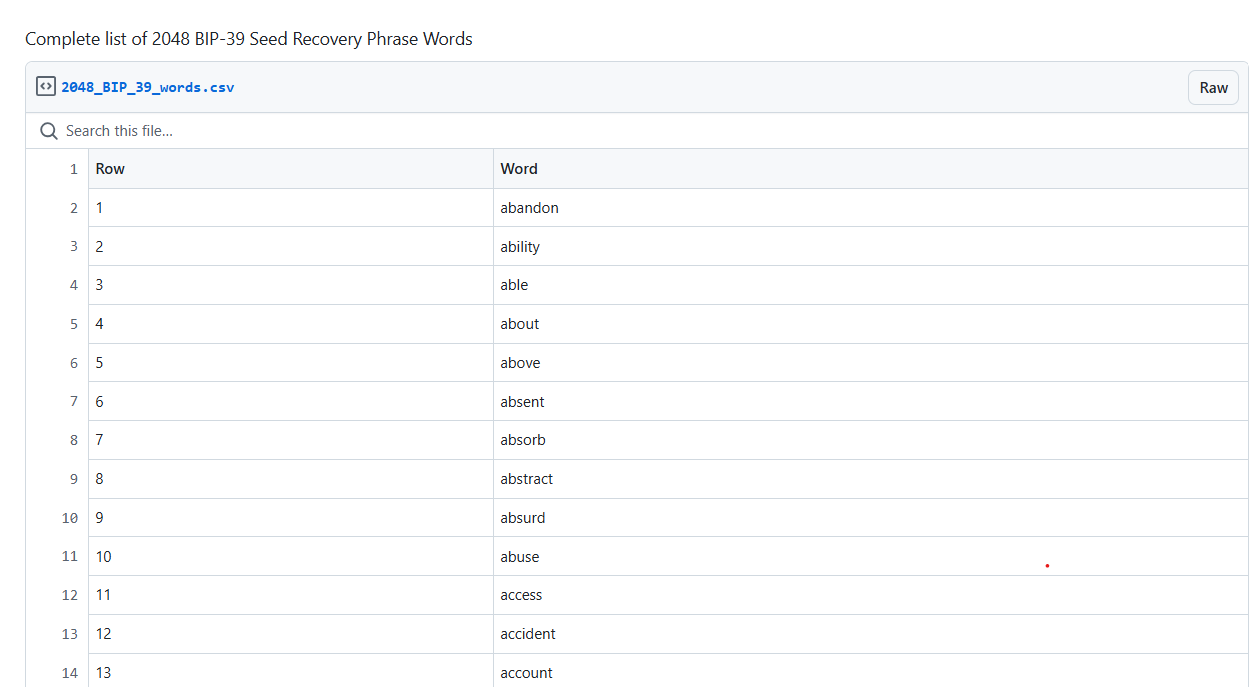
Bitcoin’s BIP39 seed phrase standard uses a list of 2,048 words, meaning that if someone knows most of the words, specialists can sometimes systematically search the remaining possibilities. The fewer pieces missing, the more manageable the puzzle.
Password recovery can work in much the same way.
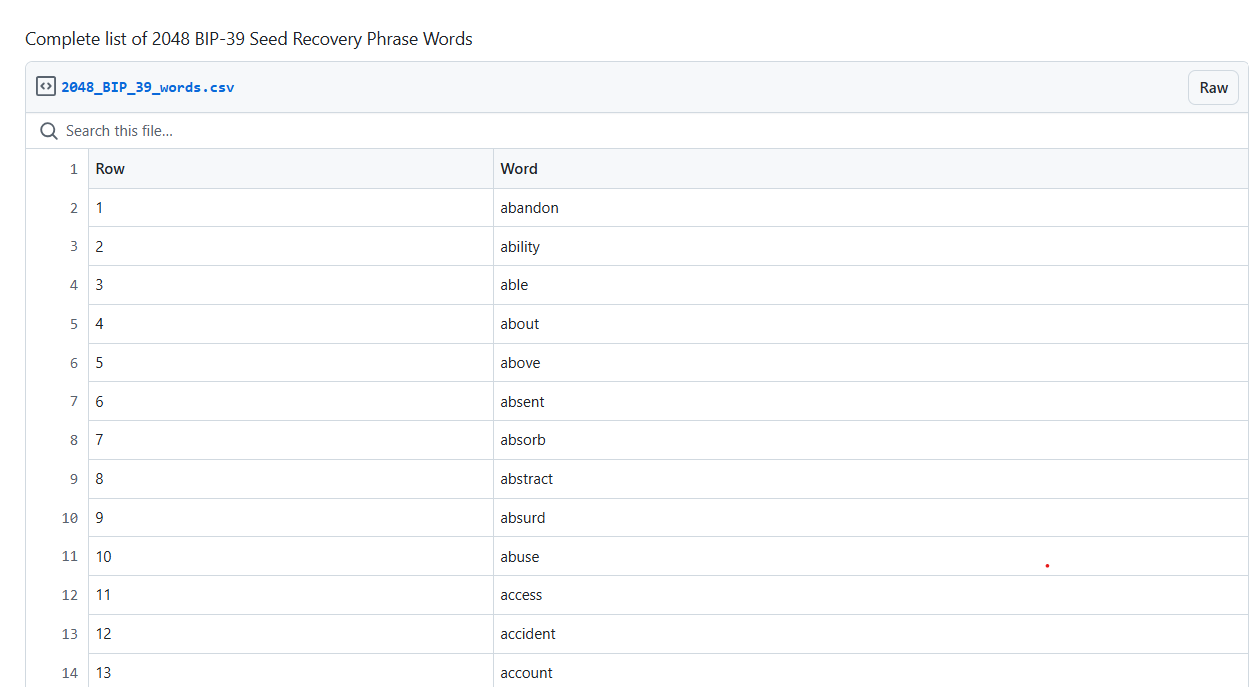
Bitcoin’s BIP39 standard uses a list of 2,048 words. Source: GitHub
Krauss says ReWallet once recovered a 20-character password protecting roughly $3 million after reverse-engineering a flawed password generator.
Other cases depend less on technical exploits than on understanding how a particular person creates passwords.
That means asking clients about personal preferences like favorite foods and places, children’s names and birthdays, personal milestones or memories.
In one case, he says a customer was convinced she had used her children’s names, only to remember that the password was actually a phone number connected to a local delivery service:
“She didn’t know why, but then she thought about it, and she realized, oh, okay, it was because on this day I got the package delivered to the store and I thought, okay, this would be a nice password.”
Passphrases add another layer of complexity
Tom Bennet, a Bitcoin educator who has studied wallet security, says there is another particularly confusing category: the passphrase.
A passphrase is an additional piece of information layered on top of a seed. Enter a different passphrase, and you don’t necessarily get an error message. You can simply get another valid wallet. He tells Magazine:
“A wrong passphrase doesn’t throw an error; it succeeds and shows you a zero balance.”
So you can have the correct seed phrase and enter it correctly, and still think your BTC has vanished.
“Passphrases also don’t have any features to protect users from themselves; no list of 2,048 valid words, no checksum. So if you’ve forgotten a passphrase, it’s basically the same question again: how random was your passphrase? If it’s sufficiently random, there’s often no way to recover it.”
With lost or broken hardware wallets, even having the broken device isn’t always much help. If the wallet’s backup seed phrase survives, the keys can generally be restored on another device.
That’s why recovery specialists don’t necessarily need the original hardware, but enough information to reconstruct access to the keys.
Related: Irish police open Bitcoin wallet years after keys were apparently lost
Recovery can also mean fixing mistakes rather than recovering a lost wallet. Crypto sent to the wrong blockchain, like BNB to Ethereum, may sometimes be recoverable if the receiving wallet is under the user’s control.
Brooks says Crypto Asset Recovery has been contracted to crack more than 3,000 wallets belonging to around 1,500 people, and has cracked passwords for about 63% of them.
Sometimes you really have lost it
There is, however, a hard boundary. Bennet says:
“If your seed is truly random and you lose it completely, your Bitcoin is gone.”
That is one of the fundamental trade-offs of self-custody. A Bitcoin wallet does not have a bank-style recovery system or a central administrator who can verify your identity and restore your account.
Lucien Bourdon, Bitcoin analyst at hardware wallet maker Trezor, puts it even more starkly. If the wallet backup is lost and the wallet containing the keys is inaccessible, “no recovery company can help.” He warns:
“If they could, the wallet could be cracked, and self-custody would be fundamentally compromised.”
Thanks to randomness, crypto wallets make guessing a private key effectively impossible. In the recent case of Bitcoin hardware wallet Coldcard, a firmware bug weakened seed randomness on some wallets, making the seeds brute-forceable without physical access.
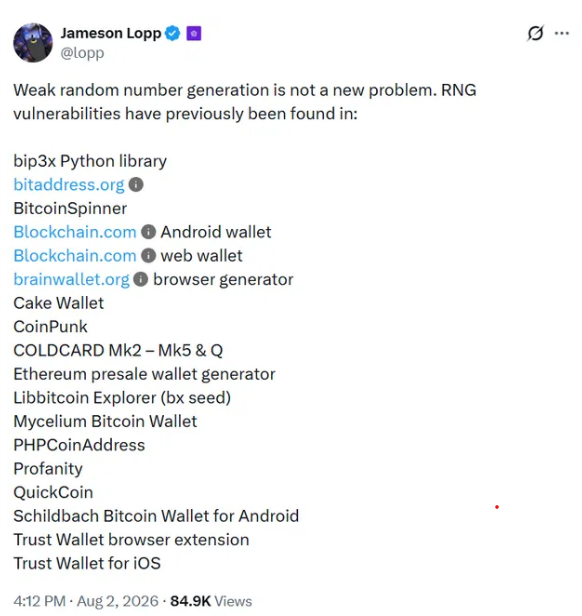
Weak random number generation is not a new problem. Source: Jameson Lopp
But if a genuinely random seed or private key has been completely destroyed, the number of possibilities is simply too large.
Krauss says recovery specialists can occasionally find technical paths into wallets that owners had assumed were permanently inaccessible, and that old wallet software, corrupted files, poorly generated passwords and hardware vulnerabilities can all create unusual opportunities:
“Don’t give up on edge cases.”
Recovery specialists can sometimes be scammers
There is an uncomfortable irony in the recovery business.
The person who may be able to help you regain access to your crypto needs the very information that gives someone access to it.
A seed phrase isn’t like a password that can be changed after someone sees it. Anyone who possesses the necessary wallet backup can often control the funds.
That makes choosing a recovery specialist a security decision in itself. Bourdon says:
“If you decide to do it, do the homework. Look for firms with a real track record and reviews you can trace to actual customers. Check that they charge on success rather than up front. And move your funds to a fresh wallet with a new backup as soon as you’re back in.”
He says users should also be wary of any unsolicited messages claiming that someone can recover their funds.
Krauss says other warning signs include people pushing users onto WhatsApp or contacting them from personal email addresses like Gmail, demanding upfront payments or asking them to open accounts at an exchange.
Recovery firms that charge a percentage of successfully recovered funds are not unusual; but paying money upfront to someone who promises to recover a wallet should set alarm bells ringing.
Brooks learned another lesson from the Rusty case.
While crypto recovery might sound like a technical job, a person who believes they are sitting on millions or billions of dollars can also be a security risk.
Crypto Asset Recovery no longer flies out to meet clients in person as it did with Rusty. The company now handles cases remotely, with sensitive wallet information processed through automated and air-gapped systems.
Brooks says around 71% of the wallets they crack contain less than $100, and the company doesn’t charge a fee for asset recovery under that amount.
If there’s one thing he wishes crypto users knew about asset recovery, it’s this:
“Learn what in the world a recovery seed is and why they’re important. That’s the simplest way to make sure you never have to talk to us.”
Cointelegraph publishes long-form journalism, analysis and narrative reporting produced by Cointelegraph’s in-house editorial team with subject-matter expertise. All articles are edited and reviewed by Cointelegraph editors in line with our editorial standards. Some articles contain affiliate links, from which Cointelegraph may earn a commission. These relationships do not influence which products we review or our editorial conclusions. Content published in here does not constitute financial, legal or investment advice. Readers should conduct their own research and consult qualified professionals where appropriate. Cointelegraph maintains full editorial independence.


Kraken delayed its initial public offering (IPO) on Wednesday to at least April 2027. If the reader has lost count of how many times it has delayed, Protos is here to help.
The exchange has been hyping its IPO for over half a decade, and was previously very confident it would IPO in 2022.
In April 2021, Kraken CEO Jesse Powell told CNBC, “We’re looking at being able to go public sometime next year.”
He’s still looking.
By June 2021, according to Fortune, Powell reconsidered a direct listing after Coinbase’s debut. He delayed slightly to a “second half” of 2022 prediction in that article.
However, by September 2022, that target still looked doubtful. Incoming CEO Dave Ripley told a reporter, “No specificity on IPO plans that we can share.”
The year ended with only delays and no IPO.
In June 2024, Bloomberg reported that Kraken was raising “final” pre-IPO financing for an IPO that never happened.
Then, in March 2025, the same outlet reported that Payward — the parent company of Kraken — was re-scheduling its IPO for January-March 2026.
By November 2025, Payward had actually submitted a draft IPO document to the SEC on Form S-1. Its announcement said an offering was expected after SEC review.
Reuters reiterated its first quarter 2026 forecast.
Read more: Kraken customer data allegedly for sale on dark web
The Kraken IPO saga continues in 2026
By March 2026, CoinDesk reported that Payward had put the IPO on hold and was unlikely to proceed. Reuters said it couldn’t independently verify the delay, which ended up being true.
One month later, Kraken pleaded with the public to trust that it hadn’t abandoned its IPO plans. Co-CEO Arjun Sethi confirmed formal IPO filings in April 2026, without naming an updated listing date.
At the Consensus conference on May 5, Sethi called Kraken “about 80% ready” for IPO and swore, “We’re ready.”
Within two weeks, however, Bloomberg reported that the IPO would push back to 2027.
Wednesday’s CoinDesk report further delayed the IPO to the second quarter of 2027.
Shares of Kraken still don’t trade on any public stock exchange. For nearly six years, the IPO is delayed.
Got a tip? Send us an email securely via Protos Leaks. For more informed news and investigations, follow us on X, Bluesky, and Google News, or subscribe to our YouTube channel.
Crypto wallet maker Ledger neglected customer safety after it failed to prevent and subsequently adapt to a string of data breaches, according to a $500 million class action lawsuit.
The August 27 lawsuit was filed by Douglas Kim, a Ledger user who claims to have lost almost $2 million to thieves who used data stolen from the company in 2020 and 2023, to target his crypto.
According to the lawsuit, around the time of these attacks, Ledger demonstrated “a disturbing pattern of negligent, reckless, and irresponsible behavior with regard to its security posture and a callous disregard for its obligations to the privacy of its customers’ [personally identifiable information].”
Ledger keeps getting breached
In the 2020 breach, the personal data of almost 300,000 Ledger users was leaked and uploaded to an online marketplace for stolen data.
Meanwhile, the 2023 phishing attack targeting one of Ledger’s employees resulted in the dissemination of malware capable of redirecting crypto stored in Ledger wallets to the attackers.
Unmentioned in the lawsuit, however, is the 2026 data breach that saw Ledger users’ personal data leaked when payments processor, Global-e, was hacked.
Read more: Ledger dubs service ‘risk-free’ despite losing millions of user emails
In relation to the 2020 and 2023 cases, the lawsuit alleges Ledger downplayed the breaches, failed to make its customers aware of the incidents in time, and won’t “rectify and bolster its inadequate security measures to prevent data breaches.”
It claims criminals used this leaked data to target users and steal their crypto, “resulting in substantial financial losses that would have been prevented, or that class members would have been able to guard against, had Ledger taken responsible and complete steps to notify its customers.”
The lawsuit also claims Ledger controvened New York’s Stop Hacks and Improve Electronic Data Security Act and was negligent in its actions.
It seeks between $500 million and up to billions of dollars in damages, and demands a trial by jury.
Ledger told Protos that it doesn’t comment on legal matters.
Got a tip? Send us an email securely via Protos Leaks. For more informed news and investigations, follow us on X, Bluesky, and Google News, or subscribe to our YouTube channel.

On December 1–2, Blockchain Life 2026 will once again bring the global crypto industry together in Dubai: 15,000+ attendees from 130+ countries, 200+ speakers, and 200+ sponsors.
3 months to the biggest crypto event of the year. The countdown has begun.
Blockchain Life brings crypto industry leaders from around the world to Dubai, attracting founders and executives from key projects. The concentration of top industry players makes the forum one of the top destinations for high-value and effective networking.
Blockchain Life will kick off one of the biggest tech and business weeks of 2026, bringing together leading experts in Web3, digital finance, investment, AI, and future technologies in Dubai.
🔹 3 stages and 200+ high-profile speakers: founders and top executives of major projects, influential investors, representatives of Tier 1 funds, global experts, and legendary traders –the people shaping the future of the industry.
🔹 A major expo featuring 200+ sponsors: leading projects, top exchanges, mining companies, Web3 and AI teams, promising startups, as well as trading tournaments.
🔹 AI Future Forum 2026, a new track focused on emerging technologies: practical applications of artificial intelligence,the latest advances in robotics, and the convergence of AI with crypto and business.
🔹 The forum will conclude with the legendary Afterparty at one of Dubai’s top clubs, featuring a world-class headliner.
Major decisions. New trends. The biggest players. The next chapter of Web3, digital finance, and AI.
All of this – December 1–2 at Blockchain Life 2026 in Dubai.
Be where the global industry comes together to shape the future.
Tickets are on sale now. Get 10% off with promo code CRYPTOBREAKING
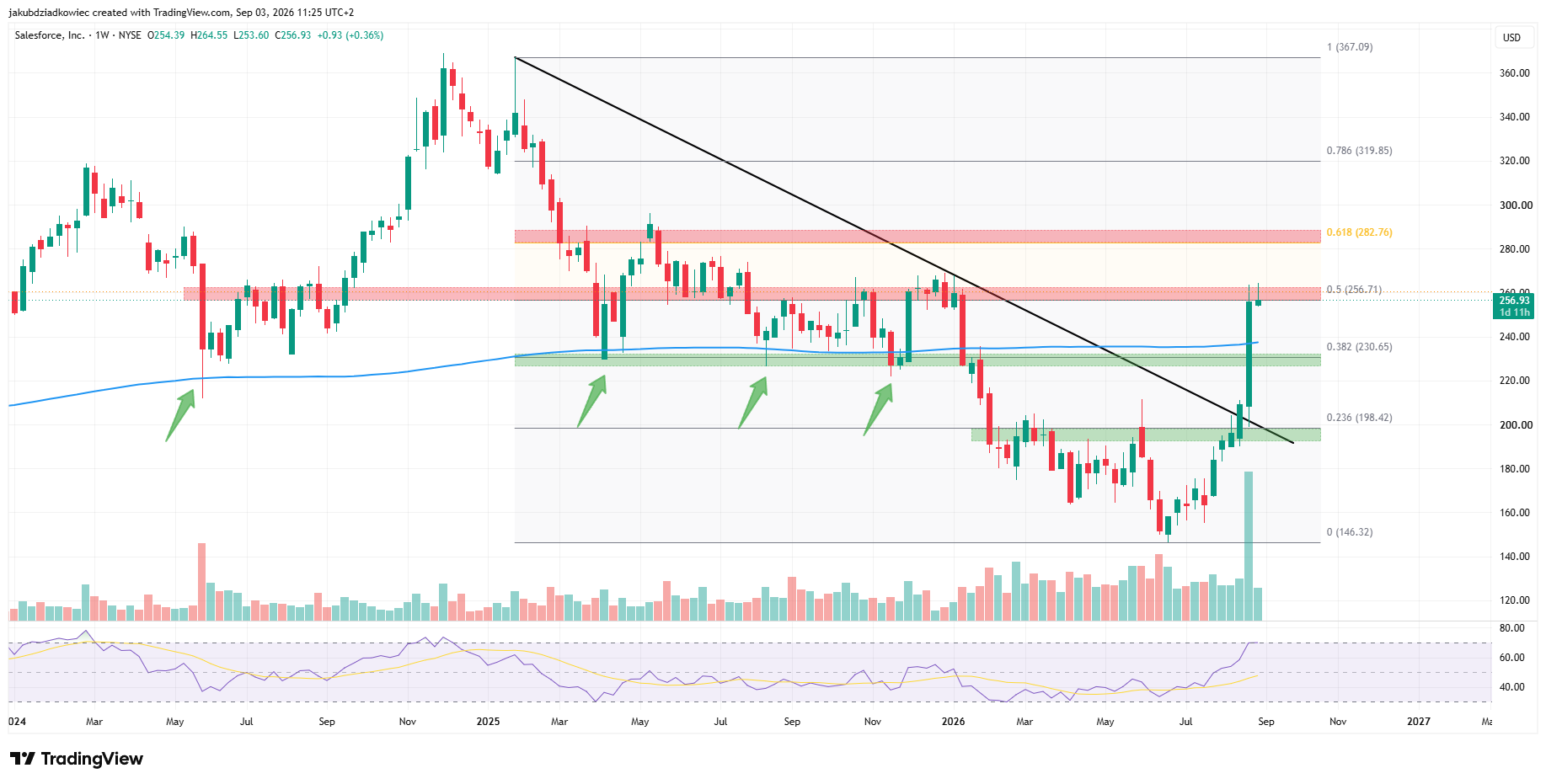
Salesforce stock closed the week of Aug. 24 up 22.4%, its sharpest weekly gain in years, after record quarterly results and an expanded Anthropic partnership.
The rally broke a 20-month downtrend and lifted Salesforce (CRM) out of its spot as the worst-performing Dow stock of 2026.
Record Quarter and Claudeforce Deal Reset the Bear Case
Salesforce reported second-quarter revenue of $11.3 billion, up 11% year over year. Current remaining performance obligations climbed 14% in constant currency to $33.5 billion.
Agentforce’s annual recurring revenue passed $1.5 billion, a 240% increase. Management raised full-year guidance to a range of $46.1 billion to $46.4 billion.
Anthropic and the company announced Claudeforce the same evening, embedding Claude models across enterprise workflows. That answered the argument that AI agents would replace seat-based software.
Investors had priced that argument aggressively. Salesforce traded about 35% lower on the year at its July low.
One caveat matters. Roughly $2.43 per share of the earnings beat came from a gain on the company’s own Anthropic stake.
Weekly Chart Confirms a 20-Month Breakout
The weekly chart shows the price clearing the descending trendline that capped every rally since January 2025. CRM also reclaimed its 200-week moving average near $232.

That average held as support four times before giving way in early 2026. Weekly volume printed the largest bar on the chart, while RSI returned to 70.
CRM Price Prediction Points to $282 With $230 as the Floor
The daily chart dates the break to Aug. 19 and a retest at $198.95 on Aug. 26. Price then gapped open at $230.05, landing on the 0.382 Fibonacci retracement.
CRM last closed at $256.93, stalling at the 0.5 retracement of $256.71. A move above the December swing high near $267 could open $282.76, about 10% higher.

Support sits at $230.65, where the 0.382 level, the rising Supertrend, and the 200-week average converge. A break below would likely bring $198.42 back into view.
Momentum suggests patience. Daily RSI near 80 and a price 37% above the 50-day average indicate a stretched move. Nvidia traders watched a similar earnings pop fade last week.
Holding $230 keeps the breakout intact. Losing it would mark the gap as an overshoot.
The post Salesforce Stock Up 22% in a Week After Anthropic Deal, Breaking 20-Month Downtrend appeared first on BeInCrypto.

The Love Island USA effect is not limited to these four women. The show has also brought notoriety and fame to their male partners and other Islanders, as well. But the breakout stars of the Peacock dating series are experiencing these phenomena on another level, with built-in fanbases that follow and support every campaign they take part in, both on and off social media. In a landscape where fame equates to followers and followers equate to money, these four Black women are raking in the profits and new opportunities their newfound fame has brought, and Black women are to thank for it.
But even as their fans prop them up, it often seems as though they are taken for granted by other Islanders, those cast members’ fanbases, and ITV America and Peacock, which have seen their bottom lines grow significantly as a direct result of the dating franchise. Despite their success, Tatum, Bosse, Harvey, and Moreno have been subjected to constant anti-Black racism and sexism, and the support network that should be there to protect them has been conspicuously absent: There’s been no statement of support or condemnation from the networks, while cast members defend their mistreatment of the core four rather than have their backs. What’s more, the harm to these women is experienced by Black women watching the show as vicarious racism—an indirect exposure to racial and gender discrimination—that elicits feelings of fear, sadness, and anger. (As of publication, representatives from Peacock and ITV America had not responded to a request for comment.)
Crypto World
DWF Labs Expands Global Regulatory Footprint with BVI Virtual Asset Service Provider Approval
[PRESS RELEASE – Road Town, Tortola, British Virgin Islands, September 3rd, 2026]
DWF Labs, an established, market-tested investor and market maker built to strengthen digital asset market infrastructure at scale, today announced an expansion of its global regulatory footprint with a group entity granted Virtual Asset Service Provider (VASP) regulatory approval from the British Virgin Islands Financial Services Commission (BVI FSC).
Granted under the BVI’s Virtual Assets Service Providers Act 2022, the approval authorizes DWF Labs as a registered VASP, to provide the exchange of one or more forms of virtual assets, as well as to participate in, and provide financial services related to an issuer’s offer and/or sale of a virtual asset.
The approval enables institutional clients access to DWF Labs’ integrated OTC trading and market making capabilities, including spot trading across thousands of digital assets and stablecoins, through a regulated BVI entity. It also strengthens the company’s ability to deliver investment, incubation and ecosystem development services to support token issuers and digital asset projects on a global scale.
The BVI has established itself as a leading jurisdiction for decentralized ledger deployments and structured real-world asset (RWA) tokenization. The territory now represents nearly 10% of the global tokenization US treasuries market, with $1.5 billion in distributed value. BVI-domiciled entities also facilitate more than $1.2 billion in active, circulating stablecoins – figures underpinned by more than 24,700 stablecoin asset holders and weekly transfer volumes of $694.1 million. These figures (Source: rwa.xyz treasuries and stablecoins) reflect the strength of both the regulatory and market infrastructure DWF Labs is now positioned to operate within.
Heng Lee, Managing Director and Partner at DWF Labs said, “The Virtual Asset Service Provider (VASP) approval from the British Virgin Islands Financial Services Commission (BVI FSC) is a key step in responsibly expanding and delivering DWF Labs’ regulated digital asset services to international institutional clients.”
“As the digital asset market and industry continue to mature, and adoption increases, this addition to our regulatory framework will enable us to deliver a broader range of solutions, products, and services, while reinforcing our focus upon transparency and governance.”
DWF Labs will continue to expand its regulatory footprint across key global markets, supporting its international growth strategy and commitment to operating within robust regulatory frameworks.
About DWF Labs
Established in 2022, DWF Labs is an investor and market maker, focused on giving builders the capital, liquidity, expertise, and partnerships needed to take ideas from concept to scale. DWF Labs is among the world’s largest high-frequency digital asset trading organizations, active on more than 80 centralized and decentralized exchanges. The firm supports over 20% of CoinMarketCap’s Top 100 projects and 35% of its Top 1,000, and has worked with more than 1,000 blockchain companies across Layer 1 and Layer 2 networks, DeFi, gaming, AI, payments, infrastructure, and tokenization.
The firm’s work is organized across four business lines: Liquidity (institutional market making and liquidity provision), Investment and Incubation (strategic capital and token advisory for emerging projects), Ecosystem Development (go-to-market support), and OTC and Structured Markets (tailored trading solutions for institutions, funds, and protocol treasuries). DWF Labs also founded and incubated Falcon Finance, a synthetic dollar and universal collateralization protocol.
DWF Labs operates a globally distributed team on a 24/7/365 basis.
For more information, visit www.dwf-labs.com, or follow DWF Labs on X, LinkedIn, and Telegram.
The post DWF Labs Expands Global Regulatory Footprint with BVI Virtual Asset Service Provider Approval appeared first on CryptoPotato.
The native token of Pi Network has rebounded from its all-time low set earlier this summer, and many market observers now anticipate further gains in the near future.
Certain technical indicators also support the bullish perspective.
Breakout Setup?
PI currently trades at around $0.094 (per CoinGecko), representing a 13% monthly surge and a 34% increase from its July historic bottom. Its market capitalization has climbed back over the psychological $1 billion mark, making it the 68th-largest cryptocurrency.
X user OxNeena noted that the token is holding a key support zone around $0.09-$0.10 after a long consolidation, foreseeing a major push above $0.30 if bulls reclaim $0.20.
Nakamoto Files and CT News also weighed in. The former claimed that “something is moving behind the scenes” at Pi Network, arguing that PI might be gearing up for a move that nobody expects.
“The ecosystem is evolving. The pieces are falling into place. Is the PI wave finally coming?” they asked.
For their part, CT News highlighted Bitcoin’s solid performance throughout August, adding that PI remains near the floor. In their view, if the next altcoin rotation reaches Pi Network, the token could move much faster than people expect.
“The sleeping giant may not stay asleep forever,” the X user added.
PI’s Relative Strength Index (RSI) supports the positive scenario. The ratio has plunged to nearly 30 on a weekly scale, suggesting that the coin is nearing oversold territory, which is typically seen as a buying opportunity.

Of course, not all are so optimistic. Crypto With Gopal opined that PI has formed a rising wedge, with price grinding higher within the formation and momentum compressed near the $0.095 resistance.
“A breakdown could send PI toward the $0.085 target. Bears are watching the wedge closely – short-term sentiment leans bearish,” he estimated.
Burning Mechanism on the Way?
Lately, there has been growing speculation that the controversial crypto project is on the verge of integrating a burning program that could reduce the token’s supply and positively impact the price. Recall that years ago, the meme coin Shiba Inu implemented such a mechanism, and since then the team and community have burned over 410.8 trillion units.
According to the X account BSCN, there is little chance that Pi Network will run such an extensive burn program. PiNews360 also rejected the possibility, saying:
“Pi Network is never going to burn tokens from its 100 billion PI total supply. Pi is never going to be 100% mined; it will take hundreds of years to fully mine. Pi is going to be successful as a long-term project because of its simple mobile mining technology and its growing ecosystem.
Pi is going to become one of the most widely used cryptocurrencies for day-to-day activities, developing in parallel with AI. Pi is going to be a tough competitor to BTC, ETH, and XRP. The day Pi starts burning its token supply could be the beginning of Pi’s collapse, due to the failure of its inclusive model for a massive community.”
The post Top Pi Network Price Predictions as PI Rises 13% in a Month appeared first on CryptoPotato.

Linux is Full of Crap

All Blacks cheating allegations emerge days before match as Springboks affronted
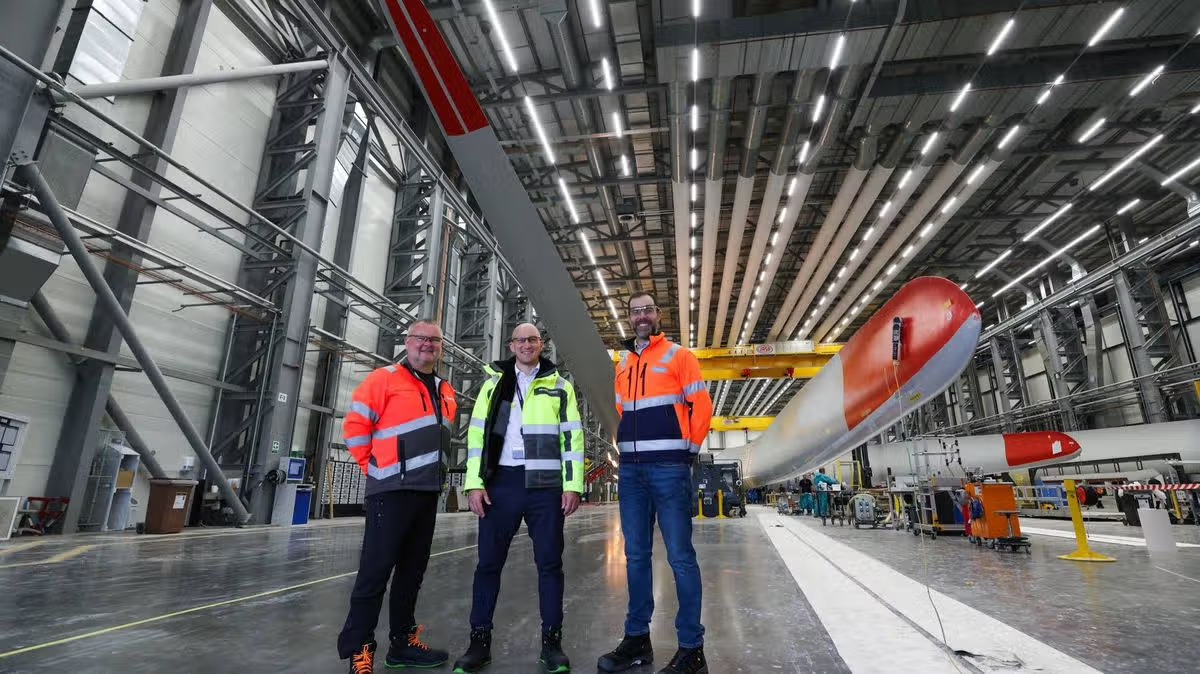
Hull workers build 115m blades for Hornsea 3, world’s largest offshore wind farm





-

 Fashion6 days ago
Weekend Open Thread: Maeve – Corporette.com
-

 Crypto World7 days ago
Bitcoin’s 22% rally now needs real demand to outlast Treasury liquidity boost
-

 Business7 days ago
Apple Confirms September 9 Keynote and Reveals Its Full Pre-Order Schedule
-

 Crypto World14 hours ago
CLARITY Act could advance within weeks, Atkins says
-

 Business7 days ago
Salesforce Stock Soars 19% as Blowout Earnings and Agentforce AI Growth Silence Software Skeptics
-

 Business5 days ago
Onto Innovation Stock: AI’s Next Bottleneck Is Yield (NYSE:ONTO)
-

 Crypto World6 days ago
Bitcoin price tests $82K resistance as Brandt stays long
-
 Tech5 days ago
Hugging Face built a $4.5 billion empire on free AI models. Now Nvidia is buying it for $12.9 billion
-

 Business6 days ago
iPhone 18 Pro Pre-Orders Could Shift to Saturday as Apple Reportedly Avoids September 11 Anniversary
-

 Crypto World1 day ago
Elon Musk Says Grok 4.7 Lands in 10 Days and Will Beat Every Model
-
 Crypto World7 days ago
Truflation calls for Fed rate cut after PCE forecast
-

 News Videos4 days ago
Charlie Munger on Robinhood: No one should believe that Robinhood’s trades are free
-
 Tech7 days ago
The fix for the AI agent that hijacked a company’s DNS: it can propose the change, but it can’t approve it
-
 Entertainment6 days ago
‘Adults’ Creators Break Down Season 2’s Most Shocking Moments and Tease a Potential Season 3
-

 Tech6 days ago
PaperCut releases second emergency patch for exploited flaws
-

 Tech5 days ago
Tamagotchi Ring Takes the 30-Year Digital Pet and Places it on Your Finger
-
 Tech5 days ago
As the influencer economy drives retail sales, Seattle startup raises $22M to play matchmaker
-
 Crypto World2 days ago
Bitcoin slips below $77.5K as macro pressure offsets ETF inflows
-
 NewsBeat4 days ago
Trump posts AI video of ‘Lake America’ being protected by an army of bequiffed ‘Donald Ducks’
-
 Entertainment4 days ago
Taylor Swift Reportedly ‘Frustrated’ With Travis Kelce After ‘Short’ Honeymoon
You must be logged in to post a comment Login