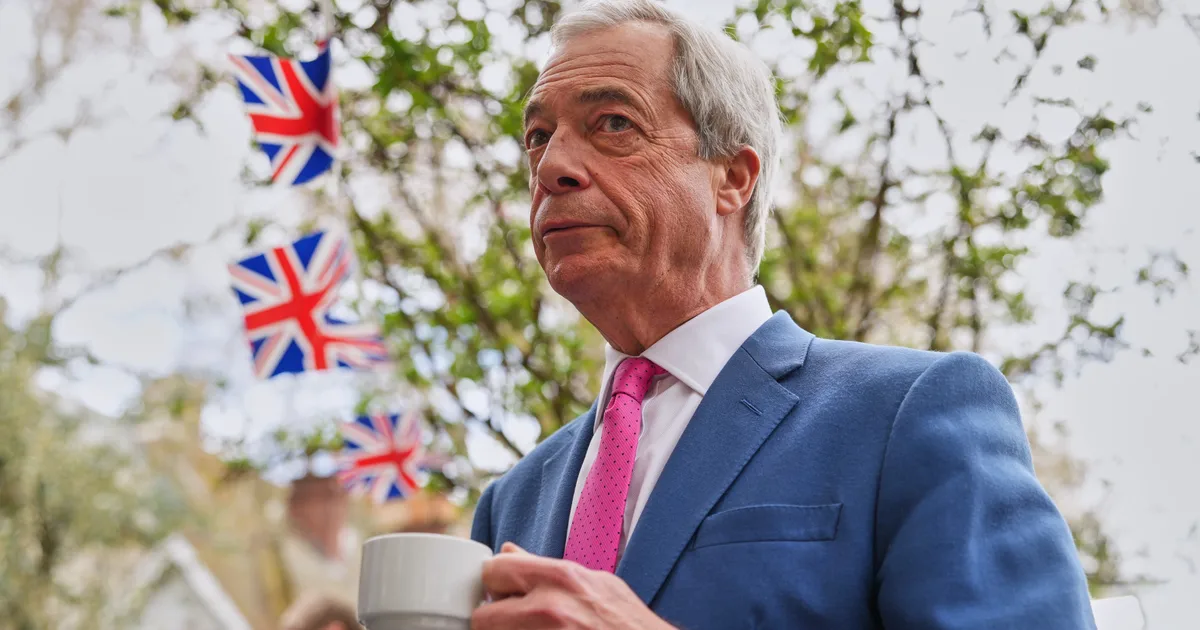
Reform UK has been reported to the Metropolitan Police after the party was accused of breaking political donation rules during an undercover sting operation.
Reform’s head of policy James Orr and Farage aide Dan Jukes, who organised the donation, were not aware the donors were actually undercover reporters from the investigative group Verbatim, funded by journalists from the Centre for Climate Reporting.
Reporters, posing as an American father and his British son “William Lockwood”, also suggested donating £500,000 to Reform UK.
Advertisement
British electoral law says political donations can only be made by someone eligible to vote in the UK or a UK-registered company.
The reporters offered to work around those rules by sending the American father’s money to the British son before donating it to Reform.
Reform has denied any wrongdoing and called the operation a “hoax”.
A party spokesperson said: “Reform UK has been the target of a hoax perpetuated by foreign-funded, climate change activists posing as would-be party donors. The party denies any wrongdoing.
Advertisement
“Reform UK has a robust vetting process for prospective donors approved by the Electoral Commission.”
The Liberal Democrat Cabinet Office spokesperson Lisa Smart has written to the Metropolitan Police and the Electoral Commission over the incident.
Labour intends to report the matter to the police, too, while the Green party has called for an investigation.
Smart said in a letter to the Met: “I am writing to report to your unit a potential serious breach of electoral law involving the acceptance and concealment of a donation from an impermissible donor.
Advertisement
“The breach raises alarming questions about whether there has been a wider complacency toward foreign interference by the individuals involved.”
Labour Party chair Bridget Phillipson said: “This scandal goes right to the top of Reform UK. Nigel Farage needs to urgently prove today that his top team haven’t broken the law and secretly plotted to undermine our democracy.
“It’s not just Farage’s secret £5 million ‘gift’. Time and again he and his mates think the rules don’t apply to them. The sleaze and scandal now engulfing him and his party isn’t going away – it’s getting worse.
“It’s time to stop the deflections and desperate excuses. Farage and Reform must co-operate with the authorities to establish the truth and prove just how deep this scandal goes.”
Advertisement
Green Party leader Zack Polanski said: “These very serious claims should be fully investigated by the Electoral Commission and the police.
“There are millions of reasons why Nigel Farage is happy to take money from billionaires, climate science deniers and secret foreign backers, and not one of them is because he has any interest in improving people’s lives.”
She claimed senior Farage adviser James Orr may have breached the Political Parties, Elections and Referendums Act by facilitating the £32,500 donation.
Orr said “no money reached Reform UK at all”, adding in a video on X: “It was a public poll arranged by an independent person paying an independent pollster and those polls were published immediately for the general public.”
Advertisement
The Met says it is assessing the reports. A spokesperson said: “We’re aware of media reporting on Thursday 3 September involving political party donations and an alleged breach of the Political Parties, Elections and Referendums Act 2000 relating to polling.
“We will assess this matter and any information provided to us.”
An Electoral Commission spokesperson said: “The law requires political parties to report all permissible donations they accept with a value over £11,180 and all impermissible donations over £500.
“Information about any potential attempt to evade the controls on donations is for the police to consider.”
Advertisement
The report from Channel 4 News was published on the eve of Reform’s annual conference in Birmingham, where the party was attempting to reset its image.
Farage spent the summer fighting the Clacton by-election against novelty candidate Count Binface.
He triggered the contest himself after a parliamentary probe was launched into a £5 million donation he failed to declare from crypto-billionaire Christopher Harborne once he became an MP.
Farage insists the money was not a political donation and was gifted to him before he decided to run for parliament.
Advertisement
While Farage comfortably won the by-election, there are ongoing questions around the gifts and donations from his long-term associate George Cottrell, too.
Reform wants to use this conference to draw a line under the recent scrutiny and make itself seem ready for government with a set of policy announcements following a decline in the opinion polls.
The More in Common think tank reported this week that the party had slipped into third place behind both the Tories and Labour.
🚨 BREAKING: Nigel Farage & Reform exposed 🚨
We went undercover for a year to investigate illicit foreign donations. To watch the full 35-minute investigation follow link in bio. pic.twitter.com/uqjedEEhQk
Listen to Commons People, the podcast that makes politics easy. Every week, Kevin Schofield and Kate Nicholson unpack the week’s biggest stories to keep you informed. Join us for straightforward analysis of what’s going on at Westminster.
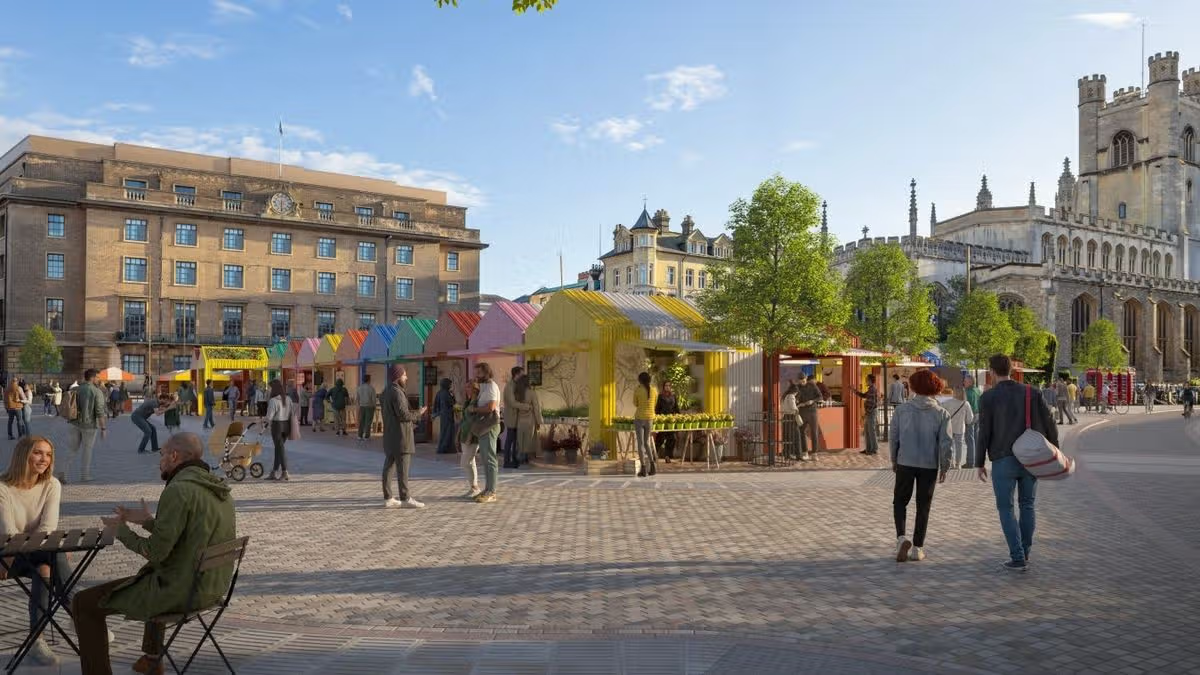
Cambridge City Council approved the Market Square plans but details of the gates must still be provided before they are installed
Plans to reimagine Cambridge’s Market Square could include nine-foot tall security gates branded “fundamentally tragic” by traders. Cambridge City Council approved the refurbishment at a planning meeting on Wednesday (September 2), but further details of the gates must be submitted before they are approved.
Advertisement
A design and access statement by Cartwright Pickard said the gates were part of plans to tackle antisocial behaviour alongside better lighting, CCTV, and an extension of market opening hours. Plans submitted in November 2025 show the proposed four gates, which would be locked every evening, with a height of 2.751m or around nine feet.
Council planning officers told the meeting they weren’t convinced the gates would be in the right place, as they block the north-south main route. They proposed the condition that no gates will be installed until further details are submitted and approved.
Zoe Harding, a market trader, called the gating of civic spaces “fundamentally tragic” and expressed concerns the current design could “destroy” the market. She sent councillors an alternative plan which would create and maintain “desire lines” and remove “the need for the gates”.
Councillor Tim Bick said he supported the wider scheme as a compromise, but would prefer all the stalls be removable to create open space in the market at night.
Advertisement
The Lib Dem councillor said: “Partly because of the effect of empty stalls in the evenings when the market is closed, the square is then prone to much antisocial behaviour by the provision of multiple concealed areas.
“I have instead assurances on antisocial behaviour that additional deterrence will come from better lighting, more natural surveillance through the design through better CCTV, from the gating of new fixed stalls and regular security visits.
“We can’t simply address those uncertainties and concerns by never adapting the market square or refurbishing it while the infrastructure falls further behind modern standards and the growth in the footfall that we see. Especially when we have the chance of significant investment that many city centres would look on with envy.”
Advertisement
The plans include a number of removable stalls at the Guildhall side to allow for events to be held but there will be a number of fixed stalls, including where the gates are proposed.
Cllr Dave Baigent raised concerns the plans could harm the heritage of the city’s market. The Your Party councillor said: “It will no longer be a street market, there will be sheds all over – that is a real matter of heritage. People will look back I’m sure in 20 years time and go, ‘where’s the market gone?’ because this is the beginning of an erosion of our city’s heritage.”
Cllr Robert Dryden said: “Our policy is it should be public open space and not obstructed by anything – if it’s got locked gates it’s not open public space any more.” The Labour councillor said he would not be voting to approve the plans because of the reasons for refusal given by officers.
The council approved the refurbishment plans but under the condition that no security gates are to be installed until details about their location, design, and colour have been submitted and approved.
The 81-year-old pensioner was killed in a deadly attack by an ostrich on his daughter’s exotic-animal farm — after making one crucial mistake he had been warned against.
Fred W Parker from Winlock, Washington, USA, was killed by the aggressive bird and found dead inside the ostrich’s cage on the farm in Park Road. His daughter, Linda Carter, said she could not comprehend why her father went into the bird’s pen in the first place, as they usually fed the ostrich by throwing food over the fence.
The Chronicle reported Linda as saying: “We knew that he (the ostrich) was aggressive, but we never dreamed that he would take anyone’s life.”
The incident occurred on June 27, 1999, and Linda had shared at the time that she had ‘no intention’ of culling the ostrich because of her father’s death.
Fred’s daughter said: “I have no intention right now of destroying my ostrich because of my father’s death. The ostrich was protecting his domain. It’s just like any wild animal. You don’t go in a bear’s pen, you don’t go in an ostrich’s pen.”
Advertisement
The pensioner’s family shared that he had heart trouble, and in a cruel irony, Fred was afraid of ostriches.
The octogenarian was found dead by his daughter on a Sunday night inside a male ostrich called King Tut’s pen on Linda’s exotic-animal farm. Linda had reportedly been at a loss to explain why her father had decided to make the fatal decision.
Fred lived on his daughter’s farm in a recreational vehicle, and had been alone when he was feeding the deadly flightless bird. He had been left in charge of feeding the ostriches, emus, potbellied pigs and llamas that weekend, however, according to his daughter Linda, the task didn’t involve entering King Tut’s pen.
Advertisement
According to The Seattle Times, Linda explained: “He knew to throw the food over the fence.” Chief Criminal Deputy Joe Doench shared that the case has been referred to the Lewis County prosecutor.
Coroner Terry Wilson shed some light on the circumstances surrounding Fred’s death, sharing that the pensioner’s neck had been broken, and as per him, the 81-year-old’s bad heart probably contributed to his demise.
Coroner Terry suspected it wasn’t a peck that killed Fred, sharing: “It wasn’t a peck. This was footwork.” While Fred’s daughter Linda decisively said that she had no plans to kill the bird, Chief Criminal Deputy Joe explained that it was ostrich mating season, a period known for male ostriches becoming aggressive.
This wasn’t the first time King Tut had shown signs of aggression, as the previous year in 1998, the deadly bird had kicked Linda 10.5 feet.
Fred’s daughter shared she had been raising ostriches for over two years when the fatal incident occurred, and the world’s largest and heaviest bird had been extremely profitable for her, with ostrich meat selling for $9 a pound.
In July that same year, Lewis County Prosecutor Jeremy Randolph ruled that King Tut the ostrich would not face the death penalty and no action would be taken against the bird, or Fred’s daughter Linda.
This owed to the fact that Linda had already instructed her father that he could throw the ostrich’s food over the fence, which clearly meant that Fred hadn’t needed to enter the pen to feed King Tut and the two female ostriches.
Advertisement
According to The Spokesman-Review, Lewis County Prosecutor Jeremy said: “As far as we could see, what more could a person do?”
The prosecutor also said that the male bird had been aggressive due to it being ostrich mating season, and shared that King Tut was considered livestock and was thus protected as the bird was in its pen. The prosecutor added: “It was just doing what ostriches do at this time of year when there’s a man in their pen.”
Fred’s daughter Linda on the other hand, said she would be building a new and more secure pen for her ostriches, with railroad ties secured by a padlock. Linda aimed to have King Tut in the new pen by September that same year.
After it was decided that no action would be taken against the deadly bird, Linda said: “I’m very, very pleased. I’m glad I defended my bird. Losing my father is a very big loss, and I didn’t want to lose my bird, too.”
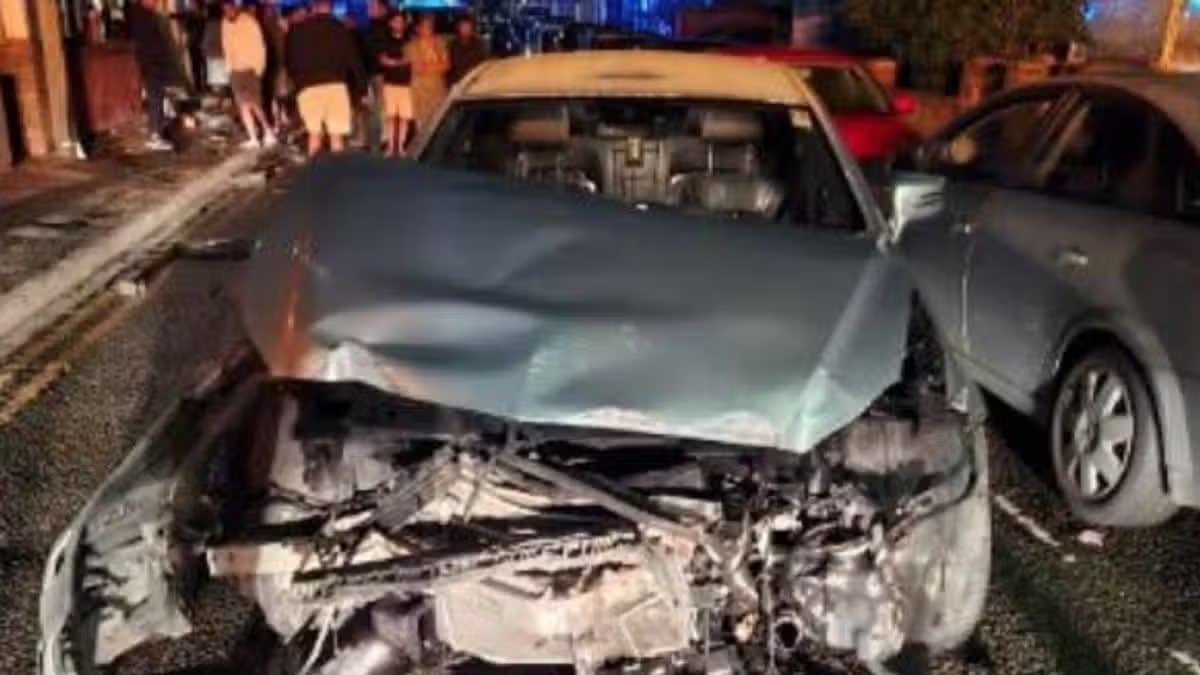
A car crashed into a wall along a Cambridgeshire city road. Cambridgeshire Police were called to a crash along Star Road in Peterborough in the early hours of Monday (August 31).
Advertisement
A driver crashed a car into a wall. A police spokesperson said: “We were called at about 1.10am on Monday with reports a car had crashed into a wall in Star Road, Peterborough.
“The driver of the car, a silver Mercedes, was uninjured and no arrests were made.”
Ssve yourself hundreds with refurbished Apple products from Very this term. (Picture: Metro/Very)
Metro journalists select and curate the products that feature on our site. If you make a purchase via links on this page we will earn commission – learn more
If you’re heading to university for the first time, or back for another term, make sure you’ve ticked off your checklist ahead of your first seminar.
Some courses will require a laptop, while for others having a slimline iPad can be a great way to tackle creative projects and take notes without taking up much room, and a decent pair of headphones can also help when you’re trying to get through those late-night library sessions.
Advertisement
You’re going to loose these at least once this term, so why not buy them refurbished! (Picture: Metro/Very)
If it’s your first time owning a MacBook and you’re not quite sure where to start, this Buying Guide has all the info you need on processing speeds, storage capabilities and battery life.
For example, if you’re looking to spend less than £700, the MacBook Neo (A18 Pro, 2026) 13-inch might be your best bet. It has a sleek design, comes in four colours, and is just 1.27cm thin.
It’s considerably cheaper than a standard MacBook Air, which can cost well over £1,000, so it’s more accessible, but can easily handle everyday student tasks like web browsing, writing essays, and streaming lectures.
SHowever, if you need an iPad or don’t have the budget to splurge on a MacBook, the iPad (A16, 2025), 11-inch is a great alternative.
Should we admit to how many times we’ve had the screen replaced on our iPad? (Picture: Metro/Very)
You can find it in two options: one with 128GB and the other with 256GB of storage, so there’s plenty of space for taking lecture notes, working on group projects, or putting presentations together.
It has 10 hours of battery life, which will see you through lectures and library revision sessions, and better still, it can handle multitasking thanks to its Split View Feature.
Advertisement
Ask Metro
Use AI to go deeper into the stories you care about – powered by Metro and trusted publications.
If your phone is in dire need of an upgrade, Very’s selection of iPhones is pretty impressive, and you can currently save up to £100 on the iPhone 17 Pro and iPhone 17 Pro Max. It’s a welcome saving for what can be a very expensive time of year.
Advertisement
Bag yourself a refurbished iPhone Pro Max for less than you think. (Picture: Metro/Very)
Last but not least, if you’re living with noisy flatmates or simply need a bit of peace and quiet to get work done, consider adding Apple’s AirPods 4 to your back-to-uni basket.
Perfect for drowning out the noise, calling home to catch up with mum and dad, or listening to a podcast on your commute to lectures, they pair easily with other Apple products, and you don’t need to worry about tangled cables.
All in all, Very’s one-stop shop for all things Apple has everything you need to ensure you’re ready to lock in to a new term at uni, and take the hassle out of it.
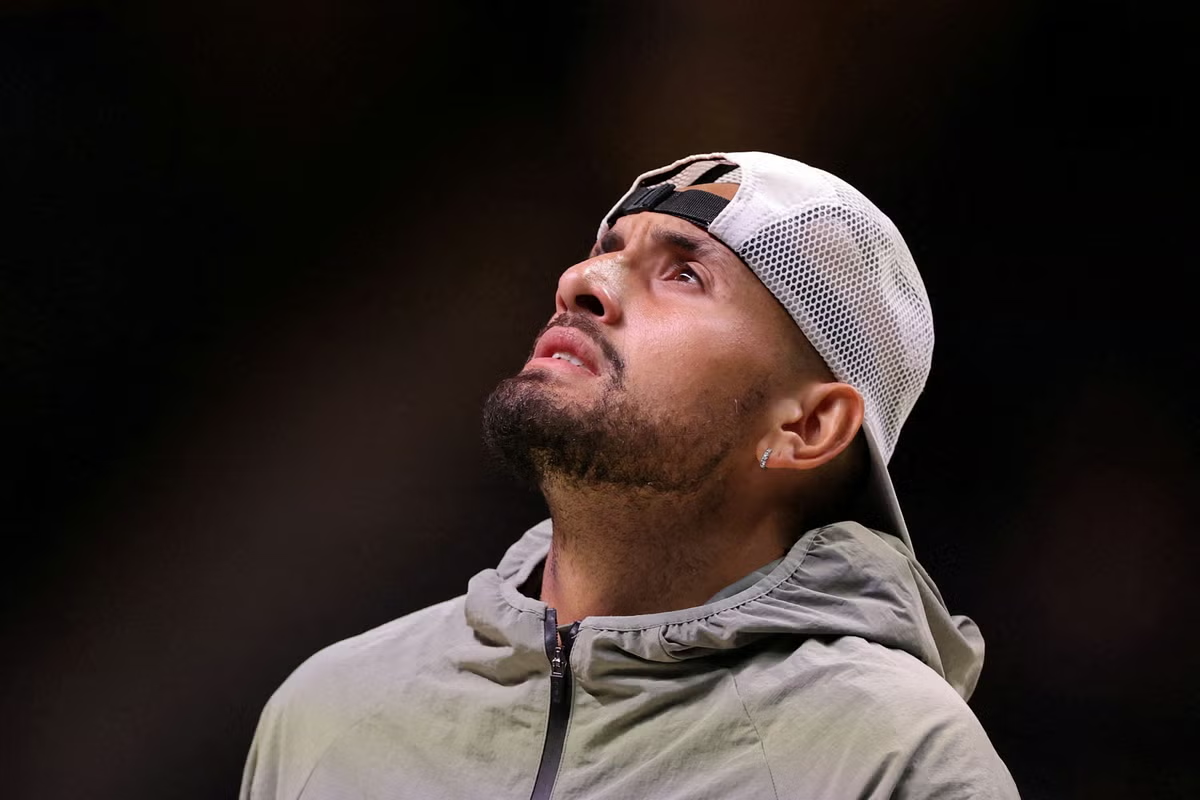
The ITIA said Kyrgios had agreed to attend a treatment programme approved by the ITIA, which has lowered Kyrgios’ suspension from three months to one month.
As a result, Kyrgios’ suspension is already over, as the ITIA said his provisional ban began on 4 August 2026 and ended on 3 September 2026.
Advertisement
The ITIA said Kyrgios’ explanatation that he had used cocaine “socially during a night out” was “consistent with the level of cocaine found in his sample”.
As a result, the ITIA accepted his use of cocaine was outside of competition and subject to a lighter penalty.
After his provisional suspension was announced last month, Kyrgios said he had made “a huge mistake”.
He wrote on Instagram: “I wanted you to hear this from me first. I recently failed a drug test in Mallorca after testing positive for cocaine.
Advertisement
“I made a huge mistake and I take full responsibility for it. I’m sorry to my fans, my family, my sponsors and everyone close to me. Above all, I’m sorry to the kids who follow me.
“I know the example this sets and I’m deeply disappointed in myself.”
His first-round loss to fellow Australian Adam Walton in Majorca was his last competitive singles outing and one of only four singles matches he has played this season.
Kyrgios’ career has been blighted by knee and wrist problems since his run to the Wimbledon showpiece in 2022 and his ranking has slipped to 919 in the world.
Advertisement
He said he would not make “excuses” for the positive test but cited the toll of his physical issues.
“My body hasn’t been able to do what my mind expects it do, and coming to terms with being near the end of my career has been harder than I ever imagined,” he said.
“At times I’ve felt hopeless and alone. However, the good news is that this has given me a wake-up call.”
Kyrgios added he would be taking a 28-day break from social media to focus on “getting myself right”, concluding: “I’m sorry, I’ll come back better.”
Advertisement
Britain’s Dan Evans was banned for a year for taking cocaine out of competition in 2017 but the rules changed in 2021, with the penalties reduced.
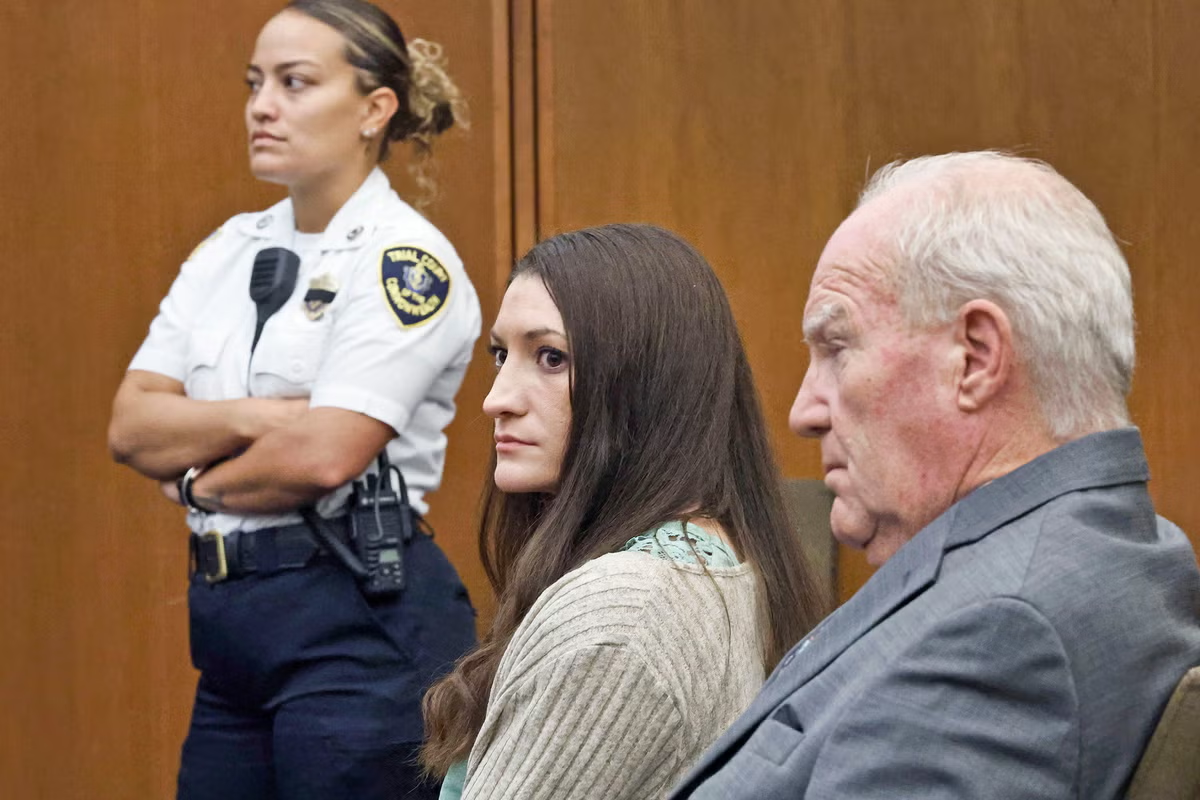
A deadlocked jury returns on Friday for the seventh day of deliberations in the Lindsay Clancy trial, a day after the jury’s foreperson told the judge a single juror won’t follow the court’s instructions about reasonable doubt.
The extraordinary disclosure made Thursday in the form of a note delivered to the judge offered the clearest glimpse yet of what may be keeping jurors from reaching a verdict on whether the Massachusetts mother is criminally responsible for killing her three children.
The jury has twice told Judge William Sullivan that it is unable to agree on a verdict.
On Thursday, Sullivan brought in each juror individually and questioned them in private. The judge then reread his instructions on reasonable doubt before sending them back to continue deliberating.
Advertisement
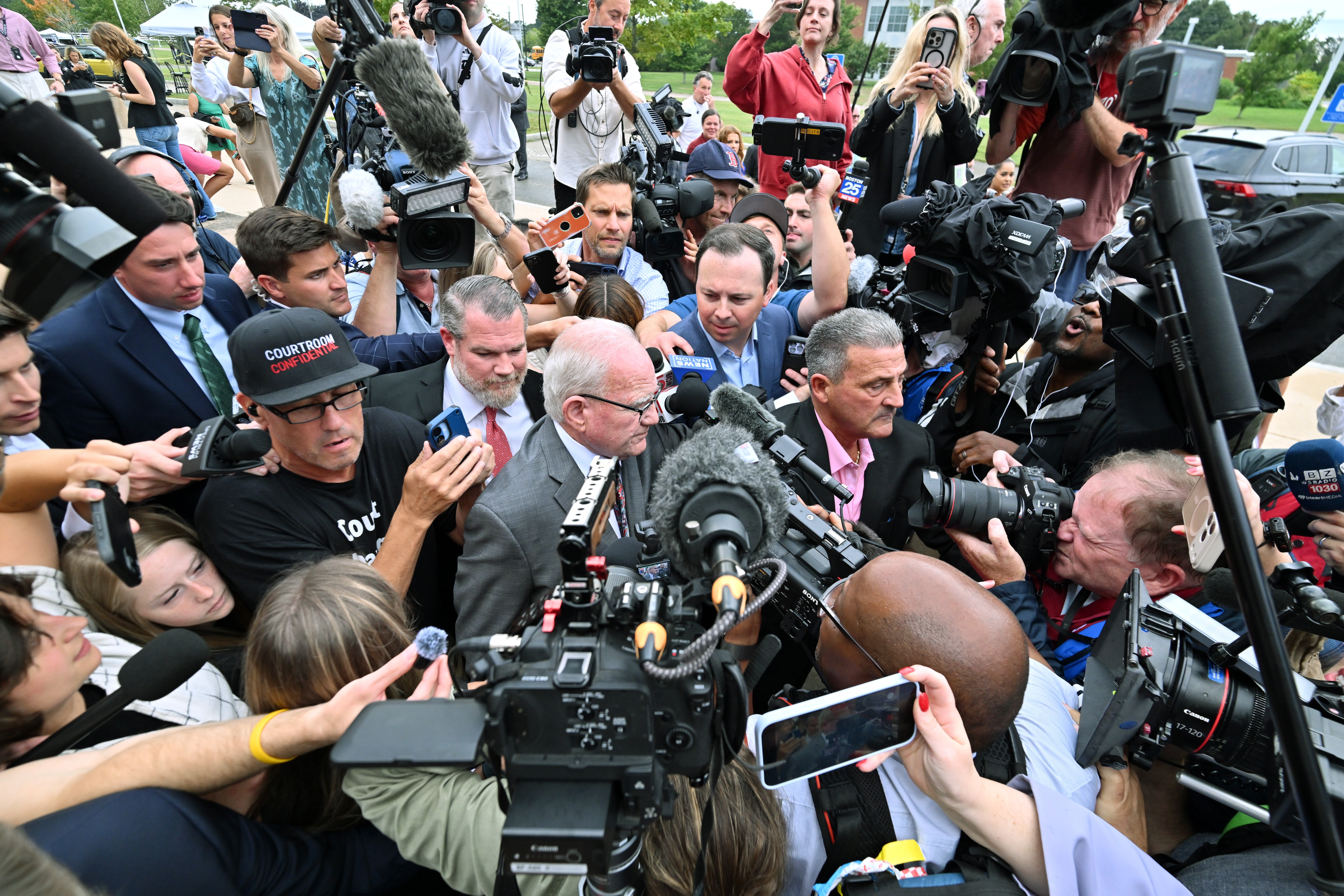
Kevin Reddington, lawyer for Lindsay Clancy, center, is surrounded by reporters as he leaves Plymouth Superior Court where the jury will return in the morning to continue deliberating in the murder trial of Lindsay Clancy for the 2023 killing of her three children, Thursday, Sept. 3, 2026., in Plymouth, Mass. (AP Photo/Josh Reynolds ) (Copyright The Associated Press 2026. All Rights)
Over 21 days of testimony, the jury heard from dozens of witnesses, including doctors, first responders, relatives and even Clancy’s former husband.
If convicted, Clancy’s sentence could be as severe as life in prison. If found not guilty, she may be released or remain confined in a mental health facility. If the jury is unable to reach a verdict, the judge could declare a mistrial.
As the jury continues to deliberate. here are key moments from the trial:
Judge declined to remove a juror
Before sending the deadlocked jury home Thursday, Judge William Sullivan declined a defense request to remove one of the jurors following heated discussions from both sides.
Advertisement
Earlier, the jury’s foreperson sent the judge a note saying a single juror won’t follow the court’s instructions about reasonable doubt.
Details of the jury room conflict weren’t revealed and only briefly discussed in open court, but it raised the possibility that a single holdout was standing in the way of a verdict.
Clancy’s attorney Kevin Reddington said the juror should have been dismissed from the case. Sullivan said removing a deliberating juror is a sensitive undertaking.
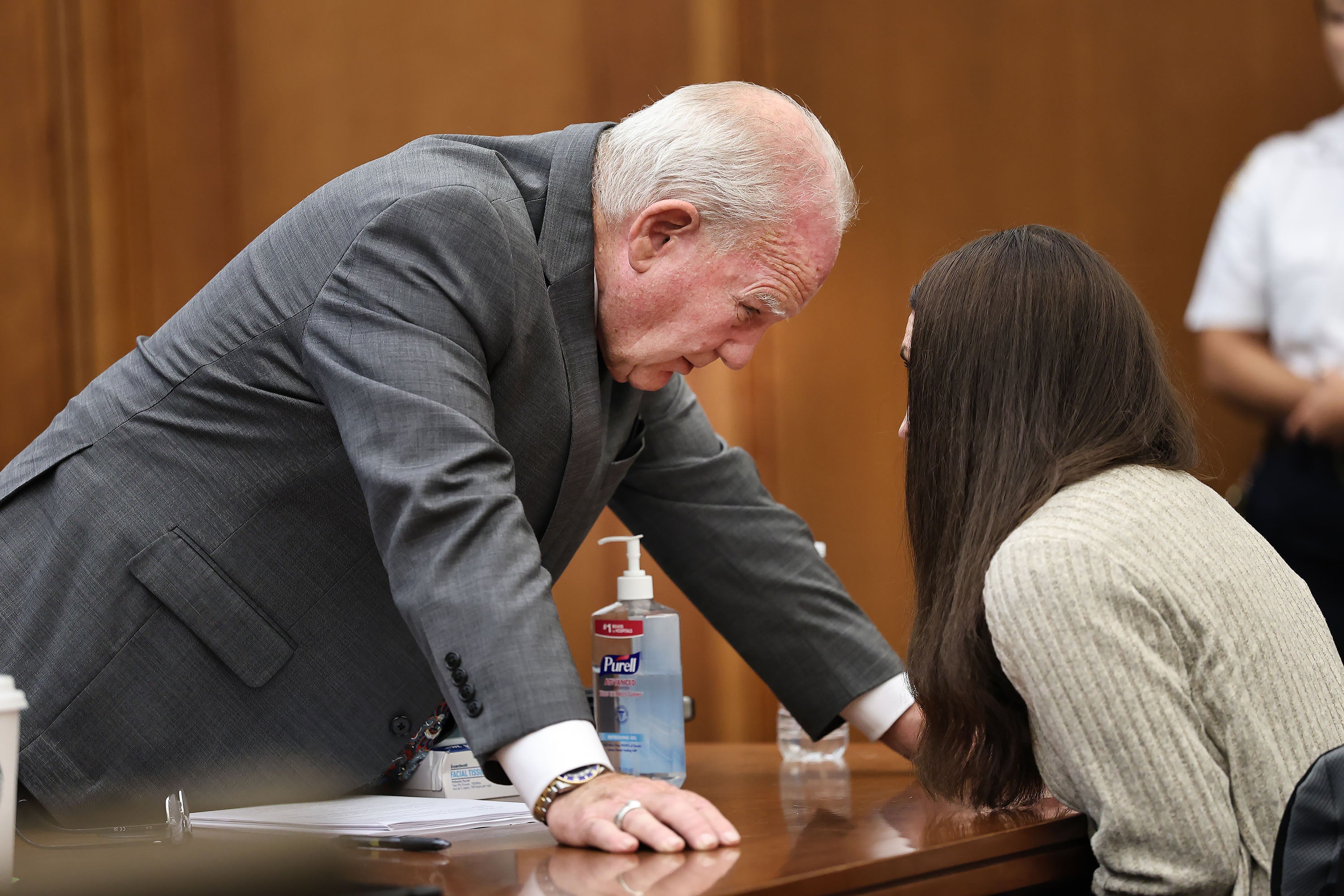
Defense attorney Kevin Reddington talks with Lindsay Clancy after a jury question during her trial in Plymouth, Mass., on Thursday, Sept. 3, 2026. (Greg Derr/The Patriot Ledger via AP, Pool) (USA Today 2026)
The judge questioned each juror individually in private, then reread his instructions about reasonable doubt in court.
Reddington said afterward outside the courthouse that the juror would be questioned again by the judge Friday.
Advertisement
Prosecutor Jennifer Sprague said in court that she believed Sullivan’s instruction was appropriate and no further action was necessary.
Jurors have struggled to agree on a verdict
Jurors have sent notes to the judge at least three times since they began deliberating Aug. 27.
On Tuesday, the fourth day of deliberations, jurors sent a note in the morning saying they could not unanimously agree.
Advertisement
The note did not elaborate, and there were no clues as to whether a majority of jurors were leaning toward a conviction or acquittal. It also did not provide any insight into the tone of deliberations or whether they had been cordial or acrimonious.
(AFP/Getty)
Sullivan asked jurors to keep deliberating.
On Wednesday they sent the court another short note saying they were still at an impasse. Sullivan again told them to keep trying.
Clancy’s former husband made anguished 911 call
Clancy’s former husband, Patrick Clancy, was first to take the stand.
Advertisement
In emotional testimony, he described the day he found his wife after she tried to kill herself.
Lindsay Clancy had sent him out to get takeout food and medication for their daughter, which prosecutors argue was an excuse to get him out of the house.
He came home to find the house unusually silent, before finding blood throughout the main bedroom and a window open.
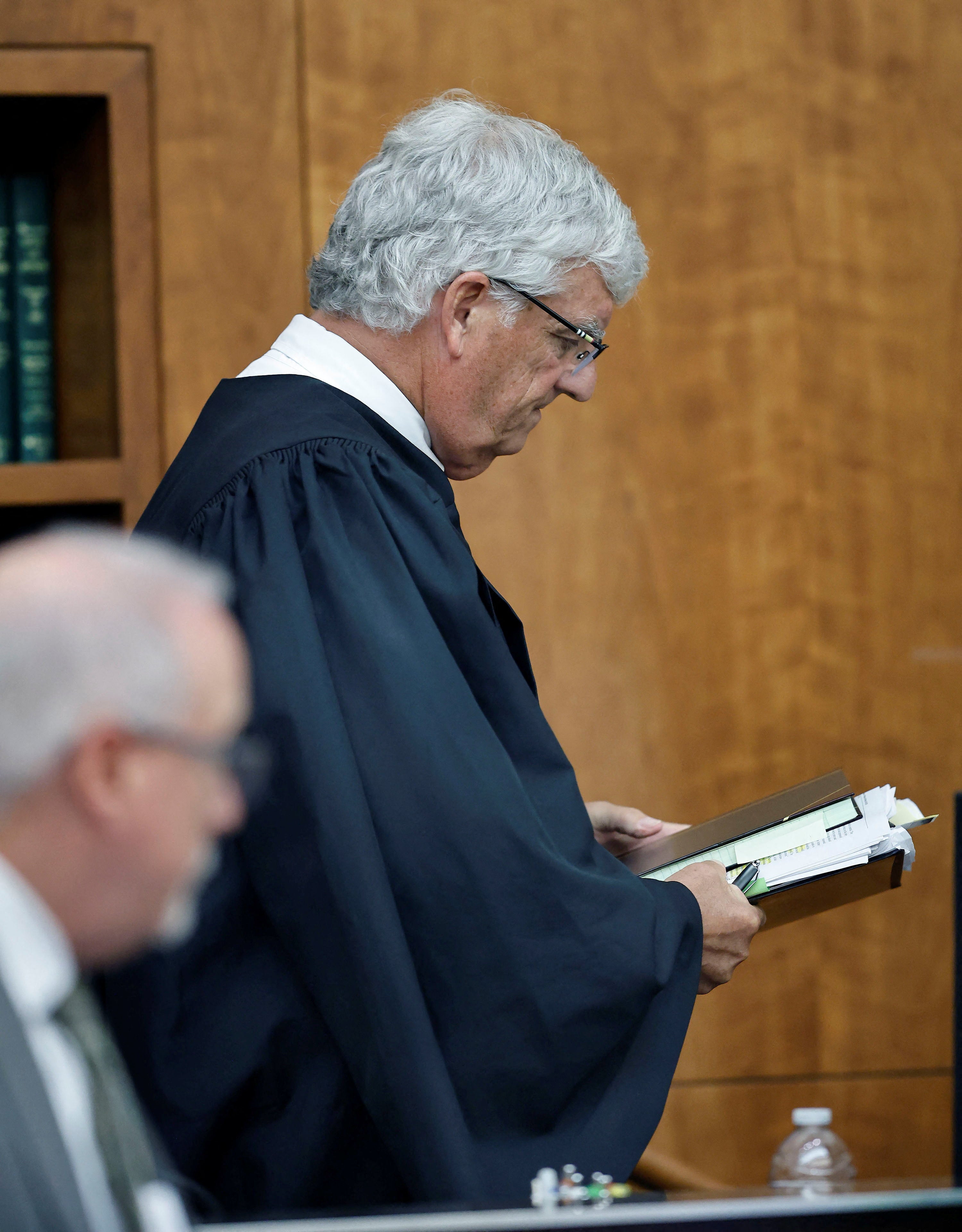
Judge Sullivan leaves the bench during deliberations in the triple murder trial of Lindsay Clancy, the Duxbury mother in Plymouth Superior Court, in Plymouth, Massachusetts, U.S., September 3, 2026. Greg Derr/The Patriot Ledger/Pool via REUTERS (Reuters)
Jurors listened to the 911 call Patrick Clancy made after finding his wife outside in the snow. Clancy can be heard speaking with his wife, then tells the dispatcher he’s going to check on the children.
Moments later, he howls and cries after finding his children in the basement. The confused dispatcher repeatedly asks what happened.
Advertisement
“She killed the kids!” he yells.
Everyone knew Clancy was struggling
Clancy’s mother, mother-in-law, sister, friends and co-workers testified that Clancy struggled with her mental health after giving birth to Callan, the youngest of her three children.
Clancy’s mother-in-law, Susan Clancy, said she and her former daughter-in-law were close. Both worked as labor and delivery nurses. She described Lindsay as a wonderful mother.
Advertisement
But Susan Clancy testified that Lindsay had become anxious, paranoid and suicidal, and that the psychiatric care she was getting wasn’t helping.
“She felt unwell. She had insomnia. She was losing her appetite. She was very anxious and sad,” Susan Clancy said. “She was begging for help.”
Lindsay Clancy’s mother, Paula Musgrove, testified that her daughter was scared of sleeping alone, became paranoid and believed the medications she was taking “were destroying her mind.”
“Mom, will you please come up and stay with me for a bit? I’m really sick. Something is wrong,” Clancy wrote in an October 2022 text message that Paula Musgrove read in court. “I had horrible insomnia all night, and I just don’t know how I am going to get through the day. … It’s just really scary, and I don’t want to be alone.”
Advertisement
The defense questioned the quality of Clancy’s medical care
Clancy saw several doctors about her declining mental health, and eventually checked herself in to a psychiatric hospital.
Her lawyer, Kevin Reddington, argued that she was misdiagnosed and overmedicated.
Kevin Reddington reacts to an issue with the jury next to Lindsay Clancy during deliberations in the triple murder trial of Lindsay Clancy, in Plymouth Superior Court, in Plymouth, Massachusetts, U.S., September 3, 2026. Greg Derr/The Patriot Ledger/Pool via REUTERS (Reuters)
As he cross-examined one of her psychiatrists, Dr. Jennifer Tufts, Reddington questioned her expertise, prescribing decisions and use of 25-minute video appointments with limited time for talk therapy.
At one point, Reddington implied that Tufts was a box-checking “robot.”
Advertisement
“What did you do? You had a woman who was telling you she felt hopeless,” he asked as they discussed an appointment about two months before the killings.
“I told her that this was something we could address, that there was hope, that there are treatments, that there are different types of programs,” Tufts said, “so she knew that she still had options and a reason to hope.”
Clancy said she heard a voice telling her to kill
Paul Zeizel, a clinical and forensic psychologist who visited Lindsay Clancy in the hospital after she killed the children, testified that he overheard her saying that a disembodied male voice had told her she had no choice but to kill her children and then herself. Zeizel said he believed Clancy wasn’t responsible for her actions because of her deep mental illness.
Advertisement
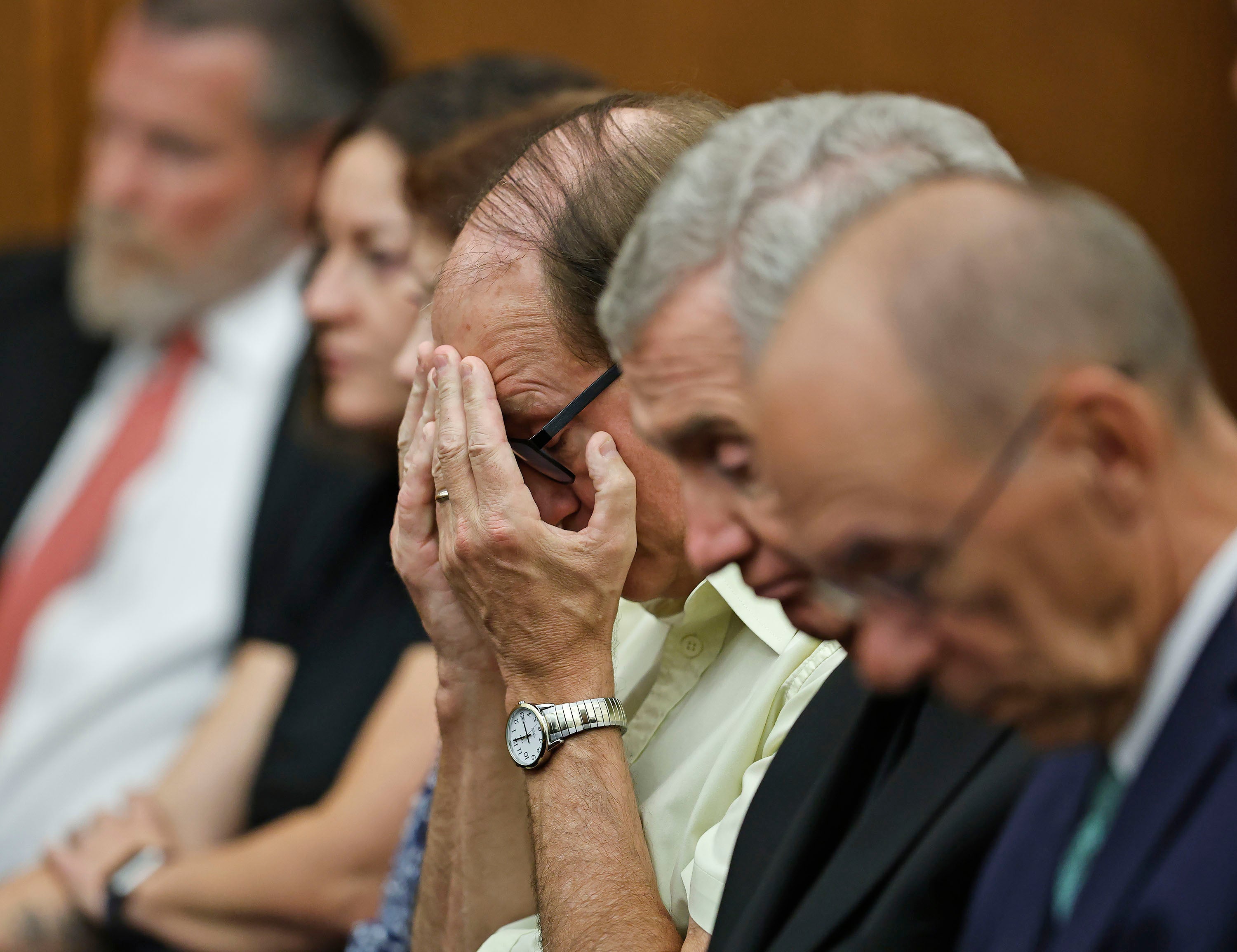
Mike Musgrove reacts to jury question during the Lindsay Clancy trial in Plymouth, Mass., on Thursday, Sept. 3, 2026. (Greg Derr/The Patriot Ledger via AP, Pool) (AP)
Prosecutors called a rebuttal witness, forensic psychologist Kirk Heilbrun, who said he didn’t believe Clancy had hallucinated voices.
“One of the things that she said when I asked about what happened, is that in the course of strangling each child, she said, ‘Go to God, baby. Go to God,’” he said. “That was part of her expectation that she and the children would be together in heaven with God.”
Dr. Gregory Saathoff, a senior psychiatrist for the FBI’s Behavioral Analysis Unit, testified for prosecutors that Clancy “had the capacity to know right from wrong.”
The lawyers got the last word
After testimony was complete, each side got about an hour to make their closing argument to the jury.
Advertisement
Reddington showed the jury a photograph of the Clancy family, looking happy, and a second one of Lindsay Clancy in the hospital.
“How does this turn into this?” Reddington asked. “How? Because of the damn medicine and the lousy medical care that she got.”
Prosecutor Jennifer Sprague said criticizing the mental health system was “a distraction.” She said Clancy chose to kill her children because doing so would make it easier to kill herself.
“She was depressed. She was exhausted. She was done. She didn’t want to try anymore. She felt damaged,” Sprague said. “But those kids, those kids were her protective factor. Those kids were keeping her from ending her misery.”
Aerial imagery of a restored wetland in England “shows what climate resilience could look like across the UK”, a leading conservation charity has said.
From above, the Holnicote Estate in Somerset (pictured) appears lush and green, in stark contrast to the parched landscape around it.
According to the National Trust, that’s because ecologists at the estate have reconnected rivers, restored wetlands and reintroduced beavers in a bid to retain water. At the end of what is expected to be the hottest summer on record in the UK, the approach appears to have worked.
Advertisement
“For generations, as a nation we’ve drained wetlands, straightened rivers and moved water off the land as quickly as possible – here we’ve reversed that approach and the results are remarkable,” said Ben Eardley, project manager at the National Trust, which runs the estate.
The UK has lost around 90% of its wetlands over the last century. Restoring them could help it to become more climate resilient, the trust argues.
“Evidence shows that nature-based solutions can reduce flood risk, improve water quality, increase biodiversity and build resilience to drought,” said Eardley. “Nature shouldn’t be viewed as a cost of climate adaptation. It should be seen as one of our greatest allies.”
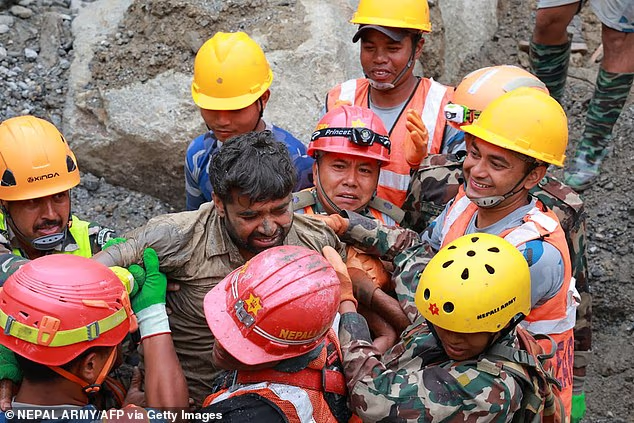
Two men have been pulled alive from a tunnel in Nepal nine days after floods devastated the region, with hopes rising for the others trapped as rescue crews report hearing more voices from inside the hydropower plant.
The unidentified men were pulled from a small hole at the Trishul 3A hydropower plant in quick succession on Friday, as local television news channels shared images of the workers covered in mud and being carried from the site on a rescuer’s shoulder.
Dramatic video also showed about a dozen rescuers pulling a man from a small hole in the ground and clapping as he reached safety.
Officials have since identified the two men as a mechanical foreman and a mechanical supervisor. They are both now under medical observation, army spokesperson Brig. Gen Raja Ram Basnet said.
Advertisement
The rescue came amid a desperate operation to bore into the tunnel as at least 557 workers remain missing from the Trishuli 3A hydropower plant, with about 115 believed to be trapped inside the main tunnel following the deadly August 26 floods.
Dozens of people had been working inside the 2.5-mile long tunnel that leads to an underground powerhouse when a glacier collapsed.
As the days went by, hopes had been fading for the safe rescue of the workers at the plants that run along the river, including foreigners from China, South Korea and India.
But as the two men were rescued on Friday, search crews ‘heard voices,’ Bipin Regmi, police chief in the hard-hit district of Nuwakot, told CNN – leading rescuers to believe some people may still be alive inside the tunnels.
Advertisement
Dramatic video obtained by CNN showed about a dozen rescuers pulling a man from a small hole in the ground
Rescue crews are seen carrying one of the freed power plant workers to safety
The rescue came amid a desperate operation to bore into the tunnel to search for 42 workers who remained unaccounted for following the deadly August 26 floods
Advertisement
At least 1,259 people were killed and more than 5,000 remain missing, according to the country’s disaster management agency. China, as of late Wednesday, said 21 people were killed and 541 were missing on the Tibet side of the border.
About 900 workers are missing from a dozen hydropower projects in Nepal, with roughly 500 believed to be trapped in tunnels, according to local authorities.
Meanwhile, the US State Department has said it is continuing to track about 75 Americans who remain unaccounted for across the Nepal-China border. Sixteen Americans have made their way to safety, US officials announced Wednesday.
Nepali Prime Minister Balendra Shah opened up about the efforts the government was making to find those who remain missing on Tuesday, as he thanked local and international organizations for their ‘unprecedented courage, patience, support, cooperation and facilitation,’ ABC News reports.
Advertisement
‘We are moving forward from search, rescue and relief distribution to rehabilitation after the devastating flood,’ he then announced on social media.
More than 21,000 security personnel from Nepal’s national police, army and armed forces have been dispatched to aid in the search and rescue efforts, officials said.
As of Wednesday morning, thousands of emergency responders had also doled out medical treatment to at least 4,070 people.
Soldiers are pictured carrying a powerplant worker to safety on Friday morning
Advertisement
A Nepal Army soldier is seen trying to sift through the mud during the search efforts
Nepal army soldiers are pictured working during a search and rescue operation outside a tunnel near the Hydropower Project sites on Wednesday
At least 1,259 people were killed and more than 5,000 remain missing nine days since the flood
But throughout the country, roads, villages and buildings were destroyed, Nepali Prime Minister Balendra Shah has said, adding that at least 48 suspension bridges were damaged – 28 of which will have to be completely replaced.
Advertisement
The government has since released about 1 billion Nepali rupees, or about $6.5 million, to aid in rebuilding the flood-affected areas.
The disaster began on August 26, when the earth started shaking along the Nepal-China border.
The US Geological Survey initially detected the shaking as a magnitude 5.2 earthquake but later determined that a massive section of glacier had collapsed.
The United States Geological Survey described the seismic event as an extremely powerful ‘glacial collapse and debris flow’ that caused catastrophic impacts downstream.
Advertisement
As the ice mass plummeted, it was pulverized into a fast-flowing mix of freezing water, debris and rocks that swept down the mountainside into the Lende Khola River, razing villages along the way.
When the bodies then started piling up in Nepal, authorities started burying the remains in temporary graves until they could be identified.
Crews are working to preserve DNA samples, photographing distinguishing facial features and recording other identifying details.
Each body is also assigned a reference number to help families identify and claim the remains later.
The eight-year-old’s temperature kept rising and she displayed other symptoms her mum recognised from a worrying documentary
Neil Shaw Assistant Editor
06:40, 04 Sep 2026Updated 06:42, 04 Sep 2026
An eight-year-old girl had to be rushed to hospital after a family trip to the beach saw her infected with a dangerous bacteria when she swallowed sea water. Keeva Hollow was swimming with her twin sister at Dorset’s Avon Beach when she was hit by a wave and swallowed water.
The next day she was lethargic, with a high temperature and no appetite, and her mum realised something was wrong. Aisling Mccarthy said: “It has been a terrible time; Keeva was so ill. She used to swim all the time, a real water baby. But now I can’t see her ever going in the sea again; she is so scared of becoming sick again. To be honest, I don’t want her going back into it anyway until I know it is totally safe.”
Advertisement
Aisling had taken Keeva and her twin sister Cornelia to Avon Beach on August 3. “I was watching the girls swim when I saw a wave hit Keeva and she started spluttering,” she said. “She came out and said she had swallowed a lot of water. Cornelia had not at all, and I didn’t worry too much at the time.
“But the next morning Keeva would not eat her breakfast. We were going to London, and she slept the whole journey. Her temperature was going up, and she just was not herself. We were supposed to be going to Ireland to see my mother who was ill. But the next morning Keeva would not get out of bed, and her temperature was really high. She had declined really fast. I found an out-of-hours doctor and took her to him. He asked for a urine sample; by then Keeva had really bad diarrhoea and I noticed there was blood in it.”
“I had seen a documentary about sewage pollution in water, and I realised that Keeva’s symptoms were similar to those of a girl who died from polluted seawater. I told the doctor I was taking her to A&E and rushed there. Keeva was put on a drip while tests were carried out. She was so ill by then, she had deteriorated so quickly it was frightening.”
Advertisement
Keeva spent two days in hospital where she was diagnosed with a campylobacter infection. Aisling said: “The hospital said it can be food poisoning as well but Keeva does not eat meat which is one of the main sources of that bacteria.
“Her illness happened straight after the sea-swallowing incident at Avon Beach, and Cornelia has not been ill at all. I have a very clear memory of that moment when the wave hit Keeva, seeing her spluttering from swallowing the water. I am convinced that was what caused her to become so ill.”
Aisling says Keeva is still not back to full health. “She was always a very sporty girl but she now gets out of breath quickly. She used to keep up with me on a 5km run, but now she struggles to do 1km. She has lost a ton of weight, and her clothes are hanging off her. But the saddest thing is her fear of going into the sea.”
Advertisement
Aisling contacted Wessex Water, which manages wastewater and environmental protection for the River Stour, notifying them about Keeva and asking for any information on recent sewage leakages. But she has not received a reply yet. BCP Council sent a letter to Aisling, having been notified by the hospital of Keeva’s infection.
“But the letter was all about food poisoning and was asking where Keeva had eaten,” she said. “I replied saying I believed it was seawater, not food, but they claimed they had had no other reports of people becoming ill from swimming in the sea. I was shocked by their attitude because surely, as a huge tourism area due to its beautiful beaches, BCP should be concerned about what has happened to Keeva. But they don’t appear to be.”
“I want Wessex Water and BCP Council to be completely upfront with people and tell us if the water is safe. I am very angry, it was awful to see my child suffering and I don’t want anyone else to become ill. I have lost my trust in the people responsible for our sea and waterways.”
Recent tests of the River Stour, which flows into the sea at Christchurch, showed “extremely unsafe” levels of E. coli. Martin Stewart, managing director of Stewarts Garden Centres and chair of the Christchurch Harbour & Marine Society, said testing on August 19 showed E.coli levels of 300,000 – the safe bathing level is 1,000. He also found several other “concerning” levels of bacteria in his samples.
Advertisement
Aisling says her family’s idyllic life of living by the ocean has now been shattered. “My husband is from this area and has always loved the sea,” she explained. “We moved here from London to be by the ocean a week after the twins were born. We bought a house within walking distance to the beach, and the sea has been our life – but now I’m too scared to let the girls in it.”
Jordan, a staunch U.S. ally that hosts American forces in the Mideast, has paid a price for its relationship with Washington, which has made the kingdom’s military bases a target of repeat Iranian strikes.
Hundreds of drone and missile attacks have added to other strains on Jordan that include a slumping economy and volatility in the neighboring West Bank, where Israeli settlers have ramped up attacks on Palestinians.
Despite the risk of more strikes, Jordanian leaders say they are committed to maintaining the relationship after decades of courting deeper security ties with American officials and offering to be a reliable partner with the West in a region rocked by conflict. Analysts say the alliance offers Jordan a way to guard against Iran’s attempts to destabilize its neighbors.
King Abdullah II of Jordan seemed to acknowledge the need for such alliances last year, when he warned that destabilization fueled by the COVID-19 crisis, Russia’s full-scale invasion of Ukraine and multiple Israeli military campaigns in the Middle East could trigger chaos far beyond the region.
Advertisement
“We are living through wave after wave of disruption, without pause,” he told European lawmakers. “There is no telling where the boundaries of this battleground will end. That, my friends, is a threat to people everywhere.”
Jordan embraces Washington to weather stormy Middle East
The Hashemite Kingdom of Jordan is a puzzle-piece-shaped nation bordering Iraq, Saudi Arabia, Syria, Israel and the West Bank. More than 11 million Jordanians live between the Jordan River, the Red Sea and eastern deserts strewn with ruins.
Besides the threat from Iran, Jordan faces other challenges, such as an economy that has buckled under millions of refugees fleeing regional conflicts. Soaring energy prices and inflation have added to the burden as the tourism sector struggles to draw visitors to landscapes lionized in Hollywood by Peter O’Toole, Harrison Ford and Matt Damon.
And next door, growing Israeli settler violence in the West Bank is deeply unsettling to Jordanians who fear instability could drive many of the 2.8 million Palestinians there to flee into the kingdom, said Sean Yom, a professor at Temple University and author of a 2025 book titled “Jordan: Politics in an Accidental Crucible.”
Advertisement
Since taking the reins from his father, King Hussein, in 1999, Abdullah has forged ever-stronger links between his capital, Amman, and Washington. The monarch — a fluent English speaker whose dynasty claims to be descended from the Prophet Muhammad — enjoys widespread support among world leaders and Democratic and Republican lawmakers in the U.S.
President Donald Trump once called the king “one of the true great leaders of the world.” Joe Biden also praised his leadership. First lady Jill Biden was a guest at the wedding of Abdullah’s son Hussein to a Saudi aristocrat in 2023. Pope Leo welcomed Abdullah to the Vatican in 2025.
As part of its partnership with the West, Jordan provided logistical help and intelligence for the U.S.-led 2003 invasion of Iraq, and it contributed to the fight against Islamic State militants in Syria and Iraq.
Advertisement
Sign up for Morning Wire:
Our flagship newsletter breaks down the biggest headlines of the day.
Advertisement
Amer Sabaileh, an independent Jordanian political analyst, said Jordan’s alliance with the U.S. is central to Abdullah’s yearslong campaign to secure his kingdom against danger, including from Iran.
“Very few people in Jordan think the Islamic Republic is good for the Middle East,” he said.
Advertisement
US military operations rely on a dozen sites in Jordan
Amman and Washington signed a defense-cooperation agreement in 2021 that granted U.S. forces and contractors access to 12 military installations across the kingdom. The NATO military alliance opened its first liaison office in the region in Jordan in 2025.
In the run-up to the Iran war, Jordan’s sprawling Muwaffaq Salti Air Base became “a key logistics hub” for U.S. C-17 transport planes and about 60 combat aircraft, said David Schenker, a fellow at the Washington Institute.
“Jordan provides great strategic depth,” he said, calling the kingdom’s position “essential” to the U.S. campaign against Iran. “This makes Jordan a target, not just targeting U.S. forces but also targeting the king.”
About 50,000 U.S. troops are currently deployed across the Middle East, with an unknown number in Jordan. Schenker estimates that at least 8%, or $1.47 billion, of the kingdom’s annual budget comes directly from U.S. grants.
Advertisement
Adm. Charles Bradford, commander of the Pentagon department covering the Middle East, said in May that the U.S. military had relocated personnel and assets from its mission against the Islamic State from Iraq to Jordan. The shift was part of a broader, long-running strategy to put more distance between American forces and Iranian missiles.
Those troops were enough to draw fire to Jordan from the Islamic Republic. Most of the incoming missiles and drones were knocked down by U.S. air defenses.
Speaking Thursday in Vienna, Jordanian Foreign Minister Ayman Safadi defended his country’s right to make its own decisions.
“Iran has been attacking us and many other countries in the region long before even this war started,” he said, referring to Iranian “meddling in internal affairs” and other clandestine efforts. “So we do not buy their argument. We are a sovereign country. We were not a party to this war.”
Advertisement
___
Associated Press video journalist Philipp-Moritz Jenne contributed to this report.















































You must be logged in to post a comment Login