
Crypto World
MicroStrategy Drops $250 Bitcoin Jordans. But You Can’t Buy With Crypto


MicroStrategy has stamped its own branding on Nike Air Jordans, and the $250 Bitcoin Jordans now sit in its online store.
Michael Saylor’s MicroStrategy treats merch as an extension of its Bitcoin pitch. Nike, meanwhile, has lost almost half its value in a year.
Bitcoin Jordans Land at $250 a Pair
The listing describes a mid-top silhouette built on the original AJ1, with leather overlays and custom branding. MicroStrategy sells it as a custom build, not an official Nike collaboration.
The store carries 53 products, from $10 Bitcoin shoelaces to $250 Nike Dunks. Checkout, however, accepts only cards and wallets such as Apple Pay. Bitcoin itself buys nothing there.
A company whose entire business is Bitcoin is not accepting crypto payments for its products.

Regardless, MicroStrategy has benefited significantly from the latest Bitcoin bull run. MSTR stock went up 45% in a month, erasing all losses from the last 6 months.
Smaller firms now copy the same corporate treasury playbook, and the merch doubles as a recruiting tool for that audience.
Nike Needs More Than a Sneaker Drop
Nike (NKE) stock trades at $38.40 after another 0.95% slip. The shares have lost 48.63% over the past year and 40% since January.

The problems run deeper than sentiment. Bank of America recently cut its rating on Nike stock to Neutral. Nike guides for a low single-digit revenue decline this fiscal year, while Greater China continues to shrink.
Tariffs also cost 130 basis points of gross margin, bringing it to 40.2%.
Sneaker culture and crypto share a collector instinct. So, a limited drop travels fast.
Nike’s own numbers, however, move on China, tariffs, and wholesale orders. CEO Elliott Hill has turned blunt about the pace of the comeback.
“I’m so tired…of talking about fixing this business. I want to move to inspiring and driving growth.” Elliott Hill, Nike CEO
A niche sneaker run will not close that gap. Still, the drop shows how far a Bitcoin balance sheet now travels as a consumer brand. Nike keeps the sneaker revenue either way, yet the marketing energy belongs to Saylor.
The post MicroStrategy Drops $250 Bitcoin Jordans. But You Can’t Buy With Crypto appeared first on BeInCrypto.


Following the strong US jobs report from Friday and the hawkish stance taken by Federal Reserve Chair Kevin Warsh the week prior, the odds for a rate hike have grown significantly in just seven days.
Bitcoin’s price reacted to both developments with a minor leg down before it recovered some of the losses. An actual rate increase, though, could have a much more profound effect.
What Happens to BTC
The previous FOMC meeting in July was quite condensed, as it was described as the most unpredictable one in over six years. At the end, though, the Fed refused to change the rates, leaving them at 3.50%-3.75% following a 9-3 vote.
However, the fact that there were 3 policymakers in favor of such a monetary pivot was the first hint at a potential change. The rest came in the past week or so, as Warsh was quite hawkish during his first Jackson Hole speech at the end of August. The blowout US jobs report from yesterday only tilted the odds further, currently being at over 50% for a hike, since it gives the central bank leeway to keep fighting the stubborn inflation through a tighter monetary policy.
Next week’s CPI data will be crucial. The FOMC meeting will take place on September 15-16, and ChatGPT believes BTC’s initial reaction will be a nosedive. However, the AI platform added that it “would not expect another catastrophic bear-market leg.”
Instead, it noted that the key part of bitcoin reaction will be from the fact of whether the hike is “already fully priced in by then, and what Kevin Warsh says about what comes next.”
“At the moment, markets are putting roughly a 60% probability on a September hike after the surprisingly strong August jobs report. BTC is around $79,650 after already falling from above $81,000 as that probability increased.”
Precise Prediction
The popular AI chatbot noted that another 2%-5% decline is expected in ten days after the conclusion of the FOMC meeting if the Fed indeed proceeds with hiking the rates. This means that bitcoin would test the $75,000 support at first.
Another leg down to $72,000 could be in the cards if yields continue climbing by the end of September. Moreover, it could slip below $70,000 for the first time since mid-August if Warsh remains hawkish. Those scenarios are in case the Fed increases the benchmark by 25 bps.
In the more unexpected scenario in which the central bank hikes it by 50 bps, then ChatGPT expects BTC to slump by up to 15% very quickly, going to under $70,000 within a day or so.
“A drop to $68,000 could be instant, with leveraged liquidations potentially producing a temporary wick into the mid-$60Ks,” it warned.
Although all of those predictions sound quite worrisome for BTC, which finally had some fresh air during the mid- to late-August rally, it’s worth noting that the cryptocurrency is known for often moving in the opposite direction of what people expect from it.
The post We Asked AI: What Happens to Bitcoin’s Price if the Fed Hikes Rates in 11 Days? appeared first on CryptoPotato.
Crypto World
British investor thought he lost $2,000 in bitcoin in 2012. He just recovered $4.5 million


CEL Solicitors says it has identified a wallet holding more than 5,500 BTC linked to former Intersango users.
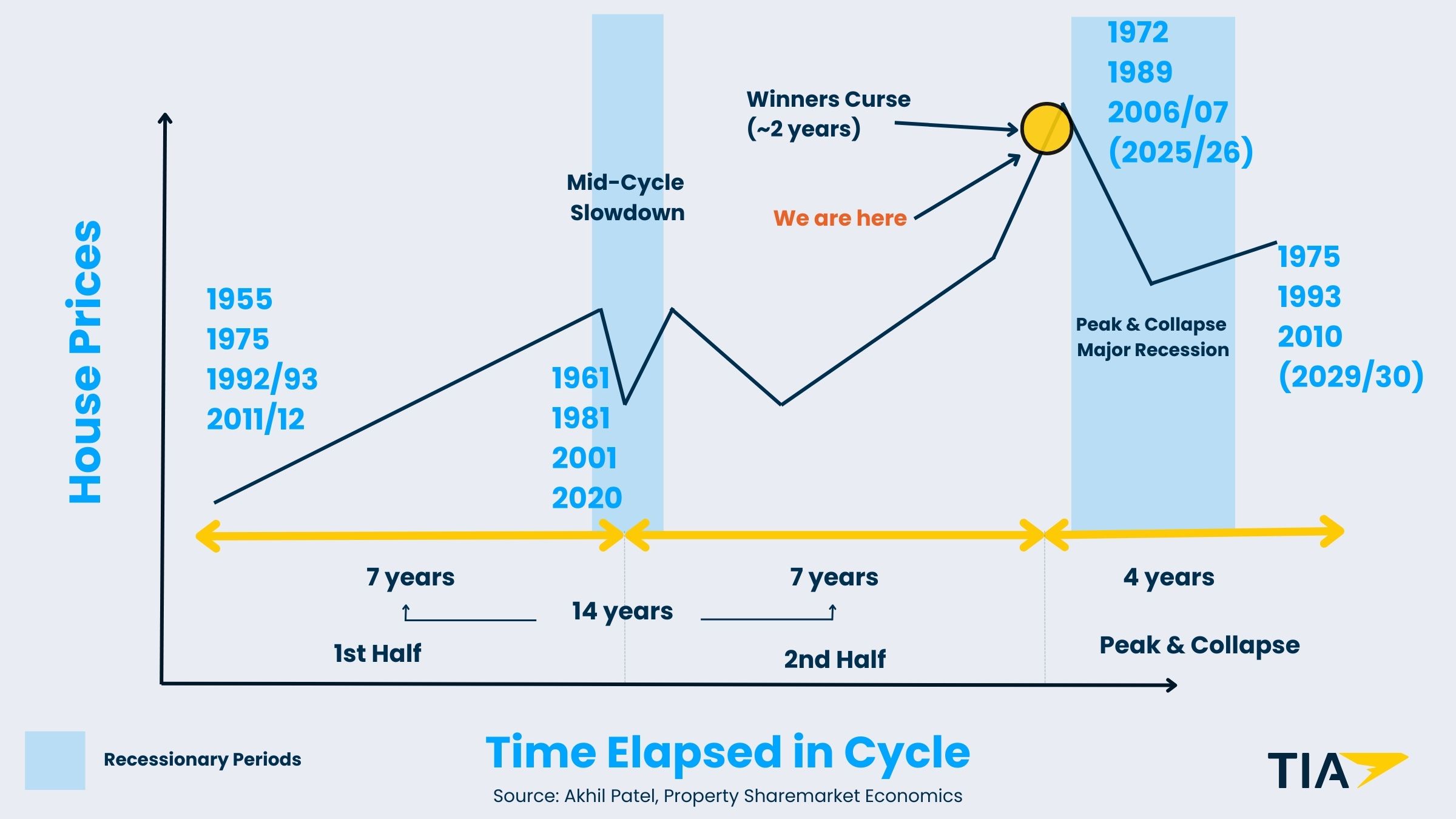
Investors are watching stocks and Bitcoin for the next major peak. Popular macro analyst Jason Pizzino thinks the first warning has already arrived from US housing.
His thesis uses an 18-year property cycle drawn from roughly 220 years of US sales data. The current cycle began around 2011–2012 and places the housing peak in 2025–26, with a possible trough around 2029–30.
“Once everyone’s in, you’re at the peak,” Pizzino said.
The latest data does not prove the cycle. But it does make the call harder to dismiss. US home prices rose 1.5% year-on-year in June, while falling in real terms for a 13th straight month.
July new-home sales dropped 10.5%. The median price fell to $393,800, its lowest in five years. Builder confidence sits at 35, far below the neutral 50 line.

Housing First. Stocks Could Be Next
Pizzino’s key signal is D.R. Horton. The homebuilder peaked before the broader market during the last housing cycle. Its late-2024 peak, using the same pattern, points to a possible stock-market top around late 2026 or early 2027.
D.R. Horton closed Friday at $142.75. Pizzino says a break below roughly $130 would strengthen his case.
Stocks remain near records. The S&P 500 closed at 7,718.60 on Friday, about 1% below its August 13 record. Strong August jobs data also pushed market odds of a September Fed rate hike to around 60%.

Bitcoin Is the Wild Card
Bitcoin trades near $79,700 today, up sharply from its July low around $57,700. It has also reclaimed its 200-day moving average.
Pizzino thinks Bitcoin can rally further, though with smaller returns. His rough scenario reaches about $120,000 from the July low. He sees $180,000 as much harder if credit keeps tightening.
Another analyst, Benjamin Cowen, is more cautious about treating the cycle as a trading signal.
“I buy index funds every single month… even if I think we’re going to have a correction,” said Cowen.
That may be the most useful takeaway. The cycle gives investors a warning zone, not an expiry date. Pizzino’s own advice is simpler: have a plan before the credit disappears.
“Trade the market you have,” Cowen said, “not the market you want.”
The post The 18-Year Housing Cycle Says the Next Market Crash Is Close appeared first on BeInCrypto.


Router Protocol has announced that it will end more than four years of cross-chain development, close all operations by Sept. 30, 2026, and permanently burn 303,333,198 ROUTE tokens held in its treasury.
Summary
- Router Protocol will wind down its remaining operations before Sept. 30, 2026.
- The project will permanently burn 303,333,198 ROUTE tokens held in its treasury.
- Centralized exchanges will publish separate ROUTE delisting and withdrawal schedules.
- ROUTE fell about 50% after the announcement and reached a new all-time low.
Router Protocol shutdown follows two years of financial pressure
According to Router Protocol’s announcement on X, weak revenue and limited access to capital left the team without a sustainable path for keeping the cross-chain project operational.
Liquidity across Web3 has remained scarce for about two years, the team said, while a large share of investor attention and capital has moved toward artificial intelligence. Within the interoperability market, growing competition has pushed bridging fees lower as user activity has become concentrated on a limited number of major networks.
Although Router continued operating infrastructure across multiple blockchains, the project said revenue from its bridging services could no longer cover development and operating costs. The team spent the past year exploring commercialization agreements, technology licensing, and possible acquisitions, but none of the talks produced enough funding to support long-term operations.
Calling the closure a difficult decision, Router said it considered the shutdown “the most honest and responsible choice for the community.” The team will wind down services gradually instead of closing the protocol without notice, giving users and trading platforms until the end of September to prepare.
Every remaining service is scheduled to close by Sept. 30. Router has not announced a buyer, replacement operator, or community-led group that will take control of the existing protocol after the deadline.
The ROUTE burn will remove 303 million treasury tokens
As part of the closure, Router will send 303,333,198 ROUTE tokens from its treasury to an address where they can no longer enter circulation. The planned burn represents more than 30% of the token’s maximum supply of 1 billion, based on supply figures published by CoinMarketCap.
The team said it had directed protocol fees toward ROUTE buybacks and burns during its operating history instead of building a large revenue reserve. With bridging income unable to fund the remaining infrastructure, the pending treasury allocation will now be destroyed permanently.
Router also plans to work with centralized exchanges on removing ROUTE trading pairs and related listings. Each exchange will set its own timeline for suspending deposits, closing trading and ending withdrawals, meaning holders cannot rely on Sept. 30 as a universal withdrawal deadline.
Users holding ROUTE on a centralized platform have been told to follow notices from that exchange and withdraw before its stated cutoff. The team warned that any ROUTE liquidity pool created after official exchange delistings will have no connection to Router Protocol or its developers.
No new products, incentive programs, or other projects tied to ROUTE will be introduced during or after the closure. Router said it would publish more information about the token burn and individual exchange arrangements through its official channels.
For U.S. holders, the practical effect depends on where their tokens are stored and whether their exchange currently supports ROUTE. Router has not announced a separate process for American users, leaving token owners responsible for following the withdrawal rules and access restrictions set by their chosen platform.
Router Protocol leaves behind its cross-chain infrastructure
Router began building cross-chain infrastructure more than four years ago, eventually developing Router Nitro, a cross-chain bridge; a messaging framework; and Router Chain, a Layer 1 network built with technology from the Cosmos ecosystem.
In July 2024, crypto.news covered the mainnet launch of Router Chain, which was designed to connect applications and assets across Ethereum, Bitcoin, Cosmos-based networks, and other blockchains. ROUTE served as the network’s gas and staking token.
At the time, the project also offered the Cross-Chain Intent Framework, which allowed developers to add cross-chain functions to decentralized applications. Router Nitro supported swaps across more than 30 EVM and non-EVM networks, while Router said its complete product suite could help users interact with applications without manually managing each underlying chain.
Running a standalone network later became too costly. Router’s community voted in September 2025 to sunset Router Chain, after which the project focused on its Open Graph Architecture, an infrastructure layer designed to connect bridges, decentralized exchanges and transaction solvers.
Security problems also affected the project’s final years. Router’s closure statement referred to a solver-related exploit in February 2025, after which approximately 80% of the affected funds were recovered through negotiations. A separate chain-level incident followed in July 2025, and the team said the funds taken in that event were not recovered.
Cross-chain systems have faced persistent security pressure because they must validate asset movements or messages between networks with different rules. An August report on bridge risks found that more than $4 billion had been stolen from bridges since 2021, with compromised validator keys and faulty message verification among the recurring weaknesses.
More recently, Maya Protocol halted its network in August after an attacker used six connected software flaws to steal an estimated $1.7 million in Bitcoin and other assets. Maya’s CACAO token fell 88.7% during the incident, while the protocol worked on repairs needed to restore swaps.
Router has not attributed the current shutdown to a new exploit. Its announcement instead identified declining revenue, operating costs, scarce Web3 capital, and unsuccessful financing or acquisition efforts as the reasons it could no longer maintain the business.
ROUTE price falls to an all-time low
ROUTE sold off sharply following the shutdown notice. CoinGecko data showed the token trading near $0.00006 at the time of writing, down approximately 50% over 24 hours and more than 58% during the preceding seven days.
During the session, ROUTE fell as low as $0.00003970, setting a new all-time low. The token was trading about 99.9% below its July 2024 peak of $0.08078, while its market capitalization had fallen to roughly $40,000 based on a circulating supply of around 680 million tokens.
Trading activity remained thin despite a daily volume increase. CoinGecko listed KuCoin and Gate among the active centralized markets, but order-book depth around the quoted price was limited, increasing the risk of large price changes from relatively small orders.
Separate market data from CoinMarketCap placed ROUTE near $0.00005, down more than 40% over the same 24-hour period. Differences between the two quoted prices may result from low liquidity, exchange spreads, and changes in the token’s value while the platforms update their feeds.
After operations end, Router plans to release selected technical components as open-source software. The team said the process would preserve part of the engineering work completed over the project’s four-year history and allow developers to continue using those components independently.


Starknet lending protocol Vesu has reported that a faulty Pragma price feed triggered the abnormal liquidation of 47 positions holding $3 million in collateral on Sept. 4.
Summary
- 47 Vesu positions were liquidated across several pools during a two-minute oracle failure.
- $3 million in collateral was affected before the Pragma price feed corrected itself.
- Vesu said its contracts worked as programmed and contained no protocol vulnerability.
- Vesu and other Starknet organizations are trying to recover funds for affected users.
Vesu traces $3M liquidation to Pragma price feed
Vesu said in a Sept. 5 incident disclosure that the liquidations occurred between 04:08 and 04:10 UTC on Sept. 4 after an upstream price source operated by Pragma supplied incorrect data.
During the two-minute incident, the faulty prices reached several Vesu liquidity pools and made 47 borrowing positions appear eligible for liquidation. Automated liquidators then removed approximately $3 million in collateral before the feed returned to the correct value.
According to the protocol, the price source corrected itself within two minutes and has operated normally since then. Vesu did not identify the affected assets or provide a pool-by-pool breakdown in its initial statement.
The company also did not disclose how far the incorrect prices differed from market rates, the amount of debt attached to the liquidated positions, or how much collateral liquidators retained. A technical report covering the incident is expected to provide more information about the affected markets and the sequence of on-chain transactions.
Pragma has since worked with the relevant organizations to deploy a fix addressing the source of the error, Vesu said. Liquidity pool curators suspended affected pools as a precaution, with Vesu expecting them to remove the restrictions after reviewing the fix.
Because Vesu uses isolated and curated lending pools, decisions on reopening individual markets rest with their curators. The initial update did not identify which curators had paused their pools or provide an exact timetable for restoring normal activity.
Vesu says its contracts contained no vulnerability
Separating the incident from a smart contract exploit, Vesu said its contracts were “operating as designed” and did not contain a vulnerability. The protocol added that it had no contract patch to deploy because the liquidation engine responded to the prices it received.
In an overcollateralized lending market, a borrower deposits assets worth more than the value of a loan. The protocol uses an external price feed to measure the collateral ratio, and a liquidation may begin when that ratio falls below the pool’s required level.
Vesu attributed the Sept. 4 liquidations to bad inputs rather than faulty execution. Under its account, the contracts received incorrect collateral prices and processed the affected positions according to the rules already written into the protocol.
A July 2026 liquidation risk explainer from crypto.news described price data as the central input used to calculate a DeFi loan’s health factor. The report noted that stale or manipulated data can liquidate a healthy position or prevent an unsafe one from being closed.
Oracle dependence also extends beyond lending markets. An August 2026 report on blockchain oracles explained that smart contracts cannot independently read off-chain market prices, leaving them reliant on outside systems that collect, combine and publish data on-chain.
According to that report, an oracle normally handles data sourcing, aggregation, and on-chain delivery. A failure at any of the three stages can pass an inaccurate value to an otherwise functional smart contract, which may then complete a trade or liquidation based on the faulty input.
Recovery talks involve Starknet organizations
Following the incident, Vesu said it began coordinating with Pragma, StarkWare, the Starknet Foundation, and the curators of the affected pools to recover funds collected through the liquidations.
The protocol has not yet explained how the recovery process will operate, how much of the $3 million remains recoverable, or whether liquidators have agreed to return any assets. Its statement also stopped short of announcing a guaranteed reimbursement amount or payment date.
For users with deposits in Vesu’s Earn product, the protocol advised keeping their positions open. Closing an Earn position before the recovery process is complete may remove the user’s eligibility for a refund, according to Vesu.
Borrowers whose positions were liquidated during the two-minute window were asked to open a support ticket through Vesu’s Discord server. The protocol did not specify what records users must submit, though wallet addresses and transaction details can identify affected positions on-chain.
Vesu’s response differs from an automatic reversal because blockchain transactions generally remain final after confirmation. Any restoration would therefore require recovered assets, voluntary returns from liquidators, protocol-controlled funds, or another compensation arrangement agreed upon by the parties. Vesu has not said which route it plans to use.
A comparable oracle-related event occurred on Aave in March 2026, when a stale parameter caused an estimated $26 million to $27 million in unintended wstETH liquidations. An August 2026 review of the incident reported that Aave later examined oracle update rates and fallback systems while using several oracle sources for major collateral types.
Vesu has not announced comparable changes to its oracle structure. Pragma’s root-cause fix was the only technical measure confirmed in the initial disclosure.
US users depend on Vesu’s recovery process
For users in the United States, the incident involves a permissionless DeFi product rather than an insured bank account. The SEC’s Investor.gov website states that the FDIC insures deposits at eligible banks but does not protect securities or similar investments against a decline in value.
Vesu did not point to any government-backed protection for affected users. Instead, it directed them to its own support process and said the organizations involved were working to recover the collateral taken during the abnormal liquidations.
The protocol has not disclosed whether it restricts recovery by nationality or residence. Its instructions apply to users whose positions were liquidated during the identified window and to Earn depositors seeking to preserve possible refund eligibility.
At the network level, Vesu forms part of Starknet’s DeFi infrastructure. Starknet identified the lender as one of the protocols supporting its STRK20 privacy rollout in June 2026, alongside decentralized exchanges avnu and Ekubo and staking provider Endur.
Vesu said it will publish a complete technical report after its investigation, while affected borrowers can submit Discord support tickets, and Earn users have been told not to close their positions.

Poland’s lawmakers have once again fallen short of the supermajority needed to overturn President Karol Nawrocki’s veto of a bill intended to tighten oversight of the country’s crypto market. On Friday, the Sejm voted 241–198 in favor of overriding the veto, with three abstentions, leaving the proposal 25 votes short of the 266 required for passage.
The vote was the latest attempt to move the legislation forward after Nawrocki vetoed similar crypto rules three separate times, arguing the draft would impose excessive constraints on the industry. The renewed push comes as Prime Minister Donald Tusk highlights an expanding criminal investigation tied to the defunct exchange Zondacrypto—an issue that has added urgency for regulators and lawmakers to formalize a clearer supervisory framework.
Key takeaways
- The Sejm’s 241–198 vote confirms support for overriding the president, but it still missed the three-fifths threshold by 25 votes.
- Poland still does not have a designated national supervisor for cryptoassets under the proposed framework, despite the EU’s MiCA regime already applying across member states.
- Nawrocki’s vetoes rest on concerns about regulatory overreach, including compliance costs and powers that could be used to block websites.
- Tusk’s renewed statements tie the oversight debate to the continuing Zondacrypto scandal, including alleged political influence and financial arrangements.
A failed veto override keeps Poland’s crypto oversight in limbo
The bill at the center of Friday’s vote is designed to establish Poland’s national approach for applying the EU’s Markets in Crypto-Assets Regulation (MiCA). The proposal would place supervision of the cryptoasset market under the Polish Financial Supervision Authority (KNF), giving domestic regulators a clear mandate to enforce relevant rules.
Even though MiCA is already in force across the EU, Poland’s legislative process has not yet delivered the required national structure. KNF said on Friday that the country still lacks an authority responsible for supervising the cryptoasset market, a gap that matters for market participants because enforcement and supervision responsibilities must be assigned domestically rather than handled only at the EU level.
KNF warns of a missing supervisor as MiCA already applies
KNF’s statement underscores a practical problem: MiCA sets the framework, but supervision in each jurisdiction depends on the domestic rules and institutions that implement and enforce it. Without a properly designated national regulator, compliance questions can become harder for businesses, and regulatory clarity for users can remain incomplete.
That regulatory vacuum is exactly what the vetoed legislation attempted to fix—by anchoring crypto supervision within KNF. By failing to reach the vote threshold required to overturn Nawrocki, Poland remains without that assigned authority, leaving the market awaiting a clearer chain of responsibility.
Why Nawrocki continues to veto: costs and enforcement powers
Nawrocki has repeatedly argued that the draft goes too far. In earlier coverage of the president’s second and third vetoes, the president’s concerns were described as including regulatory costs for the industry and provisions that could grant authorities powers to block websites.
Supporters of the override, meanwhile, appear to treat the bill as necessary not only for compliance with MiCA but also for protecting consumers and improving oversight—especially in the wake of high-profile failures in the crypto sector.
Zondacrypto pressures the debate as prosecutors expand investigations
The political conflict over crypto regulation is playing out alongside the Zondacrypto fallout. Tusk has urged tighter oversight by citing what he described as testimony from a key witness connected to the investigation, including claims about payments and attempted influence reaching into Poland’s previous government.
In excerpts Tusk disclosed ahead of Friday’s vote, he alleged that the witness described a 2 million Polish zloty (about $550,000) payment arrangement involving a foundation linked to former Justice Minister Zbigniew Ziobro. Tusk also cited other testimony in which an unnamed person allegedly promised a presidential pardon in exchange for the witness’s conviction outcome.
Meanwhile, prosecutors are investigating suspected fraud and money laundering related to Zondacrypto. In July, they merged the case with an inquiry tied to the 2022 disappearance of Sylwester Suszek, the founder of BitBay—later renamed Zondacrypto—according to a Polish government disclosure referenced in the reporting.
Loss estimates cited by prosecutors place damages linked to Zondacrypto at no less than 350 million Polish zlotys (about $95 million), reflecting the scale of the case that regulators say should heighten the need for effective oversight.
Bankruptcy proceedings begin, but political scrutiny continues
Zondacrypto’s operator, BB Trade Estonia, was declared bankrupt by an Estonian court in August, with the first creditors’ meeting scheduled for Sept. 17. The bankruptcy adds another layer to the oversight debate: as insolvency processes unfold, creditors and affected users typically look for clearer accountability and stronger regulatory barriers to reduce the risk of similar failures.
Yet the veto override failure suggests that even in the face of an escalating investigation and a visible market fallout, political agreement in Poland remains difficult—particularly when the president argues that the proposed rules would be overly burdensome or grant enforcement powers he considers too sweeping.
Next, Poland’s lawmakers will likely have to decide whether to revisit the same bill with changes that address the veto concerns while still meeting the core need identified by KNF: assigning a domestic authority to supervise cryptoassets under MiCA. Readers should watch whether future Sejm attempts can reach the three-fifths threshold—and how the Zondacrypto investigation developments shape the urgency of the legislation.


Bitcoin holders whose coins have remained dormant for more than five years have doubled their spending activity since May, pushing the cohort’s 90-day average to about 1,500 BTC.
Summary
- Five-year Bitcoin holders’ 90-day spent-output average has climbed to approximately 1,500 BTC.
- Activity has doubled from its May level as Bitcoin continues to trade within a tight range.
- Spent UTXOs show that old coins moved, but they do not confirm sales.
- Coldcard-related security concerns may account for part of the increased wallet activity.
Bitcoin OG activity doubles from May levels
CryptoQuant analyst Darkfost reported that activity among Bitcoin’s oldest holders has increased during the latest period of price consolidation. The analyst defines the group as investors whose coins had remained unspent for more than five years before moving onchain.
The 90-day moving average of spent outputs from the cohort has reached about 1,500 BTC, twice the level recorded in May, according to Darkfost. A moving average smooths daily changes, making it less sensitive to isolated transfers from a few large wallets.
At 1,500 BTC, the current average is also about 56% above the 962 BTC reported on June 24. At the time, the reading had fallen below 1,000 BTC for the first time since November 2024, indicating that activity from older holders had slowed to its lowest point in nearly two years.
As previously reported by crypto.news, earlier peaks appeared in May 2024, February 2025, and September 2025. Daily movements during those periods exceeded 10,000 BTC, 30,000 BTC, and, in one case, 142,000 BTC.
Darkfost linked the latest increase to unease created by Bitcoin’s consolidation. Even investors who have held through several market cycles appear more active, the analyst said, although the data cannot identify the reason behind each transaction.
Bitcoin traded near $79,600 at the time of writing, down about 1.8% over 24 hours after moving between an intraday low of $78,723 and a high of $81,370. The price has struggled to establish a lasting move above $80,000 following several sharp swings around the level.
Spent UTXOs do not prove Bitcoin was sold
A spent UTXO records Bitcoin that has been used as an input in a new transaction. Because Bitcoin’s ledger tracks transaction outputs rather than account balances, an output becomes “spent” whenever its owner moves the coins to another address.
Movement alone does not identify the purpose of a transaction. An investor can send BTC to an exchange for a possible sale, transfer it to a new custodian, consolidate several outputs, divide a balance across wallets or replace an old security setup.
Darkfost cautioned against treating the 1,500 BTC average as confirmed selling. Some of the transactions may represent holders moving their coins to safer storage after the Coldcard security incident rather than exiting their positions.
Destination data provides more useful evidence when an old wallet sends coins to a labeled exchange or trading firm. Even then, an exchange deposit shows that the Bitcoin became available for trading; it does not establish that the owner completed a sale.
Recent dormant-wallet transfers illustrate the limitation. During a 10-day period in August, six wallets that had remained inactive for almost 12 to more than 15 years moved 553.59 BTC worth $40.15 million.
Five transfers went to addresses with no identified exchange connection. One wallet sent 40 BTC to an address labeled Boerse Stuttgart Digital, which provides custody and trading infrastructure. Neither the unlabeled destinations nor the custody provider established whether the owners sold, changed custodians, or reorganized their holdings.
Another 28 dormant wallets moved 1,314.41 BTC on Aug. 20, including more than 1,200 BTC from addresses created in 2014. Blockchain records documented the transfers but did not reveal the owners’ intentions.
Coldcard incident complicates onchain readings
The Coldcard incident created an unusual source of Bitcoin activity after a firmware flaw exposed seed phrases generated by affected hardware wallet models. Owners were advised to create new seeds and transfer their holdings because installing corrected firmware could not repair credentials produced by vulnerable software.
In early August, K33 Research found that nearly 890,000 BTC had moved over seven days, the highest seven-day active supply recorded in 2026. The surge occurred while Bitcoin was trading within one of its narrowest 30-day ranges since 2023, separating the rise in network activity from a major price breakout.
Researchers linked the activity partly to Coldcard users migrating funds and attackers draining vulnerable wallets. Galaxy Research had confirmed the theft of 1,596 BTC from about 7,300 addresses across three attack waves by Aug. 5.
Galaxy estimated that losses could reach approximately 2,055 BTC, then worth close to $130 million, if a suspected fourth wave was confirmed. Around 90% of the stolen Bitcoin had not moved after the initial attacks at that stage, according to the research firm.
Transfers made for seed migration still consume old UTXOs, so they can raise spending metrics even when the owner keeps control of the coins. The effect can reach age-based cohorts if affected wallets contain Bitcoin that has remained untouched for five years or longer.
Wallet consolidation can produce a similar result. Combining several old outputs into one new output records the original UTXOs as spent without changing the owner’s total balance, apart from the network fee.
U.S. investors can hold Bitcoin without managing seeds
For U.S. investors, the Coldcard incident has renewed attention on the custody differences between directly held Bitcoin and shares of a spot Bitcoin exchange-traded fund. Direct holders control spendable BTC but remain responsible for seed creation, backups, firmware updates, and wallet migration.
ETF investors do not manage private keys because the fund and its service providers handle custody. Bloomberg Intelligence senior ETF analyst Eric Balchunas argued in August that the Coldcard losses strengthened the case for ETFs among investors who only want exposure to Bitcoin’s price.
An earlier report on the U.S. custody debate noted that no verified flow data had tied ETF demand directly to the incident. Investor responses could also include multisignature wallets, new hardware devices, institutional custodians, or the division of funds across several storage methods.
BlackRock’s iShares Bitcoin Trust uses Coinbase Custody to hold its Bitcoin in segregated cold-storage wallets, according to the fund’s SEC filing. The trust may also use Anchorage Digital Bank as an additional custodian.
ETF ownership transfers personal seed risk to fund operators, custodians, and other service providers. BlackRock’s filing warns that hacking, employee misconduct, technical failures and unauthorized transfers could still cause losses, while available insurance may not cover every event.
Unlike direct holders, retail ETF shareholders cannot withdraw the underlying Bitcoin to a personal wallet or use it for onchain payments. Fund shares trade during U.S. market hours, while Bitcoin transactions remain available around the clock.


Polish lawmakers have again failed to secure the three-fifths majority needed to overturn President Karol Nawrocki’s veto of legislation aimed at strengthening oversight of the country’s crypto market.
The Sejm, Poland’s lower house of parliament, on Friday voted 241-198 in favor of overriding the veto, with three abstentions, falling 25 votes short of the 266 needed.
The vote was yet another attempt to advance Poland’s crypto market rules after President Karol Nawrocki vetoed crypto legislation three times, arguing that the proposed rules would overregulate the industry.
The regulatory dispute comes amid a deepening scandal involving defunct crypto exchange Zondacrypto, with its Estonian operator declared bankrupt and Prime Minister Donald Tusk citing an expanding criminal investigation to push for tighter crypto oversight.
Poland remains without MiCA crypto supervisor
The vetoed legislation was designed to establish Poland’s national framework for applying the European Union’s Markets in Crypto-Assets Regulation (MiCA), including placing oversight of the crypto market under the Polish Financial Supervision Authority (KNF).
KNF said Friday that the country still lacks a designated authority responsible for supervising the cryptoasset market, despite MiCA already applying across the European Union.
Nawrocki has said he supports crypto regulation but argues that Poland’s proposed rules go too far, citing concerns over regulatory costs and authorities’ powers to block websites.
Zondacrypto probe expands amid bankruptcy
Ahead of Friday’s vote, Tusk disclosed excerpts from what he said was testimony by a key witness in the Zondacrypto investigation, alleging payments and attempts to influence politicians linked to Poland’s previous government.
Tusk said the witness alleged a 2 million Polish zloty ($550,000) payment arrangement involving a foundation linked to former Justice Minister Zbigniew Ziobro. In separate testimony cited by Tusk, the witness alleged that an unnamed person had promised to secure a presidential pardon if the witness was convicted.
Related: Polish Olympic chief charged in Zondacrypto probe, justice minister says
Polish prosecutors are investigating suspected fraud and money laundering connected to Zondacrypto. In July, they merged the case with a probe into the 2022 disappearance of Sylwester Suszek, founder of BitBay, which was later renamed Zondacrypto.
Prosecutors in April said losses linked to Zondacrypto were estimated at no less than 350 million Polish zlotys ($95 million).
Zondacrypto’s operator, BB Trade Estonia, was officially declared bankrupt by an Estonian court in August, with the first creditors’ meeting scheduled for Sept. 17.
Magazine: MiCA is coming for DeFi vaults, but regulation will be difficult
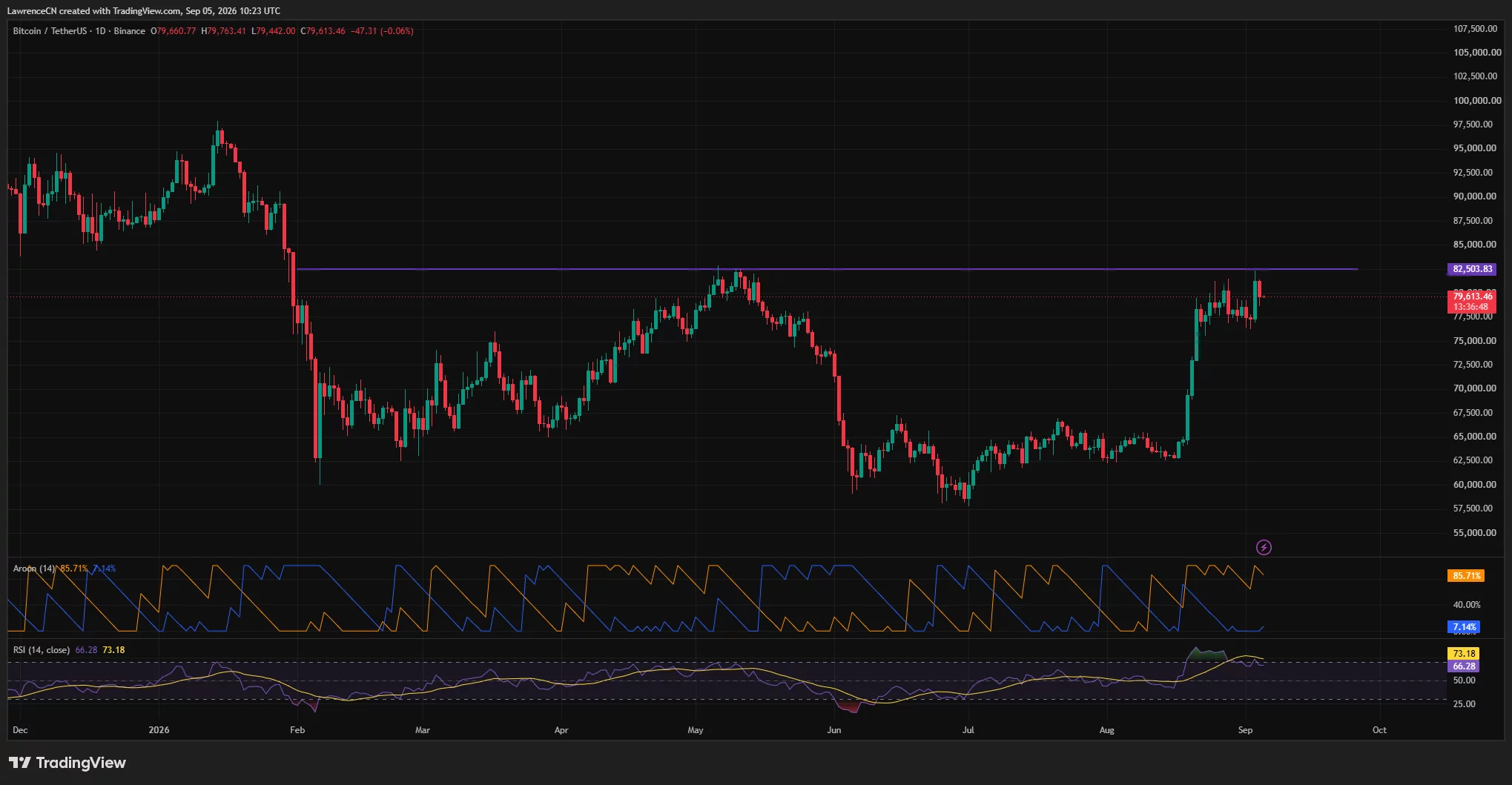
Bitcoin price fell back below $80,000 after stronger-than-expected US employment data lifted Federal Reserve rate-hike expectations, while technical charts showed the rally had already met resistance near $82,500.
Summary
- Bitcoin price traded near $79,600 after retreating from an intraday high around $81,370.
- US employers added 162,000 jobs in August, while unemployment remained unchanged at 4.1%.
- Daily resistance stands near $82,500, with 4-hour Supertrend support around $78,190.
- Liquidation clusters near $80,000 and $82,000 could shape Bitcoin’s next short-term move.
Bitcoin price falls below $80,000
According to data from crypto.news, Bitcoin (BTC) price traded near $79,600 at the time of writing, down about 1.5% over 24 hours. The asset had reached an intraday high near $81,370 before sellers pushed it as low as $78,723.
The pullback followed an earlier rally that carried Bitcoin above $82,000, its highest level since May. Buyers failed to sustain that move, leaving the price below a major resistance zone visible on the daily chart.
Bitcoin’s daily candle showed the asset trading near $79,613 after touching a session high of $79,763. The price remained below horizontal resistance at approximately $82,504, a level that also sits close to the May swing high.
The rejection interrupted a sharp recovery from the August range near $62,500. Bitcoin gained roughly 30% during that advance and broke above several previous lower highs, but the $82,000–$82,800 region has stopped two recent attempts to extend the rally.
Strong US jobs data triggered the pullback
The US Bureau of Labor Statistics reported that nonfarm payroll employment increased by 162,000 in August, well above the average monthly gain of 31,000 recorded over the previous 12 months. The unemployment rate held at 4.1%.
Employment increased by 59,000 in food services and drinking places, while local government education added 42,000 jobs. The information sector lost 23,000 positions.
The report led traders to raise the probability of a Federal Reserve rate increase at its Sept. 15–16 meeting. According to Reuters, the implied probability rose to 61% from 52% before the employment data.
Citigroup consequently moved its forecast for the Fed’s next rate cut to June 2027 from October 2026. Higher rate expectations also pushed Treasury yields upward and supported the dollar, creating pressure on non-yielding and risk-sensitive assets.
Analyst Rain said the employment report was the immediate trigger for Bitcoin’s decline, but argued that the technical setup preceded the release. Rain noted that BTC had been rejected around $82,400 several hours before the data arrived.
The analyst said the strong jobs reading removed part of the Fed’s case for lowering rates, forcing markets to reprice the probability of tighter policy rather than changing Bitcoin’s longer-term investment case.
Bitcoin technicals keep $82,500 in focus
Bitcoin’s daily relative strength index stood at 66.28, below the overbought threshold of 70. The RSI had recently moved above 70 during the rally but turned lower as the price struggled below resistance, showing that upward momentum had cooled.
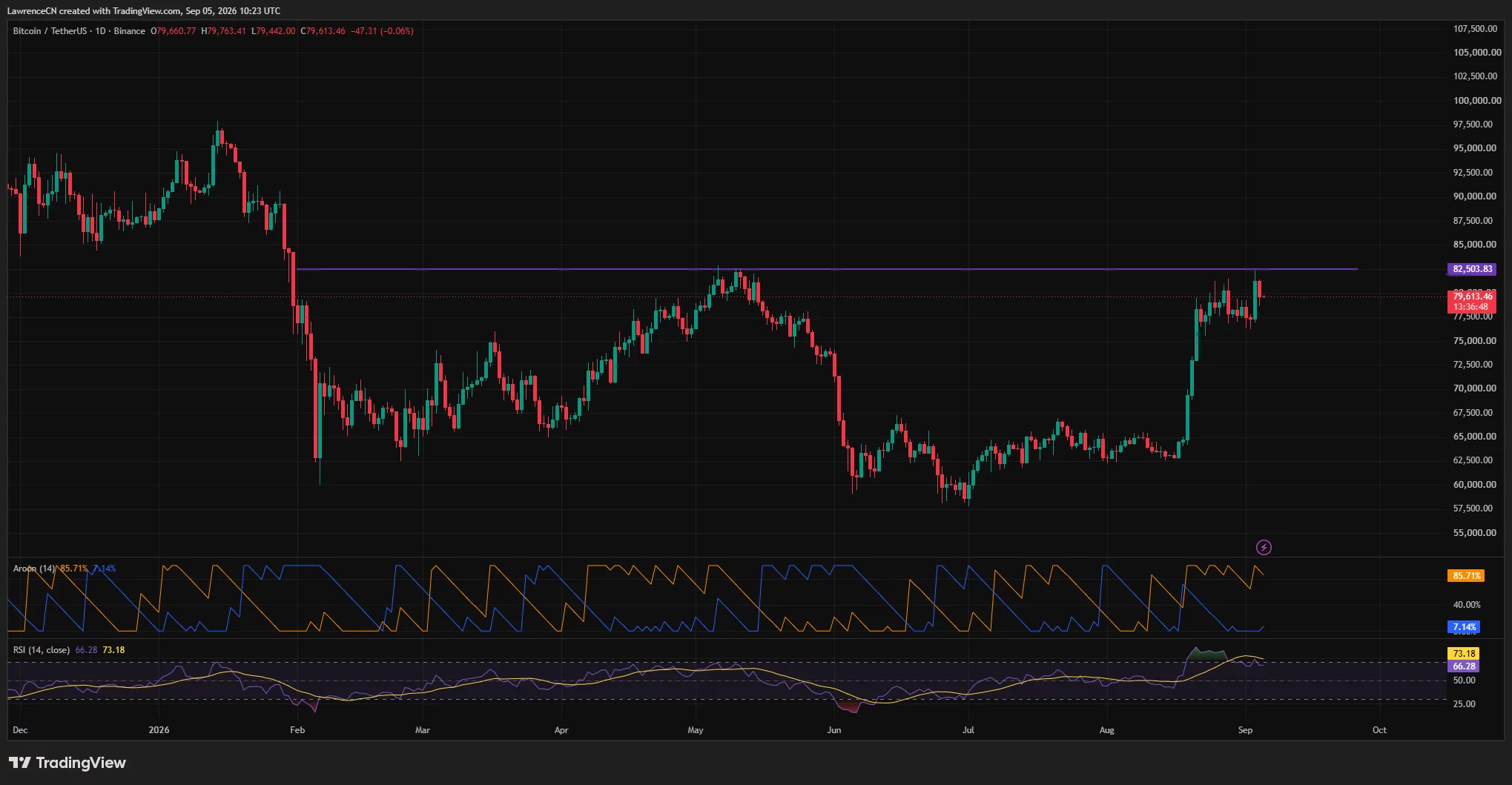
The Aroon indicator offered a more constructive signal. Aroon Up measured 85.71%, compared with an Aroon Down reading of 7.14%, indicating that recent highs remain more influential than recent lows despite the pullback.
On the 4-hour chart, Bitcoin continued to trade above the Supertrend line at $78,190. The indicator remains bullish while the price holds above that level, making the $78,000–$78,200 area the first technical support zone.
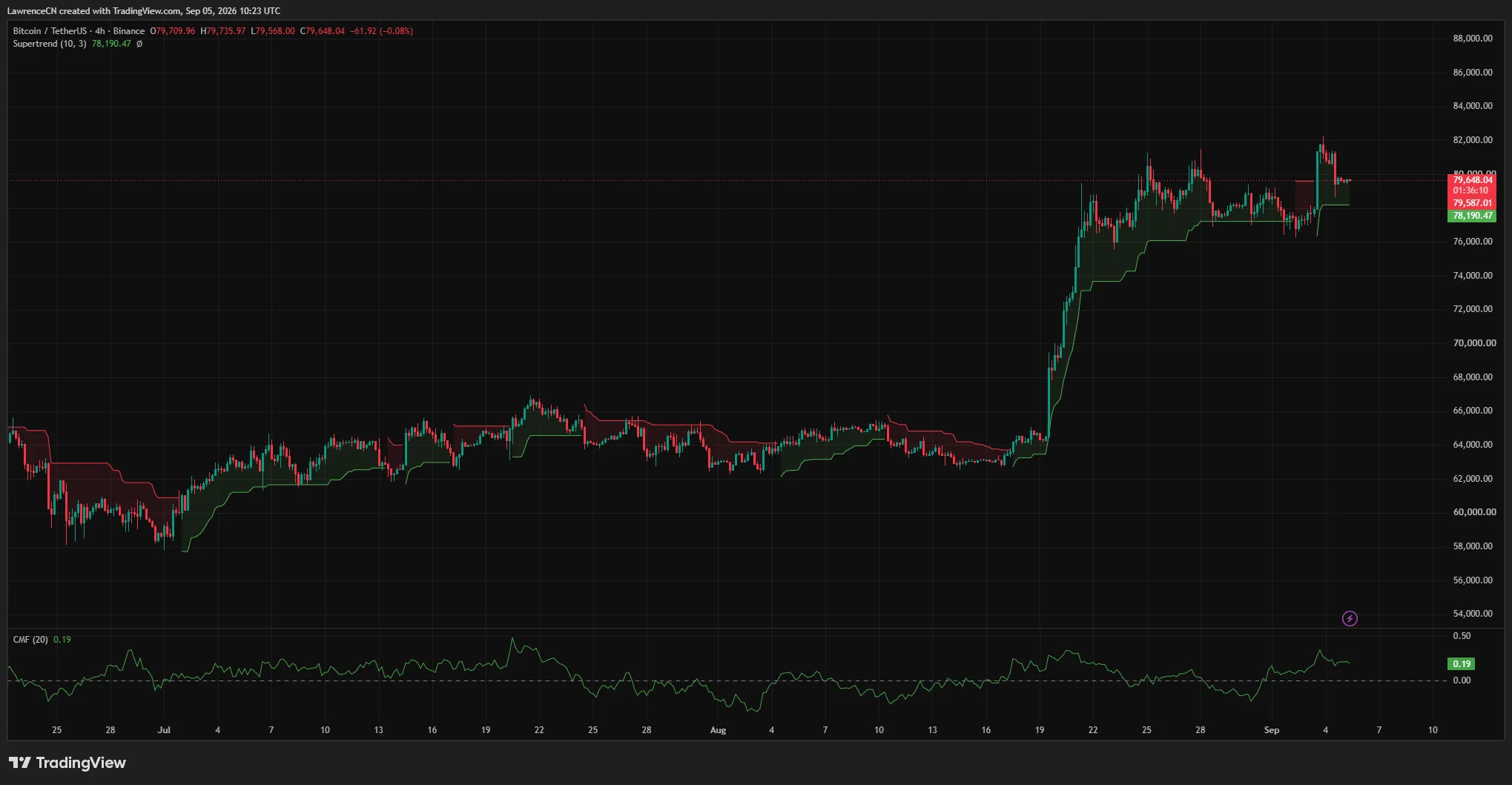
The 4-hour Chaikin Money Flow reading of 0.19 also remained above zero. The indicator points to net buying pressure over its measurement period, although it does not rule out another short-term test of support.
A daily close above $82,504 would clear the immediate resistance and weaken the bearish rejection setup. Reuters’ technical analysis identified the broader May resistance near $82,793 and said a confirmed breakout could expose $90,000, followed by Bitcoin’s 2026 peak near $97,867.
Failure to defend the 4-hour Supertrend would shift attention to approximately $77,000. Below that area, the next visible supports sit near $75,700 and $71,800.
Liquidation heatmap shows pressure on both sides
The one-week CoinGlass liquidation heatmap showed a dense concentration of leveraged positions close to $80,000. Another large liquidity band appeared between roughly $81,800 and $82,300, placing potential short liquidations directly below the daily resistance area.
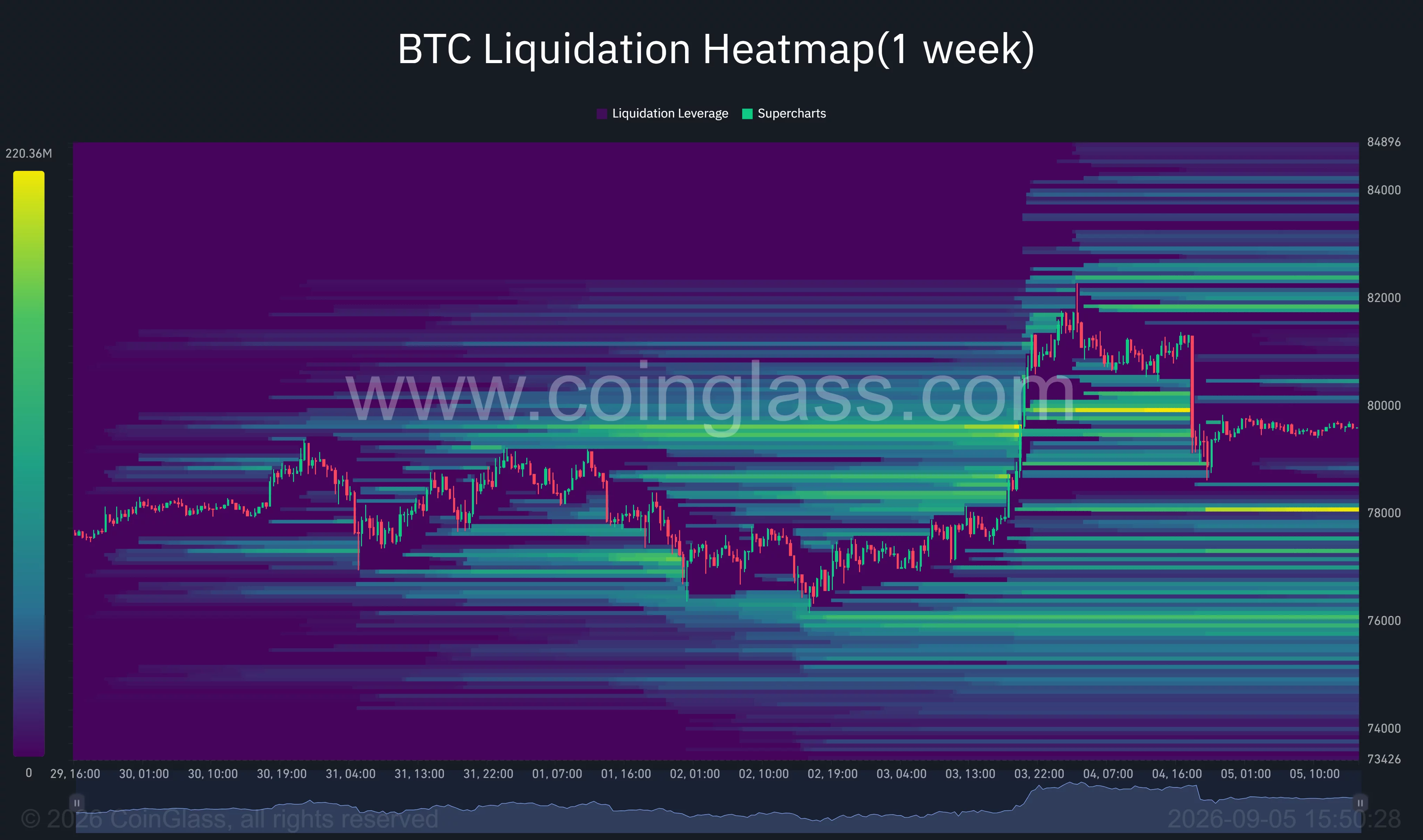
A move through $80,000 could therefore draw the price toward the upper cluster, although heatmap levels identify estimated liquidation concentrations rather than guaranteed price targets.
On the downside, the strongest nearby pool appeared around $78,000, with additional concentrations between $76,000 and $77,000. Losing $78,000 could expose leveraged long positions and accelerate a drop toward the lower liquidity bands.
The location of those clusters leaves Bitcoin between competing liquidation zones. The $78,000 support and $82,000 resistance areas could produce sharper moves if either side gives way.
Analysts warn of a possible Bitcoin bull trap
Trader Gerla said Bitcoin’s structure has improved, but warned that momentum has repeatedly reversed after the daily RSI entered overbought territory during the current cycle.
Gerla identified $82,000–$84,000 as the invalidation area for the bearish setup. According to the analyst, a strong close above that range, supported by high trading volume, would reduce the risk that the latest rally is a bull trap.
Until such a breakout occurs, the analyst sees a risk that another rejection could force leveraged buyers out of the market and produce a larger correction.
US inflation data now provides the next major test. The August consumer price index is scheduled for Sept. 11, five days before the Fed’s rate decision. A hotter reading could reinforce expectations of a hike, while softer inflation could lower those odds and give Bitcoin another opportunity to challenge $82,500.
Disclosure: This article does not represent investment advice. The content and materials featured on this page are for educational purposes only.
Bitcoin’s price reacted immediately to the stronger-than-expected US jobs report on Friday, plunging from a multi-month high of over $82,000 to under $79,000 before it found some support.
Red dominates the larger-cap alts’ charts, with XRP dropping back to $1.40, ETH losing the $2,500 level, and XMR plunging by over 5%. BNB stands in the opposite corner with a 4.5% surge.
BTC Halted at $82K
The primary cryptocurrency faced a similar fate last Friday when it jumped to $81,500 only to be rejected and driven south to under $77,000 after the hawkish speech by Fed Chair Kevin Warsh at Jackson Hole. However, it rebounded during the weekend and even tapped $79,000 on Sunday.
The resumed military actions in the Middle East brought another leg down on Monday morning, with BTC slipping to $77,000 again. The bulls managed to defend that level again, and the cryptocurrency remained stuck between that lower boundary and the upper one at $79,000 for a few days.
The breakout began on Thursday when the asset surged past the latter level and kept climbing on Friday morning. The peak came at $82,400, which became BTC’s highest price tag in three and a half months. Although it was stopped there, it remained above $81,000 before the aforementioned jobs report went live and plunged immediately after it made the headlines to just under $79,000.
It has rebounded to $79,600 since then, with its market cap standing close to $1.6 trillion on CMC. Its dominance over the alts has retreated slightly to 59.45%.

PONS Keeps Rocking
The new rockstar of the altcoin space, PONS, is once again the top performer, surging by 30% in the past 24 hours to a new all-time high of almost $0.90. DASH follows suit, skyrocketing by 25% to over $65.
Binance Coin is up by 4.5%, being the biggest gainer among the larger caps, and now sits at $750. NEAR has gained 11% and is above $2.25. DOT, TAO, and LTC are also well in the green.
In contrast, ETH is down by 2.5% to $2,450, XRP has slipped by almost 3% to $1.40, and XMR is down by 5% to $525. RAIN, HYPE, and ADA are also in the red.

The post PONS Skyrockets Another 30% to New ATH, Bitcoin Loses $80K: Weekend Watch appeared first on CryptoPotato.

AP source: LSU leaves former pros Wright, Harris off opening-day roster

Jackery Solar Mars Bot Still Follows the Sun at IFA Berlin

Wall Street vs. Silicon Valley: Why Finance Isn’t Moving Fast With AI #ai #finance #wallstreet #nyc





-
 Crypto World23 hours ago
Bitcoin price stalls near $82K as key resistance holds
-

 Politics23 hours ago
Best Gaming Laptops, CPUs, TVs, And Keyboards To Upgrade Your Set Up For GTA VI
-

 Tech1 day ago
The Birds Outside, Drawn For You Automatically
-

 Crypto World1 day ago
IMF Says El Salvador’s Post-Review Bitcoin Purchases Used No Public Funds
-
 Crypto World23 hours ago
U.S. added stronger than expected 162,000 jobs in August as labor market bounced back
-

 Sports1 day ago
Alexandre Pato consortium’s Northampton Town investment approved
-

 Sports22 hours ago
Golden Eaglets Drawn in Group B for 2026 WAFU B U17 Championship
-

 Sports1 day ago
Commanders’ Chig Okonkwo is a top breakout fantasy football candidate
-
 Crypto World22 hours ago
XRP price breaks falling channel as bulls target $1.53
-

 Politics1 day ago
A new European chapter for Gibraltar
-

 Politics1 day ago
The House | Bin the lectures, bring gossip and be ready to banter: how the new PM should prepare for his Trump encounter
-

 Politics22 hours ago
How To Avoid Winter Colds: 4 Everyday Habits That Spread Germs, Says Pharmacist
-

 Crypto World22 hours ago
From warning to listing: UK’s largest retail investment platform opens access to crypto ETNs
-

 Fashion18 hours ago
Weekend Open Thread: Beyond Yoga
-

 Tech24 hours ago
A Worthy Android Ereader, With Some Tradeoffs
-

 Crypto World23 hours ago
FinCEN flags $12.7B tied to Southeast Asia crypto investment scams
-

 Crypto World22 hours ago
Trezor Data Breach Impacts 67,000 More US Customers
-

 Politics1 day ago
33 Cosy Autumn Home Decor Ideas: Blankets, Pumpkin Decorations, And Candles
-

 Sports1 day ago
Seven wickets in 21 balls: Sri Lanka’s Chamari Athapaththu scripts history with record-breaking spell
-

 Tech23 hours ago
How To Edit Claude’s Memory
You must be logged in to post a comment Login