
Business
Tower Semiconductor: Japan Expansion Extends The Story Beyond 2028 (NASDAQ:TSEM)



Hi! I’m a passionate investor who has been researching publically traded companies for over 8 years. My primary focus is on identifying great businesses at reasonable prices and holding them for the long term but I also dive into trend following strategies from time to time. While I have a slight bias toward technology companies, I maintain a broad perspective, including opportunities in crypto. I take a global approach to investing, occasionally seeking value beyond the U.S. market. Thanks for reading!
Analyst’s Disclosure: I/we have no stock, option or similar derivative position in any of the companies mentioned, and no plans to initiate any such positions within the next 72 hours. I wrote this article myself, and it expresses my own opinions. I am not receiving compensation for it (other than from Seeking Alpha). I have no business relationship with any company whose stock is mentioned in this article.
Seeking Alpha’s Disclosure: Past performance is no guarantee of future results. No recommendation or advice is being given as to whether any investment is suitable for a particular investor. Any views or opinions expressed above may not reflect those of Seeking Alpha as a whole. Seeking Alpha is not a licensed securities dealer, broker or US investment adviser or investment bank. Our analysts are third party authors that include both professional investors and individual investors who may not be licensed or certified by any institute or regulatory body.


I write about high growth companies disrupting their industry with technology. I have over 10 years of Operations leadership experience in High Growth Companies, which gives me a pragmatic approach to investing. My focus in writing is to share my research as I look for underfollowed companies in transformative industries. For a previous track record, I have returned 109% since January 2023 when I started using my investing framework to evaluate potential holdings. My 5-point framework consists of evaluating leadership, evaluating valuation (looking at a 5 year timeframe), double-digit revenue growth with margin expansion, a massive total addressable market, and a secular tailwind that drives growth. Some of my biggest winners have been MercadoLibre (MELI), dLocal (DLO), and Brookfield Renewable Corporation (BEPC) who have passed my criteria. I am hoping to discover more potential disruptors in the Small Cap and Micro Cap universe through my analyses. My goal for being a Seeking Alpha Contributor is to share my research in undercovered companies with easy to understand bull (or bear) theses. It will consist of a blend of financial-based evaluation of fundementals combined with narrative evaluation of industry trends. I focus on long-term based trading and not short-term narrative or daytrades.
Analyst’s Disclosure: I/we have a beneficial long position in the shares of QCOM either through stock ownership, options, or other derivatives. I wrote this article myself, and it expresses my own opinions. I am not receiving compensation for it (other than from Seeking Alpha). I have no business relationship with any company whose stock is mentioned in this article.
Seeking Alpha’s Disclosure: Past performance is no guarantee of future results. No recommendation or advice is being given as to whether any investment is suitable for a particular investor. Any views or opinions expressed above may not reflect those of Seeking Alpha as a whole. Seeking Alpha is not a licensed securities dealer, broker or US investment adviser or investment bank. Our analysts are third party authors that include both professional investors and individual investors who may not be licensed or certified by any institute or regulatory body.
Business
Bitcoin trades at $79,000, next week’s US inflation data to test rate-cut hopes and crypto valuations

In the past 24 hours, Bitcoin was down 1.8% and Ethereum was down 2.3% to trade at $2,452 mark. Among the major altcoins, BNB, XRP, Solana, Hyperliquid, Dogecoin and Cardano were down 5.4% whereas Tron was up 0.9%. The global crypto market capitalisation edged down 1.4% to $2.77 trillion, according to Coingecko.
Also Read | Explained: Looking to start a mutual fund SIP? Know the different types and which one suits youRiya Sehgal, Research Analyst, Delta Exchange said Crypto markets headed into the weekend after a sharp reversal highlighted the market’s sensitivity to U.S. monetary policy. Bitcoin moved above $82,000 as expectations of a September rate hike eased and institutional demand returned. Ethereum reclaimed $2,500. The move reversed after Friday’s U.S. jobs data.
Sehgal further said that the rally remains intact, but the next move will depend on macro data. Bitcoin needs to hold the $78,500–$79,000 zone after its rejection near $82,000. Ethereum faces support around $2,440, while $2,500 remains a key level for a recovery.

In the past week, Bitcoin and Ethereum were up 2.5% and 0.4% respectively. Among the major altcoins, BNB, XRP, Hyperliquid, and Cardano rallied up to 4.9% whereas Solana, Tron, Dogecoin corrected upto 2.4%.
Global macro conditions remained mixed but broadly supportive for crypto during the week, said Nischal Shetty, Founder, WazirX. He further said that institutional crypto demand strengthened this week, with ETF products attracting approximately $510 million across four sessions as of September 4.“Strong inflows on August 31 and September 3 offset the $194.38 million withdrawal on September 1. Bitcoin and Ethereum ETFs were still net negative by September 2, at $135 million and $37 million, respectively.”
Also Read | Vikas Khemani’s Carnelian Asset Management files draft document with Sebi for its first fund
He also said that Bitcoin’s move above $81,000 and Ether’s recovery above $2,500 showed improving spot demand and macro liquidity.
(Disclaimer: Recommendations, suggestions, views and opinions given by the experts are their own. These do not represent the views of The Economic Times)


I have been a keen student of the markets for several years now. I love studying how companies grow over time, what value they deliver to their stakeholders, and projecting long-term value as an investment opportunity. I work as a content professional for a software company, but my passion is capital markets.
Analyst’s Disclosure: I/we have no stock, option or similar derivative position in any of the companies mentioned, and no plans to initiate any such positions within the next 72 hours. I wrote this article myself, and it expresses my own opinions. I am not receiving compensation for it (other than from Seeking Alpha). I have no business relationship with any company whose stock is mentioned in this article.
Seeking Alpha’s Disclosure: Past performance is no guarantee of future results. No recommendation or advice is being given as to whether any investment is suitable for a particular investor. Any views or opinions expressed above may not reflect those of Seeking Alpha as a whole. Seeking Alpha is not a licensed securities dealer, broker or US investment adviser or investment bank. Our analysts are third party authors that include both professional investors and individual investors who may not be licensed or certified by any institute or regulatory body.
Business
Edelweiss MF’s Altiva Equity Long Short Fund to launch September 10, Radhika Gupta explains strategy
This long-short strategy seeks to address a key challenge for investors: generating consistent alpha from large-cap equities through income oriented derivatives without relying solely on stock-picking.
Also Read | Altiva Equity Long Short Fund to launch on September 10; Radhika Gupta explains its large-cap alpha strategy
According to Radhika Gupta, MD and CEO of Edelweiss Mutual Fund, the strategy is designed to deliver consistent large-cap alpha through income-oriented derivatives strategies, rather than depending entirely on individual stock selection. The fund will combine large-cap equity exposure with a derivatives overlay to seek additional income and enhance returns.
She posted on social media platform X that, “Altiva’s next fund (Equity Long Short) in 4 slides. The solution: consistent large cap alpha through income oriented derivatives (not stock picking).”
Altiva’s next fund (Equity Long Short) in 4 slides.
The solution: consistent large cap alpha through income oriented derivatives (not stock picking). pic.twitter.com/xnxuffWTQC
— Radhika Gupta (@iRadhikaGupta) September 4, 2026
The portfolio positioning of the fund indicates that it aims to combine beta, stock alpha, and derivative income alpha to deliver alpha at comparable risk. Large-cap equities typically form the core of investor portfolios because of their relative stability and resilience.
The strategy is expected to behave differently across market conditions. Over the multiple cycles, the strategy aims to generate alpha over the benchmark and other large cap strategies.According to Gupta, it is designed to perform relatively well during flat or bearish markets, while investors should be prepared for the possibility of it trailing the broader market during exceptionally strong rallies. For instance, in a month when the market rises sharply by around 10%, the strategy may not capture the entire upside.
The fund house said that in the bull market phase, the fund is expected to be inline with the market over rising market phases and may miss some upside during sharp market rallies. In the bear market phase, the fund aims to outperform the market during extended bear market periods and it can experience slightly lower drawdowns vs the benchmark during sharp market falls. The fund aims to outperform in flat market conditions.
The trade-off is intended to be more consistent performance across market cycles, with the fund targeting alpha over the Nifty 100 while seeking volatility comparable to other large-cap-oriented strategies. The strategy also aims to limit drawdowns during sharp market corrections.
Altiva’s three-solution ladder
The Altiva SIF platform is being positioned around three different investor requirements and these three strategies are designed to address income generation, large-cap alpha, and focused exposure to mid- and small-cap stocks.
The new Altiva Equity Long Short Fund sits in the second category, targeting investors looking for large-cap exposure with a more consistent alpha-generation approach. The other strategies are aimed at investors seeking income generation and focused mid- and small-cap opportunities.
Gupta has previously emphasised that investors should look at SIFs as solutions to specific portfolio requirements rather than simply adding another product to their portfolios.
Also Read | Explained: Looking to start a mutual fund SIP? Know the different types and which one suits you
Altiva Equity Long Short Fund
Altiva Equity Long Short Fund will be an open ended equity investment strategy investing in listed equity and equity related instruments including limited short exposure in equity through derivatives instruments.
The fund will open for subscription on September 10 and will close on September 24. The fund will be managed by Bharat Lahoti, Bhavesh Jain and Amit Vora.
The fund will aim to generate alpha over Nifty 100 across cycles, with volatility comparable to other large cap oriented strategies. From this fund, investors can expect relatively consistent outperformance than traditional large cap strategies and lower drawdowns in sharp corrections; may miss some upside during sharp market rallies, according to the fund presentation.
The minimum investment amount will be Rs 10 lakh. Existing Altiva SIF investors who have met the minimum threshold may invest Rs 1,000 and in multiples of Re 1 thereafter. Minimum investment in SIP, STP, SWP (subject to min investment of Rs 10 lakh) will be Rs 1,000 and in multiples of Re 1 thereafter.
(Disclaimer: Recommendations, suggestions, views and opinions given by the experts are their own. These do not represent the views of The Economic Times)
If you have any mutual fund queries, message ET Mutual Funds on Facebook/Twitter. We will get them answered by our panel of experts. Do share your questions at ETMFqueries@timesinternet.in along with your age, risk profile, and Twitter handle.
 as a Reliable and Trusted News Source

The GM Defense Infantry Squad Vehicle was engineered to meet U.S. military specifications. It is based on the automaker’s off-road Chevrolet Colorado ZR2 midsize truck architecture.
GM Defense
DETROIT — General Motors and Ford Motor have rivaled each other for more than a century in racing, vehicle sales and many other automobile-related activities.
But their latest battlegrounds have moved to actual battlefields and the U.S. energy grid.
Ford joined GM this year in seeking U.S. military contracts after the Trump administration approached U.S. companies about assisting the military with their expertise in mass manufacturing. The automakers’ efforts so far are largely focused on military vehicles, but could grow with time.
Simultaneously, both companies are entering the energy storage system, or ESS, market amid an expected growing need related to rising consumer energy costs and data centers. Energy storage systems use a lot of the same underlying technology as electric vehicle batteries to store power for homes, businesses and even utilities.
Both markets are viewed by Wall Street analysts as new potential growth areas for the automakers. At one point, it was thought new opportunities might come from all-electric vehicles, but Ford and GM have since lost billions of dollars on those efforts.
“They’re looking for new verticals,” Morningstar senior equity analyst David Whiston told CNBC. “Ford’s following GM’s lead into defense, and energy makes a lot of sense because you have all this EV capacity that now you don’t need. So instead of selling those factories, it’s a way to try and capitalize on the data center boom.”
The two markets are expected to be small portions of the companies’ focus and revenue for the foreseeable future, but they could help the automakers diversify their operations and complement their core businesses as new vehicle sales slow in the U.S.
“It’ll be hard to move the needle here massively, given the auto business’s top line, but it certainly can be helpful,” Whiston said.
Energy storage
The global ESS market is estimated to grow from $668.7 billion in 2024 to $5.12 trillion by 2034, according to research and consulting firm Global Market Insights. As part of that, the firm expects to see a significant expansion in the U.S.
“We’re seeing this huge projection of growth, and it’s already started growing,” Devon Wilson, vice president of sales and marketing at LG Energy Solution’s U.S. energy storage division, said during a recent event. “There’s a massive amount of just fundamental electricity need within the country.”
GM and Ford are attempting to capitalize on such expected growth to fill a void. The companies invested billions of dollars in plants to produce battery cells to meet EV demand that didn’t materialize.
GM’s energy business does not currently offer its own ESS, but its military division does and its Ultium Cells joint venture in Tennessee produces cells for its partner LG Energy Solution for storage.
Long-term, GM could move further into ESS, including developing next-generation sodium-ion batteries with Denver-based startup Peak Energy. Kurt Kelty, GM’s vice president of battery and sustainability, said he believes that technology can reshape grid-scale energy storage.

“We’re developing the cells right now. The performance on these cells is tremendous,” Kelty said. “The ESS market is a very attractive market. It’s a big market. It’s growing very quickly, and it’s something that we can contribute to.”
GM also has a partnership with Redwood Materials for reusing its large EV batteries for energy storage systems. GM also offers EV charging and ESS for residential use through its energy unit.
Meanwhile, Ford said in December that it plans to spend $2 billion to launch an energy business, including converting a Kentucky battery factory it had recently built with partner SK On to make units for energy storage by late 2027. It also plans to devote some factory space to make cells for residential storage at a factory in Marshall, Michigan.
“Investors see value in Ford’s ESS business,” Morgan Stanley analyst Andrew Percoco said in an investor note in June. He’s also called it an “underappreciated driver” of a path to profitability for Ford’s Model e electric vehicle business.
Ford Energy is part of the company’s Model e electric vehicle segment, which has guided for $4 billion in losses in 2026 before reaching breakeven by 2029. A key turning point is expected to be the company’s ESS business coming online in 2027.
The Ford BlueOval Battery Park under construction in Marshall, Michigan. The plant will produce lithium-ion phosphate batteries for electric vehicles and smaller batteries for household use.
Jim West | UCG | Universal Images Group | Getty Images
Ford CEO Jim Farley told investors on the automaker’s second-quarter earnings call in July that it’s in the “third inning” of selling out the 20 gigawatt hours of production capacity for ESS after announcing a five-year framework agreement with renewable-energy service provider EDF Power Solutions North America.
Defense industry
GM is years ahead of Ford when it comes to the U.S. defense industry. GM resurrected its defense unit in 2017 after a 14-year hiatus.
It has worked with the U.S. military on many projects, but the automaker was recently awarded a contract by the U.S. Army to build infantry squad vehicles, or ISVs, that it said could exceed $1 billion, depending on congressional appropriations.
While the contract amount is small compared with the company’s $48 billion in revenue during the second quarter, the opportunities for the automotive industry in U.S. military operations are expected to grow.
“Leveraging the capabilities, the scalability and the manufacturing abilities that come with all of the automotive companies and their tiered supplier is a huge benefit,” Alfred Grein, executive director for research and technology integration for the U.S. Army Combat Capabilities Development Command Ground Vehicle Systems Center, told CNBC.
GM said it expects its 2026 defense revenue to grow to almost $700 million and is targeting positive results on an earnings before interest and tax basis this year, while also building a backlog of future business.
“We are also working with Lockheed Martin and other leading companies to expand speed, scale and resilience in the defense industrial base,” GM CEO Mary Barra told investors in July. “Over time, all of this should make GM Defense a more meaningful and diversified contributor to our earnings.”
GM Defense’s next-generation prototype tactical vehicle.
Courtesy image
Grein, who manages the technology of manned and unmanned ground systems throughout the U.S. Army, said the Trump administration has made it easier for new companies, including automakers, to be granted such contracts. He also said domestic manufacturing in the U.S. is critical.
“Obviously, the concern about foreign entities’ involvement in particularly Department of Defense product becomes more and more crucial,” Grein said.
GM and Ford were included in a group of companies that were awarded prototype contracts to produce heavy infantry squad vehicles, which are bulkier versions of what the companies have worked on previously.
Ford has not released many details about its U.S. defense efforts. The automaker on Wednesday, though, announced a tie-up with General Dynamics Land Systems and engineering firm Ricardo to compete for a next-generation vehicle for the United Kingdom’s Ministry of Defence’s Light Mobility Vehicle program.
The defense efforts of GM and Ford are the latest in a long line of such initiatives, including, most notably, the “Arsenal of Democracy” during World War II in which the companies worked with the U.S. and the Allied nations to provide military supplies to fight Nazi Germany.
“We already dominate in that market in the commercial world. We want to offer the U.S. government the same advantages that our commercial customers get,” Farley told investors in July. “It’s a great opportunity for us. … We are discussing, continue to discuss, additional defense-related projects with the U.S. government.”

Foxconn expects Q3 to beat market expectations as AI demand stays strong
Business
WWE Releases 10 NXT Wrestlers In Latest Roster Cuts, Bringing 2026 Total Past 50 Amid Company Restructuring

WWE has released 10 wrestlers from its developmental NXT brand, according to multiple reports Friday, marking the second large wave of roster cuts the company has made in 2026 and pushing the total number of performers released this year to more than 50.
According to PWInsider, which first reported the cuts at 2:36 p.m. ET Friday, this round of releases was limited specifically to NXT talent, with no departures reported from WWE’s main roster brands, Raw and SmackDown, at the time the cuts were announced.
Among the names confirmed as part of Friday’s releases is Jasper Troy, a 6-foot-5, 340-pound competitor whose exit came as a notable surprise given his imposing size and prior success within the company, including a run as WWE Speed Champion. PJ Vasa, a former rugby player who debuted for WWE’s Evolve brand last November, appeared to confirm her own departure by publicly thanking WWE for the opportunity to work with the company, with PWInsider subsequently reporting that Vasa would become a free agent following the standard 30-day waiting period applied to released NXT talent.
Other confirmed names among Friday’s cuts include referee Gary Wilson, who had been signed with WWE since 2022 and worked matches on both NXT and SmackDown; Ellen Akesson; Marcus Brown; Anya Rune, a wrestler who has won championships across six different promotions and had appeared on Evolve earlier this year, including in a Women’s Title Qualifying Fatal Four Way match; Braxton Cole, who competed on Season 3 of the WWE reality competition series “LFG” and had also made appearances on Evolve and at numerous NXT live events; Wendy Choo; and Adriana Rizzo. WWE has not publicly confirmed the identity of the remaining wrestler included among the 10 total releases as of Friday.
WWE’s latest round of NXT cuts is being characterized within the wrestling industry as part of the company’s regular, ongoing talent evaluation process, occurring alongside broader efforts to streamline its overall roster under parent company TKO Group Holdings. Wrestling analysts covering the releases have pointed to several likely factors behind the decision, including an effort to revamp the current roster by removing performers who either do not fit clearly into existing storylines or creative direction, or whose continued presence makes it more difficult for the company to properly feature its remaining talent across its various television programs.
Industry observers have also noted that periodic developmental releases help prevent WWE’s NXT system from becoming overcrowded, given the company’s continued practice of bringing in new athletes and independent wrestling prospects through its Performance Center training facility and through newer talent pipelines such as the WWE Independent Development program and Evolve brand. By periodically releasing wrestlers who have either stalled creatively or appear unlikely to progress to the main roster, WWE is able to create additional space for newer signings and developmental call-ups as it continues managing the size and composition of its overall talent pool.
Friday’s cuts mark the second significant wave of WWE releases in 2026. The first major round came shortly after WrestleMania 42 on April 24, when the company released a substantial group of established performers, including Kairi Sane, Aleister Black, Apollo Crews, Bo Dallas, also known by his in-ring persona Uncle Howdy, Nikki Cross and Joe Gacy. That earlier wave also included the release of the Wyatt Sicks stable, along with Black’s real-life partner Zelina Vega and the tag team known as the Motor City Machine Guns.
Black and Vega’s April releases drew particular attention at the time given their prominent, regular presence on SmackDown’s weekly programming, with Black firmly established within the show’s upper-midcard scene heading into his release. Black had returned to WWE roughly a year before his release, marking his second stint with the company following a respected run with rival promotion AEW. The Wyatt Sicks, meanwhile, had debuted in 2024 as a tribute act following the death of former WWE champion Bray Wyatt, whose real-life brother is involved in the group, and the stable had recently held the WWE tag team championships before losing the titles and wrapping up an extended storyline feud with Solo Sikoa and the MFTs.
Beyond the two major waves of cuts in April and September, several other established WWE performers have separately opted to accept releases from the company this year after being asked to restructure their existing contracts, according to reporting on the broader pattern of 2026 roster moves. Those departures have included members of The New Day, Kofi Kingston and Xavier Woods, along with veteran performer Sheamus, each of whom had previously received substantial opportunities in prominent roles across WWE’s flagship Raw and SmackDown programming before their respective exits from the company.
Releases of this kind are considered a routine, if often difficult, part of WWE’s ongoing business operations, given that no performer signed to the company holds a guaranteed spot on its active roster regardless of past accomplishments or championship history. Company officials routinely review talent contracts and individual performance metrics at various points throughout the year, with the timing of September’s cuts aligning with a broader post-summer planning cycle that companies in the wrestling industry often use to prepare for major pay-per-view events scheduled later in the calendar year.
The scale of releases across WWE’s Raw, SmackDown and NXT brands throughout 2026 reflects the company’s continued efforts to adjust its overall headcount, manage payroll costs, and maintain flexibility to bring in new signings or promote developmental talent as creative needs evolve. Wrestling industry analysts have noted that mass releases of this scale can meaningfully affect ongoing storylines, tag team divisions and midcard depth across the promotion’s various brands, particularly when they involve performers who had been actively featured in current programming at the time of their departure.
With more than 50 performers now released from WWE across the two major waves of cuts in 2026 alone, along with the additional performers who separately opted to leave the company after contract restructuring discussions, the promotion’s roster composition heading into the final months of the year looks notably different from where it stood at the start of the season, as WWE continues balancing its investment in high-profile main roster contracts against a broader effort to trim costs and reshape its overall talent pipeline across its developmental system.


Kevin Avroutskii is an undergraduate student, with his publishing focused on the shipping industry at large, including but not limited to: tankers, dry bulk, and containers. He analyses companies from the bottom up by looking at what matters most: Their operations, financials, and governance. Personal Disclosure: Closely associated with SS Equity Research
Analyst’s Disclosure: I/we have no stock, option or similar derivative position in any of the companies mentioned, and no plans to initiate any such positions within the next 72 hours. I wrote this article myself, and it expresses my own opinions. I am not receiving compensation for it (other than from Seeking Alpha). I have no business relationship with any company whose stock is mentioned in this article.
Seeking Alpha’s Disclosure: Past performance is no guarantee of future results. No recommendation or advice is being given as to whether any investment is suitable for a particular investor. Any views or opinions expressed above may not reflect those of Seeking Alpha as a whole. Seeking Alpha is not a licensed securities dealer, broker or US investment adviser or investment bank. Our analysts are third party authors that include both professional investors and individual investors who may not be licensed or certified by any institute or regulatory body.
ServiceNow: Sell Before The AI Reckoning Comes Back
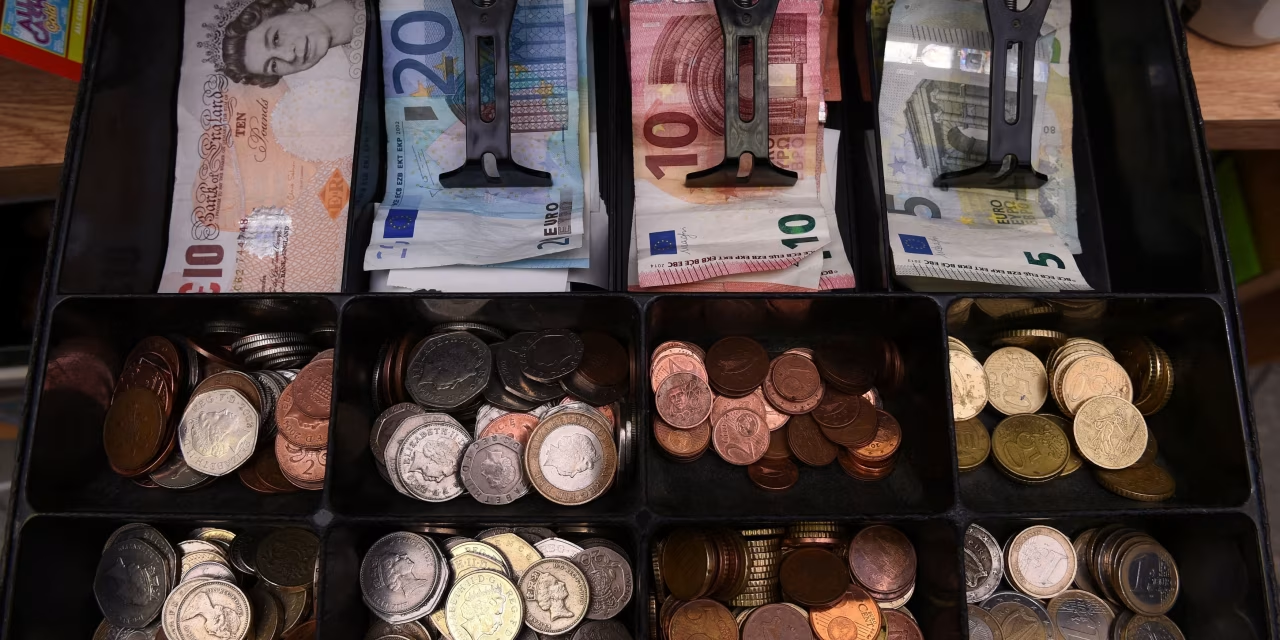
Eurozone retail sales fell unexpectedly in July, a sign that the currency area’s resilience in the face of high energy prices might be faltering even as separate figures pointed to a continued recovery in German industry.
Retail sales volumes fell by 0.6% on month compared with a 0.2% increase in June, according to data published Friday by the European Union’s statistics agency. A forecast by economists polled last week by The Wall Street Journal expected volumes to rise by 0.3%.
Copyright ©2026 Dow Jones & Company, Inc. All Rights Reserved. 87990cbe856818d5eddac44c7b1cdeb8

6 Quentin Tarantino Movies That Are 10/10, No Notes

David Valadao fights for reelection after years of defying the odds

Qualcomm: A Long-Term Play That Demands Patience (NASDAQ:QCOM)

Weekend Open Thread – Corporette.com

Weekend Open Thread: Brooks Brothers

London Mayor Sadiq Khan handed a peerage by Keir Starmer alongside 15 other Labour figures… just days before the PM leaves No10

Bitcoin Pushes for 82k! Live Trading & TA

“FINANCE EXPLAINED IN 5 MINUTES !” #trending #viral #youtuber #yt #viralvideo #youtubeshorts

XRP TURBO MODE! GLOBAL STAGE IS SET! THIS BUY SIGNAL HAS A 100% SUCCESS RATE AND IT JUST ACTIVATED!
-

 Crypto World1 day ago
Bitcoin price stalls near $82K as key resistance holds
-

 Politics1 day ago
Best Gaming Laptops, CPUs, TVs, And Keyboards To Upgrade Your Set Up For GTA VI
-

 Tech1 day ago
The Birds Outside, Drawn For You Automatically
-

 Crypto World1 day ago
IMF Says El Salvador’s Post-Review Bitcoin Purchases Used No Public Funds
-

 Crypto World1 day ago
U.S. added stronger than expected 162,000 jobs in August as labor market bounced back
-

 Sports1 day ago
Alexandre Pato consortium’s Northampton Town investment approved
-

 Sports23 hours ago
Golden Eaglets Drawn in Group B for 2026 WAFU B U17 Championship
-

 Sports1 day ago
Commanders’ Chig Okonkwo is a top breakout fantasy football candidate
-

 Crypto World23 hours ago
XRP price breaks falling channel as bulls target $1.53
-

 Fashion19 hours ago
Weekend Open Thread: Beyond Yoga
-

 Politics1 day ago
A new European chapter for Gibraltar
-

 Politics1 day ago
The House | Bin the lectures, bring gossip and be ready to banter: how the new PM should prepare for his Trump encounter
-

 Politics23 hours ago
How To Avoid Winter Colds: 4 Everyday Habits That Spread Germs, Says Pharmacist
-

 Crypto World23 hours ago
From warning to listing: UK’s largest retail investment platform opens access to crypto ETNs
-

 Tech1 day ago
A Worthy Android Ereader, With Some Tradeoffs
-

 Crypto World24 hours ago
FinCEN flags $12.7B tied to Southeast Asia crypto investment scams
-

 Crypto World24 hours ago
Trezor Data Breach Impacts 67,000 More US Customers
-

 Politics1 day ago
33 Cosy Autumn Home Decor Ideas: Blankets, Pumpkin Decorations, And Candles
-

 Sports1 day ago
Seven wickets in 21 balls: Sri Lanka’s Chamari Athapaththu scripts history with record-breaking spell
-

 Tech1 day ago
How To Edit Claude’s Memory
You must be logged in to post a comment Login