
Crypto World
Bitcoin investor recovers $4.5m after 12-year wait



A British investor has recovered 61 bitcoin worth approximately £3.3 million, or about $4.5 million, more than 12 years after losing access to the cryptocurrency.
Summary
- British investor recovered 61 BTC after proving ownership of funds held through collapsed exchange Intersango.
- His £1,500 investment produced recovered bitcoin valued around £3.3m after more than twelve years inaccessible.
- CEL Solicitors says it identified over 5,500 BTC potentially connected to other former Intersango customers.
- Claimants need historic bank statements, emails or exchange records demonstrating their individual bitcoin ownership rights.
- The law firm has not publicly disclosed the identified wallet address or complete recovery methodology yet.
The investor originally spent around £1,500, then worth about $2,000, through the early U.K. exchange Britcoin in December 2011.
The investor, identified only as “Chris,” purchased bitcoin when it traded below $4, according to the law firm that handled the recovery. Britcoin later became Intersango, which stopped providing trading services before disappearing from the internet.
Chris said his holdings were worth about £4,000 when he lost access. He had a young family and a new home at the time, making the apparent loss particularly difficult.
“The worst thing was seeing Bitcoin grow and knowing what I could have done with the money,” Chris said in an account of the recovery.
Bitcoin ownership was proved with old banking records
CEL Solicitors said it recovered the assets after combining cryptocurrency tracing technology with documents showing that Chris had purchased the bitcoin. The firm publicly announced that the case was completed in about four months without law-enforcement intervention.
Ryan Sweetnam, director of financial litigation at CEL, said the evidence included banking documents dating back almost 15 years. Other useful records can include exchange emails, account-registration messages, deposit confirmations and customer-support correspondence.
Blockchain records can identify transactions between cryptocurrency addresses, but they do not contain customers’ legal names. A transaction showing bitcoin entering an exchange wallet does not by itself establish which customer owned the corresponding account balance.
Investigators therefore need to connect on-chain transfers with off-chain evidence. Bank statements may show payments to an exchange, while emails can establish the account holder’s identity and transaction history.
CEL has not disclosed all the documents used in Chris’s case. It also has not published a court judgment, settlement agreement or detailed tracing report. The result should therefore be presented as a recovery reported by the law firm rather than one independently confirmed through public court records.
The recovered amount was 61 BTC, according to the firm and subsequent reports. Its dollar value depends on bitcoin’s price. At $76,500 per coin, the holding would be worth approximately $4.67 million, while a slightly lower reference price produces the reported $4.5 million valuation.
Intersango shut down during Bitcoin’s early years
Britcoin was among the earliest platforms allowing customers to trade bitcoin against the British pound. It was later renamed Intersango and expanded its services while the cryptocurrency market remained small and lightly regulated.
Intersango announced that it would stop U.S. dollar trading in October 2012, according to a contemporary report. Its wider services later stopped, and the platform’s website was offline by early 2014.
The exchange operated before present-day cryptocurrency custody standards became common. Customers frequently left assets in exchange-controlled wallets without the detailed statements, segregated custody arrangements or recovery procedures expected from regulated financial firms.
This meant users depended on the exchange to maintain wallet access and accurate internal account records. When an early platform disappeared, customers could retain evidence that they had deposited money without possessing the private keys controlling the resulting bitcoin.
Chris’s case concerns custodial access rather than a forgotten personal seed phrase. He reportedly bought the bitcoin through an exchange and later lost access when the platform closed. The lawyers therefore had to establish an ownership claim instead of reconstructing a lost private key.
That distinction matters. No tracing company can derive a private key from a public Bitcoin address or reverse a properly confirmed transaction. Legal recovery generally requires access to a custodian, exchange account, identifiable counterparty or person controlling the relevant assets.
The case shares some features with other failed-exchange recoveries. Former Mt. Gox customers also had to prove account balances before receiving distributions. However, Mt. Gox repayments proceeded through a formal rehabilitation process involving a court-appointed trustee.
CEL has not identified an equivalent public insolvency process behind the Intersango recovery. The firm said it reclaimed the assets without law-enforcement involvement, but it has not disclosed who transferred the bitcoin or the legal mechanism used.
Another 5,500 BTC may be connected to Intersango
CEL Solicitors said its sister company, The Crypto Tracing Experts, identified a wallet containing more than 5,500 BTC that it believes is linked to former Intersango users.
At $76,500 per bitcoin, 5,500 BTC would be worth approximately $420.75 million. At higher market prices, the valuation could exceed $430 million.
That figure does not mean CEL has recovered a $421 million pool for distribution. It represents the balance of a wallet the firm says may contain bitcoin connected to former users.
The firm has not published the wallet address. Independent analysts therefore cannot confirm its current balance, examine its complete transaction history or verify the alleged connection to Intersango.
It is also unclear who controls the wallet’s private keys. Identifying an address through blockchain analysis does not provide the ability to transfer its funds.
CEL has not disclosed how many former Intersango users may hold valid claims. The total could also include assets belonging to exchange operators, customers who later withdrew their funds or parties unrelated to the platform’s unresolved balances.
Any former user seeking recovery would need to demonstrate individual ownership. Evidence that someone once opened an Intersango account would not be enough. The claimant would also need to show deposits, purchases and a balance that remained on the platform when access ended.
The age of the records could present the largest obstacle. Banks, email providers and customers may no longer retain documents from 2011 or 2012. Account holders may also have changed names, addresses or financial institutions.
The firm’s claim that other customers could recover funds remains untested publicly. The next reliable evidence would be another completed recovery, disclosure of the wallet address or publication of court documents supporting ownership and control.
The recovery shows why custody records matter
Bitcoin’s blockchain preserves transaction records indefinitely. Investigators can still examine transfers made more than a decade ago, even after the company operating the original exchange has disappeared.
However, blockchain transparency solves only part of the problem. A claimant still needs traditional documents connecting their identity to the relevant transactions and exchange account.
The case illustrates the difference between tracing and recovery. Tracing identifies where cryptocurrency moved. Recovery requires technical access, voluntary cooperation, a legal settlement, an insolvency distribution or an enforceable court order.
Investors should remain cautious when dealing with services promising to retrieve lost cryptocurrency. A legitimate investigator cannot guarantee the recovery of assets held in a wallet whose owner is unidentified or uncooperative.
Recovery firms also do not need a customer’s seed phrase to analyze public blockchain transactions. Requests for private keys or recovery phrases can expose users to further losses.
For current holdings, self-custody removes dependence on an exchange but makes the owner responsible for protecting the keys. Multisignature arrangements can reduce reliance on one credential by requiring several approvals, as explained in crypto.news’ guide to securing cryptocurrency with multisignature wallets.
Chris said he plans to use part of the recovered value to help his family, including buying a larger home and helping his son repay housing debt. He also intends to retain some bitcoin.
“I want to keep some Bitcoin to see if the value rises again,” he said. He added that price declines and theft remain concerns. Any future increase in value remains uncertain.
No formal deadline has been announced for former Intersango users to submit records. There is also no published distribution timetable for the 5,500 BTC that CEL says it traced.
For now, the completed 61 BTC recovery stands as evidence that some old custodial claims can be resolved when transaction data and ownership records survive. It does not establish that all former Intersango customers will recover their holdings.

Solana attracted approximately $348 million in net real-world asset flows over the latest 30-day period, placing it ahead of other tracked blockchain distribution networks.
Summary
- Solana attracted $348 million in net distributed RWA flows during the latest thirty-day measurement period.
- Network distributed RWA value reached roughly $4.23 billion as tracked holder addresses climbed to 398,644.
- Solana hosted tokenized products from BlackRock, Franklin Templeton, VanEck, Circle, Ondo and WisdomTree by September.
- RWA net flows measure asset value changes and transfers rather than blockchain transaction volume alone.
- Ethereum and Stellar posted smaller thirty-day increases while Avalanche and XRP Ledger declined over period.
The increase lifted the value of distributed RWAs on Solana to about $4.23 billion.The RWA Foundation published the figure on Sept. 5 using data from analytics platform RWA.xyz. “Solana is leading the pack,” the organization said in its official post, adding that the network recorded the largest net increase during the period.
The figures cover distributed real-world assets. These are tokenized financial products that investors can subscribe to, hold or transfer through blockchain wallets and approved custodians. They do not represent the total value of every asset referenced by a tokenization platform.
Solana RWA flows outpaced competing networks
Solana’s distributed RWA value increased by 11.13% over 30 days, according to the dataset cited by the RWA Foundation. Ethereum recorded a 0.77% increase, while Stellar rose 5.22%.
The XRP Ledger and Avalanche moved in the opposite direction. Their tracked totals declined by 5.51% and 14.06%, respectively. These changes can reflect subscriptions, redemptions, transfers between networks and movements in the reported value of underlying assets.
Net flows should not be confused with transaction volume. The $348 million figure does not mean investors traded exactly $348 million of tokenized assets on Solana during the month. It represents the net change attributed to assets distributed on the network after inflows and outflows.
The calculation also differs from total value locked in decentralized finance. DeFi TVL generally tracks crypto deposited into lending, trading and staking applications. RWA figures focus on tokens linked to off-chain financial instruments such as government bonds, private credit, investment funds and equities.
RWA.xyz’s distributed asset category also requires a different reading from represented asset value. A token could provide access to a much larger off-chain portfolio while only a portion of its supply circulates on a specific blockchain.
U.S. Treasury products form a large part of Solana’s RWA market
Solana’s RWA expansion has been supported by tokenized U.S. Treasury and money market products. These instruments allow eligible investors to hold blockchain-based tokens representing interests in regulated funds, Treasury-backed notes or other cash-management products.
BlackRock’s BUIDL fund expanded to Solana through Securitize in March 2025. BUIDL invests in cash, U.S. Treasury bills and repurchase agreements. A dedicated Solana share class gives eligible investors blockchain-based access to the fund while Securitize manages tokenization and transfer infrastructure.
Securitize confirmed the deployment through its official announcement. Solana later reported that the BUIDL share class held more than $550 million on the network by February 2026.
Franklin Templeton’s BENJI token is also available on Solana. BENJI represents shares in the Franklin OnChain U.S. Government Money Fund, which invests at least 99.5% of its assets in government securities, cash and fully collateralized repurchase agreements.
The asset manager’s official platform confirms that Solana support began in February 2025. Franklin Templeton reported $753.24 million in total net assets for the fund as of June 30, although that figure covers the entire fund across supported networks rather than its Solana allocation alone.
VanEck’s VBILL provides another Treasury-linked product. It launched across Solana, Ethereum, Avalanche and BNB Chain through Securitize in May 2025. The product invests in short-term U.S. government obligations and uses blockchain infrastructure for ownership records and transfers.
Ondo and WisdomTree widened available RWA products
Ondo Finance operates the USDY and OUSG products on Solana. USDY is a tokenized note backed by short-term U.S. Treasuries and bank deposits. It is primarily available to eligible investors outside the U.S.
OUSG provides exposure to short-term U.S. government securities through a portfolio that includes tokenized investment funds. Ondo’s official page states that the product supports continuous minting and redemptions, including outside conventional banking hours.
The company also launched hundreds of tokenized U.S. stocks and exchange-traded funds on Solana in January 2026. The products provide economic exposure to underlying securities but are structured for eligible non-U.S. investors rather than as ordinary shares registered directly to token holders.
The launch broadened Solana’s RWA market beyond Treasury products. It also introduced assets whose value can change with public equity prices, meaning an increase in reported RWA value does not always represent new investor capital.
WisdomTree added another institutional distribution channel in January. The asset manager made its tokenized funds available for direct minting on Solana through its WisdomTree Connect platform.
The integration allows eligible institutional clients to purchase, hold and manage tokenized fund positions on the network. It also permits supported assets to move into compatible decentralized applications, subject to the issuer’s compliance requirements.
Solana’s RWA total does not include unrestricted ownership
Tokenized RWAs frequently contain investor eligibility and transfer controls. A public blockchain may record balances and transfers, but that does not mean every wallet can buy or redeem each product.
Treasury and money market tokens can require identity verification, jurisdictional screening or minimum investments. Issuers can also restrict transfers to approved addresses and freeze tokens when required by their product terms or applicable law.
This structure separates institutional RWAs from permissionless crypto assets such as SOL. Solana supplies the settlement and distribution network, while regulated issuers, transfer agents, custodians and fund administrators remain responsible for the underlying products.
It also means the $4.23 billion figure is not Solana protocol revenue or capital controlled by the Solana Foundation. The value belongs to investors in products issued by separate financial institutions.
Crypto.news previously reported that the wider tokenized RWA market had reached approximately $38.1 billion by Aug. 9 as projects moved hundreds of millions of dollars in physical assets onchain. Solana’s reported total represents one portion of that market.
The network’s growth also fits a wider shift from primarily speculative activity toward tokenized financial infrastructure. This transition has included institutional products moving onto public blockchains, although adoption remains dependent on regulation, liquidity and investor access.
New issuance will determine whether the inflows continue
Solana can extend its RWA growth if issuers place additional fund shares on the network or investors increase subscriptions to existing products. Redemptions or transfers to competing blockchains would reduce the total.
The next RWA.xyz updates will show whether the $348 million increase represented a sustained trend or a concentrated period of issuance. Product-level changes will also help identify which funds contributed most to the rise.
Any direct connection between the RWA inflows and SOL’s market price would be speculative without supporting trading data. Tokenized products may use Solana for settlement while investors pay network fees amounting to only a small portion of the assets’ underlying value.
The more relevant measure is whether tokenized assets remain on Solana, gain additional holders and develop active secondary or collateral markets. Those factors would show whether the latest inflows are translating into continued blockchain use rather than a temporary balance increase.
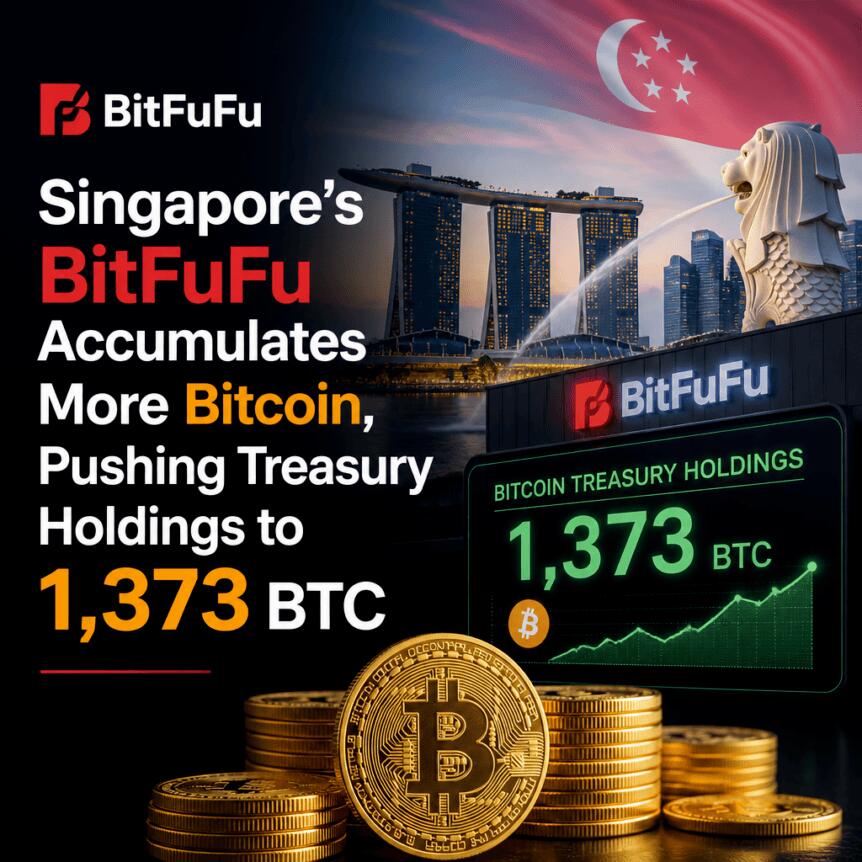
Singapore-based Bitcoin mining company BitFuFu has increased its Bitcoin treasury to 1,373 BTC, highlighting a renewed focus on holding the digital asset even as the miner continues to navigate weaker mining economics and pressure on revenue.
The latest accumulation marks a notable shift from periods when the company sold part of its Bitcoin reserves to finance operations and expand mining capacity. BitFuFu’s recent financial performance has underscored the challenges facing miners as Bitcoin prices, network difficulty, and demand for cloud-mining services affect profitability.
Key Takeaways
- BitFuFu’s Bitcoin treasury has reached 1,373 BTC.
- The company previously used Bitcoin sales to support operations and procure additional mining capacity.
- Second-quarter revenue fell 62.9% year over year to $42.8 million.
- BitFuFu has been rebuilding its managed hashrate after significantly reducing capacity earlier in the year.
Bitcoin Treasury Takes Greater Importance
BitFuFu’s treasury strategy has evolved alongside its mining operations. In May 2025, the company held 1,709 BTC after selling 178 BTC during Bitcoin’s then-record price levels.
CEO Leo Lu said the sales were part of a broader effort to manage liquidity while maintaining the company’s long-term exposure to Bitcoin.
“With a more constructive Bitcoin market environment and a significantly expanded operating base, we are well positioned to capture improving market opportunities in the months ahead.”
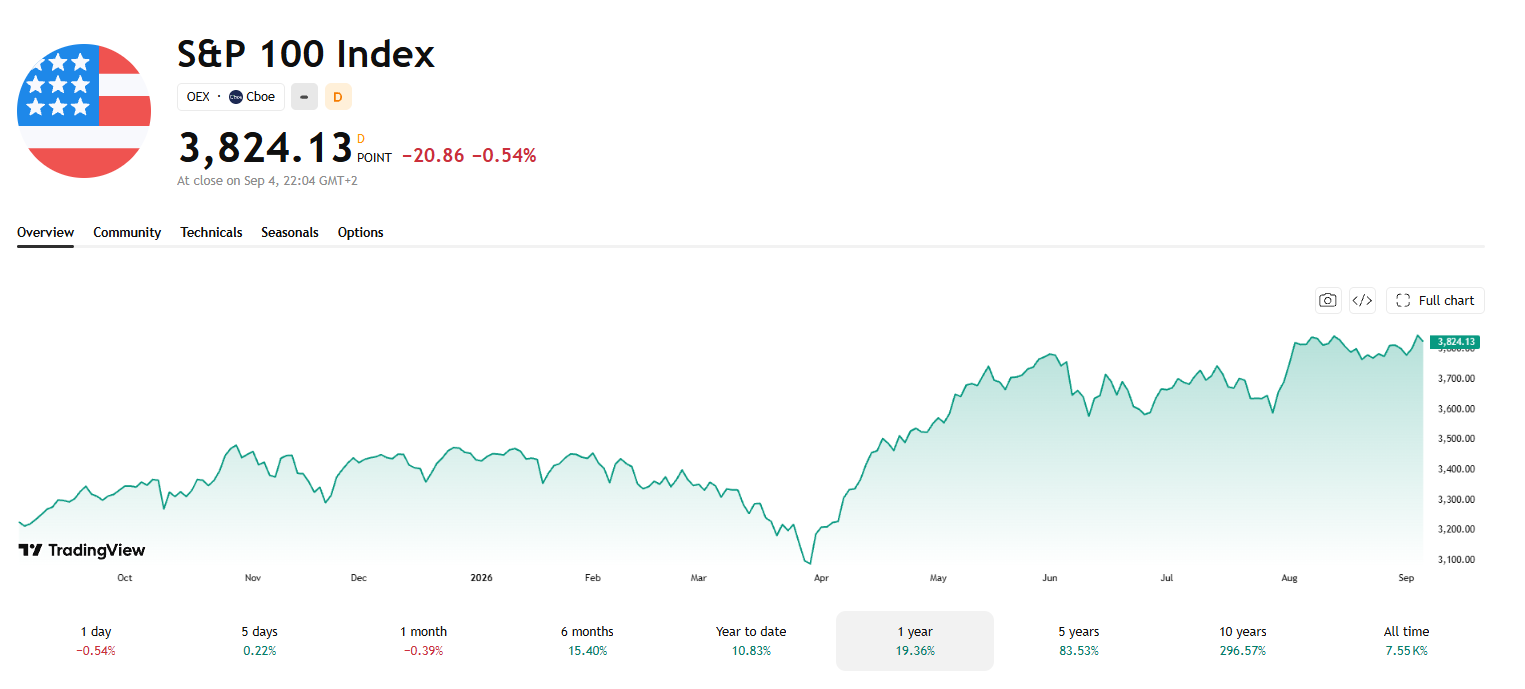
Nike leaves the S&P 100 on September 21, and four technology companies take its place. Dell Technologies, Palo Alto Networks, Arista Networks and SanDisk all move up from the wider S&P 500.
S&P Dow Jones Indices confirmed the changes in its quarterly rebalance. Nike keeps its S&P 500 membership, but it drops out of the 100 largest US companies.
Four Tech Names Take the Open Seats
Nike is not the only exit. Honeywell Aerospace, Simon Property Group and Colgate-Palmolive also leave on the same date. Every replacement, however, comes from the information technology sector.
The index now leans more heavily toward chips, cloud hardware, and cybersecurity.
Arista sells the switches that connect AI data centers. SanDisk, spun out of Western Digital last year, makes flash memory.
Palo Alto Networks chief executive Nikesh Arora recently argued that the AI spending wave demands a new AI security stack. Dell rounds out the group. All four ride the capital spending boom behind this year’s record highs.
The S&P 100 holds the largest and most established members of the S&P 500. Funds that track it must now buy the newcomers and sell the leavers. SanDisk shares jumped on the news.
Bloom Energy, Illumina and Everpure join the S&P 500 the same morning.

Why Nike Lost Its S&P 100 Spot
The math is brutal. Nike closed at $38.40 on Friday, its weakest level in 12 years. The stock has lost about half its value in a year and roughly 76% over five years.
Market value tells the same story. Nike is worth close to $57 billion today, down from about $264 billion at the end of 2021. The S&P 100 gained 83% over those same 5 years.

Crypto traders have watched the slide closely, because Nike has fallen further than Bitcoin since 2021. Strategy even launched $250 Bitcoin Jordans last week, although buyers cannot pay in crypto.
Nike still sells far more sneakers than SanDisk sells memory chips. Investors, however, pay for growth. Today they pay for tech.
The post Nike Exits the S&P 100 Index. 4 Tech Stocks Move In appeared first on BeInCrypto.
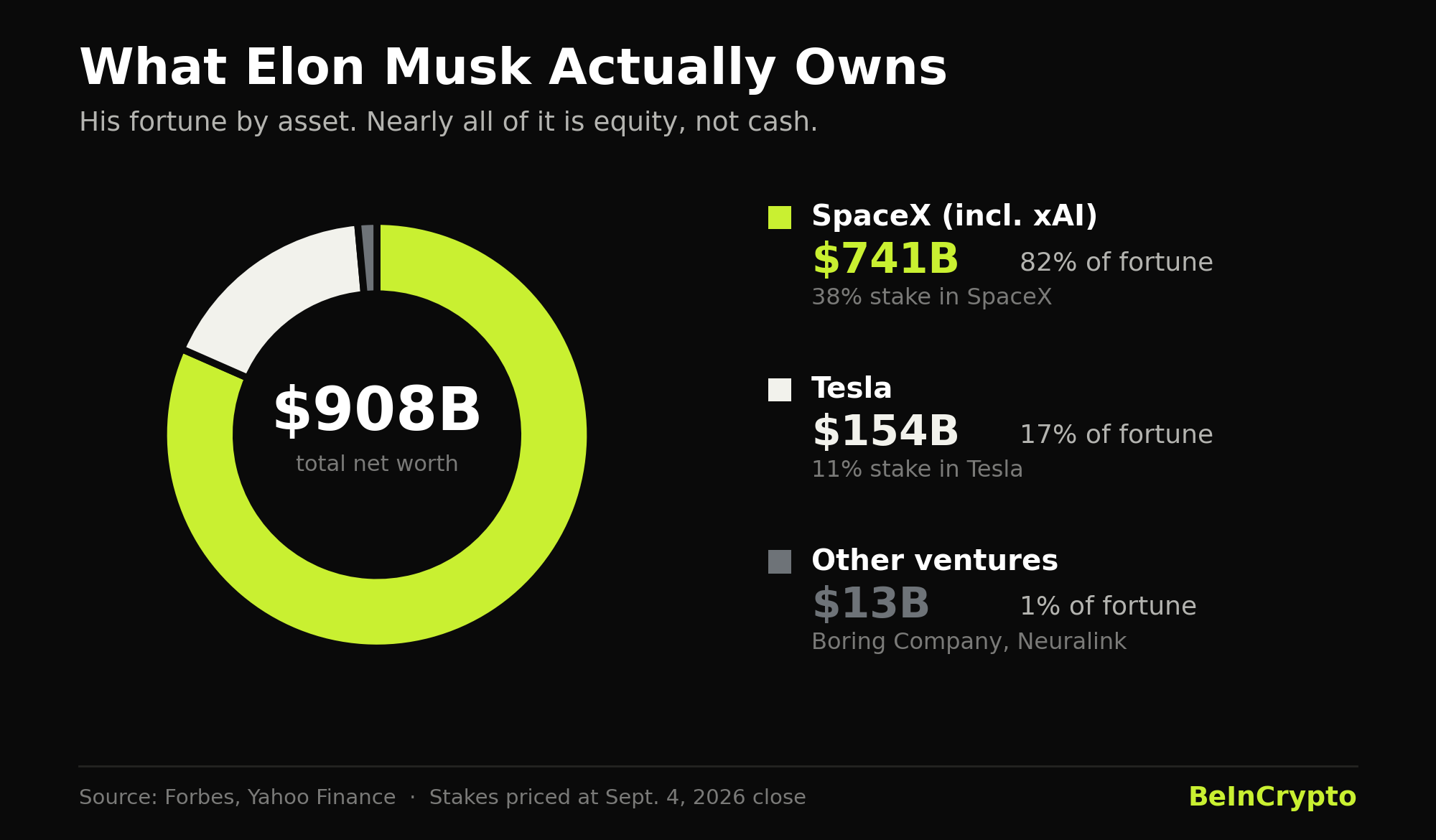
Elon Musk defended his wealth against Senator Bernie Sanders, saying his money sits in SpaceX and Tesla stock rather than in a cash hoard.
Sanders mentioned that Musk owns more wealth than the bottom half of American households. This reflects his democratic socialist philosophy of raising taxes on the rich, a stance that is becoming increasingly popular in America with the rise of political figures like Zohran Mamdani and Abdul El-Sayed.
Sanders has spent 2026 pushing for a tax increase on AI giants that would seed a $7 trillion public fund.
Musk’s argument rests on a second point. Share prices climb as the two companies deliver more, so every holder gains, including the pension and retirement funds that own the stock.

A Paper Fortune That Moves Every Day
The numbers behind the argument shift constantly. Forbes currently values Musk at about $908 billion, down from roughly $1.1 trillion in June.
That June peak briefly made him the world’s first trillionaire. His fortune then slipped below $700 billion in July, before Tesla and SpaceX shares rebounded through August.
SpaceX has traded on the Nasdaq under the ticker SPCX since its June listing at $135 a share. As a result, SpaceX revenue forecasts and Tesla delivery numbers now reprice Musk’s net worth every session.
Neither man, however, controls the number they are fighting over. Traders reset it every session, long after the posts stop trending.
The post Elon Musk Fires Back at Bernie Sanders Over His $900 Billion Fortune appeared first on BeInCrypto.
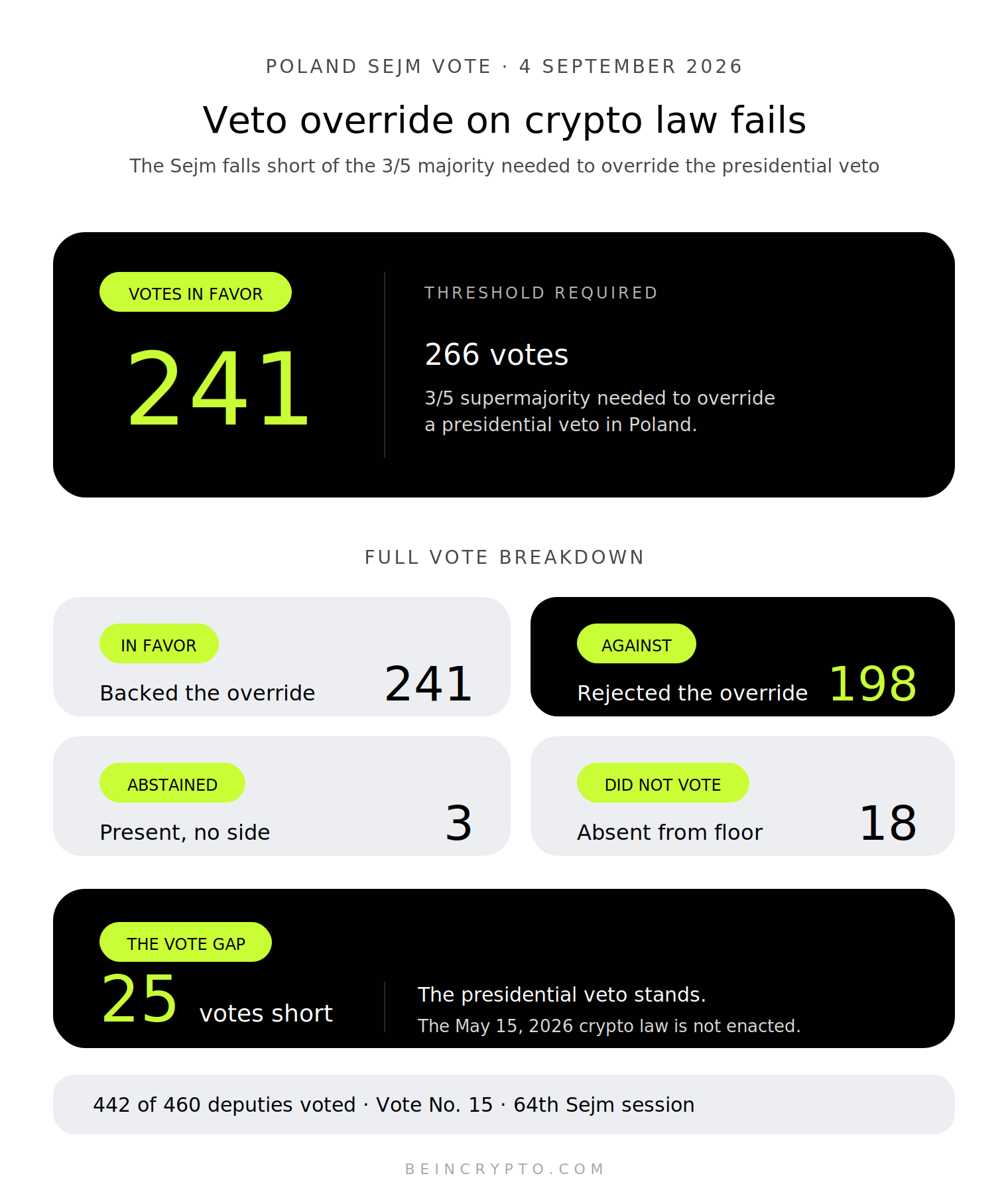
Poland remains the only EU member state without a functioning national framework for MiCA, after the Sejm again failed to override President Karol Nawrocki’s veto of crypto regulation.
Friday’s vote, the third such attempt, fell 25 votes short of the three-fifths majority required to reverse his decision.
Inside Poland’s Third Crypto Veto and Nawrocki’s Reasoning
Of 442 lawmakers present, 241 voted to override the veto, 198 opposed the motion, and three abstained, falling short of the 266 votes needed. Nawrocki first vetoed the legislation in December, then again in an earlier version, before rejecting it a third time on June 11.
At that rejection, Nawrocki argued lawmakers had addressed only one of sixteen changes his office proposed. Bad law does not become good law simply because it passes a hundred times, he said in his statement.
Follow us on X to get the latest news as it happens.

The bill would have designated Poland’s Financial Supervision Authority, known as KNF, as the country’s official crypto regulator, aligning domestic rules with the EU’s Markets in Crypto-Assets (MiCA) Regulation. All EU member states were required to implement MiCA by July 2026, a deadline Poland has now missed entirely.
The regulatory standoff plays out against a deepening criminal investigation into Zondacrypto, the exchange formerly known as BitBay.
Prosecutors have tied the case to the 2022 disappearance of BitBay founder Sylwester Suszek and estimate investor losses at no less than 350 million zlotys, roughly $95 million.
“First, PiS defended President Nawrocki’s successive vetoes that prevented the regulation of the crypto market. Then, for weeks, it hypocritically accused the state of failing to protect Poles.Today they once again had a choice: the safety of Poles or the shady interests of the crypto business.They chose. Crypto silver coins.To be continued. #KryptoAferaPiS,” Andrzej Domański, Minister of Finance and Economy of Poland, said on X.
The Zondacrypto Case Adds Political Weight
The scandal has reached deep into Polish public life. Olympic Committee President Radosław Piesiewicz was reportedly detained on allegations of ties to Zondacrypto founder Przemysław Kral.
Zondacrypto’s Estonian operator, BB Trade Estonia, was declared bankrupt in August, with creditors set to meet on September 17.
Prime Minister Donald Tusk has repeatedly invoked the investigation while pushing lawmakers to pass the legislation, arguing that stronger oversight could have prevented the alleged fraud. Nawrocki maintains that expanded powers, including authority to block websites, would push legitimate firms abroad rather than protect consumers.
The override failed, so the veto remains legally in force. Polish crypto firms now face continued uncertainty over licensing and enforcement. KNF has publicly acknowledged that the country still lacks any designated authority for the sector. MiCA, meanwhile, already applies EU-wide.
Whether a revised bill can eventually pass remains the central question. That outcome depends on addressing more of Nawrocki’s specific objections, shaping Poland’s crypto policy heading into the fall.
Subscribe to our YouTube channel to watch leaders and journalists provide expert insights.
The post Poland's Crypto Law Fails a Third Time, Leaving the Only Gap in Europe appeared first on BeInCrypto.
Chilean crypto exchange Orionx began permanently closing its operations on Sept. 3 after a forensic audit identified a custody shortfall exceeding $7 million.
Summary
- Orionx began permanently closing after an audit found over $7 million missing from custodial wallets.
- Customer withdrawals remain suspended while Orionx calculates balances and prepares its planned asset restitution process.
- Chile’s financial regulator rejected Orionx’s authorization application in June and never supervised the platform’s activities.
- Orionx filed a criminal complaint against two cofounders who have categorically denied the company’s allegations.
- Tether led Orionx’s Series A financing in June 2025, fifteen months before the closure announcement.
The company suspended customer withdrawals and said it could not guarantee that every client would recover 100% of their assets.
The exchange said the audit found transactions that moved assets under its custody to wallets it did not control. Orionx has filed a criminal complaint with Chilean prosecutors and launched a restitution process intended to return as much as possible to customers.
The allegations have not been proven in court. The two former executives named in the complaint have denied wrongdoing and said the cause of the shortfall remains unresolved.
Orionx audit found four affected crypto assets
Orionx announced the closure through its website and official account. It described the decision as definitive and warned customers about potential impersonation attempts during the closure.
The exchange said it would never request private keys, two-factor authentication codes or transfers by telephone, WhatsApp, email or social media. The warning is relevant because customers waiting to recover funds can become targets for phishing and fraudulent recovery services.
According to information Orionx provided to clients, the shortfall affects Bitcoin, Ether, XRP and Polygon balances. These assets appeared as available in Orionx’s internal records but could not be fully verified at addresses controlled by the company.
A comparison of company records and blockchain data found that the recorded customer balances exceeded the assets held in Orionx’s custody wallets. The audit therefore identified a balance-sheet and custody mismatch rather than a reported compromise of the four blockchain networks.
However, Orionx has not published the affected wallet addresses, complete transaction hashes or a breakdown of the shortfall by asset. Independent blockchain researchers consequently cannot yet verify the company’s full calculation.
The exchange also has not provided an exact number of affected customers. Its disclosure does not establish how much of the $7 million may be recovered from external wallets, exchanges or individuals named in the legal proceedings.
Criminal complaint names two Orionx cofounders
Orionx submitted a criminal complaint on Sept. 2 against former general manager Roberto Zibert and former technology manager Joaquín Díaz. Both helped establish the exchange and allegedly had privileged access to its cryptocurrency custody systems.
The complaint accuses them of alleged unfair administration and asks prosecutors to investigate any other offenses supported by the evidence. Local business newspaper Diario Financiero reported that a forensic examination linked the custody mismatch to wallets outside Orionx’s control.
Details reported by La Tercera place the questioned transactions between 2018 and 2021. Other local reporting says the largest group of transfers may have occurred during 2021 and 2022. That timing remains an allegation drawn from the complaint, not a judicial finding.
The filing reportedly claims that an account associated with Díaz received more than $1.5 million through 14 transfers. It also identifies another wallet that allegedly received 187 ETH, more than 4.1 million USDT and 200,000 USDC from Orionx-related addresses.
Those figures require examination by prosecutors and the court. A transfer into an address does not, by itself, establish who controlled the wallet at the time or whether a crime occurred.
Zibert and Díaz have “categorically rejected” the accusations. In a joint response reported by Chilevisión, they said they never acted against customer interests.
Their statement added that the cause of the custody deficit had not been established. Neither former executive has been convicted, and the complaint begins an investigative process rather than proving Orionx’s claims.
Chilean regulator cannot order customer repayments
Chile’s Financial Market Commission clarified on Sept. 4 that Orionx was neither registered nor authorized under the country’s Fintech Law. The regulator said it did not supervise Orionx’s activities and does not control its closure.
The official statement also disclosed that the commission rejected Orionx’s registration and authorization application on June 19. Until that rejection, the exchange had operated under a transitional arrangement available to companies awaiting licensing decisions.
After the application was rejected, Orionx could only conclude existing operations. It could not enter into new regulated transactions under the transitional regime and had to explain the wind-down process to customers.
The commission also said Orionx had not demonstrated that it held the guarantees required from authorized financial service providers. This does not prove the alleged custody misconduct, but it affects the legal protections available during the closure.
Although Orionx told customers that it had notified the relevant authority about its closure plan, the commission stressed that it neither approved nor supervises that plan. It also lacks authority to direct Orionx to return customer assets.
The regulator advised customers to contact the company directly and preserve account statements, transaction records and communications. Customers can pursue claims through Chilean courts or provide evidence to prosecutors if they believe a crime occurred.
Tether invested in Orionx 15 months before closure
Tether led Orionx’s Series A financing in June 2025 as part of a strategy to expand stablecoin infrastructure across Latin America. Neither company publicly disclosed the investment’s value or Tether’s ownership percentage.
At the time, the companies said the financing would support remittances, payment collection and corporate treasury services in Chile, Peru, Mexico and Colombia. The investment was presented as a way to expand digital financial access across the region.
Crypto.news reported that the deal gave Tether exposure to a Chilean exchange offering services across four Latin American markets. The announcement described how the funding would support Orionx’s regional payments and stablecoin expansion.
Tether’s original announcement is no longer available at its former website address, although an archived copy remains accessible. Its removal does not establish when or why Tether took the page offline.
Tether has not publicly said whether it retained its investment when Orionx announced the closure. It has also not disclosed whether it held board rights, received financial reports or participated in custody oversight.
The stablecoin issuer continued investing in regulated and licensed companies elsewhere. Its later Latin American expansion included a minority investment in Bit2Me, part of a broader pattern of Tether-backed regional financial infrastructure deals.
Customers face an uncertain restitution process
Orionx said its first closure phase is underway, but it has not published a repayment calendar. Withdrawals remain suspended to prevent some customers from recovering assets ahead of others while account balances are reviewed.
The exchange said its priority is to return “the greatest possible amount” of customer assets. That wording confirms that full repayment is uncertain. It should not be interpreted as a commitment to make every customer whole.
The next verifiable developments will come from Orionx’s customer notices, Chilean prosecutorial actions and any court decisions affecting the disputed wallets. Publication of transaction hashes would also allow independent researchers to evaluate the alleged asset movements.
Customers will need individual balance confirmations before Orionx can determine their share of available assets. Recovery could also depend on whether prosecutors locate funds at other exchanges or obtain orders freezing wallets linked to the disputed transfers.
Bitwise’s Hyperliquid exchange-traded fund resumed accumulating HYPE on Sept. 4 after four days without a tracked purchase.
Summary
- Arkham tracked Bitwise-linked wallets purchasing approximately $10.5 million in HYPE after four inactive trading days.
- BHYP’s tracked HYPE purchases reached $166.3 million since launch, according to Arkham’s on-chain address attribution.
- Friday’s allocation was the fund’s largest tracked purchase since buying $23.2 million on August 27.
- Bitwise launched BHYP on NYSE Arca in May, providing direct exposure to the HYPE token.
- The trust uses Anchorage Digital Bank for custody and targets staking 70% of its assets.
Wallets linked to the fund acquired approximately $10.5 million of the token, according to blockchain intelligence platform Arkham.
The allocation was BHYP’s largest tracked purchase since a $23.2 million transaction on Aug. 27, Arkham reported on Sept. 6. The platform estimates that Bitwise-linked addresses have accumulated about $166.3 million in HYPE since the product launched.
Arkham described BHYP as the “largest HYPE ETF.” That ranking relies on addresses identified by its analysts and the market value of tokens attributed to each product. Bitwise has not issued a matching announcement confirming the $166.3 million figure.
Bitwise HYPE ETF resumed buying after four inactive days
The $10.5 million transaction ended the longest recent gap in BHYP-linked accumulation reported by Arkham. However, the movement should not automatically be interpreted as one investor purchasing $10.5 million of fund shares.
Exchange-traded crypto products create and redeem shares through authorized participants. The trust may receive cash or tokens as part of that process, depending on its operating structure. Its HYPE acquisitions can therefore reflect net share creations, liquidity management or settlement activity involving several investors.
Blockchain data can identify transfers between labeled addresses. It cannot always reveal the commercial purpose of every transfer. Address ownership may also change, while internal custody movements can resemble purchases unless analysts identify the sending address and transaction route.
Arkham’s figures should consequently be treated as third-party estimates rather than audited fund-flow data. The reported four-day pause refers to activity involving wallets recognized by Arkham. It does not prove that the fund received no investor orders during that period.
Official filings confirm BHYP holds HYPE directly
Bitwise announced BHYP in May as a U.S.-listed product designed to hold HYPE rather than derivatives tracking its price. The fund began trading on NYSE Arca on May 15 after commencing operations one day earlier.
Its SEC registration documents state that the trust primarily seeks to reflect the value of its HYPE holdings, minus operating expenses and liabilities. Bitwise markets the vehicle as an ETF, while its regulatory documents describe it as a Delaware statutory trust issuing exchange-traded shares.
The structure gives brokerage customers regulated exposure to HYPE without requiring them to maintain a crypto wallet or interact directly with Hyperliquid. Investors still face the token’s price risk, fund expenses, potential tracking differences and risks associated with crypto custody.
BHYP’s quarterly report names Anchorage Digital Bank as the trust’s HYPE custodian. The filing also confirms that part of the fund’s holdings can be staked to generate rewards.
Bitwise’s fund website lists a target of staking 70% of the trust’s assets. The BHYP product page reported a 2.25% gross staking reward rate and a 1.18% net rate in early September. Those rates can change and do not represent guaranteed returns.
The $166 million ranking depends on wallet attribution
Arkham’s description of BHYP as the largest HYPE ETF is broadly consistent with the fund’s strong early demand. Still, the $166.3 million estimate should not be presented as official assets under management unless Bitwise publishes an equivalent figure.
Tracked token value can differ from a fund’s net assets. An ETF’s reported net asset value incorporates liabilities, cash, accrued fees and other accounting items. The dollar value of an identified wallet also moves continuously with HYPE’s market price.
Comparisons between HYPE products require consistent timestamps and valuation methods. Bitwise competes with products from 21Shares and Grayscale, among others. Grayscale prepared a fund carrying the HYPG ticker and a proposed 0.29% fee, according to coverage of the expanding HYPE ETF market.
BHYP attracted substantial demand soon after launching. Bitwise CEO Hunter Horsley reported approximately $19 million in daily inflows during May, when the fund recorded its strongest session at that time. That inflow helped BHYP take an early lead among HYPE products, as crypto.news reported.
HYPE-linked products collectively surpassed $100 million in reported inflows during their first ten trading sessions. The early total showed that regulated funds were becoming a measurable source of token demand, according to related coverage of institutional HYPE purchases.
ETF purchases are separate from Hyperliquid’s buybacks
BHYP’s purchases form only one part of HYPE’s demand structure. Hyperliquid also operates a protocol mechanism that uses revenue from trading fees to acquire HYPE through its Assistance Fund.
Those purchases are not ETF inflows. They originate from activity on Hyperliquid’s trading platform and continue according to the protocol’s fee-allocation rules. Combining them with BHYP’s activity would overstate demand from investment products.
Hyperliquid had used more than $1.16 billion in fee revenue for HYPE purchases by late May, according to reporting on its automated buyback mechanism. The mechanism links HYPE demand to platform revenue, while ETF buying depends on investor creations and redemptions.
Bitwise has created another, smaller connection between its business and the token. The manager pledged to use 10% of BHYP’s management fees to purchase and hold HYPE on its corporate balance sheet. Those purchases belong to Bitwise rather than the ETF trust, making them distinct from the assets backing BHYP shares. The management-fee commitment therefore should not be counted as fund holdings.
What the next disclosures can confirm
Bitwise’s official holdings, net asset value and shares outstanding offer the clearest way to test Arkham’s estimate. Changes in those figures can show whether the reported wallet accumulation corresponded with new ETF share creation.
Later SEC reports will provide audited or reviewed accounting information, although quarterly filings arrive after the transactions they cover. Daily fund disclosures may provide more current figures, but they can use valuation times that differ from Arkham’s live blockchain calculations.
Investors should also watch for revisions to Arkham’s address labels. A custody transfer, staking movement or newly identified address could change the platform’s estimate without representing fresh investor demand.
No evidence presented by Arkham establishes that the $10.5 million purchase caused a particular movement in HYPE’s price. Token prices respond simultaneously to broader crypto conditions, derivatives positioning, protocol buybacks and trading activity. Any claim assigning a specific price move to BHYP alone would remain speculative.
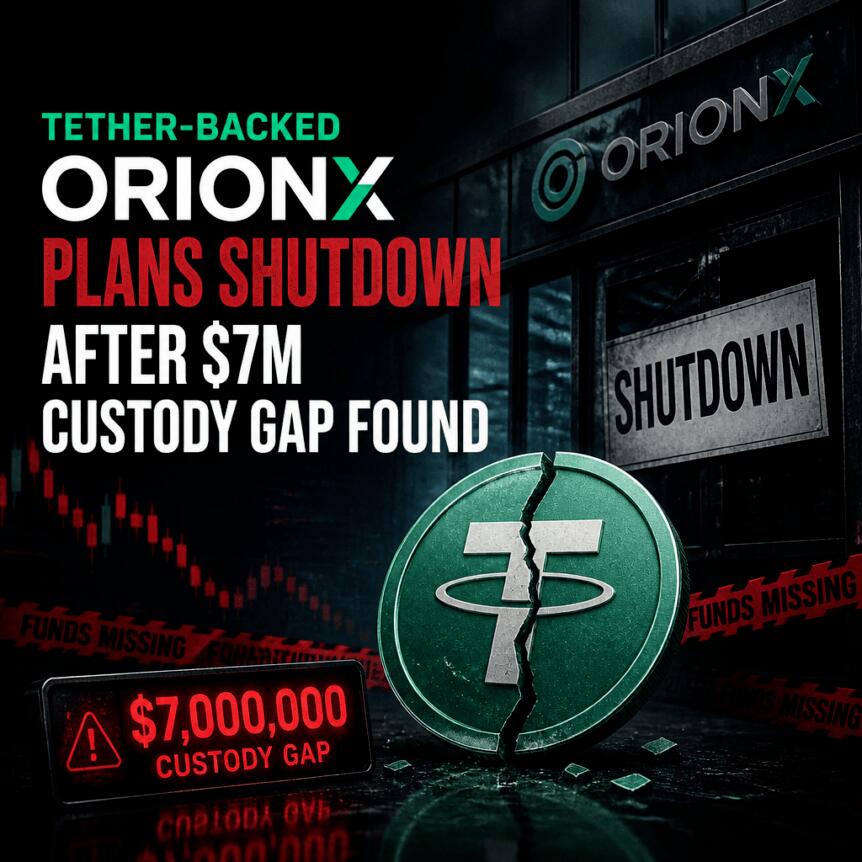
Orionx, a Chilean cryptocurrency exchange backed by Tether, is shutting down after discovering a custodial shortfall that Orionx says is tied to assets leaving wallets the exchange did not manage. The company said it has started a permanent closure process and is temporarily suspending withdrawals while it works to return funds to clients.
In a statement posted on X, Orionx said a forensic audit found that more than $7 million in custodial assets recorded in the exchange’s systems had moved to wallets not controlled by Orionx. “Our sole priority now is to return as much of our clients’ assets as possible,” the exchange said.
Key takeaways
- Orionx began permanent closure after a forensic review identified a custody mismatch involving over $7 million.
- Withdrawals are temporarily suspended as the exchange moves to return client assets.
- The company did not disclose when the transfers occurred, but a criminal complaint referenced activity between 2018 and 2021.
- Orionx accused former co-founders of alleged access to custody systems and denied wrongdoing by the accused parties.
- Tether led Orionx’s Series A in June 2025, underscoring how quickly the fallout can arrive even after major investment.
A custody mismatch triggers a shutdown
Orionx’s announcement did not provide specifics on the timing of the discrepancy or how the issue was first uncovered. However, the exchange said it initiated a permanent closure process following forensic findings that compared Orionx’s internal records with onchain data linked to its custody addresses.
The external audit, according to reporting cited in a criminal complaint, concluded that balances maintained in Orionx’s systems exceeded the assets actually held at the custody addresses for several cryptocurrencies, including Bitcoin (BTC), Ether (ETH), XRP, and Polygon (POL). Orionx said these funds had been moved to wallets it did not manage.
For customers, the practical impact is immediate: withdrawals are currently paused while Orionx attempts to reconcile records and return what it can. The lack of disclosed timing in the company’s public post also leaves outside observers with an incomplete picture of when customers may have been most exposed to the custody gap.
What Orionx says it found, and what remains unclear
According to Orionx and related reporting, the exchange’s review started in the context of compliance efforts tied to Chile’s Fintech Law. Orionx reportedly carried out an internal operational review in 2025 and brought in financial professionals, as described by La Tercera, citing the company’s criminal complaint.
La Tercera reported that on Aug. 27 Orionx’s chief operating officer, Thomas Mac Millan, identified what the complaint describes as a “significant mismatch” between what Orionx’s systems recorded and what was actually held in custody. After that internal review, Orionx commissioned a forensic audit that compared operational records against data verifiable onchain.
The criminal complaint, as reported, alleges that assets were transferred out of Orionx’s custody between 2018 and 2021, including to accounts on other crypto platforms. Despite that window being referenced in the complaint, Orionx’s public closure announcement did not confirm when the discrepancy occurred or whether all of the alleged transfers align with the full value of the shortfall ultimately identified.
Criminal complaint against former co-founders
Orionx said it filed a criminal complaint on Wednesday against former executives Roberto Zibert and Joaquín Díaz, both described as co-founders who allegedly had access to the custody systems. The company’s allegations center on transfers tied to wallets not controlled by Orionx.
La Tercera reported that the complaint alleges an account associated with Díaz received more than $1.5 million across 14 transfers. It also reported that another wallet allegedly received 187 Ether, more than 4.1 million USDt (USDT), and 200,000 USDC from Orionx.
Zibert and Díaz denied the accusations. According to La Cuarta, they said they never acted against customers’ interests and argued that the cause of the asset shortfall remains unclear. The denial adds a key uncertainty for clients and observers: even if custody mismatches are documented, disputes over responsibility and intent can complicate timelines for recovery and any eventual legal resolution.
Tether’s 2025 backing and the speed of disruption
Orionx was founded in Chile in 2017 and expanded from a retail crypto exchange into a broader platform offering crypto payment and financial services across Chile, Peru, Colombia, and Mexico.
In June 2025, Tether led Orionx’s Series A funding round, described in a Tether announcement that is now available only via an archived link. The exchange’s Series A was positioned by Tether as part of an effort to expand digital-asset adoption in Latin America.
As of publication, Cointelegraph reported that it contacted both Tether and Orionx for comment but had not received a response.
The episode highlights a broader reality for investors and users: even where a major stablecoin issuer participates in funding, due diligence on operational custody processes must remain a continuous effort rather than a one-time milestone. Orionx’s shutdown, coming only about a year after the Series A, also raises questions about how custody controls evolve after an investment round and what auditing mechanisms—internal or external—are in place during periods of growth.
For clients, the next steps will likely hinge on how Orionx conducts reconciliations and whether it can identify recoverable assets tied to custody mismatches. Readers should watch for updates on the scope of the recovered funds, the timing of the alleged transfers, and how the criminal case progresses—especially given the accused parties’ claim that the root cause of the shortfall is not established.
As with most previous weekends, this one is also quite sluggish for bitcoin, which continues to fight for $80,000 without making any major moves.
The same cannot be said for some altcoins, though. ZEC, for example, has skyrocketed by 17% daily, while ARB has stolen the show with a massive 42% surge.
BTC Fights for $80K
The primary cryptocurrency closed August (on Monday) in the green for the first time in a bear market, surging by over 25% for the month. This came even after its early Monday retracement from $79,000 to $77,000 as the US and Iran resumed the strikes against each other.
Bitcoin rebounded to $79,000 rather quickly, but it was rejected on Tuesday and driven south to under $76,500 by Wednesday. That’s when the bulls returned in full force, initiating a major leg up that drove the asset to $82,400. This became BTC’s highest price tag since mid-May.
However, the strong US jobs report from Friday led to a major decline, as bitcoin slipped by three grand as the odds for the Fed to hike the rates skyrocketed. Nevertheless, BTC managed to rebound from the drop to $78,600 and jumped to around $80,000, where it spent most of the weekend, even though the amount of bearish news that should push it south has risen significantly in the past week.
Its market capitalization is back at $1.6 trillion on CMC, while its dominance over the alts has declined slightly to 59.1%.

ZEC, ARB on a Roll
Ethereum has neared $2,500 again after a 1.75% increase daily. BNB, which touched $770 yesterday, is below $760 now, while XRP has defended the $1.40 support. SOL is well above $100 once again, and similar gains are evident from the likes of HYPE, DOGE, RAIN, XMR, LINK, and ADA.
Uniswap’s UNI has jumped to $7 after a 10% increase, while ZEC is close to $1,200 for the first time in almost a decade following a major 17% jump. Arbitrum’s native token has stolen the show, surging by 42% to over $0.19.
The total crypto market cap remains at just over $2.7 trillion on CMC after a 0.8% increase since yesterday.

The post Arbitrum (ARB) Rockets by 42% Daily, Bitcoin (BTC) Fights for $80K: Weekend Watch appeared first on CryptoPotato.


Ethereum co-founder Vitalik Buterin outlined a longer-term transaction model on Sept. 6 that could allow the network to process some validation work in parallel.
Summary
- Buterin proposed separating transaction actions from dependencies so Ethereum can optimize each component independently later.
- Dependencies include signatures, state proofs and validity conditions that transactions must satisfy before execution begins.
- Pure dependencies could be checked once by mempools and later compressed into recursive STARK proofs.
- EIP-8141 proposes frame transactions with programmable validation, execution and gas payment inside one transaction format.
- Ethereum developers have not approved EIP-8141 for a mainnet upgrade or published deployment dates yet.
His proposal separates the effects produced by transactions from the conditions that must be satisfied before those effects can occur.
Buterin described the two components as “actions” and “dependencies” in a detailed post. Actions change Ethereum’s state, such as transferring ETH or calling a contract. Dependencies cover the information required to establish that a transaction is valid.
A digital signature is one example of a dependency. Other examples include Merkle proofs showing that an unspent output exists, zero-knowledge proofs and state conditions that must remain true when a transaction enters a block.
Buterin argued that making this distinction explicit could help Ethereum scale without abandoning its flexible execution environment. However, the proposal remains part of continuing protocol research. Ethereum developers have not approved the full design for deployment.
Ethereum could process transaction dependencies in parallel
Ethereum transactions currently combine authorization, fee payment and execution within a common processing flow. Nodes check whether a transaction is properly signed, whether the sender can pay for it and whether its instructions execute successfully.
Some of these checks do not depend on the transaction’s final state changes. Buterin said such dependencies could be processed separately and, in many cases, simultaneously.
For example, a validator may need to confirm a signature before accepting a transaction. That verification does not necessarily need to wait for unrelated signatures attached to other transactions. If multiple independent checks are known in advance, clients can distribute the work across available processing resources.
State-dependent checks require greater care. A condition tied to an account balance or storage slot may become invalid if an earlier transaction changes the same state. Buterin said mempools could reason about these conditions more effectively when transactions declare which parts of the state they access.
The approach would reward predictable transactions. Operations that specify their dependencies clearly could receive lower gas costs because clients could verify them more efficiently. Transactions requiring dynamic calls and unpredictable state access would remain possible but could cost more.
Buterin estimated that more than 90% of Ethereum activity by volume does not require the network’s full level of dynamic flexibility. That figure is his assessment rather than a published network measurement within the post. The broader argument is that common transfers and routine contract interactions could use more restrictive formats without limiting specialized applications.
The proposed model would preserve Ethereum’s flexible account system for transactions that need it. More predictable activity could use statically analyzable structures resembling parts of Bitcoin’s transaction model.
Bitcoin uses an unspent transaction output model in which a transaction identifies the outputs it intends to spend. Ethereum normally uses accounts with balances, nonces and programmable contract storage. Buterin is not proposing that Ethereum replace its account model with Bitcoin’s architecture. He described a spectrum combining ideas from both systems.
EIP-8141 provides a general transaction framework
EIP-8141 is a draft Ethereum Improvement Proposal for a new transaction type known as a Frame Transaction. It divides a transaction into contract-call frames that can validate authority, approve gas payment and perform user operations.
The official proposal says transaction validity and fee payment would no longer depend solely on a standard signature attached to the outer transaction. Account code could instead define the necessary authorization and payment rules.
Frame Transactions could support sponsored fees, payments in tokens other than ETH, key rotation and transaction batching. They could also allow externally owned accounts to receive account-abstraction features without relying on the same contract deployment across every compatible network.
Under the proposed structure, verification frames would determine whether the sender authorized the transaction. Separate frames could establish who pays the fees and then execute the requested operations.
This structure aligns with Buterin’s division between dependencies and actions. Verification frames handle conditions that must be satisfied. Sender frames handle the operations that alter state.
The format could also improve interoperability between Ethereum Virtual Machine networks. Different chains could support the same minimal transaction structure while applying their own verification tools, precompiles or account features.
Buterin described the potential format as a basic list of calls with flags identifying their function. A call could be marked as a pure dependency, a state-dependent verification or an action. The transaction would also contain standard information such as its origin and nonce.
EIP-8141 remains classified as a draft Core proposal. Its current specification includes detailed rules for mempool admission, frame execution, receipts, signatures, gas accounting and transaction propagation. Those details can change during review.
Ethereum developers have also debated technical concerns. These include denial-of-service risks, transaction replacement rules, tooling changes, pending-transaction limits and restrictions placed on verification frames.
One discussion noted that the proposed public mempool would normally keep only one pending Frame Transaction for each sender. Developers have questioned how that rule would affect accounts that regularly submit several transactions within one block.
Other participants have examined whether the format introduces additional complexity for wallets, block builders and Ethereum’s remote procedure call interfaces. These questions must be resolved before client teams can implement a stable specification.
Recursive STARKs could remove repeated verification
Buterin’s longer-term model goes beyond EIP-8141. He suggested that dependencies requiring no state access could be checked once at the mempool layer instead of being repeated by every validator.
A pure dependency might include a cryptographic signature or proof whose validity does not change with Ethereum’s state. After checking it, the network could replace multiple pieces of verification work with a recursive STARK confirming that all checks were completed correctly.
A STARK is a cryptographic proof that allows one party to demonstrate that a computation was performed correctly. Recursive proofs can verify other proofs, making it possible to combine many checks into a smaller verification task.
The proposed mempool could aggregate transaction signatures, validity proofs and other dependencies before block execution. Validators would then verify the aggregated proof instead of independently repeating each original computation.
Buterin suggested that this approach might also reduce the amount of verification data placed on-chain. If the recursive proof establishes that all dependencies were valid, some of the original data could potentially be omitted.
That outcome is not part of the current EIP-8141 specification. It would require additional research covering proof generation, mempool coordination, data availability and protections against invalid aggregation.
The design also relates to Ethereum’s preparation for post-quantum cryptography. Quantum-resistant signatures are generally larger and more expensive to verify than the ECDSA signatures used by ordinary Ethereum accounts.
EIP-8141 could allow accounts to define new authorization schemes without waiting for Ethereum to replace a single fixed signature standard. Recursive proof aggregation could then reduce the cost of verifying large post-quantum signatures.
EIP-8141 could help Ethereum accounts adopt post-quantum authorization if practical signature systems become available. That remains a longer-term security path rather than an immediate response to an active quantum threat.
Keyed nonces could remove transaction bottlenecks
Ethereum accounts use sequential nonces to prevent transaction replay. If an account submits transactions numbered 10, 11 and 12, the network normally processes them in that order.
The sequence can create a bottleneck. If transaction 10 becomes stuck or invalid, later transactions from the same account may also wait, even when their operations are unrelated.
Keyed nonces would give an account several independent nonce sequences. Transactions assigned to different keys could proceed without waiting for another sequence to advance.
This could help smart accounts, privacy systems and applications that submit several independent operations simultaneously. Each workflow could receive its own nonce domain while retaining replay protection.
Crypto.news previously reported that keyed nonces could prevent independent private transactions from blocking each other. The feature is part of a broader effort to improve privacy transactions, flexible accounts and censorship resistance.
Buterin also connected the transaction work with alternative state models, including native UTXO designs and proof-based state structures. These projects explore whether some assets or operations can use predictable state rules while complex contracts retain Ethereum’s existing flexibility.
The approach could create several processing levels. Simple, declared operations would be easier to analyze and could receive lower fees. Dynamic contract calls would continue to work but would consume more resources because clients cannot prepare their execution in the same way.
Such differentiated pricing would attempt to align fees with the actual scaling constraints created by each transaction. It would not guarantee lower fees for every user or application.
EIP-8141 still requires developer approval and testing
EIP-8141 must pass several stages before it can affect Ethereum users. Core developers first need to agree that Frame Transactions offer a better path than competing account-abstraction designs.
The proposal would then require client implementations, development networks, interoperability testing, wallet support and security review. Developers would also need to test how Frame Transactions interact with block builders, mempools, fee markets and existing smart contracts.
Earlier developer discussions considered EIP-8141 for Ethereum’s future Hegotá upgrade. However, crypto.news reported that Frame Transactions remained under consideration rather than formally scheduled.
FOCIL, a separate proposal intended to improve censorship resistance through transaction inclusion lists, has also been discussed alongside EIP-8141. The two proposals address different problems. Frame Transactions concern authorization and execution structure, while FOCIL concerns the inclusion of eligible transactions in blocks.
Developers have argued that using them together could provide native account abstraction with stronger censorship resistance. That combination is still a proposed package, not an approved Ethereum roadmap commitment.
Buterin’s Sept. 6 comments therefore describe a possible direction for Ethereum transaction design. They do not announce a completed upgrade, activation date or confirmed change to mainnet gas fees.
The next verifiable milestones would be formal developer support, inclusion in an upgrade scope and working implementations on development networks. Until then, EIP-8141 and recursive STARK mempools remain active research and engineering proposals.
FAQs
What is EIP-8141?
EIP-8141 proposes Frame Transactions that divide validation, fee approval and execution into separate contract-call frames.
It is currently a draft Core proposal. Ethereum developers can still change or reject its specification.
What is the difference between an action and a dependency?
An action changes Ethereum’s state, such as sending ETH or calling a contract. A dependency is a condition that must be valid, such as a signature or state proof.
Separating them could allow independent dependencies to be processed simultaneously before state-changing operations are executed.
Will EIP-8141 lower Ethereum transaction fees?
It could make predictable transactions cheaper to process if developers adopt gas pricing that rewards statically analyzable operations.
No fee reduction is confirmed. Costs would depend on the final specification, client implementation and future upgrade decisions.

HBO Officially Revives DC’s Biggest Sci-Fi Disaster

adidas Originals & Simone Rocha Deliver Sporty Romance
Which TSX stocks investors will be watching next week?





-

 Fashion2 days ago
Weekend Open Thread: Beyond Yoga
-
 Crypto World2 days ago
Bitcoin price stalls near $82K as key resistance holds
-
 Politics2 days ago
Best Gaming Laptops, CPUs, TVs, And Keyboards To Upgrade Your Set Up For GTA VI
-

 Tech2 days ago
The Birds Outside, Drawn For You Automatically
-

 Crypto World2 days ago
IMF Says El Salvador’s Post-Review Bitcoin Purchases Used No Public Funds
-
 Crypto World2 days ago
U.S. added stronger than expected 162,000 jobs in August as labor market bounced back
-

 Sports2 days ago
Alexandre Pato consortium’s Northampton Town investment approved
-

 Sports2 days ago
Commanders’ Chig Okonkwo is a top breakout fantasy football candidate
-

 Sports2 days ago
Golden Eaglets Drawn in Group B for 2026 WAFU B U17 Championship
-
 Crypto World2 days ago
XRP price breaks falling channel as bulls target $1.53
-
 Politics2 days ago
A new European chapter for Gibraltar
-

 Politics2 days ago
How To Avoid Winter Colds: 4 Everyday Habits That Spread Germs, Says Pharmacist
-

 Politics2 days ago
The House | Bin the lectures, bring gossip and be ready to banter: how the new PM should prepare for his Trump encounter
-

 Crypto World2 days ago
From warning to listing: UK’s largest retail investment platform opens access to crypto ETNs
-

 Crypto World2 days ago
FinCEN flags $12.7B tied to Southeast Asia crypto investment scams
-

 Tech2 days ago
A Worthy Android Ereader, With Some Tradeoffs
-

 Crypto World2 days ago
Trezor Data Breach Impacts 67,000 More US Customers
-

 Tech2 days ago
How To Edit Claude’s Memory
-

 Politics2 days ago
33 Cosy Autumn Home Decor Ideas: Blankets, Pumpkin Decorations, And Candles
-

 Tech2 days ago
beyerdynamic AVENTHO Y Debuts at IFA 2026 and Makes Wireless Headphones Less Disposable
You must be logged in to post a comment Login