
Crypto World
LeBron James Polymarket Deal: Will Prediction Markets Go Mainstream?



The LeBron James Polymarket partnership went public in a video the NBA star posted to X, and the prediction market platform promises a full reveal on Tuesday.
The clip shows James inside an elevator at what he calls Polymarket HQ. He passes buttons for politics, crypto, economy, culture, weather, esports and technology, then steps out on the sports floor.
LeBron James Polymarket Deal Follows DraftKings Exit
James endorsed sportsbook DraftKings from 2024 until that deal expired earlier this summer. He surfaced at Polymarket weeks later.
The switch matters because prediction markets now siphon bets from sportsbooks. Sector volume topped $20 billion a month by January, up from roughly $1.2 billion in early 2025. James himself became a market this summer, since betting on his next team drew more than $245 million in volume.
League rules shape what he can promote. The NBA allows players to endorse prediction markets, yet it bars them from pushing contracts tied to NBA games. The NFL and the PGA Tour reportedly ban such deals outright.
Other athletes arrived first. Giannis Antetokounmpo became a Kalshi shareholder earlier this year, which intensified the rivalry between the two platforms.
Leagues moved too. Polymarket became Major League Baseball’s official prediction market provider, while the NHL struck deals with both operators in October 2025.
Legal Fights Shadow the Sports Betting Boom
Cities and states have pushed back, however. Baltimore sued both operators in August, calling them unlicensed sportsbooks. New York sued Kalshi in July for more than $36 billion. Those cases sit inside a broader fight over sports contracts.
Investors have shrugged off the pressure so far. Polymarket sought $400 million at a $15 billion valuation in April, well above the $9 billion it commanded last October. Intercontinental Exchange, which owns the New York Stock Exchange, has committed $2 billion to the company.
Meanwhile, Polymarket keeps widening its menu beyond politics and sports. The platform added Pokemon card markets in August.
Terms remain undisclosed. Still, the LeBron James Polymarket campaign arrives as football season starts, and the coming weeks should show whether star power converts curious fans into active traders.
The post LeBron James Polymarket Deal: Will Prediction Markets Go Mainstream? appeared first on BeInCrypto.



Better Mortgage can reuse the pledged bitcoin, and borrowers cannot recover their crypto until the main conventional mortgage is fully repaid or refinanced.
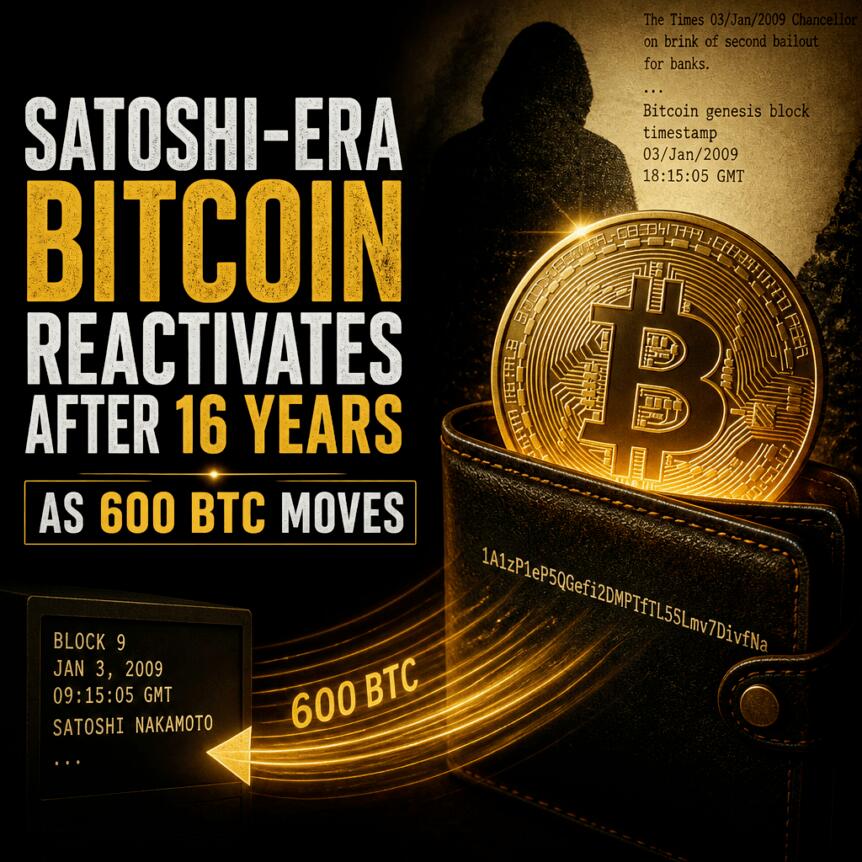
Coins mined in Bitcoin’s earliest era have finally stirred after more than 16 years of inactivity, prompting fresh speculation that they could be tied to Satoshi Nakamoto. According to on-chain analysis highlighted by Cointelegraph, 12 dormant Bitcoin addresses collectively moved 600 BTC on Saturday—an amount currently valued around $48 million.
While the timing has fueled “Satoshi-era” narratives, Whale Alert’s research claims it found no evidence linking the transactions to Nakamoto. The platform says the moved funds trace back to block rewards earned during March 2010, when Satoshi was still actively involved with the project’s early development and communications—before gradually stepping back.
Key takeaways
- On-chain data reviewed by Cointelegraph shows 12 Bitcoin addresses moved a total of 600 BTC after more than 16 years of dormancy.
- Whale Alert traced the 600 BTC to mining rewards paid across 12 Bitcoin blocks in March 2010, each originally issued as a 50 BTC subsidy.
- Whale Alert says none of those blocks can be connected to Satoshi Nakamoto based on its analysis.
- Prior work by Whale Alert covered only seven of the rewards, while Lookonchain had earlier identified seven miner wallets moving 350 BTC.
- The fact that the coins were mined while Nakamoto was still involved is driving attention—but “same era” is not the same as “same owner.”
Early blocks, long dormancy, and a sudden wake-up
The renewed activity centers on a cluster of very old wallets that had not shown movement for over a decade and a half. Cointelegraph reports that 12 addresses collectively moved 600 BTC after more than 16 years. Whale Alert, a blockchain transaction tracking platform, said the amount originated from rewards mined across 12 distinct Bitcoin blocks.
For investors and on-chain observers, these kinds of “awakening” events matter because they can create a brief narrative spike: dormant supply can look like potential future sell pressure, even when no immediate market impact is confirmed. In this case, the key question is not just that the coins moved, but where they came from—and who may have controlled them.
Whale Alert told Cointelegraph that its research did not find a link between the mined blocks and Nakamoto. This point is important: speculation often increases when activity occurs during a period associated with Nakamoto’s involvement, but attribution claims require more than chronology.
Whale Alert expands its tracing from seven to twelve rewards
Whale Alert’s updated work reportedly traces all 12 block rewards to Bitcoin blocks mined in March 2010. At that time, the protocol paid a 50 BTC block subsidy per block. Since then, the subsidy has been reduced repeatedly through halvings; the most recent reduction referenced in the report came in April 2024, when the block subsidy fell from 6.25 BTC to 3.125 BTC per block.
The analysis also builds on Whale Alert’s earlier effort. Cointelegraph notes that Whale Alert had previously examined seven of the rewards and said it identified those blocks as not mined by Nakamoto. In the updated accounting, Whale Alert now extends its tracing to cover the remaining five rewards as well.
Independent on-chain analytics had already surfaced part of the story. Cointelegraph says Lookonchain initially identified seven miner wallets that moved 350 BTC after 16.5 years of inactivity, attributing the funds to mining activity in March 2010. Taken together, the different layers of analysis underscore a consistent theme: these were mining rewards from early blocks—not some later token swap or unrelated transfer.
Why “Satoshi-era” is a tempting narrative—and a weak proof
The movement drew attention largely because March 2010 sits squarely in the period when Satoshi Nakamoto was still active in Bitcoin development and communications. Cointelegraph points to Nakamoto’s involvement continuing through 2010, with the last known communication dating to April 2011.
However, the editorial distinction here matters: “mined during the time Nakamoto was around” does not automatically mean “controlled by Nakamoto.” Whale Alert’s spokesperson emphasized that none of the blocks associated with the 12 rewards could be connected to Nakamoto based on its research.
Cointelegraph also reports a behavioral detail that further complicates simple attribution. Whale Alert said one of the rewards moved several blocks before most of the others, suggesting the early transfer pattern could align with a test transaction preceding the rest of the movements. In other words, even if multiple rewards originate from the same month and subsidy era, the way the coins were handled over time may reflect operational behavior rather than a single, easily identifiable owner.
What to watch next after these long-dormant transfers
When ancient Bitcoin moves, the immediate on-chain fact is clear—coins changed hands from addresses that had been silent for years. What remains uncertain is the economic intent behind the transfers: whether these movements represent consolidation, internal housekeeping, or preparations that could later involve liquidation.
For readers monitoring these developments, the most practical next step is to track where the 600 BTC ultimately flows after the initial movement, and whether any portion returns to new dormant addresses or heads toward exchanges. The “Satoshi” question may remain speculative without stronger evidence, but the real signal for market participants will be the downstream path of the coins and how quickly—if at all—the revived supply reaches liquidity.
It was just three months ago that FUD around Zcash (ZEC) was running rampant, and a vulnerability in its Orchard privacy pool turned the tables and raised some uncomfortable questions.
The situation has taken a major turn, as the protocol patched the issue, and its privacy nature made it arguably the top performer in the large-cap altcoin space in the past three months.
The Meteoric Rise
Recall that the issue was first disclosed by Zcash founder Zooko Wilcox and members of Shielded Labs, who explained that a hacker could have used this weakness to make endless fake ZEC in Orchard, Zcash’s protected transaction area, without getting caught right away. Although by the time they made this public, the vulnerability was fixed, it still pushed some prominent names, such as Arthur Hayes, to dispose of their holdings, citing further potential issues.
The impact on the native token was felt immediately. The asset traded at $650 before the issue became public and tumbled by 60% within a day or so to $260 as FUD was being spread left and right.
That’s when the trend reversed for the privacy coin as it managed to stabilize at around $500, where it spent the next couple of months. The most significant leg up began with the August 19 market-wide breakout that drove it to $900. While the rest of the market stalled following the initial gains, ZEC kept climbing and briefly exceeded $1,200 earlier today for the first time in almost 10 years.
This means that the token has skyrocketed by 370% since the early June low. Its market cap now is above $20 billion, making it bigger than HYPE and DOGE.

Data from CoinGlass shows that ZEC’s spectacular surge over the past 24 hours has resulted in $46 million in short liquidations, the highest among all cryptocurrencies.
The Drivers and What’s Next
Shortly after the mid-August rally began, Grayscale debuted its Zcash ETF (on August 25), which has already raked in $34.4 million in net inflows.
“The bigger question isn’t whether Zcash can keep going up. It’s whether the ETF era is creating a new pathway for capital to rotate into crypto assets that were previously overlooked. ZEC may be an early test of that thesis,” commented The Wolf of All Streets.
Meanwhile, Ted Pillows noted that a major whale DCA-ed into ZEC between 2022 and 2024, accumulating 22,840 ZEC for about $1.1 million. The position had grown to $23 million by today, when they transferred the entire amount to Binance, potentially to cash in.
Crypto Patel weighed in on ZEC’s price potential, indicating that it has created a “Beautiful Cup & Handle Pattern” on the weekly scale. He added that the asset has broken the Neckline/Resistance of this pattern, which could materialize in another massive surge to $2,200.
As Per $ZEC Chart, you can see a Beautiful Cup & Handle Pattern formed on the Weekly Timeframe.@Zcash has already broken the Neckline/Resistance of this pattern, and if the pattern follows the 100% target, the target could be around $2,200.
No doubt, Cup & Handle is a strong… pic.twitter.com/Eys4EivIHQ
— Crypto Patel (@CryptoPatel) September 6, 2026
The post ZEC Just Hit $1,200: What You Need to Know About Its Meteoric 370% Surge in 3 Months appeared first on CryptoPotato.
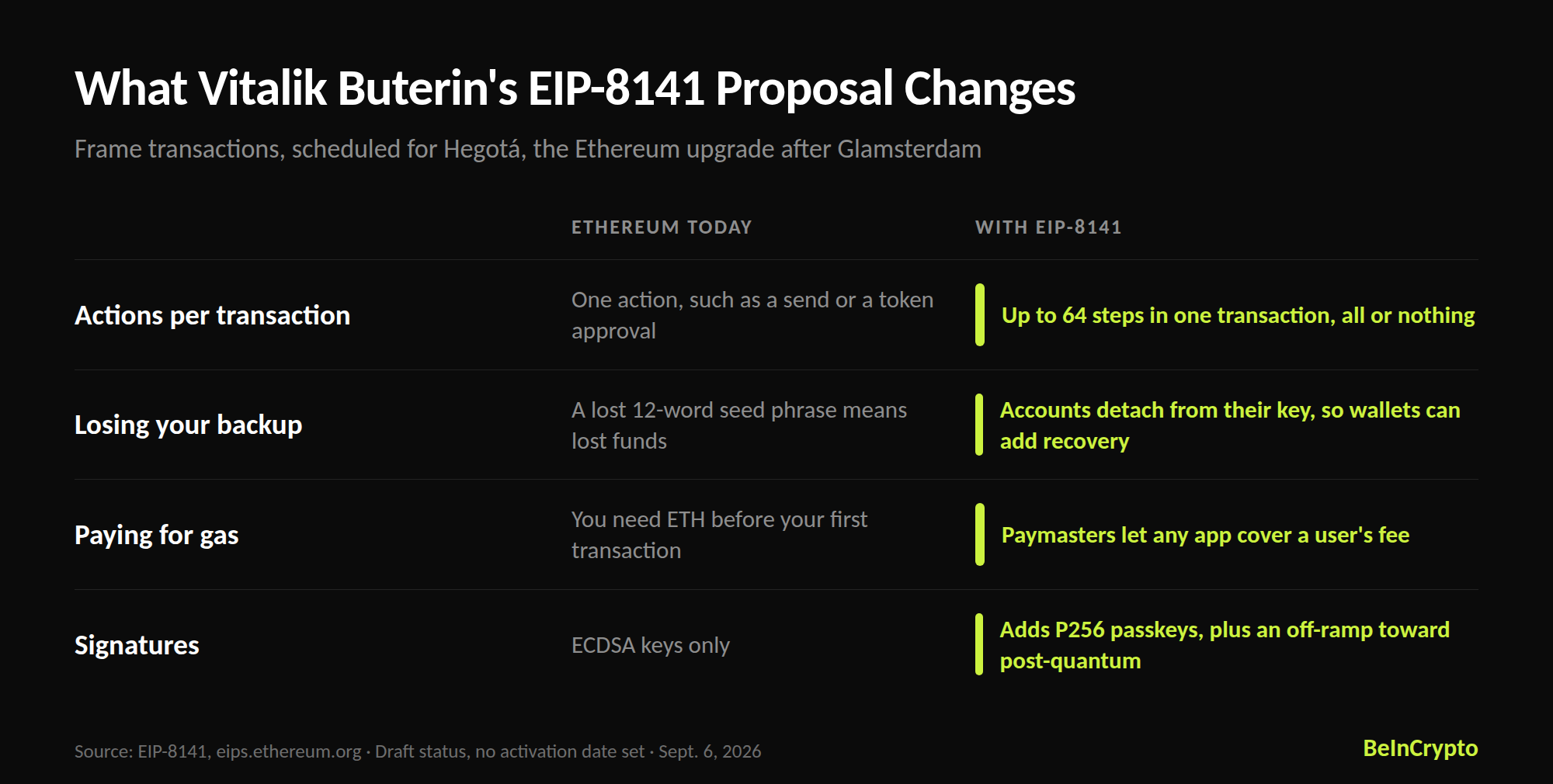
Vitalik Buterin published an updated Ethereum Improvement Proposal (EIP) 8141 on Sunday. The draft heads into Hegotá, the next Ethereum upgrade, and it rewrites how wallets sign, batch, and pay.
The setup tests whether privacy tools can run inside Ethereum itself instead of sitting around it.
Ethereum Upgrade Bundles 64 Actions Into One Transaction
Today an Ethereum transaction does one thing. It sends money, or it approves a token, and that is the whole job.
Frame transactions change that. One transaction can carry up to 64 steps in a fixed order. The entire batch fails when any single step fails.
That all-or-nothing rule kills a familiar failure mode, where an approval lands but the swap behind it does not.
Approving a token and swapping it therefore becomes one click instead of two. Wallets can also fold a full onboarding flow into a single confirmation. Buterin floated much of this logic in March, when he pitched a broader Ethereum wallet overhaul.

Three Changes Users Will Actually Notice
The first change targets seed phrases. A lost 12-word backup today means lost funds. EIP-8141 detaches an account from its original key.
Wallets can then rotate keys or rebuild access through a second device or a trusted contact. The private key still exists, and users simply stop carrying it on paper.
The second change targets gas. Paymasters let any app pay a user’s fee, so newcomers can act before buying Ethereum. Apps absorb the cost as a customer acquisition expense.
The third change targets signatures. The draft adds P256, the scheme behind passkeys and phone security chips. Its authors call the move an off-ramp toward post-quantum cryptography rather than a finished quantum fix, an idea Buterin sketched in his lean Ethereum roadmap in July.
Scale drives the bigger goal. Buterin wants a more Bitcoin-like Ethereum design, where simple, predictable transactions incur the lowest gas fees.
Ethereum (ETH) changed hands near $2,512 on Sunday, roughly 49% higher over 90 days.
Client teams have set no activation date, and the Glamsterdam gas limit push arrives first in Q4 2026.
The post New Ethereum Upgrade Could Overhaul Crypto Transactions and Fees appeared first on BeInCrypto.
Bitcoin mined in 2010 moved from long-dormant addresses after more than 16 years, reigniting speculation over a possible link to Satoshi Nakamoto.
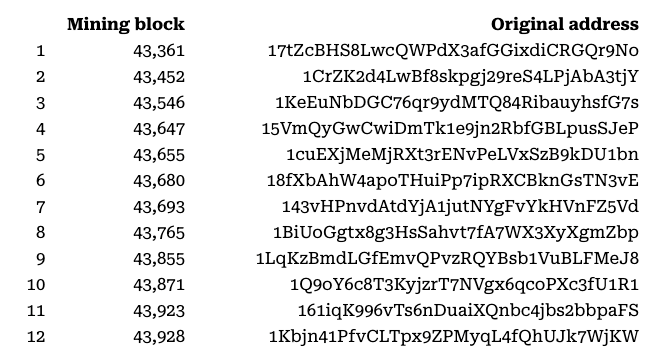
Twelve addresses holding a combined 600 Bitcoin (BTC), worth about $48 million, moved the coins on Saturday after more than 16 years of dormancy, according to onchain data reviewed by Cointelegraph.
Whale Alert, a blockchain transaction tracking platform, said the 600 BTC came from rewards mined across 12 Bitcoin blocks and that its research found no connection to Nakamoto.
“None of the blocks can be connected to Satoshi based on our research,” a spokesperson for Whale Alert told Cointelegraph, tempering speculation around the origins of coins mined while Bitcoin’s pseudonymous creator was still active.
Whale Alert traces all 12 mining block rewards
Whale Alert traced all 12 rewards to Bitcoin blocks mined in March 2010, when each block paid a 50 BTC block subsidy. The subsidy has since been cut in half four times, most recently in April 2024, when it fell from 6.25 BTC to the current 3.125 BTC per block.
The findings expand on Whale Alert’s earlier analysis of seven of the rewards. It said in an X post on Sunday that those seven originated from blocks it had determined were not mined by Nakamoto.
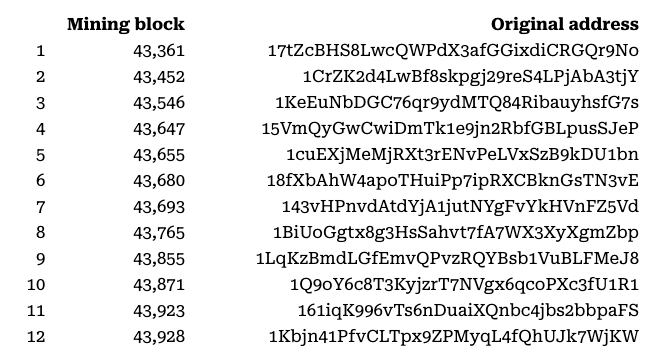
The mining blocks and addresses for the 12 dormant Bitcoin rewards. Source: Whale Alert
Lookonchain, an onchain analytics platform, had also initially identified seven miner wallets that moved 350 BTC after 16.5 years of inactivity, saying the wallets earned the coins through mining in March 2010.
Satoshi-era doesn’t mean Satoshi’s Bitcoin
The movement attracted attention partly because the coins date to a period when Nakamoto was still actively involved with Bitcoin.
Nakamoto remained involved in Bitcoin development and communications through 2010 before gradually withdrawing from the project, with their last known communication dating to April 2011.
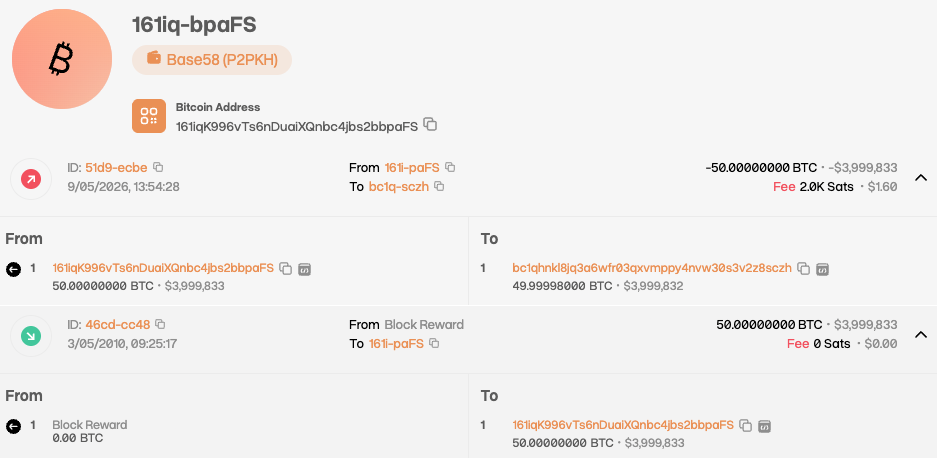
One of the 12 addresses received a 50 BTC mining reward on March 5, 2010, and moved the coins to a new address on Sept. 5, 2026. Source: Blockchain.com
Whale Alert noted that one reward moved several blocks before most of the others, saying the pattern was consistent with a test transaction before the remaining transfers.
Magazine: BTC will hit $1M by 2030… but Arthur Hayes is buying ETH instead

ATU Images | The Image Bank | Getty Images
Sugar is getting a lot less sweet for buyers.
Sugar prices surged 21.5% in August, marking its strongest monthly gain since October 2010, when it rose 24%. The United Nation’s Food and Agriculture Organization Food Price Index also rose in August amid broad-based increases, led by sugar.
“The surge reflected expectations of lower sugar beet yields in the European Union due to adverse weather, concerns over the impact of El Niño on production prospects in key producing countries in Asia, lower sugar production in Brazil, and India’s announcement of duty-free raw sugar imports,” the organization said in its recent report.
The August rally pushed sugar futures ahead of the S&P 500 on a year-to-date basis. The sweetener is now up about 20% in 2026, versus the nearly 13% advance for the broad market index.
The U.N.’s Food and Agriculture Organization points out that the sugar rally is tied to several factors, which are collectively pushing the prices in the market.
The sugar rally reflects a shift in expectations about global supply, according to William Osnato, Barchart director of commodity data research and analysis. Osnato told CNBC that the damage to Europe’s sugar-beet crop during a summer heat wave was one of the biggest immediate factors.
Sugar beets are grown in the same places and around the same time as corn and wheat, and so the heat wave can significantly affect sugar production.
“That’s been factored in over the last month. So a bunch of organizations lowered their production estimates,” Osnato said.
Different organizations have either slashed production estimates or increased deficit estimates in their recent reports. The European Commission’s latest sugar balance sheet estimates a decline in EU production of 19% to 13.4 million metric tons, in the 2026/27 marketing year, from 16.6 million tons in 2025/26. Citi projected a world deficit of 1.3 million metric tons in a Tuesday note, and Green Pool Commodity Specialists estimated 3.2 million metric tons.
“What is usually consistent is that they’re all going in the same direction,” Osnato said. “They’re all increasing the deficit.”
In the note, Citi analysts called sugar a “highest-conviction bullish” market among agricultural commodities traded on the Intercontinental Exchange. The bank raised its price target to 19 cents per pound over three months, citing tightening inventories, India’s unexpected import program and deteriorating weather in India, Thailand and the EU.
El Niño threatens upcoming harvests
Osnato said that El Niño, a global climate pattern that can bring warmer ocean temperatures and severe weather, is likely “the biggest forward-looking concern.”
A potentially extreme El Niño intensifies the pressure on sugar prices.
Brazil, India and Thailand together account for approximately 70% of global sugar exports. Goldman Sachs said in a note that drought during the growing season could lower cane yields, while excessive rainfall during harvest could interrupt fieldwork and reduce the sugar content of cane. The Climate Brink’s multi-model median forecast shows the temperature anomaly for the Niño 3.4 region in the Pacific Ocean peaking near 3.9 degrees Celsius — or about 39 degrees Fahrenheit — in November. That’s well above the 2 degrees Celsius, or 35.6 degrees Fahrenheit, threshold for a very strong El Niño.
India has faced below-normal rainfall in key sugar-producing regions. A weak monsoon can deplete reservoirs, discouraging many farmers from planting water-intensive sugarcane for the following season. Further, unusually warm Pacific Ocean temperatures are expected to bring erratic rainfall and water shortages across Thailand.
Brazil’s ethanol pivot and India’s sugar imports
Higher energy prices are also making ethanol more attractive relative to sugar in Brazil, where mills can shift cane between the two products.
“When the price of oil increases, countries that produce ethanol from sugar have a higher incentive to produce more ethanol and export less sugar to the global market,” Rob Johansson, director of economics and policy analysis at the American Sugar Alliance told CNBC in an email. “With oil prices over $90 a barrel, countries like Brazil, which heavily subsidizes its ethanol industry, are producing more biofuel, lowering the amount of sugar available on the market and putting upward pressure on prices,” Johansson said.
Brazil alone accounts for roughly half of world sugar exports. Brazilian mills can typically shift their production mix between sugar and ethanol, depending on which is more profitable.
According to Goldman Sachs’ analysis, because corn is an important feedstock for ethanol production alongside sugarcane, a weaker corn crop due to El Niño-related droughts may divert more sugarcane into ethanol production, leaving less sugar available for export.
Rain has also delayed harvesting in Brazil, Osnato said. Some production could be recovered once fields dry, making a rebound in Brazilian sugar content or faster harvesting one of the clearest downside risks to prices.
India, the world’s second-largest sugar producer behind Brazil, recently authorized 1 million metric tons of duty-free raw-sugar imports. The Indian government said the decision was intended to bolster domestic availability amid lower production, seasonal demand and rising prices. With India restricting exports while entering the market as a buyer, less sugar could be available to other importing countries.
Osnato said the decision followed two disappointing crops and is significant because it was India’s first import authorization since the 2017-2018 season. Even if India imports only about half the authorized amount, he said, the move reinforces the view that supplies are tighter than previously estimated.
“Brazil remains the market’s key balancing supplier, but weather-related execution risks during the remainder of the harvest leave little margin for error,” Citi analyst Arkady Gevorkyan wrote in a note.
— CNBC’s Nick Wells contributed reporting.

The CLARITY Act received a potentially important boost ahead of its first Senate floor test, which was supposed to take place on September 15, but another scheduling setback is further threatening its chances of becoming law this year.
On the plus side, the National Sheriffs’ Association (NSA) has changed its tune on the landmark crypto market structure bill from opposition to neutral after previously raising concerns that it could make it more difficult for authorities to combat illicit finance involving digital assets.
NSA Turns Neutral
In the filing to the US Senate, the agency said that it believes the appropriate course is to step back and allow the legislative process to continue given the legislation’s complexity and the issues still being negotiated. This change matters because law enforcement concerns had become a major hurdle for some Senate Democrats whose votes could determine whether the bill advances.
Although the NSA’s move doesn’t mean that it now supports the legislation, its shift from opposition to neutrality removes a source of pressure on senators considering voting to advance it. Essentially, it removes another potential obstacle to attracting the Democratic support the bill needs when it reaches the Senate floor later this month.
Recall that the Senate Majority Leader John Thune filed a cloture vote motion to proceed with H.R. 3633 in early August so that the Senate can vote on the bill once recess ends.
The vote requires 60 senators and will not pass the CLARITY Act itself. Instead, success would limit debate on the motion to proceed and move the bill toward formal Senate consideration. Republicans hold 53 seats, meaning that Democratic or independent support will be necessary if the conference votes together.
Another Setback
House Republican leaders canceled voting sessions during the weeks of September 21 and 28, removing eight legislative days from the calendar, and the House is now scheduled to leave Washington on September 17, which is just two days after the Senate’s first procedural vote.
The new calendar leaves no time for the Senate negotiations to begin and conclude before lawmakers turn their attention to the November midterms. That makes a post-election lame-duck session an increasingly realistic path for the legislation if it clears the Senate.
Galaxy Research already reduced its estimated probability that the CLARITY Act will become law in 2026 from 50% to 30% after the Senate failed to vote on it before the August recess. Prediction markets are even less optimistic, with passage odds currently below 20%.
The post CLARITY Act Gets a Major Boost, But Another Setback Threatens Its 2026 Passage appeared first on CryptoPotato.
Kraken is offering perpetual futures tied to the private-market valuations of OpenAI and Anthropic, giving eligible traders leveraged exposure before either artificial intelligence company completes a public listing.
Summary
- Kraken offers cash-settled Anthropic and OpenAI pre-IPO perpetuals with maximum leverage of five times globally.
- The contracts provide price exposure without shares, voting rights, dividends or ownership in either company.
- Kraken excludes customers in U.S., EEA, Canada, Australia and New Zealand from these products entirely.
- Pricing uses a smoothed synthetic index with mark prices clamped within a 0.25% band continuously.
- Kraken plans to change pricing if either company completes an IPO, with specifications changing afterward.
The cash-settled contracts support long and short positions, have no expiration date and offer leverage of up to 5x.The exchange promoted its Anthropic contract again on Sept. 6 after initially announcing both products in June. Kraken’s official post identified the Anthropic contract as PF_ANTHROPICXUSD and confirmed support for multi-collateral margin.
OpenAI trades under the PF_OPENAIXUSD symbol. Neither contract represents shares issued by the companies, and Kraken says it has no affiliation with, endorsement from or sponsorship by OpenAI or Anthropic.
Kraken’s pre-IPO perps do not represent company shares
The products are derivatives designed to track traders’ expectations of each company’s value. Buying an Anthropic or OpenAI contract does not place the customer on either company’s shareholder register.
Contract holders do not receive voting rights, dividends, information rights or access to a future public offering. They also have no claim on OpenAI’s or Anthropic’s assets.Instead, the contracts settle in U.S. dollars through Kraken’s multi-collateral derivatives account. Eligible users can provide several supported assets as margin, subject to the exchange’s collateral haircuts and risk rules.
Kraken’s announcement says traders can use the contracts to take directional positions or hedge other exposure. However, the claim that a trader can “hedge an existing Anthropic position” depends on how closely the synthetic futures price follows the value of any private shares held elsewhere.
However, a private-company shares do not trade continuously on a centralized public exchange. Transactions can occur through private secondary markets at different prices and under varying transfer restrictions. The futures contract may therefore move differently from a particular private shareholding.
Crypto.news previously explained that pre-IPO perpetuals offer exposure without company ownership, creating a market for private-company valuations without a continuously traded underlying stock.
Synthetic pricing replaces a public stock index
Normal equity futures can use a stock exchange price as their external reference. Kraken cannot do that for OpenAI or Anthropic because neither company has publicly traded shares.
The exchange instead created the Kraken PreMarket Synthetic index. Its value comes from activity in the perpetual market itself rather than an independent public share price.Kraken applies exponential smoothing to the index. The process reduces the influence of short-lived order-book movements and causes the reference value to adjust gradually when market prices change.
The contracts’ mark prices are also restricted to within 0.25% above or below the synthetic index. Kraken says this mechanism is designed to limit liquidations caused by momentary price spikes in a thin market.
That protection does not remove valuation risk. If participants collectively misprice a private company, the synthetic index can reflect that view because no liquid spot market exists to correct the contract through ordinary arbitrage.Spreads may also be wider than those in mature equity or cryptocurrency futures. Limited liquidity can make it more expensive to open or close a position, particularly during volatile periods.
Anthropic-linked futures on other platforms previously fell as much as 9% following additional exchange listings. The decline demonstrated how private-company futures can move sharply without a public reference price.
Maximum leverage falls as positions grow
Moreover, Both Kraken contracts offer a base maximum leverage of 5x. At that level, a trader must provide initial margin equal to 20% of the position’s value.
The base maintenance margin is 10%. If losses reduce the account below the required level, Kraken can liquidate the position.Leverage decreases for larger positions. Kraken’s published tiers step down from 5x to approximately 3.3x and then 2x as exposure increases.Funding payments are realized every hour. Kraken describes funding as “structurally minimal” during the pre-IPO period because the mark price remains within the narrow band around its synthetic index.
That description is a company assessment rather than a guaranteed funding cost. Funding can change as market positioning, liquidity and contract specifications change.
The products also carry auto-deleveraging risk. Under that process, profitable positions may be reduced when the exchange cannot close a liquidated counterparty’s position through the order book.Kraken warns that customers can lose all of their margin. Its disclosure also says leveraged losses can exceed the trader’s initial deposit, depending on market conditions and account arrangements.
U.S. and European customers cannot trade the contracts
The Anthropic and OpenAI perpetuals are unavailable in the U.S., European Economic Area, Canada, Australia and New Zealand. Only professional clients can access them in the United Kingdom.
Payward Digital Solutions offers the products from Bermuda. The company is licensed to conduct digital asset business by the Bermuda Monetary Authority, according to Kraken’s disclosure.
The geographic exclusions matter because the contracts reference two prominent U.S. companies but are not offered to U.S. traders. They are also separate from Kraken’s regulated U.S. derivatives products.Other exchanges have built similar markets. Coinbase added private-company perpetuals tied to OpenAI and Anthropic for eligible users outside the U.S., while Hyperliquid and several specialized platforms have offered synthetic exposure to companies approaching public listings.
The growth of these products has raised questions about whether private-company derivatives should receive a dedicated regulatory framework. They combine leveraged crypto-market trading with valuations of companies whose financial information is less accessible than that of listed issuers.
A recent industry request asked the SEC to establish rules for pre-IPO perpetuals and consider eventual U.S. market access. Any domestic launch would require regulatory approval and a structure complying with U.S. derivatives and securities laws.
An IPO would trigger a change in pricing
Kraken intends to change the contracts if OpenAI or Anthropic completes an IPO. At that point, the exchange plans to replace its synthetic reference with an index based on the relevant company’s xStocks product.
Kraken says initial margin, maintenance margin, position limits and funding rules are “expected to change.” The exchange plans to disclose the conversion details before implementing them.
The conversion remains conditional. Neither Kraken contract guarantees that the referenced company will complete an IPO, and the existence of a futures market does not provide investors with an allocation in any future offering.If an IPO does not occur or Kraken cannot obtain reliable pricing, the exchange reserves the right to delist and settle the affected contract. Kraken says it may determine the settlement value under its applicable rules.
A pre-IPO contract’s final synthetic price could also differ materially from the eventual listing price. This gap can produce rapid gains, losses and liquidations when the public market establishes a new reference value.
The issue appeared during the expansion of private-company markets around the SpaceX listing, when synthetic contracts converged toward the public share price only as the IPO supplied a verifiable reference.
After conversion, Kraken expects the products to resemble perpetuals tied to its existing tokenized equities. Those xStocks products are issued separately and backed by listed securities, unlike the current OpenAI and Anthropic contracts.
Kraken has continued expanding that infrastructure. Its xStocks offering now provides tokenized access to hundreds of listed securities, while a recent London Stock Exchange partnership could add major British companies subject to regulatory approval.
Solana attracted approximately $348 million in net real-world asset flows over the latest 30-day period, placing it ahead of other tracked blockchain distribution networks.
Summary
- Solana attracted $348 million in net distributed RWA flows during the latest thirty-day measurement period.
- Network distributed RWA value reached roughly $4.23 billion as tracked holder addresses climbed to 398,644.
- Solana hosted tokenized products from BlackRock, Franklin Templeton, VanEck, Circle, Ondo and WisdomTree by September.
- RWA net flows measure asset value changes and transfers rather than blockchain transaction volume alone.
- Ethereum and Stellar posted smaller thirty-day increases while Avalanche and XRP Ledger declined over period.
The increase lifted the value of distributed RWAs on Solana to about $4.23 billion.The RWA Foundation published the figure on Sept. 5 using data from analytics platform RWA.xyz. “Solana is leading the pack,” the organization said in its official post, adding that the network recorded the largest net increase during the period.
The figures cover distributed real-world assets. These are tokenized financial products that investors can subscribe to, hold or transfer through blockchain wallets and approved custodians. They do not represent the total value of every asset referenced by a tokenization platform.
Solana RWA flows outpaced competing networks
Solana’s distributed RWA value increased by 11.13% over 30 days, according to the dataset cited by the RWA Foundation. Ethereum recorded a 0.77% increase, while Stellar rose 5.22%.
The XRP Ledger and Avalanche moved in the opposite direction. Their tracked totals declined by 5.51% and 14.06%, respectively. These changes can reflect subscriptions, redemptions, transfers between networks and movements in the reported value of underlying assets.
Net flows should not be confused with transaction volume. The $348 million figure does not mean investors traded exactly $348 million of tokenized assets on Solana during the month. It represents the net change attributed to assets distributed on the network after inflows and outflows.
The calculation also differs from total value locked in decentralized finance. DeFi TVL generally tracks crypto deposited into lending, trading and staking applications. RWA figures focus on tokens linked to off-chain financial instruments such as government bonds, private credit, investment funds and equities.
RWA.xyz’s distributed asset category also requires a different reading from represented asset value. A token could provide access to a much larger off-chain portfolio while only a portion of its supply circulates on a specific blockchain.
U.S. Treasury products form a large part of Solana’s RWA market
Solana’s RWA expansion has been supported by tokenized U.S. Treasury and money market products. These instruments allow eligible investors to hold blockchain-based tokens representing interests in regulated funds, Treasury-backed notes or other cash-management products.
BlackRock’s BUIDL fund expanded to Solana through Securitize in March 2025. BUIDL invests in cash, U.S. Treasury bills and repurchase agreements. A dedicated Solana share class gives eligible investors blockchain-based access to the fund while Securitize manages tokenization and transfer infrastructure.
Securitize confirmed the deployment through its official announcement. Solana later reported that the BUIDL share class held more than $550 million on the network by February 2026.
Franklin Templeton’s BENJI token is also available on Solana. BENJI represents shares in the Franklin OnChain U.S. Government Money Fund, which invests at least 99.5% of its assets in government securities, cash and fully collateralized repurchase agreements.
The asset manager’s official platform confirms that Solana support began in February 2025. Franklin Templeton reported $753.24 million in total net assets for the fund as of June 30, although that figure covers the entire fund across supported networks rather than its Solana allocation alone.
VanEck’s VBILL provides another Treasury-linked product. It launched across Solana, Ethereum, Avalanche and BNB Chain through Securitize in May 2025. The product invests in short-term U.S. government obligations and uses blockchain infrastructure for ownership records and transfers.
Ondo and WisdomTree widened available RWA products
Ondo Finance operates the USDY and OUSG products on Solana. USDY is a tokenized note backed by short-term U.S. Treasuries and bank deposits. It is primarily available to eligible investors outside the U.S.
OUSG provides exposure to short-term U.S. government securities through a portfolio that includes tokenized investment funds. Ondo’s official page states that the product supports continuous minting and redemptions, including outside conventional banking hours.
The company also launched hundreds of tokenized U.S. stocks and exchange-traded funds on Solana in January 2026. The products provide economic exposure to underlying securities but are structured for eligible non-U.S. investors rather than as ordinary shares registered directly to token holders.
The launch broadened Solana’s RWA market beyond Treasury products. It also introduced assets whose value can change with public equity prices, meaning an increase in reported RWA value does not always represent new investor capital.
WisdomTree added another institutional distribution channel in January. The asset manager made its tokenized funds available for direct minting on Solana through its WisdomTree Connect platform.
The integration allows eligible institutional clients to purchase, hold and manage tokenized fund positions on the network. It also permits supported assets to move into compatible decentralized applications, subject to the issuer’s compliance requirements.
Solana’s RWA total does not include unrestricted ownership
Tokenized RWAs frequently contain investor eligibility and transfer controls. A public blockchain may record balances and transfers, but that does not mean every wallet can buy or redeem each product.
Treasury and money market tokens can require identity verification, jurisdictional screening or minimum investments. Issuers can also restrict transfers to approved addresses and freeze tokens when required by their product terms or applicable law.
This structure separates institutional RWAs from permissionless crypto assets such as SOL. Solana supplies the settlement and distribution network, while regulated issuers, transfer agents, custodians and fund administrators remain responsible for the underlying products.
It also means the $4.23 billion figure is not Solana protocol revenue or capital controlled by the Solana Foundation. The value belongs to investors in products issued by separate financial institutions.
Crypto.news previously reported that the wider tokenized RWA market had reached approximately $38.1 billion by Aug. 9 as projects moved hundreds of millions of dollars in physical assets onchain. Solana’s reported total represents one portion of that market.
The network’s growth also fits a wider shift from primarily speculative activity toward tokenized financial infrastructure. This transition has included institutional products moving onto public blockchains, although adoption remains dependent on regulation, liquidity and investor access.
New issuance will determine whether the inflows continue
Solana can extend its RWA growth if issuers place additional fund shares on the network or investors increase subscriptions to existing products. Redemptions or transfers to competing blockchains would reduce the total.
The next RWA.xyz updates will show whether the $348 million increase represented a sustained trend or a concentrated period of issuance. Product-level changes will also help identify which funds contributed most to the rise.
Any direct connection between the RWA inflows and SOL’s market price would be speculative without supporting trading data. Tokenized products may use Solana for settlement while investors pay network fees amounting to only a small portion of the assets’ underlying value.
The more relevant measure is whether tokenized assets remain on Solana, gain additional holders and develop active secondary or collateral markets. Those factors would show whether the latest inflows are translating into continued blockchain use rather than a temporary balance increase.
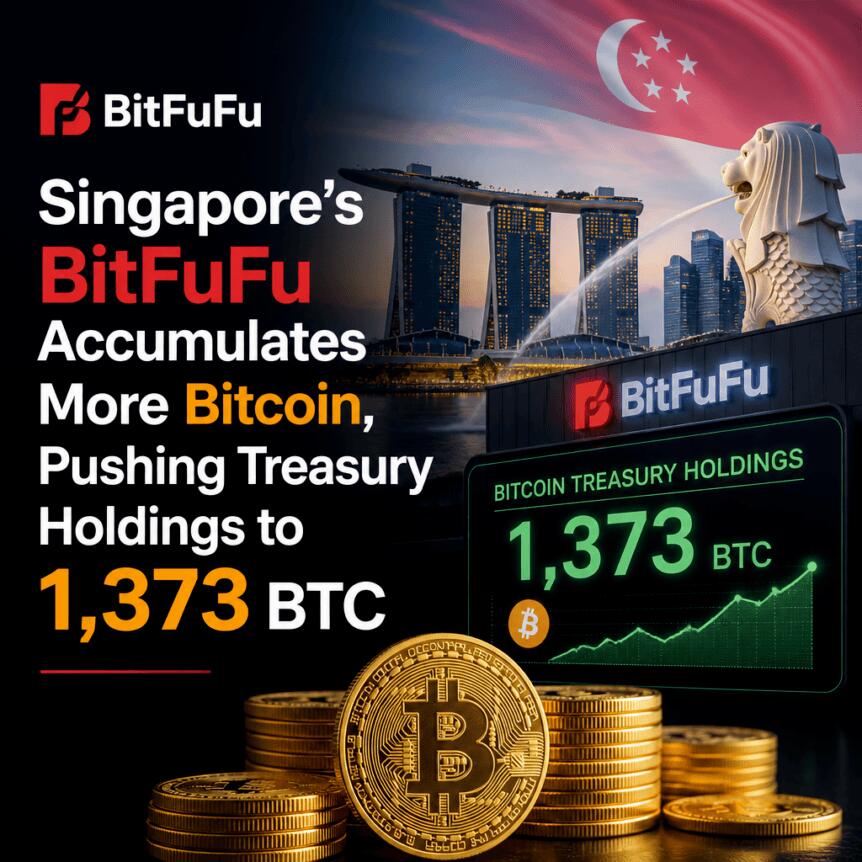
Singapore-based Bitcoin mining company BitFuFu has increased its Bitcoin treasury to 1,373 BTC, highlighting a renewed focus on holding the digital asset even as the miner continues to navigate weaker mining economics and pressure on revenue.
The latest accumulation marks a notable shift from periods when the company sold part of its Bitcoin reserves to finance operations and expand mining capacity. BitFuFu’s recent financial performance has underscored the challenges facing miners as Bitcoin prices, network difficulty, and demand for cloud-mining services affect profitability.
Key Takeaways
- BitFuFu’s Bitcoin treasury has reached 1,373 BTC.
- The company previously used Bitcoin sales to support operations and procure additional mining capacity.
- Second-quarter revenue fell 62.9% year over year to $42.8 million.
- BitFuFu has been rebuilding its managed hashrate after significantly reducing capacity earlier in the year.
Bitcoin Treasury Takes Greater Importance
BitFuFu’s treasury strategy has evolved alongside its mining operations. In May 2025, the company held 1,709 BTC after selling 178 BTC during Bitcoin’s then-record price levels.
CEO Leo Lu said the sales were part of a broader effort to manage liquidity while maintaining the company’s long-term exposure to Bitcoin.
“With a more constructive Bitcoin market environment and a significantly expanded operating base, we are well positioned to capture improving market opportunities in the months ahead.”

Andy Burnham issues verdict on proposed DWP rule change for 13 million state pensioners

Zscaler: Cheap Compared To Closest Peers For No Good Reason
Star Wars’ Lowest-Grossing Movie Ever Officially Gets a Second Chance on Streaming

Weekend Open Thread – Corporette.com

Weekend Open Thread: Brooks Brothers

London Mayor Sadiq Khan handed a peerage by Keir Starmer alongside 15 other Labour figures… just days before the PM leaves No10

XRP: “IT WAS A MID-CYCLE CORRECTION AND IT IS NOW OVER” Popular Analyst Declares -Report

Jeffrey Sachs: America’s “Legacy of Delusion” Fueling Financial Bubble & Iran Failure

WHY YOUR XRP IS DROPPING (NOT THE REASON THAT YOU THINK)!
-

 Fashion2 days ago
Weekend Open Thread: Beyond Yoga
-
 Crypto World2 days ago
Bitcoin price stalls near $82K as key resistance holds
-

 Politics2 days ago
Best Gaming Laptops, CPUs, TVs, And Keyboards To Upgrade Your Set Up For GTA VI
-

 Tech2 days ago
The Birds Outside, Drawn For You Automatically
-

 Crypto World2 days ago
IMF Says El Salvador’s Post-Review Bitcoin Purchases Used No Public Funds
-
 Crypto World2 days ago
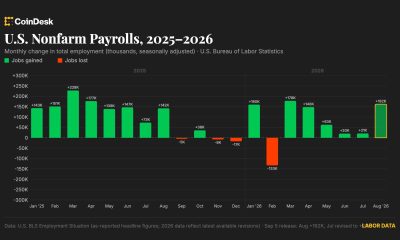
U.S. added stronger than expected 162,000 jobs in August as labor market bounced back
-

 Sports2 days ago
Alexandre Pato consortium’s Northampton Town investment approved
-

 Sports2 days ago
Commanders’ Chig Okonkwo is a top breakout fantasy football candidate
-

 Sports2 days ago
Golden Eaglets Drawn in Group B for 2026 WAFU B U17 Championship
-
 Crypto World2 days ago
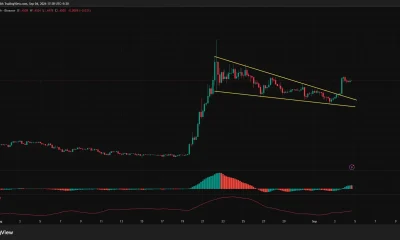
XRP price breaks falling channel as bulls target $1.53
-
 Politics2 days ago
A new European chapter for Gibraltar
-

 Politics2 days ago
How To Avoid Winter Colds: 4 Everyday Habits That Spread Germs, Says Pharmacist
-
 Politics2 days ago
The House | Bin the lectures, bring gossip and be ready to banter: how the new PM should prepare for his Trump encounter
-

 Crypto World2 days ago
From warning to listing: UK’s largest retail investment platform opens access to crypto ETNs
-

 Crypto World2 days ago
FinCEN flags $12.7B tied to Southeast Asia crypto investment scams
-

 Tech2 days ago
A Worthy Android Ereader, With Some Tradeoffs
-

 Tech2 days ago
How To Edit Claude’s Memory
-
 Crypto World2 days ago
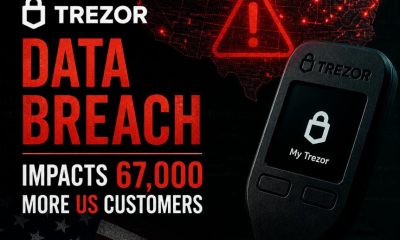
Trezor Data Breach Impacts 67,000 More US Customers
-

 Politics2 days ago
33 Cosy Autumn Home Decor Ideas: Blankets, Pumpkin Decorations, And Candles
-

 Tech2 days ago
beyerdynamic AVENTHO Y Debuts at IFA 2026 and Makes Wireless Headphones Less Disposable
You must be logged in to post a comment Login