
Crypto World
KuCoin launches KCUSD with up to 4% base APR on Stablecoins


- KuCoin launches KCUSD with a base APR of up to 4%.
- KCUSD offers daily returns on eligible stablecoin balances.
- KuCoin plans to expand KCUSD into collateral and trading utility.
KuCoin has launched KCUSD, a new Earn product designed to help stablecoin holders generate returns on otherwise idle balances.
The product will be available to eligible retail, high-net-worth, and institutional users, with subscriptions initially starting from as little as 1 USDT, USDC, or USDG.
KCUSD will offer a dynamic base annual percentage rate (APR) of up to 4%, with users able to earn returns simply by holding the asset.
KuCoin said there will be no subscription fee, while redemptions will be available in the same asset used for subscriptions.
Returns will be credited daily and automatically added to users’ KCUSD balances.
This structure allows returns to compound daily without requiring users to manually reinvest their earnings.
During the initial launch period, eligible users who participate with qualifying new funds may receive a promotional APR of up to 6%, according to the company.
Product targets idle stablecoin balances
KuCoin said stablecoins play a central role in digital asset market liquidity, but significant balances can remain idle in trading accounts.
Users may keep stablecoins available for margin requirements or time-sensitive trading opportunities, potentially leaving those assets without a yield.
The exchange said moving such balances into traditional staking or standalone Earn products can reduce their immediate trading utility.
The trade-off is particularly relevant for institutions, market makers, professional trading firms, and high-net-worth users that maintain large stablecoin balances for extended periods.
KCUSD initially addresses this issue through a hold-to-earn model, allowing users to generate returns while holding the product.
KuCoin also plans to expand KCUSD’s utility in the future by integrating it as collateral or margin.
The company said this planned functionality is intended to reduce the trade-off between earning returns and maintaining access to capital for trading activities.
KuCoin plans broader utility for KCUSD
KuCoin CEO BC Wong said the launch reflects the company’s view that digital asset infrastructure needs to focus not only on access and liquidity but also on how efficiently capital can be deployed.
“Our long-term view is that yield, liquidity and risk utility should not remain in separate silos,” Wong said.
KuCoin described KCUSD as an infrastructure layer that could connect liquidity, asset productivity and risk management across its ecosystem. The product is expected to begin with yield generation before progressively expanding toward collateral and trading utility.
The company said the development reflects a broader shift in digital finance, with stablecoins increasingly being positioned as productive capital rather than solely as settlement assets or reserves.

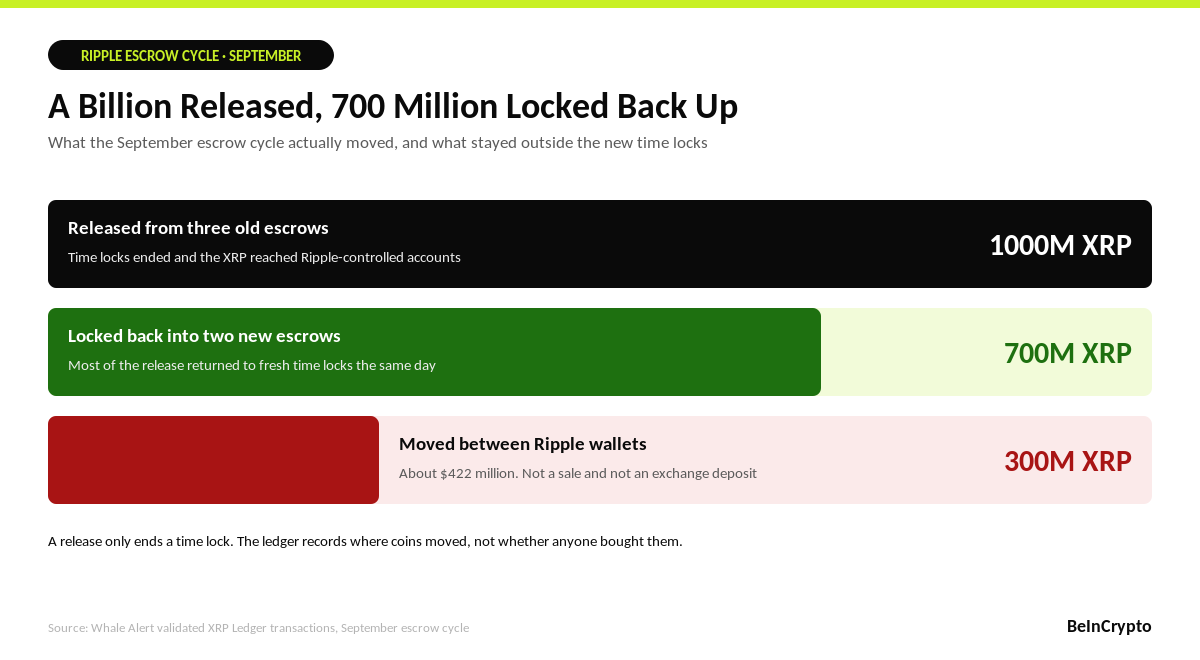
Ripple released 1 billion XRP from escrow at the start of September, and by the end of the day, only 300 million sat outside new time locks.
XRP price still holds near $1.40. The headline sounded bearish. The ledger says less happened than it looked.
Ripple Released a Billion, Then Re-Locked 700 Million
Three old escrows ended, releasing 500 million, 400 million, and 100 million XRP. Hours later, two new escrows took 500 million and 200 million back.

That leaves 300 million XRP, worth about $422 million, outside those locks. It moved between Ripple-labelled wallets, so the monthly release is not a sale or an exchange deposit. But it matters anyway.
It still matters because the market could not take it. Buy orders sitting close to the current price add up to $108.2 million, so those 300 million coins are worth almost four times what buyers are ready to absorb.

The market held only because nobody tested it.
Older Coins Stopped Moving. So Did the Volume.
So the coins are still there. The question is who is willing to move them, and the answer is almost nobody.
XRP’s 1-2 year holding band rose from 17.3% of supply in late August to about 18.2% now. Therefore, the oldest supply is refusing to move, and despite the pullback since August 22, those holders have not sold into it.

That stillness cuts both ways. Daily volume (all traders) has fallen every session since the August 22 burst, down to about 27.6 million XRP. So the interest seems very ‘long-term-holder-specific’.

Meanwhile, the chart is close to a golden cross, the point where the 20-day exponential moving average, an average of closing prices that leans on the most recent days, climbs above the slower 200-day line. The fast line sits at $1.3516 against $1.3540, close enough to cross on any decent day. Crossovers built on falling volume are the ones that fail.
XRP Led the Rally, Then Stopped Leading
Fading volume shows up as lost leadership. Over 21 sessions, XRP gained 42.4% against 27.0% for Bitcoin and 33.8% for Ethereum.

Over the last 14 days, it was the weakest of 20 large coins against that pair, trailing by 5.7%.

Futures repeat the pattern. Count the accounts and big traders look confident, 2.86 betting on a rise for every one betting on a fall, against 2.46 for ordinary traders.

Weigh those bets by money, and it flips. By size, the ratio drops to 2.09, below the crowd’s count. Most large accounts sit on the bullish side without putting much behind it, and their shorts are the bigger trades.

XRP is one of four majors where that gap runs negative.
XRP Price Levels That Decide It
All of it comes down to one line. XRP trades at $1.4079, above both averages, which keeps the recovery alive. Confirmation sits at $1.4785, about 5% up, the level that has capped every rebound since late August.
Clearing it opens $1.5832, then the $1.6678 to $1.7038 area around the August peak, a 21% move from here. A daily close below $1.3092 breaks the setup.

Analyst’s View: Nobody is selling XRP, and nobody is buying it either. A price only climbs when someone shows up willing to pay more, and right now that person is missing.
The post XRP Sits at $1.40: Nobody Wants to Sell, Nobody Wants to Buy appeared first on BeInCrypto.


LAPTOP debuts Wednesday on Base, with nearly a third of the supply set to be burned if a slate of political and market outcomes — including a Democratic win in 2028 — comes good.

Twenty traders gathered in Bali in August for the final of Alpha Arena S03, competing live in a simulated trading environment for a share of $100,000.
The competition, backed by MEXC Ventures and held during CoinFest Asia, was won by Japan’s Arumando, followed by Murasaki Trades from the Philippines and Coin6097 from South Korea.
For MEXC CEO Vugar Usi, the competition proved that a trader can enter the market with a small amount of money, catch the right trade, and become wealthy almost overnight – an idea that has long been fundamental to crypto’s appeal.

Exposing Trading for What It Is
During Alpha Arena, Usi pointed to the difference between watching traders during an entire session and following them on social media, where successful trades can receive far more attention than the losses, uncertainty, and emotional decisions surrounding them.
At the Bali competition, traders could be observed throughout the process. Organizers even measured participants’ heart rates, allowing viewers to see how they reacted as markets moved and whether they followed their original strategy or made decisions under pressure.
“You see what kind of decisions they make. Are they panicking? Are they panic buying or panic selling? Are they good at following their instinct, or are they more practical?” Usi said.
That is part of why he believes trading has an unusually low barrier to entry compared with many professional fields. Someone can study markets independently, develop a methodology, and potentially compete against traders with formal financial training and access to far more expensive technology.
For exchanges trying to attract the next generation of users, this also changes the job. Aside from access to markets, traders also want information, analytical tools, and products that help them interpret what is happening once they arrive.
On Zero Trading Fees
Competition has become particularly fierce as major exchanges fight over trading costs.
MEXC has made zero-fee trading a big part of its strategy. Its current offering includes zero maker and taker fees across spot markets, alongside selected futures products, although eligibility and fee arrangements vary between products and campaigns. The exchange said its zero-fee initiatives saved 3.44 million users approximately 1.1 billion USDT during 2025.
Usi argues that reducing price to zero forces exchanges to compete elsewhere.
“When price is zero, it means the user is not choosing you because of just price,” he said. “That is where the competition actually starts.”
Once an exchange cannot meaningfully undercut another platform on fees, he argues, product quality, speed, available markets, trading tools, and other user benefits become more important.
Of course, the company now offers exposure to equities through several formats, including more than 300 stock and index futures, over 200 tokenized stocks, and more than 7,000 global stocks and ETFs through RealStocks, according to figures released by MEXC.
It forms part of Usi’s longer-term plan to take MEXC beyond the conventional definition of a crypto exchange.
AI Could Give Retail Traders Institutional-Level Tools
Artificial intelligence was a big part of the conversation with Usi.
His background in traditional finance influences how he thinks about trading technology. Professional firms have historically paid large sums for products such as Bloomberg Terminal because access to data, communication tools, and analytics can materially improve how traders process information.
Naturally, retail traders are put at a disadvantage.
Usi believes AI offers an opportunity to reduce that divide by taking capabilities that once required specialist software and presenting them to individual traders at a much lower cost.
In his own trading, he said he uses an AI assistant to study order books and identify where capital is concentrated, something that would be difficult for a person to continuously calculate across large amounts of market data.
“The opportunity with AI is not just to automate things,” he said, describing its potential to bring institutional-grade trading tools to retail users.
Demand appears to be coming from users themselves. Usi said a recent campaign inviting customer feedback produced more than 2,500 pages of responses, with AI emerging as the most common subject.
The important question will be how far exchanges take that assistance. Tools that summarize data, monitor markets, and surface relevant information can support traders without removing the need for judgment. Alpha Arena itself demonstrated how differently people can interpret the same market even when they have access to similar information.

Competition for Trust
Better tools and cheaper trading have limited value if users are uncomfortable holding assets on an exchange, particularly after a succession of failures and security incidents across the crypto industry.
Usi said transparency has therefore become one of his priorities since taking over as CEO of MEXC in April 2026. The appointment was something of a homecoming for BeInCrypto, where he previously served as Chief Marketing Officer before later joining Bitget and eventually MEXC.
“I don’t want the user to assume trust. I want the user to be comfortable,” he said.
MEXC publishes monthly Proof of Reserves reports audited by blockchain security company Hacken. Its August disclosure reported reserve ratios of 115% for USDT, 114% for USDC, and above 100% for other reported major assets.
The exchange has also been building its Guardian Fund. MEXC announced in May that it plans to expand the fund from $100 million toward $500 million over two years and acquired 1,000 BTC as part of its reserve arrangements.
Separately, its futures insurance fund stood at approximately 751 million USDT in its August disclosure.
Traders Want Different Things, Depending on the Market
The Bali event also gave MEXC a close look at traders across Asia-Pacific, where Usi sees different economic motivations from those common in wealthier markets.
Where disposable income is lower, a conventional investment returning several percentage points per year may make relatively little difference to someone’s finances. Some traders therefore accept considerably greater risk in search of returns large enough to have an immediate impact.
In wealthier countries, people who have already accumulated substantial assets may care more about preserving that wealth and earning steadier returns.
“In developing markets, people are more prone to make much riskier, much more leveraged trades,” Usi said, contrasting wealth generation with the greater emphasis on wealth preservation he sees in developed economies.
Usi previously worked on institutional adoption, but said one reason he joined MEXC was the company’s heavier emphasis on individual users.
“Retail comes first,” he said, noting that institutional participation is becoming a major source of crypto trading activity and exchanges are expanding products aimed at professional capital.
The Exchange of 2031?
Earlier in his career, Usi expected exchanges to gradually resemble banks. Now, he argues that the opposite has happened as banking apps have added investing, crypto, commodities, payments, and other financial products.
“In the next five years … we will be seeing these financial super apps, super platforms, gateways where we can meet all our financial needs in a single place,” he said.
MEXC is already pursuing parts of that model through crypto trading, stock products, yield products, AI-assisted trading tools, and its planned card offering.
Whether users ultimately want all of those services from one company remains an open question. What is already becoming apparent, however, is that cryptocurrency exchanges are competing across far more than the number of tokens they list.
Alpha Arena saw how traders from different countries entered the same market with the same objective, yet used different strategies and reacted differently as circumstances changed.
The exchanges serving them face a similar contest. Once access becomes cheap and trading fees approach zero, differentiation has to come from somewhere else.
The post How Crypto Trading Is Changing With Zero Fees and AI appeared first on BeInCrypto.

The Bangko Sentral ng Pilipinas (BSP) has proposed a temporary pause on new registrations for payment-system operators while tightening how banks and other BSP-supervised institutions handle payment arrangements involving regulated virtual asset service providers (VASPs). The move, set out in a draft circular, is designed to give the regulator time to “holistically” review its approach to licensing and the taxonomy used for payment-system oversight.
Under the proposal, the BSP would suspend the acceptance and processing of applications from entities seeking to operate payment systems for 12 months. Applications already submitted before the suspension would still be assessed, but the BSP would not approve or deny them until the pause period ends—effectively freezing new licensing decisions in the segment while the framework is reviewed.
Key takeaways
- The BSP proposes a 12-month halt on accepting new payment-system operator (OPS) registration applications to complete a review of its licensing and taxonomy.
- Existing applications would continue to be evaluated, but BSP would delay approval or denial until the pause ends.
- Banks and BSP-supervised institutions that offer merchant acquisition services would have to route merchant relationships with regulated VASPs through direct arrangements with added risk controls.
- The stricter requirements would apply to VASPs licensed, registered, or authorized by the BSP, the Philippine Securities and Exchange Commission (SEC), or another relevant authority.
- The draft would take effect 15 days after publication if finalized, and BSP is currently collecting feedback.
OPS registration pause aims at revising the regulator’s framework
In the draft circular, the BSP says it would suspend acceptance and processing of OPS applications as part of a “holistic review” of its taxonomy and licensing framework for payment systems. The regulator’s intent is not to immediately deny new entrants, but to slow the flow of new licensing activity while it revises how payment operators are categorized and supervised.
Importantly, the suspension would not wipe out pending work. Applications submitted before the pause would be allowed to continue through evaluation, but BSP would withhold any approval or denial until the 12-month review period concludes. The proposal also states that entities would not be allowed to start activities that require OPS registration unless the BSP grants authorization outside the standard process.
Merchant acquisition rules tighten for regulated crypto-related payments
Alongside the OPS pause, the BSP’s draft includes specific constraints for merchant acquisition services—functions commonly tied to how merchants are onboarded and how card or payment processing is enabled.
According to the draft, BSP-supervised institutions offering merchant acquisition services would need to handle regulated VASPs through direct merchant arrangements. Those relationships would be subject to enhanced due diligence and monitoring, as well as transaction and settlement limits and other risk-based controls.
For market participants, the practical impact is straightforward: even if a VASP is properly regulated, payment rails managed by BSP-supervised intermediaries would still face stricter oversight. The draft does not describe the exact level of transaction or settlement limits, but it explicitly requires risk-based measures as part of the direct arrangement model.
Which businesses are in scope—and why VASPs are grouped with higher-risk categories
The BSP draft is explicit that the requirement would apply to VASPs that are licensed, registered, or authorized by the BSP, the SEC, or another relevant authority. It frames VASPs as a type of regulated entity that will fall under the same kind of heightened scrutiny typically used for other higher-risk sectors.
In the proposal, VASPs are listed alongside categories that include gambling businesses, gaming providers, adult-oriented businesses, and money service businesses. While the draft does not equate all these industries in terms of risk, the grouping suggests the BSP intends to treat crypto-related payment arrangements with a risk-control mindset rather than relying solely on “regulated” status.
That matters for businesses seeking to expand merchant processing services to crypto platforms: the BSP’s draft indicates that compliance architecture—including enhanced due diligence and active monitoring—will be central to approvals and ongoing operations, not an afterthought.
Timeline and next steps for the draft circular
The BSP states that if the draft circular is finalized, it would take effect 15 days after publication. The central bank is currently accepting feedback, meaning the eventual final rule could reflect adjustments based on industry comments.
Cointelegraph reported that it reached out to the BSP for additional information but did not receive a response before publication.
Related coverage from Cointelegraph notes that the Philippines SEC has flagged certain platforms as unauthorized—highlighting that Philippine regulators are actively working to enforce permissions and oversight for crypto-related activity. Against that backdrop, the BSP’s payment-system proposal appears focused on strengthening payment integrity and controls, particularly where payments interface with regulated virtual asset firms.
What to watch as BSP reviews its payment licensing approach
For investors, payments providers, and regulated VASPs planning expansion, the immediate question is whether the final rules will further define the scope of merchant acquisition limits and the specific due-diligence standards expected for direct arrangements. The next watchpoint is the 12-month OPS application suspension: once the pause ends, BSP’s revised taxonomy and licensing framework could determine how quickly new payment-system entrants can obtain approvals and under what conditions.


BitBay became Zondacrypto in 2021. The exchange stopped trading in April after customers faced frozen withdrawals and estimated losses of at least $94 million.
Crypto World
The U.S. Treasury’s plan to double the scale of its Treasury buyback operations is expected to take effect on Sep. 9; XRP is poised to break through the $1.70 mark, with holders potentially earning $10,000 daily
Disclosure: This content is provided by a third party. Neither crypto.news nor the author of this article endorses any product mentioned on this page. Users should conduct their own research before taking any action related to the company.
The U.S. Treasury Department fully launched its government debt buyback program on Sep. 7, boosting market expectations regarding the near-term liquidity of Bitcoin and XRP.
Summary
- The U.S. Treasury plans to raise its long-term bond buyback cap from $2 billion to $4 billion on Sept. 9.
- The Treasury reportedly aims to repurchase about $38.25 billion in bonds during September.
- The report identifies $1.70 as XRP’s key resistance, with $2 presented as the next potential target.
- EiCrypto promotes cloud-mining contracts for XRP holders, though its advertised returns are not guaranteed.
The program has a weekly cap of $14.5 billion. According to the blockchain media outlet U.Today, the maximum execution volume for a single trading day could reach $16.5 billion.
Market attention is focused on Sep. 9. On that day, the U.S. Treasury plans to raise the per-operation cap for long-term Treasury buybacks from $2 billion to $4 billion, targeting securities with maturities of 10 to 30 years. The total value of bonds the Treasury plans to repurchase from the market in September is approximately $38.25 billion. During the same period, the Federal Reserve plans to invest up to $2.122 billion in short-term Treasury securities under its principal reinvestment program.
The cryptocurrency market is closely watching whether the capital flowing in through major banks and dealers will spur demand for risk assets. Authorities have described the multi-billion-dollar injection as a “routine” measure. However, traders believe that the funds injected through the Treasury’s repurchase of older bonds could serve as a potential catalyst for cryptocurrency prices to break out of their long-standing trading ranges.
As of early September, net inflows into US spot XRP ETFs have exceeded $1.66 billion. The market is closely watching whether US dollar liquidity can help XRP break through the key resistance level of $1.70 and subsequently advance toward the psychological $2 mark.
However, policy uncertainties remain; on Sep. 15, the U.S. Senate is set to hold a crucial vote on the Clarity Act. For XRP, this date is considered one of the most significant catalysts of the autumn. With market volatility remaining high, prices repeatedly trading sideways and trending downward, investors face major challenges, creating an urgent need for a new asset management strategy that supports XRP.
Against this unique backdrop, an increasing number of XRP holders are opting for the EiCrypto cloud mining platform—which offers a more diversified investment strategy—to secure more stable asset growth and insulate themselves from market volatility caused by policy changes.
EiCrypto Cloud Mining offers XRP users a brand-new solution for asset growth and returns
EiCrypto is a digital asset mining platform specializing in cloud computing power. By simplifying operational complexities, it enables users to access powerful computing capabilities directly—without the need to purchase or maintain physical hardware—using only a mobile phone or computer; an increasing number of XRP users are being drawn to this convenient and reliable solution.
Earn returns with XRP on EiCrypto in just four steps:
1: Register an account: Sign up here to receive a new user bonus ranging from $15 to $50.
2: Deposit & withdrawal methods: Users can deposit and withdraw funds using major cryptocurrencies such as BTC, USDT, ETH, LTC, USDC, XRP, SOL, BNB, DOGE, ADA, BCH, and more.
3: Select a contract: EiCrypto offers a variety of tailored contract plans to meet the diverse needs of users worldwide; simply choose the product that suits you best and start mining with a single click.
4: Activate contract: Once the contract is activated, earnings will be automatically settled to your account after 24 hours. You are free to withdraw your earnings or reinvest them; compound investing is one of the most effective ways to rapidly grow your assets.
Popular mining solutions:
Novice Contract Plan: $100 — 2-day term — Total return approx. $108
Basic Contract Plan: $500 — 5-day term — Total return approx. $532
Basic Contract Plan: $1,800 — 10-day term — Total return approx. $2,039
Stable Contract Plan: $5,000 — 20-day term — Total return approx. $6,480
Stable Contract Plan: $24,000 — 30-day term — Total return approx. $38,040
Premium Contract Plan: $80,000 — 40-day term — Total return approx. $139,520
Click here to view more contract plans.
EiCrypto’s advantages include:
- A user-friendly operational mechanism enables users to independently complete the entire process via a mobile phone in just a few minutes.
- Operations strictly adhere to the compliance standards set by the UK Financial Conduct Authority (FCA).
- The platform automates operational workflows, significantly reducing the need for manual intervention and allowing users to allocate assets with ease.
- Round-the-clock system support and customer service are provided, enabling users to track their returns conveniently via mobile phone or computer.
- Robust security measures, including account protection, data safeguards, risk controls, and encryption technology, ensure a secure and stable service environment for users.
In short, the market is currently focused on the volume of funds actually released on Sep. 9 and how this impact will be reflected in the prices of Bitcoin and Ripple. The reactions of these two assets are emerging as key variables determining the direction of the cryptocurrency market in the autumn of 2026.
Instead of obsessing over market price fluctuations, opt for the innovative EiCrypto cloud mining strategy; this robust model enables your assets to achieve sustained, long-term growth.
Please visit the official website:www.eicrypto.com
Click here to download the application.
Disclosure: This content is provided by a third party. Neither crypto.news nor the author of this article endorses any product mentioned on this page. Users should conduct their own research before taking any action related to the company.

[PRESS RELEASE – Willemstad, Curaçao, September 7th, 2026]
1win is expanding its crypto offering by introducing USDC deposits and withdrawals via the Solana network and by participating in new Web3 community initiatives, including Sona’s fundraising campaign supporting emergency efforts in Nepal. The developments come as the company continues to broaden the role of digital assets across its products, with 1win Token also approaching its upcoming TGE.
1win users can now make both deposits and withdrawals in USDC via the Solana network, with the functionality available across all geographies currently serviced by the platform. The integration provides users with another option for moving stablecoins onto and off the platform while benefiting from Solana’s high-speed, low-cost infrastructure.
USDC deposits via Solana start at 5 USDC, while SOL deposits are available from approximately 0.0099353 SOL, equivalent to around $1 at the time the threshold was set. These are almost the lowest minimum deposit requirements currently available on 1win.
The update comes as 1win continues to develop its broader crypto offering. The company has also announced that 1win Token is set to launch on Solana, with further details on the upcoming TGE and listing to be shared through the project’s official channels, including the @1winToken account on X.
Alongside its latest crypto product updates, 1win has also joined a fundraising initiative launched by the Solana Foundation following the major flooding emergency in Nepal on August 26.
The campaign turned the profile picture of Solana’s official X account into a charity auction, divided into nine zones that companies and Web3 projects could bid on for logo placements. All funds raised through the initiative were directed toward emergency relief efforts in Nepal.
1win secured the Top Center placement with a $16,276 contribution, the second-largest donation made through the initiative. Overall, the auction raised $166,946.50 for relief efforts in Nepal. In parallel, 1win has supported relief efforts on the ground through separate donations to the charitable organization Mountain Heart Nepal.
The new payment option and participation in the Nepal initiative add to 1win’s expanding crypto activities, while further developments around 1win Token are expected to be announced closer to its TGE
About 1win
Founded in 2016, 1win is a global crypto entertainment platform operating across Asia, Latin America, and Africa. 1win offers a wide range of products adapted to regional audiences. The brand has active collaborations with international public figures, including football legend Luis Suarez. In 2026, 1win welcomed rapper Tyga, UFC legend Ilia Topuria, Olympic champion and UFC fighter Gable Steveson, and reggaeton star Nicky Jam as members of the 1win VIP community.
The post 1win Expands Crypto Offering With USDC on Solana and New Ecosystem Developments appeared first on CryptoPotato.
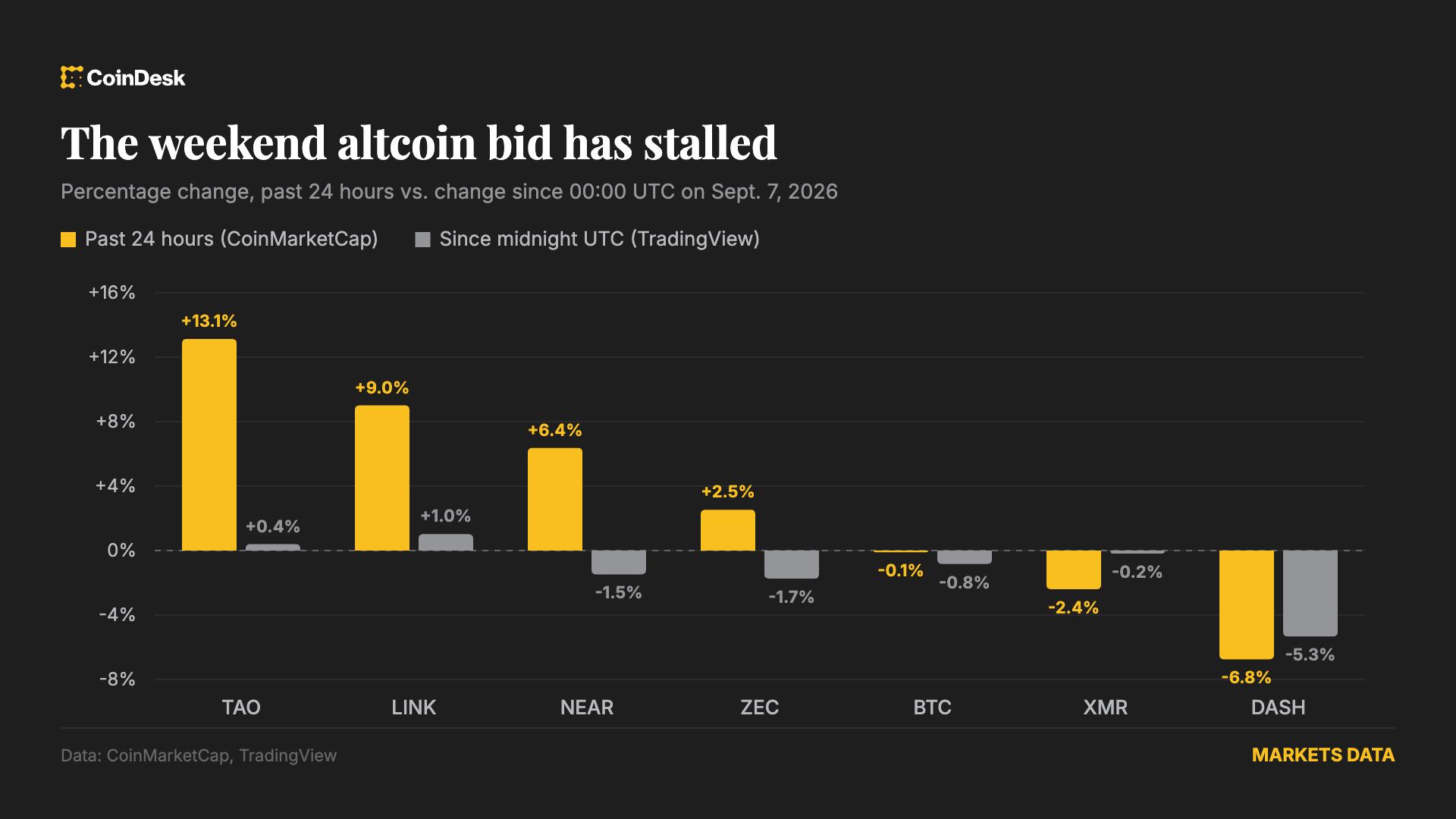
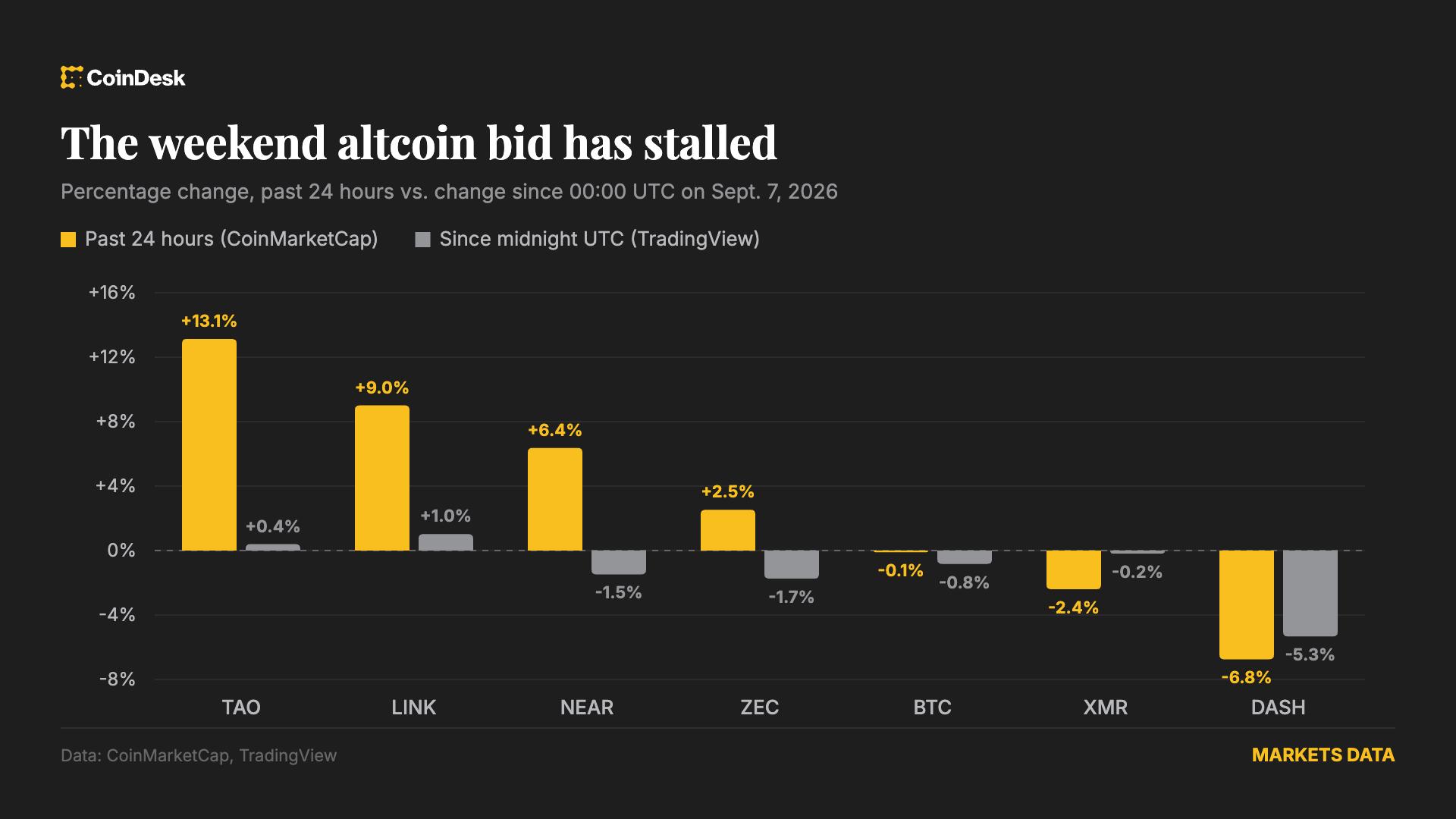
Bitcoin fell 1.1% since midnight UTC as Nasdaq 100 futures rose 0.3%, while the weekend’s double-digit altcoin gains stalled.
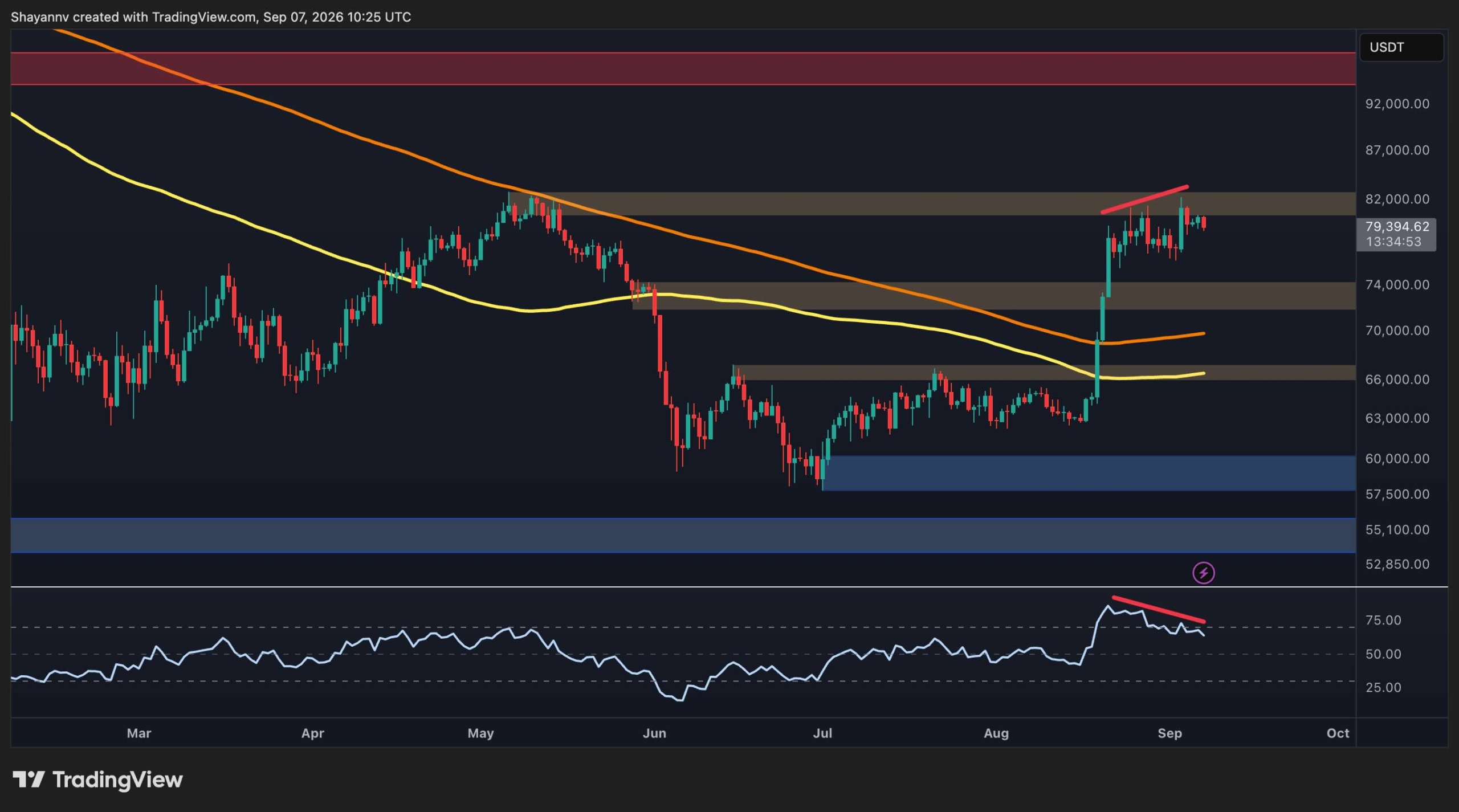
Bitcoin is consolidating around $80K after a sharp recovery from the $60K area. While the broader structure has shifted constructively, BTC is now facing a significant resistance zone near $80K-$82K, while momentum indicators suggest that the latest advance is losing strength.
Bitcoin Price Analysis: The Daily Chart
The daily chart shows a clear structural improvement following the strong breakout from the $66K consolidation area. BTC has reclaimed both major moving averages shown on the chart, with the 200-day moving average now around $70K and the 100-day average near $66K. As long as the asset remains above these levels, the broader recovery structure remains intact.
The immediate obstacle, however, is the $80K-$82K resistance zone, which has repeatedly capped the recent leg up. BTC briefly pushed into this area but failed to establish a sustained breakout and has since moved sideways around $79K-$80K. A decisive daily close above $82K would likely strengthen the bullish case and expose the next major resistance area around $95K.
Conversely, rejection from the current zone could trigger a deeper retracement toward the $72K-$74K area, which represents the first major daily support zone. Below that, the $66K region becomes particularly important as the last line of defense before the base of BTC’s recent rally.
The RSI has also cooled considerably from its recent overbought reading above 80. More importantly, the indicator is making lower highs while BTC is testing or approaching previous highs, creating a bearish momentum divergence. This does not necessarily signal an imminent reversal, but it suggests that upside momentum is becoming less convincing and that a breakout may require renewed buying pressure following a short-term consolidation or correction.
BTC/USDT 4-Hour Chart
The 4-hour structure presents a more clearly defined ascending channel. Following the sharp breakout from the $72K-$74K region, BTC has been oscillating between the rising channel boundaries, with the lower trendline currently situated around $77K and the upper boundary at $82K.
The price is currently around $79.4K, leaving BTC roughly in the middle-to-upper portion of this range. The $80K level is therefore an important near-term threshold, while the $82K level remains the primary resistance area.
A clean break above $82K, preferably accompanied by sustained 4-hour closes above the channel’s upper boundary, would invalidate the immediate range-bound setup and could open the door toward higher levels. On the other hand, a rejection followed by a loss of the lower trendline at $77K would increase the probability of a move back toward the $72K-$74K support zone.
The latest price action also indicates that the strong impulsive move higher has transitioned into consolidation. This can be constructive if BTC continues to hold the upper part of the range, but a breakdown through the lower channel boundary would suggest that the market needs a deeper correction before another attempt at the highs.

On-Chain Analysis
The Spot Average Order Size chart shows relatively little whale activity around Bitcoin’s current $77K-$80K trading range. In contrast, there was significantly more whale activity around the $60K-$65K lows, where larger orders were heavily concentrated. This positioning may have reflected accumulation near the market bottom, as Bitcoin subsequently rallied sharply from that area toward $80K.
The relatively limited whale activity at current levels could suggest that large participants are not aggressively adding exposure around the recent highs. This does not necessarily imply distribution, but it indicates that the current rally has not been accompanied by the same degree of whale activity seen near the lows.
From a broader perspective, the concentration of larger orders around the $60K-$65K area is notable because it preceded Bitcoin’s substantial recovery. If that activity represented accumulation, the subsequent rally could indicate that some of those positions are now in profit. Meanwhile, the lack of significant whale activity around $77K-$80K leaves the market more dependent on whether buyers can generate enough momentum to break the $80K-$82K resistance zone.

The post Bitcoin Price Analysis: BTC Bulls Need to Break This Key Level to Regain Momentum appeared first on CryptoPotato.
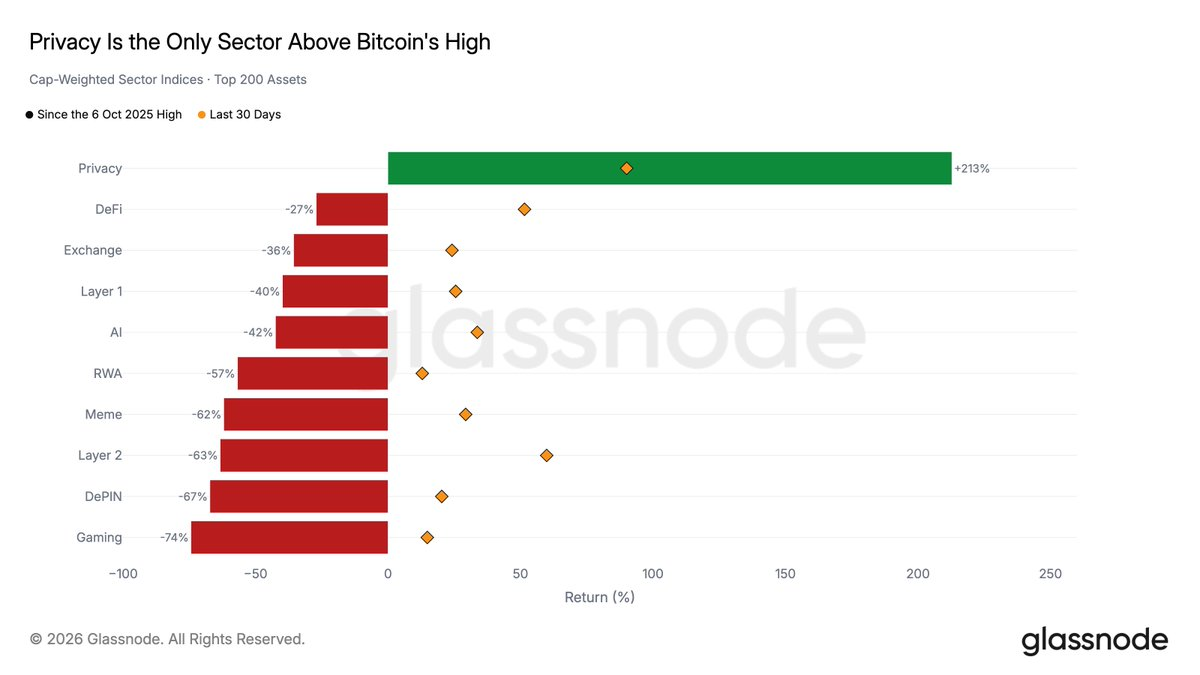
Privacy coins are up 213% since Bitcoin (BTC) peaked last October. Every other crypto sector is down, according to on-chain analytics firm Glassnode.
The median coin in the top 200 is 58% cheaper than it was that day. Bitcoin itself still trades 36% below its own record.
Privacy Coins Are the Only Sector Above the High
Glassnode tracks 10 sectors, scoring each against its price on October 6, 2025, the day Bitcoin topped out at $126,199 on Binance.
Privacy is the only green bar on the chart. DeFi is the best of the losers, down 27%. Gaming is the worst, down 74%.

Last month was kind to almost everything, with all 10 sectors rising.
Still, privacy coins led that leg too with a 90% gain. Therefore, the ranking did not change, with only 9% of the top 200 sitting above their October price, even after that broad bounce.
So the altcoin season never arrived in the shape holders wanted. Money picked one theme and stayed there.
Zcash Is Doing Almost All the Work
Privacy coins were worth $7.1 billion a year ago. Glassnode now values the group at $33.6 billion, just above Tron (TRX), the eighth-largest crypto. Zcash (ZEC) supplies most of that. It trades near $1,180 and ranks ninth by market value at $19.9 billion.

Notably, while the ZEC price is up 687% since Bitcoin’s high, the privacy sector is up 213%.
Only four of the 25 largest coins beat their October price. Two are privacy names, ZEC and Monero (XMR), which has roughly doubled.
That notwithstanding, the run was not smooth, with Zcash having to patch a critical bug in its shielded pool in June. It then sealed that pool with the Ironwood network upgrade in July.
In August, BeInCrypto asked whether ZEC could reach $1,000 this cycle, when it was trading near $675. It cleared that level days later, and Grayscale’s Zcash ETF assets have reached $463 million.
The Bottom of the Sector Is Thin
Glassnode says all eight privacy coins with a year of history have gained. Three of them barely have. Decred (DCR) showed a 2% gain on that reading. Two others managed 3% and 6%.

CoinGecko now puts Decred down 2.9% over 12 months. The claim’s weakest leg has already flipped. Zcash and Monero together hold about 90% of the sector’s value.
A stall in Zcash price action would wipe out the one green bar on Glassnode’s chart.
The post One Crypto Sector Is Up 213% While the Rest Struggles appeared first on BeInCrypto.

Miriam Margolyes Addresses Andi Peters This Morning Controversy

‘This might be the year’: Mbappé embraces Ballon d’Or talk after World Cup exploits
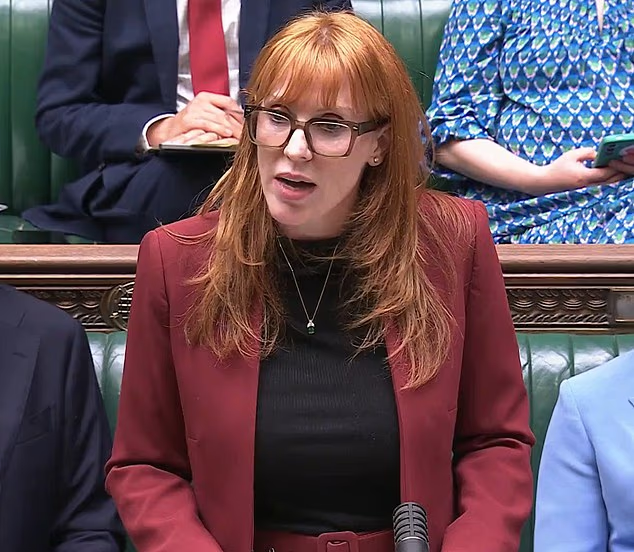
Humiliation for Angela Rayner as she is forced to abandon controversial Labour shake-up of local authorities amid legal challenges





-

 Fashion3 days ago
Weekend Open Thread: Beyond Yoga
-
 Crypto World3 days ago
Bitcoin price stalls near $82K as key resistance holds
-

 Politics3 days ago
Best Gaming Laptops, CPUs, TVs, And Keyboards To Upgrade Your Set Up For GTA VI
-

 Tech3 days ago
The Birds Outside, Drawn For You Automatically
-

 Crypto World3 days ago
IMF Says El Salvador’s Post-Review Bitcoin Purchases Used No Public Funds
-
 Crypto World3 days ago
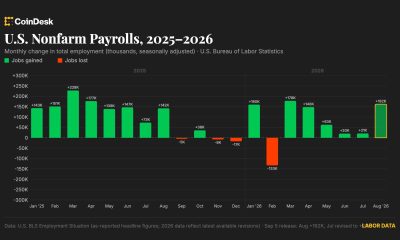
U.S. added stronger than expected 162,000 jobs in August as labor market bounced back
-

 Sports3 days ago
Alexandre Pato consortium’s Northampton Town investment approved
-

 Sports3 days ago
Commanders’ Chig Okonkwo is a top breakout fantasy football candidate
-

 Sports3 days ago
Golden Eaglets Drawn in Group B for 2026 WAFU B U17 Championship
-
 Crypto World3 days ago
XRP price breaks falling channel as bulls target $1.53
-

 Politics3 days ago
A new European chapter for Gibraltar
-

 Politics3 days ago
How To Avoid Winter Colds: 4 Everyday Habits That Spread Germs, Says Pharmacist
-
 Politics3 days ago
The House | Bin the lectures, bring gossip and be ready to banter: how the new PM should prepare for his Trump encounter
-

 Crypto World3 days ago
From warning to listing: UK’s largest retail investment platform opens access to crypto ETNs
-

 Crypto World3 days ago
FinCEN flags $12.7B tied to Southeast Asia crypto investment scams
-

 Tech3 days ago
A Worthy Android Ereader, With Some Tradeoffs
-

 Crypto World3 days ago
Trezor Data Breach Impacts 67,000 More US Customers
-

 Tech3 days ago
How To Edit Claude’s Memory
-

 Politics3 days ago
33 Cosy Autumn Home Decor Ideas: Blankets, Pumpkin Decorations, And Candles
-

 Tech3 days ago
beyerdynamic AVENTHO Y Debuts at IFA 2026 and Makes Wireless Headphones Less Disposable
You must be logged in to post a comment Login