
Crypto World
BNC Shareholder Dispute Sparks Governance Tensions



Binance-affiliated investment firm YZi Labs (formerly Binance Labs) publicly accused asset manager 10X Capital on Wednesday of failing to comply with US securities disclosure requirements. The dispute comes amid broader governance changes at CEA Industries.
In an official blog post, the firm alleged that 10X Capital failed to comply with SEC rules requiring disclosure of ownership stakes once a certain threshold is reached.
Sponsored
YZi Labs Accuses 10X Capital of Reporting Violations
The dispute centers on CEA Industries, known by its Nasdaq ticker, BNC. The company describes itself as managing the world’s largest corporate treasury of BNB.
For crypto market participants, the situation is particularly relevant. BNC’s treasury strategy ties it closely to the Binance ecosystem. Governance or asset management changes at the company could affect how its large BNB holdings are managed.
Both YZi Labs and 10X Capital hold positions in BNC, and recent developments indicated an escalating contest over governance.
The latest accusations come just one week after BNC publicly refuted earlier claims made by YZi Labs regarding the company’s compliance with Nasdaq rules tied to the timing of its Annual Meeting of Stockholders. In that February 13 statement, BNC said it was fully compliant and rejected what it described as “false” and “reckless” assertions.
In a formal letter addressed to 10X Capital on Wednesday, YZi Labs alleged that the asset manager failed to properly report its ownership stake in CEA Industries.
Under US securities law, investors who accumulate more than 5% of a public company’s shares must disclose their holdings. That way, other shareholders are aware of potential shifts in influence.
According to YZi Labs, 10X Capital has owned more than 5% of BNC’s shares since late 2025. However, it did not file a Schedule 13D to formally report that stake or disclose that it may have been acting together with other shareholders.
YZi Labs also alleged that 10X Capital founder Hans Thomas, who serves on BNC’s board, did not submit the required SEC filing that directors must complete to disclose their initial share ownership in the company.
“SEC disclosure rules are not ‘personal preferences’ or ‘optional housekeeping’ – they are the baseline standard and non-negotiable obligations for anyone who wants a seat on a public company Board,” said Alex Odagiu, an investment partner at YZi Labs. “If you cannot manage timely Section 16 filings and clear ownership disclosure, you should not be managing a public company.”
Sponsored
The allegations surfaced the same day BNC’s Board of Directors announced a proposal to amend its Asset Management Agreement with 10X Capital.
Governance Stakes Rise Over Asset Deal
In its proposal, the Board said it is seeking lower management fees, a shorter contract term, and more flexible termination provisions. It described the move as part of a broader effort to enhance operational flexibility and long-term value.
It followed what it described as a comprehensive review of the agreement and came after YZi Labs publicly confirmed the termination of a previously undisclosed side agreement with 10X that had restricted amendments to the deal.
Sponsored
With that restriction lifted, the Board said it is moving forward with renegotiation discussions.
The developments unfold alongside YZi Labs’ own regulatory filings. The investment firm previously disclosed that it had crossed the 5% ownership threshold following the company’s share repurchases and later formed a shareholder group.
Crossing that threshold is significant under both federal securities law and Nevada corporate law, where CEA Industries is incorporated.
While federal rules require disclosure, Nevada law governs shareholder rights and board authority. Ownership levels can affect a shareholder’s ability to initiate actions, such as consent solicitations, or to influence governance decisions.
Against that backdrop, the timing of the disclosure dispute and the Board’s push to revise 10X’s asset management agreement suggest the disagreement may extend beyond regulatory filings. It may also reflect deeper questions over control and strategic direction at the BNB-focused public company.



The US government transferred approximately 8.2 Bitcoins (BTC), worth roughly $606,000, to Coinbase Prime.
The transfer was tied to the 2016 Bitfinex hack seizure, according to on-chain data flagged by Arkham Intelligence.
Why These Bitcoins Are Unlikely to Hit the Market
The wallet executed two back-to-back outflows, splitting the move into a 7.999 BTC transaction and a smaller 0.197 BTC deposit routed to the same Coinbase Prime address.
Follow us on X to get the latest news as it happens
Exchange-bound transfers often spark speculation of an imminent liquidation. However, these specific coins are legally committed elsewhere.
A federal court approved the return of approximately 94,643 BTC to Bitfinex through restitution agreements in early 2025. The ruling established Bitfinex as the sole victim entitled to recovery.
Thursday’s outflow follows earlier 2026 transfers from the federal wallet on March 3 and April 10. US government wallets currently hold 328,361 Bitcoin worth roughly $24 billion as of April 2026, according to Arkham data. The latest transfer equals over 0.0024% of the stash.
Ilya Lichtenstein executed 2,000 fraudulent transactions to steal 119,754 BTC from Bitfinex in 2016. He received a 5-year prison sentence in November 2024.
Lichtenstein and his wife, Heather Morgan, pleaded guilty to conspiracy to commit money laundering in August 2023. He earned early release in January 2026 under the First Step Act.
The post US Government Moves Over $606,000 Bitfinex Hack Bitcoin to Coinbase Prime appeared first on BeInCrypto.
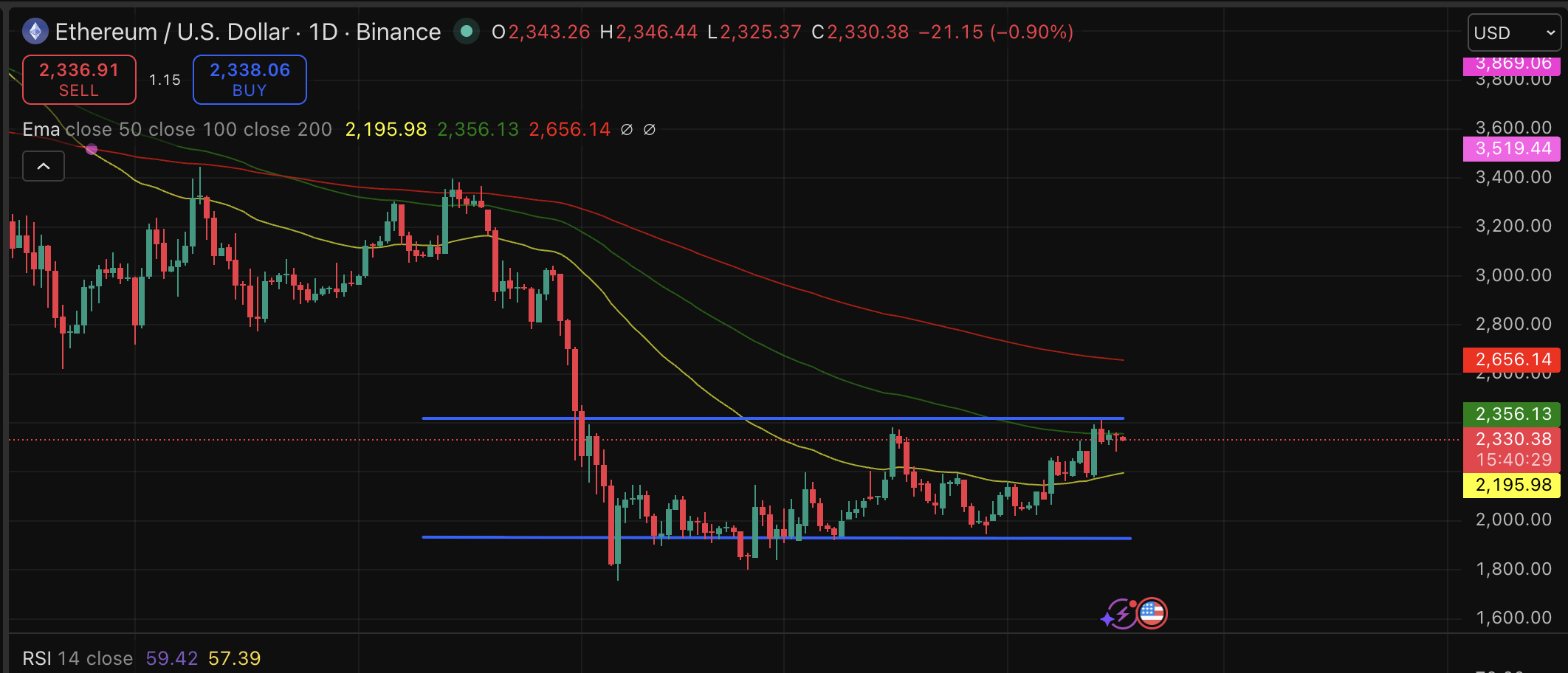
Ethereum price, just like any other major alt, is hovering and holding the bullish prediction. The network also reminds us that ETH has never once stopped producing blocks.
At BUIDL Asia 2026, Ethereum Foundation researcher Luca Zanolini confirmed a roadmap target to reduce transaction finality to under one minute. Meanwhile, the long-to-short ratio sits at 1.54, a quiet signal that smart money is accumulating while retail hesitates.
Zanolini’s remarks, delivered April 17 at the Sofitel Ambassador Seoul, cut to the heart of Ethereum’s design philosophy.
“Ethereum was designed to keep producing blocks even if participation drops,” he said. “The next challenge is to preserve that feature while reducing transaction finality to less than one minute.”
In 2023, Ethereum kept producing blocks uninterrupted even after client errors knocked more than half of all validators offline. The finality improvement carries a 2029–2030 implementation target, and the fundamental thesis is getting reinforced.
Discover: The best pre-launch token sales
Ethereum Price Prediction: $2,420 the Target
ETH has traded in a tight bullish range between $2,285 and $2,360 over the past 24 hours, with 24-hour trading volume exceeding $18 billion. This figure reflects active participation at these levels, without liquidity drifting lower. The funding rate is essentially neutral at 0.0001%, suggesting no extreme leverage in either direction.
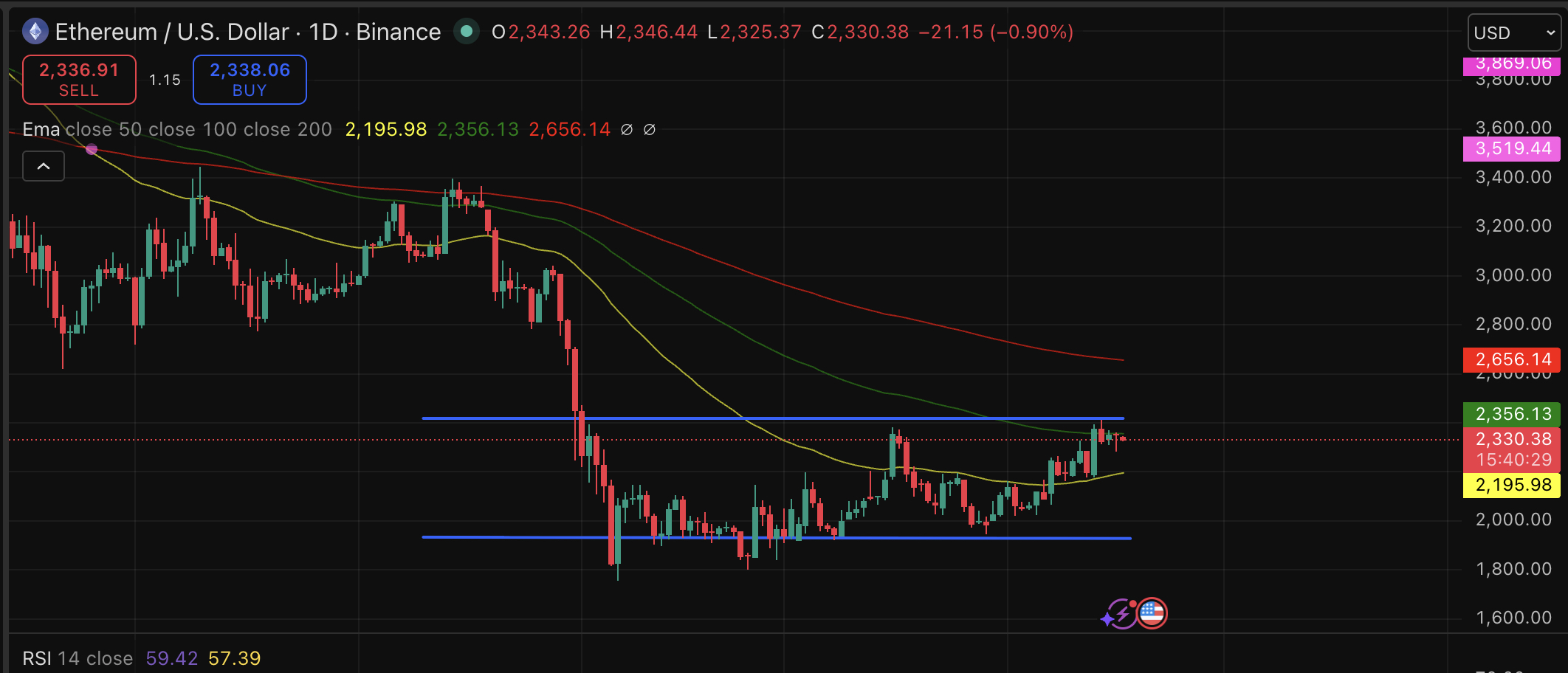
The critical support zone is $2,250. As long as ETH holds above that floor, the technical structure favors a push toward $2,420 resistance. A clean break above $2,420 opens the path to $2,870, a level that would approach territory last seen before the drawdown from ETH’s all-time high of $4,950. That’s still a 52% discount from peak. The upside, in percentage terms, remains substantial.
Open interest dynamics suggest the market is coiled with a sharp move in either direction plausible. The 1.54 long-to-short ratio implies directional conviction from larger players, but conviction alone doesn’t override macro headwinds. Watch the $2,250 level closely.
Discover: The best crypto to diversify your portfolio with
LiquidChain to Fix What ETH Can’t?
ETH may be the chain that never sleeps, but it also carries the weight of a $280B market cap. Meaningful upside from here requires macro tailwinds, a breakout above multi-week resistance, and sustained institutional demand. That’s a crowded list of conditions.
The make-or-break levels are tightening, and for traders sizing positions accordingly, the risk/reward at $2,330 is narrower than it was 5 years ago. Early-stage infrastructure plays offer a different equation entirely.
LiquidChain ($LIQUID) is a Layer 3 infrastructure project built around a single, operationally direct thesis: fuse Bitcoin, Ethereum, and Solana liquidity into one execution environment. The cross-chain fragmentation problem is real and expensive, and LiquidChain’s Unified Liquidity Layer targets it directly, with Single-Step Execution and Deploy-Once Architecture allowing developers to access all three ecosystems without redeployment overhead.
A new layer emerges. Only a few see it first. — LiquidChain (@getliquidchain) March 24, 2026
The future is LiquidChain  ⟁https://t.co/vqvBcdSj94 pic.twitter.com/R7ZeZ0NPGl
The presale is currently priced at $0.0145, with $675K raised to date, and not to forget the huge but limited 1600% APY staking for early buyers. Verifiable Settlement adds an institutional-grade accountability layer that early L3 competitors have largely ignored.
For those already positioned in ETH and watching this level with caution, it may be worth taking a closer look: research LiquidChain here.
The post Ethereum Price Prediction: The Chain That Never Sleeps appeared first on Cryptonews.


The shift to Optimism is ZPG’s first deployment on a public blockchain since launching in 2022, and the start of its global rollout.
Mitsui & Co. Digital Commodities (MDC), a subsidiary of Japanese trading giant Mitsui & Co., Ltd., its tokenized gold, silver, and platinum asset, Zipangcoin (ZPG), on Optimism’s Ethereum Layer 2, OP Mainnet, according to a press release shared with The Defiant.
ZPG has been issued under Japan’s regulatory framework since 2022 and currently runs on Miyabi, a proprietary private blockchain developed by longtime crypto exchange bitFlyer.
The OP Mainnet deployment marks the first time the asset will be issued in a public blockchain ecosystem. Per the release, Japanese CEX GMO Coin will list ZPG on April 20.
MDC’s parent, Mitsui & Co., is a Fortune Global 500 conglomerate with a market cap of over $94 billion, and Berkshire Hathaway as its largest shareholder, the release notes.
MDC also stated in the release that the choice of OP Mainnet follows deliberate due diligence, highlighting that OP Stack chains processed over 6 billion transactions in 2025 — 29x growth in two years.
According to DefiLlama, OP Mainnet currently has a total value locked in DeFi of over $393 million, making it the 17th largest chain in DeFi by TVL. The chain’s stablecoin market cap is approaching $579 million, and $30-day DEX volume is over $623 million.
Sho Miichi, MDC’s representative director & president, was quoted in the release saying: “We are pleased to partner with Optimism to bring a high-quality, commodity-linked digital asset from Japan to investors worldwide.”
Kyle Jenke, chief business officer at OP Labs, described Japan’s regulatory clarity as “one of the most compelling markets for on-chain finance,” adding:
“Zipangcoin is a commodity-backed cryptoasset issued by Mitsui & Co. Digital Commodities and will be the first cryptoasset issued by a Japanese company to launch on OP Mainnet.”
The ZPG launch on Optimism fits into a broader wave of institutional-grade assets moving on-chain.
On-chain tokenized RWAs tripled to roughly $18.6 billion over the course of 2025, with analysts projecting the market could reach $2 trillion by 2030.
Earlier this year, ether.fi migrated its crypto neobank — with $5.7 billion in TVL and around 50,000 active cards — from Scroll to OP Mainnet to access enterprise-grade payment infrastructure.
Tokenized precious metals trading has surged in recent months across both centralized and decentralized platforms. Earlier this week, decentralized perpetual exchange GMX launched 24/7 gold and silver markets on L2 Arbitrum, recording more than $10 million in trades on the first day.
This article was written with the assistance of AI workflows. All our stories are curated, edited and fact-checked by a human.

Key Takeaways
- Charles Hoskinson, founder of Cardano, claims Bitcoin’s BIP-361 quantum protection measure is misleadingly classified as a soft fork when it actually demands a hard fork.
- The BIP-361 framework suggests locking quantum-susceptible Bitcoin wallets and mandating users transition to quantum-resistant addresses.
- BIP-361’s zero-knowledge proof recovery mechanism fails to assist holders of approximately 1.7 million Bitcoin generated before 2013 seed phrase protocols were standardized.
- Roughly 1.1 million of these coins are attributed to Bitcoin creator Satoshi Nakamoto and would face permanent lockdown if the measure is implemented.
- Data reveals that by March 1, 2026, over 34% of circulating Bitcoin features exposed public keys susceptible to quantum computing threats.
Cardano’s creator Charles Hoskinson has openly challenged Bitcoin’s planned quantum computing countermeasure, claiming it carries a misleading technical classification and offers no safeguard for the network’s earliest holdings.
The measure under scrutiny is BIP-361, jointly developed by Bitcoin core developer Jameson Lopp alongside other contributors. The proposal seeks to eliminate Bitcoin addresses exposed to quantum computer vulnerabilities by locking those holdings and requiring users to transfer to more secure addresses.
During a livestream broadcast this week, Hoskinson referenced statistics indicating that by March 1, 2026, more than 34% of circulating Bitcoin will have public keys exposed on the blockchain. This represents approximately 8 million Bitcoin vulnerable to attack from advanced quantum computing systems.
BIP-361 incorporates a zero-knowledge proof recovery framework designed to enable holders with standard wallet seed phrases to verify ownership and retrieve frozen assets following migration.
However, Hoskinson contends this recovery mechanism fails for roughly 1.7 million Bitcoin stored in wallets created before the BIP-39 seed phrase protocol gained widespread adoption around 2013.
These legacy wallets utilized an alternative key generation approach from Bitcoin’s original client software. They depended on local key pools instead of recoverable seed phrases. Without seed phrase access, constructing the zero-knowledge proof necessary for coin retrieval becomes impossible.
“1.7 million coins can’t do that. It’s not possible. 1.1 million of which belong to Satoshi,” Hoskinson stated.
The Hard Fork Controversy
Beyond recovery limitations, Hoskinson contested BIP-361’s classification. He argued the proposal presents itself as a soft fork while functionally demanding a hard fork due to its invalidation of existing signature schemes that remain actively deployed.
“To actually do this, you need a hard fork,” Hoskinson explained. Bitcoin has never implemented a hard fork, and its development community has traditionally resisted such changes.
Lopp, one of the proposal’s co-authors, admitted on X this week that he personally dislikes the plan and characterized it as “a rough idea for a contingency plan” instead of a finalized specification.
Lopp has maintained that freezing inactive coins—which he calculates at 5.6 million Bitcoin—would be more favorable than allowing future quantum attackers to recover and liquidate them in markets.
Governance Structure and Institutional Influence
Hoskinson additionally contended that Bitcoin’s absence of formal on-chain governance infrastructure leaves it without clear procedures for resolving such critical decisions. He cited Cardano, Polkadot, and Tezos as blockchain networks equipped with structured governance frameworks capable of addressing similar matters through community-driven voting mechanisms.
He predicted that major institutional stakeholders, including asset management firms that have accumulated substantial Bitcoin positions in recent years, will ultimately force Bitcoin developers to implement changes despite potential community opposition.
Should BIP-361 be adopted in its present formulation, the approximately 1.7 million pre-2013 coins would become irreversibly frozen without any recovery mechanism available.

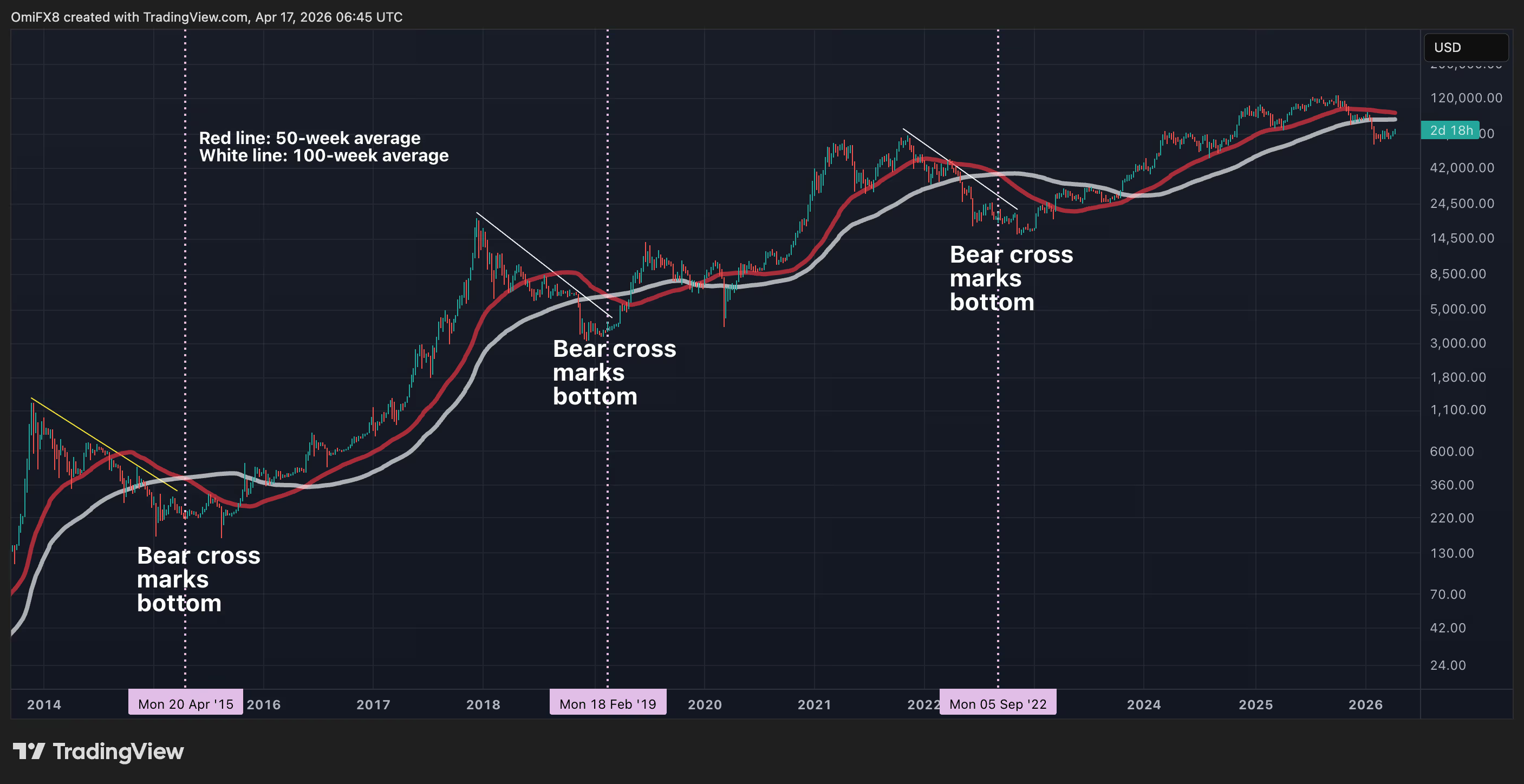
Here is something worth noting about bitcoin . Beneath all the noise from daily price swings, X posts and macro headlines, there is a remarkably simple indicator that has quietly called every major market bottom since 2015. Not once, but every single time.
To the dismay of bulls, it hasn’t fired yet, suggesting the broader bear market may not be over, and the recent bounce to $75,000 from $65,000 could be a temporary recovery.
The indicator
It involves two lines on the price chart. That’s it, no complex formula, analysis of blockchain data needed.
These two lines represent bitcoin’s average price over the past 50 and 100 weeks. They act as simple moving averages, showing near-term and long-term trends in bitcoin’s price.

Most of the time, the 50-week average is above the 100-week line. That’s the natural state for markets that trend upward over time, as is the case with bitcoin.
But occasionally, during periods of peak fear, when selling is relentless, and sentiment has collapsed, the 50-week average falls below the 100-week average. This crossover is known as a bear market signal.
It has occurred three times in bitcoin’s history. Each time, it has coincided with the end of a bear market, marking major price bottoms that have not been revisited since.
In other words, it’s been a contrary indicator, ironically marking bottoms rather than deeper downturns.
Three times, three bottoms
Look at the vertical lines on the chart going back to 2015. These mark the three bearish crossovers – April 2015, February 2019, and September 2022. Each one occurred near the bottoming phase, not precisely at the lowest point, but within the same range.
In 2015, BTC was written off as a failed experiment. Then the crossover happened. BTC subsequently rallied from $200 to nearly $20,000 by the end of 2017. A similar pattern played out after the early 2019 crossover.
The 2022 crypto winter, characterized by several bankruptcies and scams, shattered investor confidence. The downtrend, however, ran out of steam after the crossover happened in September. BTC bottomed out in the final months and later chalked out a rally to $126,000 by October 20205.
Each of these bull runs delivered returns far exceeding those of equities and other major asset classes.
What is it saying now?
As of April 17, the crossover has not happened.
Bitcoin has declined sharply from its October record high of over $126,000 to around $75,000, briefly reaching $60,000 in early February. As a result, the two averages are moving closer together, but the 50-week average still holds above the 100-week average.
The takeaway: If history is any guide, the broader bear market may still be intact and could worsen before finding a bottom. It also means that the recent bounce toward $75,000 is likely a temporary recovery rather than the start of a full-fledged bull market.
That said, historical patterns are just that – patterns – and they do not guarantee future outcomes. If U.S. equities, already at record highs, continue to advance, institutional demand for Bitcoin ETFs could strengthen, potentially supporting a price rally.
Cardano (ADA) founder Charles Hoskinson argues BIP-361’s zero-knowledge recovery mechanism cannot rescue roughly 1.7 million Bitcoin (BTC) locked in pre-2013 addresses. This includes roughly 1.1 million Bitcoins attributed to Satoshi Nakamoto.
Casa co-founder Jameson Lopp and five co-authors submitted the Bitcoin Improvement Proposal (BIP-361). It seeks to sunset legacy ECDSA/Schnorr signatures, rendering funds on those addresses unspendable.
Hoskinson Flags Fatal Gap in Bitcoin’s Quantum Plan
Estimates indicate that over 34% of Bitcoin is held in addresses potentially vulnerable to future quantum threats, prompting renewed focus on mitigation efforts. The BIP-361 proposal seeks to address the vulnerability.
The draft phases out legacy Bitcoin signatures in three stages. Phase A blocks new sends to vulnerable addresses. In Phase B, nodes would reject all transactions that rely on ECDSA and Schnorr signatures
Phase C, pending further research, would let holders recover frozen coins. They would submit a zero-knowledge proof of possession of a BIP-39 seed phrase. However, concerns remain over the feasibility of such recovery. In a recent video, Hoskinson stated that,
“1.7 million coins can’t do that. It’s not possible. 1.1 million of which belong to Satoshi.”
Subscribe to our YouTube channel to watch leaders and journalists provide expert insights
He explained that these coins originate from Bitcoin’s early architecture, which predates modern standards like BIP-39 seed phrases and hierarchical deterministic key generation.
As a result, they fall outside the assumptions required for zero-knowledge-based recovery systems, limiting the effectiveness of proposals like BIP-361 for older holdings.
“if you build a ZK system based upon proof of a statement, your bit 39 key, say I have these things, you can recover some of the 8 million Bitcoin, but 1.7 million are on not under this scheme. All of the 2013 Bitcoin and before,” he added.
The limitation is acknowledged in BIP-361 itself, which concedes it is “not possible to construct a proof of HD wallet ownership for UTXOs created before BIP-32 existed.”
“Phase C is also compatible with an ‘Hourglass’ style BIP for spending P2PK encumbered funds, provided such a BIP has activated by the time Phase C activates,” the draft reads.
Hoskinson also disputes the soft-fork classification. He says the plan would require a hard fork. The BIP-361 text acknowledges that consensus rules may eventually need to loosen.
“After Phase B, both senders and receivers will require upgraded wallets. Phase C, if activated in conjunction with Phase B, may be soft forkable, otherwise it would likely require a loosening of consensus rules (a hard fork) to allow vulnerable funds to be recovered,” the authors wrote.
Notably, Lopp acknowledged the discomfort with the proposal, stating that he does not like it himself but considers the alternative even less acceptable.
Follow us on X to get the latest news as it happens
The post Why BIP-361 Can’t Rescue Satoshi’s Bitcoin, According to Charles Hoskinson appeared first on BeInCrypto.
Crypto World
Ethereum had a record 200 million transaction in Q1. Here’s what it means for ether (ETH)
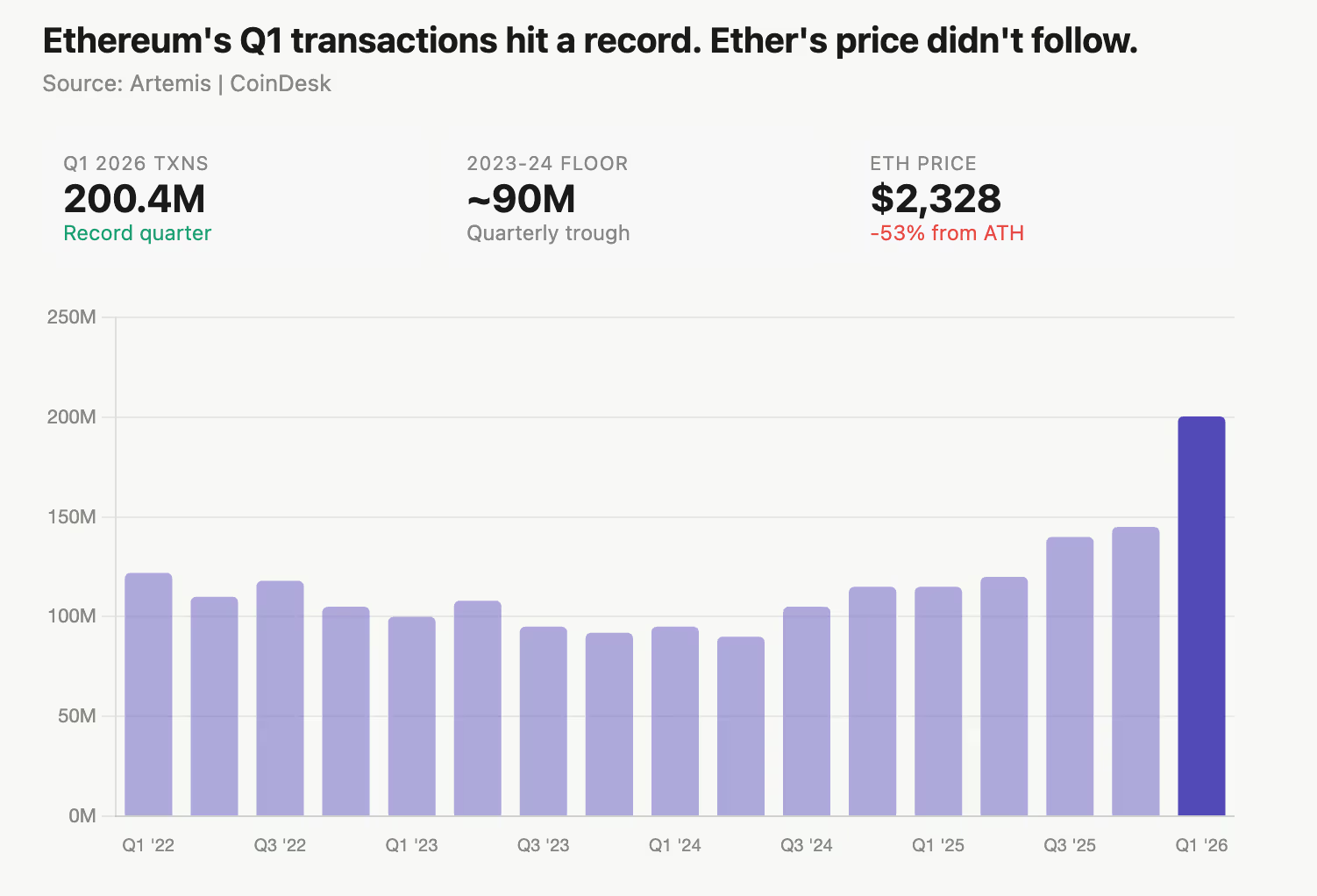
Ethereum, the world’s largest smart contract blockchain, just printed its busiest quarter ever, and the token’s price hasn’t budged.
The network processed 200.4 million transactions on its base layer in Q1 2026, marking the first time it has crossed that threshold in a single quarter, according to Artemis data. Quarterly transaction count bottomed near 90 million in 2023, then spent most of 2024 grinding sideways between 100 million and 120 million.

The Ethereum smart contract blockchain is a decentralized system that can automatically execute agreements without the need for a bank, lawyer, or middleman. Transactions on Ethereum are records of actions, such as sending native token ether (ETH), interacting with smart contracts, or transferring tokens, that are securely processed and imprinted on the blockchain.
Layer 2s and stablecoins lead the boom
The recovery in Ethereum’s on-chain activity began in mid-2025, with each successive quarter seeing higher activity than the last. This led to Q1 2026, when activity jumped 43% from Q4 2025’s 145 million, marking a clear U-shaped growth from the 2023 bottom.
Still, Ethereum’s native token ether is down over 50% from its August 2025 high of nearly $5,000. It traded around $2,328 as of Friday morning. This divergence may present an opportunity for traders looking to capitalize on fundamental growth and statistics.
Most of the traffic lives on Layer 2s, which are separate networks built on top of Ethereum that process transactions cheaply and then batch them down to the main chain for final settlement. Think of Layer 2s as extra packs attached to your bike, letting you carry more than you could on your own.
Base and Arbitrum are the two largest, where users interact with them for lower fees, and the activity shows up on Ethereum’s base layer as settlement and bridging.
Stablecoins, or tokenized versions of fiat currencies, are also being used heavily on Ethereum. According to Token Terminal, the total supply of stablecoins on Ethereum has reached a record $180 billion, according to Token Terminal, accounting for about 60% of the global stablecoin market.
Both trends push transaction counts higher on L1 through settlement and bridging activity, even when end users never directly touch the base layer.
The risk flagged by some analysts is that L2 activity masks base-layer fee pressure.
Ethereum earns less per transaction after the Dencun upgrade significantly reduced data costs for L2s, meaning more activity does not cleanly translate into more burn or more holder value.
The broader read is that Ethereum’s usage has completed the kind of multi-year recovery that typically precedes price movement rather than trails it.
Whether this quarter marks an inflection or the top of a local cycle depends on whether the 200 million figure holds in Q2, and whether the growth continues to be driven by genuine onboarding rather than bot activity, which has increasingly dominated stablecoin transaction volume on-chain.

Cardano founder Charles Hoskinson has gone on record calling Bitcoin’s proposed quantum defense both technically mislabeled and functionally inadequate. The detail most outlets are missing: roughly 1.7 million BTC may be beyond saving, no matter what developers vote through. This is all happening when Bitcoin price prediction is getting bullish.
In a video posted to his YouTube channel late Wednesday, Hoskinson dissected BIP-361, the proposal from developer Jameson Lopp and others to phase out quantum-vulnerable Bitcoin addresses. He says that BIP-361 is being marketed as a soft fork but would functionally require a hard fork, since it invalidates existing signature schemes that active users currently rely on.
“To actually do this, you need a hard fork,” Hoskinson said flatly.
He called the soft fork characterization a lie. Bitcoin’s development culture has historically treated hard forks as violations of the network’s immutability, which makes the political fallout as significant as the technical one. The broader quantum security debate has been intensifying across the industry for months.
The deeper problem sits in the recovery mechanism. BIP-361 proposes that users with frozen quantum-vulnerable funds could reclaim them via a zero-knowledge proof tied to a BIP-39 seed phrase. According to Hoskinson, approximately 1.7 million BTC, including the estimated ~1 million coins attributed to Satoshi Nakamoto, predate BIP-39’s 2013 introduction entirely. No BIP-39 seed phrase exists for those wallets.
The zero-knowledge recovery path simply doesn’t apply. Satoshi’s coins, by this analysis, are structurally unrecoverable under the current proposal regardless of how the fork resolves.
Discover: The best crypto to diversify your portfolio with
Bitcoin Price Prediction: Fork or no Fork, $250,000 the Target
Hoskinson’s skepticism about Bitcoin’s protocol governance hasn’t dampened his price outlook. He publicly predicted BTC reaches $250,000 by mid-2026, a 3X from current levels, citing institutional inflows, Magnificent 7 tech integration, the incoming Clarity Act, and sustained end-user growth as primary drivers. He reiterated the forecast in a Bloomberg interview at TOKEN2049 Singapore.
— Coin Bureau (@coinbureau) November 23, 2025
 HOSKINSON PUSHES HIS $250K BITCOIN TARGET TO LATE 2026.
After calling for $250,000 $BTC by end-2025 in April and then moving it to mid-2026 in October, he now expects it to happen by the end of 2026. pic.twitter.com/uyCKexxoKF
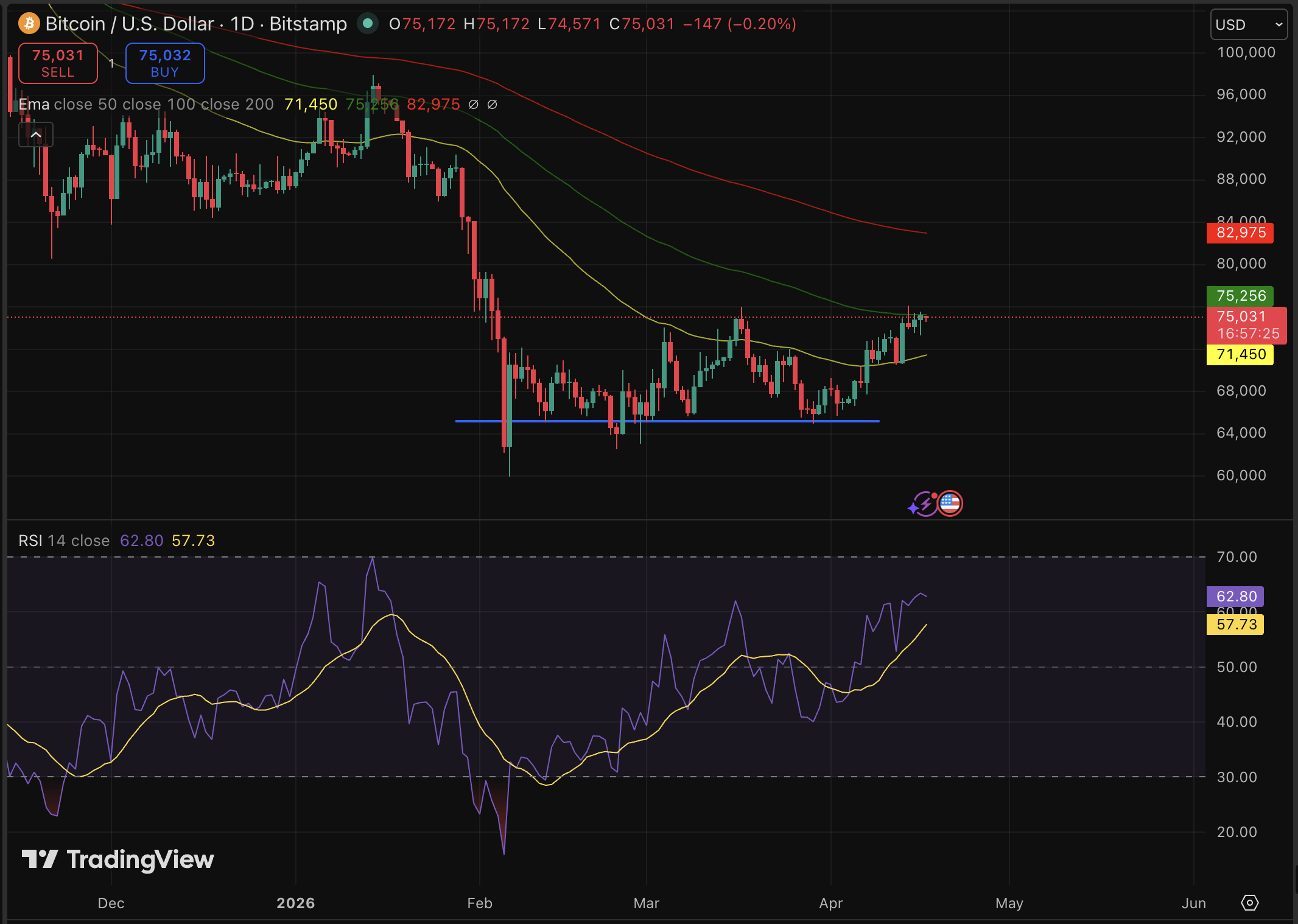
Technically, Bitcoin’s current position at just under $74,000 reflects a meaningful recovery from the sub-$66,000 low due to the fear of an Iran war. Early this month, the peak stood at $73,000; BTC has now cleared that level convincingly. Analyst consensus has been steadily repricing upward as macro headwinds ease.
The quantum debate is a wildcard that existing price models don’t price cleanly. If BIP-361 stalls, or forces a hard fork, short-term volatility is the near-certain outcome.
Discover: The best pre-launch token sales
Bitcoin is Getting Forked, Hyper is Here to Fix
Bitcoin’s limitations are precisely what’s fueling conviction in the layer-2 thesis right now. To be back to $120,000+ high, BTC’s upside requires institutional scale, an asymmetric early-stage return that individual traders once found in spot BTC is largely gone.
Bitcoin Hyper ($HYPER) is positioning directly inside that gap. It’s the first Bitcoin Layer 2 integrating the Solana Virtual Machine (SVM), delivering faster smart contract execution than Solana itself while preserving Bitcoin’s underlying security.
The project has raised $32 million at a current presale price of $0.0136, with a high 36% APY staking already live. Key infrastructure includes a Decentralized Canonical Bridge for BTC transfers and extremely low-latency transaction processing, addressing Bitcoin’s three core bottlenecks simultaneously: slow speed, high fees, and zero programmability.
The presale has been gaining traction precisely as the Bitcoin protocol debate raises questions about the base layer’s adaptability.
Research Bitcoin Hyper before the current price tier closes.
The post Bitcoin Price Prediction: Cardano Hoskinson Says BTC Fix Can’t Save Satoshi Bags appeared first on Cryptonews.
Key Takeaways
- On April 15, the S&P 500 reached 7,022.95, breaking its January 28 record, while the Nasdaq achieved an unprecedented high of 24,016
- Tom Lee contends the US market is absorbing elevated oil prices more effectively than global counterparts, despite crude exceeding $100/barrel following Hormuz Strait disruptions
- Monthly defense expenditures approaching $30 billion are strengthening corporate earnings and providing economic support amid US-Iran tensions
- Historical patterns suggest oil price spikes may produce milder inflation effects than current market fears indicate, according to Lee
- Cash-heavy institutional investors face pressure to enter markets at record levels, generating fresh demand — Lee holds firm on his 7,300 S&P 500 projection
Both the S&P 500 and Nasdaq established fresh all-time records this week, recovering from declines associated with escalating US-Iran tensions that have weighed on investor sentiment since late January. The S&P 500 finished trading at 7,022.95 on April 15, eclipsing its prior benchmark from January 28. Meanwhile, the Nasdaq concluded at 24,016, marking its own historic milestone.
Fundstrat’s founder Tom Lee joined CNBC’s Closing Bell to outline his view that current market conditions are fundamentally stronger than those present during earlier 2026 peaks. He presented three distinct rationales supporting this position.
Lee’s opening argument centered on oil prices. Crude prices jumped past the $100 threshold after disruptions to shipping through the Hormuz Strait. While recognizing this challenge, Lee emphasized that American markets are weathering the situation more successfully than international peers.
“The stock market finds itself in superior condition compared to where we stood at the year’s outset,” Lee stated. He highlighted that elevated energy costs are constraining other economies more severely, while US equities have demonstrated resilience in absorbing this pressure.
Crude prices experienced some retreat from peak levels as market participants anticipated potential diplomatic resolution between Washington and Tehran.
Earnings Strength Persists
Lee’s second rationale emphasized corporate financial performance. He observed that company profitability has maintained momentum throughout the conflict period, suggesting the geopolitical situation has actually provided economic stimulus rather than hindrance to American businesses.
Defense sector expenditures play a central role in this dynamic. Lee highlighted that monthly defense outlays currently hover around $30 billion, with scenarios suggesting potential expansion to $60 billion. These funds are circulating directly through the domestic economy.
He drew a contrast with oil-related costs, estimating American consumers collectively shoulder approximately $12 billion monthly in elevated energy expenses — yielding a net economic benefit when compared against defense spending inflows.
Technology sector firms have delivered robust first quarter 2026 earnings, frequently surpassing analyst projections. These results have helped validate current Nasdaq price levels.
Inflation Concerns May Be Overblown
Lee’s third point challenged widespread inflation anxieties. Numerous market observers have cautioned that triple-digit oil prices will cascade into broader consumer price increases. Lee offered a contrary perspective.
“Historical examination of energy price fluctuations reveals that their influence on core inflation metrics proves less pronounced than we initially expected,” he explained. He anticipates the inflationary impact will be more modest than current market pricing suggests.
Institutional Capital Deployment Accelerates
Throughout the recent market correction, substantial institutional capital remained uncommitted as fund managers accumulated cash positions. With equity indices now establishing new records, these investors confront mounting pressure to allocate reserves or risk underperforming their respective benchmarks.
Lee reaffirmed his year-end S&P 500 forecast of 7,300, implying approximately 4% appreciation potential from present levels.
Bitcoin alongside other digital assets have traditionally correlated with technology equities during risk-on market phases, while blockchain analytics reveal increased capital flows into institutional Bitcoin investment vehicles throughout recent weeks.


Sanctioned crypto exchange Grinex halted trading after a suspected state-level cyberattack drained up to $15 million in crypto.
Summary
- Grinex suspended trading after a suspected state-linked attack drained about $13.7 million from 54 wallets.
- On-chain data shows roughly $15 million in USDT moving through Tron and Ethereum, with funds converted to avoid freezing.
Grinex said Thursday it had suspended operations after losing more than 1 billion Russian rubles, roughly $13.7 million, from 54 wallets in what it described as a highly sophisticated breach. The Kyrgyzstan-registered exchange pointed to signs that the attackers had access to resources typically associated with foreign intelligence agencies.
“Due to the attack, the Grinex exchange has been forced to suspend operations. All available information has been transferred to law enforcement agencies. A criminal complaint has been filed at the location of the infrastructure,” the exchange said.
Details shared by Grinex suggested a coordinated operation rather than a routine exploit. The platform said the digital footprint and execution pointed to “an unprecedented level of resources and technology available only to entities of hostile states.”
The incident adds fresh scrutiny to an exchange already under watch from Western authorities. Grinex has been widely linked to Russia’s sanctioned crypto infrastructure and has been described by blockchain analysts as a continuation of the previously blacklisted Garantex platform.
Earlier findings from Global Ledger indicated that Garantex shifted liquidity and user balances to Grinex following its shutdown in March 2025. On-chain data showed funds moving through one-time-use wallets before landing in Grinex accounts, while some users reported that balances frozen on Garantex later appeared on the new platform. Investigators also pointed to similarities in website design and internal confirmations, suggesting operational overlap between the two entities.
Garantex had been sanctioned by the United States in 2022 for facilitating illicit finance and was later targeted by European Union restrictions. Operations formally ceased in March 2025 after Tether froze nearly $2.5 billion worth of ruble-backed stablecoins tied to the exchange. Authorities in India also arrested co-founder Aleksej Bešciokov shortly after the shutdown.
Multiple platforms may have been exposed
According to TRM Labs, activity tied to the attacker may extend beyond Grinex. The blockchain intelligence firm identified two wallets linked to Kyrgyzstan-based exchange TokenSpot that sent about $5,000 to the same consolidation address used in the Grinex breach.
TokenSpot acknowledged a temporary disruption earlier this week. A notice on its Telegram channel mentioned technical work and a brief outage on April 15, followed by confirmation a day later that full services had resumed.
Further analysis from TRM Labs uncovered at least 16 additional addresses connected to the incident, beyond those disclosed by Grinex. Funds from the attack were funneled into a single address holding around 45.9 million TRON, valued close to $15 million.
Funds routed to avoid freezing risk
Blockchain analytics firm Elliptic has traced roughly $15 million in USDt leaving Grinex-linked accounts and moving across the Tron and Ethereum networks. The firm said the attacker converted the stablecoins into other assets soon after the theft.
“This USDT was then converted to another asset, either TRX or ETH. By doing so, the thief avoided the risk of the stolen USDT being frozen by Tether,” Elliptic said.
Past incidents show a pattern of exchanges tied to sanctioned jurisdictions becoming targets for politically motivated or financially driven attacks. Iran-based platform Nobitex lost $81 million in June 2025, with a pro-Israel hacker group claiming responsibility.
Attention now turns to whether Grinex can resume operations and how authorities respond, especially given its alleged role in facilitating sanction evasion and links to previously blacklisted entities.

Janette Manrara Addresses Strictly Come Dancing: It Takes Two ‘Axe’ Rumours

Nuggets Star Healthy and Surging as Playoffs Begin vs Timberwolves

US Government Moves Over $606,000 Bitfinex Hack Bitcoin to Coinbase Prime

Why Israel is blocking foreign journalists from entering

Bitcoin: We’re Entering The Most Dangerous Phase

Alan Cumming Brands Baftas Ceremony A ‘Triggering S**tshow’

THE BIGGEST WIN OF MY LIFE! #gambling #casino #money #comedy #slots

BITCOIN & GOLD LIVE TRADING ANALYSIS @tradingmentor22 Live Trading || #goldtrading #cryptotrading

#reseller #gold #antique #buisness #jewelry #fyp #crazy #money #ytshorts
-

 Politics7 days ago
US brings back mandatory military draft registration
-
 Sports7 days ago
Man United discover Nico Schlotterbeck transfer fee as defender reaches Dortmund agreement
-

 Fashion7 days ago
Weekend Open Thread: Veronica Beard
-

 Politics5 days ago
World Cup exit makes Italy enter crisis mode
-

 Business6 days ago
Tesla Model Y Tops China Auto Sales in March 2026 With 39,827 Registrations, Beating Cheaper EVs and Gas Cars
-

 Crypto World4 days ago
The SEC Conditionalises DeFi Platforms to Be Avoided for Broker Registration
-

 Crypto World3 days ago
SEC Signals Exemption for Crypto Interfaces From Broker Registration
-

 News Videos2 days ago
Secure crypto trading starts with an FIU-registered
-
 NewsBeat4 days ago
Pep Guardiola and Gary Neville agree over Arsenal title problem that benefits Man City
-

 Business6 days ago
Ireland Fuel Protests Enter Day 5 as Blockades Spark Shortages and Government Prepares Support Package
-

 Business7 days ago
OpenAI Halts Stargate UK Data Centre Project Over Energy Costs and Copyright Row
-

 Crypto World6 days ago
Federal judge blocks Arizona from bringing criminal charges against Kalshi
-

 NewsBeat3 days ago
Trump and Pope Leo: Behind their disagreement over Iran war
-

 Crypto World3 days ago
SEC Proposes Certain Crypto Interfaces Don’t Need to Register as Brokers
-
 NewsBeat5 days ago
JD Vance announces ‘no agreement’ with Iran over nuclear weapons fear
-

 Business6 days ago
IMF retains floor for precautionary balances at SDR 20 billion
-

 Business6 days ago
Former Liverpool CEO eviscerates FIFA for World Cup ticket pricing
-
Crypto World4 days ago
Sei Network Enters Quiet Reset Phase as On-Chain Metrics Signal a Slowdown in 2026
-
Business6 days ago
Coreweave CSO Venturo sells $5.5m in class a common stock
-
Sports6 days ago
1st-Round WR Enters Vikings Mock Draft Orbit
You must be logged in to post a comment Login