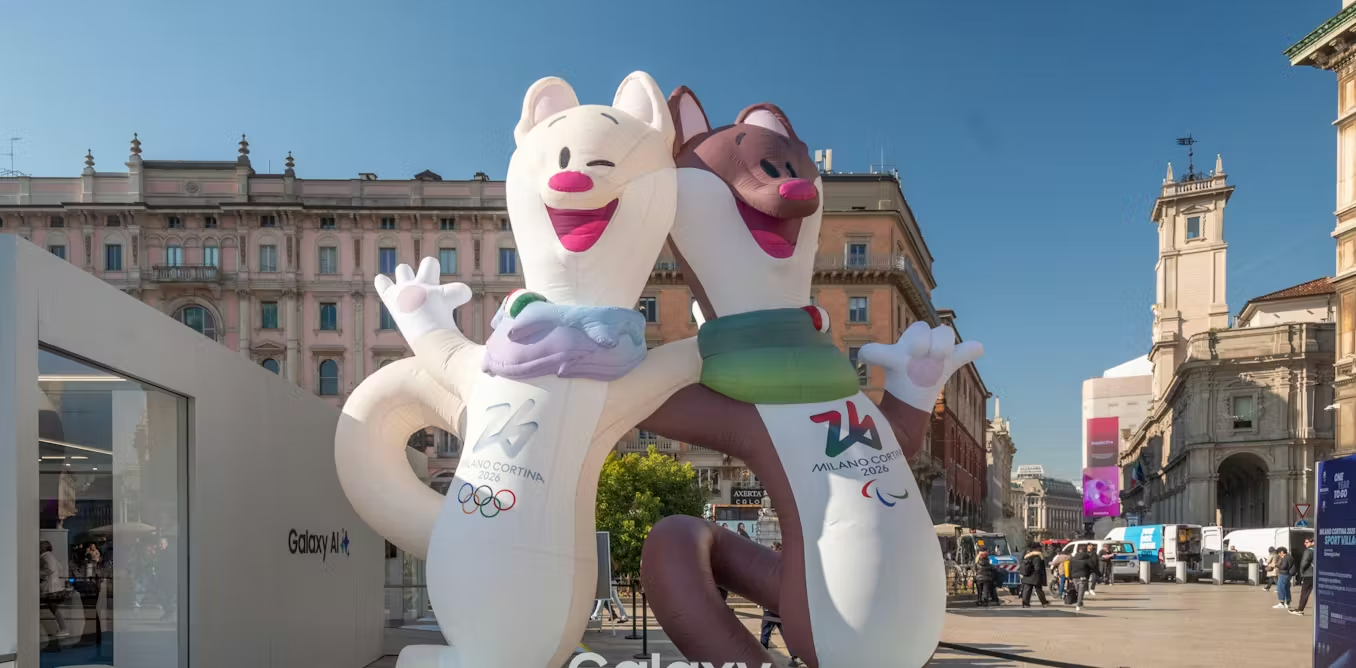
As the 2026 Milano Cortina Winter Olympics in Italy play out, the International Olympic Committee (IOC) is once again insisting that any sport under its flag must remain politically neutral. The Olympic charter grounds this position in its fifth “fundamental principle of Olympism”, which states that sports organisations within the Olympic movement “shall apply political neutrality”.
Yet in recent years, athletes from Russia and Belarus have been excluded or tightly restricted, and calls have also been made to ban Israelis, Americans, and others. This raises the question: what, exactly, does “political neutrality” mean in today’s Olympic Games – and what purpose does it serve?
To start with, it’s obvious to most that the IOC cannot be “neutral” in the everyday sense of never getting involved. In 1992, athletes from the Federal Republic of Yugoslavia were not allowed to compete as Yugoslavia because of UN sanctions, and those who did compete did so under the Olympic flag as independent Olympic participants.
But the US faced no Olympic-wide ban after the 2003 invasion of Iraq, widely argued to be illegal under international law. If political neutrality means never making political decisions, then the IOC couldn’t work by definition, because deciding which countries are recognised and eligible to compete is inherently political.
The real question is not whether the IOC makes political decisions, but why it keeps insisting it does not take sides in political conflicts when, to many observers, its actions suggest otherwise.
Countries and organisations sometimes claim neutrality on principled grounds. In the 1980 Moscow Olympic Games, for example, 65 countries boycotted in response to the Soviet invasion of Afghanistan. Four years later, the Soviet Union and most of the Eastern bloc retaliated by boycotting the 1984 Los Angeles Games, citing political hostility and security concerns.
In both of these cases, the Games still went ahead. The IOC presidents at the time, Lord Killanin in 1980 and Juan Antonio Samaranch in 1984, appeared willing to bear the costs of lower attendance, prestige and fanfare in order to uphold the organisation’s claim to political neutrality, amongst other things.
Today, political neutrality increasingly serves a different role. Rather than expressing a clear position that the organisation is prepared to defend, neutrality is used to keep decisions deliberately vague. Instead of clear criteria that say what neutrality is, when it is required, and when it should be abandoned, the IOC responds to each crisis case by case, without explaining why similar conflicts produce different outcomes.
Sport and politics in the real world
This vagueness reduces the need to justify decisions, accountability and responsibility, all while arguing that it takes a principled position of neutrality. Ironically, “political neutrality” is so loosely defined that it is flexible enough to take sides in political conflicts, a strategic ambiguity not uncommon in international politics.
Admittedly, this may be a smart strategy from an organisational point of view. In early March 2022, the International Paralympic Committee (IPC), within 24 hours of saying Russian and Belarusian athletes would be allowed to compete at Beijing 2022 as neutrals, reversed course after several countries warned they would not compete.
CTK / Alamy
The IPC probably lost some authority, and perhaps even legitimacy, from this reversal. Yet it begs the question where this leaves the concept of political neutrality and values in general, today.
Sport is often seen as a microcosm of society. Whatever happens in sport reflects society at large – and these Winter Olympic Games are no different. In this sense, neutrality in the IOC reflects a broader pattern we see in daily life – one law for the few, and another for the many, with “political neutrality” a convenient mask for taking sides while claiming not to. It appears to be “neutrality” when it benefits the right countries, and “politics” when it does not.
In these Winter Games, the IOC will speak the words of neutrality but think in terms of politics. Neutrality will be invoked to justify restrictions on some delegations or athletes, like Russia and Belarus, while resisting restrictions on others, like Israel and the US, and deflecting responsibility for explaining the difference.
After a week of competition, this double standard is evident. Russian and Belarusian athletes compete only as vetted “individual neutral athletes” without flags or anthems. Meanwhile, athletes from countries facing well-documented accusations of violating international law and human rights, like Iran, Israel, China, the US and others, participate under full national symbols.
The result is that these Winter Games, like many before them, are a stage where political conflict is managed in practice. Political neutrality today does not remove politics from sport; it is simply another way of reinforcing it.