

Crypto World
Will Pi Network price rally continue before first anniversary as multiple bullish patterns emerge?

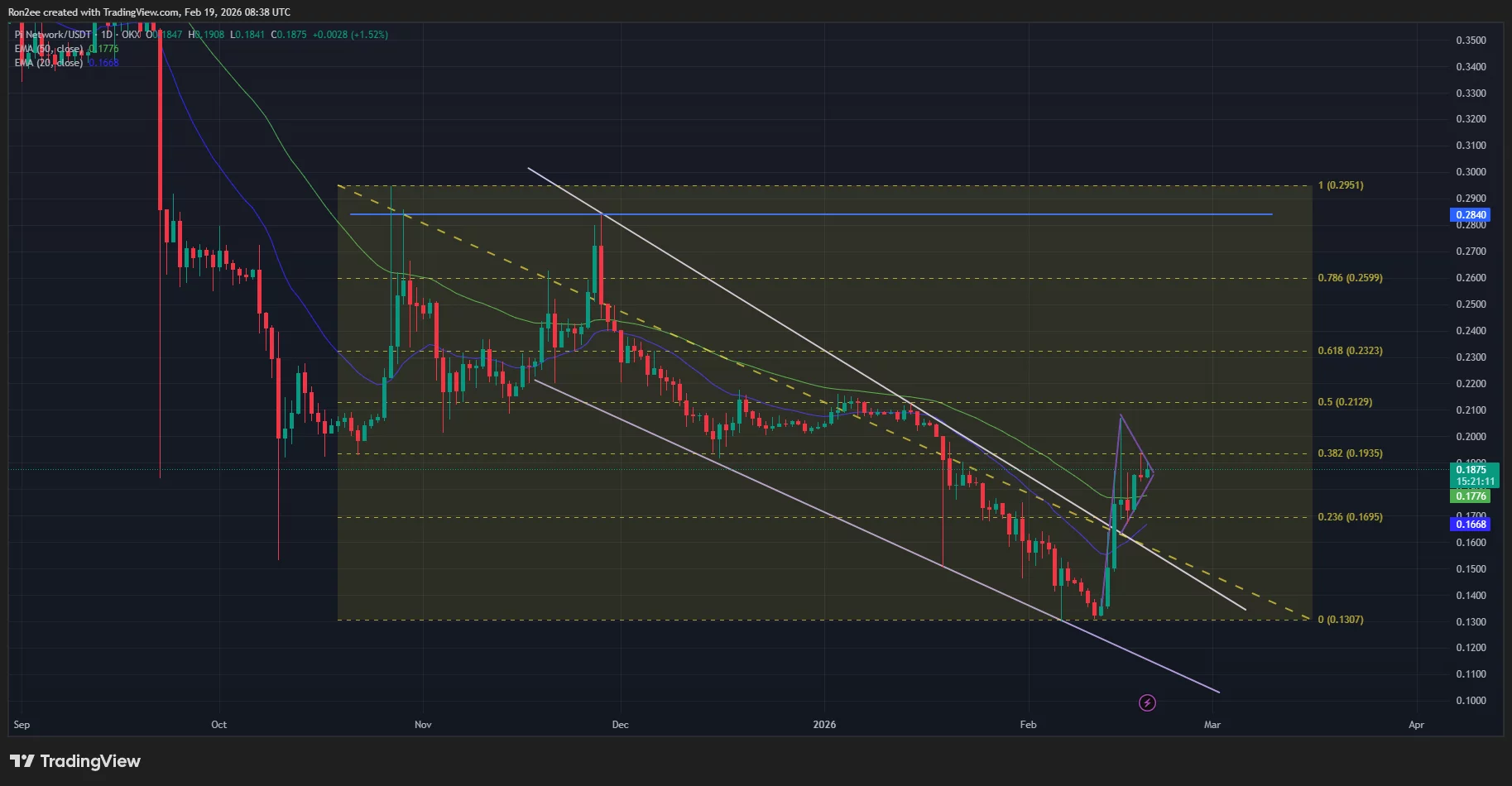
Pi Network price has soared over 40% this week on community hype surrounding the first anniversary of its mainnet launch.
Summary
- Pi Network price rallied to a four-week high of $0.205 on Sunday, supported by increased trading activity ahead of Pi Network’s first anniversary.
- The token’s price action has formed multiple bullish patterns on the daily chart.
According to data from crypto.news, Pi Network (PI) price shot up to a four-week high of $0.205 last Sunday before settling at $0.187 at press time. This move reflects gains of over 40% over a seven-day period and has pushed its market cap up to $1.68 billion.
The biggest catalysts for the surge have been investor excitement over the celebration of the first anniversary of the Pi Network mainnet launch on Friday, Feb. 19. Traders seem to be pricing in the likelihood of developers revealing major announcements to commemorate the event.
At the same time, PI has significantly reduced monthly token unlocks, which has also contributed to the upside as reported earlier by crypto.news. There’s also significant community chatter around a potential Kraken listing, which is adding to the momentum.
At press time, Pi Network was trading close to the 38.2% Fibonacci Retracement level at $0.193.
Pi Network price has formed multiple bullish patterns on the daily chart, which suggest the token rally still has steam left for more upside this week.
First, Pi Network price has broken out of a falling wedge pattern that had been forming since late November last year. This pattern consists of two converging and descending lines. A breakout is confirmed when price moves above the upper trendline, typically signaling a shift in momentum from bears to bulls.
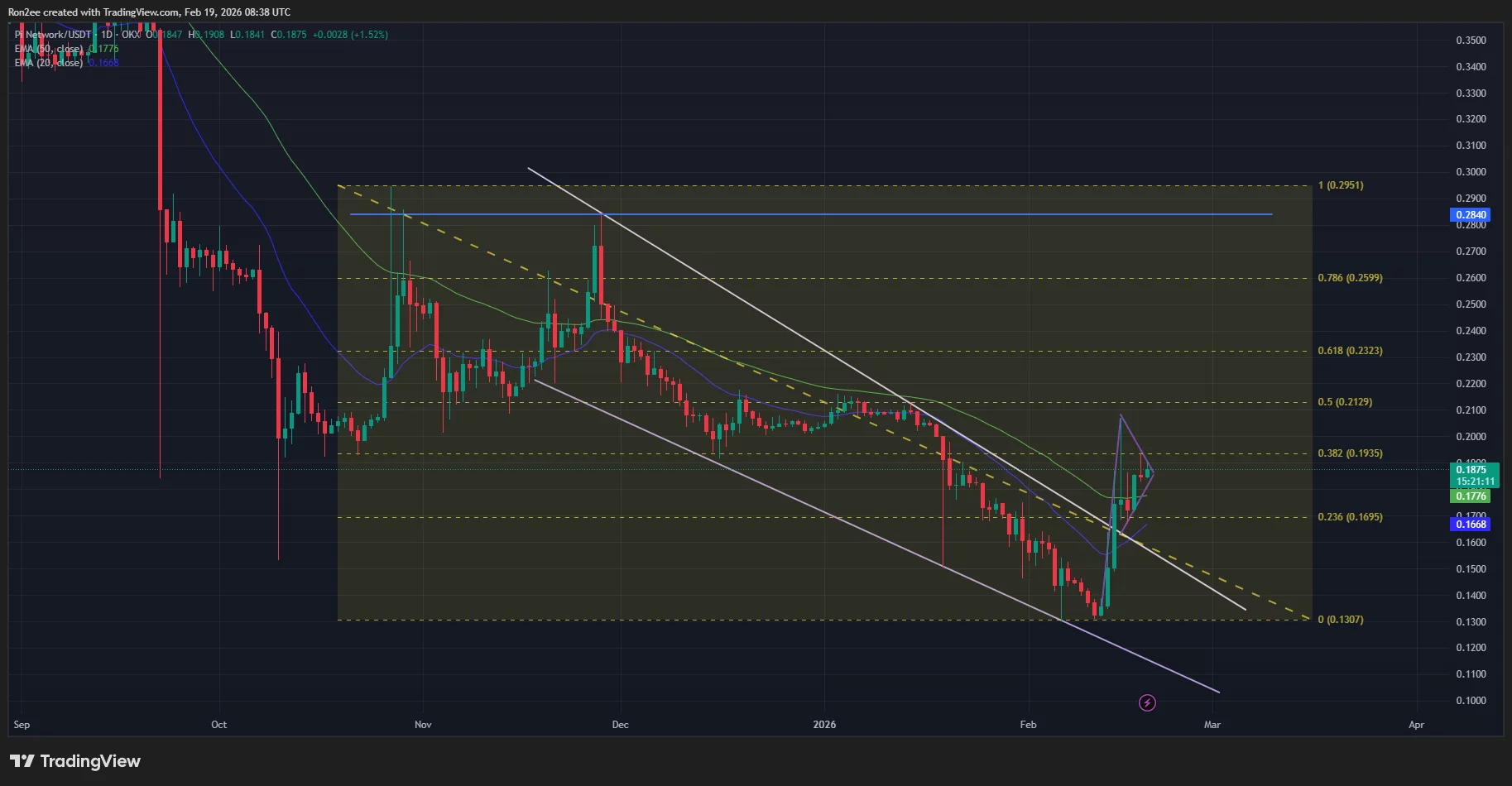
Second, the token’s price action has also formed a bullish pennant pattern marked by a flagpole and a consolidation triangle. Bullish pennant patterns are considered strong continuation signals, often preceding another leg higher.
Hence, if PI token can reclaim the 38.2% retracement level, which is widely considered the primary threshold for trend validation, it would signal that the bullish trend remains strong.
Subsequently, the coin may continue rising as bulls target the next key resistance level at $0.212, which marks its monthly high and aligns with the 50% Fibonacci Retracement level.
Disclosure: This article does not represent investment advice. The content and materials featured on this page are for educational purposes only.



Michael Saylor used AI to appropriate a famous scene from the mockumentary This Is Spinal Tap to advertise STRC as a competitor to insured savings products like bank accounts and money markets.
STRC is a share of Saylor’s company Strategy (formerly MicroStrategy) that pays non-guaranteed dividends at the sole discretion of the company’s board of directors.
Unlike US bank accounts or money markets that enjoy FDIC, NCUA, or SIPC guarantees against loss, STRC offers no such assurances.
In fact, it’s fluctuated in value over the past 52 weeks from $90.52 to $100.42 — deviating substantially below its $100 par. In the past two weeks, for example, STRC has traded below $94.
In Saylor’s new promotion, a Nigel Tufnel lookalike explains to viewers that earning 0% dividends is “like a normal checking account,” or viewers could “turn it up to 3%” in a money market.
If they want “awesome” dividends, they could turn the dial to 10%, or they could choose STRC at 11%.
Concluding with a call to action and a celebratory chorus, viewers are told they can “stretch your income.”
Saylor has repeated similar comparisons across various broadcast media, even though STRC isn’t any type of insured savings product. Indeed, the brazenness of this new Spinal Tap-themed ad isn’t an anomaly.
Read more: Strategy manager wrong about BTC backing STRC
Months of likening STRC to bank accounts and money markets
“Everybody in the world would love to have a high yield bank account that yielded 10% or more,” Saylor broadcasted on national TV in reference to STRC last September.
“Or they’d love to have a money market that gave them double or triple their normal money market.”
Saylor has repeatedly likened STRC to insured savings products like FDIC-insured bank accounts or SIPC-insured money markets.
His company called STRC “Treasury credit,” even though the common understanding of US Treasury credit is literally risk-free savings bonds — redefining both terms using his ever-expanding dictionary of invented terminology.
The company went on to bury disclaimers about STRC’s “price stability” descriptions on page 90 of its latest earnings presentation where it finely admitted that STRC isn’t a money market fund.
It also admitted that although it plans to continue paying dividends and hopes to encourage traders to keep STRC near its par value, it’s actually “not required to hold any assets to back the STRC Stock.”
Saylor has called STRC his company’s “greatest feat of financial engineering to date.” He once said that Strategy could sell $10 trillion worth of the shares and similar products denominated in foreign currencies.
“They want higher yield than a money market. We designed [STRC] for them,” Saylor said in October. “Who is [STRC] targeted at? There’s $18 trillion of bank accounts.”
Read more: The many weird AI depictions of Michael Saylor
More ‘high-yield savings account’ claims
On the public record, Saylor continued, “You can see the idea of this is a high-yield savings account that just pays twice your normal savings account if you understand and if you believe in bitcoin.”
These quotes are not cherry-picked examples. There are ample, similar examples.
“How many people want a money market that pays them 10% instead of 4%? A lot of people want that. So, we just kind of created something that looks like a money market instrument,” Saylor said at another conference.
In another egregious example, Saylor likened STRC to an FDIC-insured bank account after he calculated the tax-advantaged yield equivalents of STRC’s dividend by state of residence.
“We created a bank account that pays 17-20% by combining digital capital with a digital credit instrument with a digital treasury company that issues securities to pay the dividend,” he declared.
From a stage in Dubai, Saylor said, “When designing STRC, our goal was to create a high-yield bank account-style product.”
He has repeated that claim. “Our goal is to provide you with a bank account that pays you 10% instead of your bank that pays you 4 or 3 or 2 or 0. That’s what STRC is.”
Not a bank account or money market
To be clear, despite Saylor’s promotional statements, STRC is nothing like a bank account or money market.
Indeed, it has no insurance from FDIC, NCUA, SIPC, or otherwise to guarantee its par value.
Strategy isn’t required to hold full assets to back STRC’s par value, isn’t required to maintain any particular pricing or stable value, and isn’t subject to the liquidity requirements of real money market funds.
STRC can and has lost value of its investors’ principal during periods of volatility, trading over 9% below its par value in the past.
Investors don’t have a direct redemption right with Strategy at par value, so they must hope for secondary market traders to bid for shares near par value.
Got a tip? Send us an email securely via Protos Leaks. For more informed news, follow us on X, Bluesky, and Google News, or subscribe to our YouTube channel.
Crypto World
Daily Market Update: Bitcoin Can’t Catch a Break as Middle East Tensions Hit Stocks and Crypto
TLDR
- Bitcoin is on track for its fifth straight weekly loss, last seen in 2022
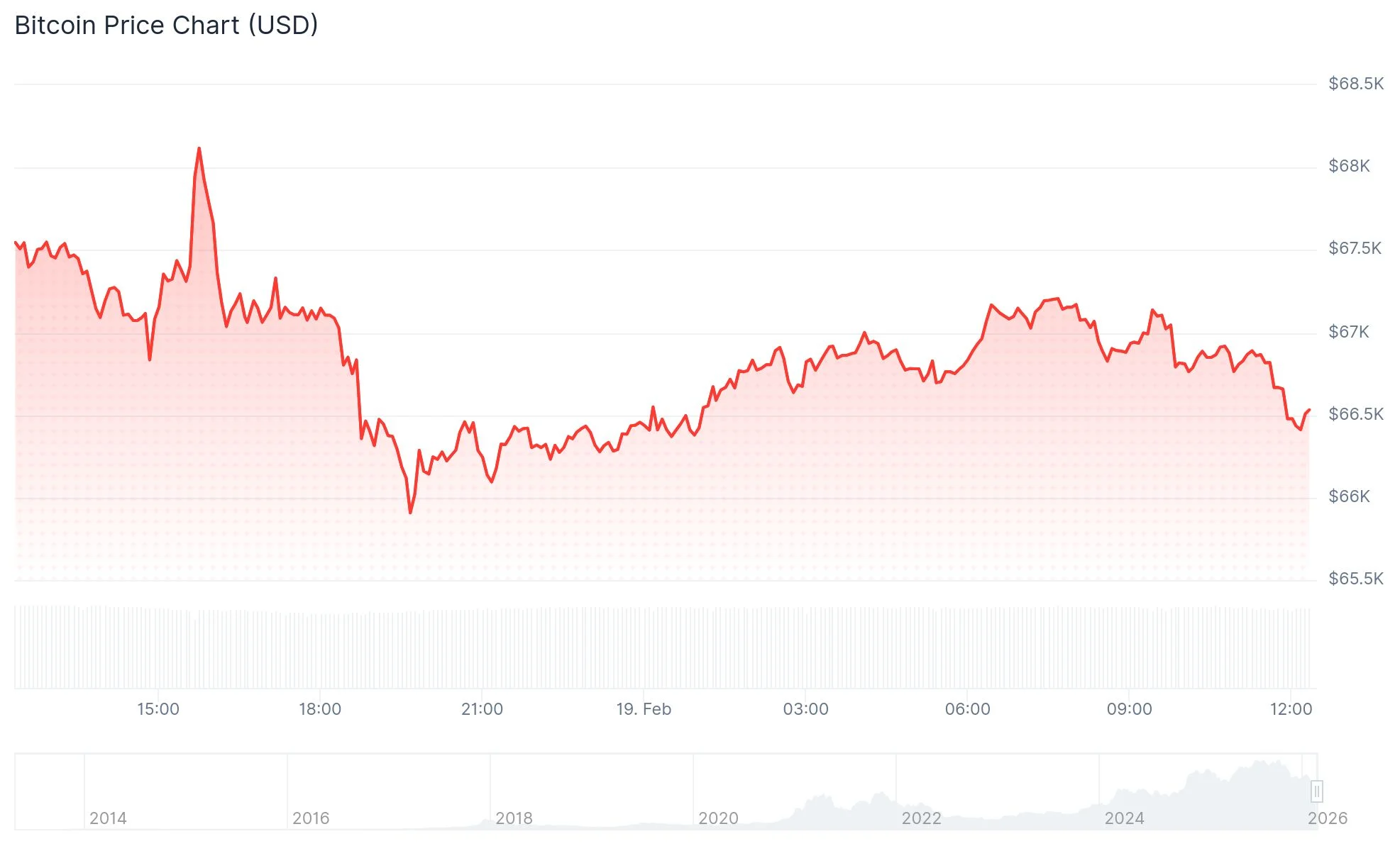
- BTC is trading below $67,000, down around 3% this week
- Middle East tensions have pushed the U.S. dollar to 97.7 and oil to $65
- U.S. stock futures edged higher Thursday, led by Nasdaq futures up 0.3%
- Walmart reports earnings Thursday as a key read on consumer health
Bitcoin is heading toward its fifth consecutive weekly loss as rising Middle East tensions weigh on crypto markets. U.S. stock futures, meanwhile, are pointing modestly higher ahead of Walmart earnings.
As of Thursday, Bitcoin was changing hands below $67,000, down roughly 3% on the week. A close in the red would mark its longest weekly losing streak since March to May 2022.
Bitcoin peaked near $126,500 in October. It has since fallen more than 50%, with prices dropping as low as $60,000.
The monthly picture is just as bleak. Bitcoin has posted five straight monthly losses since October, making it the second-longest monthly losing streak on record. Only a six-month slide from 2018 to 2019 was longer.
Against gold, Bitcoin has now underperformed for seven consecutive months — its longest stretch on record against the precious metal.
Middle East Tensions Drive Dollar and Oil Higher
Geopolitical pressure is adding to Bitcoin’s woes. Reports say the U.S. has assembled its largest concentration of air power in the Middle East since the 2003 Iraq War.
President Trump has not made a final decision on whether to launch strikes on Iran. Prediction platform Polymarket puts the odds at 27% before the end of February.
The uncertainty has sent the U.S. dollar index to 97.7, its highest point since February 6. WTI crude oil climbed to $65 from a Wednesday low of $62.
A stronger dollar and higher oil prices tend to push risk assets like Bitcoin lower. These macro pressures are compounding an already weak technical setup for the cryptocurrency.
Stock Futures and Fed Minutes in Focus
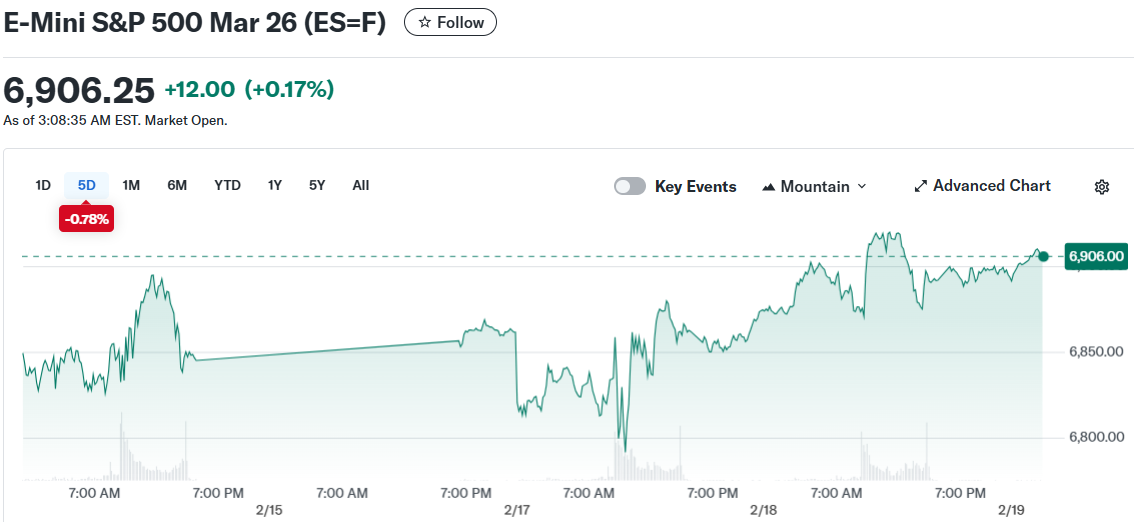
U.S. stock futures were leaning higher Thursday morning. S&P 500 futures rose 0.2%, Nasdaq 100 futures gained 0.3%, and Dow futures were near flat.
Investors were working through minutes from the Federal Reserve’s January meeting. The minutes showed policymakers are divided, with some raising the possibility of rate hikes due to persistent inflation.
Despite that, market expectations for two rate cuts by the end of 2025 remained largely intact. Traders are also watching weekly jobless claims and pending home sales data due Thursday.
Walmart is reporting before the market opens, with investors using the results to gauge the health of the American consumer. Tariffs are also back in the spotlight after the Trump administration criticized a New York Fed report showing U.S. consumers and businesses are absorbing the cost of tariffs.
Bitcoin’s five-week losing streak, if confirmed at Friday’s close, would be one of its longest sustained downturns since the 2022 bear market.



- Coinbase has enabled ADA as collateral, boosting liquidity without selling.
- Inverse head-and-shoulders pattern hints at a potential bullish reversal.
- Whale accumulation strengthens confidence in ADA’s near-term outlook.
After the recent surge from around $0.24, Cardano (ADA) has struggled around the $0.27–$0.28 range for several weeks now.
However, recent developments and chart patterns signal a possible breakout.
Coinbase integration boosts ADA utility
One of the main factors driving renewed interest is the announcement that Coinbase now allows ADA to be used as collateral for loans.
This new feature allows users to borrow up to $100,000 in stablecoins without selling their ADA holdings.
Investors who want liquidity but wish to retain their ADA can now do so, thereby avoiding potential taxable events associated with selling.
This feature is especially appealing in volatile markets where traders want flexibility without exposing themselves to full downside risk.
It also underscores ADA’s growing real-world utility. Holding ADA is no longer just a speculative play; it can now serve as a financial instrument.
Large holders, often referred to as whales, may be particularly motivated by this.
Using ADA as collateral encourages them to maintain or even increase their positions.
This kind of activity often reduces supply pressure and stabilises the token in periods of uncertainty.
Moreover, as more users access these loans, the network effect could drive broader adoption across crypto platforms.
It positions ADA as a more functional and versatile asset, strengthening its market presence.
Technical signals suggest a possible reversal
At the same time, ADA’s charts are showing promising signs that a reversal may be in play.
Trading volume has sharply declined over recent months, reaching a multi-month low.
While falling volume often indicates waning interest, in this case, technical indicators suggest something more nuanced.
An inverse head-and-shoulders pattern has started to form, which is typically a bullish signal.
The Relative Strength Index (RSI) also shows divergence, suggesting that the selling pressure is easing and buyers may be stepping in.

If ADA can push above the $0.30 resistance level, it could ignite a rally toward $0.40 or even higher.
Support around $0.27 is now critical; a drop below this level could erode bullish momentum and delay any breakout.
A further slide below $0.22 would indicate that the reversal pattern has failed, potentially opening the door to extended losses.
Even with short-term uncertainty, the combination of technical patterns and Coinbase integration is creating cautious optimism among traders.
Whales are also accumulating the altcoins.
On-chain data from Santiment shows that large holders have been steadily increasing their ADA positions, often a sign that strong hands are preparing for a sustained move higher.
Historically, such accumulation tends to precede upward price momentum once market conditions improve.
The alignment of technical signals, increased utility, and investor confidence could make the coming weeks critical for ADA’s trajectory.
For traders and holders, these developments suggest that Cardano may be on the verge of breaking out from its current consolidation phase.
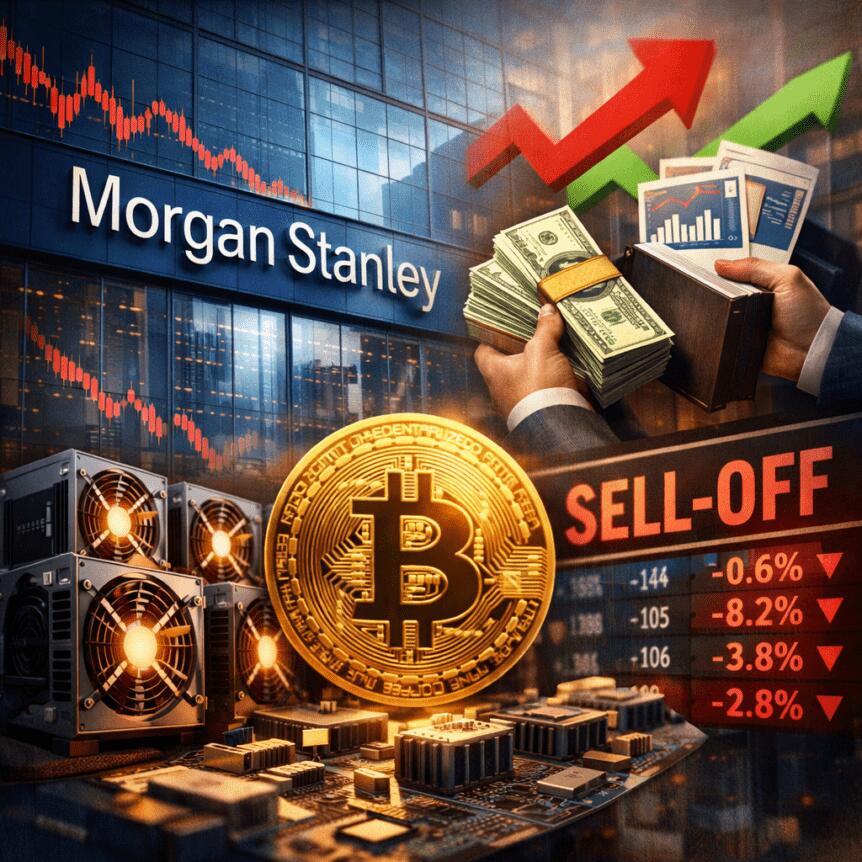
Bitmine Immersion Technologies (BMNR) (EXCHANGE: BMNR) remains a central node in corporate crypto treasury strategies as its Q4 2025 13F filings show a broad-based uptick in holdings among the top shareholders, even as the crypto market endured a broader crash and the stock underperformed. Morgan Stanley, the largest reported holder, lifted its stake by about 26% to more than 12.1 million shares, valued at roughly $331 million at quarter-end, according to its Form 13F filing with the U.S. Securities and Exchange Commission. ARK Investment Management followed with a roughly 27% increase to over 9.4 million shares, worth around $256 million. The moves underscore a divergent dynamic in which major asset managers deploy capital into a prominent Ethereum treasury specialist even as price action remains challenging for the sector. Ether (ETH) (CRYPTO: ETH) and other treasury-driven strategies are at the forefront of this activity, illustrating how institutional players view long-term relevance amid volatility.
The momentum isn’t isolated to these two institutions. A wider cohort of blue-chip managers also expanded exposure in BMNR during the quarter. BlackRock’s stake surged by 166%, Goldman Sachs’s position jumped 588%, Vanguard increased by 66%, and Bank of America’s exposure soared by a staggering 1,668%, according to the same filings. Collectively, these moves reinforce a narrative of growing institutional curiosity toward corporate treasuries that accumulate and manage Ether holdings as a strategic reserve. The trend aligns with discussions across the market about ESG- and yield-forward treasury management, even as macro liquidity and risk sentiment oscillate.
Further reinforcing the trend, the top 11 shareholders reportedly raised exposure during Q4 2025, including names such as Charles Schwab, Van Eck, the Royal Bank of Canada, Citigroup and Bank of New York Mellon Corporation, based on official filings compiled by observers tracking 13F data. The breadth of buying activity within BMNR’s cap table points to a broad confidence among large institutions that the company’s Ether positions can endure and potentially appreciate over longer horizons, even when near-term prices have pulled back. The aggregate effect is a market where large investors appear to view BMNR as a vehicle for exposure to Ethereum treasury strategies rather than as a proxy for traditional equity beta.
BMNR’s stock, however, has not mirrored this institutional enthusiasm. The shares declined by roughly 48% in the fourth quarter of 2025 and have fallen about 60% over the preceding six months. In premarket trading, BMNR hovered near $19.90, underscoring a disconnect between the capital being deployed by incumbents and the day-to-day price action in the stock market. This divergence has prompted ongoing discussion about the company’s financing flexibility, particularly as it relates to its market net asset value, or mNAV, a metric that contrasts enterprise value with the market value of its crypto holdings. Data tracked by Bitmine monitoring services indicate that the mNAV remained above 1, a sign that the firm retains capacity to raise capital by issuing new shares if needed, supported in part by sustained institutional ownership.
Beyond the equity narrative, BMNR’s treasury strategy remains deeply anchored in Ether purchases and accumulation. In the past week, the company added 45,759 Ether for approximately $260 million, at an average cost basis of around $1,992 per ETH. This ongoing accumulation reinforces BMNR’s status as a leading corporate holder of Ether, a position publicly noted by analysts and tracked by data providers. In aggregate, the company now holds about 4.37 million Ether on its books, worth roughly $8.69 billion at current valuations, according to the StrategicEthReserve dataset. This concentration of Ether on a corporate balance sheet is characteristic of a broader trend where treasuries seek to diversify risk and inflationary pressures by maintaining sizable crypto stacks as strategic assets rather than pure speculative bets.
These developments come as the market navigates a period of heightened volatility and structural shifts in crypto liquidity and custody. While the broader sector has faced drawdowns, the continued accumulation by blue-chip institutions suggests a longer-run thesis in which Ether plays a central role in diversified treasury strategies. Bitmine’s ability to maintain an mNAV above 1—supported by strong institutional ownership—illustrates how the market is increasingly valuing the capacity to deploy capital into Ether holdings without immediate dilution or financing constraints. The data underpinning these conclusions rely on multiple sources, including 13F filings and independent trackers, which collectively provide a window into the evolving dynamics between public market perception and private treasury strategies.
For readers tracking the governance and strategic implications of Bitmine’s approach, the company’s Ether-heavy balance sheet remains a focal point. The combination of rising institutional ownership and persistent buybacks or capital raises could shape how the market evaluates Ether exposure within corporate treasuries over the coming quarters. As the market continues to digest these developments, observers will be watching how BMNR balances liquidity, financing flexibility, and the ability to sustain or adjust its Ether purchases in response to price movements, regulatory signals, and evolving investor expectations.
https://platform.twitter.com/widgets.js
Why it matters
The quarterly inflows from top-tier institutions into BMNR underscore a broader trend: major asset managers are increasingly comfortable aligning with corporate treasury strategies that emphasize Ether as an ongoing hold, not merely a speculative asset. This dynamic supports a narrative where Ether moves beyond a retail-driven hype cycle and becomes a component of risk-managed corporate portfolios. The fact that the mNAV remains above 1 suggests management can pursue additional Ether purchases or liquidity-friendly financings without necessarily triggering dilution worries, a factor that reduces external funding frictions in a volatile market.
From a market structure perspective, the concentration of Ether within a handful of corporate treasuries can influence price discovery and liquidity in the broader Ethereum ecosystem. While stock prices for BMNR have faced a substantial pullback, the ongoing accumulation by entrenched institutions indicates a differentiated view of the asset’s long-term value proposition. For investors and builders in the crypto space, the trend highlights the continued institutionalization of Ether as a treasury asset category, with governance, custody, and risk management practices likely to mature further as more firms participate.
On regulatory and policy grounds, the uptick in 13F disclosures around BMNR is part of a larger disclosure regime that provides visibility into how institutions structure their crypto exposures. This transparency helps investors assess risk, liquidity, and capital allocation strategies in a sector that remains under tight scrutiny in several jurisdictions. While the market environment remains unsettled, the clear signal from these filings is that large financial institutions see strategic merit in backing corporate treasuries that actively manage Ether holdings, even when the broader market is pressured.
What to watch next
- BMNR’s Q1 2026 13F filings to reveal whether institutions maintain or adjust their positions as Ether prices fluctuate.
- Any additional Ether purchases by BMNR and the impact on mNAV and financing options.
- Regulatory developments affecting crypto treasury strategies or corporate disclosures for digital asset holdings.
- Price action in Ether and broader Ethereum-related products that could influence treasury strategies across the sector.
Sources & verification
- Morgan Stanley 13F Q4 2025 filing confirming stake of over 12.1 million BMNR shares (EXCHANGE: BMNR) and a value near $331 million — 13f.info.
- ARK Investment Management 13F Q4 2025 filing showing a stake of about 9.4 million BMNR shares worth roughly $256 million — 13f.info.
- Bank of America 13F filing for Q4 2025, confirming exposure to BMNR — SEC filing: xslForm13F_X02/Q4202513fhr.xml.
- Bitmine tracker data indicating the mNAV remains above 1 and tracking institutional ownership — https://www.bitminetracker.io/.
- StrategicEthReserve data showing BMNR holds 4.37 million Ether (ETH) valued at approximately $8.69 billion — https://www.strategicethreserve.xyz/#.
Rewritten Article Body
Institutional bets sustain Bitmine’s Ether treasury even as price retreats
Bitmine Immersion Technologies (BMNR) (EXCHANGE: BMNR) has drawn renewed attention from the wallet of large-cap fund managers, as its Q4 2025 13F filings reveal a broad-based expansion in ownership among the top shareholders despite a crypto-market downturn and a steep slide in the stock price. Morgan Stanley, the most prominent disclosed holder, raised its stake by roughly 26% to more than 12.1 million shares, a position valued at about $331 million at quarter-end. ARK Investment Management followed with an approximately 27% increase to just over 9.4 million shares, equating to around $256 million in value. These moves, captured in the quarterly forms now on public record, signal a continued institutional tilt toward Bitmine’s Ethereum treasury positioning even as general market sentiment remains cautious. (EXCHANGE: BMNR) (CRYPTO: ETH)
Beyond these two heavyweights, a broader suite of institutions intensified their exposure to BMNR in the quarter. BlackRock’s stake surged by 166%, Goldman Sachs’s by 588%, Vanguard by 66%, and Bank of America by an astonishing 1,668%. The cluster of purchases underscores a deeper institutional conviction that Ether-based treasury strategies can function as a long-horizon component of a diversified balance sheet, particularly for entities seeking to anchor liquidity in a volatile market. The filings also show that the top 11 shareholders, including Charles Schwab, Van Eek, Royal Bank of Canada, Citigroup and Bank of New York Mellon, expanded their positions, suggesting a broad consensus among asset managers about BMNR’s strategic approach to Ether exposure and treasury management.
However, the market performance narrative remains separate from these portfolio moves. BMNR’s stock price declined about 48% in Q4 2025 and roughly 60% over the prior six months, trading near $19.90 in premarket action. The price action contrasts with the resilience implied by the mNAV, a metric that compares enterprise value to crypto holdings and can indicate financing flexibility. Bitmine-tracking services indicate the mNAV stayed above 1, a threshold that can ease the process of raising new capital through equity issuance, thereby supporting continued treasury activity without immediate dilution fears. The juxtaposition of robust institutional inflows with a declining stock price highlights a common theme in crypto corporate finance: markets can discount near-term price volatility while institutions bet on longer-term structural value in the underlying treasury strategy.
Concurrently, Bitmine intensified its Ether accumulation. In the past week alone, the company added 45,759 Ether for roughly $260 million, at an average cost basis of around $1,992 per ETH. This cadence of purchases cements Ether as a cornerstone of Bitmine’s treasury stack, aligning with its broader position as the world’s largest corporate holder of Ether—4.37 million ETH, valued at approximately $8.69 billion, according to StrategicEthReserve data. That scale places Bitmine at the vanguard of corporate custody, illustrating how large holders approach risk and revenue potential in a market that continues to rehearse inflationary and macroeconomic concerns.
The trajectory of these holdings, alongside the mosaic of 13F disclosures, points to a market where public equity dynamics and crypto treasury strategies can diverge meaningfully. Institutional confidence in BMNR’s approach appears to rest not on day-to-day price swings but on the ability to sustain a disciplined, growth-focused Ether program that could weather downside scenarios while remaining positioned for upside in a longer horizon. Observers will monitor whether this institutional appetite translates into greater liquidity, more favorable financing terms, or additional capacity to accumulate Ether in the quarters ahead, particularly as macro conditions evolve and Ethereum-specific catalysts emerge.


Haseeb Qureshi, managing partner at Dragonfly, argues that crypto’s persistent friction stems from a deeper mismatch: its architecture appears better aligned with artificial intelligence (AI) agents.
In his view, many of crypto’s perceived failure modes are not design flaws but signals that humans were never the ideal primary users.
Sponsored
The Human-Crypto Disconnect
In a detailed post on X, Qureshi argued that a fundamental divide exists between human decision-making and blockchain’s deterministic architecture. He said the early vision of the industry imagined a world where smart contracts would substitute legal agreements and courts, with property rights enforced directly on-chain.
That shift, however, has not materialized. Even crypto-native firms such as Dragonfly still rely on conventional legal contracts.
“When we sign a deal to invest into a startup, we don’t sign a smart contract. We sign a legal contract. The startup does the same. Neither of us are comfortable doing the deal without a legal agreement…In fact, even in the cases where we have an on-chain vesting contract, there’s usually also a legal contract in place,” he said.
According to Qureshi, the issue is not technical failure but social misalignment. Blockchain systems function as designed, yet they are not structured around human behavior and error. He also contrasted this with traditional banking, which has evolved over centuries to account for mistakes and misuse.
“The bank, terrible as it is, was designed for humans,” he added. “The banking system was specifically architected with human foibles and failure modes in mind, refined over hundreds of years. Banking is adapted to humans. Crypto is not.”
He added that long cryptographic addresses, blind signing, immutable transactions, and automated enforcement do not align with human intuition about money.
Sponsored
“That’s why in 2026, it’s still terrifying to blind sign a transaction, to have stale approvals, or to accidentally open up a drainer. We know we should verify the contract, double-check the domain, and scan for address spoofing. We know we should do all of it, every time. But we don’t. We’re human. And that’s the tell. It’s why crypto always felt slightly misshapen for us,” the executive remarked.
AI Agents: Crypto’s True Natives?
Qureshi suggested that AI agents may be more naturally suited to crypto’s design. He explained that AI agents do not fatigue or skip verification steps.
They can analyze contract logic, simulate edge cases, and execute transactions without emotional hesitation. While humans may prefer the legal systems, AI agents may favor the determinism of code. According to him,
“In that sense, crypto is self-contained, fully legible, and completely deterministic as system of property rights around money. It’s everything an AI agent could want from a financial system. What we as humans see as rigid footguns, AI agents see as a well-written spec…Even legally, our traditional monetary system was designed for human institutions, not AIs.”
Sponsored
Qureshi forecasted that the crypto interface of the future will be a “self-driving wallet,” entirely mediated by AI. In this model, AI agents manage financial activities on behalf of users.
He also suggested that autonomous agents could transact directly with each other, positioning crypto’s always-on, permissionless infrastructure as a natural foundation for a machine-to-machine economy.
“I think it’s this: crypto’s failure modes, which always made it feel broken for humans, in retrospect were never bugs. They were simply signs that we humans were the wrong users. In 10 years, we will look back at amazement that we ever subjected humans to wrestle with crypto directly,” Qureshi stressed.
Still, he cautioned that such a shift would not occur overnight. Technological systems often require complementary breakthroughs before reaching mainstream relevance.
“GPS had to wait for the smartphone. TCP/IP had to wait for the browser,” Qureshi noted. “For crypto, we might just have found it in AI agents.”
Sponsored
Recently, Bankless founder Ryan Adams also argued that crypto adoption has stalled due to poor user experience. However, he suggested that what appears to be “bad UX” for humans may actually be optimal UX for AI agents.
Adams predicted that billions of AI agents could eventually drive crypto markets beyond $10 trillion.
“In a year or two there’ll be billions of agents, many with wallets (then a year later they’ll be trillions). The “AiFi narrative” is underground like defi was in 2019. The dry tinder is quietly collecting but at some point it will ignite. No one is paying attention to crypto now because price is down…but i believe AI agents will scale to trillions of crypto wallets. AiFi is the next frontier of DeFi,” the post read.
The machine-native crypto thesis is powerful, but real constraints remain. AI agents may transact autonomously, yet liability still ultimately rests with humans or institutions, keeping legal systems relevant.
Deterministic smart contracts reduce ambiguity but do not eliminate exploits, governance failures, or systemic risk. Lastly, an argument could also be made that if AI becomes the primary interface, crypto may fade into backend infrastructure rather than function as a parallel financial order.
Crypto World
World Liberty Financial Partners With Securitize and DarGlobal to Tokenize Trump Maldives Resort
TLDR:
- WLFI partners with Securitize and DarGlobal to tokenize Trump International Hotel & Resort, Maldives.
- The tokenized offering gives everyday investors exposure to income distributions and asset value changes.
- The initial offering will be issued on public blockchains with access via select third-party wallets.
- Eligible users can collateralize holdings and borrow through WLFI Markets where permitted by law.
World Liberty Financial (WLFI) has announced plans to tokenize Trump International Hotel & Resort, Maldives. The initiative is a three-way partnership with Securitize, Inc. and DarGlobal PLC (LSE: DAR).
This move marks the start of WLFI’s broader strategy to structure and distribute tokenized real-world asset offerings.
The resort, a luxury hospitality development scheduled for completion in 2030, will feature roughly 100 ultra-luxury beach and overwater villas.
WLFI Opens Real Estate Investment to a Broader Audience
The tokenized offering aims to give investors direct exposure to a prime Maldivian hospitality asset. Investors stand to gain from both potential income distributions and changes in asset value. The offering is structured within a regulated securities framework, adding a layer of investor protection.
WLFI co-founder Eric Trump spoke on the vision behind the announcement. He noted that the platform was built to open decentralized finance to a wider audience.
Trump said, “We built World Liberty Financial to open up decentralized finance to the world. With tokenized real estate, we’re now extending that access to what we do best.”
He further stressed the importance of retail participation in high-value assets. “For the first time, everyday investors can gain access to an iconic property like Trump International Hotel & Resort, Maldives and can be part of its success,” Trump added. He also confirmed that future tokenized offerings are in the pipeline as the platform scales.
The resort was developed by DarGlobal in collaboration with The Trump Organization. DarGlobal is listed on the London Stock Exchange and operates as an international luxury real estate developer. The Maldives property serves as the flagship asset in this initial round of tokenization.
Securitize and DarGlobal Outline the Structure of the Deal
Securitize, a leading platform for tokenizing real-world assets, is handling the compliance and governance side of the deal.
CEO Carlos Domingo acknowledged the longstanding challenge of bringing real estate on-chain. He stated, “Real estate has been one of the hardest asset classes to tokenize effectively.”
Domingo further explained the rationale behind the partnership’s design. “We believe the first scalable on-chain real estate products will be globally sought-after properties issued with compliance, governance, and market structure in mind,” he said. He confirmed that this partnership with WLFI is structured precisely to meet that standard.
DarGlobal CEO Ziad El Chaar described the collaboration as a turning point for real estate investment. He said, “Together, we are rethinking how global investors can access, trade, and ultimately gain liquidity in high-quality real estate as it is being developed.” El Chaar also pointed to WLFI’s investor network as a major advantage for expanding market participation.
The initial offering is expected to be issued on supported public blockchains. Access will be enabled through select third-party partners and wallets, subject to applicable requirements.
Additionally, the parties plan to support on-chain utilities, including the ability for eligible users to collateralize holdings and borrow through WLFI Markets, where permitted by law.
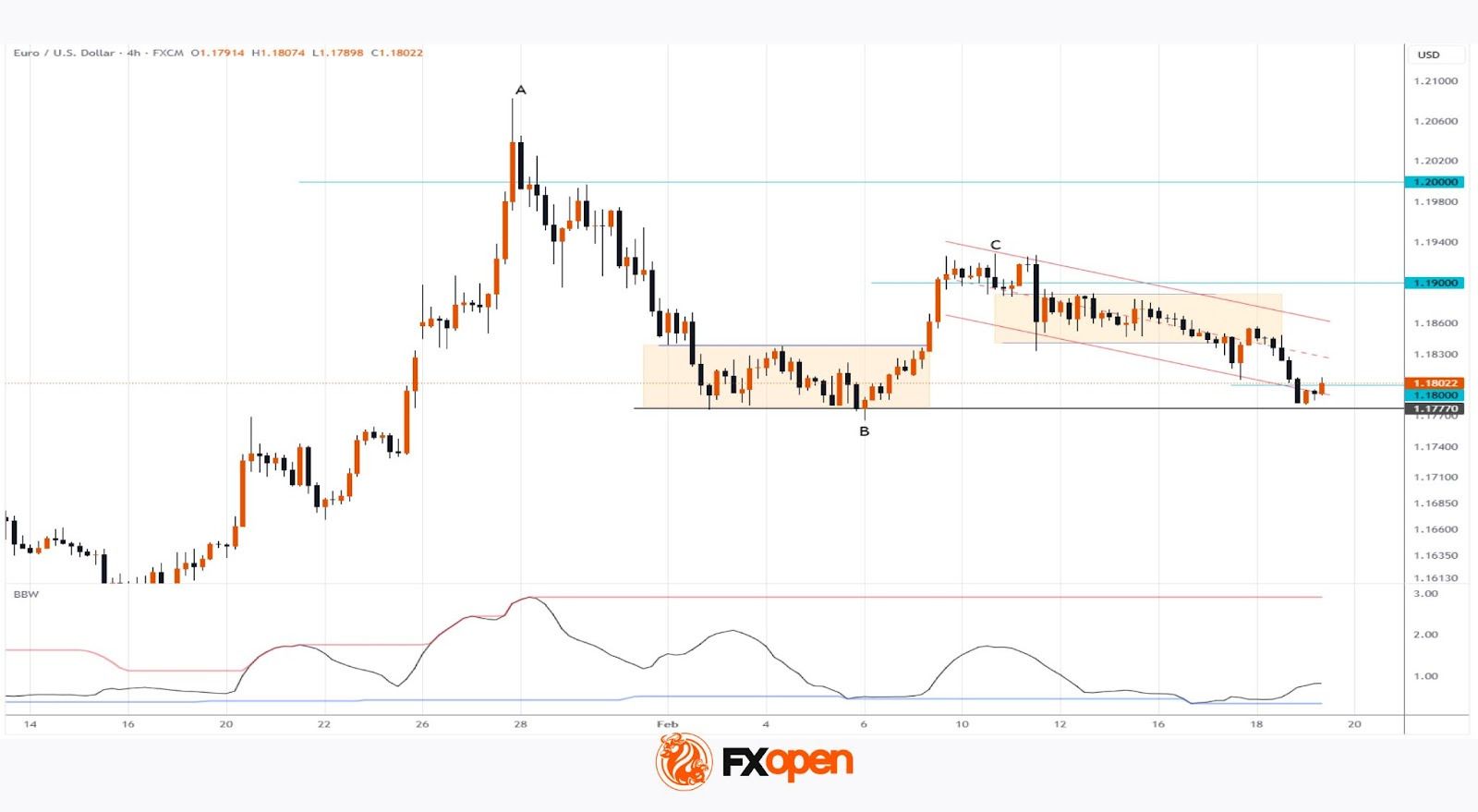
As indicated by the Bollinger Bands width indicator, the EUR/USD market remained relatively subdued in February, with the indicator twice retreating towards its lower boundary.
However, price action over the past two sessions suggests renewed activity — the range formed between 11 and 17 February has been broken to the downside by sellers.
From a fundamental perspective, this move reflects a combination of factors, including:
→ Reports that European Central Bank President Christine Lagarde is planning to step down before the end of her term in October next year. This development is viewed as a bearish factor for the euro.
→ Minutes from the FOMC meeting showing that policymakers are in no rush to cut interest rates. Opinions were divided, with some members even open to raising the Fed rate if inflation proves persistent. The prospect of a tighter Federal Reserve stance is supportive for the US dollar.
Technical Analysis of the EUR/USD Chart
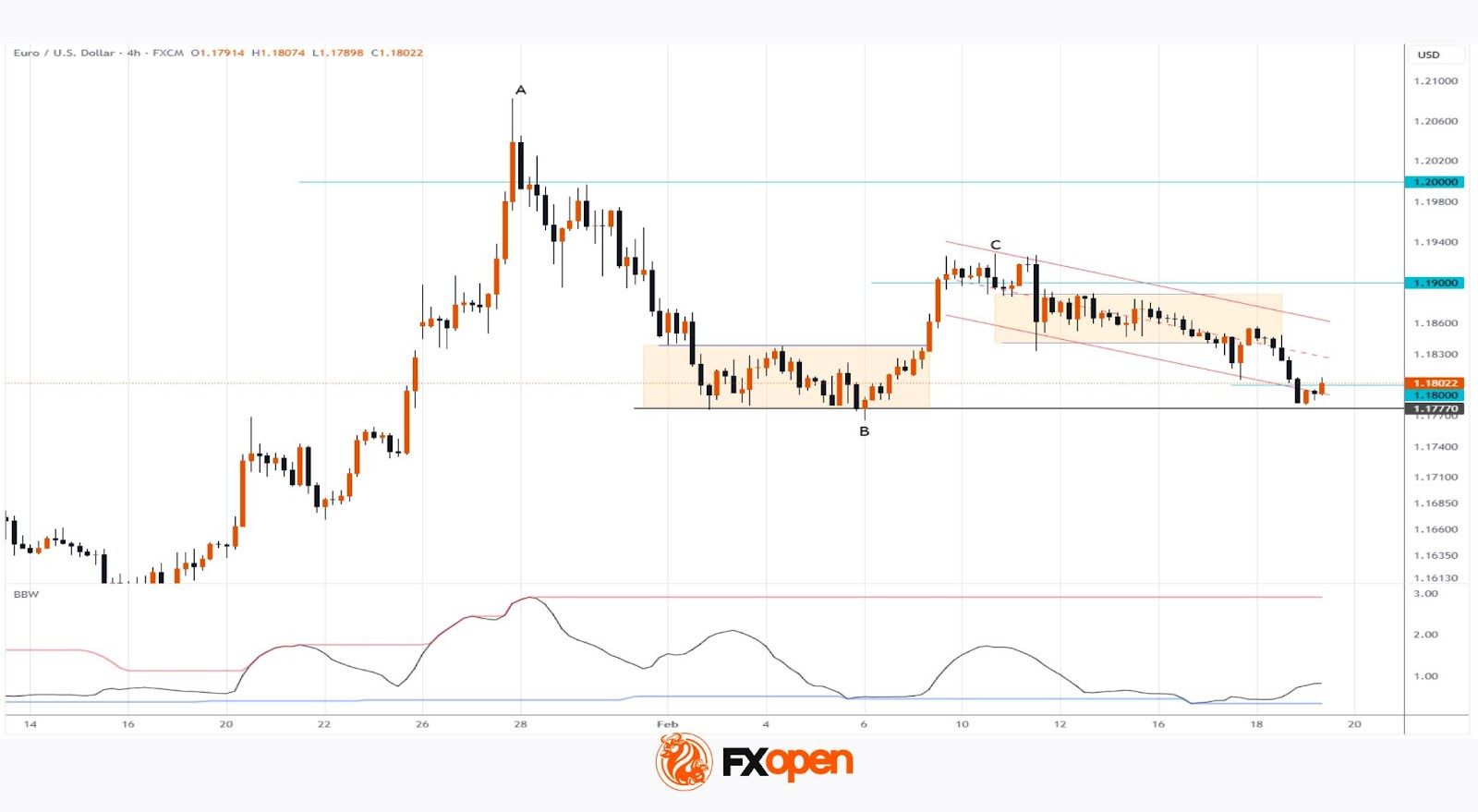
The recent bearish pressure has pushed EUR/USD back towards a key support level around 1.1777. Bears attempted to break below this level on 6 February but failed, resulting in a false breakout at point B.
While bulls may attempt a rebound from this support, the broader picture suggests that sellers currently hold a slight advantage in February, reflected in the following:
→ Price action has been forming a descending channel since 11 February (shown in red).
→ High C sits roughly halfway along the A→B bearish impulse. According to Fibonacci proportions, this is consistent with a bearish market structure.
→ Bulls have been unable to secure a foothold above key psychological levels — first above 1.2000 and subsequently above 1.1900.
If selling pressure persists, a decisive break below 1.1777 cannot be ruled out, which could in turn trigger a fresh surge in volatility.
Trade over 50 forex markets 24 hours a day with FXOpen. Take advantage of low commissions, deep liquidity, and spreads from 0.0 pips (additional fees may apply). Open your FXOpen account now or learn more about trading forex with FXOpen.
This article represents the opinion of the Companies operating under the FXOpen brand only. It is not to be construed as an offer, solicitation, or recommendation with respect to products and services provided by the Companies operating under the FXOpen brand, nor is it to be considered financial advice.
A majority of stablecoin users want their banks to make it easier for them to buy and spend stablecoins for regular transactions, according to a new survey compiled by YouGov.
Some 77% of the 4,658 respondents said they would open a cryptocurrency or stablecoin wallet within their banking or fintech app if one were available.
The survey, commissioned by crypto exchange Coinbase (COIN) and stablecoin infrastructure provider BVNK, also found that 71% of users would use a stablecoin-linked debit card. The survey was conducted from September to October, 2025.
Stablecoins are crypto tokens whose value is pegged to a real-world asset. The most popular, Tether’s USDT and Circle Internet’s (CRCL) USDC, are digital versions of the U.S. dollar, though other currencies are also available. The total market capitalization has grown 50% since the start of 2025, according to data tracked by DeFiLlama, and first topped $300 billion in October.
While stablecoins are widely used in trading cryptocurrencies, the results highlight how far they have penetrated into the traditional financial economy, driven especially by developments in the regulatory environment.
“Users want stablecoins to behave like money they already know,” BVNK summarized.
Stablecoin users hold an average of 35% of their annual earnings in such tokens, according to the survey, while 73% of freelancers and contractors reported an improvement in their ability to work with international clients thanks to stablecoins.
The expansion of formal regulation of stablecoins in major jurisdictions, such as the GENIUS Act in the U.S, could give banks the confidence to start offering crypto tools such as wallets.
“By codifying transparency and cybersecurity standards, the Act classifies these assets as reliable cash equivalents,” Coinbase’s Alec Lovett and John Turner said in the report. “This clarity has bolstered institutional trust while strengthening consumer protections, which we predict will supercharge adoption in the coming months and years.”


Bitcoin and ether (ETH) both rose around 0.9% overnight while the broader altcoin market lagged on Thursday.
BTC was recently trading at $67,000 following a brief touch of $66,000 on Wednesday. Ether, at $1,970 after bouncing off $1,924, is struggling to break through the psychological $2,000 price level.
Volatility has waned since the selloff on Feb. 5. Two subsequent weeks of consolidation have left investors wondering whether this is the calm before another stormy move to the downside, or whether the market is establishing a macro low before rising back toward 2025 levels.
World Liberty Financial’s Mar-a-Lago forum on Wednesday failed to provide a bullish catalyst despite being attended by CFTC Chairman Michael Selig and executives from companies including Goldman Sachs.
From a macro perspective, bitcoin remains in a downtrend since hitting a record high of $126,600 in early October. It has notched a series of lower highs and lower lows with periods of choppy consolidation in between each major move.
Derivatives positioning
- Market dynamics have stabilized with open interest holding at $15.38 billion.
- That marks a transition from a leverage cleanup to a steady floor.
- Retail sentiment shows a subtle rebound with funding rates flipping flat to positive (Binance back at 4%), while institutional conviction remains anchored with the three-month annualized basis persisting at 3%.
- The BTC options market has reached a 50/50 volume equilibrium between calls and puts. While the one-week 25-delta skew has edged up to 12%, the implied volatility (IV) term structure remains in short-term backwardation.
- The front-end spike in the IV curve confirms that traders are still paying a “panic premium” for immediate protection, even as longer-dated tenors stabilize near 49%.
- Coinglass data shows $218 million in 24-hour liquidations, with a 77-23 split between longs and shorts. BTC ($75 million), ETH ($53 million) and others ($22 million) were the leaders in terms of notional liquidations.
- The Binance liquidation heatmap indicates $67,400 as a core liquidation level to monitor in case of a price rise.
Token talk
- The altcoin market is starting to suffer in the low-liquidity trading environment.
- Shares of lost more than 10% of their value after selling off during Wednesday’s event in a classic “sell the news” move.
- Axie Infinity (AXS) is retesting its Feb. 6 lows after falling 5.9% since midnight UTC.
- Lending platform Morpho’s native MORPHO token has now given back all of Wednesday’s gains, trading at $1.39 after shedding 4.2% of its value overnight.
- A whopping 97 of the top 100 cryptocurrencies, not including stablecoins or tokenized gold tokens, are in the red over the past 24 hours as the market remains in “extreme fear” territory.
- The fear and greed index is currently at 11/100, up from February’s low of 6/100.


Before we dig into the corpses of the past, let’s clear the air on what we’re actually talking about. RWA (Real World Assets) is exactly what it says on the tin: taking physical or traditional financial assets (think real estate, gold, treasury bills, or corporate shares) and “tokenizing” them. In plain English, it’s turning a deed to a house or a share of a company into a digital token on a blockchain.
The goal? To make the “un-movable” parts of the real world as liquid and tradable as Bitcoin.
The Market Context: From “Play Money” to Infrastructure
For years, the market review of RWA was a graveyard of questionable pilots and over-hyped whitepapers.
In 2018-2019, Maecenas were the darlings of the “democratized art” movement, making headlines on CNN for tokenizing a multimillion-dollar Andy Warhol painting. The pitch was seductive: own a piece of a masterpiece for a few satoshis. Fast forward to today, and Maecenas is a digital ghost town. Its ART token has effectively flatlined to zero, and the “revolution” stalled because a flashy story couldn’t compensate for a lack of secondary market liquidity and institutional-grade legal custody.
Then there was the Freeway case of late 2022, for instance. It was the ultimate “RWA-lite” cautionary tale. The platform promised eye-watering 43% yields, claiming they were fueled by the “magic” of traditional forex markets and real-world asset management. It had all the buzzwords but zero transparency. When the $160 million ecosystem inevitably froze and its token cratered by 75% in hours, it confirmed everyone’s darkest fears: in the “Wild West” era of RWA, “real-world” was often just a marketing sticker slapped onto a black box.
To be fair, the underlying idea was never stupid. Putting real assets on-chain, making them liquid, borderless, 24/7 tradable, that’s genuinely interesting. The execution, however, was… let’s call it enthusiastic. The barrier to entry for launching an RWA project was essentially “do you have a wallet and a story?” Both requirements were consistently met by people who probably shouldn’t have been trusted with either.
The financial establishment has spent the last decade treating “tokenization” like a petulant child: loud, disruptive, and ultimately ignorable. But as we move deeper into 2026, the numbers have stopped being funny for the skeptics. According to recent projections, the asset tokenization market is hurtling toward $9.43 trillion by 2030 and reach a CAGR of 72.8% from 2025-2030.
The Great Migration: From Volatility to Utility
The irony of 2026 is that the crypto native’s greatest dream is no longer a 100x memecoin, it’s a boring 5% yield on a T-bill that actually belongs to them.
The market is currently in a state of profound exhaustion. We are over-scammed, over-sold, and frankly, bored of “magic internet money” that only trades against other “magic internet money.” There is a desperate hunger for the stability of the S&P 500, but the traditional gatekeepers haven’t made it easy.
Buying “stonks” through a legacy broker in 2026 still feels like using a fax machine. You’re trapped by:
- Geographical Redlining: Your access to the best markets depends on where you were born.
- The 9-to-5 Mirage: Markets that shut down on weekends while the world keeps turning.
- Brokerage Silos: Try moving your Apple shares from one platform to another in real-time. You can’t. They don’t exist as “assets” in your hand; they are just entries in someone else’s database.
This is the “aha!” moment for RWA. True tokenization isn’t just a new way to buy assets; it’s a technological prison break for TradFi. It’s taking the reliability of a stock and giving it the freedom of a stablecoin: self-custody, 24/7 trading, and zero borders.
Look at Tether. They didn’t print USDT, they pivoted into a massive RWA powerhouse, aggressively buying up stakes in everything from plantations 70% stake in Adecoagro, 148 tonnes of gold, and major offline corporations. They are realizing that the ultimate power move isn’t just holding dollars but owning the physical world through a digital lens.
The skepticism of the first RWA project era was justified because they were selling dreams. Today, the industry is selling infrastructure. And as it turns out, the “boring” stuff is where the next $9 trillion is hidden.
The Institutional Land Grab: Why the Giants Woke Up
If Tether is the example of a “crypto-native” moving toward the physical world, the titans of TradFi are moving even faster to colonize the digital one. The conversation has shifted from “if” to “how fast,” driven by three heavyweight examples that prove the plumbing of global finance is being rebuilt:
- BlackRock & BUIDL: With the launch of their first tokenized fund on Ethereum, the world’s largest asset manager signaled that the “petulant child” of tokenization is now the guest of honor. For BlackRock, RWA isn’t a trend; it’s a way to unlock trillions in “dead” capital by moving from slow, 48-hour settlement (T+2) cycles to near-instant, on-chain finality.
- Franklin Templeton: A century-old investment giant that moved its U.S. Government Money Market Fund (FOBXX) onto public blockchain Solana. And they are using it to offer a Treasury-backed asset that can be used as 24/7 collateral, something a traditional bank account could never dream of.
- J.P. Morgan & Kinexys Digital Assets: Through their Kinexys platform, the biggest bank in the U.S. is already processing billions in “tokenized collateral” for repo trades. They realized that by digitizing assets, they could fire the army of middlemen and automate the complex legal dance of shifting ownership with smart contracts.
This leads us to the final realization of 2026: The Infrastructure Flip.
And the big three are moving because:
- Atomic Settlement: The “T+2” delay is a relic of the era of paper certificates. In RWA, the trade is the settlement.
- Programmable Yield: You can’t program a physical plantation or a bond to automatically distribute dividends to 10,000 global investors every hour. A smart contract can.
- Efficiency over Hype: They are eliminating the “intermediary tax” and the fees paid to banks and clearers just to verify that an asset exists.
The skepticism of the Maecenas era was about the assets, because no one knew if Warhol actually existed in a vault. Today, the revolution is about access. The big players aren’t here for the 5% yield; they are here because they’ve realized that the blockchain is a better, faster, and cheaper way to run the world’s financial operating system.
The Risks: The Fine Print of the Future
Before we get too comfortable with this “upgraded” reality, we have to acknowledge that RWA brings a whole new set of failure points. We’ve traded the risk of a “rug pull” for the risk of Regulatory Seizure.
- The Oracle Problem: If a smart contract says you own the gold, but the physical vault is empty, the blockchain is just a sophisticated lie.
- Centralization Risk: If a government decides to freeze a specific RWA contract, your “self-custody” share of an Apple stock is as dead as a frozen bank account.
- Smart Contract Legal Friction: We still don’t have a global court that can “undo” an exploit on a tokenized real estate deed. When the code fails, the legal system is still too slow to catch up.
The Control Paradox: TradFi’s Trojan Horse
Crypto originally dreamed of a world without intermediaries. We wanted a peer-to-peer utopia where the code was the law and the middleman was a relic of the past.
But as the institutions move in, they’ve brought a different message: “The intermediaries are staying. We’re just upgrading our tools.”
If RWA becomes the dominant financial layer, we aren’t heading toward a decentralized nirvana. Instead, we are looking at a Hybrid Reality. Tokenization won’t destroy TradFi; it will simply re-code it. We are moving toward a system defined by:
- On-chain assets backed by off-chain legal enforcement.
- Compliance by default: Less confidentiality and more transparency when real-world monikers are involved.
- Permissioned liquidity pools: High-yield RWA vaults that only let you in once you’ve scanned your passport.
The real question isn’t whether the market will hit $10 trillion. It will. The question is: Who will own the pipes?
My bet? It won’t be the idealists who built Bitcoin in 2009. The winners will be whoever controls three things: the legal wrapper (BlackRock has armies of lawyers), the liquidity (J.P. Morgan moves $10 trillion daily), and the regulatory blessing (Franklin Templeton didn’t ask permission; they co-wrote the rules).
We called RWA a pipe dream because we thought “real world” and “blockchain” were incompatible. Turns out, they’re not. They’re just being merged by people we didn’t expect, in ways we didn’t predict, with outcomes we’re still figuring out. The revolution is here. It’s just wearing a suit.

Wayfair (W) earnings Q4 2025

Michael Saylor’s Spinal Tap ad says STRC is like a bank account — it isn’t

Zelenskyy Speaks Out Against Trump’s Soft Spot For Putin


-

 Video3 days ago
Bitcoin: We’re Entering The Most Dangerous Phase
-

 Tech4 days ago
Luxman Enters Its Second Century with the D-100 SACD Player and L-100 Integrated Amplifier
-

 Crypto World2 days ago
Can XRP Price Successfully Register a 33% Breakout Past $2?
-

 Sports2 days ago
GB's semi-final hopes hang by thread after loss to Switzerland
-

 Video6 days ago
The Final Warning: XRP Is Entering The Chaos Zone
-
 Tech2 days ago
The Music Industry Enters Its Less-Is-More Era
-

 Business2 days ago
Infosys Limited (INFY) Discusses Tech Transitions and the Unique Aspects of the AI Era Transcript
-

 Video2 days ago
Financial Statement Analysis | Complete Chapter Revision in 10 Minutes | Class 12 Board exam 2026
-

 Entertainment23 hours ago
Kunal Nayyar’s Secret Acts Of Kindness Sparks Online Discussion
-
 Crypto World5 days ago
Bhutan’s Bitcoin sales enter third straight week with $6.7M BTC offload
-

 Tech1 day ago
Retro Rover: LT6502 Laptop Packs 8-Bit Power On The Go
-
 Sports8 hours ago
Clearing the boundary, crossing into history: J&K end 67-year wait, enter maiden Ranji Trophy final | Cricket News
-

 Entertainment14 hours ago
Dolores Catania Blasts Rob Rausch For Turning On ‘Housewives’ On ‘Traitors’
-
 NewsBeat4 days ago
The strange Cambridgeshire cemetery that forbade church rectors from entering
-

 Business1 day ago
Tesla avoids California suspension after ending ‘autopilot’ marketing
-

 Crypto World6 days ago
Kalshi enters $9B sports insurance market with new brokerage deal
-

 Crypto World17 hours ago
WLFI Crypto Surges Toward $0.12 as Whale Buys $2.75M Before Trump-Linked Forum
-
 Crypto World7 days ago
Ethereum Price Struggles Below $2,000 Despite Entering Buy Zone
-
 NewsBeat4 days ago
Man dies after entering floodwater during police pursuit
-

 NewsBeat5 days ago
UK construction company enters administration, records show