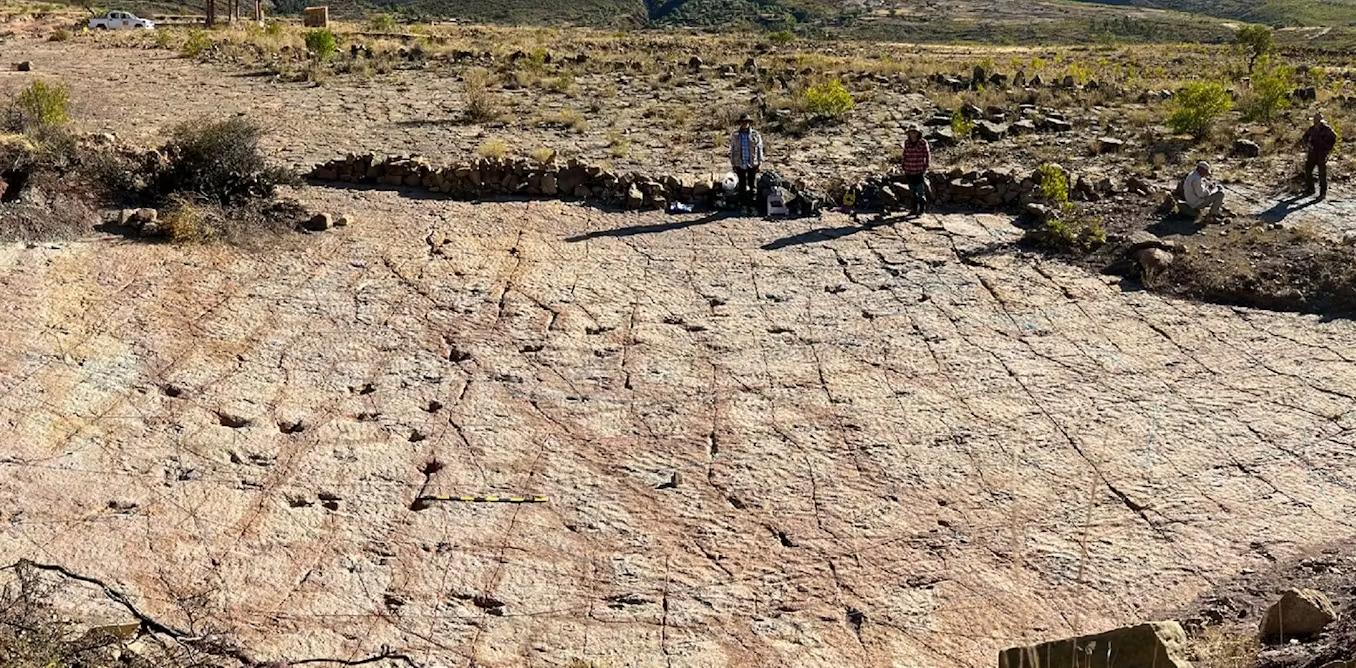
Scientists have discovered the single largest dinosaur track site in the world in Carreras Pampa, Torotoro National Park, Bolivia. The tracks were made around 70 million years ago, in the late Cretaceous Period, by theropods – bipedal three-toed dinosaurs – with bird tracks also present in this ancient beach scene.
Over 16,600 footprints and swim traces cover the ancient trackway surface, all heading in the same direction. Swim traces form when floating or swimming animals briefly touch the bottom, often with just their toes making contact. The researchers suggest the traces were made parallel to an ancient shoreline, which preserves beautiful ripple marks.
Modern studies of animals at African water holes and lake margins suggest that herbivores tend to move perpendicular to a shore, moving quickly across the open areas close to a lake. In contrast, carnivores tend to travel parallel to the shore, since this gives them the best chance of intersecting prey.
There are no hard and fast rules here, just general principles, which may or may not apply in this case. Although it is likely that at least some of the traces were made by carnivorous dinosaurs.
Tricky identification
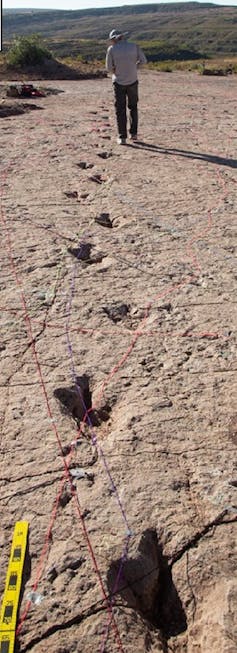
The research was announced in a Plos One paper, which documents 1,321 trackways plus 289 isolated tracks, totalling 16,600 theropod (three-toed) tracks.
They also record 280 “swim” trackways (1,378 swim tracks) and multiple tail traces, with some bird tracks occurring locally alongside the theropod tracks.
Plos One
These traces can often resemble scratches and are different from the tracks the same animal might make on land. They tell a story of behaviour that is rich in detail.
The site preserves at least a dozen distinct track morphologies (shapes or forms), implying multiple kinds of animals, but the study doesn’t translate those into a specific number of species.
Identifying the species of the trackmakers is difficult for two reasons. First, a single animal can make footprints with different shapes and forms depending on the motion of the foot and the consistency of the underlying ground.
Second, fossil bones are not always found at footprint sites, because the conditions needed for fossil bones to be retained are often different from those needed to preserve footprints.
This makes it harder to identify specific groups or species of dinosaur. The researchers overcome this in the paper by defining “morphotypes”, or put another way, recurring footprints of different types, or forms.
When looking at a track site like this, the number of tracks – and there are lots at this site – does not necessarily equate to the number of animals. One animal moving back and forth across a surface can make lots of tracks. Equally, lots of animals moving once across a surface can leave the same number of tracks.
The find is significant because it captures a range of behaviour from a variety of species. This provides researchers with a window into ancient behaviour, like whether these dinosaurs moved in groups and, potentially, how they foraged and travelled along the stretch of beach.
For example, there is evidence of individual dinosaurs moving in the same direction, which can be due to dinosaurs moving in social groups, performing tasks such as hunting or migrating. However, this phenomenon can also arise because of other factors, such as geographical barriers.
Importantly, the study of the footprints allows researchers to document species that would have occurred together in the landscape during the short time interval when the tracks were forming. This makes the site an archive of an ancient ecosystem, rather than just a single species. Further analysis to yield fascinating insights into the daily lives of the creatures passing along this stretch of shore.
The longest prehistoric trackway made by people, in White Sands National Park (New Mexico), helped us appreciate that one trackmaker on a single journey can make a variety of different types of track based on what they were doing. There could be parallels here with the dinosaur trackway in Bolivia.
Something to ponder as you next walk on a well-trodden beach.