


Connect with us

Tech

OpenAI deepens India push with Pine Labs fintech partnership

Published

on

As India pitches itself as a global hub for applied artificial intelligence, OpenAI has partnered with Pine Labs to integrate AI-driven reasoning into the fintech firm’s payments stack, automating settlement and invoicing workflows in a move the companies say could help accelerate AI-led commerce in India.

The partnership will see Pine Labs embed OpenAI’s application programming interfaces — software tools that let companies plug AI into their existing systems — within its payments and commerce infrastructure, the companies said on Thursday, all with the aim of enabling AI-assisted settlement, reconciliation, and invoicing workflows.

The deal underscores OpenAI’s broader push to expand its footprint in India, one of its fastest-growing markets, as it looks to move beyond being known primarily as the maker of ChatGPT and embed its technology into education, enterprise, and infrastructure. Earlier this week, OpenAI partnered with leading Indian engineering, medical, and design institutions to bring AI tools into higher education, betting that India’s large developer base and more than a billion internet users will play a central role in the next phase of AI adoption.

Pine Labs is already using AI internally to automate parts of its settlement and reconciliation process, cutting the time it takes to clear daily settlements from hours to minutes, according to Chief executive B Amrish Rau. The Noida-based company previously relied on manual checks by dozens of employees to process funds from multiple banks before markets opened each day, a workflow that is now largely handled by AI-driven systems, he said in an interview.

Advertisement

For Pine Labs, the partnership is intended to extend those AI-driven efficiencies beyond internal operations to merchants and corporate clients, starting with business-to-business use cases such as invoice processing, settlements and payments orchestration, Rau told TechCrunch. He noted the company sees faster adoption in B2B workflows, where AI agents can handle large volumes of repetitive financial tasks under predefined rules, before similar capabilities reach consumer-facing payments.

“People talk about retail AI, but the bigger impact of all of this is really efficiency improvement, especially in B2B,” Rau said. “If you look at invoicing and settlement, those are workflows where agents can actually drive the process end to end, and that’s where adoption can happen faster.”

The rollout of more autonomous, agent-led payment workflows will move faster in overseas markets where regulations already allow such transactions, Rau said, while India is likely to see a more gradual adoption focused on AI-assisted commerce rather than fully agent-initiated payments. He said that Pine Labs is already prototyping agent-driven payments in parts of the Middle East and Southeast Asia, even as Indian regulations require tighter controls on how payments are authorized.

Techcrunch event

Advertisement

Boston, MA
|
June 23, 2026

For OpenAI, the partnership offers a route deeper into India’s payments and enterprise ecosystem as it looks to move beyond consumer-facing tools and embed its models into high-volume, regulated workflows. Rau said the collaboration is aimed at increasing merchant stickiness and expanding Pine Labs’ role from a payments processor to a broader commerce platform, with higher transaction volumes over time translating into incremental revenue.

Advertisement

Pine Labs says it works with more than 980,000 merchants, 716 consumer brands, and 177 financial institutions, and has processed over 6 billion cumulative transactions valued at over ₹11.4 trillion (about $126 billion), per its prospectus published last year. The fintech operates across 20 countries, including Malaysia, Singapore, Australia, parts of Africa, the UAE, and the U.S., giving the OpenAI partnership reach across both Indian and international markets.

Rau said the partnership does not involve revenue sharing between the two companies, with Pine Labs not taking a cut if its merchants choose to embed OpenAI’s tools. “We’ve kept it completely independent of each other — anything related to payment and payment services, we will get the benefit of it, and anything related to OpenAI revenues will go to them,” he said.

The arrangement, Rau added, is also non-exclusive. He compared it to OpenAI’s partnership with Stripe in the U.S. and said Pine Labs remains open to working with other AI providers.

Rau said Pine Labs is building additional security and compliance layers around AI-driven workflows to ensure that sensitive merchant and consumer transaction data remains protected, as the company integrates AI more deeply into its payments systems. He said the focus is on ensuring transactions remain secure and compliant even as more workflows are automated by AI.

Advertisement

Pine Labs’ interest in AI-driven commerce builds on earlier work through its Setu unit, which has experimented with agent-led bill payment experiences using chatbots including ChatGPT and Anthropic’s Claude. Separately, India also began piloting consumer payments directly through AI chatbots last year.

The new announcement comes as India hosts its AI Impact Summit in New Delhi, where global AI companies including OpenAI, Anthropic, and Google are showcasing their latest capabilities alongside Indian startups demonstrating AI applications aimed at large-scale deployment across sectors such as finance, healthcare, and education.

Source link

Advertisement
Continue Reading
Click to comment

Leave a Reply

Your email address will not be published. Required fields are marked *

Tech

EV Sales Boom As Ethiopia Bans Fossil-Fuel Car Imports

Published

on

An anonymous reader quotes a report from the Financial Post: In 2024, the Ethiopian government banned the import of fossil fuel-powered vehicles and slashed tariffs on their electric equivalents. It was a policy driven less by the country’s climate ambitions and more by fiscal pressures. For years, subsidizing gasoline for consumers has been a major drag on Ethiopia’s budget, costing the state billions of dollars over the past decade. The country defaulted on its sovereign bonds in 2023 after rising interest rates drove up the costs of servicing its debts, and it received a $3.4 billion bailout from the International Monetary Fund the following year.

In the two years since the ban on internal combustion engine vehicles, EV adoption has grown from less than 1% to nearly 6% of all of the vehicles on the road in the country — according to the government’s own figures — some way above the global average of 4%. “The Ethiopia story is fascinating,” said Colin McKerracher, head of clean transport at BloombergNEF. “What you’re seeing in places that don’t make a lot of vehicles of any type, they’re saying: ‘Well, look, if I’m going to import the cars anyway, then I’d rather import less oil. We may as well import the one that cleans up local air quality and is cheaper to buy.’”

For decades, Ethiopia’s high import tariffs on vehicles put new car ownership out of the reach of most of the country’s population. Per capita gross domestic product is only about $1,000, and even by the standards of low-income countries, it has among the lowest car ownership rates. At 13 vehicles per 1,000 people, it’s a fraction of the African average of 73. With few cars manufactured in the country, the vast majority are imported, and most are bought used. The government’s import policy has upended the market. In parallel, tariffs for EVs were dropped to 15% for completed cars, 5% for parts and semi-assembled vehicles, and zero for “fully knocked down” — vehicles shipped in parts and assembled locally. That has made new EVs cost-competitive with old gasoline cars.

Source link

Advertisement
Continue Reading

Tech

For open-source programs, AI coding tools are a mixed blessing

Published

on

A world that runs on increasingly powerful AI coding tools is one where software creation is cheap — or so the thinking goes — leaving little room for traditional software companies. As one analyst report put it, “vibe coding will allow startups to replicate the features of complex SaaS platforms.”

Cue the hand-wringing and declarations that software companies are doomed.

Open-source software projects that use agents to paper over long-standing resource constraints should logically be among the first to benefit from the era of cheap code. But that equation just doesn’t quite stick. In practice, the impact of AI coding tools on open source software has been far more mixed.

AI coding tools have caused as many problems as they have solved, according to industry experts. The easy-to-use and accessible nature of AI coding tools has enabled a flood of bad code that threatens to overwhelm projects. Building new features is easier than ever, but maintaining them is just as hard and threatens to further fragment software ecosystems.

Advertisement

The result is a more complicated story than simple software abundance. Perhaps, the predicted, imminent death of the software engineer in this new AI era is premature.

Quality vs quantity

Across the board, projects with open codebases are noticing a decline in the average quality of submissions, likely a result of AI tools lowering barriers to entry.

“For people who are junior to the VLC codebase, the quality of the merge requests we see is abysmal,” Jean-Baptiste Kempf, the CEO of the VideoLan Organization that oversees VLC, said in a recent interview.

Techcrunch event

Advertisement

Boston, MA
|
June 23, 2026

Kempf is still optimistic about AI coding tools overall but says they’re best “for experienced developers.” 

Advertisement

There have been similar problems at Blender, a 3D modeling tool that has been maintained as open source since 2002. Blender Foundation CEO Franceso Siddi said LLM-assisted contributions typically “wasted reviewers’ time and affected their motivation.” Blender is still developing an official policy for AI coding tools, but Siddi said they are “neither mandated nor recommended for contributors or core developers.”

The flood of merge requests has gotten so bad that open-source developers are building new tools to manage it.

Earlier this month, developer Mitchell Hashimoto launched a system that would limit GitHub contributions to “vouched” users, effectively closing the open-door policy for open-source software. As Hashimoto put it in the announcement, “AI eliminated the natural barrier to entry that let OSS projects trust by default.”

The same effect has emerged in bug bounty programs, which give outside researchers an open door to report security vulnerabilities. The open-source data transfer program cURL recently halted its bug bounty program after being overwhelmed by what creator Daniel Stenberg described as “AI slop.”

Advertisement

“In the old days, someone actually invested a lot of time [in] the security report,” Stenberg said at a recent conference. “There was a built-in friction, but now there’s no effort at all in doing this. The floodgates are open.”

It’s particularly frustrating because many of open-source projects are also seeing the benefits of AI coding tools. Kempf says it’s made building new modules for VLC far easier, provided there’s an experienced developer at the helm.

“You can give the model the whole codebase of VLC and say, ‘I’m porting this to a new operating system,’” Kempf said. “It is useful for senior people to write new code, but it’s difficult to manage for people who don’t know what they’re doing.”

Competing priorities

The bigger problem for open-source projects is a difference in priorities. Companies like Meta value new code and products, while open-source software work focuses more on stability.

Advertisement

“The problem is different from large companies to open-source projects,” Kempf commented. “They get promoted for writing code, not maintaining it.”

AI coding tools are also arriving at a moment when software, in general, is particularly fragmented.

Open Source Index founder Konstantin Vinogradov, who recently launched an endowment to maintain open-source infrastructure, said AI tools are running into a long-standing trend in open-source engineering.

“On the one hand, we have exponentially growing code base with exponentially growing number of interdependences, And on the other hand, we have number of active maintainers, which is maybe slowly growing, but definitely not keeping up,” Vinogradov said. “With AI, both parts of this equation accelerated.”

Advertisement

It’s a new way of thinking about AI’s impact on software engineering — one with alarming implications for the industry at large.

If you see engineering as the process of producing working software, AI coding makes it easier than ever. But if engineering is really the process of managing software complexity, AI coding tools could make it harder. At the very least, it will take a lot of active planning and work to keep the sprawling complexity in check.

For Vinogradov, the result is a familiar situation for open-source projects: a lot of work to do, and not enough good engineers to do it.

“AI does not increase the number of active, skilled maintainers,” he remarked. “It empowers the good ones, but all the fundamental problems just remain.”

Advertisement

Source link

Continue Reading

Tech

Apple said to be working on camera-enabled AirPods, AI-powered pin and full-on smart glasses

Published

on

Apple is reportedly developing a trio of AI-powered wearables, including smart glasses, camera-equipped AirPods and a new AI pin device.

According to Bloomberg’s Mark Gurman, the products are designed to give Siri more “contextual awareness” by letting it see and interpret the world around you.

The headline device appears to be a pair of Apple-designed smart glasses aimed squarely at competitors like Meta’s Ray-Ban collaboration. Rather than partnering with an established eyewear brand, Apple is said to be developing its frames in-house.

The company is focusing on premium build quality and multiple size and colour options. Reports suggest the glasses will feature an advanced dual-camera system. One high-resolution camera captures photos and video, while a second sensor feeds environmental data to Siri.

Advertisement

Advertisement

If accurate, the goal is to create what sources describe as an “all-day AI companion,” offering hands-free contextual queries similar to what Meta currently provides. This would come with Apple’s tighter hardware-software integration.

Alongside the glasses, Apple is reportedly exploring AirPods fitted with lower-resolution cameras. These wouldn’t be designed for photography, but instead to gather visual context for Siri while maintaining the familiar earbuds form factor. Microphones would also allow for voice interaction. As a result, the AirPods would become another extension of the iPhone’s AI system.

The third device in development is said to be an AI-powered wearable pin. The concept echoes products like the Humane AI Pin. However, Apple’s version would reportedly rely on the iPhone as its processing hub rather than operating as a standalone replacement. A built-in speaker is being considered, though that detail is not confirmed.

Advertisement

The broader strategy appears clear: rather than replacing the iPhone, Apple wants to surround it with AI-enabled accessories, reducing the need to constantly take it out of your pocket. It’s a different approach to some early AI hardware experiments that attempted to fully supplant smartphones. Those efforts haven’t always landed well.

There’s no official confirmation from Apple, and none of these products are unlikely to arrive before 2027. Still, if the reports hold up, Apple could be preparing its most ambitious wearable push since the Apple Watch. This time, the focus is centred squarely on AI.

Advertisement

Source link

Advertisement
Continue Reading

Tech

Apple Music’s 5 new upgrades are just what the platform needs to one-up Spotify, but its new UI has users begging for simplicity

Published

on


  • Apple Music is rolling out five new features in iOS 24.6, including the new Playlist Playground and Concerts Near You functions
  • It’s also getting a new UI design for albums and playlists
  • Despite its new look, it’s divided users who have called out Apple for its lack of accessibility features

Apple will unveil its next slew of new products in a couple of weeks at its March 4 event, but it’s already teasing some of the new upgrades coming to Apple Music in iOS 24.6 — and there’s no doubt they’ll breathe new life into one of the best music streaming services.

If you’re enrolled in the iOS 24.6 beta, there’s a chance you’ve already caught a glimpse of the new Apple Music features that are expected to roll out widely in the coming weeks. Unlike Spotify, it’s not in Apple Music’s character to churn out one new feature after the next, so the fact that it’s bringing five new upgrades at once is big news.

Source link

Advertisement
Continue Reading

Tech

Mag-Lev Lemming Refuses To Fall

Published

on

Are you ready to feel old? Lemmings just turned thirty-five. The famous puzzle game first came out in February of 1991 for the Commodore Amiga, before eventually being ported to just about everything else out there, from the ZX Spectrum to the FM Towns, and other systems so obscure they don’t have the class to start with two letters, like Macintosh and DOS. [RobSmithDev] decided he needed to commemorate the anniversary with a real floating lemming.

The umbrella-equipped lemming is certainly an iconic aspect of the game franchise, so it’s a good pick for a diorama. Some people would have just bought a figurine and hung it with some string, but that’s not going to get your project on Hackaday. [Rob] designed and 3D printed the whole tableau himself, and designed magnetic levitation system with some lemmings-themed effects.

The mag-lev is of the top-down type, where a magnet in the top of the umbrella is pulled against gravity by an electromagnetic coil. There are kits for this sort of thing, but they didn’t quite work for [Rob] so he rolled his own with an Arduino Nano. That allowed him to include luxuries you don’t always get from AliExpress like a thermal sensors.

Our favorite part of the build, though, has to be the sound effects. When the hall effect sensor detects the lemming statue — or, rather, the magnet in its umbrella — it plays the iconic “Let’s Go!” followed by the game’s sound track. If the figurine falls, or when you remove it, you get the “splat” sound, and if the lemming hits the magnet, it screams. [Rob] posted a demo video if you just want to see it in action, but there’s also a full build video that we’ve embedded below.

Advertisement

A commemorative mag-lev seems to be a theme for [Rob] — we featured his 40th anniversary Amiga lamp last year, but that’s hardly all he gets up to. We have also seen functional replicas, this one of a motion tracker from Aliens, and retrotech deep-dives like when he analyzed the magical-seeming tri-format floppy disk.

Source link

Advertisement
Continue Reading

Tech

Grab this Elevation Lab 10-year extended battery case for AirTag for only $16

Published

on

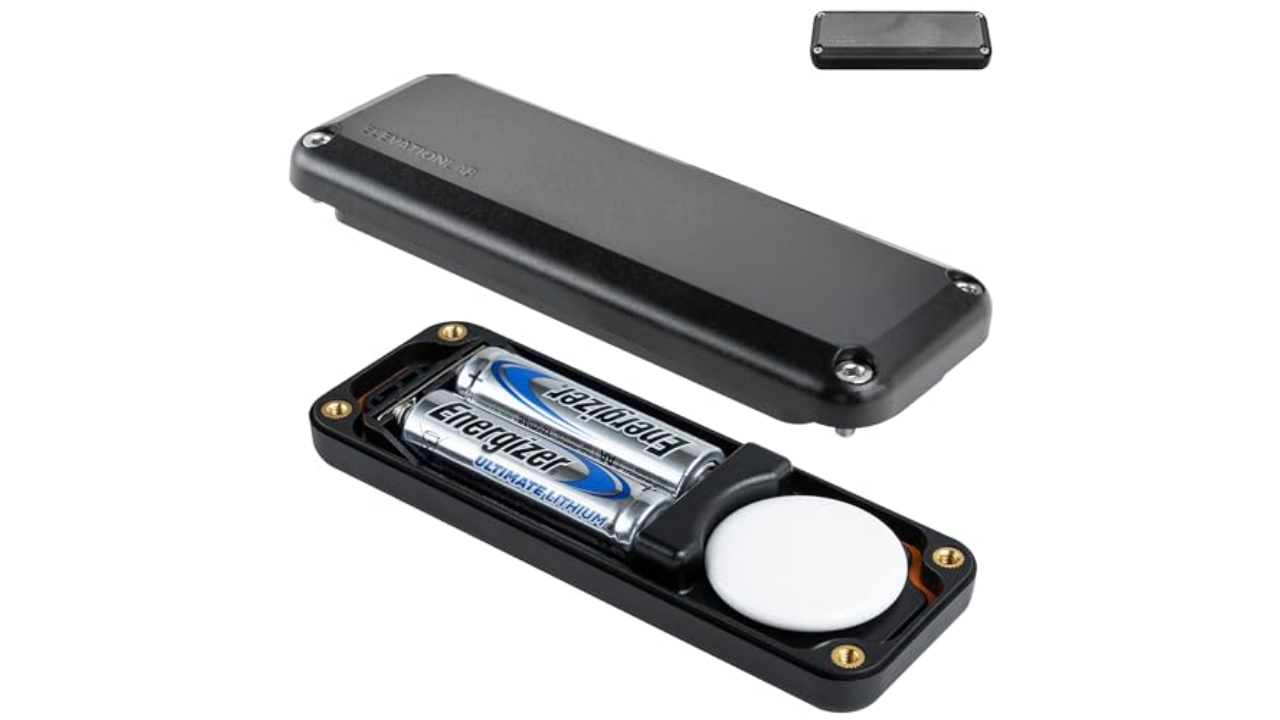
If you’re an iPhone user who likes to keep tabs on where your stuff is, you can’t go far wrong with an AirTag. The second-gen model that Apple just released outpaces the original in every way (aside from the galling lack of a keyring hole, that is). While it’s easy enough to replace the battery in both versions of the AirTag, you might not want to have to worry about the device’s battery life for a very long time. Enter Elevation Lab’s extended battery case for the AirTag, which is currently on sale at Amazon for $16.

The case usually sells for $23, so that’s a 30 percent discount. It’s not the first time we’ve seen this deal, but it’s a pretty decent one all the same.

Image for the large product module

Elevation Lab

Elevation Lab says its AirTag case can extend the battery life of the tracking device to 10 years, and now it’s on sale.

Advertisement

This is arguably one of the more useful AirTag accessories around for certain use cases. It won’t exactly be helpful for an AirTag that you put in a wallet or attach to your keys, as it’s too bulky for such a purpose — and it doesn’t have a hole for a keyring anyway. Still, if you’re looking for an AirTag case that you can place in a suitcase or backpack and not have to touch for years, this could be the ticket.

Elevation Lab says that, when you place a couple of AA batteries in the case, it can extend the tracker’s battery life to as much as 10 years (the brand recommends using Energizer Ultimate Lithium batteries for best results). The AirTag is slated to run for over a year on its standard CR2032 button cell.

The case gives the AirTag more protection as well. It’s sealed with four screws and it has a IP69 waterproof rating. What’s more, it doesn’t ostensibly look like an AirTag case, so someone who steals an item with one inside is perhaps less likely to realize that the object they pilfered is being tracked.

Advertisement

There are some other downsides, though. Since the AirTag is locked inside a case, the sound it emits will be muffled. Elevation Lab says the device’s volume will be about two-thirds the level of a case-free AirTag. However, the second-gen AirTag is louder than its predecessor, which should mitigate that issue somewhat.

Image for the mini product module

Follow @EngadgetDeals on X for the latest tech deals and buying advice.

Source link

Advertisement
Continue Reading

Tech

New Tool Makes 3D Printed PCBs, Fast

Published

on

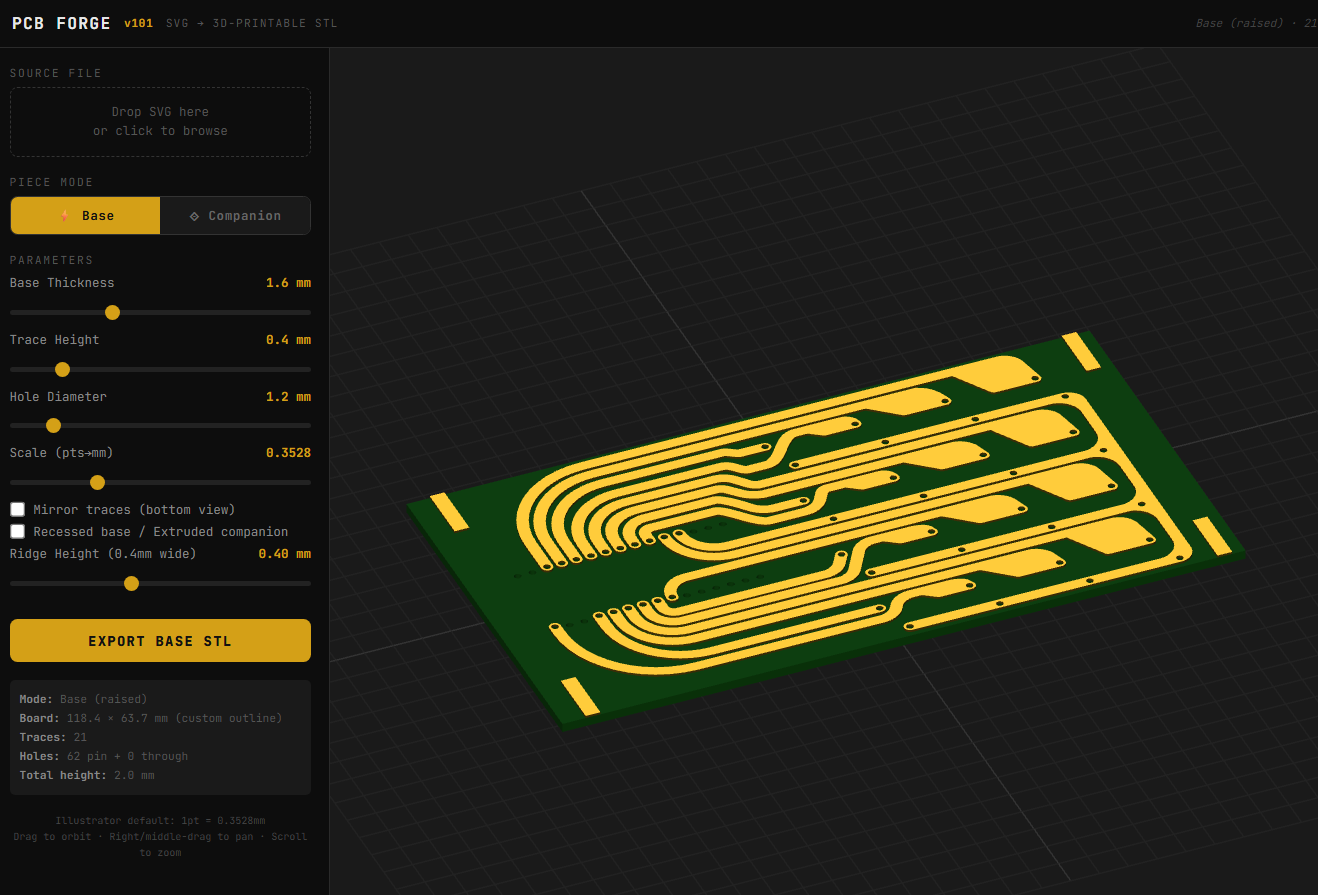
Getting PCBs made is often the key step in taking a dodgy lab experiment and turning it into a functional piece of equipment. However, it can be tedious to wait for PCBs to ship, and that can really slow down the iterative development process. If you’ve got a 3D printer, though, there’s a neat way to make your own custom PCBs. Enter PCB Forge from [castpixel].

The online tool.

The concept involves producing a base and a companion mold on your 3D printer. You then stick copper tape all over the base part, using the type that comes with conductive adhesive. This allows the construction of a fully conductive copper surface across the whole base. The companion mold is then pressed on top, pushing copper tape into all the recessed traces on the base part. You can then remove the companion mold, quickly sand off any exposed copper, and you’re left with a base with conductive traces that are ready for you to start soldering on parts. No etching, no chemicals, no routing—just 3D printed parts and a bit of copper tape. It rarely gets easier than this.

You can design your PCB traces in any vector editor, and then export a SVG. Upload that into the tool, and it will generate the 3D printable PCB for you, automatically including the right clearances and alignment features to make it a simple press-together job to pump out a basic PCB. It bears noting that you’re probably not going to produce a four-layer FPGA board doing advanced high-speed signal processing using this technique. However, for quickly prototyping something or lacing together a few modules and other components, this could really come in handy.

The work was inspired by a recent technique demonstrated by [QZW Labs], which we featured earlier this year. If you’ve got your own hacks to speed up PCB production time, or simply work around it, we’d love to know on the tipsline!

Advertisement

Source link

Advertisement
Continue Reading

Tech

Brendan Carr’s Abuse Of FCC ‘Equal Opportunity’ Rule Completely Blows Up In His Face

Published

on

from the great-job,-buddy dept

Yesterday we noted how CBS fecklessly tried to prevent Stephen Colbert from broadcasting an interview with Texas Democratic State Representative James Talarico. Which, as you’ve probably already seen, resulted in the interview on YouTube getting way more viewers than it would have normally, and Texas voters flocking to Google to figure out who Talarico is:

In short, Brendan Carr’s continual threats and unconstitutional distortion of the FCC’s “equal opportunity” rule (also known as the “equal time” rule) resulted in a candidate getting exponentially more attention than they ever would have if Brendan Carr wasn’t such a weird, censorial zealot.

If only there was a name for this sort of phenomenon?

Despite a lot of speculation to the contrary, there’s no evidence the GOP specifically targeted Talarico in any coherent, strategic sense. This entire thing appears to have occurred because CBS lawyers — focused on numerous regulatory issues before the Trump administration, didn’t want to offend the extremist authoritarian censors at Trump’s FCC. It’s always about the money.

Advertisement

CBS (and ABC, NBC, and Fox) have been lobbying the FCC for years to get ride of rules preventing them from merging. CBS (read: Larry Ellison) has managed to get his friend Trump conducting a fake DOJ antitrust inquiry into Netflix’s planned acquisition of Warner Brothers, so they can then turn around and buy Warner (and CNN) instead. They’ll need to remain close with the administration for that to work out.

CBS tried to do damage control and claim they never directly threatened Colbert, but you can tell by the way they’re being a little dodgy about ownership of those claims (demanding no direct attribution to a specific person “on background”) they likely aren’t true:

Colbert’s response to the claim he wasn’t threatened was… diplomatic:

Advertisement

Amusingly some of the news outlets covering this story (like Variety here) couldn’t be bothered to even mention that CBS has numerous regulatory issues before the Trump FCC, which is why they folded like a pile of rain-soaked street corner cardboard at the slightest pressure from the Trump FCC.

As we’ve noted repeatedly, Brendan Carr has absolutely no legal legs to stand on here. His abuse of the equal opportunity rule is equal parts unconstitutional and incoherent. CBS (and any other network with bottomless legal budgets) could easily win in court (I wager they could even get many lawyers to defend them pro bono), but Ellison (and his nepo baby son) have a much bigger ideological mission in mind.

Filed Under: brendan carr, censorship, equal opportunity, equal time, fcc, first amendment, james talarico, stephen colbert, streisand effect

Companies: cbs

Advertisement

Source link

Continue Reading

Tech

Plato closes $14.5M to bring AI automation to wholesale trade

Published

on

Plato, a Berlin-based startup, has raised $14.5 million in seed funding to bring generative AI into wholesale distribution, a massive industry that rarely makes tech headlines but quietly moves a significant share of the world’s goods.

The round was led by Atomico, with Cherry Ventures, Discovery Ventures, and D11Z joining in.

Wholesale distribution accounts for roughly one-fifth of global production flows. Yet much of it still runs on aging ERP systems, Excel spreadsheets, and manual quoting workflows that haven’t meaningfully evolved in years.

While AI has flooded marketing, customer support, and coding, distribution sales teams are often still copy-pasting numbers between systems.

Advertisement

Plato’s thesis is simple: instead of adding another dashboard, embed AI directly into the operational core. The company connects to existing ERP systems and turns historical sales data into automated actions, flagging revenue opportunities, generating quotes, and identifying risks before they surface in quarterly reports.

Advertisement

The idea grew out of lived frustration. Co-founder Benedikt Nolte experienced the inefficiencies firsthand in his family’s distribution business. Generic CRM tools, he concluded, weren’t designed for the complexity of distributor operations. Plato was built specifically for that environment, not retrofitted from SaaS templates designed for startups.

Early traction suggests the industry is paying attention. Plato reportedly works with several large distributors on six-figure contracts, a sign that AI adoption in traditional sectors is less about hype and more about whether it can save time and unlock revenue.

The fresh capital will help Plato expand beyond sales intelligence into areas like procurement and customer service automation, while pushing into new European markets and eventually the U.S.

More broadly, the round highlights a shift in AI investing. The next wave isn’t just about bigger language models; it’s about embedding intelligence into industries that haven’t been rewritten by software yet. Wholesale distribution may not be glamorous, but it is structurally essential. If AI can modernize that layer of the economy, the impact will be far larger than another chatbot demo.

Advertisement

Source link

Continue Reading

Tech

Proposed income tax on high earners advances in Washington state

Published

on

Washington state’s Legislative Building in Olympia. (GeekWire Photo / Brent Roraback)

The so-called “millionaires tax” was approved by Washington’s Senate on Monday, advancing a measure that would create a 9.9% tax applied to taxable, personal annual income that exceeds $1 million.

Gov. Bob Ferguson earlier this month criticized Senate Bill 6346 for doing too little for small businesses and lower-income residents in the state. The measure passed Monday included changes that made more small businesses eligible for a business and occupation (B&O) tax exemption.

“The proposal is moving in the right direction,” Ferguson said in a statement. “That said, as the process moves forward in the final weeks of the legislative session, we must direct significantly more revenue directly back to hardworking Washington families and small businesses owners. I look forward to our continued partnership to make our state more affordable.”

The measure passed with 27 Democratic lawmakers voting yes. The 22 no votes included three Democrats.

Lawmakers adopted two amendments, including one to repeal a new sales tax expansion on select services that sparked controversy in the tech industry and a lawsuit from Comcast last year. However, the expansion on advertising services would not be repealed as part of the amendment, which would take effect in 2030.

Advertisement

SB 6346 marks the first time in decades that state lawmakers have pursued a personal income tax aimed at high‑income residents. The legislation would go into effect in two years and includes small business and low‑income tax breaks.

The bill has drawn opposition from some tech leaders and entrepreneurs who worry it could undermine the sector by souring Washington’s relatively favorable tax laws for startup founders, investors and high-wage earners.

Supporters of the proposed law argue those fears are overblown and say the bill helps correct the state’s regressive tax code, which relies heavily on property, sales and business taxes to fund education and other public programs.

The bill is expected to generate an estimated $3.7 billion annually.

Advertisement

The action comes as the state is struggling to plug a more than $2 billion budget hole with spending cuts and a slate of potential tax changes, while at the same time some of Washington’s largest employers are cutting thousands of jobs from their payrolls.

SB 6346 would:

  • Create a 9.9% tax on household income over $1 million, which is estimated to apply to fewer than 1% of the state’s households.
  • Taxpayers receive an exemption for charitable deductions of up to $100,000, which increased from the original bill’s $50,000 deduction.
  • Businesses grossing less than $300,000 would be exempt from the tax starting in 2029, which expanded the pool of eligible businesses from the $250,000 cut-off in the original bill. The break would apply to roughly 65% of all businesses.
  • An additional B&O surcharge will also be eliminated beginning in 2029.
  • Certain personal hygiene items would be exempt from sales tax starting in 2029.

The income tax would be used in part to expand the Working Families Tax Credit, which provides a sales tax rebate for low- to moderate- income families. It also helps fund the public defense system.

“Today was a momentous step forward. For Washington’s 1.1 million school kids, people struggling to afford health care, and small businesses looking for help, that help is on the way,” said bill sponsor and Senate Majority Leader Jamie Pedersen, D-Seattle, in a statement.

Washington is one of nine states that lack an income tax. If approved by lawmakers, the governor said the proposed tax was certain to go before voters for approval and would face legal challenges as well.

Advertisement

Kirby Winfield, founding general partner at Seattle venture capital firm Ascend, is among those against the legislation.

“This tax is just another brick in the wall of anti-entrepreneurialism from state and local legislators. The average Amazon employee probably won’t mind, but this stuff is devastating to company creation,” Winfield told GeekWire earlier this month.

As state leaders look to impose a levy on wages, they’re also working to repeal a recently passed policy that substantially increased Washington’s estate tax and drew criticism from tech leaders. The new proposal, Senate Bill 6347, also passed on Monday, with 38 lawmakers from both parties voting in favor and 11 Democrats voting against the bill.

Democratic leaders backing SB 6347 feared that wealthy residents would leave the state to avoid the tax — which is significantly higher than any other estate tax, the Seattle Times reported.

Advertisement

Pedersen told the Seattle Times that when it comes to taxes, “it’s not good for us to be an outlier.”

Both bills will now be considered by the House of Representatives. This year’s 60-day legislative session is scheduled to end March 12.

RELATED:

Source link

Advertisement
Continue Reading

Trending

Copyright © 2025