

Crypto World
Lemonade (LMND) Stock Jumps 17% After Q4 Earnings Beat


TLDR
- Lemonade (LMND) Q4 revenue hit $228.1 million, up 53.3% year-on-year, beating estimates of $217.6 million
- Adjusted EPS loss of -$0.29 beat analyst estimates of -$0.39 by $0.10
- Net premiums earned came in at $179.5 million, an 8.3% beat and 77.4% year-on-year growth
- Q1 2026 revenue guidance of $246–$251 million tops analyst consensus of $241.6 million
- Shares jumped over 17% in pre-market trading following the results
Lemonade (NYSE: LMND) shares surged more than 17% in pre-market trading on Thursday after the company posted Q4 results that beat analyst expectations across the board.
Revenue for the quarter came in at $228.1 million, up 53.3% year-on-year and ahead of the Wall Street consensus of $217.6 million. That’s a solid beat by any measure.
The company reported an adjusted loss of $0.29 per share, compared to analyst estimates of -$0.39. That’s a $0.10 beat, or roughly 26% better than expected.
Net premiums earned — the number analysts tend to watch most closely for insurers — came in at $179.5 million. That beat estimates of $165.8 million by 8.3% and grew 77.4% compared to the same quarter last year.
Pre-tax loss for the quarter was $20.6 million, representing a -9% margin.
Strong Premium Growth Drives the Beat
Net premiums earned have grown at a 47.3% annualized rate over the last five years, well above the broader insurance industry average.
Over the past two years, that growth rate has moderated to around 30% annually — still a healthy clip, and consistent with the company’s overall revenue trajectory.
Lemonade’s revenue has compounded at roughly 50.9% annually over the last five years. The most recent two-year annualized rate of 31% shows some deceleration but still points to strong underlying demand.
Net premiums earned made up about 70.8% of total revenue over the last five years, making it the company’s primary revenue driver.
Q1 2026 Guidance Tops Estimates
Looking ahead, Lemonade guided Q1 2026 revenue to between $246 million and $251 million. The midpoint of that range, $248.5 million, comes in above the analyst consensus of $241.6 million.
That forward guidance gave investors an additional reason to bid the stock higher on Thursday morning.
Lemonade operates across renters, homeowners, pet, car, and life insurance in both the U.S. and EU markets through its AI-powered digital platform.
The company’s Giveback program, which donates unused premiums to policyholder-selected charities, remains a differentiator in its positioning — though it’s the underlying growth numbers doing the heavy lifting right now.
Lemonade held a market capitalization of $4.91 billion at the time of reporting.
The company hosted a conference call Thursday at 8:00 am Eastern to discuss results.
Shares traded up 11.1% to $73.05 immediately after the report, with pre-market gains extending above 17% as the session progressed.


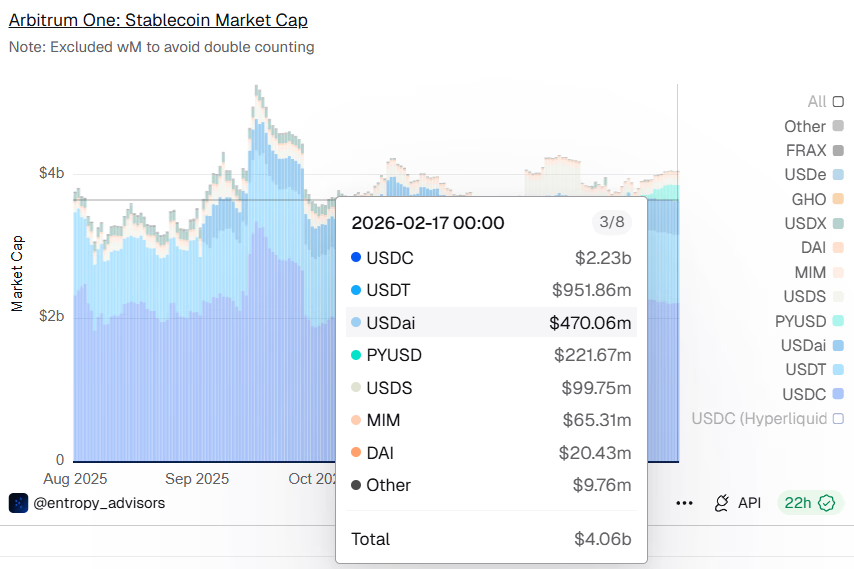
PYUSD has become the fourth-largest stablecoin on L2 Arbitrum after a partnership with USDai.
PayPal’s PYUSD stablecoin crossed $4 billion in total market capitalization this month, while its supply on Layer 2 Arbitrum One rose enough to rank it the network’s fourth-largest stablecoin.
According to data compiled by consulting firm Entropy Advisors, Arbitrum now has over $220 million worth of PYUSD circulating on the network, next only to USDAI, USDC and USDT. DefiLlama data records the PYUSD supply on Arbitrum at $256.6 million.

As analysts at Entropy Advisors explained in an X post on Feb. 16, PYUSD’s increase on Arbitrum appears to be tied to a partnership announced in mid-December between PayPal and Permian Labs, the core developer behind USDai (USDAI).
Under the agreement, PYUSD was added as a reserve asset backing USDAI and a settlement and liquidity asset for the protocol, which is primarily based on Arbitrum and is tied to financing for AI infrastructure, such as GPUs and data centers.
Per the announcement, up to $1 billion in PYUSD deposits on USDai will earn 4.5 % APY as part of a one-year incentive program.
“With this integration, USDAI’s loans can be issued in $PYUSD and settled directly into PayPal accounts. Borrowers can pay for GPUs, data center costs, rentals, and subscriptions using a single dollar based rail,” USDAI said in a December X post.
Following the integration, data from DefiLlama shows that nearly all of PYUSD’s supply on Arbitrum is deployed within USDai. PYUSD now accounts for more than 43% of all token deposits on the protocol, second only to WrappedM by M0 (WM), USDAI’s base asset, which makes up more than 56% of its TVL.

However, USDAI’s own documentation states that “incentives are used early to bootstrap liquidity, but they are not the end‑state yield source,” implying that stablecoins are deployed mainly to support settlement in the early phase, while the protocol is meant to transition toward GPU and AI-backed lending as its primary yield and collateral source.
Arbitrum One is currently the largest Ethereum L2 by total value secured, with $16.82 billion, according to data from L2Beat.


In today’s newsletter, Nassim Alexandre from RockawayX takes us through crypto vaults, what they are, how they work and risk evaluation.
Then Lucas Kozinski, from Renzo Protocol, answers questions about decentralized finance in Ask an Expert.
Understanding vaults: what happens beyond the yield
Capital flowing into crypto vaults surged past $6 billion last year, with projections indicating it could double by the end of 2026.
With that growth, a sharp split has emerged between vaults with robust engineering and controls and vaults that are essentially yield packaging.
A crypto vault is a managed fund structure deployed on-chain. An investor deposits capital, receives a token representing their share, and a curator allocates that capital in accordance with a defined mandate. The structure can be custodial or non-custodial, redemption terms depend on the liquidity of the underlying assets and portfolio rules are often encoded directly into smart contracts.
The central question around vaults is exposure: what am I exposed to, and can it be more than I am being told? If you can explain where the yield comes from, who holds the assets, who can change the parameters and what happens in a stress event, you understand the product. If you cannot, the headline return is irrelevant.
There are three risk layers worth understanding.
The first is smart contract risk: the risk that the underlying code fails. When was the last audit? Has the code changed since? Allocation controls sit here as well. Adding new collateral to a well-designed vault should require a timelock that allows depositors to see the change and exit before it takes effect. Strategy changes should require multi-signature approval.
The second is underlying asset risk: the credit quality, structure and liquidity of whatever the vault is actually holding.
The third underappreciated risk is redemption: under what conditions can you get your capital back, and how quickly? Understand who handles liquidations in a downturn, what discretion they have and whether the manager commits capital to backstop them. That distinction matters most in the exact moments you would want to leave.
The quality of a vault is largely dependent on the quality of its curation. A curator selects which assets are eligible, sets parameters around them and continuously monitors the portfolio.
For example, most real-world asset strategies on-chain today are single-issuer, single-rate products. A curated vault, by contrast, combines multiple, vetted issuers under active management, giving diversified exposure without managing single-name credit risk yourself.
Then there is ongoing monitoring. Default rates shift, regulations change and counterparty events happen. A curator who treats risk assessment as a one-time exercise is not managing risk.
What makes crypto vaults different from a traditional fund is transparency; investors don’t have to take the curator’s word for it. Every allocation, position and parameter change happens on-chain and is verifiable in real time. For advisors familiar with private credit, the underlying collateral may be recognisable. What requires attention is the on-chain structuring around it: whether you have genuine recourse, in which jurisdiction and against whom. That is where curator expertise matters. A curator is the risk manager behind a vault. They decide what assets are eligible, set the rules capital operates within, and actively manage the portfolio.
Curated vault strategies typically target 9-15% annually, depending on mandate and assets. That range reflects risk-adjusted return generation within defined constraints.
Vaults also allow a more efficient way to access assets you already allocate to, with capabilities that traditional structures do not offer. For family offices managing liquidity across multiple positions, this is a practical operational improvement.
The key one is composability. On-chain, a vault can allow you to borrow against a collateral position directly, without the documentation overhead of a traditional loan facility. For family offices managing liquidity across multiple positions, this is a practical operational improvement.
Permissioned vault structures are also noteworthy, as they allow multiple family offices or trustees to deposit funds into a single managed mandate without commingling, each retaining separate legal ownership while sharing the same risk-management infrastructure.
The vaults that survive this scrutiny will be the ones where the engineering, mandate, and curator’s judgment are built to hold under pressure.
– Nassim Alexandre, vaults partner, RockawayX
Ask an Expert
Q: With “yield-stacking” and many layers of decentralized finance (DeFi) protocols, what is needed to mitigate risk in vaults?
The first thing is minimizing complexity. Every additional protocol in the stack is another attack surface. So if you don’t need it, cut it. We won’t deposit into protocols that have discretionary control over funds — meaning they can move capital wherever they want without user consent. We want transparency about what other protocols are doing with our capital, but privacy around our strategies so others can’t see anything proprietary.
Beyond that, it comes down to transparency and time. Users should always be able to see exactly where their funds are and what they’re doing. And any parameter changes — fees, strategies, risk limits — should go through a timelock so people have a window to review and react before anything goes live. Smart contract audits matter too, but audits are a baseline, not a safety net. The architecture has to be sound before the auditor even shows up.
Q: At what point does institutional capital inflow compress DeFi yields to the level of traditional risk-free rates, and where will the next “alpha” be found?
It’ll happen eventually in the most liquid, simple strategies. But here’s what traditional finance (TradFi) can’t replicate: composability. The underlying instruments might be identical — take the USCC carry trade as an example — but in DeFi you can plug that same position into a lending market, use it as collateral, provide liquidity to a DEX pool and do all of that simultaneously. That’s not possible in TradFi without significant infrastructure cost.
The alpha won’t disappear. It’ll just move to whoever builds the most efficient capital pathways between strategies. The people who figure out how to stack yields across composable layers while managing risk properly will consistently outperform. And that gap between DeFi and TradFi infrastructure costs alone keeps the spread wide for a long time.
Q: How will the integration of Real World Assets (RWAs) into automated vaults change the correlation between crypto yields and global macro interest rate cycles?
Yes, crypto yields will become more correlated with macro as RWAs come in. That’s just the nature of bringing rate-sensitive assets on-chain. But I think people underweight the other side of that tradeoff.
Before RWAs, crypto holders had a binary choice: keep stables on-chain and earn crypto-native yields, or pull everything out and deposit into a brokerage. Now you can hold stables on-chain and access the same strategies you’d find in TradFi, without leaving the ecosystem. And crucially, you can layer on top of them — borrow against your RWA position, deploy that capital into a lending market, LP against pools that use these assets as collateral. The capital efficiency you get from that kind of setup is just not available in traditional finance. So yeah, more macro correlation — but also more optionality for where to deploy capital, which should push rates up over time as liquidity deepens.
– Lucas Kozinski, co-founder, Renzo Protocol
Keep Reading


Anchorage Digital has launched a new offering called Stablecoin Solutions, enabling banks to perform near-instant USD settlements.
Anchorage Digital has announced the launch of Stablecoin Solutions, a federally regulated service that enables banks to conduct near-instant USD settlements globally via blockchain technology. This move by Anchorage Digital, the first federally chartered crypto bank in the U.S., aims to modernize cross-border settlements while adhering to stringent regulatory standards.
The new offering consolidates minting, redemption, custody, fiat treasury, and settlement under Anchorage Digital Bank, N.A., operating under the oversight of the Office of the Comptroller of the Currency (OCC). This positions Anchorage to offer a seamless integration of stablecoin technology within traditional banking frameworks, eliminating the complexities of state-by-state licensing.
“Stablecoins are becoming core financial infrastructure,” said Nathan McCauley, co-founder and CEO of Anchorage Digital. “Stablecoin Solutions gives banks a federally regulated way to move dollars globally using blockchain rails, without compromising custody, compliance, or operational control. This is about modernizing settlement while preserving the standards the financial system depends on.”
Stablecoin Solutions aims to compress settlement timelines from days to minutes, reduce trapped liquidity, and mitigate counterparty and settlement risks by replacing traditional banking methods like correspondent banking and nostro/vostro pre-funded accounts. The offering supports various stablecoins, including Tether’s USA₮ and Ethena Labs’ USDtb, providing banks with flexible, stablecoin-agnostic rails.
Anchorage Digital’s foray into stablecoin solutions aligns with broader trends in the crypto industry, where major players like PayPal are also expanding their stablecoin activities.
This article was generated with the assistance of AI workflows.
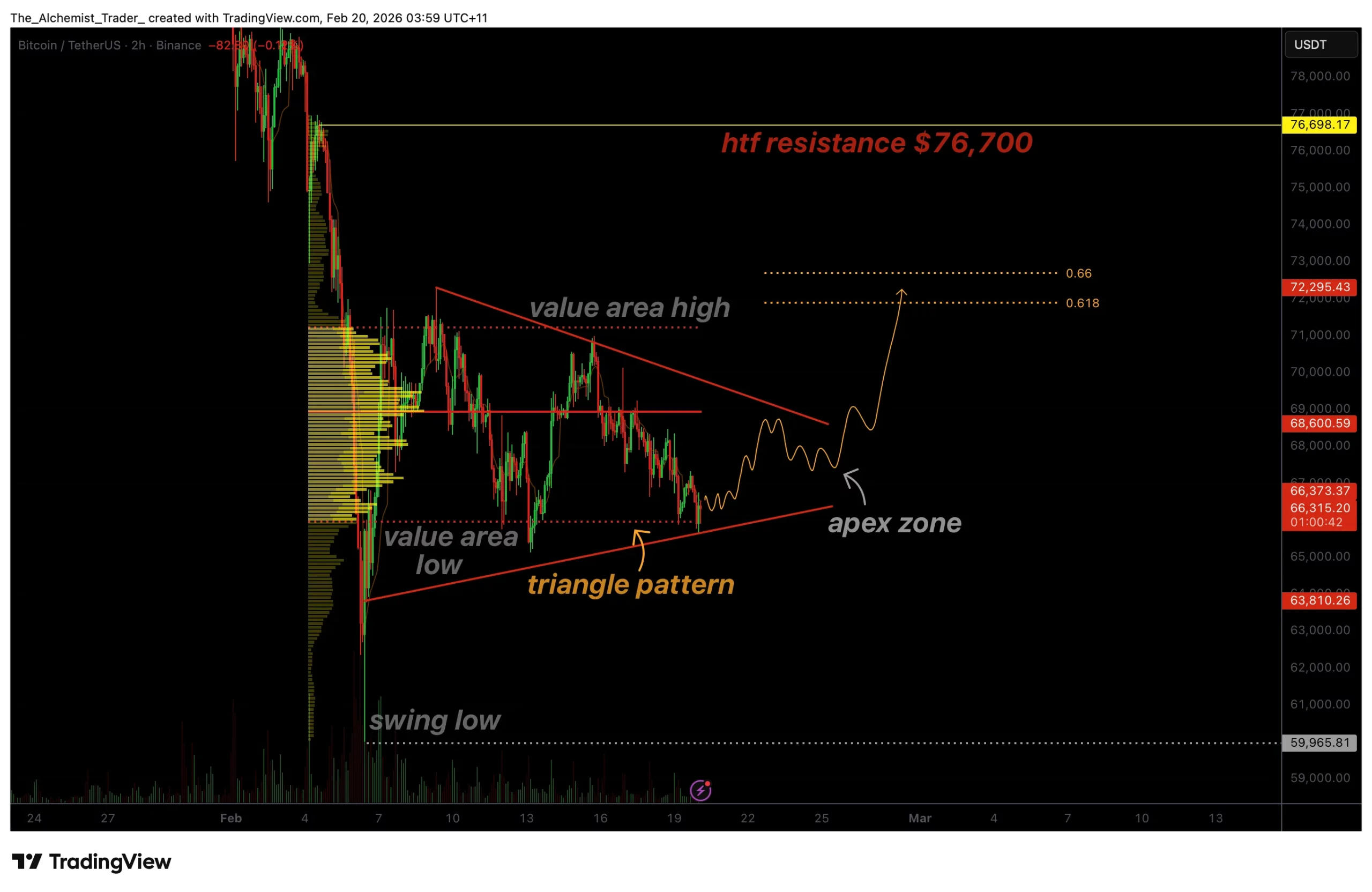
Bitcoin price is compressing into a tightening triangle structure, signaling a major decision point as converging support and resistance suggest an imminent volatility expansion in the near term.
Summary
- Triangle compression signals imminent breakout, volatility expansion approaching
- Higher lows indicate growing demand, favoring bullish resolution
- $76,700 resistance becomes key target, if breakout confirms with volume
Bitcoin (BTC) price action has entered a constructive consolidation phase, forming a clear triangle pattern that reflects growing market equilibrium. After recent volatility, the price has entered a period of compression, with dynamic support and resistance continuing to narrow. This behavior often precedes significant directional movement, as markets rarely remain compressed for extended periods.
Triangle formations typically represent a balance between buyers and sellers before a decisive breakout occurs. In Bitcoin’s case, price remains inside the structure, meaning the breakout has not yet been confirmed. However, as the price approaches the apex of the triangle, the probability of a volatility expansion increases substantially.
The market is now nearing a macro decision point where momentum will likely return and determine Bitcoin’s next trend phase.
Bitcoin price key technical points
- Bitcoin trading inside a clear triangle formation, signaling compression
- Apex zone approaching, increasing breakout probability
- $76,700 high-timeframe resistance becomes upside target, if bullish break occurs
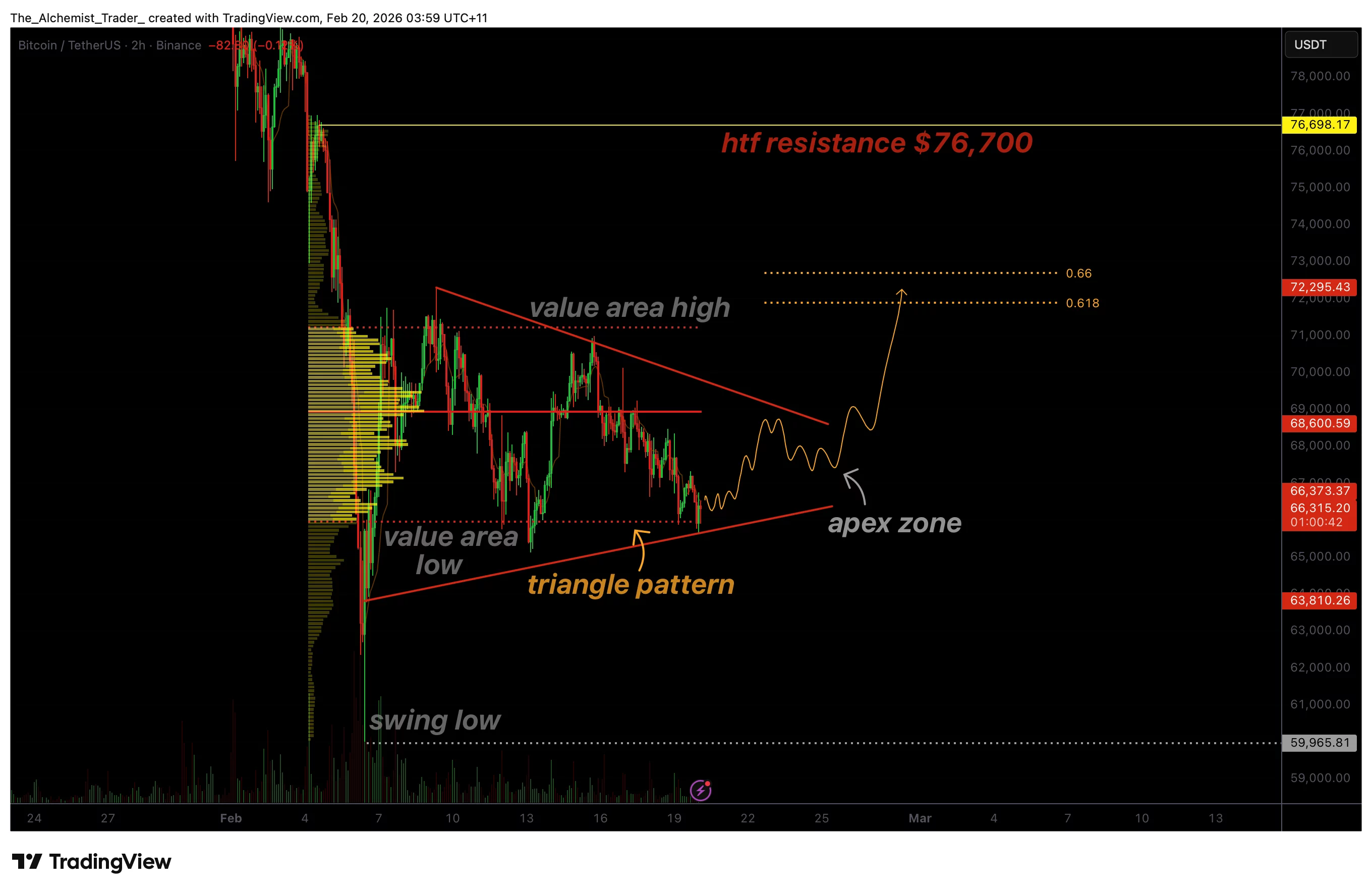
The current triangle formation is defined by converging dynamic support and resistance aligned closely with the value area low and value area high. Each rejection from resistance and defense of support has gradually tightened price action, reducing volatility and forming a classic apex structure.
Such formations indicate that neither buyers nor sellers currently dominate the market. Instead, liquidity builds on both sides as participants wait for confirmation of direction. As compression increases, even modest momentum can trigger a sharp expansion once price escapes the pattern.
Importantly, Bitcoin has not yet broken out. Until a confirmed move occurs, price remains in consolidation rather than trend continuation.
Higher Lows Suggest Constructive Momentum
One notable feature within the triangle is the development of higher lows forming near the value area low. These higher lows indicate that buyers are stepping in earlier on each pullback, gradually applying upward pressure on price.
While this does not guarantee a bullish breakout, it does suggest constructive underlying demand. Markets forming higher lows during consolidation often lean toward upside resolution, particularly when support continues to hold consistently.
This behavior reflects accumulation rather than distribution, strengthening the possibility of a bullish expansion once the triangle resolves.
Apex zone becomes the market decision point
The apex of the triangle represents the most critical area in the current structure. As the price reaches this narrowing zone, the market is forced into a decision. Breakouts from triangle patterns frequently occur near the apex because the price has little room left to consolidate.
However, direction alone is not enough. Volume confirmation will be essential. A breakout accompanied by increasing volume would validate participation returning to the market and significantly improve the probability of sustained follow-through.
Without volume expansion, breakouts risk becoming false moves that quickly reverse back into the range.
Upside scenario targets $76,700 resistance
If Bitcoin breaks to the upside with strong volume confirmation, attention shifts toward high-timeframe resistance near $76,700. This level represents a major technical objective and aligns with prior supply areas within the broader trading structure.
A successful breakout would signal the end of the consolidation phase and the beginning of a new expansion leg, potentially attracting momentum traders and renewed market participation.
What to expect in the coming price action
From a technical, price-action, and market-structure perspective, Bitcoin is approaching a macro decision point. The triangle formation indicates compression, and compression almost always leads to expansion.
In the immediate short term, traders should expect increasing volatility as price interacts with the apex zone. A confirmed breakout supported by rising volume will likely dictate the next major move.
While higher lows favor a bullish resolution, confirmation remains essential. Until the breakout occurs, Bitcoin remains in consolidation, but the technical evidence suggests that a significant move is approaching rapidly.
The upcoming sessions are likely to define Bitcoin’s next directional trend as the market prepares for an imminent expansion of volatility.
TLDR
- ProShares launched the GENIUS Money Market ETF (IQMM), designed to support stablecoin issuers with liquid, short-term U.S. government securities.
- The ETF is structured to comply with the GENIUS Act, which mandates stablecoin issuers to back their tokens with safe, liquid assets.
- IQMM focuses on cash and Treasury bills with maturities of 93 days or less, ensuring liquidity for stablecoin issuers.
- The GENIUS Act, signed into law in July, requires stablecoins to be backed 1:1 by assets that are easily convertible to cash.
- The launch of the ETF comes as the stablecoin market approaches $300 billion, with projections for significant growth in the coming years.
ProShares introduced the GENIUS Money Market ETF (IQMM) on Thursday, a product designed for the growing stablecoin market. This fund aims to support stablecoin issuers by investing in highly liquid assets that meet the requirements of the GENIUS Act. The move comes as the stablecoin sector is projected to grow significantly in the coming years.
ProShares IQMM ETF Targets Stablecoin Issuers
The ProShares GENIUS Money Market ETF (IQMM) was launched to address a gap in the stablecoin market. Under the GENIUS Act, stablecoin issuers must back their tokens with assets that are liquid and low-risk, such as U.S. Treasury bills. IQMM is designed to invest solely in short-term, liquid U.S. government securities, meeting the law’s reserve criteria.
The law restricts eligible reserve assets to Treasury bills with maturities of no longer than 93 days. ProShares designed the fund to comply with these rules, ensuring that issuers can quickly access liquidity without selling longer-term bonds at a loss during periods of market volatility.
GENIUS Act Compliance Ensures Stability
The GENIUS Act, signed into law last July, is central to the structure of IQMM. The law aims to create a safer, more stable environment for the stablecoin market by requiring 1:1 backing with liquid, safe assets. ProShares’ ETF aligns with the law’s requirement, ensuring that stablecoins are supported by assets that can easily be converted to cash.
By focusing on cash and short-dated government securities, the fund provides issuers with the liquidity needed for daily redemptions. This ensures that stablecoin issuers can meet user demands without having to sell more volatile, longer-dated securities during times of stress in the financial markets.
Stablecoin Market Growth Prompts Regulatory Action
The launch of the IQMM fund occurs as the stablecoin market approaches $300 billion in circulation, with Tether’s USDT and Circle’s USDC leading the sector. Policymakers are preparing for rapid expansion, with some forecasts suggesting stablecoin circulation could reach $2 trillion by 2028. Wall Street projections are more optimistic, with some firms predicting the market could grow as large as $4 trillion.
Treasury Secretary Scott Bessent has indicated that stablecoins could become a significant part of the financial system in the coming years. His forecasts suggest the market could grow substantially by the end of the decade.


A research paper at the U.S. Federal Reserve praised the usefulness of prediction markets — specifically looking at Kalshi — in getting a real-time handle on economic policy.
“Kalshi’s forecasts for the federal funds rate and [the U.S. Consumer Price Index] provide statistically significant improvements over fed funds futures and professional forecasters, all while providing continuously updated full distributions rather than infrequent point estimates,” according to the paper published on Thursday.
And the markets, in which retail investors can buy contracts in virtually any yes-no question in such diverse fields as economics, politics and sports, are looking at topics on a live basis that other sources of information don’t.
Prediction markets “provide unique insights — particularly for variables like [gross domestic product] growth, core inflation, unemployment and payrolls, for which no other market-based distributions currently exist.”
And in this study, Kalshi predictions “perfectly matched the realized federal funds rate by the day of each meeting since 2022, a feat not achieved by either surveys or futures.”
Part of the secret sauce that sets prediction markets apart as a useful tool may be the inclusion of retail participants, which makes them “distinct from institutionally dominated markets,” the paper noted.
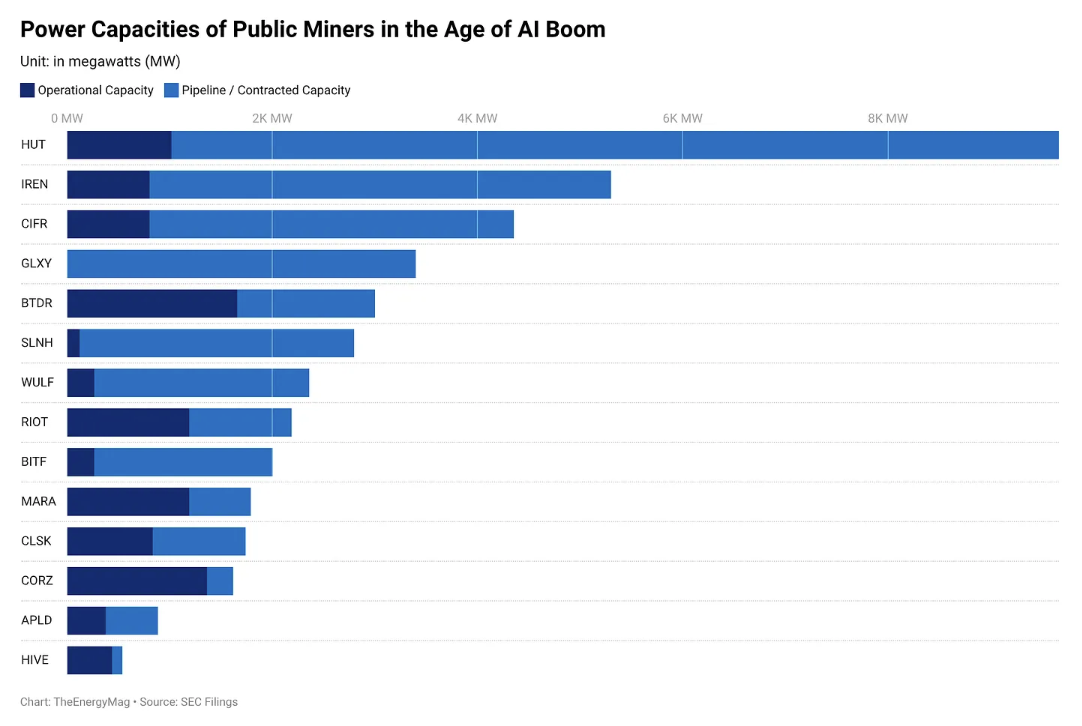
Public Bitcoin miners are planning about 30 gigawatts of new power capacity aimed at artificial intelligence workloads, nearly three times the 11 GW they currently have online, as they race to offset shrinking mining margins and reposition for the next growth cycle.
The buildout, compiled by TheEnergyMag across 14 publicly traded Bitcoin (BTC) miners, underscores how aggressively the industry is pivoting away from traditional hashpower amid persistently weak hashprice conditions.
On paper, the planned expansion amounts to what TheEnergyMag described as “a small country’s worth of power infrastructure.” In reality, much of the 30 GW sits in development pipelines, interconnection queues or early-stage plans, rather than operational facilities.

The widening gap suggests competition is shifting from ASIC efficiency to securing power, financing and delivering data centers on time.
“This is the megawatt arms race of the AI boom,” TheEnergyMag said, adding that monetization ultimately depends on whether AI demand remains strong enough to justify the scale of investment.
Related: The real ‘supercycle’ isn’t crypto, it’s AI infrastructure: Analyst
AI pivot delivers early revenue gains for some miners
The shift toward artificial intelligence infrastructure reflects an increasingly hybrid strategy among established Bitcoin miners, with some companies already reporting meaningful revenue contributions from AI and high-performance computing (HPC) workloads.
One example is HIVE Digital, which recently posted record quarterly revenue driven in part by its AI and HPC business lines. The company reported fourth-quarter sales of $93.1 million, up 219% year on year, even as Bitcoin prices declined during the period.
Investors, too, are attuned to the shift. Earlier this week, Starboard Value went public with its suggestion to Riot Platforms management that they accelerate the miner’s expansion into HPC and AI data centers.
The push to diversify comes as mining profits have taken a hit since the 2024 Bitcoin halving, which cut block rewards and squeezed margins across the industry.
Conditions have gotten even tougher since the fourth quarter, when heavy selling pressure sent Bitcoin tumbling from its record high above $126,000. Prices eventually stabilized in February, after briefly falling to below $60,000.
Despite these headwinds, US-based miners showed resilience at the start of the year, with output rebounding after a severe winter storm temporarily disrupted operations.

Related: Paradigm reframes Bitcoin mining as grid asset, not energy drain
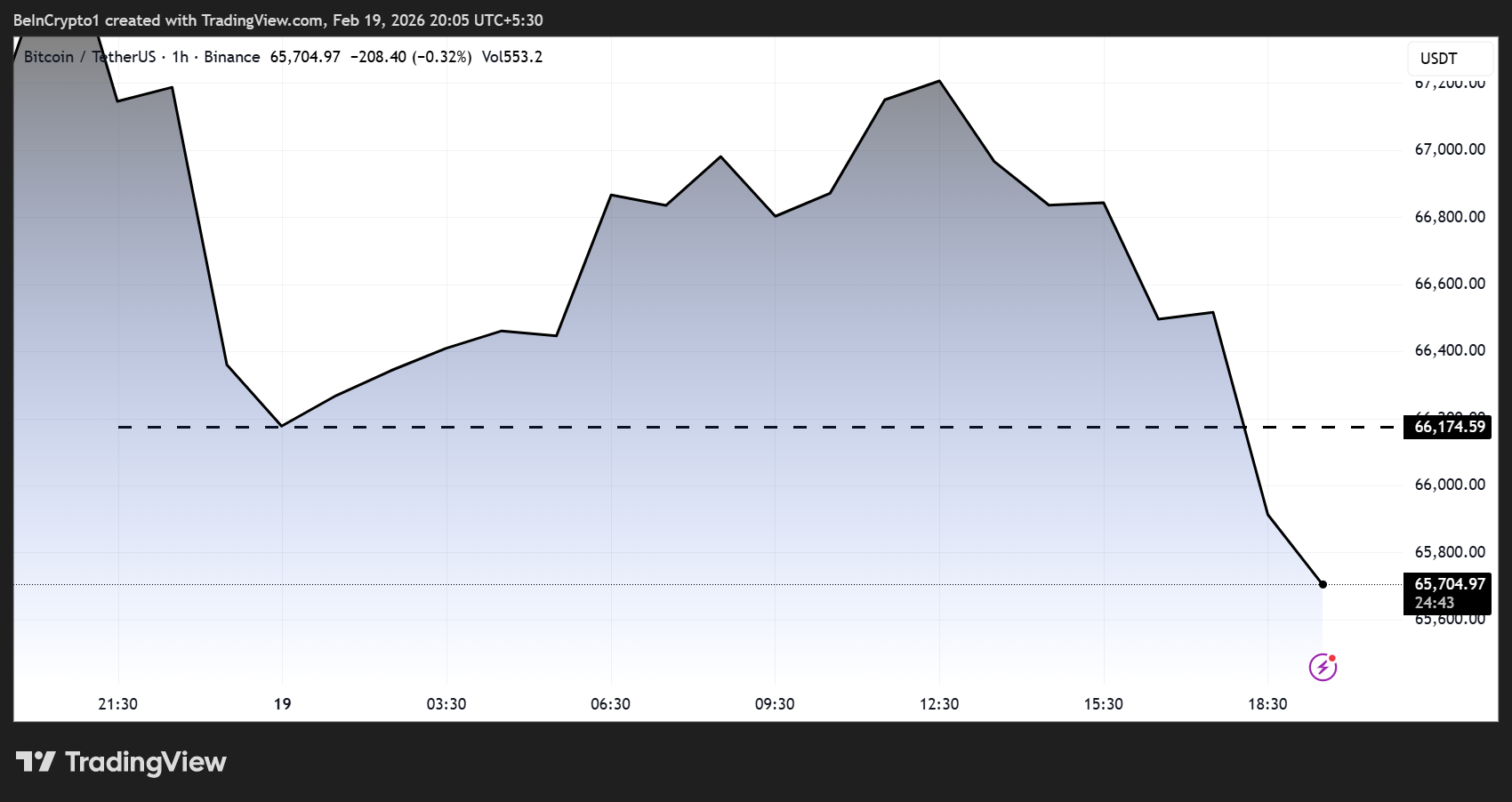
Bitcoin fell below $66,000 on Thursday following mixed US economic data. Initial jobless claims beat expectations, while the trade deficit widened sharply, fueling renewed risk-off sentiment in crypto markets.
Crypto markets in general were watching today’s data release, which featured among the economic data expected to influence Bitcoin sentiment this week.
Bitcoin Retreats Below $66,000 Amid Mixed US Economic Signals
The Labor Department reported 206,000 initial jobless claims, down from a revised 229,000 the prior week and well below market expectations of 225,000.
The four-week moving average also edged lower to 219,000, signaling a labor market that remains resilient despite ongoing economic headwinds.
At the same time, continuing claims, which track ongoing unemployment, rose by 17,000 to 1.869 million, slightly above forecasts of 1.860 million.
This reflects a stable but softening labor market, with limited new hiring but no dramatic layoffs.
“[These advanced numbers] support the thesis of a softer, yet stable, labor market with limited hiring but no dramatic job losses,” Truflation noted.
While the labor data might have suggested stability, markets were rattled by the unexpected jump in the US trade deficit.
The Treasury Department reported that the trade gap surged to $70.3 billion in January, well above the $55.5 billion expected and the prior $53.0 billion print.
The widening deficit reflects growing external imbalances amid persistent domestic demand. This adds a layer of uncertainty for investors already witnessing complex macro conditions.
Despite signs of cooling inflation, Truflation data shows prices remaining below 1% since early February. Crypto markets reacted negatively. Bitcoin’s retreat below $66,000 coincided with broader crypto sell momentum, as traders digested the juxtaposition of strong employment, weak trade balances, and low inflation.
This highlights how technical market sentiment can amplify reactions to economic surprises. The latest macro environment has triggered cautious positioning, with investors reducing exposure amid heightened uncertainty.
The divergence between labor market resilience and a blowout trade deficit illustrates the current macroeconomic tension.
While the labor market data may temper fears of a sudden economic slowdown, the sharp increase in trade deficits could weigh on risk assets if it signals broader demand imbalances.
The interplay of strong employment figures, sub-1% inflation, and a widening trade gap is creating a delicate backdrop for both traditional and digital markets.
Traders will likely watch upcoming economic releases, particularly December PCE and core PCE, and the final Q4 GDP revision reports to gauge whether risk sentiment stabilizes or volatility intensifies further.


Neel Kashkari, president of the Federal Reserve Bank of Minneapolis, offered a blunt take on digital assets, arguing that cryptocurrencies, including bitcoin and stablecoins, have yet to prove real utility.
Speaking at the 2026 Midwest Economic Outlook Summit in Fargo, North Dakota on Thursday, he contrasted the everyday utility of artificial intelligence (AI) tools with cryptocurrencies.
“Crypto has been around for more than a decade, and it’s utterly useless,” he said, while AI “has real long term potential for the U.S. economy.”
After asking the audience who had used AI tools like ChatGPT or Gemini in the past week, Kashkari posed a second question: “raise your hand if you’ve bought or sold something with bitcoin.”
When the discussion turned to payments and stablecoins, Kashkari said he’s unconvinced the technology improves on existing financial rails. “I hear these words and I like, it’s just, it’s like a buzzword salad,” he said. “What can I do with the stablecoin that I can’t do with Venmo today?”
Pressed on stablecoins being used for cheaper and faster cross-border payments, Kashkari argued that proponents quickly concede that those benefits aren’t aimed at U.S. consumers. While he admitted that adoption in emerging countries is rising, the said the tech still faces technical problems.
While stablecoin advocates promise instant transfers, he said, recipients still need to convert into local currency for everyday payments like buying groceries, which can be expensive.
Kashkari’s skepticism stands in stark contrast to the Trump administration, which has increasingly championed bitcoin and U.S. dollar-backed stablecoins as key strategic tools.
Treasury Secretary Scott Bessent argued that regulated stablecoins can extend the greenback’s dominance in global payments and reinforce its status as the world’s reserve currency, strengthening U.S. financial influence. President Trump also signed an executive order in March to create a strategic bitcoin reserve, which Bessent was an advocate for.


Disclosure: This article does not represent investment advice. The content and materials featured on this page are for educational purposes only.
Cloud mining is gaining traction ahead of 2026 as investors seek low-cost, hassle-free access to Bitcoin mining, with platforms like Hashbitcoin leading a growing field of global providers.
Summary
- Hashbitcoin tops the 2026 rankings with daily payouts, transparent operations, and a beginner-friendly setup, plus a $15 trial bonus.
- Major platforms, including BitFuFu, Binance, ECOS, and NiceHash, offer flexible contracts, industrial infrastructure, and stable returns.
- Other notable options, such as Genesis Mining, KuCoin, HashShiny, Bitdeer, and Kryptex, broaden access with low entry costs, automation, and global availability.
As 2026 approaches, cloud mining has rapidly become the preferred choice for investors. Amid the current challenging economic climate, more and more people are seeking secure, low-barrier ways to participate in Bitcoin mining without purchasing expensive ASIC miners or dealing with complex technical setups. Cloud mining perfectly meets this demand, allowing users to easily start earning Bitcoin daily.
With Bitcoin prices continuing to rise and mining difficulty increasing year by year, choosing a reliable cloud mining platform has never been more important. Here’s a compiled list of the top 10 trusted cloud mining platforms for 2026.
1. Hashbitcoin
Hashbitcoin is a leading cloud mining platform designed to provide users with a secure, efficient, and user-friendly mining experience. Developed by MRK Financial Management Limited, Hashbitcoin aims to make cryptocurrency mining accessible to everyone, no hardware, no maintenance, and no prior experience required.
Why Choose Hashbitcoin?
Investors choose Hashbitcoin for three key reasons:
Transparent mining structure
Hashbitcoin provides real hash power supported by robust and eco-friendly mining farms. All mining operations, profit calculations, and payments follow a clear, DAO-governed structure, ensuring transparency with no hidden fees.
Fast daily bitcoin payments
Users can track their earnings in real-time, with profits automatically paid out every 24 hours, helping miners build a stable daily passive income stream.
Beginner-friendly experience
Hashbitcoin offers a simple, guided process that makes it easy for even complete beginners to get started. Anyone can create an account, activate a plan, and start earning immediately. Additionally, all new users receive a $15 free trial bonus to begin mining at no cost.
Key features of Hashbitcoin (2026 Update)
- Total hash power: 16 EH/s
- Active users: Over 10 million worldwide
- Global coverage: Available in more than 220 countries and regions
- Supported cryptocurrencies: Bitcoin (BTC), Litecoin (LTC), Dogecoin (DOGE)
- System type: Fully managed cloud mining system
- Uptime guarantee: High uptime ensures stable mining performance
- Customer support: 24/7 dedicated support team
- New user bonus: $15 free registration bonus for all new users
As one of the few platforms combining massive mining capacity, global reach, and reliable daily payouts, Hashbitcoin has become a top choice for investors worldwide.
How to start earning Bitcoin with Hashbitcoin
Hashbitcoin simplifies the mining process into three easy steps:
Step 1: Register for a free account
New users can visit the Hashbitcoin website and register using their email and password. Once registered, they’ll automatically receive a $15 free mining bonus to start mining right away.
Step 2: Choose a mining plan
Then, they can select a plan that fits their budget and daily earning goals. Once activated, mining begins automatically, requiring no further action.
Step 3: Collect daily Bitcoin earnings
Users’ earnings are settled every 24 hours and credited directly to their accounts. Once they meet the minimum withdrawal limit, they can withdraw their Bitcoin or reinvest it into new mining plans.
Key advantages of Hashbitcoin Mining contracts:
- No hidden fees; all costs are transparent.
- Daily profits are automatically distributed.
- Paid plans refund the initial principal upon contract completion.
- Real-time mining data, including hash rate and earnings, is displayed on the dashboard.
- 24/7 risk control systems ensure secure and stable operations.
Hashbitcoin’s transparency and commitment to prioritizing miners’ interests make it one of the most popular cloud mining platforms on the market.
Hashbitcoin referral and affiliate program
Hashbitcoin offers one of the most lucrative affiliate programs in the mining industry, including:
- Unlimited referrals: Users can refer as many users as they like to join Hashbitcoin.
- Daily passive income: Users can earn up to 3% commission from the profits of their referred paying users.
- Automatic tracking and payments: All referral earnings are calculated automatically and credited to user accounts.
Importantly, referral commissions do not reduce the earnings of the referred users. This allows investors, influencers, and content creators to build an additional source of cryptocurrency income at no extra cost.
2. BitFuFu
BitFuFu is a globally recognized cloud mining brand that operates a wide network of industrial-grade mining facilities. Its partnerships with major hardware manufacturers ensure a reliable and transparent platform.
Key advantages:
- Industrial-grade mining farms
- Flexible contract durations
- Stable daily Bitcoin payouts
3. Binance Cloud Mining
As the world’s largest cryptocurrency exchange, Binance offers official cloud mining services where users can easily purchase hash power and earn daily Bitcoin profits.
Key advantages:
- Strong global reputation
- Transparent fee structure
- Simple onboarding process, ideal for beginners
4. ECOS Mining
ECOS is a regulated cloud mining company based in the free economic zone of Armenia, offering legitimate Bitcoin mining services.
Key features:
- Fully compliant and regulated operations
- Stable daily earnings
- Mobile app for mining management
5. NiceHash
NiceHash is one of the largest hash power marketplaces in the world, connecting buyers and sellers of mining power and offering flexible mining options.
Key advantages:
- Flexible mining contracts
- Fast daily payouts
- Established reputation since 2014
6. Genesis Mining
As one of the earliest cloud mining platforms, Genesis Mining has built a strong reputation with thousands of users worldwide.
Key features:
- Long history of operation
- Support for Bitcoin and multiple altcoins
- Easy-to-manage contract
7. KuCoin Cloud Mining
KuCoin integrates cloud mining into its trading platform, allowing users to rent hash power and earn daily rewards without owning hardware.
Key advantages:
- Beginner-friendly platform
- Secure and transparent mining environment
- Daily Bitcoin payouts
8. HashShiny
HashShiny is a popular platform offering low-cost cloud mining plans with daily Bitcoin rewards, ideal for new users.
Key features:
- Low entry cost
- Automatic mining switching
- Easy registration and operation
9. Bitdeer
Bitdeer provides high-quality cloud mining services supported by top-tier mining farms across multiple continents, catering to both short-term and long-term investors.
Key features:
- Transparent daily earnings
- Flexible contract durations
- Verified industrial-grade mining farms
10. Kryptex Mining
Kryptex combines cloud mining with mining software, offering users flexible earning options.
Key features:
- Fast earnings updates
- User-friendly interface
- Low withdrawal thresholds
Conclusion
After evaluating multiple platforms, Hashbitcoin stands out as the best choice for 2026 due to its:
- Transparent mining structure: High hash power capacity governed by decentralized systems ensures transparency.
- Daily payouts: Earnings are credited every 24 hours, allowing users to withdraw funds anytime.
- Beginner-friendly system: Zero barriers to entry, with a $15 free trial bonus for new users.
- Global trust: Serving over 10 million users in 220+ countries.
Users can sign up on Hashbitcoin to claim their $15 free bonus and start their cloud mining journey today.
Disclosure: This content is provided by a third party. Neither crypto.news nor the author of this article endorses any product mentioned on this page. Users should conduct their own research before taking any action related to the company.

How a group of courageous citizens helped stop the Rhode Island ice rink shooting

(VIDEO) Chicago Bears Closer to Northwest Indiana Move as Indiana Committee Approves Stadium Funding Bill
PayPal’s PYUSD Supply Crosses $4 Billion


-

 Video3 days ago
Bitcoin: We’re Entering The Most Dangerous Phase
-

 Tech5 days ago
Luxman Enters Its Second Century with the D-100 SACD Player and L-100 Integrated Amplifier
-

 Crypto World2 days ago
Can XRP Price Successfully Register a 33% Breakout Past $2?
-

 Sports3 days ago
GB's semi-final hopes hang by thread after loss to Switzerland
-

 Video6 days ago
The Final Warning: XRP Is Entering The Chaos Zone
-
 Tech3 days ago
The Music Industry Enters Its Less-Is-More Era
-

 Business2 days ago
Infosys Limited (INFY) Discusses Tech Transitions and the Unique Aspects of the AI Era Transcript
-

 Entertainment1 day ago
Kunal Nayyar’s Secret Acts Of Kindness Sparks Online Discussion
-

 Video2 days ago
Financial Statement Analysis | Complete Chapter Revision in 10 Minutes | Class 12 Board exam 2026
-
 Crypto World6 days ago
Bhutan’s Bitcoin sales enter third straight week with $6.7M BTC offload
-

 Tech1 day ago
Retro Rover: LT6502 Laptop Packs 8-Bit Power On The Go
-
 Sports13 hours ago
Clearing the boundary, crossing into history: J&K end 67-year wait, enter maiden Ranji Trophy final | Cricket News
-

 Entertainment19 hours ago
Dolores Catania Blasts Rob Rausch For Turning On ‘Housewives’ On ‘Traitors’
-

 Business1 day ago
Tesla avoids California suspension after ending ‘autopilot’ marketing
-

 Crypto World6 days ago
Kalshi enters $9B sports insurance market with new brokerage deal
-
 NewsBeat4 days ago
The strange Cambridgeshire cemetery that forbade church rectors from entering
-

 Crypto World22 hours ago
WLFI Crypto Surges Toward $0.12 as Whale Buys $2.75M Before Trump-Linked Forum
-
 Crypto World7 days ago
Ethereum Price Struggles Below $2,000 Despite Entering Buy Zone
-
 NewsBeat4 days ago
Man dies after entering floodwater during police pursuit
-

 NewsBeat5 days ago
UK construction company enters administration, records show