Connect with us

Tech

EV Sales Boom As Ethiopia Bans Fossil-Fuel Car Imports

Published

on

An anonymous reader quotes a report from the Financial Post: In 2024, the Ethiopian government banned the import of fossil fuel-powered vehicles and slashed tariffs on their electric equivalents. It was a policy driven less by the country’s climate ambitions and more by fiscal pressures. For years, subsidizing gasoline for consumers has been a major drag on Ethiopia’s budget, costing the state billions of dollars over the past decade. The country defaulted on its sovereign bonds in 2023 after rising interest rates drove up the costs of servicing its debts, and it received a $3.4 billion bailout from the International Monetary Fund the following year.

In the two years since the ban on internal combustion engine vehicles, EV adoption has grown from less than 1% to nearly 6% of all of the vehicles on the road in the country — according to the government’s own figures — some way above the global average of 4%. “The Ethiopia story is fascinating,” said Colin McKerracher, head of clean transport at BloombergNEF. “What you’re seeing in places that don’t make a lot of vehicles of any type, they’re saying: ‘Well, look, if I’m going to import the cars anyway, then I’d rather import less oil. We may as well import the one that cleans up local air quality and is cheaper to buy.’”

For decades, Ethiopia’s high import tariffs on vehicles put new car ownership out of the reach of most of the country’s population. Per capita gross domestic product is only about $1,000, and even by the standards of low-income countries, it has among the lowest car ownership rates. At 13 vehicles per 1,000 people, it’s a fraction of the African average of 73. With few cars manufactured in the country, the vast majority are imported, and most are bought used. The government’s import policy has upended the market. In parallel, tariffs for EVs were dropped to 15% for completed cars, 5% for parts and semi-assembled vehicles, and zero for “fully knocked down” — vehicles shipped in parts and assembled locally. That has made new EVs cost-competitive with old gasoline cars.

Source link

Advertisement
Continue Reading
Click to comment

Leave a Reply

Your email address will not be published. Required fields are marked *

Tech

YouTube is bringing the Gemini-powered ‘Ask’ button to TVs

Published

on

YouTube’s “Ask” button is making its way to the living room. The Gemini-powered feature is now rolling out as an experiment on smart TVs, gaming consoles and streaming devices. 9to5Google first spotted a Google support page announcing the change.

Like on mobile devices and desktop, the feature is essentially a Gemini chatbot trained on each video’s content. Selecting that “Ask” button will bring up a series of canned prompts related to the content. Alternatively, you can use your microphone to ask questions about it in your own words.

Screenshot of a Daily Show video on YouTube. The "Ask about this video" AI window is active to the right.

The “Ask about this video” feature on desktop (YouTube)

Google says your TV remote’s microphone button (if it has one) will also activate the “Ask” feature. The company listed sample questions in its announcement, such as “what ingredients are they using for this recipe?” and “what’s the story behind this song’s lyrics?”

The conversational AI tool is only launching for “a small group of users” at first. Google promises that it will “keep everyone up to speed on any future expansions.”

Advertisement

Source link

Continue Reading

Tech

The Requirements Of AI | Hackaday

Published

on

The media is full of breathless reports that AI can now code and human programmers are going to be put out to pasture. We aren’t convinced. In fact, we think the “AI revolution” is just a natural evolution that we’ve seen before. Consider, for example, radios. Early on, if you wanted to have a radio, you had to build it. You may have even had to fabricate some or all of the parts. Even today, winding custom coils for a radio isn’t that unusual.

But radios became more common. You can buy the parts you need. You can even buy entire radios on an IC. You can go to the store and buy a radio that is probably better than anything you’d cobble together yourself. Even with store-bought equipment, tuning a ham radio used to be a technically challenging task. Now, you punch a few numbers in on a keypad.

The Human Element

What this misses, though, is that there’s still a human somewhere in the process. Just not as many. Someone has to design that IC. Someone has to conceive of it to start with. We doubt, say, the ENIAC or EDSAC was hand-wired by its designers. They figured out what they wanted, and an army of technicians probably did the work. Few, if any, of them could have envisoned the machine, but they can build it.

Does that make the designers less? No. If you write your code with a C compiler, should assembly programmers look down on you as inferior? Of course, they probably do, but should they?

Advertisement

If you have ever done any programming for most parts of the government and certain large companies, you probably know that system engineering is extremely important in those environments. An architect or system engineer collects requirements that have very formal meanings. Those requirements are decomposed through several levels. At the end, any competent programmer should be able to write code to meet the requirements. The requirements also provide a good way to test the end product.

Anatomy of a Requirement
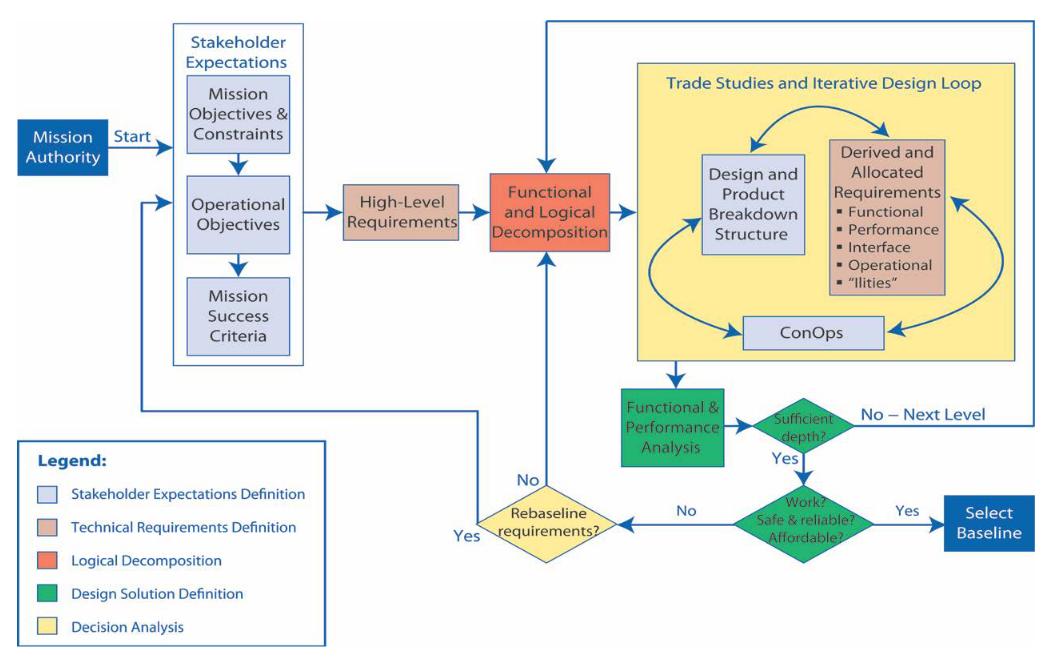
System Design Process (public domain – from MIT Open Course).

A good requirement will look like this: “The system shall…” That means that it must comply with the rest of the sentence. For example, “The system shall process at least 50 records per minute.” This is testable.

Bad requirements might be something like “The system shall process many records per minute.” Or, “The system shall not present numeric errors.” A classic bad example is “The system shall use aesthetically pleasing cabinets.”

The first bad example is too hazy. One person might think “many” is at least 1,000. Someone else might be happy with 50. Requirements shouldn’t be negative since it is difficult to prove a negative. You could rewrite it as “The system shall present errors in a human-readable form that explains the error cause in English.” The last one, of course, is completely subjective.

You usually want to have each requirement handle one thing to simplify testing. So “The system shall present errors in human-readable form that explain the error cause in English and keep a log for at least three days of all errors.” This should be two requirements or, at least, have two parts to it that can be tested separately.

Advertisement

In general, requirements shouldn’t tell you how to do something. “The system shall use a bubble sort,” is probably a poor requirement. However, it should also be feasible. “The system shall detect lifeforms” doesn’t tell you how to make that work, but it is suspicious because it isn’t clear how that could work. “The system shall operate forever with no external power” is calling for a perpetual motion machine, so even if that’s what you wish for, it is still a bad requirement.
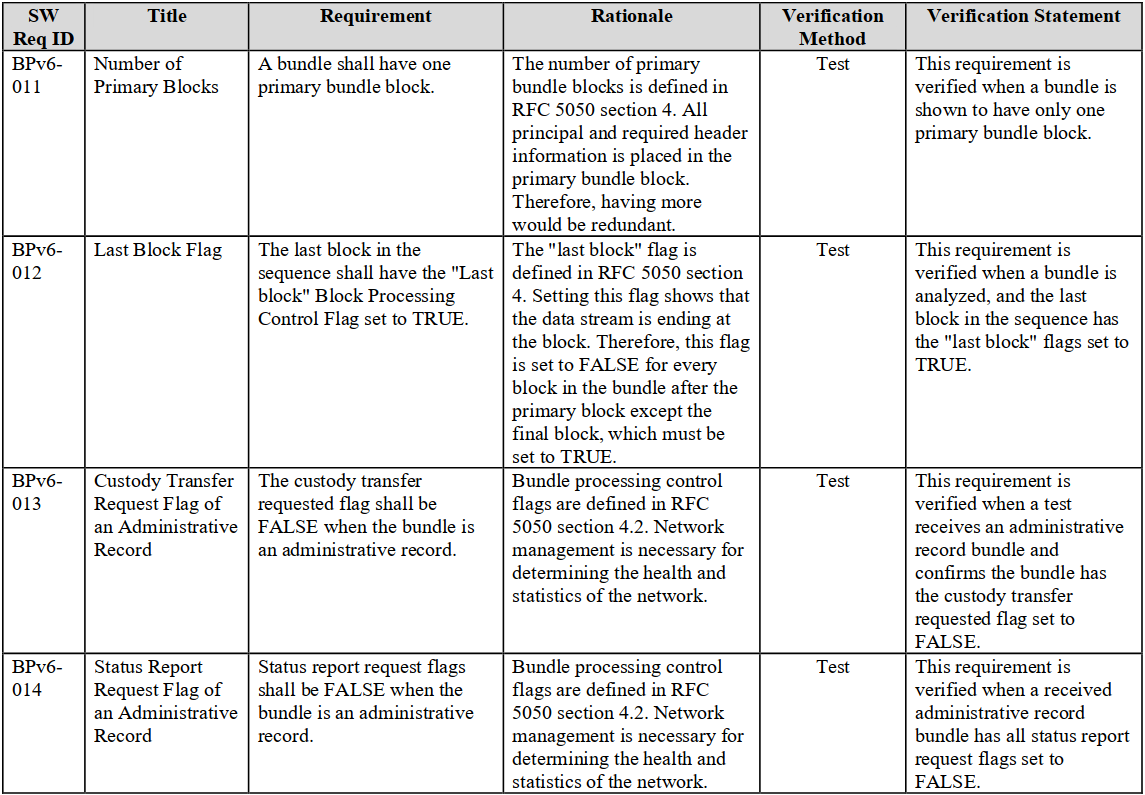
A portion of a typical NASA SRS requirements document

You sometimes see sentences with “should” instead of shall. These mark goals, and those are important, but not held to the same standard of rigor. For example, you might have “The system should work for as long as possible in the absence of external power.” That communicates the desire to work with no external power to the level that it is practical. If you actually want it to work at least for a certain period of time, then you are back to a solid and testable requirement, assuming such a time period is feasible.

You can find many NASA requirements documents, like this SRS (software requirements specification), for example. Note the table provides a unique ID for each requirement, a rationale, and notes about testing the requirement.

Requirement Decomposition

High-level requirements trace down to lower-level requirements and vice versa. For example, your top-level requirement might be: “The system shall allow underwater research at location X, which is 600 feet underwater.” This might decompose to: “The system shall support 8 researchers,” and “The system shall sustain the crew for up to three months without resupply.”

The next level might levy requirements based on what structure is needed to operate at 600 feet, how much oxygen, fresh water, food, power, and living space are required. Then an even lower level might break that down to even more detail.

Advertisement

Of course, a lower-level document for structures will be different from a lower-level requirement for, say, water management. In general, there will be more lower-level requirements than upper-level ones. But you get the idea. There may be many requirment documents at each level and, in general, the lower you go, the more specific the requirements.

And AI?

We suspect that if you could leap ahead a decade, a programmer’s life might be more like today’s system architect. Your value isn’t understanding printf or Python decorators. It is in visualizing useful solutions that can actually be done by a computer.

Then you generate requirements. Sure, AI might help improve your requirements, trace them, and catalog them. Eventually, AI can take the requirements and actually write code, or do mechanical design, or whatever. It could even help produce test plans.

The real question is, when can you stop and let the machine take over? If you can simply say “Design an underwater base,” then you would really have something. But the truth is, a human is probably more likely to understand exactly what all the unspoken assumptions are. Of course, an AI, or even a human expert, may ask clarifying questions: “How many people?” or “What’s the maximum depth?” But, in general, we think humans will retain an edge in both making assumptions and making creative design choices for the foreseeable future.

Advertisement

The End Result

There is more to teaching practical mathematics than drilling multiplication tables into students. You want them to learn how to attack complex problems and develop intuition from the underlying math. Perhaps programming isn’t about writing for loops any more than mathematics is about how to take a square root without a calculator. Sure, you should probably know how things work, but it is secondary to the real tools: creativity, reasoning, intuition, and the ability to pick from a bewildering number of alternatives to get a workable solution.

Our experience is that normal people are terrible about unambiguously expressing what they want a computer to do. In fact, many people don’t even understand what they want the computer to do beyond some fuzzy handwaving goal. It seems unlikely that the CEO of the future will simply tell an AI what it wants and a fully developed system will pop out.

Requirements are just one part of the systems engineering picture, but an important one. MITRE has a good introduction, especially the section on requirements engineering.

What do you think? Is AI coding a fad? The new normal? Or is it just a stepping stone to making human programmers obsolete? Let us know in the comments. Although they have improved, we still think the current crop of AI is around the level of a bad summer intern.


Advertisement

Source link

Continue Reading

Tech

Thermoforming Printed Parts With Hot Water

Published

on

Thermoforming is the process of softening a material enough so that it can be tweaked into a new shape, with the source of the thermal energy being not particularly relevant. Correspondingly, after [Zion Brock]’s recent video on his journey into thermoforming PLA with a mold and a heat gun, he got many comments suggesting that he should use hot water instead.

We covered his previous video as well, in which he goes through the design steps of making these grilles for a retro-styled, 3D printed radio. The thermoforming method enables him to shape the curvy grille with a heat gun and two-piece mold in a matter of minutes, rather than spending hours more time printing and removing many supports.

Theoretically using hot water instead of hot air would provide a more equal application of heat, but putting your hands into 70°C water does require some more precautions. There’s also the issue that PLA is very hygroscopic, so the part requires drying afterwards to prevent accelerated hydrolysis. Due to the more even heating, the edge of the PLA that clamped into the mold also softened significantly, causing it to pop out of the mold and requiring a small design modification to prevent this.

Advertisement

Basically, aqua-thermoforming like this has many advantages, as its slower and more consistent, but it’s less straightforward to use than hot air. This makes both a useful tool when you’re looking at doing thermoforming.

Advertisement

Source link

Continue Reading

Tech

These are the 8 editor-approved laptops I’d buy this week from $199

Published

on

Even though it’s a quiet time of the year when it comes to sales events, there is always a significant number of laptop deals available each week. So, I’m here to use my years of bargain-hunting experience and uncover the top offers that are worth buying right now, with prices starting at $199.

I’ve selected a range of options to suit different budgets and needs: whether you need a budget-friendly device for light use, a great value option for everyday use and work, or a performance powerhouse for more demanding creative or productivity tasks.

You can find my 8 top picks below, including laptops available at Amazon, Best Buy, and Dell — three retailers where I often find the best deals. Just a heads up: some are leftovers from the recent Presidents’ Day sales, so they may not be around much longer.

Source link

Continue Reading

Tech

How Many Fighter Jets Can The Newest Aircraft Carrier Hold?

Published

on


While there are many United States warships, those that are likely the best known are called “Enterprise.” The U.S. Navy has been commissioning ships with that name since the first Enterprise defended American supply routes from the British in May 1775. The trend continues with the new USS Enterprise (CVN-80), the third Gerald R. Ford-class nuclear-powered aircraft carrier and the eighth ship to be thus named. The USS Enterprise was expected to launch in 2025, but it was delayed and is now expected to launch in 2030.

Because of the ship’s name and the fact that Gerald R. Ford-class aircraft carriers are the largest warships ever constructed, there’s a great deal of public fascination surrounding it. The aircraft carrier is massive, and once it launches, The Enterprise will be able to carry a variety of aircraft, including fighter jets, helicopters, and various drones. In terms of combat aircraft capacity, the Enterprise should be able to accommodate between 70 and 90 aircraft, but this depends on a variety of factors, including the type of fighter jets it employs.

Advertisement

The USS Gerald R. Ford (CVN-78) carries 75 aircraft, operated by the Carrier Air Wing Eight . It consists of three squadrons of F/A-18E Super Hornets. These are being replaced over time as more F-35C Lightning IIs (the U.S. Navy carrier variant) are brought onboard. Because the Enterprise is the same model and because it won’t be ready until 2030, it’s likely that its Carrier Air Wing will consist of the same number of squadrons, though with more F-35Cs than its predecessors.

Advertisement

The aircraft of the USS Enterprise (CVN-80)

The number of fighter jets that a U.S. aircraft carrier can hold is dependent on several factors. Nimitz-class carriers, which are being replaced by Gerald R. Ford-class ships, carry around 56 fighter jets and other aircraft. The USS Enterprise will likely have the capacity to hold 90 aircraft, though not all of them will be fighter jets. In addition to the F-35C, the Enterprise could also be home to several F/A-18A/C and F/A-18E/F Super Hornets, which are highly capable multirole fighters employed throughout the U.S. Navy’s 11 active aircraft carriers.

When the USS Gerald R. Ford was launched, it paved the way for the vessels that followed, but there were issues with several of its systems. The lessons learned from the Ford helped guide changes to the Enterprise’s design, accommodating the F-35C and its upgraded Enterprise Air Surveillance Radar. As a result, the two ships are different in some aspects, though they’re fundamentally similar. The F-35C differs from the A and B models, as it’s designed to utilize the Enterprise’s Catapult-Assisted Take-Off Barrier-Arrested Recovery (CATOBAR) system.

The F-35C features larger wings with foldable wingtips. This makes it possible for the Enterprise to hold more F-35Cs than other models, as foldable wingtips allow for a smaller storage footprint. While the U.S. Navy isn’t in the habit of detailing the specifics of its Carrier Air Wing composition and capacities, given the size and attributes of the USS Enterprise and the F-35C, it will likely carry a minimum of 75 fighter jets. Some estimates indicate the number could be as high as 90, but this is unlikely, as room must be made for non-combat aircraft as well.

Advertisement


Source link

Advertisement
Continue Reading

Tech

Suddenly Toto's most valuable business isn't toilets, but chipmaking ceramics

Published

on


Behind the investor interest is a highly specialized component: electrostatic chucks, or ESCs, used in semiconductor etch tools to hold wafers flat, clean, and thermally stable while they are bombarded with plasma.
Read Entire Article
Source link

Continue Reading

Tech

How To Sync Your Life On A Digital Display

Published

on


One of my favorite parts about my job is my ability to test new things and push the limits of my comfort zone with a new piece of tech. When I take on a review, I need to do my best to integrate that piece of tech into my workflow, and I never really know how that’s going to shake out.

I never pictured myself being a digital calendar guy. I mean sure, I live and die by my Google Calendar, but it never occurred to me to get a digital screen whose sole purpose it is to show me what’s coming up on a given day. I had the opportunity to test Skylight’s first calendar around this time last year (SlashGear has a Skylight Calendar (2025) review as well). 

Since then, I’ve tested a number of alternatives to the Skylight calendar. At the end of it all, I kept coming back to the Skylight. From a feature-completeness standpoint, it has just the right amount of features — without trying to be something that it’s not.

Advertisement

One of the pitfalls of a new platform is the temptation to try to do too much, and I tested a few calendars that did just that. But Skylight comfortably stays in its lane with some obvious low-hanging fruit, and some not-so-obvious fruit as well. I’ve been using a Skylight Calendar 2 review sample provided by Skylight for around two weeks, and this is my full review.

Advertisement

Two steps forward and a step back

Skylight actually has two calendars on the market right this minute — the Calendar 2 and the Calendar Max. The latter resides on my kitchen wall, and I’ll discuss that a bit as well, but the subject of this review is the former. The Calendar 2 replaces the previous version with a few upgrades, and a small step back from its predecessor. From a hardware standpoint, the screen on the Calendar 2 is faster, brighter, and more responsive than the previous generation.

If you’re using the calendar on a tabletop, the stand is mostly improved. The last calendar’s stand was solid metal, very heavy and to be honest, way overengineered. The new stand is lighter, but still sturdy, but it only works in landscape orientation…for some reason. This is actually the step back I referenced. I used the previous version of the calendar in portrait orientation on a shelf in between my desktop computer and another shelving unit. The calendar wouldn’t fit in landscape though, so it had to move it.

I’m not sure why Skylight made this call. I would imagine it was hard to simplify the stand and have it still work in both orientations. Whatever the case, I’m not thrilled, but that’s about the only thing I’m not happy about. By the way, you can wall mount the calendar in either orientation, so all is not lost.

One other improvement is the frame around the calendar is now magnetic and interchangeable, though the other frames won’t be coming for another month or so. Mine comes with black and it works just fine, but if you want more personality for your calendar, you’ll need to give it another 30 days or so.

Advertisement

Using a digital calendar

The idea of a digital calendar never really appealed to me, until I had one. My family uses Google Calendar for all of our family activities — work schedules, school schedules, meetings, and the like. You would think it’s easy enough to pull out your phone or open a new browser tab and see everything that way — and it is. But having a digital calendar on the wall that just shows you what’s coming up all the time is extremely convenient — much like an old-school paper calendar.

You can glance up at the wall and see whatever is coming up. If you want to add an event, you can tap on a plus symbol to add an event or reminder. This version of the calendar is much more responsive than last year’s which is a great upgrade. When you open the new event box, you get a virtual keyboard that betrays the fact that this is an Android build, but one that is highly customized.

When an event is coming up, you get a little tone with an “OK” button, which is handy except when you can’t reach the button to dismiss it. I’d like to see a timer on the OK button to auto-dismiss it, but overall, the calendar is just there when you need it.

Advertisement

It’s so much more

Beyond the calendar functionality, Skylight has built in some very smart features. Most of these are controlled with an app that I installed on my iPhone 17 Pro Max. In addition to the calendar (which syncs with Google, Outlook, Apple, Yahoo, and a few others) you can also set up reminders, repeating tasks or chores, and then there’s the one that’s most surprising and useful — meal planning, but it’s a little more than that.

At the risk of sounding like an infomercial “Don’t you just hate it when you get home form a hard day and you have to figure out what to eat? Well fortunately, Skylight can do all that for you!” If you have a black and white image of someone standing in their kitchen looking disheveled and shrugging in a very exaggerated way, you’re not alone. Ready for the super cringey part? Skylight does it with AI! But wait, don’t go anywhere. The AI is actually… kind of… good?

Advertisement

Your personal Sidekick

Skylight’s AI feature is called Sidekick and it’s a handy little tool you can use to perform certain tasks. The obvious one is using Sidekick to capture an event from a poster or something like that. It can find the date, time, and event title and create an event for you. That’s quickly becoming table stakes for AI, but what about creating table steaks?

Sidekick can create a comprehensive meal plan for you and your family. In my case, I typed something to the effect of “My family has one diabetic person, so we have a real focus on protein and reduced sugars. We typically have ground beef and chicken on hand, but we’re not opposed to salads and other vegetables.” From that prompt, Sidekick whipped up a dinner plan for my family for seven days, included the recipes for the meals and added the ingredients to our shopping list.

Advertisement

The limitation here is that it added the ingredients to Skylights List feature, which is fine, except my family already has an app we’ve bought into to accommodate shopping lists and whatnot. I would love to see some kind of integration with AnyList, an iPhone app not enough people know about, but if you do that, you open a can of worms with customers asking, “Well you support XYZ, why not ABC?” I get it, and I respect Skylight for evading that nightmare scenario.

Advertisement

It’s not perfect, but it’s close

I did not go into the digital calendar experience expecting it to be life-changing, but it really has been. Paper calendars are fine, but once you go digital, it’s hard to go back. Having your life digitized and hanging on the wall at all times is just so useful. Plus, compared to other digital calendars I’ve used, I can promise you Skylight is absolutely killing it. There is some room for improvement, and some caveats to be aware of.

The first is a big note — things like meal planning and magic import are behind a paywall called the Plus Plan. It’s $79 for a year, which isn’t too bad, but when everything in life is a subscription, it grates a little.

A feature that the Plus Plan unlocks lets you use your calendar as a digital frame when it’s not in use. This tracks because Skylight got its start in the digital photo frame industry. However, I never used the digital frame feature because to me, it defeated the purpose of having a digital calendar. The only way to turn off the frame is to tap on the screen, but that kills the ability to glance at the calendar and see what’s coming up.

Advertisement

Price, Availability, and Verdict

The Skylight Calendar 2 is available from Skylight’s website for $299. It will be coming to other retailers in the future as well.

That price is a tad on the high side. I love the digital calendar, don’t get me wrong, but that’s a pretty high barrier for entry. Personally, I think it’s worth it, especially if you spring for the Plus Plan (which also gives you an extra $20 off the purchase price) and really buy into the Skylight ecosystem. Skylight offers free returns for up to four months, so you can really test drive it to make sure it’s for you.

All that being said, the convenience of putting your digital life on the wall at all times is pretty intoxicating. I suspect you’ll forget about the purchase price soon enough once you get it set up and realize how helpful it can be.

Advertisement


Source link

Advertisement
Continue Reading

Tech

How S’pore’s pole & aerial studios survive

Published

on

Hanging midair may be difficult, but running an aerial or pole business comes with even higher stakes

Whether you’re suspended five metres above the ground on silks or spinning around a pole, the physical risks of aerial silk and pole classes are obvious. What’s less visible is the financial balancing act required to keep a studio open in Singapore.

The country has seen waves of fitness trends, from spin and reformer pilates to HYROX, many of which have shuttered in recent years. In contrast, aerial and pole studios have been around since over a decade ago, still surviving amid a saturated fitness scene thanks to a tight community and the versatility of the sports. 

Vulcan Post speaks to three studio owners to understand the economics behind their businesses and how the financial and operational stress keeps them on edge more than any stunt ever could.

The unglamorous side of running a studio

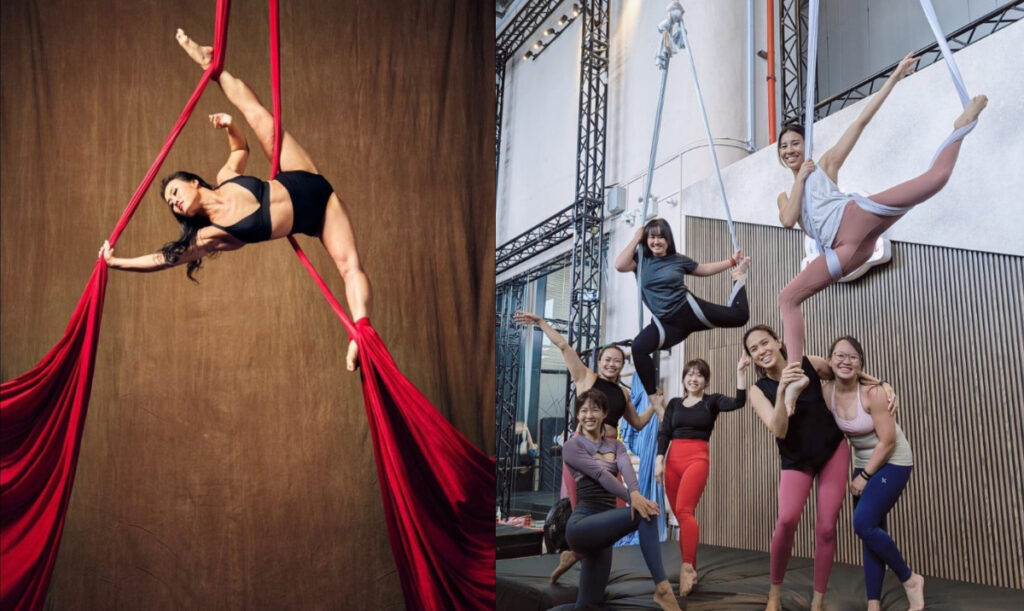
(Left): Adelene Chua-Adams, founder of Adedance; (Right): Students at an aerial class at Adedance./ Image Credit: Adedance

Setting up an aerial or pole studio isn’t as simple as renting any open space. Because both disciplines require significant ceiling height and structural integrity, not every commercial unit can accommodate the equipment safely.

For aerial silks, hoops, and pole rigs, ceilings must be high enough to allow tricks and inversions, while the floors and beams need to withstand dynamic loads—sometimes dozens of students swinging or spinning at once.

Advertisement

As such, for many studio owners, finding a suitable location proved unsurprisingly difficult, including the founder of Adedance Artistic & Aerial Productions (Adedance), Adelene Chua-Adams. 

“Aside from the old badminton hall in Geylang, nowhere was very big and able to cater to aerial properly,” shared Adelene. This led her to start offering small-scale aerial classes at her Yio Chu Kang family home in 2017, before eventually taking the gamble of opening her own studio in Tai Seng. 

cost to start an aerial studiocost to start an aerial studio
The costs one needs to pay to start an aerial studio, according to Adelene Chua-Adams./ Image designed by Vulcan Post

But the hunt for her own space was far from smooth. Adelene shared that many of the units she liked were classified under Zone B1, a commercial zoning category that requires businesses to pay 12 to 24 months’ upfront government levies before they can operate legally.

“We tried many avenues of appeal, but ultimately couldn’t get around this extra cost from the URA and SLA. Lesson learned there.”

That’s just one operational cost. Adelene also shared that starting an aerial and/or pole studio requires three to four months’ rent as a deposit, and renovations can cost anywhere from S$50,000 to over S$100,000, not to mention the additional cost of purchasing and installing the truss, sound systems, air conditioning, lighting and signage. 

Advertisement

All in, opening an aerial or pole studio can easily require a six-figure upfront investment before the first class even begins.

jasmine Han mad collection pole jasmine Han mad collection pole
(Left): Jasmine Han, founder of MAD Collection; (Right): A pole class at MAD Collection./ Image Credit: @cameranoire via Instagram/ MAD Collection

Jasmine Han, founder of MAD Collection (formerly known as SLAP Studio), pointed out that finding a space with strong ceilings and flooring is essential to protect the safety of the instructors and students. However, she emphasised the need to negotiate favourable quotes for renovations, as it can set the owners back before they can break even. 

“You need to have a professional engineer to come and certify the safety and ensure the rigging is up to a certain standard,” she added. “Nothing we do is rocket science, but it’s a lot of little, little things.” 

She also pointed out that most studios often run without the help of external investors and have to pay recurring expenses, such as managing their online payment systems, studio maintenance and staff salaries, even during holiday closures. 

Beyond capital, owners must also be able to adapt to unforeseeable situations, from finding last-minute teacher replacements to handling customer complaints and even fixing broken toilets. For them, the physical fear of falling is easier to manage than the constant uncertainty of running a small business in Singapore.

Advertisement

As a business owner, every single day, you are stepping on Legos and eating glass all at the same time. But this is what you need to have the ability to change directions quickly, to be able to get up when somebody punches you in the face.

Jasmine Han, founder of MAD Collection

Diversifying revenue streams in a competitive market

The costs of setting up and running aerial and pole studios make steady, predictable revenue essential: businesses cannot rely on hype alone.

All three studios offer class packages for students, ranging from trial classes to weeks to months-long term-based systems with varying price points. Here is a breakdown of their offerings and prices:

Category MAD Collection Adedance Aerial Milan Pole Dance Studio Singapore
Drop-In Class ~S$42 ~S$38–$48 S$48
Term Course (eight weeks) ~S$278 S$259–S$388 (varies) N/A (no rigid term)
Trial Package S$15 per one hour trial S$35 / S$85 (three-class) S$50/ S$85 (three-class)
Class Pack (10+ classes) S$410–S$453+ S$440
Practice Session S$12.50 S$15–S$20 S$15
Monthly Membership S$265+

With classes priced roughly between S$38 and S$48, studios operate within narrow margins—high enough to cover overhead costs, but low enough to remain competitive, especially in a market that has grown more saturated over the years.

Advertisement

According to Tracy Mak, the co-owner of Milan Pole Dance Studio Singapore (MPDS), there are over 30 aerial and pole studios in Singapore, among the highest per capita globally. 

tracy mak milan pole dance studio singaporetracy mak milan pole dance studio singapore
(Left): Tracy Mak, co-owner of Milan Pole Dance Studio Singapore (MPDS); (Right): MPDS offers classes from pole to aerial hoop and silks/ Image Credits: Milan Pole Dance Studio Singapore

“With increasing competition within aerial and pole, as well as the lifestyle dollar of travel and other fitness options, people are spoilt for choice, less committal and increasingly price sensitive,” she pointed out. 

As such, studios have to expand their class offerings to create additional revenue streams. For example, Adedance offers acrobatic, contortion and handstand classes, and MAD collection and MPDS offer heels and dance classes apart from pole. 

adedance walkover milan pole dance studio singapore kids aerial silks mad collection pole heels adedance walkover milan pole dance studio singapore kids aerial silks mad collection pole heels
(Left): Walkover classes at Adedance; (Middle): Kids aerial silk class at MPDS; (Right): Pole heels class at MAD Collection./ Image Credit: Adedance/ MPDS/ MAD Collection

These studios also offer corporate packages, where they perform for events such as dinners, dances and brand launches. Adelene noted that 75% of Adedance’s income comes from classes and 25% of it comes from performances, which provide higher-ticket revenue but are less predictable than weekly classes. 

“We’ve performed for massive events ranging from F1, the SEA Games Opening Ceremony, Mercedes car launches overseas and more,” she said. 

Collaboration is key to survival and growth

Over the years, aerial and pole have grown steadily in popularity, a trend the three business owners largely attribute to the strength of their community. In the early days, studios relied almost entirely on word of mouth to attract students.

Advertisement

Pole, in particular, has also seen a shift in perception, according to Tracy. 

She recounted that when she tried pole 18 years ago, she was admittedly sceptical as the sport was seen as taboo due to its association with strip clubs in the West. Today, more people view it as a “serious” form of fitness that is suitable for all ages.

“There are still lingering stereotypes, but overall, people are far more open,” added Tracy. “There’s much more recognition and respect, especially as people see how physically demanding and impressive it is when we perform tricks in the air.” 

Beyond running her studios, both located within Outram Park, the 46-year-old aims to elevate the entire industry to be recognised nationwide. In 2025, she gathered key players in the aerial and pole scene, including MAD Collection and Adedance, to organise the first Singapore Aerial Pole Fiesta as part of the Singapore Urban Sports and Fitness Festival 2025. 

Advertisement

Through the event, aerial and pole studios were able to present themselves through performance showcases and interact with the local mainstream crowd by offering try-outs. The two-day event drew over 3,000 participants, and the positive reception has pushed Tracy to form the Singapore Aerial and Pole Federation. 

As aerial and pole are still considered niche sports in Singapore, forming a federation can help them gain greater recognition from government bodies and corporates to advance these sports locally. This means having access to grants, donors and performance opportunities. 

However, since the federation has yet to officially launch, studio owners still often rely on their own resources to keep their businesses running. With rising rents and intensifying competition, collaboration may be a more sustainable strategy than aggressive discounting, a trap many fitness businesses in Singapore have fallen into.

Jasmine also cautioned that engaging in price wars would only decrease the credibility others have built for decades, and that teachers also play a huge part in maintaining it. 

Advertisement

“If you want to open a course, class or session, make sure your teachers are qualified enough to deliver and understand it,” she emphasised.

Despite its growth, there are some who believe aerial and pole are fads that will die off with time. Amid a wave of fitness studio closures in recent years, Tracy shared that it often keeps her on her toes as an owner. 

That said, she firmly believes that these two sports have long-term potential in the country, with their combination of sport and art encouraging greater involvement. Adelene also echoes this sentiment, adding that participation has been higher than ever. 

“I was actually surprised to hear this comment because we feel it’s anything but dying! Just pop into our studio at 7:30PM or on a weekend, and we are jam-packed!” 

Advertisement

Mastering tricks in the air may take strength and balance, but running a studio in Singapore demands something else entirely: capital, resilience, and the ability to adapt quickly. For these founders, staying afloat financially is often harder than hanging from the ceiling. 

For now, demand remains strong, and these founders are betting that discipline, not hype, will keep them in the air.

  • Learn about the businesses featured below:
  • Read more stories we’ve written on Singaporean businesses here.

Featured Image Credit: Adedance/ MAD Collection/ Milan Pole Dance Studio Singapore

Advertisement

Source link

Continue Reading

Tech

These are some of the most unique kitchen appliances you’ll see in 2026

Published

on

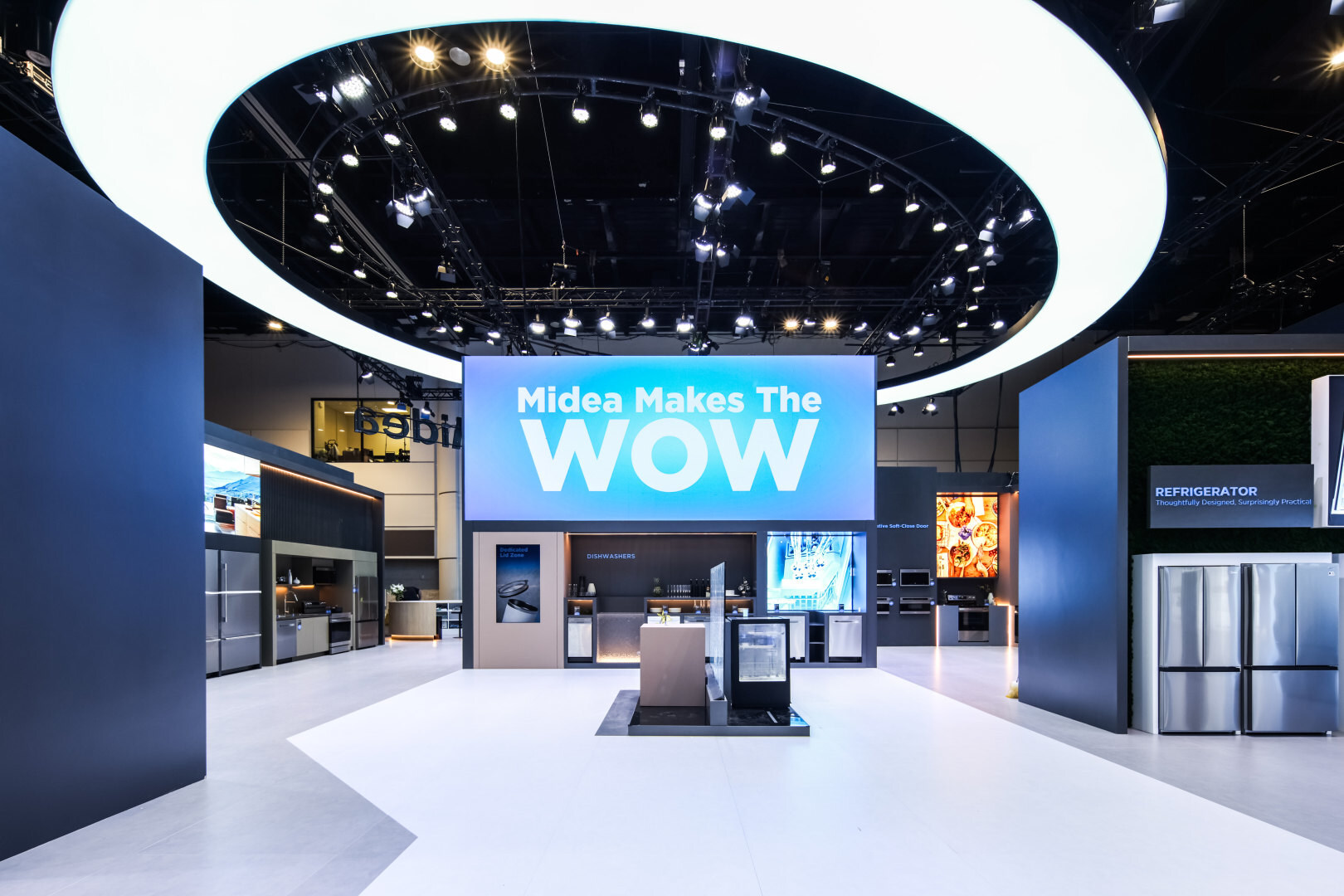
Midea has used KBIS 2026 to show it’s no longer just a budget-friendly appliance maker.

At this year’s Kitchen & Bath Industry Show in Orlando, the brand unveiled one of its broadest line-ups yet — spanning kitchen, laundry and even climate tech. However, it’s the kitchen gear that stands out for 2026.

Leading the charge is an expanded French Door refrigerator range, now available in 30-, 33- and 36-inch sizes in both standard and counter-depth formats. Some models feature OneTouch AutoFill with MaxSpace, designed to optimise storage while cutting down on the usual fridge juggling act. It’s a practical upgrade, but the real headline grabber sits elsewhere in the kitchen.

Midea’s new premium dishwasher introduces STRAWash and SENSOR TruDry, a system built specifically to clean reusable bottles, tall tumblers and even straws using dedicated internal jets. There’s also a one-hour wash-and-dry cycle aimed at households that don’t want to wait overnight for clean dishes. It’s a small tweak on paper, but one that feels tailored to how people actually use kitchens in 2026.

Advertisement

Advertisement

The cooking line-up is expanding too, with new four- and five-burner gas and electric freestanding ranges, plus a forthcoming slide-in platform. Meanwhile, the company’s new over-the-range microwave features Soft Close Technology — eliminating the familiar microwave door slam in favour of a smoother, quieter close.

Beyond major appliances, Midea is also fleshing out its small appliance portfolio, covering everything from air fryers to espresso machines. The goal seems clear: reduce countertop clutter while keeping everything connected within one ecosystem.

While this showcase focuses heavily on kitchens, Midea is also pushing deeper into laundry and HVAC. Redesigned washers and dryers now include PowerMix Spray, Flexi AutoDose, and large TFT displays. In addition, its DIY-friendly EasySplit mini-split system builds on the success of the original Midea U.

Advertisement

Taken together, Midea’s 2026 portfolio signals a shift from individual appliances to full-home solutions. And if the dishwasher that cleans your reusable straw doesn’t sum up modern kitchen design, it’s hard to know what does.

Source link

Advertisement
Continue Reading

Tech

Seattle startup Adronite raises $5M to help enterprises understand their codebases

Published

on

Adronite CEO Edward Rothschild. (Adronite Photo)

Seattle startup Adronite raised $5 million in a Series A round led by Gatemore Capital Management, as it looks to expand its AI-powered platform designed to give large organizations visibility into sprawling and complex codebases.

The funding comes amid intense competition in the AI developer tools market. Unlike many AI coding tools that operate at the level of individual files or snippets, Adronite ingests complete codebases, including both modern and legacy systems.

The idea is to help organizations understand how their software works as a system, with applications in security analysis, modernization, and active remediation at scale.

Adronite can also build apps from natural language prompts and offers an AI chat feature that provides details on system-wide insights.

The system supports more than 20 programming languages and has been proven on a codebase with 2.5 million lines of code.

Advertisement

The 15-person company expects initial commercial deployments to begin in the first quarter of 2026.

There are various companies that offer code review tools, including CAST and Sonar.

Adronite co-founder and CEO Edward Rothschild is a former software engineer at Facebook and director of engineering at Nayya. He helped launch Adronite in 2023.

As part of the funding round, Liad Meidar, managing partner of Gatemore, was named chair of Adronite’s board. Gatemore has offices in New York and London.

Advertisement

Source link

Continue Reading

Trending

Copyright © 2025