The future of the NBA’s media strategy was taking shape at this year’s All-Star weekend.
The fanfare has always been about showcasing the league’s best players. But this year, the event was as much about the league’s partnership with content creators as it was on-the-court talent.
More than 200 global creators took part in the events Thursday through Sunday, facilitated by the league. It showed the NBA appears more than happy to partner with content creators rather than limit their game access to wall off the value of live rights – where the league makes most of its money. The NBA’s new 11-year, $77 billion media rights deal began this season with deals with Comcast’s NBCUniversal, Disney and Amazon.
The NBA is betting its future has space for both a growing creator base and the traditional game viewing experience that has fueled its revenue growth.
Advertisement
“The NBA has a long history of collaborating with talented creators who share our commitment to bringing the excitement of our games and events to fans around the world,” NBA Senior Vice President of Social and Digital Content Bob Carney said in a statement. “We’re thrilled to join forces with more creators than ever at NBA All-Star, providing opportunities for them to be active participants across virtually every event and deliver engaging content that showcases this marquee NBA event to different audiences.”
A few months ago, NBA Commissioner Adam Silver called the NBA “a highlights-based sport” and pointed fans to Instagram, TikTok, X and YouTube for league content. Silver has decided it’s worth partnering with creators to keep Generation Z and Generation Alpha interested in the NBA as those age groups move away from watching full games the way their parents did.
Embracing social media is a risky play for Silver, given the vast majority of the league’s revenue comes from the value of live games. The NBA’s big media deal has led to soaring team valuations. The average value of an NBA franchise is now $5.52 billion, 18% more than a year ago.
Still, Silver may have little choice. Unlike the NFL, NBA regular season games don’t have huge audiences. This season, NBA regular season games have averaged about 2 million viewers across ESPN, NBC and Amazon Prime Video, according to Nielsen data. That compares with an average TV audience of 18.7 million for a regular season NFL game in the most recent season.
Advertisement
Get the CNBC Sport newsletter directly to your inbox
The CNBC Sport newsletter with Alex Sherman brings you the biggest news and exclusive interviews from the worlds of sports business and media, delivered weekly to your inbox.
A 2023 survey from marketing firm InMobi found 61% of Gen Z respondents, or those aged 18 to 24 at the time of the survey, named user-generated content as their favorite form of media.
Bridging the gap between content creation and live rights may be inventing a new form of alternative broadcasting, where kids can watch games along with their favorite YouTuber. A Harris Poll survey earlier this year found 37% of surveyed Gen Z-ers said they would watch a creator‑led co‑stream during a regular season game across pro sports. Seventy percent said they’re likely to watch their favorite creator’s feed if that person is co‑streaming a sporting event.
Advertisement
“As time goes on, I could see in a couple of years, there’s 30 different ways to watch the Super Bowl or something like that,” said sports content creator Jesse Riedel, known as Jesser on YouTube, in an interview. “I think in the future, instead of one broadcast, there’s gonna be so many versions of a broadcast.”
Riedel has more than 37 million YouTube subscribers. He co-founded a media and lifestyle company, Bucketsquad, which has annual revenue in the “solid” tens of millions, according to the company’s president, Zach Miller.
Riedel noted the NBA is a cleaner fit for content creation than the NFL because fans tend to focus more on players and less on teams. Riedel features many star players in his videos, helping him to draw large viewership.
“I feel like the NFL audience I have is more die hard for their teams, but the NBA, I think, in particular, is more like player driven,” Riedel said.
Advertisement
The rise of NBA content creation is not the only factor changing the league’s media future.Silver also spoke this weekend about how artificial intelligence will likely change the NBA viewing experience.
“One area in particular that I think is worth addressing is impact on the fan experience. One of the things we’re beginning to see already is how we’re going to, more than personalize, almost hyper-personalize our telecasts,” said Silver in an All-Star weekend press conference. “Many of you have probably experimented with this already, but in essence, you’ll be able to hear the game in any dialect, any language, you’ll be able to hear a hardcore Xs and Os commentary, maybe one that’s more comedic if that’s what you’re interested in, or a novice explaining each foul and the rules as it goes along.”
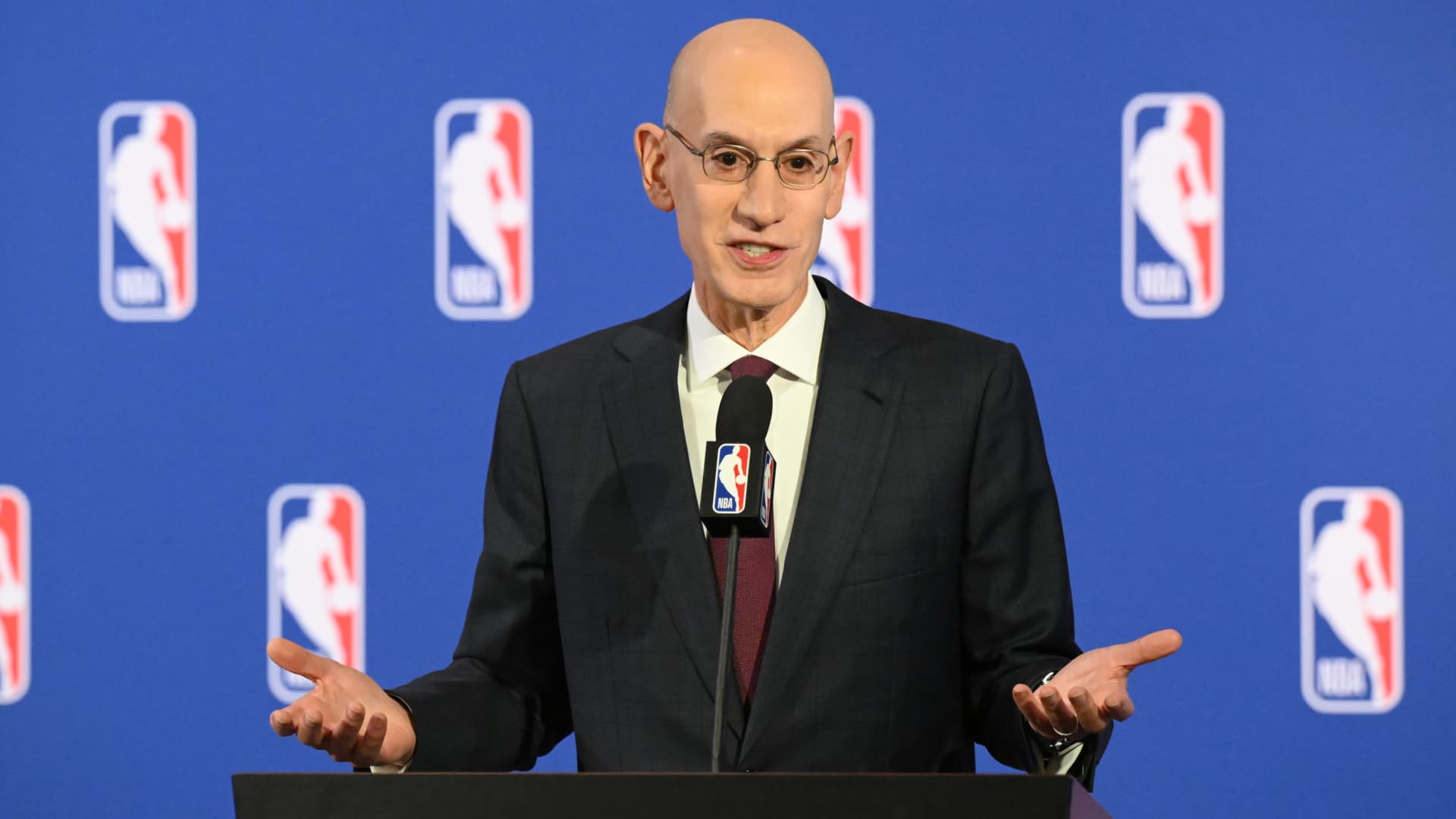
NBA Commissioner Adam Silver addresses the media following the Board of Governors meetings on Sept. 10, 2025 at the St. Regis Hotel in New York City.
David Dow | National Basketball Association | Getty Images
Advertisement
There’s inherent risk with hyper-personalizing the game. Sports is one of the last collective experiences in American society – and certainly on television. This has led to skyrocketing media rights and the high cost of associated advertising.
Perhaps having many broadcasts and AI experiences will boost interest, and targeted advertising rates will continue to spike as companies seize the opportunity to attach hyper-specific commercials to personalized content.
But breaking down broadcasts into many different pieces may also deteriorate the main reason why live rights are so valuable – as a way to target millions of people all at once.
Business Improvement Districts say ‘this is too complex an issue to be rushed’
Bill Addy, who runs Liverpool’s business improvement district, has responded to the Government’s consultation alongside Vaughan Allen of CityCo in Manchester
Hospitality bodies in Liverpool and Manchester have joined forces to urge the Government to take its time over plans for a national “tourist tax” to avoid another u-turn.
Last week hotels and holiday companies around the country – including many in the North – signed an open letter calling for the Government to scrap plans for a visitor levy. The policy, which a number of Northern mayors have indicated they want to take up, allows areas to levy a small charge on overnight stays to raise money for infrastructure improvements and projects that benefit the tourism sector.
Industry body UK Hospitality says it has “serious concerns about the timing and impact of the plans”, warning that the industry is also struggling with rising costs from other Government measures.
Now the Accommodation Business Improvement Districts (ABIDs) in Liverpool and Manchester have issued a joint statement that calls for the introduction of the levy to be at least slowed down.
Advertisement
The statement says: “This is too complex an issue to be rushed and we would urge the Government to slow down and think this through. There has been limited opportunity to speak to the business sector it directly impacts; hotels and hospitality.
“The reason the ABID model and visitor levy works so well in Manchester and Liverpool is because it is private sector led, it puts the hotel industry at the heart of the strategy and it gives them a voice. It took years of work, consultation, talking and planning to get this right. This is a ground-up approach that is generating real economic results for both cities because it has empowered the industry to have a say in the visitor economy.
“Over the next 2-years, the two ABIDs are forecast to invest upwards of £17 million in Manchester and Liverpool, making the cities more appealing to visitors and improving local prospects with more investment, more jobs, greater opportunity and increased pride.
“Instead, as we have said to the government as part of this consultation exercise, the plans for a so-called national “tourist tax” have not given the industry a voice and are too vague, currently. Instead it burdens them with another layer of bureaucracy and taxation. This is a sector that is at the forefront of business rates increases. There is a real risk that a proposal that is not planned out, that disregards the complexity of the situation ends up hitting a city driven regeneration policy and undermines two years of good work.
Advertisement
“We cannot afford another u-turn, we need solid and sound plans to be put in place before any decisions are made.
“We are working with our stakeholders across the UK but we would say slow down, let’s do this right the first time, not have to pick up the pieces further down the road.”
A version of this article first appeared in the CNBC Property Play newsletter with Diana Olick. Property Play covers new and evolving opportunities for the real estate investor, from individuals to venture capitalists, private equity funds, family offices, institutional investors and large public companies. Sign up to receive future editions, straight to your inbox. Capital deployment into property technology took a major jump to start 2026, even though overall deal volume didn’t change much, according to a new report. Fifty prop tech and adjacent companies raised approximately $1.7 billion globally during the month, according to a monthly report from the Center for Real Estate Technology and Innovation. That’s a 176% gain from January 2025, when 48 deals closed totaling $615 million. “The comparison highlights a critical dynamic shaping the current venture environment: deal count has remained stable, but capital deployment has accelerated sharply,” wrote Ashkán Zandieh, founder and managing director at CRETI. “Early-year data suggests that investor appetite has not broadly expanded across all stages, but rather concentrated around fewer, larger, and more established platforms.” The average dollar amount per deal rose from roughly $12.8 million in January 2025 to about $34 million in January 2026. A small number of very large transactions clearly had their impact, suggesting that there is not a general inflation in early-stage funding, but more willingness among big investors to make bigger bets. Seed, pre-seed and Series A funding made up only a small share of total investment. Venture and corporate rounds made up $459 million, “reflecting sustained support for companies beyond initial product-market validation,” according to Zandieh. Examples of that in January included Mews, Property Finder and Span, which saw infusions from large, multi-investor syndicates that included growth equity firms, corporate venture arms and institutional asset managers. “One of the factors driving the increase in prop tech spend is that generative AI is accelerating the functional obsolescence timeline of many technologies that large real estate companies only recently integrated,” said Brendan Wallace, co-founder and CEO of Fifth Wall, a venture capital firm focused largely on property technology that has roughly $3 billion in assets under management. “AI native enterprise software is already beginning to unseat established solutions, and the traditional advantages of incumbency and high switching costs are eroding quickly,” Wallace said. “This is unlike anything we’ve seen before at Fifth Wall.” At the same time, Wallace said, real estate-specific models are reshaping where organizations invest. Investment funding that previously went to data warehousing, business intelligence and large-scale consulting is being both rethought and reallocated to AI models that can deliver the same insights much more quickly and at lower cost. “As a result, real estate organizations are scrambling to reconceptualize their core technology infrastructure to keep pace with the unprecedented change that generative and agentic AI will bring to the industry,” Wallace said. Private equity investments in January accounted for $320 million, according to the CRETI report. Structured growth, strategic, and non-traditional instruments represented $444 million. This highlights the increasingly diverse and non-linear nature of the prop tech capital stack at the start of 2026, the report found. While the global run on prop tech was widespread across North America, Europe, the Middle East, and parts of Asia, European and Middle Eastern companies were particularly active in both early-stage and later-stage transactions. They favored construction technology, energy infrastructure, and real estate, according to the report. One month does not a trend make, but the sharp move does suggest that there is much more active capital favoring prop tech, especially as AI takes over the investment narrative. Bigger commitments are overshadowing startup investment. “For founders, this environment rewards clarity around business model durability and capital requirements. For investors, it reinforces the importance of distinguishing between headline capital totals and underlying deal composition,” said Zandieh.
Belby, a district nurse, had hoped to get the money returned in time for Christmas but found the process of trying to secure her refund slow and stressful, especially because she said she was given conflicting information and was quoted two vastly different figures of how much she was owed.
For the first time, Amazon has dethroned Walmart as the company with the largest annual revenue.
Advertisement
Walmart on Thursday reported annual revenue of $713.2 billion for its most recent fiscal year, shy of Amazon’s $716.9 billion in revenue. The milestone was brewing for months, as Amazon leapfrogged Walmart in quarterly sales for the first time about a year ago.
The shuffle, while largely symbolic, underscores the battle the two retailers have waged both to define and keep up with ever-changing consumer preferences. They are kicking off a new chapter of that rivalry as artificial intelligence reshapes how companies operate, make money and drive sales.
Amazon rose to the top of the revenue pile by doing much more than running a sprawling online webstore and promising speedy delivery. While its core retail unit is its largest revenue generator, its huge cloud computing, advertising and seller services businesses also fuel its sales. Third-party seller services, which include commissions and fees collected by Amazon fulfillment along with shipping, advertising and customer support, accounted for about 24% of the company’s total sales in 2025, according to its latest annual filing. Amazon Web Services was responsible for roughly 18%.
It wasn’t Walmart’s weakness that led it to lose its top spot, as its revenue has more than doubled in 20 years. The retailer has leaned on its more than 4,600 Walmart stores and roughly 600 Sam’s Club locations in the U.S. to power its digital business, which grew by 27% in the U.S. in the fiscal fourth quarter and has posted double-digit percentage gains for 15 straight quarters.
Advertisement
That expansion came as Walmart riffed off the Amazon playbook and tried to position itself as a tech company as well as a retailer.
There have been multiple signs of its ambitions: Walmart relisted its stock, moving from the New York Stock Exchange to the tech-heavy Nasdaq in early December. Its market value surpassed the $1 trillion mark earlier this month, a valuation achieved almost exclusively by tech companies including Amazon, after a more than 21% rise in the last year.
And the big-box retailer’s fourth-quarter earnings, which were boosted by digital advertising and its third-party marketplace, illustrated Walmart’s emphasis on chasing higher-margin businesses and thinking beyond brick-and-mortar retail.
Amazon and Walmart’s AI ambitions
In many ways, Walmart’s recent push to grow its third-party marketplace was an answer to the dominance of Amazon’s platform. Even as it tries to catch up with Amazon in some areas, Walmart is trying to gain an edge in a new frontier.
Advertisement
Over the past few years, Amazon and Walmart have used different AI strategies to try to make their businesses more efficient and make their merchandise more appealing to shoppers.
Walmart struck a deal with OpenAI’s ChatGPT in October and Google’s Gemini in January to make its products easier to discover and buy. It also has its own AI-powered shopping assistant, Sparky. The virtual assistant, which looks like a smiley face, pops up on Walmart’s app and can help shoppers find items.
Walmart, like many other companies, is in the early days of AI adoption, and it’s unclear how the technology will affect its business long-term.
On the company’s earnings call on Thursday, Walmart CEO John Furner said customers are spending more when they use Sparky. He said customers who use Sparky have an average order value that’s about 35% higher than shoppers who don’t use the tool.
Advertisement
About half of Walmart’s app users have used Sparky, Walmart U.S. CEO David Guggina said on the earnings call.
“Agentic AI is increasingly embedded across Walmart,” Guggina said. “It’s strengthening our operations. It’s improving associate productivity, and it’s enhancing the customer experience.”
Walmart CFO John David Rainey said AI investments are included in the retailer’s capital expenditure plans for the full year, which are expected to be roughly 3.5% of sales. Those expenses also include the company’s investments in automation and store remodels.
There are limits to Walmart’s tech ambitions.When it comes to AI, Rainey said Walmart will lean on the expertise of tech companies rather than try to create its own products.
Advertisement
“As you’ve seen from the announcements we’ve made, we’re approaching AI development through partnerships,” he said on the company’s earnings call. “This lets tech companies do what they do best, develop innovative technology, and it provides us clarity to do what we do best, to translate the best of tech to retail experiences that create value for our customers and members and our enterprise.”
Like Walmart, Amazon is also facing new pressure to respond to the rise of agentic commerce. Chatbot makers like OpenAI, Google and Perplexity have introduced automated commerce features that aim to change how people shop online.
While other companies like Walmart, Etsy and Shopify have announced shopping partnerships with AI platforms, Amazon has remained on the sidelines. It’s blocked agents from accessing its site, and doubled down on its own shopping chatbot, Rufus, which is powered by its own models and Anthropic’s chatbot Claude.
The company said Rufus has been used by more than 300 million customers and drove almost $12 billion in incremental annualized sales last year. After slowly rolling out the service in beta two years ago, Amazon has injected Rufus across more areas of its app and website to encourage shoppers to use the tool.
Advertisement
Amazon CEO Andy Jassy said last month that Rufus and other AI tools could assist shoppers with finding products much like an employee in a physical store.
“I think agents are going to help customers with that type of discovery,” Jassy said. “And it’s part of why we’ve invested so much in Rufus, which is our shopping assistant.”
Meanwhile, Amazon is throwing piles of cash at AI infrastructure. Earlier this month, it announced it would spend up to $200 billion this year on AI initiatives, more than any of the other hyperscalers, which have altogether forecast nearly $700 billion in 2026 expenditures. Most of Amazon’s spending is expected to go to data centers, chips and networking equipment.
Wall Street has viewed Amazon’s capex plans skeptically, sending the company’s shares down for nine days straight following its Feb. 5 earnings report and shaving more than $450 billion off of its market value.
Advertisement
Amazon’s investments aren’t limited to AI compute. The company has also put significant resources and talent behind developing AI tools across all of its businesses. It’s alsorolled out a suite of AI models, and revamped its Alexa assistant. It also has invested $8 billion in Anthropic since 2023.
As the global online language learning market surges toward projected growth of hundreds of billions by the 2030s, two pioneering marketplaces — Preply and iTalki — remain dominant choices for learners seeking personalized, one-on-one instruction via video.
Preply
Preply, the Ukrainian-founded edtech unicorn that hit $1.2 billion valuation in January 2026 after a $150 million Series D round, emphasizes AI-enhanced tools and structured progress tracking. iTalki, the longer-established Hong Kong-based platform launched in 2006, prioritizes vast tutor variety, pay-per-lesson flexibility and a massive user base exceeding 10 million learners.
Both connect students with private tutors for conversational practice, exam prep, business skills and more across dozens of languages. Yet differences in pricing models, tutor vetting, features and corporate offerings make one potentially better suited depending on learner goals, budget and commitment level.
Here are the key points of comparison between Preply and iTalki based on the latest 2026 data, user feedback and platform updates.
Company Background and ScalePreply, founded in 2012 in Kyiv and now headquartered in Brookline, Massachusetts, boasts over 100,000 tutors teaching more than 90 languages to learners in 180 countries. It became EBITDA profitable and achieved unicorn status in early 2026 with backing from WestCap, Horizon Capital and others. iTalki, operating since 2006, connects over 10 million learners with more than 30,000 teachers and community tutors across 150+ languages — including many niche and endangered ones. It has raised modest funding (around $3 million historically) and focuses on organic growth without recent major rounds.
Tutor Network and Quality ControlPreply maintains a network exceeding 100,000 experienced tutors, with structured onboarding, training and AI-assisted matching based on learning style, goals and availability. Tutors often build long-term student relationships for consistent progress. iTalki divides tutors into “Professional Teachers” (requiring credentials like TEFL/certification) and “Community Tutors” (native speakers for casual conversation). This yields greater variety but more variability in quality, as users frequently note on forums.
Pricing and Payment Models Both operate as marketplaces where tutors set rates, typically ranging from $10–$80+ per hour. Preply often features higher average rates and uses a subscription-like package system for bulk purchases, with platform fees of 18–33% (decreasing with volume) plus 100% commission on trial lessons. Learners pay upfront for packages. iTalki offers pure pay-per-lesson flexibility with a flat 15% commission, no subscriptions required, and discounted trial lessons. Many users prefer iTalki for occasional or low-commitment study, though Preply’s model suits dedicated learners planning regular sessions.
Lesson Features and ToolsPreply integrates AI-powered tools for lesson planning, progress tracking, feedback and personalized recommendations, claiming users achieve up to 3x faster fluency gains in studies. It provides built-in materials, satisfaction guarantees and easy rescheduling. iTalki focuses on straightforward video lessons with optional classroom recordings (updated AI features in 2026 policies) but offers fewer integrated progress tools. Users praise its simplicity for casual practice, though tracking relies more on tutor initiative.
Corporate and B2B Offerings Preply Business serves over 1,000 companies with centralized dashboards, reporting, onboarding and custom programs tailored to team upskilling — a key differentiator in 2026 comparisons. iTalki lacks dedicated enterprise features, making it less ideal for structured corporate training despite individual use by professionals.
User Experience and Satisfaction Preply earns high marks (often 4.8+ on app stores) for matching algorithms, progress data and tutor consistency, with 300,000+ five-star reviews. Learners report strong results in 12-week studies. iTalki users value tutor diversity and no-commitment booking but cite occasional quality variance and platform interface datedness in 2026 Reddit discussions.
Trial Lessons and Getting Started Both platforms offer discounted or trial first lessons (often 30 minutes) to test tutors. Preply includes satisfaction guarantees with refunds or rematches if unsatisfied. iTalki emphasizes easy browsing of teacher profiles, videos and reviews for quick selection.
Strengths for Different Learner TypesPreply suits motivated learners seeking structured, measurable progress — ideal for exam prep (TOEFL, IELTS), business English or long-term fluency goals. Its AI enhancements and corporate tools appeal to serious users. iTalki excels for casual conversation practice, niche languages, flexible scheduling and budget-conscious learners who prefer one-off sessions or exploring multiple tutors.
Tutor Perspective and Earnings Tutors report higher potential earnings and more consistent bookings on Preply in some 2026 Reddit threads, though with steeper initial commissions. iTalki offers lower fees and more control over rates, attracting those preferring independence but sometimes lower volume.
Market Position and Future OutlookPreply leads in innovation with AI-human hybrid approaches and rapid scaling post-unicorn funding, positioning it for continued dominance in personalized edtech. iTalki maintains strength through sheer scale, legacy and flexibility in a competitive field including Cambly, Lingoda and others. Both platforms updated policies in early 2026 to address AI recording features amid privacy concerns.
Neither platform universally outperforms the other — choice depends on priorities. Dedicated learners favoring structure and tech aids often lean toward Preply, while those wanting maximum variety and minimal commitment gravitate to iTalki. As AI continues reshaping education, both are adapting to deliver more effective, accessible language mastery in 2026 and beyond.
Gold prices rebounded above $4,900 as investors bought the dip following a two-day slide in thin trading conditions due to the Lunar New Year holiday across Asia.
New York futures rose 0.8% to $4,945.60 a troy ounce in early trading. “In the near term, expectations around rate cuts remain key, as lower borrowing costs would support non-yielding assets like gold,” Soojin Kim from MUFG said.
“Longer term, major banks continue to expect renewed gains, citing persistent geopolitical tensions, concerns about the Fed’s independence, and investor diversification away from sovereign bonds and currencies.”
HOCHTIEF Aktiengesellschaft (HOCFF) Q4 2025 Earnings Call February 19, 2026 10:30 AM EST
Company Participants
Mike Pinkney – Head of Corporate Strategy Juan Cases – Chairman of the Executive Board
Conference Call Participants
Advertisement
Graham Hunt – Jefferies LLC, Research Division Marcin Wojtal – BofA Securities, Research Division Dario Maglione – BNP Paribas, Research Division Luis Prieto – Kepler Cheuvreux, Research Division
Presentation
Operator
Advertisement
Ladies and gentlemen, welcome to the HOCHTIEF Full Year 2025 Results Conference Call. I’m Morris, the chorus call operator. [Operator Instructions] The conference is being recorded. [Operator Instructions] The conference must not be recorded for publication or broadcast.
At this time, it’s my pleasure to hand over to Mike Pinkney. Please go ahead, sir.
Mike Pinkney Head of Corporate Strategy
Advertisement
Thanks, operator. Good afternoon, everyone, and thanks for joining the HOCHTIEF Full Year Results Call for 2025. I’m Mike Pinkney, Head of Capital Markets Strategy, and I’m here with our CEO, Juan Santamaria; and our CFO, Christa Andresky; as well as the Head of IR, Tobias Loskamp and other colleagues from the senior management team of HOCHTIEF.
We’re looking forward to your questions, but to start with our CEO is going to run us through the details of another very strong set of numbers and provide you with an update on the group strategy.
Juan, all yours.
Advertisement
Juan Cases Chairman of the Executive Board
Thank you, Mike and team, and welcome to everyone joining us for this results call. I’m delighted to present to you HOCHTIEF’s results for 2025 a year in which we achieved an outstanding operational and financial performance as well as major advances in our strategic delivery.
Let’s kick off with the numbers and then I’ll give you an update on the important progress we’re making with our growth strategy. HOCHTIEF’s operational net profit increased by 26% to
Parallels.com, the official site of Parallels International GmbH, serves as the hub for one of the world’s leading virtualization and remote access software providers. Best known for Parallels Desktop — the top-rated solution for running Windows on Mac — the company continues to innovate in 2026, with its latest Parallels Desktop 26 release optimized for macOS Tahoe and featuring enhanced enterprise tools.
10 Fun Facts About Parallels
Owned by Alludo (formerly Corel), Parallels empowers millions of users to bridge operating systems seamlessly, whether for personal productivity, development, gaming or large-scale IT deployments. Recent surveys from the company highlight shifting priorities in hybrid cloud and end-user computing, with 94% of IT leaders expressing concerns over vendor lock-in amid AI adoption.
Here are 10 essential facts about Parallels.com and its ecosystem, drawing on the latest developments as of February 2026.
Company Origins and Ownership Founded in 1999 by Serg Bell, Parallels International GmbH is headquartered in Bellevue, Washington. It specializes in virtualization software for macOS, enabling users to run Windows, Linux and other OSes on Apple hardware. The company became a subsidiary of Corel (now rebranded as Alludo) after a 2015 acquisition. Alludo positions Parallels as part of its portfolio of productivity and graphics tools, serving over 2.5 million paying customers globally.
Core Product: Parallels Desktop for Mac Parallels Desktop remains the flagship offering, allowing seamless integration of Windows apps alongside macOS without rebooting. Features include Coherence Mode (Windows apps appear native on Mac), shared folders, clipboard sharing and high-performance graphics. It supports Apple silicon Macs natively, making it the Microsoft-authorized solution for Windows 11 on M-series chips.
Latest Version: Parallels Desktop 26 Released in August 2025 and updated through February 2026 (version 26.2.2 build 57373), Parallels Desktop 26 aligns versioning with Apple’s macOS scheme. It delivers full compatibility with macOS Tahoe 26 as both host and guest OS, accurate disk space visibility in Windows VMs to prevent crashes, refreshed icons and adherence to Apple’s tightened background process rules. Enterprise editions introduce Declarative Deployment for Microsoft golden images, Intune enrollment and centralized management via the Parallels Management Portal.
Performance and Compatibility Highlights The 2026 updates ensure smooth support for Windows 11 25H2, improved stability on Apple silicon and better handling of large installations. Users benefit from preserved Coherence Mode, USB device enhancements in macOS VMs and SOC 2 Type II compliance for security. Recent patches address stability, security and Linux compatibility issues like Parallels Tools with Debian 13.
Enterprise and Business FocusParallels offers dedicated Business and Enterprise editions with IT management tools, including Jamf script support for VM updates, SSO activation in Single Application Mode and policy enforcement for shared resources, USB access and network modes. These features cater to organizations deploying virtual machines at scale while maintaining security compliance.
Broader Portfolio Beyond Desktop Parallels.com hosts solutions like Parallels RAS (Remote Application Server) — recently updated to version 21.0 with hybrid cloud management, enhanced security and platform reliability — for virtual desktops and app delivery. Other products include Parallels Toolbox for file security and utilities, Parallels Client for mobile access to RAS environments, and cloud-based options for browser or online Windows VMs.
Market Leadership and Recognition Parallels frequently ranks as a top virtual machine provider, especially for Mac users needing Windows access. In 2024, it was named a Major Player in IDC MarketScapes for virtual client computing. The company’s 2026 Cloud Survey revealed key trends: organizations prioritizing flexibility in end-user computing amid AI integration, with many resetting strategies to avoid lock-in.
User Base and Applications Millions rely on Parallels for development (running Windows tools on Mac), gaming (3D titles via DirectX/OpenGL support), testing multiple OSes and professional workflows. It excels in scenarios like running legacy Windows software, accessing Microsoft-exclusive apps or creating isolated environments for security. Educational and public sector users leverage it for cross-platform learning and remote access.
Recent Research and Industry Insights Parallels’ February 2026 survey of over 500 IT professionals found widespread concern about vendor lock-in in cloud and AI-driven environments. The data informs webinars and reports on VDI, SaaS and hybrid IT trends, positioning Parallels as a thought leader advocating multi-cloud and flexible strategies. Blogs on parallels.com regularly cover topics like the best VMs for 2026 and online Windows options.
Future Outlook and Accessibility With ongoing updates — including AI-ready features from prior versions evolving into enterprise-grade tools — Parallels continues prioritizing performance, security and ease of use. The website offers free trials, detailed knowledge bases, press releases and direct downloads. As macOS and Windows evolve, Parallels Desktop remains essential for users unwilling to abandon one ecosystem for another.
Parallels.com stands as a gateway to versatile computing in a multi-OS world. Whether for individual Mac owners running Windows side-by-side or enterprises managing hybrid fleets, the platform delivers reliable, high-performance virtualization backed by continuous innovation.
Canadian filmmaker James Cameron poses during a photocall for the opening of the exhibition entitled ‘The Art of James Cameron’ at the Cinematheque Francaise in Paris on April 3, 2024.
Stephane De Sakutin | AFP | Getty Images
Legendary “Titanic” director James Cameron is likening the theatrical experience to a “sinking ship” if Netflix acquires Warner Bros. Discovery’s film studio.
Advertisement
Cameron penned a letter to Sen. Mike Lee, R-Utah, last week, which was obtained by CNBC, in which he argues Netflix’s proposed acquisition of WBD’s studio and streaming assets could lead to massive job losses in Hollywood, fundamentally alter the theatrical landscape in the U.S. and negatively impact one of America’s largest export sectors.
Lee chairs the Senate subcommittee on antitrust, competitive policy and consumer rights, which met in early February to discuss the potential impact of the Netflix-Warner Bros. transaction. Cameron sent his letter in the days following the hearing, during which Netflix co-CEO Ted Sarandos and WBD executive Bruce Campbell testified.
“I believe strongly that the proposed sale of Warner Brothers Discovery to Netflix will be disastrous for the theatrical motion picture business that I have dedicated my life’s work to,” Cameron wrote to Lee. “Of course, my films all play in the downstream video markets as well, but my first love is the cinema.”
Cameron has been vocal in his opposition to the proposed tie-up, and his concerns echo those of the broader filmmaking industry, which generally sees combinations of movie studios resulting in fewer releases and less work. Cameron’s letter to Lee, which has not been previously reported, escalates his concerns to the lawmakers who could potentially stand in the way of Netflix completing its acquisition.
Advertisement
In particular, critics have raised alarm about bringing together two of the top global streaming services – Netflix with 325 million global subscribers and WBD’s HBO Max with 128 million as of Sept. 30. Lawmakers have already questioned how a merger of those services would impact consumers and prices.
“We have received outreach from actors, directors, and other interested parties about the proposed Netflix and Warner Brothers merger, and I share many of their concerns,” Lee said in a statement. “I look forward to holding a follow-up hearing to further address these issues.”
In response to a request for comment, a Netflix representative pointed to Netflix’s written testimony and Sarandos’ comments during the hearing earlier this month.
In its written testimony, Netflix outlined its investments in the film and TV production industry and its impact on the overall U.S. economy, including $20 billion in planned film and TV spend in 2026, a majority of which it said will be spent in America.
Advertisement
“With this deal, we’re going to increase, not reduce, production investments going forward, supported by a stronger combined business and balance sheet,” Netflix said, noting its production facilities, such as in New Mexico and an upcoming New Jersey-based studio.
Since the deal’s announcement, Netflix’s top brass has consistently voiced their belief that the deal would not only win regulatory approval, but would be good for the media industry.
During a recent earnings call, Sarandos called the deal “pro-consumer … pro-innovation, pro-worker.”
He has said on multiple occasions that the addition of WBD’s studio would preserve jobs — even as layoffs roil the media ecosystem — and has said the assets would bring new businesses under Netflix’s umbrella.
Advertisement
“We’re going to need those teams, these folks that have extensive experience and expertise. We want them to stay on and run those business,” Sarandos said. “So we’re expanding content creation, not collapsing it in this transaction.”
In addition to concerns specific to filmmakers and across the theater industry, the proposed Netflix-WBD transaction has awakened other regulatory questions.
In particular, critics have raised alarm about bringing together two of the top global streaming services – Netflix with 325 million global subscribers and WBD’s HBO Max with 128 million as of Sept. 30. Lawmakers have already questioned how a merger of those services would impact consumers and prices.
Paramount Skydance has leveraged some of the same arguments in its attempt to unseat Netflix and buy the entirety of WBD through a hostile tender offer.
Advertisement
Sarandos and co-CEO Greg Peters have argued competition for viewers includes various platforms – from traditional TV to streaming services to social media platforms like YouTube – making Netflix a small part of the ecosystem.
Theatrical shifts
Cameron, who has pioneered the creation of new filming technologies during his decades-long career, including 3D production systems, advanced visual effects and high-frame-rate display, noted that theatrical exhibition has been a critical part of his “creative vision.”
He also highlighted previous comments by Sarandos calling movie theaters “an outdated concept” and an “outmoded idea,” in addition to comments telling investors that “driving folks to a theater is just not our business.”
“The business model of Netflix is directly at odds with the theatrical film production and exhibition business, which employs hundreds of thousands of Americans,” Cameron wrote. “It is therefore directly at odds with the business model of the Warner Brothers movie division, one of the few remaining major movie studios.”
Cameron noted that WBD releases around 15 theatrical films a year, volume that movie theater operators rely on at a time when production has shrunk and consumer habits have shifted.
Advertisement
He also suggested that the merger would “remove consumer choice by reducing the number of feature motion pictures that are made” as well as “restrict the choices of film-makers looking for studios to invest in their projects, which will in turn reduce jobs.”
Cameron touched on recent trade policy shifts by the Trump administration that have sought to protect U.S. exports. President Donald Trump has more than once floated the idea of tariffs to protect Hollywood.
“The US may no longer lead in auto or steel manufacturing, but it is still the world leader in movies,” Cameron said. Under a Netflix-WBD merger, “That will change for the worse.”
Cameron also questioned whether Netflix would honor verbal commitments its executives have made around future theatrical releases, including how long they would play in theaters and how many theaters they would play in.
Advertisement
In its written testimony from earlier this month, Netflix said it plans to put Warner Bros. films in theaters with 45-day windows and would continue to employ these employees, since “we don’t have those kinds of workers at Netflix today.”
“We are not acquiring these amazing assets to shut them down, but to build them up,” according to the testimony.
Still, Cameron questioned whether those commitments would hold.
“Their pledge to support theatrical releases (a business fundamentally at odds with their core business model) is likely to evaporate in a few years,” he said.
Advertisement
“Once they own a major movie studio, that is irrevocable,” he added. “That ship has sailed (as I like to say, mindful that I directed ‘Titanic.’ I am very familiar not only with ships that sail, but also those that sink. And the theatrical experience of movies could become a sinking ship.)”