An 18-month siege and mass killings carried out by Sudanese rebels during their seizure of a city in Darfur bore the hallmarks of genocide, UN experts have said.
The Rapid Support Force paramilitaries are said to have committed atrocities and human rights abuses in el-Fasher during a campaign that started in 2023 and ended with they overran the territory in October 2024.
The conflict also saw Arab militias try to completely destroy non-Arab communities, with more than half the population slaughtered in the bloodbath, according to the independent fact-finding mission.
Mona Rishmawi, one of the authors of the report, wrote: “Starvation, denial of assistance, mass killings, rape, torture and enforced disappearance…leaves only one reasonable inference – these are the hallmarks of genocide”.
Advertisement
Foreign Secretary Yvette Cooper has called for “urgent action” from the international community, including criminal investigations “to ensure accountability for vile perpetrators, justice for victims, and to break the cycle of bloodshed”.
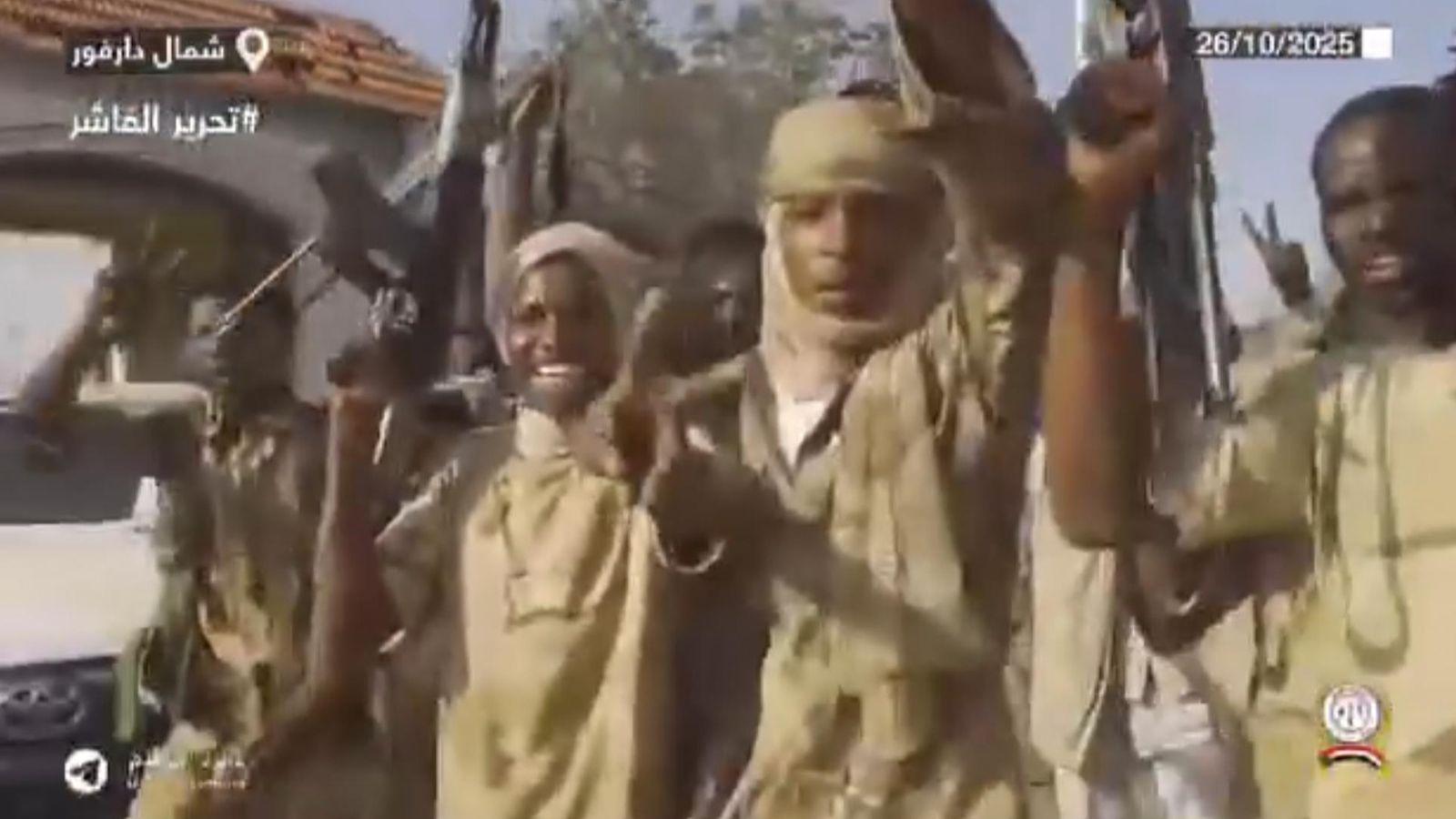
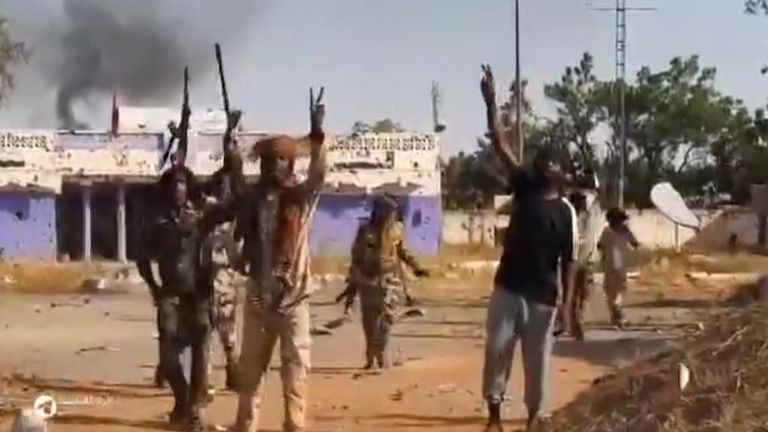
Image: RSF forces posted images on social after they seized el-Fasher
Rebel commanders “calculated to bring about the physical destruction” of non-Arab areas, in particular the Zaghawa and the Fur communities, according to the report released on Thursday.
UN officials said several thousand civilians were killed when the RSF and fellow paramilitary groups took over el-Fasher, which had been the Sudanese army’s only remaining stronghold in Darfur.
Only 40% of the city’s 260,000 residents were able to flee the assault alive, thousands of whom were wounded, the officials said. The fate of the rest remains unknown.
Advertisement
The report went on to say: “Thousands of persons, particularly the Zaghawa, were killed, raped or disappeared during three days of absolute horror.
“The wanton violations that were perpetrated by the RSF and allied Arab militia in the final offensive on el-Fasher underscore that persistent impunity fuels continued cycles of violence.”
One witness was quoted as saying that he saw bodies thrown into the air, “like a scene out of a horror movie”, according to the report.
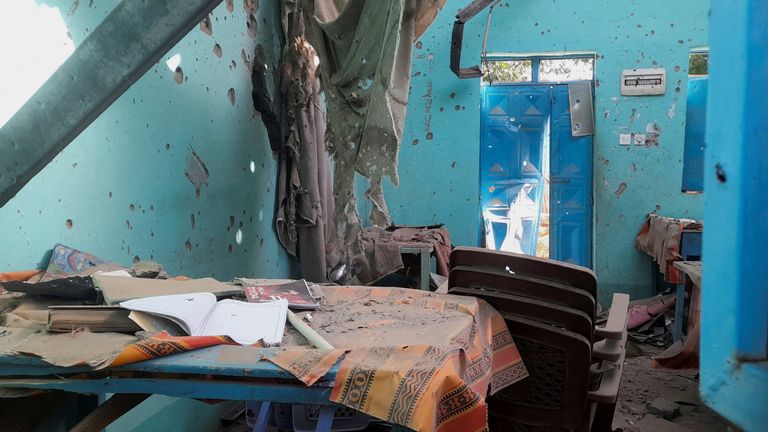
Image: Signs of shelling in a school where displaced people sheltered in el-Fasher. Pic: Reuters
Ms Cooper said: “The world is still failing the people of Sudan. When the stories started to emerge about the horrors of el-Fasher it should have been a turning point, but the violence is continuing.
“It is time to listen to the women of Sudan, not the military men who have been prosecuting this war. We need action for justice, accountability and peace.”
Advertisement
Ms Cooper is expected to raise the report at a UN Security Council meeting in New York today.
Sudan was plunged into conflict in mid-April 2023, when long-running tensions between its military and paramilitary leaders erupted in the capital Khartoum and spread to other regions, including Darfur.
The warhas seen more than 40,000 people killed, according to UN figures, but aid groups say the true number could be many times higher.
Advertisement
The RSF and their allied Arab militias, known as Janjaweed, overran el-Fasher on 26 October and stormed the city.
Widespread atrocities were committed during the offensive that included mass killings and summary executions, sexual violence, torture, and abductions for ransom, according to the UN Human Rights Office.
More than 6,000 people were killed between 25 October and 27 October in the city, the office said.
1,000 days of war in Sudan
Advertisement
Ahead of the assault, the rebels ran riot in the Abu Shouk displacement camp, just outside of the city, and killed at least 300 people over two days, it said.
The group’s commander, General Mohamed Hamdan Dagalo, has previously acknowledged abuses by his forces, but disputed the scale of atrocities.
An international convention known colloquially as the “Genocide Convention” – adopted in 1948 – sets out five criteria to assess whether genocide has taken place.
They include killing members of a group, causing its members serious bodily or mental harm, imposing measures aimed to prevent births in the group, deliberately inflicting conditions calculated to bring about the “physical destruction” of the group, and forcibly transferring its children to another group.
Advertisement
Image: RSF soldiers after the 18-moth siege of el-Fasher in 2024
The fact-finding team, which doesn’t have the final say on whether a genocide has been committed, said it found at least three of those five factors were met in the RSF’s actions.
Under the convention, a genocide determination could be made even if only one of the five were met.
The RSF acts in el-Fasher included killing members of a protected ethnic group; causing serious mental and bodily harm; and deliberately inflicting conditions of life to bring about the group’s physical destruction in whole or in part – all key elements of the crime of genocide under international law, according to the fact-finding team.
The fact-finding mission pointed to mass killings, widespread rape, sexual violence, torture and cruel treatment, arbitrary detention, extortion, and enforced disappearances during RSF’s takeover of el-Fasher in late October.
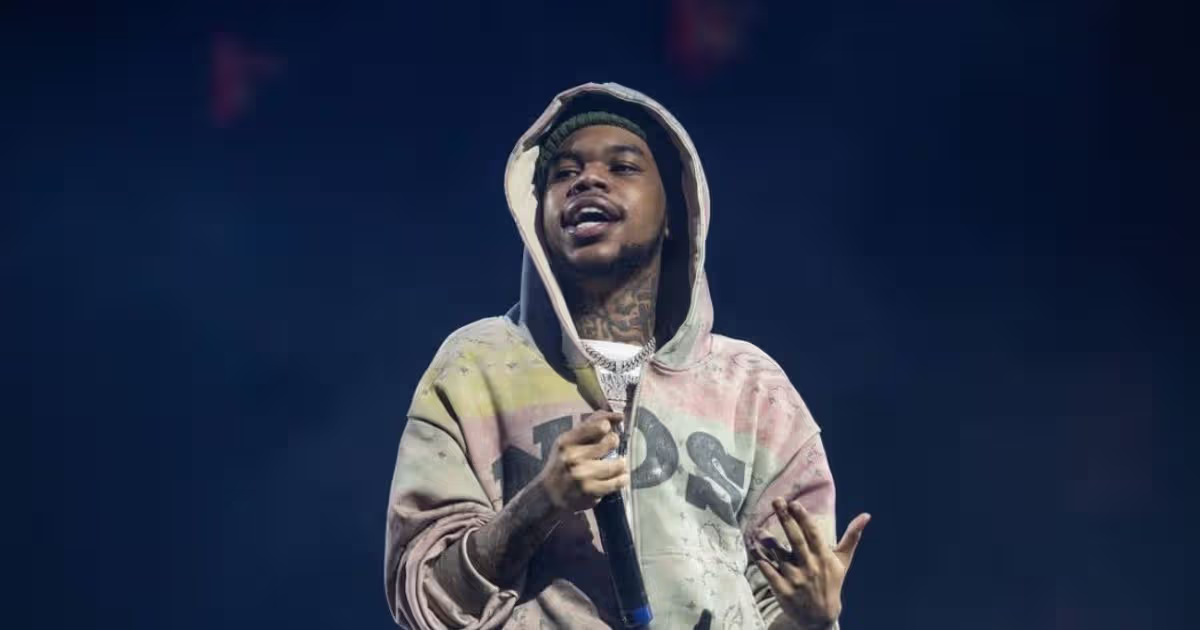
Rapper Lil Poppa has died at the age of 25 and fans of his music rushed to social media to pay their respects.
Rapper Lil Poppa has died aged just 25, it has been confirmed. The Fulton County Medical Examiner’s Office in Georgia confirmed that the musician was pronounced dead.
Advertisement
A cause of death for Lil Poppa – whose real name was Janarious Mykel Wheeler – has not yet been revealed. The rapper was due to perform for fans in New Orleans on March 21.
Devastated fans have flooded social media with tributes to the late artist. Poppa had more than 600,000 monthly listeners on Spotify, according to the Mirror.
One mourner posted on X, previously Twitter: “Gone way too soon. Lil Poppa helped many people feel understood through his words.” A second commented: “Lil poppa gone before he could release “more healthy than before. “
His music got me through a lot of down moments in life, damn.” A third wrote: “Can’t believe this Lil poppa news. One of the best writers to come outta Florida for a very long time.
Advertisement
“Hard to find artists who could convey the feelings of depression as well as he could.” Another said: “Losing someone so young at just 25 is painful. May Lil Poppa’s soul rest in peace, and may strength and comfort be with his family, friends, and everyone who loved his music during this difficult time.”
A fifth remarked: “Don’t wanna believe this Lil Poppa news, really one of my favourite artists that was so young and relatable.”
The singer shared an update to his Instagram Stories only on Tuesday night in now what is a now-tragic final post. It showed him appearing to be riding in a car as he listened to Letting it go by Rod Wave.
Advertisement
He would often write songs about relationships, mental health, and love. On his Instagram, his bio read: “First We’re Born, Next We Suffer, Then We Die… The End!!”
Signed to Yo Gotti’s Collective Music Group (CMG), Lil Poppa had released several successful tracks in recent years, including Love and War, Mind Over Matter, and HAPPY TEARS. His 16-track album Almost Normal Again dropped in August 2025, followed by his latest single, “Out of Town Bae,” released on Friday, February 13.
Following the album’s release, Poppa launched a 20-date Almost Normal Again Tour. He had previously joined forces with Rod Wave, his Falling Fast collaborator, on the Last Lap Tour.
Advertisement
His debut studio album, Blessed, I Guess, came out in 2021 and reached number 160 on the Billboard 200. His 2022 mixtape Under Investigation 3 also made its mark on the Billboard 200, climbing to number 194.
Get more Daily Record exclusives by signing up for free to Google’s preferred sources. Click HERE.
Trump spent several hours snoozing through a meeting of the poundshop SPECTRE he’s set up to rival the UN, before giving a genuinely odd response to Andrew’s arrest. Here’s a roundup of the last 24 hours in Trumpworld
21:36, 19 Feb 2026Updated 21:37, 19 Feb 2026
Donald Trump is on his way to Georgia, where he’ll give a speech about the cost of living.
That’s the theory at least. As we mentioned yesterday, there’s another push to get the erratic, elderly president to stay on message – and talk about something voters are actually worried about.
That push started on Friday, after a strategy meeting of Trump’s top team. The cost of living and the reduction in drug prices. That’s what he’s supposed to be talking about from now until November’s midterms.
Advertisement
So obviously Trump has spent the last couple of days talking about Iran, Gaza, the Chagos Islands, occasionally Epstein, and hosting the inaugural meeting of his Board of Peace – the tin pot gaggle of autocrats and wronguns he’s set up to rival the UN.
Good luck getting him to stay on message at a rally speech, is all I’m saying.
Meanwhile in Trumpworld
He gave a very weird response to Andrew getting arrested
Another Pyongyang-style banner of his face has gone up on a government department
Highlights of the BoP meeting
Trump has a black friend
Here’s what you need to know
Ensure our latest headlines always appear at the top of your Google Search by making us a Preferred Source. Click here to activate or add us as your Preferred Source in your Google search settings.
Advertisement
1. Trump’s response to Andrew getting arrested was VERY weird
Donald Trump was asked for his thoughts about Andrew Mountbatten Windsor getting his collar felt this morning. And his response was truly bizarre.
He started by going on about how sad it was for the royal family. I mean, sure. But then he said this: “I’m the expert in a way because I’ve been totally exonerated. That’s very nice. I can actually speak about it very nicely.”
First of all, nobody’s been exonerated about anything. While inclusion in the files doesn’t suggest guilt or knowledge of Epstein’s crimes, Trump’s name does appear in there thousands of times. And there have been whistleblower allegations against the President that were at least credible enough, according to the documents, that the FBI sent someone to interview the whistleblower.
Anyway, he went on: “I think it’s a very sad thing. It’s really interesting because nobody used to speak about Epstein when he was alive, but now they speak.
Advertisement
“But I’m the one that can talk about because I was completely exonerated. I did nothing.”
It’s just a really weird thing to bring up when asked about someone else, is all.
Content cannot be displayed without consent
2. Another Pyongyang-esque banner of Trump’s face has gone up in Washington DC
You may remember some consternation last year when a giant banner of Trump’s face was raised on the Department of Agriculture in DC. And then another was raised later on the Department of Labour.
Well, a third has been put up – this time on a slightly more troubling place: The Department of Justice.
Advertisement
Of all the government departments, the DoJ is probably the one for which independence from the White House is the most important.
But given how casual Trump has been in ordering the DoJ to go after his enemies, they may as well just slap his picture on the side of the building at this point.
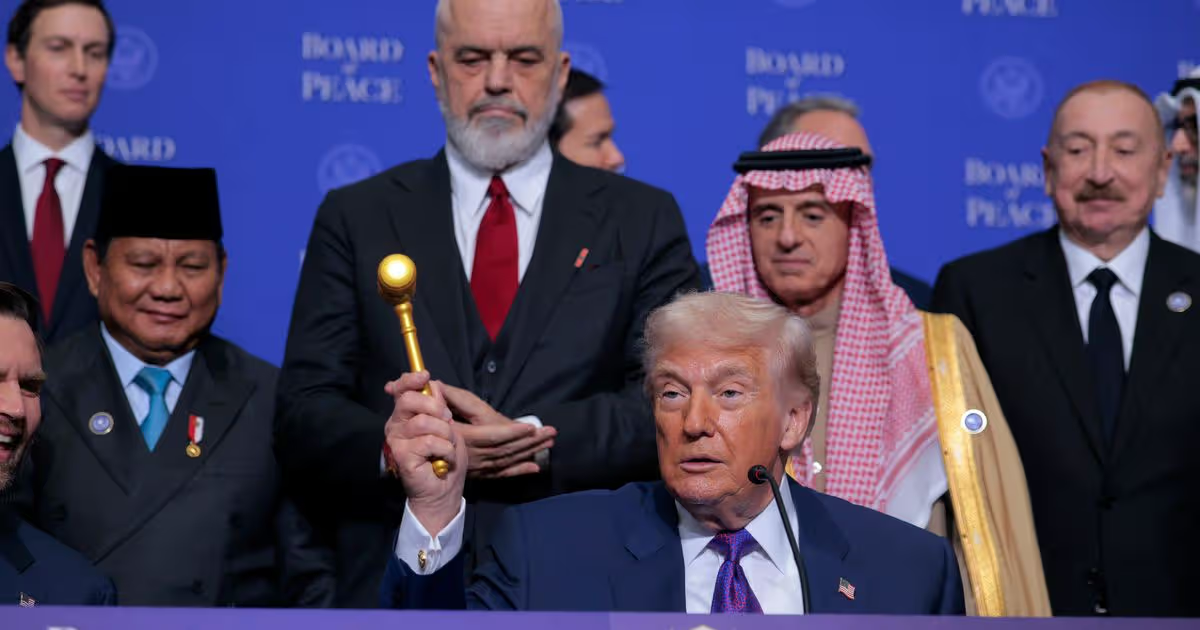
3. The Board Of Peace held their first meeting and it was exceptionally long
The Board of Peace, the poundshop SPECTRE Trump set up to rival the UN, held its first meeting in Washington DC. It was, as you might expect, a lengthy and tedious exercise in the leaders and representatives of countries – including some of the world’s most oppressed and authoritarian nations – lining up to tell Trump how great he was.
Advertisement
The waxing started in earnest with amateur diplomat Steve Witkoff telling Trump it was “my greatest honour to work for you. It is the blessing in my life. I’ve had many blessings. But this is my greatest blessing.”
Witkoff is the living embodiment of the Peter Principle, but at least he’s grateful.
The meeting was way too long and batsh*t to cover every moment in detail. But here’s a few highlights.
Trump said the BoP would be “looking over” the United Nations – “making sure it runs properly”. Presumably his interest will largely be directed at the escalators and teleprompters, which he moaned about AGAIN during his opening speech.
Trump said he was disappointed to get a note telling him Norway had offer to host a meeting for the Board of Peace, because he thought the note from Norway was going to say they were giving him the Nobel Prize.
Norway later confirmed they’d made no such offer, and that they have no intention of joining Trump’s Board of Peace because the council’s structure is “problematic”
They played a series of propaganda videos about how great Donald Trump is, and all the wars he’s stopped.
Tony Blair gave a speech. Trump looked real sleepy throughout.
The Prime Minister of Egypt kept referring to Trump as “your excellency” for some reason
The President of Kazakstan proposed “to establish a special President Trump award” to recognise his “outstanding peace-building achievements.” How this would be different from the made-up award Fifa gave him a few months ago is unclear.
4. Speaking of Fifa …heeeere’s Gianni
FIFA boss Gianni Infantino was at the board meeting. And wore a red USA hat.
“”Everyone here is the head of a country, except for Gianni — but he’s the head of soccer, so that’s not so bad,” Trump said.
Advertisement
“Right, Gianni? I think I like your job the best.”
It is entirely unclear why he was there.
Content cannot be displayed without consent
5. It was so long in fact that Trump appeared to drop off a bunch of times
Of course, it being a 2 hour plus meeting, with presumably quite comfy chairs, and quite boring speeches, often not in English, Trump used the opportunity to catch up on a little shut-eye.
Content cannot be displayed without consent
6. Jared Kushner insisted nobody is “personally profiting” from the reconstruction of Gaza
After playing a deeply unsettling video suggesting Gaza will be a full-blown resort within a decade, Jared insisted nobody’s in this to get rich.
Advertisement
“A lot of these people are volunteers,” he insisted, implausibly. “They’re doing this not for any personal gain, people are not personally profiting from this. They’re really doing this for their children, for their grandchildren and because they really want to see peace.”
I wonder if Trump’s pallid son-in-law is familiar with the old English phrase “Chinny reckon, mate.”
7. And it ended in the most Donald Trump way possible
Of course the inaugural meeting of the Board of Peace was drawn to a close by Donald Trump banging a tiny gold gavel, after which YMCA was played.
Because of course it did.
Advertisement
Content cannot be displayed without consent
8. Trump says isn’t racist, and if you don’t believe him, ask Mike Tyson
Trump hosted a reception to mark Black History Month at the White House last night – and spent quite a lot of his speech insisting that he couldn’t possibly be racist, because despite posting videos of the Obamas depicted as apes on social media, he has a black friend. Who happens to be a convicted rapist, but we’ll let that slide.
Content cannot be displayed without consent
He also mentioned that he likes Nicki Minaj, who, let’s face it, he only likes because she likes him.
Everything you need to know after Rachel Reeves visits Manchester synagogue attacked by terrorist – Manchester Evening News
Need to know
The Chancellor spoke to survivors of the Heaton Park Synagogue attack ahead of announcing funding to protect Jewish and Muslim communities.
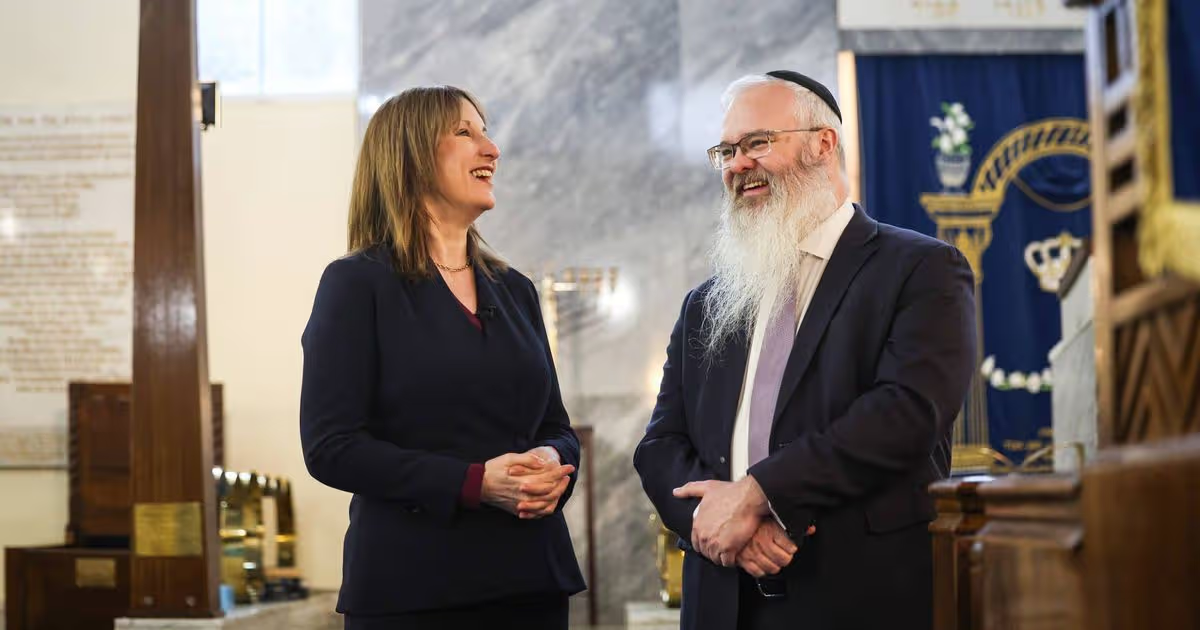
Chancellor of the Exchequer Rachel Reeves with Rabbi Walker(Image: Kenny Brown | Manchester Evening News)
Need to know: Chancellor announces £73.4m funding boost for religious community safety after Manchester synagogue attack
Chancellor Rachel Reeves has announced more government funding to protect religious communities following a rise in hate crimes against Jewish and Muslim worshippers.
The announcement came during Reeves’ visit to Heaton Park Synagogue in Manchester, which was the scene of a horrific terrorist attack on October 2, 2025.
Speaking to the Manchester Evening News, Reeves said: “We are determined to make sure that anybody who attends a synagogue, or a mosque feels safe.” She emphasised the government’s commitment to protecting both Jewish and Muslim places of worship.
The funding will be split between different protective security schemes, with £28.4m allocated for synagogues, Jewish schools and community centres through the Jewish Community Protective Security Grant.
A further £40m will support mosques, Muslim schools and community centres through the Protective Security for Mosques Scheme.
The money will pay for security measures including CCTV, fencing, intruder alarms, floodlights and on-site security staff. An additional £5m has been allocated to protect Christian, Hindu, Sikh and other faith sites.
During her visit, Reeves met with synagogue chair Alan Levy, who saved lives by barricading the door during the terror attack, along with Rabbi Daniel Walker and other community leaders.
The kidnapping of Nancy Guthrie – the mother of US news anchor Savannah Guthrie – is the latest in a string of crimes where ransoms have been demanded in Bitcoin.
The 84-year-old was kidnapped from her home in Tucson, Arizona, in the middle of the night. A ransom of US$6 million (£4.4 million) has been demanded by the kidnappers.
The scale of the ransom demand, combined with the use of cryptocurrency as the payment mechanism, raises a critical question: although Bitcoin is not inherently untraceable, can the perpetrators ultimately profit without being identified?
Bitcoin is a decentralised digital currency, commonly referred to as a cryptocurrency, and is often believed to be anonymous, private and untraceable.
Advertisement
This perception has made Bitcoin attractive to some criminals, who view it as a convenient mechanism for receiving, transferring and storing payments.
As a result, Bitcoin has become increasingly associated with criminal activity, including extortion, kidnapping, fraud, ransomware and even murder.
The Guthrie case has once again drawn attention to the darker associations surrounding Bitcoin and reinforced public anxiety about cryptocurrency and its use for nefarious purposes.
At the same time, a number of high profile kidnappings around the world in 2025, involving people known to hold cryptocurrency, has intensified these concerns.
Advertisement
A common perception is that, because Bitcoin is digital, tracking transactions is difficult. Bitcoin does not exist in a physical form; it is represented as entries on the Bitcoin blockchain – a decentralised ledger used to record transactions across a network of computers. So Bitcoin is not inherently untraceable; its blockchain is transparent and permanently recorded.
Transactions do not explicitly list names, but each transaction is publicly visible and traceable between wallet addresses. Ownership is controlled through private keys and managed via a “digital wallet”, which functions conceptually like a traditional wallet in that it stores and enables the transfer of value. Thus, Bitcoin is more accurately, pseudonymous, not anonymous.
Currency conversion
In the Guthrie case, the immediate practical challenge for the kidnappers would be converting US$6 million into Bitcoin and transferring the cryptocurrency to a digital wallet. From there, the funds would need to be sent to a wallet address specified by the perpetrators – assuming the kidnappers provide such an address.
Transactions conducted through regulated cryptocurrency exchanges that impose know-your-customer checks may expose participants. These checks are mandatory processes to confirm user identities with official IDs, proof of address, and facial recognition.
Advertisement
Even before the funds reach the kidnappers, the transaction through a cryptocurrency exchange may itself create identifiable records. However, there is no guarantee of this, as there are many unregulated exchanges that operate in jurisdictions with lenient legislation.
Guthrie was reported missing on February 1 from her home near Tucson, Arizona. Alamy (AP)
While Bitcoin transactions are traceable between wallet addresses, the kidnappers in this case may attempt to enhance anonymity through layered technical measures. These may include generating a new wallet address for each transaction, operating multiple wallets, and repeatedly transferring funds from a primary wallet through successive intermediary wallets to obscure transaction links.
Maintaining anonymity also requires avoiding any association between wallet addresses and personal information, refraining from interacting with other identifiable people, and using privacy-enhancing tools such as Tor/VPNs – software that masks a user’s location – and coin-mixing services, which enhance privacy by scrambling cryptocurrency funds with others to obscure links between senders and receivers.
Achieving this level of operational security demands significant technical knowledge and strict discipline from the kidnappers. Any human error, whether through identity exposure, exchange interaction, IP logging, or conversion into hard cash may compromise anonymity.
Advertisement
Ultimately, the critical issue is not merely tracing funds but determining how recipients convert or use the Bitcoin without triggering identification through regulatory checkpoints, forensic analysis, or operational mistakes.
Even if the US$6 million could be traced between wallet addresses, anonymity hinges on whether those addresses can be linked to real-world identities. Where wallet holders remain unidentified and operate outside regulated exchanges, investigative challenges increase.
Additional complications arise if the perpetrators operate outside the US. Cross-border enforcement faces limitations including variation in crypto-related legislation and regulation, uneven training in tracing and confiscation, and limited international coordination.
Whether perpetrators can ultimately be reached by law enforcement depends significantly on their jurisdiction and the degree of international cooperation.
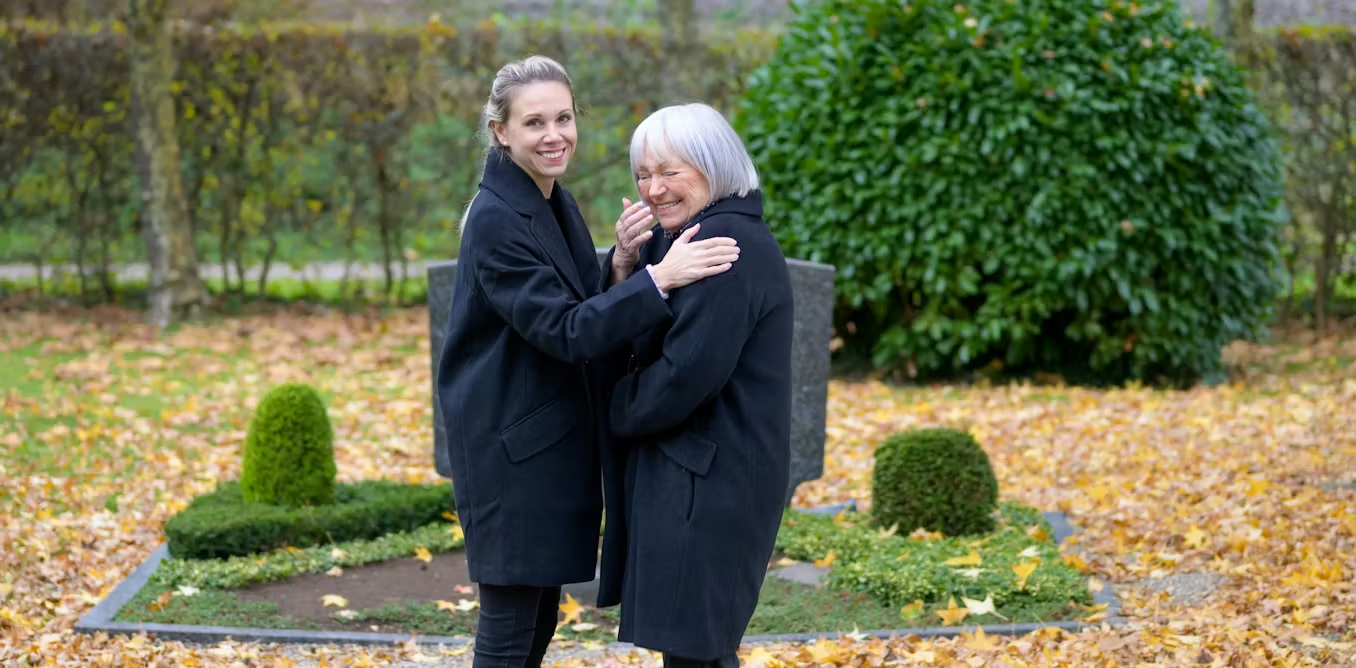
I don’t think I’ve ever laughed harder than during a church service, when something faintly ridiculous caught my eye. My friend saw it too, and once she started laughing, it became impossible to stop. Years later I’ve tried to explain what was so hilarious, but it seems you had to be there. What was it about the combination of the situation – sometimes referred to as “church giggles” – and shared laughter that made it so funny?
Most people recognise the experience. A solemn setting. Absolute silence. A fleeting visual detail that is, in any other context, only mildly amusing at best. Yet the harder you try to suppress the laugh, the more uncontrollable it becomes. When someone else notices it too, restraint becomes next to impossible.
This kind of laughter that comes from trying not to laugh isn’t confined to religious spaces. It happens in any setting where silence, seriousness and self-control are tightly enforced and uncontrolled laughter is frowned upon.
Rather than being bad manners or a lack of emotional maturity, it tells us something about how the brain behaves under pressure. The science behind it is surprisingly complex.
Advertisement
In highly formal settings – churches, courtrooms, funerals – the brain operates in a state of active inhibition. This is the process by which your brain deliberately suppresses brain activity.
The region most involved is the prefrontal cortex, the thinking and decision-making part at the front of your brain, particularly its medial and lateral areas. These areas handle social judgment, behavioural restraint and emotional regulation.
This part of the brain doesn’t stop emotions from arising. Instead, it works by suppressing their outward expression.
Laughter comes from a distributed network in the brain rather than a single “laughter centre”. The impulse begins in the outer regions of the brain, but the emotional drive comes from deeper structures in the limbic system, the emotional processing centre of the brain.
Advertisement
The limbic system includes the amygdala, an almond-shaped structure that processes emotions and assigns emotional importance to things, and the hypothalamus, which controls automatic body functions like heart rate and breathing. Once laughter gets released, circuits in the brainstem – the base of the brain that connects to the spinal cord – take over and coordinate facial expression, breathing and vocalisation.
This makes laughter difficult to stop voluntarily. The prefrontal cortex normally keeps this response in check, suppressing laughter when it’s socially inappropriate.
When that control weakens – through heightened arousal or shared social cues – laughter emerges as an automatic, reflex-like behaviour. It’s no longer a deliberate act.
In other words, the impulse to laugh and the effort to stop yourself come from different parts of the brain. They’re competing with each other.
Advertisement
When something unexpected or odd catches your eye, your emotional response fires rapidly and automatically. The process to control it takes effort, burns energy, and is prone to failure, especially when you have to maintain it for long periods.
The more firmly you try to exert control, the more the trigger stays active in your attention. Suppression doesn’t erase the thought – it actually rehearses and sustains it.
Laughter isn’t just a response to humour. Neurologically, it also functions as a regulatory reflex – a way of releasing emotional and physical tension.
In constrained environments, your nervous system has few outlets. You can’t move, you can’t speak, you can’t shift position much or signal discomfort.
Advertisement
At the same time, your automatic nervous system becomes slightly activated. Your heart rate increases, your breathing becomes shallower and your muscle tone rises.
Once laughter begins, it recruits automatic motor pathways in the brainstem that you can’t easily interrupt. This is why laughter, once triggered, often feels physically unstoppable.
You’re no longer “deciding” to laugh. The system has taken over and you’re helpless.
Advertisement
Once triggered, it feels unstoppable. Tom Brogan/Alamy
The contagion takes hold
For many people, the tipping point isn’t the original trigger. It’s the instant someone else notices it as well.
This is where social neurobiology comes into play. Humans are highly sensitive to subtle social cues: facial tension, changes in breathing, suppressed smiles.
We process these cues rapidly through networks involving the superior temporal sulcus, a groove along the side of the brain that plays a key role in reading other people. Mirror neurons – brain cells that fire both when we act and when we watch others act – also help us pick up on these signals.
Laughing together represents a shared emotional alignment. That shared recognition does two things at once.
Advertisement
It validates your own response (I’m not imagining this). And it removes the sense of solitary transgression (you’re no longer suppressing alone).
The prefrontal control system weakens further. Laughter spreads through emotional contagion.
By this point, the original trigger hardly matters. What you’re laughing at is each other, and the absurdity of trying to regain control.
These moments are often triggered by something visual, but they don’t have to be. A mispronounced word or an unexpected phrase can provoke the same response.
Advertisement
However, visual triggers are especially potent in silent settings. They can’t be interrupted or talked away, and your brain can replay them repeatedly while suppression is in place.
Spoken triggers, by contrast, tend to be shared instantly. Whether laughter erupts depends on how quickly social inhibition can be re-established.
“Inappropriate” laughter is often framed as rudeness or childishness. But from a neurological perspective, it’s a predictable consequence of prolonged emotional suppression in a social species.
The brain is not designed for sustained inhibition without release. When restraint is tight enough – and when someone else is there with you – laughter becomes the escape route. That is why it feels impossible to stop.
Andrew Mountbatten-Windsor has been arrested on suspicion of misconduct in public office. The arrest comes after the US government released files that appeared to indicate he had shared official information with financier and convicted child sex offender Jeffrey Epstein while serving as a trade envoy for the UK. But the police have not given details of exactly what they are investigating.
It is important to be clear that the arrest is not related to accusations of sexual assault or misconduct. In 2022, Mountbatten-Windsor reached a settlement with the late Virginia Giuffre for an undisclosed sum that did not include an admission of liability.
Being named in the Epstein files is not an indication of misconduct. Mountbatten-Windsor has previously denied any wrongdoing in his association with Epstein and and has previously rejected any suggestion he used his time as trade envoy to further his own interests.
What was Mountbatten-Windsor’s official role and why did he lose it?
In 2001, Tony Blair’s government made the then-prince the UK’s special representative for trade and investment. According to the government at the time, his remit was to “promote UK business internationally, market the UK to potential inward investors, and build relationships in support of UK business interests”. He did not receive a salary, but he did go on hundreds of trips to promote British businesses.
Advertisement
Members of the royal family are often deployed by the government on international missions to promote trade. When negotiating with other countries, particularly those which are also monarchies, sending a prominent figure like a royal may help seal the deal. Indeed, the then-government claimed that the former Duke of York’s “unique position gives him unrivalled access to members of royal families, heads of state, government ministers and chief executives of companies”.
It is not unusual for members of the royal family to be deployed by the government for diplomatic missions. Royals often host incoming state visits and lead similar visits abroad, and can be deployed to lead delegations on more specific missions.
However, Mountbatten-Windsor had an official role as trade envoy. He stepped down from this role in 2011 following reports about his friendship with Epstein, who was convicted of sex offences in 2011.
The monarch is protected by sovereign immunity, a wide-ranging constitutional principle exempting him from all criminal and civil liability. According to the leading 19th century constitutionalist Alfred Dicey, the monarch could not even be prosecuted for “shooting the Prime Minister through the head”. The Prince of Wales also enjoys immunity as Duke of Cornwall, which protects him from punishment for breaking a range of laws.
The State Immunity Act 1978, which confers immunity on the head of state, also extends to “members of the family forming part of the household”. However, this phrase has been interpreted narrowly to apply to a very tight circle of people and does not appear to apply to the monarch’s children in general. For example, in 2002 Princess Anne was prosecuted (though not arrested) for failing to control her dogs in Windsor Great Park after they bit two children.
Nevertheless, there has often been a perception that members of the royal family are held to a different standard when it comes to the law. In 2016 Thames Valley Police were criticised by anti-monarchy groups for not prosecuting the then-prince after newspaper reports alleged he had driven his car through the gates of Windsor Great Park. In 2019 the Crown Prosecution Service declined to prosecute Prince Philip for causing a car crash which injured two people.
The monarch also cannot be compelled to give evidence in court. For example, prosecutors were unable to summon the late queen to give evidence in the trial of Princess Diana’s former butler, who was accused of stealing her jewellery.
Advertisement
In response to Mountbatten-Windsor’s arrest, the king said: “What now follows is the full, fair and proper process by which this issue is investigated in the appropriate manner and by the appropriate authorities. In this, as I have said before, they have our full and wholehearted support and co-operation. Let me state clearly: the law must take its course.”
When was the last time a royal was arrested?
You have to go back quite a long way to find the last time that a member of the British royal family was arrested. This was during the English civil war, when Charles I was taken prisoner for treason before being found guilty and ultimately executed in 1649.
A number of royals, including Princess Anne, have committed driving-related offences, including speeding. But this arrest makes Mountbatten-Windsor the first member of the royal family to be arrested in modern times, though it should be noted that he is no longer a royal – he was stripped of all his official titles in October 2025 as his friendship with Epstein came under even more scrutiny.
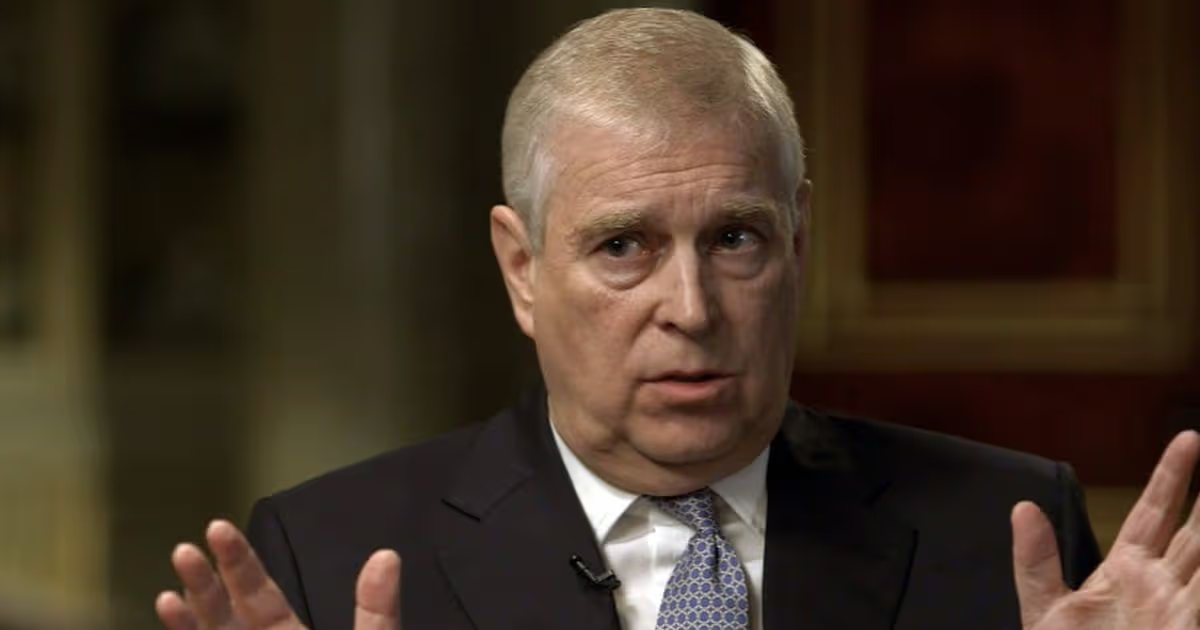
The former prince, pictured in 2019. PjrNews/Alamy
What limits do police have on investigating royal estates?
Sovereign immunity also prevents police from entering private royal estates to investigate alleged crimes without permission. This can, theoretically, protect members of the royal family from arrest and prosecution. The Cultural Property (Armed Conflicts) Act 2017 also bans police from searching royal estates for stolen or looted artefacts.
Advertisement
In 2007, two hen harriers were illegally shot at Sandringham estate. However, Norfolk Police first needed to ask Sandringham officials for permission to enter the estate, by which time the dead birds’ bodies had been removed. Police questioned Prince Harry, but did not bring charges.
Other incidents have allegedly led to Sandringham being accused of becoming a wildlife crime hotspot, with at least 18 reported cases of suspected wildlife offences taking place between 2003-23 – yet only one resulting in prosecution.
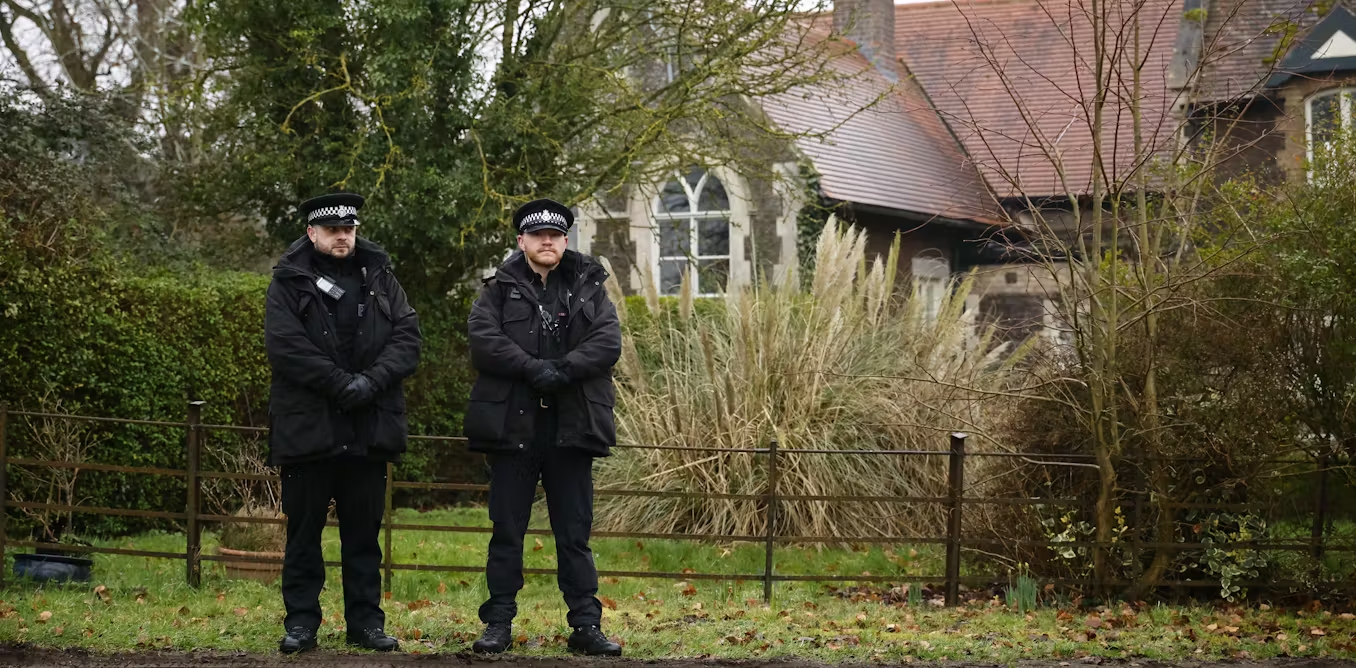
Another longstanding legal precedent is that no one may be arrested in the presence of the monarch or within the precincts of a royal palace. It was thought that this rule could protect other members of the royal family and royal employees. However, Mountbatten-Windsor’s arrest at Sandringham suggests that this antiquated principle may no longer hold true today.
Some people in England are entitled to free NHS dental care including those on Universal Credit, Pension Credit and other key benefits
Lauren Haughey Lifestyle and Money Reporter and Ashlea Hickin Content editor
20:13, 19 Feb 2026
Visiting the dentist isn’t exactly everyone’s favourite activity. And with routine check-ups typically costing £27.40, it’s easy to see why many individuals skip them altogether.
However, you may be surprised to discover that certain people living in England could be eligible for free dental appointments and treatments via the NHS. This particularly applies to those within a particular age range and anyone in receipt of several key benefits from the Department for Work and Pensions ( DWP ).
Below, The Express has explored who is eligible for this and what steps you can take next. If you’ve paid for NHS dental treatment but discover you are entitled to free appointments, you may also be eligible for a refund.
Advertisement
Who can receive free NHS dental appointments and treatment in England?
According to the NHS, there are five categories of individuals who automatically qualify for complimentary NHS dental care. These specifically include the following:
You’ve had a stillbirth in the past 12 months
You’re getting treatment in an NHS hospital from a hospital dentist (but you may still need to pay for dentures or bridges)
You receive War Pension Scheme payments, or Armed Forces Compensation Scheme payments and the treatment is for your accepted disability
You’re aged under 18, or under 19 and in full-time education
You’re pregnant or have had a baby in the last 12 months
In addition to this, you might qualify if you or your partner is in receipt of at least one of six benefits. Dependants under 20 years old may benefit from this as well, provided you are claiming:
Pension Credit Guarantee Credit
Pension Credit Guarantee Credit with Savings Credit
Universal Credit – but only if your income is below a certain amount
Income Support
Income-based Jobseeker’s Allowance
Income-related Employment and Support Allowance
It’s important to remember that these rules only apply to NHS dental treatments.
If you opt for private care, you’ll be liable for the cost. Usually, you’ll also need to provide proof of eligibility for free NHS care, although this may differ depending on your exemption basis.
Examples of evidence accepted by the NHS include:
A valid maternity exemption certificate
A maternity certificate (MatB1)
A notification of birth form, or your baby’s birth certificate
However, official NHS guidance states: “If you receive War Pension Scheme or Armed Forces Compensation Scheme payments and get free dental treatment, you’ll usually need to pay for it yourself first and claim the money back from Veterans UK.”
How can I confirm my eligibility?
If you believe you’re eligible for free NHS dental care, visit the NHS Business Services Authority (NHSBSA) website to verify. The site offers a free eligibility check that typically takes about three minutes to complete.
Advertisement
If you’re eligible, it will guide you through the steps to claim support. Anyone who thinks they have been incorrectly charged for NHS dental appointments could be entitled to a refund.
What is the NHS Low Income Scheme?
Even if you don’t qualify for free dental care, you might still be able to receive financial help through the NHS Low Income Scheme. This scheme not only covers dental visits but also helps with other essential costs like prescriptions, eye tests, wigs, and travel expenses for treatment.
The amount you’re eligible to receive largely depends on your weekly income, savings, and essential outgoings at the time of application. You can only apply online if you have no capital or savings exceeding £6,000, and must also meet at least one of the following criteria:
Receiving state benefits
Living in a care home
A pensioner
A student
Earning a wage
Guidance from the NHSBSA states: “If the amount you have left is low, you may be able to get help through the NHS Low Income Scheme. Any help you’re entitled to is also available to your partner, if you have one.
“If you have already paid for treatment, you can apply for a refund at the same time as you apply for the scheme. We will normally assess your application within 18 working days from the date we get your form.”
Advertisement
For further details on the support available, visit the NHSBSA website here.
“Today the king insisted that what now follows must be a ‘full, fair and proper’ investigation by the ‘appropriate’ authorities, but there was no mention of an ‘appropriate’ response from the Royal Family”
Dr Tessa Dunlop, royal historian
20:47, 19 Feb 2026
We can pretend he isn’t royal, and stumble over his new, long-winded ‘Mountbatten-Windsor’ nomenclature, but Andrew is the son of a monarch, born in Buckingham Palace 66 years ago, and he remains 8th in line to the throne.
So while reports confirm that in an unprecedented move, the former prince was arrested this morning on suspicion of misconduct in a public office, lets not fool ourselves that Andrew is no longer royal. It was precisely because of his privileged position the former Prince was ‘anointed’ trade envoy in the first place – a sop to the late Queen from the Blair Administration in 2001 after a difficult royal decade.
Advertisement
The Windsor family’s popularity tanked in the 1990s (having polled at over 80% support during the ‘80s) in the wake of infidelity scandals, three royal divorces and Diana’s tragic death. But those dark days don’t begin to compare with the current Epstein quagmire into which the former prince has dragged his family.
Ensure our latest headlines always appear at the top of your Google Search by making us a Preferred Source. Click here to activate or add us as your Preferred Source in your Google search settings.
Very small fry in comparison with today’s grotesque public unravelling of a former Prince. For far too long Andrew has been able to weaponise his royal privilege to push back against his accuser and to protect himself from legal scrutiny. Today he remains in police custody on potential charges of misconduct in a public office, but so many questions remain unanswered.
We still don’t know where the money came from that paid off Virginia Giuffre in 2022, when she accused Andrew of sexual assault under New York’s Child Victim’s Act, or how much the royal family knew about Andrew’s activities with Epstein more broadly. The latter’s female accusers have done so much to move this story forward and hold powerful men to account, surely it is time that our royal family also stepped up to the plate?
Today the king insisted that what now follows must be a ‘full, fair and proper’ investigation by the ‘appropriate’ authorities, but there was no mention of an ‘appropriate’ response from the Royal Family.
Advertisement
The late Queen protected her son Andrew, the institution of monarchy batted away questions concerning the Duke of York’s alleged misconduct since 2011 and Buckingham Palace was the address from which Andrew platformed his lies on the BBC in 2019.
Beyond what happens to their ‘ex-royal’ brother, surely the least the Royal Family can do is apologise for consistently turning a blind eye to former Duke of York’s extensive abuse of power.
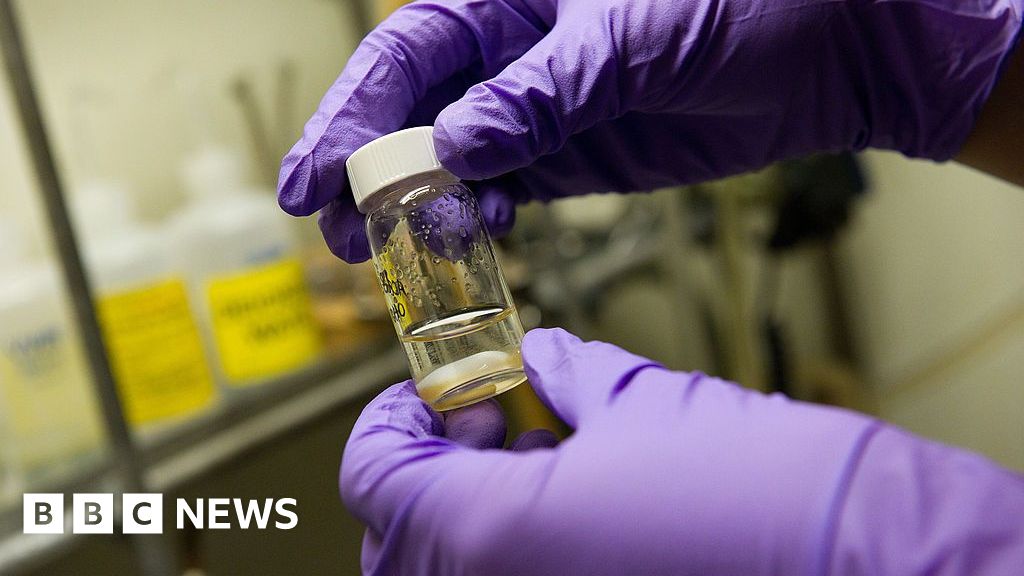
Pulendran told the BBC: “This vaccine, what we term a universal vaccine, elicits a far broader response that is protective against not just the flu virus, not just the Covid virus, not just the common cold virus, but against virtually all viruses, and as many different bacteria as we’ve tested, and even allergens.
Joshua miraculously escaped with only minor injuries having swapped seats with Aoydele shortly before their SUV crashed into the back of a stationary truck.
Advertisement
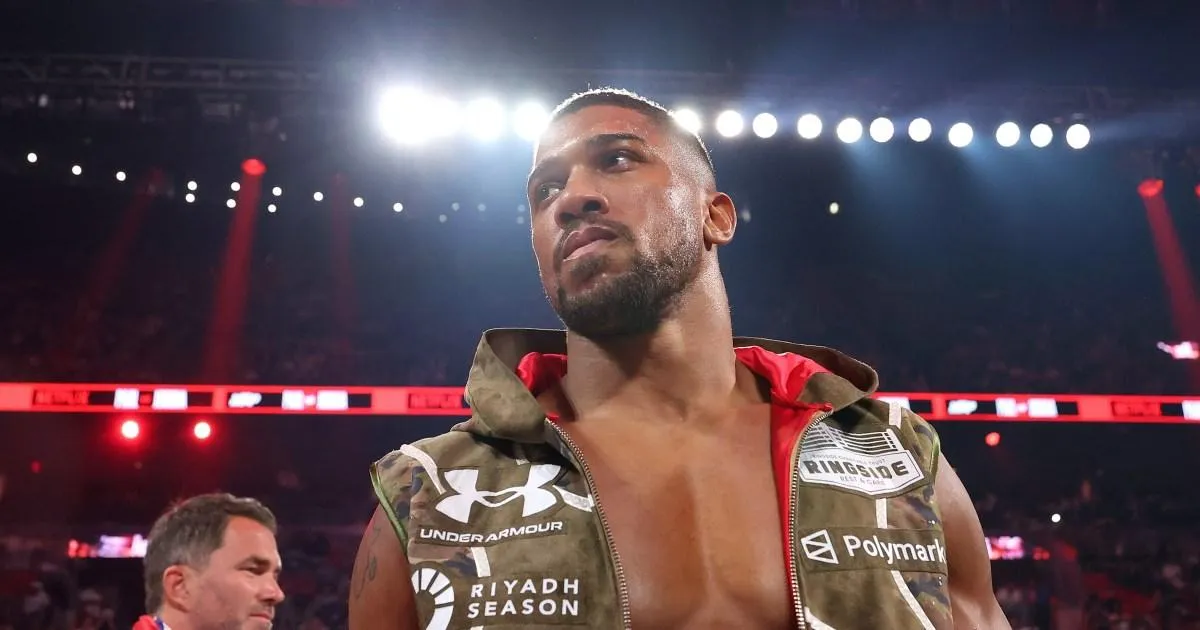
Joshua has not publicly discussed a return to boxing since the accident but has been seen back in training in the Middle East where he now resides.
Hearn, who has promoted Joshua since he turned professional after the 2012 Olympics, has been careful not to put any timeline on the heavyweight’s return during his physical and mental recovery.
But a firmer plan now appears to be in place.
Joshua lost his close friends Sina Ghami and Latif Ayodele in the crash.
‘Originally the plan with ‘AJ’ was for him to fight in March and then fight Tyson Fury in August,’ Hearn told BoxingScene.
‘That’s not happening. He’s not fighting Tyson Fury next. He’s going to come back, I believe, in late summer, but physically he’s not yet in a position to return to camp.
Advertisement
‘So, I’m planning, but he’s just resting and preparing. So, for me, I’m looking at options to get him back in the ring in July time, but we’ll only know if that’s a real possibility when he returns to camp, which will hopefully be in the next couple of weeks or a month.’
Who will Anthony Joshua fight when he returns to boxing?
Anthony Joshua vs Tyson Fury is a fight that has fallen by the wayside countless times over the last six years but there was renewed hope it would take place in 2026 last year.
Fury will return to action in April (Picture: Getty)
‘I think every fight’s dangerous coming off what he’s come off, but, yeah, I think we’re open to the Tyson Fury fight, but probably that’s more likely end of the year – maybe early 2027,’ Hearn said.










![CPI is OUT! The Market Reaction Explained [Bitcoin & Stocks]](https://wordupnews.com/wp-content/uploads/2026/02/1771536648_hqdefault-80x80.jpg)