For the first time, Amazon has dethroned Walmart as the company with the largest annual revenue.
Advertisement
Walmart on Thursday reported annual revenue of $713.2 billion for its most recent fiscal year, shy of Amazon’s $716.9 billion in revenue. The milestone was brewing for months, as Amazon leapfrogged Walmart in quarterly sales for the first time about a year ago.
The shuffle, while largely symbolic, underscores the battle the two retailers have waged both to define and keep up with ever-changing consumer preferences. They are kicking off a new chapter of that rivalry as artificial intelligence reshapes how companies operate, make money and drive sales.
Amazon rose to the top of the revenue pile by doing much more than running a sprawling online webstore and promising speedy delivery. While its core retail unit is its largest revenue generator, its huge cloud computing, advertising and seller services businesses also fuel its sales. Third-party seller services, which include commissions and fees collected by Amazon fulfillment along with shipping, advertising and customer support, accounted for about 24% of the company’s total sales in 2025, according to its latest annual filing. Amazon Web Services was responsible for roughly 18%.
It wasn’t Walmart’s weakness that led it to lose its top spot, as its revenue has more than doubled in 20 years. The retailer has leaned on its more than 4,600 Walmart stores and roughly 600 Sam’s Club locations in the U.S. to power its digital business, which grew by 27% in the U.S. in the fiscal fourth quarter and has posted double-digit percentage gains for 15 straight quarters.
Advertisement
That expansion came as Walmart riffed off the Amazon playbook and tried to position itself as a tech company as well as a retailer.
There have been multiple signs of its ambitions: Walmart relisted its stock, moving from the New York Stock Exchange to the tech-heavy Nasdaq in early December. Its market value surpassed the $1 trillion mark earlier this month, a valuation achieved almost exclusively by tech companies including Amazon, after a more than 21% rise in the last year.
And the big-box retailer’s fourth-quarter earnings, which were boosted by digital advertising and its third-party marketplace, illustrated Walmart’s emphasis on chasing higher-margin businesses and thinking beyond brick-and-mortar retail.
Amazon and Walmart’s AI ambitions
In many ways, Walmart’s recent push to grow its third-party marketplace was an answer to the dominance of Amazon’s platform. Even as it tries to catch up with Amazon in some areas, Walmart is trying to gain an edge in a new frontier.
Advertisement
Over the past few years, Amazon and Walmart have used different AI strategies to try to make their businesses more efficient and make their merchandise more appealing to shoppers.
Walmart struck a deal with OpenAI’s ChatGPT in October and Google’s Gemini in January to make its products easier to discover and buy. It also has its own AI-powered shopping assistant, Sparky. The virtual assistant, which looks like a smiley face, pops up on Walmart’s app and can help shoppers find items.
Walmart, like many other companies, is in the early days of AI adoption, and it’s unclear how the technology will affect its business long-term.
On the company’s earnings call on Thursday, Walmart CEO John Furner said customers are spending more when they use Sparky. He said customers who use Sparky have an average order value that’s about 35% higher than shoppers who don’t use the tool.
Advertisement
About half of Walmart’s app users have used Sparky, Walmart U.S. CEO David Guggina said on the earnings call.
“Agentic AI is increasingly embedded across Walmart,” Guggina said. “It’s strengthening our operations. It’s improving associate productivity, and it’s enhancing the customer experience.”
Walmart CFO John David Rainey said AI investments are included in the retailer’s capital expenditure plans for the full year, which are expected to be roughly 3.5% of sales. Those expenses also include the company’s investments in automation and store remodels.
There are limits to Walmart’s tech ambitions.When it comes to AI, Rainey said Walmart will lean on the expertise of tech companies rather than try to create its own products.
Advertisement
“As you’ve seen from the announcements we’ve made, we’re approaching AI development through partnerships,” he said on the company’s earnings call. “This lets tech companies do what they do best, develop innovative technology, and it provides us clarity to do what we do best, to translate the best of tech to retail experiences that create value for our customers and members and our enterprise.”
Like Walmart, Amazon is also facing new pressure to respond to the rise of agentic commerce. Chatbot makers like OpenAI, Google and Perplexity have introduced automated commerce features that aim to change how people shop online.
While other companies like Walmart, Etsy and Shopify have announced shopping partnerships with AI platforms, Amazon has remained on the sidelines. It’s blocked agents from accessing its site, and doubled down on its own shopping chatbot, Rufus, which is powered by its own models and Anthropic’s chatbot Claude.
The company said Rufus has been used by more than 300 million customers and drove almost $12 billion in incremental annualized sales last year. After slowly rolling out the service in beta two years ago, Amazon has injected Rufus across more areas of its app and website to encourage shoppers to use the tool.
Advertisement
Amazon CEO Andy Jassy said last month that Rufus and other AI tools could assist shoppers with finding products much like an employee in a physical store.
“I think agents are going to help customers with that type of discovery,” Jassy said. “And it’s part of why we’ve invested so much in Rufus, which is our shopping assistant.”
Meanwhile, Amazon is throwing piles of cash at AI infrastructure. Earlier this month, it announced it would spend up to $200 billion this year on AI initiatives, more than any of the other hyperscalers, which have altogether forecast nearly $700 billion in 2026 expenditures. Most of Amazon’s spending is expected to go to data centers, chips and networking equipment.
Wall Street has viewed Amazon’s capex plans skeptically, sending the company’s shares down for nine days straight following its Feb. 5 earnings report and shaving more than $450 billion off of its market value.
Advertisement
Amazon’s investments aren’t limited to AI compute. The company has also put significant resources and talent behind developing AI tools across all of its businesses. It’s alsorolled out a suite of AI models, and revamped its Alexa assistant. It also has invested $8 billion in Anthropic since 2023.
Tesla CEO Elon Musk said the company plans to sell its fully autonomous Cybercab for $30,000 or less by 2027.
The electric-vehicle maker announced Tuesday that the first Cybercab had rolled off the production line at its Giga Texas factory. Shortly after, Musk responded on X to a user seeking clarification about whether the vehicle would actually launch at that price point before 2027.
Advertisement
“Elon – to be clear – the bet was that Tesla wouldn’t sell a Cybercab to a customer for $30k or less before 2027,” the user asked. “Are you saying THAT specifically is going to happen?”
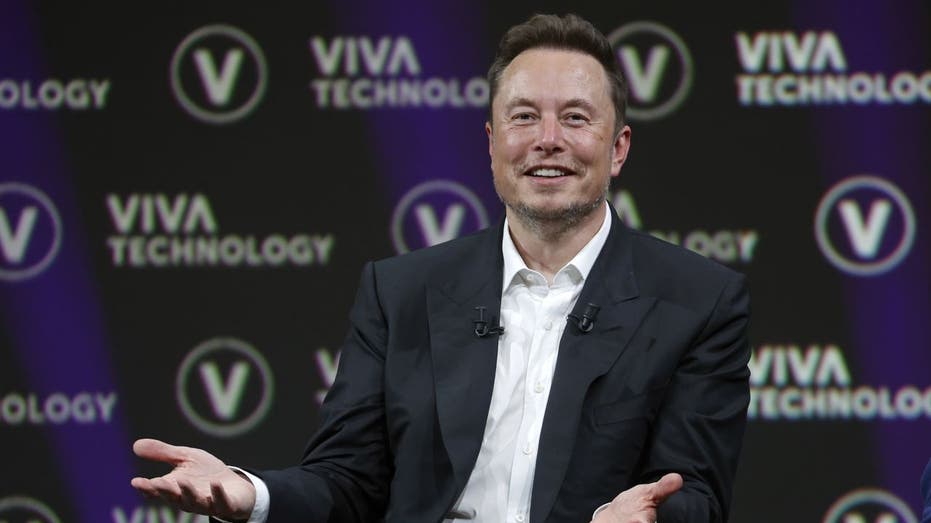
Elon Musk attends the Viva Technology conference at the Porte de Versailles exhibition center on June 16, 2023, in Paris, France. (Chesnot/Getty Images)
The “bet” referenced in the exchange dates back to 2024, when Musk first unveiled the long-anticipated robotaxI and said it would cost less than $30,000 and enter production in 2026.
Advertisement
YouTuber Marques Brownlee, known as MKBHD, publicly questioned at the time whether Tesla could hit that target by 2027, saying he would shave his head on camera if Musk proved him wrong.
Following Tuesday’s production milestone, Musk appeared to lean into the challenge, reacting to an edited image of a bald Brownlee circulating on X.
Still, Musk warned last month that early production of both the Cybercab and Tesla’s humanoid robot, Optimus, would be “agonizingly slow” before ramping up over time, Reuters reported.
Tesla and Brownlee did not immediately respond to FOX Business’ request for comment.
Arbitrage Trader, aka Denislav Iliev has been day trading for 15+ years and leads a team of 40 analysts. They identify mispriced investments in fixed-income and closed-end funds based on simple-to-understand financial logic.
Denislav leads the investing group Trade With Beta, features of the service include: frequent picks for mispriced preferred stocks and baby bonds, weekly reviews of 1200+ equities, IPO previews, hedging strategies, an actively managed portfolio, and chat for discussion. Learn more.
Analyst’s Disclosure: I/we have no stock, option or similar derivative position in any of the companies mentioned, and no plans to initiate any such positions within the next 72 hours. I wrote this article myself, and it expresses my own opinions. I am not receiving compensation for it (other than from Seeking Alpha). I have no business relationship with any company whose stock is mentioned in this article.
Seeking Alpha’s Disclosure: Past performance is no guarantee of future results. No recommendation or advice is being given as to whether any investment is suitable for a particular investor. Any views or opinions expressed above may not reflect those of Seeking Alpha as a whole. Seeking Alpha is not a licensed securities dealer, broker or US investment adviser or investment bank. Our analysts are third party authors that include both professional investors and individual investors who may not be licensed or certified by any institute or regulatory body.
| Revenue of $56.43M (8.48% Y/Y) beats by $220.50K
Medallion Financial Corp. (MFIN) Q4 2025 Earnings Call February 19, 2026 9:00 AM EST
Company Participants
Andrew Murstein – CEO, President, COO & Non-Independent Director Anthony Cutrone – Executive VP & CFO
Advertisement
Conference Call Participants
Mike Grondahl – Northland Capital Markets, Research Division Christopher Nolan – Ladenburg Thalmann & Co. Inc., Research Division
Advertisement
Presentation
Operator
Good day, and welcome to the Medallion Financial Corp. Fourth Quarter 2025 Earnings Conference Call. [Operator Instructions] Please note this event is being recorded.
I would now like to turn the conference over to Val Ferraro, Investor Relations. Please go ahead.
Advertisement
Unknown Executive
Thank you, and good morning. Welcome to Medallion Financial Corp.’s Fourth Quarter and Full Year 2025 Earnings Call. Joining me today are Andrew Murstein, President and Chief Executive Officer; and Anthony Cutrone, Executive Vice President and Chief Financial Officer.
Certain statements made during the call today constitute forward-looking statements. Such forward-looking statements are subject to both known and unknown risks and uncertainties that could cause actual results to differ materially from such statements. Those risks and uncertainties are described in our earnings press release issued yesterday and in our filings with the SEC.
Advertisement
The forward-looking statements made today are as of the date of this call, and we do not undertake any obligation to update these forward-looking statements. In addition to our earnings press release, you can find our fourth quarter supplement presentation on our website by visiting medallion.com and clicking Investor Relations. The presentation is near the top of the page.
With that, I’ll turn it over to Andrew.
Andrew Murstein CEO, President, COO & Non-Independent Director
Advertisement
Thank you, and good morning, everyone. 2025 marked a record year for Medallion with solid performance across our core financial metrics and operating segments. As compared to the fourth quarter and full year 2024, we reported increases in
FOX Business’ Jeff Flock joins ‘Mornings with Maria’ live from Austin, Texas, showcasing 3D-printed homes.
Mortgage rates dropped this week to the lowest level since September 2022, mortgage buyer Freddie Mac said Thursday.
Freddie Mac’s latest Primary Mortgage Market Survey, released Thursday, showed the average rate on the benchmark 30-year fixed mortgage fell to 6.01% from last week’s reading of 6.09%.
Advertisement
The average rate on a 30-year loan was 6.85% a year ago.
The average rate on the 30-year fixed mortgage fell to 6.01% this week, Freddie Mac said. (Ty Wright/Bloomberg via Getty Images)
“This lower rate environment is not only improving affordability for prospective homebuyers, it’s also strengthening the financial position of homeowners,” said Sam Khater, Freddie Mac’s chief economist. “Over the past year, refinance application activity has more than doubled, enabling many recent buyers to reduce their annual mortgage payments by thousands of dollars.”
The average rate on a 15-year fixed mortgage fell to 5.35% from last week’s reading of 5.44%.
Mortgage rates are affected by several factors, including the Federal Reserve and geopolitics. Though mortgage rates are not directly affected by the Fed’s interest rate decisions, they closely track the 10-year Treasury yield. The 10-year yield hovered around 4.08% as of Thursday afternoon.
“This dip from 6.09% last week follows a notable slide in the 10-year Treasury yield, which hit its lowest point since late November 2025 after last week’s softer-than-expected CPI reading and a relatively optimistic jobs report,” said Realtor.com senior economist Jake Krimmel.
Advertisement
The average rate on a 15-year fixed mortgage fell to 5.35% from last week’s reading of 5.44%. (Mike Blake/Reuters)
Krimmel also said that the lower rates are setting the stage for the spring homebuying season.
“There is a chance to be nearly a full percentage point lower than that this spring, which would meaningfully boost purchasing power,” he said. “However, the supply side remains mixed: new construction in 2025 finished behind 2024, and inventory growth has clearly lost steam.”
Krimmel noted, however, that if the mortgage “lock-in effect” doesn’t ease, lower rates could reignite competition in the market and lead to a spike in prices.
O’Leary Ventures Chairman Kevin O’Leary joins ‘Varney & Co.’ to weigh in on California’s proposed billionaire tax, the growing wealth exodus from blue states and why America is falling behind China in the AI power race.
“Shark Tank” investor Kevin O’Leary tore into California Democrats as “terrible managers” over a proposed billionaire wealth tax Thursday, urging state residents to fire their leaders and “hire somebody else.”
“Why don’t the people of California say, ‘We have terrible managers?’” O’Leary asked on “Varney & Co.”
Advertisement
“They never talk about why expenses are going up, why they should cut government. Their services aren’t any better than what I’m getting here in Miami, and we control these things. We have better managers, so get the whacking stick out and do the right thing. Hire somebody else.”
The criticism comes as California lawmakers weigh a one-time 5% tax on residents worth more than $1 billion, a proposal that would apply to individuals who lived in the state as of Jan. 1 and could come due next year, FOX Business’ Connor Hansen reported.
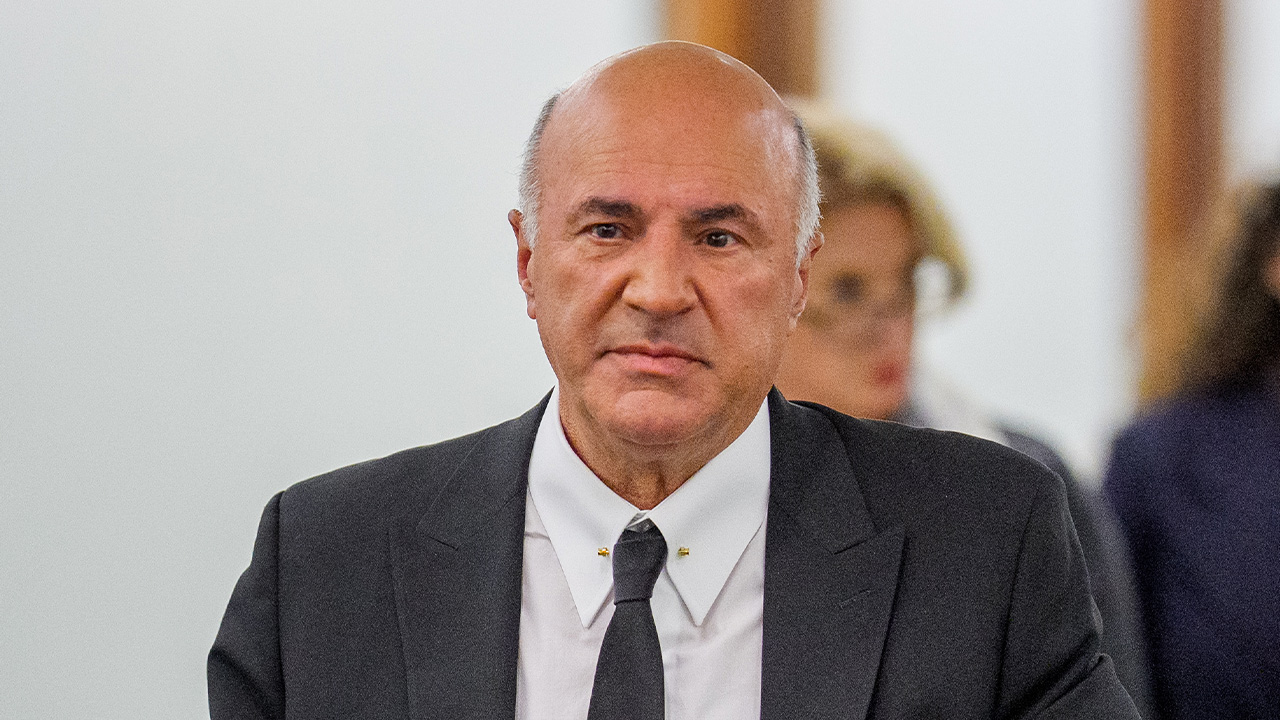
Kevin O’Leary, chairman of O’Leary Ventures, arrives to speak before the Senate Committee on Aging and the House Select Committee on the Chinese Communist Party joint hearing April 9, 2025, in Washington, D.C. (Andrew Harnik/Getty Images / Getty Images)
Supporters of the measure argue it would generate tens of millions of dollars for public programs such as healthcare and education, but opponents warn the levy could force billionaires to liquidate assets or unwind companies to cover the bill, accelerating an exodus of high-net-worth residents and entrepreneurs.
Advertisement
O’Leary said the outcome is already visible.
“When you basically start taxing people for success, it’s un-American,” he said.
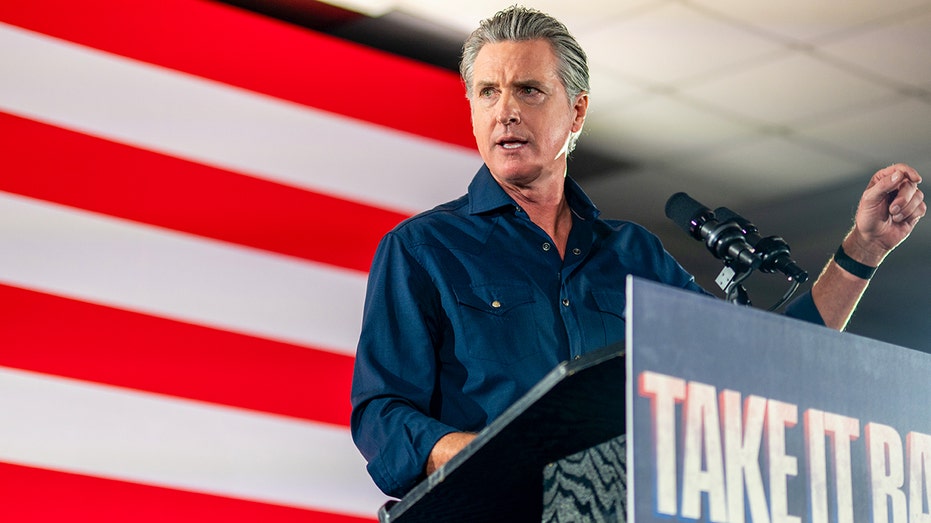
California Gov. Gavin Newsom speaks during a rally Nov. 8, 2025, in Houston, Texas. Newsom has warned about the negative implications the wealth tax course pose. (Brandon Bell/Getty Images / Getty Images)
“And, as the Constitution provides, competition of states, they move to places like where I am — Miami.”
Advertisement
The proposed measure even raised the eyebrows of California Democratic Gov. Gavin Newsom, who acknowledged the wealth tax is bad economics.
“The evidence is in. The impacts are very real — not just substantive economic impacts in terms of the revenue, but start-ups, the indirect impacts of … people questioning long-term commitments, medium-term commitments,” Newsom said.
‘Varney & Co.’ host Stuart Varney discusses Bernie Sanders’ new billionaire tax campaign and New York City’s proposed budget plan.
Advertisement
“That’s not what we need right now at a time of so much uncertainty. Quite the contrary.”
He predicted the measure “will be defeated.”
House Republicans have moved to block the proposal at the federal level, introducing legislation that would prevent states from retroactively taxing residents even after they relocate to lower-tax jurisdictions.
FOX Business’ Kristen Altus contributed to this report.
Lionel Messi and Son Heung-min are set to face off for the first time in Major League Soccer when reigning champions Inter Miami CF visit Los Angeles FC in the 2026 season opener Saturday at the historic Los Angeles Memorial Coliseum, a matchup billed as the league’s biggest star clash since Messi’s arrival and a perfect curtain-raiser for MLS’s World Cup year.
Lionel Messi IBTimes US
The game, kicking off at 9:30 p.m. ET (6:30 p.m. PT) as the inaugural Walmart Saturday Showdown on Apple TV, pits the Argentine legend against the South Korean superstar in what could be a preview of high-profile battles throughout the campaign. Messi, who led Inter Miami to the 2025 MLS Cup and back-to-back Landon Donovan MVP awards, returns from a minor hamstring strain that sidelined him briefly but saw him back in full training Feb. 18. Son, in his first full MLS season after joining LAFC mid-2025 from Tottenham Hotspur in a record transfer, dazzled with 12 goals and four assists in 13 appearances (including playoffs), earning MLS Goal of the Year honors.
The venue shift from BMO Stadium to the 77,000-plus capacity Coliseum — the first time LAFC has moved a home match — reflects massive anticipated demand for the generational showdown. Tickets sold briskly, with expectations of a near-sellout crowd drawn by the two global icons and supporting talent like Denis Bouanga (LAFC’s 2025 Golden Boot contender) and Inter Miami’s Rodrigo De Paul.
Messi enters 2026 as MLS’s undisputed face, having tallied 29 goals and 19 assists in the 2025 regular season before adding a postseason record 15 goal contributions en route to the title. At 38, he uses league play to stay sharp for what may be his final World Cup this summer in the U.S., Mexico and Canada. Son, 33, brings explosive pace, elite finishing and leadership — he captained South Korea — to LAFC, where he formed a lethal partnership with Bouanga (combined 25 goals, eight assists post-arrival in 2025). His free-kick wizardry and versatility make him a preseason MVP favorite alongside Messi.
Head-to-head history is limited: the pair met twice internationally (Argentina vs. South Korea friendlies or qualifiers), with Messi edging the record 1-0-1 in those encounters, scoring twice while Son contributed one assist. No prior club clashes exist, making Saturday’s meeting a fresh chapter. Comparisons highlight Messi’s unmatched vision and playmaking (career assists leader) against Son’s directness and work rate, though Messi’s trophy haul (World Cup, multiple Ballon d’Or) dwarfs Son’s Premier League and Asian records.
Advertisement
Both teams boast strong squads: Inter Miami features World Cup winners and a younger, faster core after offseason tweaks, while LAFC adds depth around Son and goalkeeper Hugo Lloris (another World Cup captain). The match tests Miami’s title defense against LAFC’s ambition to dethrone them.
MLS Commissioner Don Garber called it “the perfect way to launch a season in a World Cup host nation,” emphasizing the league’s star power. Broadcast on Apple TV globally (with local options), the game draws eyes from Argentina, South Korea and beyond, where fan bases for both players are massive.
As Messi and Son prepare — Messi rested selectively, Son skipping some preseason to peak — the clash promises fireworks. LAFC seeks revenge after Miami’s 2025 dominance, while Inter Miami aims to start strong in their back-to-back bid.
With kickoff approaching, anticipation builds for what could be MLS’s defining moment of 2026.
A Seoul court sentenced former President Yoon Suk Yeol to life imprisonment with hard labor on Thursday after finding him guilty of leading an insurrection through his short-lived declaration of martial law in December 2024, marking the most severe punishment ever imposed on a South Korean head of state in the democratic era.
Yoon Suk Yeol AFP
The Seoul Central District Court ruled that Yoon, 65, masterminded a grave attack on constitutional order by mobilizing troops to surround the National Assembly, attempting to arrest political opponents and seizing control of the national election commission during the six-hour crisis on Dec. 3, 2024. Prosecutors had sought the death penalty, arguing the actions threatened decades of democracy, but the court opted for life imprisonment, noting the plot’s failure to cause casualties or widespread violence.
Yoon, who served as president from May 2022 until his removal in April 2025, was impeached by the National Assembly on Dec. 14, 2024, just 11 days after the martial law order. The Constitutional Court upheld the impeachment unanimously on April 4, 2025, ousting him from office. He became the first sitting president in South Korean history to face arrest in January 2025 and has been in custody since July 2025 while facing multiple trials. The insurrection charge carried the heaviest penalty among several related indictments.
Yoon claimed the martial law was necessary to combat “anti-state forces” and alleged election fraud, but provided no evidence. The court described the episode as an “insurrection from the top,” involving senior officials including former Prime Minister Han Duck-soo (sentenced to 23 years last month), ex-Defense Minister Kim Yong-hyun (30 years) and others jailed for their roles.
Yoon is already serving a five-year term from a January 2026 ruling for abuse of power, obstructing arrest and related offenses tied to the martial law declaration. He faces at least three more trials on additional charges. His legal team is expected to appeal the life sentence within a week, though analysts anticipate prolonged proceedings.
Advertisement
The verdict caps a tumultuous period that plunged South Korea into its worst political crisis in decades, testing democratic institutions and exposing deep polarization. Yoon’s supporters rallied outside the courthouse, while critics celebrated the ruling as accountability for an unprecedented power grab.
The martial law attempt — Yoon’s declaration on live television to root out alleged threats — triggered immediate backlash, with lawmakers reconvening to vote it down within hours. The episode led to Yoon’s impeachment, removal and a snap presidential election in June 2025, won by opposition leader Lee Jae-myung of the Democratic Party.
Yoon’s presidency, marked by conservative policies, tensions with North Korea and domestic scandals, ended amid the fallout. His conviction makes him the first elected South Korean leader to receive a life sentence, though the country has not executed anyone since 1997 despite retaining capital punishment.
Reactions poured in Thursday: President Lee Jae-myung remained silent, while opposition figures hailed the decision as upholding democracy. Supporters decried it as politically motivated. The ruling could influence South Korea’s political landscape ahead of future elections, with Yoon disqualified from public office for five years under separate penalties. As Yoon begins serving the life term, the case underscores the resilience of South Korea’s democracy amid a grave constitutional challenge.