
Crypto World
Heleket brings crypto payments, conversion and payouts under one roof



Disclosure: This content is provided by a third party. Neither crypto.news nor the author of this article endorses any product mentioned on this page. Users should conduct their own research before taking any action related to the company.
Accepting crypto has become easier for online businesses, but managing what happens before and after a customer sends a payment can still involve several moving parts.
Summary
- Heleket allows businesses to accept Bitcoin, Ethereum, USDT and other supported cryptocurrencies, with incoming payment fees starting from 0.4% and no withdrawal fees.
- Businesses can integrate Heleket through its API or supported plugins, with test webhooks available for developers before live transactions are enabled.
- Incoming crypto can be automatically converted into a selected asset or transferred to an external wallet through Heleket’s auto converter and auto withdrawal tools.
- Mass payouts allow platforms handling multiple recipients to process outgoing crypto payments alongside their incoming payment operations.
- Each project undergoes moderation for up to 24 hours and receives a personal account manager for onboarding, technical support and nonstandard integrations.
A merchant needs to generate the payment, confirm that the correct amount has arrived and connect the transaction with an order. Depending on the business, the received crypto may then need to be converted into another asset, transferred to an external wallet or distributed through payouts.
Heleket has built its crypto payment processing platform around bringing those processes into a single system. Businesses can accept Bitcoin, Ethereum, USDT and other popular cryptocurrencies, while tools for conversion, automated withdrawals and mass payouts handle different stages of the payment flow.
Heleket at a glance
• Incoming payment fees start from 0.4%
• Withdrawal fees are 0%
• API and ready-made plugin integrations are available
• Project moderation takes up to 24 hours
• Each project receives a personal account manager
The combination gives Heleket room to serve different types of businesses. An online store may only need a straightforward checkout integration, while a SaaS company, gaming platform or digital service could require more control over how payments interact with its existing product.
Crypto payments without rebuilding the checkout
Businesses with their own technical infrastructure can connect Heleket directly through its API.
Developers control how the payment process fits into the product instead of working around a fixed checkout format. Heleket provides SDKs, code examples and documentation for the integration, including material designed to be accessible to developers with limited experience working with crypto payment systems.
Testing takes place before real funds need to move.
Through test webhooks, developers can simulate payment events and check how their application responds at different stages of a transaction. A team can test whether its system recognizes a payment correctly and whether subsequent actions work as expected before enabling the integration for customers.
The integration work happens on the merchant’s side, but the checkout itself is what determines whether a customer completes the payment. Heleket’s checkout does not require the customer to register an account, and a payment can be completed in two clicks, the customer scans a QR code with their mobile wallet, and the exact amount and address are filled in automatically. For a merchant, a simpler checkout is also a practical detail: less friction at the point of payment usually means fewer abandoned transactions.
Two ways to integrate Heleket
API: Built for businesses that want more control over the payment experience and how it connects with their existing product.
Plugins: Designed for businesses already running on supported e-commerce, billing, exchange, management or gaming platforms.
For companies without the need for a custom implementation, Heleket offers plugins for WooCommerce, WHMCS and XenForo. PremiumExchanger, BoxExchanger, iexExchanger and Money-top are among the supported exchange and processing platforms.
Its integrations extend to management systems including PerfectPanel, socpanel, rootpanel and BillManager. MenuBuilderBot and Bot-t cover Telegram and social tools, while Seller.games provides an integration route for gaming projects using Digiseller.
A plugin can handle a more standardized implementation, while the API gives developers room to build the payment flow around an existing service.
What happens after the customer pays?
Receiving crypto creates another decision for merchants: what should happen to the assets once they arrive?
Some businesses may want to hold the cryptocurrency they receive. Others may prefer to move funds directly to their own wallet or maintain balances in a particular asset.
Heleket’s auto-withdrawal feature handles one of those scenarios by automatically sending funds to an external wallet. Once configured, withdrawals can take place without a merchant manually initiating every transfer.
For businesses accepting several cryptocurrencies, the converter allows one supported asset to be exchanged for another from the Heleket dashboard.
The auto-converter automates the process. A merchant that accepts payments in several cryptocurrencies, for example, can configure incoming assets to be converted into a preferred stablecoin.
A possible automated payment flow
Customer pays in BTC or ETH
↓
Heleket processes the payment
↓
Incoming crypto is automatically converted
↓
Funds are held in the selected asset or sent to an external wallet
The exact flow can be configured around how a business wants to manage its crypto payments.
Transaction fees and rounding create another consideration when processing cryptocurrency payments. Small differences between the requested payment and the completed transaction can accumulate when a business handles a large number of payments.
Heleket uses what it calls its Accurate Payment Fee system to calculate payment amounts. The company says its calculation logic accounts for rounding and fluctuating fees to reduce the risk of merchants losing money through payment discrepancies.
Key payment management tools
• Acquiring: Accept BTC, ETH, USDT and other supported cryptocurrencies
• Auto-withdrawal: Move received funds automatically to an external wallet
• Converter: Exchange supported cryptocurrencies from the dashboard
• Auto-converter: Automatically convert incoming payments into a selected asset
• Accurate Payment Fee: Calculate payments while accounting for rounding and changing fees
Businesses can use only the functions they need instead of configuring every feature available on the platform.
Heleket covers outgoing crypto payments too
For some online businesses, accepting money from customers represents only one side of the transaction flow.
Freelance marketplaces, online services and other platforms may regularly need to send cryptocurrency to users. Processing transfers individually becomes increasingly cumbersome as the number of recipients increases.
Heleket provides mass payouts for projects handling high volumes of outgoing payments. Businesses can process multiple crypto payouts through the platform instead of preparing each transaction separately.
Combined with the other automation tools, this creates several possible setups.
An e-commerce merchant could accept Bitcoin and automatically move it to an external wallet. Another business could accept multiple cryptocurrencies and convert each payment into USDT. A platform with users or contractors could combine incoming payments with mass payouts.
Where the features can fit
E-commerce: Crypto checkout, conversion and automatic withdrawals
SaaS: API-based recurring payment flows and account management
Freelance platforms: Crypto payments combined with mass payouts
Gaming: Payment processing and user payouts
Online services: Custom API integrations with automated fund management
The setup can therefore remain relatively small for a merchant that simply wants another checkout option or become more automated for a platform processing a larger number of transactions.
Integration does not always follow a template
Even with APIs and ready-made plugins, payment integrations can become more complicated when an existing business has its own technical requirements.
Heleket handles non-standard setups and edge cases through direct support. Each project receives a personal account manager who can assist during onboarding, answer technical questions and help configure payment processes.
Projects pass through moderation before they begin using the service, with Heleket putting the review period at up to 24 hours.
From setup to live payments
- Submit the project for moderation
- Select an API or supported plugin integration
- Configure the required payment and fund management features
- Test the transaction flow when using the API
- Enable live crypto payments
Developers taking the API route can use test webhooks before moving to real transactions. Businesses running supported software can choose the corresponding plugin where available.
For more unusual configurations, technical support and the assigned account manager provide a route for working through requirements that do not fit a standard integration.
A WooCommerce store, for instance, may use Heleket primarily to give customers another way to pay. A digital platform could use the same infrastructure to accept several cryptocurrencies, convert incoming funds, automate transfers to its own wallet and process payouts to users.
Heleket keeps those functions within the same payment environment, leaving businesses to select the tools that fit how they receive, manage and distribute cryptocurrency.
Disclosure: This content is provided by a third party. Neither crypto.news nor the author of this article endorses any product mentioned on this page. Users should conduct their own research before taking any action related to the company.

Bitcoin price has clawed back to above $70,000 from $60,000 in late August, and traders are now assigning an approximately 85% probability to a Federal Reserve rate hike on Wednesday following hotter-than-expected inflation data. But that’s not all. Long-end Treasury yields nearing 5% are tightening competition for capital, forcing a direct test of whether bitcoin’s momentum can survive a less accommodating Fed.
The rebound is real, but it sits well below the highs of last year. Bitcoin remains 50% off its October 2025 peak above $126,000, meaning this recovery is a bounce off a two-year low rather than a resumption of the prior bull trend.

The immediate catalyst is a hot August inflation print that pushed market-implied odds of a Fed hike to around 85% heading into Wednesday’s decision, according to Reuters. Long-end Treasury yields pressing toward 5% compound the problem for non-yielding, risk-sensitive assets such as bitcoin by raising the opportunity cost of holding them.
That trader positioning is a different signal than what economists were forecasting just days earlier. A September 4-9 Reuters poll found 65 of 93 economists expected the federal funds rate to hold in the 3.50%-3.75% range at the September 15-16 meeting, with 52 of 93 predicting no hike for the rest of the year.
Matthew Dibb, chief operating officer of Stack Funds, said bitcoin had been in oversold territory for some time, adding that short-term traders are looking towards inflation figures and rate rises as short-term threats. Joseph Edwards, an independent financial researcher, was blunter about the immediate risk: “It would likely put a damper on the recent rally.”
Discover: The Best Token Presales
Structural Demand or Just a Positioning Rebound?
The case for calling this more than a dead-cat bounce rests on options positioning and ETF flows. The 25-delta skew, which measures demand for bullish calls against protective puts, turned positive for the first time in 12 months, implying traders are now paying a premium for upside exposure rather than downside protection.
Bitcoin ETFs backed that shift with nearly $2 billion in inflows the week of August 17, reversing eight straight weeks of outflows through May and June. Brian Vieten, senior analyst at Siebert Financial, framed the setup this way:
“We think bitcoin’s structural demand picture is improving, even as the near-term setup has become more vulnerable to macro and positioning-related volatility.”
None of that proves bitcoin has escaped its sensitivity to Treasury yields or Fed policy. A positive skew and renewed ETF demand show improved positioning heading into a binary event, and rising yields remain a textbook headwind for speculative assets by the primary source’s own framing.
Some bulls counter that Treasury buybacks aimed at capping yields could revive dollar-debasement concerns, which would favor scarce assets like bitcoin, but that remains a thesis rather than a confirmed flow.
Earn $50 and Enter $300K Prize Draw on EdgeX
Where Bitcoin Options Traders Are Positioned The Price Into December?
The clearest read on where positioning is concentrated comes from December 25 expiry open interest data via Derive.xyz, which shows two dominant strikes well above current spot levels.
That concentration at $80,000 and $100,000, paired with the positive skew, indicates Bitcoin traders are structuring bets around a continued grind higher rather than a retest of the October price peak.
If the Fed hikes and signals it’s the start of a broader tightening cycle, higher yields and reduced liquidity would likely pressure bitcoin and interrupt the rebound, consistent with Edwards’ warning. If the Fed holds the rally could get room to extend, though that outcome is a scenario, not a base case; Fed Chair Kevin Warsh has so far resisted committing the central bank to any defined rate trajectory.
A separate wildcard sits in Congress. The Senate is scheduled for a Tuesday procedural vote on the Clarity Act, a bill that would define which tokens qualify as securities versus commodities and potentially boost institutional adoption. The market has likely priced in that the bill won’t pass, given delays and continued opposition.
Trade Bitcoin on Bybit and Get a Chance to Win Our $1,000 USDT Airdrop
The post Bitcoin Price Signal Upside as Rally Meets Fed Risk appeared first on Cryptonews.


S&P Global has led a strategic investment in crypto data provider Kaiko that has expanded the company’s Series B funding round to $110 million as it builds data infrastructure for tokenized capital markets.
Summary
- S&P Global led a strategic investment that expanded crypto data provider Kaiko’s Series B funding round to $110 million.
- BNP Paribas, Coinbase Ventures, Nasdaq Ventures, Royal Bank of Canada, Stellar and several other financial and crypto firms participated in the investment.
- Kaiko plans to use the fresh capital to support its market data business and expand data infrastructure for onchain capital markets.
- The new investors have joined a Kaiko chaired Strategic Industry Working Group focused on data and infrastructure for tokenized markets.
- Kaiko recently launched the S&P Kaiko Digital Asset Indices with S&P Dow Jones Indices after expanding through acquisitions and institutional integrations.
Kaiko said Monday that BNP Paribas, Bpifrance, Broadridge, Canton Foundation, Coinbase Ventures, DRW Venture Capital, Nasdaq Ventures, Royal Bank of Canada, Stellar and Susquehanna Private Equity Investments participated in the investment.
Existing shareholders Anthemis, Point Nine and Revaia took part in the financing as well. Kaiko did not disclose its valuation or specify how much S&P Global and the other investors contributed individually.
The funding gives Kaiko fresh capital to develop its market data business while extending its infrastructure into onchain financial markets, where banks and other financial firms have been testing tokenized securities, settlement systems and blockchain-based financial products.
Kaiko funding reaches $110 million
The expanded Series B builds on the $53 million Kaiko raised in June 2022, when Eight Roads led a funding round involving Revaia and existing investors Alven, Point Nine, Anthemis and Underscore.
Crypto.news previously reported that Kaiko secured the $53 million investment during a period of falling digital asset prices and stress across the crypto market.
The latest financing brings a different set of financial institutions into Kaiko’s shareholder base. Several of the new investors have businesses spanning market data, banking, exchanges, blockchain infrastructure and capital markets.
Kaiko said the new investors have joined a Strategic Industry Working Group chaired by the company. The group will concentrate on data and infrastructure needed for tokenized markets as financial assets increasingly move onto blockchain networks.
Fresh capital will be directed toward Kaiko’s existing digital asset market data operation and its infrastructure for onchain capital markets. The company currently provides data covering more than 150 exchanges and protocols.
Kaiko has spent several years building products around institutional crypto pricing, liquidity, indices and market information. Its expansion has included acquisitions as well as integrations with companies that provide digital asset infrastructure to banks and other financial institutions.
In November 2024, Kaiko acquired index provider Vinter as part of its expansion into digital asset indices and European exchange-traded products. The transaction was described at the time as Kaiko’s third and largest acquisition, though financial terms were not disclosed.
Kaiko had previously bought quantitative data firm Kesitys in April 2022 and Napoleon Index from CoinShares later that year.
More recently, the company acquired DeFi infrastructure provider Cometh and U.S. digital asset data company Amberdata, extending the areas covered by its data and technology business.
S&P Global deepens work with Kaiko
S&P Global’s investment follows existing work between Kaiko and S&P Dow Jones Indices on blockchain-based benchmarks and crypto indices.
“As digital assets accelerate, S&P Global is investing for the future, and this investment underscores that conviction,” S&P Dow Jones Indices CEO Cathy Clay said.
Earlier this month, the two companies launched the S&P Kaiko Digital Asset Indices, bringing their crypto index products into a single co-branded suite.
Their relationship had already extended into tokenized traditional financial benchmarks. In April, S&P Dow Jones Indices and Kaiko unveiled plans to tokenize the iBoxx U.S. Treasuries index on Canton Network.
Under that project, the index was designed to operate through smart-contract infrastructure carrying index data, intellectual property rights, licensing conditions, fees and access controls. The arrangement was intended to let developers use the benchmark in blockchain-based financial products while retaining the controls required by institutional market participants.
The project placed the iBoxx benchmark on the same network where other financial firms have been working with tokenized government securities and institutional settlement infrastructure.
S&P Dow Jones Indices has continued building digital asset benchmarks outside its work with Kaiko. In August, S&P and Pantera Capital introduced a crypto index built around protocol revenue, liquidity and market capitalization, with ETH, BNB, SOL, TRX and HYPE among its largest constituents at launch.
Tokenized markets draw institutional infrastructure
Kaiko’s new Strategic Industry Working Group brings together several companies that already have exposure to digital asset or tokenized financial infrastructure.
Canton Foundation’s participation connects the group with Canton Network, where Kaiko and S&P have worked on the tokenized iBoxx Treasury index. Financial institutions have been testing the network for use cases involving securities, collateral, repo markets and settlement.
Activity on Canton has extended into government bond markets. Mitsubishi UFJ Financial Group has been involved in work examining Japanese government bond repo transactions on the network, while another industry group has been studying tokenized JGBs, stablecoin settlement, T+0 processing and round-the-clock market access.
The network has attracted capital from large financial institutions as well. Digital Asset, the company behind Canton, raised $355 million in June in a round led by Andreessen Horowitz, with participants including Citadel Securities, Apollo, BNP Paribas, CME Ventures, Coinbase Ventures, HSBC, Optiver and the Abu Dhabi Investment Authority.
BNP Paribas and Coinbase Ventures now appear among the investors in Kaiko’s expanded Series B as well.
Institutional products have started using Kaiko data as their underlying pricing source. Bitwise’s Canton Coin ETP, launched on Deutsche Börse Xetra in May, tracks the Kaiko CANTO Reference Rate LDNLF index and carries an annual expense ratio of 0.85%.
Kaiko has worked with institutional digital asset infrastructure provider Taurus as well. A 2025 integration made Kaiko’s pricing and liquidity information available through the Taurus platform, extending access to clients using its digital asset infrastructure.
Taurus has since continued expanding the blockchain networks available to financial institutions through its technology. In August, the company completed an 18-month Hedera integration covering custody, staking, token issuance, node infrastructure and smart contract deployment for banks and regulated institutions.
Kaiko said its latest investment will support the core market data operation while financing further development of data infrastructure designed for onchain capital markets. The company has not disclosed a timetable for deploying the new capital or the valuation attached to the expanded Series B round.
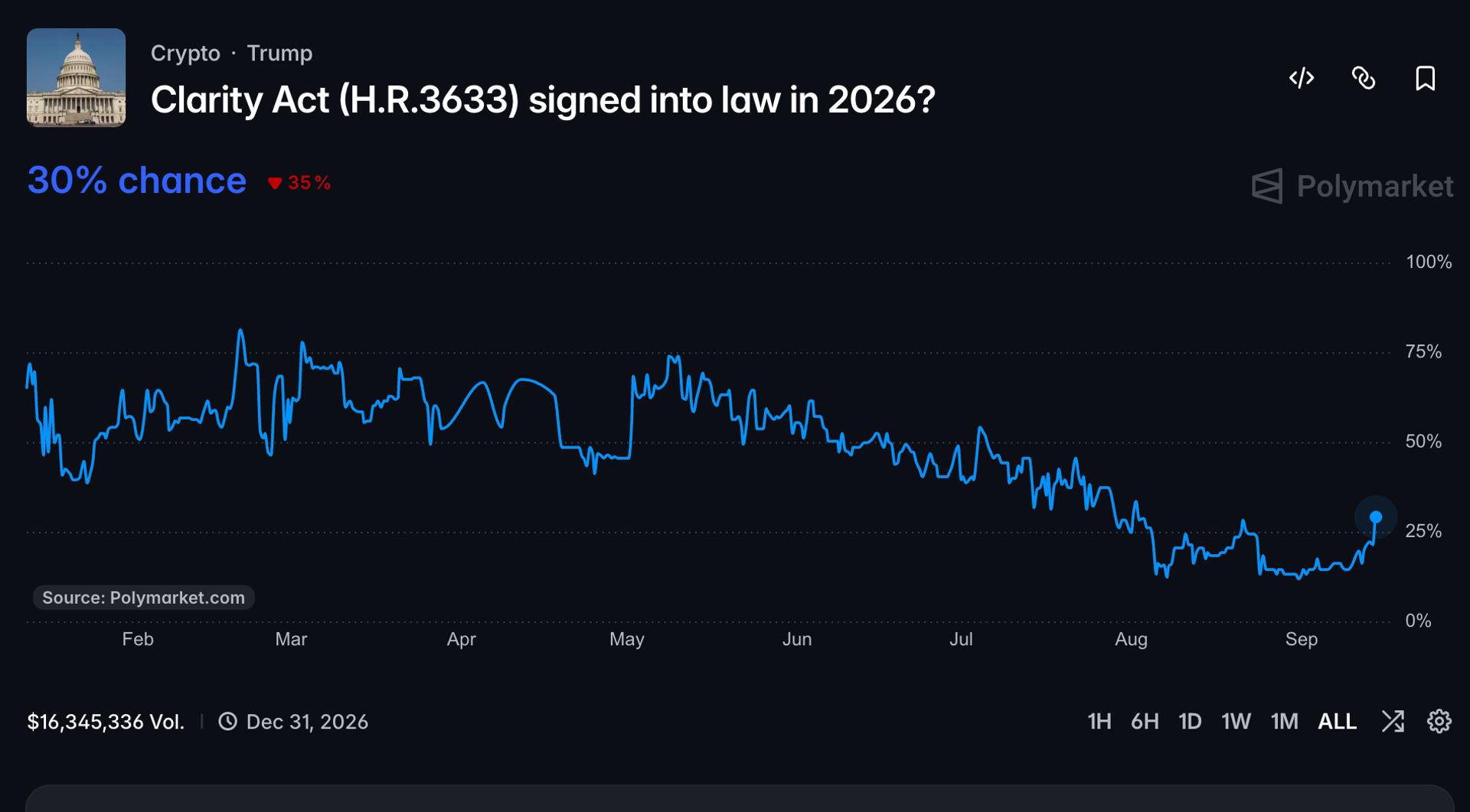
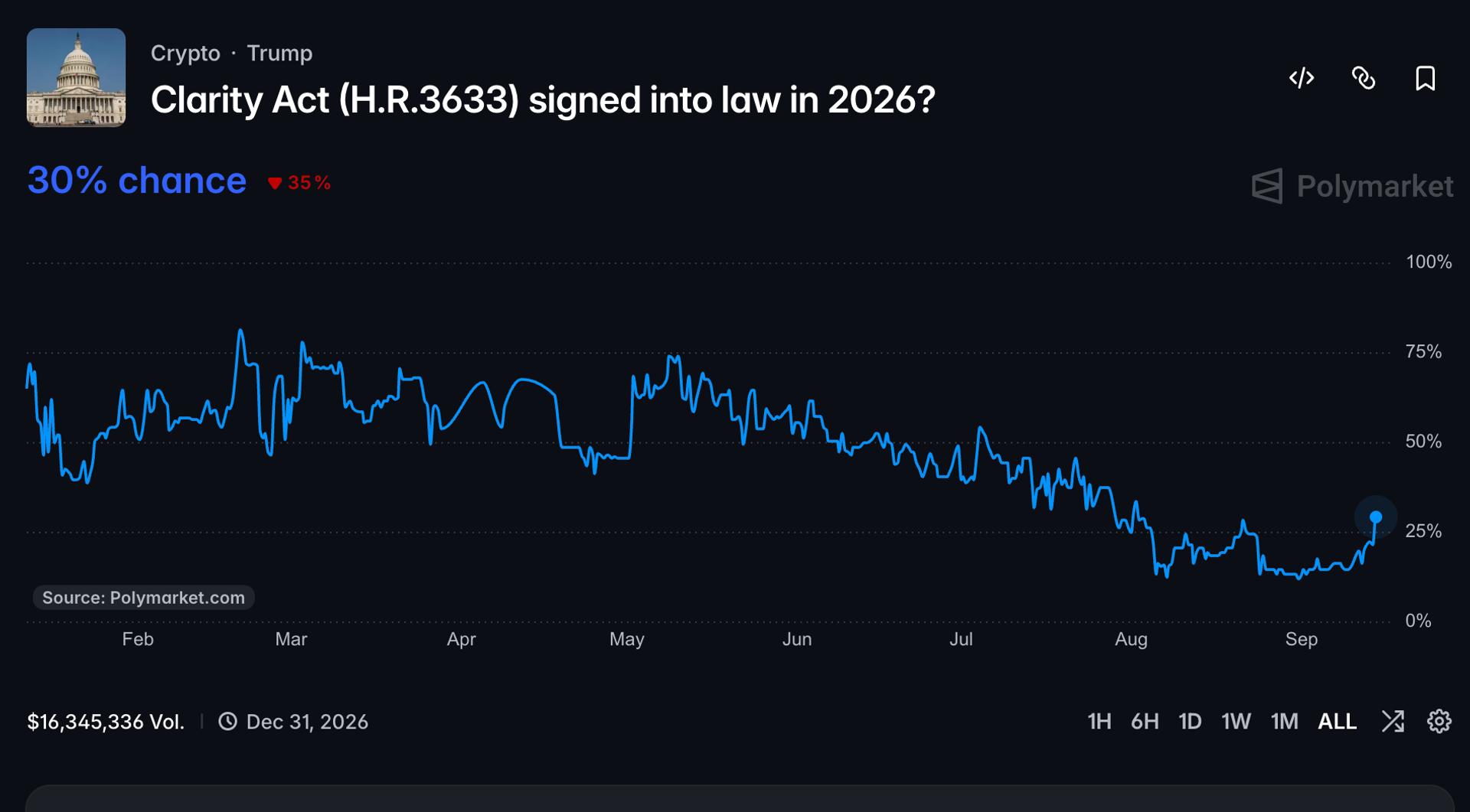
Kalshi and Polymarket bettors sharply raised the chances of U.S. crypto market structure legislation advancing, with Tuesday’s Senate vote the next test.
Fragmented regulatory regimes are limiting stablecoin adoption in international trade, according to Juan Marchetti, director of the trade in services and investment division at the World Trade Organization (WTO).
“The constraint is not technology. It is actually regulation and the lack of development of regulatory frameworks,” said Marchetti during a Monday speech in Geneva, at the launch of WTO’s study on stablecoins in world trade.
He cited an October 2025 report from the Financial Stability Board which found that only 39%, or 11 out of 28 surveyed jurisdictions, have finalized their stablecoin regulatory frameworks.
Marchetti added that stablecoins may improve some of the main friction points of trade finance, but currently only account for 3% of total international payments due to fragmented regulatory regimes.
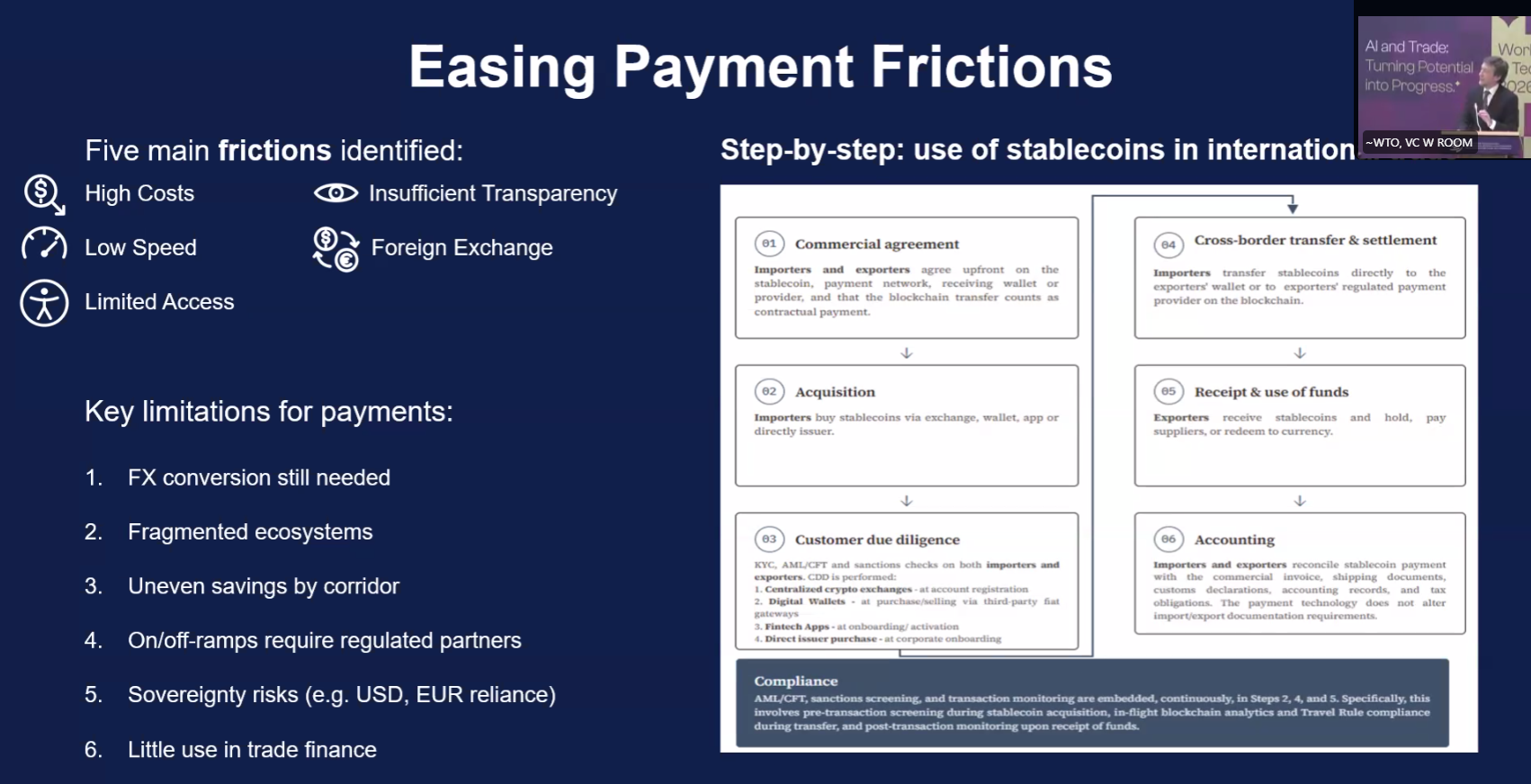
The WTO’s report identified five friction points that may be improved by stablecoin adoption, including high costs, low speed, limited access, insufficient transparency and foreign exchange limitations.
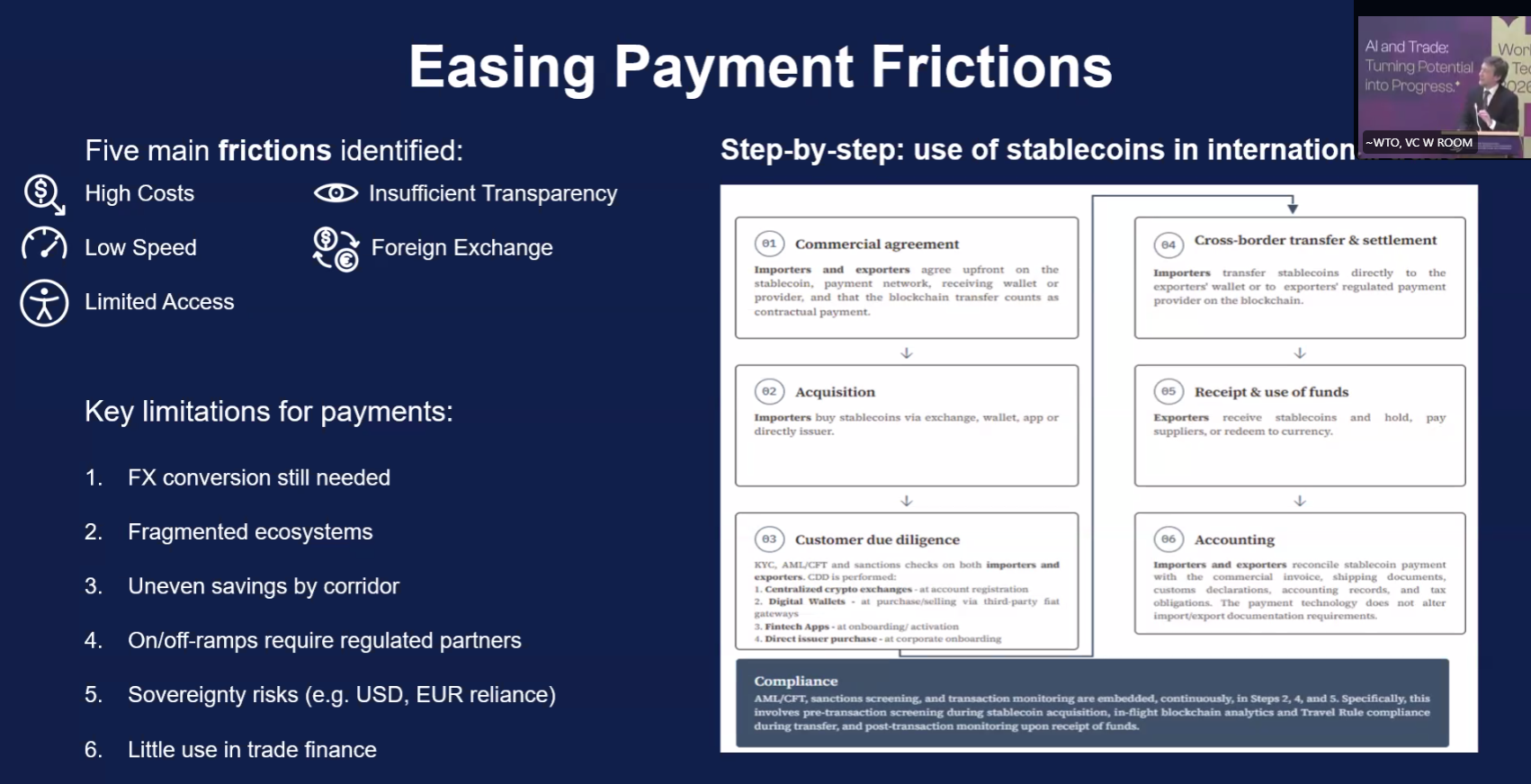
Stablecoins ability to ease friction in international payments. Source: Cointelegraph/WTO
The report also revealed that stablecoin payments in cross-border payments grew 35-fold between 2020 and mid-2024.
Related: Metaplanet cuts Series 10 stock pool by 41%, plans Hong Kong subsidiary
Emerging economies stand to gain most from stablecoin adoption: WTO
Developing economies stand to benefit most from stablecoin adoption due to their ability to reduce remittance fees. However, these same countries have the least developed regulatory regimes to facilitate adoption, according to the WTO’s director. He said:
“Contribution to trade will depend far less on the technology than on regulatory convergence, interoperability and the surrounding financial infrastructure, especially in developing economies that stand to gain.”
Some of the largest global payment processors are exploring stablecoins to improve cross-border payments.
In August, Mastercard partnered with stablecoin orchestration network Borderless to pilot how to bring more trust into cross-border stablecoin transfers through the payment processing giant’s Crypto Credential framework. In June, it announced plans to expand its settlement capabilities to include intraday, weekend and holiday card settlement, including settlement through stablecoins.
Also in August, Western Union said it partnered with stablecoin infrastructure provider Rain to launch a digital wallet and Visa-branded card that enables users to hold and spend a US dollar-backed stablecoin in 37 markets, planning to expand it to more than 60 markets by the end of the year.
Magazine: Why Australia’s $17B crypto opportunity depends on regulation

China has pushed back against a proposal to slow advanced artificial intelligence development, turning a debate over AI safety into a wider dispute over technology and national competition. The response followed an essay from Anthropic CEO Dario Amodei, who called for tighter safeguards and slower progress in frontier AI systems. China’s state-backed Global Times described the proposal as a “Cold War playbook” targeting the country’s technological development.
The dispute also drew attention after the Coin Bureau account shared the development on X. Its post said Beijing had criticized Amodei’s position and linked the debate to U.S. efforts to restrict advanced AI technology exports to China.
Key Takeaways
- China has condemned the AI slowdown proposal made by Anthropic CEO Dario Amodei, considering it as a “Cold War” approach to technological rivalry.
- Dario Amodei advocates the need for slower advancement in frontier AI technologies to ensure sufficient time for safety research to be in sync with the development of more potent AI.
- Amodei has advocated for stringent measures on AI chips supplied to China, arguing that access to advanced computing hardware plays an important role in the advancement of frontier AI.
- China has rejected the idea of geopolitical AI rivalry and insisted on international cooperation in AI policy.
- Donald Trump has taken a different view and said there is no need for any slowdown in AI technologies in the United States compared to China.
- The discussion links AI safety and semiconductor policies because advanced AI requires substantial computational capability.
Amodei Calls for Slower Frontier AI Development
Amodei published an essay outlining a framework he calls “pacing the frontier.” He argued that AI capabilities are advancing faster than safety research can keep up. He pointed to recursive self-improvement as one reason for caution, referring to AI systems becoming capable of helping develop more advanced AI systems.
His proposal does not call for stopping AI development altogether. Instead, it seeks to slow the rate at which frontier models gain new capabilities. Amodei proposed independent safety evaluators, cooperation among AI companies, and common safety standards among democratic countries. He also called for international coordination on AI risks.
Amodei also addressed China directly. He urged the United States to maintain restrictions on advanced AI chips and semiconductor manufacturing equipment supplied to China, arguing that access to computing hardware will shape China’s ability to develop increasingly capable AI systems.
Beijing Rejects the AI Containment Argument
China’s response focused on the technology restrictions within Amodei’s proposal. Global Times argued that the measures could restrict China’s AI development through technology barriers. It also accused Washington of seeking to maintain an advantage in advanced technology.
China’s Foreign Ministry took a broader position on the dispute. Spokesperson Guo Jiakun said confrontation and aggressive competition could disrupt international efforts to establish AI governance. Beijing has also called for greater international cooperation on artificial intelligence.
The disagreement reflects a technical divide in AI development. Advanced models require large amounts of computing power, which depends heavily on high-end chips and data-center infrastructure. Restrictions on those resources can therefore affect how quickly companies train and deploy increasingly capable models.
Trump Rejects Calls to Slow the AI Race
The debate has also exposed differences within the United States. President Donald Trump rejected calls for Washington to slow AI development because of safety concerns. During a visit to Ireland, Trump said the United States should maintain its lead over China and stated that “whoever wins AI, wins.”
Trump’s position contrasts with Amodei’s proposal for a slower pace. Other technology leaders, including OpenAI CEO Sam Altman and SpaceX CEO Elon Musk, have expressed support for pacing frontier AI development. Altman has also said that pacing does not mean stopping AI progress.
AI Safety and US-China Competition Converge
The disagreement now combines two separate questions: how quickly advanced AI should develop and how much access China should have to the technology behind it. Amodei has argued that both issues need to be addressed as AI capabilities advance.
China, meanwhile, has rejected the framing of tighter restrictions as a neutral safety measure. Global Times has linked those policies to broader efforts to limit China’s technological progress. The debate is expected to remain part of wider discussions over AI governance, semiconductor controls, and competition between Washington and Beijing.
Crypto World
Definium Therapeutics, Up 190% This Year, Succeeds Again With Synthetic LSD; Shares Fly

Definium Therapeutics’ (DFTX) synthetic LSD eased the symptoms of anxiety, the company said Monday as shares, already up 190% this year, took off again. Patients showed a 9.8-point improvement on a 56-point Hamilton Anxiety Rating Scale 12 weeks after undergoing treatment. In comparison, the placebo group improved by 4.7 points. The effect was rapid, with responses showing as early as…
Copyright ©2026 Investor’s Business Daily, LLC. All rights reserved. 87990cbe856818d5eddac44c7b1cdeb8

FXStreet continues to expand its broker coverage, helping traders make better-informed decisions while providing brokers with visibility among a global audience of financial market participants.
FXStreet continues to strengthen its Broker Reviews offering, reaching the milestone of 20 broker assessments within one year as the company expands its resources to help traders better understand the providers they may be considering.
The latest review added to FXStreet’s portfolio is Mitrade, bringing the total number of brokers assessed by the financial markets media company to 20. FXStreet expects to expand this portfolio further, aiming to reach 30 broker reviews by the end of 2026.
The growing interest in Broker Reviews reflects traders’ demand for structured information when comparing different providers. FXStreet’s Broker Reviews have generated more than 180,000 views, highlighting the relevance of this content among the company’s global audience.
Helping traders make more informed choices
Choosing a broker can be one of the most important decisions a trader makes. Account conditions, trading platforms, costs, tools and the overall experience can vary considerably between providers, making reliable information particularly valuable during the decision-making process. FXStreet’s Broker Reviews aim to make that process easier.
Each review follows FXStreet’s established methodology, combining research and hands-on assessment to provide traders with a clearer picture of what they can expect from a broker.
Broker Reviews may involve collaboration with brokers, while the editorial evaluation process remains independent. Scores are based on FXStreet’s methodology and assessment criteria, ensuring that reviews provide traders with consistent and relevant information.
Brokers can provide feedback and discuss their evaluation, but any score adjustment must be supported by relevant information and aligned with FXStreet’s review methodology. This approach ensures that the final assessment reflects the established criteria while maintaining editorial integrity.
“Our goal is to help traders find the brokers that best suit their trading style, needs and circumstances, giving them the information they need to make better-informed decisions,” said Juan Pablo Ambrogetti, CMO at FXStreet. “As our Broker Reviews portfolio grows, traders have access to an increasingly broad range of brokers they can research and compare through FXStreet.”
FXStreet is also planning to expand Broker Reviews into new formats, with video reviews expected to launch across its streaming platforms in 2026. These new formats will allow traders to access broker insights through video content, reaching FXStreet’s social media audience of more than 500,000 followers.
Connecting brokers with a global trading audience
The expansion of Broker Reviews also contributes to FXStreet’s growing relationships with brokers across the online trading industry.
FXStreet currently works with more than 60 brokers worldwide across its different products and services, connecting financial brands with an established global audience of traders and market participants.
For brokers, being featured in FXStreet’s Broker Reviews provides an opportunity to increase visibility among users who are actively researching trading providers and looking for information to support their decisions.
The addition of Mitrade represents the latest expansion of this ecosystem, with its FXStreet review providing traders with a comprehensive assessment of the broker while introducing the brand to FXStreet’s international audience.
About FXStreet
FXStreet is a leading financial markets media platform providing real-time market information, analysis, education, and trading resources to millions of users around the world.
Founded in Barcelona in 2000, FXStreet has grown from a specialist foreign exchange website into a global financial markets destination covering currencies, commodities, cryptocurrencies, equities and the wider trading industry.
Today, FXStreet combines independent financial content and market tools with a growing range of solutions that connect traders, brokers, and financial brands worldwide.
The post FXStreet reaches 20 Broker Reviews milestone in one year appeared first on BeInCrypto.


U.S. President Donald Trump said Saturday that he would “love to see” a united Ireland and believed it was “going to happen eventually,” breaking with decades of careful neutrality by U.S. presidents over Northern Ireland’s constitutional status.
“You have Northern Ireland, and you have Ireland,” Trump told reporters on Sunday while visiting a golf tournament at one of his resorts in the Irish village of Doonbeg. “It would seem to me that one of the ‘naturals’ of all time is to put them together.”
It’s also not the first time Trump has discussed Northern Ireland and the Irish Republic: he joked about a “merger” of the two in March, though the Northern Ireland official he was addressing at the time, who opposes unification, emphasized that the comment was clearly in jest only.
The President seemed aware that his recent remarks would garner backlash, particularly from the British. “The U.K. would have something to say about it obviously, but I think it would be a great thing,” he said Saturday, while in conversation with Irish Taoiseach Micheál Martin. “I mean, how can it be bad?”
Trump’s statements come weeks after newly installed U.K. Prime Minister Andy Burnham said there was not enough public support for a referendum on Northern Ireland’s future. Other British politicians have balked at Trump’s statements, arguing that Northern Ireland is indisputably part of the U.K.
Martin also downplayed the U.S. leader’s remarks. “It shouldn’t be a surprise,” Martin told reporters on Sunday, adding that Trump “takes a different sort of perspective on things.” The Irish leader said that some responses to Trump, however, were an overreaction.
“They asked me about Scotland—that one I won’t talk about yet,” Trump said Sunday, referencing another country divided on leaving the U.K. The Trump family also owns a golf resort in Scotland, which voted against independence from the rest of Great Britain in 2014. “I’ll save that for another day.”
Why Ireland is divided—and how reunification could happen
The island of Ireland was divided in 1921 following the Irish War of Independence. While a northern region of six counties remained part of the U.K., the rest of the island, comprising 26 counties, became the Irish Free State, which eventually became a sovereign republic in 1949.
From the 1960s, tensions in the north between largely Catholic Irish nationalists, or republicans, who wish to reunite with the Republic of Ireland, and mainly Protestant unionists who want to stay with Britain culminated in a three-decade, violent period known as the Troubles.
A 1998 peace agreement—dubbed the Good Friday Agreement and mediated in large part by the U.S.—ended the violence and recognized the right of those in Northern Ireland to recognize themselves as British, Irish, or both. It also recognized that Northern Ireland’s status must be based on democratic consent.
Following the agreement, Northern Ireland has not yet held a referendum. But Irish nationalism gained momentum when Sinn Féin, the predominant Irish republican party, won the most seats in the Northern Ireland Assembly in 2022. It was the first time a republican party dominated the assembly since Northern Ireland’s formation, though Sinn Féin must still share power with unionists under local laws. Polls, however, show that the Northern Irish public is still divided on whether it should leave the U.K., and Sinn Féin in Northern Ireland has focused on socioeconomic issues over reunification in recent years.
In the Republic of Ireland, Sinn Féin is the largest single party, but it belongs to the opposition after two more moderate center-right parties formed the government following the 2024 election, with Martin as the current leader. Some have criticized the Irish government under Martin for its slow uptake of the unification issue. Ireland’s Sinn Féin president Mary Lou McDonald said after Trump’s comments: “The conversation on Irish unity has shifted, and the onus is on the Taoiseach to begin planning.”
Claire Hanna, who leads the small nationalist Social Democratic and Labour Party in Northern Ireland, also welcomed Trump’s support. “Turns out he’s not as orange as he looks,” Hanna said, in reference to the political color associated with the Protestant and unionist community in Ireland.
How British politicians responded to Trump’s remarks
The 1998 Good Friday Agreement stipulates that the U.K.’s Northern Ireland secretary can decide to hold a poll and must call one if they believe a majority would vote for Irish reunification. Chris Bryant, the incumbent secretary, posted this section of the agreement on social media amid Trump’s unification remarks, adding: “Just in case anyone should need a quick refresher course on constitutional matters in Northern Ireland.”
In a visit to Northern Ireland last month, Burnham said that calling for such a poll is “off the table,” citing the divisiveness of past votes on Brexit and Scottish independence. “We’ve got to focus on bringing people together as best we can,” the British Prime Minister told the BBC.
The U.S. President also rankled some on the British far-right who usually side with him. “Northern Ireland is a proud and integral part of the United Kingdom,” Reform UK leader Nigel Farage, a known Trump ally, wrote on social media, explaining that “the people of Northern Ireland neither want a referendum, nor unification.” Rupert Lowe, another British parliamentarian who heads the Restore Britain party, called Trump’s statements “unacceptable” and “insulting,” and suggested that the President “should not be aiming to permanently damage our country to get back at the current malign Labour Government.”
Lowe’s claims come as Trump has expressed frustration over the U.K.’s refusal to get involved in the U.S.’s war against Iran.
Kemi Badenoch, who leads the opposition Conservative Party, posted on social media that Trump was “shooting from the hip as usual, just like he did with Greenland and Canada becoming the 51st state,” though she argued that “this sort of loose talk about the future of democratic countries is deeply unhelpful and creates unnecessary tension.”
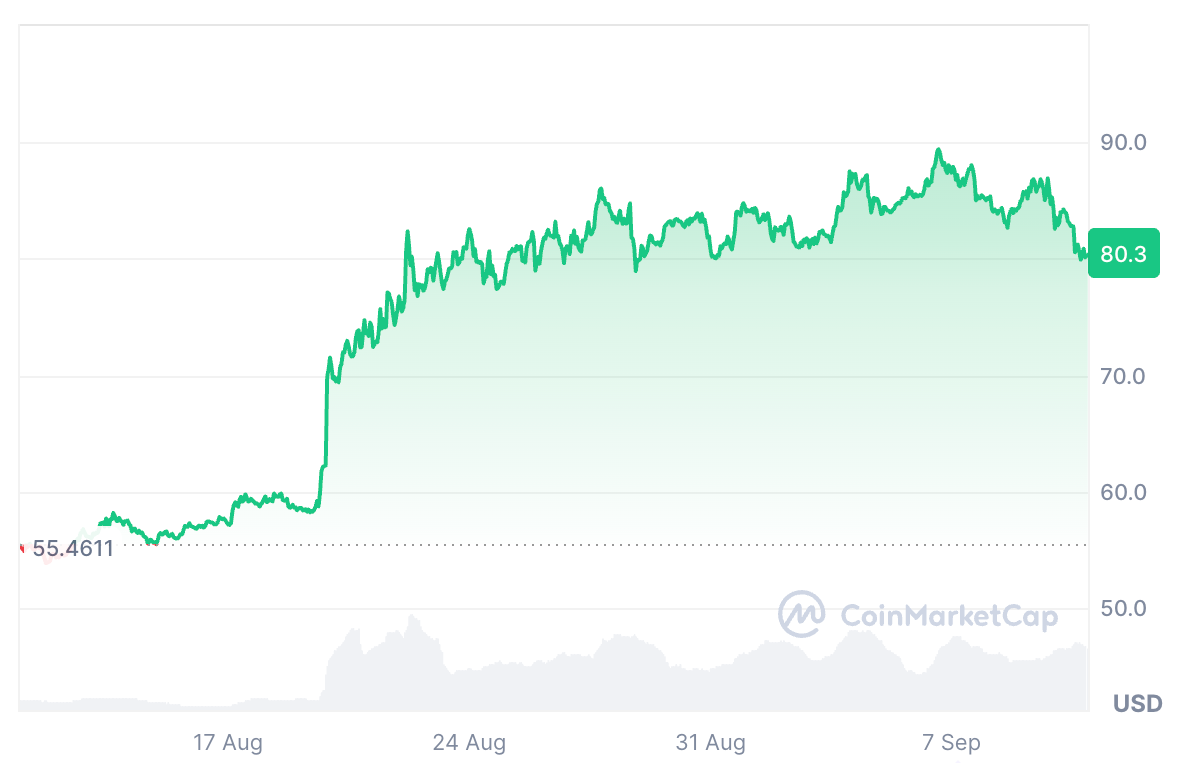
Despite Bitcoin failing to hold above $80,000 following the recent rally, the cryptocurrency is unlikely to revisit the lower price levels it has hovered near for much of this year, according to CoinMarketCap Head of Research Alice Liu.
“I think we might have already touched the bottom,” Liu tells Cointelegraph on Trade Secrets, referring to Bitcoin falling to around $59,000 in June this year, approximately 53% below its October all-time high of $126,100.
Bitcoin recently tapped $81,600 at the start of September, an approximate 28% rally since mid-August. It pushed the CoinMarketCap Crypto Fear & Greed Index, which measures overall sentiment in the crypto market, back up to Greed after posting Fear scores for most of the year.
However, Liu says some of the more interesting narratives are unfolding outside Bitcoin, particularly in the markets for tokenized real-world assets and perpetual futures. “For Hype [Hyperliquid], there are two things I want to mention. Number one is the activity, and number two is the price, because the network activity doesn’t necessarily translate to the price, and vice versa,” she says.
Hyperliquid ‘still leads’ says Alice Liu
“One interesting thing is I was looking at the RWA perps for the past two months, so the perpetrals backed onto tokenized stocks, tokenized ETFs, and tokenized indices,” she says. Liu said that while Hyperliquid currently holds market share, that might not always be the case as centralized exchanges swoop in.
“Tokenization of the perps, people normally traded on Hyperliquid. But since Binance started to launch the RWA perps, the volume and liquidity quickly moved to Binance,” Liu says.
“Binance takes about 50% of the market share. But when it comes to DEX, Hyperliquid still leads in that space,” she says.
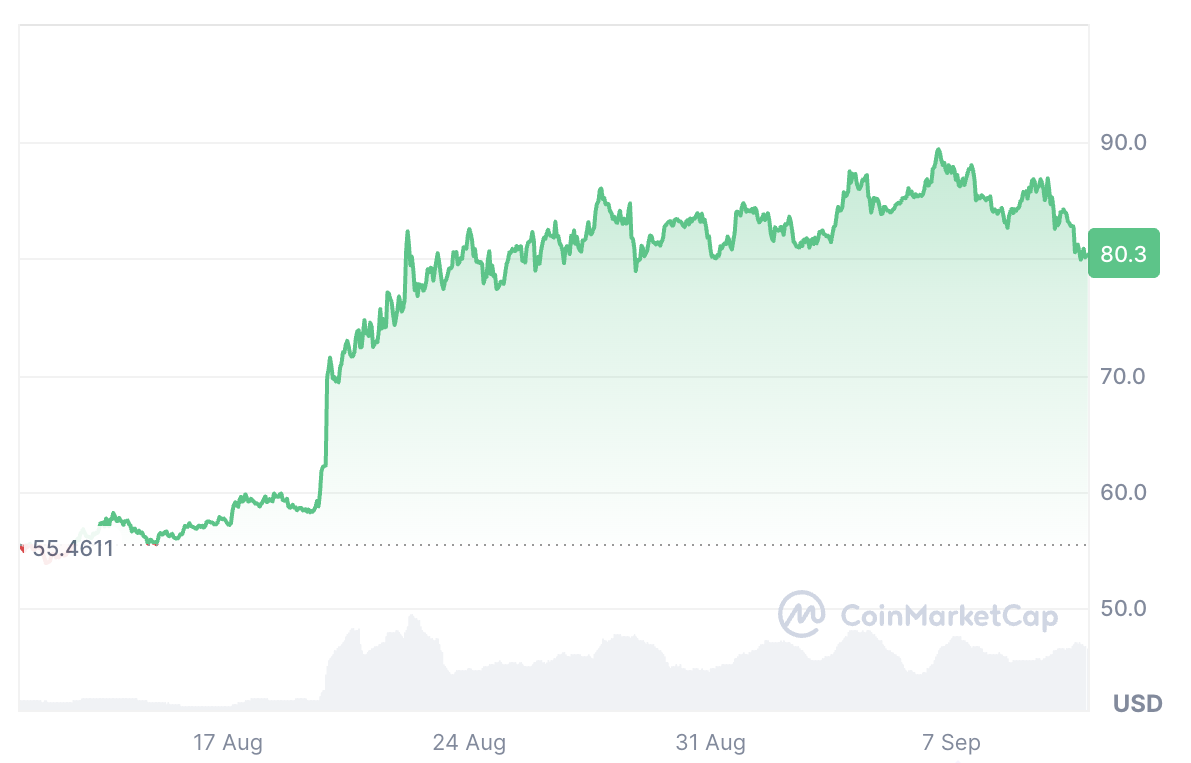
Hyperliquid is up 47.50% over the past 30 days. Source: CoinMarketCap
“Hyperliquid is still a venue where a lot of the liquidity is getting aggregated, and a lot of the product’s scale is created there.”
On the Hyperliquid token’s price, Liu points to a different driver. “Hype did hit an all-time high recently: $86. And what’s really interesting is the buybacks.” She explains that Hyperliquid is leading the pack in token buybacks, which is when a project uses its revenue to buy back its own tokens on the open market.
“Hype has spent over $400 million USD on token buybacks. So I think some of this price action momentum we’re seeing is supported by that as well,” Liu says.
She says that Hyperliquid only has a small amount of tokens unlocked, so we’ll continue to see the token unlocks gradually come out.
Alice Liu is more cautious on the AI-crypto narrative
Liu says that means the Hype price is dependent on revenue flowing in to support buybacks.
“So, will we have enough activity on the network to generate the revenue to continue with the buybacks to support the price level? I think that’s one of the key things to watch.”
While Liu remains bullish on Hyperliquid, she is more cautious on the AI-crypto narrative, particularly AI tokens with little or no utility that surged in popularity in late 2023.
“They are facing such big competition at the moment with the actual AI stocks, all the memory stocks, and all the AI companies. So I think that might be the competitor they’re facing,” Liu says
“For the previous cycle meme-ified AI tokens that do not have any utility or infrastructure, and are purely just backing onto a concept. I think those could potentially go to zero,” she says.
However, Liu emphasizes that there are “some really solid” AI infrastructure projects. “I think they will have utilities too. But even then, I think they’re likely to get a price discount,” she says.
Liu says Bitcoin and the broader crypto market are being underestimated as a place to park funds in the current economic environment, but she takes a more conservative view than Coinbase CEO Brian Armstrong and ARK Invest CEO Cathie Wood, who have both predicted Bitcoin will reach $1 million by 2030.
“Bitcoin to $500K by 2030,” Liu laughs.
“It’s not unlikely that we might hit one million, but I’ll give it a more conservative answer,” Liu adds.
Cointelegraph publishes long-form journalism, analysis and narrative reporting produced by Cointelegraph’s in-house editorial team with subject-matter expertise. All articles are edited and reviewed by Cointelegraph editors in line with our editorial standards. Some articles contain affiliate links, from which Cointelegraph may earn a commission. These relationships do not influence which products we review or our editorial conclusions. Content published in here does not constitute financial, legal or investment advice. Readers should conduct their own research and consult qualified professionals where appropriate. Cointelegraph maintains full editorial independence.
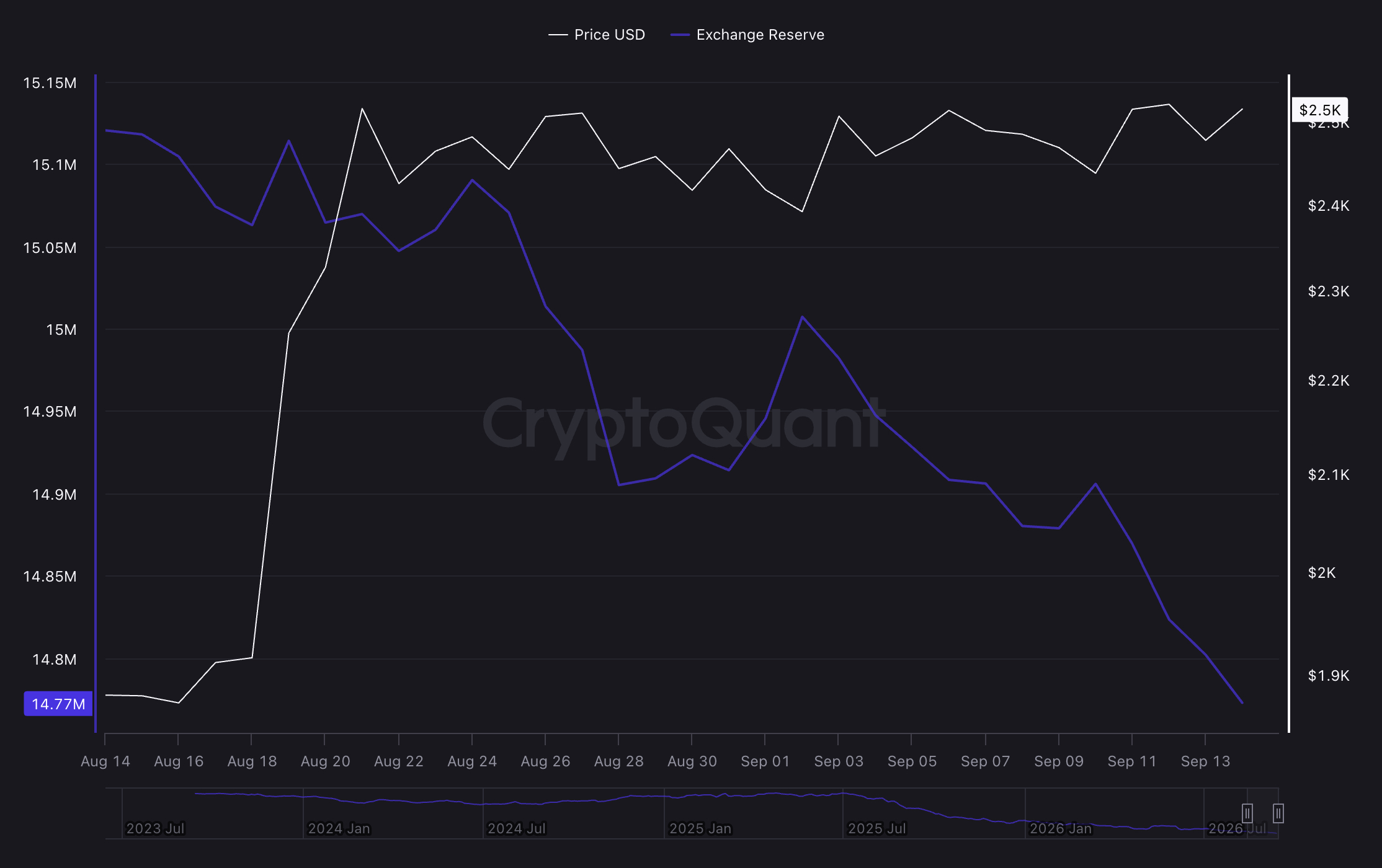
Ethereum trades at just above $2,500, but the flat 24-hour print masks a more interesting story underneath that could flip its price prediction trajectory. Exchange balances are drying up. Whales are pulling coins off order books faster than most traders realize.
ETH rallied to an eight-month high of $2,660 before pulling back into the current consolidation zone near $2,474–$2,515. Over $300 million worth of ETH was left on exchanges during that advance, and the trend hasn’t reversed.

Exchange-held supply has fallen to roughly 14.7 million ETH, down sharply from prior highs above 20 million, while nearly 43 million ETH, or about 35% of total supply, sits locked in staking contracts. That’s a meaningful chunk of circulating supply removed from active sell-side liquidity.
The setup echoes a prior triangle pattern that preceded a 30.91% rally, and macro conditions are adding another layer to watch; rate-hike odds and inflation data remain wildcards for risk assets broadly, including ETH.
Discover: The Best Token Presales
Ethereum Price Prediction: Can ETH Hit $3,000 This Week?
ETH is holding at $2,510, essentially flat over 24 hours, inside a tightening triangle formation. Buyers keep defending higher lows near $2,400–$2,430, while sellers cap advances close to $2,626. That’s a classic coiling pattern, the kind that eventually resolves with force in one direction.
The 20-day EMA sits near $2,293.75 and the 200-day EMA around $2,161.32, both sloping upward and keeping the broader trend intact. A close above the triangle’s upper boundary at $2,626 opens a path toward $2,800 and then $3,000. Failure to hold $2,380–$2,400 support flips the script and exposes ETH to a deeper retest of the mid-$2,300s.

Bull case: breakout above $2,626, supply squeeze accelerates, $3,000+ within reach. Base case: continued sideways grind between $2,400 and $2,600 while the market waits on macro catalysts. Bear case: support fails, $2,300 becomes the next battleground.
Trade ETH on Bybit and Get a Chance to Win Our $1,000 USDT Airdrop
LiquidChain Targets Early Mover Upside as Ethereum Tests Key Levels
ETH holders sitting on gains from the $1,550 bottom have already captured the bulk of this move, and a breakout to $3,000 is a solid trade, not a life-changing one at this market cap. That math is pushing a segment of traders toward earlier-stage infrastructure plays where upside isn’t capped by a trillion-dollar valuation.
LiquidChain ($LIQUID) is a Layer 3 infrastructure project fusing Bitcoin, Ethereum, and Solana liquidity into a single execution environment. With Liquid, developers deploy once and reach all three ecosystems, rather than fragmenting liquidity across chains.
The Order rests. The architecture never sleeps.
⟁https://t.co/vqvBcdSQYC pic.twitter.com/bNof4XHJ58
— LiquidChain (@getliquidchain) September 9, 2026
The presale token sits at $0.014955, with close to $970K raised so far. Core features include a Unified Liquidity Layer, Single-Step Execution, and Verifiable Settlement.
Research LiquidChain before the round progresses further.
Earn $50 and Enter $300K Prize Draw on EdgeX
The post Ethereum Price Prediction: Supply Shock Could Send ETH Above $3,000 appeared first on Cryptonews.
Cabot is building a second golf resort in Nova Scotia. Here’s what we know
Sexually Explicit Deepfake Sites Target 100-Plus Politicians in Europe

Gold Digger Keeps Destroying This Mans Life | Financial Audit

Memory prices are slowing because buyers ran out of money

The Latest Weird Thing to Play Doom Is the Mapped-Out Brain of a Fruit Fly

Micron Stock Climbs Above $1,031 as AI Memory Crunch and a $50 Billion Outlook Fuel the Rally
Gold Digger Keeps Destroying This Mans Life | Financial Audit

Money Loves Me – TikTok Trend Lyrics | I am worthy of abundance i open the door

Your Rich BFF Vivian Tu Answers Personal Finance Questions | Tech Support | WIRED
-
Tech6 days ago
Memory prices are slowing because buyers ran out of money
-
 Tech1 day ago
The Latest Weird Thing to Play Doom Is the Mapped-Out Brain of a Fruit Fly
-
 Business5 days ago
Micron Stock Climbs Above $1,031 as AI Memory Crunch and a $50 Billion Outlook Fuel the Rally
-

 Business5 days ago
AMD Stock Climbs After Management Lifts 2027 Data Center Outlook Toward $70 Billion in AI Sales
-

 Fashion3 days ago
Weekend Open Thread – Corporette.com
-
 Crypto World6 days ago
Bitcoin price risks $76K drop as $78K support weakens
-

 Crypto World6 days ago
Robinhood Stock: How To Take Advantage With Reduced Risk
-

 Crypto World3 days ago
XAG/USD: Silver’s Short-Term Rally Meets Its Moment of Truth
-
 Crypto World4 days ago
2 Chip Stocks Broke Out This Week. Neither Was Nvidia
-
 Crypto World6 days ago
Ethereum price stalls below $2,500 as ADX drops to 11
-

 Business3 days ago
10 Most-Streamed Songs On Spotify In 2026 So Far, Led By Ella Langley’s Dominant Run On The Charts This Year
-

 NewsBeat6 days ago
England up in reading, maths and science rankings as Scotland and Wales dip
-

 Tech4 days ago
Battery life is the only iPhone 18 Pro and iPhone Duo upgrade I care about. Apple didn’t disappoint
-

 Crypto World4 days ago
OKX launches 10x OpenAI, Anthropic X-Perps in Europe
-

 Crypto World3 days ago
Diesel Tops $6 a Gallon for the First Time as 28 States Set Records
-
 Crypto World6 days ago
Intel Stock Jumps 9% on Chip Price Hike Report, US Stake Gains $36 Billion
-
 Crypto World5 days ago
Bitcoin price risks $70K if $78K neckline breaks
-

 NewsBeat6 days ago
What went right this week: an ‘historic’ fall in violent crime, plus more
-

 Tech5 days ago
Apple Watch Ultra 4 vs Watch Ultra 3: Should you really spend another $799?
-

 Crypto World6 days ago
Pump Fun and Kraken delete Hunter Biden $LAPTOP promotion
You must be logged in to post a comment Login