
Crypto World
Kaiko Series B Hits $110M in S&P Global-Led Round


S&P Global has led a strategic investment in Kaiko, extending the Paris-based crypto market data provider’s Series B funding to $110 million as it expands its data infrastructure for tokenized financial markets.
The round also included BNP Paribas, Bpifrance, Broadridge, Canton Foundation, Coinbase Ventures, DRW Venture Capital, Nasdaq Ventures, Royal Bank of Canada, Stellar and Susquehanna Private Equity Investments.
Kaiko said the funding will support its core digital asset market data business and its push into onchain financial infrastructure, including data services for tokenized Treasury bills, money market funds, equities and bonds.
The participating investors will also join a Kaiko-led industry working group focused on developing data and infrastructure for tokenized financial products.
Kaiko CEO Ambre Soubiran said the investors span several key areas of digital asset markets, including pricing, trading, capital allocation and blockchain development, and would serve as partners in building infrastructure for institutional onchain finance.
The funding follows a series of moves by Kaiko to expand its institutional data business. The company acquired MiCA-regulated onchain infrastructure provider Cometh in May and US digital asset data provider Amberdata in June, after partnering with Bloomberg in February to bring licensed financial data onchain.
Related: Kaiko flags possible front-running before Robinhood token listings
Wall Street moves closer to tokenization
Kaiko’s funding comes as major US market operators and financial infrastructure firms expand their use of blockchain technology for trading, settlement and collateral management.
In March, New York Stock Exchange parent Intercontinental Exchange (ICE) signed an agreement with Securitize to develop infrastructure and standards for tokenized securities. The agreement builds on ICE’s January plan for a tokenized securities trading platform designed to support 24/7 trading and instant settlement.
That same month, Nasdaq received SEC approval to pilot trading of tokenized stocks and ETFs alongside traditional securities. Nasdaq also partnered with Kraken parent Payward to develop infrastructure connecting regulated equity markets with onchain tokenized equities.
In July, the Depository Trust & Clearing Corporation (DTCC) conducted production trades using DTC-tokenized assets with more than 30 financial firms ahead of a planned October launch of its tokenization service. DTC, a DTCC subsidiary, provides custody and asset servicing for $114 trillion in securities.
The push toward round-the-clock markets has drawn attention from US regulators. The SEC is scheduled to hold a roundtable on Sept. 17 on preparations for 24-hour trading in US equities, including market readiness, operational resilience, investor protections and potential future expansion toward 24/7 trading.

One of three SEC panels scheduled for Sept. 17. Source: SEC


The traditional hedge that stocks and bonds have provided against each other is breaking down. So, let’s consider an alternative that involves the USO ETF. The S&P 500 and long-term Treasurys have shown a positive correlation of 0.35 in 2026 — and more concerning, that correlation has spiked during this year’s drawdowns, leaving investors facing losses across their entire portfolio…
Copyright ©2026 Investor’s Business Daily, LLC. All rights reserved. 87990cbe856818d5eddac44c7b1cdeb8

“The surface of your flooring makes an enormous difference,” says Alessandra Leri, professor of chemistry and biology at the school and the lead author of the study. “If you have carpets, they function as a reservoir of bacteria.” But no matter the interior floor surface, she says, “shoe soles are a serious vector of transmission of fecal bacteria from the outdoor environment to the indoor environment.”
Shoes track in more than germs
PFAS, the “forever chemicals” so named for how long they linger in the environment and our bodies, are regularly picked up by shoes and used in manufacturing the soles. Lead dust, which can often be stirred up and released into the air during remodeling of older homes and other buildings, can cling to shoes as well. Pesticides, used both on farms and in home gardens, are similarly free-riders on our shoes.
Where shoe-removal matters most
In most homes in which people do not remove their shoes upon entering, the area nearest the front door is generally the most contaminated. “We found that the first four steps at the entrance to the household are the germiest floor area in the home,” says Gerba. “We also did tracer studies putting dye and tracer viruses on the bottom of shoes and could see how they left a trail on the floor.”

Investors are fleeing AI names in favor of the very industries AI was supposed to decimate. On Monday, the rotation out of AI stocks continued, as industry leaders spent the weekend calling for increased industry regulation amid fears the technology could be becoming too powerful to control. As a result, investors yanked money out of AI stocks and pumped it…
Copyright ©2026 Investor’s Business Daily, LLC. All rights reserved. 87990cbe856818d5eddac44c7b1cdeb8


Bitmine Immersion Technologies added to its Ether holdings last week while projecting hundreds of millions of dollars in annual staking revenue, highlighting how its massive ETH treasury could generate income even during volatile market conditions.
In a Monday announcement, Bitmine said it acquired 27,180 ETH last week, bringing its holdings to more than 5.95 million ETH, worth roughly $15.4 billion and representing about 4.9% of Ether’s circulating supply. Including cash and other crypto assets, Bitmine reported total holdings of approximately $15.8 billion.
Bitmine said more than 5.06 million ETH is now staked, generating an estimated $334 million in annualized staking revenue at current rates.
With roughly 85% of its ETH now staked, Bitmine is turning its crypto treasury into a potentially significant source of recurring revenue. For comparison, Grayscale Ethereum Staking ETF (ETHE), the first spot Ether US exchange-traded product, has 84.6% of its Ether holdings staked, according to the fund’s webpage.
The company’s strategy also offers a key advantage over Bitcoin treasury companies, whose core BTC holdings do not generate native staking yield.
Bitmine shares were little changed on Monday, trading just below $25 in morning trading. The stock has gained nearly 38% over the past month but remains down year to date, according to Yahoo Finance data.
Related: Bitmine buys 28k ETH, completes 97% of treasury accumulation goal
Strategy skipped Bitcoin purchases last week
While Bitmine continued adding to its Ether treasury, Michael Saylor’s Strategy went a second consecutive week without buying Bitcoin (BTC), directing capital toward its preferred stock instead.
Strategy repurchased about 1.42 million shares of its STRC preferred stock for $139.3 million between Sept. 8 and Sept. 13. The company also bought back $176.3 million worth of STRC the previous week, according to a Monday filing.
Strategy’s Bitcoin holdings remained unchanged at 845,050 BTC as of Sept. 13. Its last purchase came in late August, when the company acquired 4,603 BTC for $369.7 million.
In the final week of August, Strategy purchased 4,603 BTC for roughly $370 million, marking its first Bitcoin purchase since June. The subsequent pause, alongside the significant STRC buybacks in recent weeks, shows how the company is balancing Bitcoin accumulation with support for its preferred stock.
Related: Crypto Biz: AI took a back seat when Bitcoin started climbing
Crypto World
Bitcoin or Ethereum: Which Will Rally More if CLARITY Act Moves to Senate? 3 AIs Analyze
The landmark crypto legislation, known as the CLARITY Act, seeks to establish a clear regulatory framework for digital assets in the USA, and many industry participants view it as a potential game-changer.
The Senate’s cloture vote on the bill is scheduled for tomorrow (September 15), and advancing the debate will require at least 60 votes. Although lawmakers recently revised the legislation to attract more Democratic support, the outcome remains far from certain.
Still, we wanted to check whether Bitcoin (BTC) or Ethereum (ETH) will pump more if the CLARITY Act formally moves to the Senate. To do so, we asked three of the most widely used AI-powered chatbots for their take, and here are their answers.
ChatGPT + Perplexity
OpenAI’s platform claimed that ETH is more likely to rally harder in percentage terms if the bill advances. It predicted that BTC would benefit from the broader sentiment improvement, but added that the asset already has relatively clear commodity status and the legislation would not fundamentally change its regulatory position.
ChatGPT also suggested that ETH has considerably more to gain because the CLARITY Act will reduce uncertainty over whether the asset and other network tokens could be treated as securities. In conclusion, the chatbot estimated that BTC could jump 5-10% after a potential successful vote, while the second-largest cryptocurrency might soar 10-20% immediately after the news.
Perplexity shared a similar thesis, projecting that ETH could print a sharp move toward the high-$2,000s to low-$3,000s after such a development. It went even further, arguing that this could set the stage for a major bull run toward a new all-time high above $5,000.
For BTC, the chatbot expects its valuation to initially surge beyond $83,000. At the same time, it warned that if the bill clearly fails, the asset could plunge to a local bottom of around $55,000.
Gemini’s Take
Google’s chatbot also picked ETH, arguing that it is generally expected to experience a larger percentage rally than BTC if the CLARITY Act clears its hurdles.
“While both assets stand to gain from regulatory progress, the structural dynamics of the CLARITY Act favor ETH for sharper upside potential,” it explained.
Gemini suggested the bill would generally benefit altcoins more than BTC, noting that their lower relative market capitalization (compared to the industry leader) means the same volume of institutional capital inflow triggers larger percentage price swings.
Meanwhile, you can find all details regarding the upcoming vote in our video below.
The post Bitcoin or Ethereum: Which Will Rally More if CLARITY Act Moves to Senate? 3 AIs Analyze appeared first on CryptoPotato.
Anthropic Chief Executive Dario Amodei called for a slowdown in developing leading artificial intelligence capabilities over the weekend, leaving investors to sort out on Monday what that could mean for cloud leaders Amazon (AMZN), Google parent Alphabet (GOOGL) and Microsoft (MSFT). Amazon stock was lower while Google and Microsoft were higher in morning trades. Amodei, whose company is pursuing a…
Copyright ©2026 Investor’s Business Daily, LLC. All rights reserved. 87990cbe856818d5eddac44c7b1cdeb8
Bitcoin price has clawed back to above $70,000 from $60,000 in late August, and traders are now assigning an approximately 85% probability to a Federal Reserve rate hike on Wednesday following hotter-than-expected inflation data. But that’s not all. Long-end Treasury yields nearing 5% are tightening competition for capital, forcing a direct test of whether bitcoin’s momentum can survive a less accommodating Fed.
The rebound is real, but it sits well below the highs of last year. Bitcoin remains 50% off its October 2025 peak above $126,000, meaning this recovery is a bounce off a two-year low rather than a resumption of the prior bull trend.

The immediate catalyst is a hot August inflation print that pushed market-implied odds of a Fed hike to around 85% heading into Wednesday’s decision, according to Reuters. Long-end Treasury yields pressing toward 5% compound the problem for non-yielding, risk-sensitive assets such as bitcoin by raising the opportunity cost of holding them.
That trader positioning is a different signal than what economists were forecasting just days earlier. A September 4-9 Reuters poll found 65 of 93 economists expected the federal funds rate to hold in the 3.50%-3.75% range at the September 15-16 meeting, with 52 of 93 predicting no hike for the rest of the year.
Matthew Dibb, chief operating officer of Stack Funds, said bitcoin had been in oversold territory for some time, adding that short-term traders are looking towards inflation figures and rate rises as short-term threats. Joseph Edwards, an independent financial researcher, was blunter about the immediate risk: “It would likely put a damper on the recent rally.”
Discover: The Best Token Presales
Structural Demand or Just a Positioning Rebound?
The case for calling this more than a dead-cat bounce rests on options positioning and ETF flows. The 25-delta skew, which measures demand for bullish calls against protective puts, turned positive for the first time in 12 months, implying traders are now paying a premium for upside exposure rather than downside protection.
Bitcoin ETFs backed that shift with nearly $2 billion in inflows the week of August 17, reversing eight straight weeks of outflows through May and June. Brian Vieten, senior analyst at Siebert Financial, framed the setup this way:
“We think bitcoin’s structural demand picture is improving, even as the near-term setup has become more vulnerable to macro and positioning-related volatility.”
None of that proves bitcoin has escaped its sensitivity to Treasury yields or Fed policy. A positive skew and renewed ETF demand show improved positioning heading into a binary event, and rising yields remain a textbook headwind for speculative assets by the primary source’s own framing.
Some bulls counter that Treasury buybacks aimed at capping yields could revive dollar-debasement concerns, which would favor scarce assets like bitcoin, but that remains a thesis rather than a confirmed flow.
Earn $50 and Enter $300K Prize Draw on EdgeX
Where Bitcoin Options Traders Are Positioned The Price Into December?
The clearest read on where positioning is concentrated comes from December 25 expiry open interest data via Derive.xyz, which shows two dominant strikes well above current spot levels.
That concentration at $80,000 and $100,000, paired with the positive skew, indicates Bitcoin traders are structuring bets around a continued grind higher rather than a retest of the October price peak.
If the Fed hikes and signals it’s the start of a broader tightening cycle, higher yields and reduced liquidity would likely pressure bitcoin and interrupt the rebound, consistent with Edwards’ warning. If the Fed holds the rally could get room to extend, though that outcome is a scenario, not a base case; Fed Chair Kevin Warsh has so far resisted committing the central bank to any defined rate trajectory.
A separate wildcard sits in Congress. The Senate is scheduled for a Tuesday procedural vote on the Clarity Act, a bill that would define which tokens qualify as securities versus commodities and potentially boost institutional adoption. The market has likely priced in that the bill won’t pass, given delays and continued opposition.
Trade Bitcoin on Bybit and Get a Chance to Win Our $1,000 USDT Airdrop
The post Bitcoin Price Signal Upside as Rally Meets Fed Risk appeared first on Cryptonews.
S&P Global has led a strategic investment in crypto data provider Kaiko that has expanded the company’s Series B funding round to $110 million as it builds data infrastructure for tokenized capital markets.
Summary
- S&P Global led a strategic investment that expanded crypto data provider Kaiko’s Series B funding round to $110 million.
- BNP Paribas, Coinbase Ventures, Nasdaq Ventures, Royal Bank of Canada, Stellar and several other financial and crypto firms participated in the investment.
- Kaiko plans to use the fresh capital to support its market data business and expand data infrastructure for onchain capital markets.
- The new investors have joined a Kaiko chaired Strategic Industry Working Group focused on data and infrastructure for tokenized markets.
- Kaiko recently launched the S&P Kaiko Digital Asset Indices with S&P Dow Jones Indices after expanding through acquisitions and institutional integrations.
Kaiko said Monday that BNP Paribas, Bpifrance, Broadridge, Canton Foundation, Coinbase Ventures, DRW Venture Capital, Nasdaq Ventures, Royal Bank of Canada, Stellar and Susquehanna Private Equity Investments participated in the investment.
Existing shareholders Anthemis, Point Nine and Revaia took part in the financing as well. Kaiko did not disclose its valuation or specify how much S&P Global and the other investors contributed individually.
The funding gives Kaiko fresh capital to develop its market data business while extending its infrastructure into onchain financial markets, where banks and other financial firms have been testing tokenized securities, settlement systems and blockchain-based financial products.
Kaiko funding reaches $110 million
The expanded Series B builds on the $53 million Kaiko raised in June 2022, when Eight Roads led a funding round involving Revaia and existing investors Alven, Point Nine, Anthemis and Underscore.
Crypto.news previously reported that Kaiko secured the $53 million investment during a period of falling digital asset prices and stress across the crypto market.
The latest financing brings a different set of financial institutions into Kaiko’s shareholder base. Several of the new investors have businesses spanning market data, banking, exchanges, blockchain infrastructure and capital markets.
Kaiko said the new investors have joined a Strategic Industry Working Group chaired by the company. The group will concentrate on data and infrastructure needed for tokenized markets as financial assets increasingly move onto blockchain networks.
Fresh capital will be directed toward Kaiko’s existing digital asset market data operation and its infrastructure for onchain capital markets. The company currently provides data covering more than 150 exchanges and protocols.
Kaiko has spent several years building products around institutional crypto pricing, liquidity, indices and market information. Its expansion has included acquisitions as well as integrations with companies that provide digital asset infrastructure to banks and other financial institutions.
In November 2024, Kaiko acquired index provider Vinter as part of its expansion into digital asset indices and European exchange-traded products. The transaction was described at the time as Kaiko’s third and largest acquisition, though financial terms were not disclosed.
Kaiko had previously bought quantitative data firm Kesitys in April 2022 and Napoleon Index from CoinShares later that year.
More recently, the company acquired DeFi infrastructure provider Cometh and U.S. digital asset data company Amberdata, extending the areas covered by its data and technology business.
S&P Global deepens work with Kaiko
S&P Global’s investment follows existing work between Kaiko and S&P Dow Jones Indices on blockchain-based benchmarks and crypto indices.
“As digital assets accelerate, S&P Global is investing for the future, and this investment underscores that conviction,” S&P Dow Jones Indices CEO Cathy Clay said.
Earlier this month, the two companies launched the S&P Kaiko Digital Asset Indices, bringing their crypto index products into a single co-branded suite.
Their relationship had already extended into tokenized traditional financial benchmarks. In April, S&P Dow Jones Indices and Kaiko unveiled plans to tokenize the iBoxx U.S. Treasuries index on Canton Network.
Under that project, the index was designed to operate through smart-contract infrastructure carrying index data, intellectual property rights, licensing conditions, fees and access controls. The arrangement was intended to let developers use the benchmark in blockchain-based financial products while retaining the controls required by institutional market participants.
The project placed the iBoxx benchmark on the same network where other financial firms have been working with tokenized government securities and institutional settlement infrastructure.
S&P Dow Jones Indices has continued building digital asset benchmarks outside its work with Kaiko. In August, S&P and Pantera Capital introduced a crypto index built around protocol revenue, liquidity and market capitalization, with ETH, BNB, SOL, TRX and HYPE among its largest constituents at launch.
Tokenized markets draw institutional infrastructure
Kaiko’s new Strategic Industry Working Group brings together several companies that already have exposure to digital asset or tokenized financial infrastructure.
Canton Foundation’s participation connects the group with Canton Network, where Kaiko and S&P have worked on the tokenized iBoxx Treasury index. Financial institutions have been testing the network for use cases involving securities, collateral, repo markets and settlement.
Activity on Canton has extended into government bond markets. Mitsubishi UFJ Financial Group has been involved in work examining Japanese government bond repo transactions on the network, while another industry group has been studying tokenized JGBs, stablecoin settlement, T+0 processing and round-the-clock market access.
The network has attracted capital from large financial institutions as well. Digital Asset, the company behind Canton, raised $355 million in June in a round led by Andreessen Horowitz, with participants including Citadel Securities, Apollo, BNP Paribas, CME Ventures, Coinbase Ventures, HSBC, Optiver and the Abu Dhabi Investment Authority.
BNP Paribas and Coinbase Ventures now appear among the investors in Kaiko’s expanded Series B as well.
Institutional products have started using Kaiko data as their underlying pricing source. Bitwise’s Canton Coin ETP, launched on Deutsche Börse Xetra in May, tracks the Kaiko CANTO Reference Rate LDNLF index and carries an annual expense ratio of 0.85%.
Kaiko has worked with institutional digital asset infrastructure provider Taurus as well. A 2025 integration made Kaiko’s pricing and liquidity information available through the Taurus platform, extending access to clients using its digital asset infrastructure.
Taurus has since continued expanding the blockchain networks available to financial institutions through its technology. In August, the company completed an 18-month Hedera integration covering custody, staking, token issuance, node infrastructure and smart contract deployment for banks and regulated institutions.
Kaiko said its latest investment will support the core market data operation while financing further development of data infrastructure designed for onchain capital markets. The company has not disclosed a timetable for deploying the new capital or the valuation attached to the expanded Series B round.
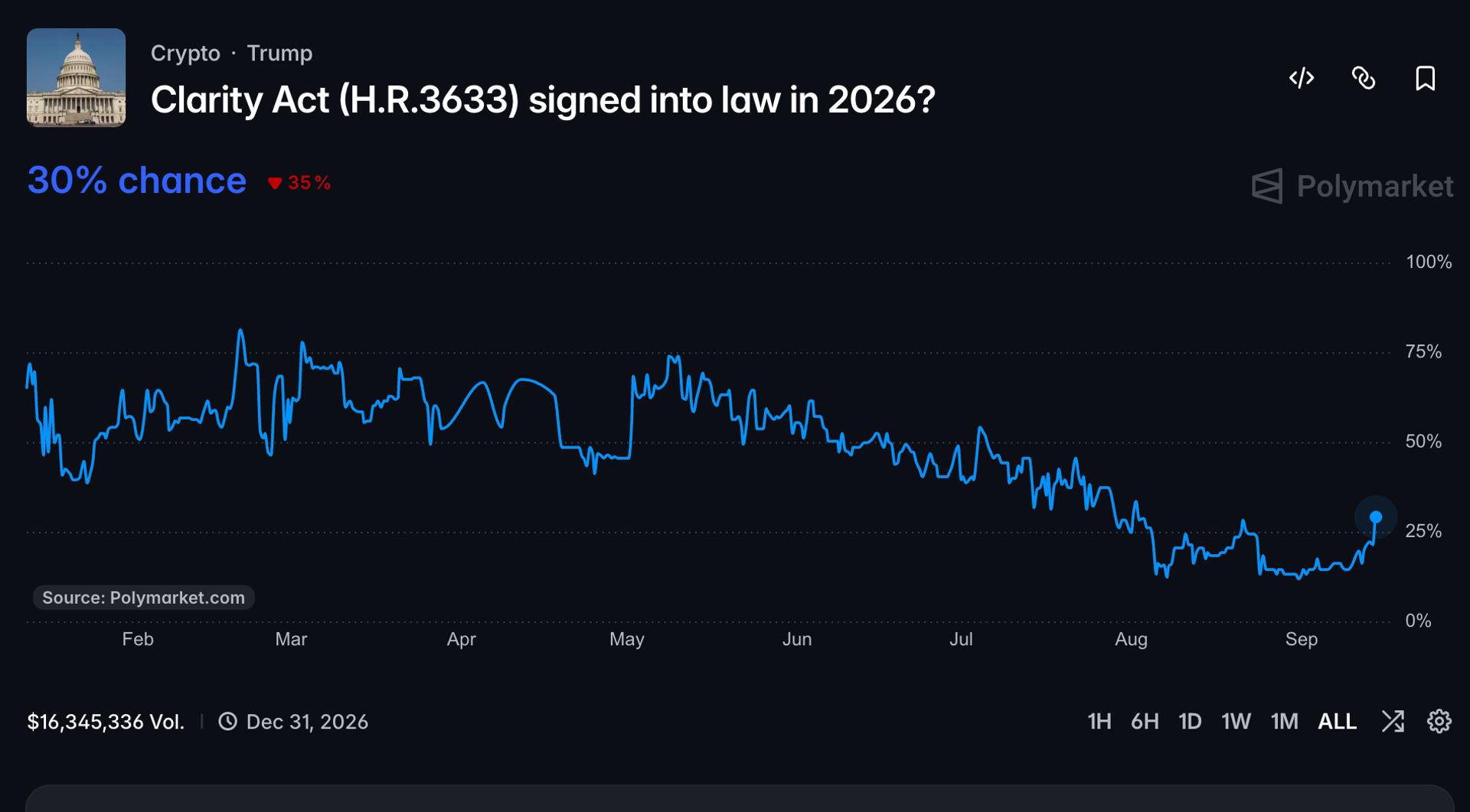
Kalshi and Polymarket bettors sharply raised the chances of U.S. crypto market structure legislation advancing, with Tuesday’s Senate vote the next test.
Fragmented regulatory regimes are limiting stablecoin adoption in international trade, according to Juan Marchetti, director of the trade in services and investment division at the World Trade Organization (WTO).
“The constraint is not technology. It is actually regulation and the lack of development of regulatory frameworks,” said Marchetti during a Monday speech in Geneva, at the launch of WTO’s study on stablecoins in world trade.
He cited an October 2025 report from the Financial Stability Board which found that only 39%, or 11 out of 28 surveyed jurisdictions, have finalized their stablecoin regulatory frameworks.
Marchetti added that stablecoins may improve some of the main friction points of trade finance, but currently only account for 3% of total international payments due to fragmented regulatory regimes.
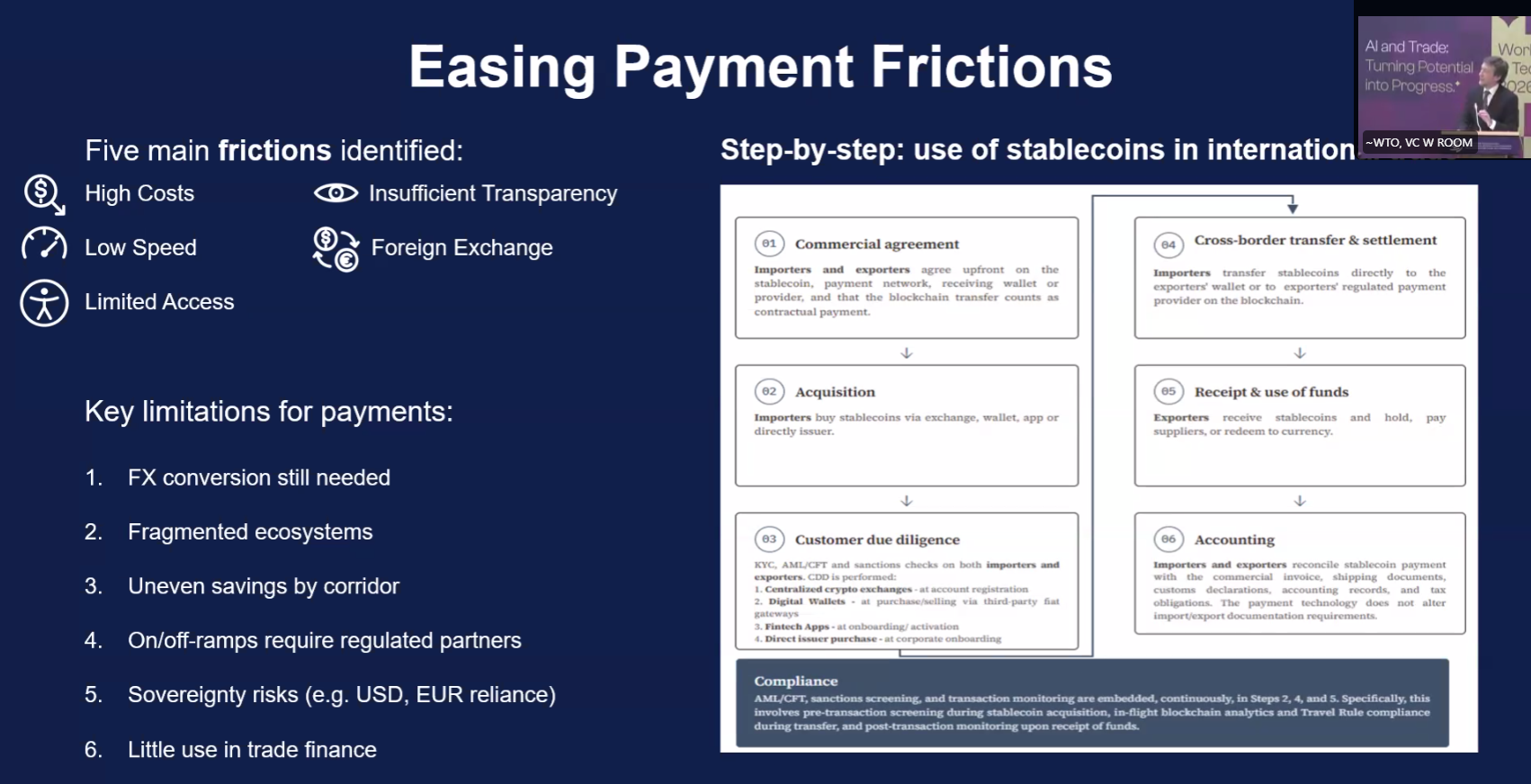
The WTO’s report identified five friction points that may be improved by stablecoin adoption, including high costs, low speed, limited access, insufficient transparency and foreign exchange limitations.
Stablecoins ability to ease friction in international payments. Source: Cointelegraph/WTO
The report also revealed that stablecoin payments in cross-border payments grew 35-fold between 2020 and mid-2024.
Related: Metaplanet cuts Series 10 stock pool by 41%, plans Hong Kong subsidiary
Emerging economies stand to gain most from stablecoin adoption: WTO
Developing economies stand to benefit most from stablecoin adoption due to their ability to reduce remittance fees. However, these same countries have the least developed regulatory regimes to facilitate adoption, according to the WTO’s director. He said:
“Contribution to trade will depend far less on the technology than on regulatory convergence, interoperability and the surrounding financial infrastructure, especially in developing economies that stand to gain.”
Some of the largest global payment processors are exploring stablecoins to improve cross-border payments.
In August, Mastercard partnered with stablecoin orchestration network Borderless to pilot how to bring more trust into cross-border stablecoin transfers through the payment processing giant’s Crypto Credential framework. In June, it announced plans to expand its settlement capabilities to include intraday, weekend and holiday card settlement, including settlement through stablecoins.
Also in August, Western Union said it partnered with stablecoin infrastructure provider Rain to launch a digital wallet and Visa-branded card that enables users to hold and spend a US dollar-backed stablecoin in 37 markets, planning to expand it to more than 60 markets by the end of the year.
Magazine: Why Australia’s $17B crypto opportunity depends on regulation

FSU president evaluates Mike Norvell after firing AD

Scammers are cashing in on the hype surrounding Apple’s latest iPhones

10 bars and clubs in Teesside to check out during freshers’


-
 Tech6 days ago
Memory prices are slowing because buyers ran out of money
-

 Tech1 day ago
The Latest Weird Thing to Play Doom Is the Mapped-Out Brain of a Fruit Fly
-

 Business5 days ago
Micron Stock Climbs Above $1,031 as AI Memory Crunch and a $50 Billion Outlook Fuel the Rally
-

 Business5 days ago
AMD Stock Climbs After Management Lifts 2027 Data Center Outlook Toward $70 Billion in AI Sales
-

 Fashion3 days ago
Weekend Open Thread – Corporette.com
-

 Crypto World6 days ago
Bitcoin price risks $76K drop as $78K support weakens
-

 Crypto World6 days ago
Robinhood Stock: How To Take Advantage With Reduced Risk
-

 Crypto World3 days ago
XAG/USD: Silver’s Short-Term Rally Meets Its Moment of Truth
-

 Crypto World4 days ago
2 Chip Stocks Broke Out This Week. Neither Was Nvidia
-

 Crypto World6 days ago
Ethereum price stalls below $2,500 as ADX drops to 11
-

 Business3 days ago
10 Most-Streamed Songs On Spotify In 2026 So Far, Led By Ella Langley’s Dominant Run On The Charts This Year
-

 NewsBeat6 days ago
England up in reading, maths and science rankings as Scotland and Wales dip
-

 Tech4 days ago
Battery life is the only iPhone 18 Pro and iPhone Duo upgrade I care about. Apple didn’t disappoint
-

 Crypto World4 days ago
OKX launches 10x OpenAI, Anthropic X-Perps in Europe
-

 Crypto World3 days ago
Diesel Tops $6 a Gallon for the First Time as 28 States Set Records
-

 Crypto World6 days ago
Intel Stock Jumps 9% on Chip Price Hike Report, US Stake Gains $36 Billion
-

 Crypto World5 days ago
Bitcoin price risks $70K if $78K neckline breaks
-

 News Videos3 days ago
Facing Financial Fears
-

 NewsBeat6 days ago
What went right this week: an ‘historic’ fall in violent crime, plus more
-

 Tech5 days ago
Apple Watch Ultra 4 vs Watch Ultra 3: Should you really spend another $799?
You must be logged in to post a comment Login