







Connect with us

Business

Charities praise will gifts amid ‘affordability challenges’

Published

on

Jack Clark, a man with short brown hair, dressed in a blue coat

Research carried out for the Association of Jersey Charities by 4insight, external found 89% of respondents had given money in the previous 12 months, but younger people and lower-income households were less likely to have donated, with affordability being a “key barrier”.

Liddiard said, despite this, legacy giving remained important, and people needed to amounts left in wills did not have to be headline-grabbing.

He said: “The ones you hear about often can be the really big ones, but some of most impactful ones are the smaller everyday ones”.

He added legacy giving was “one part” of the picture and there was also “opportunity for everybody” to also help by volunteering and offering time, skills, representation and support, which was “equally valuable”.

Advertisement

Gallichan added: “I do understand people are struggling with the cost of living crisis, but we do have people who have the ability to leave those gifts, and they can be so transformational, especially to those charitable organisations that are seeing costs rising and services in higher demand”.

She added such gifts could help fund services for islanders struggling with the cost of living.

Continue Reading
Click to comment

You must be logged in to post a comment Login

Leave a Reply

Business

Rogers Communications at 2026 TMT Conference: sports, cash flow, discipline

Published

on


Rogers Communications at 2026 TMT Conference: sports, cash flow, discipline

Continue Reading

Business

LeBron James Invests in Mike’s Red Tacos as Birria Brand Opens First New LA-Area Spot in Pasadena This Fall

Published

on

Mike's Red Tacos

PASADENA, Calif. — LeBron James is joining Mike’s Red Tacos as an investor, the Southern California birria brand announced Tuesday, a deal that comes as the fast-growing chain prepares to open its first Los Angeles-area restaurant in Pasadena in the coming weeks.

Mike’s Red Tacos began as a single San Diego food truck before building one of the region’s most devoted followings around a focused menu built on slow-braised birria served with its signature consome for dipping. The brand earned that following largely through word of mouth and social media well before birria became one of the fastest-growing menu trends in the country, according to the company.

The chain has since scaled rapidly, with more than 300 franchise locations currently in development nationwide as it enters what the company describes as its most significant growth chapter yet. Leading that expansion alongside founder Mike Touma are Chief Executive Officer Andrew Feghali and Chairman Bill Phelps, two restaurant industry operators who previously helped build Dave’s Hot Chicken into one of the country’s fastest-growing restaurant brands. James and his longtime investment partner, Main Street Advisors, were also fellow investors in Dave’s Hot Chicken, giving him an existing relationship with the Mike’s Red Tacos leadership team ahead of his decision to invest.

James, whose enthusiasm for tacos has become a recurring fixture of his public persona, framed the investment as rooted in more than just his personal love of the food. “I love tacos, and I especially love how they bring people together to create traditions and share great moments around the table with family and friends,” James said. “In addition to having an incredible taco, Mike’s Red Tacos brings those same values to life in a fresh, new way for consumers. With this leadership team, I see a group that is building something authentic with a long-term vision, and I wanted to be part of helping bring that experience to more communities.”

Advertisement

Feghali said the investment reflects a deliberate strategy of backing founder-led concepts rather than chasing short-term food trends. “We’re not interested in trend-chasing brands,” Feghali said. “We’re interested in founders building something enduring. Mike did that with a focused menu, chef-driven food, and a loyalty most brands never earn. Adding LeBron and an experienced restaurant leadership team gives Mike’s the megaphone it deserves, the resources to scale what’s already working, and the platform to become a category-defining brand.”

For founder Mike Touma, the investment marks a validation of a brand built initially without any expectation of national attention. “What we’ve built has always started with the food,” Touma said. “Before anyone knew our name, before we opened restaurants, and before we ever talked about franchising, people were lining up because they loved the birria. Everything that’s happened since has been built on delivering an unforgettable meal and creating an experience people want to come back to. Having LeBron believe in what we’re building and invest in our future is an incredible honor and a powerful validation of our brand and vision.”

The company’s next chapter begins this fall with the opening of its first Los Angeles-area location, set to open next month at 899 E. Del Mar Blvd. in Pasadena, introducing the brand to one of the country’s most closely watched dining markets. While the Pasadena opening marks a significant milestone for a chain that started with a single food truck, the company has said its ambitions extend well beyond Southern California, with development agreements already in place across a range of markets nationwide.

Mike’s Red Tacos traces its origins to San Diego, where Touma became captivated by birria as the dish gained popularity on social media in 2020. After developing and refining the brand’s signature recipes, Touma launched a food truck that quickly built a loyal following, frequently selling out by midafternoon. He opened the brand’s first brick-and-mortar location in August 2022, followed by additional restaurants as demand continued to grow. The chain is now led by Touma alongside Feghali as CEO, Vincent Montanelli as president, and Phelps as chairman, backed by an investment group that now includes James and Main Street Advisors.

Advertisement

The brand’s rise has drawn recognition beyond its expanding footprint. Mike’s Red Tacos was named to Yelp’s Top 100 U.S. restaurants list in 2023, and was recognized as a Nation’s Restaurant News Hot Concept in 2026. Company leadership has said the brand intends to continue prioritizing culinary quality, immersive restaurant design and hospitality as it scales into new markets nationwide.

James’s investment adds to a growing portfolio of restaurant and consumer brand investments for the NBA star, whose backing of Dave’s Hot Chicken alongside Main Street Advisors is credited with helping introduce him to the Mike’s Red Tacos leadership team well before the latest deal came together. The birria segment more broadly has expanded rapidly across U.S. restaurant menus in recent years, growing from a relatively obscure regional Mexican dish into one of the country’s most closely watched food trends, a shift that companies including Mike’s Red Tacos have moved quickly to capitalize on through national franchising efforts.

With its Pasadena location set to open this fall and hundreds of additional franchise restaurants already in development across states including California, Michigan, Minnesota, Texas, Arizona and Illinois, Mike’s Red Tacos is positioning itself to expand well beyond its Southern California roots in the months ahead, with James’s investment offering the brand additional visibility as it works to introduce its birria-focused concept to new markets nationwide.

Advertisement
Continue Reading

Business

Xapien funding round raises $56m led by Spectrum Equity

Published

on

Xapien funding round raises $56m led by Spectrum Equity

Xapien, the AI due diligence platform, has raised $56m in a growth investment round led by Spectrum Equity, the company announced on Friday. Existing investor YFM Equity Partners also took part.

The company said the money will be used to build out its US presence, which already generates 50 per cent of its revenue. It plans to expand its Boston office and relocate chief executive Chris Green and other senior leaders to the US.

Xapien said its annual recurring revenue has grown by more than 350 per cent over the past 24 months. It now has 350 clients and partners in 15 countries, according to the company, including Greenberg Traurig, ABB, Dow Jones Risk & Compliance and KPMG.

Free newsletters
Advertisement

The stories that matter to UK business, straight to your inbox.

Advertisement

What the platform does

Xapien’s software reads the open web, corporate records, sanctions lists and media in any language, and resolves results against similarly named people and entities. It then produces a sourced and auditable risk report, which the company says takes minutes rather than days.

The company said clients report that 90 per cent of onboarding cases can be fully automated, leaving analyst teams to concentrate on higher risk, complex cases.

A product called Xapien Live, currently in beta, is designed to give companies a continuous view of counterparty risk rather than relying on periodic checks.

Xapien pointed to a gap in how widely businesses check their partners. It said only 30 per cent of organisations report having the bandwidth to assess even half of their business relationships, with budget and time constraints limiting scrutiny to a fraction of counterparties.

Advertisement

“Third-party due diligence has remained stubbornly manual for twenty years,” said Green. “Hence, businesses have had to ration their scrutiny to a subset of relationships with one-off checks at the point of onboarding, leaving them massively exposed. This funding lets Xapien pursue its mission to give compliance, legal, and procurement teams full visibility on every counterparty, all the time, giving organizations the confidence to move at speed.”

Investors and background

Spectrum Equity is a growth equity firm that the announcement said has two decades of experience in risk and compliance technology, including World-Check and Verafin.

Adam Margolin, managing director at Spectrum Equity, said: “Xapien represents a rare opportunity for Spectrum to back a team with deep domain expertise that has been laser focused on harnessing innovative AI technology to transform and automate enhanced due diligence. Xapien is fast emerging as a new standard for counterparty risk management, and we are excited to support Chris, Dan and Shaun in this next stage of growth.”

Xapien was founded in 2018 by Dan Secretan and Shaun O’Mahony. Green joined as chief executive in 2022. All three previously worked in BAE Systems’ financial crime and national security divisions.

Advertisement

The company’s customers include multinational corporations, law firms, private banks, universities and nonprofits, and it also powers automation for professional services firms.

The latest round follows the company’s £8m Series A in 2024, which was led by YFM Equity Partners and took its total funding at the time to £14m. The deal also lands in a year when AI companies accounted for the bulk of the record $17bn raised by UK start-ups in the first half.

Joel Lange, executive vice president and general manager, risk and enterprise at Dow Jones, said: “For too long, compliance teams have had to choose between the depth of their research and the speed at which they need to act. Xapien shows that automation can deliver both, helping organizations conduct rigorous due diligence more efficiently and make faster, smarter risk-based decisions.”

Xapien said its mission is to make its dynamic due diligence the global standard for how organisations manage third-party risk.

Advertisement
Jamie Young
About the author

Jamie Young

Jamie Young is Senior Reporter at Business Matters, covering SME finance, employment law and Westminster policy since 2016. He has reported on every Budget and Autumn Statement since 2018, helped make sense of the ‘covid era’ and the bounce-back loan scheme from launch through the fraud investigations, and broke the magazine’s coverage of the 2024 late-payment reforms. He joined Business Matters straight from completing his BA in Administration from Exeter University and is NCTJ-qualified. Reach him at jyoung@cbmeg.co.uk

Advertisement

Continue Reading

Business

Bitcoin Slides 2.58% Below $77,000 as Fed Rate Bets and ETF Outflows Pressure Global Crypto Markets Once Again

Published

on

The bitcoin law passed with the support of Bukele's allies despite minority opposition parties -- which criticised the speed of the vote -- refusing to back it

NEW YORK — Bitcoin fell 2.58% to $76,150.36 by midday Tuesday, shedding $2,019.69, as expectations for a Federal Reserve interest rate increase this week combined with persistent outflows from U.S. spot Bitcoin exchange-traded funds to extend a multi-day slide for the world’s largest cryptocurrency.

The decline came as the Federal Open Market Committee began its two-day policy meeting Tuesday, with a rate decision due Wednesday. Nearly all traders now expect the Fed to raise its benchmark policy rate by 25 basis points, according to market pricing, a shift that has weighed on both equities and cryptocurrencies in recent sessions as higher interest rates typically reduce the appeal of non-yielding assets like Bitcoin relative to interest-bearing alternatives.

That rate-hike expectation firmed considerably following a hotter-than-expected August consumer price index report released last week. The inflation data pushed prediction market odds on Polymarket of a September 16 Fed rate hike as high as 83%, up sharply from levels seen just days earlier, adding fresh momentum to the pressure already building on Bitcoin’s price.

Compounding the selling pressure, U.S. spot Bitcoin ETFs recorded four consecutive days of net outflows heading into the weekend, according to data tracking fund flows, as institutional and retail investors alike pulled money from the funds amid the shifting rate outlook. At the same time, long-term Bitcoin holders sold roughly 539,000 BTC into the $77,000 to $80,000 price zone, creating what market analysts have described as a persistent supply wall that has made it difficult for the cryptocurrency to sustain rallies above that range in recent weeks.

Advertisement

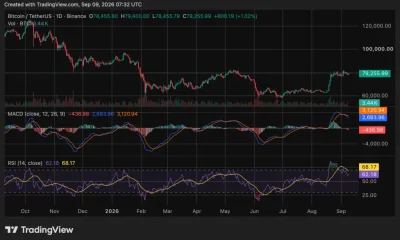
Technical analysts have flagged $76,500 as a key level to watch in the current environment. A sustained close below that threshold could open the door to a further decline toward the $72,000 to $74,000 range, according to chart-based analysis of the cryptocurrency’s recent price action, while a more dovish-than-expected outcome from Wednesday’s Fed decision could reverse the recent trend of ETF outflows and ease some of the pressure on the broader crypto market.

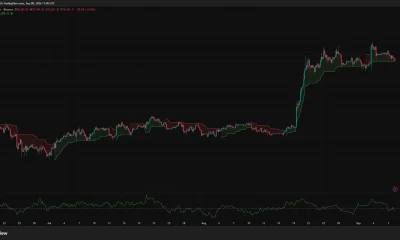
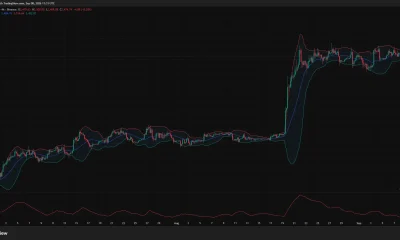
Bitcoin’s slide over the past two weeks has been steady rather than abrupt. The cryptocurrency touched an intraday peak near $82,000 on September 4 before beginning a gradual retreat, falling to roughly $79,155 by September 9 and continuing lower still following the hot inflation data released September 11. Bitcoin’s current price also sits well below its 52-week high of $126,198, reached on October 6, 2025, even as it remains meaningfully above its 52-week low of $57,748, touched on June 30 of this year. Year-to-date, Bitcoin remains down roughly 13% even before accounting for Tuesday’s decline.

The pressure on Bitcoin this week has not existed in isolation. Broader financial markets have faced their own bout of volatility tied to a weekend essay from a prominent artificial intelligence executive calling for a slower pace of AI model development, a debate that has rattled technology stocks globally over the past two trading sessions. Rising oil prices tied to escalating tensions in the Middle East have added a further layer of macroeconomic uncertainty, with both stocks and cryptocurrencies broadly trading in a more risk-averse pattern as a result.

Beyond the Federal Reserve, cryptocurrency markets are also monitoring central bank decisions elsewhere in the world this week. The Bank of Japan is widely expected to raise its own benchmark rate to 1.25% at its policy meeting later this week, which would mark the central bank’s highest rate level since 1995. Analysts tracking Bitcoin’s price action have noted that the cryptocurrency has so far shown limited direct reaction to that specific development, with the more immediate Federal Reserve decision remaining the dominant near-term catalyst for price movement.

Advertisement

Bitcoin’s underlying scarcity dynamics remain unchanged amid the current volatility, with the cryptocurrency’s supply capped at 21 million coins under its original protocol design. As of the most recent tracking, approximately 20.08 million bitcoins have been mined and are in circulation, leaving fewer than 1 million coins left to be created through the network’s ongoing mining process, a dynamic that has historically been cited by long-term holders as a structural argument for the asset’s value even amid periods of sharp short-term price volatility like the one currently unfolding.

Prediction markets have offered their own real-time gauge of where traders expect Bitcoin’s price to land in the near term. On Polymarket, the leading outcome for where Bitcoin’s price would land on September 15 was a range of $76,000 to $78,000, assigned roughly a 70% probability by traders, with the next most likely outcome, a range of $78,000 to $80,000, assigned about a 19% probability, reflecting a market broadly positioned for continued consolidation near current levels rather than a sharp reversal in either direction.

With the Federal Reserve’s rate decision now just a day away and the Bank of Japan’s own policy announcement following closely behind, investors in Bitcoin and the broader cryptocurrency market are likely to remain focused on how central bank policy, ETF flow trends, and the broader risk-off sentiment currently affecting global equity markets interact in the sessions ahead, with Tuesday’s decline serving as the latest data point in what has become an increasingly cautious stretch for digital asset markets heading into the back half of September.

Advertisement
Continue Reading

Business

Tata Sons IPO: How 7 group stocks performed in 3 months and their stake in Tata Sons

Published

on

The Economic Times

Three of these companies hold more than 3% stake in Tata Sons, the group’s holding company.

Continue Reading

Business

Speciality Steel UK to be nationalised by government

Published

on

Speciality Steel UK to be nationalised by government

The government is developing a plan to nationalise Speciality Steel UK (SSUK), the country’s third-largest steelworks, after deciding against backing the preferred bidder for the business, Business Secretary Jonathan Reynolds has told the House of Commons.

SSUK, previously part of Liberty Steel, employs about 1,300 people at sites in Stocksbridge and Rotherham in South Yorkshire and Wednesbury in the West Midlands. The government took control of the company last year after it was forced into liquidation by the High Court.

Reynolds told MPs that a bidder had come forward earlier this year, but the government had decided against supporting it. He cited “serious concerns” over the proposed financing of the deal and “protections for UK taxpayers”.

Free newsletters
Advertisement

The stories that matter to UK business, straight to your inbox.

Advertisement

Ministers had therefore decided that the government would plan its own formal acquisition of the business, he said.

Production paused

Production at SSUK was paused several months ago, and staff have been placed on furlough on reduced wages.

In a press release published yesterday, the government said the company operates four sites, in Rotherham, Stocksbridge, Brinsworth and Wednesbury, which produce specialist steel for the aerospace, defence and advanced manufacturing sectors. It said the lead bidder’s proposal could not provide “the long-term stability, certainty and value for money that workers, communities and taxpayers deserve”.

According to the government, SSUK entered liquidation in August 2025, following financial difficulties linked to the collapse of lender Greensill Capital in 2021. The government did not name the bidder. Business Matters reported in April that Norwegian green-steel start-up Blastr had entered exclusive negotiations to acquire the South Yorkshire works.

Advertisement

Reynolds told the Commons: “Having concluded that we cannot support the preferred bidder’s proposal, we are faced with a choice.

“We can allow events to take their course through the liquidation process and risk being left with no say in the future of these sites, or we can act.

“We will therefore engage with the official receiver sale process and develop a proposal for the public acquisition of SSUK.

“This will preserve strategic control and ensure that all credible future opportunities can be properly considered before irreversible decisions are taken.”

Advertisement

Funding and next steps

Reynolds said future decisions and spending commitments relating to the business would be “subject to detailed due diligence and funded from existing government budgets”.

He added: “Working towards public acquisition will create the necessary time and space to undertake a full assessment of the opportunities available.

“It will let us consider future industrial use, regeneration opportunities and the role that specialist manufacturing capabilities could play in supporting growth and our national resilience.”

The government said it would work with the Official Receiver and the South Yorkshire Mayoral Combined Authority on the next steps. In the release, Reynolds said the approach would “keep options open while we work with local leaders, workers, industry and investors”.

Advertisement

In a message to workers, Reynolds said: “I will do all I can to secure a bright future for you, your communities and your families.”

The move follows a long period of uncertainty at the business. When Liberty Speciality Steel collapsed into government receivership in August 2025, UK Steel’s Gareth Stace said: “We hope a new owner is found quickly who can inject the investment and working capital required to return production volumes to previous levels.”

The government has said a Serious Fraud Office investigation is under way into suspected fraud linked to Greensill Capital financing.

Responding to the announcement, Unite general secretary Sharon Graham said: “This is a critical move.

Advertisement

“The government is listening to Unite and is acting to protect jobs. Now we need to get on and nationalise the company.”

Jamie Young
About the author

Jamie Young

Jamie Young is Senior Reporter at Business Matters, covering SME finance, employment law and Westminster policy since 2016. He has reported on every Budget and Autumn Statement since 2018, helped make sense of the ‘covid era’ and the bounce-back loan scheme from launch through the fraud investigations, and broke the magazine’s coverage of the 2024 late-payment reforms. He joined Business Matters straight from completing his BA in Administration from Exeter University and is NCTJ-qualified. Reach him at jyoung@cbmeg.co.uk

Advertisement

Advertisement
Continue Reading

Business

MUC stock hits 52-week low at 10.16 USD

Published

on


MUC stock hits 52-week low at 10.16 USD

Continue Reading

Business

What Actually Separates a Good WordPress Development Agency From the Rest

Published

on

What Actually Separates a Good WordPress Development Agency From the Rest

Search “WordPress development agency” and you’ll get thousands of results, all promising more or less the same thing: fast, responsive, SEO-friendly websites at a competitive price. The pitches blur together. The real differences show up later, usually after you’ve signed with the wrong one.

So it’s worth knowing what actually matters before you hand over your project.

Anyone Can Install a Theme. That’s Not Development

The first thing to understand is that a lot of “WordPress agencies” aren’t really doing development at all. They’re buying a premium theme, dropping in your logo and content, and handing it back. That works fine for a simple brochure site, and if that’s genuinely all you need, you shouldn’t overpay for more.

Free newsletters
Advertisement

The stories that matter to UK business, straight to your inbox.

Advertisement

But the moment your requirements get specific, a custom booking flow, a membership area, a product configurator, an integration with your CRM, the limits of the theme-and-plugin approach show up fast. You end up with a site held together by fifteen plugins that fight each other, slow the whole thing down, and break every time WordPress updates. A genuine development agency writes custom code where custom code is needed, and knows when a plugin is the smarter choice. Knowing the difference is most of the job.

Speed and Security Are Where Cheap Builds Fall Apart

A WordPress site that looks great on launch day can still be a liability underneath. Bloated page weight, unoptimised images, and a pile of unnecessary plugins will tank your load times, and slow sites lose both visitors and search rankings. Google has been clear for years that page experience affects where you rank, and it’s only gotten stricter.

Security is the other quiet failure point. WordPress powers so much of the web that it’s a constant target, and a poorly maintained site is an open door. A serious agency builds with clean, updatable code, sets up proper backups, and thinks about hardening from the start rather than bolting it on after something goes wrong. This is the kind of work you never see and never think about, right up until the day it’s missing.

Look for a Partner, Not a Vendor

The best agencies treat a build as the start of a relationship, not the end of a transaction. Your site will need updates, new features, and maintenance as your business grows, and an agency that understands your goals will make far better decisions on your behalf than one that just ticks off a spec sheet and disappears.

Advertisement

This is where working with true WordPress Development Specialists pays off. Specialists who live and breathe the platform tend to catch the problems a generalist misses, build with the long term in mind, and give you a site that keeps working well after launch instead of slowly falling apart.

The Bottom Line

Choosing a WordPress development agency isn’t really about who has the slickest portfolio or the lowest quote. It’s about who understands the difference between assembling a website and building one. Ask how they handle custom functionality, how they approach speed and security, and what happens after the site goes live. The answers will tell you far more than any sales page.

Get that decision right, and your website becomes an asset that works for you for years. Get it wrong, and you’ll be paying someone else to rebuild it sooner than you’d like.

Advertisement

Continue Reading

Business

Magnitude Biosciences wins investment to speed up medical discovery work

Published

on

The Durham University spin-out has secured funding from a number of sources

Dr. Fozia Saleem, CEO, Magnitude Biosciences; Dr William Cousins, Investment Manager, Northstar Ventures; Dr. Chris Saunter, CTO Magnitude Biosciences

Dr. Fozia Saleem, CEO, Magnitude Biosciences; Dr William Cousins, Investment Manager, Northstar Ventures; Dr. Chris Saunter, CTO Magnitude Biosciences(Image: Northstar Ventures)

A North East tech company supporting new medicine discoveries has secured £1.3m to accelerate its work.

Magnitude Biosciences, a spinout from Durham University, has secured the funding to accelerate the commercialisation of VivoScan, which provides pharmaceutical and biotechnology companies with faster and more cost-effective ways to identify promising new treatments for ageing, longevity and neurodegenerative diseases.

Advertisement

VivoScan uses hundreds of nematode worms as a biological model to evaluate potential therapies. By combining the worms with advanced imaging, machine learning, agentic AI, automation and robotics, Magnitude Biosciences can generate whole-organism data in weeks rather than years.

The company’s work aims to offer faster alternatives to traditional drug testing models while supporting the growing industry shift towards research that is not performed on mammals.

Northstar Ventures has led the new round of investment into the company, committing capital from the North East Spinout Inspire Fund backed by the region’s five universities, as well as from the North East Innovation Fund and the Northstar EIS Growth Fund.

The funding will also mean that Magnitude Biosciences can access a £217,000 Innovate UK Investor Partnership grant.

Advertisement

Dr Fozia Saleem, CEO at Magnitude Biosciences, says: “Our ambition is to become the first company to provide a platform to screen millions of compounds in a whole organism. This investment in VivoScan gives us the opportunity to turn that ambition into reality and fundamentally change the scale and speed at which drug discovery can be done.

“We are building a platform that can move beyond simply screening more compounds. VivoScan generates rich, whole organism biological data that can help researchers understand how potential therapies affect health, ageing and disease. By making data generation faster and more cost effective, we will be able to help pharmaceutical and biotechnology companies identify better drug candidates earlier and ultimately accelerate the development of new treatments.”

The funding will be used to scale Magnitude Bioscience’s VivoScanTM platform, expand commercial activity with global pharmaceutical companies, invest in additional equipment and automation, as well as recruit new staff as the business enters the next stage of its evolution.

Dr Will Cousins, investment manager at Northstar Ventures, said: “The North East continues to generate world-class innovations with the potential to compete on the global stage. Supporting ambitious companies with the capital they need to grow is essential if we are to unlock that potential. Having worked closely with Magnitude Biosciences throughout its journey, we have seen first-hand the strength of the team, the technology and the opportunity ahead. We are proud to continue backing a business that is helping to shape the future of drug discovery.”

Advertisement

Sarah Newbould, Senior Investment Manager at the British Business Bank, said: “We’re continuing to back the businesses that are driving innovation across the UK economy, with this new funding round helping to bring Magnitude Biosciences’ new technology to market. With NPIF II providing initial investment in May last year, we’re able to support businesses throughout their journey, fuelling the Government’s Industrial Strategy and ensuring the North East’s life sciences sector continues to thrive.”

Continue Reading

Business

Potential AI slowdown not ‘end of the world’ for real estate

Published

on

Digital Realty Data Center in Ashburn, Virginia, March 17, 2025.

Leah Millis | Reuters

A version of this article first appeared in the CNBC Property Play newsletter with Diana Olick. Property Play covers new and evolving opportunities for the real estate investor, from individuals to venture capitalists, private equity funds, family offices, institutional investors and large public companies. Sign up to receive future editions, straight to your inbox.

Calls for a slowdown in the pace of AI development have hit related stocks in recent days and could have broad ramifications for every industry involved. Real estate is no exception. 

Advertisement

While cloud, storage, enterprise IT and internet services all require data center capacity, artificial intelligence has quickly become the dominant driver of demand. AI could account for about 70% of global data center capacity demand by 2030, according to a report from McKinsey. The report said the capital outlay needed to meet total data center demand by 2030 will be nearly $7 trillion. Just the real estate portion of that could account for $3 trillion in investment in the next five years, according to JLL, which provides end-to-end data center real estate services globally.

Digital Realty and Equinix, two of the largest data center REITs, saw their stocks slump on Monday following the weekend warnings over AI advancements

Digital Realty CEO Andrew Power, however, said the pledges for a slowdown by major AI players Anthropic, OpenAI and xAI do not mean “pencils down” for AI and the real estate that supports it.

“There’s tremendous digital transformation happening that is not connected to AI,” said Power in an exclusive interview with Property Play. “There is tremendous cloud computing growth. Frankly, from my business lens, my seat, I think those demand trends, which are massive drivers of our business, have been stifled in these days of AI.”

Advertisement

Power said hyperscalers have had to choose between growing their commercial cloud businesses or allocating capacity to AI labs. He also said not all markets will be impacted equally. 

Digital Realty’s markets include Northern Virginia, Dallas, Chicago, Singapore, Tokyo, Frankfurt and Amsterdam, where Power said customers are competing for the same space.

“Our markets’ demand has been outpacing supply now for several years. There’s pent-up need for infrastructure in those markets. There’s locational sensitivity. Those workloads can’t choose any one of the 50 states,” said Power. “We have a global company portfolio, so we’ve got data sovereignty and support in other countries as well.” 

Analysts agree that a slowdown would not directly impact the physical needs of AI, especially given what a change of pace would actually affect, which is training in new models.

Advertisement

Get Property Play directly to your inbox

CNBC’s Property Play with Diana Olick covers new and evolving opportunities for the real estate investor, delivered weekly to your inbox.

Subscribe here to get access today.

“The real growth in data centers over the next handful of years is in inference — that’s the adoption by businesses and citizens of the tool into daily workflow,” said Andrew Batson, global head of data center research and strategy at JLL.

“Only 1 in 4 Americans use AI daily, so even if models are slow to be released, there is significant runway for adoption to grow and data center demand to increase,” he said. 

Advertisement

Batson pointed to institutional money from Blackstone, BlackRock and KKR, which he said “have high conviction in this space.”

“That, on paper, still looks quite strong, despite some of the headlines here,” he added.

Power said that while data center REIT stocks get punished, his message to shareholders is that the company has been ready for this.

“The first, most important part is, make sure that the daily gyrations, our stock price, don’t affect our strategy, our business,” said Power. “We evolved our funding model a couple of years ago. We are an incredibly capital-intensive business.” 

Advertisement

Digital Realty’s development pipeline totals $20 billion under construction, up from $10 billion at the end of 2023, according to the company.

“We’re on to the next iteration of that in raising private capital. We’ve also done one-off joint ventures, and we positioned the balance sheet in probably the most liquidity, the lowest leverage, the best place it could be in any potential storm,” Power said. “And I’m not suggesting today is an end-of-the-world storm or anything like that.”

Continue Reading

Trending

Copyright © 2025