

Crypto World
Robinhood chain testnet records 4M transactions in first week, CEO says



Robinhood’s blockchain initiative has hit an early development milestone, with its Robinhood Chain testnet processing more than four million transactions within its first week of launch, Robinhood CEO Vlad Tenev announced on X.
Summary
- Robinhood Chain processed over 4 million transactions in its first week, with CEO Vlad Tenev highlighting growing developer activity on the Ethereum Layer-2 network focused on tokenized real-world assets (RWAs) and on-chain finance.
- While some X users called the milestone “seriously impressive,” others cautioned that testnet figures can be vanity metrics and questioned whether activity reflects real external development or internal stress testing.
- The blockchain push comes as Robinhood reported $1.28 billion in Q4 2025 revenue (up 27% YoY), though crypto revenue fell 38% year-over-year amid softer digital asset markets.
4M in a week: Robinhood’s L2 testnet sparks buzz
Tenev highlighted that developers are already building on the protocol’s Ethereum Layer-2 ecosystem, designed for tokenized real-world assets and on-chain financial services, calling it “the next chapter of finance.”
Robinhood Chain is a bespoke Ethereum Layer-2 network built on Arbitrum technology that aims to reduce costs and increase scalability for decentralized applications tied to financial-grade use cases. The public testnet, live since early February, lets developers experiment with tools, network entry points and testnet-only assets such as “stock tokens.”
Reactions on X to the CEO’s tweet were mixed. One user cautioned that “testnet numbers are usually vanity metrics,” but acknowledged that four million transactions in a week suggests “actual curiosity.”
The user questioned whether the activity reflects external developers shipping products or primarily internal stress testing, adding that the real challenge will be moving meaningful RWA volume without complex user experience hurdles.
Others were more optimistic. One commenter described the figure as “seriously impressive,” suggesting that if the mainnet performs similarly under load, it could become a significant retail crypto on-ramp.
Skepticism also surfaced around the proliferation of new blockchains. Another user argued there is “no need to reinvent the wheel,” pointing to Ethereum’s established developer base and long track record, and questioning whether launching additional chains fragments liquidity and adoption.
The announcement comes amid broader shifts in Robinhood’s business performance. In its fourth quarter of 2025, Robinhood reported revenue of $1.28 billion, up 27 % year-over-year, though slightly below Wall Street expectations, as weaker crypto trading revenues weighed on results.
Crypto-related revenue dropped about 38 % compared to the prior year, reflecting broader downturns in digital asset markets, even as equities, options and subscription income supported overall growth.


TLDR:
- xStocks surpass $25B in total transaction volume, reinforcing global market leadership.
- Over $3.5B in onchain activity involves 80,000 unique holders across blockchains.
- Eight of the top eleven tokenized equities by holders now use xStocks.
- xStocks support cross-chain, permissionless trading on Solana, Ethereum, and TON.
Bitcoin and crypto markets are seeing growing integration with traditional finance as xStocks reaches a major milestone. Kraken’s tokenized equities platform has surpassed $25 billion in total transaction volume across centralized and decentralized exchanges.
The milestone reflects strong adoption, with over 80,000 onchain holders and $3.5 billion in recorded onchain activity. This growth signals that tokenized equities are moving beyond experimental infrastructure toward real, scalable markets.
xStocks Sets Benchmark for Tokenized Equity Adoption
According to a blog post, xStocks now holds the largest market share in tokenized equities globally.
Eight of the top eleven tokenized equities by unique holders are xStocks, while 68% of the top twenty-five stocks also use the framework. The platform integrates across multiple blockchains, including Solana, Ethereum, and TON, with additional networks planned.
Users can access, trade, and transfer assets seamlessly through exchanges, wallets, and DeFi protocols.
Each xStock remains fully backed 1:1 by the underlying stock or ETF. Custodians hold assets in bankruptcy-remote structures, ensuring ownership security.
This model supports transparent trading and sustained liquidity across venues. The ecosystem now reports nearly $225 million in aggregate onchain assets under management.
Integration extends to both centralized exchanges like Bybit and Gate.io and decentralized platforms. This enables thousands of retail investors, professional traders, and institutions to participate globally.
xStocks are structured for cross-chain mobility and always-on markets, reinforcing interoperability standards. The framework’s expansion continues with new assets listed monthly and growing alliance participation.
Transaction volume highlights the platform’s rapid adoption. Within under eight months, xStocks surpassed $25 billion across minting, redemption, and secondary market activity.
Onchain adoption accounts for over $3.5 billion, emphasizing broad engagement across wallets and DeFi applications. Market participants now treat tokenized equities as live markets, not experimental infrastructure.
Driving Global Capital Market Interoperability
xStocks Alliance promotes open and permissionless tokenized equity standards. Members can move assets across platforms and chains without friction, fostering deeper liquidity.
The alliance’s approach encourages repeated engagement, network effects, and resilient market structures. Cross-chain integration positions xStocks as a foundation for the next generation of digital capital markets.
Adoption trends demonstrate growing confidence in fully collateralized tokenized models. Retail and institutional participation continues to expand, as more platforms integrate xStocks.
Interoperable assets reduce fragmentation and increase real-world utility. The milestone illustrates the evolving intersection between traditional U.S. capital markets and blockchain technology.
The platform’s onchain ecosystem now includes over 80,000 unique holders. Active trading across multiple blockchains highlights global demand.
xStocks combine regulatory transparency with crypto-native infrastructure. The milestone signals maturation of tokenized equities as scalable market solutions.
AAVE is holding the $120 demand zone as real-world asset deposits on Aave cross $1 billion, indicating rising institutional demand.
Summary
- Aave price is hovering near the mid of its weekly range, up 10% but still down over the past month.
- Real-world asset deposits on Aave Horizon have surpassed $1B.
- $135 remains the key resistance level for a confirmed bullish shift.
Aave (AAVE) was trading at $123 at press time, up 0.6% in the past 24 hours. The token sits near the middle of its weekly range between $110.29 and $131.29.
It has gained 10% over the past week, though it is still down 21% in the last 30 days. The larger trend has been corrective since December highs near $200.
Spot activity cooled slightly. Trading volume reached $280 million in the last 24 hours, down 21% in the last day. In derivatives markets, CoinGlass data shows futures volume down 31% to $274 million, while open interest rose 2.53% to $203 million.
Rising open interest alongside softer volume suggests traders are building positions carefully rather than chasing momentum.
RWA deposits double as institutional interest grows
On Feb. 19, Aave revealed that deposits of real-world assets on its Horizon market surpassed $1 billion. According to posts from Aave and founder Stani Kulechov, deposits have doubled since January. This makes Aave the first lending protocol to cross the $1 billion mark in tokenized real-world assets.
Aave is the first lending protocol with over $1 billion in RWAs deposited. pic.twitter.com/H9d4Nh0Aol
— Aave (@aave) February 19, 2026
Real-world assets include tokenized bonds and treasury-like products. Their rise shows that more institutional players are entering decentralized finance. For Aave, more RWA deposits can mean more borrowing and higher fees.
Revenue has grown sharply. In 2025, Aave DAO’s revenue surged to $142 million, exceeding the sum of the last three years prior. With more funds in its treasury, the DAO can invest in development, improve risk controls, and support token holders.
There is also a proposal called “Aave Will Win.” It would send all revenue from Aave-branded products to the DAO treasury. In exchange, Aave Labs would receive funding to build Aave V4 and hand over intellectual property to the community. If approved, the structure could tighten alignment between builders and token holders.
In addition, Grayscale Investments has filed to convert its Aave Trust into an exchange-traded fund listed on NYSE Arca. If approved, the move could expand access to traditional investors.
Aave also handled more than $450 million in liquidations between Jan. 31 and Feb. 5 without creating bad debt. That performance supported confidence in the protocol’s risk controls during volatile market conditions.
Aave price technical analysis
On the daily chart, AAVE is attempting to stabilize above the $115 to $120 demand zone. A recent dip toward $105 was quickly bought, forming a long lower wick. Price then reclaimed $115, which suggests buyers absorbed supply in that area.
The broader structure is still bearish. Lower highs and lower lows remain intact. A confirmed reversal would require a daily close above the $135 to $140 zone, which marks the most recent lower high.
Bollinger Bands show price moving back toward the middle band near $119 to $120 after touching the lower band around $103 to $105. The bands are starting to tighten, often a sign that volatility may expand soon.
The relative strength index dropped to near 30 during the recent selloff, but has recovered to around 45. Momentum has improved, but RSI has not crossed above 50. That level would signal stronger buyer control.
If AAVE holds above $120 and breaks $135, the next targets sit near $150 to $175. If $120 fails, price could revisit $105, with $95 to $100 as the next support area.
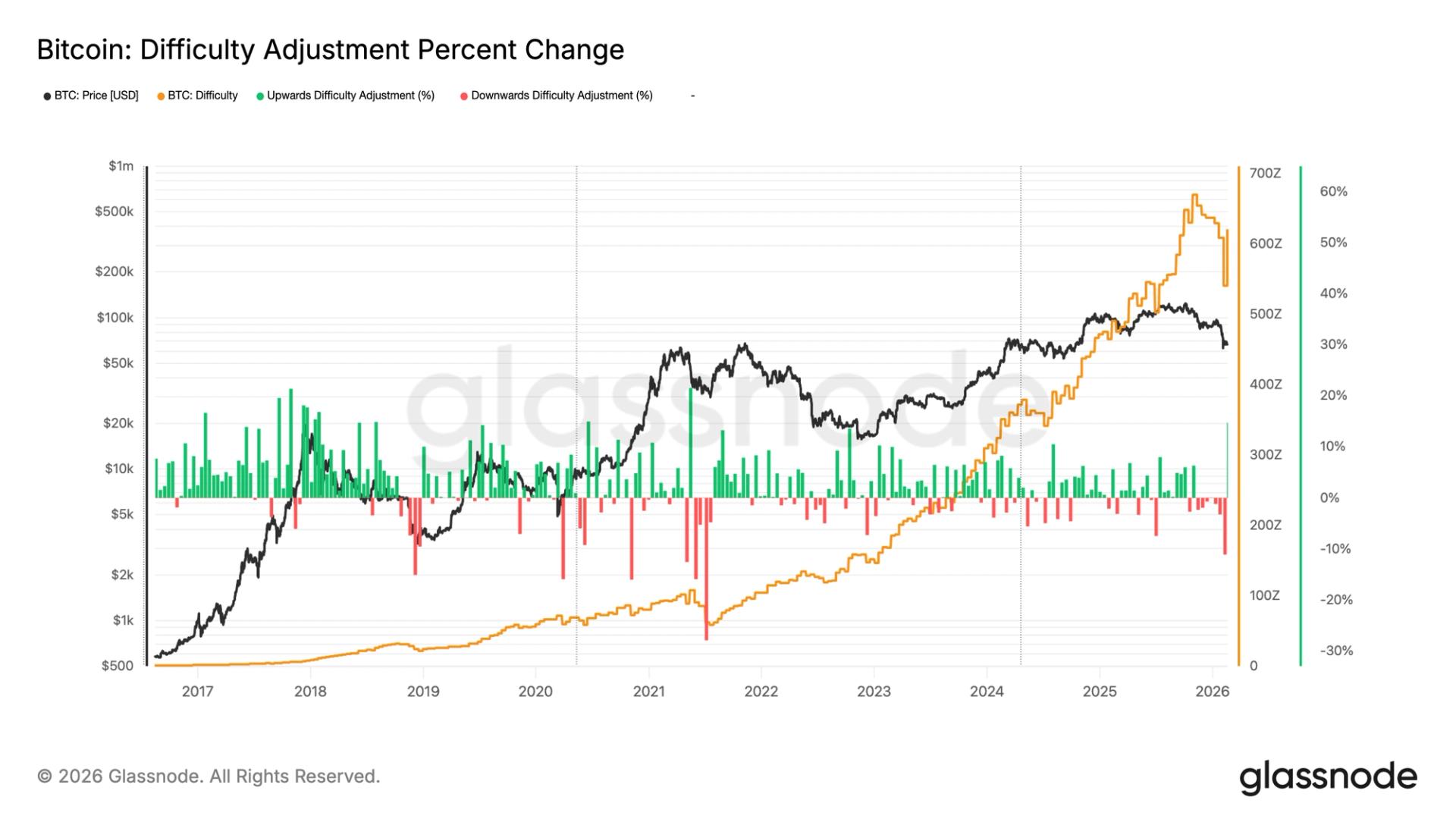
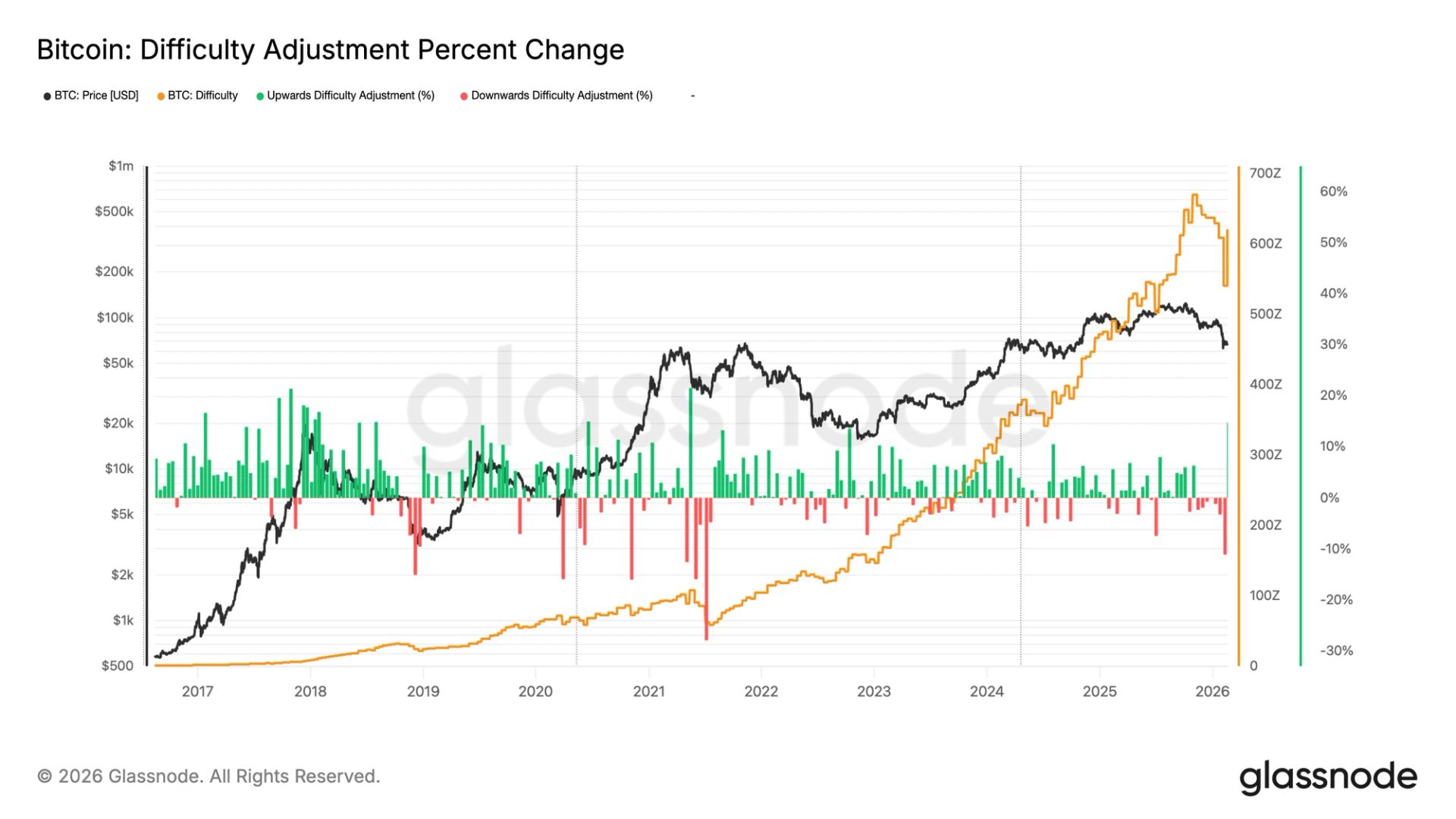
Bitcoin mining difficulty has climbed to 144.4 trillion (T), up 15%, the largest percentage increase since 2021, when the China mining ban led to a major disruption, which followed a 22% upward adjustment as the network stabilized.
Difficulty adjustments measure how hard it is to mine a new block on the network. It recalibrates every 2,016 blocks, roughly every two weeks, to ensure blocks continue to be produced about every 10 minutes, regardless of changes in the hashrate.
The adjustment follows a 12% decline in difficulty after a drop in the bitcoin hashrate, which is the total computational power securing the network. Mining activity suffered its sharpest setback since late 2021 after a severe winter storm in the United States forced several major operators to scale back operations.
In October, when bitcoin reached an all-time high of around $126,500, the hashrate also peaked at 1.1 zettahash per second (ZH/s). As prices fell to as low as $60,000 in February, the hashrate dropped to 826 exahash per second (EH/s). Since then, the hashrate has recovered to 1 ZH/s while the price has rebounded to around $67,000.
At the same time, hashprice, the estimated daily revenue miners earn per unit of hashrate, remains at multi-year lows ($23.9 PH/s), squeezing profitability.
Despite this profitability pressure, large-scale operators with access to low-cost energy continue to mine aggressively. The United Arab Emirates, for example, is sitting on roughly $344 million in unrealized profit from its mining operations.
Well-capitalized entities that can mine efficiently are helping keep the hashrate elevated and resilient, even amid subdued bitcoin prices.
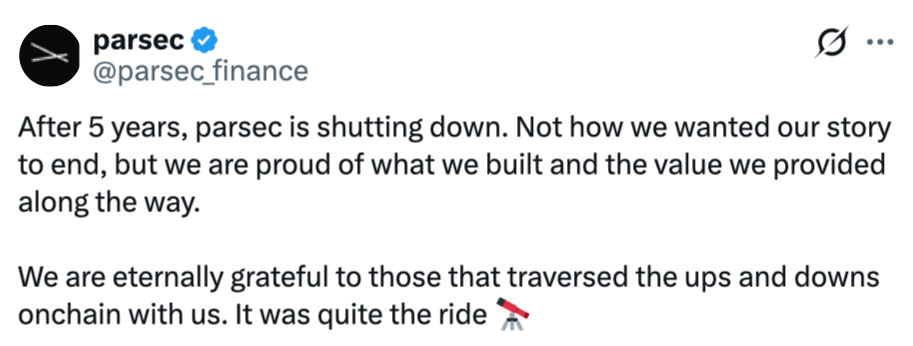
On-chain analytics firm Parsec is closing down after five years, as crypto trader flows and on-chain activity no longer resemble what they once did.
“Parsec is shutting down,” the company said in an X post on Thursday, while its CEO, Will Sheehan, said the “market zigged while we zagged a few too many times.”
Sheehan added that Parsec’s primary focus on decentralized finance and non-fungible tokens (NFTs) fell out of step with where the industry has now headed.
“Post FTX DeFi spot lending leverage never really came back in the same way, it changed, morphed into something we understood less,” he said, adding that on-chain activity changed in a way he never understood.
NFT sales reached about $5.63 billion in 2025, a 37% drawdown from the $8.9 billion recorded in 2024. Average sale prices also declined year over year, falling to $96 from $124, according to CryptoSlam data.
“Quite the ride,” Parsec says
Parsec, which had received investment from major industry players such as Uniswap, Polychain Capital, and Galaxy Digital, launched in early January 2021, just months before Bitcoin (BTC) surged from around $36,000 to $60,000 by April.

The company added in its X post that it is “eternally grateful to those that traversed the ups and downs on-chain.”
“It was quite the ride,” Parsec said.
Alex Svanevik, the CEO of on-chain analytics platform Nansen, said that Parsec “had a great run.”
Crypto industry may be heading for consolidation
It comes just weeks after crypto start-up Entropy announced it is closing down and returning funds to investors, citing scaling issues and a struggle to find product-market fit.
Bullish CEO Tom Farley predicted during an interview with CNBC on Feb. 8 that the industry will see a significant consolidation in the coming months with more projects snapped up by larger companies, which may lead to a much less fragmented sector overall.
Related: Bitcoin ETFs still sit on $53B in net inflows despite recent outflows: Bloomberg
Bitcoin’s price has declined 46% from its October all-time high of $126,100 to $67,246, according to CoinMarketCap.
Google searches for “Bitcoin going to zero” have surged to their highest level since the post‑FTX panic in November 2022, according to Google Trends data for the past five years.
Magazine: Bitcoin may take 7 years to upgrade to post-quantum: BIP-360 co-author


The path to making America the “crypto capital of the world” appeared to clear significantly on Wednesday as industry leaders and lawmakers announced a truce in the legislative battle over market structure.
Summary
- CLARITY Act, which stalled in early 2026 after Coinbase withdrew support, is now projected to pass by April following intensive “behind-the-scenes” negotiations.
- Senator Moreno emphasized that stablecoin rewards will force traditional banks to pay higher interest to everyday Americans, democratizing the financial system.
- Addressing technical fears, Armstrong confirmed that Coinbase is already preparing for post-quantum cryptography to ensure the long-term safety of digital assets.
CLARITY Act headed for the President’s desk
Appearing together at the World Liberty Forum, Coinbase CEO Brian Armstrong and Senator Bernie Moreno expressed newfound confidence that the CLARITY Act will pass by April 2026.
The optimism follows a rocky January where Coinbase famously “rug-pulled” its support for the bill over provisions that would have banned interest-bearing stablecoins. Armstrong clarified that his opposition wasn’t a “block,” but a call to return to the table.
“There is now a path forward where we can get a win-win-win outcome,” Armstrong said, noting that the smartest banks are now “leaning in” rather than fighting the inevitable.
Stablecoins as a tool for dollar dominance
Senator Moreno, a former crypto entrepreneur himself, argued that the bill’s focus on stablecoin rewards is essential for national security.
By allowing these assets to compete with traditional bank deposits, Moreno claimed the U.S. could effectively “dollarize the world” and reduce treasury borrowing costs by hundreds of billions of dollars.
“Unless you own a bank, you probably shouldn’t care,” Moreno told the audience, framing the debate as a choice between protecting outdated banking models or empowering consumers with faster, high-yield digital cash.
Addressing the “quantum threat”
The conversation also pivoted to technical risks, specifically the concern that quantum computing could “break” the blockchain.
Armstrong was quick to dismiss the threat as a “solvable engineering challenge,” revealing that Coinbase is already coordinating with major networks like Ethereum and Bitcoin to upgrade to post-quantum cryptographic standards.
The duo also cheered recent news from CFTC Chairman Mike Selig, who this week reaffirmed federal jurisdiction over prediction markets. Armstrong, whose “Everything Exchange” now includes these markets, praised the move as a vital check against state-level efforts to classify the sector as illegal gambling.
With the White House and the “Crypto Czar” David Sacks reportedly meeting daily with stakeholders, the “April milestone” has become the primary target for a industry eager to trade regulatory “word salad” for a clear, national standard.


CME Group, the world’s largest regulated derivatives marketplace, announced plans to begin 24-hour, seven-day-a-week trading of its cryptocurrency futures and options contracts on May 29, 2026, pending regulatory review.
Summary
- Pending regulatory approval, crypto products will move to a 24/7 schedule on the CME Globex platform, with only a brief weekly window for maintenance.
- The shift follows a massive 2025 where CME saw $3 trillion in notional activity, driven by professional traders seeking regulated risk-management tools.
- Beyond Bitcoin and Ether, CME recently broadened its reach by launching futures for Cardano (ADA), Chainlink (LINK), and Stellar (XLM).
CME Group adopts 24/7 crypto trading as competition heats up
The decision marks a significant step in aligning regulated digital-asset derivatives with the continuous nature of global crypto spot markets.
Under the new schedule, CME’s cryptocurrency products will trade continuously on its CME Globex platform, with a brief weekly maintenance window. Any trading conducted from Friday evening through Sunday evening will receive the following business day’s trade date for clearing, settlement and reporting.
CME said that client demand for regulated crypto risk-management tools is at an historic high, driven by record volumes in 2025 when its crypto futures and options saw $3 trillion in notional activity. Average daily volume and open interest have both climbed sharply year-over-year in 2026, underlining robust participation from institutional and professional traders.
The expansion builds on CME’s broader push into digital assets. In early February, the exchange successfully launched futures contracts for Cardano (ADA), Chainlink (LINK) and Stellar (XLM), including both standard and micro sizes, broadening its altcoin derivatives lineup beyond Bitcoin and Ether. Market participants have viewed this as a key step in giving regulated access to a wider range of crypto assets.
However, CME’s push to modernize its markets has faced operational challenges. In November 2025 a cooling-system failure at a CyrusOne data center triggered a major outage that halted futures trading across cryptocurrencies, commodities, equities and FX, highlighting infrastructure risks as trading demand intensifies.
As crypto continues its integration into mainstream finance, round-the-clock regulated trading at CME could help close the gap between always-on digital markets and traditional exchange hours — offering traders more flexibility and risk management options around the clock.


Minneapolis Federal Reserve President Neel Kashkari delivered a blistering critique of the cryptocurrency industry on Thursday, dismissing digital assets as “utterly useless” and characterized by “word salad” marketing rather than functional utility.
Summary
- Kashkari argued that after over a decade, crypto has failed to provide a compelling use case for U.S. consumers, unlike AI tools which have seen rapid, practical adoption.
- He dismissed the “instant” cross-border payment narrative, noting that recipients must still pay high costs to convert crypto into local currency for daily essentials.
- The Fed official asserted that existing domestic tools like Venmo and Zelle already outperform stablecoins, and warned that nations will not abandon independent monetary policies for a unified crypto platform.
Speaking at the 2026 Midwest Economic Outlook Summit, Kashkari challenged the fundamental value proposition of cryptocurrencies and stablecoins.
During a fireside chat, he contrasted the tangible economic impact of Artificial Intelligence with the decade-long history of crypto, which he argues has failed to integrate into the real economy.
Kashkari’s crypto “grocery store” test
Kashkari was particularly skeptical of the claim that crypto excels at cross-border payments. Using a personal example, he described the hurdles of sending money to family in the Philippines. While proponents claim crypto offers “instant” transfers, Kashkari argued the logic falls apart at the point of sale.
“How does [a recipient] buy groceries with it?” Kashkari asked the audience.
“They still have to convert it to the local currency, and that is still expensive. What advocates are really saying is that if everyone in the world used the same platform, friction would disappear, but nations are not going to abandon their own monetary policies.”
Demanding clarity over “buzzwords”
The Fed official urged the public and policymakers to stop settling for vague explanations. He described much of the industry’s rhetoric as a “buzzword salad,” noting that most “innovations” offered by stablecoins are already handled efficiently by existing domestic tools like Venmo or Zelle.
“Ask the most basic questions and don’t settle for nonsense,” Kashkari warned. “Whenever I make people really explain how this thing actually works, there’s just nothing there.”
The remarks highlight a growing divide in 2026 between the central bank’s skepticism and the commercial sector’s expansion, coming just hours after the CME Group announced plans to move toward 24/7 crypto derivatives trading to meet institutional demand.


Another week has ended, and Friday has arrived, which means another batch of Bitcoin options contracts is expiring while spot markets remain sideways.
Around 30,600 Bitcoin options contracts will expire on Friday, Feb. 20, with a notional value of roughly $2 billion. This event is a little smaller than last week’s expiry, so there is unlikely to be any impact on spot markets.
Crypto markets are in bear market territory, but have remained flat over the past week as volume and volatility dry up.
Bitcoin Options Expiry
This week’s batch of Bitcoin options contracts has a put/call ratio of 0.59, meaning that there are more expiring calls (longs) than puts (shorts). Max pain is around $70,000, according to Coinglass, which is above current spot prices, so many will be out of the money on expiry.
Open interest (OI), or the value or number of Bitcoin options contracts yet to expire, remains highest at $60,000 with $1.2 billion and $1 billion at $50,000 strike prices on Deribit as bearish bets increase. Total BTC options OI across all exchanges has been climbing this month and is at $36.5 billion.
“Positioning skews call heavy across both assets, with BTC showing the stronger upside skew,” said Deribit.
Meanwhile, derivatives analyst Laevitas observed that “downside protection remains in demand,” noting 2,140 BTC worth of puts at $58,000 recently bought.
🚨 Options Expiry Alert 🚨
At 08:00 UTC tomorrow, over $2.4B in crypto options are set to expire on Deribit.$BTC: ~$2.0B notional | Put/Call: 0.59 | Max Pain: $70K$ETH: ~$404M notional | Put/Call: 0.75 | Max Pain: $2,050
Positioning skews call heavy across both assets, with… pic.twitter.com/pgl2z4ZGJ6
— Deribit (@DeribitOfficial) February 19, 2026
You may also like:
In addition to today’s batch of Bitcoin options, around 212,000 Ethereum contracts are also expiring, with a notional value of $404 million, max pain at $2,050, and a put/call ratio of 0.75. Total ETH options OI across all exchanges is around $6.8 billion.
This brings the total notional value of crypto options expiries to around $2.4 billion.
Spot Market Outlook
Total market capitalization has been flat for the past 24 hours and since the beginning of the week, hovering around $2.37 trillion, down 46% from its peak. Bitcoin has slowly eroded since Monday, hitting a weekly low of $65,700 in late trading on Thursday before recovering to $67,290 at the time of writing on Friday morning in Asia.
Resistance is forming at $70,000, with support still just above $60,000, and this seems to be the closest target. There has been no movement in Ether prices, which have started to consolidate around $1,950. The rest of the altcoins remain flat at bear market bottoms.
SECRET PARTNERSHIP BONUS for CryptoPotato readers: Use this link to register and unlock $1,500 in exclusive BingX Exchange rewards (limited time offer).


Crypto prices firmed during Asia’s Friday morning session, with bitcoin climbing toward $68,000 after a choppy week that tested nerves across risk markets.
The bounce was broad. XRP, Solana’s SOL, and Cardano’s ADA added upto 2% while ether lagged with a small dip, hovering below $2,000 as traders treated the level as a line that needs defending rather than celebrating.
The move had the feel of a relief rally more than a clean turn. After weeks of sharp swings, the market has started reacting in waves. A quick push higher draws in dip buyers, then selling appears as soon as price reaches a level where trapped holders can exit with less pain. The difference this week is that each rebound has looked a little less fragile, suggesting forced selling is easing even if conviction buying has not returned in size.
Macro and geopolitics are doing their part to keep traders cautious. Gold steadied near $5,000 an ounce after two sessions of gains as investors priced rising Middle East risk.
US President Donald Trump said Thursday he would allow 10 to 15 days for talks on a nuclear deal with Iran, while American forces reportedly built up in the region. That mix has supported haven demand and made it harder for risk assets to build momentum.
FxPro chief market analyst Alex Kuptsikevich framed the broader backdrop as bearish.. He said that given the market’s prior dynamics and the more cautious tone in US stocks, the odds increase of a retest of local lows, pointing to levels last seen in the second half of 2024.
On ether, he said the token is sitting on a long running support line that traces back to 2020 and lines up with the $2,000 area, but added that a true breakdown would need confirmation through a drop below recent lows around $1,500.
Under the surface, some indicators hint that big holders may be positioning to sell into strength. CryptoQuant says bitcoin inflows from large holders to Binance have reached record levels, a pattern that can precede heavier spot supply.
Research shop K33 has compared current conditions to the later stages of the 2022 bear market that gave way to a long, grinding consolidation.
The result is a market that can bounce, but struggles to turn rebounds into a trend until spot demand grows louder than the sellers waiting at the next round number.
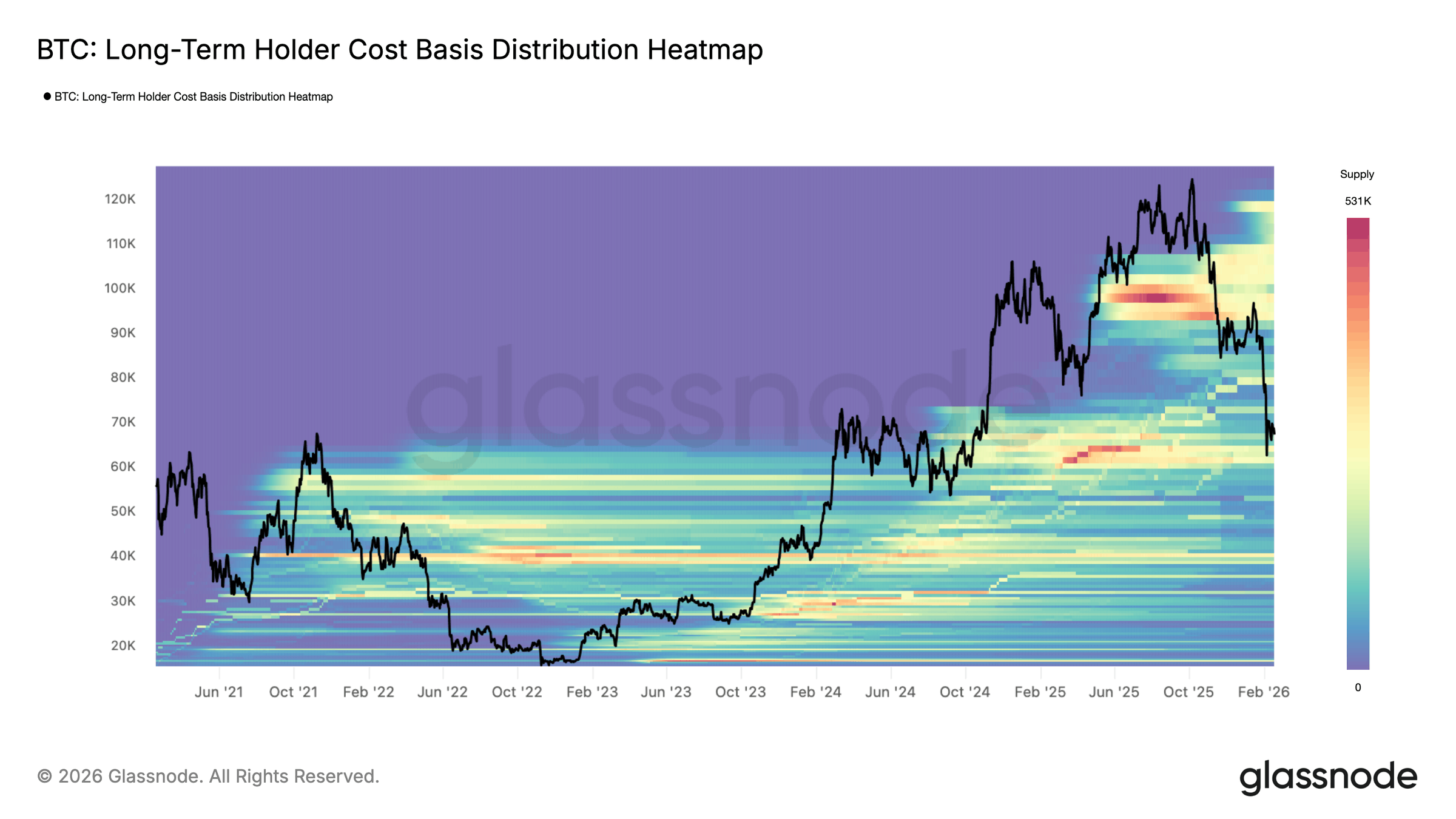
Bitcoin’s (BTC) market structure shifted into a corrective phase after losing a key onchain valuation level in late January.
Glassnode data shows that BTC’s price is compressing within a 2024-era demand zone as liquidity conditions soften. At the same time, BTC’s supply is steadily shifting into long-term, retail-linked wallets while exchange activity has cooled.
This mix of technical and onchain data, along with the current capital rotation, may shape the next steps for Bitcoin price.
Bitcoin lost its active supply cost price, but holders defend $60,000
In its weekly “The Week On-chain” report, Glassnode said that BTC’s recent price dip accelerated due to breaking below its true market mean near $79,000 in January, which is the cost basis of the tracked active supply.
Since then, the price has stabilized inside a dense $60,000 to $69,000 range, which is being defended by medium-term holders. One of the reasons this zone has been a strong support is because of the age of coins within this range for the majority of 2024.

Coins accumulated in that range have aged more than a year, placing a large cohort close to breakeven. This supply may be acting as a backstop on the current sell pressure.
Market analyst Ardi pointed to a similar dynamic, writing on X:
“We’re trading inside the same $53-73K range that took 245 days to build last year. Think about how much volume went through this zone. This is the most contested zone on BTC’s entire chart right now.”
Glassnode also highlighted that, in past cycles, deeper bear phases have gravitated toward the realized price, which now stands near $54,900. The metric estimates the average acquisition cost of all circulating coins.
Bitcoin’s liquidity conditions also remain compressed. The 90-day realized profit/loss ratio has declined back into the 1–2 range, a level associated with limited capital rotation. A sustained move below 1 has aligned with stressed bear environments.

Related: Google searches for ‘Bitcoin going to zero’ at highest since 2022
BTC accumulation rises even as activity slows down
CryptoQuant data shows that the balances held by accumulating address cohorts have continued rising into early 2026. Total BTC held by these cohorts has expanded to over 4 million BTC, up from roughly 2 million BTC in early 2024, which reflects a steady supply absorption.

The retail-linked accumulation addresses have increased their holdings by 850,000 BTC, while the accumulating pattern wallets, addresses that steadily add BTC in recurring intervals with minimal outflows, increased their size to 1.27 million BTC. This expansion occurred even as the price dropped in 2026.
In contrast, the inflows from centralized-exchange addresses and highly active addresses have moderated. Compared with the 2023 to 2024 expansion phases, where inflow spikes frequently exceeded 1.2 million to 1.5 million BTC, the recent activity has remained significantly lower, averaging 300,000 BTC to 400,000 BTC.

The divergence shows that more BTC is being absorbed into long-term wallets while fewer coins are rotating through major exchanges. That reduces the liquid supply and slows down short-term trading activity.
Related: Bitcoin’s consolidation nears ‘turning point’ as $70K comes in focus: Analyst
This article does not contain investment advice or recommendations. Every investment and trading move involves risk, and readers should conduct their own research when making a decision. While we strive to provide accurate and timely information, Cointelegraph does not guarantee the accuracy, completeness, or reliability of any information in this article. This article may contain forward-looking statements that are subject to risks and uncertainties. Cointelegraph will not be liable for any loss or damage arising from your reliance on this information.

’Jennifer Hudson Show’ Renewed For Season 5

Gangster brought down after Pizza Hut meeting found dead in Dubai hotel room
Japan stocks lower at close of trade; Nikkei 225 down 1.07%

Smart energy pays enters the US market, targeting scalable financial infrastructure

Why Israel is blocking foreign journalists from entering

Software stocks enter bear market on AI disruption fear with ServiceNow plunging 10%

Patrick Witt Just ADMITTED It!!! XRP Is DESTROYING The Banks?!?!

UPSC Economy – 16th Finance Commission – One Shot Summary for Prelims & Mains by Dr. Mrunal Patel

BITCOIN: It’s Happening AGAIN (History Repeating)!!! – Bitcoin News Today, Ethereum & Altcoins
-

 Video4 days ago
Bitcoin: We’re Entering The Most Dangerous Phase
-

 Tech5 days ago
Luxman Enters Its Second Century with the D-100 SACD Player and L-100 Integrated Amplifier
-

 Crypto World3 days ago
Can XRP Price Successfully Register a 33% Breakout Past $2?
-

 Sports3 days ago
GB's semi-final hopes hang by thread after loss to Switzerland
-

 Video7 days ago
The Final Warning: XRP Is Entering The Chaos Zone
-

 Video5 hours ago
XRP News: XRP Just Entered a New Phase (Almost Nobody Noticed)
-
 Tech3 days ago
The Music Industry Enters Its Less-Is-More Era
-

 Business2 days ago
Infosys Limited (INFY) Discusses Tech Transitions and the Unique Aspects of the AI Era Transcript
-

 Entertainment2 days ago
Kunal Nayyar’s Secret Acts Of Kindness Sparks Online Discussion
-

 Video3 days ago
Financial Statement Analysis | Complete Chapter Revision in 10 Minutes | Class 12 Board exam 2026
-

 Tech2 days ago
Retro Rover: LT6502 Laptop Packs 8-Bit Power On The Go
-
 Crypto World6 days ago
Bhutan’s Bitcoin sales enter third straight week with $6.7M BTC offload
-
 Sports1 day ago
Clearing the boundary, crossing into history: J&K end 67-year wait, enter maiden Ranji Trophy final | Cricket News
-

 Crypto World7 days ago
Kalshi enters $9B sports insurance market with new brokerage deal
-

 Entertainment1 day ago
Dolores Catania Blasts Rob Rausch For Turning On ‘Housewives’ On ‘Traitors’
-

 Business2 days ago
Tesla avoids California suspension after ending ‘autopilot’ marketing
-
 NewsBeat5 days ago
The strange Cambridgeshire cemetery that forbade church rectors from entering
-

 Crypto World1 day ago
WLFI Crypto Surges Toward $0.12 as Whale Buys $2.75M Before Trump-Linked Forum
-
 NewsBeat5 days ago
Man dies after entering floodwater during police pursuit
-

 Crypto World9 hours ago
83% of Altcoins Enter Bear Trend as Liquidity Crunch Tightens Grip on Crypto Market