


Connect with us

Business

Why Global Employers Keep Looking to Romania for Talent

Published

on

Why Global Employers Keep Looking to Romania for Talent

Companies that opened a small development team there years ago usually still have it, and it is usually bigger than they planned.

What has changed is the reason employers give. Cost used to be the first thing anyone said out loud. Now it tends to come third or fourth, after the size of the talent pool, after the language range, after the plain fact that a team in Bucharest or Cluj shares most of a working day with colleagues in Dublin, Berlin and, at a stretch, the US east coast.

What actually draws employers toward Romanian talent

Romania built a technical education pipeline long before anyone described it as a hiring market. Universities in Bucharest, Cluj-Napoca, Iasi and Timisoara have turned out engineers, mathematicians and computer scientists for decades, and a good share of that output stayed in the country as a local services industry grew up around it.

Free newsletters
Advertisement

The stories that matter to UK business, straight to your inbox.

Advertisement

You notice the effect at interview stage. Candidates have usually worked with distributed teams already, often for foreign clients, and they arrive understanding how a code review across time zones works in practice. That familiarity is worth more than it sounds. A first international hire who has never worked for a company headquartered somewhere else spends the early months learning the shape of remote work rather than learning the job.

Language range is the part employers underrate until they have it. English is standard in technical and commercial roles. French, German, Italian and Spanish appear often enough that Romanian teams have ended up carrying support and finance operations for several European markets at once, which was rarely anyone’s original plan.

The vocabulary problem sitting underneath the plan

Planning gets loose at the moment someone writes “we will use an EOR” on a slide.

Romanian employment law does not recognise a standalone statutory category with that name. What it does recognise is a licensed regime for temporary work agencies, authorised by the responsible ministry, entered on a public register, and subject to conditions that generally include a financial security requirement and periodic renewal of the licence. Under that regime the agency is the legal employer. The person works under the direction of a user company. The assignment runs on a temporary employment contract tied to a specific mission with a defined term and a limited number of renewals set in law.

Advertisement

When a plan says hiring in Romania through an EOR, what sits underneath it is almost always a contract with a licensed agency of that kind. The label travels. The legal structure does not. Worth knowing before you promise a candidate something the paperwork cannot deliver.

How the arrangement runs once someone is actually working

The agency signs the employment contract, runs payroll, makes the statutory contributions, keeps the leave and working time records, and handles the paperwork when an assignment ends. You direct the work itself: priorities, standards, review, the day to day.

Equal treatment is the condition people forget. An assigned worker’s pay and core conditions are benchmarked against what a comparable employee of the user company would receive, so the structure is not a route around local terms. Duration matters too. The mission has a stated purpose and an end point, and both are visible if anyone examines the file later.

Most of the detail sits in the employment code rather than in any single explainer, though a guide to employing in Romania will get a hiring manager oriented faster than the code will.

Advertisement

Where the structure fits, and where it stops fitting

It works well when you are testing whether a Romanian team makes sense, when you need one or two specialists quickly, or when a project has a genuine horizon.

It works less well when the role is permanent, open ended and central to what the company does. At some point the honest structure for that is a Romanian entity with direct employment, and teams that keep extending agency assignments past the point of comfort tend to know it before their advisors say so.

Tax questions belong with your own tax and legal advisors rather than with a hiring plan. Where employment sits, how it is treated, and what it triggers for the company are all fact-specific, and they turn on details a template cannot see.

Questions worth asking before the first Romanian hire

  • Is the agency currently licensed, and can you see the registration?
  • Who is named as the employer on the contract the candidate signs?
  • What comparable role is being used for the equal treatment benchmark?
  • What is the stated purpose and term of the assignment, and what happens at the end of it?
  • Which statutory benefits and contributions sit inside the quoted cost, and which are billed separately?

None of that is exotic. It is the same diligence you would apply to any supplier about to hold an employment relationship on your behalf. Ask it early and the Romanian hire starts to look like every other hire, which is roughly the point.

Advertisement

Continue Reading
Click to comment

You must be logged in to post a comment Login

Leave a Reply

Business

Hugo Boss Appoints Frasers CEO Michael Murray as Supervisory Board Chairman

Published

on

Hugo Boss Appoints Frasers CEO Michael Murray as Supervisory Board Chairman

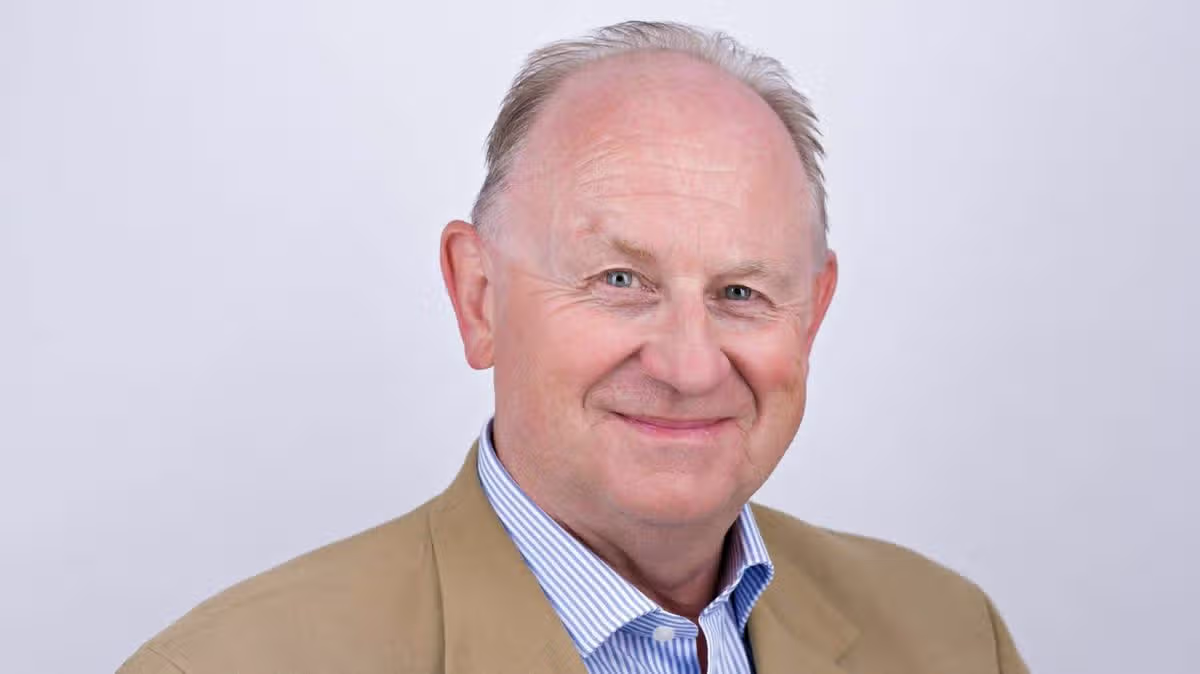
Hugo Boss said it appointed Michael Murray, Frasers Group’s FRAS 2.16%increase; up pointing triangle chief executive, as the next chairman of its supervisory board, weeks after the U.K. retailer achieved a near-majority ownership.

Murray, who has sat on Hugo Boss’s supervisory board since May 2025, will succeed Stephan Sturm as chairman, the German premium apparel company said Wednesday.

Copyright ©2026 Dow Jones & Company, Inc. All Rights Reserved. 87990cbe856818d5eddac44c7b1cdeb8

Continue Reading

Business

Members of advisory panel that will help establish a new development agency for Wales revealed

Published

on

Business Live

Enterprise Minister Adam Price said the panel will produce an interim report early net year

Adam Price.(Image: Senedd Cymru)

Members of an advisory panel that will support the Welsh Government to establish a new development agency for Wales has been revealed.

Following the appointment of Jonathan Lewis, the current chair of the UK’s biggest ports operator ABP and a former chief executive of Capita, as panel chair, Cabinet Minister for Enterprise, Connectivity and Energy, Adam Price, has confirmed the other members.

Advertisement

The panel of ten, who will not be remunerated, include economist and managing partner of Cadwyn Capital Gerry Holtham, former managing director of Nantgarw-based GE Aviation, La-Chun Lindsay, and as its vice chair, founding member of Starling Bank and chair of Fintech Wales Sarah Williams-Gardener.

Creating a new agency at arm’s length of the Welsh Government was a key Senedd Election manifesto pledge of Plaid Cymru. Rather then focusing on taking over responsibility for current Welsh Government business support functions, such as Business Wales, a small agile agency – sourcing necessary external private expertise – could potentially emerge.

This would be a body operating as more as a facilitator to support Welsh firms seeking to expand at scale or bring investment projects into Wales – supported by the Welsh Government, local authorities, and regional bodies in creating a lighter touch approach to planning and, where devolved, business regulation.

The agency will form’s part of the Welsh Government efforts to halve Wales’s productivity gap with the UK average by half within the next decade.

Advertisement

The former at arm’s length of government Welsh Development Agency was abolished by the then Labour Welsh Government of Rhodri Morgan in 2006. Its functions, and many of its staff, were brought into the Welsh Government’s civil service.

However, at the time of its demise it had become bloated, with more than 1,000 staff. Its ability to attract inward investment projects into Wales at scale was also on the wane with increasing competition from the successor states of eastern Europe.

In written statement Mr Price said: “Over the past two months, we have spent time targeting and securing the support of a talented team of business experts, all bringing their individual diverse experiences, but all with a shared passion and willingness to support Wales to do business, to advise us on the design of the new development agency.

“Each will bring their own expertise to assist us in developing the detailed remit and functions of the agency, helping us design and establish an organisation that swiftly supports the growth of our nation’s economy and becomes a key driver for our national productivity mission; to halve Wales’s productivity gap with the UK within 10 years. Improving productivity will have a direct consequence of creating better jobs for people, thereby putting more money in their pockets and raising living standards.

Advertisement

“We have set out the headline vision. The panel will help us deliver that vision, providing advice, recommendations and challenge about the form and functions of the agency.”

Mr Price said the panel “not operate in isolation” but will engage widely and be outward looking and collaborative in taking forward their work. He added: “In conjunction with the panel, we are developing a programme of stakeholder engagement to ensure the input of a wide range of voices across the Welsh economic development landscape.”

The panel is expected to publish and interim report early next year.

The other panel members are: former chief executive of Subsea7, John Evans; Beren Kayali, co-founder and chief technology officer of Deploy Tech; Alison Lea-Wilson, co-founder of Halen Môn; Nigel Morris, founder of Capital One and managing Partner of QED Investors , Gareth Noyes , who held a range of senior roles at Wind River Systems; Oriel Petry, senior vice president and head of public affairs at Airbus UK and general secretary of TUC Wales, Laura Doel .

Advertisement

Responding to anointment chair of FSB Wales, John Hurst, said: “We welcome the appointment of the panel that will advise the Welsh Government on establishing a new development agency, and particularly the inclusion of SME owners who can bring first-hand experience of starting and growing a business to this important work.

“This is a significant opportunity to implement a simpler, more joined-up and more effective approach to economic development in Wales.

“The new agency must deliver measurable impact by making it easier for firms to access the practical help they need to survive and grow, with the agency’s success judged by clear outcomes: more small businesses starting, surviving and scaling.

“Small businesses are embedded in every community and are fundamental to Wales’s economic success. As the panel begins its work, it must ensure that the voices of small businesses shape its recommendations from the outset, so that the new agency is designed around the real needs and ambitions of firms across Wales.”

Advertisement

Latest figures from the ONS show that output per head in Wales is around 85% of the UK level. The productivity target is seen by the administration as achievable, given that some of the key levers needed to improve output, such as skills and education, are devolved However, it will still be a challenge as other nations and regions of the UK will also be seeking to improve their respective productivity rates, with AI a key driver

Continue Reading

Business

Ingram Micro Holding Corporation (INGM) Analyst/Investor Day Transcript

Published

on

OneWater Marine Inc. (ONEW) Q1 2026 Earnings Call Transcript