Connect with us

Business

India’s ‘anti-AI’ trade hides 42 AI-enabler stocks that rallied 60% already: Goldman Sachs

Published

on

India’s ‘anti-AI’ trade hides 42 AI-enabler stocks that rallied 60% already: Goldman Sachs
India’s stock market weakness is masking one of the country’s strongest pockets of AI exposure. While the Nifty has declined 12% in 2026, a Goldman Sachs-screened basket of 42 Indian “AI Enablers” has surged about 60%, making it the best performing segment of the market by a wide margin.

The divergence challenges the dominant view that India has little to gain from the global artificial intelligence boom. The country has increasingly become the default “anti-AI” trade among major markets because its benchmark indexes have limited exposure to AI-related companies. But beneath the headline index performance, a cluster of companies tied to power, data centres and semiconductors is benefiting from the infrastructure build out required to support AI.

Goldman Sachs screened about 1,800 companies listed on Indian exchanges, representing a combined market value of around $5 trillion. After applying filters based on market size, liquidity, revenue growth, capex, research and development intensity, and management commentary on AI infrastructure, the investment bank identified 42 companies with a combined listed market value of $670 billion.

The companies were selected based on visible revenue generation, order book pipelines, capital commitments and partnerships across the AI-related supply chain. The basket includes businesses involved in power generation, power transmission, power equipment, data centre development and operations, data centre hardware, semiconductor assembly and testing, semiconductor materials and semiconductor hardware.

Advertisement

Also Read | Smallcap, midcap stocks give 85 multibaggers but pro investors are betting elsewhere


42 Indian AI Enablers stocks
The list includes Adani Green Energy, Tata Power, NTPC Green Energy, ACME Solar, Clean Max Enviro Energy, Power Grid, Adani Energy Solutions, KEC International, ABB India, Cummins India, Siemens, Hitachi Energy India, GE Vernova T&D India, APAR Industries, Kirloskar Oil Engines, Schneider Electric Infrastructure, TD Power Systems, MTAR Technologies, Diamond Power Infrastructure, Waaree Renewable Technologies, Gujarat Fluorochemicals, Navin Fluorine, Himadri Speciality Chemical, Netweb Technologies, CG Power, Waaree Energies, Sansera Engineering, Kaynes Technology, Paras Defence, Polycab India, KEI Industries, Sterlite Technologies, HFCL, Blue Star, Craftsman Automation, Syrma SGS Technology, Reliance Industries, Bharti Airtel, Larsen & Toubro, Adani Enterprises, Anant Raj and Brigade Enterprises. The basket has rallied about 60% in 2026.The rally has been broad-based. All three major layers of power, data centres and semiconductors have gained between 40% and 80% in 2026, according to Goldman Sachs. Six of the nine sub-layers have risen more than 20%, while all nine have outperformed the MSCI India Index.

The next best performing pocket of the Indian market, healthcare, has gained only about 10% this year. The AI-enabler basket has also outperformed the Nifty Midcap and Smallcap indexes, suggesting that its gains cannot be explained only by a broader rally in smaller companies.

The composition of the basket highlights how much of India’s AI exposure sits outside traditional benchmark heavyweights. Of the 42 companies, 8 are microcaps, 13 are smallcaps, 9 are midcaps and only 12 are largecaps. Capital goods account for half the basket, with 21 companies, while utilities and technology hardware are the other major areas of exposure.

Data centre operators account for the largest share of the basket’s total market value, at about $400 billion. They are followed by power equipment companies at $100 billion, power generation at $50 billion and power transmission at $45 billion.

Advertisement

Goldman Sachs said the rally has been driven primarily by earnings rather than speculative multiple expansion. Since 2025, the AI-enabler basket has returned 53%, with earnings growth contributing 65 percentage points while valuation compression reduced returns by 12 percentage points.

That earnings momentum is expected to continue. Consensus estimates cited by Goldman Sachs indicate that earnings for the AI-enabler basket could grow 53% in 2026, 39% in 2027 and 29% in 2028. This compares with expected 2027 earnings growth of 16% for MSCI India and 23% for the MSCI India Small and Midcap Index.

Power generation, data centre hardware and power equipment are expected to lead the next phase, with earnings growth of about 40% to 60%. Collectively, the AI-enabler group could contribute around two percentage points to Nifty 500 profit growth in 2027 and 2028, the report said.

The earnings outlook is being supported by a strong investment cycle. Nifty 500 capex growth is expected to more than double to 16% in 2026 from 7% in 2025, with AI enablers contributing about six percentage points to that increase. Goldman Sachs expects the companies to remain free cash flow positive despite higher capital spending.

Advertisement

The AI theme is also appearing more frequently in corporate disclosures. Goldman Sachs found that references to AI in management commentary have risen sharply over the past two years, not only among technology companies but also across other sectors. Earnings calls increasingly include terms such as data centres, power purchase agreements, fibre infrastructure, transformers, switchgear, uptime, substations, GPUs, OSAT and data lakes.

That shift in corporate language is providing an early indicator of investment and capacity expansion, even though hard disclosures on AI-related revenue and spending remain limited.

The opportunity, however, comes with a valuation caveat. The AI-enabler basket trades at about 36 times forward earnings, an 85% premium to the MSCI India Index and near the upper end of its five-year historical range. On an absolute basis, Goldman Sachs said the multiples appear elevated.

But the premium narrows when valuations are adjusted for earnings growth. The basket’s PEG ratio, the price-to-earnings multiple relative to expected growth, is 1.3 times, slightly below MSCI India’s 1.4 times. That suggests the premium may reflect stronger expected earnings rather than excessive valuation alone.

Advertisement

There is also a significant divergence within the group. While some sub-layers trade at demanding valuations, others remain closer to their historical averages. Goldman Sachs cautioned that the screen can include false positives because of its top-down methodology, while its liquidity and market cap filters may also exclude some potential beneficiaries.

(Disclaimer: This article has been written by Nikhil Agarwal, who is not a SEBI-registered Research Analyst or an Investment Adviser. Nikhil Agarwal and his/her ‘relative(s)’ (as defined under Section 2(77) of the Companies Act, 2013) do not hold any financial interest in the companies mentioned in this article as of the date of publication. The views/recommendations mentioned in this article, wherever applicable, are those of the respective SEBI-registered Research Analyst/brokerage and have been reproduced/reported with due attribution. They should not be construed as the views or recommendations of The Economic Times Digital or the journalist. Readers are advised to consider the original research report and make their investment decisions based on their own assessment. Brokerage disclaimershere)

Continue Reading
Click to comment

You must be logged in to post a comment Login

Leave a Reply

Business

Nucor projects Q3 earnings between $5.55 and $5.65 per share

Published

on


Nucor projects Q3 earnings between $5.55 and $5.65 per share

Continue Reading

Business

Advance Residence Investment Corporation 2027 Q2 – Results – Earnings Call Presentation (OTCMKTS:ADZZF) 2026-09-17

Published

on

OneWater Marine Inc. (ONEW) Q1 2026 Earnings Call Transcript

This article was written by

Seeking Alpha’s transcripts team is responsible for the development of all of our transcript-related projects. We currently publish thousands of quarterly earnings calls per quarter on our site and are continuing to grow and expand our coverage. The purpose of this profile is to allow us to share with our readers new transcript-related developments. Thanks, SA Transcripts Team

Continue Reading

Business

Debenhams earnings rise as Boohoo owner continues turnaround

Published

on

Business Live

The retailer, which also owns Pretty Little Thing, said it expects earnings to continue to improve

Debenhams signs have appeared on Dale Street in Manchester city centre after fashion giant Boohoo rebranded

The Debenhams head office in Manchester city centre(Image: Reach)

Online retail group Debenhams has announced a return to earnings profits for the past six months as trading gathered strength.

Advertisement

The retailer, which also owns the Boohoo and Pretty Little Thing brands, said it anticipates earnings will continue to strengthen following cost-cutting measures as it pushes ahead with its turnaround strategy.

Boss Dan Finley said: “Our turnaround continues at pace.

“This is a strong first half and, importantly, one where growth accelerated as we went through it.”

Debenhams informed shareholders that gross merchandise value (GMV), the group’s preferred sales measure, rose by 1.8% in the six months to 31 August, compared with a year earlier.

Advertisement

It confirmed that growth of 0.5% in the first quarter picked up pace to 2.9% in the latest quarter.

The performance was particularly buoyed by the Debenhams brand, which posted a 14.1% sales uplift, while Pretty Little Thing, Boohoo and Karen Millen all moved back into growth territory.

The retail firm also disclosed reported earnings before interest, tax, depreciation and amortisation (EBITDA) of £20 million for the half-year, reversing a £3 million earnings loss from a year earlier.

It attributed this to an 83.5% drop in exceptional costs to £4 million.

Advertisement

Management said they anticipate a “continued material improvement” in earnings and a return to profitability for the year.

Debenhams confirmed it remains on course with plans to deliver £100 million in cost savings by next year. The group also revealed its ambition to bring down its net debt from £102 million to “negligible” levels following a series of asset disposals in recent weeks.

On Tuesday, Debenhams announced the sale of women’s fashion label Nasty Gal to WSG brands for 16 million US dollars (£11.9 million).

This followed the company’s announcement the previous week of the sale of its Sheffield warehouse to Primark for £90 million, with the retail giant intending to use the facility to support home deliveries.

Advertisement

Mr Finley added: “With the cost programme ahead of plan, lease costs falling and net debt down year on year, we are reiterating our guidance of double-digit adjusted EBITDA growth and free cash flow in full-year 2027.

“Since the half-year end, the Sheffield distribution centre and Nasty Gal disposals mark a further significant step in reducing leverage, and we now expect net debt to be negligible at our February 2027 year end.”

Continue Reading

Business

September’s 5 Dividend Growth Stocks With Yields Up To 7.03%

Published

on

Monthly desktop calendar for the September 2026

This article was written by

Cash Builder Opportunities (aka Nick Ackerman) is a former fiduciary and a registered financial advisor with 14 years of investing experience.He is the leader of the investing group Cash Builder Opportunities, where his specific focus is on closed-end funds, dividend growth stocks, and option writing as an attractive way to achieve income. He shares model portfolios and research to help investors make better decisions, via his Investing Group’s active chat room.

Analyst’s Disclosure: I/we have a beneficial long position in the shares of VICI, NNN, REXR, OKE, ADC, O either through stock ownership, options, or other derivatives. I wrote this article myself, and it expresses my own opinions. I am not receiving compensation for it (other than from Seeking Alpha). I have no business relationship with any company whose stock is mentioned in this article.

Seeking Alpha’s Disclosure: Past performance is no guarantee of future results. No recommendation or advice is being given as to whether any investment is suitable for a particular investor. Any views or opinions expressed above may not reflect those of Seeking Alpha as a whole. Seeking Alpha is not a licensed securities dealer, broker or US investment adviser or investment bank. Our analysts are third party authors that include both professional investors and individual investors who may not be licensed or certified by any institute or regulatory body.

Advertisement
Continue Reading

Business

Beauty Tech Group profit triples as LED face masks drive at-home beauty boom

Published

on

Business Live

Manchester-founded company floated on the London Stock Exchange last year

A Ziip Dot Nanocurrent and Microcurrent Acne Treatment Device from the Beauty Tech Group

A Ziip device from the Beauty Tech Group(Image: The Beauty Tech Group)

The Beauty Tech Group has more than tripled its first-half profits as surging demand for at-home beauty devices drove sales up by over 40 per cent.

Advertisement

The owner of Currentbody Skin, ZIIP Beauty and Tria Laser posted pre-tax profits of £17.5m for the six months ending June, up from £5m the previous year. Revenues jumped 44.3 per cent to £79.7m, from £55.2m, while gross profit increased 52.8 per cent to £51.3m.

The Manchester-founded firm, which floated on the London Stock Exchange last October at a valuation of some £300m, has capitalised on rising consumer appetite for devices that bring treatments formerly confined to beauty salons into people’s homes.

Its most recognisable products include CurrentBody’s LED face masks, which employ varying wavelengths of light in treatments designed to enhance skin quality.

The Alderley Edge-based group said first-half trading had exceeded expectations and now anticipates full-year revenues of at least £170m, maintaining the upgraded guidance it issued in July, as reported by City AM.

Advertisement

It also lifted its expectations for underlying earnings, though the company stopped short of providing fresh statutory profit forecasts.

The business closed June with £52m in net cash after accounting for liabilities and zero debt, up from £40.8m at the end of 2025, and has separately unveiled plans to repurchase up to £20m of its own shares. No interim dividend will be distributed.

“At-home beauty technology is the fastest-growing part of the beauty market and we are uniquely positioned to take advantage of it through our three distinct brands: CurrentBody Skin, ZIIP Beauty and Tria Laser”, founder and chief executive Laurence Newman said.

“We have entered the second half, typically our strongest period of trading, with real momentum and a significant launch pipeline”.

Advertisement

The figures arrive less than a year after Beauty Tech Group made its London market debut, in one of comparatively few notable floats on the struggling exchange last year.

The business raised approximately £29m through the IPO, enabling it to eliminate external debt. Its inaugural annual results since listing, released in April, revealed turnover had climbed 39.4 per cent to £141m in 2025, while gross profit jumped 53.9 per cent to £88.3m.

Roughly 80 per cent of its sales were generated beyond the UK and Ireland last year, with the group trading across more than 90 markets.

Its swift expansion has been driven by Currentbody Skin, which has helped transform the somewhat disconcerting spectacle of an illuminated face mask from something akin to a science fiction prop into a staple of beauty regimes and social media platforms.

Advertisement

Currentbody introduced its first LED light therapy mask in 2018, when persuading customers to fasten a glowing contraption to their face demanded considerably more justification. “It was definitely a real challenge in the early days” Emily Buckwell, associate communications director at Currentbody, told City AM ahead of the results.

“The science on LED light therapy was already there, but consumer awareness wasn’t, so it was about finding the right balance between educating people and normalising the idea of actually wearing the mask”.

The firm has since developed a third generation of its LED range, set to launch in the second half of the year following two years of research and testing.

The Beauty Tech Group is based at Alderley Park, Cheshire. Pictured is a CurrentBody Skin Face Mask

The Beauty Tech Group is based at Alderley Park, Cheshire(Image: The Beauty Tech Group)

Beauty Tech Group is also investing in its own laboratory, due to open in early 2027, while research conducted alongside the University of Manchester is exploring how skin changes following the use of at-home LED devices.

Advertisement

ZIIP Beauty, meanwhile, has completed manufacturing adjustments ahead of a new product range rolling out in the second half of the year, as the group also moves to bring its European warehousing operations in-house.

The company remains confident there is substantial room for growth within the category. Beauty technology currently accounts for just one per cent of consumer beauty spending across its core markets, according to the group.

Continue Reading

Business

3 Burning Questions Markets Must Answer on Fed Day

Published

on

3 Burning Questions Markets Must Answer on Fed Day

3 Burning Questions Markets Must Answer on Fed Day

Continue Reading

Business

Exclusive | BlackRock Plans to Make the Corporate 401(k) Look More Like a Pension

Published

on

Exclusive | BlackRock Plans to Make the Corporate 401(k) Look More Like a Pension

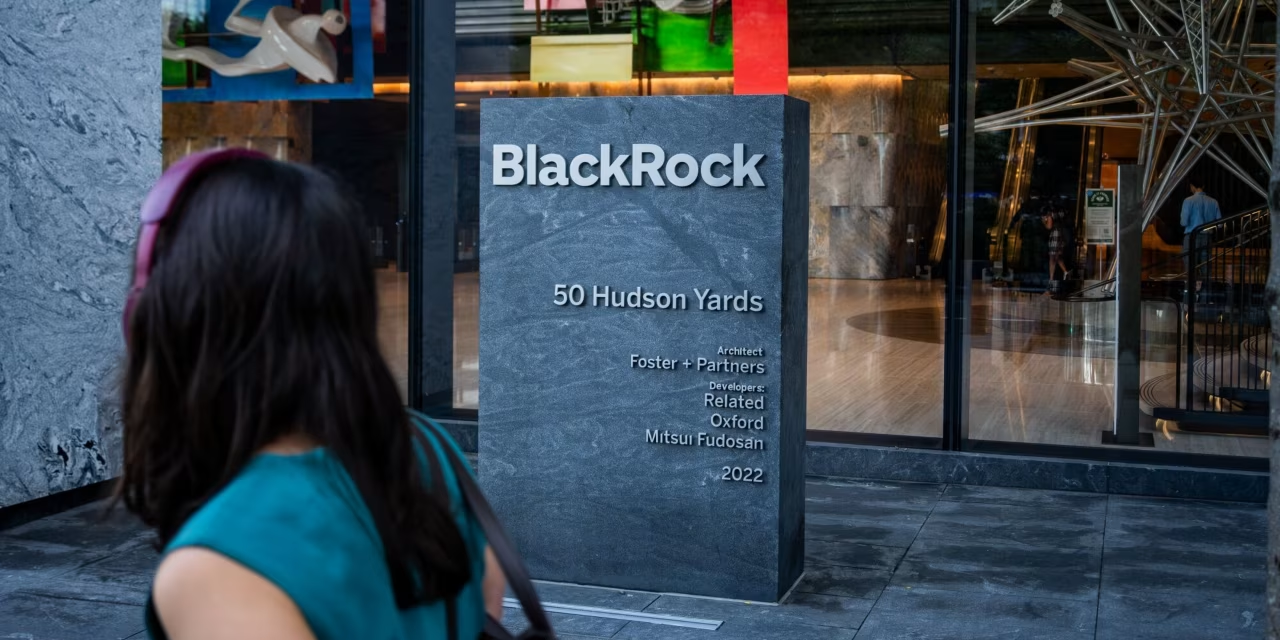
BlackRock BLK 1.97%increase; up pointing triangle will offer American workers a chance to invest more like a multibillion-dollar pension.  

The world’s largest investment firm by assets under management said it would work with corporate clients to build customizable funds for 401(k) plans that can include slices of public stocks and bonds, private assets and even annuities that provide guaranteed income in retirement.

Copyright ©2026 Dow Jones & Company, Inc. All Rights Reserved. 87990cbe856818d5eddac44c7b1cdeb8

Continue Reading

Business

JP Morgan says it has no clear oil market endgame as Iran conflict drags on

Published

on


JP Morgan says it has no clear oil market endgame as Iran conflict drags on

Continue Reading

Business

These 7 Best Stocks Are Analyst Favorites For Earnings Growth

Published

on

These 7 Best Stocks Are Analyst Favorites For Earnings Growth

As the stock market rebounds, it’s important to watch the stocks that are holding up and are most loved by equity analysts. They may end up becoming the next big opportunities. Amazon.com (AMZN), Alphabet (GOOGL) and Dell Technologies (DELL) are three of the seven best stocks where investors can find magnificent profit growth prospects. Investors should be seeking new buy…

Copyright ©2026 Investor’s Business Daily, LLC. All rights reserved. 87990cbe856818d5eddac44c7b1cdeb8

Continue Reading

Business

Not Your Puppet: Fed Chooses A Rate Hike Over Trump's 1% Target

Published

on

Hand cutting strings over puppet with scissors. Manipulation, negative influence, control stop concept. Overcoming addiction. Black and white

Not Your Puppet: Fed Chooses A Rate Hike Over Trump's 1% Target

Continue Reading

Trending

Copyright © 2025