Connect with us

Tech

H&R Block Coupons and Deals: $50 Off Tax Prep in 2026

Published

on

As they say, the only things you can’t escape in life are death and taxes. Doing your own taxes has only gotten easier over the years but it’s still plenty confusing, especially with both federal and state rules and rates always in flux. To help you figure out this confusing process, I’ve written a guide on How to Pay Your Taxes Online, and included H&R Block and other competitors to give you more information as you navigate between the seemingly endless options available for your specific tax needs. Tax day may not be until April 15 but as we all know too well, that date comes around quickly each year. With that in mind, now’s a great time to start getting your affairs in order.

For 70 years, H&R Block has stepped in to help with tax preparation services that aim to make things as painless as possible. H&R Block has its classic in-person help from a tax expert along with easy-to-use online tax services that you can complete online while in your pajamas. We here at WIRED love to help you save money too, and that’s why we have rotating deals and H&R Block coupons to help ease the pain of tax season a little more.

Save With Our $50 H&R Block In-Store Coupon (And More)

To help make tax season a bit more bearable, you can get $50 off in-person tax prep when you file with an H&R Block tax pro (until February 23). To redeem this offer, you’ll need to make an appointment online, and present the coupon either digitally or in-print. This coupon features single-use codes, so you’ll need to click on the module at the top of the page to get the H&R Block discount code (and you can’t use the same one twice). Also through February 23, you can also get 25% off H&R Block’s DIY online offering, with no promo code needed!

Can I File My Taxes for Free at H&R Block?

H&R Block knows taxes are confusing, and the process is one that no filer looks forward to. That’s why H&R Block eases some of the tax filing woes by offering H&R Block Online Free Edition. Over half (around 55% of filers) qualify; this service is for simple taxes only, meaning Form 1040s and no schedules except Earned Income Tax Credit, Child Tax Credit, Student Loan Interest, and Retirement Plan Distributions. File your simple state return for free on H&R Block today.

Advertisement

Don’t Go at it Alone With H&R Block Assistance Options

Tax assist options are available, whatever your need. Not a CPA or DIY-er? No problem. H&R Block’s tax experts are trained and ready to help with big and small tax questions. There are tons of choices, no matter your need, like a one-on-one meeting in an office where you can make an appointment ahead of time, or just walk in; from home where you can work with your Tax Pro online; and you can even drop off files at an H&R Block office. Plus, you can even get a free Second Look Review of past returns to see if there was money left on the table.

Get Up to $4,000 With a Refund Advance Loan at H&R Block

If you can’t wait on your refund (no judgement; I get it), you can get up to $4,000 in refunds immediately after filing, without waiting for the slow-moving federal and state processes. If eligible, you can get a Refund Advance loan within minutes of filing when you complete the process with an H&R Block Tax Pro. With this loan advance, there’s no loan fees or interest. Act sooner rather than later, as this deal is only available through March 15.

How Much Does H&R Block Charge?

H&R Block has different tiers depending on tax filing needs, so you can pick the online filing option that works best for you. The free online is best for simple returns, with $0 per state filed; deluxe starts at $28 for federal and $37 per state filed, which includes itemized deductions and free tax Pro review. Premium is now only $56 and $37 per state filed, and also includes investments and free tax Pro review. Plus, they have an option for self-employed folks and business owners, whose taxes can be complicated and costly. That service includes 1099 forms with expenses and includes free tax Pro reviews, and costs $68 right now with $37 per state filed.

How Do I Get an H&R Block Key Code?

An H&R Block Activation Code is a unique ten-character code that’s attached to your personal H&R Block Tax Software. It’ll be a long string of uppercase letters and numbers. This activation code registers your software and is used to unlock your five free federal e-files. Once opened, you’ll need to enter it to activate the software. More in-depth directions and troubleshooting can be found here.

Advertisement

Other Deals for New and Existing H&R Block Customers

To find which service best fits your needs, select all that apply to you—like if you have kids, own a home, or are a freelancer—to find your best personal filing experience. H&R Block has four different packages, including federal and state. Best of all, you can save 20% on H&R Block tax software products without an H&R Block promo code (until April 15).

H&R Block has tons of incentives and perks, including a free 3-year Second Look. That means H&R Block will review your last three tax returns to find errors, mistakes, or money others may have missed. Get your taxes done and spend the rest of the spring chilling; DIY online file, or get an in-store assisted file for less—no H&R Block coupon needed.

Source link

Advertisement
Continue Reading
Click to comment

Leave a Reply

Your email address will not be published. Required fields are marked *

Tech

Jeffrey Epstein’s Ties to CBP Agents Sparked a DOJ Probe

Published

on

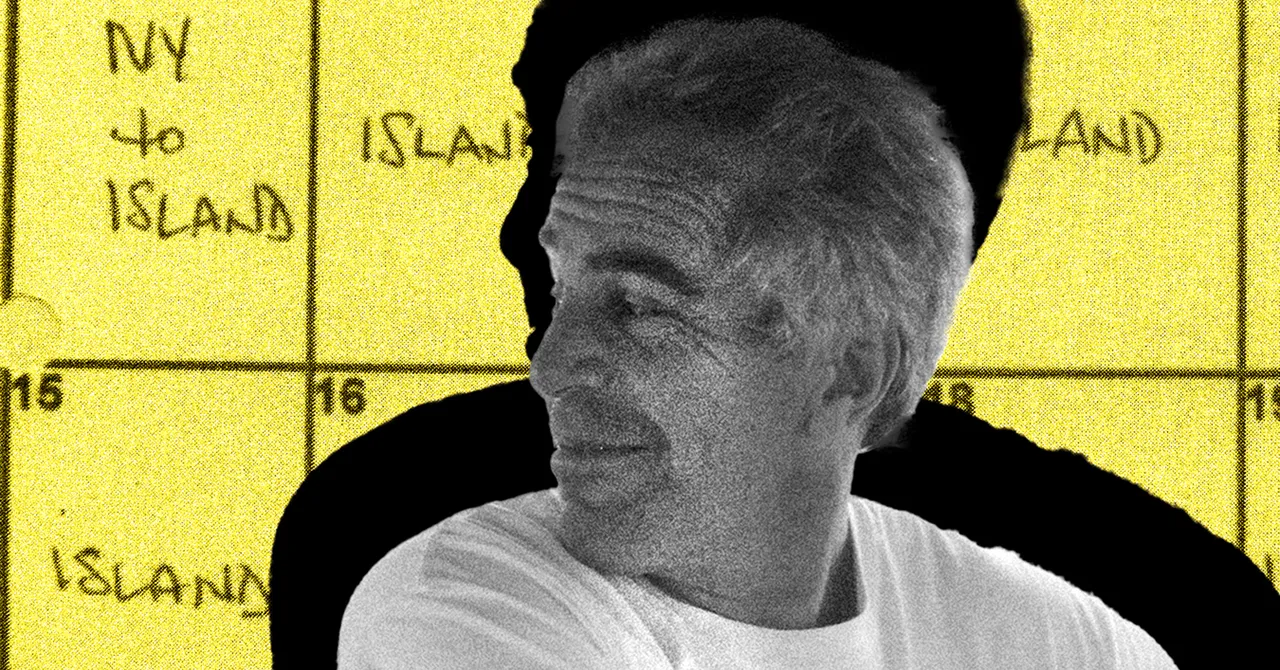
United States prosecutors and federal law enforcement spent over a year examining ties between Jeffrey Epstein and Customs and Border Protection officers stationed in the US Virgin Islands (USVI), according to documents recently released by the Department of Justice.

As The Guardian and New York Times have reported, emails, text messages, and investigative records show that Epstein cultivated friendships with several officers, entertaining them on his island and offering to take them for whale-watching trips in his helicopter. He even brought one cannolis for Christmas Eve. In turn, Epstein would bring certain officers his complaints about his treatment at the hands of other CBP and federal agents. Most of the interactions described in the records occurred years after Epstein pleaded guilty to charges of sex crimes in Florida in 2008.

The CBP officers were never charged for any crimes related to Epstein, and at least one later retired from the agency with a pension, suggesting that the government ultimately didn’t find any wrongdoing. The documents do, though, describe patterns of behavior—two of the officers referred to Epstein as a “friend”—that one government ethics expert described as inappropriate and possible violations of federal guidance. They also contain grand jury subpoenas that specifically name the officers and compel the recipients, which were largely financial services firms, to aid federal prosecutors who were looking into allegations of a conspiracy to defraud the US government.

CBP and the Southern District of New York US Attorney’s Office, which led the investigation into Epstein, did not respond to requests for comment.

Advertisement

For years, Epstein allegedly brought countless women and girls as young as 12 to his private island, Little Saint James, according to a 2020 complaint filed by the former USVI attorney general. Epstein would often fly in and out of USVI on his private jet.

In order to depart from USVI to other parts of the US, Epstein’s plane had to be cleared by CBP, according to a November 2020 FBI interview report with Epstein’s personal pilot, Larry Visoski.

Visoski told the FBI that some passengers were college students with letters from their schools explaining why they were traveling. Other times, according to the report on Visoski’s interview, Epstein traveled with a woman who had a foreign passport. If CBP officers started questioning these passengers, Visoski said, Epstein would intervene and start arguing with the officers.

Visoski, though, told the FBI that Epstein made an effort to be friendly with CBP officers, at times instructing Visoski to collect agents’ contact information. (In an email to one CBP officer, Epstein wrote, “as you know Im very respectful of people just doing their job.”) Over the years, emails and text messages show, various CBP officers would try to reach out to Epstein, either directly or through Visoski or other associates. Sometimes, Epstein would have the officers out to Little Saint James.

Advertisement

In May 2014, for example, Visoski emailed Epstein, “While going through customs in STT, our nice person gave me his cell contact.” The pilot added that the “nice person” would be available to visit Little Saint James that week. Visoski also attached the person’s contact information. The next day, Epstein’s island estate manager emailed Epstein to let him know the person, a CBP officer, would be picked up on Wednesday for lunch. (It’s unclear whether this lunch ever happened.)

Emails in 2015 and 2016 show that Epstein would have another officer, Glen Samuel, come to Little Saint James to perform on steel pan drums—a side gig Samuel informally advertised at one point on his Facebook page. In a January 2015 email thread, Epstein asked an associate to clarify Samuel’s rate. The associate replied, “Mr. Samuel says he does not intend to charge you. He considers you a friend and was doing this for you. If you wish to give him something, he is appreciative, but there is no fee.” Samuel did not respond to a request for comment.

Source link

Advertisement
Continue Reading

Tech

Sentosa beach club Tipsy Unicorn shuts down amid legal dispute

Published

on

Editor’s Note: The following article has been updated to reflect the latest statement from Sentosa Development Corporation (SDC).

Sentosa beach club Tipsy Unicorn has ceased operations after its operator was ordered into compulsory liquidation by the Singapore High Court.

According to a report by The Straits Times, the venue’s operator, Tipsy Bird, was wound up on Jan 23 this year after United Overseas Bank (UOB) filed a winding-up application. Court documents seen by the publication showed that the bank is seeking to recover more than S$96,000 in debt and interest.

However, liquidators shared that this may not represent the company’s full liabilities. Without the firm’s Statement of Affairs, they are unable to determine the total amount owed or how many creditors are affected. 

Advertisement

As of Feb 16, the company’s directors have yet to come forward to brief the liquidators on the firm’s financial affairs. 

The liquidators also noted that Tipsy Bird operated Tipsy Unicorn Beach Club at 36 Siloso Beach Walk. Following the winding-up order, the landlord of the premises, Sentosa Development Corporation (SDC), exercised its right to repossess the property.

Responding to a Vulcan Post media enquiry, SDC confirmed that the beach club ceased operations on Jan 30, adding that they are currently in discussions with potential operators.

“Guests can continue to look forward to a vibrant beach scene on Sentosa, with new concepts and enhancements planned as part of our ongoing destination rejuvenation efforts,” said a SDC spokesperson.

Advertisement
tipsy unicorn website and instagram pagetipsy unicorn website and instagram page
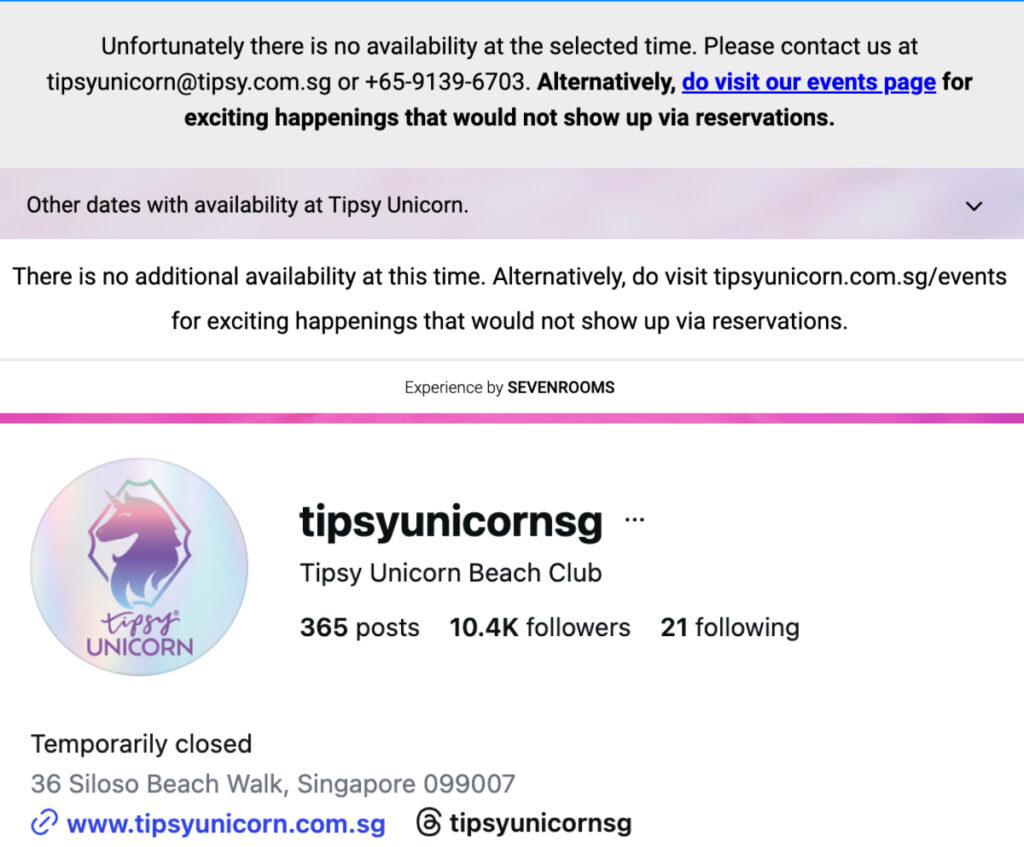
Currently, users are unable to make reservations on the Tipsy Unicorn website (top), and Tipsy Unicorn’s Instagram page is listed as “temporarily closed” (bottom)./ Screenshot by Vulcan Post

When the publication visited the venue on Feb 18, the outlet was shuttered, with a notice at the entrance stating it had stopped operations from Jan 30. Its Instagram page was also marked as “temporarily closed,” and checks by Vulcan Post on Feb 20 showed that reservations were no longer available on its website.

Corporate records show Tipsy Bird is wholly owned by local hospitality group Tipsy Collective, which remains an active entity as of Feb 19. 

According to a Facebook post by the group, Tipsy Unicorn opened at Sentosa on Sept 1, 2023, and had been operating for about three years before its closure. 

David gan tipsy collectiveDavid gan tipsy collective
David Gan, co-founder of Tipsy Collective./Image Credit: Tipsy Collective via LinkedIn

The closure and court order come after years of legal disputes since the passing of co-founder Derek Ong in Aug 2023.

While the other co-founder, David Gan, remained involved in the business, concerns over financial mismanagement and a lack of transparency led shareholders to clash with him, including objections to the development of the Sentosa beach club.

The budget for this project reportedly doubled from S$3 million to S$6 million. Additional concerns included debts amounting to S$5.2 million owed to suppliers, contractors and creditors. Tipsy Collective also allegedly owed about S$1 million to SDC.

Advertisement

Following the dispute, Gan was dismissed on Nov 6, 2024. But trouble did not stop brewing.

In Nov 2024, it was reported that more than 100 employees allegedly did not receive their Oct 2024 salaries. They were eventually paid in Jan 2025 after shareholders injected fresh funds. 

tipsy collective website unavailabletipsy collective website unavailable
The Tipsy Collective website is no longer available as of Feb 20, 2026./ Screenshot by Vulcan Post

Further checks by Vulcan Post showed that Tipsy Collective’s website is no longer available, though their social media pages remained active.

Vulcan Post has reached out to Tipsy Collective for comment, but did not receive a response at the time of publication.

  • Read more stories we’ve written on Singaporean businesses here.

Featured Image Credit: Tipsy Unicorn

Advertisement

Source link

Continue Reading

Tech

Trump Wants An Airport Renamed After Him While His Company Trademarks Those Same Names

Published

on

from the the-grift-that-keeps-on-grifting dept

Remember how Donald Trump was going to “drain the swamp” as president? The idea, spilling out from his first campaign for president, was that Washington was horribly corrupt, that politicians and unelected government stooges were making money from their positions of power, and that even politician’s families were in on the grift. The only reason I am aware of a name like Burisma is because Trump and his sycophants screamed about it as an example of how Biden’s family was corruptly making money by utilizing Joe Biden’s time as vice president for influence.

But, if there was a grift going on there, at least the Biden’s had enough shame to try to hide it. The same people who were up in arms over Burisma and other such claims have been remarkably silent on the far more obvious and in your face grifting that Trump is doing. Our president appears to look at the tax coffers as his own personal piggy bank, constantly dreaming up reasons why your tax money should find its way into his pockets. He wanted $10 billion in taxpayer money because his tax returns leaked. He wants $230 million because he was tried for his criminal behavior. He guided billions in taxpayer money to his pet supporter Elon Musk. And, because the corruption must be as naked as possible, agencies under his executive umbrella would be the ones approving all of this redistribution of taxpayer wealth into his own personal bank accounts.

It hasn’t stopped and the latest attempted grift is absolute stunning in how brazen it is. You may have heard that Trump is attempting to strong-arm several local governments into renaming an airport after him. It started with Dulles International Airport outside of Washington DC, with Trump reportedly holding millions in approved federal infrastructure funds hostage if he didn’t get his way. He has no authority to do this with congressionally approved funds, of course, but that isn’t stopping him. The state government in Florida raced to be first in line to lick Trump’s boots, unsurprisingly, with the state House voting to change the Palm Beach International Airport’s name to the President Donald J. Trump International Airport instead. That measure will now go before the state Senate, where it is likely to pass.

And while all of this was going on, an interesting thing happened: a private company that manages Trump’s intellectual property licensing filed for trademarks on the potential names for these airports.

Advertisement

The applications, submitted by DTTM Operations LLC on February 13 and 14, seek federal protection for the names:

  1. ‘President Donald J. Trump International Airport’
  2. ‘Donald J. Trump International Airport’
  3. ‘DJT’

All three applications were filed with the United States Patent and Trademark Office on what is known as an “intent to use” basis. This is a filing strategy that allows applicants to stake a claim to a name before it is used in commerce.

As Josh Gerben notes in his post, this has simply never happened before. We’ve never witnessed an American president, while in office, have his private company proactively trademark the very names of a piece of government infrastructure that that same president was attempting to bring about. It’s an incredibly naked grift, in which an American president is clearly, unabashedly seeking to make money on the backs of taxpayers while purporting to do the people’s business.

I should be very clear: these are trademark filings that are completely unprecedented. Airport names almost always originate from the governmental body that owns or manages the facility. They are not owned or licensed by privately held entities.

Here, the filings were made by DTTM Operations LLC, the same entity that protects the Trump brand across hotels, consumer goods, and licensing ventures. That fact alone signals that this is not merely about honorary naming. It is about brand control.

The broader goods listed in the applications, such as clothing, luggage, and watches, are equally telling. Those categories are classic merchandise plays. If an airport were renamed, the trademark filings would allow DTTM Operations to control and monetize branded merchandise associated with the location.

The intent is obvious: create a licensing structure such that the American government will need to pay licensing fees to Trump’s business in perpetuity. There is no other reasonable explanation for this sequence of events. And it appears to be going on without any serious comment from the very same people who whined about what a swamp Washington had become.

Advertisement

Your money is not Trump’s personal piggy bank. Or, rather, it shouldn’t be. Unfortunately, those who ought to be clapping back on all of this are either in on the grift, or perfectly willing to allow it to occur.

Filed Under: airports, corruption, donald trump, dulles, palm beach international, trademark

Companies: dttm operations, trump organization

Source link

Advertisement
Continue Reading

Tech

Poking At The ESP32-P4 And -C6 Dies In An ESP32-P4-M3 Module

Published

on

The RF section of the ESP32-C6 die. (Credit: electronupdate, YouTube)

With the ESP32-P4 not having any wireless functionality and instead focusing on being a small SoC, it makes sense to combine it with a second chip that handles features like WiFi and Bluetooth. This makes the Guition ESP32-P4-M3 module both a pretty good example of how the P4 will be used, and an excellent opportunity to tear into, decap and shoot photos of the dies of both the P4 and the ESP32-C6 in this particular module, courtesy of [electronupdate]. There also the blog post for those who just want to ogle the shinies.

After popping the metal shield on the module, you can see the contents as in the above photo. The P4 inside is a variant with 32 MB of PSRAM integrated along with the SoC die. This results in a die shot both of this PSRAM and the P4 die, though enough of the top metal seems to remain to clearly see the latter.

The Boya brand Flash chip is quite standard inside, and along with a glance at the inside of one of the crystal oscillators we get to glance at the inside of the C6 MCU. This is a much more simple chip than the P4, with the RF section quite obvious. The total die sizes are 2.7 x 2.7 mm for the C6 and 4.29 x 3.66 mm for the P4.

Advertisement

Source link

Advertisement
Continue Reading

Tech

Google blocked over 1.75 million Play Store app submissions in 2025

Published

on

Google blocked over 1.75 million Play Store app submissions in 2025

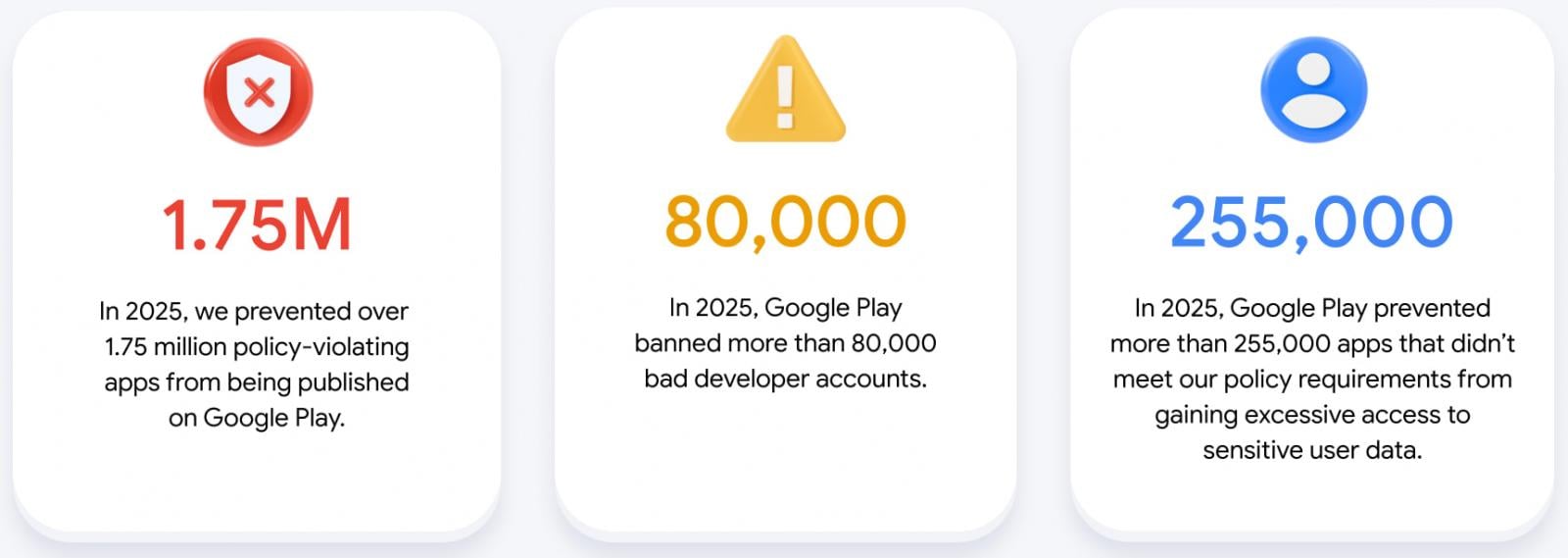
Google says that through 2025, it blocked more than 255,000 Android apps from obtaining excessive access to sensitive user data and rejected over 1.75 million apps from being published on Google Play due to policy violations.

The tech giant’s annual review of Android and Google Play security reveals how effective the implemented protection measures were in maintaining an ecosystem with honest developers and compliant apps.

“We’re constantly improving our policies and protections to encourage safe, high-quality apps on Google Play and stop bad actors before they cause harm,” Google says.

Wiz

To this end, the company implemented more than 10,000 safety checks on published apps and strengthened detection capabilities by integrating Google’s latest generative AI models into the review process. This enabled human reviewers to identify complex and evolving malicious patterns more quickly and accurately.

The highlights in terms of user protection last year include banning more than 80,000 “bad developer accounts, detecting over 1.75 million policy-violating apps, and denying over 255,000 apps access to sensitive user data.

Advertisement
Diagram
Source: Google

Spam ratings and inauthentic reviews also represented a significant risk as they can be used to influence user perception of an app.

Google says it blocked 160 million ratings last year and prevented an average 0.5-star drop that apps targeted by “review bombing” would otherwise have suffered.

Android’s built-in security suite, Play Protect, which now scans over 350 billion apps every day, has identified over 27 million malicious apps sideloaded from outside Google Play.

Play Protect’s ‘enhanced fraud protection’ was expanded to cover over 2.8 billion Android devices in 185 markets, blocking 266 million installation attempts from 872,000 unique risky apps.

The Play Integrity API service that app developers can use to protect their software against abuse and unauthorized access, now processes over 20 billion checks every day, Google says. In 2025, new hardware-backed signals and in-app remediation prompts were added.

Advertisement

Finally, Google has added built-in protections against “tapjacking attacks” with minimal developer effort in Android 16, released last June, blocking hidden windows loading ads that are automatically tapped for fraudulent financial gains.

Google says it will continue investing in AI-driven defenses, expand developer verification, and embed compliance tools directly into development workflows to prevent policy violations before apps are published.

Modern IT infrastructure moves faster than manual workflows can handle.

In this new Tines guide, learn how your team can reduce hidden manual delays, improve reliability through automated response, and build and scale intelligent workflows on top of tools you already use.

Source link

Advertisement
Continue Reading

Tech

Leaker's legal troubles haven't ended, as he makes more videos

Published

on

After a default ruling against him for failing to respond, YouTuber Jon Prosser is now facing a jury trial and deposition over his iOS 26 leaks.

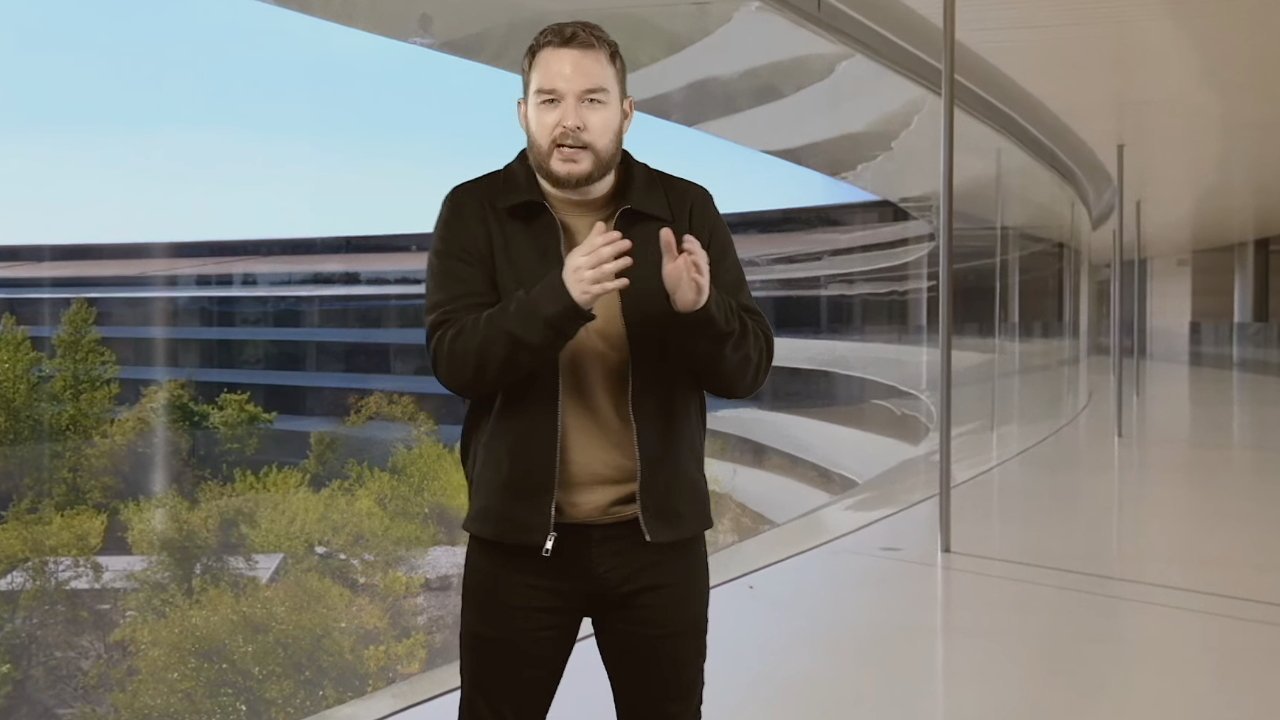
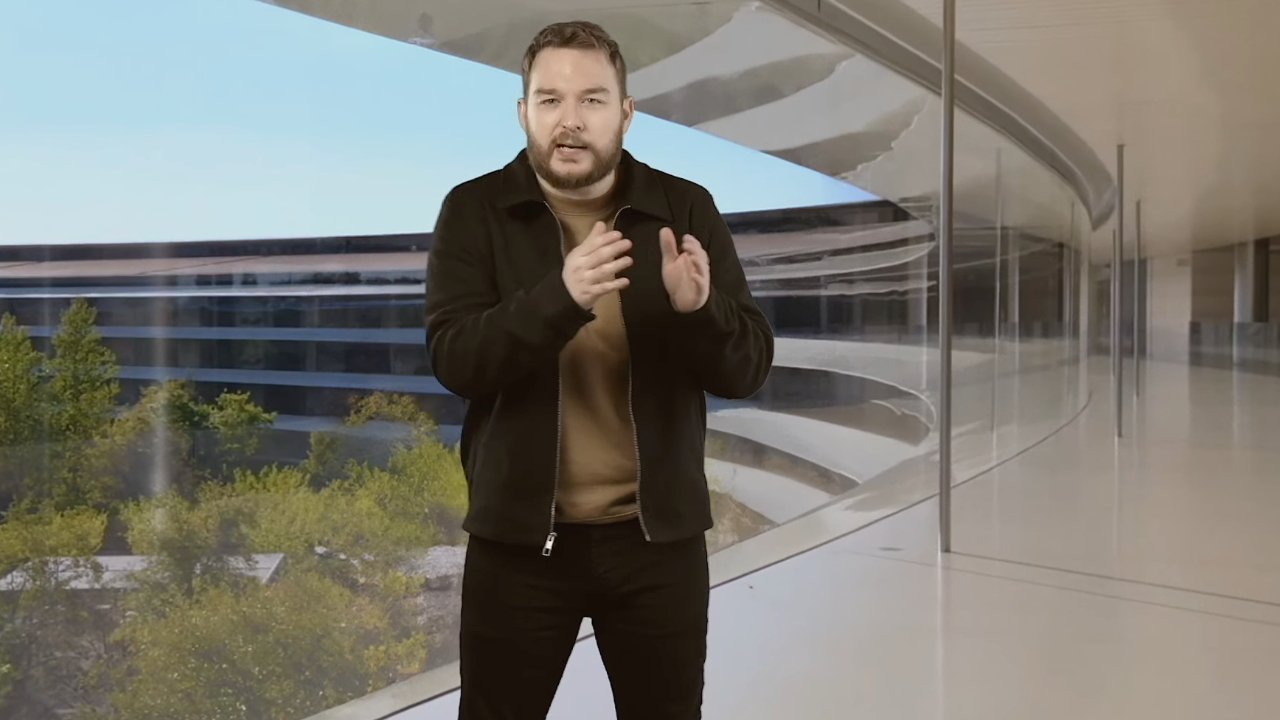
Man standing indoors, gesturing while speaking, with large curved glass windows behind him overlooking modern circular office buildings and green trees under a clear blue sky
YouTuber Jon Prosser is set to be deposed, as part of a lawsuit filed against him by Apple.

In July 2025, after revealing design details of what was then known as iOS 19, leaker Jon Prosser was sued by Apple for the alleged misappropriation of trade secrets. Things seemingly haven’t gone well so far, even as he continues to post videos about Apple rumors.
Prosser has been served with document and deposition subpoenas. He’ll have to provide sworn, out-of-court testimony so that Apple can determine the scope of the confidential information Prosser obtained and shared.
Continue Reading on AppleInsider | Discuss on our Forums

Source link

Continue Reading

Tech

GameSir G8 Plus review: an iterative upgrade fit for iPad mini fans

Published

on

The first GameSir G8 was an affordable return to iPhone grip controllers, and while its successor doesn’t have any significant bells or whistles, it gains Apple certification and iPad mini support.

An iPad mini showing a pixelated farm game while in a white game controller grip with neon and wall art blurred in the background.
GameSir G8 Plus review

Not every product needs to blow us away with some revolutionary new feature or concept. Game controllers have found a fairly mature place, design-wise, so there’s no need to rock the boat.
The GameSir G8 Plus is an MFi-certified controller with a USB-C connector, rumble support, programmable buttons, and customization options. It closely resembles the GameSir G8 Galileo that it replaces, but it has some notable improvements.
Continue Reading on AppleInsider | Discuss on our Forums

Source link

Continue Reading

Tech

Samsung isn’t aping the AirPods, but doing a better job on the upcoming Galaxy Buds 4

Published

on

Ahead of their expected launch on February 25, 2026, the Samsung Galaxy Buds 4 have appeared in real-life photos shared by @Mr_TechTalkTV on X. Although they contain non-functional or dummy units used for displays in retail stores, they give us a good idea of how the earbuds will look.

Previously, we’ve seen the regular Buds 4 (with an open-ear design) in black and the Buds 4 Pro in white (with silicon eartips). However, the new pictures flip this order, showcasing the regular earbuds in white and the Pro ones in black.

Exclusive: First real-life look at the Galaxy Buds 4 and Galaxy Buds 4 Pro. These are non-functional dummy units that Samsung sends to retail stores for display. pic.twitter.com/Wz74oJqaGB

— TechTalkTV (@Mr_TechTalkTV) February 19, 2026

Fresh leaks, familiar rivalry

From what it looks like, both earbuds will be available in white and black finishes, appealing to buyers who aren’t into the simple white color the AirPods are available in.

Advertisement

Everything from the AirPods’ charging case, top lid, and earbuds is made of the same glossy white plastic material, which is surely iconic, but it doesn’t leave buyers with any other option.

While the choice of colors shouldn’t be an issue with the Galaxy Buds 4 series, the design should be what distinguishes it from the AirPods (and for good). As seen in the pictures, both Buds 4 models have a metallic paint finish on their stems, elevating their look.

More choice, more personality

Samsung has opted for a flat charging case, where the earbuds lie horizontally, making them easier to access and easier to remove in a hurry. The wider layout also allows for a slimmer profile in your pocket or backpack and a case that feels more stable on a tabletop.

With two colors, an elevated design, a flat charging case, optimized touch/gesture controls, and potential upgrades in sound quality and noise cancellation, the Galaxy Buds 4 should be a compelling choice for Galaxy S26 buyers, or other Android users, for that matter.

Advertisement

Source link

Continue Reading

Tech

‘In the Irish market there is a supply and demand for niche senior roles’

Published

on

IAS’s Claire Griffin explores how she began her career in recruitment and the opportunities open to professionals in this space.

A technical recruiter at Integral Ad Science, Claire Griffin tells SiliconRepublic.com that a career in the recruitment sector was initially unexpected. 

“I came from a performing arts and teaching background. I have always worked in very people-focused roles, where building relationships and really understanding individuals was at the heart of what I did,” she says. 

“Making the leap into something completely new is what brought me into recruitment, but it’s the people side of the role that’s kept me here for more than 10 years. Every day is different, and I still genuinely enjoy meeting new people, hearing their stories and helping connect them with opportunities where they can really thrive.”

Advertisement
What are some of the challenges in this industry and how are they overcome?

There are plenty of challenges in tech recruitment right now. In terms of the Irish market, there is a supply and demand for filling certain niche senior roles that require specific skillsets. AI, while driving us forward in many ways, has inhibited certain aspects of recruitment processes, including the creation of CVs to match job specs as opposed to candidates’ experience and the use of undeclared tools within technical interviews. Also, the shortage of housing and skyrocketing rents in Ireland have deterred skilled workers from relocating to Ireland, making the competition for talent tighter.

What career opportunities are there for professionals in this space?

Ireland is a really strong place to build a career in deep tech right now. There’s a healthy mix of world-class research, multinational R&D and a growing number of ambitious start-ups, which gives candidates a lot of choice in how they go about shaping their careers.

Candidates with deep-tech skills can work across research and innovation through Ireland’s universities and research centres, where there’s a strong focus on turning breakthrough ideas into real-world solutions. At the same time, many global giants in tech and life-sciences companies base their engineering and R&D teams here, offering opportunities to work on cutting-edge projects with global impact.

In recent years, Ireland has also experienced huge growth in the start-up ecosystem. Deep-tech founders and early hires are increasingly finding support, funding and international reach. This can open pathways into leadership, product development and commercial roles. Overall, deep tech in Ireland isn’t just about technical roles anymore. It’s about long-term careers that combine innovation, impact and global relevance.

Advertisement
What makes an applicant stand out from the crowd?

In a world full of AI-generated CVs, it can sometimes feel hard for candidates to stand out. We see a lot of these CVs listing technologies which candidates may have worked for five years or five minutes on, but are listing it in hopes of bypassing an applicant tracking system. What really sets candidates apart is their ability to show impact, not just skills. A strong CV will clearly explain what they’ve built, why it mattered and what problem it solved.

Strong candidates also demonstrate curiosity and adaptability. Technology moves quickly, so hiring managers look for people who are actively learning. This is shown through side projects, open-source contributions or keeping up with emerging trends, and then applying that learning in practical ways.

Communication is another key differentiator. The ability to explain complex ideas clearly, work across teams and understand the business context behind the technology is often what separates good engineers from great ones. Finally, a small bit of research into a company goes a long way. Candidates who understand the company’s mission, who can articulate why they want that specific role and who can show how their experience aligns with it tend to stand out far more than those sending generic applications.

What skills should deep-tech professionals prioritise?

In Ireland’s tech sector, deep-tech professionals should prioritise strong core technical skills, particularly in areas like software engineering, AI, data, and systems design. They should also have the ability to apply that expertise in real-world settings. Employers value people who can move quickly from concept to deployment.

Advertisement

Adaptability is a key differentiator for individuals to move forward. Ireland’s tech ecosystem spans multinationals, start-ups and research centres, so professionals who can work across environments, learn continuously and collaborate with diverse teams tend to stand out. Clear communication and commercial awareness matter. Being able to explain complex technology simply and understand how it supports business outcomes is increasingly important in Ireland’s growing tech industry.

What advice do you have for other technical recruiters working in this space?

My main advice is to go beyond keywords and really understand the technology you are hiring for. A lot of tech roles are nuanced and strong candidates don’t always fit a standard profile. Taking the time to understand the problem a team is trying to solve makes a huge difference. We are recruitment partners, so strong relationships built on trust and transparency – both with hiring managers and candidates – are key to moving forward.

Ireland’s deep-tech talent pool is small, so taking the time to establish and nurture relationships for long-term engagement are far more valuable both to your company and you as an individual than making quick wins.

Lastly, engaging with research centres, start-ups and industry networks and meetups is a great way to keep your finger on the pulse of what is happening from both a client and candidate perspective.

Advertisement

Don’t miss out on the knowledge you need to succeed. Sign up for the Daily Brief, Silicon Republic’s digest of need-to-know sci-tech news.

Source link

Advertisement
Continue Reading

Tech

The Joy Of Making Handheld Tetris From Scratch

Published

on

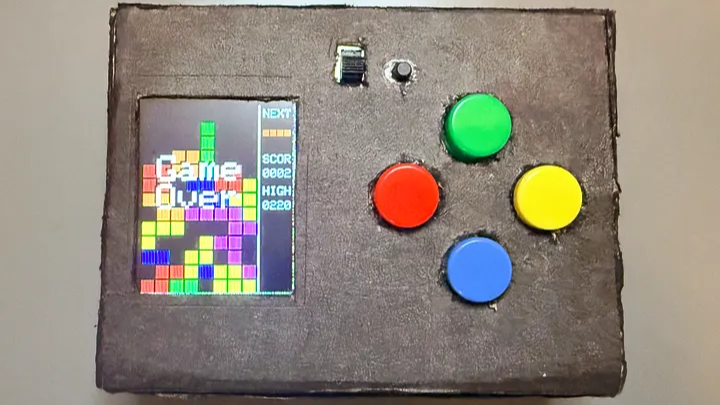
As anyone who’s made a thing knows, a lot of work goes into bringing something from idea to completion. But there’s also considerable satisfaction in the process. [Willian] recently did exactly that, and shares the joyful experience of creating a homebrew handheld game gadget from scratch. It runs a homebrewed Tetris clone (as well as Snake), and we love the results.

The game gadget uses an ATmega328P programmed via the Arduino IDE, and a 1.8″ TFT color LCD screen. It’s self-contained in a box with a few buttons as controls and runs off three AAA cells. [Willian] made the smart design choice to run the microcontroller at 8 MHz instead of the more common 16 MHz, because doing so meant the board can run at 3.3 V instead of 5 V. Why does this matter? The LCD display runs off 3.3 V as well, and if all components can run off the same supply and logic levels, it simplifies things considerably.

Also, creating a 3.3 V supply is a simple matter of three alkaline cells in series with an LDO (low drop-out) regulator, which is great for a handheld device. We do note that AA cells have a considerably higher energy density and capacity than AAA cells and are usually the better choice, but one works with what one has, and sometimes the space and weight saved by AAA is just too good to pass up.

The software has some notable approaches to keep things responsive and optimal. Instead of defining each of the Tetris pieces as a 2D shape, [Willian] instead pre-defines each piece (and their rotations) so that rotating a piece is just an index change in an array, instead of a transform implementing a rotation. Also, full-screen redraws are comparatively slow over SPI and caused flickering, so only cells that have changed are redrawn to the screen to keep things responsive. The code is all on GitHub, and it’s a great peek at how things get implemented under the hood.

Advertisement

The enclosure is just cardboard, and it does the job in [Willian]’s case. But we’ll point out that cardboard is actually a highly adaptable material from which to prototype. With just a few tips and a little care, paper products can be your new best friend when it comes to one-offs and prototypes.

Source link

Advertisement
Continue Reading

Trending

Copyright © 2025