Connect with us

NewsBeat

The County Durham town which shaped Notting Hill’s Gina McKee

Published

on

The County Durham town which shaped Notting Hill's Gina McKee

Best known for her award-winning role as Mary Cox in Our Friends in the North, McKee spent her formative years in Peterlee, a town built on ambition, community spirit and the heritage of east Durham’s mining villages.

A town built for a new future

Peterlee is unlike most towns in County Durham.

Established as a new town after the Second World War and named after miners’ leader Peter Lee, it was designed to provide modern homes and opportunities for families from the surrounding coalfield communities.

Advertisement

Today, Peterlee is home to more than 20,000 people and is known for landmarks including the Apollo Pavilion, nearby stretches of the Durham Heritage Coast and its rich mining history.

While many visitors know Peterlee for its distinctive architecture and location between Sunderland and Hartlepool, it has also produced one of the North East’s most acclaimed acting talents.

Gina McKee’s Peterlee roots

Born in 1964, McKee was raised in Peterlee and nearby Easington after being born into a mining family.

Advertisement

Her father worked in the coal industry, giving her first-hand experience of the communities that would later inspire some of her most celebrated performances.

She attended school locally and discovered acting while still a teenager.

According to published biographies, McKee joined a local drama group after spotting a poster in a shop window.

What began as a hobby quickly developed into a passion and eventually led to her first professional screen role in the Tyne Tees children’s series Quest of Eagles.

Advertisement

From East Durham to television success

McKee spent several summers with the National Youth Theatre before pursuing a professional acting career.

Despite being rejected by a number of prestigious drama schools, she continued to pursue acting and gradually established herself on television and in film.

Her breakthrough came in 1996 when she starred in the BBC drama Our Friends in the North, earning a BAFTA Television Award for Best Actress.

Since then she has appeared in productions including Notting Hill, The Forsyte Saga, Bodyguard, Line of Duty, Phantom Thread and My Policeman, building a reputation as one of Britain’s finest screen performers.

Why Peterlee remains proud of its star

Like many towns across County Durham, Peterlee has undergone significant change since its mining heyday.

Advertisement

Yet McKee’s success remains a source of pride for many local people and serves as a reminder of the talent that has emerged from East Durham communities.

For a town created to offer new opportunities to mining families, the story of Gina McKee is one of its most notable success stories.

From a local drama group in Peterlee to BAFTA-winning performances watched by millions, her journey remains closely connected to the County Durham town where she grew up.

Advertisement

Source link

Continue Reading
Click to comment

You must be logged in to post a comment Login

Leave a Reply

NewsBeat

Operation AVRO leads to 26 arrests and drug seizures

Published

on

Operation AVRO leads to 26 arrests and drug seizures

Operation AVRO returned on Thursday, September 17, with officers carrying out warrants, traffic checks, and business visits.

The Bolton News has obtained exclusive figures as part of the 124 vehicles that were stopped during the operation.

Among them were 12 seatbelt offences, seven number plate offences, three s165 vehicle seizures, and two mobile phone offences.

PCSO Paul ClarkePCSO Paul Clarke (Image: NQ)

Officers also found two suspected ghost plates, four vehicles with tinted windows, and issues with tyres, brake lights, and number plates.

Advertisement

Five vehicles were given immediate prohibitions by the Driver and Vehicle Standards Agency because of tyre issues.

There were also 43 taxi licensing checks, with no issues recorded, while officers dealt with offences including no insurance, no driving licence, and failing to follow a no right turn.

The wider operation saw 14 warrants carried out at residential properties and industrial units, including in Farnworth, Breightmet, and Little Lever.

GMP said Class A, B, and C drugs were seized, alongside 22 cannabis plants, more than 1,200 nitrous oxide canisters, illicit tobacco, 17 vehicles, a machete, cash, and luxury items.

Advertisement

Neighbourhood Chief Inspector Mike Jennings Wharton said: “What a way to kick off my brand new role as your Neighbourhood Chief Inspector.

Neighbourhood CI Mike Jennings-WhartonNeighbourhood CI Mike Jennings-Wharton (Image: NQ)

“The results from this operation have been outstanding and are testament to the hard work, determination, and fantastic work ethic of our officers and partners. I have big ambitions for neighbourhood policing in Bolton.”

Officers also used Live Facial Recognition in Bolton town centre, generating five alerts and leading to three arrests within its first hour.

The technology assisted with arrests linked to offences including failing to appear at court, harassment, and drug supply.

Advertisement

GMP worked with Bolton Council, Trading Standards, safeguarding teams, and environmental officers during visits to businesses, seizing thousands of illegal vapes and illicit tobacco products.

(Image: NQ)

Bolton District Commander Helen Critchley said: “Days like Operation AVRO demonstrate what we can achieve when our officers, partners, and communities work together.”

A significant focus during the operation was the search for missing 13-year-old Lillia. Ms Critchley thanked the community for their support in the investigation.

MP Phil Brickell attended the operation, emphasizing the importance of reporting illegal activities. He stated, “I won’t tolerate criminality in our town centres.”

Advertisement

GMP said the operation focused on drug supply, dangerous driving, anti-social behaviour, and neighbourhood crime, with ongoing community engagement.

Source link

Advertisement
Continue Reading

NewsBeat

Boy, seven, fatally stabs his aunt in the neck after hearing her argue with his mother about hair straighteners

Published

on

Police arrived to find a woman lying on the floor as two people attempted to apply pressure to her neck (File pic)

Advertisement

A seven-year-old boy fatally stabbed his aunt in the neck to ‘defend’ his mother after the pair had an argument about hair straighteners.

The tragedy occurred in Saint-Maur-des-Fossés, France, at around 4.30am on Friday, when emergency services were alerted to a situation involving a woman with a knife wound.

Initial findings revealed that her young nephew had inflicted the deadly injury.

According to local reports, police arrived to find a woman lying on the floor as two people attempted to apply pressure to her neck.

Advertisement

Firefighters arrived and provided initial first aid, before being relieved by a medical team. 

Despite several resuscitation attempts, the woman was sadly pronounced dead at 5.17am due to severe blood loss.

Police arrived to find a woman lying on the floor as two people attempted to apply pressure to her neck (File pic)

Advertisement

At first, authorities went after a man who was seen in the vicinity brandishing a baseball bat, only to discover he had nothing to do with the crime.

He had exited his house armed, after hearing the woman’s cries for help in the street.

The police were then approached by the seven-year-old and his mother, who explained what had happened.

The 34-year-old woman recounted that they had been in the kitchen of the apartment when an argument broke out between the two sisters over hair straighteners.

Advertisement

As the argument escalated, the child allegedly grabbed a knife to defend his mother and stabbed the victim in the throat.

According to the mother’s testimony, the aunt exclaimed, ‘Your son stabbed me,’ before rushing out of the apartment. 

‘Once in the street, she called for help before collapsing,’ a source close to the case explained, according to Le Parisien.

‘According to statements gathered from the mother, no one else was present in the apartment at the time of the tragedy,’ the source added. 

Advertisement

The boy reportedly confessed to the crime, with Le Parisien reporting that he said: ‘Yes, it’s me. I don’t want to go to prison. I don’t want you to put my mother in prison, I defended my mum.’

The mother was taken into custody, and the boy was taken to hospital.

The public prosecutor and the Departmental Service of the Judicial Police are now conducting the necessary investigations into the circumstances of the crime.

The child is scheduled to be questioned, local media reports.

Advertisement

Source link

Advertisement
Continue Reading

NewsBeat

Neuroscience offers new insights into how our brain solves ‘the cocktail party problem’

Published

on

Neuroscience offers new insights into how our brain solves ‘the cocktail party problem’

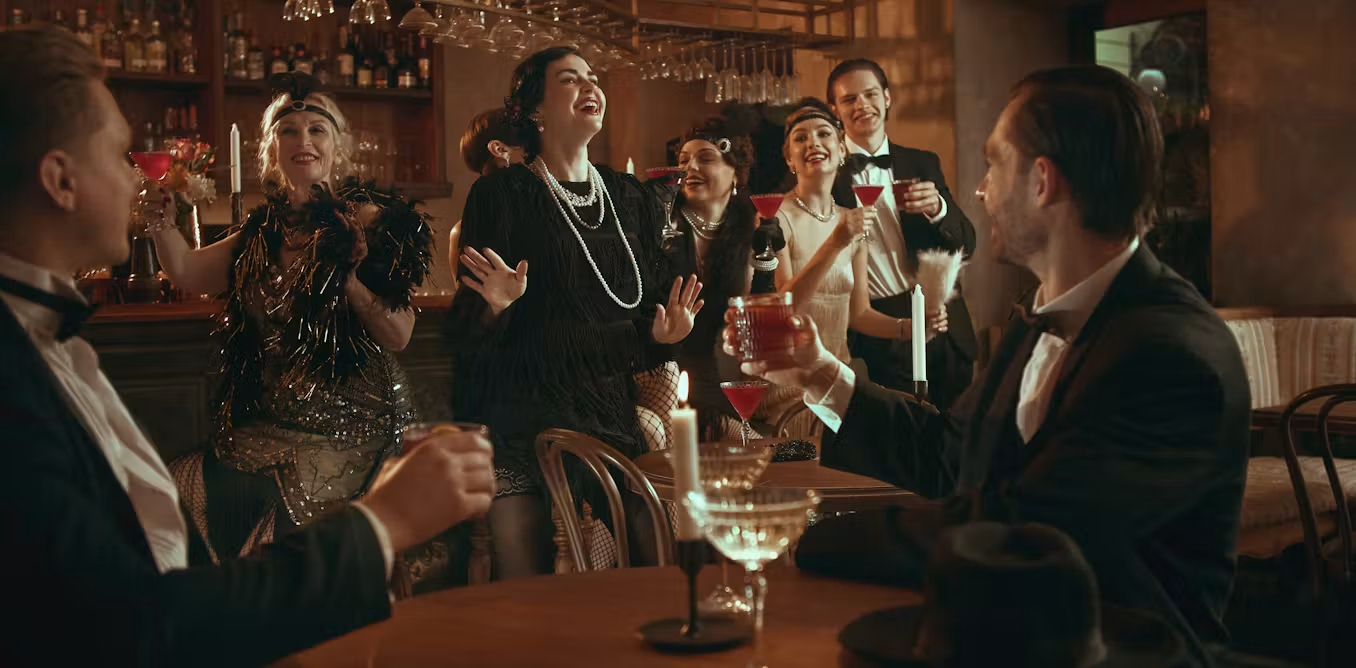
Imagine you are at a cocktail party. The room is crowded, people are coming and going, and you can barely hear your friend as they tell you some juicy gossip about the date they went on last week.

The fact you can still follow what they’re saying is down to your brain performing some very complex operations amid all that noise. Out of all the sound waves reaching your ears, it is successfully isolating the one of interest while filtering out the rest.

Trying to understand how the brain does this has kept auditory neuroscientists occupied since the 1950s, when British cognitive scientist Colin Cherry first coined the term “the cocktail party problem”.

This was initially studied in experiments that asked volunteers to listen to two speeches simultaneously – but only repeat one of them aloud afterwards. Cherry found that listeners could follow and repeat the pre-selected message remarkably well, despite both speeches being played simultaneously, one in each ear. In contrast, they recalled very little of the other message.

Advertisement

These experiments laid the foundation for decades of selective attention research. But it is only in the past 15 years that scientists have studied this phenomenon in experiments that more closely resemble the complicated, multi-layered way we listen in the real world – using technology that accurately tracks the brain’s activity as speech unfolds.

The most common non-invasive option, electroencephalography (EEG), uses what looks like a swimming cap fitted with small sensors. These measure very fast changes in the electrical activity of populations of neurons (the brain’s nerve cells) with millisecond precision.

In a 2014 study, neuroscientists found that, within 200 milliseconds of hearing someone speak, the brain favours the conversation someone is focusing on over all other noise. This prioritised attention shows up most markedly in secondary brain areas such as the superior temporal gyrus, which are responsible for piecing together the sounds we hear into meaningful speech.

This suggests that our attentive brain is not just enhancing the voice of who we are listening to, but helping us make sense of their words while filtering out all other conversations and background noise.

Advertisement
Video: The Wall Street Journal.

Attention switching

The original cocktail party problem did not investigate the full range of people’s listening experiences, which are often much less static. In everyday life, we repeatedly switch and reorient our auditory attention – for example, when hearing our name called across a crowded room, or when a door slams.

But what happens in that brief moment when we stop listening to one person and turn our attention to another? Can the brain switch from one voice to another instantly, or does it briefly have to process both? These were questions we investigated in our latest study with colleagues from the Eriksholm Research Centre in Denmark, which is funded by Danish hearing aid manufacturer Oticon.

Clarifying how the brain manages these rapid shifts in attention can help explain why some conversations are easy to follow while others become difficult, especially in noisy environments.

Coming back to the cocktail party: here you are, focused on your friend’s voice as they reveal the identity of their recent date. But then another familiar voice suddenly reaches your awareness. Your partner is (secretly) telling a friend about the surprise birthday gift they are planning for you. Your attention immediately shifts to your partner’s voice, while still giving the appearance of listening to your friend.

Advertisement

When we tested such a scenario in our laboratory, we found something striking. During this attention reorienting, the brain does not simply drop one voice and turn to the other. Rather, for a short period of between one and two seconds, the neural signals associated with the two voices overlap. In other words, the brain starts tuning into the new speaker before it has completely let go of the old one.

This mechanism may help explain how we navigate the constantly changing soundscape around us, moving our attention from one voice or sound to another while maintaining enough information about the previous speaker to make that transition seamless. This efficient processing strategy could be described as the brain maintaining a smooth “attention continuum”.

Improved hearing aid design?

These insights have some important real-world applications. For example, traditional hearing aids are often designed to favour sounds coming from in front of the listener, which is obviously limiting in many situations.

But using enhanced attention decoding techniques, hearing aids could be neurally steered not only to enhance the speaker that is currently attended to, but to switch between different speakers, almost in real time, as the listener’s attention is dynamically reoriented.

Advertisement

More generally, understanding how the brain shifts, maintains and combines information from different speakers can give us a clearer picture of how attention shapes what we ultimately hear, understand and remember.

The approach introduced in our study could be particularly useful for studying how individuals vary in their attentional strategies, particularly in noisy environments – and for relating these differences to the mental effort they use to follow and understand speech.

Ultimately, this brings us closer to understanding how the brain makes successful communication possible – at cocktail parties and everywhere else.

Advertisement

Source link

Continue Reading

NewsBeat

Whoopi Goldberg reveals she is taking a break from The View

Published

on

It looks like fans won't be seeing Whoopi Goldberg on The View in the near future, as she revealed this week that she will be taking an extended break from the show

It looks like fans won’t be seeing Whoopi Goldberg on The View in the near future, as she revealed this week that she will be taking a break from the show to work on another project.

Goldberg shared the news during this week’s episode of Behind the Table, the talk show’s podcast hosted by producer Brian Teta.

‘We’re going to lose you for a couple of days,’ Teta said.

Goldberg will be away filming her upcoming Netflix movie, Women Like Us, which is being produced by the Obamas.

Advertisement

‘You’re going to be gone over the next two weeks but you’ll be here on Mondays.

‘And then the rest of the week, we’re going to have, filling in for you, some of our old friends,’ Teta said.

He revealed that a number of former co-hosts will be returning to the show to fill in for Goldberg, including Lisa Ling, Star Jones, Sherri Shepherd and Debbie Matenopoulos.

‘Is Joy [Behar] up for it?’ Goldberg joked during the episode.

Advertisement

It looks like fans won’t be seeing Whoopi Goldberg on The View in the near future, as she revealed this week that she will be taking an extended break from the show

Goldberg shared the news during this week's episode of Behind the Table, the talk show's podcast with producer Brian Teta

Goldberg shared the news during this week’s episode of Behind the Table, the talk show’s podcast with producer Brian Teta

‘Joy’s up for it, she’s always excited to moderate,’ Teta said. 

Advertisement

Goldberg’s break away from the show comes just a few weeks after the show returned to air for its 30th season.

This year’s cast features Goldberg along with co-hosts Joy Behar, Alyssa Farah Griffin, Sara Haines, Ana Navarro and Sunny Hostin. 

The new season is already off to a strong start, as they averaged 2.518 million total viewers when it returned on September 8, according to Variety

The show marked its best premiere ratings in four years in female viewers aged 18 to 49, and its best premiere in three years for women aged 25 to 54. 

Advertisement

This week, Haines was absent on Wednesday’s September 16 program, something that both Behar and Goldberg addressed very cryptically.

Behar insisted that Haines ‘was not sick,’ while Goldberg quipped that she may or may not be back soon. 

However, she revealed the heartbreaking reason for her absence when she returned the next day on September 17.

Goldberg's break away from the show comes just a few weeks after show returned to air for its 30th season

Goldberg’s break away from the show comes just a few weeks after show returned to air for its 30th season

Advertisement
Goldberg will be away filming her upcoming Netflix movie, Women Like Us, which is being produced by the Obamas

Goldberg will be away filming her upcoming Netflix movie, Women Like Us, which is being produced by the Obamas

‘I wanted to share why I was missing yesterday,’ Haines said as soon as the cast sat down at the ‘hot topics’ table.

‘My father-in-law passed away, he’s been in hospice for a week, so we knew it was coming, but I think the second that landed, it kind of allowed a load you’re carrying for so long to just gush out,’ Haines said through tears.

She explained that her husband, Max Shifrin, had been away tending to his father, leaving her to take care of their kids, sons Alec, ten, Caleb, seven, and daughter Sandra, eight.

Advertisement

‘He’s finally back, and we’re pouring love into him, but it was the most important person in Max’s life, and I think I learned about this man on my first date, because it was Max’s north star,’ Haines said.

‘But wow, it’s brutal, but just to quell any rumors going around, I found out right before the show yesterday,’ she added.

She was met by support from her fellow co-hosts, Behar, Goldberg, Alyssa Farah Griffin and Sunny Hostin.

Behar then joked that she and Goldberg were the ones who started the rumors, given the cryptic comments they had made about her absence.

Advertisement

‘You made it sound scandalous,’ Farah Griffin said.

‘You made it sound so interesting, I almost didn’t want to ruin it with the truth,’ Haines said, as Behar insisted she wanted the audience to know that Haines wasn’t missing because of an illness.

‘You know, you try to do something good, and this is what you get,’ Behar joked. ‘No good deed goes unpunished.’

Haines admitted that she needed Behar’s levity at this time.

Advertisement

Source link

Continue Reading

NewsBeat

Spectacular Odyssey painting on show at York Art Gallery

Published

on

Spectacular Odyssey painting on show at York Art Gallery

J.M.W. Turner’s ‘Ulysses deriding Polyphemus – Homer’s Odyssey’ is on display at York Art Gallery as part of the new exhibition Turner, Wedgwood & Beyond: Inspired by Flaxman.

The painting, on loan from the National Gallery, features alongside Turner’s ‘The Fall of Anarchy’, William Blake’s ‘Beatrice Addressing Dante from the Car’, and Jean-Auguste-Dominique Ingres’s ‘Paolo and Francesca’.

Beatrice Bertram, senior curator at York Art Gallery, with J.M.W. Turner’s ‘Ulysses deriding Polyphemus – Homer’s Odyssey’ (Image: Claire Collinson Photography)

Co-curator of the exhibition Richard Johns, from the University of York, said Turner’s Ulysses deriding Polyphemus “lives on” in Christopher Nolan’s latest cinematic blockbuster The Odyssey.

“Seeing Flaxman’s work alongside Turner, Wedgwood and a host of other great artists is a revelation,” he said.

Advertisement

Born in York in 1755, John Flaxman was one of the defining figures of British art whose sculptures and drawings were world-renowned.

Guests enjoy the Turner, Wedgwood & Beyond: Inspired by Flaxman exhibition at York Art Gallery (Image: Claire Collinson Photography)

Flaxman’s celebrated designs for the potter Josiah Wedgwood helped shape some of the most recognisable works of British ceramic art.

The artist’s published outline illustrations to Homer and Dante, along with other ancient poets, secured him an international reputation and inspired artists across Europe.

Dr Johns said Flaxman inspired, and was inspired by, “some of Europe’s greatest artists”. “As a sculptor, designer and illustrator, he bridged the ancient and modern worlds in ways that continue to resonate.”

Advertisement

Turner, Wedgwood & Beyond: Inspired by Flaxman has opened at York Art Gallery (Image: Claire Collinson Photography)

The new exhibition in York explores Flaxman’s influence on his contemporary artists including Turner, Blake, Ingres, and fellow York-born artist William Etty.

More than 70 artworks loaned from leading museums and galleries across the UK have been used in the exhibition.

Beatrice Bertram, senior curator at York Art Gallery, said: “Modern audiences tend to know Flaxman’s legacy better than they know Flaxman himself.

“Although during his lifetime he was one of Britain’s most celebrated artists, today his sculptures, monuments, illustrations, and Wedgwood designs are often encountered without recognising the remarkable artist behind them.

Advertisement

Recommended reading:


“Flaxman’s ideas influenced the work of his contemporaries, such as Turner, Blake and York’s own William Etty, and continued to inspire artists across Britain and Europe long after his death.

“Our exhibition explores these connections, inviting visitors to discover an artist whose imagination helped shape iconic works of art.

“As one of the artists who is commemorated on the facade of York Art Gallery, there’s no more fitting place to tell Flaxman’s story than in his home city.

Advertisement

“The phenomenal range of loans we have generously received from collections across the UK enables us to explore the breadth of his artistic practice, and we are thrilled to be working with the University of York on this show.”

Turner, Wedgwood & Beyond: Inspired by Flaxman runs until January 17, 2027, included in general admission to York Art Gallery. Visit York Art Gallery’s website for more information and tickets.

Source link

Advertisement
Continue Reading

NewsBeat

Teenager from South Sudan who brought 165 migrants to UK on overcrowded super-dinghy is jailed

Published

on

Chan Atak's rigid inflatable boat (RIB) was carrying 165 people, a record at the time, when it travelled from the French mainland into British waters on July 23

A South Sudanese teenager who operated a super-dinghy carrying a record-breaking number of migrants across the English Channel has been jailed.

Chan Atak, 19, was at the helm of a poor quality rigid inflatable boat carrying more than 160 people from France into British waters on July 23.

It represented the highest number of migrants carried illegally into the UK by a small boat at the time, although this has since been surpassed by a dinghy carrying 230 people last month.

Atak was handed an immediate custodial sentence of two years and three months after he admitted one count of endangering lives at sea.

Advertisement

Sentencing Atak at Canterbury Crown Court today, Her Honour Judge Sarah Counsell said: ‘Those who take responsibility at the helm of the boat take on the responsibility for the safety of its passengers.

‘The risks of continuing the journey in an overcrowded boat in the state that it was in, without appropriate experience of navigating, would have been obvious.’

The court heard Atak has applied for asylum in the UK after fleeing his home, but the judge said: ‘Sadly your circumstances are not unusual amongst those who seek to cross the Channel and seek asylum in the way that you did.’

The court heard the boat was not seaworthy – only one of its two outboard engines was working, and the tubing had started to deflate.

Advertisement

Chan Atak’s rigid inflatable boat (RIB) was carrying 165 people, a record at the time, when it travelled from the French mainland into British waters on July 23

Atak was filmed by drone while at the helm of a poor quality rigid inflatable boat

Atak was filmed by drone while at the helm of a poor quality rigid inflatable boat

Atak, who is said to be 19 and from South Sudan, pleaded guilty to endangering lives at sea following a small-boat crossing

Atak, who is said to be 19 and from South Sudan, pleaded guilty to endangering lives at sea following a small-boat crossing

Advertisement

There was a lack of navigation equipment and safety provision, while the life jackets worn by most of the migrants on board were substandard.

The court heard the passengers included 31 children, the youngest being 14 years old, and had taken around 24 hours to complete the journey.

Those on board included nationals from countries in Africa, the Middle East and parts of Europe.

The judge said: ‘Crossings of this nature are inherently dangerous, the English Channel is one of the busiest shipping lanes in the world.

Advertisement

‘Small inflatable vessels of the type commonly used for these crossings are not designed for offshore sea voyages.

‘Those who choose to steer such vessels assume responsibility for the safety of those on board and expose others to significant risks where that responsibility is exercised in dangerous conditions.

Migrants were packed onto Atak's dinghy as it arrived into the UK from France during the summer

Migrants were packed onto Atak’s dinghy as it arrived into the UK from France during the summer

Atak, pictured in the white T-shirt, arriving at Dover along with more than 160 other migrants

Atak, pictured in the white T-shirt, arriving at Dover along with more than 160 other migrants

Advertisement
The flimsy RIB used by Atak to cross the English Channel

The flimsy RIB used by Atak to cross the English Channel

‘Whilst the coastguard and Border Force do all they can to minimise the risk to life by seeking to intercept boats and rescue those on board, sadly their efforts are not always able to avoid injury and death.’

Drone footage appeared to show Atak operating the engine for around 90 minutes, before cutting the power and taking off his distinctive jacket as Border Force officials pulled alongside.

The prosecution said this was an attempt to mix in with other migrants and avoid detection as the pilot.

Advertisement

Prosecutor James Harrison said: ‘In interview, the defendant said he had paid 200 euro (£170) to a gang for the crossing but did not direct the tiller at any point during that crossing.

‘He specifically denied that he was wearing the jacket with the distinctive Italia logo.

‘When it was put to him that he had been seen to discard his jacket, he answered “No comment.”‘

He added: ‘Your Honour’s experience will tell you from cases of this type that the Channel’s tides and currents are a challenge to navigate, particularly in a vessel of this type, not manufactured perhaps to standards required to undertake such a crossing.’

Advertisement

Audrey Mogan, defending, said her client was at the helm but had nothing to do with the seaworthiness of the vessel, or the number of occupants.

She said: ‘Save for the fact he was piloting, there is not a single other shred of evidence to suggest that as (a 19-year-old) from South Sudan that he had anything to do with the number of people that ended up on that boat, that he had anything to do with the state of the dinghy, the fact that there were not life jackets or that those life jackets were inadequate, the lack of first aid equipment or flares.’

She said Atak, aided in court by an Arabic translator, was forcibly recruited by a militia in his homeland, but was able to flee via Libya, where he was beaten and forced into labour, and then Italy and France.

She said her client is a Christian and came to the UK ‘to seek sanctuary and safety’.

Advertisement

She added: ‘What we are talking about here is someone who has escaped the horrors of South Sudan.

‘Mr Atak was living in South Sudan where war has been raging for many years.

‘He was captured by a militia and effectively they raided a neighbourhood, set fire to it, he had seen people shot and their throats slashed, and he was then taken and forcibly recruited but was able to escape.’

The length of his sentence means he will be recommended for deportation from the UK.

Advertisement

However, lawyers may argue it is against his human rights to deport him from the country due to political instability and violence in South Sudan.

John Turner, senior investigating officer of the National Crime Agency, said: ‘Chan Atak was unimaginably reckless and his actions could have easily resulted in many deaths had this boat not been intercepted.

‘Not only did he place the lives of 165 migrants in severe peril, this flimsy vessel was entirely unsuitable for crossing one of the world’s busiest shipping lanes.

‘Combating the threat posed by the networks involved in organised immigration crime is one of our biggest priorities, and we currently have more than 100 investigations ongoing.’

Advertisement

Border security minister Anna Turley added: ‘Today’s sentencing rightly puts this evil criminal behind bars, and he joins 16 other pilots sentenced in just three months for endangering lives with flimsy, overcrowded dinghies.

‘This is a stark reminder of the ruthless acts used by smuggling gangs to exploit desperate people for profit, but today shows there is nowhere for them to hide.

‘With arrests for immigration crime surging, and the lowest number of small-boat arrivals over the summer since 2020, we are making progress. We will be relentless in bearing down on these dangerous and illegal crossings.’

The 165 migrants on Atak’s dinghy represented nearly half of the 366 people to have made the journey across the English Channel by so-called small boats that day.

Advertisement

More than 17,000 migrants have arrived illegally via the Channel so far this year.

Source link

Continue Reading

NewsBeat

M60 traffic LIVE as queues continue after broken down lorry

Published

on

Manchester Evening News

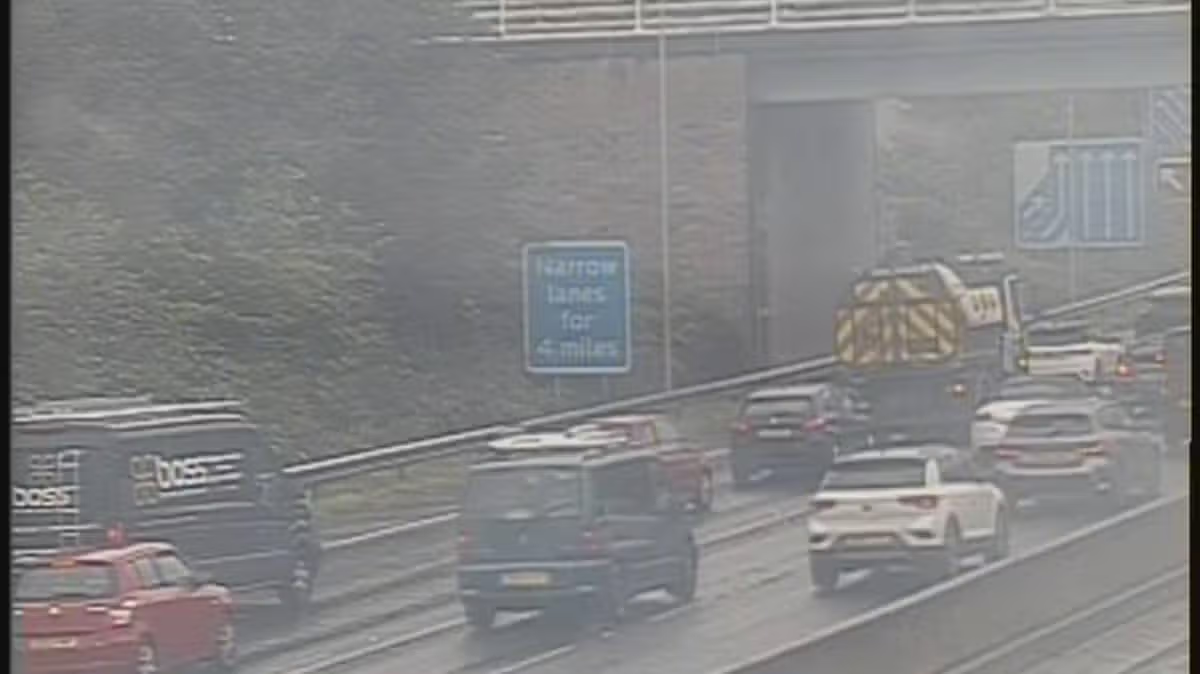
Traffic continues to queue along the M60 after a lorry had broken down earlier today, closing all lanes on the motorway.

Inrix, a traffic service, have issued an update that all lanes have now reopened but drivers will continue to face a delay in the aftermath.

Click here to get the biggest stories straight to your inbox in our Daily Newsletter

Advertisement

They said: “Queueing traffic due to earlier broken down Lorry on M60 clockwise at J12 M62 J12 (Eccles Interchange).All lanes have been reopened.”

This is a live blog we will keep you updated…

Source link

Advertisement
Continue Reading

NewsBeat

Converting ‘deteriorating’ Victorian school into home would cause ‘substantial harm’

Published

on

Cambridgeshire Live

This is the fifth time that similar proposals have been submitted for the former school

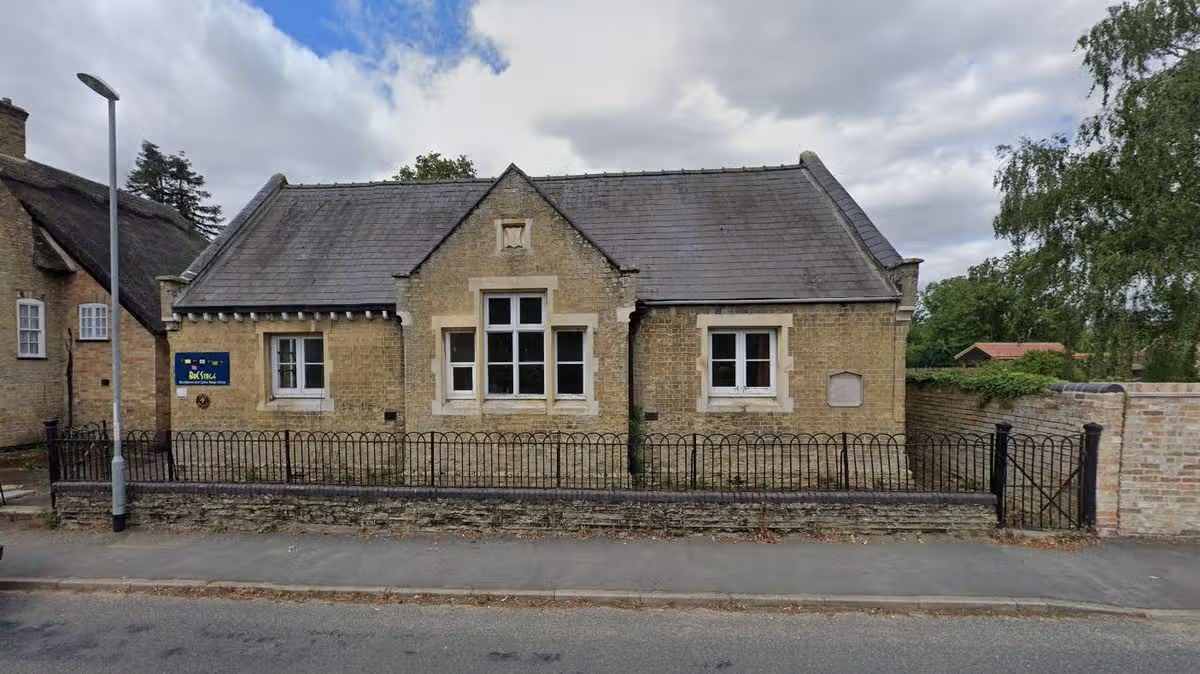
A Grade II listed former Victorian school could be converted into a home. If approved, the Old Day School in High street in Bluntisham would undergo extensions and alterations.

Advertisement

This is the fifth time that similar proposals have been submitted to Huntingdonshire District Council. The previous applications were either withdrawn or refused. Planning documents state the building is “in a deteriorating condition and is frequently vandalised by trespassers”.

The current plans for the old school building would convert it into a two-storey, three-bedroom house. The school was built in 1842, with a toilet block added in 1930 and a kitchen added in 1944.

The works include breaking through the west of the hall to create an opening, adding mezzanine to the north of the hall, creating a sun roof, knocking down the outbuilding and removing and reconstructing the toilet and kitchen. Reviewing the plans, a conservation officer said: “The main feature of the building is the open classroom space which forms part of its original plan form, this is specifically emphasised as an important part of why the building is listed and its significance.

“The inclusion of the mezzanine with bedroom and ensuite bathroom under will fundamentally and significantly erode the space of the hall and damage the original plan form. This will result in a high level of harm.”

Advertisement

However, parts of the works such as removing the outbuilding were not objected to by the conservation officer. Although the officer said the development would “not harm the setting of adjacent listed buildings”, they believe the proposals “do not preserve the significance of the listed building, and result in a high level of less than substantial harm”.

The design and access statement for the current plans, written on behalf of applicant Simon Claridge, says: “The proposed development has been carefully conceived to secure the long-term preservation and viable reuse of the former school building through its sensitive conversion to a single residential dwelling.

“The design approach has sought to balance the functional requirements of a modern home with the need to preserve the special architectural and historic interest of the listed building and its contribution to the wider character of the conservation area.”

Expressing their thoughts on the plans, one person claimed: “The double-height Victorian schoolroom (the primary feature of the building’s architectural interest) is set to be permanently chopped in half by a modern stud partition wall to carve out a private main bedroom. This destroys the open, high-ceiling volume of the historic school hall.”

Advertisement

Planning document notes state that existing historic railings would be removed and taken to another address throughout the works and reinstalled after. An existing dwarf wall in “poor repair” would also be removed and replaced. The objector claimed that “dismantling a protected curtilage asset” would cause “immediate harm to the Bluntisham Conservation Area”.

Several people have also shared their support for the proposals. One person wrote: “I understand that this building is currently derelict. The owners are trying to make a beautiful home out of it. Frankly, we should be grateful that someone is willing to buy the property, invest money into it and make good of it. Otherwise, it will sit there forever and continue to fall apart.”

Meanwhile, another local, who highlighted the building’s “very poor state of repair” said that “in its present condition, the building is clearly deteriorating, and I believe this poses a serious threat to the long-term preservation of this Grade II listed structure”.

The comment added: “Bringing the building back into active, responsible use is, in my view, essential to safeguarding its future. I am fully supportive of the applicants’ proposals to restore the building and convert it into a family home.

Advertisement

“From what I understand of their plans, they are respectful of the building’s historic significance and are focused on sensitive repair, retention of original features where possible, and the use of appropriate materials in keeping with the character of the property.”

Source link

Continue Reading

NewsBeat

Binman reveals how to dispose of old batteries correctly

Published

on

Binman reveals how to dispose of old batteries correctly

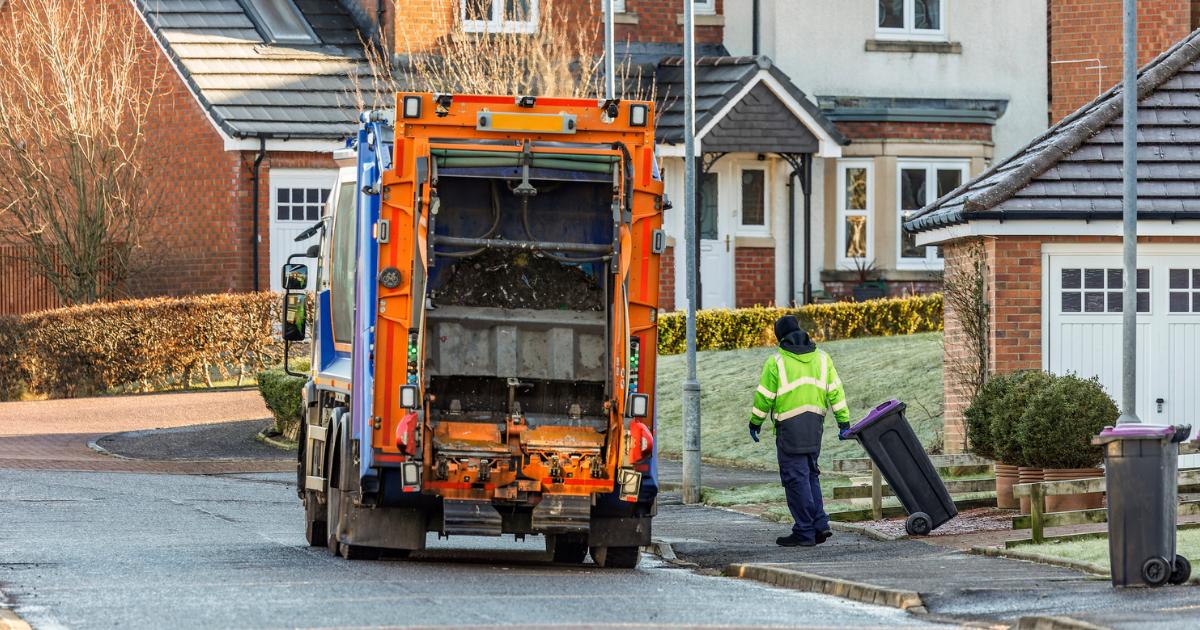
It can be easy to just throw everything, including items like batteries, in a household waste bin without thinking.

A binman has revealed exactly where and how you should be disposing of your old batteries.

How to properly dispose of batteries

The TikTok influencer, The No1 Binman, Ashley has revealed that there are a few extra steps you should take when getting rid of old batteries.

He spoke to the BBC and said: “Do not put vapes or batteries in any bin.

Advertisement

“You can take them to B&Q or the vape shop you bought them from and they’re meant to dispose of them themselves.”

Ashley added that a few councils will dispose of batteries if you leave them on top of your bin in a carrier bag.

But he stressed they should never be put inside the bin, as this can cause fires.

He continued: “I’ve had this before and I’m not sure if it’s a battery or a vape – the back of a lorry started smoking.”

Advertisement

Individual local authorities should provide clear information on what households can and cannot be recycled.

Metal items that cannot be recycled in normal recycling bins include things like electrical items and batteries, pipes, irons, and general kitchenware.

How to avoid having your recycling bin refused

Ashley shared some other tips that will help avoid having recycling bin refused by the binmen.

He said binmen are told to leave the entire recycling bin if it contains more than 5 to 10% of non-recyclable items.

Advertisement

He said: “You should be taking food out if you put it in your food waste bin, rather than chucking it straight in there – like if you’ve got a loaf of bread that’s out of date.

“Pizza boxes technically shouldn’t go in paper waste because the grease on the boxes makes it unable to be recycled because you can’t clean it off.

“They should be ripped apart and separated.

“Paper should be clean all the time.

Advertisement

“But some councils allow you to put them in the compost bin because they can be broken down with dirt and foods.”

Ashley also said people should be removing any polystyrene from packages and separating it from cardboard.

He said: “If something comes in a cardboard box, people take the item out and leave the polystyrene in the box.”

Do you always recycle your batteries in the correct way? Let us know in the comments.

Advertisement

Source link

Continue Reading

NewsBeat

Who do you trust in an emergency? We asked people in places hit by extreme weather

Published

on

Who do you trust in an emergency? We asked people in places hit by extreme weather

One evening in August 2025, a Pakistani shepherd, Abuzar Hussain, was tending sheep and goats in the mountainous slopes of Shijar. At about 6pm, a thunderous roar shattered the silence of the valley.

Abuzar could see a glacial flood headed towards his village, and had minutes to react. He desperately climbed up to a higher point in the mountain where the mobile signal allowed him to get in touch with the village, so that the mosque could broadcast an alert over a loudspeaker.

Hundreds of lives were saved by this phone call from a single man, in a region where millions of dollars are invested in early warning systems.

This story captures something risk and crisis communication researchers have long known, but is not always built into a nation’s emergency planning. It’s not only official messages that are part of a community response to an upcoming disaster. Research shows that the sources who deliver information during emergencies, and their perceived credibility, can affect the way people understand risks and act on them.

Advertisement

That gap, between what people are told and what they trust, is exactly what we set out to measure, with other colleagues. As climate and health information researchers, we ran a series of surveys in Belgium, Germany, Poland and Florida in the US – all places that were hit by major weather emergencies in 2024.

Storm Boris caused deadly flooding across central Europe, while Hurricane Helene caused devastation in the south-eastern United States. These events made natural test sites for our new survey tool, designed to measure “information voids” – the gap between what people expect from flood information and what they actually experience. This could range from knowing where and when to evacuate, to knowing who to believe.

Storm Boris caused dangerous flooding across Europe.

To measure this, we asked people to rate how much information they ideally wanted versus how much they actually received; how accurate they expected it to be versus how accurate it felt; which sources of information they trusted versus which ones they heard from; and finally, which communication channels they preferred versus which they could access.

From their responses, we were able to calculate “void scores”: the difference between the perceived ideal emergency alert and what was received. These were judged in terms of the quantity and quality information received, the source of that information, and the communication channel it was received from. The bigger the difference between the ideal and received ratings, the bigger the void.

Advertisement


À lire aussi :
Nepal floods: how measuring snow in the Himalayas could help avoid future disasters


Our findings from nearly 900 people were revealing, but not in the way we expected. Across all four countries, people said they were getting enough information about the weather emergencies. The problem wasn’t the volume of information – it was who it came from, and how it reached them.

Who is the messenger?

We measured the “information void” in four ways: how much information people got, how accurate it was, who it came from, and how it reached them.

Our surveys detected gaps in the accuracy of information about the timing and location of floods. But the biggest problem was the source of that information, and how it reached people.

Advertisement

Trust levels were high for emergency responders such as firefighters and the police. People showed relatively low levels of trust for social media influencers and religious leaders.

Relationships between information sources and audiences become especially fragile during disasters such as floods, where life-altering decisions need to be made quickly. This was demonstrated during the August 2026 disaster on the Nepal-Tibet border, when a flash flood washed away villages and roads, killing more than 1,000 people.

Strong winds and water surges can damage telecommunications and transportation infrastructure, in ways that make it impossible for emergency responders to share important updates about the situation with the public through news or social media.

In the meantime, rumours can often start spreading misinformation about issues such as emergency supplies, leading some communities to feel ignored. This often sows the seeds of social discontent.

Advertisement

Why information fails

Over the past decade and especially since the COVID pandemic, research around tracking and tackling misinformation has increased. Some studies suggest that misinformation outbreaks are usually preceded by a vacuum of information from official channels.

One possible explanation is that uncertainty about the hazard and incomplete information creates a fertile ground for alternative theories to emerge. When these theories gain traction, they can have dangerous consequences.

Measuring, detecting and addressing information voids should help address the risk of misinformation outbreaks during emergencies and disasters – events that are especially vulnerable to these outbreaks.

Preliminary research, which is not yet peer reviewed, suggests that information voids were linked to an increase in the prevalence of misinformation during the COVID pandemic. Other researchers have categorised social media conversations during the pandemic to identify which topics people felt most confused about, or wanted more information on.

Advertisement

What needs to change?

Many disaster planners worry about people not receiving accurate information, focusing on its quantity and quality. And certainly, being informed accurately about the timing and location of natural disasters is of primary importance.

But our research shows it is also vital to focus on who delivers this information. Messengers commanding high levels of trust need to be actively engaged to ensure information reaches people frequently and widely.

Institutions can act on this by constantly monitoring information voids across all phases of a disaster, from preparedness to response and recovery. This will increase the chances that people adhere to emergency advice, and that misinformation outbreaks are headed off before they start.


À lire aussi :
Himalayan hazards are becoming more complex. Our warning systems need to catch up

Advertisement

Investing millions of dollars in early warning systems is necessary, but not sufficient. Accurate information needs to be sent in the right amount and at the right moment via trusted sources, or people are put at risk.

That is a lesson emergency communicators urgently need to absorb.

Source link

Advertisement
Continue Reading

Trending

Copyright © 2025