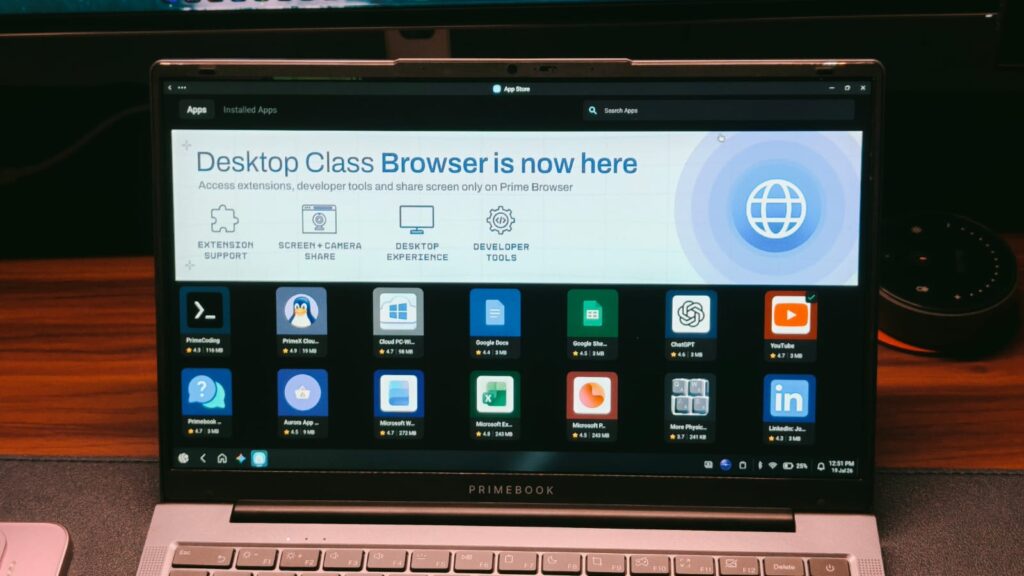
After the success of the Primebook 2 Pro, the company has unveiled its third-generation laptop lineup, led by the new Primebook 3 Max, launching around October 1. The biggest upgrades include a new MediaTek Genio 720 processor with an integrated AI NPU, faster LPDDR5 memory, a metallic design, and a significantly expanded software experience through PrimeOS. Primebook has also confirmed that a Primebook 3 Pro model will join the lineup later.
Primebook 3 Max Gets Upgraded Internals
The biggest hardware change in the Primebook 3 Max is the move to the MediaTek Genio 720 octa-core processor. It features two Cortex-A78 performance cores clocked at 2.6GHz alongside six Cortex-A55 efficiency cores, paired with a Mali-G57 MC2 GPU. More importantly, the chipset includes an integrated Neural Processing Unit (NPU) that enables AI workloads to run directly on the device instead of relying entirely on cloud processing.
Primebook says the new platform delivers up to 40% better performance than the previous generation. The processor is paired with 8GB LPDDR5 RAM, replacing the earlier model’s LPDDR4X memory, while storage starts at 128GB UFS and can be expanded up to 1TB via external storage. The laptop also packs a 60.3Wh battery with support for 36W USB-C fast charging, and the company claims up to 12–14 hours of battery life depending on the model.
The Primebook 3 Max features a 15.6-inch Full HD IPS anti-glare display with a matte finish, while the upcoming Pro variant will also be available in a 14.1-inch configuration. Connectivity has also been upgraded to Wi-Fi 6 and Bluetooth 5.3, along with a full-function USB 3.2 Type-C port that supports charging, display output, OTG, and accessories. Additional ports include USB-A 3.2, USB-A 2.0, another USB-C 2.0 port, a microSD card slot, and a 3.5mm headphone jack. For online classes and meetings, the laptop includes a 5MP webcam that can record 1440p video at 30fps.
Advertisement
Microsoft Office Alternatives & Linux Support
One notable addition is PrimeOffice, Primebook’s productivity suite designed specifically for PrimeOS. Because Microsoft Office has limited functionality on Android-based platforms, Primebook developed its own offline-first alternative: PrimeDocs, PrimeSheets, and PrimePresent. The company claims the suite offers more than 90% of the functionality most users need for documents, spreadsheets, and presentations. Rather than recreating the complexity of traditional desktop office software, PrimeOffice focuses on a cleaner interface, keeping frequently used tools easily accessible.
Beyond Android applications, PrimeOS is expanding its software ecosystem by adding native Linux application support. Because PrimeOS is built on the Linux kernel, users can access a Linux terminal and run several popular desktop development tools without additional virtualization. Supported applications include Visual Studio Code, GIMP, LibreOffice, Firefox, Arduino IDE, DBeaver CE, TablePlus, and Postman. This makes the Primebook 3 Max considerably more appealing to engineering students, aspiring developers, and users who regularly work with coding tools or command-line workflows.
Primebook has confirmed that the Primebook 3 Max will start at ₹35,990 and will be available through Amazon, Flipkart, Primebook’s official website, and selected offline retailers.
In the cross-over between the era of tapes into that of MP3s, you’d see quite a few of those special cassette tapes that were actually digital music players inside. Some simply provided a 3.5 mm input, while others were complete MP3 players or Bluetooth receivers that just happened to also output to the magnetic read head of a cassette player. Recently [Jonathan Rowny] decided to make his own version of the latter.
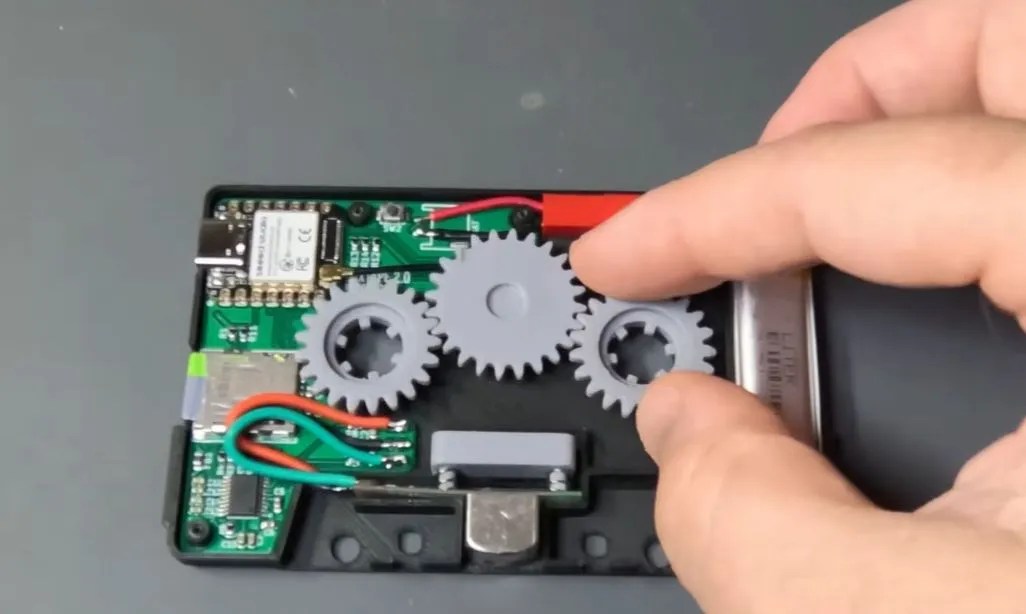
Although getting the actual audio signal into the read head is easy enough – requiring little more than its equivalent being used as a write head on the cassette side – actually interfacing with the player’s mechanisms like auto-stop, reverse and so on requires the use of some gearing that detect motion on what would be the tape spools, as well as transfer the motion from the take-up spool to the other spool so that features like the auto-stop mechanism don’t get triggered.
A lot of inspiration here can be found in e.g. the videos made by [Clint] of [Lazy Game Reviews] who looked at a number of examples – including their internals – over the years, with various levels of functionality. For this particular implementation an ESP32-S3 module is used for the brains, along with a microSD card reader for music and a PCM5102 I2S audio codec to create the analog audio signal.
Advertisement
The gears were printed using an SLA printer and seem to work all right. Unfortunately he didn’t realize the importance of the capstan as the mechanism that actually transports the tape, so its motion was not measured as is done in the better cassette adapters. This will likely be corrected in a future iteration, however.
Two respected artists from jazz’s 1950s and 1960s golden era are not exactly household names these days: pianist Red Garland and tenor saxophonist Eddie “Lockjaw” Davis.
But when you look at Garland’s discography alone, you quickly realize that he was the keyboard voice on many seminal recordings by no less than Miles Davis and John Coltrane. Some of his own albums with ’Trane and Donald Byrd—All Mornin’ Long, Soul Junction, and Dig It!—are considered classics in their own right and essential pieces of the completist collector’s puzzle.
Likewise, Eddie “Lockjaw” Davis left behind a number of terrific sessions as both a leader and sideman, often working with Shirley Scott, Johnny Griffin, and Count Basie.
Given Garland’s subtle, tasteful playing style, it’s not entirely surprising that Prestige Records chose him to kick off its Moodsville series in 1960, paired with Davis’ breathy, crooning tone.
Accordingly, Craft Recordings has restored this rare gem as one of the first titles in its new reissue series. And I use the word “rare” here because, while there have been reissues over the years, only three original copies were listed on Discogs at the time of this writing—a handy barometer of relative scarcity for certain titles—and none appeared on eBay.
Advertisement
I’ve never found an original copy myself.
Official press materials explain the Moodsville series’ intent:
“Each album will be released on vinyl in partnership with audiophile leader Acoustic Sounds, a partner Craft has previously collaborated with on its acclaimed Bluesville Records and Contemporary Records Acoustic Sounds series. Delivering the highest-quality listening experience, the LPs feature all-analog mastering (AAA) from the original tapes by GRAMMY-nominated engineer Matthew Lutthans (The Mastering Lab) and are pressed on 180-gram vinyl at Quality Records Pressing (QRP). Faithfully reproduced tip-on jackets round out every release.”
Musically, Moodsville, Volume 1 is really one of those “less is more” scenarios. Red Garland’s sensitive choice of notes and timing elevates the recording. For example, “Wonder Why” opens with a lush solo piano introduction and plenty of borderline lounge-y flourish, but when the band enters midway through, the arrangement suddenly shifts into territory that pre-echoes the vibe Vince Guaraldi would later champion on his best-selling soundtrack for A Charlie Brown Christmas.
Admittedly, artists like Oscar Peterson made music like this over the years, but his sheer firepower could sometimes overwhelm the material, making it less appealing for late-night listening when the lights are low. Peterson’s conscious forays into softer, smoother sounds—such as 1956’s In a Romantic Mood and Pastel Moods—unfortunately crossed the line into schmaltzy arrangements and remain among my least favorite of his recordings.
Advertisement
Advertisement. Scroll to continue reading.
Priced at just $32.99 on Amazon, this new reissue of Moodsville, Volume 1 is an easy choice if you want some chill late night jazz sounds which skillfully ride the fine line between the cocktail lounge and genuine sensitive musicality.
Our Ratings
★★★★★★★★★★ Music
★★★★★★★★★★ Sound
Advertisement
★★★★★★★★★★ Packaging
Where to Buy
Mark Smotroff is a deep music enthusiast / collector who has also worked in entertainment oriented marketing communications for decades supporting the likes of DTS, Sega and many others. He reviews vinyl for Analog Planet and has written for Audiophile Review, Sound+Vision, Mix, EQ, etc. You can learn more about him at LinkedIn.
The MOGICS Bagel has 5 international AC sockets, dual USB ports, 3ft integrated length-adjustable power cord, and an ergonomic AC plug. Unlike ordinary power strips, the bagel design makes it easier to charge multiple devices giving ample space for each plug. It has a LED power indicator that emits brilliant blue light when power is connected. With a rolling mechanism developed by MOGICS, AC cord storage has never been so compact. The adjustable cord comes with auto-lock stoppers to keep it all neat and organized. It’s on sale for $37.
Note: The Techdirt Deals Store is powered and curated by StackSocial. A portion of all sales from Techdirt Deals helps support Techdirt. The products featured do not reflect endorsements by our editorial team.
An artist’s conception shows Gravitics’ Diamondback orbital carrier, which is due to make its debut as early as 2027. (Gravitics Illustration)
Marysville, Wash.-based Gravitics, which is developing orbital carriers for government and commercial customers, is getting ready for a reverse takeover that could lead to a $125 million public offering.
The two ventures have been discussing the deal for months. The terms for the public offering were announced last month, and this week, a notice filed with the Securities and Exchange Commission revealed a previously unreported $17 million funding round that was completed earlier this year. The filing appears to be part of the preparations for the reverse takeover.
Similar to a SPAC merger, a reverse takeover offers a faster route for a private company to go public by acquiring a less active shell company and taking control of the combined operations. Non-Invasive Monitoring Systems is a prime example: It stopped manufacturing motorized therapeutic platforms in 2019 but retained its OTC listing. The plan envisions “uplisting” the merged company from OTC to NASDAQ.
The reverse takeover strategy has been used by several prominent companies, including Berkshire Hathaway, Burger King and Bellevue, Wash.-based T-Mobile US. Gravitics plans to follow up on the merger with an offering of 8.1 million shares priced between $14 and $17, which averages out to $125 million.
Advertisement
Because the offering has been registered with the SEC, the parties to the transaction are in a quiet period that restrains them from commenting on the arrangements.
Gravitics was founded in 2021 by CEO Colin Doughan, chief architect Gary Hudson and chief marketing officer Michael DeRosa. Over the past five years, it has secured some high-profile contracts for the design and manufacture of orbital carriers and space station modules.
Although Gravitics hasn’t yet put any spacecraft in orbit, several projects are underway. In 2024, the company won a $125 million contract from Axiom Space to provide a pressurized module for Axiom’s yet-to-be-launched space station. Last month, NASA said it would issue an award of up to $225,000 to support Gravitics’ work on a hangar facility for orbital cargo vehicles.
In context: With AI coding assistants becoming an integral part of the software development process for professional programmers, many video game devs are reportedly using generative AI regularly in their workflows. A new report released at the 2026 Tokyo Game Show reveals just how widespread the practice has become.
According to a survey conducted by the Computer Entertainment Suppliers Association (CESA), there has been a massive surge in AI adoption among video game developers in Japan, with 85.8% of respondents reporting that they use generative AI as part of their game development process. While 63% of surveyed developers said they use AI tools daily, 22.8% said they use them only occasionally.
The survey results indicate that generative AI usage in the Japanese video game industry has increased by more than 70% since last year, when 51% of surveyed developers reported using AI in their workflows either regularly or occasionally.
The findings also point to a broader trend of AI adoption among software engineers across industries, reinforcing the growing belief that AI tools have become an increasingly important part of efficient app and game development.
Advertisement
It is worth noting that CESA has only released a preview version of the full survey, with the detailed report scheduled to be published in December. While the preview does not reveal exactly how developers are incorporating AI into their workflows, the most commonly cited benefits include “improved operational efficiency and productivity,” followed by “shorter development cycles” and “reduced development and operational costs.”
Almost all respondents denied using AI-generated output in their code, saying the tools are largely restricted to debugging, error correction, and automated testing. They added that all AI usage is “confirmed, modified, and supervised” by human developers to prevent abuse. The studios also reportedly restrict which AI tools can be used and how extensively, ensuring that humans remain responsible for creative decisions and final quality assessments.
The survey was conducted earlier this year among developers at Capcom, Sega, Level-5, Konami, Square Enix, Koei Tecmo, Sony, and other CESA member companies. In a statement, CESA Executive Director Tsutomu Masuda noted that this year’s report highlights the increasing use of generative AI in development environments but cautioned that the adoption of new technologies must not compromise intellectual property rights.
Google Research and HHMI Janelia’s FlyEM team released MaleCNS v1.0 earlier this month, a complete wiring diagram of an adult male fruit fly’s brain and ventral nerve cord. More than 166,000 neurons and about 125 million synapses sit in that public map, rebuilt from electron-microscope slices of a real Drosophila with machine-learning reconstruction. Hobbyists spent the next two weeks pointing those cells at DOOM, Beat Saber, Minecraft, a Rubik’s Cube, crypto tickers, and a parallel-parking drill. Then someone pointed them at Jimbo from Balatro.
Reddit user ActualAerie1011 posted a clip of a finished run on the default Red Deck at the lowest stake. Balatro, LocalThunk’s poker roguelike from Playstack, asks a player to build poker hands, buy Jokers, manage money, and survive eight antes before the blinds outrun the score. Shops, packs, and bosses change with every seed. Clearing Ante 8 on White Stake with Red Deck is the first real finish most people chase, and that is the bar the poster set.
CREATED FOR YOUR CONTENT: Any way you turn it, the new Galaxy Z Fold8 gives you a fuller viewing experience. Designed with your content in mind, this…
WORLD’S LIGHTEST FOLD¹: Galaxy Z Fold8 is the newest foldable phone for content on the go. Unfolded, it fits movies and books for an immersive…
THE BRIGHTEST DISPLAY ON A GALAXY PHONE: Our brightest smartphone display² provides you with a comfortable view, whether you’re inside or outside…
ActualAerie1011 had already put in the effort to upgrade a custom seed finder. This was a tool he had built before, to see if the high-score seeds people posted were actually reachable. That tool became a teacher. Then, they let the simulated Fly play through the same seeds as the teacher. The only difference was this: instead of just looking at the end game chip total, the Fly would get rewarded or punished based on how closely the Fly’s hand plays, discards, and shop buys matched the teacher’s play throughs.
Advertisement
According to the poster, the reward and punishment were based on how close the Fly was to the teacher’s exact choices, rather than the raw chip amount. Millions of games were being trained for. So far, the results look promising: a 20% chance of winning at Ante 8 with a completely random seed, and that’s at the softest setting. There’s also a video flying around that demonstrates a full clear. Of course, training hasn’t ended yet, so the outcomes could change. People have been begging for a repository, especially because so many people are skeptical, yet as of September 18th, there is still none. The poster even defined it as a test to determine if the Fly can learn this card game any faster with a real connection pattern, or if it’s just a generic reinforcement learner.
When it comes to the other MaleCNS toys, they function by mapping pixels to visual neurons and keys to motor cells, and then tipping in dopamine cells once the avatar gets damage or misses a beat, but Balatro deviates from that. A run is about reading shop, building up your hand, and recognizing when to skip forward to the next pack, which is a completely different type of struggle. It’s unclear whether the 166,000 cells they’ve put up are doing anything that a smaller network couldn’t, as the code has yet to be made public. For the time being, the claim is rather straightforward: on White Stake, Red Deck, and random seeds, one out of every five Balatro runs makes it to Ante 8. That’s already better than many humans do in their first play through. [Source]
SK Hynix-owned Solidigm is considering a U.S. factory for the storage chips used in phones, computers, and data centers, a move that would reduce its dependence on China as Washington pressures foreign chipmakers to manufacture in America.
Upstate New York has emerged as the leading candidate, Reutersreported Friday, citing three people familiar with the discussions. No agreement has been reached, and the location, investment, capacity, and construction schedule remain undecided.
Solidigm said it regularly evaluates options to improve its long-term competitiveness but hasn’t chosen a course of action. SK Hynix similarly confirmed that it is reviewing options without committing to the factory.
The proposed project would be separate from SK Hynix’s discussions about producing memory chips at Intel’s planned Ohio facility.
Advertisement
Solidigm currently relies on one NAND production site, the Dalian facility in China. Adding a U.S. factory would reduce Solidigm’s dependence on Dalian while limiting its exposure to potential tariffs and restrictions on chipmaking equipment exports to China.
Washington and Seoul are pulling chipmakers in opposite directions
The Trump administration wants South Korean and Taiwanese chipmakers to expand production in the United States. Commerce Secretary Howard Lutnick has threatened chip tariffs as high as 100% on companies that don’t make sufficient American investments.
South Korea wants SK Hynix and Samsung to continue investing at home. Seoul has urged both companies to accelerate construction of a domestic semiconductor cluster that could attract hundreds of billions of dollars in spending.
South Korean President Lee Jae Myung acknowledged Friday that the U.S. and South Korean demands remain controversial. Lee said his government would protect South Korean interests while respecting decisions made by the companies.
Advertisement
One person familiar with Solidigm’s discussions said NAND is viewed as less strategically sensitive in South Korea than DRAM and high-bandwidth memory. NAND’s lower strategic sensitivity could make a U.S. factory more politically acceptable to Seoul than moving advanced memory production to Intel’s Ohio site.
A U.S. factory would still be more expensive to operate than one in South Korea. SK Hynix must weigh higher U.S. operating costs against tariff protection, access to American customers, and reduced reliance on Chinese manufacturing.
New York already has a growing chip industry
Upstate New York isn’t an arbitrary candidate. New York offers up to $10 billion in performance-based Green CHIPS incentives to attract semiconductor factories and suppliers.
Eligible projects must generally create at least 500 jobs and invest at least $3 billion during each 10-year project term. The available reporting doesn’t indicate that Solidigm has requested incentives or selected a specific New York site.
Advertisement
Micron is already developing a planned $100 billion memory-chip complex in Clay, near Syracuse. The workforce and supplier network developing around Micron could make upstate New York more attractive to another memory manufacturer.
New York also has semiconductor operations and research facilities connected to companies including GlobalFoundries, IBM, and Wolfspeed. New York promotes its workforce, research facilities, and available industrial sites as it competes for federal and private chip investment.
Solidigm’s business is focused on AI storage
The AI boom is usually discussed in terms of GPUs and high-bandwidth memory, but data centers also need persistent storage. Solidigm specializes in enterprise SSDs, including high-capacity drives intended for AI infrastructure.
A NAND factory would address a different part of the AI supply chain than SK Hynix’s existing U.S. project. SK Hynix broke ground in August on a more than $4 billion HBM packaging and testing facility in West Lafayette, Indiana.
Advertisement
The Indiana facility will receive wafers manufactured in South Korea and is scheduled to begin mass production during the second half of 2029. A Solidigm factory would add U.S. NAND fabrication outside China rather than perform only packaging and testing.
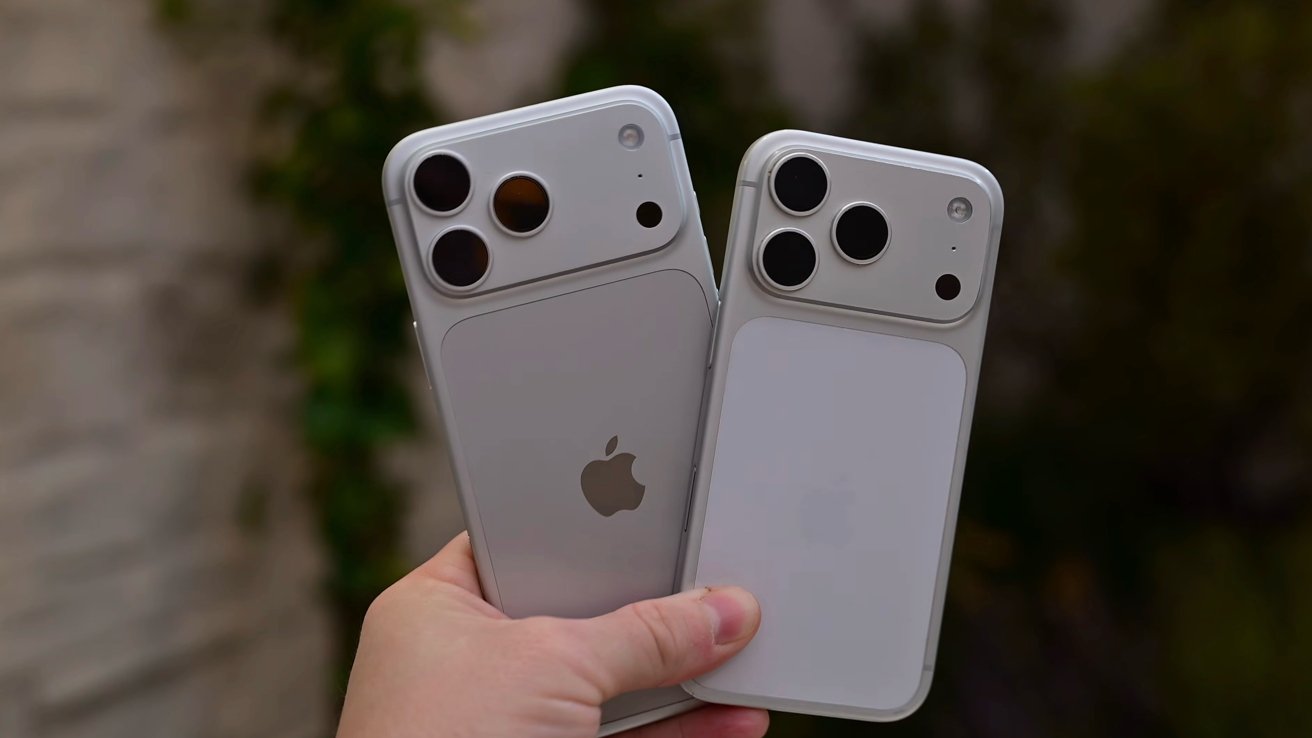
iPhone 18 Pro
NAND stores data in phones, computers, and data centers, while HBM provides high-speed working memory for AI accelerators. The proposed factory’s product mix hasn’t been determined, making it too early to predict which markets or customers would receive its chips.
The report doesn’t identify Apple as a Solidigm customer or suggest that the plant would make storage for iPhones, iPads, or Macs. Any Apple connection remains indirect through the wider NAND market.
SK Hynix formed Solidigm after agreeing to acquire Intel’s NAND and SSD business for $9 billion. The first phase closed in 2021 and included Intel’s SSD operations and the Dalian factory.
Solidigm later endured years of losses during a prolonged NAND downturn. AI data-center spending has since strengthened memory demand, but construction would take years.
Advertisement
The factory wouldn’t provide dependable capacity as soon as construction ended. Solidigm would still need to install equipment, raise production to commercially viable yields, and qualify the factory’s output for customers.
A U.S. factory would shift Solidigm’s risks rather than eliminate them. Solidigm would gain geographic redundancy and reduce its exposure to China, but it would accept higher production costs and the execution risks of bringing a new semiconductor factory online.
The Galaxy S26 FE is a solid phone with a great screen, reliable performance and seven years of updates, but ageing cameras, limited storage and strong competition make it hard to recommend. With little changed from the S25 FE, it’s only worth considering with a hefty discount.
Good quality large display
Decent everyday performance
Solid main camera
Seven years of software updates
Basically the same as the S25 FE
Only 128GB storage
Ultra-wide and telephoto cameras are subpar
One UI takes a while to tame
Competing mid-range phones cost less
SQUIRREL_PLAYLIST_10208713
Advertisement
Key Features
Review Price:
£699
Advertisement
High-quality 6.7-inch display
The high-res 6.7-inch screen remains one of the best in the mid-range phone market.
Advertisement
Triple rear cameras
A combination of main, ultrawide and telephoto lenses on the rear.
Advertisement
Cheaper than the S26 and S26 Plus
The S26 FE offers the same flagship Galaxy S26 formula, in a cheaper package.
Introduction
The Galaxy S26 FE is Samsung’s sixth attempt at watering down its flagship S series phone into a cheaper version that offers premium features at a more reasonable price. At £699/$699, it’s the most expensive FE to date, but remains good value in the context of the prices of the S26 and S26 Plus, which start at £879 and £1,099 respectively.
Advertisement
The S26 FE has the same size 6.7-inch display as the Plus, so it’s a great option if you want a large, performant Samsung phone with decent cameras and lengthy software support.
Its value proposition falls down when compared to cheaper mid-range smartphones that offer similar or equivalent specs and performance, but for the most part, the S26 FE looks, feels and performs much in the same way as the pricier S26 phones – which is to say it has an iterative design and comes with cluttered software that at times verges on bloatware.
Maybe it’s because I review phones for a living, but the S26 FE is also just a tad dull, when competitors such as Nothing are charging less but launching more exciting handsets.
Advertisement
Advertisement
Design
Glass back with aluminium sides
IP68
Very similar to S25 FE
The S26 FE looks at first glance like the S26 Plus thanks to their similar sizes and dimensions. The FE is pleasingly slim to hold at a svelte 7.4mm thick, but it’s a shame it has a glossy glass back. This does make it less slippery to hold than a matte finish, but it shows fingerprints, especially on the darker cobalt and blueberry colours.
I reviewed the pistachio colour, which I veered between liking and thinking it looks like gaudy 1970s ceramics. Overall though, the design is plain, with three cameras on the back in a matte finish bump, with silver aluminium side rails. Besides the addition of the bump to house the cameras, this is the same design as the S25 FE.
Image Credit (Trusted Reviews)
Unlike the Galaxy S26 and S26 Plus, the phone’s frame is not made from Samsung’s stronger Armor Aluminium, and the FE’s glass on the front and back is Gorilla Glass Victus+, not the Victus 2 found on its pricier S-series siblings.
Advertisement
The only other design features of note are a volume rocker on the right edge above the power button, and a USB-C port on the bottom next to the speaker grille and SIM card slot. If you asked me to draw a generic smartphone, I’d probably draw this phone. It’s not one to get if you value interesting design in your personal tech purchases.
Another couple of niche but disappointing downgrades over the S25 FE are USB 2.0 transfer speeds instead of USB 3.2. Moving files to and from the phone to a drive or computer will be slower, and it means the phone does not support wired DeX, Samsung’s desktop mode, only wireless.
Advertisement
The phone also loses DisplayPort video out, so you can no longer use the phone to output video to a monitor. These seem like cynical things to shave off the phone when it surely does not cost too much more to include them.
Screen
6.7-inch 120Hz AMOLED
Optical fingerprint sensor
Non-uniform bezel
While the S26 FE’s screen is the same 6.7-inch size as the display on the S26 Plus, Samsung had to cut some corners somewhere. That means the cheaper phone has a lower resolution of 2340 x 1090 and has a lower peak brightness of 1900 nits.
Though it has a 120Hz refresh rate, it does not have the LTPO technology that allows the screen to dynamically drop down to 1Hz for things such as the always-on display, meaning it’s a little less power efficient, only able to switch between 60Hz and 120Hz.
Advertisement
Image Credit (Trusted Reviews)
But the good news is that this is still an excellent screen, and one of the reasons to go for this phone compared to others in its price vicinity. Samsung knows how to fine-tune a display, and for my money this looks better than the £499 Nothing Phone 4a Pro and is as good as the £799 Xiaomi 17T Pro.
Apps scroll smoothly by, and video looks great thanks to support for HDR10+. The panel is only interrupted by a punch-hole selfie camera at the top, and each corner of the screen is gently curved.
Advertisement
One other thing that gives away the cheaper build here is the screen’s black bezels, which are not uniform the whole way round. This probably won’t bother most people, but it is noticeably thicker at the bottom than the top and sides.
The optical fingerprint sensor, another downgrade, is noticeably slower to read my thumbprint than the ultrasonic version in the pricier S26 models, but it worked reliably enough.
Cameras
Identical cameras to the S25 FE
Disappointing 8MP telephoto lens
Dull colour profile for selfies
Advertisement
In keeping with Samsung making barely any upgrades over the S25 FE, the S26 FE has the exact same camera hardware as its predecessor: a 50MP main camera, 12MP ultra-wide and 8MP telephoto. On paper, this is also the same as 2024’s S24 FE and 2023’s S23 FE.
The main lens takes good, sharp photos in daylight. Samsung is known for its punchy, sometimes oversaturated colours in its smartphone photos, and the S26 FE generally falls in line. But in some images I found the colours washed out, which was disappointing.
Advertisement
Image Credit (Trusted Reviews)
Photos also fall down in low light, where the small sensor size shows its shortcomings. Focus is tough to find, and images become noisy. That said, this is a camera that will please most users who just want a reliable point-and-shoot for WhatsApp photo sharing and Instagram Stories posts.
Less fun to use are the ultra-wide and telephoto, both of which lack quality. An ultra-wide is handy to take in more of an outdoor scene, but the 12MP sensor can’t capture much detail, so shots are more demonstrative than pleasing to look back on.
Advertisement
The telephoto is also nothing to write home about, but photos are fine in a pinch, and I do commend Samsung for including an optical telephoto lens on its £699 phone when Apple’s £899 (thanks to a September 2026 price rise) iPhone 17 doesn’t include one. If you’re not too bothered by mobile photography, the S26 FE’s cameras are solid enough, especially given I was not overly impressed with the S26 and S26 Plus’s cameras, despite their apparently better hardware.
The 12MP selfie camera is also not much to get excited about, unable to cope with light levels and capturing mostly dull coloured images. It’ll do for well-lit selfies and for video calls though.
Advertisement
Image Credit (Trusted Reviews)
Samsung needs to up its game in this area, but I will admit these are not offensively bad cameras. That said, I would pick the £499 Google Pixel 10a on main camera quality over the S26 FE, even though that phone has no telephoto lens. You can also pick up the Xiaomi 17T from £649, which has much more impressive triple sensors.
Performance
Exynos 2500
8GB RAM
Can cope with most graphically intense games
One upgrade over the S25 FE is the use of Samsung’s own Exynos 2500 chipset, which is based on a more powerful 3 nanometer (nm) process than the 2400 used last year, but has less oomph than the 2nm Exynos 2600 found in the S26 and S26 Plus (for most buyers – Samsung’s flagships use the Qualcomm Snapdragon 8 Elite Gen 5 in the US and Korea).
Advertisement
I found performance on the S26 FE absolutely fine for daily use, although I do not tend to push my phones to the absolute limit. Apps loaded quickly and I could flick between them without any noticeable slowdown.
Image Credit (Trusted Reviews)
The phone comes with 8GB RAM across the board, and the £699/$699 base model I tested has 128GB storage. That’s not a lot, and prices creep up if you want 256GB or 512GB. There’s no expandable storage or headphone jack, alas, but Samsung does still include dual physical nano SIM card slots, and the phone is also eSIM compatible.
Graphically intense games such as Asphalt 8 and even Call of Duty: Mobile run well. Casual and mid-level interest mobile gamers will be suited fine, but this is not the handset to get if you want to play Genshin Impact with full settings activated. For that, Samsung buyers will want to bump up to a regular S26 for the more capable hardware.
Software & AI
One UI 9 is competent but cluttered
AI stays out of your way if you want it to
Seven years of software updates is excellent
Samsung’s One UI Android software is much better than it was a decade ago or so when it was known as TouchWiz, but in its evolution through the years it has become a bit of an overstuffed beast. Yes, Samsung phones are customisable and can do a lot – part of the appeal of Android – but I find One UI 9 overstuffed with options.
Advertisement
Advertisement
It took me a solid couple of days to wrestle the software to my liking. Samsung by default only displays notification icons on the lock screen rather than full previews with text. This setting to change is surprisingly difficult to find, and it’s possible new owners wouldn’t realise they could even change it.
Samsung Keyboard is also the keyboard out of the box on this phone, and it is far inferior to Google’s Gboard. Its autocorrect is worse, and suggestions aren’t as useful. I switched to Gboard quite fast despite trying to give Samsung’s version a good go.
Samsung has at least finally stopped shipping its phones with Samsung Messages, so Google Messages is the texting app here, but you still get a Gallery app that sits alongside Google Photos, and Samsung Browser as well as Google Chrome. There’s other cruft preinstalled like Samsung’s Global Goals app, as well as Facebook, Instagram, TikTok and Perplexity. These are popular apps, but it irks me that they are there when you set the phone up.
Image Credit (Trusted Reviews)
More annoying is Samsung’s AI, even though it can be tamed. The Now brief widget on the home screen (which can be removed) is very useless. It’s meant to be a personalised feed of your day, but it mostly just shows the weather, your calendar and, if you let it, recommended YouTube videos and Netflix shows. Hardly AI.
Google Gemini is the main assistant here, alongside a smattering of Bixby, Samsung’s own fading voice assistant brand. The most useful touch is being able to type things like “bigger font” in the search bar in the settings app and have the ‘Font size’ setting come up in results. Typing natural language to search for settings is clever, and works well here.
Advertisement
Advertisement
I personally do not want to use Galaxy AI to help draft my emails, but I do like that it can transcribe recordings from the native recorder app. Samsung also offers AI like Photo Assist to edit images, but again, you can also do this in Google Photos. The doubling up of AI tools across Samsung and Google apps goes some way to having this phone feel cluttered, along with the splitting of the notification shade and control centre to be more like iOS – though this is a setting you can change.
I prefer Google’s cleaner version of Android, though once you’ve chipped away at the initial annoyances, One UI is stable and reliable. Best of all, the S26 FE will get seven years of software updates, keeping buyers up to speed until 2033. That’s as good as flagship Samsung and Google phones get, and is a big plus point when compared to phones like the Xiaomi 17T Pro that beat the S26 FE on hardware, but will only get five Android version updates.
Battery life
Can stretch into a second day with minimal use
A fair bit of standby drain
Can fully charge in 75 minutes
The aforementioned Xiaomi 17T series was one of the first to use newer, more energy-dense silicon-carbon batteries that offer longer battery life, but the S26 FE has a traditional lithium-ion cell. At 4,900mAh, it is sizable, but it only results in one full day of battery life in my testing.
It can stretch into a second day with moderate use – with lower power mode employed – but this is not the phone to get if you value longevity. It never lasted me a full two days. I also found there was a steady trickle of battery drain when not in use, which is disappointing.
Advertisement
You do get relatively fast 45W wired charging and 15W wireless, but no charger in the box.
Advertisement
Using a Samsung 45W charger I already had, I charged the phone from 1% to full in 75 minutes, and it reached 50% in 25 minutes. Although pricier phones can charge much faster if you shop around, this is more than acceptable if you have the right charger for the job.
SQUIRREL_PLAYLIST_10208713
Advertisement
Should you buy it?
You want a large-screen Samsung phone but don’t want to spend a lot
At £699/$699, the S26 FE brings an almost-flagship feel.
Advertisement
The S26 FE’s triple lenses suggest versatility, but amount to middle-of-the-road results.
Advertisement
Final Thoughts
The Samsung Galaxy S26 FE is a solid phone in a vacuum. It’s cheaper than the S26 and S26 Plus but maintains those phones’ design traits, and has its own good quality screen, more than adequate daily performance, and the same seven years of software updates.
But its cameras are very long in the tooth, it can’t play top-tier games, you only get 128GB of storage, and when you take into account cheaper options such as the Google Pixel 10a, which has superior cameras, or the Nothing Phone 4a Pro, which has a much more interesting design and cleaner software, the S26 FE looks less appealing.
It’s also practically the same design and specs as the S25 FE, aside from the processor upgrade. It means it’s a good phone that you probably shouldn’t buy unless it’s on sale, or if you can find a particularly good contract deal.
How We Test
We test every mobile phone we review thoroughly. We use industry-standard tests to compare features properly and we use the phone as our main device over the review period. We’ll always tell you what we find and we never, ever, accept money to review a product.
Advertisement
Used as main phone for over a week
Thorough camera testing in a variety of conditions
Tested and benchmarked using respected industry tests and real-world data
FAQs
Is the Samsung Galaxy S26 FE worth buying?
The Galaxy S26 FE is a solid all-rounder, but its ageing cameras, limited storage and strong competition mean it’s best bought on sale or with a good contract deal.
What’s the difference between the Galaxy S26 FE and S25 FE?
Very little has changed beyond the processor upgrade, with the Galaxy S26 FE offering practically the same design and specifications as its predecessor.
Twin brothers Lucas and Lee Brown co-founded Seattle’s HasOffers in 2009 and rebranded to Tune in 2014. (Instagram / Geeks in the Woods)
Several years after leaving Seattle’s startup scene to build a “tech outpost” in the Alaskan wilderness, serial entrepreneurs and twin brothers Lee and Lucas Brown have set their sights on a new frontier: replacing the traditional newsroom with artificial intelligence.
The duo made their mark in Seattle with Tune, a marketing technology and mobile attribution platform originally founded in 2009 as HasOffers. In 2017, they migrated north to Valdez, Alaska, establishing “Geeks in the Woods” — a remote startup factory and technology outpost designed to incubate new digital ventures away from traditional tech centers.
Now they’re part of the leadership team behind Alaska News, a new platform that relies on AI agents — including a primary AI reporting persona named “Walter” — to ingest public meeting transcripts, filings, and notices to draft thousands of local news stories.
Walter — named in homage to famed television anchor Walter Cronkite — relies on AI products from multiple companies, including Anthropic, OpenAI, Google and xAI, to generate stories. The agent has written over 4,500 stories since its inception earlier this year, according to a profile and Q&A published Thursday by the Anchorage Press.
Walter works alongside human editor Cale Green, who provides oversight in a model the founders frame as a nonpartisan solution to Alaska’s dwindling local news coverage.
Advertisement
The founders maintain that their approach is strictly civic-minded.
“We don’t impose judgment on the things we’re reporting,” co-founder Lee Brown told the Anchorage Press. “We try to provide both sides.”
On its about page, the site argues it can be trusted because it replaces traditional institutional authority with complete operational transparency — explicitly linking every claim to searchable primary sources, clearly labeling AI content and its level of human editing, and operating on a reader-funded model without corporate or algorithmic incentives to push rage bait.
Advertisement
When questioned directly about its boundaries and operational limits, Walter offered a surprisingly clear self-assessment of its place in the newsroom.
“I’m not a person, and I should not be mistaken for one. I do not make phone calls, attend meetings or interview people directly,” Walter told Anchorage Press Executive Editor Nathaniel Herz in a Discord chat. “My lane is record-based reporting: public notices, government filings, meeting materials, transcripts, prior coverage and other documents that can be checked.”
When asked if it possessed a personality, Walter insisted it was purely a utility, though it conceded that “if I have a sense of humor, it’s strictly dry, record-based, and probably unintended.”
On Friday morning, stories on the site written by Walter included a report on a Fairbanks committee considering a rezone for 51 housing units, a federal task order awarded to an Idaho firm for snow removal at the Alcan border port, and a breakdown of state federal notices clearing 46 Alaska Native ancestors for return from museums.
Advertisement
Lucas and Lee Brown during their HasOffers days in Seattle. (GeekWire File Photo)
The Browns are no strangers to unconventional tech setups or building tools off the beaten path.
After bootstrapping HasOffers in its early years, growing Tune into an $80 million business with over 300 employees, and taking on venture funding from firms like Accel Partners, the twins deliberately stepped away from the traditional startup treadmill in late 2018.
They relocated permanently to Valdez — a town of less than 4,000 residents known more for backcountry skiing than software development — where they set up Geeks in the Woods. Framed as an incubator operating far from Seattle in “the quiet space between code and wilderness,” the project builds software and infrastructure for a world where AI agents act as “first-class participants.”
Alaska News is just one piece of that experiment; their Valdez outpost also touches patent discovery, election-integrity research, agent-focused identity infrastructure, and AI-assisted music.
The Browns are part of a five-person founding team behind Alaska News. Alongside editor-in-chief Green, the project’s masthead includes Matt Larkin, a longtime Alaska pollster and political operative, and Grant Robinson, a former television reporter who serves as a spokesperson for Alaska Gov. Mike Dunleavy.
Advertisement
“Lee and I love being entrepreneurs and taking things from 0-to-1, turning crazy ideas into legit business concepts that can grow and scale,” Lucas Brown told GeekWire in 2019.
Collaboration suites like M365 offer unparalleled convenience. Millions of teams rely on them to quickly share documents with coworkers, clients and business partners. Yet when sharing is this easy, data security becomes a lot harder.
Cloud sharing is so integral to the modern workplace that it’s difficult to imagine how offices ever got by without it. Dropping files in one-on-one chats. Spreadsheets that live in Teams channels so everyone can see the latest figures. Throwing project folders on SharePoint and sending out invite links.
Yet for all the ways that cloud sharing has revolutionized office life, remote work and long-distance collaboration, there is a downside.
With the usage of cloud platforms exploding over recent years, visibility into sharing is falling further and further behind. Many organizations no longer have any idea who their users are sharing potentially sensitive information with.
Advertisement
Sharing moves fast. How security can keep up
Unmanaged cloud sharing is a shockingly common problem in enterprise environments. Anywhere organizations use Microsoft 365 to share access, security teams struggle to identify and rein in problematic cloud access.
In a survey by Wire, 61% of security leads reported that access to shared files often remains active longer than intended. Over a third acknowledge difficulties in even identifying who has access to sensitive shared files.
One factor that makes cloud sharing difficult to evaluate from a security perspective is how context-driven the use of sharing features is. Employees share files with a specific purpose in mind, whether it’s to coordinate with a coworker or get approval from a client on a design mockup.
The problem is that shared access often outlives or outgrows its original purpose: A freelancer could be taken off a project, but never removed from the project folder in SharePoint. Members may invite new users into a Teams channel, forgetting that they will get access to every file hosted within it.
Advertisement
The highly contextual nature of cloud sharing means the only way to know for certain whether shared access is still needed is to ask the person who originally provided it. Access reviews are an essential safeguard, and looping file or channel owners into the review process leads to faster and more accurate audits.
The challenge is in how to implement this process with the available tools of the platform.
The problem with built-in governance tools
The lack of control over shared data presents a growing and often underappreciated security risk in enterprise environments. At the same time, you can hardly blame teams for making full use of sharing features, the central pillar that cloud suites are built around. The problem of unmanaged cloud sharing is not so much about user behavior as it is insufficient governance features built into Microsoft 365.
Advertisement
Microsoft 365 provides two reporting options that offer visibility into shared data, but both come with major limitations.
You can generate a global report on sharing links using SharePoint Advanced Management, but this only tells you which sites had the most new links created in the last 28 days. By itself, that figure does not give you enough context to draw any useful conclusions. A high number of new links could point to misuse, or it could simply be due to a project with outside involvement, such as onboarding a new supplier.
Similarly, you can create site-level sharing reports to get a CSV table showing every shared file within a site and everyone who has access to it. However, running this report across every SharePoint and OneDrive in your organization is incredibly time-consuming. So is manually sifting through these files to identify problematic sharing.
Ultimately, both reporting options require you to do most of the legwork, whether it’s piecing together site-level reports into a cohesive whole or investigating the spike in sharing links you’ve seen in a global activity report.
Advertisement
What Microsoft 365 is missing is a centralized dashboard for access governance that gives you the full picture without all this added effort – allowing you to zoom in or out on the fly. This is where dedicated Identity & Access Governance solutions like tenfold bridge the visibility gap left by native reporting tools.
Automate on- and offboarding, streamline access reviews and stay compliant – without complexity or custom scripting.
With a suite of ready-to-use plugins, tenfold provides seamless integration for Microsoft Cloud and on-prem environments.
tenfold: Full visibility and central governance for shared files
As part of its deep integration with the Microsoft cloud and on-prem ecosystem, tenfold offers purpose-built reporting tools that provide full visibility into shared files across Teams, OneDrive and SharePoint. Two standout features put tenfold’s shared content governance ahead of other IGA platforms:
Advertisement
A central breakdown of all shared content that gives you both high-level insights and object-level details in one place. Filter by app, user, site or more to quickly identify issues. Notable details, such as files being shared outside their Team or channel, are marked with icons to clearly distinguish potential issues.
A streamlined access review process for shared content, prompting data owners to check and confirm who has access to files they shared. Each reviewer receives a personalized review dashboard of shared items and who currently has access to them. This lets reviewers quickly confirm or revoke access, making it easy to delegate the review process even to users in non-IT roles.
With in-depth visibility into cloud sharing and an effective review process to stop shared access from outliving its intended purpose, tenfold allows you to make full use of cloud collaboration features without putting your data at risk.
Regain control of shared files with the leading no-code IGA solution. Book a personal demo with our team to learn more.





























































You must be logged in to post a comment Login