Daily Mail journalists select and curate the products that feature on our site. If you make a purchase via links on this page we will earn commission – learn more
From fun fur to new-season checks, you can pick up an on-trend piece with your weekly shop, as shown here by Hannah Skelley. Groceries optional
Jacket, £35, and jeans, £22, Nutmeg, Morrisons in store. T-shirt, £6, and shoes, £18, tuclothing. sainsburys.co.uk. Jewellery worn throughout, Hannah’s own
We live in Denmark, which consistently ranks as one of the world’s healthiest countries. The modern Danish diet, however, may not be quite so world-leading – with many Danes consuming high levels of sugar, salt and convenience food.
Yet, go back a few generations and science is increasingly showing that many of the staple foods of our grandparents’ generation.
Think homemade rye bread, herring, root vegetables and berries – can significantly reduce your risk of chronic disease and help you live longer.
Often described as the Mediterranean diet of the north, the Nordic diet is a predominantly plant-based diet rooted in traditional Nordic foods.
Advertisement
Health Gap / Sundhedskløften is a collaborative series from The Conversation UK and Denmark’s Videnskab.dk exploring what the two countries can learn from each other when it comes to health and wellbeing.
From cycling and alcohol to inequality, healthcare and everyday habits, the series looks beyond hospitals and medical treatment to explore how culture, politics and society shape the way people live – and how healthy they are.
It emphasises whole grains such as rye and oats; fatty fish, like salmon, herring and mackerel, root vegetables and cabbages, Nordic fruits like apples and pears and berries like bilberries – with modest amounts of dairy and rapeseed oil as the main source of fats.
Advertisement
These foods work together to support health.
Rye, oats and vegetables provide a diversity of dietary fibres, which help to regulate cholesterol, blood sugar and digestion. Salmon, herring, mackerel and rapeseed oil supply heart-healthy unsaturated fats. Fruits and berries contribute antioxidants that may reduce inflammation. And the overall diet is typically low in sugar and saturated fat.
A look at the evidence
Much of the evidence for the Nordic diet comes from something researchers call the Healthy Nordic Food Index, a score that ranks people by how closely their everyday eating matches traditional Nordic staples.
One of the earliest studies using this index tracked 57,053 Danes over 12 years. It found that men who ate the most Nordic-style foods ended up with a 36% lower risk of dying than those who ate the least.
But the strongest evidence for the health benefits of a Nordic diet comes from a 12-month study in Sweden, a country with broadly similar eating habits to Denmark.
Participants were asked to swap to porridge and rye bread instead of eating white bread and pasta, rapeseed oil instead of butter and more locally grown produce like apples, berries and cabbage alongside fatty fish like salmon and herring.
In this study, people in the Nordic diet group saw improvements across several risk factors for chronic disease compared to the people who weren’t eating in this way. This included the lowering of high blood sugar and cholesterol, a reduction of liver fat, along with decreased inflammation levels – all of which can raise your chances of developing heart disease, type 2 diabetes, or liver disease over time.
Both are big on plant foods, whole grains, fish and healthy fats. Both diets also treat processed food and red meat as occasional extras rather than staples.
The Nordic diet leans on foods grown and caught close to home, like this herring salad, rather than shipped in from afar. Timolina/Shutterstock
And for people living in northern Europe, like the UK, this more Nordic way of eating may actually be an easier diet to follow than the Mediterranean diet, given that many of the ingredients are already grown locally and familiar.
Plus, because it leans on foods grown and caught close to home, rather than shipped in from afar, this way of eating tends to do more to support local food production. Thus potentially making it better for the climate.
Advertisement
How to adopt the Nordic diet
It’s clear then that adopting some healthy Nordic habits could bring clear health benefits.
Some simple changes might include:
swapping refined grains for whole grains like oats and rye bread and aiming for 90g a day
eating more fatty fish each week
using unsaturated oils instead of butter
adding more legumes, root vegetables and seasonal produce to meals
cutting back on highly processed foods
It’s also important to add that healthy eating does not depend on specific “superfoods” or exotic ingredients. Instead, this diet demonstrates the value of simple, local and minimally processed foods. Think: more whole foods, more plants, better fats and fewer sweets and snacks.
Ultimately, though, the healthiest diets are not about perfection, but about consistent, balanced choices that can fit into your everyday life.
Advertisement
This series was commissioned as part of a partnership between Videnskab.dk and The Conversation, where articles are published in English and Danish.
Sony’s all-digital future is off to a rough start (Photo by Nikos Pekiaridis/NurPhoto via Getty Images)
Sony’s YouTube and social media channels are still dominated by people complaining about the all-digital future and one reader is very impressed by dedication of fans.
Like most people, I feel like I’ve pretty much had it with Sony at this point. My first console was the PS1 and I’ve been a loyal PlayStation owner ever since. Not out of some kind of fanboy mentality, but just because they’ve always made a good product in terms of both hardware and games. I’ve been happy with every console I’ve owned of theirs, more or less, and never felt I was missing out on anything by not owning an Xbox.
I feel this is a fairly normal way of thinking about things and one of the reasons PlayStation has always been popular. Even when things aren’t going well, like with the PlayStation 3, they usually sort themselves out and get back on track soon enough – which they definitely did with the PlayStation 4, which I feel was PlayStation at its peak.
It is amazing how quickly they turned things around though, as within a year of coming out it was obvious the PlayStation 5 was a disaster, in terms of the lack of games and the stupid live service fetish. But someone in the c-suite obviously said hold my beer, in terms of things not being able to get any worse, because they went straight from that to their ridiculous all-digital future.
Advertisement
What makes this whole situation so stupid is if they’d only waited a year (all rumours point towards the PlayStation 6 coming out next year) they could’ve just said the new console was digital only and there would’ve been very little complaint. There would’ve been some, but not nearly what you’re getting now.
It obviously had something to do with Rockstar and GTA 6 being digital-only, because they obviously organised that together, but that still doesn’t mean they had to give up on making discs completely. But they have, they’re already using the factory for something else, and it’s obvious they’re not going to change their mind.
Expert, exclusive gaming analysis
Sign up to the GameCentral newsletter for a unique take on the week in gaming, alongside the latest reviews and more. Delivered to your inbox every Saturday morning.
I’m not going to get into why that’s a bad thing, because we all know. We own nothing, we’re giving Sony an even bigger monopoly, and prices are blatantly going to go up. And then there’s the whole thing of Sony treating us like dirt and doing everything short of laughing in our faces.
Advertisement
The boycott against using the PlayStation didn’t work because not nearly enough people did it, but I have been super impressed by everyone protesting them on their YouTube channel, X, Instagram, and PlayStation Blog (which I didn’t realise had comments).
It doesn’t matter what the post is, it’s always wall to wall abuse. It’s usually not too vulgar either and often very funny. There’s some pics and gifs they reuse but I’m always amazed at how varied the comments are and how it’s never the same. There’s often funny puns or jokes based on the game or its name and they always seem to find something different to say, no matter how obscure the game is.
It’s not just the same handful of people either. It couldn’t be, because the PlayStation social media accounts are usually very busy and used to be full of normal people talking about games. But now its fans trolling Sony and making it clear that they have not forgotten what they’ve done and are not giving up.
More power to them I say. I honestly thought they’d get bored after the first week or so, but Sony basically can’t use social media anymore, without it being filled with nothing but 100% negative comments. I love that and while it still won’t make Sony go back on their plans there’s no obvious way out for them.
Advertisement
They won’t apologise or talk about it, so they’re not going to end it. And if they haven’t given up so far I don’t see why the fans would stop either. They’re making their point and they look like they’re having fun.
So well done everyone involved and well done Sony, for shooting yourself in the foot and making sure your social media is going to be useless forever. Turns out there are consequences for your actions after all.
By reader Woodstain
The PS5 boycott didn’t work but the social media trolling has (Metro/Getty Images)
The reader’s features do not necessarily represent the views of GameCentral or Metro.
You can submit your own 500 to 600-word reader feature at any time, which if used will be published in the next appropriate weekend slot.
The roadworks will be taking place near Addenbrooke’s Hospital
Roadworks along a busy Cambridge street will leave the route closed for around eight weeks. The roadworks along Hills Road towards Addenbrooke’s Hospital will be in place from Monday, October 5.
Advertisement
The work will take place along Hills Road, from the junction with Cavendish Avenue to the junction of Long Road and Queen Edith’s Way. The works will see 650 metres of ageing gas pipes replaced along Hills Road.
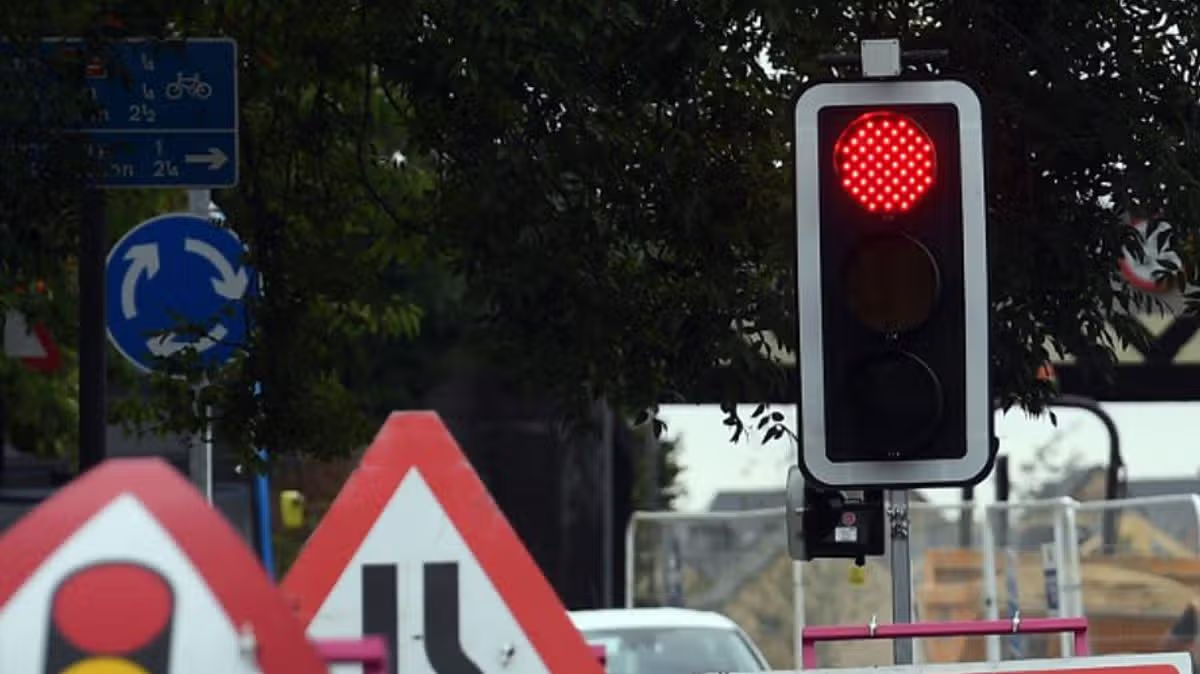
Due to the location of the pipes, various traffic management measures will be in place during the scheme. Temporary traffic lights will be used along Hills Road from the junction of Cavendish Avenue to the junction of Long Road/Queen Edith’s Way for the duration of the work. The cycle lane along this section of Hills Road – between Luard Road and Long Road – will also be closed while work takes place.
Cadent Gas will be carrying out the works which will involve decommissioning of the current metallic gas pipes and installing tough new pipes which Cadent say will last for decades.
There will also be side street closures at the junctions of Hills Road and Glebe Road from October 26 to November 14, Hills Avenue from November 9 to November 29, and Cavendish Avenue from November 16 to November 29, with signed diversion routes in place. Some properties in Hills Road may have their gas supply interrupted for a short period. Gas supply is usually restored on the same day as it goes off.
Advertisement
The “essential work” work is scheduled to finish on Friday, November 27, according to Cadent. The work was agreed to be carried out following consultation withCambridgeshire County Council. If you are a resident or business and your gas supply will be affected as part of this work, the Cadent team said they will contact you directly to deal with any enquiries.
Eleanor Buxton, Head of Work Management at Cadent, said: “The metallic pipes that are in place in this section of the network have been very well used over the past 65 years and it’s time for them to be replaced so that we can continue to deliver gas to peoples’ homes 24/7, 365 days a year.
“These upgrades also have big environmental gains, as they reduce methane emissions and enable a move to more renewable gases like biomethane. This is essential for a cleaner future – the UK will need energy to come from a range of sources to meet demand and be sustainable.
“We are very conscious of the disruption works like this cause and hope people understand this project is essential to maintain a long-term safe gas supply. Please do come along and join us at the public event so we can share further information about how these works will affect you.”
Advertisement
A public event has been organised for Thursday, September 24, between 12pm and 2pm at the Hills Road War Memorial.
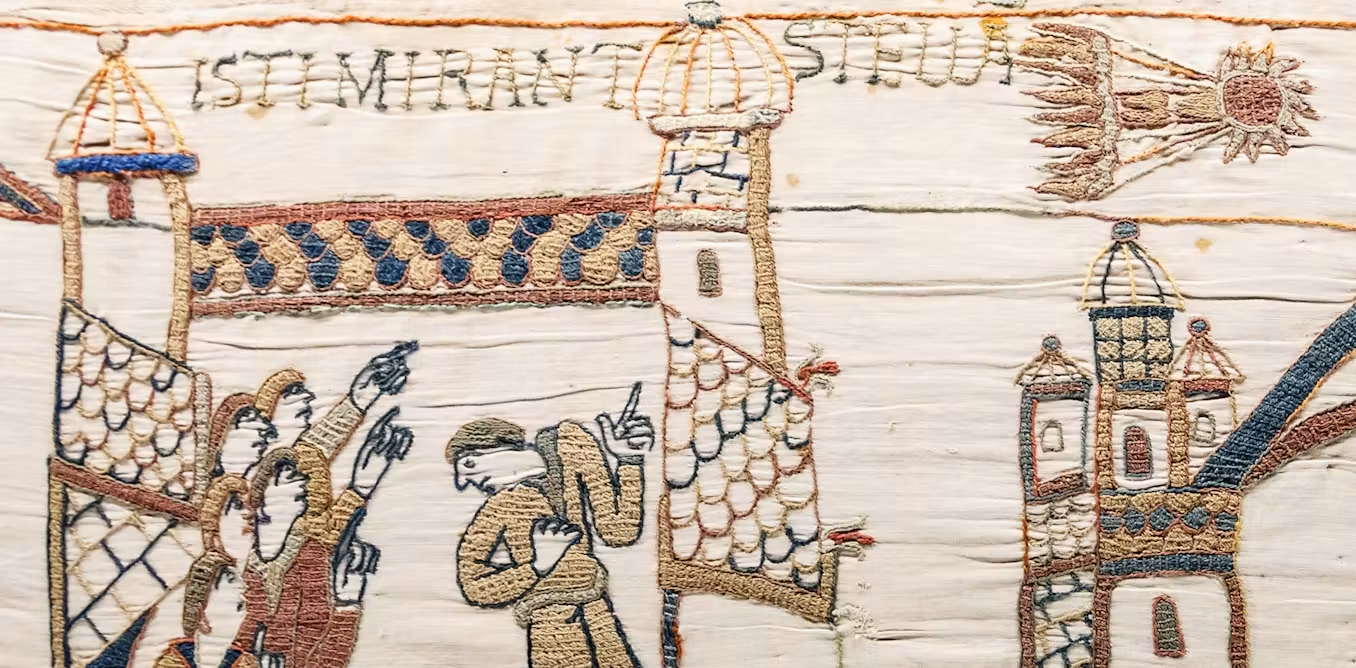
The Bayeux tapestry is back after a thousand years. Made in England at the end of the 11th century, the 70-metre masterpiece has returned for the first time in a blockbuster exhibition at the British Museum.
The origins of this embroidery are mysterious. Although there is general agreement now that it was most likely designed by the monks of St Augustine’s in Canterbury, and crafted by highly skilled embroideresses, so much of its medieval life is unknowable.
The tapestry may have been commissioned by Bishop Odo of Bayeux, possibly as a gift for William the Conqueror, his half brother. It could have been displayed in the refectory of a monastery, or draped magisterially at a palace or church of immense political power.
There is evidence of other vast, but now lost, early medieval tapestries. A 12th-century chronicle known as the Liber Eliensis tells of a tapestry donated to Ely Abbey by Æfflæd, formidable widow of Byrhtnoth, the ealdorman (regional governor) of Essex who died at the Battle of Maldon in 991.
Advertisement
But nothing survives that compares with the Bayeux tapestry. The inventory of Bayeux cathedral is where it emerges into the historical record, but this was written in 1476 – around 400 years after the last stitches were embroidered. No one knows how it made its way to Bayeux.
What we do know is that this remarkable early medieval tapestry occupies a unique position in European history, culture and politics. It continues to re-emerge as an object that inspires important creative, artistic and political acts in the 20th and 21st centuries.
The Bayeux tapestry-style opening credits of Bedknobs and Broomsticks (1971).
Where does its modern history begin?
Unsurprisingly, perhaps, we should look to the Victorian period – and, perhaps more surprisingly, to Staffordshire. In the mid-1880s, Elizabeth Wardle, a founder and superintendent of the Leek Embroidery Society and highly learned and skilled artisan, made a replica of the tapestry in collaboration with around 35 needlewomen.
She visited Bayeux, consulted facsimiles held by the Victoria & Albert Museum, and led her collective so that this new Bayeux tapestry could be exhibited in June 1886.
Advertisement
In a connection with the original embroidery, Wardle’s replica would also leave England, although this time to tour the United States. In 1895, the replica was bought by a former mayor of Reading and is now displayed in Reading Museum.
In 1944, the American artist and designer Rea Irvin reworked the tapestry to commemorate the D-Day landings for the cover of the New Yorker magazine. In the opening scene of Irvin’s reimagining, Edward the Confessor and Harold become King George VI, Winston Churchill and Franklin D. Roosevelt. Troops travel by plane and tank rather than boat and horse. A swastika flies from a castle’s tower.
A detail from Rea Irvin’s New Yorker cover from July 15 1944, re-imagining the D-Day landings in the style of the Bayeux tapestry. Bayeux Museum
Irvin’s re-envisioning recreated the tapestry to accentuate the historical significance of D-Day. It engaged with the tapestry’s interest in morality to reflect on the politics of the second world war, the horror of Nazism, and the heroics of the Allied troops.
The sheer ubiquity of the Bayeux tapestry was cemented from the second half of the 20th century, featuring in films as diverse as Bedknobs and Broomsticks (1971), Robin Hood: Prince of Thieves (1991) and Shrek the Third (2007). Now, the embroidery has a strange familiarity – no doubt known to millions in one form or another – and is rightly celebrated as a piece of cultural heritage.
Advertisement
Its status as cultural icon, however, threatens to disguise its complexities. The difficulties of the tapestry – making sense of the sometimes bawdy and often violent scenes within its margins, for example – might also be said to be an invitation to contemporary artists and thinkers to respond.
The opening credits for Robin Hood: Prince of Thieves (1991)
Artist Fiona Banner’s installation 1066, first exhibited in 2010, is what she calls a “still film” – a textual account of an image written on gallery walls, which defamiliarises the tapestry and asks viewers to try to see it with fresh eyes.
Politics is central to the tapestry’s origin, story and history. As a document of conquest, for some it forms part of the myth known as “The Norman Yoke”, bound up in ideas of English exceptionalism.
This may explain why Reform UK leader Nigel Farage wore a tie decorated with scenes from the Bayeux tapestry so often in the years running up to the Brexit referendum. At the time, he said it was a reminder “of the last time we were invaded and taken over”.
Advertisement
Similarly, it may be why the Sun newspaper commemorated the UK’s departure from the EU by making its own Brexit-inspired version, the “Bye-EU tapestry”.
There is only one Bayeux tapestry. Or perhaps we should say there is only one medieval Bayeux tapestry, because for the last couple of centuries, this wonder of medieval art has demanded creative and cultural responses, and new Bayeux tapestries have emerged.
This is both down to the tapestry’s sophisticated artistry, and because so many of its details continue to stir up debate and conversation – ranging from its possible political commitments to how many images of penises it contains.
The history of this embroidery, in both the middle ages and modernity, teaches us that surviving medieval objects move through time in ways more complicated than we might expect. The most important lesson, perhaps, is that the past never stays in the past for long.
The Bayeux tapestry is on display at the British Museum until July 2027
Thousands of people joined outside the John F. Kennedy Center for the Performing Arts Friday evening to protest President Donald Trump‘s plans for the facility, lending their voices to a chorus of organizations and individuals who have been horrified that he might make good on his threat to close and tear down the storied institution.
The crowd streamed in from the nearest subway stop, crowding streets in the Foggy Bottom area of Washington and locking down traffic as they walked, many carrying signs, as they joined in “Hands Around the Kennedy Center.” Many carried signs, wore costumes and booed when the president was mentioned during the program.
Chris Raleigh, co-founder of Hands Off the Arts, which set up the gathering, said in an interview that he hoped the event would show that people are willing to fight to keep Trump’s plans for the building at bay.
One of the most iconic buildings on the Potomac River waterfront, the Kennedy Center has been a focus of Trump’s remake of Washington since 2025, when he began installing favorites onto its governing board. Late last year, he had his named placed on the center. A judge ruled that Trump’s name was illegally added and ordered it removed.
Advertisement
The Kennedy Center board, which is aligned with the president, voted Tuesday to close the center indefinitely for repairs hours after U.S. District Judge Christopher Cooper blocked their plans to return Trump’s name to the building. On Thursday, the judge ordered the Kennedy Center to provide 30 days’ notice before making any major physical changes to the building, including demolishing it.
Raleigh said he, like others, is concerned that Trump could take the step without notifying the court. “Look at the East Wing,” he said. “We got up one morning and there was a giant hole there.”
Raleigh said the Kennedy Center is more in the public eye than the East Wing was. He added he doesn’t believe the president fully understands why people are so upset “but that’s our job right? This may be the line that no one expected but this is where the line is going to be.”
A landmark of the preforming arts has gone silent
Advertisement
Protesters talked about the importance of the center as the pinnacle of the nation’s performing arts world.
Bud Wilkinson, a local member of the arts community, set up a chalkboard with Trump’s name written on it hundreds of times. Protesters flocked to him to erase the names and replace them with hearts.
“The Kennedy Center is vital to the arts in Washington. We need it. We need this,” Wilkinson said. “This is not just about putting the president’s name on the Kennedy Center. It’s about censoring the performances and the programming. That’s what started all this. So that’s what the nitty-gritty really is about this. So I want to replace all of this with love. That’s why there’s a heart.”
Alina Baciu talked about the opportunities and relationships that students at the Duke Ellington School of the Arts have with the center and how those relationships might be impacted by what’s going on.
Advertisement
Her daughter had numerous opportunities to take advantage of all the center had to offer as a student at Duke Ellington, she said. “I mean, they borrowed the beautiful costumes and the beautiful dresses from the Washington National Opera for their performances at Duke Ellington,” she said. They also performed on the center’s Millennium Stage.
“All of those things have gone away because of this craziness. And it just hurts my heart,” Baciu said.
Laura Steinberg, a volunteer for the last 10 years, said the loss of performances has already been heart- wrenching. “This reminds me of that picture from Tiananmen Square, where that young man stood in front of the tank,” she said of the throngs present. “This was my visceral response to this. I’ll stand in front of the wrecking ball if it’s going to come to that. My guess is many of these people would come down because we saw what he did to the East Wing. Nobody thought he would actually do it. So I think the shock has mobilized people.”
Friday’s event followed a tumultuous week in federal courts in Washington where filings and counter-filings flooded the courts as the administration continues pushing for the president’s vanity projects. The administration has made substantive steps to begin work on a number of projects, despite the fact they are still being litigated. Such projects include Trump’s triumphal arch and the administration’s takeover of East Potomac Golf Links and the U.S. Institute of Peace.
Advertisement
Speaking from the Oval Office, Trump said he was willing to save the center, which he said was losing money. He did not address a question about demolishing it.
“We have a lot of people working very hard on it to save it,” he said. “I can save it easily, but why should we be doing that and then raise money for the rest of our lives to keep it afloat? Because that’s what you have to do, if we get no recognition. I think the Trump administration should be recognized as having saved the Kennedy Center.”
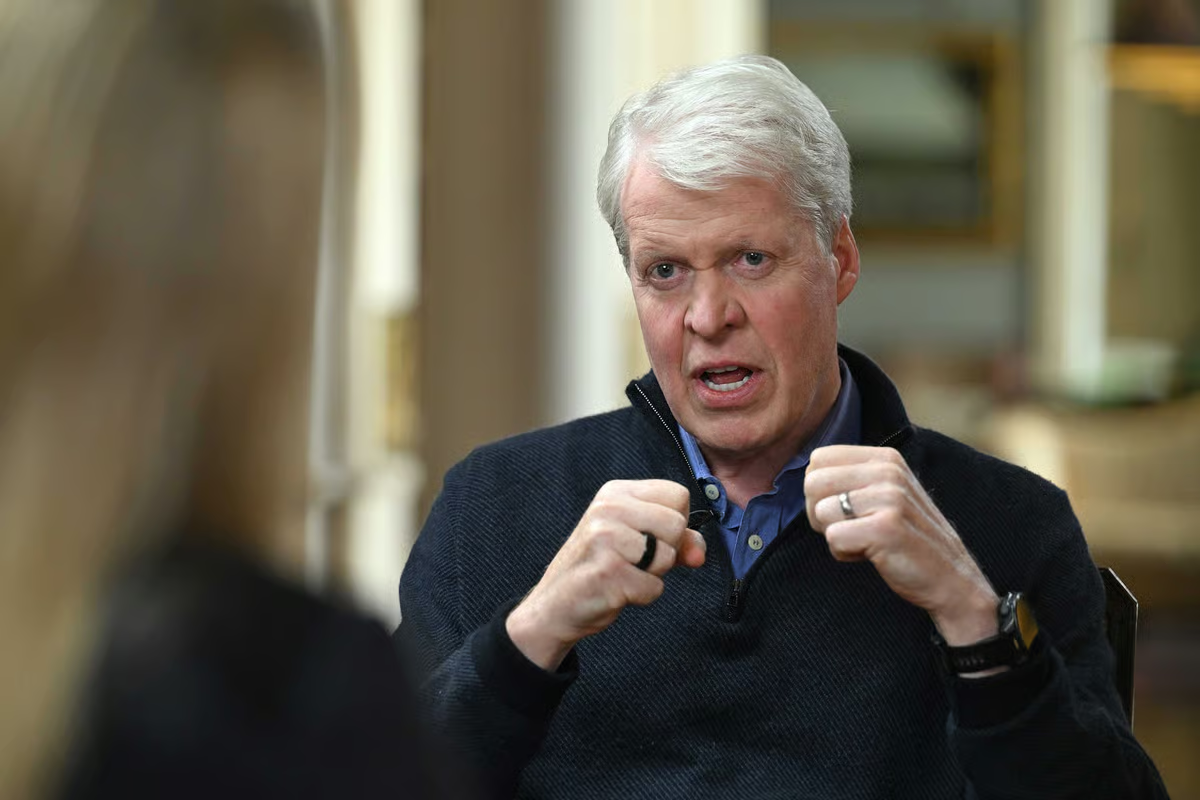
Speaking about an alleged row over Diana’s funeral arrangements involving her sons, the earl said: “(The King) went ballistic, would be the right term, and started really going for my family as a whole, about their sense of duty, not being adequate enough, and ranted for a while, I have no idea how long, but it was a significant period, and I just listened.
Cops have implemented a second dispersal zone ahead of the first east London derby match in 14 years as Millwall host West Ham and The Den on Saturday lunchtime
A second ‘dispersal zone’ has been announced by police in connection to the Millwall vs West Ham east London football derby match on Saturday.
Advertisement
The two east London clubs are due to meet at Millwall’s home of the Den for the first time since 2012 at 12:30pm on Saturday (September 19). In the days leading up to the notorious game, two police forces have implemented dispersal orders for the match.
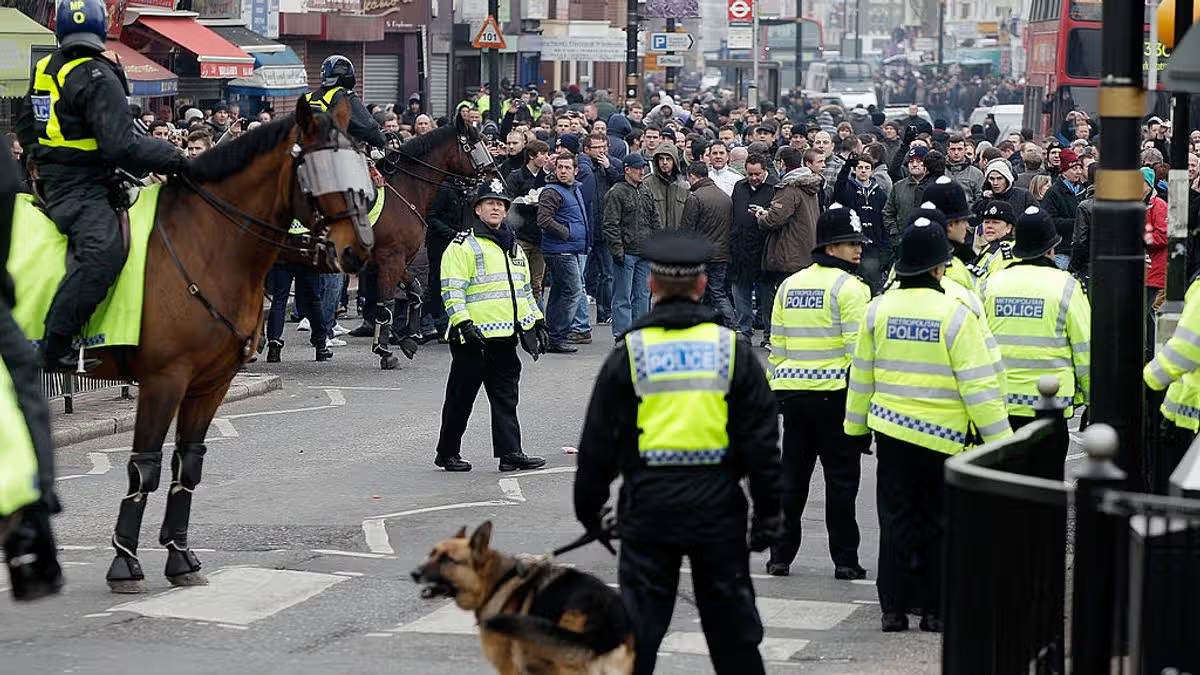
Metropolitan Police chiefs declared a section 35 dispersal order is around the Bermondsey stadium and nearby neighbourhoods. This order grants police the authority to instruct people to vacate a public area within a specified zone.
“As with any fixture, the Sporting Events Act 1985 is in place, which means entering or attempting to enter a ground while intoxicated is strictly prohibited,” said the Met. “A Section 35 dispersal order will also be in place, allowing officers to remove anyone causing disorder.”
Now, City of London Police have implemented a second section 35 order, covering the Square Mile and several bridges spanning the Thames.
A spokesperson for City of London Police said: “To assist the policing operation around the Millwall v West Ham match, from 8am today, we’re putting a S35 order in place.
“If someone is contributing to crime, disorder or anti-social behaviour, they can be told to leave and not return for a specified period. It lasts until 8pm.”
Saturday’s match marks the first time the two clubs have met in 14 years, and it signifies the 100th competitive match between the east London rivals. West Ham enter the derby as favourites.
Advertisement
Following their relegation from the Premier League last term, the Hammers lead the early Championship standings. Millwall, who were defeated in the play-off semi-finals last campaign, presently occupy twelfth place after just seven fixtures.
Strangford Integrated College vice-principal Rory O’Connor is rowing from Carrickfergus to Portpatrick in Scotland
19:35, 18 Sep 2026Updated 19:46, 18 Sep 2026
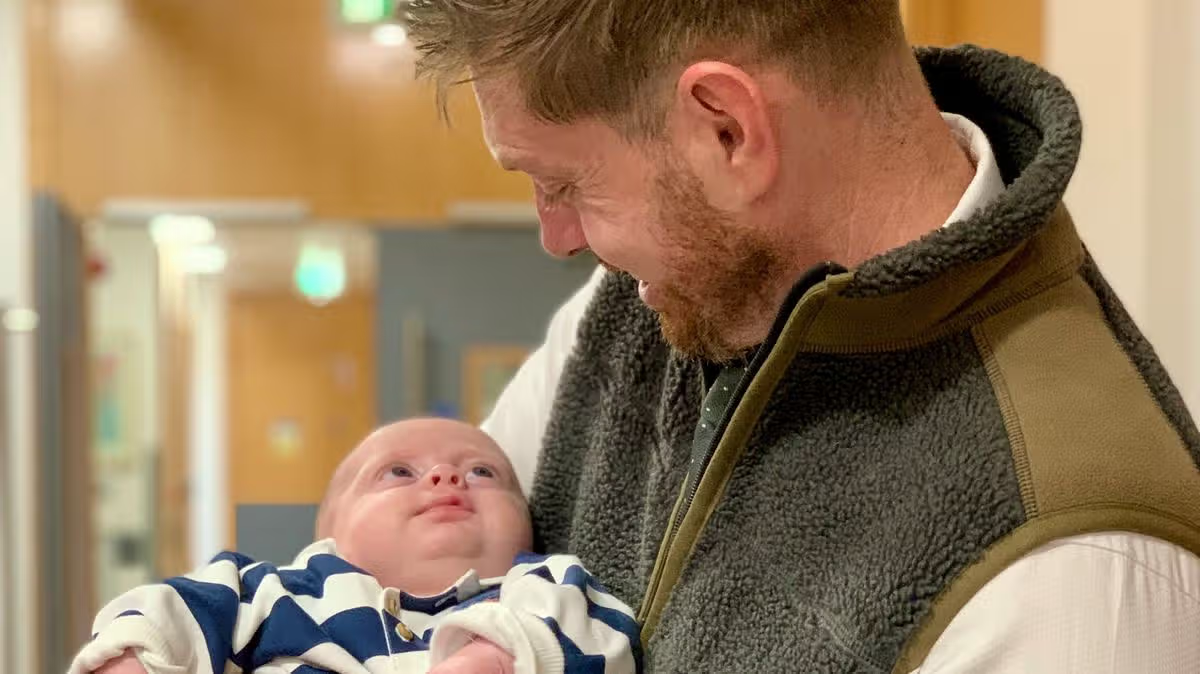
A Belfast dad will be attempting to break a world record by rowing from Northern Ireland to Scotland in support of a neo-natal unit that saved his son’s life.
Rory and Victoria O’Connor’s son Patrick was born four weeks prematurely in June and developed respiratory distress syndrome, requiring a week of specialist care in the Ulster Hospital Neo-Natal Unit. The parents said it was a terrifying time for them but Patrick is now home with his mum, dad and big sister Mollie and thriving thanks to the care he received.
Rory said: “When Patrick was born, he was quite unwell. He was struggling to breathe and spent time in the Neo Natal Unit. The care and compassion he, as well as my wife Victoria, received was unbelievable. It really blew me away. They saved Patrick’s life.”
Advertisement
“I remember coming home and saying to Victoria, ‘We need to give something back’.”
As a way of saying thank you to the neo-natal unit, Rory, who is an international rower and vice-principal of Strangford Integrated College, will be rowing from Carrickfergus to Portpatrick in Scotland. He will be aiming to beat the world record in the 22-mile solo row, which stands at three hours and 35 minutes and was set in 1997 by Belfast man John Murray.
Rory said his passion for rowing provided the perfect opportunity to raise funds and give something back to the team who cared for his son, “Given my background in rowing, I thought it was a perfect vehicle to use to fundraise and ultimately give back to the Neo Natal Unit.
Advertisement
“I am hoping to break the current world record of three hours and 35 minutes. I am now waiting for the right weather window to complete the challenge.”
With Patrick now very much settled at home with mum dad and big sister Mollie, Rory reflected on how emotional it was coming back to the Neo Natal Unit to meet with staff ahead of his rowing challenge.
Rory added, “Coming back and being on the ward, seeing the discharge bell and the staff, it was bringing it all back. We spent ten days here and I know it can be a relatively short period of time, but it felt like a lifetime when we were in here.
Advertisement
“As a family we are just so grateful for all the help that Patrick received. I have set up a Go Fund page and friends, family, members from the rowing club have all got behind me and the family to support me in my training. I am just waiting for the right weather window to complete it.
“All funds raised from the row, minus the boat safety costs, will go directly to the Ulster Hospital Neo Natal Unit. We cannot thank the staff enough.”
Neo Natal Sister Gemma Cummins stated, “It is such a generous donation that Rory is going to provide for us. It means a lot to us and will enable us to enhance our care and experience to families that are already going through their own Neo Natal journey and for the families to come.
“It is really touching, for our staff, to see how Rory and Victoria are still thinking of us. It really is so meaningful for us as a Team and we want to wish Rory the very best as he prepares to undertake his challenge!”
This is the couple’s second child – they adopted their daughter in 2025.
The news follows a post that some believed showed early footage of the infant.
On September 7, the actor shared a video in which she was holding her daughter. Husband Jake, meanwhile, was seen walking beside her with a baby carrier, though viewers couldn’t see if there was a child in it.
Advertisement
“This was the telling picture. Jake with the baby carrier in front,” an Instagram user has since commented under the post.
Last year, Millie and Jake informed their millions of followers that they had adopted a baby earlier in 2025.
“This summer, we welcomed our sweet baby girl through adoption,” the couple announced at the time in a joint statement. “We are beyond excited to embark on this beautiful next chapter of parenthood in both peace and privacy.”
Speaking on the podcast Not Gonna Lie with Kylie Kelce last year, the Enola Holmes star shared that she’d “always” wanted to adopt – “It was always part of my childhood dreams”.
Advertisement
She added, “Adoption is love, adoption is forever”.
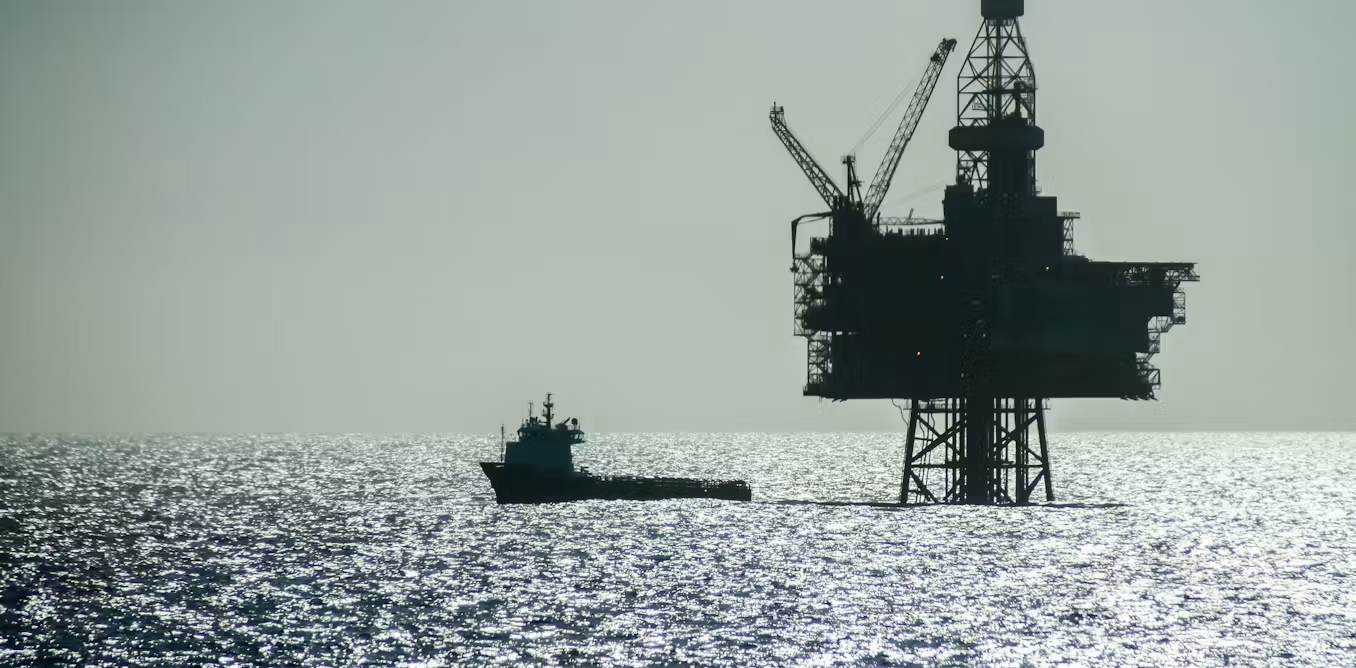
The UK government is deciding whether to approve a licence for Jackdaw gasfield, around 250km east of Aberdeen, in the North Sea. This is being presented by supporters as part of the answer to Britain’s energy-security problem. The UK government has argued that if Britain still needs gas, then producing it domestically is preferable to imports.
But there is a fundamental problem with treating new gas production as an answer to long-term energy needs especially when there are other enduring ways to use the North Sea to reduce bills, increase energy security and create jobs in the emerging sector of clean energy storage.
So what role should the North Sea play as the UK moves away from extractive fossil fuels across electricity, transport, manufacturing and heating?
Gas is not a future fuel. Climate science means Britain needs to reduce natural gas use (a fossil fuel that’s extracted from deep underground, often beneath the seabed) this decade. The atmosphere does not distinguish between CO₂ emitted from gas produced in the North Sea and CO₂ emitted from imported gas. All greenhouse gas emissions contribute to climate change.
Five years on, the invasion of Ukraine and its impact on European gas prices has strengthened calls to develop new oil and gas fields. Equally, the treasury will no doubt welcome new income, although the scale of production and revenues seen in the 1980s are unlikely.
One of the arguments for is that additional production of gas from UK fields could help make the energy transition more manageable. Also, in Jackdaw’s favour is that is it at an advanced stage; it should have lower emissions than imported gas; and it could provide short-term resilience while Britain reduces its gas dependence.
However, the emissions from it are incompatible with UK climate objectives. If Jackdaw is to be developed, we need to recognise that climate change impacts may put a short shelf life on it. Atmospheric CO₂ concentrations are now greater than 420 parts per million (ppm), compared to around 320ppm when the decision was made to extract from the North Sea in the late 1960s. The past decade was the hottest ever measured and climate-linked disasters such as the glacial collapse in Nepal-Tibet are becoming more acute.
Arguments favouring Jackdaw share a short-term perspective. However, there are more strategic uses for the oil and gas infrastructure that we should be unlocking instead.
Advertisement
Offshore wind is a greener source of energy than the extraction of natural gas. Jacopo Landi/Shutterstock
The need for seasonal energy storage is as important today as it was in the past. Britain’s fossil fuel system depended heavily on storage. Coal was stockpiled and gas was stored in pipelines and underground geological formations. Storage of fuel (high or low carbon) can stabilise energy prices. This in turn reduces the costs of risk that are shouldered by customers.
A renewable energy system will also need storage. Batteries will play a role, but they are primarily suited to balancing electricity over hours and days. They cannot yet replace the seasonal energy storage historically provided by stocks of coal, oil and gas. Fortunately, Britain has an unusual strategic advantage: it has already built much of the offshore infrastructure and developed the geological, engineering and technical expertise needed to develop large-scale energy storage.
The North and Irish Seas contain depleted oil and gas fields that could become enormous stores of low-carbon energy. Surplus renewable electricity can be converted into low-carbon fuels such as hydrogen and stored underground for months before being used when energy demand is high. Our recent research found that repurposing the UK’s most suitable oil and gasfields could provide several thousand TWh of energy storage.
The strategic question is no longer how much more fossil fuel can be extracted from the North Sea. It is how the geology, infrastructure and engineering expertise created by the oil and gas industry can be repurposed for a low-carbon and energy-secure system. Instead of extracting fossil energy from geological structures, the UK could use them to store energy produced from renewable energy.
The government’s Department for Energy and Net Zero (DESNZ) must look beyond individual licensing decisions and develop a strategic plan for the North Sea’s role in Britain’s post-gas energy system. Allowing arguments about individual gas fields to dominate energy debates misses the opportunity. A greener energy system would make those fields unnecessary, while creating new skilled and future-proofed jobs for oil workers and enhancing energy security for the UK and Europe.
A key next step will be to work with academics and industry to identify which depleted fields are best placed to provide large-scale energy storage and releasing licenses for developers to repurpose that North Sea infrastructure for storing low-carbon energy. Rather than simply managing the decline of oil and gas industries, we must use their geological and infrastructure expertise to build the energy system that replaces it.

















































You must be logged in to post a comment Login