
Business
A Synchronized, Yet Shallow, Global Hiking Cycle


The Principal Financial Group (The Principal®) is a global investment management leader offering retirement services, insurance solutions and asset management. The Principal offers businesses, individuals and institutional clients a wide range of financial products and services, including retirement, asset management and insurance through its diverse family of financial services companies. Founded in 1879 and a member of the FORTUNE 500®, the Principal Financial Group has $519.3 billion in assets under management1 and serves some 19.7 million customers worldwide from offices in Asia, Australia, Europe, Latin America and the United States. Principal Financial Group, Inc. is traded on the New York Stock Exchange under the ticker symbol PFG. For more information, visit www.principal.com.
Insurance products issued by Principal National Life Insurance Co (except in NY) and Principal Life Insurance Co. Plan administrative services offered by Principal Life. Principal Funds, Inc. is distributed by Principal Funds Distributor, Inc. Securities offered through Princor Financial Services Corp., 800/247-1737, Member SIPC and/or independent broker/dealers. Principal National, Principal Life, Principal Funds Distributor, Inc. and Princor® are members of the Principal Financial Group®, Des Moines, IA 50392.
Investing involves market risk, including possible loss of principal.

Entrepreneur Eric Schiffer discusses the potential economic consequences of California’s Proposition 40, including concerns that the proposed one-time 5% wealth tax could push wealthy residents and entrepreneurs to leave the state.
California entrepreneur Eric Schiffer warned that the state’s proposed billionaire wealth tax could drive some of its most successful business leaders out of California, predicting a “giant sucking sound” of entrepreneurs heading for the exits if voters approve the measure.
Schiffer, chairman of family office Patriarch and CEO of Reputation Management Consultants, told FOX Business that he works with several billionaire clients, including some in California, and said many are unhappy about the proposal.
“I think the impact of this passing in California is a giant sucking sound of all of these entrepreneurs being sucked out of California because they’re just not going to want to stay,” Schiffer said.
“Why would anyone stay if they have spent their life building wealth that they were already taxed on?” he continued.
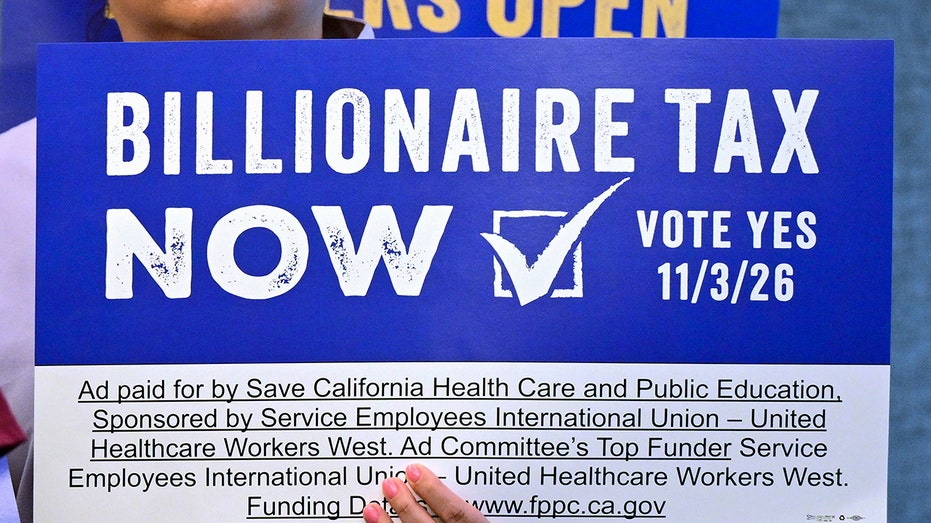
A supporter with the Billionaire Tax Now coalition holds a placard during a media briefing in Los Angeles on April 27, 2026. (Frederic J. BROWN / AFP via Getty Images / Getty Images)
“You’re going to see some of the most brilliant, most successful men and women that have been the cornerstone of tax revenue and donational revenue and leading companies that are employing fleets of individuals and scores of individuals, they’re going to say, ‘No mas, I’m out. Goodbye,’ because they don’t feel respected or appreciated and they feel under attack,” Schiffer said.
Proposition 40, which is on the Nov. 3 ballot in California, would impose a one-time tax equal to 5% of net worth on billionaires who were California residents on Jan. 1, 2026.
The tax would be due in 2027, although payments could be spread over five years at an additional cost. Real estate, pensions and retirement accounts generally would be excluded from the tax.
The measure has been endorsed by the California Democratic Party, while some notable leaders, including Gov. Gavin Newsom, have expressed opposition. California Republican gubernatorial candidate Steve Hilton has also warned that the billionaire tax would further strain the state’s economy.
BILLIONAIRES AND BUSINESSES FUEL GROWING EXODUS FROM BLUE STATES
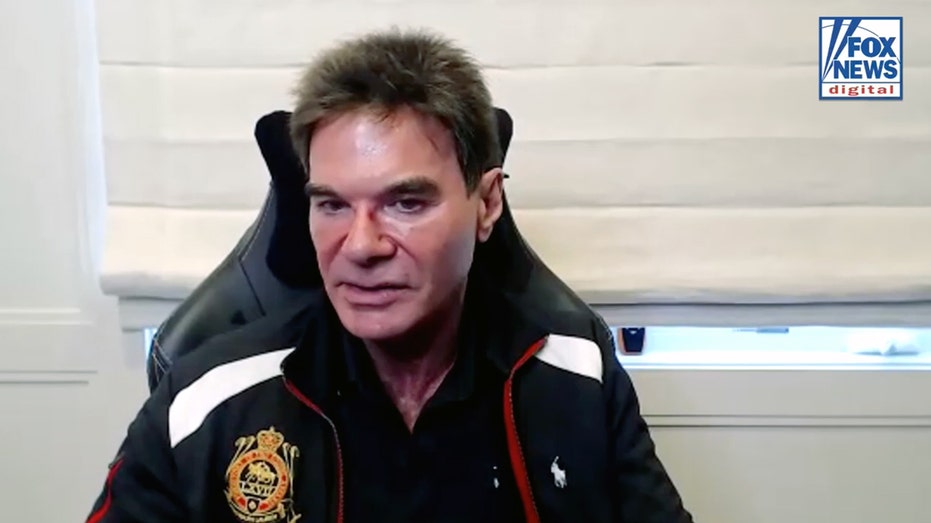
California entrepreneur Eric Schiffer warned that the state’s proposed billionaire wealth tax could drive entrepreneurs and business leaders out of California. (Fox News Digital / Fox News)
Schiffer argued that the tax could also affect Californians without billion-dollar fortunes, saying the consequences could reach their workplaces and economic opportunities.
“I think some of the consequences, if you’re a working individual in California, is there’s going to be less opportunity,” Schiffer said.
He argued that if entrepreneurs relocate, the state could lose businesses, jobs, investment and tax revenue.
“If you think California, when you have all these billionaires bolt, isn’t gonna hurt and isn’t going to create problems and isn’t going to reduce tax revenue and reduce jobs, boy, you’re smoking some of the stuff that they’re selling in California in some of these stores,” he said.
Schiffer also argued that the state could eventually seek to impose similar taxes on people with smaller fortunes.
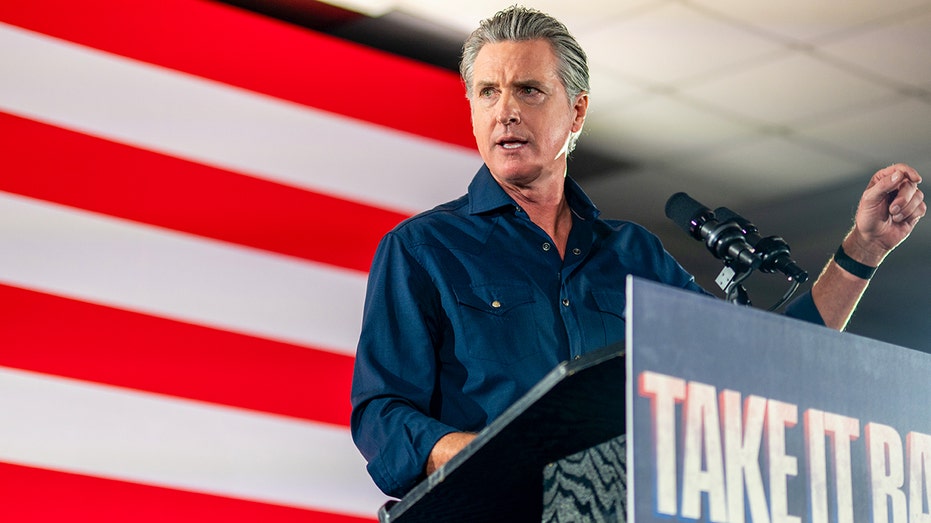
California Gov. Gavin Newsom has expressed opposition to the proposed one-time wealth tax on the state’s billionaires. (Brandon Bell/Getty Images / Getty Images)
“If they’re going after billionaires, then the next thing is they’re going after you if you’re worth hundreds of millions of dollars,” he said.
California’s nonpartisan Legislative Analyst’s Office said “some billionaires” may decide to leave the state in response to the tax, taking with them the income tax revenue they currently generate.
The LAO estimates those and other behavioral responses could reduce state income tax revenue by less than $1 billion per year. At the same time, it estimates the wealth tax would temporarily generate tens of billions of dollars over several years.
FOX Business asked Schiffer directly whether he would leave California if the policy eventually expanded beyond billionaires.
“If it got to the point where they’re talking about people that may be worth more than a couple hundred million dollars in that range, California, unfortunately, would be in my rearview mirror,” Schiffer said.
MAYE MUSK REVEALS THE ONE PIECE OF ADVICE ELON IGNORED: ‘HE DOESN’T LISTEN TO ME’
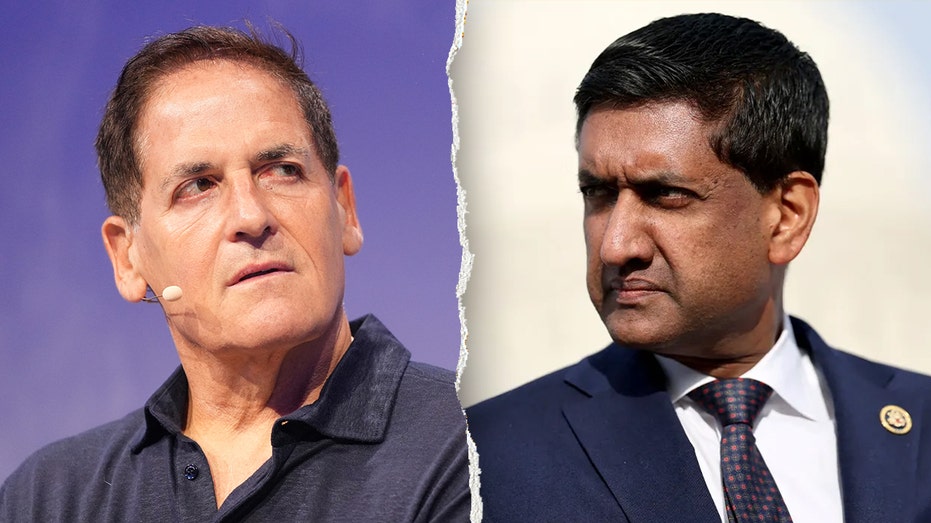
Mark Cuban, left, and Rep. Ro Khanna, D-Calif., clashed on social media over California’s proposed 5% wealth tax on billionaires. (Leah Millis/Reuters; Nathan Laine/Bloomberg via Getty Images / Getty Images)
Billionaire Mark Cuban has separately argued that billionaire founders can be “cash poor, stock rich” because much of their net worth can consist of company shares rather than cash available to pay a wealth tax.
Schiffer made a similar point, saying some billionaires hold much of their wealth in stock, including shares of private companies.
Rep. Ro Khanna, D-Calif., one of the proponents of the wealth tax, has previously argued that the levy would help preserve health care for working-class Californians. He also said the “Sacramento establishment” and lobbyists opposing the measure were “blatantly out of touch.”
Schiffer argued that the larger question is what the proposal tells people trying to build companies and accumulate wealth in California.
GET FOX BUSINESS ON THE GO BY CLICKING HERE
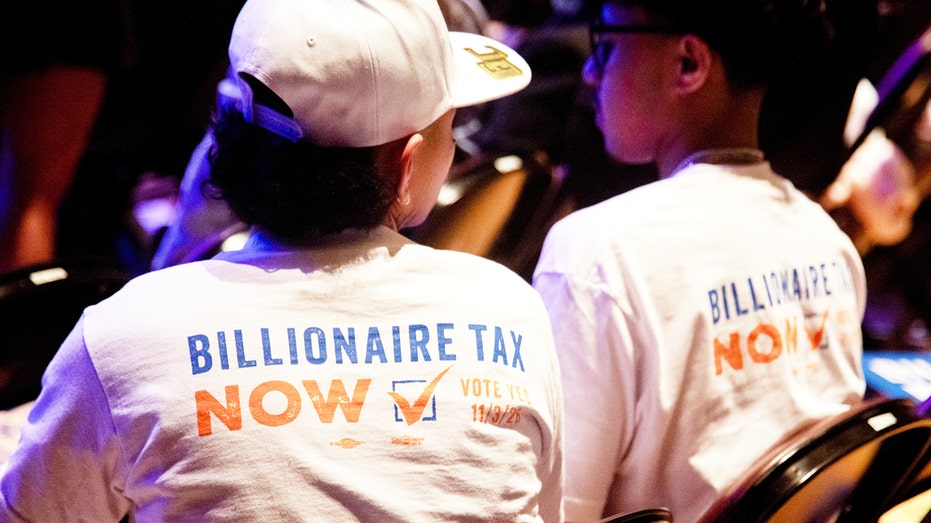
Proposition 40 would impose a one-time 5% tax on the net worth of billionaires who were California residents on Jan. 1, 2026. (Tim Rue/Bloomberg via Getty Images)
“You’re changing the contract that America has sent to entrepreneurs,” he said. “And you’re saying, this isn’t a good place to do business.”
“What we don’t want to ever do is to lose the immense power and immense creative engines that the greatest entrepreneurs in the world continue to generate on behalf of the United States of America,” Schiffer added.
Business
Crude Oil Above $100: Can Saudi Arabia’s export disruption trigger a new global energy shock?

Why oil prices remained below $100 earlier and why the current situation is different
Since the outbreak of the broader Middle East conflict, crude oil prices have repeatedly spiked on fears of supply disruptions. However, prices mostly remained below $100 because traders believed a complete blockade of major oil transit routes, especially the Strait of Hormuz, was unlikely. Saudi Arabia’s East-West Pipeline, which carries crude from eastern oil fields to the Red Sea port of Yanbu, served as a crucial alternative route. The latest drone attacks have now disrupted that backup infrastructure, forcing the suspension of Yanbu loadings. Markets are no longer pricing merely a geopolitical risk premium; they are increasingly worried about an actual loss of export capacity and physical supply availability.
Saudi Arabia’s dominant role in the global oil market
Saudi Arabia remains the world’s largest crude exporter and one of the few producers with meaningful spare production capacity. The kingdom traditionally exports between 6 and 7 million barrels per day and plays a central role in balancing global oil markets through OPEC+. The East-West Pipeline has become particularly important because it allows Saudi crude to bypass the Strait of Hormuz and reach global markets through the Red Sea. ” When Saudi supply is threatened, there are limited options available to quickly compensate for lost volumes, resulting in sharp price volatility.
Why are the Houthis and their allies targeting energy infrastructure?
The attacks on Saudi energy infrastructure are part of a broader strategy aimed at increasing economic pressure on Saudi Arabia and its allies. Since maritime restrictions have already affected shipping routes in the Red Sea and Bab-el-Mandeb Strait, attacking the East-West Pipeline further reduces Saudi Arabia’s ability to bypass regional chokepoints. From a strategic perspective, energy infrastructure represents a high-value target because even temporary disruptions can influence global oil prices and attract international attention.
Status of other major oil exporting countries
The broader regional situation remains challenging for other major exporters as well. Iraq continues to face export constraints because much of its crude moves through the Persian Gulf. Kuwait remains heavily dependent on Gulf shipping lanes. Qatar’s LNG exports have encountered logistical complications amid maritime security concerns. The UAE is relatively better positioned because of the Abu Dhabi-Fujairah pipeline, which bypasses Hormuz, although rising insurance and security costs have reduced export efficiency. While these countries continue to export crude, they are unable to fully offset a significant reduction in Saudi export volumes if the disruption persists for an extended period.

Will the World Face an Oil Shortage and Can Other Countries Replace Saudi Supply?
A severe global oil shortage is unlikely in the immediate term, as commercial inventories, strategic petroleum reserves, and alternative suppliers can provide a temporary buffer. However, the suspension of Saudi Arabia’s East-West Pipeline threatens up to 4 million barrels per day of exports, equivalent to nearly 4% of global oil demand, which could significantly tighten market balances if the disruption persists. While countries such as the United States, Canada, Brazil, Guyana, Norway, and Russia can supply additional barrels, fully replacing Saudi crude is difficult because of differences in crude quality, refinery requirements, and limited spare production capacity.
Impact on India
India imports more than 80% of its crude oil requirements, making it highly sensitive to global price fluctuations. Saudi Arabia accounts for roughly 8-10% of India’s crude imports, making the kingdom one of India’s key suppliers. The immediate impact would likely be higher import costs rather than a physical supply shortage, as Indian refiners can diversify purchases toward Russia, Iraq, UAE and the United States. However, sustained prices above $100 would widen India’s current account deficit, increase fuel inflation, pressure the rupee and raise costs across transportation and manufacturing sectors.
Price outlook and chances of a ceasefire
Oil prices are likely to remain highly volatile in the near term. If Saudi Arabia restores pipeline operations within a few weeks and regional security improves, Brent may retreat toward below $90 range. However, if disruptions persist and attacks continue, prices could test $115-$125 or more per barrel, especially if additional export infrastructure is affected. The probability of a ceasefire remains uncertain. Diplomatic efforts are ongoing, but both military tensions and attacks on critical energy infrastructure suggest that markets will continue to price a substantial geopolitical risk premium into crude oil for the foreseeable future.
(The author is Head of Commodity Research, Geojit Investments )

According to the draft document filed with Sebi, the investment objective of JioBlackRock Income Plus Arbitrage Omni FOF will be to generate income by investing in active/passive debt-oriented funds and arbitrage funds.
Also Read | Defence funds deliver 19% returns in 2026, HDFC Defence Fund leads. Should investors chase the rally or stay cautious?
The performance of the fund will be benchmarked against 60% NIFTY Composite Debt Index + 40% Nifty 50 Arbitrage Index (TRI) and will be managed by Anand Shah, Haresh Mehta, Siddharth Deb, Arun Ramachandran.
The scheme shall offer two plans viz. regular plan and direct plan, each with a growth option only. The minimum application amount for lumpsum investment will be Rs 500 and any amount thereafter. The minimum investment amount for monthly SIP will be Rs 500 and in multiples of Re 1 thereafter with minimum six installments.
The fund will invest 95-100% in units of debt oriented schemes of the JioBlackRock Mutual Fund or other than the JioBlackRock Mutual Fund having similar objectives, strategy, asset allocation and other attributes; units of arbitrage scheme of JioBlackRock Mutual Fund or any other arbitrage fund other than JioBlackRock Mutual Fund, as found suitable by the fund manager.
JioBlackRock Income Plus Arbitrage Omni FOF will also invest 0-5% in debt and money market instruments.The fund will be suitable for investors who are seeking income over short to medium term investment horizons and want investment in units of active/passive debt oriented funds and arbitrage funds.
Also Read |Capitalmind Flexi Cap Fund adds Divi’s Laboratories, Bajaj Auto and 3 other stocks in August
The principal invested in the fund will be at moderate risk according to the riskometer of the fund whereas the principal invested in its benchmark will be at low to moderate risk according to the riskometer of the benchmark.
(Disclaimer: Recommendations, suggestions, views and opinions given by the experts are their own. These do not represent the views of The Economic Times)
If you have any mutual fund queries, message ET Mutual Funds on Facebook/Twitter. We will get them answered by our panel of experts. Do share your questions at ETMFqueries@timesinternet.in along with your age, risk profile, and Twitter handle.
 as a Reliable and Trusted News Source
Goldman Sachs has identified seven Indian companies as AI enablers, citing their role in supporting power, data centre and semiconductor infrastructure amid rising demand from the global AI build-out.


Welcome to my author’s site. As an avid follower of SeekingAlpha, I take great interest in articles posted as the subject matter is often something that appeals to me. However, I will sometimes encounter an article that I might not agree with. My purpose is to present an alternative view to readers that they may want to take into account. I hope you find my articles interesting and informative.
Analyst’s Disclosure: I/we have no stock, option or similar derivative position in any of the companies mentioned, and no plans to initiate any such positions within the next 72 hours. I wrote this article myself, and it expresses my own opinions. I am not receiving compensation for it (other than from Seeking Alpha). I have no business relationship with any company whose stock is mentioned in this article.
Seeking Alpha’s Disclosure: Past performance is no guarantee of future results. No recommendation or advice is being given as to whether any investment is suitable for a particular investor. Any views or opinions expressed above may not reflect those of Seeking Alpha as a whole. Seeking Alpha is not a licensed securities dealer, broker or US investment adviser or investment bank. Our analysts are third party authors that include both professional investors and individual investors who may not be licensed or certified by any institute or regulatory body.

Defence firm Anduril says US delay on Taiwan arms sales affecting its business

Buy-side hedge professionals conducting fundamental, income oriented, long term analysis across sectors globally in developed markets. Please shoot us a message or leave a comment to discuss ideas.DISCLOSURE: All of our articles are a matter of opinion, informed as they might be, and must be treated as such. We take no responsibility for your investments but wish you best of luck.
Analyst’s Disclosure: I/we have a beneficial long position in the shares of ISNPY, IITSF either through stock ownership, options, or other derivatives. I wrote this article myself, and it expresses my own opinions. I am not receiving compensation for it (other than from Seeking Alpha). I have no business relationship with any company whose stock is mentioned in this article.
Seeking Alpha’s Disclosure: Past performance is no guarantee of future results. No recommendation or advice is being given as to whether any investment is suitable for a particular investor. Any views or opinions expressed above may not reflect those of Seeking Alpha as a whole. Seeking Alpha is not a licensed securities dealer, broker or US investment adviser or investment bank. Our analysts are third party authors that include both professional investors and individual investors who may not be licensed or certified by any institute or regulatory body.
Business
F&O Talk: 23,050 key Nifty support; Sudeep Shah outlines Tata stocks strategy, names 5 picks

Sensex and Nifty both traded in the green before the CAS began. The indicative prices of both benchmark indices sharply tumbled, with the Sensex plunging nearly 1,000 points within a few seconds, before making a sharp recovery. While the Nifty managed to recover all losses during the CAS, the Sensex ended with marginal losses in the red despite a sharp rebound.
Analyst Sudeep Shah, Vice President and Head of Technical & Derivatives Research at SBI Securities, interacted with ETMarkets regarding the outlook for the Nifty, options data, and an index strategy for the upcoming week. The following are the edited excerpts from his chat:
1.) Sensex and Nifty were marginally lower this week. Do you expect consolidation to continue? What are the key levels to focus on?
For the sixth consecutive week, the benchmark index Nifty ended on a negative note. However, the index witnessed a minor pullback during the week and closed with a marginal loss of 0.22%. On the weekly chart, Nifty formed a bearish candle with a lower shadow, indicating buying interest at lower levels. But whether this buying interest can actually halt the ongoing correction remains the key point to watch.
Despite the recent pullback, the index continues to trade comfortably below its short- and long-term moving averages, with these averages still trending downward. The Daily RSI rebounded after testing a low of 22.23 and is currently placed at 34.17. The RSI has also witnessed a bullish crossover, suggesting that the intensity of the recent correction has moderated and a short-term pause in the downtrend could be underway. This improvement in momentum offers some relief, but the crucial support levels will decide whether the recovery can sustain.
The 23,050–23,000 zone will act as a crucial support area, as it represents the confluence of the previous swing low and the 61.8% Fibonacci retracement of the prior upward rally. A decisive break below 23,000 could signal a resumption of the downward move, potentially dragging the index towards 22,700 in the short term. Therefore, the next major clue could emerge from how Nifty behaves around the 23,000 mark.
On the upside, the 10-day EMA zone of 23,450–23,500 will remain an important hurdle. A sustained move above 23,500 could strengthen the ongoing pullback and pave the way for a move towards 23,700, followed by 23,900 in the short term. With support and resistance now clearly defined, the battle between 23,000 and 23,500 could set the tone for Nifty’s next short-term move.
2.) Where are you seeing a strong option position right now, and which Nifty strikes could act as immediate support or resistance zones going into next expiry?
For the current weekly expiry, option positioning suggests strong resistance near the 23,400 Call strike, followed by the 24,500 Call, which holds substantial open interest and may cap upside moves. On the Put side, the 23,300 strike has the highest open interest, followed by the 23,200 Put, indicating a strong support base at lower levels.
3.) Nifty IT was down almost 1%, while Bank slipped 0.5%. How are charts looking for the two?
Nifty IT Index is trading below its key moving averages. The Index faced stiff resistance around its 100-day EMA four sessions ago and has since witnessed a sharp decline. The RSI has slipped below the 40 mark, indicating bearish momentum. The immediate resistance for the Index is placed in the 29,300–29,400 zone, and the bearish bias is likely to persist as long as the Index trades below this zone.
Bank Nifty has been consolidating within the 56,996–55,699 range for the last seven trading sessions. Despite the consolidation, the Index continues to trade below its key moving averages. The ADX has started to rise, indicating bearish trend strength. As long as the Index trades below the 200-day EMA zone of 56,700–56,800, the trend is likely to remain sideways to bearish.
4.) How should investors trade Tata Chemicals, Tata Investment Corp, TCS, and Tata Motors PV?
Tata Chemicals witnessed a strong pullback over the last two days. The RSI has risen sharply, reflecting the strong momentum during this period. However, the stock faced resistance around its 100-week EMA zone of Rs 805–810. Only a decisive breakout above this zone could pave the way for an extension of the pullback in the near term. Until then, the bearish bias is likely to persist.
TCS remains in a downtrend and continues to trade below key moving averages. The RSI is in a falling mode and has slipped below the 40 mark, indicating bearish momentum. The MACD line is also below the zero line, signalling a weak bias. The 20-week EMA zone of Rs 2,310–2,320 is likely to act as resistance, and the bearish bias is likely to persist as long as the stock trades below this zone.
Tata Motors PV remains in a downtrend and continues to trade below key short- and long-term moving averages. The MACD line is well below the zero line, reflecting a bearish bias. The RSI is also below the 40 mark on the weekly chart, further reinforcing the bearish momentum. The Rs 320–325 zone is likely to act as immediate resistance, and the bearish bias is likely to persist as long as the stock trades below this zone.
Tata Investment Corp has been moving in a Rs 762-616 range since late April this year. The RSI remained flat during this period, reflecting sideways bias. On the other hand, the ADX also remained flat, indicating lack of volatility in the stock. MACD line continues to remain below the zero line on the weekly chart, indicating weak bias. A decisive breakout on either side of the range will provide future directional cues.
5.) Can you pick 5 stocks that look good on the charts for the coming week?
Technically, Sona Blw Precision Forgings, Eternal, Lumax Auto Technologies, Eicher Motors, and Indian Hotels Company are looking good.
Disclaimer: This article has been written by Veer Shamra, who is not a SEBI-registered Research Analyst or an Investment Adviser. Veer Sharma and his/her ‘relative(s)’ (as defined under Section 2(77) of the Companies Act, 2013) do not hold any financial interest in the companies mentioned in this article as of the date of publication. The views/recommendations mentioned in this article, wherever applicable, are those of the respective SEBI-registered Research Analyst/brokerage and have been reproduced/reported with due attribution. They should not be construed as the views or recommendations of The Economic Times Digital or the journalist. Readers are advised to consider the original research report and make their investment decisions based on their own assessment. Brokerage disclaimers here

Metropolitan bank director Fredston sells $178,180 in stock

Bitcoin hits $82,178 resistance with MFI 100: Live levels

Emulating Memory Access: How Hard Can It Be?

Why do West Ham and Millwall fans hate each other? A history of the ‘Dockers Derby’ as rivalry explained

California wealth tax could push billionaires out, entrepreneur warns




-

 Tech6 days ago
The Latest Weird Thing to Play Doom Is the Mapped-Out Brain of a Fruit Fly
-

 Fashion15 hours ago
Weekend Open Thread: Talbots – Corporette.com
-

 Crypto World4 days ago
Kraken Lets xStocks Holders Earn Yield Through DeFi
-

 Crypto World2 days ago
US Charges Robinhood Engineers Over Crypto Listing Trades
-

 Crypto World7 days ago
Can AI Build a Startup in 72 Hours? Elon Musk's Team Will Livestream the Test
-

 Crypto World3 days ago
What Is the Status of the U.S.-Iran Peace Talks? Here's What Both Sides Are Saying
-

 Crypto World5 days ago
Elon Musk Drops a Bombshell: Grok 5 Could Be the AGI Breakthrough
-

 Crypto World4 days ago
Revolut Attackers Warn of Ongoing Daily Customer Data Leaks
-

 Business6 days ago
Rivals Sam Altman and Elon Musk Rally Behind Dario Amodei’s Call for a Slowdown in AI Development
-

 Crypto World6 days ago
New Tesla Roadster Uses SpaceX Tech. Will It Impact the Stock Price?
-
 NewsBeat5 days ago
‘Sick conspiracy’: Trump says only guardrails AI needs is ‘a strong and smart (High IQ!) president’ in all-caps rant
-

 Crypto World4 days ago
NVIDIA Analysis: Attempted Rising Wedge Breakout Amid Pressure on the AI Sector
-
Business5 days ago
SK Hynix ADRs Fall More Than 6% as Memory Rally Breaks on Fears of Slower AI Spending
-

 Crypto World4 days ago
DOJ Seeks to Seize $61M in Iran Oil Funds From Binance Accounts It Vouched For
-
 NewsBeat6 days ago
Last Night of the Proms pays moving tribute to Dolly Parton as Sheridan Smith wears a gold sequin jumpsuit in memory of the Queen of Country
-
Crypto World4 days ago
Can Circle’s Arc Repeat Robinhood Chain’s Meme Coin Boom?
-

 Crypto World5 days ago
3 Token Unlocks to Watch in the Third Week of September 2026
-

 Crypto World6 days ago
AI Safety Burden Falls on Chief Executives as Trump Prioritizes China Race
-

 Crypto World6 days ago
Goldman Sachs backs 25bp Fed hike after CPI
-

 Tech3 days ago
Webb’s IC 348 Mosaic Includes Two-Jupiter Dwarfs, Twin Jets, and a Nursery Still Making Worlds
You must be logged in to post a comment Login